Showing posts with label St. John the Russian. Show all posts

Tuesday, May 26, 2020

"You were led away like a stranger and a slave..."

Christ is risen! Truly He is risen!
St. John the Russian (source)
  
You were led away like a stranger and a slave, by the hands of the Hagarenes, O Father, and lived a strange life, O glorious one, living in a stable like another Job upon a dunghill, amidst struggles and trials, and ever shedding streams of fervent tears, which reached Him Whom you desired, O John, truly the namesake of grace.
-Prosomoion from the Aposticha

(source)

Christ is risen from the dead, by death trampling down upon death, and upon those in the tombs He has granted life!
Truly the Lord is risen!

Friday, May 24, 2019

"Let the village of Prokopi leap for joy and cry out to God today..."

Christ is risen! Truly He is risen!
St. John the Russian (source)
  
Let the village of Prokopi leap for joy and cry out to God today: My beauty today shines greater than any other city, for behold the divine offspring of Russia and the great treasure of the Venerable, John, who is truly the namesake of grace, proceeds towards Heaven, leaving behind me behind his holy body for my sanctification. Therefore, come, all you ranks of the Orthodox, let us celebrate his divine memory, that we might partake of the grace of him who intercedes on behalf of our souls.
-Doxastikon of the Litia in the Plagal of the First Tone, from the feast of St. John the Russian of Evia
  
(source)
  
St. John the Russian (source)
  
Christ has risen from the dead, by death trampling down upon death, and to those in the tombs He has granted life!
Truly the Lord is risen!

Thursday, May 24, 2018

"A great and awesome wonder is seen in you, O Father!"

St. John the Russian (source)
  
A great and awesome wonder is seen in you, O Father! For many years after your burial in the tomb, O blessed one, your body is kept incorrupt! But through this you glorify the Lord Who glorified you.
-from the Matins Canon of St. John the Russian
  
(source)
  
Through the prayers of our Holy Fathers, Lord Jesus Christ our God, have mercy on us and save us! Amen!
Tuesday, November 22, 2016

St. Iakovos (Tsalikis) of Evia (+1991)

St. Iakovos (Tsalikis) of Evia - Reposed November 21st 1991, Commemorated November 22nd (source)
 
Modified from "The Elder of love, forgiveness and discernment", by Alexandros Christodoulou.
Elder Iakovos Tsalikis (5/11/1920-21/11/1991)
Our age and today’s culture has, unfortunately moved away from the vision and pursuit of sanctity. The Orthodox faith is based on the presence of the saints. Without these, our Church is on the path towards secularization. Naturally, as we know from Scripture, God alone is holy, and sanctity derives from our relationship with Him, and therefore sanctity is theocentric rather than anthropocentric. Our sanctity depends on the glory and the grace of God and our union with Him, not on our virtues.
 
Sanctification assumes the free will of the person being sanctified. As Saint Maximos the Confessor says, all that we bring is our intentions. Without those, God doesn’t act. And Saint John the Damascan repeats that we render honour to the saints ‘for having become freely unified with God and having Him dwell in them and by this participation having become by grace what He is by nature’. The saints didn’t seek to be glorified, but to glorify God, because sanctity means participation in and communion with the sanctity of God.
 
The source of sanctity in the Orthodox Church is the Divine Eucharist. By partaking of the Holy One, Jesus Christ, we become holy. The ‘holy things’, the Body and Blood of Christ, are given as communion ‘to the holy’, the members of the Church. Sanctity follows on from Holy Communion. The ascetic struggles of the saints are not an aim but a means which leads to the aim, which is Eucharistic communion, the most perfect and complete union with the Holy One. In the Lord’s prayer, the ‘Our Father’, we see that sanctification is associated with the Kingdom of God. We ask that His Kingdom come into the world so that everyone can praise Him and can partake of His sanctity and His glory, which is what we call ‘deification’.
 
Elder Iakovos Tsalikis of Evia (source)
   
The Kingdom of God and deification are an eternal extension of the Divine Liturgy within space and time, as Saint Maximos the Confessor writes. By taking part in the Divine Eucharist, the saints become gods by grace, but they’re aware that ‘they have the treasure in vessels of clay’ and they see ‘through a glass darkly’. They await and expect the time when the gate of heaven will open and they’ll see God ‘as He is’. Their struggle against the passions and the demons is continuous and they believe that everyone else will go to Paradise except them. They know their insignificance and unworthiness, they don’t believe in their moral superiority and worthiness and, with the humility which they feel, they see others as saints, especially when these people render them honours. This is due to love, which is the one thing which will remain in the Kingdom of God.
 
St. Iakovos of Evia (source)
  
An example of their love for God is their personal struggle to observe His commandments. Submission to the will of God cleanses people of their passions and prepares the place for grace to take up its dwelling. All the saints are characterized by an attitude of asceticism and self-sacrifice. According to Saint Isaac, the ascetic life is the mother of sanctification ‘from which is born the first taste of the sense of the mysteries of Christ’. Or, as Saint Maximos the Confessor puts it: ‘By their voluntary mortification, denying all evils and passions… they have made themselves pilgrims and strangers to life, fighting boldly against the rebellions of the world and the body… and have preserved the honour of their soul’.
 
Such a vessel of grace and dwelling-place of the Holy Spirit, was Elder Iakovos Tsalikis, one of the most important and saintly personalities of our day, a great and holy Elder, a true friend of God.
He was a living incarnation of the Gospel, and his aim was sanctification. From early childhood he enjoyed praying and would go to different chapels, light the icon-lamps and pray to the saints. In one chapel in his village, he was repeatedly able to speak to Saint Paraskevi. He submitted to God’s call, which came to him when he was still a small child, denied himself and took up the Cross of Christ until his last breath.
 
Elder Iakovos as a child in the chapel of St. Paraskevi (source)
 
[As a child, Elder Iakovos was also wondrously healed by St. Charalampos, see here.]
 
In 1951, he went to the Monastery of Saint David the Elder, where he was received in a miraculous manner by the saint himself.
 
He was tonsured in November 1952. As a monk he submitted without complaint and did nothing without the blessing of the abbot. He would often walk four to five hours to meet his Elder, whose obedience was as parish-priest in the small town of Limni. The violence he did to himself was his main characteristic. He didn’t give in to himself easily. He lived through unbelievable trials and temptations. The great poverty of the monastery, his freezing cell with broken blinds and cold wind and snow coming in through the gaps, the lack of the bare essentials, even of winter clothing and shoes, made his whole body shiver and he was often ill. He bore the brunt of the spiritual, invisible and also perceptible war waged by Satan, who was defeated by Iakovos’ obedience, prayer, meekness and humility. He fought his enemies with the weapons given to us by our Holy Church: fasting, vigils and prayer.
 
His asceticism was astonishing. He ate like a bird, according to his biographer. He slept on the ground, for two hours in twenty-four. The whole night was devoted to prayer. Regarding his struggle, he used to say: ‘I do nothing. Whatever I do, it’s God doing it. Saint David brings me up to the mark for it’.
  
St. Iakovos of Evia (source)
  
His humility, which was legendary and inspiring, was his main characteristic. The demons which were in the possessed people who went to the monastery cursed him and said: ‘We want to destroy you, to neutralize you, to exterminate you, but we can’t because of your humility’. He always highlighted his lack of education, his inadequacies and his humbleness. It was typical of him that, when he spoke, every now and again he’d say: ‘Forgive me’. He was forever asking people’s forgiveness, which was a sign of his humble outlook. Once, when he was invited to visit the Monastery of Saint George Armas, where the abbot was the late Fr. George Kapsanis, he replied: ‘Fathers, I’m a dead dog. What will I do if I come to see you? Pollute the air?’ He always had the sense that he was a mere nothing.
  
St. David and St. Iakovos the protectors of their monastery in Evia (source)
 
And when he became abbot he always said that he wasn’t responsible for what happened in the monastery: ‘Saint David’s the abbot here’, he maintained. When he served with other priests, he went to the corner of the altar, leaving them to lead the service. When they told him: ‘This isn’t right, you’re the abbot of the monastery’, he’d reply: ‘Son, Saint David’s the abbot here’.
 
Although he didn’t seek office, he agreed to be ordained to the diaconate by Grigorios, the late Bishop of Halkida, on 18 December 1952. The next day he became a priest. In his address after the ordination, the bishop said: ‘And you, son, will be sanctified. Continue, with God’s power, and the Church will declare you [a saint]’. His words were prophetic. He was made abbot on 27 June, 1975, by Metropolitan Chrysostomos of Halkida, a post he held until his death.
 
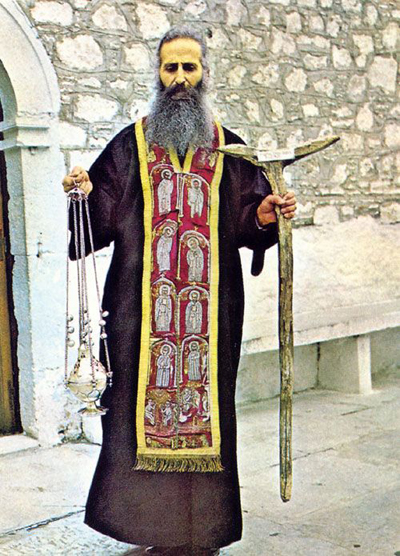
Elder Iakovos wearing the epitrachili (stole) of St. David of Evia, along with his monastic staff (source)
 
As abbot he behaved towards the fathers and the visitors to the monastery with a surfeit of love and understanding and great discernment. His hospitality was proverbial. Typical of him was the discernment with which he approached people. He saw each person as an image of Christ and always had a good word to say to them. His comforting words, which went straight to the hearts of his listeners, became the starting-point of their repentance and spiritual life in the Church. The Elder had the gift, which he concealed, of insight and far-sight. He recognized the problem or the sin of each person and corrected them with discretion. Illumined by the Holy Spirit he would tell each person, in a few words, exactly what they needed. Saint Porfyrios said of the late Elder Iakovos: ‘Mark my words. He’s one of the most far-sighted people of our time, but he hides it to avoid being praised’.
In a letter to the Holy Monastery of Saint David, the Ecumenical Patriarch, Vartholomaios, wrote: ‘Concerning the late Elder, with his lambent personality, the same is true of him as that which Saint John Chrysostom wrote about Saint Meletios of Antioch: Not only when he taught or shone, but the mere sight of him was enough to bring the whole teaching of virtue into the souls of those looking at him’.
 
Elder Iakovos kneeling in prayer (source)
   
He lived for the Divine Liturgy, which he celebrated every day, with fear and trembling, dedicated and, literally, elevated. Young children and those with pure hearts saw him walking above the floor, or being served by holy angels. As he himself told a few people, he served together with Cherubim, Seraphim and the Saints. During the Preparation, he saw Angels of the Lord taking the portions of those being remembered and placing them before the throne of Christ, as prayers. When, because of health problems he felt weak, he would pray before the start of the Divine Liturgy and say: ‘Lord, as a man I can’t, but help me to celebrate’. After that, he said, he celebrated ‘as if he had wings’.
One of the characteristic aspects of his life was his relationship with the saints. He lived with them, talked to them and saw them. He had an impressive confidence towards them, particularly Saint David and Saint John the Russian, whom he literally considered his friends. ‘I whisper something in the ear of the Saint and he gets me a direct line to the Lord’. When he was about to have an operation at the hospital in Halkida, he prayed with faith: ‘Saint David, won’t you go by Prokopi and fetch Saint John, so you can come here and support me for the operation? I feel the need of your presence and support’. Ten minutes later the Saints appeared and, when he saw them, the Elder raised himself in bed and said to them: ‘Thank you for heeding my request and coming here to find me’.
 
One of his best known virtues was charity. Time and again he gave to everybody, depending on their needs. He could tell which of the visitors to the monastery were in financial difficulties. He’d ask to speak to them in private, give them money and ask them not to tell anyone. He never wanted his charitable acts to become known.
 
[For another wondrous miracle through the Elder's prayers, see the multiplication of food through the prayers of St. David here.]
 
Another gift he had was that, through the prayers of Saint David, he was able to expel demons. He would read the prayers of the Church, make the sign of the Cross with the precious skull of the saint over the people who were suffering and the latter were often cleansed.
 
Elder Iakovos Tsalikis (source)
   
He was a wonderful spiritual guide, and through his counsel thousands of people returned to the path of Christ. He loved his children more than himself. It was during confession that you really appreciated his sanctity. He never offended or saddened anyone. He was justly known as ‘Elder Iakovos the sweet’.
 
He suffered a number of painful illnesses. One of his sayings was, ‘Lucifer’s been given permission to torment my body’. And ‘God’s given His consent for my flesh, which I’ve worn for seventy-odd years, to be tormented for one reason alone: that I may be humbled’. The last of the trials of his health was a heart condition which was the result of some temptation he’d undergone.
 
The Cell of St. Iakovos Tsalikis, in the Monastery of St. David on the Island of Evia (source)
   
He always had the remembrance of death and of the coming judgement. Indeed, he foresaw his death. He asked an Athonite hierodeacon whom he had confessed on the morning of November 21, the last day of his earthly life, to remain at the monastery until the afternoon, in order to dress him. While he was confessing, he stood up and said: ‘Get up, son. The Mother of God, Saint David, Saint John the Russian and Saint Iakovos have just come into the cell’. ‘What are they here for, Elder?’ ‘To take me, son’. At that very moment, his knees gave way and he collapsed. As he’d foretold, he departed ‘like a little bird’. With a breath like that of a bird, he departed this world on the day of the Entry of the Mother of God. He made his own entry into the kingdom of God. It was 4:17 in the afternoon.
His body remained supple and warm, and the shout which escaped the lips of thousands of people: ‘Saint! You’re a saint’, bore witness to the feelings of the faithful concerning the late Elder Iakovos. Now, after his blessed demise, he intercedes for everyone at the throne of God, with special and exceptional confidence. Hundreds of the faithful can confirm that he’s been a benefactor to them.
 
Icon of St. Iakovos of Evia. Interestingly, this icon of the Saint carries the inscription "O Me Synchoreite", or "The 'Forgive me'". This is because one of the Saint's most characteristic phrases in discussion was "forgive me". This resembles the title of St. Nikon "Metanoeite" ("Repent ye") (source)
 
Apolytikion to St. Iakovos Abbot of the Holy Monastery of St. David (+1991)
(written by Charalampos Bousias)
Plagal of the First Tone.
The prototype of discernment and modesty, the wonderworking leader of the Monastery of David the venerable, who plowed and sowed love in the hardened hearts of the God-bearing people, O Father Iakovos. Do not neglect to intercede with Christ on behalf of those who call upon you in faith.
   
Note***: The official service of St. Iakovos has not been released yet so the commonly used apolytikion may change in the future.
  
St. Iakovos of Evia, icon available from Uncut Mountain Supply.
     
An akathist to St. Iakovos is available here.
    
Icon of St. Iakovos Tsalikis of Evia, canonized November 27th 2017 by the Ecumenical Patriarchate (source)
 
Through the prayers of our Holy Fathers, Lord Jesus Christ our God, have mercy on us and save us! Amen!

Sunday, September 20, 2015

A paralyzed boy healed by St. John the Russian

St. John the Russian, depicted with St. Seraphim of Sarov and St. John of Kronstadt (source)
  
In one of the two children's hospitals of Athens, a mother lied at the head of her child day and night. She brought the child from Patras, because the child's chronic affliction, paralysis of the lower extremities, had worsened in the last few days...
  
One evening, while the sun was setting, and the last few sunbeams lit up the hospital room, the mother remembered how she would go to a chapel of the Panagia high above Patras, and prayed, lighting the vigil lamps, sometimes with her husband, other times with her children. Her nous was fixed on that chapel. She prayed noetically: “My Panagia, my sweetest Mother who feels our pain, help my child. My Panagia, send me a Saint, look at my poor child, how in his life, he is struggling to stand on his feet. Help, my poor little boy.”
  
“Mother,” the child said, “who are you talking to?”
  
“My Georgie, remember when you read in your church book how our Lord lived in Palestine, and healed demoniacs, opened the eyes of the blind, lifted up Paralytics and made them to walk, and raised the dead? Tell him, my Georgie, and He will hear you, my good boy, tell Christouli to make you well.”
  
The helpless child, with his innocent gaze, looked at his mother, and at the sun which was setting. He looked on high towards the heavens.
  
That midnight, George saw a dream of a beautiful horseman, on a glorious horse. He stopped before him and said:
  
“Get up, Georgie, jump up on my horse!”
  
“But I am a paralytic, my feet don't move and hold me up.” he replied.
  
“Give me your hand, Georgie, get up on my horse. I am St. John from Russia, and our Lord sent me to bring you His grace and His healing power!"
The child, half awake, then awoke his mother, who picked him up so that he wouldn't fall out of bed.
  
“Mother, hold me, St. John from Russia told me to get up.”
  
In the morning when the night resident told the professor that the paralyzed child from Patras began walking that night, went with a hammer in hand, checked the child's reflexes, and plucked his feet with a sharp instrument, and he saw that his body was functioning normally.
  
“Go,” said the professor, “God had something to do with you."
  
(8/17/77 – from the book “Life and new miracles of the Venerable John the Russian”, by Priest Ioannis Vernezou, 1999, source)
  
St. John the Russian (source)
  
Through the prayers of our Holy Fathers, Lord Jesus Christ our God, have mercy on us and save us! Amen!

Wednesday, May 27, 2015

St. John the Russian heals a man near death

St. John the Russian, the New Confessor and Wonderworker - Commemorated May 27 (source)
  
E.P. from Eurytania, when he visited his homeland [Greece], got gravely sick from pneumonia, internal infection and cardiopathy. He was approaching his death. The doctors tried in vain to save him. He was battling with death for forty days. One day, a lawyer friend of the sick man came to visit him from Volos.

He told the despairing mother of the sick man that, once in Halkida, he heard someone talking about some St. John the Russian. The sick man, as he relates, was in such a terrible state that he could not sense, and could not follow what was going on around him. He only heard the word "Russian".

The next day, the man who was healed relates: "My state got even more dangerous. I couldn't sleep, but passed the hours in agony. I was awaiting my death. Then straightaway, I sensed that I wanted to sleep, and I fell into a very deep sleep.

"During the course of my sleep, I saw a strange dream, which I will never forget! I saw that the door of my room opened, and a young man dressed in a white shirt entered. He greeted me, and asked me who I was. I told him that the sickness had taken over me now, and that only death could free me. Then the young man told me in simple words: 'Listen to me. I am St. John the Russian. I will make you well in five days. But you should go venerate at my church. If you can't, then send your wife or your sister or your mother. Have faith and do not fear. In five days you will be well.'

"Immediately, the Saint disappeared from my room. In the morning when I awoke, I felt that my state had improved. This was confirmed by the doctor that visited me that day.

"As soon as I awoke, I called my relatives, and with emotion I related the strange dream. However, I and some of my relatives did not know anything about such a Saint. And only the Priest, Fr. Lambros, informed me that day in reality that I was saved by St. John the Russian, whose body remains whole [and incorrupt] outside of Halkida.

"In five days, I became totally well, and I will never forget the divine intervention of the Saint on behalf of my life. From my great gratitude towards the Saint, and in order to show my faith, I went to venerate the Holy Relics. This miracle occurred in 1937."

(amateur translation of text from source)
  
St. John the Russian and St. David the Elder, Protectors of the island of Evia (source)
  
Through the prayers of our Holy Fathers, Lord Jesus Christ our God, have mercy on us and save us! Amen!

Sunday, May 25, 2014

Some additional healings of St. John the Russian

Christ is risen! Truly He is risen!
St. John the Russian, the Wonderworker of Christ - Commemorated May 27 (source)
 
Some additional healings of St. John the Russian (amateur translations)
I. A family from Patras brought their baby into the world. What tragedy, however...The child's tongue was hanging outside of his mouth, was abnormally large, with the result that the child could not eat and his saliva ran from his mouth continuously. The mother froze when she saw this, along with the whole family. They began to run to doctors to do treatments, but they were all futile. They even reached Sweden, to a special medical center, but the results were zero: the child's tongue was still large and it was difficulty for him to eat. The bitterness and agony for the future, along with their depression had reached its limit. They struggled with treatments for three years, but did not find even the smallest benefit. Then (the evening as soon as they had returned from Sweden), and while all the relatives were gathered together, with one soul they decided to offer the child to St. John the Russian, and at the same time, to go all together to the church of [Panagia] Pantanassa to serve Paraklesis to the Saint, even though they were tired, thinking that prayer, especially prayer that is pained for others, brings results. In reality, they went and the Priest chanted the Paraklesis. When they returned to their home and turned on the light, what did they see? The tongue inexplicably had shrunk back into its place! That which the physicians and medical centers could not accomplish in at least three years, St. John the Russian did at once! What followed cannot be described. Speechless joy and tears of gratitude filled all their eyes for the help which the Saint so easily and speedily granted, as an end to their ordeal...

II. A. was married for eight years, and did not have children. She tried all those years, but a child did not come, despite how much they desired one. From a young age she would pray and believed, as her mother taught her. Many times, she had visited St. John the Russian and entreated him regarding this issue. She also told him that she was: "waiting for a response from the Heavens," but as time passed, it became more bitter, though her husband tried to console her, even with spiritual words. It was the winter of 1979 when she went again to the icon stand to pray, but she could not even gather her thoughts. She had been "patient" for all these years. She felt as if a knot was choking her, and she wanted to cry outt. In such a bad psychological state, she saw the icon of St. John the Russian, and she told him out loud: "It's over, what did I do to you, my Saint? Why did God not give me children? Why?  Do you hate me, my Saint?"

The next midnight, as she had fallen asleep with her husband, the two heard someone climbing the stairs, and they awoke. They thought that there was someone from the company that had made a mistake at that hours and for some reason came to the house. They heard a knock at the door (which was locked) and it opened straightaway, and within a radiance, appeared St. John the Russian, who told her sweetly: "Ah, what was that prayer that you made earlier? My child, the Saints don't hate anyone. It is not the will of God that you have children yet. Another two years will pass, and then this joy will come!"

In reality, two years passed, and in 1981, A. began to have the children that she so greatly desired...

III. In 2010, a pregnant woman was diagnosed with cancer, and the doctor advised her to terminate the pregnancy so that she could begin chemotherapy. She refused to kill her child, and prayed to God, saying: "Lord, is there no Saint to help me?" That night, she saw in her sleep that she had entered a church where there were four reliquaries. Straightaway, one of them opened, and she found a radiant youth who told her: "I am John from Prokopi, and I will make you well." In reality, the pregnancy proceeded smoothly, the cancer disappeared, and the couple came with their child to venerate and to thank the Saint."
(source)
 
St. John the Russian (source)
  
Christ is risen from the dead, by death trampling down upon death, and to those in the tombs, bestowing life!
Truly the Lord is risen!

Saturday, May 26, 2012

Akathist to St. John the Russian


St. John the Russian - Commemorated May 27 (source)
  
Please note that the meter of this translation is not set to match the original music.
   
Akathist to St. John the Russian, the New Confessor and Wonderworker, whose incorrupt Holy Relic is treasured in Neo Prokopion, Evia
Written by Nun Isidora Agierotheitissa
  
Kontakion in the Plagal of the Fourth Tone
The perfect pinnacle of confession, and the divine example of humility, you willingly were steadfast amidst the bitterness, and your flesh shone forth with incorruption, let us honor John whose name is great, singing to him: Rejoice, O boast of the Russians.

You lived the life of the bodiless on earth in your physical flesh, O John, (3) and imitating the ranks of the Bodiless Angels, God Who fashioned you glorified you in wondrous and divine works. Therefore, you hear from those who are amazed by you such words as these:
Rejoice, the precious icon of piety,
Rejoice, rich support of the holy faith.
Rejoice, perfect one in godly struggles,
Rejoice, privileged one serving uplifted things.
Rejoice, the fair pinnacle of all the Righteous ones,
Rejoice, the sacred radiance of the confessors.
Rejoice, the most-precious joy of the Church,
Rejoice, the most-prided offspring of noble Russia.
Rejoice, lamp of the radiance of the saints,
Rejoice, treasury of incorrupt and sacred gifts.
Rejoice, O boast of the Russians.

Barbarians faced your nation in battle, and took you hostage, O all-blessed one, thus bringing you to Asia Minor, where you were sold to a terrible boss, while you totally submitted to him in slavery in your incomparable steadfastness, O Father. And being obedient to him as a humble slave, O John, to God, the guide of all things, you offered the hymn, chanting endlessly: Alleluia.

You willed to imitate Christ, and to suffer the divine Passion, therefore, you endured every insult, O John, in your gladsome and undoubting heart. And you drank their every ridicule and bitterness as a pleasant drink. Therefore, you ever gladden those you cry out to you words like these:
Rejoice, true steward of the God of all,
Rejoice, deferential servant of a vicious boss.
Rejoice, you who endured unspeakable evils,
Rejoice, you who were enriched with heavenly rewards.
Rejoice, you who endured the bitter yoke of slavery,
Rejoice, you who bore the Lord's yoke with joy.
Rejoice, divine mirror of mystical rays,
Rejoice, sacred treasury of God-given gifts.
Rejoice, anointer of the unspeakable mystagogy,
Rejoice, shining pearl of the Church.
Rejoice, lamp that shines upon the hearts of the faithful,
Rejoice, sun that speaks of the unwaning Christ.
Rejoice, O boast of the Russians.

In the rich home in which you served, a dinner was served, and through the grace of your Lord, you worked a great miracle through your piercing prayer, O Father. And from afar, O John, you sent food to your slave master in his own dish, thus granting him joy. While to God, Who dwells in the highest, you granted joy, as your burning heart chanted the hymn: Alleluia.

Having the most-pure fear of the Lord in your holy heart, O Father, as David the Prophet, you were enriched with perfect love. And through the spring of love, you approached God perfectly, and you meditated upon the law mindfully, O all-precious John, and called upon His name ceaselessly from the mouth of your heart. Therefore with incomparable care, you hearken upon us who call upon you ceaselessly:
Rejoice, the most-faithful worshipper of the God of all,
Rejoice, the bloodless Martyr of the Master of all.
Rejoice, you who were enriched with the great forbearance of Job,
Rejoice, you who unflinchingly gave a good witness.
Rejoice, you who traveled the straight path of turmoils,
Rejoice, you who bent the neck of your soul to Christ.
Rejoice, treasury of graces, full of divine fragrance,
Rejoice, river of wonders, and inheritance of fragrance.
Rejoice, the wealth of the Greeks, the incorruptible treasure,
Rejoice, perfect sharer of the mystical Table.
Rejoice, O boast of the Russians.

With the immense warmth of your fervor, O John, you followed Christ willingly, and you did not at all deny His holy and all-powerful name, O blessed one. You suffered many pains, but you were as a diamond amidst turmoils, that beautifies the Church of Christ. With the fiery rays of the confession which you gave before the godless rulers with a piercing voice, O Father, you ceaselessly spoke of God, and chanted the thrice-holy hymn, chanting in thanksgiving: Alleluia.
 
St. John the Russian (source)
   
From Russia, O Father, you were transported to the holy land of Asia Minor as a slave. And by your righteous pains you cultivated the land, and harvested the fruit of the faith, offering it to God Who cultivated you. Through freedom in soul, you served Him, O Righteous John, and kept your mind free, giving glory to Him instead as is right. Therefore, for those who bless you, grant a godly mind and a pure heart, as we cry out to you with loud voices like this:
Rejoice, you who worked the mystical vineyard,
Rejoice, you who fed upon the grapes of your athletic pains.
Rejoice, for with precious tears you watered your pillow,
Rejoice, for with divine rejoicing you bestow harmony.
Rejoice, you who received a great talent from the hand of God,
Rejoice, you who greatly increased the portion given to you.
Rejoice, you who received the holy seed within the field of your heart,
Rejoice, you who bore fruit through the good word of your confession.
Rejoice, the good servant of every virtue,
Rejoice, the prudent disciple of the Master of all.
Rejoice, the boast of the Church and root of beautiful fruit,
Rejoice, the glory of the Righteous, and wonder of the Angels.
Rejoice, O boast of the Russians.

Willingly doing the will of the Lord, you eagerly served, O sacred John, and with your humble mindset you followed the commandments. Therefore, you rejoiced as you accepted the yoke of slavery for the love which He offered to us, as He took on the form of a servant in His great goodness. With utter desire in heart, and a joyous voice, you offered to Him the hymn and ode as is proper: Alleluia.

In your endurance, you dwelt within a dark stable with the horses, while in your heart you mystically beheld the light of Christ, and you hymned the Giver-of-light in truth, keeping the lamp of your soul lit through the illuminating rays of your all-holy prayers. I entreat you to drive away the darkness from my irrational soul, that I may rationally offer you this light-bearing ode, saying fervently these words in thanksgiving:
Rejoice, healer adorned with the beauty of confession,
Rejoice, steadfast and divine pinnacle of good struggles.
Rejoice, the most-joyous treasury of the spotless faith,
Rejoice, spotless treasury of joyous graces.
Rejoice, you who freely give from the treasury of the Saints,
Rejoice, you who strengthen the souls with precious wealth.
Rejoice, spring which brings the fragrant message of dispassion,
Rejoice, well that waters with the refreshment of the spirit.
Rejoice, for you wore the tattered garment of the flesh in humility, O Father,
Rejoice, for you gladden the soul with songs from above.
Rejoice, the perfect companion of servants,
Rejoice, the faithful servant of the divine will.
Rejoice, O boast of the Russians.

Though you lived under the dominion of deceived ones, you who trample upon the enemy, you preserved your heart, O wondrous John, and you founded a great tower of the strength of God in the house of your soul that was unassailable to all, in which you loudly spoke of God's greatness. Loudly speak to my mouth, through the boldness of your prayers, that I might totally resist the strength of the deceiver, and offer to the all-powerful God, along with the Angels, the hymn: Alleluia.

Shining with the beauty of your soul more than corruptible gold, you beautify the Church of Christ, O John, and with the golden rays of your holy deeds, you shine upon all of us with the beauty of the Master. Illumine the garment of my soul, which is soiled by the passions, through your bold intercessions, I entreat you, that I might hymn your fervent help, as is needful, and with all joy, ceaselessly saying to you words such as these:
Rejoice, container of healings, and river of wonders,
Rejoice, the most-speedy physician of incurable diseases.
Rejoice, you who exalted God through your wondrous works,
Rejoice, you who trampled upon the enemy through your unspeakable groans.
Rejoice, you who imitated well the endurance of Job,
Rejoice, for as another Lazarus, you persevered in poverty.
Rejoice, you who inherited well the wealth of Eden,
Rejoice, you who wisely found the great treasure.
Rejoice, for your flesh did not taste of corruption in death,
Rejoice, you who partake of the grace of incorruption upon the earth.
Rejoice, you who offer to God prayers of intercession,
Rejoice, protector of all the faithful, full of sympathy.
Rejoice, O boast of the Russians.

The precious members of your flesh, O Champion, bore the sacred marks of your confession, as you withstood many evils with your unswayable mind, and suffered hunger, and the bitterness of insults, which you drank as a river, and joyous food, from the eternal city of Eden, O John, in which dwell the choirs of the Righteous, and the sacred ranks of the Martyrs, and the cities of the divine confessors, as you chant ceaselessly unto God in Trinity the gladsome hymn in joy: Alleluia.
 
St. John the Russian (source)
   
Dwelling in the divine house of the radiant and glorious trophy-bearer George in Asia Minor, you supplicated all day, and prayed all night, thus pleasing the Master of all, O John. Therefore, may you ever look graciously upon us who hymn you, granting remission of sins to our souls, and deep peace and transformation of the passions, that out of gratefulness we might cry to you in truth:
Rejoice, fund of prayer, and rule of continence,
Rejoice, river of love, and icon of gladsomeness.
Rejoice, for you imitated the heavenly ranks of the Cherubim,
Rejoice, for you illuminated the sacred ranks of the Righteous.
Rejoice, house of purity, and robe of cleanliness,
Rejoice, the highest imitator of the divine life.
Rejoice, you who took refuge in the divine church of Saint George,
Rejoice, for you pray with him to God, O Father.
Rejoice, you who accepted the passion of the Martyrs in the flesh,
Rejoice, you who joined with all those who confess God.
Rejoice, Christ's teacher of humility for us,
Rejoice, for you properly reached the height of dispassion.
Rejoice, O boast of the Russians.

You lived your life on earth as a stranger, but grew closer to Christ, Who estranged Himself for us on earth, that we might become friends and close to God, delivering us from our former disobedience, and making us sharers in the eternal joy, and that we be found in light. May your light-bearing prayers, O servant of the light, grant us every grace, O sacred John, that we be delivered from the darkness, and chant unto the Worker-of-light and Master of all, the great ode and never-silent hymn: Alleluia.

With your whole mind, O Father, you unwaveringly followed the Lord of all, Whom you desired from childhood, and Whose army you were numbered in out of obedience, inscribing His laws upon the tablets of your heart, and keeping them with exactness as a good servant, and from Whom you received divine grace as the reward for your efforts, and your face shone as did the Law-giver Moses. Therefore, do not cease to intercede for us, O good John, and make us worthy to keep the holy commandments, that we might be found in the radiant bridal chamber, and ever chant to you these good words:
Rejoice, perfect mystagogue of divine visions,
Rejoice, precious diner from the radiant Table.
Rejoice, friend of the Master and beloved son,
Rejoice, protector of the faithful, and sacred guide of brides.
Rejoice, you who glorified the immortal God below,
Rejoice, you who trampled upon the powerless enemy.
Rejoice, you who wondrously were true to your Christian name,
Rejoice, stream of wonders, and river of healings.
Rejoice, the joyfulness of the Russians and the sweetness of the Greeks,
Rejoice, the lamp of Evia and the adornment of the Church.
Rejoice, the holy shield of confessors,
Rejoice, the purity and gladness of the Athletes of the Lord.
Rejoice, O boast of the Russians.

Every painful notion you endured with joy, as you were shown to be a tower of strength against every enemy, O John, utterly revealing their machinations, and receiving the crown from the hand of Him Who works all things. Through your prayers, O Father, make us worthy to be victorious over [the enemy's] machinations, and to raise up the trophies of godly victory in strength, and strength of life, that we might all cry out the victorious ode: Alleluia.

The Russian people take refuge in your holy memory, and skip and magnify God, O John, for He gave you to them as an all-holy root. Asia Minor also dances in glory, for you blessed her through your pains and holy struggles. And Evia also sings, and the noble island rejoices, being joyously enriched with your wondrous body, which transforms corruption, and turns beyond, calling the Greeks, and every city and people that bears the name of Christ to cry out to you these words graciously:
Rejoice, you who drank insults as sweet water,
Rejoice, you who took reproach as joyous food.
Rejoice, you who bore the marks of the Lord in your flesh,
Rejoice, you who bear the seal of incorruption in it.
Rejoice, for you offered yourself to the King of all,
Rejoice, for you ever stand before His throne in heaven.
Rejoice, you who in slavery were proven as gold,
Rejoice, you who are full of gold, and shine upon the earth.
Rejoice, you who quenched the fire of the furnace through your pains,
Rejoice, you who saved your flesh from corruption in the flames.
Rejoice, you who saved the disciple from terrible danger,
Rejoice, you who fill every heart with wonder.
Rejoice, O boast of the Russians.

We venerate your incorrupt body in piety, O John, and we bless the immortal God, Who delivered every race of man from death, and through His Third-day Resurrection, resurrected us. We sing to Him in joyous voices faithfully, praising the strength of His wonders, the multitude of His miracles, and we cry from our hearts, with the Angelic choirs, the joyous hymn and cherubic ode: Alleluia.
 
St. John the Russian (source)
   
Foreseeing your blessed repose, O John, you sought to partake of the Spotless Mysteries, that you might be born into the life of eternal communion. These were brought to you by a priest in an apple, hidden as a treasure from the faithless enemies. Having received the Mysteries within your soul, O Father, you gave your soul to God. We ever glorify Him, as the Author of our life, and we all say these to you from our heart, ceaselessly:
Rejoice, the most-precious temple of divine gifts,
Rejoice, the most-radiant container of precious virtues.
Rejoice, you who bear the good news of your calling from above,
Rejoice, you who enrich with the fragrance of the Holy Spirit.
Rejoice, you who founded within the zeal and steadfastness of the Martyrs,
Rejoice, for having them in mind, you imitated their life.
Rejoice, you who who copied the lives of all the Righteous Ones.
Rejoice, you who reached the hymnody of the Angelic ranks.
Rejoice, you who remained for many years in the dark stable,
Rejoice, you who ever dwell in the pastures of light.
Rejoice, you who adorn the Church of Christ,
Rejoice, you who beautify the holy island of Evia.
Rejoice, O boast of the Russians.

Having burned up every evil material within yourself, you were offered to the Church as an all-fragrant harbor, gladdening the faithful with the grandeur of virtues. Therefore, at your holy memory, O John, we weave godly crowns with flowers, out of debt, and rightly engrave a hymn, honoring you from our soul, for the Lord also, in great joy, placed a crown upon your head, O Father, and we chant together: Alleluia.

Beholding light from your grave as a pillar of fire, you told to those there clearly, O John, of your life full of light which you struggled in on earth, and the boldness which you were eternally enriched with by the Father of Lights. As you never leave His hand, we entreat you to extend your hand, that we be delivered from the darkness, and walk in the light of the commandments, as your servants ceaselessly hymn the Giver-of-light and Savior, the Redeemer Jesus, and ceaselessly say to you with one voice:
Rejoice, lamp of the Light that drives away the darkness of passions,
Rejoice, for you lit within your soul a lamp with the light of the virtues.
Rejoice, you who gladden the hearts of the faithful with your light,
Rejoice, you who make joyous the holy Church with your beauty.
Rejoice, man of godly and holy desires,
Rejoice, divine lover of sacred commandments.
Rejoice, you who adorn the firmament above,
Rejoice, you who strengthen the souls of all through the wood of the Cross.
Rejoice, spring of divine things, and life-giving waters,
Rejoice, infinite stream of unspeakable wonders.
Rejoice, tree that bears the fruit of Paradise,
Rejoice, flower that carries the fragrance of the Comforter.
Rejoice, O boast of the Russians.

Rejoicing that your time of bitter slavery had come to an end, your holy soul passed to the hand of God, and inherited joy in truth, O John, as you ever rejoice together with the choirs of the Angels. Let us all hail you, speaking to the Athlete of the Lord, celebrating his radiant memory with fervor, and embracing his sacred body with faith. And the choir claps on earth in harmony, while those in the heavens cry out the ode, to God in the highest, ever chanting to Him: Alleluia.

Truly surpassing the sands of the sea, O Father, are the multitude of your wonders, which you pour upon the faithful, who out of debt approach your sacred church, and entreat your intercessions, O sacred John, that we be delivered from sicknesses and from the assaults of the passions, as we cry out willingly with a glad heart:
Rejoice, healer of sicknesses, and driver-out of demons,
Rejoice, fountain of wonders, and mixing-bowel of blessing.
Rejoice, you who shine as a star with the Three-rays of light,
Rejoice, you who dissipate the soul-corrupting mist of the passions.
Rejoice, you grant to all the true wealth of the Master,
Rejoice, you who pour forth incorruptible treasure for the faithful.
Rejoice, divine harbor which grants salvation to souls,
Rejoice, you who befriend us with the Prince of peace.
Rejoice, you who truly bring forth strange wonders,
Rejoice, for your flesh was wondrously estranged from corruption.
Rejoice, pillar of Russia and treasure of Greece,
Rejoice, unsleeping protector of the whole world.
Rejoice, O boast of the Russians.

O All-holy Father, the height of divine confessors, and newly-illumined star, O John, (3) you who received the experience of the Martyrs in your precious body, and the sweat of the Righteous, and willingly endured toils, and received a crown upon your head from your beloved Master, and were honored by incorruption of your holy flesh: grant us the honor of incorruption in the heavens, through your prayers and uplifted hands, that we find the glory of eternal life, with all those who have been saved. To the Lord, Whom you stand before, we offer the ode, crying out with the Bodiless ones ceaselessly: Alleluia.  
   
For the life of St. John the Russian, see: http://full-of-grace-and-truth.blogspot.com/2009/05/st-john-russian-new-confessor.html.
   
   
Through the prayers of our Holy Fathers, Lord Jesus Christ our God, have mercy on us and save us! Amen!

Sunday, December 18, 2011

Three moving miracles of St. John the Russian

St. John the Russian, the Confessor of Prokopi, Evia - Commemorate May 27 (http://pravicon.com/images/sv/s0971/s0971005.jpg)
  
An unbelieving physician is miraculously healed (amateur translation)
At Limne of Evia lived and worked a physician named Mantzoros. As a physician he was very good, but he did not believe in Christ, and of course did not wish to hear questions about religion and the soul. He was against religion, and his opinions were harsh on the subject of Christianity.
  
One day, he however became very sick. This illness had struck this unbelieving doctor with terrible pains as soon as it arrived. Amidst unbearable pains, he was taken to the Hospital of Chalkida. There, due to his illness, they were unable to help him, so they sent him to the Athens clinic “Pantocrator”, which is on September 3rd road. There they took x-rays and and ran blood tests, which showed that he had a problem with his large intestine...The physicians of the Hospital, therefore, said that if he agreed, he would be operated on the next day. He agreed, based on the medical knowledge that he had. But the words of his brethren: “Take hope in the Almighty, O brother”, led him to a spontaneous prayer from his soul the night before his surgery. He entreated God, not only to make him well, but to forgive him for the disbelief which he had shown for so many years.
  
During his prayer, someone knocked on his door and entered. It was a beautiful young man, who opened his door and entered the doctor's room.
   
“What do you have?” he asked.
  
“I am very sick” the doctor answered.
  
“But you don't have anything wrong with you” he replied.
  
“What are you saying, my Christian? I have colon cancer of the final stage, and tomorrow I am going to surgery. Do you understand what is going on?”
  
The young man replied “You don't have anything wrong with you anymore. I made you well.”
  
“Don't you have any shame talking like this to a sick man?” the doctor said, “Are you just trying to calm me down?”
  
“I am Saint John the Russian. If you insist, have the surgery tomorrow, and you will be convinced that nothing is wrong with you.” The young man disappeared.
  
The doctor was full of agony, and he rang the bell in his room to ask the nurses who the young man was who came to his room. However, not one of the nurses had seen anything. The next day, the sick physician went to the operating room for the surgery. The doctors were ready for the operation when they heard the doctor tell them that he didn't need the surgery, and that his health was good: “Saint John the Russian healed me”.
  
“What are you talking about?” they asked him, “We're in the 20th century, what are you talking about brother? Our brother must be out of it.”
  
Though the sick man had improved, they continued with the surgery. He went under anesthesia, and when they opened him up, they did not find any cancer. The Saint had done his miracle, and the doctors were astonished, and were looking at each other. The doctor was totally well. He relates this himself, wherever he goes.
(from the book: “Lives of Orthodox Saints 9: Saint John the Russian”, published by Entheos Vios (http://1myblog.pblogs.gr/2011/04/o-apistos-giatros-ena-thayma-toy-ai-giannh-toy-rwsoy.html))
  
 "The Saint Was Helping Me To Pray"
Aikaterina M. from Athens related the following miracle of St. John the Russian in 1995, about her first visit to the Church of Saint John the Russian in Evia:
The first time I came here with my friends, I barely knew who St. John was, nor did I know what to expect, as I had never seen incorrupt relics before. At first I was shocked - the saint's body was certainly there, as it should not have been if it had been subject to the normal processes of nature, but his skin looked dark and a little withered, and I was fearful of coming any closer to the glass coffin. I finally gathered my courage and went up to look. His face was covered with a gold cloth, out of reverence, but I could clearly see his hands and wrists. I knelt down beside the coffin to pray, feeling that even if it seemed strange to me, I should still try to be respectful. I asked the saint to help me understand what I was seeing, and to know him. When I finished praying, I went to sit in a chair off to the side while I waited for my friends. I thought that I should pray some more, but I didn't know any prayers to St. John so I took out my Akathist Hymn to the Panagia, which I always carry with me, and told St. John that it was for him also. I begged him to forgive me for not having a special prayer for him alone.
  
Probably like most people, I often don't pray very deeply unless someone I love is ill or in danger, and this time I began read the Akathist to the Panagia in my usual way, although I tried hard to concentrate on the words. Suddenly, I felt that someone had come up and was standing next to me. I looked around quickly, but the nearest person was kneeling at the relics with his back to me, about a dozen meters away. I went back to my prayers, and although I didn't actually hear anything spoken aloud, I had the distinct impression that someone was praying to the Panagia with me, with great strength and love. I suddenly found myself praying with a depth I have never felt before or since - as if I was somehow in the middle of the prayer, and it was alive. I could feel the prayer moving up to heaven, and I knew in my soul that it was St. John himself, praying with me.
  
I was filled with such awe and joy at the nearness of the saint who was helping me to pray even though I had been afraid of him. It felt like Pascha, and as if I had just received the Holy Mysteries. I come to him now as often as I can.
  
The Cane
For many years, pilgrims to the shrine of St. John the Russian saw a simple cane standing before the glass-enclosed sepulchre. It belonged to an old woman, Maria Spaik, who was bent over from osteoporosis and had been unable to stand upright for eighteen years. In August 1978, he relatives brought her to the Church of St. John and lifted her in their arms so that she could venerate the relics. When Maria saw the incorrupt body of the Saint, she began to cry, asking St. John to help her. As she prayed over the relics, she felt an invisible hand touch her back. The old woman drew herself up erect. Tears appeared in the eyes of all the onlookers. The bells were rung, and a Supplication Service was sung in thanksgiving. The cane was left at the shrine as a memorial of the miracle.
Through the prayers of our Holy Fathers, Lord Jesus Christ our God, have mercy on us and save us! Amen!