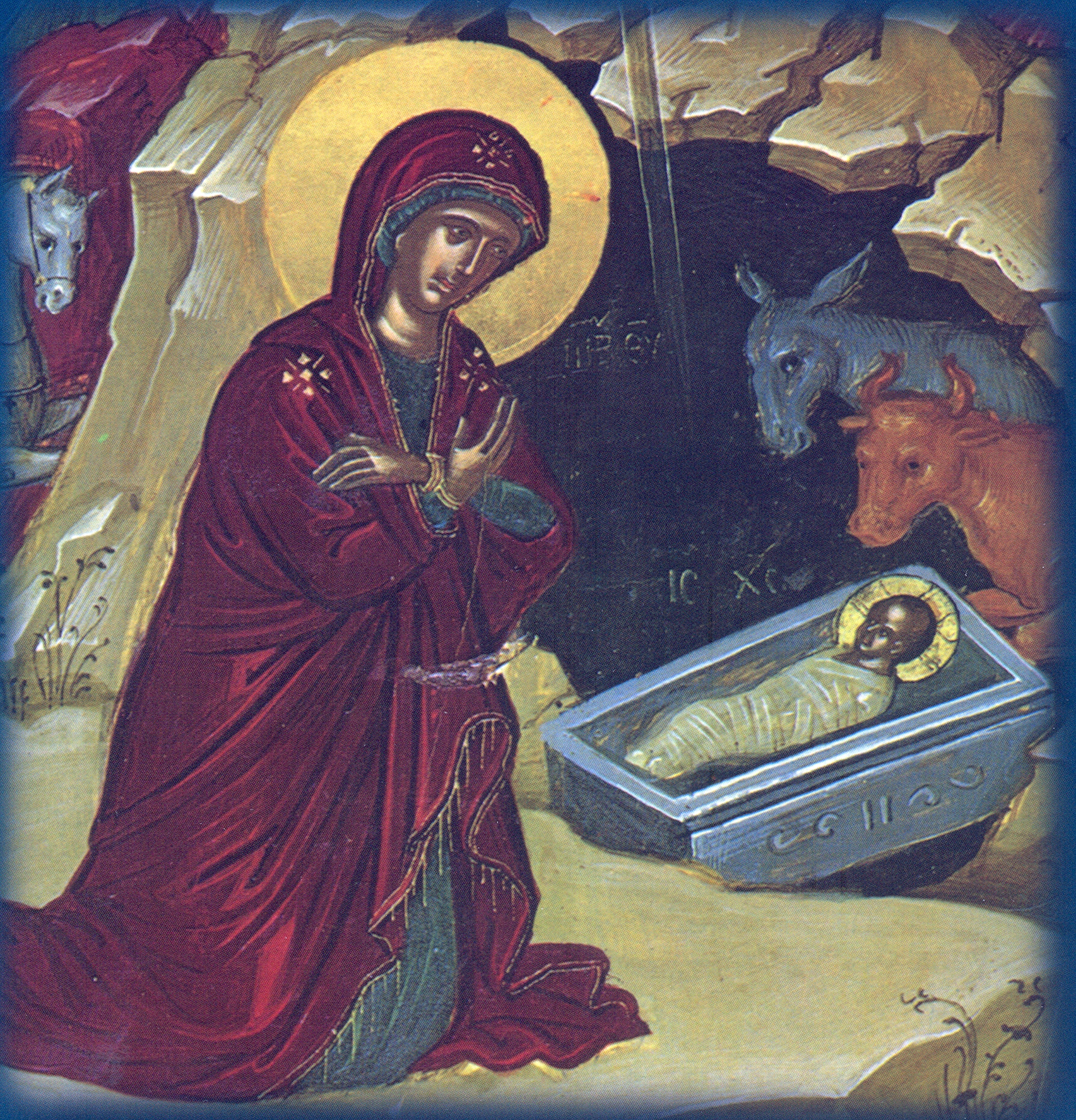
Showing posts with label St. Nikodemos of the Holy Mountain. Show all posts

Thursday, January 30, 2020

St. Nikodemos: "Let Jesus be your breath..."

Jesus Christ the Son of God the Savior of the world (source)
  
"Let Jesus be the sweetest meditation of your heart.
Let Jesus be the nourishment of your tongue.
Let Jesus be your breath.
And never get your fill of calling upon Jesus!"
-St. Nikodemos of the Holy Mountain

(source)
  
Through the prayers of our Holy Fathers, Lord Jesus Christ our God, have mercy on us and save us! Amen!
Thursday, November 7, 2019

St. Nikodemos on the Holy Ranks of the Angels

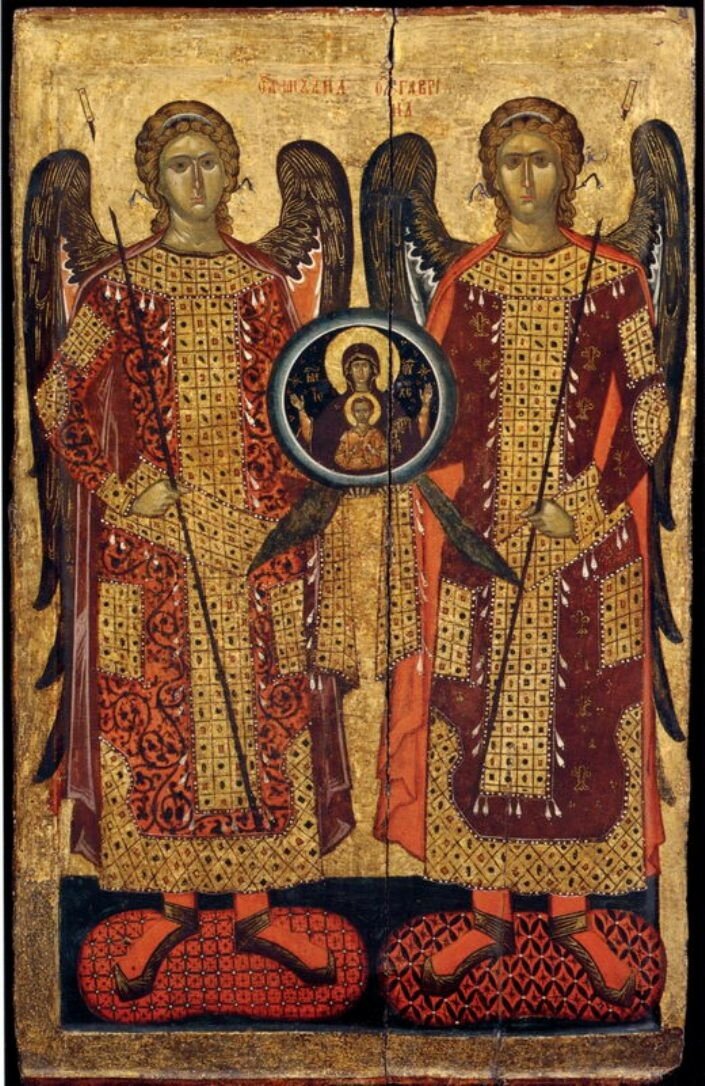
Holy Archangels Michael and Gabriel (source)
  
"And while, according to the Theologians,
the Thrones judge,
the Seraphim warm us,
the Cherubim make us wise,
the Principalities command,
the Powers work deeds,
the Dominions preserve things,
the Authorities rule the nations,
the Archangels are ministers of the faith,
and the Angels liturgize,
however, Michael and Gabriel,
as the Taxiarchs over all the rest, even more so,
judge, warm us, make us wise, even more so command us, work deeds for us, and preserve us,
even more so rule over nations, minister the faith, and liturgize with us."
-Excerpt on the Holy Angels by St. Nikodemos of the Holy Mountain

(source)

Through the prayers of our Holy Fathers, Lord Jesus Christ our God, have mercy on us and save us! Amen!

Tuesday, January 21, 2014

Prayers for Holy Confession, by St. Nikodemos of the Holy Mountain

The Holy and Saving Mystery of Confession (source)
 
Prayers for Holy Confession, by St. Nikodemos of the Holy Mountain
A prayer before Holy Confession
O Father of mercies before the ages, and God of all entreaty, I the wretched one, desiring to try my conscience regarding my offenses, fear greatly and tremble, because the condition of my life is so utterly clear, where no deed or single thought could be hidden from before Your eyes. Therefore, I ask with all my lowliness, through the mercies of Your Only-begotten Son, that you grant me the grace to come to know well, and to hate and to correct all of my sins. Give to me, O Father of lights, Your All-holy Spirit, to bring to me the remembrance of sins that I have forgotten, and to crush my heart towards contrition, and to bring repentance over these, that I might come to hate them, and to distance myself from every sin that comes. And you, O Virgin Theotokos, the Mother of mercy, and Refuge of sinners, nourish me, I entreat you, and help me at the Judgment seat of the compassion and righteousness of God, that I might come to know, and hate from my heart and to confess all of my sins. And similarly, O Holy Angel, the guardian of my soul, I entreat you to help me in this work, which is so necessary for my eternal salvation. Amen.

A prayer following Holy Confession
I thank You greatly, my Redeemer, and Most-philanthropic Physician of the human race, for with the most-precious balsam of Your life-creating Blood, You heal the wounds of my soul, and You cleans me from the leprosy of my sins. I know Your divine compassion, with which you brought me to repentance, I, the thrice-wretched sinner, while so many others are being tortured currently in the wrath of Your righteousness in Hades. Receive, therefore, I entreat You, my Lord, through the intercessions of Your Ever-virgin Mother and Theotokos Mary, and all of Your Saints, this my confession, and if anything stands missing or incomplete in any instance, complete this through Your divine compassion and love for man, and through this I entreat You that I be totally forgiven, and correct my moral life, bringing forth worthy fruits of repentance, and thus, remaining steadfast in goodness in this present life, may I be made worthy to partake of the glory of Your divine glory in Heaven. Amen.
(Amateur translation of texts from here and here)
 
The Parable of the Prodigal Son (source)
   
Through the prayers of our Holy Fathers, Lord Jesus Christ our God, have mercy on us and save us! Amen!

Wednesday, June 5, 2013

St. Nikodemos of the Holy Mountain on Self-denial and Spiritual Perfection

Christ is risen! Truly He is risen!
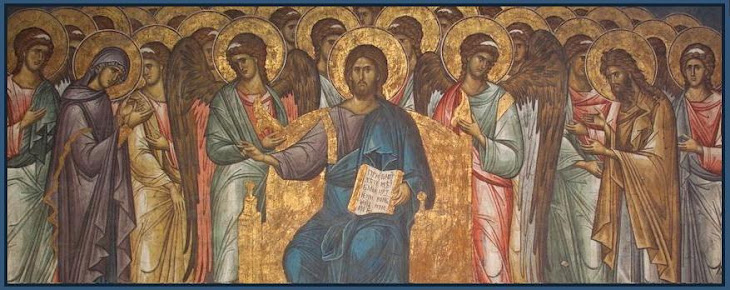
Jesus Christ enthroned in majesty (source)
  
St. Nikodemos of the Holy Mountain on Self-denial and the Spiritual Struggle
I will tell you plainly: the greatest and most perfect thing a man may desire to attain is to come near to God and dwell in union with Him.

There are many who say that the perfection of Christian life consists in fasts, vigils, genuflections, sleeping on bare earth and other similar austerities of the body. Others say that it consists in saying many prayers at home and in attending long services in Church. And there are others who think that our perfection consists entirely in mental prayer, solitude, seclusion and silence. But the majority limit perfection to a strict observance of all the rules and practices laid down by the statutes, falling into no excess or deficiency, but preserving a golden moderation. Yet all these virtues do not by themselves constitute the Christian perfection we are seeking, but are only means and methods for acquiring it.

There is no doubt whatever that they do represent means and effective means for attaining perfection in Christian life. For we see very many virtuous men, who practice these virtues as they should, to acquire strength and power against their own sinful and evil nature, -- to gain, through these practices, courage to withstand the temptations and seductions of our three main enemies: the flesh, the world, and the devil; and by these means to obtain the spiritual supports, so necessary to all servants of God and especially to beginners. They fast, to subdue their unruly flesh; they practice vigils to sharpen their inner vision, they sleep on bare earth, lest they become soft through sleep; they bind their tongue by silence and go into solitude to avoid the slightest inducement to offend against the All-Holy God; they recite prayers, attend Church services and perform other acts of devotion, to keep their mind on heavenly things; they read of the life and passion of our Lord, for the sole purpose of realizing more clearly their own deficiency and the merciful loving-kindness of God, -- to learn and to desire to follow the Lord Jesus Christ, bearing their cross with self- denial, and to make more and more ardent their love of God and their dislike of themselves.

On the other hand, these same virtues may do more harm than their open omission, to those who take them as the sole basis of their life and their hope; not from their nature, since they are righteous and holy, but through the fault of those, who use them not as they should be used; that is, when they pay attention only to the external practice of those virtues, and leave their heart to be moved by their own volitions and the volitions of the devil. For the latter, seeing that they have left the right path, gleefully refrains from interfering with their physical endeavors and even allows them to increase and multiply their efforts, in obedience to their own vain thought. Experiencing with this certain spiritual stirrings and consolations, such people begin to imagine that they have already reached the state of angels and feel that God Himself is present in them. And at times, engrossed in the contemplation of some abstract and unearthly things, they imagine that they have completely transcended the sphere of this world and have been ravished to the third heaven.

However, anyone can see clearly how sinfully such people behave and how far they are from true perfection, if he looks at their life and character. As a rule they always wish to be preferred to others; they love to live according to their own will and are always stubborn in their decisions; they are blind in everything relating to themselves, but are very clear-sighted and officious in examining the words and actions of others. If another man is held by others in the same esteem, which in their opinion they enjoy, they cannot bear it and become manifestly hostile towards him; if anyone interferes with them in their pious occupations and works of asceticism, especially in the presence of others, -- God forbid! -- they immediately become indignant, boil over with wrath and become quite unlike themselves. . . .

Now, having seen clearly and definitely that spiritual life and perfection do not only consist in these visible virtues, of which we have spoken, you must also learn that it consists in nothing but coming near to God and union with Him, as was said in the beginning. With this is connected a heartfelt realization of the goodness and greatness of God, together with consciousness of our own nothingness and our proneness to every evil; love of God and dislike of ourselves; submission not only to God but also to all creatures, for the sake of our love of God; renunciation of all will of our own and perfect obedience to the will of God; and moreover desire for all this and its practice with a pure heart to the glory of God (I Corinthians 10:31), from sheer desire to please God and only because He Himself wishes it and because we should so love Him and work for Him.

. . . Therefore, to reach your desired aim, it is first of all necessary to stifle your own wills and finally to extinguish and kill them altogether. And in order to succeed in this, you must constantly oppose all evil in yourself and urge yourself towards good. In other words, you must ceaselessly fight against yourself and against everything that panders to your own wills, that incites and supports them. So prepare yourself for this struggle and this warfare and know that the crown -- attainment of your desired aim -- is given to none except to the valiant among warriors and wrestlers.

But this is the hardest of all wars -- since in fighting against ourselves it is in ourselves that we meet opposition -- victory in it is the most glorious of all; and, what is the main thing, it is most pleasing to God. For if, inspired by fervor, you overcome and put to death your unruly passions, your lusts and wills, you will please God more, and will work for Him more beautifully, than if you flog yourself till you draw blood or exhaust yourself by fasts more than any ancient hermit of the desert. Even if you redeem hundreds of Christian slaves from the infidels and give them freedom, it will not save you, if with this you remain yourself a slave to your own passions. And whatever work you may undertake, however glorious, and with whatever effort and sacrifice you may accomplish it, it will not lead you to your desired aim, if you leave your passions without attention, giving them freedom to live and act in you.

Finally, after learning what constitutes Christian perfection and realizing that to achieve it you must wage a constant cruel war with yourself, if you really desire to be victorious in this unseen warfare and be rewarded with a crown, you must plant in your heart the following four dispositions and spiritual activities, as it were arming yourself with invisible weapons, the most trustworthy and unconquerable of all, namely: (a) never rely on yourself in anything; (b) bear always in your heart a perfect and all-daring trust in God alone; (c) strive without ceasing; and (d) remain constantly in prayer.
(from "Unseen Warfare," by St. Nicodemos of the Holy Mountain, revised by St. Theophan the Recluse, (Crestwood, N.Y.: St. Vladimir's Seminary Press, 1978), pp. 77 - 81 (Source))

Christ has risen from the dead, by death he has trampled on death, and to those in the graves given life!
Truly the Lord is risen!

Tuesday, November 13, 2012

Excerpt from the encomium on St. John Chrysostom by St. Nikodemos of the Holy Mountain

St. John Chrysostom, Patriarch of Constantinople (source)
 
Excerpt from the encomium on St. John Chrysostom by St. Nikodemos of the Holy Mountain (amateur translation)
By which sacred and holy name shall I call Chrysostom, and which would be befitting of him? Shall I call him an angel? It befits him, because he truly lived a life equal to the angels, full of self-denials, vigils, prayers and ascesis surpassing nature...

Before his death, for three whole months he ate no human food, being as one without flesh and immaterial until he was perfected. He was sustained on that incorruptible food which was given to him by and was eaten by the holy Apostles, as all of his biographers bear witness...

Shall we call him an Apostle? Of course, for he, with his all-golden teaching netted many nations and brought them to the faith of Christ. Because of this, the divine Apostles appeared to him visibly, as one equal to the Apostles, many times, Peter and John twice...Paul in Constantinope, when he spoke mystical words in his ears, explaining his epistles, and when he sensed that he kissed him, he gave thanks to him, having explained them to him...

Shall we call him a Prophet? Yes, and he inherited this name through his works...He foretold to St. Epiphanios how he would not return to his throne...and when he was exiled, passing by Nicea, he prophesied to the father of king Maurikios, who was without child, that he would have a son who later would become king, and that he had sinned, and that he needed further repentance and that he wished him to be made worthy of salvation, as these things occurred in reality.

Shall we call him a Martyr? Yes, and this befits him, because beyond his infirmities of edema and fevers and constant stomach aches which the thrice-blessed one suffered, he suffered many tortures and martyrdoms during his exiles...

Because of this, at the time of his death, the holy martyrs Vasiliskos and the hieromartyr Loukianos came to him, and called him to come to the heavens to dwell with them as a fellow athlete.

Shall we name him a Hierarch, and teacher of the Church? Yes, with certainty! Do you wish to understand? Listen to the awesome vision which the bishop of Aravissou Adelphios saw. He, having much love to learn of the holy Chrysostom what glory he was made worthy to receive from God in heaven, and entreated the Lord continuously for this, entered into ecstasy, and beheld a handsome man who showed him in radiant place all the fathers and teachers, but he did not see John among them! And he was saddened in heart. Then he heard the voice of an angel tell him: “Do you speak of John of repentance? O man, where he is in body, none can behold! For he is standing there where is the throne of the Master.” The same vision St. Mark the ascetic saw.

Shall we call him a rhetor and explainer of the Divine Scriptures? ...The rhetor Livanios, before Julian the apostate, later an enemy of the faith, preached that John surpassed the rhetoric and wisdom of Demosthenes and Plato.

In the explaining of the Scriptures, furthermore, he surpassed even the great Theologian Gregory. King Theodosios the great entreated Gregory the Theologian to explain the holy Gospel, which he attempted. Entreating God to inform him if his explanation was correct, he heard a voice from God tell him: “Neither to you, nor to anyone else has been given this gift, except to John of Antioch”. St. Proklos the Patriarch said: “Thus am I before the blessed John, exactly as a spring before the sea, and a stream before a river.”

Because of this, in every teaching of the Saint, the men who heard him, not being able to withhold their joy, often times clapped their hands below the ambo all together. At one point, when there was a litany in Constantinople, he spoke 18 sermons off-the-cuff on the road from his all-golden mouth, so easy it was for him to preach!

Shall we call Chrysostom a close friend of the Theotokos? Yes, and even this he was made worthy of! When the Saint was sick outside of Constantinople, where he was praying at midnight, he beheld the Lady Theotokos while awake, who came to him with an incomparable light, and having around her a multitude of men and women, and said the following with a most-graceful voice: “John, healer of my Son and God, you fought the fight of ascesis well, you shepherded the rational sheep well, but be be manly furthermore, and be strong. For behold the road of martyrdom awaits you, and the athletic stadium through various pains and temptations, that your trial might be revealed on earth and in heaven...Let your soul rejoice and be glad, for joy has been laid up for you in the heavens corresponding to your trials.”

Furthermore there is the wondrous vision which St. Cyril of Alexandia saw:
The uncle of the Patriarch of Alexandria Theophilos had St. Chrysostom as his enemy...Once he saw the Lady Theotokos together with St. Chrysostom, speaking together in an all-radiant and most-beautiful place. Beholding them, however, he desired to, and asked to go near them, but the divine Chrysostom rebuked them and hindered him. Then, he heard the Theotokos tell Chrysostom: Forgive him, according to my grace, for he suffered much, was tried on behalf of me, shaming the blasphemer Nestorius, and proclaimed me Theotokos. Out of ignorance, he has a bad perception of you—an acquaintance formed an opinion and revealed it, which he accepted with awareness.

After this vision, St. Cyril became a great friend of Chrysostom, praising him and helping to write on his life.

What else shall we name Chrysostom? Wonderworker? Yes, for very richly was he granted the grace of working wonders, such that all name him: “John the Wonderworker”.

Shall we name him merciful? Of course, for his surpassing compassion for the poor, all name him: “John of Charity”.

Shall we name him a preacher of repentance? And who could deny it? Such strength did his word have that he would pull sinners towards repentance, such that, solely by hearing his teaching to repent, they would change their life!...Rightly therefore, do all name him: “John of Repentance”...

Brethren, the feasts of the saints do not occur other than to gather the Christians in them, to hear of the feats of the Saints that celebrate, and to imitate them also, as much as possible, and thus to receive piety in their soul and correction and precision in life. Thus the all-golden tongue of Chrysostom teaches: “A feast is a sign of good works, a pious soul, and a life of precision.”
   
Through the prayers of our Holy Fathers, Lord Jesus Christ our God, have mercy on us and save us! Amen!

Thursday, November 8, 2012

Excerpt from the Homily on the Archangels Michael and Gabriel by St. Nikodemos of the Holy Mountain


The Holy Taxiarchs and Archangels Michael and Gabriel (source)
   
Excerpt from the Homily on the Archangels Michael and Gabriel by St. Nikodemos of the Holy Mountain (amateur translation)
...According to the Theologians, there are two foremost powers and special qualities and idioms of the holy God: the one being Righteousness, also called conferment and judgment, and the other is Goodness, also called faithfulness and compassion and mercy, as David says: “I will sing of Your mercy and judgment, O Lord.” With righteousness God judges and chastens men, when they sin, and do not keep His commandments, and with goodness He again shows mercy and compassion.

Now the Archangel Michel appears as the special Angel of the righteousness of God, for we see him utilized as a servant in order to chasten and to make continent the evil, and to protect those who take refuge in the good. This is clear from the many parts of the divine Scripture, and of course from the death of the first-born of the Egyptians worked by Michael, while the life of the first-born of the Hebrews was preserved.

The Archangel Gabriel appears as a special Angel of the goodness and compassion of God, for we see him utilized as a servant when there must be special compassion and mercy. This we also see many times, and of course from the good news which Gabriel offered to the world, of the great mercy by the coming of Christ.

Three are the special and greatest works which God performed: first, the creation of the noetic world, second, the creation of the sensible world, and third, the incarnate economy of God the Word. And in all three of these, first and foremost He utilizes Michael and Gabriel...

And therefore, Michael and Gabriel are the two brightest eyes of the all-perceiving God, with which He beholds and enlightens all of the visible and invisible world. Michael and Gabriel are the two strongest hands of the All-Governing One, with which He works all on heaven and earth. Michael and Gabriel are the two swiftest and thousand-winged feet of the Lord Who is everywhere present, with which He hastens everywhere and passes through not only the whole world, but even to the bodiless souls of men, even into the darkest abysses. Because of this in one instant you behold them to be found at one end of the earth and at the next instant to be found at the other end, here healing a barren woman, and there seizing one drowning in the abyss.

Michael, the Angel of divine fear; Gabriel, the Angel of divine grace. Michael, the chastening right hand of the Righteous One; Gabriel, the merciful right hand of the Lover-of-Man. Michael, who rests upon the strongest; Gabriel, who speaks from the ineffable. Michael, the stern eye of the Judge; Gabriel, the peaceful gaze of the Foreseer. Michael, the fearful voices and thunder and lightning and trumpets of the descent of God on Mount Sinai; Gabriel, the peaceful dawn, the calm embraces, the gladsome light and soft voice of He Who comes upon an ass [i.e. Christ's humble coming to Jerusalem] proclaiming the descent of God the Word to the womb of Mariam. Michael, the supreme servant of the Old Testament; Gabriel, the chosen servant of the new grace of the Gospel.

Michael had as a purpose the entrance of praxis, for he served the Law, as Paul said that we were under a custodian until Christ, while Gabriel has as a purpose the perfection of theoria, for he served the mystery of Christ, as he was the completion of the Law and the surpassing. Michael was the beginning and Gabriel the end. Michael was the fore-chastening, Gabriel the perfecting. Michael the Alpha and Gabriel the Omega. But they were not against each other or spoke against each other, of course not. But just as there is no praxis without theoria, neither is their theoria without praxis, according to the Fathers, in the same way, there is neither Michael without Gabriel, nor Gabriel without Michael. For as the Law springs the Gospels and the Gospel from the Law, in the same way, in Michael is found Gabriel and in Gabriel is found Michael, and the one and the other are united more than is the soul and the body. Because of this, wherever is Michael there is Gabriel, and wherever is Gabriel there is Michael. The two are always and everywhere inseparable. They are inseparable in Heaven, inseparable in the Old Testament, inseparable in the New. And in working wonders they are inseparable. And if Michael chastens the evil, he chastens towards continence, that they might fear the power and greatness of God and not neglect them due to His great goodness. And if Gabriel again shows them mercy, he does this that they might have hope and not come to despair from their great fear. And the two therefore have the same goal: the salvation of men and the fulfilling of the all-good will of God, as His good Gracious Angels...

But O most-glorious Michael and Gabriel, the sweetest among all the angels and men in reality and names, the Angels of the righteousness and goodness of God, the special servants of the special works of God, the two silver and golden-winged eagles, the two great Arch-soldiers of the life-creating Trinity, who with unflinching eyes behold the uncreated light of the three-sunned Godhead, the two arch-satraps and of the King of kings and Lord of lords, and first consultans and bodily protectors of the God-man Jesus Christ, the archangelic pair and beloved dyad desired-of to the world and by all, the adornment of all the Angels, the boasts of Christians, the excellent and special guides and protectors of the Monastic rank, who imitate your angelic way of life as much as possible: receive this offering which we all who have gathered today offer to doxology of the All-governing God Who loves man in honor of your holy gathering. Accept this as a gift and a smallest sign of thanksgiving for all that you continuously work for each of us, for you care for us, and in many ways save us from every evil. And we entreat you humbly to not abandon us of your fatherly providence, but, O most-sympathetic and most-compassionate, you approach us always and surround us, in order to fill us with holy theoria and spiritual minds, and to deliver us, by virtue of your approach, from all evil and obscene thoughts, and simply, all invisible and visible enemies which tempt us, because with grace like this, they are estranged if and when they approach. For St. Mark the Ascetic says: “When the holy Angels approach us, they fill us with spiritual theoria.” Similarly, Abba Issac says: “When the holy Angels approach you to surround you, all temptations hold back.” And because those who theologize say that to each man is granted one of the Angels in this preset life, you do not neglect, O divine Archangels, to grant to us this from you: first, to drive from our bodies and souls all those dangers which could accompany us externally or internally; and second, in order to compel us always towards the good, enlightening our nous with divine illumination, sweetening our desire and our heats with divine grace; third, to hinder from us the wiles and schemes of the demons; fourth, in order to offer our prayers to God, as the Angel Raphael offered the prayer of Tobit, and as the Angels in the Apocalypse offered the prayers of the Saints; fifth, to ever intercede to God on behalf of us; and sixth, to chasten us in a fatherly manner sometimes, when we stumble, not through vengeance, like the evil demons chasten us, but through correction and chastity, for this gift is granted to us.

And straightaway we entreat you: hearken unto our entreaties, O most-philanthropic Arch-soldiers of God, do not cease with your ineffable intercessions for us to to calm God's indignation, and to overlook, as the All-Compassionate One, all of our sins, whether committed in deed or in word or in thought, with which we embitter Him each day. Yea, we are sinners—we confess this—and have transgressed His holy commandments, but we know no other God but Him. Make us worthy, O Virgins and guardians of virgins, O Archangels, to pass through this life of ours in chastity and virginity, as we have planned, when we wear this Angelic Schema. Be for us protectors and sleepless guardians, for all of us who celebrate your all-holy Synaxis. And throughout this passing life, drive away from us the scandals, and machinations of all visible and invisible enemies, and at the hour of death, stand by us sinners as helpers, from the right and the other from the left, covering us with your golden wings, that our soul not behold the terrible sight of the evil demons. And taking us up, lead us unto the eternal and bright dwelling-place of the heavenly Kingdom, that we might ever glorify with you one Godhead in Trinity, to Whom belong all glory, honor and worship unto the ages of ages. Amen.
   
The Holy Archangels Michael and Gabriel (source)
   
Through the prayers of our Holy Fathers, Lord Jesus Christ our God, have mercy on us and save us! Amen!

Sunday, July 29, 2012

St. Nikodemos of the Holy Mountain: "When you find yourself wounded by sin"

Jesus Christ, the Good Shepherd Who lays down His life for the Sheep (http://thesobornost.org/wp-content/uploads/2012/05/6a00d8341c10c553ef00e54f827bf28834-800wi.jpg)
 
St. Nikodemos of the Holy Mountain: "When you find yourself wounded by sin" (amateur translation)
When you find yourself wounded because you fell into some sin because of your weakness, or sometime through your desire to your detriment: do not be afraid, nor should you be troubled because of this, but as you immediately return to God, speak thusly: "Look, my Lord, I did this deed as I am that kind of person. It is impossible for You to expect anything else from me, who am so ill-intentioned and weak, other than falls from me and being demolished."

And then, bring tears to your eyes for a while, and mourn with pain of heart for the sadness which you cause God, and without becoming confused, become indignant against your shameful passions, especially against that passion which became the cause of your fall. And say again: "I would not have been standing up till now, my Lord, I would have sinned worse, unless you had not kept me in Your great goodness."

And thank Him and love Him much more, being amazed at His great compassion, for despite all the things that you have done to sadden Him, He again extends His hand to help you, that you might not fall again into sin. Finally, say with great firmness to His compassion: "You, my Lord, do as You are, and forgive me and do not allow me from now on to be separated from You, nor to be distanced from You ever, nor to sadden You anymore."

And doing this, do not wonder if He forgave you, because this is nothing other than pride, disturbance of the nous, loss of the time, and deception of the devil, colored with different beautiful excuses. Because of this, leave yourself free in the merciful hands of God, continue your ascesis, as if you had not fallen. And if, due to your weakness, the same occurs and you sin many times in the day and you remain wounded, do that which I said each time, not with any less hope in God. And condemn yourself further and hate the sin further, and struggle to live with even greater care.

This struggle does not please the devil, because he sees how much it pleases God, and because the enemy remains shamed seeing that he had been defeated by him whom he had previously conquered. Because of this he uses different fraudulent ways to prevent what we are doing.

And many times he accomplishes his task due to our negligence and the little care that we have for ourselves.

Because of this, whenever you find yourself in this difficulty from the enemy, even more so should you struggle to do this many times, even if you only fell once. Of course, you should do this when, having sinned, you feel that you are troubled and confused; you should seize the thoughts of disbelief, and thus you bring about peace and tranquility in your heart, along with bravery. And having been armed with these weapons, you return to God.

Because, a confusion and being troubled by sin like this does not occur because we saddened God, but it occurs because of fear of His condemnation. And this signifies that it springs from our self-love, as we said many times before.

Our method, therefore, to bring about peace is the following: to totally forget your fall and your sin, and to deliver your thoughts to the great and ineffable goodness of God. And that, He waits with great diligence and desire to forgive every sin, even if it is grave, calling the sinner with various ways and through different paths, to come to his senses and to be united with Him in this life through His grace, and in the other life, to sanctify him with His glory and to make him blessed forever.

And with these and similar thoughts and reflections, you will bring peace to your nous, then you can return from your fall, doing as I said above. Straightaway, when the hour of your confession comes (which I advise you to do very frequently), bring to mind all of your sins, and with new pain and sadness for that with which you saddened God, and with diligence and resolve to not sadden Him further, reveal them all to your Spiritual Father, and fulfill with diligence the canon that he ordains.
(http://vatopaidi.wordpress.com/2012/07/28/τι-πρέπει-να-κάνουμε-όταν-είμαστε-πληγ/)
 
Through the prayers of our Holy Fathers, Lord Jesus Christ our God, have mercy on us and save us! Amen!

Wednesday, July 13, 2011

Selected hymns for St. Nikodemos of the Holy Mountain

  
Selected hymns for St. Nikodemos of the Holy Mountain (all hymns below, except for the Apolytikion, are amateur translations from the full service to the Saint in Greek here: http://analogion.gr/glt/texts/Jul/14b.uni.htm)
  

Doxastikon of the Stichera in the Plagal of the Second Tone
Glory to the Father and to the Son and to the Holy Spirit.
Today has dawned for us as the morning star, the memory of the Righteous teacher, Nikodemos the heavenly-minded one, enlightening the Church. Come, therefore, those who love his words, let us celebrate in spirit and truth, and cry to him: hail, who through your virtuous life was made a dwelling-place of the Holy Spirit, working your mind. Hail, spiritual treasure-house, in which the many-varied treasures of wisdom are boundless. Hail, the divine root of Naxos, the adornment of the Holy Mountain, and the godly-wise teacher of the whole Church. Intercede, we pray, O Father, on behalf of our souls.
  
Doxastikon of the Aposticha in the Plagal of the Fourth Tone
Glory to the Father and to the Son and to the Holy Spirit.
Through the word of your teaching, you cultivated well the fruits of eternal life, which you bore forth for the Church, O divine Nikodemos. As an ever-green tree planted by the streams of the waters of grace, through your God-inscribed tablets, you offered to us for all, the knowledge of salvation, as heavenly sweetness, through which we are delivered from the bitterness of the passions, as we partake of peace and great mercy from Christ.
  
Apolytikion of St. Nikodemos of the Holy Mountain - Third Tone
Thou hast been shown to be a godly clarion of holy oracles, teaching us righteousness. Thou wast adorned with wisdom's grace, O Father, Saint Nicodemus For thou didst present to all thy pure life as a paradigm, pouring forth enlightenment by the wealth of thy godly words. Thy teachings of salvation illumined as light the whole world, O righteous Father.
(taken from Holy Trasfiguration Monastery's translation in St. Anthony's music: http://www.stanthonysmonastery.org/music/Menaion/Finale%202003%20-%20%5B5814b%5D.pdf)

Kontakion
As a perfect mystic of the virtuous life, and God-bearing teacher of piety, the Orthodox Church praises you. For having received heavenly grace, you shine with your writings upon those who cry to you:
hail O father Nikodemos.

Oikos
An angel in ways, and much so in knowledge, Nikodemos you were shown to be on Athos. For having the angelic life, your angelic voice resounded from the writings of the fathers, through which you enlighten those who cry out:
Hail, adornment of Naxos, hail, torch-bearer of Athos.
Hail, product of the dogmas of the fathers, hail analysis of the words of the saints.
Hail, height of discernment and river of wisdom, hail, depth of divine knowledge and treasury of love.
Hail, for you were shown forth a God-bearing writer, hail, for you were shown a godly studier.
Hail, radiant ethic of prudence, hail, radiance of the fire above.
Hail through whom the faithful are confirmed, hail, through whom the enemies are defeated.
Hail, O father Nikodemos.

Synaxarion.
On the 14th day of this month (July), the memory of our Righteous and God-bearing father Nikodemos of the Holy Mountain, the most-wise teacher of the Church.

Doxastikon of the Praises in the Plagal of the First Tone
Glory to the Father and to the Son and to the Holy Spirit.
Let us sing with the trumpet of songs, and dance festally, and skip for joy, at the light-bearing memory of our teacher. Priests and monks gathered, to applaud the God-bearer in hymns, who poured out for the world the streams of holy teachings, as that which from Eden watered all. O ranks of the Orthodox, let us together hymn the newly-radiant star of Orthodoxy, the treasury of wisdom, the container of virtues, the mouth of the Comforter, the pillar of prudent ethics, the godly-voiced tongue of theologians, the godly-shining lamp of chastity, the lyre of true dogmas, the godly guide of the faithful, let us therefore honor him with godly songs: O godly-wise Nikodemos, enlighten us by your teaching, and ever intercede to the Trinity, for those who honor you.

Megalynarion
Hail new star of the Church, and holy adornment of the Orthodox, hail. O light-bearing lamp of monastics, O Nikodemos most-blessed, the boast of Athos.


Through the prayers of our Holy Fathers, Lord Jesus Christ our God, have mercy on us and save us! Amen!

Friday, August 13, 2010

Quote of St. Nikodemos on the Theotokos

Icon of the Theotokos: "All creation rejoices in Thee..." (http://vatopaidi.files.wordpress.com/2010/08/panagia222.jpg)
  
If the nine orders of angels desired to descend from the heavens, and become demons,

If all men would become evil,

If all creations, heaven, lights, priests, animals desired to apostasize from God,

All these evils of creation weighed against the fulness of the Holiness of the Theotokos could not sadden God.

For only the Lady Theotokos was able to please Him in all things. She alone stands between God and men, who made God the son of men, and men sons of God.

Without her intercessions no one, neither angels, nor men could entreat God, for she alone is found on the border between the uncreated and natural creation.

She alone is God immediately after God and has second place to the Holy Trinity, as being truly the mother of God in essence.

And she alone is not only the protector of the treasury of all the riches of the Godhead, but she is the distributor to all angels and men, all those gifts from God to the supernatural creation, illumination and divine and spiritual gifts.

And there is no one who cannot call upon her with faith and not be heard with compassion.
This Son of God and beloved son of the Virgin gave us His mother (and thus our mother) as such an advocate, to help us towards our salvation.
-St. Nikodemos of the Holy Mountain

from Fr. Demetrios Athanasiou, "Panton Anassa",
amateur translation from the Greek
  
Most-Holy Theotokos, save us!

Sunday, June 13, 2010

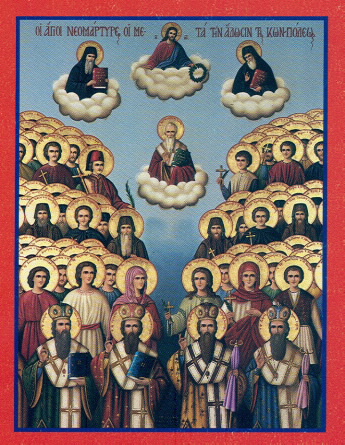
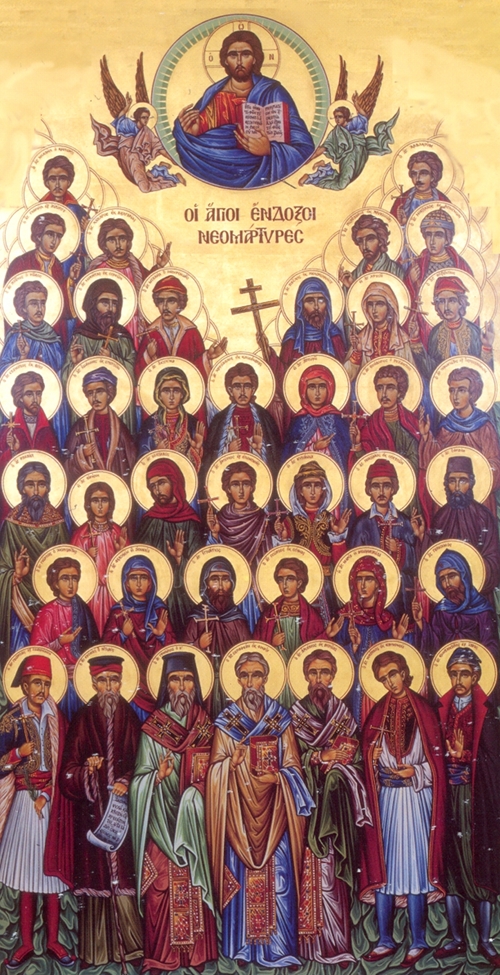
Synaxis of the Holy New Martyrs under the Turkish Yoke

Synaxis of the Holy New Martyrs under the Turkish Yoke - Commemorated on the Third Sunday after Pentecost (http://vatopaidi.files.wordpress.com/2010/06/neomartyres-ceb7-cebfcebccebfcebbcebfceb3ceb9ceb1-cf84cf89cebd-cebdceb5cebfcebcceb1cf81cf84cf85cf81cf89cebd-1.jpg)
  
St. Nikodemos of the Holy Mountain, the author of the New Martyrologion (the primary Greek anthology of the lives of Orthodox New Martyrs who suffered for Christ under the Turkish yoke), composed a service in praise of all Neomartyrs to be commemorated on the Third Sunday following Pentecost. The following are two quotes from a sermon of St. Nikodemos in praise of the Neomartyrs (Note: the following two quotes and the hymns below are all amateur translations):

“How can one not feel the need to thank God, seeing that under their heavy yoke and slavery were kept so many champions? To preserve the freedom and the people of our Christian faith, they refused riches, glory, pleasures and every bodily repose, and delivered themselves first of all to death. How is it not worthy to glorify God, seeing the fear of the coming judgment compel so many brave Martyrs? The desire for the good things of heaven to conquer them? The faith to strengthen their souls so greatly? Hope to captivate their minds? And the fire of divine love to be lit within their hearts so greatly? How did these blessed ones run towards martyrdom, as sheep to the slaughter? And how they counted their tortures as a phantasy, and their prisons as palaces, and their bonds as golden adornments, and their indignities as precious, their turmoils as rest, the flame of fire as dew and repose, swords as toys, and ultimately, the most difficult death through life eternal...”

"Some behold this and ask, for what reason was God pleased to bring about new Martyrs in these times? We note the following five things: A. that there be a renewal of the whole Orthodox faith. B. that those of other faiths be without defense on the Day of Judgment. C. that they might be the glory and the boast of the Church of the East, and the reproach and despised by the heterodox. D. that they might be an example of patience to all Orthodox Christians that are tyrannized under the heavy yoke of slavery. E. and finally, that they bravely compel through the martyrical work until death all Christians who at some point are called to martyrdom, especially those who had formerly denied the Orthodox faith."

These New Martyrs came from all walks of life, all ages, and all professions. Some were clergy and monastics, others were lay men and women. Some were faithful Christians, others had denied Christ but returned to Him, and still others had converted to Orthodoxy from islam and proceeded to suffer for Christ. Many of the most-beloved Orthodox Saints help comprise this glorious band of Neomartyrs (e.g. St. Kosmas Aitolos, Sts. Raphael, Nicholas and Irene, St. Ephraim of Nea Makri, St. George of Ioannina, St. Constantine of Hydra, St. Polydoros, St. Theodore the Byzantine, Sts. Euthemios, Akakios and Ignatios, St. Gregory V, Patriarch of Constantinople, St. Philothei of Athens, St. Seraphim Archbishop of Phanarion, St. Chryse the New of Meglin, St. Argyre, and many, many more).

For an excellent book of the lives of many Neomartyrs under the Turkish yoke, see: Witnesses for Christ by Vaporis.
  
May we all imitate their struggle till death for Christ, and may they intercede for us all!

   
Apolytikion in the Third Tone
The New Martyrs trampled upon the ancient error, and lifted up the faith of the Orthodox, and struggled valiantly. The faith of the lawless they despised, and they proclaimed Christ with boldness as perfect God. And they ever intercede unceasingly that great mercy be granted to us.

Kontakion in the First Tone
Rejoice mystically, O Church of Christ, seeing your sons, the Neomartyrs, surrounding your table and altar as olive trees, arrayed as newly-illumined stars, and to the Creator cry out: You are the strength of the Martyrs, O Christ.

Oikos
We ever, O bretheren, have need to remember and wonder at the inscrutable judgments of the providence of our man-loving God, Who even during the long period of tyrannical slavery of our people, worked a multitude of good things for our tyrannized souls. And especially, through this and from this, the glorious boasts, the friends of Christ, and the heavenly treasuries grew forth bearing fruit, Newly-revealed Martyrs. They are now worthy to be praised, for these who were brave in soul, and arrayed with the power of Christ as a breastplate, counted all things of life as refuse, and did not at all spare their flesh, and struggled bravely in the stadium, and were triumphant against the impiety of the Hagarenes, and proclaimed the faith of Christ with boldness, and because of this, suffered many forms of tortures bravely, and struggled until the end, and were granted the crown of martyrdom. To the Bestower-of-crowns let us cry out: You are the strength of the Martyrs, O Christ.

(amateur translation of the Greek service of the Synaxis of the Holy Neomartyrs (written by St. Nikodemos) available here: http://agioreitika.blogspot.com/2007/06/ako.html)
  
Through the prayers of our Holy Fathers, Lord Jesus Christ our God, have mercy on us and save us! Amen!

Friday, December 25, 2009

Prayer to the Lord Who was born, by St. Nikodemos of the Holy Mountain


Prayer to the Lord Who was born
by St. Nikodemos of the Holy Mountain

Jesus, Son of the Father without mother according to divinity, I glorify You the eternal Who is above every entreaty and word.

Jesus, Son of a Mother without father according to humanity, I glorify You Who became man for us.

 Jesus, Emmanuel unchanged, for You are the Angel-bearer of the great message of salvation, I thank You for Your great love for man.

 Jesus, spotless Lamb of God, I ever confess You, for I am the lost sheep.

 Jesus, most-compassionate Comforter, make the grace of your Spirit to work within me.

 Jesus, new Adam, take from me the old man, and establish in me the new.

 Jesus, You Who descended to earth, make me worthy to have my habitation in the heavens.

 Jesus, You Who took on the human nature make me a partaker in the grace of theosis.

 Jesus, my breath, come to visit me.

(amateur translation of Greek text from: http://vatopaidi.wordpress.com/2009/12/25/%cf%80%cf%81%ce%bf%cf%83%ce%b5%cf%85%cf%87%ce%ae-%cf%83%cf%84%ce%bf%ce%bd-%ce%ba%cf%8d%cf%81%ce%b9%ce%bf-%cf%80%ce%bf%cf%85-%ce%b3%ce%b5%ce%bd%ce%bd%ce%ae%ce%b8%ce%b7%ce%ba%ce%b5/)

St. Nikodemos of the Holy Mountain (Icon courtesy of www.eikonografos.com used with permission)

Christ is born! Glorify Him!

Tuesday, July 14, 2009

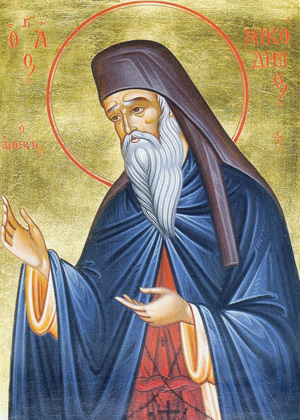
St. Nikodemos of the Holy Mountain

Icon of St. Nikodemos the Hagiorite (taken from: http://agioritikesmnimes.pblogs.gr/files/f/247413-02.jpg)
  
St. Nikodemos the Righteous of the Holy Mountain - Commemorated on July 14
"Saint Nicodemus of the Holy Mountain was born on the Greek island of Naxos in the year 1748, and was named Nicholas at Baptism. At the age of twenty-six, he arrived on Mount Athos and received the monastic tonsure in the Dionysiou monastery with the name Nicodemus.

As his first obedience, Nicodemus served as his monastery's secretary. Two years after his entry into the Dionysiou monastery, the Metropolitan of Corinth, St Macarius Notaras (April 17), arrived there, and he assigned the young monk to edit the manuscript of the PHILOKALIA, which he found in 1777 at the Vatopedi monastery. Editing this book was the beginning of many years of literary work by St Nicodemus. The young monk soon moved to the Pantokrator skete, where he was under obedience to the Elder Arsenius of the Peloponnesos, under whose guidance he zealously studied Holy Scripture and the works of the Holy Fathers.

In 1783 St. Nicodemus was tonsured to the Great Schema, and he lived in complete silence for six years. When St Macarius of Corinth next visited Athos, he gave the obedience of editing of the writings of St. Symeon the New Theologian to St. Nicodemus, who gave up his ascetic silence and occupied himself once more with literary work. From that time until his death he continued zealously to toil in this endeavor.

Not long before his repose, Father Nicodemus, worn out by his literary work and ascetic efforts, went to live at the skete of the iconographers Hieromonks Stephen and Neophytus Skourtaius, who were brothers by birth. He asked them to help in the publication of his works, since he was hindered by his infirmity. There St. Nicodemus peacefully fell asleep in the Lord on July 14, 1809.

According to the testimony of his contemporaries, St. Nicodemus was a simple man, without malice, unassuming, and distinguished by his profound concentration. He possessed remarkable mental abilities: he knew the Holy Scriptures by heart, remembering even the chapter, verse and page, and he could even recite long passages from the writings of the Holy Fathers from memory.


Icon of St. Nikodemos (taken from: http://agioritikesmnimes.pblogs.gr/files/f/247357-00.jpg)
   
The literary work of St. Nicodemus was varied. He wrote a preface to the PHILOKALIA, and short lives of the ascetics. Among the saint's ascetical works, his edition of Lorenzo Scupoli's book, UNSEEN WARFARE is well known, and has been translated into Russian, English, and other languages. A remarkable work of the ascetic was his MANUAL OF CONFESSION (Venice, 1794, 1804, etc.), summarized in his treatise, "Three Discourses on Repentance". His most edifying book CHRISTIAN MORALITY was published in Venice in 1803.

The saint also made great contributions by publishing liturgical books. Using materials from the manuscript collections of Mt Athos, he published sixty-two Canons to the Most Holy Theotokos under the title, NEW THEOTOKARION (Venice, 1796, 1849). St. Nicodemus prepared a new edition of the the PEDALION or RUDDER, comprised of the canons of the Holy Apostles, of the holy Ecumenical and Local Synods, and of the holy Fathers.

St Nicodemus had a special love for hagiography, as attested by his work, NEW EKLOGION (Venice, 1803), and his posthumous book, THE NEW SYNAXARION in three volumes (Venice, 1819). He completed a Modern Greek translation of a book by St Theophylact, Archbishop of Bulgaria, PAUL'S FOURTEEN EPISTLES in three volumes. St. Nicodemus himself wrote AN INTERPRETATION OF THE SEVEN CATHOLIC EPISTLES (also published at Venice in 1806 and 1819).
   
Icon of St. Nikodemos holding an icon of the Most-Holy Theotokos (most likely the icon of the Theotokos "Gorgoepikoos" ("Quick-to-hear") from the Monastery of Docheiariou (http://www.mountathos.gr/active.aspx?mode=en{6adcc17a-9146-449a-8d53-5b1683f4825e}View), which he composed the service to) (taken from: http://agioritikesmnimes.pblogs.gr/files/f/247414-03.jpg)

The exceedingly wise Nicodemus is also known as the author and interpreter of hymns. His Canon in honor of the Mother of God "Quick to Hear" (November 9) and his "Service and Encomium in Honor of the Fathers who Shone on the Holy Mountain of Athos" are used even beyond the Holy Mountain. Some of his other books include the HEORTODROMION, an interpretation of the Canons which are sung on Feasts of the Lord and of the Mother of God (Venice, 1836), and THE NEW LADDER, an interpretation of the 75 Hymns of Degrees (Anabathmoi) of the liturgical book called the OKTOECHOS (Constantinople, 1844)." (taken from:http://ocafs.oca.org/FeastSaintsViewer.asp?SID=4&ID=1&FSID=102028)
  
Selected Quotes from St. Nikodemos
"The grace of the Holy Spirit which is given mystically to every Christian when he is baptized acts and is manifested in proportion to our obedience to the commandments of the Lord. That is, if a Christian obeys the commandments of the Lord more, grace acts with him more, while if he obeys them less, grace acts within him less. Just as a spark, when covered in the ashes of fire becomes increasingly manifest as one removes the ashes, and the more fire wood you put the more the fire burns, so the grace that has been given to every Christian through Holy Baptism is hidden in the heart and covered up by the passions and sins, and the more a man acts in accordance with the commandments of Christ, the more he is cleansed of the passions and the more the fire of Divine grace lights in his heart, illumines and deifies him. Christian Morality, p. 343. Quoted in Cavarnos, 133-134.

"Those, on the other hand, who dwell in the wilderness and lead the quiet life, despise all the pleasures which others long form, as harmful to the soul and separating it from God. They withdraw their mind from every distraction and contemplation of the world, and gather it into their heart; and there they pray unceasingly, meditating on the dearest and sweetest name of Jesus, saying lovingly: “Lord Jesus Christ, Son of God, have mercy upon me.” Through this unceasing prayer and frequent meditation on the name of Jesus they kindle in their heart the aspiration and eros for God, and turn their mind to the contemplation of the Divine beauty. Being thus enraptured by that surpassing beauty, and becoming ecstatic, they forget food, drink, and clothes. The New Ladder, pp. 37-38. Quoted in Cavarnos, pp. 136-137

"There is no other virtue that is either higher or more necessary than sacred Prayer, because all the other virtues—I mean fasting, vigils, sleeping on the ground, ascesis, chastity, almsgiving, and all the rest—even though they are ways of imitating God, even though they cannot be taken away from us and constitute the immortal ornaments of the soul—do not unite man with God, but only render man fit to be united. Sacred Prayer, and it alone, unites. It alone joins man with God and God with man, and makes the two one spirit." Anthology from the Psalms of the Prophet-king David, Proem. Quoted by Cavarnos, p. 139.
(above three quotes taken from: http://www.bombaxo.com/blog/?p=1206)
   
"My brother sinner, this is the preparation you must undergo before you repent and go to confession. Know firstly that repentance, according to St. John of Damaskos, is a returning from the devil to God, which comes about through pain and ascesis. So you also, my beloved, if you wish to repent properly, must depart from the devil and from diabolical works and return to God and to the life proper to God. You must forsake sin, which is against nature, and return to virtue, which is according to nature. You must hate wickedness so much, that you say along with David: “Unrighteousness have I hated and abhorred” (Ps. 118:163), and instead, you must love the good and the commandments of the Lord so much, that you also say along with David: “But Thy law have I loved” (ibid.), and again: “Therefore have I loved Thy commandments more than gold and topaz” (Ps. 118:127). In brief, the Holy Spirit informs you through the wise Sirach what in fact true repentance is, saying: “Turn to the Lord and forsake your sins… Return to the Most High, and turn away from iniquity, and hate abominations intensely” (Sir. 17:25-26)...And just as hunters are not satisfied with merely finding a beast in the forest, but attempt through every means to also kill it, likewise, my brother sinner, you should also not be satisfied with merely examining your conscience and with finding your sins, for this profits you little, but struggle by every means to kill your sins through the grief in your heart, namely, through contrition and affliction. And in order to acquire contrition, consider how much you have wronged God through your sins. In order to also acquire affliction, consider how much you have wronged yourself through your sins." (excerpt from the Exomologetarion, taken from: http://uncutmountain.com/index.php/uncut/pages/C33/)
  

Picture of the Monastery of St. Nikodemos, Goumenissa (northern Greece), where relics of St. Nikodemos are treasured (taken from: http://ne.pasok.gr/wp-users/kilkis/Osios_Nikodimos_.jpg)
   
The works of St. Nikodemos (in Greek, many of which have been translated)

α. Αγιολογικά (Lives of the Saints):
1. «Νέον Εκλόγιον», 1797 στην έρημο της Καψάλας, έκδοση το 1803.
2. «Νέο Μαρτυρολόγιο», 1797 στην έρημο της Καψάλας, έκδοση το 1799.
3. «Συναξαριστής των Δώδεκα μηνών του Ενιαυτού», 1805-1807, στην Ι. Μ. Παντοκράτορα.

β). Απολογητικά (Apologetics):
1. «Απολογία περί της Κυρίας ημών Θεοτόκου», 1799 στην έρημο της Καψάλας.
2. «Ομολογία Πίστεως», 1805 στην Ι. Σκήτη Παντοκράτορα.

γ). Ασκητικά (Asceticism):1. «Φιλοκαλία των ιερών νηπτικών», 1777 στις Καρυές, έκδοση το 1782.
2. «Ευεργετινός», 1777 στις Καρυές, έκδοση το 1794.
3. «Βίβλος Βαρσανοουφίου και Ιωάννου», 1797 στη καλύβα Άγιος Βασίλειος στην έρημο της Καψάλας, έκδοση το1805.

δ). Εποικοδομητικά – Ηθικά (Constructive / Ethical works):
1. «Περί συνεχούς θείας Μεταλήψεως των αχράντων του Χριστού Μυστηρίων», 1778 στις κελί Άγιος Αντώνιος, έκδοση το 1794.
2. «Βιβλίον καλούμενον Αόρατος πόλεμος», 1785 στην Ι. Σκήτη Παντοκράτορα, έκδοση το 1796. 3. «Πνευματικά γυμνάσματα», 1785 στο ίδιο μέρος.
4. «Επιτομή εκ των Προφητανακτοδαυϊτικών ψαλμών», 1797 στη καλύβα Άγιος Βασίλειος (Καψάλα).
5. «Χρηστοήθεια», 1798 στο ίδιο μέρος.

ε). Ερνηνευτικά:
1. «Αι δεκατέσσαρες Επιστολαί του Αποστ. Παύλου», 1797 στη καλύβα Άγιος Βασίλειος, έκδοση το 1804.
2. «Ψαλτήριον Ευθυμίου Ζυγαβηνού», 1797 στο ίδιο μέρος.
3. «Κήπος χαρίτων», 1798 στο ίδιο μέρος.
4. «Επτά καθολικαί επιστολαί», 1799 στο ίδιο μέρος.
5. «Νέα Κλίμαξ», 1806 στην έρημο της Καψάλας.
6. «Εορτοδρόμιον», 1806 στο ίδιο μέρος.

στ). Θεολογικά (Theological works):
1. «Αλφαβηταλφάβητος», 1778-1779 στην Ι. Σκήτη του Παντοκράτορα.
2. «Συμεών του Νέου Θεολόγου Άπαντα, 1784 στην Ι. Σκήτη του Παντοκράτορα και συμπλήρωση το 1794 στη καλύβα Άγιος Βασίλειος.
3. «Άπαντα Γρηγορίου του Παλαμά»,1787 στη Καψάλα.

ζ). Ποιμαντικά – κανονικά (Pastoral - Canonical works):
1. «Συμβουλευτικόν εγχειρίδιον περί φυλακής των πέντε αισθήσεων», 1781-1782 στο τόπο εξορίας του, δηλ. στην ερημόνησο Σκυροπούλα Βορίων Σποράδων, έκδοση το 1801.
2. «Εξομολογητάριον», 1784 στη Ι. Σκήτη του Παντοκράτορα και συμπλήρωση το 1794 στη καλύβα Άγιος Βασίλειος.
3. «Πηδάλιον», 1793 στη καλύβα του γερο-Λουκά Ι. Μ. Παντοκράτορα, έκδοση το 1800.

η). Ποιητικά (Poetics):1. Επιγράμματα – Ποιήματα.
2. Λειτουργικοί Ύμνοι και Εγκώμια.
3. «Νέον Θεοτοκάριον κλπ. 1795 στην Ι. Σκήτη Παντοκράτορα

On the relics of St. Nikodemos
"Many visitors to the Holy Mountain don't know that in Karyes, the Cell, of the Skourtaion, houses the relics of his Holy Skull, and due to this ignorance they are deprived of the blessing of this treasure...The Holy Skull of Saint Nikodemos is kept by Father Ananias, over 90 years old in our opinion. Furthermore it is Father Ananias' efforts to erect a church in Saint Nikodemos' name. " (taken from: http://www.saintnicodemos.org/articles/saintnikodemoshagioritearticle.php). In addition, there is a monastery dedicated to St. Nikodemos in Goumenissa, along with a church dedicated to him in the Chora of the island of Naxos, where he was born, both of which have relics of him.

Reliquary with relics of St. Nikodemos, from the island of Naxos, his place of birth (taken from: http://eortia.pblogs.gr/files/f/219215-%CE%9B%CE%B5%CE%B9%CF%88%CE%B1%CE%BD%CE%BF%CE%B8%CE%AE%CE%BA%CE%B7.jpg)
   
Today (July 14th 2009) is the 200th anniversary of St. Nikodemos' repose. Thankfully, the awareness and appreciation of such a great saint and father of our Church has continued to increase over recent years. The life of St. Nikodemos has been published by Constantine Cavarnos as part of his Modern Orthodox Saints series. The incredible Philokalia have become very widely circulated. The Rudder (Pedalion), or collections of the holy canons of the Church are studied and used by many. The lives of the saints written and compiled by him, especially those of many new martyrs of the Church (Neo Martyrologion), are being included in many different compilations of hagiographies (e.g. in the Great Synaxaristes from Holy Apostles Convent). Three of the works of St. Nikodemos have just been published by Uncut Mountain Press: Concerning Frequent Communion (http://www.uncutmountainsupply.com/proddetail.asp?prod=CFC), the Exomologetarion - A Manual of Confession (http://www.uncutmountainsupply.com/proddetail.asp?prod=EXOMO), and Confession of Faith (http://www.uncutmountainsupply.com/proddetail.asp?prod=COF).

Note: St. Nikodemos, as one of the foremost of the Kollyvades movement, is also celebrated in the Synaxis of the Kollyvades Fathers on Bright Saturday (see an earlier post here: http://full-of-grace-and-truth.blogspot.com/2009/04/synaxis-of-holy-kollyvades-fathers.html).
The Paraklesis and Akathist to St. Nikodemos (in Greek) are available here, respectively: http://voutsinasilias.blogspot.com/2009/07/14-1.html, http://voutsinasilias.blogspot.com/2009/07/14-2.html. And finally, here is a list of festivities planned on the island of Naxos to celebrate St. Nikodemos (in Greek): http://www.i-m-paronaxias.gr/events/index.html.
   
May St. Nikodemos intercede for all of us and help us!
  

Icon of St. Nikodemos of the Holy Mountain (taken from: http://agioritikesmnimes.pblogs.gr/files/f/247417-06.jpg)

Apolytikion of St. Nikodemos of the Holy Mountain - Third Tone
Thou hast been shown to be a godly clarion of holy oracles, teaching us righteousness. Thou wast adorned with wisdom's grace, O Father, Saint Nicodemus For thou didst present to all thy pure life as a paradigm, pouring forth enlightenment by the wealth of thy godly words. Thy teachings of salvation illumined as light the whole world, O righteous Father.
   
(taken from Holy Trasfiguration Monastery's translation in St. Anthony's music: http://www.stanthonysmonastery.org/music/Menaion/Finale%202003%20-%20%5B5814b%5D.pdf)
      
Through the prayers of our Holy Fathers, Lord Jesus Christ our God, have mercy on us and save us! Amen!