Showing posts with label Christian Apology. Show all posts

Sunday, February 21, 2010

The Triumph of the Church, by St. John Chrysostom

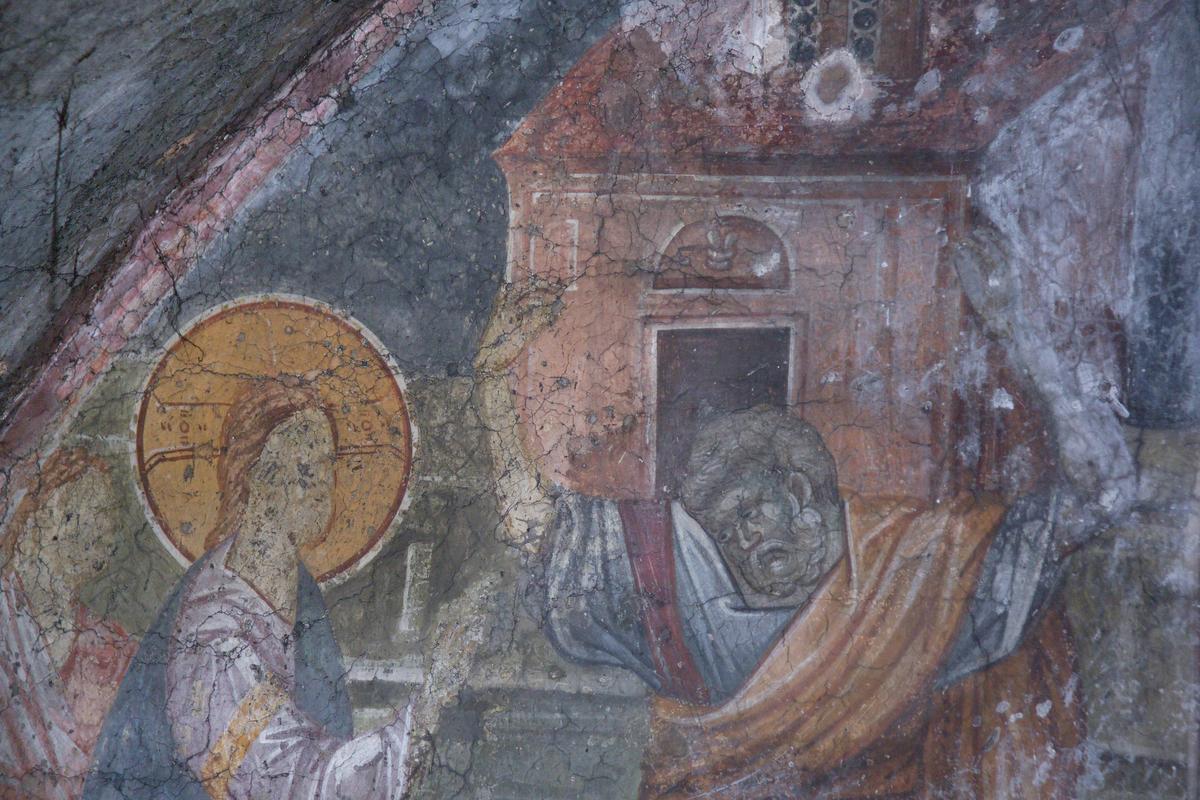
Fresco from Gracanica Monastery depicting Christ's words: “On this stone (i.e. on Peter’s confession of faith) I will build my Church, and the powers of Hades will not prevail against it” (Matthew 16:18). (http://www.srpskoblago.org/Archives/Gracanica/exhibits/digital/n3-w5e5/large/n3-w5e5-2.jpg)

The Triumph of the Church, by St. John Chrysostom
"How does one prove that Christ is God? We should not try to answer this question by using the argument of the creation of heaven and earth, because the unbeliever will not accept it. If we tell him that He raised the dead, healed the blind, expelled demons, he still will not agree. If we tell him that He promised us resurrection from the dead, the kingdom of heaven, and ineffable goods, not only he will not agree, but also he will laugh at us.

How then shall we lead him to the faith, especially when he is not spiritually developed? Surely, we shall do this by resting on truths which are acceptable both to us and to him without any dispute or shadow of doubt.

We shall start from the fact that Christ planted the Church in the world. What is the point then that we absolutely agree upon? It is the fact that Christ planted the Church. It is by this means that we shall reveal the power and prove the divinity of Christ. We shall see that it is impossible to regard the dissemination of Christianity in the whole wide world in such a short period of time as a human work. And indeed, when Christian ethics invites people who have bad habits and are slaves to sin to a higher life. And yet, the Lord managed to liberate from such things not only us, but the entire human species.

Christ’s superbly wondrous achievement is the Church. He achieved this without using arms, without spending money, without mobilizing armies, without causing wars. He achieved it by starting only with twelve disciples, who were insignificant, uneducated, poor, naked, unarmed… It was with such human resource that He succeeded in persuading the nations to think correctly, not only in the present life, but also in the life which is to come. He managed to nullify the ancestral laws, to uproot ancient customs, and to plant new ones. He managed to detach man from an easy way of life and to lead him to a difficult one. He managed all these things, although all fought against Him, and He had to endure a degrading crucifixion and an ignominious death!

This superbly wondrous achievement is not human. Surely, such things do not occur to human beings. What occurs is the exact opposite. In other words, as long as they are alive and prosper their work progresses. When, however, they die, what they created is destroyed along with them. This is endured not only by the rich or the leading ones, but also by the chief governors. This is so, because their laws are abolished, their memory is obliterated, and their names are forgotten, while their intimate associates are pushed aside. These things occur to those who originally governed the nations by a mere nod, and led to war grand armies; to those who condemned to death and recalled the exiled. To the Lord, however, it was the exact opposite that occurred.

It is superbly wondrous because it was achieved by the Crucified Christ. Before the crucifixion the state of his work looked pitiful. Judas betrayed Him. Peter denied Him. The rest of the Disciples fled in order to save their lives, while many believers abandoned Him. He was left alone among enemies. And yet, after the slaughter and the death, so that you may learn that the Crucified Christ was not a mere man, all things became brighter, jollier, and glorious. Peter, the head Apostle, who before the crucifixion did not bear the threat of a maidservant, but after so many heavenly teachings and his participation in the divine mysteries said that he does not know the Lord, the same one after the crucifixion preached Him to the ends of the world. Innumerable martyrs were sacrificed, because they preferred to be put to death than to deny Christ, as the head Apostle had denied Him after being intimidated by a young maiden.

The amazing submission of the world to the Crucified Christ and His Apostles: Now, all the lands, all the cities, the deserted and the inhabited places, confess the Crucified Lord. On Him faith is placed by kings and generals, archons and consuls, slaves and freemen, unlettered and educated, the barbarians and the various nations of humanity. Even that small and insignificant tomb that received the blood stained and tortured body of the Lord is more valued than a thousand royal palaces and more venerable even to kings. What is even a greater paradox is the fact that what happened to the Lord also happened to His disciples. Because, those who were despised and imprisoned, those who were atrociously tortured and underwent innumerable martyrdoms, the very same ones, after their death, were more honored than the kings. Where do we see this? In Rome, the emperors, the consuls and the generals put aside all things and run to venerate the tombs of Peter the fisherman and Paul the tent maker. In Constantinople, those who bear diadems on their heads, wish to be buried next not close to the tombs of the Apostles but at the entrance of their temples. And so the kings become the doormen of the fishermen! Indeed, they are not ashamed for this, but boast about it, not only themselves but also their descendants.

Christ’s prophesy about the Church and its speedy fulfillment. When Christ’s disciples were only twelve and the Church was not in any one’s thought, when the Jewish synagogue was still flourishing and the impious idolatry dominated almost the entire world, the Lord had prophesied: “On this stone (i.e. on Peter’s confession of faith) I will build my Church, and the powers of Hades will not prevail against it” (Matthew 16:18). Do you realize the truth of this prophesy? Do you see its fulfillment? Think how important a fact is the spreading of the Church almost to the entire earth in a very brief span of time. Think how the life of so many nations changed and led to the faith so many peoples, how it abolished ancestral customs, how it liberated from age-long habits, how it scattered like dust the domination of pleasure and the power of sin, how it extinguished like smoke the foul smell of the sacrifices, the idolatrous ceremonies, the abominable feasts, the idols, the pagan altars and temples, how it erected sacred altars everywhere, in our land and in the lands of the Persians, the Scythians, the Africans and the Indians. What I say? Even in the British Isles, which are beyond the Mediterranean, in the ocean, the Church was spread and erected altars.

The superbly wondrous liberation and change that the Church induced in the world: The work of liberation of so many peoples from age-long shameful habits, as well as the change in the manner of life from an easier to a more difficult one, is indeed wondrous, or rather superbly wondrous. It is a proof of divine operation (energy), even if no one had opposed it, even if peace had prevailed and many had assisted. Because this spreading of the Church did not only come into collision with ancient habit, but also with pleasure, the happy manner of life. In other words, it had two powerful opponents, which tyrannized humanity: habit and pleasure. Whatsoever people had received, from centuries ago, from their fathers, their grandfathers and their ancient ancestors, even what they had received from the philosophers and the rhetoricians, all these things they agreed to despise, an attitude extremely difficult. Besides, they had to accept a new manner of life, which was indeed much more difficult; because she removed them from luxury and attached them to fasting. She removed them from avarice and led them to lack of property. She removed them from profanity and led them to chastity. She removed them from aggressiveness and led them to gentleness. She removed them from envy and led them to friendship. She removed them from an easygoing and pleasurable life and led them to a life of difficulties, hardships, and full of sorrows. Indeed she led to this life those who had been accustomed to the life of luxuries. Surely, those who became Christians were not people who lived in some other worlds and did not have sinful habits, but were those who had rotted in them and had become more flexible than clay. It was them that she called to follow the hard and ragged road. And it persuaded them to follow it!

The superbly wondrous work of the Twelve Apostles in the spreading of the Church. How many were persuaded? Not two, not ten, not twenty, not a hundred, but an innumerable crowd. And how many did she use to persuade them? She used two men, uneducated, uncultured, unknown, poor, without property, without bodily strength, without glory, without illustrious ancestry, without rhetorical eloquence. She used twelve men who were fishermen, tent makers, whose mother tongue was foreign; because, they did not speak the same tongue with the idolaters. They spoke Hebrew, which was different from all other languages. It was with them that the Church was built up and spread to the ends of the world. This is not the only wondrous fact, but there is also the fact that these few, these poor, these uneducated and despised men, who set out to change humanity, did not pursue their work without disturbance. They were confronted with innumerable wars from every side. They were opposed by every nation and in every city. But why do I speak of nations and cities? War was raised against them even on every house. Their teaching separated on many occasions the child from the father, the daughter in law from the mother in law, the brother from the brother, the servant from the master, the citizen from the ruler, the man from the woman, and the woman from the man. In every family not all believed simultaneously,, and so the Christians suffered daily harassments, ceaseless enmities, a myriad of deaths. All fought them as common opponents and enemies. They were pursued by kings, governors, citizens, freemen, slaves, crowds, cities. They did not pursue only them, but –how terrible– even the neophyte catechumens, i.e. those who just believed.

The victory of the Apostles and the Church is due to the power of the Crucified but also Risen Lord. It caused horror and wrath to the idolaters the thought of abandoning their pagan altars, of despising their bloody sacrifices, which all their fathers and ancestors practiced, and of believing in the Lord; of believing in Him who took flesh from the Virgin Mary, and stood trial before Pilate, and suffered numberless tribulations and degradations, underwent a dishonorable death, was buried and rose again. It is indeed a paradox, that, while the sufferings of the Lord were indisputable, -inasmuch as many had seen the lashings, the biting, the spitting, the slapping, the cross, the mocking, the entombment– it was not the same with the resurrection. The Lord, after his resurrection, manifested Himself only to the disciples. In spite of this fact, they spoke about the resurrection and persuaded the peoples and built up the Church. How did they do it? They did it with the power of the Lord, who sent them to preach his Gospel to the nations. It was He who opened to them the way. It was He who facilitated their difficult task. Had they not been assisted by the divine power, the spreading of Christianity would not have even begun.

The persecutions against the Church did not inhibit its expansion. The reason was that while the tyrants were forearmed against the Church, while the soldiers interposed their arms, while the mobs raged like a wild fire, while the bad habit was lined up in opposition, while orators, sophists, the rich people, ordinary citizens and leaders were aroused in enmity, the word of God, being stronger than the flame, turned the thistles into ashes, cleansed the fields and sowed the word of the preaching. Some of the believers were thrown into the prisons, others were exiled, others had their property confiscated, others were assassinated, and others were torn to pieces. In spite of the fact that Christians were treated as common criminals, suffering patiently every kind of punishment, humiliation and persecution, more and more people joined the Church. Indeed, the new believers not only were not discouraged by the tortures which they saw the older believers undergoing, but became more eager! They run by themselves, without constraint, showing gratitude to their torturers. They became more fervent in the faith, seeing the torrents of the blood of the believers.

The expansion of the Church in spite of the persecutions proves the incomparable and unconquerable power of Christ. Did you see the incomparable power of Him who achieved all these wonders? How is it possible that people who are undergoing such horrid martyrdoms feel no sorrow? And yet, they rejoiced, and were elated! This is what St. Luke the Evangelist adduces as an example, when he says about the Apostles that “they left from the council rejoicing, because they were proved worthy to be ill-treated for the shake of Christ” (Acts 5:41). While no one can build even a wall with stones and plaster when is persecuted, the Apostles built up the Church throughout the world while sufferings persecutions, imprisonments, exiles and deaths as martyrs. They did not build her up with stones, but with souls –which is much more difficult; since it is not the same to build a wall as to persuade perverted souls to change their manner of life, to abandon their demonic madness and to follow the life of virtue. They achieved this, because they had with them the unconquerable power of the Lord, who had prophesied; “I will build up my Church, and the powers of Hell will not prevail against her” (Matthew 16:18).

Consider how many tyrants fought the Church and how many persecutions they raised against it… Augustus, Tiberius, Gaius, Nero, Vespasian, Titus and their successors right down to Constantine, were all idolaters. All of them –some more moderately, and some more harshly– fought the Church. Even if some of them did not raise persecutions, nevertheless, their attachment to idolatry motivated those who wanted to flatter them to oppose the Church. In spite of all this, the evil schemes and attacks of the idolaters were dissolved as cobwebs, scattered like dust, vanished like smoke. Besides, what were planned against the Church became the occasion of great benefits for the Christians. The reason was that such plans created choruses of martyrs, who constitute the treasure, the pillars, and towers of the Church.

The wondrous fulfillment of what Christ prophesied about the Church reveals most clearly his true Godhead. Do you see the wondrous fulfillment of this prophesy? Indeed, “the powers of Hell cannot prevail against her.” Looking at what came to pass, believe what is to come. No one in the future will be able to prevail against the Church. If they did not manage to crush her when she numbered but a few members, when her teaching seemed novel and strange, when so many terrible wars and so many persecutions were raised against her from everywhere, much more they will not manage to injure her today, when she has spread in the whole world, and increased her dominion among all nations, abolishing their pagan altars and idols, their festivals and celebrations, the smoke and the smell of their abominable sacrifices. How did the Apostles achieve such a great, such an important task, after so many obstacles? Surely, it was by the divine and unconquerable power of Him, who prophesied about the creation and triumph of His Church. No one can deny this, unless he is mindless and completely unable to think."
(Translated and edited by Protopresbyter George Dion. Dragas, PhD, DD, DTh; This article represents selections from St. John Chrysostom’s treatise To Jews and Greeks, a demonstration, that Christ is God… (PG 48, 813-838); http://www.johnsanidopoulos.com/2009/10/triumph-of-church.html)

St. John Chrysostom, Archbishop of Constantinople (Icon courtesy of www.eikonografos.com used with permission)

Through the prayers of our Holy Fathers, Lord Jesus Christ our God, have mercy on us and save us! Amen!

Monday, September 21, 2009

The Holy Apostle Quadratus (Kodratos) of the Seventy, and the Epistle to Diognetos

Icon depicting the Holy Prophet Jonah and St. Quadratus (Kodratos) the Apostle of the Seventy (Commemorated on September 21) (icon taken from: http://www.christopherklitou.com/icon_21_sept_jonah_prophet_codratus.htm)

"Saint Quadratus, Apostle of the Seventy preached the Word of God at Athens and at Magnesia (eastern peninsula of Thessaly), and was Bishop of Athens. His biographer called him "a morning star" among the clouds of paganism. He converted many pagans to the true faith in Christ the Savior, and his preaching aroused the hatred of the pagans. Once, an angry mob fell upon the saint to pelt him with stones. Preserved by God, St Quadratus remained alive, and they threw him into prison, where he died of starvation. His holy body was buried in Magnesia.

In the year 126, St Quadratus wrote an Apologia in defence of Christianity. Presented to the emperor Hadrian (117-138), the Apologia affected the persecution of Christians, since the emperor issued a decree saying that no one should be convicted without just cause. This Apologia was known to the historian Eusebius in the fourth century. At the present time, only part of this Apologia survives, quoted by Eusebius: "The deeds of our Savior were always witnessed, because they were true. His healings and raising people from the dead were visible not only when they were healed and raised, but always. They lived not only during the existence of the Savior upon the earth, but they also remained alive long after His departure. Some, indeed, have survived to our own time.

St Quadratus is also commemorated on January 4."
(taken from: http://ocafs.oca.org/FeastSaintsViewer.asp?FSID=102683)

Fresco from Decani Monastery depicting the Martyrdom of the Holy Apostle Quadratus (taken from: http://www.srpskoblago.org/Archives/Decani/exhibits/Menologion/September/CX4K3369_l.html)

HYMN OF PRAISE
The Holy Apostle Quadratus
(by St. Nikolai Velimerovich)
St. Quadratus, like the morning star,
Shone forth the light of the Holy Gospel,
Shone forth rays through the thick darkness,
And grace upon empty hearts.
Quadratus dispelled the confusion of men's thoughts,
Illumining the forebodings in men's hearts,
Illumining them with the light of Christ,
And enlightening the world with Christ's wisdom.
Unbelievers converted to the Most-high God,
And received cruel wounds for Christ.
To Hadrian, the persecutor of the Cross,
Quadratus wrote a great defense
With the eloquence and the skill of the Hellenes
And the simplicity of Christian truth.
Quadratus succeeded: the emperor was persuaded
To protect the Holy Church from evil.
O Quadratus, Christ's disciple,
Wise defender of the Holy Church,
In word and deed, you were God's servant-
With unfading glory, you are now crowned!
To you, we Christians pray fervently:
Help us, O holy Apostle!
Help us to overcome misfortunes,
And to endure all sufferings for Christ.

The Epistle to Diognetos

"The Epistle of Mathetes to Diognetus is probably the earliest example of Christian apologetics, writings defending Christianity from its accusers. The Greek writer and recipient are not otherwise known, but the language and other textual evidence dates the work to the late 2nd century [citation needed]; some assume an even earlier date and count it among the Apostolic Fathers." (http://en.wikipedia.org/wiki/Epistle_to_Diognetus)

"P. Andriessen has suggested that Quadratus' Apology is the work known as Epistle to Diognetus,[3] a suggestion Michael W. Holmes finds "intreguing". While admitting that Epistle to Diognetus does not contain the only quotation known from Quadratus' address, Holmes defends this identification by noting "there is a gap between 7.6 and 7.7 into which it would fit very well." (http://en.wikipedia.org/wiki/Quadratus_of_Athens)

Regardless of whether or not the Apostle Quadratus is the author of this incredible document of early Christianity, it is worth reading, as it not only is one of the earliest Christian apologies, but also describes beautifully the life of the early Christians:

"For the Christians are distinguished from other men neither by country, nor language, nor the customs which they observe. For they neither inhabit cities of their own, nor employ a peculiar form of speech, nor lead a life which is marked out by any singularity. The course of conduct which they follow has not been devised by any speculation or deliberation of inquisitive men; nor do they, like some, proclaim themselves the advocates of any merely human doctrines. But, inhabiting Greek as well as barbarian cities, according as the lot of each of them has determined, and following the customs of the natives in respect to clothing, food, and the rest of their ordinary conduct, they display to us their wonderful and confessedly striking method of life. They dwell in their own countries, but simply as sojourners. As citizens, they share in all things with others, and yet endure all things as if foreigners. Every foreign land is to them as their native country, and every land of their birth as a land of strangers. They marry, as do all [others]; they beget children; but they do not destroy their offspring. They have a common table, but not a common bed. They are in the flesh, but they do not live after the flesh. They pass their days on earth, but they are citizens of heaven. They obey the prescribed laws, and at the same time surpass the laws by their lives. They love all men, and are persecuted by all. They are unknown and condemned; they are put to death, and restored to life. They are poor, yet make many rich; they are in lack of all things, and yet abound in all; they are dishonoured, and yet in their very dishonour are glorified. They are evil spoken of, and yet are justified; they are reviled, and bless; they are insulted, and repay the insult with honour; they do good, yet are punished as evil-doers. When punished, they rejoice as if quickened into life; they are assailed by the Jews as foreigners, and are persecuted by the Greeks; yet those who hate them are unable to assign any reason for their hatred." (taken from: http://www.earlychristianwritings.com/text/diognetus-roberts.html, the full text in Greek is available here: http://www.ccel.org/l/lake/fathers/diognetus.htm)


Apolytikion in the Third Tone
O Holy Apostle Quadratus, intercede with the merciful God that He grant unto our souls forgiveness of offences.

Kontakion in the Plagal of the Fourth Tone
As a most honoured hierarch and athlete of great fortitude, the world doth offer Apostle Quadratus now to Thee, O Lord most merciful; as with hymns it doth honour his all-ven'rable memory, it doth ask of Thee through him to grant forgiveness of failings to them that sing his praise.(taken from: http://goarch.org/chapel/saints_view?contentid=212)

Through the prayers of our Holy Fathers, Lord Jesus Christ our God, have mercy on us and save us! Amen!

Monday, June 1, 2009

St. Justin the Philosopher and Martyr, and those with him

Icon of St. Justin the Philosopher and Martyr - Commemorated on June 1st along with his fellow martyrs (Sts. Chariton, Charita the Virgin, Euelpistos, Hierax, Paion, Liverianos, and according to others, Vallerian (http://palioahrista.blogspot.com/2009/06/blog-post.html) (icon taken from: http://christopherklitou.com/icon_1_june_justin_the_philosopher.htm)
  
"Reading:
This Saint, who was from Neapolis of Palestine, was a follower of Plato the philosopher. Born in 103, he came to the Faith of Christ when he was already a mature man, seeking to find God through philosophy and human reasoning. A venerable elder appeared to him and spoke to him about the Prophets who had taught of God not through their own wisdom, but by revelation; and he led him to knowledge of Christ, Who is the fulfillment of what the Prophets taught. Saint Justin soon became a fervent follower of Christ, and an illustrious apologist of the Evangelical teachings. To the end of his life, while preaching Christ in all parts, he never put off his philosopher's garb. In Rome, he gave the Emperor Antoninus Pius (reigned 138-161) an apology wherein he proved the innocence and holiness of the Christian Faith, persuading him to relieve the persecution of Christians. Through the machinations of Crescens, a Cynic philosopher who envied him, Saint Justin was beheaded in Rome in 167 under Antoninus' successor, Marcus Aurelius (reigned 161-180). Besides his defense of Christianity (First and Second Apologies), Saint Justin wrote against paganism (Discourse to the Greeks, Hortatory Address to the Greeks), and refuted Jewish objections against Christ (Dialogue with Trypho)." (taken from: http://goarch.org/chapel/saints_view?contentid=73&type=saints)
  
St. Justin the Martyr and Philosopher (Source: www.eikonografos.com)
  
"THE MARTYRDOM OF THE HOLY MARTYRS JUSTIN, CHARITON, CHARITES, PAEON, AND LIBERIANUS, WHO SUFFERED AT ROMEtranslated by Rev. M. Dods, MA

CHAP. I.--EXAMINATION OF JUSTIN BY THE PREFECT.IN the time of the lawless partisans of idolatry, wicked decrees were passed against the godly Christians in town and country, to force them to offer libations to vain idols; and accordingly the holy men, having been apprehended, were brought before the prefect of Rome, Rusticus by name.
And when they had been brought before his judgment-seat, Rusticus the prefect said to Justin, "Obey the gods at once, and submit to the kings."
Justin said, "To obey the commandments of our Saviour Jesus Christ is worthy neither of blame nor of condemnation."
Rusticus the prefect said, "What kind of doctrines do you profess?"
Justin said, "I have endeavoured to learn all doctrines; but I have acquiesced at last in the true doctrines, those namely of the Christians, even though they do not please those who hold false opinions."
Rusticus the prefect said, "Are those the doctrines that please you, you utterly wretched man?"
Justin said, "Yes, since I adhere to them with right dogma."
Rusticus the prefect said, "What is the dogma?"
Justin said, "That according to which we worship the God of the Christians, whom we reckon to be one from the beginning, the maker and fashioner of the whole creation, visible and invisible; and the Lord Jesus Christ, the Son of God, who had also been preached beforehand by the prophets as about to be present with the race of men, the herald of salvation and teacher of good disciples. And I, being a man, think that what I can say is insignificant in comparison with His boundless divinity, acknowledging a Certain prophetic power, since it was prophesied concerning Him of whom now I say that He is the Son of God. For I know that of old the prophets foretold His appearance among men."

CHAP. II.-- EXAMINATION OF JUSTIN CONTINUED.
Rusticus the prefect said, "Where do you assemble?"
Justin said, "Where each one chooses and can: for do you fancy that we all meet in the very same place? Not so; because the God of the Christians is not circumscribed by place; but being invisible, fills heaven and earth, and everywhere is worshipped and glorified by the faithful."
Rusticus the prefect said, "Tell me where you assemble, or into what place do you collect your followers?"
Justin said, "I live above one Martinus, at the Timiotinian Bath; and during the whole time (and I am now living in Rome for the second time) I am unaware of any other meeting than his. And if any one wished to come to me, I communicated to him the doctrines of truth."
Rusticus said, "Are you not, then, a Christian?"
Justin said, "Yes, I am a Christian."

CHAP. III.--EXAMINATION OF CHARITON AND OTHERS.
Then said the prefect Rusticus to Chariton, "Tell me further, Chariton, are you also a Christian?" Chariton said, "I am a Christian by the command of God."
Rusticus the prefect asked the woman Charito, "What say you, Charito?"
Charito said, "I am a Christian by the grace of God."
Rusticus said to Euelpistus, "And what are you?"
Euelpistus, a servant of Caesar, answered, "I too am a Christian, having been freed by Christ; and by the grace of Christ I partake of the same hope."
Rusticus the prefect said to Hierax, "And you, are you a Christian?"
Hierax said, "Yes, I am a Christian, for I revere and worship the same God."
Rusticus the prefect said, "Did Justin make you Christians?"
Hierax said, "I was a Christian, and will be a Christian."
And Paeon stood up and said, "I too am a Christian."
Rusticus the prefect said, "Who taught you?"
Paeon said, "From our parents we received this good confession."
Euelpistus said, "I willingly heard the words of Justin. But from my parents also I learned to be a Christian."
Rusticus the prefect said, "Where are your parents?"
Euelpistus said, "In Cappadocia."
Rusticus says to Hierax, "Where are your parents?"
And he answered, and said, "Christ is our true father, and faith in Him is our mother; and my earthly parents died; and I, when I was driven from Iconium in Phrygia, came here."
Rusticus the prefect said to Liberianus, "And what say you? Are you a Christian, and unwilling to worship [the gods]?"
Liberianus said, "I too am a Christian, for I worship and reverence the only true God."

CHAP. IV.--RUSTICUS THREATENS THE CHRISTIANS WITH DEATH.
The prefect says to Justin, "Hearken, you who are called learned, and think that you know true doctrines; if you are scourged and beheaded, do you believe you will ascend into heaven?"
Justin said, "I hope that, if I endure these things, I shall have His gifts. For I know that, to all who have thus lived, there abides the divine favour until the completion of the whole world."
Rusticus the prefect said, "Do you suppose, then, that you will ascend into heaven to receive some recompense?"
Justin said, "I do not suppose it, but I know and am fully persuaded of it."
Rusticus the prefect said, "Let us, then, now come to the matter in hand, and which presses. Having come together, offer sacrifice with one accord to the gods."
Justin said, "No right-thinking person falls away from piety to impiety."
Rusticus the prefect said, "Unless ye obey, ye shall be mercilessly punished."
Justin said, "Through prayer we can be saved on account of our Lord Jesus Christ, even when we have been punished, because this shall become to us salvation and confidence at the more fearful and universal judgment-seat of our Lord and Saviour."
Thus also said the other martyrs: "Do what you will, for we are Christians, and do not sacrifice to idols."

CHAP. V.--SENTENCE PRONOUNCED AND EXECUTED.
Rusticus the prefect pronounced sentence, saying, "Let those who have refused to sacrifice to the gods and to yield to the command of the emperor be scourged, and led away to suffer the punishment of decapitation, according to the laws."
The holy martyrs having glorified God, and having gone forth to the accustomed place, were beheaded, and perfected their testimony in the confession of the Saviour. And some of the faithful having secretly removed their bodies, laid them in a suitable place, the grace of our Lord Jesus Christ having wrought along with them, to whom be glory for ever and ever. Amen." (taken from: http://voskrese.info/spl/justmart.html; For St. Justin's philosophical expositions and defenses of Christianity, see: http://voskrese.info/spl/XjustinM.html)
  
St. Justin the Philosopher and Martyr (taken from: http://www.egolpio.com/AGIOLOGIO/Ioustinos.htm)

Apolytikion of St. Justin the Martyr in the Plagal of the First Tone
Thou didst empty the cup of the wisdom of the Greeks, and thou didst thirst yet again, till thou camest unto the well where thou foundest water springing to eternal life. And having drunk deeply thereof, thou didst also drink the cup that Christ gave to His disciples. Wherefore, O Justin, we praise thee as a philosopher and Martyr of Christ.


Kontakion in the Third Tone
As the breath of Paradise, the dew descending from Aermon, Christ the Power and the Peace and Wisdom of God the Father, came upon thy thirsting spirit, O Martyr Justin, making thee a spring of knowledge for all the faithful, when thou barest with true valour death as a martyr, to live for ever in Christ.
St. Judtin the Philosopher and Martyr (http://days.pravoslavie.ru/jpg/ih4293.jpg)
  
Through the prayers of our Holy Fathers, Lord Jesus Christ our God, have mercy on us and save us! Amen!