Showing posts with label Chanting. Show all posts

Tuesday, April 17, 2018

Elder Ephraim of Arizona on Pascha, Paradise and Springtime

Christ is risen! Truly He is risen!
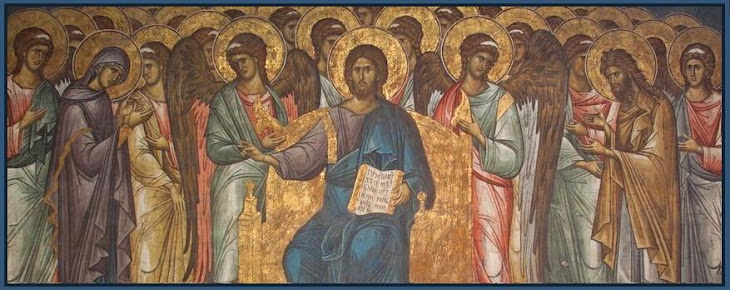
The Resurrection of Christ (source)
   
"Now in the springtime, when nature is wearing its most beautiful apparel, one feels inexpressible joy when this natural beauty is accompanied by a sublime spiritual state. Truly, our holy God has made all things in wisdom (Ps. 103:26)! The soul cannot get enough of beholding the beauty of nature. Oh, if man would only lift his mind above this earthly realm to the heavenly Jerusalem, to the inconceivable beauty of paradise where the finite, earthly mind ceases to operate! If here in exile, in this accursed land of weeping, our holy God has given us so much beauty to enjoy, I wonder how much there will be in the place where God Himself dwells! Truly, “the sufferings of this present time are not worthy to be compared with the coming glory and bliss (Rom. 8:18).” Theosis* in the heavens, my child! There the Lord our God will remove every tear from our eyes, and do away with all sorrow and pain and sighing, for there the angelic way of life reigns, and the only work is to chant hymns and spiritual odes! An eternal Sabbath is prepared for us where we shall live in joy with our Father, God, Who is waiting for us to be ready so that He may call us to Him forever! There every saved soul will live in an ocean of love, sweetness, joy, amazement, and wonder!" 
*Theosis: Connected with the theoria of uncreated Light, theosis, or divinization, is a participation in the uncreated grace of God. At this stage of perfection, one has reached dispassion. Through the cooperation of God with man, theosis is attained through the action of the transfigurative grace of God.
   
The Resurrection of Christ (source)
   
"Ah, if you could only see a little bit of paradise, if you could only hear for a few seconds the chanting of the sweet angels who shine with heavenly light and emit paradisiacal fragrance! Oh, what beauty! Unfortunately, we are in the dark about all these things.
There everything shines with limitless bliss. And what does the throne of Christ tell you? Christ the Master sits upon a throne, and due to His light no one can discern His sacred and most sweet face. Oh, what sweetness and beauty! What is more beautiful than this? This is truly paradise: to behold the face of our Jesus! Glory to Thy Cross, O Lord, and to Thy Resurrection!
O depth of the wisdom of God! O mysteries of the three sun Deity! Blessed is he who humbles himself like a child, obeying all commands with a guileless soul for the love of God! And woe to him who will hold on to his egotism, like me; how many divine gifts does he deprive himself of!
My children, run with humility to reach the Lord Who humbled Himself for our sake—our sweetest, beloved Christ, the light of our poor souls.
See what beauty awaits us! If you could only see how beautiful it is! You would disregard everything; you would even become like trash to be stepped on, just as long as you would not be deprived of everything that the sweet love of Jesus has prepared! These are the kinds of things my Elder used to tell me, and I am conveying them to you so that you may be sweetened. I am done—forgive me!
   
Christ, the Good Shepherd, Who came to find the lost sheep (source)
   
From Counsels from the Holy Mountain: Selected from the Letters and Homilies of Elder Ephraim of Arizona (sources 1 and 2)
Christ the Creator blessing creation (source)  
Christ is risen from the dead, by death, trampling down upon death, and to those in the tombs, He has granted life!
Truly the Lord is risen!

Saturday, August 23, 2014

St. Porphyrios: The pious chanter radiates the grace of God

St. Porphyrios of Kavsokalyvia (source)
 
"Byzantine ecclesiastical music is a teaching...it softens the soul of man, and slowly lifts him up to other spiritual worlds with his voice, which sows [spiritual] pleasure and rejoicing and thanksgiving, traveling to another, spiritual world. This is how it is in reality, my children. Do not look where you are hearing this and what they are doing. When you do this slowly, you enter in with such a spiritual form, and thus sense what to do.

"You can be an egotistical chanter, and rock and be pleased with your self and be hollow. You might have the voice that can move others, but he who is truly holy when he chants has something else. He does not have his voice alone. Together with his voice, which radiates with sound waves, he radiates grace with other mystical waves, which reaches the souls of men and moves them even more deeply.

"The hollow “musician” (let us call him), the egotist, has [pride] and is pleased [with this]. The holy musician sends forth waves together with his voice. This is a very great mystery. As a result, if you go to the Holy Mountain, and hear the monks chanting, even if you have a frozen and stony heart, when you hear them, [you say]: “There it is. This musician can [truly move someone]...”
   
(amateur translation of text from source)
 
An icon of some of the most prominent Holy Melodists and Hymnographers of the Orthodox Church: Sts. Romanos the Melodist, John Koukouzelis, Gregory Domestikos, John of Damascus, Joseph the Hymnographer and Kosmas the Poet (source)
  
Through the prayers of our Holy Fathers, Lord Jesus Christ our God, have mercy on us and save us! Amen!

Monday, August 26, 2013

St. Basil the Great on the Psalms


The holy Prophet David (source)
   
The following is a beautiful quote from St. Basil on the Psalms, which to this day, make up the majority of the hymns and services of the Orthodox Church.
   
St. Basil the Great on the Psalms
When, indeed, the Holy Spirit saw that the human race was guided only with difficulty toward virtue, and that, because of our inclination toward pleasure, we were neglectful of an upright life, what did He do? The delight of melody He mingled with the doctrines so that by the pleasantness and softness of the sound heard we might receive without perceiving it the benefit of the words, just as wise physicians who, when giving the fastidious rather bitter drugs to drink, frequently smear the cup with honey.

Therefore, He devised for us these harmonious melodies of the psalms, that they who are children in age, or even those who are youthful in disposition, might to all appearances chant, but in reality, become trained in soul. For, never has any one of the many indifferent persons gone away easily holding in mind either an apostolic or prophetic message, but they do chant the words of the psalms, even in the home, and they spread them around in the market place, and, if perchance, someone becomes exceedingly wrathful, when he begins to be soothed by the psalm, he departs with the wrath immediately lulled to sleep by means of the melody.

A psalm implies serenity of Soul; it is the author of peace, which calms bewildering and seething thoughts. For, it softens the wrath of the soul, and what is unbridled it chastens. A psalm forms friendships, unites those separated, conciliates those at enmity. Who, indeed, can still consider as an enemy him with whom he has uttered the same prayer to God? So that psalmody, bringing about choral singing, a bond, as it were, toward unity, and joining people into a harmonious union of one choir, produces also the greatest of blessings, love.

A psalm is a city of refuge from the demons; a means of inducing help from the angels, a weapon in fears by night, a rest from the toils of the day, a safeguard for infants, an adornment for those at the height of their vigour, a consolation for the elders, a most fitting ornament for women. It peoples the solitudes; it rids the market places of excesses; it is the elementary exposition of beginners, the improvement of those advancing, the solid support of the perfect, the voice of the Church. It brightens feast days; it creates a sorrow which is in accordance with God. For, a psalm calls forth a tear even from a heart of stone.

A psalm is the work of angels, a heavenly institution, the spiritual incense.
(Source)
   
Through the prayers of our Holy Fathers, Lord Jesus Christ our God, have mercy on us and save us! Amen!

Saturday, April 28, 2012

"That which we are doing is higher than chanting"

Christ is risen! Truly He is risen!

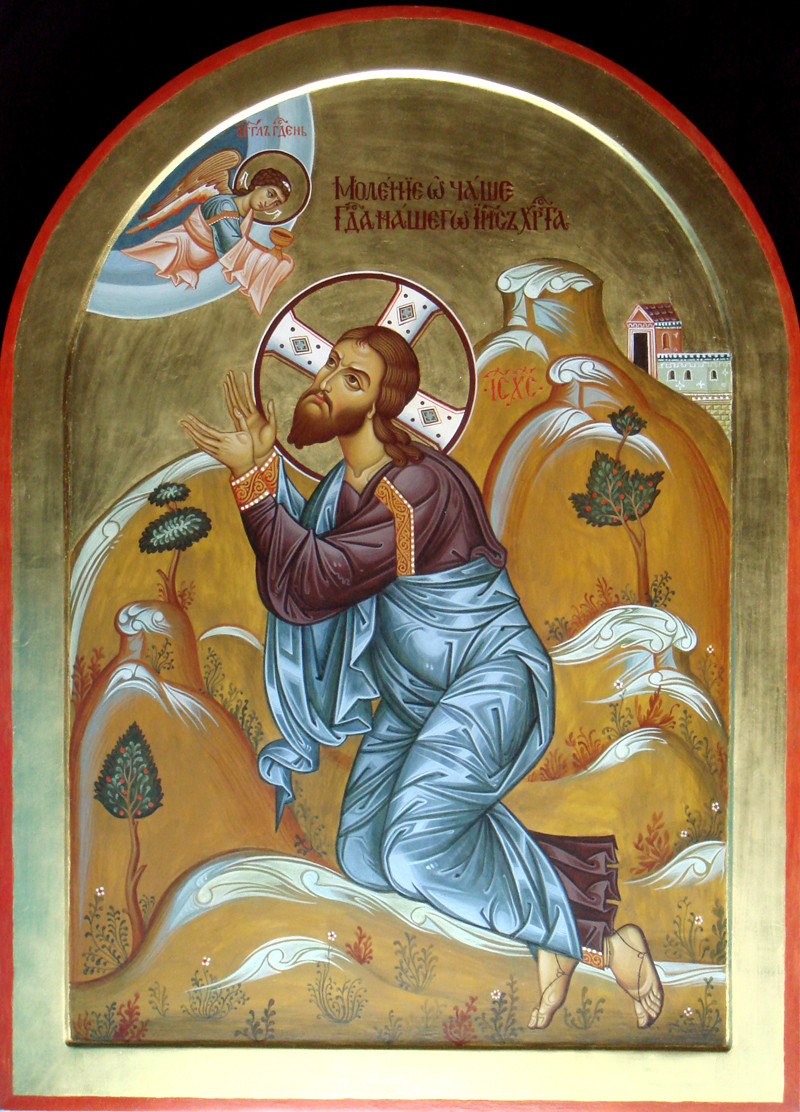
Christ praying in the Garden of Gethsemane (http://www.artlib.ru/objects/gallery_574/artlib_gallery-287028-o.jpg)
  
Note: The purpose of this anecdote is to encourage both monastics and laymen to pursue noetic prayer. Though some might feel that this demeans psalmody/chanting and the liturgical worship of the Orthodox Church, this is not so. The Fathers throughout history have been both hymnographers and chanters, and feel that this is the most appropriate form of common worship that is pleasing to God, and that there is a time and place for every form of true worship. However, the Fathers have always acknowledged that true prayer of the heart surpassess all, as St. John of the Ladder writes: "Men, whose mind has truly learned to pray, indeed converse with the Lord face to face, as those who have the ear of the king (that is his most close and trusted servants.)”
(http://www.orthodoxytoday.org/view/unceasing-prayer-bibilography-and-notes)
  
"That which we are doing is higher than chanting" (amateur translation)
An ascetic on the Holy Mountain once sent his disciple to sell his handiwork in Karyes. There, the disciple heard the most beautiful chanting, in the Church of the Protaton.

One day, he asked his Elder: “Elder, I have a thought. We here in the desert are not doing anything. You should see how they hymn God there: psalmody, choirs, and other things. Here we only pray with the prayer rope: “Lord Jesus Christ...”

Another day, the Elder came to him and said: “Let's go, my child, to see what those fathers are doing. Let's experience their typikon ourselves.”

And when they were there in church, the Elder bent down and whispered into his disciple's ear: “Truly, my child, here they are glorifying God.”

But before he could finish, a strong earthquake hit; everything was shaking.

Then, immediately, the chanters left their music books and the “terirems”, and pulled out their prayer ropes, crying out: “LORD JESUS CHRIST, SON OF GOD, HAVE MERCY ON US!!!”

The disciple turned to his Elder and said: “Elder, let's go to our work, to our hesychia, to our kalyve. That which we are doing is higher than chanting.”

Thus he was truly convinced that the best prayer is the prayer with the prayer rope.
(http://agioritikovima.gr/ΠΕΡΙ-ΖΩΗΣ/6225-proeuchi-me-to-kompochoini-i-chorοnties-kai-terirem)
  
Christ is risen from the dead, by death trampling down upon death, and to those in the tombs, bestowing life!
Truly the Lord is risen!

Saturday, February 11, 2012

St. Cassiane the Hymnographer, the Righteous

  
The Iconoclast controversy, which vexed the Church for over a hundred years, coincided with one of the most productive periods in church hymnography. Among those who made significant contributions in this field, the names of St. Andrew of Crete (+740), Saint John Damascene (+754), and Saint Theodore the Studite (+826) are well known. Less familiar are the women hymnographers of this period-the nuns Thecla, Cassiane and Theodosia-who demonstrated considerable talent in this same field. Of these, Cassiane won lasting distinction as the only woman whose works have entered into the liturgical tradition of the Church.

Cassiane was born in Constantinople some time before 805. Her father's aristocratic status gave Cassiane the privilege of a good education. She was tutored in both secular and sacred studies, and showed such exceptional aptitude for learning as to draw the attention of the great abbot of the Studion Monastery, Saint Theodore. He remarked likewise on her pious character, and indeed, from an early age she desired to become a nun. She was at the same time a spirited young woman of strong convictions and did not hesitate to express her opinions.

Cassiane was also gifted with physical beauty. When the heir-apparent, Theophilus, was in search of a bride, he narrowed the choice to six lovely maidens. Cassiane was one of them. When they gathered for the final decision to be made, Theophilus, who had heard of Cassiane's intelligence, approached her with the statement, "From woman came corruption" (referring to the fall of Eve), to which the quick-witted Cassiane responded, respectfully but surely, "But also from woman sprang forth what is superior" (i.e., God's incarnation from the Holy Virgin). Unnerved, Theophilus passed over Cassiane and offered the golden apple, the sign of his choice, to the more demure, and silent, Theodora.

It would have been a difficult match. Theophilus was an iconoclast and harshly enforced the imperial edict-renewed after the death of Empress Irene -forbidding the veneration of sacred images. Theodora, an iconodule, did not approve of her husband's policy, but she concealed her veneration of icons and kept quiet. Cassiane, by contrast, openly professed herself in favor of the holy icons. She not only spoke her mind, but she acted on her convictions, visiting iconodule monks in prison and sending them gifts. For her defiance of the imperial edict, she suffered persecution and was beaten with a lash.

  
Far from being disappointed at Theophilos' rejection, Cassiane was now free to unite herself to the bridegroom of her own choosing-the King of kings, Jesus Christ. She was tonsured a nun about the year 820, and founded a convent on one of Constantinople's seven hills, where she led "an ascetic and philosophical life" pleasing to God. An energetic abbess, she not only regulated the life of the convent, but she also found time to pursue her scholarly literary interests. She combined the talents of poet, theologian and musician, writing hymns and composing musical settings for them. Originally sung by her nuns, many of her compositions proved to have enduring value; twenty-three of her works were later incorporated into the liturgical books of the Church.

One of Cassiane's most brilliant creations is her hymn, sung in the Matins service for Holy Wednesday, on the subject of the sinning woman. Based on the story from St. Luke's Gospel (7:36-50), this hymn blends dramatic and narrative elements to create a masterpiece of hymnography which manages, in a few short lines, to present the essential Christian drama of sin and salvation.

The most familiar of Cassiane's works are undoubtedly the irmoi in the Matins canon for Holy Saturday, which is repeated at the Midnight Office for Holy Pascha: "Weep not for me, O Mother, beholding in the tomb the Son Whom thou hast conceived without seed in thy womb, for I shall arise..." With these stanzas, Cassiane achieves a taut sense of anticipation, providing a marvelous momentum into the climatic celebration of Our Lord's Resurrection.

Cassiane had a forceful personality: "I hate the fool who acts the philosopher," she wrote. "I hate silence when it is time to speak." And this, combined with her many talents and keen intellect makes her an appealing model for today's woman. But it is the fact that she lived only for God, to the end of her life, that made her a saint.

"One of Cassiane’s biographer’s comments, “She lived only for God, to the end of her life.” Thus, after
dedicating her life to Christ and the Church, and adorned with the diadem of virginity and the crowns of a confessor, an ascetic, and a hymnographer, our holy mother Cassiane reposed in the Lord."

  
Apolytikion in the Plagal of the Fourth Tone
That which was created in the image of God was preserved in you, O Mother; for taking up the cross you followed after Christ. By your deeds you have taught us to reject the flesh for it passes away, but to care for the soul as a thing immortal. Therefore, O venerable Cassiane, your soul rejoices with the angel

Through the prayers of our Holy Fathers, Lord Jesus Christ our God, have mercy on us and save us! Amen!

Thursday, September 29, 2011

St. John Koukouzelis, the Righteous Chanter of Great Lavra

St. John Koukouzelis - Commemorated October 1 (http://christopherklitou.com/icon_1_oct_john_koukouzelis.htm)

John Kukuzelis was born in Dyrrachium, the birthplace of the Great Justinian, in Macedonia, probably during the twelfth century. His father died while he was still a child, and his devout mother placed him in school to learn to read and write and to chant. It so happened that he was noticed during a search for talented students and accepted into the school of the imperial court in Constantinople. Here he attracted the attention of the Emperor Comnenos and his court because of his exceptionally fine voice, comely appearance and native talent. Soon he surpassed all his school mates and eventually became the principal chanter for the court.

It was during his school years that he received the nick-name Kukuzelis. Because he was of Bulgarian birth, when he entered the imperial school he did not know the Greek language very well. Once his class-mates asked him what he had eaten for lunch. He replied, "Beans and greens," using the Greek word for broad beans, "kukia", and the Slavic word for greens, "zelie"; hence the name coined first in jest by his school mates, Kukuzelis.

The young John was constantly being showered with flattery and all kinds of favors because of his very moving chanting and his modesty. But in the midst of all this, his heart was burdened with a sense of secret sorrow which he himself could not explain, and this was coupled with an indifferent attitude towards the pleasures of life. John was languishing among all the charms of the court, among all the bright and promising hopes for the future, and he languished all the more, because he had no bosom friend to whom he could reveal his sorrow, who could sympathize with him and alleviate his sorrowful yearning.

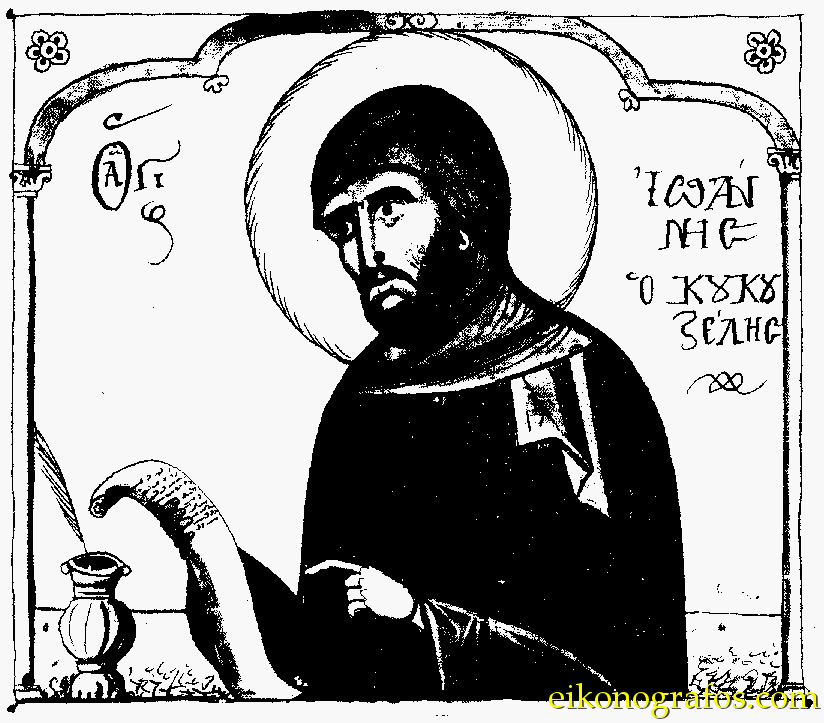
St. John Koukouzelis, depicted in the traditional chanter's garments of Constantinople (http://kukuzel.files.wordpress.com/2009/02/joan-kukuzel-johanneskapelle11.jpg)

His sufferings were multiplied when he learned that the Emperor had decided to marry him into a wealthy family. The very thought that because of the temporal delights of life he could lose the joy of the Kingdom of God so distressed the young John that he made up his mind that surely he must run away from the capital and hide himself in some remote desert hermitage. God beheld the purity of his intentions and came to his aid in realizing them.

When the chaste young John thus grew weary of the life at court and was thinking of a way to escape, the abbot of the Grand Lavra on Mount Athos arrived in Constantinople on monastery business. It so happened that John saw this elder and his young heart trembled with joy. In his childish and innocent way he admired the reverent appearance of his visitor from the Holy Mountain. He made his acquaintance, revealed his thoughts and intentions to him and asked for his instructions. When the elder not only approved but even blessed them, John followed almost in his footsteps when he left the capital to return to Athos.

Exchanging the fine silken garments of the court for a hair shirt and a pilgrim's staff, John soon appeared at the gates of the Grand Lavra. When the gatekeeper inquired where he was from and what he wanted, John replied that he was a simple shepherd and that he wanted to become a monk.
"You are too young yet," the gatekeeper remarked.

"It is good to take on the yoke of the Lord in one's youth," John meekly replied and began to beg to be presented to the abbot. The gatekeeper took him to the abbot, who was happy to accept him, because he was in need at that time of a shepherd to look after the goats.

After a short period of trial, John was tonsured and assigned the duty of looking after the monastery's flocks on the mountain pastures. This duty, which was completely new for him, overjoyed the devout young chanter· He went off with his flock into the depths of the Athonite wilderness, where his favorite occupation was meditation and prayer.

In the meantime the Emperor learned that his favorite chanter had run away. He was deeply hurt and sent special agents off to search everywhere for the young chanter. But being hidden by God, John remained totally unknown in spite of the fact that the Emperor's agents came to Mount Athos and were even in the Grand Lavra of St. Athanasius. No one could imagine that the poor shepherd in worn and tattered rags was a favorite of the imperial court.

Quietly and peacefully John passed his days and years in the desert; he could not get his fill of joy from his new circumstances. Once, when he was in a state of compunctionate and deep thought, he sat with his peacefully grazing flock. His thoughts went hack over all his past life and his heart trembled with the sense of a living gratitude to God and His all-hymned Mother for Their providence concerning him.

After looking about to make certain there was no one else in that wilderness that could hear him, John began to chant. Just as before, the divine words of the hymns and his angelic voice resounded in graceful melodies, but now they echoed through the wild desert heights of Athos. John was deeply moved and he chanted with all his skill and to his heart's content.

However, there was a certain hermit, who lived secretly inside a cave in a nearby diff. Suddenly this desert-dweller heard the most beautiful chanting ringing through that secluded wilderness. Quietly he came out of his cave and started to investigate where the chanting was coming from. Finally he discovered that the sweet sounds of the angelic chanting, which moved him to tears and brought his compunctionate soul into a state of special grace, was coming from a shepherd looking after a flock of goats. The desert-dweller was even more astonished when he noticed that the goats were not grazing under the melodious sounds of their shepherd's voice; these dumb beasts with bated breath encircled their shepherd and stood immovably staring before him, as if they were hypnotized or charmed by his angelic, rather than human, voice.

When he saw all this, the desert dweller made his way to the lavra and told the abbot about the marvelous shepherd and his extraordinary chanting, John was summoned from his secluded wilderness. "I adjure you by God,". said the abbot severely, !."Tell me the truth. Are you the court chanter John Kukuzelis who is being sought out by the Emperor?"

Falling at the abbot's feet, John begged his forgiveness, uttering through tears, "I am an unworthy sinner and I beg you with all my heart: let me remain with those same duties you assigned to me at the beginning. Let me look after the goats, so the Emperor will not find out about me."

The abbot could scarcely recognize in this pale and emaciated shepherd with his down-cast gaze the imperial favorite whom he had spoken with in Constantinople, a youth in his prime with a vibrant and captivating appearance. The abbot heeded his tearful request and left him to tend the goats as before.
  

However, the abbot was afraid the Emperor might hear some rumor about the discovery of this goat-herd chanter. So he set out for Constantinople and personally appeared before the Emperor.

"Have mercy, O sovereign, on your slave!" the elder cried out, kissing the feet of his monarch. "In the name of God, Who seeks the salvation of each and every one of us, I beg you, listen with fatherly condescension to my petition and grant it, so that God will fulfill all your desires in His good pleasure!"

Moved by the sincere and subject humility of the elder, the Emperor lifted him up and kindly asked, "Father, what is it that you want from me?"

"Forgive me, my sovereign, if I am bold before your Majesty! My request is insignificant for you to grant it. It is easy for you and there is nothing that can stop you except your own word. Moreover by granting it you will provide consolation and joy for the very angels and a great boon for my lavra."

"What is it that you want?" the Emperor gently replied. "Tell me and I will grant you everything."

"Your kingdom is sacred," the abbot reverently remarked. "It cannot be changed."

"Exactly, exactly, my father," the Emperor said, touched by the simplicity of the old monk. "What is it that you want?"

"I beg and beseech your Majesty to grant me one of your subjects who is seeking his eternal salvation and is praying for your Majesty. Nothing else," said the abbot, and fell silent.

"At your pleasure," the Emperor smiled with relief. "And what is his name?"

"First you must assure me in writing that you will release him to me," said the abbot, and then added timidly, "He is already in our lavra and has been tonsured to the angelic schema."

The Emperor commanded that the necessary documents be drawn up and affixed his signature. "His name is John Kukuzelis."

"Kukuzelis!" the Emperor exclaimed, and tears rolled from his eyes and fell on his royal breast. Then the abbot related everything in detail about John. The Emperor listened attentively and finally cried out with emotion, "I miss my favorite chanter! I miss my dear John! But if he has already been tonsured, there is nothing I can do. The salvation of his soul is what is most important. Let him pray for my salvation and for my kingdom."

The elder blessed the Lord and his merciful sovereign and joyfully returned to his lavra. Thus John was given his freedom to continue hymning the King of the heavens unimpeded.

Soon he received the blessing from the monastery to build himself a cell dedicated to the Archangels. Here he spent six days of the week in solitude. On Sundays and other feast days he came to the monastery's main church, where he took his place on the right choir and chanted with compunction along with the other chanters.

Once he chanted with particular inspiration on the Saturday of the Akathist Hymn. After the vigil he sat in one of the stalls on the choir opposite the icon of the Theotokos before which the akathist hymn had just been'' chanted. Because he was tired he fell into a light sleep.

Suddenly he heard a meek voice say, "Rejoice, John!" He looked, and there in a glow of heavenly light the Theotokos was standing before him. "Chant unto me and never stop chanting," she continued. "For this I will never abandon you."

The miraculous icon of Panagia Koukouzelissa, treasured by the Monastery of Megiste Lavra, and before which St. John chanted, and the Theotokos appeared to him (http://analogion.com/Pan_Koukouzelissa_Gr_Lavra.jpg)

At these words the Theotokos placed in John's hand a gold coin and then disappeared. John woke up and saw that there actually was a gold coin in his right hand. Tears of sincere gratitude flowed from the eyes of the chanter. He wept and blessed the unspeakable mercy and blessing he had received from the Queen of Heaven. The gold coin was placed on the icon of the Theotokos before which John had chanted and been granted this heavenly vision. Amazing miracles were worked by this icon which to this day is kept in a chapel just inside the main gates of the Grand Lavra.

[Note: Another tradition states that St. John actually was chanting a composition of his to the Theotokos when she appeared to him. This hymn ("Anothen oi Prophytai") is still chanted to this day during Orthros at the vesting of the Bishop:
"Of old, the prophets aforetime proclaimed thee, the Jar of Manna, the Rod of Aaron, the Tablet, the Lampstand, the Ark, the Table, the Mountain Unhewn, the Golden Censer, the Gate Impassible, and the Throne of the King. Thee did the Prophets proclaim of old." (http://www.stanthonysmonastery.org/music/Orthros/Finale%202003%20-%20%5B3995_Anothen%5D.pdf)]

From that time John carried out his duties in the choir even more fervently than before, and he was never absent from the right choir. However, because of his ascetic feats in his cell as well as from standing at the long services in church, his legs swelled up and were covered with infected sores full of maggots. But John did not suffer long. Once again, just as before, the Theotokos appeared to him in a light sleep and quietly told him, "From now on, be healthy?' The sores vanished and the grateful John spent the remainder of his days in astounding labors of the ascetic life, in fastings and vigils. He was especially gifted with deep humility.

[He also worked hard on the discipline of church singing, gaining the title of both master teacher and regent (overseer).  He arranged and compiled melodies for church stichera verses, troparia and kontakia. He edited texts of hymns and wrote his own troparia. Some of his compositions are also in the following manuscripts: "A Book, by the Will of God Encompassing All the Order of Progression of Church Services, Compiled by Master Teacher John Koukouzelis," "Progression of Services, Compiled by Master Teacher John Koukouzelis,""From the Beginning of Great Vespers through to the Completion of the Divine Liturgy," and "The Science of Song and Singing Signs with all the Legitimate Hand-Placement and with all the Arrangements of Song." (http://ocafs.oca.org/FeastSaintsLife.asp?FSID=102832)

Also note that many of St. John's original compositions and melodies exist to this day. For example, see: "Praise the Lord - Long Version, First Mode, by St. John Koukouzelis: http://stanthonysmonastery.org/music/download.php?file=Chrys/Finale%202003%20-%20%5B1110_One%20is%20Holy.pdf"]

St. John was spiritually enlightened to such a degree that he was found worthy to learn the hour and day of his death. He bid a tender farewell to all the brethren who came to him and after asking to be buried in the church of the Archangels, which he had built himself, with a blessed smile on his prayerful lips, he passed away to the Lord on the first day of October.

Now he dwells in the heavens together with the choirs of the angels and with lips no longer earthly and corruptible he is never silent in glorifying the Ever-glorified, unto Whom from us also be honor and glory and thanksgiving unto the ages of ages. Amen.
A. Sources: Athonite Patericon (in Russian) and the Great Synaxarion (in Greek) (http://www.roca.org/OA/104/104g.htm)

A chanting site with information about St. John Koukouzelis: http://analogion.com/Koukouzelis.html.
  
  
Apolytikion in the Fourth Tone (amateur translations)
Being zealous for righteousness in the prime of your life, you hastened to the Holy Mountain, and struggled perfectly. Therefore your Monastery is enriched by each of the hymns granted by you, as a precious gift. Therefore, O John, intercede with the Lord.
  
Kontakion in the Plagal of the Fourth Tone
Let us praise the chosen one of the Lord, and let us fervently honor his virtues, for he lived a life of asceticism, keeping all the commandments of the Lord, steadfastly desiring perfect virtue, to whom we cry out: Hail, O divine teacher.
   
Oikos
You called an angel from your youth, as having the voice of the Angels, and along with your divinely-granted voice, you founded virtue, O Righteous one, through much asceticism, and therefore were made worthy to hear:
Hail, you who had a gifted voice,
Hail, you who had the appearance of a fisherman.
[i.e. simplicity, humility]
Hail, holy dweller of a palace,
Hail, teacher of the chanters of Athos.
Hail, for you despised the garments of rulers,
Hail, for you prepared monastic virtues.
Hail, for you were shone the boast of maestros,
Hail, for you properly hastened towards the Mountain.
Hail, star enlightening Athos,
Hail, father of all things desired.
Hail, through whom music is renewed,
Hail, through whom new works were created.
Hail, O divine teacher.
  
Synaxarion
On the first of this month (October), our Righteous Father John the chanter, who was called Koukouzelis, who struggled in humility in the Holy Monastery of Great Lavra on Athos, and reposed in peace.
  
Verses
Now unto the Mother of God does thou chant on high,
Together with the immaterial hosts, O blessed John.\
  
For the full service of St. John Koukouzelis in Greek, see: http://voutsinasilias.blogspot.com/2010/10/1_04.html.
  
St. John Koukouzelis (Icon courtesy of www.eikonografos.com used with permission)
  
Through the prayers of our Holy Fathers, Lord Jesus Christ our God, have mercy on us and save us! Amen!