Showing posts with label St. George Karslides. Show all posts

Thursday, October 31, 2019

Akathist to St. George Karslides

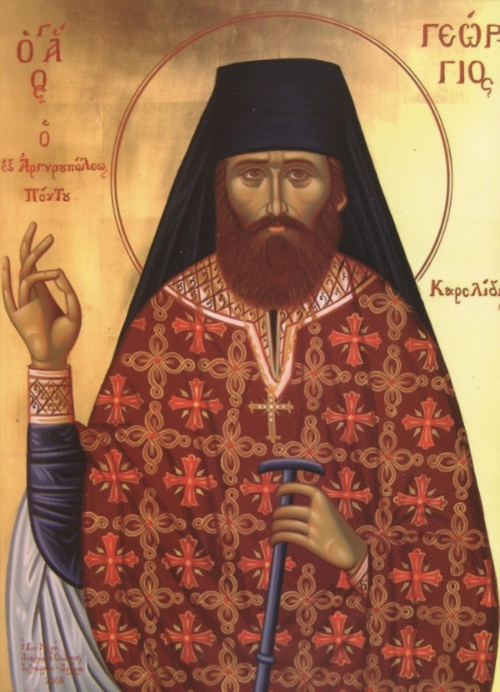
St. George Karslides (source)
  
Akathist to St. George Karslides the Confessor, our New Venerable Father of Drama and Pontos, Founder of the Monastery of the Ascension of Christ, Sipsa
written by Dr. Charalampos Bousias
  
Kontakion in the Plagal of the Fourth Tone
The indomitable sower of virtue, who sowed piety in the furrows of souls, and whom we hymn nobly with love, for in these latter days he founded the Monastery of the Ascension in Drama, as we cry out in fitting hymns: Rejoice, O blessed George.
  
Oikoi
An angel bearing flesh, you were shown to be, while your nous was made to dwell in the heavenly mansions, O George, (3), for you were shown to all to be a surpassing one and the type of blessed ascetics, therefore we bless you, crying out in reverence:
Rejoice, foundation of chastity,
Rejoice, radiance of goodness.
Rejoice, the rejoicing of pious people of Drama,
Rejoice, example of God-bearing ascetics.
Rejoice, the ever-verdant and glorious root of Pontos,
Rejoice, undying and most-radiant torch for the world.
Rejoice, founder of the Monastery of the divine Ascension,
Rejoice, great defender and protector of Drama.
Rejoice, lamp-lighter of the merciful life,
Rejoice, our star of brotherly love.
Rejoice, you who confessed the faith,
Rejoice, you who attracted the grace of God.
Rejoice, O blessed George.
  
You lived a divine life in these latter days, O offspring of Argyroupolis of Pontos, and ever-verdant protector and defender of the people of Drama, as you hastened to heaven, O George, unceasingly chanting: Alleluia.
  
Being the Elder of the honored Monastery of the Ascension in Drama, O George, you built it with your very own hands, and there you lived in chastity with faith, while your divine Relics are ever venerated there, as you hearken to those you cry out to you:
Rejoice, fragrance of new Monastic Saints,
Rejoice, ode of godly gifts.
Rejoice, newly-lit light of Pontos,
Rejoice, newly-founded foundation of grace.
Rejoice, newly-shown life of the age to come, equal to the Angels,
Rejoice, fragrant cinnamon of an honorable life.
Rejoice, for you sanctified your Monastery through your pains,
Rejoice, for you grant holiness richly to Drama.
Rejoice, defender of prayer and nepsis,
Rejoice, vessel of love of the Creator.
Rejoice, you who inspire the struggles of the Venerable,
Rejoice, instrument of many wonders.
Rejoice, O blessed George.
  
Drama was made chaste through your asceticism and your chaste way of life, O blessed George, and you unflinchingly protect it in a godly manner, and it is sanctified by the container of your wholly sacred Relics, O Venerable One, compelling us to ceaselessly chant: Alleluia.
  
Having fervor engraved within your heart, O George, through your divine forbearers, you were watered with the sacred and living streams of the Orthodox faith, and you chanted mindfully to the greatly-compassion Lord, as we cry out:
Rejoice, new boast of the faith,
Rejoice, divine house of grace.
Rejoice, director towards greater wisdom,
Rejoice, most-ready deliverer of the faithful.
Rejoice, telling that is spoken of by God-bearing ascetics,
Rejoice, all-wise reading of pious strugglers.
Rejoice, for you came from Pontos to Drama,
Rejoice, you who play the beautiful-sounding lyre of the Most-High.
Rejoice, dweller in the divine mansions,
Rejoice, foretype of divine wonders.
Rejoice, icon of the life equal to the Angels,
Rejoice, canon of love for the Creator.
Rejoice, O blessed George.
  
Having fiery faith and an icon of the All-Pure [Theotokos], O George, you were granted these joys from your Mother before her repose, and you hastened to Theodosiopoulos, ceaselessly chanting: Alleluia.

St. George Karslides (Source)
  

You came to Tbilisi of Georgia, O thrice-blessed George, at the inspiration of God, and hastened to the sacred Monastery, in which you fought the good fight, as a man equal to the Angels, therefore, we cry out to you these things:
Rejoice, beautiful depth of struggles,
Rejoice, precious stream of accomplishments.
Rejoice, handiwork of Him Who fashioned all things,
Rejoice, beautifully-sounding bird of the Most-High.
Rejoice, for you bore ascetical pains in your flesh,
Rejoice, for you showed to everyone the divine strength of your soul.
Rejoice, for you spat upon the mania of the demons,
Rejoice, for you gladdened the choir of the Angels.
Rejoice, steadfast support of the faith,
Rejoice, radiant knowledge of grace.
Rejoice, sacred defender of piety,
Rejoice, scepter against the madness of the enemy.
Rejoice, O blessed George.
  
Desiring, O divine George, to join the choir of the Angels, they rejoiced together with you at your sacred tonsure, and at that hour, the bells of the Monastery began to ring in a strange and wondrous manner, and the mouths of your sacred fellow monastics were opened to chant: Alleluia.
  
You feet were bound by the shackles of the faithless who had fallen into terror and wretchedness, that you might receive the incorruptible crown of the Confessor, O Father George, and from all of those who honor you, you receive these reverent cries:
Rejoice, the stream of piety,
Rejoice, cradle of the wisdom of God.
Rejoice, for you endured prison like the bodiless,
Rejoice, for you showed wondrous strength as a godly one.
Rejoice, for with humility, you drove away the terrible stench of lawlessness,
Rejoice, for you truly bore pains in your flesh.
Rejoice, for you endured difficulties without complaining,
Rejoice, for you cast out the desires of the flesh.
Rejoice, for you join the choirs of the Angels,
Rejoice, for you are the unsleeping defender of the faithful.
Rejoice, krater of health for the pious,
Rejoice, star of spiritual goodness.
Rejoice, O blessed George.
  
You endured evil things in your flesh from the faithless, while three times you were shot at unjustly, but by the divine will, you remained unharmed, as you chanted hymns to God Who saved you, O George, as you cried out to Him in reverence: Alleluia.
  
You shown forth with the lightning rays of the priesthood, O George, and were made to behold things to come as present, and things far off as close, through your pure heart, O Saint. Therefore, with hymns we praise you, crying out in faith:
Rejoice, vessel of the graces of God,
Rejoice, container of many wonders.
Rejoice, flower of virtue and prudence,
Rejoice, type of expectation for heavenly glory.
Rejoice, for the Creator magnified you greatly,
Rejoice, for the God-man radiantly glorified you.
Rejoice, for you healed the afflictions of the faithful,
Rejoice, for you showed forth the grace of prophecy.
Rejoice, you who were filled with the love of God,
Rejoice, war against the delusion of the enemy.
Rejoice, ray of the wisdom of the Most-high,
Rejoice, all radiant bolt of piety.
Rejoice, O blessed George.
  
Praising your way of life at all times, I hymn your coming to the village of Sipsa, in which you founded a monastery in honor of the glorious Ascension of the Lord, while I cry out with melodious hymns: Alleluia.
  
St. George Karslides (source)
  
The streams of your sacred sweat you mixed with clay to build your monastery of the Divine Ascension, and in it, you struggled ascetically with pains and chastity wondrously, O George, and you open the lips of the pious to cry out to you:
Rejoice, example of asceticism,
Rejoice, myrrh vessel of knowledge.
Rejoice, refuge for the pious people of Drama,
Rejoice, protecting wall for the faithful in dangers.
Rejoice, lily of holiness gladdening the faithful,
Rejoice, pillar of goodness and canon of meekness.
Rejoice, all-bright lamp of struggles day and night,
Rejoice, precious boast of ever-flowing tears.
Rejoice, spigot of prayer and understanding,
Rejoice, unassailable wall of silence and nepsis.
Rejoice, the light and protection of the faithful,
Rejoice, horn of godly providence.
Rejoice, O blessed George.
  
You work strange wonders like a many-headed waterfall, through the container of your Sacred Relics, O Wonderworker George, and we who venerate them reverently offer up a hymn to Christ Who made you wondrous, to Whom we cry out in compunction: Alleluia.
  
You came to Drama living a life of joy, and together were numbered with the choirs of the Venerable Saints and rejoiced together with the radiant Angels, as your newly-lit flame reached the City Above [of Heaven] through your faith, and we cry out in joy:
Rejoice, harp of the wisdom of God,
Rejoice, lyre of dispassion.
Rejoice, the fire-bearing teacher of the people of Drama,
Rejoice, you who followed the Unmercenary Physicians.
Rejoice, you who were seen as a boast for pious Priests,
Rejoice, very-precious adornment of God-bearing Ascetics.
Rejoice, for your eye beholds your refugees in dangers,
Rejoice, for your mouth offers teachings of salvation.
Rejoice, vessel showing the way to Heaven,
Rejoice, frost that crushes the enemy.
Rejoice, you who show us the way to God,
Rejoice, sanctuary against noetic foes.
Rejoice, O blessed George.
  
O Father, you were shown to be a vessel of the Holy Spirit in these latter days, and a myrrh vessel of incomparable streams of wonders, and you became the defender and unsleeping protector of the people of Drama, O George, your refugees, who in unflinching faith, cry out to you: Alleluia.
  
The all-sacred container of your Holy Relics truly pours forth streams of healings for the choirs of the faithful who embrace them with reverence, O Venerable One, and they cry out to you, in this Monastery built by you:
Rejoice, spring of wonders,
Rejoice, deliverer of those in afflictions.
Rejoice, you who received the gift of healings,
Rejoice, you who partake of the drink of incorruption.
Rejoice, very-precious vessel of the graces of God,
Rejoice, you who crushed the innumerable ranks of enemies.
Rejoice, you who alleviate the pains of the faithful,
Rejoice, you who strengthen the pious in sickness.
Rejoice, our ready help,
Rejoice, sacred promontory of the Venerable.
Rejoice, speedy physician of those ill,
Rejoice, protection from the terrible demons.
Rejoice, O blessed George.
  
Through your providence, and speedy help, O George, and the protection that you bring, Drama is made holy through you, and with your help, O Father, and having you as a protector, O Venerable One, she honors you and chants in faith to him who strengthens her: Alleluia.
  
St. George Karslides (source)
  
You traveled the way of pain and difficulties of the Venerable Fathers, O George, and became a radiant icon and pious prototype of asceticism. Therefore, we bless you, crying out to you in compunction:
Rejoice, type of the monastic way,
Rejoice, lamp of wonders.
Rejoice, you who were nourished by noetic prayer,
Rejoice, emblem of sacred compunction.
Rejoice, greatly-voiced trumpet of the way of God,
Rejoice, melodious instrument of an all-spotless life.
Rejoice, divine founder of the Monastery of the Ascension,
Rejoice, deliverer of the choir bearing the name of Christ.
Rejoice, for your light shines to the ends of the earth,
Rejoice, rain that waters the whole world.
Rejoice, spring of heavenly gifts,
Rejoice, tree pouring forth the fragrance of wonders.
Rejoice, O blessed George.
  
We chant melodious hymns and divine praises to you, O thrice-blessed George, as the unflinching protector of the people of Drama, and they in faith embrace the container of your Relics, O Venerable One, crying out to Him Who glorified you: Alleluia.
  
Your precious struggles have shown throughout all creation, O George, with the multitude of your bright and wondrous and sacred ascetical deeds, shining anew with the faith of Christ, and driving away the clouds of darkness for those who cry out to you:
Rejoice, light of confession,
Rejoice, lamp of dispassion.
Rejoice, you who enlightened the city of Drama,
Rejoice, you who gladdened the group of your refugees.
Rejoice, for you shown forth from famed Pontos,
Rejoice, for you drove away the wiles of the enemy.
Rejoice, ever-verdant shoot of dispassion,
Rejoice, wall of piety founded by God.
Rejoice, song of the love of Christ,
Rejoice, ray of nepsis golden with light.
Rejoice, protector of the virgins of your Monastery,
Rejoice, you who cease the evils of the demons.
Rejoice, O blessed George.
  
The sacred Hierarch of Drama removed your Relics from your grave, that richly poured forth grace, granting unassailable joy to the faithful who now venerate them in faith, O George, crying out to Christ: Alleluia.
  
We chant of the wonders that you worked, O George, and we hymn you as a soul-nourishing worker of virtue, and an all-radiant and bright star of the faith of Christ, that illumines the ends of creation, as we cry out:
Rejoice, [bearer of the] Uncreated Light,
Rejoice, horn of goodness.
Rejoice, defender of the Bishop of Drama,
Rejoice, protector of the choir bearing the name of Christ,
Rejoice, unsleeping protector your pious Nuns,
Rejoice, most-sacred rod delivering the faithful.
Rejoice, joyous son of Macedonia,
Rejoice, newly-founded pillar of the Church.
Rejoice, offspring of Argyroupolis,
Rejoice, light of fasting and nepsis.
Rejoice, equal in zeal of the divine Angels,
Rejoice, equal in way of the former Venerable Saints.
Rejoice, O blessed George.
  
O Father beloved by God, Who richly sowed fruit within your soul, O George, (3) and founder of the Monastery of the Ascension, stand beside us as a defender, and intercede that we might obtain virtue, we who praise you, and in unflinching faith cry out to you: Alleluia.

And again the Kontakion of the Saint.
  
(source)

St. George Karslides (source)
  
Through the prayers of our Holy Fathers, Lord Jesus Christ our God, have mercy on us and save us! Amen!

Wednesday, November 5, 2014

St. George Karslides heals the Metropolitan

Metropolitan Benediktos of Philadelphia, venerating the holy tomb of St. George Karslides (source)
  
On the feast of St. George Karslides in Drama (11/4/14), was found the Metropolitan Benediktos of Philadelphia as a pious pilgrim.

His Eminence wished to thank the celebrating Saint from his heart for the miracle that he worked for him recently.

According to information from Romfea.gr, a short time ago, there appeared a serious problem with his vocal cords.

He made numerous visits to special physicians, without finding the cause of his problem or more importantly giving him healing.

When, at the suggestion of the Abbess of the Holy Monastery (of the Ascension of Christ, Sipsa), Gerontissa Porphyria, he drank some holy water from the grace-flowing relics of St. George, and after prayer, his throat was healed.

As a sign of thanksgiving for the Saint's miracle, he vowed to take a cow to his monastery, on his feast.

The fulfillment of his vow occurred on November 4th, 2014, and the pictures are incontrovertible.

It should be noted that the Metropolitan of Philadelphia was granted hospitality like Abraham by the local Metropolitan Paul of Dramas, who had been his friend for many years.
(source)
  
The Metropolitan bringing a cow to the monastery as a gift (source)
     
Through the prayers of our Holy Fathers, Lord Jesus Christ our God, have mercy on us and save us! Amen!

Wednesday, November 14, 2012

The Holy Forty Divine Liturgies

Christ communing His Holy Apostles (source)
 
The Holy Forty Divine Liturgies ("Sarantoleitourgo")
During the forty day period prior to the celebration of the Nativity of our Lord*** it is a tradition for priests to celebrate daily the Divine Liturgy. The Forty Liturgies celebrated during this time are a great blessing not only for those who participate, but also for those commemorated among both the living and reposed. As St. Ignatius of Antioch writes: "Take heed, then, often to come together to give thanks to God, and show forth His praise. For when you assemble frequently in the same place, the powers of Satan are destroyed, and the destruction at which he aims is prevented by the unity of your faith" (Eph. 13). The power of the Divine Liturgy isn't magical, but it is a manifestation of love and unity in Christ. It teaches us to forgive, to have love for one another, and to be united in Christ as one body. In such an assembly, where the living and reposed are commemorated, great blessings follow for all.

The Divine Forty Day Liturgies of the Nativity season on behalf of the living and reposed are a manifestation of the love we should have for one another as members of the Church. Nothing makes more real and present the love of Christ for mankind, who took on flesh for the salvation of sinners, then the daily offering of the Divine Eucharist for the forgiveness of sins and life everlasting of the living and reposed.


As St. John of Kronstadt writes: "In the Divine Liturgy is celebrated the Mystery of Love...[O perfect love! O love which embraces all! O strongest love! What can we offer in thanksgiving to God for His love for us? This love is found in the sacrifice of Christ, which is offered for the liberation of all from every evil...]"

And Elder Paisios advised regarding the need to pray for the departed: "Leave in your prayers room for the reposed. The dead can do nothing for themselves. The living can. Bring to the church prosphoro, and give the names of the reposed to be commemorated by the priest in the proskomede. Do also memorials and trisagia. But the trisagion without the Divine Liturgy is nothing. The greatest thing we can do for someone is Forty Liturgies. It would be good to tie it in together with almsgiving."

St. Symeon of Thessaloniki writes of the commemoration of the reposed during the Divine Liturgy: "During the Liturgy their portion which is placed on the diskos invisibly partakes of God, they are cleansed through the Sacred Blood and commune,...and they are consoled...and they rejoice in Christ." 

And St. John Chrysostom writes: "You should not have any doubt whatsoever that the dead will benefit spiritually. The priest does not plead in vain in the Holy Prothesis or at the Holy Table for the reposed in Christ, with faith in the God-man Lord."
(http://www.johnsanidopoulos.com/2011/11/divine-forty-liturgies-and-nativity.html)
   
***Note: There are many places which also celebrate the Forty Divine Liturgies at other periods of the year (e.g. during the forty days after Pascha), while there are other places which, through the grace of God, celebrate the Divine Liturgy every day, for the healing, forgiveness and sanctification of the faithful.
   
On the benefit of the Forty Liturgies for the Departed
Elder Daniel of Katounakia (+1929) was originally from Smyrna, and at one point while he was a monk on Mount Athos he lived at Vatopaidi Monastery. One of his obediences was to travel on business for Vatopaidi to Smyrna where he stayed for nine months.

When Elder Daniel was a young boy in Smyrna, there was a simple Christian named Demetrios, who was known for his great virtue and piety, that would counsel and admonish him with heavenly wisdom. Upon his return to Smyrna the elder had heard that Demetrios was dead and he wished to meet with Demetrios' son George to ask him about it. He writes: "As soon as I arrived, I considered it my inviolable duty to first of all visit George, the son of the ever-memorable Demetrios. I questioned him minutely about the death of his father, of whose repose I had heard from many people."

George described the details of his virtuous father's death to Elder Daniel with tears in his eyes, yet one event was so remarkable that Elder Daniel decided to record it for our spiritual benefit.

Archimandrite Cherubim, in his book Contemporary Ascetics of Mount Athos (vol. 1, pp. 241-245), describes the event as follows:

Reaching the sunset of his earthly life, the divinely-enlightened Demetrios knew beforehand, by the grace of God, the day of his death. On that day he asked a certain devout, guileless, and saintly priest, Fr. Demetrios, to come to him.

"I will die today, my father," he said to him. "I beg you, tell me what I must do at this critical time."

The priest knew of his virtuous life; he knew that he had confessed, received Holy Unction, and had Holy Communion several times. Seeing his desire, however, it came to him to suggest the following:

"If you wish, give a command that after your death forty Liturgies should be served for you in a country chapel."

The dying man accepted the priest's suggestion with joy. A little while later he called his son.

"My son, I ask one favor. I ask that after my death you arrange to have forty Liturgies served for me in some church far away from the city."

"Give me your blessing, Father, and I will promise you to fulfill your wish," was the reply.

After two hours the man of God gave up his spirit. Without delay, his good son addressed Fr. Demetrios, not knowing it was he who had suggested the forty Liturgies.

"Fr. Demetrios, my father left me a command to have forty Liturgies served for him somewhere outside the city. As you sometimes stay at the Chapel of the Holy Apostles, i beg you to take on the labor of serving them. I will take care of your work and the expenses of the church."

With tears the priest replied: "My dear George, I myself gave this advice to your father, and I will always commemorate him as long as I live. I cannot serve a regular forty Liturgies, however, because right now my presvytera is a little sick. You will have to entrust them to another priest."

George, however, knowing Fr. Demetrios' great piety and his father's devotion to him, persisted until he persuaded him. The priest returned to his home and said to his presvytera and his daughters:

"I must serve forty Liturgies for the soul of the good Christian Demetrios. Therefore don't expect me home for forty days. I will be at the Holy Apostles the whole time."

He began willingly to serve the Liturgies. Thirty-nine went by without hindrance, and the last was to fall on a Sunday. On Saturday evening, however, he was seized by a terrible toothache which forced him to return home. He was moaning from the pain. His presvytera suggested that they call someone to extract the painful tooth.

"No," he answered, "I have to serve the last Liturgy tomorrow."

In the middle of the night, however, the pain grew so great that they were forced to summon a specialist to pull the decayed tooth. As he was bleeding, he decided to serve the last Liturgy on Monday.

On Saturday afternoon, George got some money ready to repay the labor of the priest, which he would give him the next day. In the middle of the night, as Sunday was approaching, he arose to pray. The absolute silence of the night was conducive to compunction. Later, growing tired, he sat on his bed and began to recall to his mind the virtues, gifts and wise words of his blessed father. The thought also passed through his mind: "Do the forty Liturgies really benefit the soul of the reposed, or does the Church mainly recommend them for the consolation of the living?" Just at that moment he fell into a light sleep.

He saw himself in a beautiful plain, of an indescribable loveliness one does not see the earth. He felt himself unworthy to be in such a holy paradisiacal place, however, and was overcome by fear, afraid that because of his unworthiness he would be cast out from there and thrust into the depth of hades. But the thought strengthened him: "Since the All-Good God deigned to bring me here, He will have mercy on me and lead me to repentance, for since I am still in my body I must still be living."

After this consoling thought he saw from afar a most pure and clear light, shining much brighter than the sun. He ran towards it and saw with unspeakable surprise a sight of indescribable beauty. Before him stretched a vast forest-garden, all wooded, fragrant with a wonderful and unutterable aroma. He said within himself: "This must be Paradise! Oh, what blessedness awaits those who live virtuously on the earth!"

Examining this other-worldly beauty with astonishment and delight, he saw a most beautiful palace of exceeding brightness and excelling architectural grace, whose walls shone more than gold and diamonds. It was impossible to describe it beauty in human terms, and he was speechless and amazed. Drawing closer - oh joy! He saw his father, light-bearing and shining, before the door of the palace.

"How did you come here, my child?" his father asked him with gentleness and love.

"I don't know either, Father. I realize that I am not worthy of this place. But tell me, how are you here? How did you come here? Whose palace is this?"

"The goodness of our Savior Christ, by the intercession of the Mother of God, whom I especially revere, vouchsafed me this place. I was to have entered into the palace today, but since the builder who is constructing it is suffering from bad health - he had his tooth extracted today - the forty days of its building have not been completed. Therefore I will enter it tomorrow."

After those words George awoke, full of tears and wonder, but also with some perplexities. For the remainder of the night he did not sleep, but sent up continuous praise and glorification to the All-Good God. In the morning he went to attend Liturgy at the Cathedral of St. Photini. Afterwards he took with him prosphora, blessed wine, and an unburnt candle and set out for the region of Mirtakia, where the Chapel of the Holy Apostles was located. He found Fr. Demetrios sitting in a chair inside his cell.

The priest welcomed him with joy, saying: "I also have just come from Divine Liturgy. Now the forty Liturgies are finished."

This he said so as not to grieve George.

George then began to describe in detail the vision he had in the night. When he came to the account of his father's entering was delayed because of the builder's toothache, the priest was overcome with fear, but also by wonder and joy. Standing upright, he said:

"My dear George, I am the builder who worked at constructing the palace. Today I did not serve Liturgy because I had my tooth extracted. See, the handkerchief in my hand is stained with blood. I told you a falsehood because I didn't want to sadden you."

Elder Daniel was deeply moved by this blessed narrative. At the end, George urged him to visit Fr. Demetrios, who at that time was working as a priest in the district of St. John the Theologian. The priest told him exactly the same story, and begged him to record such a profitable tale. This is what happened, as we found it among his manuscripts. At the end of it, Elder Daniel noted with his pen: "The above account I heard in the year 1875, in the month of October. This ever-memorable Demetrios reposed in 1869."

(http://www.johnsanidopoulos.com/2010/09/on-benefits-of-forty-liturgies-for.html)
   
St. George Karslides on the Forty Liturgies
1. When he would Liturgize he would become another man. Those attending church would hear various sounds from the Holy Altar from his heavenly visitors. They would kneel and chant "Lord have mercy".

2. One day the Saint said to his chanter: "I had so many saints today that I didn't have enough room to fit them. We put Saint Panteleimon in one corner, because there was no room."

3. At one time demons bothered the Saint and would not allow him to do the proskomede. After the Liturgy he said: "I began these Forty Liturgies with stress. The demons would yell out the names so that I would not be able to commemorate them, and thus not allow them to be forgiven."

4. After a period of Forty Liturgies he was asked:

"Elder, were you tired to finish them?"

"No my child. It was a pleasure for me, as if I did one Vespers, because they were very good people. Your father had a rich table like Abraham."

Then the man thought: "We were so poor, to the point we were hungry, so where did our father find such a rich table?"

"Don't see things like that," the Saint corrected. "Maybe he did not have to give, but his soul wanted to give much, and God accounted it to him as if he did give it. Your mother is a servant of your father, because she was very tiresome and would sadden him, always complaining to him. But your father always wore a smile with much goodness. Among your relatives you had a blind girl, whom you forgot to write. She was pure and very good."

"But how did you know this?" asked the man in wonder.

"When I commemorate, she also comes to the kollyva, but she comes as a guest, and does not unite with the others. Now everyone went to their place and opened the road for you."
Source: Athonite Flowers (vol. 14). Translated by John Sanidopoulos. (http://www.johnsanidopoulos.com/2011/11/saint-george-karslidis-on-forty.html)

   
Through the prayers of our Holy Fathers, Lord Jesus Christ our God, have mercy on us and save us! Amen!

Saturday, November 3, 2012

Selected hymns to St. George Karslides

St. George Karslides, the New Righteous Confessor of Drama (+1959) - Commemorated November 4th (source)
   
Idiomelon of the Liti in the Fourth Tone. Glory. (amateur translations below)
He who kept his mind in Hades, and was made worthy of receiving the uncreated light, as an illumined father of the light of Tabor, George, the ascetic of Drama, let us praise, and cry out in faith: you who wisely guided those who hastened to the unsetting moon [of your grace], dissolve from them the darkness of ignorance, through the fire of your ascetical boldness, enlighten our fathers towards the increase of virtue and theosis.

   
Doxastikon of the Aposticha in the Plagal of the Fourth Tone
He who hid a most-healthy heart in a sickly body, and had continuous memory of death, O George, surnamed Karslides, the ever-memorable, let us sweetly praise him with hymns, for he took up the Cross of the Lord upon his shoulders unflinchingly, and passed through the stadium of asceticism, founding the Monastery of His Ascension in Drama, which was shown forth as a workshop of prayer and righteousness. Within her, he completed the struggle well, and from death proceeded towards life to be united with Christ, Who bestows upon the world the great and rich mercy.

St. George Karslides (source)
  
Apolytikion of St. George Karslides the Righteous of Drama
O river of Divine Grace, O God-bearing George, and vessel of miracles of all kinds, we praise him crying out, Ascension, Holy Monastery's Founder, and Drama's protector and shelterer, do not despise those who entreat you, and magnify you, O Righteous Father. Glory to Christ Who glorified you. Glory to Him who sanctified you, Glory to Him who showed forth this new ascetic fruitful.

   
Kontakion in the Plagal of the Fourth Tone
The indomitable sower of virtue, who sowed with piety and love as a plow in the souls [of the faithful], let us hymn in a befitting manner him who founded the Monastery of the Ascension in Drama in the latter days, crying out with proper hymns: Hail, of blessed George.
   
Synaxarion
On the fourth of this month (November), the memory of our righteous and God-bearing father George, surnamed Karslides, the spiritual father of Drama, and founder of the Holy Monastery of the Ascension of Christ.

   
Doxastikon of the Praises in the Plagal of the First Tone
Come, O band who loves the righteous ones, let us praise the Righteous one among confessors, and spirit-bearing teacher of piety, George, the founder of the Monastery of the Ascension, and cry out with joyous souls: he who endured hardship and troubles in humility as an all-radiant lamp in years trying for the ranks of the Orthodox, enlighten my mind to meditate on the law of the Lord, and to confess the name of the Lord in every instance, Who grants to us through your prayers the great mercy.
   
St. George Karslides (source)
   
Through the prayers of our Holy Fathers, Lord Jesus Christ our God, have mercy on us and save us! Amen!

Monday, November 2, 2009

St. George the New Hieromartyr of Neapolis (+1797)

Icon of the Saints celebrated on November 3rd: (first row) Sts. Akepsimas, George of Neapolis, Joseph, (second row) George the Great Martyr (the dedication of his church) and Aethalas (taken from: http://christopherklitou.com/icon_3_nov_george_aethalas_acepsimus_george_of_neapolis_joseph.htm)

St George the New Hieromartyr of Neapolis (Asia Minor) (+1797) - Commemorated on November 3rd

"Saint George, the new martyr of Christ, lived in Neapolis of Asia Minor (Nev-Sechir in Turkish) in the eighteenth century. He was a priest at the Church of the Dormition of the Theotokos and served his flock with righteousness and holiness as a true servant of the Most-high. Gifted with the qualities of love and meekness, brotherly love and forbearance, humble and spotless was his support and consolation of the Greek Christians who then lived under the yoke of the Turks. As an angel on earth the divine George willingly served his fellow men cultivating the divine gifts and pleasing to God.

In the year 1797 he was invited to the village Malakopi-located within six hours from Neapolis-to serve at some great feast and to bless their pious Christians, because their priest was ill, and or, in the opinion of others, was hiding from the fury of the Hagarenes [Turks]. The elder George now gladly accepted the invitation without considering the suffering and above all the risks.

St. George of Neapolis (source)

Mounting his shabby donkey, he proceeded willing. He approached close to Malakopi, when suddenly at “Kobia Dere ", meaning “ravine”, he experienced a wild attack of Turkish shepherds, who angrily fell on him with an indescribable fury. They robbed him they stripped him naked, and in the end they gave him a martyric death, cutting off his precious head. His body, naked and bloodied, with his head they left in an adjacent canyon, but his soul flew close to its Lord to be numbered among the Righteous and the Hieromartyrs.

Four days passed without the Holy priest reaching Malakopi, but also not returning to Neapolis. Concerned citizens of Neapolis went in search of him. They found his holy body and his precious head and lamenting and weeping at his difficult death, a shepherd hastily buried him, fearing the fury of Hagarenes. Above his grave a stone bore the simple inscription: “The Priest George”.

St. George of Neapolis (Icon courtesy of www.eikonografos.com used with permission)

Some time passed, until one night the holy hieromartyr appeared in a vision to a pious widow relating to her what happened and urging her to inform the Mayor to look to find the location in which he was buried. The woman did not give importance to it, but when after a few days the dream was repeated, she was fearful and did what the saint asked. Without delay the pious citizens of Neapolis led by a priest, called Neophytos, son also of priest Basilios, fellow priest? [συνεφημερίου] of the saint, hastened and excavated that shallow? [πρόχειρο] grave. Oh, the miracle! The relic of the Saint remained whole and incorrupt spreading heavenly fragrance and Grace! After they venerated it with reverence and awe, they placed in a wooden casket and carried it to the home of Fr. Neophytos, according to the desire of the Saint himself, and kept it in a cell.

There many came, locals and foreigners, to venerate the Saint and receive blessing from his venerable relic. Miracles began to occur. The sick and disabled were healed, childless couples bore children, spiritual illnesses disappeared, and further during drought the citizens of Neapolis fled to the Saint, that they might shortly see the blessed rain fall strongly. All confessed how miraculous St. George was shown to be!

In 1924, with the exchange of populations, the Greeks of Cappadocia left for free Greece, each taking with him whatever he considered most precious. The then priest of the Church of the Dormition of the Theotokos archimandrite Ignatios, perceiving his first responsibility to safely transfer the miraculous and incorrupt relic of St. George, brought it from the shore of Mersinis by steamer to Attica. During the journey they had very rough seas, but they were lulled with a miracle of the Saint.

In Attica the sacred relic was handed over to citizens of Neapolis, who placed it with reverence in the Church of St. Eustathios in New Neapolis, Perissos. Since then countless are the miracles and the healings which St. George worked to those who call on his name with faith.
 
The Reliquary containing the Holy and Incorrupt Relic of St. George of Neapolis, treasured by the Church of St. Eustathios, Nea Neapolis, Perissos (Athens) (source)
 
Other Holy Relics treasured in the Church of St. Eustathios, including the Skull of St. Gregory of Nyssa, and Holy Relics of Sts. Theodore Tyron, Theodore Stratelates, and St. George Karslides (source)
 
Since 2/11/1999, at request of the first Metropolitan Dionysios and noble concession of the Metropolitan of Trifilias and Olympias Stephen, a piece of the sacred relics of the Saint are treasured at the Holy Metropolis Church of St. George of Neapolis, as a permanent blessing of the people of the Metropolis bearing the name of Christ."
(amateur translation of text from here: http://www.imnst.gr/index.php?id=11)

For a video of the Church of St. Eusthathios, Perissos, Athens, along with icons and the Holy Relic of St. George of Neapolis, see: http://apantaortodoxias.blogspot.com/2009/11/3.html.

Icon depicting Christ seated, with Saints of Neapolis: (right to left) Sts. George of Neapolis, Athanasios Koulakiotou, Akakios Asvestochoritou, and George the Great Martyr (taken from: http://www.imnst.gr/images/neapolites.jpg)

Στίχοι.

Γεώργιον ἔμψυχον Κυρίῳ ὤφθης,

Γεώργιε ὅσιε, τμηθεὶς τὴν κάραν.

Apolytikion (for a Hieromartyr) in the Fourth Tone
As a sharer of the ways and a successor to the throne of the Apostles, O inspired of God, thou foundest discipline to be a means of ascent to divine vision. Wherefore, having rightly divided the word of truth, thou didst also contest for the Faith even unto blood, O Hieromartyr George. Intercede with Christ our God that our souls be saved.

St. George of Neapolis, the New Righteous Hieromartyr of Christ (+1797) (http://pravicon.com/images/sv/s0511/s0511001.jpg)
  
Through the prayers of our Holy Fathers, Lord Jesus Christ our God, have mercy on us and save us! Amen!


Saturday, November 1, 2008

"Numbered among the Saints" - St. George Karslides of Drama (+1959)


Apolytikion of St. George Karslides the Righteous of Drama (amateur translation from the above Greek)
O river of Divine Grace, O God-bearing George, and vessel of miracles of all kinds, we praise him crying out, Ascension, Holy Monastery's Founder, and Drama's protector and shelterer, do not despise those who entreat you, and magnify you, O Righteous Father. Glory to Christ Who glorified you. Glory to Him who sanctified you, Glory to Him who showed forth this new ascetic fruitful.

Greetings!

I just thought I would upload a short clip from TV4E (http://www.tv4e.gr/) of the Patriarchical Great Vespers on the evening of November 1st (2008), at the Metropolis Church of Drama. Patriarch Bartholomew was there to help recognize St. George Karslides the Righteous as a Saint. This clip shows the chanting of his apolytikion (included above in Greek, with a first draft of a translation), and you can see the church, his icon and the case of his Holy Relics. Note: I'm not aware of any of TV4E's regulations against posting a clip like this, but if this is problematic with respect to any copyright laws, let me know.

And though I'm not an expert at all, from what I know the Orthodox Church and its hierarchs do not get together and agree to make someone a saint (which seems different from from other faiths). It is a life and struggle in Christ's Holy Church with the Grace of God that brings sanctification, enlightenment and salvation. The Orthodox Church leadership only acknowledges and brings to people's attention the presence of the Holy Spirit in the lives of the Saints and codifies the devotion of the faithful towards them. As is clear, St. George Karslides was a great grace-filled Father of our Church, and may he intercede for all of us, while we emulate his life and faith.

Picture of Patriarch Bartholomew venerating the Holy Relics of St. George in Drama (taken from: http://www.imdramas.gr/images_file/view_image.php?image_id=1093)

For more information on St. George, see the following excellent books:

-Precious Vessels of the Holy Spirit: The Lives and Counsels of Contemporary Elders of Greece, by Herman A. Middleton. Published by Protecting Veil Press 2003.

-The Blessed Elder George Karslides (1901-1959) by Monk Moses the Athonite. Published by Orthodox Kypseli Publications.


"The Christian who loves all people has a great reward, especially if he forgives those who do him evil. For if we don't love our neighbor, all the good works we do will be worthless. They amount to nothing, we will be worthless. Love, my bretheren, God requires love from us."
-St. George Karslides of Drama (+1959)
(quote from Precious Vessels of the Holy Spirit, Middleton)

Through the prayers of our Holy Fathers, Lord Jesus Christ our God, have mercy on us and save us! Amen!

Friday, October 31, 2008

The Life of St. George Karslides the Righteous of Drama (+1959)

Picture of St. George Karslides the Righteous of Drama (1901-1959) - Commemorated on November 4th (icon taken from http://www.rel.gr/photo/displayimage.php?album=7&pos=22; Note: the following five icons from the life of St. George are taken from the ornate, beautiful copy, I believe, of the official Patriarchical acknowledgment of his Sainthood posted on the Metropolis of Drama website: http://www.imdramas.gr/view_image.php?image_id=ierov_001.jpg)

Below are excerpts and summaries from the life of St. George given in an excellent book: Precious Vessels of the Holy Spirit: The Lives and Counsels of Contemporary Elders of Greece, by Herman A. Middleton. Published by Protecting Veil Press 2003.

St. George Karslides was born in Argyroupolis, Pontos in 1901. He was orphaned very young, so it was his pious grandmother, who raised the young Athanasios (St. George's baptismal name) to have a "holy fear of God and a fervent love for the Church's divine services." The region of Pontos in Asia Minor has historically been a great seat of Orthodoxy, and more recently was also the site of such spiritually important monasteries of Panagia Soumela, Peristereota and St. John Vazelonos. At the age of five Athanasios began tending his family's flocks, all while bearing the harsh treatment of his older brother, who made life difficult for him and for his younger sister Anna. They bore this with love, perseverance and holiness. In fact, when Anna died at a young age, light emanated from her grave. Three years later when her remains were exhumed, her bones had the same yellow hue as the Saints of God. "Thus, Athanasios's early days were permeated both with the piety and holiness of lives dedicated to God, as well as with the pain of the corruption and instability of this life. This very realistic understanding of life was to prove to be a firm foundation for Athanasios's future spiritual development." (Middleton)

Because of the extremely difficult situations he was facing, at the age of seven Athanasios decided to run away, and was sheltered for awhile by some crypto-Christians. St. George the Great-martyr was a great protector of Athanasios, and he appeared to him, told him to mount his horse, and helped him to travel to Tiflis, Georgia where a pious priest took care of him. The priest was impressed by his spirituality and maturity, and clothed him in a cassock from age nine. In 1919 Athanasios was tonsured a monk with the name Symeon, and during his tonsure the bells of the monastery began to run by themselves. Fr. Symeon still faced many difficulties, however, as his monastery was soon closed by the communists, and the monks were humiliated, imprisoned, and threatened with execution.

The following is a beautiful story of St. George's time in this prison:

"The imprisoned monks and clergy asked permission at Pascha to go to church. Having been denied this, they fervently prayed for continued strength in the struggle. As they chanted, "Christ is risen," the prison shook and the doors opened of their own accord. The inhabitants of that area hastened to see what was happening and beheld three holy figures who, chanting "Lord have mercy" and holding a cross, were processing in a circle above the prison. The vision lasted until dawn, when the captives were prepared for execution. They were tied together and led to the edge of a cliff. The firing squad took aim and fired. Three bullets hit Symeon, but only grazed him, and did little harm. He was dragged off the cliff, however, by the weight of the others. Miraculously, he fell without being killed and this escaped death." (Middleton)

Once released from prison, he was ordained by Metropolitan John Tsiaparaski of Grouzia Scheta in 1925, and was given the new name George. He was recognized by many as being a God-bearing elder. Despite his difficult situations, he was constant in his ascetical struggles, eating mostly wild greens, sleeping little, and pursuing voluntary poverty (for example, refusing a new cassock to replace his old one which was falling apart). His service of the sacraments was filled with his love, care and attention.

St. George Karslides (source)
   
"During the preparation of the elements [in the Proskomedi, preparation for the Divine Liturgy], God would inform him of the spiritual state of those he commemorated, both the living and the dead. With great pastoral discernment he would pass the information on to his parishoners, either to encourage them to pray more fervently for the souls of the deceased or to bring sinners to repentance. Before bringing the Holy Communion out to the fathful, he would ask that those who wanted to commune come to the left-hand door of the iconostasis where he would read the prayer of absolution over them and anoint them with oil...[St. George] would sometimes be seen levitating during the Divine Liturgy. When he celebrated he would often be visited by the Saints, who would serve him." (Middleton)

In 1929, most likely because of his failing health (not quite thirty years old and semi-paralyzed), St. George moved to Greece, and settled in the town of Sipsa near Drama in northern Greece. He gradually recovered with the help of the local inhabitants, who became aware of his holiness and sought his help. In 1936 the Elder went on a pilgrimage to the Holy Lands, where he met his uncle (who was a monk) who urged him to return to serve in the world, where there was a great need for spiritual guidance. Later, the Elder was given a plot of land by the Greek government, and in the year 1939, a monastery he founded and dedicated to the Ascension of Christ was consecrated.

Many of the accounts of the counsels and miracles of St. George come from this later period of his life as the shepherd of the community of Drama. He forsaw both World War II and the Greek Civil War. During the civil war, three different groups of fighters went to slaughter the inhabitants of Sipsa, and they each felt intense remorse and apprehension and repented beforehand without harming the villagers. The Elder had forseen this danger, and instructed the inhabitants to have a procession around the village with the icon of Panagia. Thus the village was saved from certain destruction.

There are many other stories of St. George's discernment and spiritual gifts: "On another occasion a woman visited him and before she even managed to greet him he told her, "Your hands are on fire. They are burning, but we don't see the fire. What work do you do?" She told him that she was a midwife. "How many children have you killed?" he then asked. She denied having kiled any. "Shall I tell you? Five." He went on to tell her in which villages and of which mothers the children were whom she had aborted. Speechless, the lady wept and through active repentance was reconciled to God." (Middleton)

"One day a lady brought some quinces to the Elder. A pregnant woman stopped her along the way and asked for some, but she refused. When she arrived at the monastery and gave them to the Elder, he told her, "On the way the gate of Paradise opened and you closed it." (Middleton)

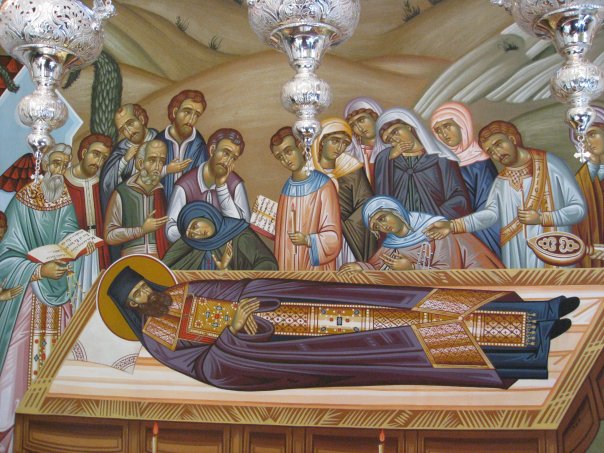
In early 1959 St. George forsaw his upcoming death. As the day approached, he gave instructions to his spiritual children on his departure. "On the eve of his repose he asked to be helped to go into the monastery church. There he venerated the icons and partook of the Holy Mysteries one last time. A few hours after midnight on November 4th, 1959, St. George reposed in the Lord.

Icon depicting the repose of St. George Karslides the Righteous of Drama (+1959) (taken from: http://commons.orthodoxwiki.org/images/8/8f/GKarslidis02.jpg)

Today a monastic community of nuns continue the spiritual legacy of St. George at the Monastery of the Ascension of Christ in Sipsa, Drama, in northern Greece. St. George has continued to work many miracles after his repose in the Lord. In 2008 St. George was officially acknowledged to be a Saint by the Ecumenical Patriarchate.

Once again, many thanks to the author of the following book for translating the truly inspiring life of the newly-revealed St. George: Precious Vessels of the Holy Spirit: The Lives and Counsels of Contemporary Elders of Greece, by Herman A. Middleton. Published by Protecting Veil Press 2003. For a full biography and many stories and miracles from St. George, see: The Blessed Elder George Karslides (1901-1959), translated from the Greek text of Monk Moses the Athonite, by Orthodox Kypseli Publications. Also see: http://orthodoxwiki.org/George_(Karslidis)_of_Drama.

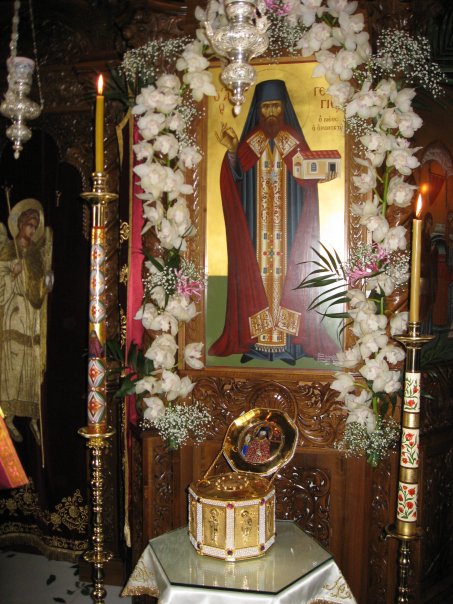
Picture of the Icon of St. George and his holy Skull at the Monastery of the Ascension of Christ, Sipsa (taken from: http://commons.orthodoxwiki.org/images/6/60/GKarslidis05.jpg)


For a beautiful video of the Saint's Monastery of the Ascension of Christ in Sipsa, see: http://apantaortodoxias.blogspot.com/2011/11/blog-post_8910.html.
  
Icon of St. George the Righteous of Drama (taken from: http://vatopaidi.files.wordpress.com/2009/11/agios-georgios-karslides-01.jpg)


Apolytikion of St. George Karslides the Righteous of Drama (amateur translation from the above Greek)
O river of Divine Grace, O God-bearing George, and vessel of miracles of all kinds, we praise him crying out, Ascension, Holy Monastery's Founder, and Drama's protector and shelterer, do not despise those who entreat you, and magnify you, O Righteous Father. Glory to Christ Who glorified you. Glory to Him who sanctified you, Glory to Him who showed forth this new ascetic fruitful.

Apolytikion (for a Monastic) in the Plagal of the Fourth Tone
The image of God, was faithfully preserved in you, O Father. For you took up the Cross and followed Christ. By Your actions you taught us to look beyond the flesh for it passes, rather to be concerned about the soul which is immortal. Wherefore, O Holy George, your soul rejoices with the angels.
(altered from: http://goarch.org/chapel/saints_view?contentid=225&type=saints)
 
St. George Karslides (source)
   
Holy Father George, intercede for us!
Through the prayers of our Holy Fathers, Lord Jesus Christ our God, have mercy on us and save us! Amen!

Wednesday, October 29, 2008

Sayings of St. George Karslides the Righteous (+1959)

Icon of St. George Karslides the Righteous (taken from: http://vatopaidi.files.wordpress.com/2009/11/agios-georgios-karslides-01.jpg)

"God cares for everyone. Despair is in effect a lack of faith"
«Ο Θεός φροντίζει για όλους. Η απελπισία είναι σχεδόν απιστία».

"The Panagia does not want big candles, she wants charity shown to the poor"
«Η Παναγία δεν θέλει μεγάλες λαμπάδες, ελεημοσύνη στους φτωχούς θέλει»

The Elder said that what saves man is «the good works of God, humility, obedience, love, and charity».
Έλεγε ο Γέροντας ότι αυτά που σώζουν τον άνθρωπο είναι «τα έργα τα καλά του Θεού, η ταπείνωση, η υπακοή, η αγάπη, η ελεημοσύνη».

He said to a woman he met at the monastery: «What? You go to church every day and have not forgiven [made peace with?] your children?».
Είπε σε μια γυναίκα που τον συνάντησε στο μοναστήρι: «Τι; πηγαίνεις κάθε ημέρα στην Εκκλησία και δεν έχεις συγχωρεθεί με τα παιδιά σου;».

«Do not sit at the hour of the Divine Liturgy. Your nous should not fly here and there. As long as you are in church make the decision to devote all of the time to prayer ».
«Να μην κάθεσθε την ώρα της θ. Λειτουργίας. Ο νους σας να μην πετάει εδώ κι εκεί. Όσο θα είσθε στην εκκλησία να το πάρετε απόφαση, να διαθέσετε όλο τον χρόνο στην προσευχή».

«Do not think only about what you eat, what to wear, how large a house you will build. Knock on the doors of the poor, the sick, orphans. Prefer more the houses of the sad rather than happy. If you do good works, you will have a large reward from God. You will be made worthy to see miracles, and in the other life you will have endless jubilation ».
«Να μη σκέπτεσθε μόνο τι θα φάτε, τι θα φορέσετε, τι μεγάλο σπίτι θα χτίσετε. Να κτυπάτε τις πόρτες των φτωχών, των αρρώστων, των ορφανών. Περισσότερο να προτιμάτε τα σπίτια των θλιμμένων παρά των χαρούμενων. Εάν κάνετε καλά έργα, θα έχετε μεγάλο μισθό από τον Θεό. Θ’ αξιωθείτε να δείτε θαύματα, και στην άλλη ζωή θα έχετε απέραντη αγαλλίαση».

«The Christian who loves all people has a great reward, especially if he forgives those who do him evil. For if we don't love our neighbor, all the good works we do will be worthless. They amount to nothing, we will be worthless. Love, my bretheren, God requires love from us.»

(Quote from Precious Vessels of the Holy Spirit, Middleton; the rest are amateur translations from the Greek taken from: http://www.dailygreece.com/2007/01/post_28.php, from: Μοναχού Μωϋσέως Αγιορείτου, Ο Μακαριστός Γέροντας Γεώργιος Καρσλίδης.Γ.Κ. Χατζόπουλου, Θαύματα και Προφητείες του οσίου πατρός Γεωργίου Καρσλίδη.)

I believe this is an ornate, official copy of the Patriarchical Proclamation of the recognition of St. George as a Saint. There are icons of him and scenes from his life. (taken from http://www.imdramas.gr/main.php)

For more information on St. George, see the following excellent books:

-Precious Vessels of the Holy Spirit: The Lives and Counsels of Contemporary Elders of Greece, by Herman A. Middleton. Published by Protecting Veil Press 2003.

-The Blessed Elder George Karslides (1901-1959) by Monk Moses the Athonite. Published by Orthodox Kypseli Publications.

Also, see other posts on the life (http://full-of-grace-and-truth.blogspot.com/2008/10/life-of-st-george-karslides-righteous.html) of St. George, along with a clip from his canonization service (http://full-of-grace-and-truth.blogspot.com/2008/11/numbered-among-saints-st-george.html). Also see: http://orthodoxwiki.org/George_(Karslidis)_of_Drama.
  
St. George Karslides (source)
  
Through the prayers of our Holy Fathers, Lord Jesus Christ our God, have mercy on us and save us! Amen!