Showing posts with label Hate. Show all posts

Sunday, September 13, 2020

Homily on the Meaning of the Holy Cross, by Metropolitan Avgoustinos Kantiotes

The Holy Cross of Christ (source)
 
Homily on the Meaning of the Holy Cross, by Metropolitan Avgoustinos Kantiotes
My beloved, what does the Cross teach us? Take a chalk and write, like children do in school, 2+2=4. Thus, the Cross is the "equal sign", but what is it? Do you think that it is simply a piece of wood that we venerate and are saved? You are mistaken, because this is not how it is in reality.

The Cross equals forgiveness.
Because upon the Cross, Christ forgave His murderers. Are there today some here in church who are at odds with each other? Are there women who hate their mothers-in-law? Are there houses where people don't speak with each other? Are there neighbors that don't greet each other? Is there hatred? Well then, the Cross tells us today: "Forgive!" If you don't forgive, then don't approach the Cross, don't venerate it. When, within your heart, you have bitterness, you have this serpent of hatred, you can't approach the Cross. Because the Cross means forgiveness. You must forgive even your greatest enemy.

The Cross equals truth.
Even if they put a knife to your throat, and slaughter you, you should speak the truth. Not in the sense that you go to court and raise your wretched hand upon the Gospel and take a false oath. Not like this. Christ was crucified for the truth. Whoever says lies, whoever goes to court and takes false oaths, he is not worthy to venerate the Cross. The Cross, therefore, equals forgiveness, the Cross equals truth.

The Cross equals humility.
No--even though you might have a very large home, or more money or lands or animals, or if you have children studying in school or if you have a beautiful wife, or whatever else you might do--you should not boast or feel proud. You are not a Christian! Humility! Humble yourself to say: I am nothing, I am a worm, I am nothing in this world. However, when you have pride and you boast and you show off your body and your job and your money, then you are not a Christian.

The Cross equals love.
Is your neighbor hungry? Give him a piece of bread. Is he thirsty? Give him a glass of water. Is he naked? Give him a shirt to wear. Go and console him and wipe away his tears. This is Christianity. Not when you have everything and your neighbor has nothing.

The Cross equals sacrifice.
As Christ sacrificed Himself, thus we must sacrifice ourselves. This is what the Cross means. If you do these things, then you are worthy to be called Christians. But you who dip your hands in blood, you who take false oaths, you who are unjust to the orphan, you cannot approach the Cross. The Cross casts you out.

Read the life of St. Mary of Egypt. On this day, she went to Jerusalem and saw the crowd going into the church and everyone--old, young, women, men--were going to venerate. She herself tried to approach the entrance. But some power pushed her back. She tried and second and a third time, but she was unable. Why? Because she was a sinful woman, and she worked in sin in Alexandria. Only after she repented, then she was able to enter the church and she became a Christian in reality.

The Cross, my beloved, creates presuppositions. We must live corresponding to the teaching of the Cross.

And something else: You should make your Cross properly. Because unfortunately, in our faithless years that we are living through, everything has become fashionable. Fashionable hair, fashionable clothing, fashionable shoes, fashion everywhere. Unfortunately many in Church do it out of fashion. Unfortunately you see scientists, congressmen, ministers, prime ministers, and none are doing their Cross correctly. That which they are doing is not the Cross. It joking and mocking. It is playing with God. Do not play with God. How will they understand that you are a Christian? By your Cross. When you make the sign of the Cross properly, you are doing a whole prayer. Therefore, do your Cross properly.

And when should you do your Cross? When you awake in the morning, do your Cross. Are you going to work? Do your Cross. Are you going to your field? Do your Cross. Are you sowing, returning from your field, entering your home? Do your Cross. Are you sitting at your dinner table? Do your Cross. Are you going to sleep? Do your Cross.

"Though I fall, I make my Cross
And have an Angel by my side."

O woman, are you baking? Make the sign of the Cross in the dough. Wherever you go and whatever you do, make your Cross. The Cross is the "protector of the whole world."
(+) Bishop Avgoustinos
Imera, Kozani, 9/14/1965
(source)
   
Through the prayers of our Holy Fathers, Lord Jesus Christ our God, have mercy on us and save us! Amen!

Wednesday, November 20, 2019

Elder Ephraim of St. Andrew Skete: "God is everywhere present..."

Christ Pantocrator (Source)
  
"God is everywhere present. Wherever God is, there also is His Uncreated Light. The Uncreated Light of our Triune God fills all things. Therefore, no place is a place of darkness. All is all-bright with the Uncreated Light of our Triune God, Who shines with His Light and with his incomparable Divine Love. In other words, God bombards us with incomparable tons of His Divine Love. And woe to him who does not accept this Love, for he will experience it as incomparable hell, as incomparable hate and incomparable darkness in the other life.

"With this teaching, all of the thoughts of modern man are put into order, that say that, if God is incomparable love, how is it possible for us to go to hell for all eternity with so many torments? God neither condemns to hell, nor is hell His creation. God out of love made all things, and whatever He created is wholly light and love. Darkness and punishment were not created by God. We have created them with sin and with death, we have created darkness and hell. Therefore, God, does not condemn us to hell, but we self-condemn ourselves on our own.

"It is like the sun which shines wholly bright, and there are eyes of men who desire to go blind and do not wish to see the light of the sun, even forever. In this eternal self-blinding, one remains in darkness even though he was given the chance to see. Every human being has this pure choice and is free, and God honors this and does not intervene. And man lives his life and works his sins and God does not stand in his way, but unless he turns in repentance and chooses to follow His righteousness, then he can't condemn God for the hell that he will experience in the next life."
-Elder Ephraim of St. Andrew Skete, Mount Athos

(source)

Through the prayers of our Holy Fathers, Lord Jesus Christ our God, have mercy on us and save us! Amen!
Friday, November 1, 2019

St. Gabriel of Georgia on Love

 
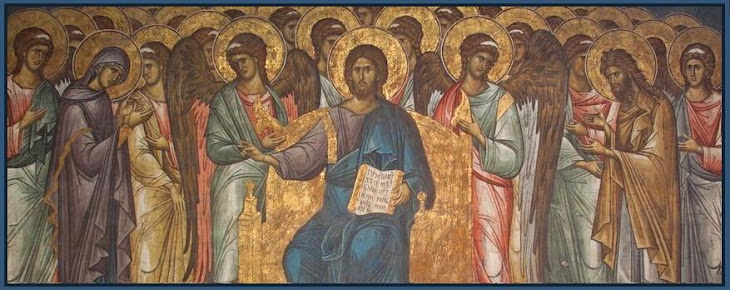
St. Gabriel the New Confessor of Georgia (source)
  
Faith and love are perceived through sufferings...If you have everything else, but love, you have nothing. If you hate even a single person - you are disgusting before GOD.

Love your enemies – it’s clear. But how to love enemies of Christ? Stop hating and then you will be able to love them. How to love the evil man? Hate the evil, but love those who do evil. Who knows maybe one day they will repent their sins by the powers of prayer, tears and confession and become like an angel. Everything is God's Will. Love everyone; if you can’t, at least show a goodwill.

In the End Days a man will be saved by love, humbleness and kindness. Kindness will open the gates of Heaven; humbleness will lead into the Heaven; a man, whose heart is filled with love, will see the God. This is my last will and testament: raise your prayers for everyone; your prayers will move the mountains. Love each other.
-St. Gabriel the New Confessor of Georgia (+1995)

(source)
  
Through the prayers of our Holy Fathers, Lord Jesus Christ our God, have mercy on us and save us! Amen!

Tuesday, September 17, 2019

St. Basil the Great: Account of the Present State of the Churches

Christ calming the storm (source)
  
Note: Metropolitan Ierothos (Vlahos) of Nafpaktos, a notable theologian and author of many books, recently wrote a post entitled: "Proposal for dealing with the Ukrainian issue". In this article, he summarizes his extensive previous writing on the issue of Ukraine and the many related issues that it highlights for the Church, and proceeds to give his suggestion for how this might be remedied going forward. One of the most striking parts of this article, however, is his lengthy quote of St. Basil the Great: "Account of the Present State of the Churches", in which the Saint highlights the great battle that was being waged in his time and afflicting the entire Church. I am not including this to endorse any opinion about the state of the Church and Ukraine (I do not have the wisdom or authority to do so). I do not want this post to be a place of argument on this issue, as there are too many places online already where this is occurring. I include this excerpt from a great Saint that we might fully perceive the great temptation that is facing the Church, that we might all endlessly repent of our sins, weaknesses and passions that are harming our brethren and breaking God-given peace, love and unity. May we pray for the Church and the people of Ukraine, entreating our Lord, His Mother, and all the Saints that they might enlighten and guide our Hierarchs, and that repentance, communion, peace, love, forgiveness, forbearance and true unity might speedily be granted to all who are suffering throughout the world.
  
St Basil the Great: Account of the Present State of the Churches
(St Basil the Great, On the Holy Spirit, ch. 30, para. 76-79 in Letters and Select Works, in A Select Library of Nicene and Post-Nicene Fathers, 2nd series, ed. Philip Schaff & Henry Wace, Vol. 8, T&T Clark, Edinburgh, reprinted Eerdmans, Grand Rapids, Michigan 1996, pp. 48-50)
  
“To what then shall I liken our present condition? It may be compared, I think, to some naval battle which has arisen out of time old quarrels, and is fought by men who cherish a deadly hate against one another, of long experience in naval warfare, and eager for the fight. Look, I beg you, at the picture thus raised before your eyes. See the rival fleets rushing in dread array to the attack. With a burst of uncontrollable fury they engage and fight it out. Fancy, if you like, the ships driven to and fro by a raging tempest, while thick darkness falls from the clouds and blackens all the scenes so that ensigns are indistinguishable in the confusion, and all distinction between friend and foe is lost.
  
To fill up the details of the imaginary picture, suppose the sea swollen with billows and whirled up from the deep, while a vehement torrent of rain pours down from the clouds and the terrible waves rise high.
  
[Suppose] from every quarter of heaven the winds beat upon one point, where both the fleets are dashed one against the other. Of the combatants some are turning traitors; some are deserting in the very thick of the fight; some have at one and the same moment to urge on their boats, all beaten by the gale, and to advance against their assailants. Jealousy of authority and the lust of individual mastery splits the sailors into parties which deal mutual death to one another.
  
Think, besides all this, of the confused and unmeaning roar sounding over all the sea, from howling winds, from crashing vessels, from boiling surf, from the yells of the combatants as they express their varying emotions in every kind of noise, so that not a word from admiral or pilot can be heard. The disorder and confusion are tremendous, for the extremity of misfortune, when life is despaired of, gives men license for every kind of wickedness.
  
Suppose, too, that the men are all smitten with the incurable plague of mad love of glory, so that they do not cease from their struggle each to get the better of the other, while their ship is actually sinking into the deep.

Turn now, I beg you, from this figurative description to the unhappy reality. Did it not at one time appear that the Arian schism, after its separation into a sect opposed to the Church of God, stood itself alone in hostile array? But when the attitude of our foes against us was changed from one of long-standing and bitter strife to one of open warfare, then, as is well known, the war was split up in more ways than I can tell into many subdivisions, so that all men were stirred to a state of inveterate hatred alike by common hostility and individual suspicion.
  
But what storm at sea was ever so fierce and wild as this tempest of the Churches? In it every landmark of the Fathers has been moved; every foundation, every bulwark of dogma has been shaken: everything resting on an unsound basis is dashed about and shaken down. We attack one another. We are overthrown by one another. If our enemy is not the first to strike us, we are wounded by the comrade at our side. If a foeman is stricken and falls, his fellow soldier tramples him down. There is at least this bond of union between us that we hate our common foes, but no sooner have the enemy gone by than we find enemies in one another.
  
And who could make a complete list of all the wrecks? Some have gone to the bottom on the attack of the enemy, some through the unsuspected treachery of their allies, some from the inexperience of their own officers. We see, as it were, whole churches, crews and all, dashed and shattered upon the sunken reefs of disingenuous heresy, while others of the enemies of the saving Passion have seized the helm and made shipwreck of the faith. And then the disturbances wrought by the princes of this world have caused the downfall of the people with a violence unmatched by that of hurricane or whirlwind.
  
The luminaries of the world, which God set to give light to the souls of the people, have been driven from their homes, and a darkness verily gloomy and disheartening has settled on the Churches. The terror of universal ruin is already imminent, and yet their mutual rivalry is so unbounded as to blunt all sense of danger. Individual hatred is of more importance than the general and common warfare, for men by whom the immediate gratification of ambition is esteemed more highly than the rewards that await us in a time to come, prefer the glory of getting the better of their opponents to securing the common welfare of mankind. So all men alike, each as best he can, lift the hand of murder against one another. Harsh rises the cry of the combatants encountering one another in dispute; already all the Church is almost full of the inarticulate screams, the unintelligible noises, rising from the ceaseless agitations that divert the right rule of the doctrine of true religion, now in the direction of excess, now in that of defect.
  
On the one hand, are they who confound the Persons and are carried away into Judaism; on the other hand, are they that, through the opposition of the natures, pass into heathenism. Between these opposite parties inspired Scripture is powerless to mediate; the traditions of the apostles cannot suggest terms of arbitration.
  
Plain speaking is fatal to friendship, and disagreement in opinion is all the ground that is wanted for a quarrel. No oaths of confederacy are so efficacious in keeping men true to sedition as their likeness in error.
  
Every one is a theologian though he has his soul branded with more spots than can be counted. The result is that innovators find a plentiful supply of men ripe for faction, while the self-ordained and place-hunters reject the government of the Holy Spirit and divide the chief dignities of the Churches. The institutions of the Gospel have now everywhere been thrown into confusion by want of discipline; there is an indescribable pushing for the chief places while every self-advertiser tries to force himself into high office. The result of this lust for power is that our people are in a state of anarchy; the exhortations of those in authority are rendered wholly purposeless and void, because there is not a man but, out of his ignorant impudence, thinks that it is just as much his duty to give orders to other people, as it is to obey any one else.
  
So, since no human voice is strong enough to be heard in such a disturbance, I reckon silence more profitable than speech, for if there is any truth in the words of the Preacher, ‘The words of wise men are heard in quiet,’ in the present condition of things any discussion of them must be anything but becoming.
  
I am moreover restrained by the Prophet’s saying, ‘Therefore the prudent shall keep silence in that time, for it is an evil time,’ a time when some trip up their neighbours’ heels, some stamp on a man when he is down, and others clap their hands with joy, but there is no one to feel for the fallen and hold out a helping hand, although according to the ancient law he is not uncondemned, who passes by even his enemy’s beast of burden fallen under his load. This is not the state of things now. Why not? The love of many has waxed cold; brotherly concord is destroyed, the very name of unity is ignored, brotherly admonitions are heard no more, nowhere is their Christian pity, nowhere falls the tear of sympathy. Now there is no one to receive ‘the weak in faith,’ but mutual hatred has blazed so high among fellow citizens that they are more delighted at a neighbour’s fall than at their own success. Just as in a plague, men of the most regular lives suffer from the same sickness as the rest, because they catch the disease by communication with the infected, so nowadays by the evil rivalry which possesses our souls we are carried away to an emulation in wickedness, and are all of us each as bad as the others.
  
Hence merciless and sour sit the judges of the erring; unfeeling and hostile are the critics of the well disposed. And to such a depth is this evil rooted among us that we have become more brutish than the brutes; they do at least herd with their fellows, but our most savage warfare is with our own people.
For all these reasons I ought to have kept silence, but I was drawn in the other direction by love, which ‘seeketh not her own’, and desires to overcome every difficulty put in her way by time and circumstance. I was taught too by the children at Babylon, that, when there is no one to support the cause of true religion, we ought alone and all unaided to do our duty. They from out of the midst of the flame lifted up their voices in hymns and praise to God, regardless of the host that set the truth at naught, but sufficient, three only that they were, with one another.
  
Wherefore we too are undismayed at the cloud of our enemies, and, resting our hope on the aid of the Spirit, have, with all boldness, proclaimed the truth. Had I not so done, it would truly have been terrible that the blasphemers of the Spirit should so easily be emboldened in their attack upon true religion, and that we, with so mighty an ally and supporter at our side, should shrink from the service of that doctrine, which by the tradition of the Fathers has been preserved by an unbroken sequence of memory to our own day. A further powerful incentive to my undertaking was the warm fervour of your ‘love unfeigned’, and the seriousness and taciturnity of your disposition; a guarantee that you would not publish what I was about to say to all the world, not because it would not be worth making known, but to avoid casting pearls before swine.
  
My task is now done. If you find what I have said satisfactory, let this make an end to our discussion of these matters. If you think any point requires further elucidation, pray do not hesitate to pursue the investigation with all diligence, and to add to your information by putting any uncontroversial question. Either through me or others the Lord will grant full explanation on matters which have yet to be made clear, according to the knowledge supplied to the worthy by the Holy Spirit.”
(source)
  
Christ walking on the water (source)
  
Through the prayers of our Holy Fathers, Lord Jesus Christ our God, have mercy on us and save us! Amen!

Tuesday, April 2, 2019

St. John of the Ladder's advice for those living in the world

St. John writing his Ladder of Divine Ascent (source)
  
Some people living carelessly in the world have asked me: ‘We have wives and are beset with social cares, and how can we lead the solitary life?’ I replied to them: ‘Do all the good you can; do not speak evil of anyone; do not steal from anyone; do not lie to anyone; do not be arrogant towards anyone; do not hate any one; be sure you go to church; be compassionate to the needy; do not offend anyone; do not wreck another man’s domestic happiness; and be content with what your own wives can give you. If you behave in this way you will not be far from the Kingdom of Heaven.’
-St. John Klimakos, The Ladder of Divine Ascent, Step I
(source)
  
Through the prayers of our Holy Fathers, Lord Jesus Christ our God, have mercy on us and save us! Amen!

Sunday, April 29, 2018

St. Luke of Simferopol on Condemnation

Christ is risen! Truly He is risen!
St. Luke the Surgeon, Archbishop of Simferopol of Crimea (source)
   
"Where does condemnation come from? From pride, by the fact that many perceive themselves as higher and better than others. We furthermore condemn out of malice, out of hate, by the fact that, in our heart, there is very little love."
-St. Luke of Simferopol
 
(source)
 
Christ is risen from the dead, by death, trampling down upon death, and to those in the tombs, He has granted life!
Truly the Lord is risen!

Saturday, July 1, 2017

Homily of Metropolitan Avgoustinos Kantiotes on the Holy Unmercenaries: Young scientists performing acts of love

The Holy Unmercenaries Sts. Kosmas and Damian (source)
 
Homily of Metropolitan Avgoustinos Kantiotes on the Holy Unmercenaries: Young scientists performing acts of love
The sinful man, my beloved, (in other words, he who does not sense his sins and does not repent, because we are all sinners), who does not repent according the Holy Scriptures resembles an old an unworked field, which is full of wild weeds, thorns and serpents. He is a land "in danger of being cursed", as the Apostle Paul says (Hebrews 6:8). As opposed to this, the saint is like a worked field, like the "good earth" from the Parable of the Sower, where the Sower reaps a harvest from some 30-fold, some 60-fold, some 100-fold (Matthew 13:8, Mark 4:8). The saint is a chosen garden of God. And just as it is pleasant to walk in a garden, so pleasant it is to read the lives of the saints, they are spiritual gardens.

A spiritual garden are the saints which we celebrate today, the Holy Unmercenaries Kosmas and Damian. And just as we gather flowers when we go to a garden in order to make a beautiful bouquet, thus today, reading through the life of these saints, we will cut a few spiritual flowers in order to weave a crown.

The first flower--the first lesson which we take from the life of Sts. Kosmas and Damian, is love, as the Apostle Paul relates in today's Epistle reading (I Corinthians 12:27-13:8). They had love between them. They were brothers, from one mother and one father. But is this enough?

Love of blood relatives is not steadfast. We have many examples: brothers, who were born from the same mother and nursed on the same milk and raised in the same house, who later each go their separate ways. The Holy Scriptures tell us that Cain and Abel were brothers, but Cain murdered Abel and killed him. Since then, there is enmity between brethren. Yesterday in Florina, one brother threw out of their father's house his brother with five children. The day before yesterday, again, there came to the Metropolis someone else who was saying beautiful words, and I started to believe that he was a good man. But later someone else told me: "Didn't you ask him, how long has it been since you spoke to your brother? They lived in the same village, their homes were close by, but Christmas would come, Holy Friday would come, Pascha would come, great days, and he wouldn't even say a 'Good morning' to him." I said, "Is that true? Do you appear to be a Christian but don't speak with your brother?" He replied, "I talk to everyone, but to my brother, no." "But why?" "I won't speak with him, no matter what anyone says." I tried to reconcile them, but it remained impossible.

The Holy Unmercenaries were brothers, but that which united them was not blood, nor money, nor anything else physical. It was Christ Who united them. Satan divides, Christ unites. And Christ took these two brothers and made them one soul and one heart. They were beloved in life, and beloved in death, in martyrdom, and beyond the grave into eternity. They had love, not so much love from between family members and blood, but more so love from spiritual family and a common faith.
  
Sts. Cosmas and Damian the Holy Unmercenaries (source)
  
The one flower in this beautiful garden of the saints is love. What is the other? What age were these saints? Where they gray-haired elders 80 or 90 years old? No, they were young, in the flowering of their age. There is the idea that religion is for old men and women and for those who are preparing for death. This is wrong. Religion is for everyone. It is for children, for women, and men, and for elders. But it is first and foremost for the youth. If you excuse the phrase, Christ is useful for everyone. Just like the sun is useful for everyone, both for the little child and the old man, thus it is with Christ. There is no one who can tell the sun that he doesn't need it. The sun is needed by king and poor man, woman and man, black and white, by everyone. Thus it is the with religion, it is useful for everyone, but especially for the youth. The old man resembles a boat which, hour by hour is getting ready to lower its anchor into the harbor, into eternity, while the young man is leaving the harbor and faces great waves, storms and winds, and the boat must be armed with hope, faith and the love of God. The Holy Unmercenaries are an example of this. These two brothers believed in Christ from a young age, and lived in purity. Their example shows us that even young people need faith in Christ.

Love and faith, and the third flower from the beautiful garden of the saints? What were the Holy Unmercenaries, learned or unlearned? They were not unlearned, though there are many unlearned saints. But these two were scientists. They were physicians. And they were the best physicians of their era. Sick people, who could not be healed by any other physicians, hastened to Kosmas and Damian and they made them well. How? With medicines? Yes, with medicines that they made from healing herbs that they gathered from the mountains and vales. But above all of the other medicines, however, was their wonderworking prayer. In the name of Jesus Christ the Nazarene, they healed every illness. What does this show? That religion is not just for unlearned people, like many think. This is wrong. They make fun of science and say that scientists don't believe in God. This is a lie. Why? Who are the scientists that they are thinking of? Those who get a diploma and later close their books and go play games and go out and say that there is no God, they are not scientists. They are scientists who sit day and night and read. They are the true scientists, therefore, who believe in God, And we have such scientists, astronomers, physicists, mathematicians and others, who believe in God just like a villager or a shepherd.

Do you want an example? In our days there is great achievement that man went to the moon. How did he go? With a rocket that propelled a spaceship. The rocket, who made it? A scientist. Let's not say his name, let us not say the names of foreign people in church, but those of the apostles and the saints. Let's just say that he is a German man. But he believes! Last year he came to Greece. He went to Mykonos where thousands of tourists were gathered for the summer. On Sunday, when the church bell ran, no one went to church, they went to the beach. He went like a little child and listened to the Divine Liturgy. Later they asked him, "Do you believe?" "Of course, after discoveries like that I believe in God even more..." And it is not just him, but many other scientists believe. And in our homeland there are many scientists and students who believe in Christ (mathematicians, physicians, philologists, etc.). They work and study in great cities, which are a great abyss, Sodom and Gomorrah, but they believe deeply in God.

Three things therefore, my beloved, the Holy Unmercenaries teach us today. The first, to have love, because we are all brethren. The second, to have, first and foremost the young people, purity and cleanliness. And the third, that all learning cannot separate man from God, but can bring him closer to Him.

Faith and holiness were not only "at that time". And today and tomorrow and until the close of the world they will not abandon us. They stars may fall, and the rivers may dry up, and the mountains melt, and everything may flee away, but there will not come a day that there are no Christians. There will always be men who believe in Christ, and who will be ready to trade their life for a crown, like Sts. Kosmas and Damian, whose intercessions may ever be with you, unto the ages of ages. Amen.

+Bishop Avgoustinos
(Recorded homily which occurred in the church of the Holy Unmercenaries, Perasmatos, Florina, 7/1/74, source)
   
The Holy Unmercenaries Sts. Kosmas and Damian (source)
   
Through the prayers of our holy fathers, Lord Jesus Christ our God, have mercy on us and save us! Amen!

Saturday, July 5, 2014

St. Porphyrios: When our soul is sanctified, it shines with goodness

The Adulteress saved from stoning by Christ, as He wrote the sins of those persecutors in the sand (source)
 
Man has such powers, that he can transmit good or evil to his environment. These are very delicate matters. They require great care.

We must see everything in a good manner. We should not think anything evil about others. And even a glance and a sigh can effect our fellow man. And the slightest indignation brings evil. Let us have goodness and love within out soul, let us transmit these.

Let us pray that we not be indignant towards men who hurt us. Only let us pray for them with love. Whatever our fellow man does, let us not think evil of him. Always  let us pray lovingly. Always let us think of the good.

We must never think regarding the other that God will give them some evil or punish them for their sin. This thought brings a very great evil, without us perceiving it.

Many times we are indignant, and we say to the other: "Do you not fear the righteousness of God, do you not fear that He will punish you?"

Other times we further say: "God cannot even punish you for that which you have done", or, "My God, do not do evil to that man for that which he did to me", or, "May he not suffer the same lot".

In all of these cases, we have deep within us the desire that the other be punished. Instead, however, of confessing our anger at their offense, we use another way of showing our indignation, appearing to entreat God for him. Thus, however, in reality we are cursing our brother.

And if, instead of praying, we say: "may you find it from God, that God might repay you for the evil you have done", then again we are praying for God to punish him.

Furthermore, when we say: "regardless, God sees everything", the state of our soul works in a mysterious way to bother the soul of our fellow man and he suffers evil. Do you understand, therefore, how our evil thoughts, our evil disposition bothers others? Because of these, we must find the way to purify the depth of ourselves from every evil. When our soul is sanctified, it shines with goodness. We silently sent out our love without saying words.

Christ never wants evil. Instead, He commands: "Bless those who curse you..."
 
(amateur translation of Greek text from source)
 
Christ on the Cross, Who prayed to forgive those who crucified Him (source)
 
Through the prayers of our Holy Fathers, Lord Jesus Christ our God, have mercy on us and save us! Amen!