Showing posts with label Serbia. Show all posts

Friday, May 12, 2017

The Uncovering of the Relics of St. Mardarije of Libertyville

The Uncovering of the Relics of St. Mardarije of Libertyville (source)
  
On Thursday, May 4, 2017, His Grace Bishop Longin served Divine Liturgy at St. Sava Monastery with Sindjel Serafim (Milojkovic), Priest Nikolaj Kostur and Hierodeacon Nektarije (Tesanovic), in preparation for uncovering the relics. Following the Divine Liturgy, Bishop Longin and the other clergy served a Moleban with the Akathist written to St. Mardarije. Upon completion, the crew organized to remove the tombstone and flooring in order to exhume the relics arrived, under the guidance of Mr. Dusan Djordjevic of Sveta Gora Funeral Home in Chicago. After removal of the stone, it was revealed that the casket of St. Mardarije was in a cement vault. This caused the opening to be delayed one additional day in order to organize a team to open the vault.
  
On Friday morning, May 5, 2017, the workers broke the seal of the vault, while Priest Nikolaj Kostur and Heirodeacon Nektarije (Tesanovic) served a Moleban to St. Mardarije at the tomb in the presence of Bishop Longin and Hieromonk Serafim (Milojkovic). Throughout the entire process of exhumation, “Christ is Risen” and other Paschal hymns were sung, both in Serbian and Russian tones, knowing St. Mardarije’s deep love and dedication to both Slavic traditions.
  
Once the seal of the vault was broken, every effort was taken to lift the cover. During this process, the cover of the vault shifted and fell on the casket, breaking its cover. At this moment, a sweet smelling fragrance arose from the tomb, quickly dissipating. However, it became evident that the Saint was buried facing the west instead of east. This in and of itself is miraculous. It manifested the Providence of God. Had St. Mardarije been buried in the proper direction, the vault cover would have fallen on the side of the casket where his holy head rested. It was visible that his feet had decayed and were bones.
  
Frs. Serafim and Nikolaj lifted the relics out of the tomb during the singing of “Christ is Risen.” The relics were light in weight and easily placed in a temporary metal coffin. Hereupon the feet were examined, which at this point were the only visible part of the remains. The bones of the feet were goldish-yellow in color. Then, Fr. Nikolaj Kostur proceeded to examine the mid-section of the body. St. Mardarije's Holy hands were holding the cross which was firmly in place and immovable. As Fr. Nikolaj pulled back the sleeve of the saccos, it was revealed that the hands of St. Mardarije were completely intact. Clearly visible were his skin, fingernails and hair. At this point, it was evident that the relics were more than just bones.
  
The incorrupt relics of St. Mardarije of Libertyville (source)
  
The holy relics of St. Mardarije were lifted out of the metal coffin and placed on two tables which were prepared for the examination and washing of the holy relics.  All of the vestments and clothing were carefully removed, cutting that which could not easily be taken off in order to not disturb the holy relics.   Most reverent and diligent care and utmost attention were given to the work that was being done; the clergy continuously sang the troparion to St. Mardarije and other Paschal hymns.
After all the vestments were removed, it was revealed that the holy relics, from the knee upward, were intact, although very fragile.  The Saint’s anatomy was intact with his skin and hair visible.  When the mitre was removed, his long, dark hair flowed out, confirming his continued monastic struggle until the end of his days.  The hair on his head and beard looked as though he had just reposed; it was very soft.  The eyebrows and eyelashes of his closed eyes were visible.  Also, his ears were still intact.  The body was easily lifted and moved.  There was a great deal of dust which had accumulated in the grave from the nearly eighty-two years since the burial. Upon the removal of the dust from the entire body, the holy relics were washed with warm water and white wine. Hereupon spikenard oil was was used to anoint the body, according to the instructions received from the Holy Monastery of Hilandar. After the anoninting, the color of the skin changed from tan to a dark brown.
After the washing and anointing, the legs, hands and torso were all wrapped in cotton and linen, making the holy relics more easily movable.  Following this process, the holy relics were temporarily vested in a stiharion until his vesting takes place before his Glorification in July 2017.  His face was covered with linen, and he was returned to the temporary metal coffin and covered. 
  
Truly, God is wondrous in His Saints, showing us all His Divine power and that nature is subject to God’s grace.  All of those that partook in this experience, from the clergy to the workers, were moved with the joy and spiritual peace that filled the church during the uncovering of the holy relics.  St. Mardarije lives on, not only in his legacy, but now through his incorrupt relics which will be a renewed rudder for the Serbian Orthodox Church in North and South America, guiding us to move into the future, being directed by the past.  May we follow St. Mardarije on the path of St. Sava, which lead him to sanctity.
  
Our Holy Hierarch, Father Mardarije, pray unto God for us!  Christ is risen!
Priest Nikolaj Kostur
Chairman of the Liturgical Sub-Committee for the Glorification of St. Mardarije
  
Please note that a Pan-Orthodox celebration St. Mardarije of Libertyville is being planned for July 14-16th, 2017 at St. Savas Monastery. (source)
  
Christ is risen from the dead, by death, trampling down death by death, and to those in the tombs, He has granted life!
Truly the Lord is risen!

Saturday, May 30, 2015

Serbian Patriarchate canonizes two new American Saints: Sebastian and Mardarije

Two new Serbian-American Saints: Sebastian of Jackson (+1940) and Mardarije of Libertyville (+1935) (source)
  
On May 29, 2015, the Holy Synod of Bishops of the Patriarchate of Serbia glorified two new Serbian Saints who spread the faith in Christ in America:

"St. Sebastian Dabovich (1863-1940) has the distinction of being the first person born in the United States of America to be ordained as an Orthodox priest, and also the first native-born American to be tonsured as an Orthodox monk. His greatest distinction, however, lies in the tremendous apostolic, pastoral, and literary work that he accomplished during the forty-eight years of his priestly ministry... St. Nicholai (Velimirovich) of Zhicha, Serbia, who buried Fr. Sebastian at the Zhicha Monastery when the latter reposed there in 1940, called him “a viceless man” and fittingly designated him “the greatest Serbian missionary of modern times.” (for a fuller life of St. Sebastian, see here) His feast has been designated as November 30th.
  
Sts. Mardarije and Sebastian of North America (source)
  
St. Mardarije Uskokovic (1889-1935) was the first Serbian Bishop of North America, and founded the famous Monastery of St. Sava in Libertyville, one of the center-pieces of Serbian Orthodoxy in America. His feast has been designated as December 12th. (see here for more info)
  
St. Mardarije of Libertyville with St. Sava of Serbia, depicted as founders of the Monastery, standing before Christ and the Theotokos (source)
  
Through the prayers of our Holy Fathers, Lord Jesus Christ our God, have mercy on us and save us! Amen!

Wednesday, April 29, 2015

St. Basil of Ostrog, the Wonderworker

Christ is risen! Truly He is risen!
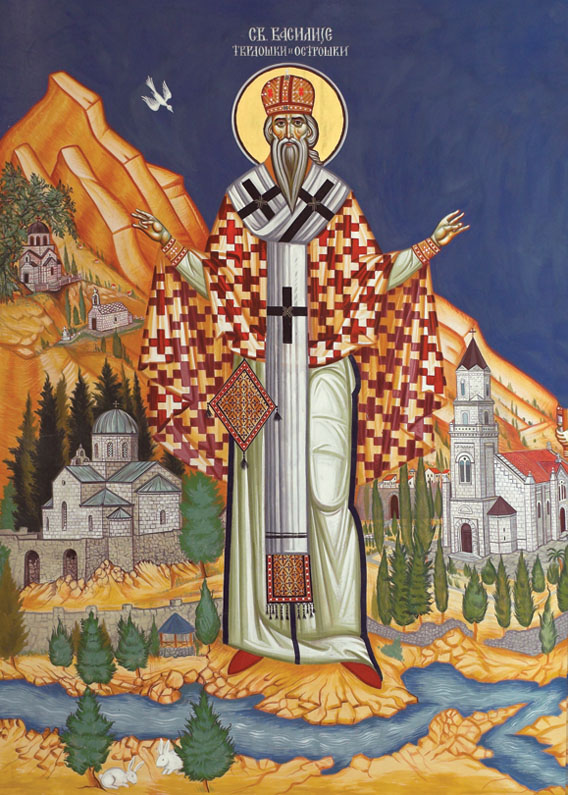
St. Basil of Ostrog, the Wonderworker - Commemorated April 29th (source)
  
A SHORT LIFE OF SAINT BASIL OF OSTROG
From the Prologue of Ochrid
Saint Basil was born in Popovo Polje, a village in Hercegovina, of simple and God-fearing parents. From his youth he was filled with love for the Church of God and when he reached maturity he entered the monastery of the Dormition of the Most Holy Theotokos in Trebinje and there received the monastic tonsure. As a monk he quickly became renowned because of his genuine and infrequently-found ascetic life. Saint Basil took upon himself mortification upon mortification, each one heavier and more difficult than the last. Later, against his will he was elected and consecrated as bishop of Zahumlje and Skenderija. As a hierarch he first lived in the monastery of Tvrdosh and from there, as a good shepherd, he strengthened his flock in the Orthodox Faith, protecting them from the cruelty of the Turks and the cunning ways of Latins. When Basil was exceedingly pressed by his enemies and Tvrdosh destroyed by the Turks*, he moved to Ostrog, where he lived an austere ascetic life, protecting his flock by his ceaseless and fervent prayer. He fell asleep peacefully in Lord in the sixteenth century, leaving behind his incorrupt Relics, incorrupt and miracle-working to the present day. The miracles at the grave of Saint Basil are without number. Christians and Muslims alike come before his Relics and find healing for their gravest illnesses and afflictions. A great people’s assembly (sabor) occurs there annually on the Feast of Pentecost.
-St. Nicolai of Zicha
 
*A new church was built in our day upon the ruins of the Old Tvrdosh monastery by Nikola Runjevac from the village of Poljica near Trebinje – a wonderful and glorious monumental church (zaduzbina) before God and before his people.
  
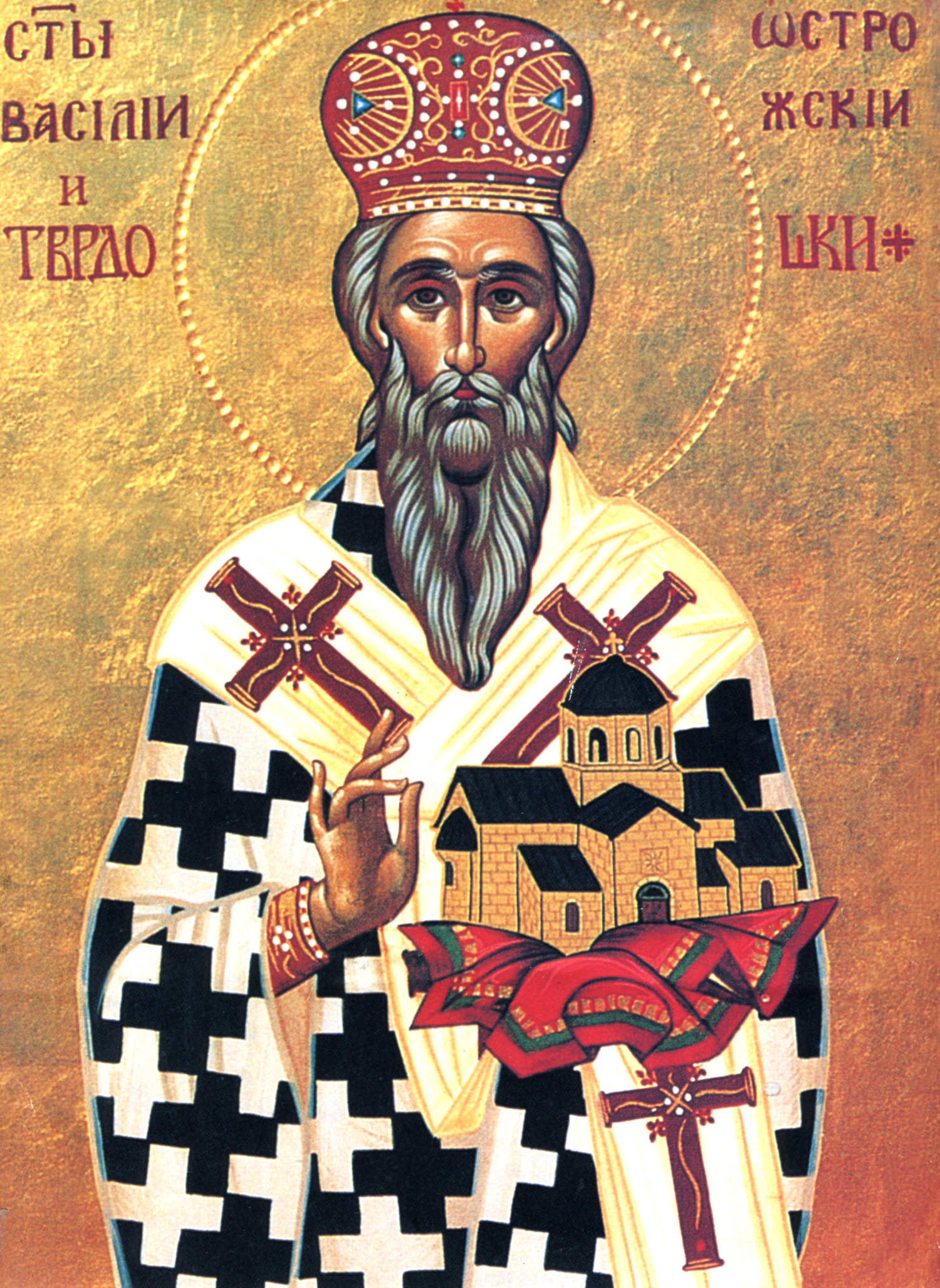
St. Basil of Ostrog, the Wonderworker (source)
  
THE GLORIFICATION OF ST.BASIL OF OSTROG
Immediately after the falling asleep of St.Basil in 1671. people started coming in great numbers to pray at his grave, just as they were accustomed to doing during his earthly life. Many miracles began taking place at the site of his grave and they have not ceased to this day.
 
Seven years after giving up his soul to God, in 1678., St.Basil appeared in a dream to father Rafailo (Kosijerevac) the Abbot of the St.Luke Monastery in Zhupa near Nikshich, and ordered him to go to Ostrog and open up the saint’s grave. The Abbot paid no attention to the dream and did not go. He had the same dream again but he again ignored it. St. Basil then appeared to the Abbot a third time, dressed in a bishop’s vestments, with a censer in his hand. The Abbot woke up in fear and trepidation and told the brotherhood of his monastery about his dream. They agreed at once to make a hasty journey to Ostrog. 
 
Upon their arrival they first informed the Ostrog monks of the Abbot’s dream and then look upon themselves a strict fast, all the while serving the complete cycle of daily prayers with Holy Liturgy. They did so for seven days. On the seventh day, they censed the Saint’s grave and opened it.
 
Before them appeared the Saint in a glorified body the colour of pure wax, giving out the fragrance similar to that of basil leaves. Then the monks placed his incorrupt body in a case and took it to the Upper Monastery, to the church of the Presentation of the Most Holy Theotokos, where it rests to this day.
  
The wonderworking Holy Relic of St. Basil of Ostrog, incorrupt to this day (source)
  
News of the glorification of St.Basil’s body quickly spread and people began to flock in great numbers to venerate his holy and wonderworking Relics. Not only Orthodox Christians, but also Roman Catholics and Lutherans, and even Muslims came to seek help at the great Sanctuary of Ostrog. According to their faith in the mercy of God and that of St.Basil they received help and found consolation.
 
Even today pilgrims from all parts of the country, of all nationalities and religions come before the Wonderworker of Ostrog. Many people travel to Ostrog from abroad. From the holy reliquary arise prayers in many languages. Many parents bring their children to be baptised before the relics of St.Basil and many name their offspring after the Saint. Many a marriage ceremony has been performed at Ostrog, countless confessions have been made and many people have partaken of the Holy Mysteries before the Holy Relics, while countless others have asked for prayers to be read for their health and salvation.
 
Many sacrifices and donations are brought to the Holy Father at the Ostrog monastery, but the greatest sacrifice of all is that of sincere repentance and the will to cleanse one’s heart before God and Saint Basil. Even the godless and atheists respect and honour St.Basil and utter his name with fear. For, as everyone knows, one did not make light of St.Basil while he lived, and one certainly does not make light of him now when he is glorified.
 
Before the merciful Ostrog saint the Serbs pour out their sorrows and pains and offer warm prayers for their living and departed relatives. Having prepared for this encounter by fasting and prayer, pilgrims from near and far, on feast days and on weekdays gather at Ostrog in great numbers to venerate the Saint, to tell him of their sorrows, to weep before his Reliquary and to confess their sins and receive a blessing. Besides the regular church fasts the people often promise to take on a special fast. This fast is called “the week of the Holy Father Basil”, and it usually precedes his Feast Day. Pronouncing the Saint’s name is traditionally accompanied by the words, “Glory and mercy be upon him”. Many an oath has been sworn before the relics of St.Basil, many a promise made …
  
Ostrog Monastery high on the mountain (source)
  
The Power of God and the Temptations of History
During his earthly life the Saint was never left in peace but was persecuted by many enemies of God and by the chief enemy of our salvation. After his repose his holy Relics were not spared by the evil one, either.
 
The first time that the Ostrog monks had to conceal the Relics of St.Basil was in 1714., when Numan-pasha Chuprilich attacked and devastated Montenegro. The monks buried the relics below the monastery, near the Zeta river. The river overflowed and flooded the area where the relics were buried, but miraculously the water penetrated neither the reliquary, nor the relics of the Saint.
 
The second time the relics had to be hidden was during the siege of Ostrog in the winter of 1852. The Turkish commander Omar Pasha encircled the monastery and the siege lasted for nine days. Thirty Montenegrins, headed by the great vojvoda (duke) Mirko Petrovic, father of prince Nikola, courageously defended the monastery. When they succeeded, with the help of St.Basil, in driving away the Turks, they served a thanksgiving molieban to God, the Most Holy Theotokos and St.Basil in the little church of the Presentation. After that the Montenegrins took the Saint with them to Cetinje and placed him in the Church of the Nativity of the Holy Virgin, near the Relics of St.Petar of Cetinje. There they remained until the spring of 1853, when they were again returned to Ostrog. During the war with the Turks the monastery of Ostrog was burned and looted. Many Ostrog treasures, as well as documents dating from the time of St.Basil, disappeared forever.
 
The third time the relics of the Saint were transferred was during the war in 1876-1877. They were again taken to Cetinje, where they remained for about a year. They were brought back to Ostrog in a majestic procession in 1878.
 
During World War II, in February 1942, when enemy grenades rained upon Ostrog, the monks, fearing that the Church of the Presentation might be hit and destroyed, took the holy Relics into a little cave behind the monastery building. This fear proved to be unfounded, for the grenades flew all around the monastery and fell and exploded, but the monastery itself was never hit, nor was anyone injured during these attacks. The Saint guarded his flock as he had always done before …
Archimandrite Justin of Chelije
  
See the source site for numerous miracles of St. Basil of Ostrog, taken from the excellent book: Healings of Soul and Body, St. Basil of Ostrog, translated by Ana Smiljanic, published by Svetigora in 2003, filled with over 300 pages of astonishing miracles of the Saint.
  
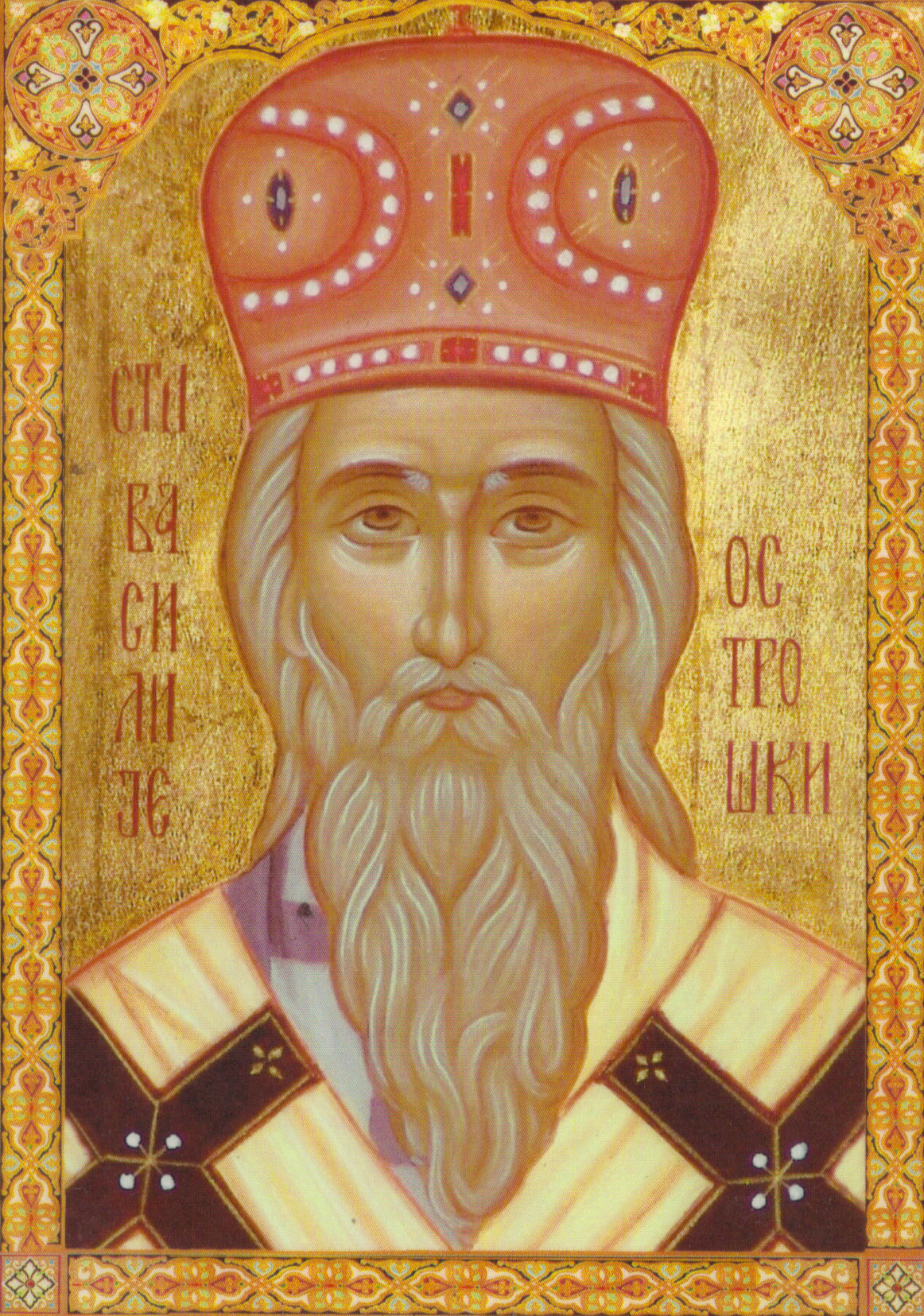
St. Basil of Ostrog, the Wonderworker (source)
  
TROPARION OF SAINT BASIL - Tone 4:
From your youth you gave yourself entirely to the Lord, remaining in prayer, labor and fasting, O God-bearing Father. Because you were an example of virtues and good works to your flock, seeing your good work, God established you as a pastor and good hierarch of His Church. And after your repose, He kept your body incorrupt, O Holy Basil. Therefore, with boldness pray to Christ God to save our souls.
 
Kontakion of Saint Basil -Tone 8:
Even as a youth, you served the Lord, O Wise one, belaboring your body with prayer and vigil. Because you were shown to be a precious vessel  of the Holy Spirit, He established you as a pastor of His Church which you tended well. And as such, you departed to the Lord whom you loved. We pray to you to remember us who keep your memory with faith, that all  may shout unto you: Rejoice, O most honorable Basil.
 
St. Basil of Ostrog, the Wonderworker (source)
  
Christ is risen from the dead, by death, trampling down upon death, and to those in the tombs, He has granted life!
Truly, the Lord is risen!