Christ is risen! Truly He is risen!
Wednesday, May 5, 2021
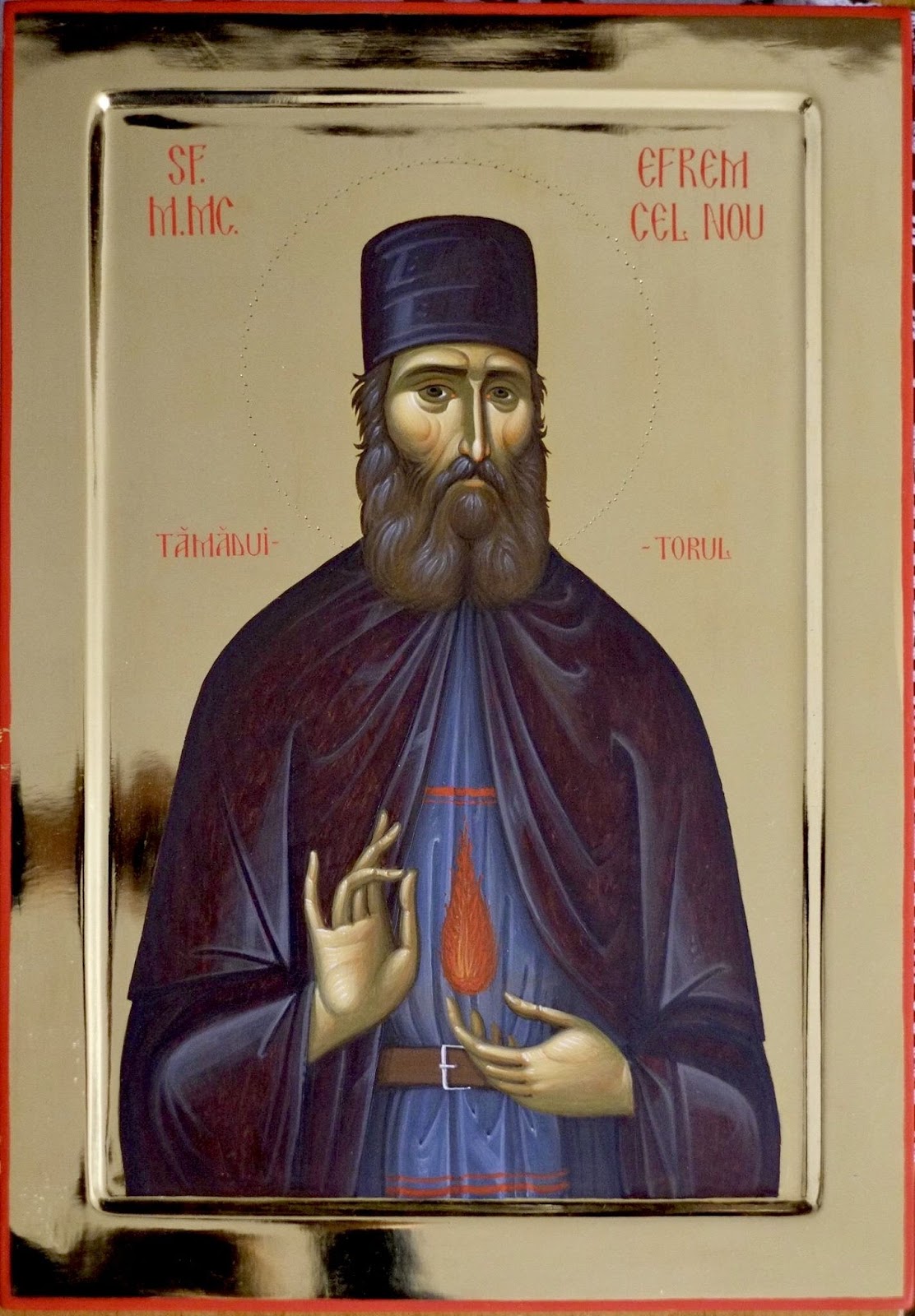
Video of Mother Makaria telling of the Revelation of the Relics of St. Ephraim of Nea Makri
Vasiliki Rallis on the Revelation of Sts. Raphael, Nicholas and Irene of Lesvos
Thursday, November 19, 2020
Six moving miracles to one man from St. Ephraim of Nea Makri
Friday, November 6, 2020
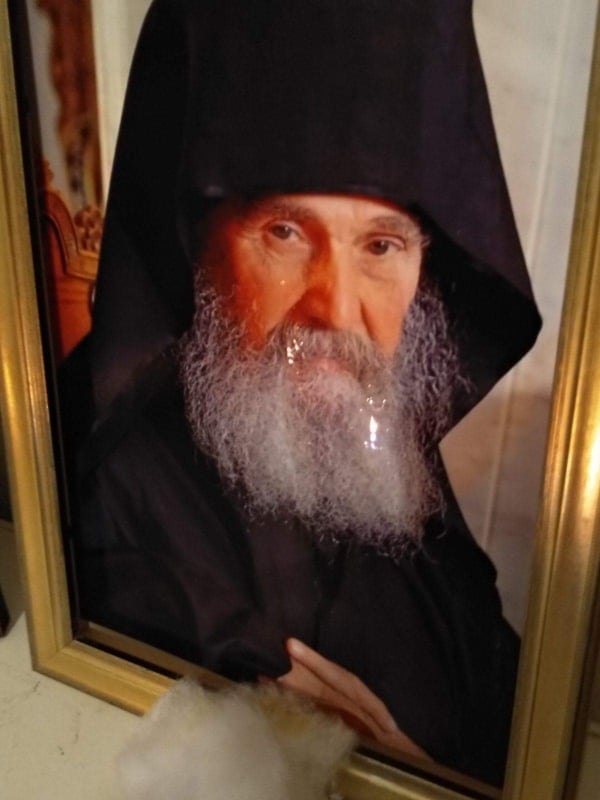
A vision of Elder Ephraim, and a picture of his purported to be weeping
"I just communicated with Gerontissa Thekla from Montreal, and she told me that our holy Elder appeared to someone living in Crete. He lives ascetically, and would go to visit the Elder at St. Anthony's [in Arizona].
He has this picture of our holy Elder with a constant vigil lamp before it. The Elder told him that God is greatly saddened by the Greeks***, because they are not praying.
On November 3rd, the picture began to weep, not just tears, but it became soaked.
The Elder is praying for all of us."
-Maria
(source)
***Note: By no means are the Greeks the only people that might not be praying as they should, but all people throughout the world, young and old, clergy, laity and monastics, should be repenting and praying as we should, entreating the Lord to save the world.
“Elder Ephraim of Philotheou, who lived as an ascetic in Arizona, appeared to a woman in Northern Greece, a long-time spiritual daughter of the elder. At the time of the appearance she was with her daughter-in-law; she was not asleep but actually in a state of alertness. At one point the woman was unresponsive, as if in ecstasy,* and this lasted for about 10 minutes, according to her daughter-in-law who was watching her. She did not realize or comprehend the time duration — i.e., for how long the vision lasted. It was something new for her (the content of the conversation) because she has seen the Elder before, after his repose, both in her sleep as well while she was awake. Due to all this (her shock), she contacted her spiritual father and asked whether this experience was real or a deception by the evil one.
She saw Elder Ephraim and he was very sad and was imploring Christ that the ongoing [direction of] events be averted (all this, of course, is in agreement with what the elder said to many while he was alive).
And he told her:
‘Repentance repentance repentance. Christ is very angry...
We people today should not be in this spiritual state we are in...
Huge tribulations are coming, you can not imagine how bad these will be...
Alas to all of you for what awaits you; you must repent as long as there is time...
You need to kneel and cry, to shed tears of repentance, that Christ soften...
This has to do with what is happening in America as well.
Many people will depart through all that is to come, many people will depart (they will die).
You have no mercy among you. You show no mercy to each other.
You are tough towards each other, you stand ready to eat (consume-destroy) each other ....
Tell all of this to your spiritual father and to others ....’
The woman who saw this was a spiritual daughter of Elder Ephraim and was in communication with him often up until his repose.
- f. I.
*Translator’s note: The Greek term here is χάθηκε. It was not immediately clear to us if this meant literally or spiritually. We received clarification that it was the latter and have made the change. We have also made other minor changes to improve the English translation and correct typos in the Greek version.
(source)
Through the prayers of our Holy Fathers, Lord Jesus Christ our God, have mercy on us and save us! Amen!
Tuesday, October 20, 2020
The Holy Relics of St. Demetrios pouring forth myrrh (2020)
The blog author remarks:
"Now that we are in need, the Saint is beside us."
Through the prayers of our Holy Fathers, Lord Jesus Christ our God, have mercy on us and save us! Amen!
Friday, August 7, 2020
A Miracle of St. Iakovos of Evia in India
When we celebrated the forty-day memorial of Papou [St. Iakovos of Evia], they whole area was covered in snow.
At one point in the evening, a rural villager came close. I heard Fr. Seraphim tell the sailor: "Go ahead, Niko, they're waiting for you behind the Altar."
When I went for a walk again in the Monastery, I passed by [the Saint's] grave, and I see the sailor crying, and after a short time, he related to us:
"We were stopped in India, because our boat had suffered damage, and we didn't know what was wrong. On Thursday evening I saw [the Saint] and he told me:
'Niko, it's there. That's where the damage is. Change out that part and you will leave.'
And that is how it occurred."
And when he returned to his home, his loved ones hadn't told him anything.
At the lunch table in his home, his little daughter told him:
"Daddy, that Papouli*** flew"
"What Papouli?"
They told him what had occurred [i.e. the repose of St. Iakovos] and he immediately came up to the Monastery. Of course at that hour, Fr. Seraphim and other pilgrims were there saying:
"He was a holy man."
And Fr. Seraphim [joked] "What kind of holy man? He was lying. He said that he hadn't gone anywhere, but he himself had gone to India."
-Quote of Metropolitan Pavlos of Siatista, of Blessed Memory, from a talk on St. Iakovos of Evia in the Holy Church of St. George, Panoramatos 11/21/2016
(source)
***Note: "Papouli" here is being used as a term of endearment for a priest.
Tuesday, July 14, 2020
Elder Ephraim of St. Andrew's Skete on the Repose of St. Paisios
"Gerontissa (Eldress) Philothei, from the Monastery of Souroti, told me that, as soon as St. Paisios reposed, his face shown, and his whole body began to pour forth fragrance and lightning!!! And he went from being very pale from his afflictions, to becoming totally white!
"A sign of his great humility and the many signs from God that he had in his life.
"St. Paisios had very many revelations, some of which he revealed to people, but he asked them to not make them known until he had died!
"His life was a martyrical one, and his battle with the devil and with the demons was not insignificant!
"To live one's whole life as a monk, this shows that he had a leonine soul, for otherwise he could not have withstood the attacks of the enemy, being totally alone."
-Elder Ephraim of St. Andrew's Skete, Mount Athos
(source)
Saturday, May 9, 2020
Elder Symeon on Healing and God's Providence
"Whatever needs to go, God will remove. Whatever doesn't need to stay, God removes, whether it is an illness or a demonic influence. And for whatever things that continue on and hurt us, we should pray to God. We should pray multiple times, again and again we should pray, not only for deliverance from our soul's illnesses and the demonic influences, but also for deliverance from bodily illnesses, as well.
"Let us pray to God for everything again and again. Not because God needs to hear our prayers repetitiously, but because we need to demonstrate by our seeking of Him, our faith. For modern man such lessons are learned from repetition.
"If you pray again and again and you will need to do this, and God does not answer your prayer or remove your illnesses, realize this: either you have not shown as much faith as He wants and expects from you, or the illness should not go because it is necessary for you.
"If you understand your illness from God's perspective, then, when it remains, you will feel twice healed. If He heals you, you are healed once. If the illness lingers, you will feel healed twice. Both when the time comes to be healed from your illness and at the right time your soul will experience healing also. When this occurs your inner person will be healed, this is the person who suffers from illness, from the leprosy of sin.
"The same goes for all mental illness and whatever else hurts us.
"If man sees all his issues within the providence of God, he will feel such a relief, as if all his problems are solved.
"Because in God all is resolved!"
-Elder Symeon Kragiopoulos (+2015),
Excerpt from the Book: Are You in Pain? Looking deeply into the mystery of pain
(source)
Tuesday, May 5, 2020
"I am Saint Efraim..."
(Written by a Pilgrim to the Monastery on June 17, 1971)
"Venerable Mother, I will tell you about a dream I had today. I dreamt that I was in the Church and we had the prayer after Supper. When it was over, as we were leaving I turned my head back and I saw Saint Efraim in front of the Altar. With fear, I went to Him and I heard Him telling me, "I am Saint Efraim. Light the oil candles of the Holy Altar." I was very scared and I called one of the Sisters. Saint Efraim approached me and once again told me, "I am Saint Efraim and He started chanting with His sweet voice, "Restrained by many temptations..." (from the Small Paraklesis to the Theotokos).
I wanted to cry, my Saint. To cry for your terrible ordeal, but I don't have this kind of tears that can reach you. My Saint, with your intercessions, purify my tears and accept them as a supplication of love to your Saintly martyr holiness.
My Saint, we most devoutly [venerate] your sufferings.
Don't stop mediating to the Lord to have mercy on us.
It is true that the Saint's grace has gotten outside our boundaries. A young woman from Kalamata told us that she had gone to Zakynthos to a Monastery and the Mother Superior had told her, "We are expecting a Saint to pass by here." When the young woman asked who that Saint was, she was told it was Saint Efraim, in glory and grandeur. Before Saint Efraim, a Nun with a lit candle was marching in solemnity.
It was September 14, 1971 that I was planning to come to the Monastery for my offering. A few days earlier, I saw the following dream: It was noon time and I was resting when Saint Nectarios along with some other Saint that I didn't know, appeared in front of me. That other Saint was dressed in an ascetic cassock. He was tall and very thin and had a calm ascetic and serious expression. When I asked them who they were, the Saint told me, "Efraim" and started telling me something about the 14th of September, the day of the Holy Cross..., but before I could understand what He wants, I woke up. Later I learned that the Saint was born on that day and on that day His sufferings started and ended on May 5, 1426."
Excerpt from the Book Visions and Miracles of the Great Martyr and Miracle-Worker Ephraim Neophanous
"When you have this love, you don't have to worry about anything, not even death..."
"Why are you crying, my child? Stop crying and listen to me. I am Saint Efraim. The love you are looking for, my child, the real love only God has it and He gives it to those creatures who love Him and He loves them. I have come now to announce to you God's Love for you. When you have this love, you don't have to worry about anything, not even death. Because God's love can save you and protect you from any illness and misfortune and guard you soul with an impenetrable wall so that no one will be able to violate it. Watch out though that until the end of your life, you will not lose the love of God and of the search for people." He said that and He left.
I cried, "My Saint, don't go. Please stay a little longer. In this world, I have no one else, but God and you. Protect me from ingratitude. Protect me from sin. Protect me so I will be able to safeguard the love of God."
From that moment, my suffering was gone like a thread that was cut. My grievance was also gone..."
Excerpt from the book: Visions and Miracles of the Great Martyr and Miracle-Worker Ephraim Neophanous
Friday, April 3, 2020
"O Champion General, I your City now inscribe to you..."
Tuesday, February 4, 2020
"A paradoxical wonder equal to Moses has occurred..."
A paradoxical wonder equal to Moses has occurred at the martyrdom of the all-glorious Agatha, and Martyr of Christ God, for he passed on to the people the Law received on the Mountain written by God, while an Angel from heaven placed a plaque upon her grave, on which was written: A righteous mind, self-determined, honor from God, the deliverance of her father-land."
-Doxastikon of the Stichera in the Plagal of the Fourth Tone, for the feast of St. Agatha
(source)
Tuesday, December 3, 2019
St. Porphyrios bringing young people to the Church
One Sunday morning, St. Porphyrios of Kavsokalyvia was traveling together with a well-known older villager towards the village church. On the road, they met a group of six or seven young people traveling in the opposite direction. The villager asked the young people:
"Where are you going guys?"
What did they respond? "To the coffee shop."
Then, the villager (who was very austere) told them:
"Aren't you ashamed, today on Sunday morning, of going to the coffee shop instead of church? Are you Christians?"
And he pelted them with a zealous sermon. The young people cursed at him and continued on their way. St. Porphyrios was silent. The villager, full of excitement and self-assurance, said to the Elder:
"Did I speak well to those brats?"
And St. Porphyrios responded: "No, you did not speak well..."
The villager, who was expecting congratulations, was embittered by the response of the Saint. They reached the church and St. Porphyrios went to the Holy Altar and the villager took a seat in church.
Not even a half hour passed, until all of the young people of that group entered the church! The villager was rubbing his hands out of satisfaction. As soon as the Divine Liturgy was finished, St. Porphyrios left the Holy Altar, and the villager hastened to meet him and pointed to the young people, saying to him:
"You said that I didn't speak well? They thought of my words and came to church."
And St. Porphyrios smiled, and explained to him that they came because he was praying silently for them and not that they were moved by the villager's stance....
In reality, prayer moves and transforms other people, not our words... Because of this we should not [primarily] speak to others about God, but speak to God about others.
(source)
Thursday, October 24, 2019
"This child you should name Demetri."
The following miracle which occurred and which you will read below will give you goose bumps. It is an astonishing miracle of St. Demetrios, which comes from the book: "The Myrrh of St. Demetrios - History and Modern Miracles".
"My name is X.A. and I am from Naousa, Imathias, and I have 4 children and have been living in Germany for 48 years. In 1975, I was 2 months pregnant and was in bed very sick, when St. Demetrios came to me on horseback riding on a cloud and stopped at my bed while I was awake and told me:
"This child you should name Demetri."
"And after this, I came to and was feeling better, and I went into the kitchen and told my husband about St. Demetrios, and during my nine months, he protected me, until my time came [to go into labor], when I heard St. Demetrios again tell me:
"Name him Demetri, do you hear?"
"My son saw him as well with his horse and his ancient clothes and the fragrance of myrrh, at which point he vanished. We later went to Greece to the Church of St. Demetrios and to his tomb and his prison and we received some of his myrrh. Today, Demetri is 38 years old. I chant Paraklesis to St. Demetrios and I thank him greatly for protecting me and for helping me give birth to Demetri.
On March 10th, 2013, I suffered 2 strokes, and I died and was found in vast plain. I saw a demon far away buzzing around, but he could not come near me. The German doctor with machines brought me back and now I am much better. I want to come to Greece but the doctor doesn't let me travel. Please pray for us...
(source)
Tuesday, August 13, 2019
"The Most Holy Mother of God prays for us ceaselessly..."
"The Most Holy Mother of God prays for us ceaselessly. She is always visiting us. Whenever we turn to her in our heart, she is there. After the Lord, she is the greatest protection for mankind. How many churches there are in the world that are dedicated to the Most Holy Mother of God! How many healing springs where people are cured of their ailments have sprung up in places where the Most Holy Theotokos appeared and blessed those springs to heal both the sick and the healthy! She is constantly, by our side, and all too often we forget her.”
-Elder Thaddeus of Vitovnica
(source)
Wednesday, July 24, 2019
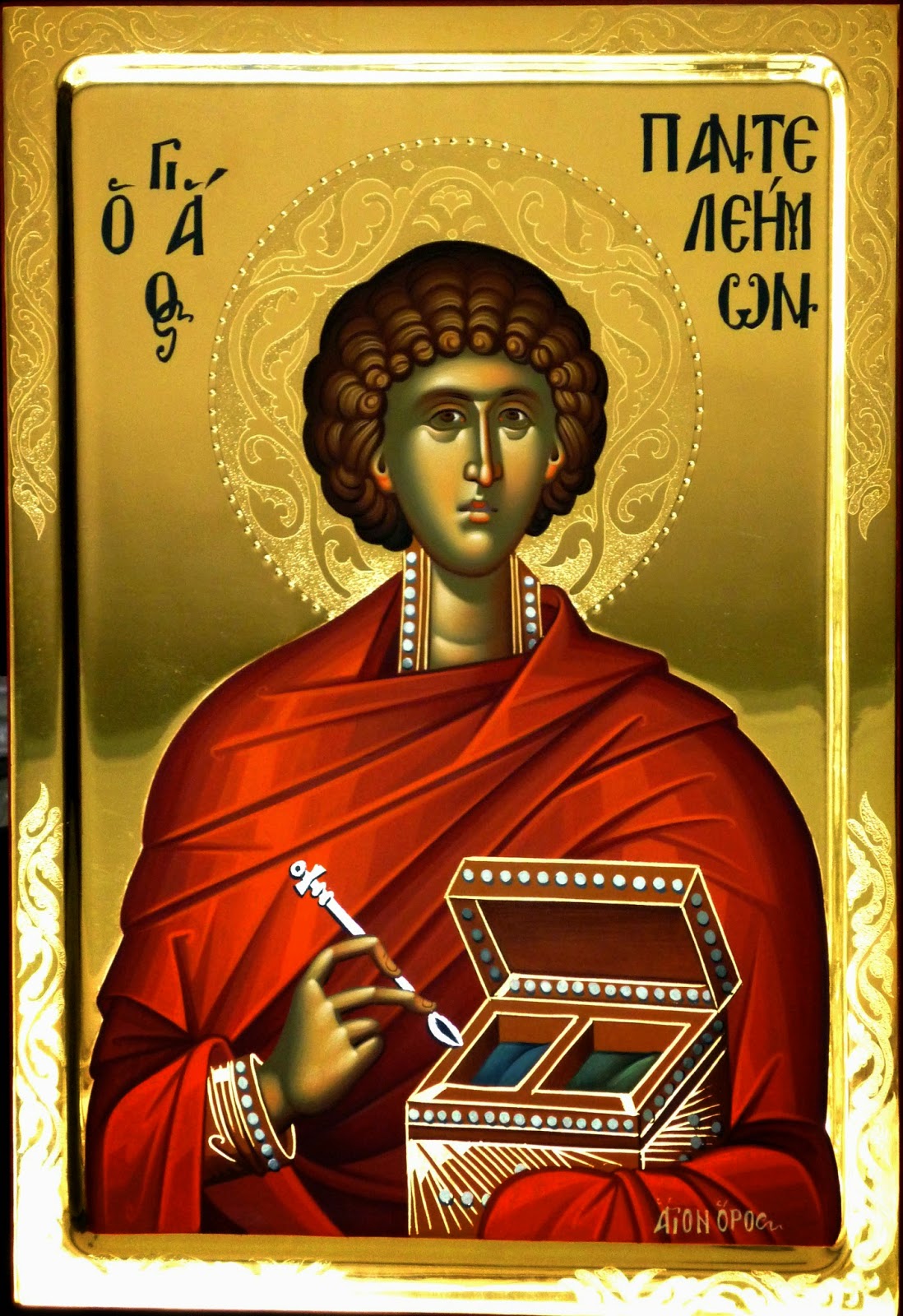
Metropolitan Avgoustinos Kantiotes on St. Panteleimon the Great Martyr
Metropolitan Avgoustinos Kantiotes on St. Panteleimon the Great Martyr: He was cast out due to jealousy
"For he knew that for envy they had delivered him" (Matthew 27:18)
My beloved, we are honoring the holy memory of the Great Martyr Panteleimon. Our topic will be the question: What was the reason that St. Panteleimon was persecuted? To this we will give a short response.
St. Panteleimon lived and struggled during the era of persecutions, when the Roman Emperor was Diocletian. He was born in Nicomedia of Asia Minor. His father was an idolater, but his mother was from the women who planted deeply into the heart of their children their faith in Christ. Therefore, she taught St. Panteleimon the truths of the faith.
He was well-sown. He had a call towards learning. He studied medicine near noted scientists. He became an exemplary physician. There were many physicians then, like there are today. However, it is rare today to find a Christian physician. The majority are faithless, materialists. And these have no worth; may God protect you from falling into their hands.
St. Panteleimon differed from them. In what way did he differ? He differed in three ways.
First, regarding money. They were lovers of money. They charged their patients a lot and became rich. St. Panteleimon was unique, a man of ideology. He used science as a mission. He was seen at night visiting huts [of the poor and sick] like an angel. While the others went only to the houses of the great ones, he went to the houses of the poor and served the sick.
And a second way in which he differed from the others. As a famous Greek university professor once said, physicians frequently study medicine like veterinary medicine, and many doctors act like veterinarians. They don't see anything else beyond veins, bones, flesh, ribs, hearts and lungs. Man of course is these, but behind this is something invisible. There is a "little motor", which moves the biological body, and there is the existence of man. And the doctor, when he doesn't see this "little motor", is blind, and is not in the position to perform his work. This "little motor" is the spiritual factor, the soul of man. A multitude of experiments and observations have shown that the soul with the passions, feelings, conscience and impulse greatly impacts the body. There is an interconnectedness between body and soul. This is what our Church chants during the 15-days of August, and which is scientifically correct: "From the great multitude of my sins, ill am I in body, ill am I also in soul..." (from the Small Paraklesis to the Theotokos). And both are sick but the root of evil is sin. Therefore, St. Panteleimon made the correct diagnosis. He saw that, when the soul is freed from guilt, the body is given life, and man breathes deeply. Many illnesses (apoplexies, heart attacks, cancer) have as their cause the spiritual world. Some bitterness from remorse or from slander or from divisiveness or from injustice or anxiety waters the body with poison.
So he differed first for not taking money, secondly because he saw man as a psychosomatic whole, and thirdly, for besides the other medicines which the other physicians had, St. Panteleimon had a rare and unique medicine, and this was the faith. He believed deeply. Because of this, together with medicines from herbs from the earth that he gathered, he knelt next to the pillow of the sick, praying, and--let the faithless disbelieve it, we believe it--the sick man was healed. And to this day, we see the sign of the Cross in clinics, hospitals and healing centers. How truly awesome a thing is the power of faith, a medicine of healing for bodily and spiritual illnesses.
This was St. Panteleimon. And because of this, his healing center was marked every day with a line of sick people, while they did not go to the other physicians of Nicomedia anymore. This being passed over, however, enflamed the hearts of his colleagues with the yellow lamp of jealousy. They were jealous of him, they hated him. They saw that, as long as he was a physician in Nicomedia, they would have to change careers because everyone was hastening to St. Panteleimon. And the sick, who themselves were loosing hope, found their healing near him. Behold therefore the cause of jealousy. Because of this they cast him out. They hated him from the beginning. With what slander did they do so? As an unmercenary? As one taking advantage of people? As an adulterer? As a fornicator? As a dangerous person? As a criminal? None of these things. If they condemned him with these during that decadent regime, it wouldn't work. They condemned him with a condemnation that took hold. Isn't that how it is, that the slanders of the faithful change in every age? Sometimes they use slander A, other times B, other times C. I will not dwell on this, I will just mention that, from the time...with various slanders, with foolish things the jealous attack the worthy men to discredit them--though at the heart of the matter, they don't believe the slanders--and people are no longer judged according to proper and steadfast criteria (ethically), but according to other criteria (politics).
They condemned him therefore with the condemnation of that era that was so devastating: that he was a Christian. And this condemnation led man to dash him to pieces. He was seized, led before rulers, confessed his faith with boldness, suffered all kinds of martyrdom, and thus, his holy soul flew to the heavens like a wholly-white dove to dwell in the heavenly mansions, in order to rejoice together with the Holy Angels and Archangels.
Behold, my beloved, the cause of the persecution and the martyrdom of St. Panteleimon: jealousy.
O jealousy, a great and abyss of a passion! It is a worm and viper that consumes the bowels of he who is jealous, but is also the grave of great men. Terrible are its consequences. If we open the holy stories, we will see that, from the beginning, this was the destruction of the human race. "Out of the jealousy of the devil", says Solomon, "death entered into the world" (Wisdom of Solomon 2:24). Satan was jealous of the magnificence of man, and was filled with wrath against him. Because of this was the first blood spilled upon the earth, due to jealousy. Cain was jealous of his brother Abel and he murdered him "in the field" (Genesis 4:8). From jealousy Esau persecuted Jacob (ibid 27:41), the eleven children of Jacob persecuted Joseph the All-comely (ibid 37), King Saul persecuted David (I Kings 19:10), and a long line of holy men were snuffed out.
And we have examples from our own national history. Great men were snuffed out like the righteous Aristides in antiquity, Socrates who drank the poison, and in later years, Harilaos Trikoubes, etc.
But why do we need other examples? Cast your eye on the Praetorium and to Golgotha. "Which of these two do you wish that I release?" asked Pilate, "Barabbas or Jesus?" Everyone cried out together: "Barabbas". And the Evangelist notes psychologically: "This he did", Pilate, in other words, "for they delivered Him up out of envy." (Matthew 27:18) The envy of the Scribes and Pharisees, which were like fireflies quenched before the great sun that is Christ, led our Lord to Golgotha. Therefore, my brethren, it is a general rule. If there ever appears some person, some worthy personality, who would perform their duty, he will elicit envy and rouse up persecution. Meaningless people do not bother, those who offer help and give their lives to those around them, they are the ones persecuted. St. Paul said this: "All those who desire to live piously in Christ Jesus will be persecuted" (II Timothy 3:12). All those who believe in Christ will be persecuted, along with all those seek to live according to His commandments. It is their fate. All those living, either through his word or through his example, bring about an earthquake. However, this is an earthquake of salvation. Blessed are the communities who have such men, either in science or in the military or in politics or in the holy clergy, for they become the agents of the proper way.
Pray, my brethren, that the sickness of envy might be healed, that it might abandon you. And may our Lord, through the intercessions of St. Panteleimon, transform all our hearts, and may we go forth with virtue and love, to the glory of God. Amen.
+Bishop Avgoustinos
(Homily of Metropolitan of Florina Avgoustinos Kantiotes, delivered in the Holy Church of St. Panteleimon, Florina, 7/27/1976) (source)
Thursday, July 18, 2019
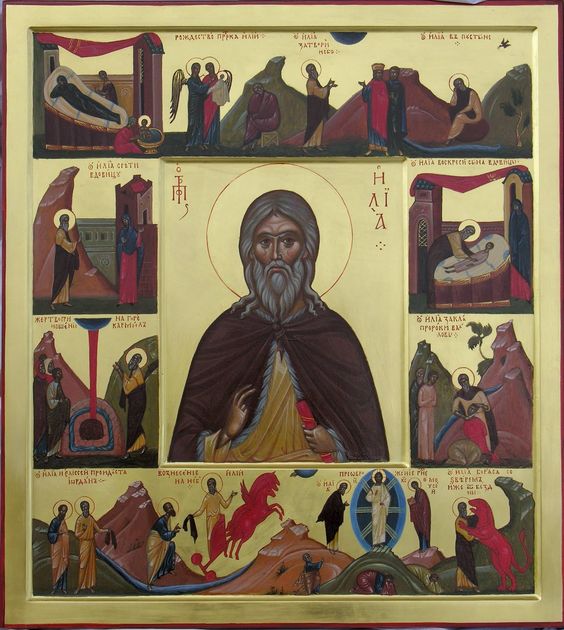
Metropolitan Avgoustinos Kantiotes: On the Prophet Elias and the Wonders of Prayer
Metropolitan Avgoustinos Kantiotes of Florina: On the Prophet Elias and the Wonders of Prayer
Today, my beloved, we celebrate one of the greatest Saints of our faith, the glorious Prophet Elias. He lived before Christ, but he is also "the second forerunner of the coming of Christ" (from the Apolytikion of the Saint). He is one of the most beloved Saints, and many bear his name, and on many hills there are built chapels in his name, and many villages celebrate his name.
Should we tell of his life? It would take much time and you don't have much stamina. So that I might not tire you, I will tell of a few essential things from the life of the Prophet Elias. I will mention three of the wonders out of the many that he had done.
The one was that once, with his prayer, there was a drought that hit along with a famine in Judea. He also was hungry, because the Saints suffer hunger. He went to a village and everyone closed their doors to him. Only one house, a hut, opened their door. And who lived there, a rich man? It was a poor widow with her children. She received him. She had nothing to offer him hospitality, only a handful of flour and a little oil. And these she did not hold back. As soon as she saw him, even though she didn't know who this old man was, she said: "Come in, Elder." She immediately took the flour, made bread and gave him to eat, because he was tired from his journey. This occurred in Zarepta of Sidonia. And then--let the faithless disbelieve; it is their right, but we believe--from that hour on, the widow's house was never lacking in flour and oil. (Third Kings 17:8-16).
What does this mean? Where there is the blessing of God, everything is riches. One can have incomparable fields, vineyards and olive groves, one can have sacks of gold and silver, one can have it all, but die from hunger. And one can have a handful of flour, a little piece of earth, a bucket of soil, and this will sustain you, as long as one blesses the Lord. These are not just words, they are reality. Because of this our Church chants: "The rick have become poor and hungry, but those who seek the Lord shall not lack any good thing." (Psalm 33:11) Everything, therefore, is a blessing. Some place too high an emphasis of work alone, because above work is the blessing of our Lord Jesus Christ.
Another miracle: While the house of the widow had flour and oil, the rest of the village was suffering hunger, for it had not rained for three and a half years. The impious King Ahab gathered the people of Israel on Mount Carmel, and there, the Prophet Elias censured them for their lack of steadfastness. Until when, he said, will you stand limping with your two feet? If our God is true, then follow Him. If Baal (the idol) is true, then follow him. They heard him without speaking, how would they be justified? Then he told them, I will only preach the true God, while the priests of the idols were about 1000. Today, therefore, we will test who is the true God. Bring two calves, and you will choose whichever you wish, and let us prepare a sacrifice with wood, but we will not light them on fire. And I will prepare the other for sacrifice and will not light it on fire. And you will entreat your god, and I will call upon the Lord my God. And He will hear me and will light and burn the calf of sacrifice, because He is the true God.
They agreed. The priests of shame placed their altar, and their calf upon it, and began to entreat, calling out: "Hear us, Baal". Noon passed, evening came, nothing. Their god was shown to be false. Afterwards, Elias places the clean altar, places wood and the calf upon it in pieces, and tells the others to sprinkle it three times with water (in order that there not be any possibility of fire). And as soon as he prayed, fire descended from heaven and consumed the whole calf, and the wood and the stones and even the water! Nothing remained. Then everyone believed that the only true God is the Lord. Immediately, the Prophet Elias commanded: cease all of the priests of shame, the priests of idolatry. And he took them to the brook of Kisson, and there--terribly--he slaughtered them all (ibid 18:19-40).
Let us now return again to the house of the widow. What happened there? One day her child fell deathly ill and died. The mother said to the Prophet Elias: "Come to my house to explain to me for which of my sins my son was put to death." "Give me your son." he told her. He took him to the upper room, laid him in his bed, and having prayed to the Lord, breathed three times on the child, and then--let the faithless disbelieve, we believe that there is a God Who works wonders through the Panagia and the Saints--the child was resurrected. "I see that you are a man of God", the widow said. (ibid 17:17-24)
I told you a few things, my beloved, about the Prophet Elias. One more thing I will mention. When it came the time for him to flee from the world, he did not die like we do. As he was walking, a fiery chariot took him and lifted him high. The Prophet Elias still lives. He is hidden somewhere, in one corner of the universe. And we expect him to come again. You don't fear the Prophet Elias, because it seems that you are Saints? I am afraid of him. He is a thunderbolt against sinners, prostitutes, adulterers, blasphemers, atheists, shameful people and all who remain unrepentant. His word is burning. He is the "second forerunner of the coming of Christ", the forerunner of the Second Coming of the Lord. And the Second Coming of the Lord is approaching, it is coming! The signs are many. There are signs which will precede the end of the world, and one of them is the appearing of the Prophet Elias.
One sign of the end of the ages is, as Christ Himself said, that there will be earthquakes, terrible earthquakes (Matthew 24:7). And continuous earthquakes are occurring. Another sign was mentioned by St. Kosmas Aitolos. When they asked him when the end of the world was coming, he replied: "When you see women walking naked in the street." And we see this in reality. Women walking around [naked], corrupting the world*, and even in the church they dare to enter naked. Another sign is the divorces that are increasing, while formerly divorce was unknown and only the shovel of the undertaker separated couples. Another sign that will appear is the 666. The devil will come out and begin to seal people, all, small and great will take this identification. These are the signs of the times. Go and sell your shirt and buy the Book of Revelation and read it, it is all written in there, what will occur.**
Within your houses, have fear of God. How will we be saved? With prayer. With what prayer? Not dead prayer, but living prayer which comes through tears. In the old blessed days the Christians listened in the Church of Christ with contrition. Today, we find the church dead. In the old days, in the crags of our homeland dwelt holy people. And what did they do? Were they partying at night? Before they would go to sleep, the father and mother, along with their seven or eight children would kneel in prayer to God. Show me today a family that prayers together! We have lost the mind of God. Where is prayer, family prayer? Where are the tears, the contrition? Where is Confession and Holy Communion? Where is almsgiving? Where are the wonders of our people?
Because of this, I advise you to take the Gospel and the Revelations and all of you read them, men and women. Pray night and day, at noon and in the evening. And if you can't say many prayers, say only one prayer: "Lord, have mercy", "Lord, have mercy", "Lord, have mercy". And if you say it with your whole heart, you will be heard, and you will work wonders, and the stars will descend to earth.
Let us live like this, therefore, my beloved and blessed ones, with Christ, awaiting the return of the Prophet Elias, and entreating God to save the world. Amen.
(+) Bishop Avgoustinos, recorded from a homily given in the Holy Church of the Prophet Elias, Xanthogeion, Amyntaiou, on July 20th, 1987) (Source)
Thursday, July 11, 2019
Metropolitan Avgoustinos Kantiotes on the Miracle of St. Euphemia
Today, my brethren, the Church honors the holy Great Martyr Euphemia. Her memory of course is honored in September. One is astonished at how she struggled against Diocletian, against the idolaters. One is astonished at how she was martyred. Her struggles do not end there, however. Years later, she made another struggle and again was victorious. She worked a great wonder, and that is what we honor today.
My beloved, 170 years passed from the martyrdom of St. Euphemia. The persecutions had largely ceased. The Church however was then found in a dogmatic struggle, which led to the recording of her teaching. The great issue which the faithful were facing during that period was the teaching on the God-man person of our Lord Jesus Christ.
The Church preached that Christ is God and man. But many, and even today, do not want to understand this. They receive Christ like a poet, like a philosopher, like a community-organizer, like a rebel. They lift Him up very high, but they do not want to confess that Christ is God. This therefore exactly is the dogma of the Godhead of Christ which the Church preaches, and is the rock of scandal around which our Holy Fathers fought great battles.
Against this dogma appeared three great beasts, three great heretics, who wanted to shake this truth. The first was Arias, who did not accept the Godhead of Christ and said, that there was a time when Christ did not exist, and that Christ was not God. Afterwards appeared another heretic, Nestorius, did not accept the union of the Godhead and humanity, and sharply divided the humanity and the Godhead. And later appeared Eutyches, who was an archimandrite and an abbot of a monastery. He preached that the divine nature of Christ swallowed up the human, that within Christ there was only the Godhead, and that the Body of Christ was different from our own. This was a blasphemy, which diminished the God-man person of our Lord Jesus Christ.
I am tiring you a bit, but you will see that the new heresies as well which are appearing now with great conquests in the world, if we analyze them, we will see that within them is Arias, Nestorius and Eutyches, and every ancient heretic.
Against the heresy of Eutyches the Fathers struggled. In Chalcedon, where there was the magnificent Church of St. Euphemia, during the reign of Pulcheria the Empress, the Fourth Ecumenical Council gathered. There gathered 630 Holy Fathers, whose memory we honor every year during the month of July on the Sunday of the Holy Fathers. There was recorded the dogma of the two natures of Jesus Christ. There, the Fathers put forward the healthy teaching and condemned the phronema of delusion. What did they say? I will give you an example, which St. Cyril of Alexandra offered, who was one of the defenders of Orthodox dogma.
If one takes a piece of iron and places it in the furnace, you will see that it becomes totally red. But even though the iron is united with the flames, it does not cease to be iron. The black has simply become red. And the fire, however, even though it is united with the iron, and cannot be separated from it, despite this, it does not cease to be fire. In this way somewhat, my beloved, is the person of Christ. The iron is the human nature, the fire is the Godhead. The two are united, and thus Christ appeared as the God-man. The natural is united with the spirit, the man is mystically united with God.
My brethren, I do not wish to tire you with dogmatic homilies. It would be good for the preacher to speak about dogmas, in order to analyze the Symbol of our Father. But unfortunately, our Christians desire easy foods, and they have need of the alphabet of our faith.
I will return to our topic therefore and say: In Chalcedon there were two groups. The one was of St. Cyril the Patriarch of Alexandria together with the Orthodox, and the other with the heretic Eutyches. The very faithful and simple people could not understand these meanings. They were confused and their faith was endangered. Then, the difference of this faith was solved by St. Euphemia. How?
In that place was preserved the Holy Relic of St. Euphemia. 170 years it rested in her Church in Chalcedon. The two groups, therefore, agreed to write their teachings into two books, one with the ideas of the Orthodox and the other of the heretics. The two books were placed within the reliquary which held her Holy Relic, upon her holy chest. Then, they proceeded to prayer and vigil for three days and nights together with all of the people of Chalcedon with fasting. They entreated St. Euphemia to respond. Clerics of the two groups guarded the Holy Relic as well. And when the third day came, they opened the reliquary, and then they saw the wonder. The book of the heretics was below the Saint's feet, and the book of the Orthodox was in her hands upon her chest, above the Saint's heart! Thus, wondrously, she showed that the faith of the Orthodox is true.
But what thing is this? What are you saying now? Those things are only from books...
Books? Here it is written. The apolytikion of the Saint says: "You greatly gladdened the Orthodox, and deposed those of evil faith, and with this wonder you confirmed what the Fathers of the Fourth Synod dogmatized well", you sealed what the Holy Fathers said with wisdom.
Thus this miracle confirms our Holy Church and this is described in the Saint's apolytikion. I do not know what will occur. At least I will never become a modern preacher and theologian. I will continue to believe and I will not teach anything other than that which our Holy Church teaches. If you do not believe and do not receive the teaching of the Church, I will keep the things of our homeland together with all of the faithful and we will believe the lives of the Saints, their miracles, their Holy Relics, and [take refuge] in the shadows of the Saints and in their memories.
I will say two more words and close. Unfortunately, this heresy of monophysitism (thus it is named the heresy of Eutyches which the Church condemns to this day), has not been abandoned totally. A relic of this great heresy which shook the ship of the Church exists to this day. And there are around 15 million Armenians, Abyssinians, and Copts of Egypt [i.e. the Oriental orthodox]. They have even their own patriarchates. They not receive the decisions of the Fourth Ecumenical Synod and why were they cut off from the Church. All of the rest until the Fourth Ecumenical Council...they accept, and they also are a martyred nation. Among these there is one difference only. They agree with everything until then, but from then on they cease. And to this day, they do not wish to accept the Fourth and the other Ecumenical Synods. Behold our disagreement.
Therefore, this day brings to our mind the Copts of Egypt, the Armenians and the Abyssinians. And I will greatly entreat today, that it is the memory of St. Euphemia, who wondrously confirmed the Fourth Ecumenical Synod, that we all might pray that the Saint might work another great wonder, that they all might return to Orthodoxy and agree on the tome of the Orthodox dogma, that they might come to agree with our Holy Church, in a manner that they might not be separated from their noble nations--for they are truly noble nations--and that we might pray to God "on behalf of the union of all". It is our holy duty, to try to bring these nations, who fled due to the heresy of Eutyches, to return to the bosom of our Holy and Great Mother Church.
(+) Bishop Avgoustinos.
Thursday, June 27, 2019
"Even though I have died, yet am I alive! Grieve not, O ye people!"
(source)