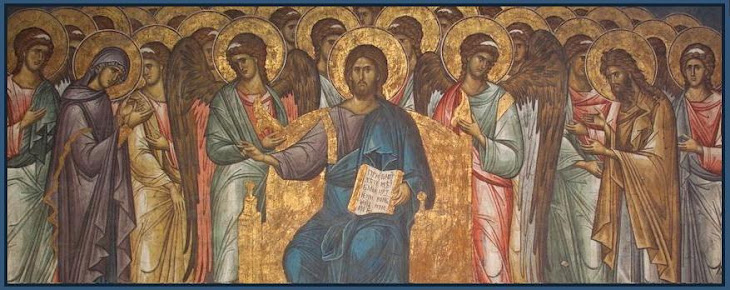
St. Nektarios the Wonderworker, Bishop of Pentapolis - Commemorated on November 9 (source)
"Saint Nectarius, the great wonderworker of modern times, was born Anastasius Kephalas in Selebria, Thrace on October 1, 1846.
Since his family was poor, Anastasius went to Constantinople when he was fourteen in order to find work. Although he had no money, he asked the captain of a boat to take him. The captain told him to take a walk and then come back. Anastasius understood, and sadly walked away.
St. Nektarios traveling to Constantinople as a young man (source)
The captain gave the order to start the engines, but nothing happened. After several unsuccessful attempts, he looked up into the eyes of Anastasius who stood on the dock. Taking pity on the boy, the captain told him to come aboard. Immediately, the engines started and the boat began to move.
Anastasius found a job with a tobacco merchant in Constantinople, who did not pay him very much. In his desire to share useful information with others, Anastasius wrote down short maxims from spiritual books on the paper bags and packages of the tobacco shop. The customers would read them out of curiosity, and might perhaps derive some benefit from them.
The boy went about barefoot and in ragged clothing, but he trusted in God. Seeing that the merchant received many letters, Anastasius also wanted to write a letter. To whom could he write? Not to his parents, because there were no mail deliveries to his village. Not to his friends, because he had none. Therefore, he decided to write to Christ to tell Him of his needs.
"My little Christ," he wrote. "I do not have an apron or shoes. You send them to me. You know how much I love you."
Anastasius sealed the letter and wrote on the outside: "To the Lord Jesus Christ in Heaven." On his way to mail the letter, he ran into the man who owned a shop opposite the one in which he worked. The man asked him where he was going, and Anastasius whispered something in reply. Seeing the letter in his hands, the man offered to mail it for him, since he was on his way to the post office.
The merchant put the letter in his pocket and assured Anastasius that he would mail it with his own letters. The boy returned to the tobacco shop, filled with happiness. When he took the letter from his pocket to mail it, the merchant happened to notice the address. Astonished and curious, the man could not resist opening the letter to read it. Touched by the boy's simple faith, the merchant placed some money in an envelope and sent it to him anonymously. Anastasius was filled with joy, and he gave thanks to God.
A few days later, seeing Anastasius dressed somewhat better than usual, his employer thought he had stolen money from him and began to beat him. Anastasius cried out, "I have never stolen anything. My little Christ sent me the money."
Hearing the commotion, the other merchant came and took the tobacco seller aside and explained the situation to him.
When he was still a young man, Anastasius made a pilgrimage to the Holy Land. During the voyage, the ship was in danger of sinking in a storm. Anastasius looked at the raging sea, and then at the captain. He went and stood beside the captain and took the helm, praying for God to save them. Then he took off the cross his grandmother had given him (containing a piece of the Cross of Christ) and tied it to his belt. Leaning over the side, he dipped the cross into the water three times and commanded the sea, "Silence! Be still." At once, the wind died down and the sea became calm.
Anastasius was saddened, however, because his cross had fallen into the sea and was lost. As the boat sailed on, sounds of knocking seemed to come from the hull below the water line. When the ship docked, the young man got off and started to walk away.
Suddenly, the captain began shouting, "Kephalas, Kephalas, come back here." The captain had ordered some men into a small boat to examine the hull in order to discover the source of the knocking, and they discovered the cross stuck to the hull. Anastasius was elated to receive his "Treasure," and always wore it from that time forward. There is a photograph taken many years later, showing the saint in his monastic skufia. The cross is clearly visible in the photo.
Photograph of St. Nektarios later in life, (I believe) still wearing the Holy Cross given by his grandmother (source)
On November 7, 1875, Anastasius received monastic tonsure at the Nea Moni Monastery on Chios, and the new name Lazarus.
St. Nektarios the Wonderworker, depicted with his spiritual father, St. Pachomios of Chios (I'm not sure if he has been officially canonized yet) (source)
Two years later, he was ordained a deacon. On that occasion, his name was changed to Nectarius.
St. Nektarios being ordained a deacon (source)
Later, when he was a priest, Fr Nectarius left Chios and went to Egypt. There he was elected Metropolitan of Pentapolis. Some of his colleagues became jealous of him because of his great virtues, because of his inspiring sermons, and because of everything else which distinguished St Nectarius from them.
Other Metropolitans and bishops of the Patriarchate of Alexandria became filled with malice toward the saint, so they told Patriarch Sophronius that Nectarius was plotting to become patriarch himself. They told the patriarch that the Metropolitan of Pentapolis merely made an outward show of piety in order to win favor with the people. So the patriarch and his synod removed St Nectarius from his See. Patriarch Sophronius wrote an ambiguous letter of suspension which provoked scandal and speculation about the true reasons for the saint's removal from his position.
Sts. Nicholas and Nektarios: both are models for Christian bishops, both were persecuted unjustly by some in the church, and both were icons of Christ-like love, humility, forgiveness and sacrifice, and great Wonderworkers, though they lived centuries apart (source), See here for another close-up of this beautiful icon by Alevizakis.
St Nectarius was not deposed from his rank, however. He was still allowed to function as a bishop. If anyone invited him to perform a wedding or a baptism he could do so, as long as he obtained permission from the local bishop.
St Nectarius bore his trials with great patience, but those who loved him began to demand to know why he had been removed. Seeing that this was causing a disturbance in the Church of Alexandria, he decided to go to Greece. He arrived in Athens to find that false rumors about him had already reached that city. His letter of suspension said only that he had been removed "for reasons known to the Patriarchate," and so all the slanders about him were believed.
Since the state and ecclesiastical authorities would not give him a position, the former Metropolitan was left with no means of support, and no place to live. Every day he went to the Minister of Religion asking for assistance. They soon tired of him and began to mistreat him.
One day, as he was leaving the Minister's office, St Nectarius met a friend whom he had known in Egypt. Surprised to find the beloved bishop in such a condition, the man spoke to the Minister of Religion and Education and asked that something be found for him. So, St Nectarius was appointed to be a humble preacher in the diocese of Vitineia and Euboea. The saint did not regard this as humiliating for him, even though a simple monk could have filled that position. He went to Euboea to preach in the churches, eagerly embracing his duties.
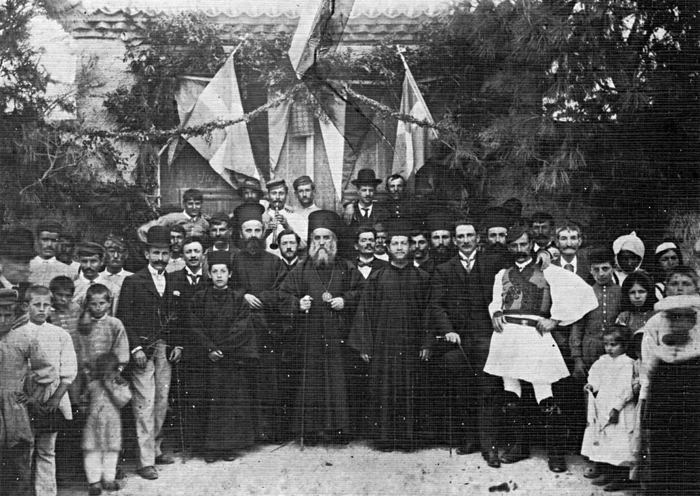
Photograph of St. Nektarios among the faithful in a town of Euboea after the Divine Liturgy, in 1893 (source)
Yet even here, the rumors of scandal followed him. Sometimes, while he was preaching, people began to laugh and whisper. Therefore, the blameless one resigned his position and returned to Athens. By then some people had begun to realize that the rumors were untrue, because they saw nothing in his life or conversation to suggest that he was guilty of anything. With their help and influence, St Nectarius was appointed Director of the Rizarios Seminary in Athens on March 8, 1894. He was to remain in that position until December of 1908.
[The following story is illustrative of the great love and humility that St. Nektarios bore throughout his life:
"[St. Nektarios]
had once again fallen ill and suffered for fifteen days. He had headaches, dizziness and weakness. He literally dragged himself to his lectures [at Rizarios school]
. His illness had probably been brought about by the extra work load he had secretly undertaken for the school custodian Loukianos. Loukianos had suddenly fallen ill due to failing kidneys, and having been overcome by excrutiating pain one day on the job, he had to be taken to the Evangelismos Hospital across the street. He then underwent a dangerous and painful operation and was ordered by his physicians not to return to work for at least two and a half months. Nektarios felt deep pity for the man and decided that he would do the work for him until he was able to come back. So, Nektarios would wake up at dawn and take to cleaning toilets and floors and whatever work was left undone by the assistant janitors."
(from
The Saint of our Century by Chondropoulos)]
The saint celebrated the services in the seminary church, taught the students, and wrote several edifying and useful books. Since he was a quiet man, St Nectarius did not care for the noise and bustle of Athens. He wanted to retire somewhere where he could pray. On the island of Aegina he found an abandoned monastery dedicated to the Holy Trinity, which he began to repair with his own hands.
The large Church of St. Nektarios at his Monastery in Aegina (one of the largest churches in Greece) (source)
He gathered a community of nuns, appointing the blind nun Xenia as abbess, while he himself served as Father Confessor. Since he had a gift for spiritual direction, many people came to Aegina to confess to him. Eventually, the community grew to thirty nuns. He used to tell them, "I am building a lighthouse for you, and God shall put a light in it that will shine forth to the world. Many will see this light and come to Aegina." They did not understand what he was telling them, that he himself would be that beacon, and that people would come there to venerate his holy relics.
A photograph of St. Nektarios (I believe) serving at his last (earthly) Divine Liturgy (source)
On September 20, 1920 the nun Euphemia brought an old man in black robes, who was obviously in pain, to the Aretaieion Hospital in Athens. This was a state hospital for the poor. The intern asked the nun for information about the patient.
"Is he a monk?" he asked.
"No, he is a bishop."
The intern laughed and said, "Stop joking and tell me his name, Mother, so that I can enter it in the register."
"He is indeed a bishop, my child. He is the Most Reverend Metropolitan of Pentapolis."
The intern muttered, "For the first time in my life I see a bishop without a panagia or cross, and more significantly, without money."
Then the nun showed the saint's credentials to the astonished intern who then admitted him. For two months St Nectarius suffered from a disease of the bladder. At ten thirty on the evening of November 8, 1920, he surrendered his holy soul to God. He died in peace at the age of seventy-four.
In the bed next to St Nectarius was a man who was paralyzed. As soon as the saint had breathed his last, the nurse and the nun who sat with him began to dress him in clean clothing to prepare him for burial at Aegina. They removed his sweater and placed it on the paralyzed man's bed. Immediately, the paralytic got up from his bed, glorifying God.
The repose of St. Nektarios, showing St. Savvas the New of Kalymnos, who was not the only clergyman to officiate at Saint Nectarios' funeral, but also perceived his great holiness and painted the first icon of him, before he was officially proclaimed a Saint. (source)
St Nectarius was buried at the Holy Trinity Monastery on Aegina. Several years later, his grave was opened to remove his bones (as is the custom in Greece). His body was found whole and incorrupt, as if he had been buried that very day.
Word was sent to the Archbishop of Athens, who came to see the relics for himself. Archbishop Chrysostomos told the nuns to leave them out in the sun for a few days, then to rebury them so that they would decay. A month or two after this, they opened the grave again and found the saint incorrupt. Then the relics were placed in a marble sarcophagus.
Several years later, the holy relics dissolved, leaving only the bones.*** The saint's head was placed in a bishop's mitre, and the top was opened to allow people to kiss his head.
[***
Note: The dissolution of St. Nektarios' relics (just as their previous incorruption) was truly by the will of God. The following story illustrates this:
"There was a rich old lady who had met Nektarios at the monastery and he was her confessor several times. She was now living in Piraeus alone, and cried both day and night over the fact that Nektarios' body had dissolved. She hoped that Nektarios' body would be eternally intact, like the relic of Saint Dionysios on her native island of Zakynthos. She thought that this would be a tribute to Orthodoxy. One night, the old woman saw Nektarios alive at her bedside. He smiled lovingly and sweetly at her. "Why are you so sad?" he asked her. "It was I who prayed to God to allow the decomposition of my body. I did this for all the pious Christians, for whose consolation the relics will now be able to be sent around Greece and around the world." The old woman awoke a bit shaken, but was nevertheless filled with gratitude at seeing her beloved confessor alive and speaking to her."
(from
The Saint of our Century by Chondropoulos)]
St Nectarius was glorified by God, since his whole life was a continuous doxology to the Lord. Both during his life and after his death, St Nectarius has performed thousands of miracles, especially for those suffering from cancer. There are more churches dedicated to St Nectarius than to any other modern Orthodox saint."
(source)
St. Nektarios' Holy Skull in his Monastery in Aegina. To the left are a sampling of the many "tamata" which the faithful have given out of gratitude from miracles of the Saint (source)
Picture of the Holy Tomb of St. Nektarios in his monastery in Aegina. Many of the faithful hear miraculous sounds when they venerate and put their ears to the tomb (source)
There are many excellent books, websites, and other resources about St. Nektarios available (I hope to keep expanding the list):
Biographies of the Saint
-ST. NECTARIOS OF AEGINA (MODERN ORTHODOX SAINTS, Vol. 7) by Dr. Constantine Cavarnos
-SAINT NEKTARIOS: The Saint of our Century by Soitos Chondropoulos.
Icons/Photographs
May St. Nektarios intercede for us all and help us!
Icon of St. Nektarios the Wonderworker (source)
Apolytikion of St. Nektarios in the First Tone
The son of Selybria, the guardian of Aegina, * and the ardent lover of virtue, * who in recent times has appeared, * the God-inspired servant of Christ, * Nektarios, O faithful, let us praise. * For he gushes forth healings of every kind * to those who cry out reverently, “Glory to Christ, who glorified you! * Glory to Him for your miracles! * Glory to Him, who, through you, effects cures for all.”
Additional Apolytikion of the Saint in the Fourth Tone
Devoutly, you led your life as a profound Hierarch; * you glorified the Lord with a most virtuous life, * O pious Nektarios; * hence, you were given glory by the Paraclete’s power; * you drive away the demons, and you heal the diseases * for those who faithfully approach your relics divine, O Saint.
Kontakion of the Saint in the Plagal of the Fourth Tone
With hymns of praise let us extol in heartfelt jubilance * the lately shining luminary of the Orthodox faith * and the Church’s recent fortification. * By the action of the Spirit was he glorified, * and he gushes up the grace of cures abundantly * unto those who cry: * Rejoice, Father Nektarios.
Oikos
A man, with his mind in heaven, were you, in the world still living, O Nektarios, Hierarch of Christ. You led a devout and holy life, and in everything you were truly impeccable, righteous, and inspired by God. And henceforth you hear us saying:
Rejoice, through whom the faithful are exalted;
rejoice, through whom the foes are astounded.
Rejoice, for of the holy fathers you were emulous;
for you are the teacher of the Orthodox.
Rejoice, most holy house of the energy of God;
rejoice, God-written book of the new way of life.
Rejoice, modern-day peer of the Saints and Fathers;
rejoice, for you wisely kept your distance from matter.
Rejoice, the radiant trophy of the Faith;
rejoice, the dignified instrument of grace.
Rejoice, through whom is the Church celebrating;
rejoice through whom the Isle of Aegina is rejoicing.
Rejoice, Father Nektarios.
Through the prayers of our Holy Fathers, Lord Jesus Christ our God, have mercy on us and save us! Amen!