Showing posts with label St. Justin Popovich. Show all posts

Thursday, January 30, 2020

St. Justin Popovich: "Every Holy Church is a piece of Heaven..."

Interior of an Orthodox Church (source)
  
"Every Holy Church is a piece of Heaven upon the earth. And when you are in Church, you are truly in Heaven. Thus, when the earth crushes you with its hell, run to Church, enter within, and behold, you are within Paradise! If people bother you with their evil, take refuge in Church, and kneel before God, and He will take you under His sweet and all-powerful protection."
-St. Justin Popovich
  
(source)
  
Through the prayers of our Holy Fathers, Lord Jesus Christ our God, have mercy on us and save us! Amen!

Saturday, May 4, 2013

A Paschal Homily by St. Justin Popovich


Christ is risen! Truly He is risen!
The Resurrection of Christ (source)
   
A Paschal Homily by St. Justin Popovich
Man sentenced God to death; by His Resurrection, He sentenced man to immortality. In return for a beating, He gives an embrace; for abuse, a blessing; for death, immortality. Man never showed so much hate for God as when he crucified Him; and God never showed more love for man than when He arose. Man even wanted to reduce God to a mortal, but God by His Resurrection made man immortal. The crucified God is Risen and has killed death. Death is no more. Immortality has surrounded man and all the world.
By the Resurrection of the God-Man, human nature has been led irreversibly onto the path of immortality, and has become dreadful to death itself. For before the Resurrection of Christ, death was dreadful to man, but after the Resurrection of Christ, man has become more dreadful to death. When man lives by faith in the Risen God-Man, he lives above death, out of its reach; it is a footstool for his feet:
“O Death, where is thy sting? O Hades, where is thy victory?” (I Cor. 15:55).
When a man belonging to Christ dies, he simply sets aside his body like clothing, in which he will again be vested on the day of Dread Judgement.
Before the Resurrection of the God-Man, death was the second nature of man: life first, death second. But by His Resurrection, the Lord has changed everything: immortality has become the second nature of man, it has become natural for man; and death – unnatural. As before the Resurrection of Christ, it was natural for men to be mortal, so after the Resurrection of Christ, it was natural for men to be immortal.
By sin, man became mortal and transient; by the Resurrection of the God-Man, he became immortal and perpetual. In this is the power, the might, the all-mightiness of the Resurrection of Christ. Without it, there would have been no Christianity. Of all miracles, this is the greatest miracle. All other miracles have it as their source and lead to it. From it grow faith, love, hope, prayer, and love for God. Behold: the fugitive disciples, having run away from Jesus when He died, return to Him because He is risen. Behold: the Centurion confessed Christ as the Son of God when he saw the Resurrection from the grave. Behold: all the first Christians became Christian because the Lord Jesus is risen, because death was vanquished. This is what no other faith has; this is what lifts the Lord Christ above all other gods and men; this is what, in the most undoubted manner, shows and demonstrates that Jesus Christ is the One True God and Lord in all the world.
Because of the Resurrection of Christ, because of His victory over death, men have become, continue to become, and will continue becoming Christians. The entire history of Christianity is nothing other than the history of a unique miracle, namely, the Resurrection of Christ, which is unbrokenly threaded through the hearts of Christians form one day to the next, from year to year, across the centuries, until the Dread Judgment.
Man is born, in fact, not when his mother bring him into the world, but when he comes to believe in the Risen Christ, for then he is born to life eternal, whereas a mother bears children for death, for the grave. The Resurrection of Christ is the mother of us all, all Christians, the mother of immortals. By faith in the Resurrection, man is born anew, born for eternity. “That is impossible!” says the skeptic. But you listen to what the Risen God-Man says:
“All things are possible to him that believeth!” (Mark 9:23).
The believer is he who lives, with all his heart, with all his soul, with all his being, according to the Gospel of the Risen Lord Jesus.
Faith is our victory, by which we conquer death; faith in the Risen Lord Jesus. Death, where is your sting? The sting of death is sin. The Lord “has removed the sting of death.” Death is a serpent; sin is its fangs. By sin, death puts its poison into the soul and into the body of man. The more sins a man has, the more bites, through which death puts its poison in him.
When a wasp stings a man, he uses all his strength to remove the sting. But when sin wounds him, this sting of death, what should be done? One must call upon the Risen Lord Jesus in faith and prayer, that He may remove the sting of death from the soul. He, in His great loving-kindness, will do this, for He is overflowing with mercy and love. When many wasps attack a man’s body and wound it with many stings, that man is poisoned and dies. The same happens with a man’s soul, when many sins wound it with their stings: it is poisoned and dies a death with no resurrection.
Conquering sin in himself through Christ, man overcomes death. If you have lived the day without vanquishing a single sin of yours, know that you have become deadened. Vanquish one, two, or three of your sins, and behold: you have become younger than the youth which does not age, young in immortality and eternity. Never forget that to believe in the Resurrection of the Lord Christ means to carry out a continuous fight with sins, with evil, with death.
If a man fights with sins and passions, this demonstrates that he indeed believes in the Risen Lord; if the fights with them, he fights for life eternal. If he does not fight, his faith is in vain. If man’s faith is not a fight for immortality and eternity, than tell me, what is it? If faith in Christ does not bring us to resurrection and life eternal, than what use is it to us? If Christ is not risen, that meant that neither sin nor death has been vanquished, than why believe in Christ?
For the one who by faith in the Risen Lord fights with each of his sins there will be affirmed in him gradually the feeling that Christ is indeed risen, has indeed vanquished the sting of sin, has indeed vanquished death on all the fronts of combat. Sin gradually diminishes the soul in man, driving it into death, transforming it from immortality to mortality, from incorruption to corruption. The more the sins, the more the mortal man. If man does not feel immortality in himself, know that he is in sins, in bad thoughts, in languid feelings. Christianity is an appeal: Fight with death until the last breath, fight until a final victory has been reached. Every sin is a desertion; every passion is a retreat; every vice is a defeat.
One need not be surprised that Christians also die bodily. This is because the death of the body is sowing. The mortal body is sown, says the Apostle Paul, and it grows, and is raised in an immortal body (I Corinthians 15:42-44). The body dissolves, like a sown seed, that the Holy Spirit may quicken and perfect it. If the Lord Christ had not been risen in body, what use would it have for Him? He would not have saved the entire man. If His body did not rise, then why was He incarnate?
Why did He take on Himself flesh, if He gave it nothing of His Divinity?
If Christ is not risen, then why believe in Him? To be honest, I would never have believed in Him had He not risen and had not therefore vanquished death. Our greatest enemy was killed and we were given immortality. Without this, our world is a noisy display of revolting stupidity and despair, for neither in Heaven nor under Heaven is there a greater stupidity than this world without the Resurrection; and there is not a greater despair than this life without immortality. There is no being in a single world more miserable than man who does not believe in the resurrection of the dead. It would have been better for such a man never to have been born.
In our human world, death is the greatest torment and inhumane horror. Freedom from this torment and horror is salvation. Such a salvation was given the race of man by the Vanquisher of death – the Risen God-Man. He related to us all the mystery of salvation by His Resurrection. To be saved means to assure our body and soul of immortality and life eternal. How do we attain this? By no other way than by a theanthropic life, a new life, a life in the Risen Lord, in and by the Lord’s Resurrection.
For us Christians, our life on earth is a school in which we learn how to assure ourselves of resurrection and life eternal. For what use is this life if we cannot acquire by it life eternal? But, in order to be resurrected with the Lord Christ, man must first suffer with Him, and live His life as his own. If he does this, then on Pascha he can say with Saint Gregory the Theologian:
“Yesterday I was crucified with Him, today I live with Him; yesterday I was buried with Him, today I rise with Him” (Troparion 2, Ode 3, Matins, Pascha).
Christ’s Four Gospels are summed up in only four words. They are:
“Christ is Risen! Indeed He is risen!”
In each of these words is a Gospel, and in the Four Gospels is all the meaning of all God’s world, visible and invisible. When all knowledge and all the thoughts of men are concentrated in the cry of the Paschal salutation, “Christ is Risen!”, then immortal joy embraces all beings and in joy responds: “Indeed He is risen!”
   
Christ has risen from the dead, by death he has trampled on death, and to those in the graves given life!
Truly the Lord is risen!

Thursday, June 14, 2012

St. Justin Popovich of Chelije (+1979)

   
Life Of Our Father Justin Archimandrite of Chelije
Who reposed in the Lord Jesus Christ 25 March 1979
Written By Reverend Father Daniel Rogich 


In the Name of the Father,
the Son, and the Holy Spirit:
Holy love has a way of consuming some. This is what is meant by one who said "Thou hast ravished our hearts, ravished them" (Song of Songs 4:9). And it make others bright and overjoyed. In this regard it has been said "My heart hath hope in Him, and I am helped and my flesh hath flourish again" (Ps. 27:7). "For when the heart is cheerful, the face beams" (cf.Prov.15:13), and "a person flooded with the love of God reveals in his body, as if in a mirror, the splendor of his soul, a glory like of Moses when he came face to face with God" (cf. Ex. 34:29-35) - St. John Climacus.


OUR HOLY FATHER JUSTIN, Abbot of Chelije Monastery in Valjevo, western Serbia, was born to pious and God-fearing parents, Prota (Priest) Spyridon and Protinica (Presbytera) Anastasia Popovich, in Vranje, South Serbia, on the Feast of Annunciation, March 25, 1894. He was born into a priestly family, as seven previous generations of the Popoviches (Popovich in Serbian actually means "family or a son of a priest") were headed by priests. At baptism, he was given the name Blagoje, after the Feast of the Annunciation (Blagovest means Annunciation or Good News). Being raised in a pious Christian atmosphere, young Blagoje learned quite early of the virtuous life in Christ as dedicated in service to God's holy Church. As a child, he often visited with his parents the Prohor Pchinjski Monastery, dedicated to St. Prophor the Miracle worker (see Oct. 19th). He witnessed firsthand the miraculous power of the Lord manifested through St. Prohor, as his mother Anastasia was healed of a deadly disease by the Saint's intercessions when Blagoje was still a young boy.
  
Blagoje was an excellent student in elementary school. His greatest love was for the Bible, and the four Gospels in particular. He began serious reading of the Bible at age fourteen, and throughout the rest of his life he carried the New Testament on his person, reading faithfully three chapters a day. In 1905 after finishing the fourth grade in Vranje, following the tradition of the Popovich family, young Blagoje entered the nine-year program of secular and religious study at the Seminary and Faculty of St. Sava in Belgrade. In the early twentieth century the School of St. Sava in Belgrade was renowned throughout the Orthodox world as a holy place of extreme asceticism as well as of a high quality of scholarship. Some of the well-known professors, were the rector, Fr. Domentian; Professor Fr. Dositheus, later a bishop, and Athanasius Popovich, and the great ecclesiastical composer, Stevan Mokranjac. Yet one professor stood head and shoulders above the rest: the then Hieromonk Nikolai Velimirovich, Ph. D. (see March 18th). Fr. Nickolai the single most influential person in his life.
  
From the Venerable Nikolai, Blagoje learned of the virtuous ascetic life in Christ the Lord, of the doctrinal genius of the great Fathers of the Church, and of the spiritual and intellectual effort needed to probe the important philosophical and theological questions of the day. In the end, both of these two spiritual geniuses possessed a commitment to Christ the Lord, provided them with a truly Orthodox vision of life, which in turn made them the two greatest voices of the Serbian Orthodox Church in modern times. Both Nikolai and Blagoje, later Monk Justin, sought to "speak the truth in love" to a passing world.
  
The sought the answers to the world's most pressing problems in the teachings of the Scriptures and the Fathers of the Church, and especially in the experiences found in the Lives of the Saints. The saints were for them "living Bibles" "incarnate dogmas", and the true source of Orthodox theology, experiential knowledge of God and existential pedagogical truth valid for all times.
  
In 1914, at age twenty, Blagoje finished the nine-year program of St. Sava's in Belgrade. At this time he had only one desire in mind: that I may dwell in the house of the Lord all the days of my life, that I may behold the delight of the Lord, and that I may visit His holy temple {Ps. 26:4}. With this hunger and thirst for righteousness driving him, Blagoje wanted to radically devote his life to Christ in the monastic vocation. However, due to the beginning of World War I in 1914, and the declining health of his parents, Blagoje decided to postpone his entrance into the monastic ranks.
  
During the early part of World War I, autumn of 1914, Blagoje served as a student nurse primarily in South Serbia-Skadar, Nish, Kosovo, etc. Unfortunately, while in this capacity, he contracted typhus during the winter of 1914 and had to spend over a month in a hospital in Nish. On January 8, 1915, he resumed his duties. It suites to say that Blagoje and the rest of the aids and nurses, as well as all of the freedom-loving Serbian Christians in South Serbia, suffered bitterly from the effects of war.
  
On the eve of the Feast of St. Nicholas, his Ksna Slava (family patron saint), 1915, Blagoje returned to Skadar in order to visit Metropolitan Demetrius, who later became the first Patriarch after the patriarchal throne was renewed in 1920. Blagoje received the monastic tonsure in the church in Skadar, taking the name Justin, after the great Christian philosopher and martyr for Christ, St. Justin the Philosopher (t. 166). This name was truly a gift and sign from Heaven, for it was as a philosopher and seeker of Christian truth that the humble Monk Justin would later receive glory from God.
  
Shortly after becoming a monk, Justin, along with several other students who received the Metropolitan's blessing, traveled to Petrograd, Russia, to begin a year's study in the Orthodox Seminary there. It was here the young Monk Justin first dedicated himself more fully to Orthodoxy and the monastic way. He learned of the great ascetics of Russia: Anthony and Theodosius of the Caves in Kiev, Seraphim of Sarov, Sergius of Radonezh, John of Kronstadt, and others. Justin fell in love with Russian spirituality and piety, especially that exhibited by the common folk of the countryside.
  
After his year's study and sojourn in Russia, Justin entered, by the prompting of his spiritual father Nikolai, the Theological School in Oxford, England. He spent seven semesters at Oxford-November 1916 to May 1919 yet he did not receive a diploma since his doctoral dissertation entitled, "The Philosophy and Religion of Dostoevsky," was not accepted. As a result, Justin returned to Belgrade after the war and became a teacher in the seminary at Karlovac, Srem. At Sremski Kalovac, Justin renewed the ancient study of the Lives of the Saints as being a proper theological focus and most important course of study. It was at this time that he received the calling and vision from God to translate into modern Serbian the entire Lives of the Saints of the Orthodox Church, a feast which to this day is truly astounding. In September of 1919, Justin entered the Greek Orthodox School of Theology in Athens, Greece. He spent two years there to finish his doctoral course work. Just as in Russia, Monk Justin traveled through out the countryside of Greece, especially benefiting spiritually from the Greek Orthodox heritage commonly known as the Byzantine legacy. In 1920, venerable Justin was ordained deacon and began to experience another side of the Church's liturgical life: leadership of the worship services. At his liturgical and ascetical life increased, Justin matured spiritually and became known throughout all of Greece as a most pious ascetic. At this time, due to his unceasing prayer to the Most sweet Jesus, Justin was granted by the grace of the Holy Spirit the gift of umilenije coupled with tears.


In May 1921, Deacon Justin returned to Sremski Karlovac and resumed this teaching duties at the Seminary. He learned on the New Testament, Dogmatics, Patristics, and the Lives of the Saints. Prior to each lesson the Scriptures he opened with this short prayer: "O Most Sweet Lord, by the power of Thy Holy Gospel and through Thy Apostles, teach me and announce through me what I am to say."
One year later, on the Feast of the Beheading of John the Baptist, 1922, Venerable Justin was ordained priest by His Holiness Patriarch Dimitrije. Throughout the ordination service, Justin was in tears, crying as a newborn babe in the Lord. His humility attracted many, as his disciples grew rapidly in number. Not only students, but also many lay people came to him for confession, counsel, and spiritual healing. His most beloved disciples were those pious men and women of the Bogomo jack Pokret (Serbian Prayer Movement) originally formed and led by the newly consecrated Bishop Nikolai. The great Bishop Nikolai as the Great Apostle of the twentieth century, as the "New Chrysostom" of all times. These two were as Anthony and Athanasius, and Basil and Gregory of old- "two bodies, yet one mind" -as their love for our Lord Jesus Christ produced much spiritual fruit in the lives of many zealots. Everyone especially enjoyed singing the spiritual songs written by Bishop Nikolai. These ones, written in the vernacular language of the people, were not only quite spiritual and edifying, but also were very didactic and doctrinal in nature. And it was this "praising the Lord in the people's language" which inspired Justin to translate into modern Serbian, from the original Greek text, the Divine Liturgy of St. John Chrysostom. Following the scriptural and the liturgical tradition of the Church given to the Slavs by the great evangelical missionaries, Cyril and Methodius and their disciples, that is, the tradition of hearing the Word of God and praying in the mother tongue of the people {I Cor. 14:19}, both Justin and Nikolai were able by the energy of the Holy Spirit to edify, enlighten, and confirm in Orthodoxy the pious faithful in their own tongue.

   
Sts. Justin Popovich and Nikolai Velimirovich (source)
     
The zealous Fr. Justin was also close contact at this time with two great Russian Orthodox pastors: Metropolitan Anthony Khrapovitsky, who taught at the Seminary in Sremski Karlova, the exiled Russian Bishop John Maximovitch. Holy Father John, a man of extreme asceticism, was truly a miracle-worker, and his coming later to America-where he reposed in the Lord in San Francisco-became a blessing and visitation from the Lord for those God-seekers there.
  
In 1923, Fr. Justin became the editor of the Orthodox journal Christian Life; and in this journal appeared his first doctoral dissertation, "The Philosophy and Religion of Dostoevsky," for which he was persecuted at Oxford. Three years later, in 1926, his second doctoral dissertation, "The Problem of Person and Knowledge in St. Macarius of Egypt," was published in Greek in Athens. Fr. Justin was now on his way to establishing himself as a modern Father of the Church. For his course on the Lives of the Saints, Justin began to translate into Serbian the Lives of the Saints from the Greek, Syriac and Slavonic sources, as well as numerous minor works of the Fathers-homilies of John Chrysostom, Macarius, and Isaac the Syrian. He also wrote an exquisite book, The Theory of Knowledge According to St. Isaac. Justin's blossoming literary genius amazed everyone.
  
In 1931, after a stint as Professor in the Theological Academy in Prizren, the brilliant Fr. Justin was requested by the Holy Synod in Belgrade to assist Bishop Joseph (Cvijovich) of Bitola in reorganizing the Church of the Carpatho-Russians in Czechoslovakia. This area had been besieged by those espousing Uniatism. Justin, an established defender of the faith, was a great aid to the reorganization of the Orthodox Church of Czechoslovakia. This experience made him realize a tremendous need of the Serbs: to have in their mother tongue an exact and complete exposition of the Orthodox faith. As a result, he began writing, after his return to Bitola in 1932, his monumental work, The Dogmas of the Orthodox Church, in three volumes. Volume one, published in late 1932, dealt with the sources and method of theology, the nature of God and the teaching on the Holy Trinity, creation, and divine providence. This volume was so well received that Dr. Justin was chosen, in 1934, as Professor of Dogmatics at the Theological Faculty of St. Sava in Belgrade. One year later, this hard-working writer completed the second volume, entitled, The God Man and His Work: Christology and Soteriology. There is so doubt that these two volumes and the third and final volume, Ecclesiology: Teaching on the Church, published later in 1970 are the most complete with his most ascetical vision of life, produced for all Christians a magnificent analysis of the ancient faith of the Church.


In 1938, Fr. Justin, along with a number of noted intellectuals of Belgrade, founded the Serbian Philosophical Society. Holy Father Justin began at this time to probe the philosophical and world issues of his day. His penetrating mind was fully displayed in two books: The Foundations of Theology (1939) and Dostoevsky on Europe and Slavism (1940). Both of these works dealt with the nature and method of theology, and the spirit and vision of western civilization. Fr. Justin was never fearful of telling the truth concerning the fallen state of humankind and, particularly, the follies of Western Eupropean religious and secular life.
  
Father Justin remained in the capacity of Professor Dogmatics in Belgrade until the end of World War II. Within the perspective of the newly established communist and atheistic regime, the likes of a zealous Christian such as Father Justin, who was now beginning to convert the intellectuals to faith in Jesus Christ, had no place. He, alone with several other teachers, was ousted from the university system in Belgrade and told never to return. Thus ended the university teaching career in Belgrade of the great Rev. Dr. Justin Popovich.
  
For two years after his exile from Belgrade, the ascetic Justin lived in several monasteries in Serbia-Kalenich, Ovchar, Sukovo, and Ravanitsa-and on May 14, 1948, he entered Chelije Monastery near the village of Lelich, only a few miles from the major town of Valjevo, Western Serbia. Father Justin remained in Chelije Monastery until his repose in the Lord on March 25, 1979. He became Archimandrite there and was the spiritual head of the Monastery. Under his guidance, Chelije Monastery became a convent. A school of iconography, renewing the Serbo-Byzantine style, was also begun there, and a new chapel dedicated to St. John Chrysostom as well as residential quarters were constructed in 1970. Many pious people from all parts of Yugoslavia, Greece, the Balkans, and literally all parts of the world came to hear him preach and teach the correct faith and life in Christ by the energy of the Holy Spirit. Without a doubt, from the end of World War I until his reposed in the Lord, Archimandrite Justin was the pillar of Orthodoxy in his homeland.
  
Photograph of St. Justin Popovich in his older years (http://www.pravoslavie.ru/sas/image/100319/31984.p.jpg)
  
During the time of confinement in Chelije Monastery, he accomplished an amazing literary feat: he translated and compiled from various sources twelve volumes (one per month) of the Lives of the Saints. Father Justin communed of the Holy Gifts daily, for the Eucharist, the Precious Body and Blood of our Lord Jesus Christ, was his "daily bread" and the true source of his entire life, work, teaching, and existence. His words, deed and thoughts exuded a lifestyle reminiscent of the ancient Fathers of the Church. Another Father of the Church walked this earth in the person of St. Justin.
  
In addition to the Lives of the Saints, the following is an incomplete list of the writings he produced in Chelije, some of which are still unpublished, plays a highly analytical and perceptive mind and heart. He actually created a new theological and philosophical language necessary to reach the heart of the modern human being. And his writings and teachings reflect a genuine and total commitment to the Lord Jesus Christ, a commitment characterized by extreme asceticism, as well as by the contemplative vision of the Divine Light of God the Holy Trinity. He was "living dogma" and a "flute of the Spirit" reflecting the divine love of God the Holy Trinity. Theology was life to St. Justin.
St. Justin fell asleep in the Lord on March 25, 1979, on his birthday, the Feast of the Annunciation. He was 85 years of age. After his most honorable burial which was attended by hundreds of pious believers who came from many parts of the world, he was laid to rest facing east behind the main church of Chelije Monastery. To this day eulogies praising his virtue and love of Christ continue to be heard from all parts of the Orthodox world. Also, miracles have occurred at his grave site, such as headings, flashes of brilliant and divine light from his tomb, as well as many conversions of unbelievers who have either read his writings or have been personally visited by Almighty God through the prayers of St. Justin.
  
Truly St. Justin's legacy is a great one. Many disciples are now extolling his name and imitating his life by drinking from the inexhaustible riches of grace and truth which he revealed to us...
  
"O Holy Father Justin, thy sweetness of life refreshes our souls. Thy love for truth and desire to live with all the saints is a reminder to us of our own calling from God to pursue virtue, that we, most unenlightened and miserable sinners, may open our hearts to the knowledge of Truth Incarnate, the Lord Jesus Christ, to Whom belongs glory, honor and worship, together with His Unoriginate Father, and Life-giving Spirit, now and ever and unto the ages of ages. Amen.
  
I would like to humbly thank the servant of our Lord Dejan Janjic, who kindly shared with me this spiritually rewarding text on the "Life Of Our Father Justin Archimandrite of Chelije".


Holy Father Justin, Pray Unto God For Us!
GLORY BE TO GOD FOR ALL THINGS!


Troparion, Tone 4
As Orthodox sweetness and divine nectar, Venerable Father* thou dost flow into the hearts of believers as a wealth:* by thy life and teachings thou didst reveal thyself to be a living book of the Spirit, most wise Justin;* therefore pray to Christ the Word* that the Word may dwell in those who honor thee.
(http://www.serfes.org/lives/stjustin.htm)
  
Through the prayers of our Holy Fathers, Lord Jesus Christ our God, have mercy on us and save us! Amen!

Sunday, June 13, 2010

Selected hymns to St. Justin Popovich

  
Tomorrow is the first feastday following the canonization of St. Justin Popovich. The following is a beautiful hymn from the Greek service of the Saint written by Fr. Athanasios of Simonopetra along with my translation:

Ὅσιε Πάτερ θεοφόρε Ἰουστῖνε χριστοκάρδιε,


ἐκ Θεολόγου ἀπανθίσας τὸ ἐν πᾶσι μυστικόν,


ἐκ Παύλου τὸ φλογερὸν τῆς πρὸς Χριστὸν ἀγάπης,


ἐκ Βασιλείου τῶν λόγων καὶ ἔργων τὸ σαφές,


ἐκ Γρηγορίου τῆς Θεολογίας τὸ εὔχαρι καὶ ποιητικόν,


ἐκ Χρυσοστόμου τὴν ἀκοίμητον μέριμναν τῆς Ἐκκλησίας,


ἐκ Μαξίμου τὴν φιλόσοφον ὁμολογίαν,


ἐκ Δαμασκηνοῦ τῶν δογμάτων τὸ ἀναλυτικόν,


ἐκ Σάββα τὸ φιλόλαον τοῦ ποιμένος,


ἐκ Παλαμᾶ τὸ βάθος τῆς ἐν εὐχαῖς θαβωρείου ἡσυχίας,


ἐκ Σεραφεὶμ τὴν ἀδιάλειπτον ἐκζήτησιν τοῦ Παρακλήτου,


ἐδείχθης ἐν τοῖς ἐσχάτοις χρόνοις στύλος καὶ ἑδραίωμα Ὀρθοδοξίας


καὶ τοῦ κατὰ σάρκα εὐσεβοῦς Σερβικοῦ λαοῦ σου,


τῶν δὲ κατὰ πνεῦμα ἠγαπημένων τέκνων σου ἀπλανὴς καὶ φιλοστοργότατος πατὴρ καὶ ὁδηγός,


οὓς καὶ ἐν σώματι ἐν λόγοις ἐστήριξας


καὶ ἐξ οὐρανοῦ τὰ νῦν ἀοράτως ἐνισχύεις.


Πρέσβευε δεόμεθα σὺν τῷ ὁμοψύχῳ σου ἱεράρχῃ Νικολάῳ


ὑπὲρ ἡμῶν τῷ Θεανθρώπῳ Χριστῷ,


ὅπως γενώμεθα μιμηταί σου οἱ ἐκ πόθου τιμῶντες τὴν μνήμην σου.
  
     
(amateur translation)
 
O Righteous God-bearing Father Justin, O Christ-hearted one,
 
from the Theologian you collected the mystery in all things,
 
from Paul the fiery love towards Christ,
 
from Basil the wisdom of words and actions,
 
from Gregory the gracefulness of Theology and composition,
 
from Chrysostom the unsleeping care of the Church,
 
from Maximos the philosophical confession,
 
from the Damascene the analysis of dogmas,
 
from Sabba the love of the flock,
 
from Palamas the depth of Taborean hesychia in prayers,
 
from Seraphim the ceaseless entreaty of the Comforter,
 
you were shown in the last days as a pillar and support of Orthodoxy
 
and to your pious Serbian people according to the flesh,
 
the unerring and most-affectionate father and guide of your beloved spiritual children, whom you strengthened by your words while you were in the body,
 
and whom you now strengthen invisibly from heaven.
 
Intercede with your fellow-soul hierarch Nicholas
 
to the God-man Christ for us,
 
that we may become imitators of you, who out of fervor honor your memory.
 
For quotes from St. Justin Popovich on the Papacy and the Apostolicity of the Church, see: http://full-of-grace-and-truth.blogspot.com/2010/04/quotes-from-st-justin-popovich-on.html.


Apolytikion in Tone One
Let us honor with splendor the divinely inspired theologian, the wise Serb Justin, who by the scythe of the Holy Spirit hath thrashed the error of atheism and the insolence of the Latins, being a mystic of the God-man and lover of piety, crying out: Glory to Christ Who hath glorified thee, glory to Him Who hath crowned thee, glory to Him Who hath rendered thee a luminary to those who are in a state of darkness.

Kontakion in Tone One
We proclaim to the faithful the inexhaustible fount conveying the Orthodox doctrines, and an angel-like man full of divine zeal, the divine Justin, the offspring of the Serbs, who by his sound teachings and writings hath strengthened the faith of all in the Lord.
  
Through the prayers of our Holy Fathers, Lord Jesus Christ our God, have mercy on us and save us! Amen!

Friday, April 30, 2010

Quotes from St. Justin Popovich on the Papacy and the Apostolicity of the Church

Christ is risen! Truly He is risen!

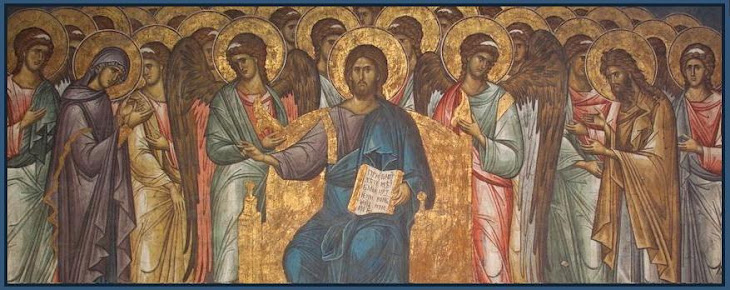
Fresco from Decani Monastery of Christ appearing to the Apostles after the Resurrection (taken from: http://www.srpskoblago.org/Archives/Decani/exhibits/Collections/AfterResurrection/CX4K3061_l.html)

I've been wanting to include various quotes from our Righteous Father Justin Popovich for a while, but for one reason or another, I haven't gotten to. However, the announcement that I saw today (see: http://www.johnsanidopoulos.com/2010/04/fr-justin-popovich-fr-simeon-of-dajbabe.html), that on May 2nd he will officially be proclaimed a Saint by the Serbian Orthodox Church, gives me an extra incentive to do so. May we all have his blessing!
  
Quotes from St. Justin Popovich on the Papacy
"In the history of the human race there have been three principal falls: that of Adam, that of Judas, and that of the pope.

The principal characteristic of falling into sin is always the same: wanting to be good for one's own sake; wanting to be perfect for one's own sake; wanting to be God for one's own sake. In this manner, however, man unconsciously equates himself to the devil, because the devil also wanted to become God for his own sake, to put himself in the place of God. And in this self-elevation he instantly became devil, completely separated from God, and always in opposition to Him.

Therefore, the essence of sin, of every sin (svegreha), consists of this arrogant self-aggrandizement. This is the very essence of the devil himself, of Satan. It is nothing other than one's wanting to remain within one's own being, wanting nothing within one's self other than oneself. The entire devil is found here: in the desire to exclude God, in the desire to always be by himself, to always belong only to himself, to be entirely within himself and always for himself, to be forever hermetically sealed in opposition to God and everything that belongs to God.

And what is this? It is egotism and self-love embraced in all eternity, that is to say: it is hell. For that is essentially what the humanist is - entirely within himself, by himself, for himself, always spitefully closed in opposition to God. Here lies every humanism, every hominism. The culmination of such satanically oriented humanism is the desire to become good for the sake of evil, to become God for the sake of the devil. It proceeds from the promise of the devil to our forefathers in Paradise—that with his help, "they would become as gods" (Gen. 3: 5). Man was created with theanthropic potential by God who loves mankind, so that he might voluntarily direct himself, through God, toward becoming God-man, based on the divinity of his nature. Man, however, with his free will sought sinlessness through sin, sought God through the devil. And assuredly, following this road he would have become identical with the devil had not God interceded in His immeasurable love of mankind and in His great mercy.

By becoming man, that is to say God-man, he redirected man toward the God-man. He introduced him to the Church which is his body, to the reward (podvig) of theosis through the holy mysteries and the blessed virtues. And in this manner he gave man the strength to become "a perfect man, in the measure of the fullness of Christ" (Eph. 4:13), to achieve, that is, the Divine destiny, to voluntarily become God-man by grace.

The fall of the pope is a consequence of the desire to substitute man for the God-man...In the kingdom of humanism the place of the God-man had been usurped by the Vicarius Christi, and the God-man has thus been exiled to Heaven. This surely results in a peculiar deincarnation of Christ the God-man, does it not?

Through the dogma of infallibility the pope usurped for himself, that is for man, the entire jurisdiction and all the prerogatives which belong only to the Lord God-man. He effectively proclaimed himself as the Church, the papal church, and he has become in her the be-all and end-all, the self-proclaimed ruler of everything. In this way the dogma of the infallibility of the pope has been elevated to the central dogma (svedogma) of the papacy. And the pope cannot deny this in any way as long as he remains pope of a humanistic papacy."
(From "Reflections on the Infallibiity of European Man" in Orthodox Faith and Life in Christ, Belmont, MA: Institute for Byzantine and Modern Greek Studies, 1994, Asterios Gerostergios, ed.; from: http://www.monachos.net/forum/showthread.php?t=5003&highlight=infallibility)
  
"In Western Europe, Christianity has been gradually metamorphosed, to humanism. Over a long period of time and with perseverance, the Divine-Human [God-man] has steadily been diminishing. He has been changed, He has been narrowed down and finally reduced to a mere man: to the “infallible” man in Rome and the equally "infallible" men in London and Berlin.

This is how Papism came into being, by stripping Christ of everything, just as Protestantism similarly did, by asking little of Christ, and quite often, nothing at all.

Both in Papism and in Protestantism, man has replaced the Divine-Human Christ, both as the highest value and the highest criterion.

Painstaking and deplorable changes to the Divine-Human's work and teachings have been accomplished. Papism has steadily and persistently been striving to substitute the Divine Man with a mortal man, until finally, in its dogma defining the infallibility of (a mere mortal) the pope, the Divine-Human Christ was once and for all substituted by an ephemeral, "infallible" man; because thanks to this dogma, the pope was decisively and clearly pronounced as being something superior – not only to all men, but even to the holy Apostles, the holy Fathers, and the holy Ecumenical Councils. With this kind of deviation from the Divine-Human Christ, from the ecumenical Church which is the Divine-Human’s organism, Papism outdid even Luther, the founder of Protestantism.

Therefore, the first radical protest that was voiced in the name of humanism but against the Divine-Human Christ and his Divine-Human organism—the Church—should be sought in Papism, not in Lutheranism. Papism is in fact the first and the oldest form of Protestantism."
(http://www.oodegr.com/english/papismos/papismos.htm)
  

The Apostolicity of the Church
"The holy apostles were the first god-men by grace. Like the Apostle Paul each of them, by his integral life, could have said of himself: "I live, yet not I, but Christ liveth in me" (Gal. 2:20). Each of them is a Christ repeated; or, to be more exact, a continuation of Christ. Everything in them is theanthropic because everything was recieved from the God-man. Apostolicity is nothing other than the God-manhood of the Lord Christ, freely assimilated through the holy struggles of the holy virtues: faith, love, hope, prayer, fasting, etc. This means that everything that is of man lives in them freely through the God-man, thinks through the God-man, feels through the God-man, acts through the God-man and wills through the God-man. For them, the historical God-man, the Lord Jesus Christ, is the supreme value and the supreme criterion. Everything in them is of the God-man, for the sake of the God-man, and in the God-man. And it is always and everywhere thus. That for them is immortality in the time and space of this world. Thereby are they even on this earth partakers of the theanthropic eternity of Christ.

This theanthropic apostolicity is integrally continued in the earthly successors of the Christ-bearing apostles: in the holy fathers. Among them, in essence, there is no difference: the same God-man Christ lives, acts, enlivens and makes them all eternal in equal measure, He Who is the same yesterday, and today, and forever (Heb. 13:8). Through the holy fathers, the holy apostles live on with all their theanthropic riches, theanthropic worlds, theanthropic holy things, theanthropic mysteries, and theanthropic virtues. The holy fathers in fact are continuously apostolizing, whether as distinct godlike personalities, or as bishops of the local churches, or as members of the holy ecumenical and holy local councils. For all of them there is but one Truth, one Transcendent Truth: the God-man, the Lord Jesus Christ. Behold, the holy ecumenical councils, from the first to the last, confess, defend, believe, announce, and vigilantly preserve but a single supreme value: the God-man, the Lord Jesus Christ.

The principal Tradition, the transcendent Tradition, of the Orthodox Church is the living God-man Christ, entire in the theanthropic Body of the Church of which He is the immortal, eternal Head. This is not merely the message, but the transcendent message of the holy apostles and the holy fathers. They know Christ crucified, Christ resurrected, Christ ascended. They all, by their integral lives and teachings, with a single soul and a single voice, confess that Christ the God-man is wholly in His Church, as in His Body. Each of the holy fathers could rightly repeat with St. Maximus the Confessor: "In no wise am I expounding my own opinion, but that which I have been taught by the fathers, without changing aught in their teaching."

And from the immortal proclamation of St. John of Damascus there resounds the universal confession of all the holy fathers who were glorified by God: "Whatever has been transmitted to us through the Law, and the prophets, and the apostles, and the evangelists, we receive and know and esteem highly, and beyond that we ask nothing more… Let us be fully satisfied with it, and rest therein, removing not the ancient landmarks (Prov. 22:28), nor violating the divine Tradition." And then, the touching, fatherly admonition of the holy Damascene, directed to all Orthodox Christians: "Wherefore, brethren, let us plant ourselves upon the rock of faith and the Tradition of the Church, removing not the landmarks set by our holy fathers, nor giving room to those who are anxious to introduce novelties and to undermine the structure of God's holy ecumenical and apostolic Church. For if everyone were allowed a free hand, little by little the entire Body of the Church would be destroyed."

The holy Tradition is wholly of the God-man, wholly of the holy apostles, wholly of the holy fathers, wholly of the Church, in the Church, and by the Church. The holy fathers are nothing other than the "guardians of the apostolic tradition. " All of them, like the holy apostles themselves, are but "witnesses" of a single and unique Truth: the transcendent Truth of Christ, the God-man. They preach and confess it without rest, they, the "golden mouths of the Word." The God-man, the Lord Christ is one, unique, and indivisible. So also is the Church unique and indivisible, for she is the incarnation of the Theanthropos Christ, continuing through the ages and through all eternity. Being such by her nature and in her earthly history, the Church may not be divided. It is only possible to fall away from her. That unity and uniqueness of the Church is theanthropic from the very beginning and through all the ages and all eternity.

Apostolic succession, the apostolic heritage, is theanthropic from first to last. What is it that the holy apostles are transmitting to their successors as their heritage? The Lord Christ, the God-man Himself, with all the imperishable riches of His wondrous theanthropic Personality, Christ—the Head of the Church, her sole Head. If it does not transmit that, apostolic succession ceases to be apostolic, and the apostolic Tradition is lost, for there is no longer an apostolic hierarchy and an apostolic Church.

The holy Tradition is the Gospel of the Lord Christ, and the Lord Christ Himself, Whom the Holy Spirit instills in each and every believing soul, in the entire Church. Whatever is Christ's, by the power of the Holy Spirit becomes ours, human; but only within the body of the Church. The Holy Spirit—the soul of the Church, incorporates each believer, as a tiny cell, into the body of the Church and makes him a "co-heir" of the God-man (Eph. 3:6). In reality the Holy Spirit makes every believer into a God-man by grace. For what is life in the Church? Nothing other than the transfiguration of each believer into a God-man by grace through his personal, evangelical virtues; it is his growth in Christ, the putting on of Christ by growing in the Church and being a member of the Church. A Christian's life is a ceaseless, Christ-centered theophany: the Holy Spirit, through the holy mysteries and the holy virtues, transmits Christ the Savior to each believer, renders him a living tradition, a living life: "Christ who is our life" (Col. 3:4). Everything Christ's thereby becomes ours, ours for all eternity: His truth, His righteousness, His love, His life, and His entire divine Hypostasis.

Holy Tradition? It is the Lord Jesus Christ, the God-man Himself, with all the riches of his divine Hypostasis and, through Him and for His sake, those of the Holy Trinity. That is most fully given and articulated in the Holy Eucharist, wherein, for our sake and for our salvation, the Savior's entire theanthropic economy of salvation is performed and repeated. Therein wholly resides the God-man with all His wondrous and miraculous gifts; He is there, and in the Church's life of prayer and liturgy. Through all this, the Savior's philanthropic proclamation ceaselessly resounds: "And, lo, I am with you always, even unto the end of the world" (Mt. 28 20): He is with the apostles and, through the apostles, with all the faithful, world without end. This is the whole of the holy Tradition of the Orthodox Church of the apostles: life in Christ = life in the Holy Trinity; growth in Christ = growth in the Trinity (cf. Mt. 28: 19-20).

Of extraordinary importance is the following: in Christ's Orthodox Church, the Holy Tradition, ever living and life-giving, comprises: the holy liturgy, all the divine services, all the holy mysteries, all the holy virtues, the totality of eternal truth and eternal righteousness, all love, all eternal life, the whole of the God-man, the Lord Christ, the entire Holy Trinity, and the entire theanthropic life of the Church in its theanthropic fullness, with the All-holy Theotokos and all the saints.

The personality of the Lord Christ the God-man, transfigured within the Church, immersed in the prayerful, liturgical, and boundless sea of grace, wholly contained in the Eucharist, and wholly in the Church—this is holy Tradition. This authentic good news is confessed by the holy fathers and the holy ecumenical councils. By prayer and piety holy Tradition is preserved from all human demonism and devilish humanism, and in it is preserved the entire Lord Christ, He Who is the eternal Tradition of the Church. "Great is the mystery of godliness: God was manifest in the flesh" (I Tim. 3 16): He was manifest as a man, as a God-man, as the Church, and by His philanthropic act of salvation and deification of humanity He magnified and exalted man above the holy cherubim and the most holy seraphim."
(Originally published in Orthodox Life, vol. 31, no. 1 (Jan.-Feb., 1981), pp. 28-33. Translated by Stephen Karganovic from: The Orthodox Church & Ecumenism (in Serbian), by Archimandrite Justin (Popovich) (Thessalonica: Chilandar Monastery, 1974), pp. 64-74; http://archangelsbooks.com/articles/church/AttributesofChurch.asp)
  
Picture of our Righteous Father Justin Popovich (to be canonized on May 2nd and to be celebrated on June 1/14; for more on his life see: http://www.serfes.org/lives/stjustin.htm) (taken from: http://www.orthodoxphotos.com/Holy_Fathers/St._Justin_Popovich/1.shtml)
  
Apolytikion of the Holy Fathers in the Plagal of the Fourth Tone
(chanted on the Feasts of the Fathers of the Ecumenical Councils)
You are greatly glorified, O Christ our God, who established our Fathers as luminaries upon the earth, and through them led us all to the true Faith. O most compassionate, glory to You.

Christ is risen from the dead, by death, trampling down upon death, and to those in the tombs, bestowing life!
Truly the Lord is risen!