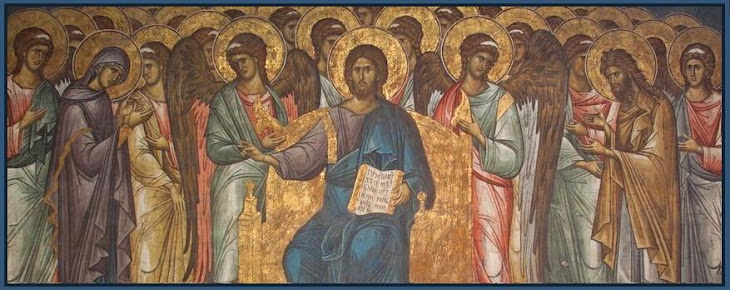
Showing posts with label St. Symeon the New Theologian. Show all posts

Tuesday, October 15, 2019

Elder Sophrony of Essex on the Holy Fathers

St. Gregory Palamas the Wonderworker, Archbishop of Thessaloniki (source)
  
In our age, we need, more than any time before, the teaching of three Fathers: St. Gregory Palamas, St. Maximos the Confessor, and St. Symeon the New Theologian.
-Elder Sophrony of Essex

(source)
 
Sts. Maximos the Confessor and Symeon the New Theologian (source)
  
Through the prayers of our Holy Fathers, Lord Jesus Christ our God, have mercy on us and save us! Amen!

Friday, October 11, 2019

St. Symeon the New Theologian on Faith in Christ

St. Symeon the New Theologian (source)
  
“To have faith in Christ means more than simply despising the delights of this life. It means we should bear all our daily trials that may bring us sorrow, distress, or unhappiness, and bear them patiently for as long as God wishes and until He comes to visit us. For it is said, ‘I waited on the Lord and He came to me.'”
— St. Symeon the New Theologian

(source)

Through the prayers of our Holy Fathers, Lord Jesus Christ our God, have mercy on us and save us! Amen!

Monday, October 12, 2015

St. Symeon the New Theologian: "We have such a generous Master..."

Jesus Christ, "The Land of the Living" (source)
  
Lamentation comes upon me; my heart is consumed, and I pine away for your sake, when I remember that we have such a generous Master, so full of loving-kindness to us men that in return for simple faith in Him He grants us such gifts as surpass our understanding, our hearing, our thinking, such as "the heart of man has not conceived" (1 Cor. 2:9). But we are like brute beasts and prefer nothing but the earth and the things that, through His great mercy, it produces to satisfy the needs of bodies! These are for our moderate sustenance, so that our souls may make the journey to the things that are above without hindrance, as they are likewise fed with the rational food of the Spirit according to the extent that they have been cleansed and ascend.
-St. Symeon the New Theologian, "The Discourses"
  
(source)
  
Through the prayers of our Holy Fathers, Lord Jesus Christ our God, have mercy on us and save us! Amen!

Saturday, October 4, 2014

Orthodox Theologians

Beautiful icon by Alevizakis depicting the three Holy Saints given the title of "Theologian" by the Orthodox Church: St. John the Evangelist, St. Gregory Patriarch of Constantinople, and St. Symeon the New Theologian (source)
  
"The one who prays is a theologian; the one who is a theologian, prays."
-Evagrios of Pontos
   
"The words of the saints are words of God and not of men."
 -St. Symeon the New Theologian, "The Discourses"
  
Through the prayers of our Holy Fathers, Lord Jesus Christ our God, have mercy on us and save us! Amen!

Monday, February 3, 2014

St. Symeon the New Theologian: In Praise of those who have Love in their Hearts

The Crucifixion of Christ (source)
   
St. Symeon the New Theologian: In Praise of those who have Love in their Hearts

Let us therefore follow one and the same path, Christ’s commandments, which elevate us to heaven and to God. Even though the word shows us many paths and many ways for people to reach the kingdom of heaven, these paths are not, in fact, many, but one, though they’re divided into many, according to each person’s ability and disposition. While we may begin from many and varied works and actions, just as travelers depart from different places and many cities, the destination we are attempting to reach is the same: the kingdom of heaven.

The actions and ways of godly men must be understood as spiritual virtues. Those who begin to walk in them must head towards one goal, just as those who come from various countries and places come together, as we have said, to one city, the kingdom of heaven, where, together, they will become worthy to reign with Christ and become subjects of one King, our God and Father. By this city, which is one, not many, you should understand the holy and undivided trinity of virtues, faith, hope and love, especially that virtue which comes before the others but is also mentioned as the last, since it is the goal of all good things and greater than them all- love.

All faith comes from it and is built on its foundation; on it, hope is based. Without love no thing has ever taken shape, nor ever will. Its names and actions are numerous. Even more so are its distinctive features; its properties are divine and innumerable. Yet it is one in nature, wholly beyond the ken of angels or men or any other creatures, even those which are unknown to us. Reason cannot tell of it; its glory is inaccessible; its counsels unsearchable. It is eternal and beyond time, and beyond sight, though it may be perceived. How many are the delights of this Holy Zion not made by human hand. Those who have begun to see it no longer take any pleasure in perceptible, earthly objects; they become indifferent to the glory of this world.

Permit me, for a short time, to address myself to this love, to fulfill my desire for it, insofar as I can.

When I recalled the beauty of undefiled love, its light suddenly appeared in my heart. I was ravished with its sweetness and lost my senses; I lost all perception of this life and forgot all the things of this world. But then- I don’t know how- it departed from me and left me to lament my weakness.

Love desired, how fortunate are those who have embraced you, for they will no longer have a yearning to embrace any human beauty. How fortunate are they who are moved by divine love to cling to you: they’ll deny the whole world, and, to whatever degree they associate with others, they won’t be spoiled. How fortunate are those who caress your beauty and delight in it with great desire, for their souls will be sanctified by the undefiled blood and water which issue from you. How fortunate are those who passionately embrace you, for they will be altered for the better in spirit and will exult in their souls, because you are inexpressible joy.

How fortunate are they who gain possession of you, for they will count the treasures of the world as nothing, for you are indeed wealth “beyond the dreams of avarice”. How blessed and thrice-blessed are they whom you accept, for though they be apparently without any glory, they will be more glorious than those who are glorious, more honoured than those who are honoured. How worthy of praise are those who pursue you; even more so those who have found you. Most blessed are those who are loved by you, received by you, taught by you, those who have dwelt in you and been fed by you with immortal food, that is the Lord, Jesus Christ.

Love divine, where are you holding Christ? Where are you concealing Him​? Why have you taken the Redeemer of the world and departed from us? Open a wicket gate for us, so that we also may see Christ Who suffered for us, and so hope in His mercy that we’ll die no more when we once have seen Him. Open up to us, you who became the door allowing Him to be made manifest in the flesh. Love, you who’ve forced the unforced and abundant compassion of our Master to bear the sins and infirmities of all people, do not reject us by saying, “I do not know you”.

Be with us, so that you may come to know us, for we are not known to you. Dwell in us, so that, for your sake, the Master may visit even us, who are lowly; go before us to meet Him, since we are wholly unworthy. So that He will pause on His way, to converse with you and will permit even us sinners to fall at His unblemished feet. You’ll intercede on our behalf and plead with Him to forgive the debt of our sins, so that through you we may again be found worthy to serve Him, our Master, and be sustained and nourished by Him. Because even those who owe nothing are still at risk of dying from starvation and poverty and are punished and chastised, just as those who do owe.

 Holy Love may we then be pardoned through you and may we enter into the enjoyment of the good things of our Master, since no-one will taste their sweetness except through you. Those who don’t love you as they ought and are not, as they should be, the object of your love, may well run, but haven’t yet reached the goal. It’s far from certain that somebody who is running will actually complete the race. But for those who have laid hold on you, or on whom you have laid hold, [victory] is certain, since you are the end of the Law. It is you who surround me and inflame me, you who, by the pangs of my heart, kindle me with boundless desire for God and for others. You’re the teacher of the prophets, the companion of the apostles, the power of the martyrs, the inspiration of the fathers and teachers, the perfection of all the saints, and the commission for my own, present task of obedience.

Forgive me, brethren, for digressing somewhat  from the subject of my discourse, but my longing for love moved me to do so. When I recalled it, my heart rejoiced, as holy David says, and I hastened to sing the praise of its marvels. I therefore entreat you, of your goodness, to pursue it with all your strength and to run after it with faith so that you may lay hold on it. You will not be disappointed in your hopes. Because any zeal and any ascetic effort is in vain and with no useful outcome, unless they end in love, with a contrite spirit. By no other virtue, by no other observance of the Lord’s commandment, can anyone be known as a disciple of Christ, for He says, “If you have love for one another, by this will everyone know that you are my disciples,”.

It’s for this reason that “the Word became flesh and dwelt among us”. It was for love that He became flesh and dwelt among us; for love, He willingly endured His life-giving passion, in order that He might deliver us from the bonds of hell and lead us up to heaven; for love, the apostles ran that unceasing race and used the fish-hook and net of the word to drag the world out of the depths of idolatry and bring it into the haven of the kingdom of heaven; for love, the martyrs shed their blood, so that they might not lose Christ; for love, our God-bearing Fathers and teachers of the world eagerly laid down their lives for the Catholic and Apostolic Church; for love, I, who am of no account at all, have embarked on your protection and am struggling to teach you about the divine words, so that I can imitate those teachers of the Church, insofar as I am able, and suffer and endure for your sake and do everything I can for your edification and profit, so that I may present you as perfect sacrifices, burnt-offerings endowed with intellect, on the altar of Christ. For you are God’s children, whom He has given to me; you are my very heart, my eyes, my pride and the seal of my teaching, as Saint Paul says.

My dear brethren in Christ, let us then strive, as we serve Christ with the other virtues, to serve Him also with love, which should dwell among us, so that God may rejoice at your harmony and perfection. Then, in my lowliness, I will also rejoice as I see your progress in the life that is in accordance with God, as you increase in faith, purity, in the fear of God, reverence, in compunction and tears. By these the soul is purified and is filled with divine light, and the Holy Spirit. My joy will be a blessing for you and an increase of the eternal and blessed life in Christ Jesus our Lord, to Whom be glory forever. Amen
   
St. Symeon the New Theologian (source)
   
Through the prayers of our Holy Fathers, Lord Jesus Christ our God, have mercy on us and save us! Amen!

Saturday, October 12, 2013

St. Symeon the New Theologian: On the Banishment and Repentance of Adam and Every Christian

Christ raising Adam and Eve, Fresco of the Resurrection, Chora Monastery, Constantinople (source)
   
St. Symeon the New Theologian: On the Banishment and Repentance of Adam and Every Christian
Being banished from Paradise, Adam and Eve immediately began to thirst and hunger, to freeze and shiver, to have labors and sweat, and to endure all those difficulties and griefs that we even now endure. Therefore, they soon felt into what a bitter condition they had descended, and to what a great misfortune they had become subject. Then they realized both their own hardness of heart and their lack of repentance, as well as God's unutterable condescension and compassion towards them. Therefore, even walking and sitting outside Paradise, they repented and shed tears, beat themselves in the face and tore out the hair of their head, lamenting over their former hardness of heart.
And this they did not for one day or two, or for ten days, but for their whole lifetime. For how can one not weep, remembering their meek and condescending Master, that unutterable delight of Paradise, those indescribable good things and beauties of the flowers of Paradise, that care-free life without labor, and that communion with angels? In worldly life, when servants are appointed by an eminent master in order to serve him, as long as they preserve attention, respect, and obedience towards their lord they have boldness before him, enjoy his favor and love, and live with him in peace and satisfaction. But when they become proud and begin to step away from the will of their master and despise their fellow servants, they lose not only their boldness before him, but even his favor and love; and at his order they are banished into a far country where they are subjected to innumerable necessities and sorrows, and the more they suffer and are in misfortunes, the more they feel the bitterness of their condition, remembering the peaceful and satisfied life that they have lost.
This same thing was experienced by our first ancestors also, who lived in Paradise and took sweet delight in its great good things. They acknowledged the greatness and value of these good things after they had lost them, being banished from Paradise; then they recognized also the whole greatness of the evil which they had done. Therefore they ceaselessly grieved and wept, calling on God's compassion.
And what did God do, being quick and ready to mercy, and slow to punishment? He foresaw that they would finally become humble and repent, and therefore He foreordained a special means for abolishing His righteous sentence upon them. But, He did not immediately bring into execution this foreordained decree, but assigned for this His own place and time and fashion, so as to teach us to love wisdom and not to rise up against our Creator and God.
Just as He foreordained, so later did He do: for those whom He banished from Paradise for their brazenness before Him and their unrepentant heart, since they had humbled themselves and wept over themselves, He arranged a way for the restoration of what had been lost.
And this is what it was: The Only-begotten Son and Word of the Unoriginate Father descended from the heavens to earth, and not only became man like them, but even was pleased to endure a violent and shameful death; then He descended into hades, brought them up from there and restored them. And thus, since Christ so suffered for them, as you hear every day, that He returned them from such a distant exile, would He not have had pity on them, if they had repented then in Paradise? How could he not have had pity on them, when He by nature is the Lover of mankind and compassionate, and He created them in order that they might take sweet delight of the good things of Paradise and might glorify their Benefactor?
But so that you might the better understand this and believe my words, hear yet more: If they had repented then, when they were still in Paradise, they would have received again only Paradise and nothing more.
But inasmuch as, being banished from Paradise for their lack of repentance, they then repented, wept much and were in great misfortunes, therefore God the Master of all, for their labors and sweat, for the misfortunes which they endured and for their good repentance, was pleased again to honor them and to glorify them so as to cause them to forget the whole evil that they had caused.
And what did He do? Behold how great is God's Love of mankind! Descending to hades and bringing them out, He did not bring them again into the same Paradise from which they had been banished, but He raised them up to the heaven of heavens; and when He sat down at the right hand of His God and Father, He sat them down together with Him. Just think what great honor He gave to Adam who by nature was His slave, and vouchsafed him to be God's own father according to His grace-given dispensation. See to what a height our Master Christ raised him up for his repentance, humility, lamentation and tears! O the power of repentance and tears! O the ocean of Love of mankind which is beyond words, and mercy which cannot be traced out!
And not only Adam did God honor and glorify, but also us his sons--those, that is, who have begun to please him by repentance, tears, lamentation and by all of which we have spoken; and even up to now He glorifies and honors like Adam those who repent well and do what Adam did. Further, those who up until now and in the future will do this and repent, whether they be laymen or monks, He will glorify like Adam, as He Himself, our true God, has said: Truly I say to you, I will not leave them ever, but show them to be My brethren and friends, fathers and mothers, kinsmen and co-inheritors. I have glorified them and will glorify them, both in the heavens on high and on the earth below; and of their life and rejoicing and glory there shall be no end.
Tell me, then, my brother: What profit was there for our first ancestors in that laborless and carefree life which they had in Paradise, when they were careless, disdained God by not believing Him, and transgressed His commandment? For if they had believed Him, Eve would not have considered the serpent to be more trustworthy than God, Adam would not have believed Eve rather than God, and they would have refrained from eating of the forbidden tree. But they ate and did not repent, and for this they were banished from Paradise.
Moreover, from banishment also they received no harm, but great benefit. This is by power of the dispensation of our salvation. For our Master Christ descended from the heavens, by His death loosed the bonds of our death, and took away the condemnation that came down to us from the transgression of our first parents; by the power of holy Baptism He regenerated us, recreated us and delivered us from every condemnation and made us in this world completely free, so that our enemy the devil might no longer act in us and against us by violence and force. He honored us with the same autonomy which was given us in the beginning, and He gave us more power against the enemy than all the saints had who lived before the dispensation of Christ, so that those who desire might easily conquer the enemy. And when such ones die they do not descend to hades like the ancients, but ascend to the heavens and are vouchsafed to receive the repose and eternal joy which are there--only to a certain degree at the present time, but completely and entirely after the resurrection.
And so let no one invent excuses for his sins and say that we, by virtue of the transgression of Adam, are entirely subject to the action of the devil and are dragged by force into sin. They who think and speak thus consider that the dispensation of the Incarnation of our Master and Savior Jesus Christ was useless and in vain. Such an opinion is the opinion of heretics and not of the Orthodox. For what other reason did Christ descend and become Incarnate, and for what else did He suffer if not in order to loose the condemnation which proceeded from sin, and to deliver our race from slavery to the devil and from the activity in us of this our enemy? This is true autonomy: in no way to be subject to someone else. We are all born sinners from our forefather Adam who sinned; we are all criminals from a criminal, slaves of sin from a slave of sin, subject to the curse and death from him who was subject to the curse and death.
And because of Adam who received the action of the cunning devil, and by his counsel was moved to sin, and enslaved himself to him and lost his autonomy--we also, as his children, are subject to the action and the compulsory dominion of the devil and are his slaves. But our Lord came down from the heavens, was Incarnate and became man like us in everything except sin, in order to annihilate sin. He was conceived and born so as to sanctify the conception and birth of men. He was raised up and grew little by little so as to bless every age of life. He began to preach at the age of thirty, having become a full-grown man, so as to teach us not to jump out of line and go before those who are greater than us in mind and virtue, that is, are more intelligent and virtuous than we, especially if we are still young and not perfect in understanding and virtue. He preserved all the commandments of His God and Father so as to loose every transgression and to deliver us criminals from condemnation. He became a slave, took the form of a slave, in order to raise us, the slaves of the devil, once more into the condition of masters and to make us masters and possessors over the devil himself, our former tyrant.
(This is confirmed by the saints who have cast out the devil, as a weak and infirm one, as well as his servants, not only in their lifetime but also after their death.). He was hung upon a Cross and became a curse, as the prophet says: Cursed is everyone that hangeth upon a tree (Deut. 21:23), in order to loose the whole curse of Adam. He died in order to put death to death, and He rose in order to annihilate the power and activity of the devil who had authority over us by means of death and sin.
Thus out Lord, having cast into the midst of the death-dealing poison of sin the unutterable and life-giving activity of His Divinity and His Flesh, has liberated our race from the working of the devil; and purifying us by holy Baptism and bringing us to life by the communion of the most pure Mysteries of His precious Body and Blood, He makes us holy and sinless. But He then leaves us again to have autonomy, so that it might not seem that we serve our Master by compulsion, but rather by our own free will. Therefore, as in the beginning Adam in Paradise was free and sinless, and by his free will obeyed the enemy, was deceived and transgressed the commandment of God--so on the contrary we, being regenerated by holy Baptism, delivered from slavery and becoming free, if we do not obey by our own free will our enemy the devil, this cunning one will in no way be able to place in us any kind of evil.
Now, before the law and the coming of Christ, without the aid of those means of which we have spoken, many and very many pleased God and manifested themselves as irreproachable; among their number the righteous Enoch was honored by God by being translated, and Elias was raised to heaven in a fiery chariot. Therefore, what kind of justification can we give, if after the manifestation of grace, after such and so great benefactions, after the annihilation of death and sin, we do nor manifest ourselves as holy; if after being regenerated by the holy Baptism which we have received, standing under the protection of the holy angels by whom we are surrounded, and under the action of the grace of the Holy Spirit which we have been vouchsafed to receive--we do not become even like those who were before grace, that is, before Christ, but we remain in carelessness, and disdain and transgress the commandments of God?
And that we, if we are careless about our salvation, will be punished more than those who sinned before Christ, the Apostle Paul indicates when he says: If the word spoken through angels proved steadfast, and every transgression and disobedience received a just recompense of reward, how shall we escape, if we neglect so great a salvation (Hebrews 2:2-3).
And thus, each one of us, no matter what transgression he might have fallen into--let him not accuse Adam, but let him reproach himself. And let him show true and worthy repentance like Adam, if he desires to be vouchsafed the Kingdom of Heaven. Amen.
   
Through the prayers of our Holy Fathers, Lord Jesus Christ our God, have mercy on us and save us! Amen!

Wednesday, October 12, 2011

Selected prayers from St. Symeon the New Theologian


Selected prayers from St. Symeon the New Theologian

I give You thanks,
to me You are a light that knows no evening,
a sun that never sets.
You cannot remain hidden,
for You fill all things with your glory.
You never hide Yourself from anyone,
but we are always hiding from You,
not wishing to come near You.
For where could You hide Yourself,
since You have no place
in which to take Your rest?
Or why should You hide,
since You turn away from no one
and are afraid of none?
Pitch Your tent within me,
gracious Master;
Take up Your dwelling in me now
and remain in Your servant unceasingly,
inseparably, to the end.
At my departure from this life
and afterwards, may I be found in You and reign with You,
who are God over all.
Stay with me, Master, do not leave me alone.
When they find You dwelling within me,
my enemies who seek always to devour my soul,
will be put to flight;
They will have no more power against me,
when they see You,
who are more powerful than all,
lodging in the house of my humble soul.
You did not forget me, Master,
when I was in the world
and sunk in ignorance,
but You chose me
and separated me from the world
and set me up in the presence of Your glory.
Keep me constant and unshaken
in the interior dwelling-place
that You have made within me.
Though dead,
I live when I gaze on You;
Possessing You, though poor,
I am forever rich,
More wealthy than any ruler.
Eating and drinking You,
clothing myself in You from day to day,
I shall be filled with blessings and delight
beyond all telling.
For You are every blessing
and all splendor and joy,
and to You is due glory,
to the Holy, Consubstantial and Life-giving Trinity,
worshipped and confessed by all the faithful
and adored in Father, Son and Holy Spirit,
now and ever, and to the ages of ages.
Amen.

Jesus Christ, "The Angel of Great Counsel" (http://pravicon.com/images/icon/0420/0420005.jpg)

O Master, Lord of heaven and earth,
I know that I have sinned before You,
more than any human being,
more than even the irrational animals and reptiles,
and I am not worthy to ever receive any mercy from You.
Therefore, I would not have dared
to draw near or to fall down before You,
O King, lover of man,
had I not heard your holy voice saying:
I do not at all desire the death of the sinner,
but that he may return and live.
And again: There is joy in heaven
over one sinner who repents.
I remember, also, the parable of the Prodigal Son,
which You have said, O Master,
that when he returned,
before he had drawn near to You,
You, O compassionate one, came to him
and fell upon his neck
and kissed him affectionately.
Hence, taking courage from the ocean
of your goodness,
I have come near to You
with pain, sadness, and grief in my heart,
even though I am still hardened
and wounded sorely and lie in misery
In the depths of the Hades
of my transgressions.
But, from now on,
I give you my word, O Lord,
that as long as You order me
to remain alive and in this body,
I will not forsake You,
nor will I turn back,
neither will I ever touch vain and evil things.
But You, O my God, know my weakness,
my wretchedness, my faintheartedness,
and my old predispositions,
which are going to torture and oppress me.
Therefore, as I fall before You,
help me and forsake me not;
neither allow me to be ridiculed
and mocked for long by the enemy,
for from now on I am your servant, O Good One.

Christ Pantocrator, enthroned upon the Cherubim and Seraphim (http://pravicon.com/images/icon/0421/0421006.jpg)

You, oh Christ, are the Kingdom of Heaven;
You, the land promised to the gentle;
You the grazing lands of paradise;
You, the hall of the celestial banquet;
You, the ineffable marriage chamber;
You the table set for all,
You the bread of life;
You, the unheard of drink;
You, both the urn for the water
and the life-giving water;
You, moreover, the inextinguishable lamp
for each one of the saints;
You, the garment and the crown
and the one who distributes crowns;
You, the joy and the rest;
You, the delight and glory;
You the gaiety;
You, the mirth;
and Your grace, grace of the Spirit of all sanctity,
will shine like the sun in all the saints;
and You, inaccessible sun,
will shine in their midst
and all will shine brightly,
to the degree of their faith,
their asceticism,
their hope
and their love,
their purification
and their illumination
by Your Spirit.


Through the prayers of our Holy Fathers, Lord Jesus Christ our God, have mercy on us and save us! Amen!

Monday, June 13, 2011

St. Symeon the New Theologian's Invocation to the God, the Holy Spirit

  
St. Symeon the New Theologian's Invocation to the God, the Holy Spirit
Come, true light.
Come, life eternal.
Come, hidden mystery.
Come, treasure without name.
Come, reality beyond all words.
Come, person beyond all understanding.
Come, rejoicing without end.
Come, light that knows no evening.
Come, unfailing expectation of the saved.
Come, raising of the fallen.
Come, resurrection of the dead.
Come, all-powerful, for unceasingly you create, refashion and change all things by your will alone.
Come, invisible whom none may touch and handle.
Come, for you continue always unmoved, yet at every instant you are wholly in movement; you draw near to us who lie in hell, yet you remain higher than the heavens.
Come, for your name fills our hearts with longing and is ever on our lips; yet who you are and what your nature is, we cannot say or know.
Come, Alone to the alone.
Come, for you are yourself the desire that is within me.
Come, my breath and my life.
Come, the consolation of my humble soul.
Come, my joy, my glory, my endless delight.
 
God, the Holy Spirit, before the Holy Saints, and depictions of His celebration of the Seven Sacraments (fresco from the Dining Hall of the Paracletos Monastery, Attica (source)
 
Through the prayers of our Holy Fathers, Lord Jesus Christ our God, have mercy on us and save us! Amen!

Sunday, April 24, 2011

Additional Quotes of the Fathers on the Resurrection of Christ

Christ is risen! Truly He is risen!
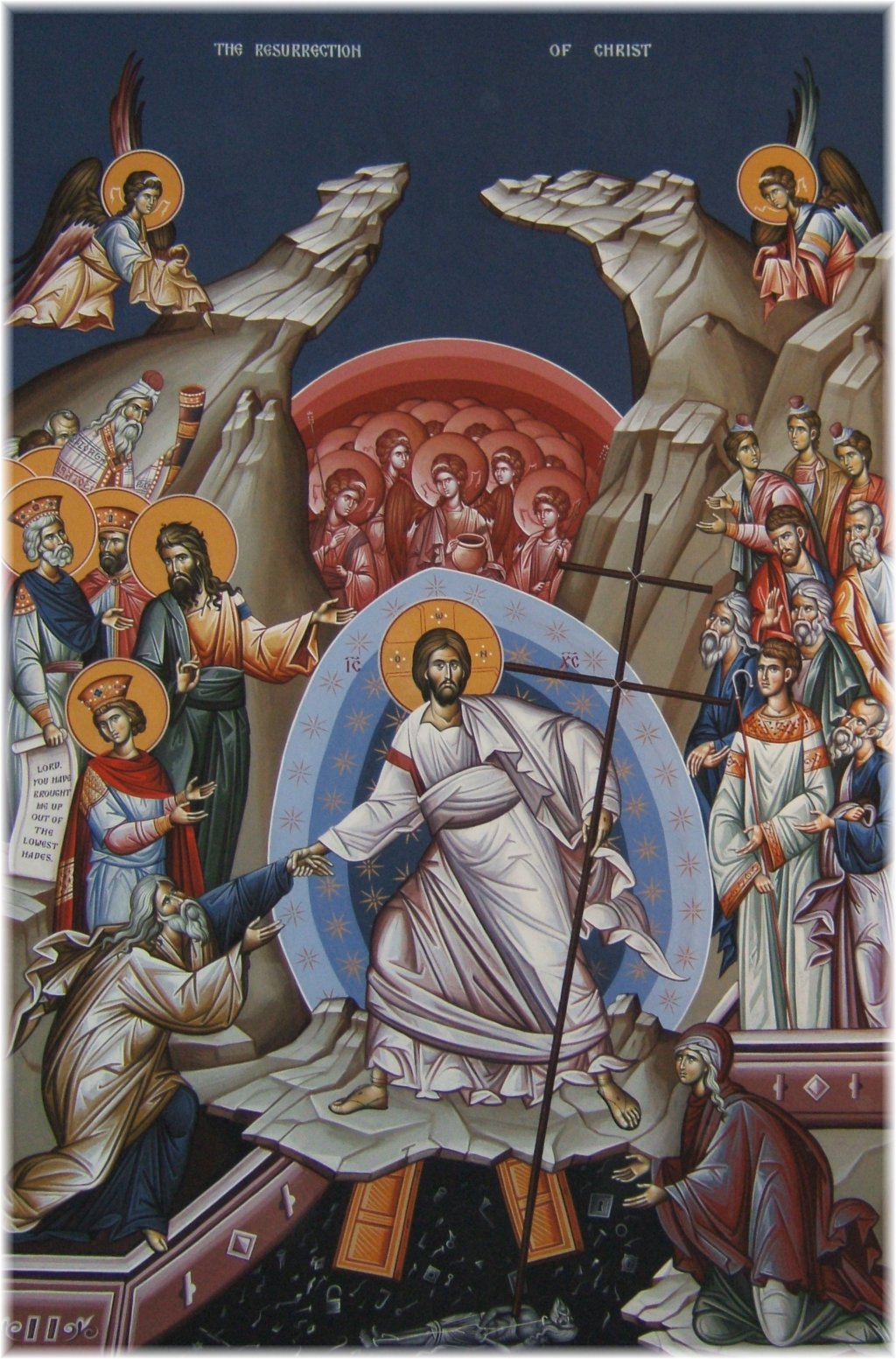
Christ descending to Hades to raise the dead (http://iconreader.files.wordpress.com/2011/01/resurrection2.jpg)
   
Additional Quotes of the Fathers on the Resurrection of Christ
"That light which far outshines the day and sun, first pledge of resurrection, and renovation of bodies long since dissolved, the divine token of promise, the path which leads to everlasting life — in a word, the day of the Passion — is arrived, best beloved doctors; and ye, my friends who are assembled here, ye blessed multitudes who worship Him who is the author of all worship and praise Him continually with heart and voice, according to the precepts of His holy word.

But thou, Nature, parent of all things: what blessing like to this hast thou ever accomplished for mankind? Nay rather, what is in any sense thy workmanship, since He who formed the universe is Himself the author of thy being? For it is He who has arrayed thee in thy beauty; and the beauty of Nature is life according to Nature’s laws.
But principles quite opposed to Nature have mightily prevailed, in that men have agreed in withholding His rightful worship from the Lord of all, believing that the order of the universe depended, not on His providence, but on the blind uncertainty of chance. And this they did, notwithstanding the clearest announcement of the truth by His inspired prophets, whose words should have claimed belief, but were in every way resisted by that impious wickedness which hates the light of truth and loves the obscure mazes of darkness.

Nor was this error unaccompanied by violence and cruelty, especially in that the will of princes encouraged the blind impetuosity of the multitude, or rather itself led the way in the career of reckless folly.

Such principles as these, confirmed by the practice of many generations, became the source of terrible evils in those early times: but no sooner had the radiance of the Saviour’s presence appeared, than justice took the place of wrong, a calm succeeded the confusion of the storm, and the predictions of the prophets were all fulfilled.

For after He had enlightened the world by the glorious discretion and purity of His character, and had ascended to the mansions of His Father’s house, He founded His Church on earth, as a holy temple of virtue, an immortal, imperishable temple, wherein the worship due to the Supreme Father and to Himself should be piously performed."
St. Constantine the Great
"Brethren, how fine a thing it is to move from festival to festival, from prayer to prayer, from holy day to holy day. The time is now at hand when we enter on a new beginning: the proclamation of the blessed Passover, in which the Lord was sacrificed. We feed as on the food of life, we constantly refresh our souls with his precious blood, as from a fountain. Yet we are always thirsting, burning to be satisfied. But he himself is present for those who thirst and in his goodness invites them to the feast day. Our Savior repeats his words:

'If anyone thirsts, let him come to me and drink.'

He quenched the thirst not only of those who came to him then. Whenever anyone seeks him he is freely admitted to the presence of the Saviour. The grace of the feast is not restricted to one occasion. Its rays of glory never set. It is always at hand to enlighten the mind of those who desire it.

Its power is always there for those whose minds have been enlightened and who meditate day and night on the holy Scriptures, like the one who is called blessed in the holy psalm:

'Blessed is the man who has not followed the counsel of the wicked, or stood where sinners stand, or sat in the seat of the scornful, but whose delight is in the law of the Lord, and who meditates on his law day and night.'

Moreover, my friends, the God who first established this feast for us allows us to celebrate it each year. He who gave up his Son to death for our salvation, from the same motive gives us this feast, which is commemorated every year. This feast guides us through the trials that meet us in this world.

God now gives us the joy of salvation that shines out from this feast, as he brings us together to form one assembly, uniting us all in spirit in every place, allowing us to pray together and to offer common thanksgiving, as is our duty on the feast. Such is the wonder of his love: he gathers to this feast those who are far apart, and brings together in unity of faith those who may be physically separated from each other.
St. Athanasios the Great

"The Lord, having put on human nature, and having suffered for him who suffered, having been bound for him who was bound, and having been buried for him who was buried, is risen from the dead, and loudly proclaims this message:
'Who will contend against me? Let him stand before me. It is I who delivered the condemned. It is I who gave life to the dead. It is I who raised up the buried. Who will argue with me? It is I, says Christ, who destroyed death. It is I who triumphed over the enemy, and having trod down Hades, and bound the Strong Man, and have snatched mankind up to the heights of heaven. It is I, says Christ. So then, come here all you families of men, weighed down by your sins and recieve pardon for your misdeeds. For I am your pardon. I am the Passover which brings salvation. I am the Lamb slain for you. I am your lustral bath. I am your life. I am your resurrection. I am your light, I am your salvation, I am your King. It is I who brings you up to the heights of heaven. It is I who will give you the resurrection there. I will show you the Eternal Father. I will raise you up with my own right hand.'"
St. Melito Bishop of Sardis
"Most men believe in the resurrection of Christ, but very few have a clear vision of it. …That most sacred formula which is daily on our lips does not say,
'Having believed in Christ’s resurrection,'
but,
'Having beheld Christ’s resurrection, let us worship the Holy Lord Jesus, who alone is without sin.'
How then does the Holy Spirit urge us to say,
'Having beheld Christ’s resurrection',
which we have not seen as though we had seen it, when Christ has risen once for all a thousand years ago, and even then without anybody’s seeing it? Surely Holy Scripture does not wish us to lie? Far from it! Rather, it urges us to speak the truth, that the resurrection of Christ takes place in each of us who believes, and that not once, but every hour, so to speak, when Christ the Master arises in us, resplendent in array and flashing with the lightnings of incorruption and Deity.

For the light-bringing coming of the Spirit shows forth to us, as in early morning, the Master’s resurrection, or, rather, it grants us to see the Risen One Himself. Therefore we say,
'The Lord is God, and He has given us light' (Ps. 118:27)
and we allude to His second Coming and add these words,
'Blessed is He that cometh in the Name of the Lord' (Ps. 118:26).
Those to whom Christ has given light as He has risen, to them He has appeared spiritually, He has been shown to their spiritual eyes. When this happens to us through the Spirit He raises us up from the dead and gives us life. He grants us to see Him, who is immortal and indestructible. More than that, He grants clearly to know Him who raises us up (Eph. 2:6) and glorifies us (Rom. 8:17) with Himself, as all the divine Scripture testifies.
These, then, are the divine mysteries of Christians. This is the hidden power of our faith, which unbelievers, or those who believe with difficulty, or rather believe in part, do not see nor are able at all to see.
St. Symeon the New Theologian
   
   
Christ is risen from the dead, by death, trampling down upon death, and to those in the tombs, bestowing life!


Truly the Lord is risen!

Sunday, February 13, 2011

Additional Quotes of the Fathers on Humility

  
Additional Quotes of the Fathers on Humility
An [Elder] was asked, "What is humility?" and he said in reply, "Humility is a great work, and a work of God. The way of humility is to undertake bodily labour and believe yourself a sinner and make yourself subject to all." Then a brother said, "What does it mean, to be subject to all?" The [Elder] answered, "To be subject to all is not to give your attention to the sins of others but always to give your attention to your own sins and to pray without ceasing to God."

An [Elder] said, "Every time a thought of superiority or vanity moves you, examine your conscience to see if you have kept all the commandments, whether you love your enemies, whether you consider yourself to be an unprofitable servant and the greatest sinner of all. Even so, do not pretend to great ideas as though you were perfectly right, for that thought destroys everything."

As Abba Macarius was returning to his cell from the marsh carrying palm-leaves, the devil met him with a sharp sickle and would have struck him but he could not. He cried out, "Great is the violence I suffer from you, Macarius, for when I want to hurt you, I cannot. But whatever you do, I do and more also. You fast now and then, but I am never refreshed by any food; you often keep vigil, but I never fall asleep. Only in one thing are you better than I am and I acknowledge that." Macarius said to him, "What is that?" and he replied, "It is because of your humility alone that I cannot overcome you."

The [Elders] used to say, "When we do not experience warfare, we ought so much the more to humiliate ourselves. For God seeing our weakness, protects us; when we glorify ourselves, he withdraws his protection and we are lost."

"...true humility does not say humble words, nor does it assume humble looks, it does not force oneself either to think humbly of oneself, or to abuse oneself in self-belittlement. Although all such things are the beginning, the manifestations and the various aspects of humility, humility itself is grace, given from above. There are two kinds of humility, as the holy fathers teach: to deem oneself the lowest of all beings and to ascribe to God all one's good actions. The first is the beginning, the second the end."
St. Gregory of Sinai
(Texts on Commandments and Dogmas no. 115)

"...we have never achieved anything good on our own, but all good things are ours from God by grace, and come as it were from nothingness into being. For 'what do you have which you did not receive?' asks St. Paul - receive, that is, freely from God; 'and if you received it, why do you boast as if you had not received it' (I Cor. 4:7), but had achieved it by yourself? Yet by yourself you cannot achieve anything, for the Lord has said: 'Without Me, you can do nothing' (John 15:5)."
St. Peter of Damascus
(Book 1: A Treasury of Divine Knowledge, The Philokalia Vol. 3 pg. 176)

"A characteristic of those who are still progressing in blessed mourning is temperance and silence of the lips; and of those who have made progress – freedom from anger and patient endurance of injuries; and of the perfect – humility, thirst for dishonors, voluntary craving for involuntary afflictions, non- condemnation of sinners, compassion even beyond one’s strength. The first are acceptable, the second laudable; but blessed are those who hunger for hardship and thirst for dishonor, for they shall be filled with the food whereof there can be no satiety."
St. John Climacus
“The Ladder of Divine Ascent,” (Boston: Holy Transfiguration Monastery, 1978), Step 7: On Joy-Making Mourning

"A man who is truly humble is not troubled when he is wronged and he says nothing to justify himself against the injustice, but he accepts slander as truth; he does not attempt to persuade men that he is calumniated, but he begs forgiveness."
St. Isaac the Syrian - The Ascetical Homilies

"A person who suffers bitterly when slighted or insulted should recognize from this that he still harbors the ancient serpent in his breast. If he quietly endures the insult or responds with great humility, he weakens the serpent and lessens its hold. But if he replies acrimoniously or brazenly, he gives it strength to pour its venom into his heart and to feed mercilessly on his guts. In this way the serpent becomes increasingly powerful; it destroys his soul's strength and his attempts to set himself right, compelling him to live for sin and to be completely dead to righteousness."
St. Symeon the New Theologian
(Practical and Theological Texts no. 31)

"Abba John [the Dwarf] said, "Who sold Joseph" A brother replied saying, "It was his brethren." The old man said to him, "No, it was his humility which sold him, because he could have said, "I am their brother" and have objected, but, because he kept silence, he sold himself by his humility. It is also his humility which set him up as chief in Egypt."
The Desert Fathers

"Abba Poemen said, "As the breath which comes out of his nostrils, so does a man need humility and the fear of God."
The Desert Fathers

"An angel fell from heaven without any other passion except pride, and so we may ask whether it is possible to ascend to Heaven by humility alone, without any other of the virtues."
St. John Climacus
"The Ladder of Divine Ascent," (Boston: Holy Transfiguration Monastery, 1978),STEP 23: On Mad Pride, and, in the Same Step, on Unclean Blasphemous Thoughts

"At the Last Judgment the righteous will be recognized only by their humility and their considering themselves worthless, and not by good deeds, even if they have done them. This is the true attitude."
St. Peter of Damascus

"Behold, this is the true and the Christian humility. In this you will be able to achieve victory over every vice, by attributing to God rather than to yourself the fact that you have won."
St. John of the Ladder

"Consider well, brethren, how great is the power of humility. Consider how great is the spiritual energy behind saying, `Pardon me.' Why is the devil called not only `enemy,' but also `adversary'? He is called `enemy' because he is a hater of man, one who hates what is good, a traitor; and `adversary,' because he always puts obstacles in the way of good. If someone wants to pray he puts obstacles in the way through evil suspicions, shameful thoughts, and spiritual torpor. If a man wants to give alms he obstructs it through avarice or procrastination. If a man wants to keep vigil he obstructs it with hesitations or laziness. In every single thing he is against us when we desire to do good. This is why he is called the enemy and the adversary and why, by lowliness, all his attacks and devices are brought to nothing."
St. Dorotheos of Gaza - Discourses and Sayings

"Extirpate two thoughts within thyself: do not consider thyself worthy of anything great, and do not think that any other man is much lower than thou in worthiness. Learn humblemindedness beforehand, which the Lord commanded in word and showed forth in deed. Hence, do not expect obedience from others, but be ready for obedience thyself."
St. Basil the Great

"For this reason the Lord calls blessed those who are opposed to worldly possessions, saying: `Blessed are the poor in spirit, for theirs is the kingdom of heaven.' Why to the words, `Blessed are the poor,' does He add, `in spirit'? So that by this would be shown that He considers blessedness to be the humility of the soul. Why did He not say, blessed are the poor-spirited - and thus would be demonstrated the humility of thinking - but rather He says, `poor in spirit'? By this He wants to teach us that bodily poverty is also a blessedness, in that through this one can receive the kingdom of heaven, when it is done for the sake of the humility of the soul. This is the case when bodily poverty is united with the humility of the soul and when it is for the person the principle of the humility of the soul. Having called blessed `those poor in spirit,' He demonstrated in a wonderful way what are the root and cause of the visible poverty of the saints - that is, their spirit."
St. Gregory Palamas - Treatise on the Spiritual Life

"God descends to the humble as waters flow down from the hills into the valleys."
St. John of Kronstadt

"What made our Lord Jesus Christ lay aside his garments, gird himself with a towel, and, pouring water into a basin, begin to wash the feet of those who were below Him (John 13:4, etc.), if not to teach us humility? For it was humility He showed us by example of what He then did. And indeed those who want to be accepted into the foremost rank cannot achieve this otherwise than through humility; for in the beginning the thing that caused downfall from heaven was a movement of pride. So, if a man lacks extreme humility, if he is not humble with all his heart, all his mind, all his spirit, all his soul and body - he will not inherit the kingdom of God."
St Anthony the Great
"Early Fathers From the Philokalia," by E. Kadloubovsky and G.E.H. Palmer, (London: Faber and Faber, 1954), pp. 45-46

"Let all who are led by the spirit of God enter with us into this spiritual and wise assembly, holding in their spiritual hands the God-inscribed tablets of knowledge. We have come together, we have investigated, and we have probed the meaning of this precious inscription. And one man said: “It (humility) means constant oblivion of one’s achievements.” Another: “It is the acknowledgement of oneself as the last of all and the greatest sinner of all.” And another: “The mind’s recognition of one’s weakness and impotence.” Another again: “In fits of rage, it means to forestall one’s neighbor and be first to stop the quarrel.” And again another: “Recognition of Divine grace and divine compassion.” And again another: “The feeling of a contrite soul, and the renunciation of one’s own will.” But when I had listened to all this and had attentively and soberly investigated it, I found that I had not been able to attain to the blessed perception of that virtue from what had been said. Therefore, last of all, having gathered what fell from the lips of those learned and blessed fathers as a dog gathers the crumbs that fall from the table, I too gave my definition of it and said: “Humility is a nameless grace in the soul, its name known only to those who have learned it by experience. It is unspeakable wealth, a name and gift from God, for it is said: “learn not from an angel, nor from man, nor from a book, but from Me, that is, from My indwelling, from My illumination and action in you; for I am meek and humble in heart and in thought and in spirit, and your soul shall find rest from conflicts and relief from thoughts.” (Matthew 11:29)"
St. John Climacus
"The Ladder of Divine Ascent," (Boston: Holy Transfiguration Monastery, 1978), Step25: On the Destroyer of the Passions, Most Sublime Humility, Which is rooted in Spiritual Perception

"Make account that thou hast done nothing, and then thou hast done all. For if, being sinners, when we account ourselves to be what we are, we become righteous, as indeed the Publican did; how much more, when being righteous we account ourselves to be sinners."
St John Chrysostom
HOMILY III., MATT. I. 1
Through the prayers of our Holy Fathers, Lord Jesus Christ our God. have mercy on us and save us! Amen!