Showing posts with label Thanksgiving. Show all posts

Thursday, September 9, 2021

Elder Symeon Kragiopoulos on the Nativity of the Theotokos: "The heavier the burdens we’ve got to lift in this world, the greater God’s blessing will be..."

The Nativity of the Theotokos (source)
   

The heavier the burdens we’ve got to lift in this world, the greater God’s blessing will be, as was the case of saint Anna who, though infertile, brought the Virgin Mary into the world.

Something similar will happen to each one of us, if we don’t despair and if we take this difficult and unbearable burden as special grace from God. Indeed, that’s the way things are. So great will the blessing from God be that man will remain in wonder.

To get to this point, man shouldn’t grumble. On the contrary, let us allow this unbearable cross, this unbearable shame we have to carry be the reason we refuse to grumble. Let it be the reason why we learn to feel gratitude to God. Let it be the reason we cry out to God with all our might, the reason we entrust ourselves to God and indeed expect for His blessing, His grace, His love to come. 

Archimandrite Symeon Kragiopoulos (†)

From the book: Archimandrite Symeon Kragiopoulos, “SPIRITUAL MESSAGES” Panorama Thessaloniki, 2017

(source)

Most-holy Theotokos, save us!

Tuesday, March 31, 2020

Excerpts from St. John of the Ladder on Illness

Christ healing the paralytic (source)
  
"When we see one of our athletes in Christ in bodily suffering and infirmity, let us not maliciously seek to learn the explanation of his illness, but rather with simple and genuine love let us try to heal him as though he were part of our own body, and as a fellow warrior wounded in the fray.

"Sickness is sometimes for the cleansing of sins, and sometimes to humble our mind.

"All that happens to us, seen or unseen, can be taken by us in a good or a passionate or some middle disposition. I saw three brethren punished: one was angry, one suppressed his grief, but the third reaped the fruit of great joy."
-St. John of the Ladder

(source)
  
St. John Climacus (source)
  
Through the prayers of your Holy Fathers, Lord Jesus Christ our God, have mercy on us and save us! Amen!

Thursday, March 12, 2020

St. Gregory Palamas: "For He is the jubilation of the righteous, the joy of the upright, the gladness of the humble..."

St. Gregory Palamas (source)
  
“Prayer changes from entreaty to thanksgiving, and meditation on the divine truths of faith fills the heart with a sense of jubilation and unimpeachable hope. This hope is a foretaste of future blessings, of which the soul even now receives direct experience, and so it comes to know in part the surpassing richness of God’s bounty, in accordance with the Psalmist’s words, ‘Taste and know that the Lord is bountiful’ (Ps. 34:8). For He is the jubilation of the righteous, the joy of the upright, the gladness of the humble, and the solace of those who grieve because of Him.”
–St. Gregory Palamas, The Philokalia Vol. 4

(source)
  
Through the prayers of our Holy Fathers, Lord Jesus Christ our God, have mercy on us and save us! Amen!
Wednesday, December 4, 2019

The Answer to "Why me?"

The Crucifixion of Christ (source)
  
"The answer to 'Why me?', to the sorrows that occur for you, are you yourself."
-St. Sophrony of Essex
   
"The greatest humility is for our nous to submit before the mysteries of God, and not to ask "how" and "why".
-Blessed Ierotheos of Hydra
  
"After our death, when we face Christ face to face, we will understand the 'why' and 'how' of our life, and He will explain to us everything that we passed through in that world. Then, with the whole strength of our being, we will tell Him: 'Thank you, my God, that You allowed those things to happen to me!'"
-St. Paisios the Athonite

(source)
  
Through the prayers of our Holy Fathers, Lord Jesus Christ our God, have mercy on us and save us! Amen!

Friday, March 22, 2019

St. Gregory Palamas: "Taste and know that the Lord is bountiful..."

Jesus Christ the Son of God the Savior (source)
  
Prayer changes from entreaty to thanksgiving, and meditation on the divine truths of faith fills the heart with a sense of jubilation and unimpeachable hope. This hope is a foretaste of future blessings, of which the soul even now receives direct experience, and so it comes to know in part the surpassing richness of God’s bounty, in accordance with the Psalmist’s words, ‘Taste and know that the Lord is bountiful’ (Ps. 34:8). For He is the jubilation of the righteous, the joy of the upright, the gladness of the humble, and the solace of those who grieve because of Him.”
–St. Gregory Palamas, The Philokalia Vol. 4
(source)
  
Through the prayers of our Holy Fathers, Lord Jesus Christ our God, have mercy on us and save us! Amen!

Friday, November 3, 2017

Elder Zacharias of Essex: "Thoughts and Comments on the Crisis in Christianity Today"

Elder Zacharias of Essex: "Thoughts and Comments on the Crisis in Christianity Today" (source)
   
Through the prayers of our Holy Fathers, Lord Jesus Christ our God, have mercy on us and save us! Amen!

Friday, September 15, 2017

A poetic prayer of thanksgiving to St. Ephraim of Nea Makri

St. Ephraim of Nea Makri, the Newly-revealed Hieromartyr Wonderworker (source)
 
A poetic prayer of thanksgiving to St. Ephraim of Nea Makri
O Saint Ephraim, I wanted
To cry out to all
Of your many wondrous deeds
And to cry with joy.
 
You have become a consolation
And a hope of the faithful.
You heal them medically
Which benefits everyone.
 
Day and night you walk,
Run, and hasten
To help young and old,
Without ceasing.
 
Because of this everyone honors you
And hastens to your Monastery,
And lights candles in your honor
Within their soul.
 
Thus, when I learned
Of your holy name,
I hastened immediately to be saved
From my tortures.
 
I entreat you, O Saint,
Give me the joy
To speedily escape
And I will become well.
(source)
  
Through the prayers of our Holy Fathers, Lord Jesus Christ our God, have mercy on us and save us! Amen!

Wednesday, November 25, 2015

St. John of Kronstadt on Prayer, Thanksgiving and Praise


Jesus Christ, the Son of God, the Savior. His Gospel reads: "Come to me, all who labor and are heavy-laden, and I will give you rest..." (source)
  
With sincere Christians prayer is continual, because we continually sin; gratitude is perpetual, because everyday, every moment, we receive fresh mercies from God, beside the old mercies, which are numberless. Praise is also perpetual, because we perpetually see the glory of God's works in ourselves and in the world, especially the glory of His infinite love towards us.
-St. John of Kronstadt, "My Life in Christ"
  
(source)
  
Through the prayers of our Holy Fathers, Lord Jesus Christ our God, have mercy on us and save us! Amen!

Thursday, November 19, 2015

St. Paisios the Athonite: "Give thanks to God for everything..."

St. Paisios the Athonite (source)
  
Give thanks to God for everything. Try to be manly. Pull yourself together a bit. Do you know what Christians are suffering in other countries? There are such difficulties in Russia! But here many exhibit indifference. There’s not enough disposition to kindness, love of devotion. You see, if we don’t begin to make war against evil, to expose those who tempt believers, then the evil will grow larger. If we throw aside fear then the faithful will be emboldened a bit. And those who wage war against the Church will have a harder time. In the past our nation lived spiritually, so God blessed her, and the saints helped us in miraculous fashion. And we were victorious against our enemies, who always outnumbered us. Today we continue to call ourselves Orthodox Christians, but we don’t live Orthodox lives.
-St. Paisios the Athonite
  
  
St. Paisios the Athonite, depicted with his heavenly patrons: Sts. Arsenios of Cappadocia and Euphemia the Great Martyr (source)
  
Through the prayers of our Holy Fathers, Lord Jesus Christ our God, have mercy on us and save us! Amen!

Monday, October 12, 2015

St. Symeon the New Theologian: "We have such a generous Master..."

Jesus Christ, "The Land of the Living" (source)
  
Lamentation comes upon me; my heart is consumed, and I pine away for your sake, when I remember that we have such a generous Master, so full of loving-kindness to us men that in return for simple faith in Him He grants us such gifts as surpass our understanding, our hearing, our thinking, such as "the heart of man has not conceived" (1 Cor. 2:9). But we are like brute beasts and prefer nothing but the earth and the things that, through His great mercy, it produces to satisfy the needs of bodies! These are for our moderate sustenance, so that our souls may make the journey to the things that are above without hindrance, as they are likewise fed with the rational food of the Spirit according to the extent that they have been cleansed and ascend.
-St. Symeon the New Theologian, "The Discourses"
  
(source)
  
Through the prayers of our Holy Fathers, Lord Jesus Christ our God, have mercy on us and save us! Amen!

Sunday, May 31, 2015

Homily on the Feast of Pentecost, by Metropolitan Avgoustinos Kantiotes

The Great and Holy Feast of Pentecost (source)
  
Homily on the Feast of Pentecost, by Metropolitan Avgoustinos Kantiotes
By the mercy of God, my beloved, we have reached the end of the feasts of Pentecostarion. The first feast is the Resurrection of the Lord, which is the greatest in the Orthodox Church. And in this way we differ from the [West], which celebrates Christmas with more grandeur. The Orthodox of the East, as the Queen of Feasts have Pascha. For forty days we hear “Christ is risen”. After the Resurrection, is the Ascension of the Lord, which we celebrated ten days ago. What meaning do these feasts have? In the Resurrection: Christ lives and reigns. In the Ascension: “Let us lift up our hearts.”
  
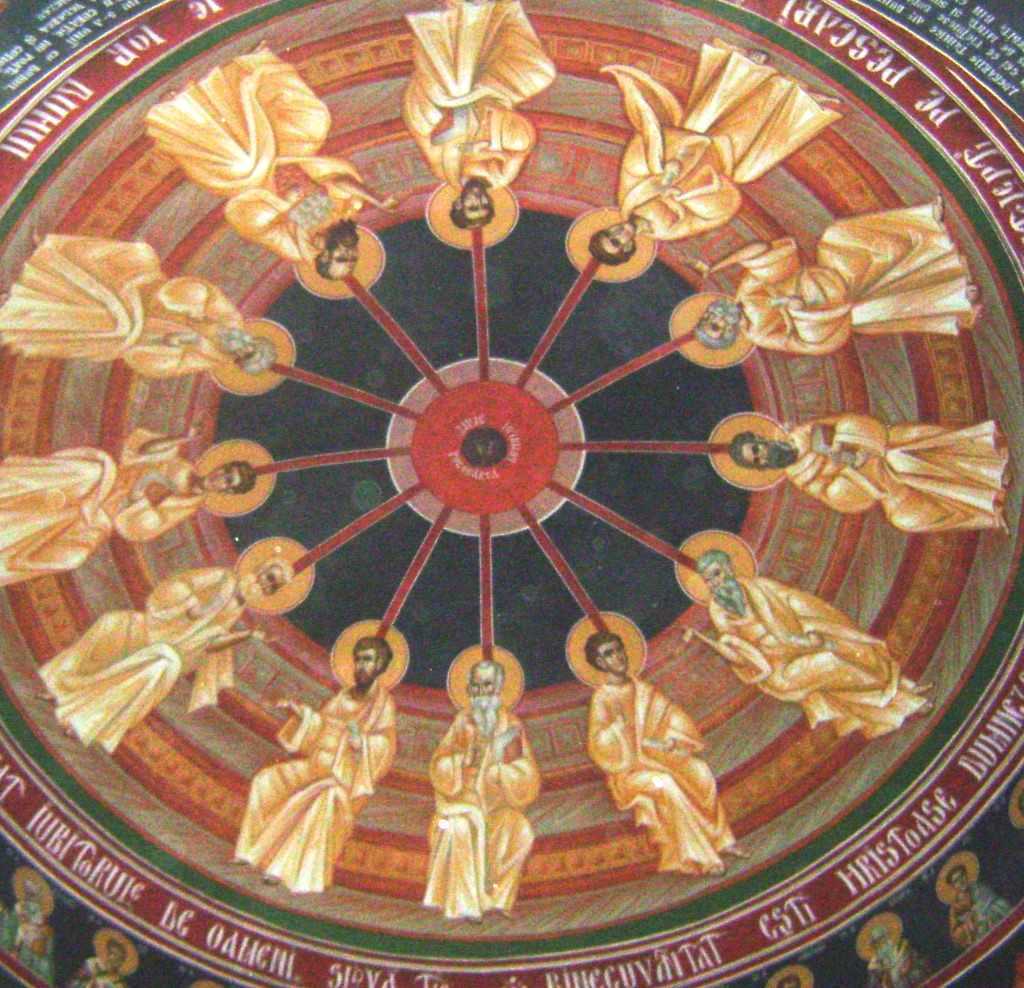
And today, my beloved, we have Pentecost, the great feast which is the fulfillment of the work of the divine economy, and signified the descent of the Holy Spirit. If you go to Mount Athos, in the Byzantine churches, you will see how Pentecost is depicted.
  
Byzantine iconographers, not like those today who are merchants of Christ, were artists who painted with faith and mixed their paints with their tears, and fasted in order to depict the icon of Christ and the Panagia, creating wonderworking icons. Out of ten-thousand icons today, I doubt if we would find one which is wonderworking. Every icon of course has its worth, due to whom it depicts, but another grace comes from the eye and hand of a sanctified iconographer.
  
Therefore, in the Byzantine icon of Pentecost, you will see that in the center is depicted a prophet, the Prophet Joel. He is depicted holding a scroll, on which is written the phrase: “I will pour out my Spirit upon all flesh...” (Joel 3:1-2)
  
I wish to speak, but I hesitate. For what benefit is there from the feasts? For many now, a feast is a party, a gathering, a dance... We do not lessen our sins, but increase them. And for the Church a feast is joy and spiritual exaltation, while we celebrate according to a Judean or idolatrous manner. That terrible prophecy of God is fitting for us, when He says: “Your feasts, my soul hates.” (Isaiah 1:14)
  
I hesitate furthermore, for Pentecost is a feast which is the most difficult for a preacher among all the other topics. For what are we? Nature, worms, unclean animals, lowly-people, sinners, “having unclean lips among a people of unclean lips.” (Isaiah 6:5) How can we speak today regarding the Holy Spirit, in an age which is known for its atheistic speeches, heresies, and generalized corruption?
  
In my place should be one of the Holy Fathers, whose spirits were intangible, and had not a molecule of carnality, and who, when they were praying, did not walk on the earth. And you, my listeners, should be purified, so that our spirits would be in harmony, and so that we be exalted above the heavens, like the Holy Apostles, so that the Holy Spirit would come upon us as well.
  
Behold why I hesitate to speak. But one phrase from today's prayers from the Kneeling Vespers helps to remove my hesitation. Believe me, I would not have even broached the topic, unless those words had strengthened me: “For in fear I stand before You, casting my soul's despair into the sea of Your mercy.” (From the Third Prayer of the Kneeling Vespers) I stand, it says, with fear before you, O Lord, and I the sinner, throw my soul's despair into the abyss of Your mercy.
  
I therefore throw myself into the incomparable mercy of God, and calling upon the grace of the Holy Spirit, I dare to utter a few words. For more properly, I don't speak myself; I become a microphone so that the opinions of the Fathers of our Church can be heard.
  
Pentecost! “I will pour out my Spirit upon all flesh...” The pouring out of the grace of the Holy Spirit, my beloved, in the Holy Scriptures and according to the Fathers of the Church, is characterized by many names. From all of this, I will take one alone, the name “gift”. Why is it called this? Because it is the culmination of everything that God has granted and continues to grant to us.
  
The grace of the Holy Spirit is not the only good thing which mankind has received from God. “In Him we live and move and have our being”, says the Apostle Paul (Acts 17:28), borrowing a phrase from the ancient poet (Aratos). We swim within the abyss of the energies and the gifts of God. What is there that we don't have as a gift from God!
  
I leave the gifts of the earth and the sea. I bring to mind the greatest gifts which come from on high, from heaven.
  
The first [great gift] is light, those countless rays of the sun, which travel at breakneck speeds, covering unimaginable distances. As one Saint said, every ray of the sun which shines upon a flower, a child, an old man, a beggar, a condemned man, upon the face of every person, what is it? It is an embrace by the heavenly Father. The hour when you sense the ray of the sun enlighten and warm you, it is as if God is saying: “O man, I love you.” How much would we pay for how many millions of kilowatts of energy from the sun? And instead of saying thank you, instead of “Glory to You Who has shown forth the light” (The Doxology), God receives blasphemies! And regardless, He sends His light “upon the thankless and sinners” (Luke 6:35).
  
Another [gift] is water, the rain which comes from the clouds, and falls upon the soil and makes it to grow all those things which nourish us. Every corner is a field. What could we pay for, and what does God receive for all of this water? The hen, when she drinks a sip of water, lifts up her head to heaven, as if to say: “Thank you, O Lord.”
  
Another is the air. Like the fish which swim in the water, and couldn't live outside of it, thus does man life within the ocean of the air. And only Earth has this atmospheric air. If we removed the atmosphere, we would die of asphyxia. Because of this, the astronauts carry with them Oxygen tanks. And think of how much it would cost if the Oxygen were sold by pharmacists. Only a few rich people could afford it. And for this, again there is thanklessness and ingratitude that our good God receives.
  
Besides these ordinary gifts of God, however, there are also extraordinary gifts, such as in the Old Testament, the manna, that sweet water, which was received by the mouths of the Jews who desired them. And those thankless ones watered the Son of the Virgin “with gall instead of mana” (hymn from Holy Friday). This is what man is.
  
Listen, my beloved, that up till now all of these gifts benefit me here. I told you understandable and simple things that we all know and can experience, and which penetrate our lives.
  
But man is not designed for here alone, for only this natural sphere, for the life of the body. He is not just a body. He is also a spirit, and primarily a spirit. He therefore, has another life, a life in the sphere of the spirit. And there, in the sphere of the spirit, he has need of other provisions. How can I make you understand? I seek the grace and the power of God.
  
Above all physical gifts which we sense, because we live with them and depend on them, is another great and uplifted gift. All of those gifts, ordinary and extraordinary, are small. Today's great gift is the Holy Spirit. “Taste of the gift of the Holy Spirit” (Acts 2:38) Great and necessary for our life is the light, the water, the air, but all of these are simply icons and symbols of that great gift, which is called the Holy Spirit.
  
The Holy Spirit has come! God has fulfilled His promises. It was prophesied of in the Old Testament by the Prophet Joel. It was the promise of Christ to His disciples, before He ascended into the Heavens. It was the completion of the work of the divine economy, the grand work of God for the salvation and glory of fallen man. Without the gift of the Holy Spirit, the work of the divine economy would be imperfect and incomplete. Today, this work is completed. Glory to the Father and to the Son and to the Holy Spirit!
  
+Bishop Avgoustinos
On the Monday of the Holy Spirit, 1961.
  
(amateur translation of text from source)
  
The Holy Spirit descending upon the Disciple at Pentecost (source)
  
Through the prayers of our Holy Fathers, Lord Jesus Christ our God, have mercy on us and save us! Amen!

Wednesday, May 20, 2015

Homily on the Ascension, by Metropolitan Avgoustinos Kantiotes (+2010)

The Ascension of Christ (source)
  
Homily on the Ascension, by Metropolitan Avgoustinos Kantiotes (+2010)
Today, my beloved, is a great feast of the Master, the Ascension of the Lord. What is the story of the day? I will speak simply, so that everyone can understand me, so that it is not a sermon with the “voice of one crying out in the wilderness.” (Matthew 3:3)

Forty days have passed since our Lord rose from the dead. He appeared to many. His disciples saw him blessing them, heard Him and touched Him. And Thomas furthermore was compelled to say: “My Lord and my God.” (John 20:28) Forty days later, He told them to gather at the Mount of Olives, a hill a short distance from Jerusalem. They gathered there. It was Peter, James, John, Andrew, Philip, Thomas, Bartholomew, Matthew, James the son of Alphaeus, Simon the Zealot, and Jude the son of James. Together with them were the Myrrhbearers, Mary, the Panagia and Mother of the Lord, as we see in the icon of the Ascension, and those who were called his brethren. (see Acts 1:13-14)
  
As they waited, Christ appeared before them, spoke to them, and gave them His final commandments. He blessed them, and then--even if the faithless do not believe, it is their right--a miracle occurred. As they were watching Him, the holy feet that had walked kilometers to find the lost sheep, the human sinner, those feet that furthermore bore the marks of the nails of the Cross, began to not walk on the earth anymore, but to be lifted up…
  
I once saw an eagle seated on a stone high up in the mountains of Grevena--it was a golden eagle--and I was amazed. And straightaway, I see it open its great wings and to fly. And I kept looking at it ascend into the air, ascend high, very high, as it turned into a small dot, and ultimately disappeared into the skies. The same occurred with Christ, Whom is named an eagle by the Revelation (12:14). It is Him Who have power to birds to fly, wouldn’t He have the same power?
   
Christ--to use a modern tongue--like the airplane which breaks through the clouds, ascended. And the disciples gazed at Him ascending. The Lord “ascended to heaven” today, and “sat at the right hand of God” (Mark 16:19). Then two angels appeared and told them: “Why are you standing looking at heaven? This Jesus that ascended, will return again in the same manner."
   
Yes, He will come. What are we thinking? --Who will come! Are you are telling us fairy tales now? Yes, the Lord will come “in [great] glory” (Matthew 24:30), to the wailing of the demons, to judge the whole “world in righteousness” (Acts 17:31). The Lord will come: joy to the righteous, and sadness to the sinners.
  
This is the story of the feast. From everything we have said, let us pay attention to one thing: that the disciples and the Panagia remained looking up at heaven. They did not look down at the earth. They were looking high up. What does this mean?
  
From the creations of God, the four-legged creatures walk with their heads looking down. Only man was created to walk upright. Many say that this is a wonder. And the word “human” (“anthropos” in Greek), if we look at it etymologically, what does it mean? It means he who faces upwards. He looks on high, for he was created for the heavens.
  
It is said that an atheist once wanted proofs. When it became night, one of his friends showed him the countless stars and asked: “Who made all of these?” There is one answer, no other: God! Gaze above, therefore, at the firmament, and you will trust that God exists. “The heavens declare the glory of God, and the firmament is the work of His hands.” (Psalms 18:2)
  
A German poet saw a herd of pigs in the forest. The pigs love acorns. They therefore gathered to eat those that fell in the forest. And the poet, with an eloquent tongue, noted this. When he left the forest, no one returned to look at the acorns to say thank you!... Thus are many of us, and this comparison should not appear offensive to us. Our Christ thus characterizes some people: “Do not give the holy things to the dogs, and do not put pearls before swine.” (Matthew 7:6) This occurs. We partake of myriads of good things, but we never lift up our eyes to say: “Glory to You, O God.”
  
Is this perhaps a hyperbole? ...When you get up in the morning, and see the sun shining brightly, you should say: “Glory to You, O God”, “Glory unto You Who have shown forth the light” (Great Doxology). Nothing. You go out to go to work. Entreat God, and make the sign of the Cross. But not even one Cross [do we do]. Noon comes, you at the table for lunch, you have all good things: say a prayer. Nothing without thanksgiving. When you drink water, you should say thank you. When you eat bread, you should say thank you. The situation is becoming like swine. Have in mind that famine is coming, a great famine, and our bread will be little.
  
How it was in the older years! I remember in my village, around 1910, there were some older people who had not gone to school, neither high school nor college. Before they drank a cup of water, they made the sign of the Cross. And do you see anyone do it now? Because of this I tell you, the hour is coming that there will be a shortage of water, and fountains and springs, rivers and lakes will be dry, the water will become twice as valuable. And then, a glass of water will cost a lira! As St. Kosmas Aitolos prophesied, a handful of flour will cost a handful of gold. We will be punished for our swine-like state, where we live like animals, without being raised, without exalted thoughts, and in some ways being worse that animals. Do you see the dog? You toss him a bone, and though he doesn’t have a tongue, he turns to you as if to say: “Master, thank you.” Thankless and pitiless people, who often times blaspheme God night and day.
  
This is how it is, therefore. We are lower than animals. There is not the time to develop the theme and explain the word of the Psalms which says: “Man cannot abide in his pomp, he is like the beasts that perish.” (Psalms (Septuagint) 48:13). He is equal to, and sometimes lower than the animals (oxen, sheep, goats) and birds.
  
On the domes and bell-towers of churches, we see the birds’ nests. What should we say about the stork? The stork loves his children, and they love him. When a stork gets old, do you know what occurs? His children bring him food. And because the old stork is shedding and cold, they warm him with their wings! And man? When he doesn’t have ideals, resurrections, exaltations, and great ideas, what should we say of man? Tell me what he thinks about at midnight, and I’ll tell you that he is. If he thinks of money, rewards, women, other earthly things, then what is he? A small and insignificant being.
  
It is said, my beloved, that the pig, as we mentioned, that has its head turned down and eats clay, only once looks up to see heaven. When? When the butcher takes him to slaughter him. This also occurs with many people. They don’t think about God, they don’t step foot in church, they don’t pray. And they think that it will always be thus. However, the hour of death comes. Then, at the last instant, the Archangel will come with his sword, and they will only then remember God.
  
We were not created for the earth, which is a handful of sand, a drop amidst the universe. Is it worth it, O man, for a handful of sand or a drop of water to wage wars and shed blood of humanity? We have departed from God. Because of this: “Let us lift up our hearts.” (Divine Liturgy). And not just today, but the whole year. This is what the Ascension means. In every Divine Liturgy we honor the Ascension. When the Priest says: “Let us lift up our hearts”, what does he mean? Gaze on high, for you were created for heaven, for great and uplifted things. This does not mean indifference for this present life, no. If we embrace the whole Gospel of Christ, this earth will become Paradise. Now, old, young, grandfathers, bishops, right-wing, left-wing, white, black, in many ways we have trampled upon the Gospel, and this earth has become hell.
  
May we repent. May our Lord Jesus Christ bless everyone, Whom, O children of the Greeks, praise and exalt supremely, unto all the ages. Amen.
  
+Bishop Avgoustinos
Delivered in the Church of the Ascension, Perdikka, Eordaias, May 24th, 1990
     
(amateir translation of text from source)
  
The Ascension of Christ (source)
  
Through the prayers of our Holy Fathers, Lord Jesus Christ our God, have mercy on us and save us! Amen!

Monday, October 13, 2014

Homily of St. Basil the Great on Thanksgiving and Mourning

Christ communing His Disciples with the Holy Eucharist (meaning Thanksgiving), His All-Precious Body and Blood (source)
  
You have heard the words of the Apostle, in which he addresses the Thessalonians, prescribing rules of conduct for every kind of person. His teaching, to be sure, was directed towards particular audiences; but the benefit to be derived therefrom is relevant to every generation of mankind. Rejoice evermore, he says; Pray without ceasing. In everything give thanks (I Thessalonians 5:16-18). Now, we shall explain a little later on, as far as we are able, what it means to rejoice, what benefit we receive from it, and how it is possible to achieve unceasing prayer and give thanks to God in all things.
  
However, it is necessary to anticipate the objections that we encounter from our adversaries, who criticize the Apostles injunctions as unattainable. For what is the virtue, they say, in passing ones life in gladness of soul, in joy and good cheer night and day? And how is it possible to achieve this, when we are beset by countless unexpected evils, which create unavoidable dejection in the soul, on account of which it is no more feasible for us to rejoice and be of good cheer than for one who is being roasted on a gridiron not to feel agony or for one who is being goaded not to suffer pain?
  
And perhaps there is someone among those who are standing among us here who is ailing with this sickness of the mind and makes excuses in sins (Psalm 140:4, Septuaginta), and who, through his own negligence in observing the commandments, attempts to transfer the blame to the law-giver for laying down things that are unattainable. How is it possible for me always to rejoice, he may ask, when I have no grounds for being joyous? For the factors that cause rejoicing are external and do not reside within us: the arrival of a friend, long-term contact with parents, finding money, honors bestowed on us by other people, restoration to health after a serious illness, and everything else that makes for a prosperous life: a house replete with goods of all kinds, an abundant table, close friends to share ones gladness, pleasant sounds and sights, the good health of our nearest and dearest, and whatever else gives them happiness in life. For it is not only the pains that befall us which cause us distress, but also those that afflict our friends and relatives. It is from all of these sources, therefore, that we must garner joy and cheerfulness of soul.
  
In addition to these things, when we have occasion to see the downfall of our enemies, wounds inflicted on those who plot against us, recompense for our benefactors, and, in general, if no unpleasant circumstance whatsoever that would disturb our life is either at hand or expected, only then is it possible for joy to exist in our souls. How is it, therefore, that a commandment has been given to us that cannot be accomplished by our own choice, but depends on other antecedent factors? How am I to pray without ceasing, when the needs of the body necessarily attract the attention of the soul to themselves, given that the mind cannot attend to two concerns at the same time?
  
And yet, I have been commanded to give thanks in everything. Am I to give thanks when I am strapped to a rack, tortured, stretched out on a wheel, and having my eyes gouged out? Am I to give thanks when I am beaten with humiliating blows by one who hates me? When I am stiff from the cold, perishing from hunger, tied to a tree, suddenly bereft of my children, or deprived even of my very wife? If I lose my wealth as a result of a sudden shipwreck? If I run into pirates on the sea, or brigands on the mainland? If I am wounded, slandered, wander around, or dwell in a dungeon?
  
Raising these objections, and more besides, our adversaries find fault with the lawgiver, thinking that, by slandering the precepts that we have been given as impossible to fulfill, they furnish themselves with a defense for their own sins. What, therefore, shall we say in response to them?
  
That, while the Apostle is looking elsewhere and attempting to elevate our souls from the earth to the heights and to transport us to a heavenly way of life, they, unable to attain to the loftiness of the lawgivers mind, and preoccupied with the earth and the flesh, crawl around in the passions of the body like worms in a swamp and demand that the Apostle issue precepts which are capable of being fulfilled. For his part, the Apostle summons not just anyone, but one who is as he was to rejoice always, no longer living in the flesh, but having Christ living in himself, since union with the highest good does not in any way allow sympathy for the demands of the flesh (cf. Galatians 2:20). And even if an incision is made in the flesh, the disintegration occasioned by its continued presence remains in the part of the body that suffers it, since the pain is unable to spread to the noetic part of the soul. For, if, in accordance with the Apostles precept, we have mortified our members which are upon the earth (Colossians 3:5) and we bear in the body the dying of the Lord Jesus (II Corinthians 4:10), necessarily the injury suffered by the mortified body will not reach the soul which has been freed from contact with the body. Dishonor, losses, and deaths of our nearest and dearest will not rise up to the mind, nor will they incline the sublimity of the mind to sympathy with things below. For, if those who fall into difficulties have the same attitude as the virtuous man, they will not cause annoyance to anyone, seeing that not even they themselves endure sorrowfully what befalls them; but if they live according to the flesh (Romans 8:13), not even in this way will they annoy anyone, but will be reckoned pitiable, not so much because of their circumstances, as because they do not choose to react properly.
  
In short, a soul which has once and for all been held fast by the desire for its Creator and is accustomed to delighting in the beauties of the heavenly realm will not alter its great joy and cheerfulness under the influence of carnal feelings, which are varying and unstable; but things which distress other people it will regard as increasing its own gladness. Such was the Apostle, who took pleasure in infirmities, in afflictions, in persecutions, and in necessities, counting his needs an occasion for glorying (II Corinthians 12:9-10); in hunger and thirst, in cold and nakedness, in persecutions and distresses (II Corinthians 12:10; 11:27), conditions in which others endure only with difficulty, bidding farewell to life: in these he rejoiced. Therefore, those who are ignorant of what the Apostle has in mind, and do not understand that he is calling us to the evangelical way of life, dare to accuse St. Paul of laying down things that are impossible for us. Well then, let them learn how many legitimate occasions for rejoicing are made available to us through Gods munificence. We were brought from non-being into being; we were made in the image of the Creator (Genesis 1:27); we have the mind and reason to perfect our nature, and through them we have knowledge of God. And perceiving the beauties of nature carefully, we thereby recognize, as if through letters, God's great providence and wisdom concerning all things. We are capable of discerning good and evil; we are taught by nature itself to choose what is beneficial and to avoid what is harmful. Having been estranged from God through sin, we have been called back to kinship with Him, being released from ignominious slavery by the blood of His Only-begotten Son. We have the hope of resurrection, the enjoyment of Angelic goods, the Kingdom of Heaven, and promised goods, which transcend the grasp of mind and reason.
  
How is it not proper to think that these things are sufficient reasons for unending joy and unceasing gladness? How is it proper to suppose that one who is a glutton, who delights in hearing flute-playing, and who lies on a soft bed and snores, is living a life worthy of joy? I would say that such people are worthy of lamentation on the part of those who are endowed with intelligence, whereas we should call blessed those who endure the present life in the hope of the age to come and who exchange present joys for eternal joys. Whether they stand amid flames, as did the three Youths in Babylon, who were united with God (Daniel 3:21), or are shut up with lions (Daniel 6:16-23), or swallowed by a whale (Jonah 2:1), we should call them blessed, and they should pass their lives in joy, not being distressed over present sufferings, but rejoicing in the hope of what is in store for us in the next life. For, in my opinion, a good athlete, once he has stripped down for the arena of piety, should valiantly endure the blows of his adversaries in hope of the glory that comes from crowns of victory. Indeed, in gymnastic contests, those who have become inured to pain in wrestling schools are not depressed at the prospect of suffering pain from blows, but advance to close quarters with their foes, disdaining momentary pains in their desire to be publicly proclaimed victors. Thus, even if some misfortune befalls a virtuous man, it will not cast a shadow over his joy. For tribulation worketh patience, and patience, experience, and experience, hope; and hope maketh not ashamed (Romans 5:3-5). Hence, in another place, Saint Paul enjoins us to be patient in tribulation and to rejoice in hope (Romans 12:12). It is hope, therefore, that makes joy to dwell within the soul of a virtuous man. But the same Apostle bids us weep with those who weep (Romans 12:15); and, writing to the Galatians, he wept over the enemies of the Cross of Christ (Philippians 3:18). And what need have I to speak of the tears of Jeremiah (Lamentations), of Ezekiel writing lamentations over the rulers of Israel, at Gods command (Ezekiel 2:9), or of many other Saints who mourned? Alas, my mother, that thou hast borne me (Jeremiah 15:10); Woe is me, for the godly man hath perished from the earth, and there is none among men that ordereth his way aright (Micah 7:2); Woe is me, for I am become as one gathering straw in the harvest (Micah 7:1).
   
So, in a word, scrutinize the sayings of the righteous, and when anywhere you find one of them emitting a rather doleful expression, you will be convinced that all who are of this world bemoan the misery of the life that is led therein. Woe is me, for my sojourning is prolonged (Psalm 119:5, Septuaginta). For the Apostle has a desire to depart, and to be with Christ (Philippians 1:23). He is, therefore, vexed at the prolongation of this earthly sojourn as an impediment to his joy. David, too, bequeathed to us a lamentation in song for his friend Jonathan, in which he also mourned for his enemy: I am grieved for thee, my brother Jonathan (II Kings 1:26); and: O daughters of Israel, weep for Saul (II Kings 1:24). He mourns for Saul, as one who died in sin, but for Jonathan, as one who shared his life in every respect. Why should I speak of the other examples? And yet, the Lord wept over Lazarus (St. John 11:35) and He wept over Jerusalem (St. Luke 19:41), and He calls blessed those who mourn (St. Matthew 5:4) and likewise those who weep (St. Luke 6:21).
  
But how, you say, are these things to be reconciled with the words: Rejoice always? For weeping and joy do not derive from the same source. Weeping, for example, is naturally engendered as a result of some blow, in which the involuntary impact strikes and constricts the soul, while the spirit surrounding the heart is depressed; but joy is like a leap of the soul, as it were, which rejoices at things that are under its control. Hence, the physical symptoms are different. For, in the case of those who are distressed, their bodies are sallow, livid, and cold, whereas in the case of those who feel joyous, the condition of their bodies is efflorescent and reddish, while their souls all but leap outwards, propelled by delight.
  
To this we will say that the Saints lamented and wept on account of their love for God. And so, ever beholding Him Whom they loved and increasing the gladness that they themselves derived from Him, they provided for the needs of their fellow-servants, mourning for those who sinned and correcting them through their tears. Just as people who stand on the shore and feel sympathy for those who are drowning in the sea do not jettison their own security in their concern for those in peril, so also, those who are distressed at the sins of their neighbors do not efface their own gladness; on the contrary, they increase it, being vouchsafed the joy of the Lord by virtue of the tears that they shed for their brothers. This is why those who weep and those who mourn are blessed, for they themselves will be comforted and they themselves will laugh. By laughter, one means not the sound which is emitted through the cheeks when the blood boils, but the cheerfulness which is pure and unmixed with any sadness. Therefore, the Apostle allows us to weep with those who weep, because tears of this kind are like the seed and pledge of eternal joy. Ascend with me in mind, please, and behold the Angelic estate and consider whether any other condition befits them than that of rejoicing and gladness; for they are vouchsafed to stand before God and enjoy the ineffable beauty of the glory of Him Who created us. And so, it is to that life that the Apostle urges us on, bidding us always to rejoice.
  
Now, as for the fact that the Lord wept over Lazarus and the city, we have this to say: He ate and drank, not because He needed these things Himself, but so as to leave you with measures and limits by which to control the unavoidable emotions of the soul. Thus, He wept in order to correct the propensity to excessive emotion and dejection among those given to mourning and lamentation. For if there is anything that needs to be moderated by reason, it is weeping: that is, over what things, to what extent, when, and how it is proper to weep. For that the Lord's weeping was not emotional, but didactic, is clear from this verse: Our friend Lazarus sleepeth; but I go, that I may awake him out of sleep (St. John 11:11). Who among us mourns for a sleeping friend, whom he expects to awake after a short while? Lazarus, come forth (St. John 11:43). And the dead man was brought back to life; he who was bound walked. This is a miracle within a miracle: that his feet were bound with grave-clothes and yet were not prevented from moving. That which strengthened him was greater than that which impeded him.
  
Why, therefore, did the Lord, Who was about to accomplish such things, judge the incident worthy of tears? Is it not clear that, disregarding our infirmity in every way, He contained the necessary emotions within certain measures and limits, avoiding a lack of sympathy, on the one hand, as something appropriate to wild beasts, and, on the other hand, refusing to give way to excessive grief and lamentation as something ignoble? Hence, in weeping over His friend, He both displayed that He Himself shared in our human nature, and freed us from either kind of extreme, allowing us neither to indulge our emotions nor to be unfeeling in the face of sorrows.
  
Therefore, just as the Lord accepted hunger, after digesting solid food, submitted to thirst, after the moisture in His body was consumed, and felt weary, when His muscles and nerves were strained from travel-ling—although it was not that His Divinity succumbed to weariness, but that His body accepted its natural attributes; so also, He accepted weeping, permitting a natural property of the flesh to supervene. This occurs when the hollow parts of the brain, filled with vapors arising from grief, discharge the burden of moisture through the opening of the eyes as through some kind of duct. Hence, one experiences a certain ringing in the ears, dizziness, and darkening of the eyes when he hears about unexpected sorrows, and ones head is set in a whirl by vapors which are emitted by compressed heat deep inside him. Then, in my opinion, just as a cloud dissolves into raindrops, so also the thickness of vapors dissolves into tears. Hence, those who grieve feel a certain pleasure when they lament, because the burden that weighs on them is secretly evacuated through weeping. Experience of events proves the truth of this account. For we know many people who, in desperate straits, forcibly restrain themselves from weeping; then, in some cases, they fall into incurable sufferings, either apoplexy or paralysis, while in other cases, they completely faint, their strength having been broken down, like a weak support, by the weight of sorrow. For, what is observable in the case of fire, that it is stifled by its own smoke if it does not escape, but rolls around it—this, it is said, occurs also in the case of the faculty that governs a living creature; that is, it wastes away and is extinguished if there is no way for it to ex-hale.
  
Therefore, let those who are given to mourning not adduce the Lords tears in support of their own weakness. For, just as the food which the Lord ate is not an occasion of pleasure for us, but, on the contrary, the highest criterion of restraint and sufficiency, so also, His weeping is not an ordinance prescribing lamentation, but is a most fitting measure and an exact standard whereby we may, with proper dignity and decorum, endure sorrows while remaining within the limits of our nature. Thus, neither women nor men are permitted to indulge in mourning and excessive weeping, but only to the extent that it is fitting to grieve over sorrows; they are permitted to shed a few tears, but this must be done calmly, without bellowing or wailing, without rending ones tunic or sprinkling oneself with dust, or committing any of the other improprieties that are typical of those who are ignorant of heavenly things. For one who has been purified by Divine doctrine must be fenced around by right reason, as by a strong wall, and must manfully and strenuously ward off the onslaughts of such emotions; he must not accept any crowd of emotions that flows in, as it were, to some low-lying place, with a submissive and compliant soul.
  
It is the mark of a craven soul, and one that is lacking in the vigor that comes from hope in God, that it utterly collapses and succumbs to adversities. For, just as worms are particularly inclined to breed on more tender pieces of wood, so also sorrows grow in men of lesser moral fiber. Was not Job adamantine in heart? Were his inward parts not made of stone? His ten children fell dead in one brief moment of time, overwhelmed by a calamity in the house of their gladness at a time of enjoyment, when the Devil brought down their dwelling upon them. He saw the table drenched with blood; he saw his children, who had been born at different times, but who had ended their lives together. He did not wail aloud; he did not pluck his hair out; he did not let out a degenerate cry; but he uttered that thanksgiving which is renowned and acclaimed by all: the Lord gave, the Lord hath taken away; as it seemed good to the Lord, so hath it come to pass; blessed be the name of the Lord (Job 1:21). Was this man not lacking in sympathy? How could this be so? For about himself, at any rate, he says: I wept over every man who was afflicted (Job 30:25). But was he not lying when he said this? But here, too, the truth bears witness to him that, in addition to his other virtues, he was also truthful: ...That man was blameless, righteous, godly, and truthful (Job 1:1).
  
Yet many of you keep on wailing in dirges that are designed to express dejection, and you deliberately waste away your soul with mournful melodies; and, just like the make-believe and paraphernalia with which they adorn theatres to typify tragedies, so, also, you suppose that the proper outfit for a mourner consists of black clothing, squalid hair, dirt, and dust, complete with a darkened house and lugubrious chanting, which preserves the wound of grief ever fresh in the soul. Let those who have no hope do these things. You, however, have been taught, concerning those who repose in Christ, that it [the body] is sown in corruption; it is raised in incorruption; it is sown in dishonor; it is raised in glory; it is sown in weakness; it is raised in power; it is sown a natural body; it is raised a spiritual body (I Corinthians 15:42-44). Why, then, do you weep for one who has gone to change his vesture? Neither mourn for yourself, as one who has been deprived of a helper in this life; for it is better to trust in the Lord than to trust in man (Psalm 117:8-9, Septuaginta). Nor lament for this helper, as one who has suffered a terrible calamity. For, a little later, the trumpet sounding from Heaven will awaken him, and you will see him standing before the judgment-seat of Christ. So, dismiss these dejected and ignorant cries: Alas, these unexpected woes! Who would have thought that this would happen? Could I have ever anticipated that I would cover this dearest friend of mine with earth? If we should hear someone else saying such things, it behooves us to blush, since we have been taught from both past memories and present experience that these natural occurrences are inevitable.
  
Therefore, neither untimely deaths nor other misfortunes that unexpectedly befall us will ever cause consternation in us who have been educated by the doctrine of piety. For example, let us say that I had a son who was a young man—the sole heir of my estate, the comfort of my old age, the adornment of his family, the flower of his peers, the support of his household, and at that time of life which is most charming—, this lad having been carried off by death, he becoming earth and dust who, a short while ago, uttered sweet sounds and was a most pleasing sight in the eyes of his father. What, then, am I to do? Shall I rend my clothing? Shall I consent to roll around on the ground, scream in vexation, and act in front of those present like a child crying out in pain and having convulsions? Rather, paying heed to the inevitability of events, that the law of death is inexorable and affects every age-group alike, dissolving all compound things in order, surely I should not be surprised at what has happened. Surely I should not be upset in my mind, as if I had been devastated by some unexpected blow, since I have been taught beforehand that, being mortal, I had a mortal son, that there is no constancy in human affairs, and that nothing wholly abides for those who possess it.
  
Why, even great cities, which were renowned for the elegance of their buildings and the abilities of their inhabitants, and conspicuous for their prosperity both in the countryside and in the marketplace, now display tokens of their erstwhile dignity only in ruins. A ship which has frequently been preserved from the sea, and which has made countless speedy voyages and conveyed innumerable amounts of merchandise for traders, vanishes with a single gust of wind. Armies which have many times defeated their foes in battle have, on suffering a reversal of fortune, become a pitiful sight and one pitiful to relate. Entire nations and islands, which have attained great power, and have raised many trophies both by land and by sea, and have gathered much wealth from booty, have either been consumed by the passage of time or been taken captive and exchanged their liberty for enslavement. Indeed, in short, whatever great and unbearable evil you care to mention, life already has prior examples of it.
  
Therefore, just as we determine weights by a turn of the scale and assay gold by rubbing it with a touchstone, so also, if we were to remember the limits revealed to us by the Lord, we would never exceed the bounds of prudence. Whenever, therefore, any involuntary adversity befalls you, by virtue of being mentally prepared, you will avoid confusion, and you will make light of present afflictions by your hope for the future. For, just as those whose eyes are weak divert their gaze from things that are excessively bright and give them rest by looking at flowers and grass, so, also, the soul must not constantly behold that which causes grief or be fixated on present sorrows, but must direct its gaze towards what is truly good. In this way will it be feasible for you always to rejoice, if your life always looks towards God and if hope of recompense alleviates life's colors.
  
Have you been dishonored? Then have regard for the glory which is laid up in Heaven through patient endurance. Have you suffered a loss? Then contemplate the heavenly wealth and treasure which you have laid up for yourself through your good deeds. Have you been expelled from your homeland? Then you have Jerusalem as your heavenly homeland. Have you lost a child? Then you have Angels, with whom you will dance around the Throne of God, rejoicing eternally. By thus opposing anticipated good things to present sorrows, you will keep your soul in the cheerfulness and tranquillity to which the Apostles precept summons us. Neither let the joys of human affairs create immoderate and excessive gladness in your soul, nor let sorrows diminish its exultation and sublimity by feelings of dejection and abasement. Unless you have previously trained yourself in this way regarding the eventualities of life, you will never have a calm and tranquil life. But you will easily achieve this if you have dwelling within you the commandment which advises you always to rejoice, dismissing the vexations of the flesh and gathering that which gladdens the soul, transcending the sensation of present realities and extending your mind to the hope of eternal realities, the mere thought of which is sufficient to fill the soul with rejoicing and to make Angelic exultation reside in our hearts; in Christ Jesus our Lord, to Whom be the glory and the dominion, unto the ages. Amen.
  
Through the prayers of our Holy Fathers, Lord Jesus Christ our God, have mercy on us and save us! Amen!

Saturday, July 12, 2014

Elder Paisios on those who suffer for the world

An icon depicting St. Paisios receiving pilgrims, taking up their burdens and preaching to them the Word of God. His scroll reads: "We must struggle with philotimo, that we may be saved, and so that we not sadden Christ..." (source)

Those who suffer deeply for the salvation of the whole world and help in their own way (as strugglers) and humbly entrust themselves to the hands of God, feel the greatest joy in the world. Their life is a constant doxology, for they flutter about internally like angels, glorifying God day and night. Those, however, who neglect the salvation of their souls and try to find joy and rest in this vain life, are continually tortured and entangled in endless worldly machinery and live in hell in this life...Those who have philotimo, because they move within the heavenly sphere of doxology, joyfully accept their trials as well as their blessings, and glorify God for them. Thus, they are continuously receiving God’s blessing from everything and are melting internally out of gratitude towards God, which they express in every spiritual way possible, like children of God.
-St. Paisios of Mount Athos (+ July 12th 1994)
   
St. Paisios the Athonite (source)  
Through the prayers of our Holy Fathers, Lord Jesus Christ our God, have mercy on us and save us! Amen!