Sunday, October 25, 2009

Miracles of St. Demetrios the Myrrh-streamer

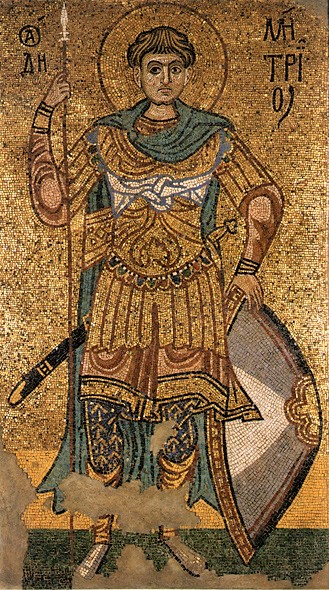
12th Century mosaic icon of St. Demetrios the Great Martyr, from Xenophontos Monastery (taken from: http://ia301511.us.archive.org/2/items/OrthodoxIconsStDemetrios/1026Dimitrie06.jpg)

The following miracles of St. Demetrios are translations from a 9th century text of Anastasius the Librarian. The current translation is from the Latin, as the Greek version is apparently lost. The text is taken from: http://www.ucc.ie/milmart/BHL2122.html. Also note, these miracles are by no means an artifact, but St. Demetrios continues to pour forth myrrh from his relics, and grants countless healings of soul and body throughout the world. For the life of St. Demetrios see: http://full-of-grace-and-truth.blogspot.com/2008/10/life-of-st-demetrios-myrrh-flowing.html and for a post on the Veneration of St. Demetrios and Thessaloniki, see: http://full-of-grace-and-truth.blogspot.com/2008/10/veneration-of-st-demetrios.html.

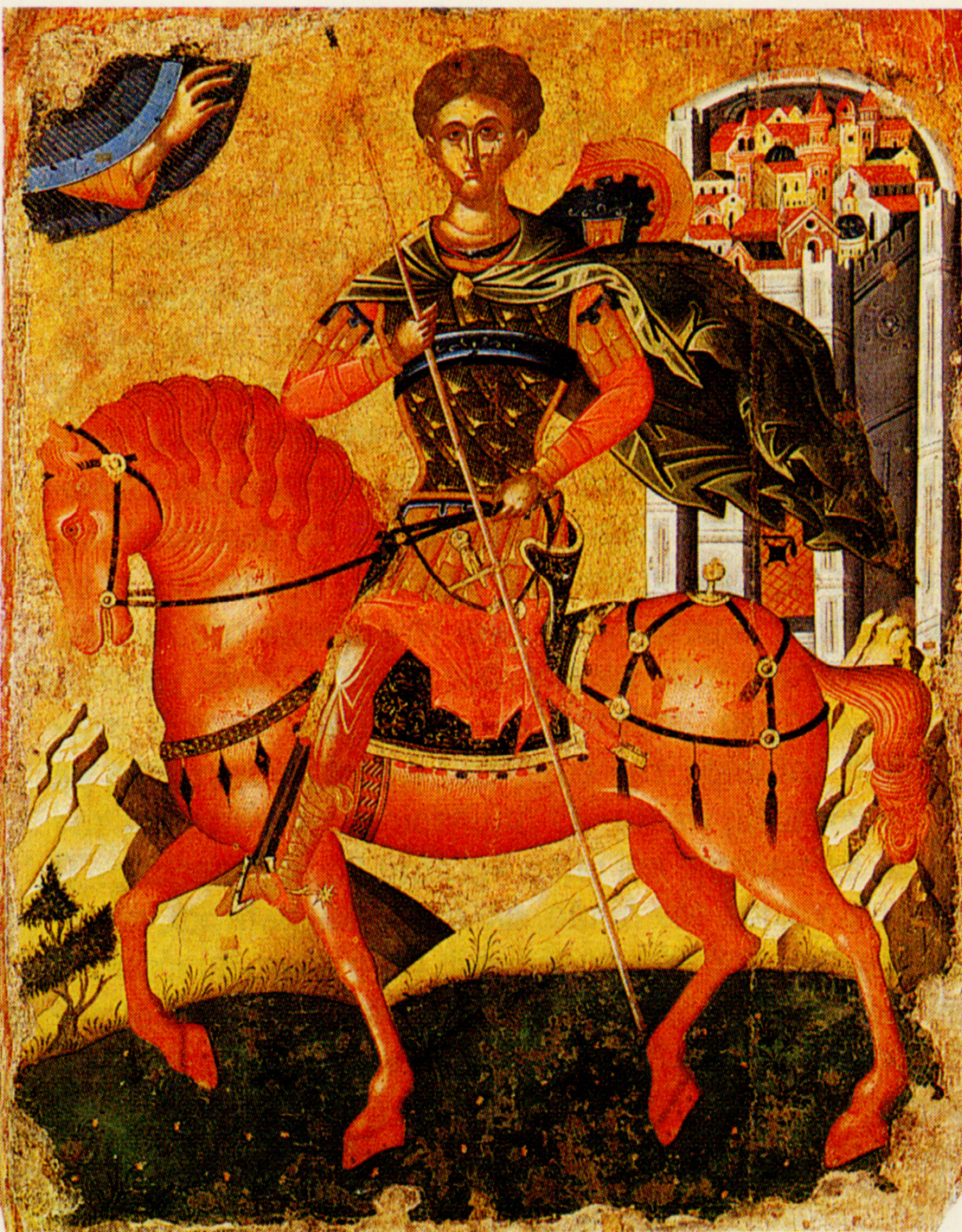
St. Demetrios the Great Martyr (taken from: http://christopherklitou.com/icon_26_oct_demetrius_greatmartyr.htm)

Miracle 1
"A certain Marianus, one of the senators, was ordered by the emperors to rule the tribes who were in Illyricum in the manner of the prefects. He, when he came to Thessalonica, managed the government of the prefecture in a pious fashion, and was pleasing to both God and man. Then the devil, envying his wealth, sought him out to test him, just like Job. And first of all he began to test him by means of the seven vices. But the other, sustained by the grace of God, overcame all his machinations. And when the devil did not succeed in this way, he deprived that man of all his worldly wealth; and he was not able to conquer him in this way either, since there was help from above with him. Finally, therefore, the devil, with the permission of God, struck him down with such a serious illness that he had no power over any of his limbs, except his tongue alone, concerning which he used constantly praise God. And when he had suffered this illness with patience for a long time, the devil came to the city in the guise of a man, carrying a certain document in his hands, and he said to one of his servants, "If your lord will carry this about himself, he will be freed from his illness." The latter entered before his lord and said to him, "So listen to me, and you will be cured. There is an unknown man in the city with a certain document who says that if you are willing to carry it about yourself, [col. 718] you will be freed from your illness." But he said, "What is written on it ?" "I do not know", the servant says, "but he [the stranger] says that it is the names of the gods and the angels." Marianus said, "God, without whose nod nothing happens, can restore me to health without a written document; let him have what is his; let God's will be done concerning me." When he had said these things, he was quickly seized by sleep because of his pain and sorrow. When he had fallen asleep, blessed Demetrius appeared to him, saying, "Rise and order your servants to carry you to the shrine of Demetrius; for there, with the help of God, you will receive a cure." And when he woke up and asked those standing around for the shrine of the martyr Demetrius, someone said, "There is a very small shrine near the stadium where they say that Demetrius lies, he who was killed by means of lances a long time ago at the order of the emperor Maximianus." Then he said, "Bring me there, since I have been told in a dream that I can receive a cure there." Then his servants carried their lord where they had been ordered; and he ordered them to place him only on the floor. And when he was lying [there], he was seized by sudden sleep; and behold, blessed Demetrius appeared to him again, saying, "You can be cured by me, but I am afraid lest after your healing you may perhaps entangle yourself in the cures of this world." But Marianus [said], "You know, lord, that I have never done this, and that I do not wish to do this [now]." And he [replied], "Christ, who raises up those cast down, cures you." And waking up, Marianus began to report his vision. And when he had got to the place where the martyr said, "Christ, who raises up those cast down, cures you," he stood up cured and, together with all those present there, gave thanks to God who lives and reigns through ages of ages. Amen.

Fresco from Decani Monastery depicting the Eparch of Illyricum mentioned above being carried to the church of St. Demetrios to be healed (taken from: http://www.srpskoblago.org/Archives/Decani/exhibits/Collections/StDemetrius/CX4K2336_l.html)

Miracle 2
Similarly, there was a certain prefect of the city of Thessalonica who suffered a discharge of blood and, just like the woman who was cured by touching the fringe of the Lord's clothing, had spent almost all his income on doctors, and had been able to be cured by no-one. So finally, inspired by divine mercy, he said to his servants one day, "Carry me to the shrine of the protector of our city." But replying with fear, they said to him, "To the shrine of which protector do you order us to lead you ?" He said to them, "[To the shrine] of the chief [protector]." They said, "Of which chief [protector] ? Tell us his name, lord." He looked at them and said, "Alas ! Do I recognise him, although I am lying [here] half-dead, while you are ignorant of him, although you are healthy ? Do you not know that this city has many protectors, but one surpasses them all, he who always fights keenly on her behalf, whom not only the city alone has merited to have as its inassailable wall, but the whole region also ? So bring me to his shrine, for he will either take pity on me as I visit, or will certainly raise up my soul when I have died there and, interceding for me at the coming presence of Christ's fearful seat-of-judgement, will save me from eternal punishment." When he had said these things, they realized that he was talking about the saint Demetrius who often bestows cures upon the sick; and they quickly raised him up and carried him there. What language, dearest brothers, can honour this martyr with worthy praises, he who has achieved such great power that he can restore to health in one moment he whom many different doctors had been unable to cure ? For as soon as [the prefect] entered the doors of the church, he merited a cure not only of his body, [col. 719] but also of his soul, through the power of Our Lord Jesus Christ who lives and reigns through ages of ages. Amen.


Miracle 3
We have heard a friend of the truth, an important priest without a doubt, report things about the martyr Demetrius which we will try to explain in the following [passages]. It happened, he said, that the magnificent, solid-silver ciborium which had stood in his holy temple was so burned one night that it totally melted. So the most holy bishop tried to recreate the aforementioned ciborium, but he did not recover a full pound of the silver which had melted away for the completion of such a great task. He planned to himself to melt down the silver throne which was in the same venerable temple, and to effect the task in that way. And when he had decided this to himself, and no-one else knew his plan, the martyr of Christ Demetrius appeared in his dreams to a certain priest, a man of excellent lifestyle, Demetrius by name, saying, "Go, tell the bishop of the city: "Do not presume to destroy the throne of my house." When the priest had told this to the bishop, his superior was indeed amazed first of all that his inner-thoughts had been made public; he then regarded the steward of the temple of the venerable martyr with some suspicion, thinking that he had arranged this. And the bishop said to him, "You have never heard this from me, brother." After many days, when he had examined the arguments again and had found no other plan by which the work on the ciborium might be completed, he confirmed himself in his first plan to make the ciborium from the throne. When he had ordered a silversmith to be called in order to instruct him to destroy the throne, someone reported to him, saying, "The priest Demetrius asks to approach to your holiness." When he had entered, [the priest] said to him, "The martyr Demetrius who appeared to me, a sinner, earlier, has appeared to me again in a vision with a somewhat sad appearance, and has ordered me to report these words to your holiness: "For the sake of charity, do not grieve me by the destruction of my throne." But [the bishop] was indignant at the priest when he heard this, since he thought that he was making these things up. He dismissed him from him more severely, and made his intention clear, saying, "You have abundant advice to give when there is less than a pound of silver ! Do not philosophize about the problems of others and pass rash judgement." Then the priest went away confused since the saint had not yet told him what ought to be done, but only, "Do not destroy my throne." But that very night saint Demetrius appeared to the priest Demetrius, and said to him, "Go, tell the archbishop: "Do not worry about my ciborium, since I will restore it myself." The priest fulfilled the martyr's commands, and reported this to his superior. When his superior heard this, he praised God and the holy martyr Demetrius. While they were still talking to each other about these things, behold the doorkeeper came, saying, "Holy superior, the very wealthy Mennas stands at your door wanting to talk to you." He said to him, "Let him come in." The aforementioned Mennas entered and gave him 75 pounds of silver for the assistance of the ciborium. And then came John, the darling of the poor without a doubt, who gave him 40 pounds of silver; and the citizens came and made donations according as they were able in order for the ciborium [col. 720] to be restored. In such a manner was this oft-mentioned work rebuilt by the merits of the holy martyr with the help of Our Lord Jesus Christ who lives and reigns, together with the Father and the Holy Spirit, through ages of ages. Amen.


Miracle 4
But we do not believe that that which we heard from the most holy archbishop ought to be omitted here. For he told us about a certain custodian of the temple of the martyr Demetrius, Honesiphorus by name. "When one day I was going to to church of the aforementioned martyr, I found the aforementioned custodian Honesiphorus lying half-dead before the door of the holy martyr. And when, troubled, I wept at the illness of my friend, Honesiphorus came to, saw me crying, and said, "Why are you sad on my account, Lord Eusebius ? If you love me, do not be troubled, but order my tomb to be readied, and toss me alive into it." Disturbed by this, I said to him in my sadness, "What is the reason for this, brother ?" He replied, "Because I roused the holy martyr to anger by my guilt. For the holy martyr appeared to me, a sinner, in my sleep, and addressed me in a sweet voice, "Brother Honesiphorus, that which you do does not please me. The salvation of a soul pleases me more than thousands of pounds of gold. Do you not realise that the longer the candle which is offered up for sins blazes, the longer it continues [to move] the saints to intercede for sinners ? So allow the greater and smaller candles to blaze away, for it is altogether fitting for my house gleam with candles." But wretched me when I awoke, I thought that I had seen a phantom, and said to myself, "The saint does not appear to sinners." Twice, indeed, and three times did I receive the same warnings in my dreams, and I wished to heed these things, and desired to obverse [them] right up to the end [tonight]. On this very night, indeed, a certain devout man came to the church bringing [some] big candles. After he had prayed, he left the church. I decided to put his candles out, forgetting about the martyr's decree. And when I began to move in order to exstinguish the candles, saint Demetrius spoke to me, shouting out from his silver chamber in a loud and terrible voice, "O greedy man !", and again, "O greedy man !" In great misery, indeed, and extremely terrified, do I lie almost dead [here] where you found me, having been cast down upon the ground and thrown out the doors of the monastery." Our father the archbishop often told us these things. And so we ought to obey the commands given to us by the saints with divine authority. May their kindness always protect us and make us persevere in the instructions of Christ, Amen.


Miracle 5
It befell the inhabitants of the city of Thessalonica, evidently on account of their sins, that a barbarian tribe plundered their land, burned their houses, laid waste their vines, and drove their sons and daughters, horses and asses, sheep and cows, off into captivity; they destroyed the corn and vine and oil in order to lay siege to the city. A great famine followed [this] persecution throughout the whole of that region. Therefore, the leading men of the city sent ambassasdors to the emperor in order that he might free the city from siege by the barbarians and from the impending famine. Meanwhile, the most glorious martyr Demetrius appeared, just as he is depicted in paintings, on part of the island of Chios to a certain shipmaster by the name of Stephen who was bringing a load of 200 [col. 721] modii of corn to the royal city, and said to him, "Hear me, and sail swiftly to Thessalonica." He, although he had been almost driven out of his mind as it were by the vision of the martyr and was scarcely able to speak, said, "Lord, we have heard that it is about to be captured by the barbarians." The saint replied, "Sail there, then, and tell the ships you meet that Thessalonica has been saved by the mercy of God." When he had said these things, the saint began to precede Stephanus, walking upon the sea. And Stephanus sailed to Thessalonica and reported his vision of the martyr to whomsoever he met. And he outstripped the ambassadors whom the citizens had sent to the emperor, together with many merchants, and turned the city's grief into joy by telling how the martyr had appeared to him. For terrified by divinely inspired fear, the enemy had left off their siege shortly beforehand.

Miracle 6
You all know the famine which occurred a short while ago not only in this city of Thessalonica, but almost everywhere else also, to such an extent that scarcity of not only corn but of other things even seized the queen of cities herself also. Therefore, since the city was being crushed by the affliction of such a great famine, that holy marryr Demetrius, at the instruction of God, sent to them ships from many and different regions filled with various produce, fresh and dry, and with every goodness of human food, so that their desperation for these necessities was immediately brought to an end, just as you have already heard. There was a certain man who had been posted by his lord on the island of Chios in order to buy the corn which the ships were bringing there. Now when he did not find any ships at all, and was seized with great sorrow, he heard a voice saying to him, "Why are you troubled ? Know that Demetrius paid [them] all [their] deposits earlier in order to send them to Thessalonica." Rising, he went to the Church of Ss. Victor and Isidore wanting to learn from the countryfolk who this Demetrius was. And when he asked this question, and could get no answer, he assumed that some man by the name of Demetrius was going to be sent by the prefect of the city of Thessalonica. He immediately sent a letter to his lord reporting that the corn was being bought by Demetrius. [His] lord reported these same things to the emperor who, when he had investigated the matter, discovered that no-one was going to be sent by the prefect of Thessalonica, and that the [prefect] did not even have a man by the name of Demetrius. Both the emperor and people realised that none other than the martyr Demetrius had appeared to the aforementioned man. And all who heard glorified God who had freed the city of Thessalonica from the dangers of famine through the merits of his martyr.


Miracle 7
A certain prefect, whose name I need not mention since he remains in eternal disgrace, was in charge of the cities in Illyricum. Swollen with pride, he summoned those who were in charge of the city of Thessalonica and demanded that they perform a certain public-work. They fell on their knees before him and declared that they were unable to obey his commands. But he replied that they were lying. They then said to him, "If you do not believe us, we will swear before the tomb of Saint Demetrius that we cannot fulfil this [command]. But he burst forth in blasphemy against the martyr, [col. 722] ridiculing his fellow citizens on account of the glorious martyr. They did not tolerate the blasphemy, but closed their ears and left. After two days the prefect's body was seized right from sole to head by such a serious illness that the doctors even could not identify his condition; he remained in this condition for eight months. In the eighth month, indeed, the wretched man reached such a state of misery that he lost the power of his lower body with the result that he could see all his limbs, but could not move them. Wondrous is God's power which works such things through his servants !


Miracle 8
Eusebius, the archbishop of the city of Thessalonica, had a vision which I wish to relate to you. Before the barbarian hordes began to attack the city of Thessalonica, the aforementioned priest saw himself, in a dream, sitting in the city theatre along with a great crowd of servants. And when he was wondering why he was seated in such a lewd place, and was rising in his desire to leave, he saw a tragic actor standing on that part of the stage where the stories are recited, and who said to him, "Wait, since I must lament you and your daughter." He said to him, "Do not bother, since I do not have a daughter, nor do I deserve lamentation." But the other said, "You do indeed have a daughter, and a mother of many children; and you must lament her." Then the chief realised that he was referring to the city as his daughter, and said, "I adjure you, by God, to lament neither me nor her." And when he expressed his wish for a third time to engage upon a lamentation, and was not allowed [to do so] by the bishop, [the bishop] woke from his sleep and realised that the tragedy did not have a good meaning. Indeed, after a few days had intervened, an innumerable horde of barbarians surrounded Thessalonica and the bishop realised that the vision which he had seen was true. When the barbarian tribe was devastating the district of Thessalonica, as we have seen above, the inhabitants of the neighbouring disticts were stricken with famine on account of their attacks. Finally, indeed, when almost as many inhabitants had died as much as a result of famine as a result of fighting, the barbarians devised a plan and suddenly attacked the city thinking that it was devoid of defenders, because the situation was so, and had been desolated by famine. For we were few, and they did indeed exceed the number of locusts. Then, when they had constructed siege-ramparts, iron battering-rams, catapults, and great tortoise-like protective covers, they covered eveything with the hides of oxen and camels in case they should be destroyed by fire hurled down by the citizens. Moreover, they pressed so heavily upon the citizens that no-one expected to survive alive. They besieged the city for a long time, until they exhausted all their supplies, both for beast and man. Having decided to attack the city altogether on the morning of the following day, they surrounded it on every side with their machines of war. And now when the city was about to be captured, they saw a crowd of armed men, like a swarm of wasps, exiting it, whom a certain red-haired youth, most beautiful to behold, led, bearing the sign of the cross in his hands. A white horse bore him. These charged forward and attacked them. Terror-stricken, the [barbarians] left the city and sought the protection of flight. However, a few, who were not able to flee, remained there half-dead. When these had been seized by the citizens, they were asked by them [col. 723] why so great a multitude was fleeing without any reason. The barbarians then [replied], "The crowd of men whom you hid, together with their most brave commander, put our companies to flight." But [the citizens] realised that the commander was the martyr Demetrius who had put the enemy to flight together with an army of angels. Then when they had collected the spoils of the enemy, they flocked together to the church of blessed Demetrius and gave great thanks to God Who had freed the city from their enemies as a result of his intercession. When several men were talking about the flight of the barbarians, one of our brothers rose and said to them, "When one night this week, after the morning prayers, I was standing in the temple of saint Demetrius the martyr and praying before his holy shrine, a great tiredness came over me so that I was neither entirely asleep nor was I wholly awake. And behold, two men appeared, terrible to behold, and said to the guardian of the temple, "Where is the lord of this temple ?" He replied, "He remains in that ciborium." They [said], "Go, tell him that we have been sent to him." He went, and they followed him. And he called him, saying, "Saint Demetrius, two soldiers are present who have been sent to you by their lord." And the most holy martyr of Christ immediately appeared from within, and stood next to the doors, and was also apparent to unworthy me. I fell on my face since I could not bear to look upon his angelic countenance. For his appearance was not like his appearance as depicted in the ancient paintings, but his face emitted rays of light just like the sun. Although I was lying facedown, nevertheles I listened intently to what they were saying to one another. And I heard that the men greeted the saint respectfully. He said to them, "The grace of God be with you. Why have you been sent to me ?" The men said, "Our lord sent us to your holiness to tell you this: "Hurry out and come to me, since your city is being surrendered to its enemies." When I had heard this, stricken by sorrow at his words, I rose upon my hands, and looking up a little, saw the the face of the most pious martyr greatly saddened. And when a moment had passed, I saw tears running down his cheeks from his eyes. Then the guardian of the temple said to the two youths whom he had led in, "Why have you afflicted my lord ? If I had known your intention beforehand, I would not have brought you to him." Then God's saint said to his attendant, "These are my servants, and they have told me what they had been ordered [to tell me]." The holy martyr then said in a loud voice, "O Lord Jesus Christ, you said: "I do not desire the death of a sinner, but that he should be converted and live", and again, "The angels of God rejoice at the repentance of one sinner." And although you are the Lord of all the angels, you gave up your life for the redemption of sinful men. You, Lord, entrusted that city and its citizens to me, that I might live there forever with them and guard them. So how can I abandon them in such great need ? or with what face will I observe the destruction of my fatherland ? What life will I have when my citizens have been destroyed ? Just as I was with them in spirit when they were prospering, so I will not desert them when they are in danger. Whatever they deserve to suffer, I better deserve to suffer with them. But You, Almighty and [col. 724] Merciful God, You who heard Jonah in the whale's stomach, and the three boys in the blazing fire of a furnace, and Susanna in the midst of a false charge, hear Your people and free them from destruction by barbarians." And thereupon a voice was heard sent by the Lord, "Let it be done to them according to your will." And with great joy, he immediately paid his respects to the two youths who had been sent to him, and thanked God that He had heard him. Know without doubt that you have received life and victory through this saint, with the help of our Lord Jesus Christ who lives and reigns through ages of ages. Amen.


Miracle 9
Among the other miracles I wish to insert this one also, a miracle which the holy martyr Demetrius worked in our time. There was a certain bishop from the country of the Africans, Cyprian by name, who cared for the true priesthood and led a life most deserving of God. He arranged to journey to the queen of cities, Byzantium, on a pressing matter of necessity. And when they had sailed for many days and had already drawn near to the regions of Greece, he was captured by the most fierce Slavs together with all his [companions]. When they had divided these captives among themselves, the [Slavs] enslaved the aforementioned bishop together with his [companions]. When these things had been done in this way, they returned to their native places, and each barbarian placed the burden of slavery upon his captive according as he wished. Bishop Cyprian managed his lord's stores and distributed his foodstuffs wisely and with foresight, and in praiseworthy fashion took comfort in prayers, vigils, and fasts. And he said to the Lord, "Although I am without any merit, you appointed me a shepherd of your flock; how have I now been brought to such a state that I have been demoted from such rank to the service of the barbarians ? But I call to mind that this has happened to me on account of my sins, and that it is for this reason that I am held ensnared by this affliction. Who will guide my sheep now that their shepherd has been captured by barbarian animals ?" While he was weeping about these and similar things, a beautiful young man, decorous in form, with a military bearing and appearance, said to him, "If you want to be freed from the slavery in which you are held and to be rescued from the barbarians, rise and follow me. Watch yourself, while we are walking, lest you say anything at all to me; but let us march each striving for quiet and praying to God in our minds." Then the bishop replied to him, "Who are you and from where have you come here ?" The other said to him, "I am called Demetrius, and I am a soldier of the great emperor. My house stands in the middle of the city of Thessalonica, to which I will lead you without harm if you follow me." Rising, therefore, he followed him, and they both proceeded in silence. They marched during the night and rested during the day. Furthermore, Demerius used leave the bishop in the morning and return to him again as the evening drew near, bringing with him fruit from various trees, together with the berries of shrubs, with which he fed his companion, and when they had taken their food, they used begin their journey. After eight days, when they had drawn near the walls of the city already mentioned, Demetrius set Cyprian in front of the gates of the city and [col. 725] disappeared. When the bishop looked for his faithful guide and good companion and did not find him, he entered the city. He made enquiries of those he met and asked them where was the house of Demetrius the soldier. And when they replied that there were many Demetrii in the city who discharged military office, he remarked, saying, "The house of the one I am looking for is in the middle of the city." Therefore, since they were are all at a loss in this matter, the man being sought was found nowhere. However, the inhabitants of the city led the bishop to the church of the martyr. When he entered, he immediately surrendered himself to prayer, and gave thanks and praise to God the Saviour; and as he raised his hands and eyes in prayer, he saw an image of the martyr Demetrius in the clothing of his companion and guide. Then, in the presence of all, he cried out, declaring that, without a doubt, it was Demetrius himself who had guided and saved him, and that this was the house which the martyr himself had mentioned to him as he appeared to him in the beginning. Then the presence of [this] man was reported to the bishop of the city, and the things which had happened to him were noted down. He immediately welcomed his fellow minister, took him into his house, and treated him kindly. But [Cyprian] could not bear to be separated from the church of the holy martyr even for a moment, and spent the whole time for which he remained in the city in this same church. When he had spent the winter there waiting for the time for sailing, and the time arrived there, he boarded a ship taking with him an image of the martyr Demetrius, and successfully sailed to the city of Constantinople. When he had suitably disposed of his business, with the help of the most victorious martyr Demetrius he returned from there to his country and flock, promising the martyr great honour on account of what had happened. Moreover, he wanted to build a ciborium and ambo similar to that which he had seen [at Thessalonica], with marble columns, in honour of the martyr saint Demetrius. He was very worried next because he totally ignorant of the equipment needed for these things and how to do this. Finally, one night when the bishop was exhausted by the great toing-and-froing of his thoughts, tiredness came over him, and he immediately fell asleeep. And behold, there stood before him the holy martyr Demetrius, saying to him, "Why are you sad, brother ? Did you not hear the Lord Jesus saying to his disciples, "Amen I say to you, if anyone tells this mountain, "Rise and throw yourself into the sea", and does not hesitate at heart, but believes that whatever he says will happen, it will happen for him" ? [col. 726] Where is your faith ? O man, do not be troubled over the columns or the ambo, since a ship will put in from the sea today carrying all the things which you seem to need for the preparation of the temple. For there is a bishop in the region of Gaul, in the city of Marseilles, who cares for the people entrusted to him and is building a temple in honour of the holy martyr Victor, my comrade or brother, and desires to build an ambo and ciborium in it just as in your church. For this reason, he sent a ship with his servants to Mt. Porphyry in order to buy enough porphyry columns and slabs to complete the work in honour of the holy martyr Victor. But the holy martyr has now intervened and the aforementioned bishop has now found [some] wonderfully coloured porphyry columns and slabs which have lain on the ground for a long time just outside his city. The martyr of Christ is sending us the ship with the porphyry columns and slabs bought by his representatives in order for you to make from them the work which you desire to make for me." Rising at last from his bed, the [bishop] reported his vision to his clerics, and sent them to the sea-harbour on this account. These, when they had found the ship and talked to its captain, asked what price they would take for the marble columns and sheets in order to fulfil the bishop's wish. But the ship's captain and those with him were unwilling [to sell] and completely denied that they had any of the things being sought. The clerics who had been sent by their bishop reported these things and left him sad. Frustrated in his plans, he proceeded to grieve. And the holy martyr Demetrius appeared to him in a vision, saying, "Go yourself to the aforementioned ship's captain and tell him, "Do not lie; for you have in your ship an ambo which is tightly packed in and other marble pieces which have been hidden away. Do not hesitate to give me these because of the bishop who sent you to get them. For my brother in the city of Marseilles has discovered how to finish the work on his own oratory." And when the bishop had gone off and said these things to the captain, and told him his marvellous visions, he persuaded him to accept from him the price offered for the marbles. And so it happened. Hence the bishop dedicated the temple which he built in honour of the holy martyr Demetrius, with an ambo and a ciborium, in praise of Christ and for the glory of the oft-mentioned martyr. If any sick person goes to this temple in prayer, and if he is annointed with oil from his lamp, he will be cured there as a result of his [the martyr's] prayers and through our Lord Jesus Christ who lives and reigns through ages of ages. Amen."
(taken from: http://www.ucc.ie/milmart/BHL2122.html)


Apolytikion in the Third Tone
The world has found in you a great champion in time of peril, as you emerged the victor in routing the barbarians. For as you brought to naught the boasts of Lyaios, imparting courage to Nestor in the stadium, in like manner, holy one, great Martyr Demetrios, invoke Christ God for us, that He may grant us His great mercy.

Kontakion in the Second Tone
God, who gave you invincible power and with care kept your city invulnerable, royally clothed the Church in purple with the streams of your blood, for you are her strength, O Demetrios.

Through the prayers of our Holy Fathers, Lord Jesus Christ our God, have mercy on us and save us! Amen!

Wednesday, October 21, 2009

St. Christodoulos the Wonderworker, founder of the Monastery of St. John the Theologian on Patmos

St. Christodoulos the Wonderworker, founder of the Monastery of St. John the Theologian on Patmos - Commemorated on March 16th (his repose) and October 21st (the uncovering of his relics) (taken from: http://www.patmosmonastery.gr/Osios.html)

"St Christodoulos, who was from the region of Nicaea of Bithynia, was the son of Theodore and Anna, and was given the name John. He assumed the monastic habit in his youth and was renamed Christodoulos ("slave [or servant] of Christ" in Greek). At first, he lived the ascetical life in various places, then he received permission and monetary aid from the Emperor Alexis I Comnenos (reigned 1081-1118 AD), and built on the island of Patmos a church and monastery named in honour of St John the Evangelist. These buildings stand to this day.

St. Christodoulos of Patmos, by Photios Kontoglou (source)
  
However, when the Arabs attacked that place, he fled with his disciples and went to Euboia (Euripus), where also he completed the course of his life about the end of the eleventh century on the 16th of March. The disciples of this righteous man took his sacred incorrupt remains and transferred them to his own monastery, where they repose to this day for the sanctification of those who have recourse to them with faith." (taken from: http://home.iprimus.com.au/xenos/christodoulos.html)

Picture of the interior of the Chapel of St. Christodoulos in the Monastery of St. John the Theologian on Patmos. The large silver reliquary against the far wall contains the holy, incorrupt and wonderworking relics of St. Christodoulos, the founder of the monastery (taken from: http://www.patmosmonastery.gr/osiosx.html)

For more information on the Monastery of St. John the Theologian on Patmos, see: http://full-of-grace-and-truth.blogspot.com/2009/09/translation-of-st-john-theologian.html.

St. Christodoulos the Wonderworker (taken from: http://ocafs.oca.org/FeastSaintsViewer.asp?SID=4&ID=1&FSID=205333)

Dismissal Hymn for St Christodoulos (First Tone)
Let us, O brethren, honour godly Christodoulos, offspring of Nicea, protector of Patmos and boast of monks. Let us venerate his relics and so receive healing of soul and body, and cry out with hymns, "Glory to Him Who has strengthened you; glory to Him Who has crowned you; glory to Him Who through your works healings for all".

Kontakion of St Christodoulos (Fourth Tone)
Since we possess your relics as a holy place of healing for all our diseases and afflictions, we are redeemed and cry aloud to you, "Rejoice, O Christodoulos".

St. Christodoulos the Righteous Wonderworker of Patmos (http://pravicon.com/images/sv/s2197/s2197002.jpg)
  
Through the prayers of our Holy Fathers, Lord Jesus Christ our God, have mercy on us and save us! Amen!

Monday, October 19, 2009

St. Gerasimos of Cephalonia

St. Gerasimos the Righteous of Cephalonia - Commemorated on October 20 and August 16th (icon taken from: http://ocafs.oca.org/FeastSaintsViewer.asp?SID=4&ID=1&FSID=103007)

"Saint Gerasimus the New Ascetic of Cephalonia was born in the village of Trikkala in the Peloponessos. As a young adult, he became a monk on the island of Zakynthos. On the Holy Mountain he became a schemamonk and studied with the ascetics of Mt Athos. Receiving a blessing from the Elders, the monk went to Jerusalem to worship at the Life-bearing Tomb of the Savior. After visiting many holy places in Jerusalem, Mount Sinai, Antioch, Damascus, Alexandria and Egypt, he returned to Jerusalem where he became a lamp-lighter at the Sepulchre of the Lord.

The monk was ordained a deacon and then a priest by the Patriarch of Jerusalem, Germanus (1534-1579). St Gerasimus maintained the discipline of an ascetic. For solitude he withdrew to the Jordan, where he spent forty days without respite. Having received the Patriarch's blessing for a life of silence, St Gerasimus withdrew to Zakynthos in solitude, eating only vegetation.

After five years he was inspired to go the island of Cephalonia, where he lived in a cave. He restored a church at Omala, and he founded a women's monastery where he lived in constant toil and vigil for thirty years. He prayed on bent knees stretched out on the ground. For his exalted life he was granted a miraculous gift: the ability to heal the sick and cast out unclean spirits.

Icon depicting the repose of St. Gerasimos (Icon courtesy of www.eikonografos.com used with permission)

At 71 years of age, the venerable Gerasimus knew that he would soon die. He gave his blessing to the nuns and peacefully fell asleep in the Lord on August 15, 1579. Two years later, his grave was opened and his holy relics were found fragrant and incorrupt with a healing power.

Since the Feast of the Dormition falls on August 15, St Gerasimus is commemorated on August 16th. Today's Feast celebrates the uncovering of his holy relics in 1581." (taken from: http://ocafs.oca.org/FeastSaintsViewer.asp?SID=4&ID=1&FSID=103007)

Another icon of St. Gerasimos (Icon courtesy of www.eikonografos.com used with permission)

The Celebration of St. Gerasimos on Cephalonia
"We thus come to the great day, the most significant day for Cephalonia and all Cephalonians living on the island or abroad: St. Gerasimos Dormition Day. St Gerasimos actually died on August 15th of 1579, the Dormition of Theotokos Day. As a result, the celebration of his memory was moved to the next day August 16th.

On the afternoon of the 15th , St. Gerasimos' Sacred Relic is moved in a litany procession from the older church that lies over his grave, amidst truly emotional and touching reactions from the devout who express their faith in God and their respect for St. Gerasimos.

The Sacred Relic is placed in a specially prepared place within the magnificent new church. Small Vespers begin and the devout start to pay respects from about 6pm until noon of the next day.

An Archieratic Liturgy is held on Saint Gerasimos Day followed by a Litany which is attended by clergy, nuns, monks, officials and thousands of Christians. The procession, which is accompanied by bands, an army honor corp, and boy scouts, ends up at the large plane tree when a prayer is chanted. The Metropolitan delivers a speech and the procession returns to the church where the public continues to worship the Sacred Relic. The Saint's Sacred Relic is returned to the smaller church and placed back in the larnax in the afternoon. A reception complete with an official dinner is given afterwards in the Convent's spacious Hall.

In the evening a special event in honor of Saint Gerasimos takes place in Argostoli. First, there is a litany of his icon throughout the town's streets which ends up at the main square. A special prayer is said and the Metropolitan addresses the cogregation...

In October, everything revolves around the commemoration of the Restitution of St. Gerasimos' Sacred Relic on the 20th of the month. The ceremonies take place at Saint Gerasimos Convent at Omala. The ceremony schedule of August 16th is repeated once again with the participation of clergy, the nuns and many officials. Small Vespers is followed by a dinner given at the Convent Hall for the clergy and the officials. The ceremonies proceed with Great Vespers and Matins officiated by the Metropolitan. The Saint's Praises are chanted. Around 1 am, followed by the Divine Liturgy. The Metropolitan departs around 2 am. On October 20th, an Archieratic Liturgy and Litany of the Sacred Relic take place.. Literally thousands of Christians come to pay their respect to Saint Gerasimos during the two days. At the conclusion of the ceremonies, the Sacred Relic is taken back to the smaller church and placed in its larnax.

A celebration is also held on this day in St. Gerasimos Church in Lixouri where the Saint's Icon is litanized through the town in the afternoon. A prayer is said at the main square and the Metropolitan addresses the congregation and the officials." (taken from: http://www.imk.gr/eng/opk/opk08.htm; see the link for an account of all the major feasts of the island)

The interior of St. Gerasimos Cathedral, with his sacred, incorrupt Relic in the background (taken from: http://www.imk.gr/eng/opk/opk07f.htm)

ST. GERASIMOS LITANY
by Father Ioannis Mesoloras
"It is true that our villages owe a great deal to the presence of the Saint and His Convent at Omala Valley. The entire area celebrates and rejoices when St. Gerasimos is litanized to the plane tree and the thrushing fields. The Saint is seen as the sun by the folk poet as He comes out of His Church and lightens the mountain-enclosed area of the valley.

"As the sun you emerge from Your church Gerasimos, and with heaven's angels you ascend the heights".

This valley will exclusively receive His Blessing. According to tradition, many times it was attempted to remove Him from here, without success. A little further down on the road to Troianata, the location is called "podoria" and it is the place from where He could be moved no further. He would become heavy. He feels content here because it is the place He chose among so many others he visited. He thus reigns over Omala and several times during the year He promenades like a rarely-seen nobleman for His subjects to admire and rejoice. And they come in thousands. Among the procession, He in the middle, raised high, humble, untouched by time, in His clerical robes which like His body did not perish in the grave.

Heading the procession are children holding cherubs and the choir chanting "Oh, Saint of God, intervene on our behalf...."

Clergy and nuns all around Him, and a humbly saintly monk - Gerasimos Psihalas from Xiromero, holding the rug on which He will be placed on the Well. Coming up behind are Metropolitans - Cephalonians do take an interest, they ask: "how many Metropolitans will come?" - officials and the congregation of God. His procession to the plane tree is a blessing, the exodus of a king to his kingdom. He will rest at the Well that He dug, under the shade of the plane tree - His eternal signs according to the poet " - a five-branch plane tree and a deep well you left for us Gerasimos as an eternal sign". The water in the Well will overflow and the leaves of the plane tree will thrush to greet The Master.

A picture of one of the plane trees planted by St. Gerasimos (taken from: http://www.imk.gr/eng/opk/opk07f.htm)

Ah, this Litany! The church bells are ringing in joy, music is playing, soldiers are marching with arms. Who knows what the Omala Ascetic is thinking? Can He see it all, can He hear it all?

These poor folks are trying to exalt Him. Officials in presence, the bands, the chanters with their melodies, the clergy and the metropolitans with their gold-weaved robes. Speeches, thank yous, praises, meals...

Accept all this, Holy Ascetic. This is what the people are able and know to offer. If need be, don't pay attention. If it's not to Your liking, look elsewhere. Look at the valleys, the trees, the mountains.

" -The valleys and mountains shine in Your presence- the trees bow their branches to worship You, listen to the birds - through the leaves of the trees the birds sing angels' hymns - sing for You Gerasimos of Virtue". And if You pass on to the unwordly, listen " the Angels in Heaven officiate at Your Liturgy".

What a festivity, what a joy is the Saint's Litany! Everything takes on a new look- Has the Saint come out, what time is the Saint coming out? Asks the Cephalonian. Asks loudly, theatrically, theologically. They are not taking Him out - He is coming out, He is alive, He moves, He acts and above all He comes out to distribute gifts like a nobleman and administrator of heavenly wealth to His subjects: "Everywhere You spread comfort, joy, bliss and invisibly You give charity".

Everyone rejoices, is touched, cries, cross themselves and pray: but some are moved to convulsions

"- the demons are torn in the presence of Your Sacred Relic-
- They beg You to stop being angry-
- To not throw them to the wild flames-
- Asking complete freedom from You- "

[Note: St. Gerasimos is known to especially help those possessed by demons]

So much freedom as to torture the children of God. " to run free and at will to torture the sinful, to run and gather them from everywhere ".

The insane are the Saint's expertise according to the nuns, which is why there were special quarters for them to do their "forties" (40 days of Lent) in order to be absolved of the demons that had conquered them. Observe what happens at the Litany. Black dressed souls, men, women, children, all running to secure a position to lay down anywhere along the procession's way so that the Saint may pass over them. The relations of the insane try to place them - some cooperate, others resist. Some of them will find a spot somewhere. The clergymen give instructions - some of them in an inappropriate way that gives the impression of unloading a boat - policemen put people in order. Everyone is looking for a position, some must line up, others must bow. As the Saint is approaching, everyone calms down. He passes over them. A miracle can now take place. If not this time, maybe another, faith is not spent. The Litany however is the peak of hope. At the plane tree, prayers are said, hymns are chanted, speeches are given, thanks are directed to those who attended and honored the Saint with their presence, and the procession starts to retrace its way back. Passing the thrushing fields, "The Farmer of Omala" - according to the late socialist Antonis Tritsis - is at His element. Here, at the place where the crops were processed, the prayer " for the fertility of the earth and peaceful times " will be heard, and chanting the departure hymns the " association of ascetics, clergy, choir, and numerous celebration participants..." will return to the "small" church ....(there is a big, Byzantine style church as well).

Picture from the Litany of St. Gerasimos' Relics in 1964. It is striking to see the number of people laying on the ground out of humility and devotion to be passed over by the Saint's relics. (taken from: http://marvelous2007.blogspot.com/2007/06/blog-post_09.html)

 The Saint has been placed in His Dormition place. The crowd awaits to pay respects. The officials have paid their respects while the Saint was held up at the western gate where a memorial prayer was said for His parents Dimitrios and Kallie and all the deceased. The clergy hurriedly disrobe and wish "may the Saint look over us". The pilgrims begin to leave and soon Omala Valley will be deserted and the Saint will be peaceful in His Dormition. The congregation however will not have gone away empty-handed, they will have taken something: conscecrated bread, blessed charms from the nuns, icons, crosses, soil from His grave, leaves from the plane tree, blessed bread, and those who got the chance, coffee and sweets at the Abbey. Some will go to the Convent Dining Room for the meal. The locals will go home where they'll most likely have boiled goat. In the past, all homes had extra food for the relatives and friends who came on the pilgrimage. They surely had to have something after hours without eating, tired from the night vigil.

In our days, they leave, most go home, we invite them but they are not very receptive, they have cars and leave...

What finally remains in the mind and soul after participating in the Litany? Every Cephalonian can express it, the locals at Omala live through it so often..

Despite this, something obscene remains on the tongue of many Cephalonians, which the poet of the verses that provoked this article, begs to stop: blasphemy.

"My beloved Christians, stop blasphemizing St. Gerasimos
and among others, respect the child of Trikala".
(published in the local newspaper "Frangata" - 1995, taken from: http://www.imk.gr/eng/opk/main.htm)

See: http://www.imk.gr/eng/opk/opk07f.htm for information and pictures from the Monastery of St. Gerasimos (along with http://kefaloniasphotobank.blogspot.com/2008/12/16-2008.html) , and: http://www.imk.gr/eng/opk/opk07i.htm on the Cave of St. Gerasimos where he lived in asceticism for five years.

Another icon of St. Gerasimos (taken from: http://www.rel.gr/photo/displayimage.php?album=26&pos=117)

A few miracles of St. Gerasimos of Cephalonia (amateur translation)
"When therefore the Saint is processed and arrives at the plane tree he is placed above the well that is found there. Years before, most likely around 1930, my grandmother was lucky to be there, and had heard of the miracle when they placed the Saint above this well, it overflowed with water. She however did not believe it saying that it was an exaggeration. However she told me, and I won’t forget as long as I live “I Gerasimos, I saw it overflow and no one can make be deny it” Certainly then there was real faith and to go venerate in Omala you would fast before for days. The trip also was by foot, which was the real way of life.

The second miracle regards a girl, who when her mother was pregnant, presented with complications and the doctors advised her to have an abortion because with certainty they believed that if the child would be born alive it would have many problems. The pious parents however did not even hear of abortion and having no other doctor they took refuge in the Saint and prayed, and gave birth to a baby girl who today is graced with total health.

And the third miracle regards a woman who had a demon and the demons tremble at only hearing the name of the Saint. The woman remained at the monastery for a period of time, given hospitality by the nuns and at a Divine Liturgy the demon could not bear it, and later she herself recounted that she felt something with power leave her body. I must say that a few days before I arrived and when the priest was performing the Holy Unction, and when the time came for the priest to anoint this woman with the demon she got up and said a phrase that I remembered characteristically “Is it not enough that the old priest that stays here doesn’t leave me in peace day or night, and today you with the oil, the two of you will burn me” and as soon as she was anointed, the demon was so shaken that the woman fell down unconscious and after a few days by the grace of the Saint she was freed.

These are only a few words brethren, which in reality is little for St. Gerasimos, as the current Eldress nun Kassiane and her synodeia have experienced so many miracles that they are uncountable…" (http://glixouri.blogspot.com/2007/11/blog-post_8568.html)

"[St. Gerasimos'] most characteristic motto, which he preached until he died, was "Children, live in peace and do not be arrogant".


Another icon of St. Gerasimos (Icon courtesy of www.eikonografos.com used with permission)

Apolytikion in the First Tone
O believers, let us praise the protector of the Orthodox, The God-bearing miracle-worker lately appearing to us, the incarnate angel, divine Gerasimos. For he has rightly received from God the ever-flowing grace of performing healing. He strengthens those with diseases and he heals those with demons. And therefore he pours out healings to those who honor him.

Kontakion in the Third Tone
Now doth Cephalonia, with sacred songs of thanksgiving, call upon the multitudes of all the Orthodox Christians to extol the boast and glory of Orthodoxy, the divine and great Gerasimus, who is truly her deliverer and champion, who doth preserve her from all the harm of her foes.
(taken from: http://goarch.org/chapel/saints_view?contentid=250)

The full service of St. Gerasimos in Greek under the title "Ακολουθία του οσίου και θεοφόρου Πατρός ημών Γερασίμου του νέου ασκητού..." is available (in numerous editions) here: http://anemi.lib.uoc.gr/search/?store_query=1&display_mode=overview&search_help=list&dtab=m&search_type=simple&search_help=&display_mode=overview&wf_step=init&show_hidden=0&number=100&keep_number=&cclterm1=&cclterm2=&cclterm3=&cclterm4=&cclterm5=&cclterm6=&cclterm7=&cclterm8=&cclfield1=&cclfield2=&cclfield3=&cclfield4=&cclfield5=&cclfield6=&cclfield7=&cclfield8=&cclop1=&cclop2=&cclop3=&cclop4=&cclop5=&cclop6=&cclop7=&isp=&search_coll[metadata]=1&stored_cclquery=&skin=&rss=0&cclfield1=term&search_coll[metadata]=1&cclterm1=%CE%B3%CE%B5%CF%81%CE%B1%CF%83%CE%AF%CE%BC%CE%BF%CF%85#.

St. Gerasimos the Righteous Wonderworker of Cephalonia (http://www.saint.gr/797/saint.aspx)
Through the prayers of our Holy Fathers, Lord Jesus Christ our God, have mercy on us and save us! Amen!

Thursday, October 15, 2009

St. John Lampadistis the Wonderworker of Cyprus

Icon of All Saints of Cyprus (taken from: http://www.rel.gr/photo/displayimage.php?album=26&pos=136)

Lampadistis, the Saint of three churches
Written by Philip Stylianou
"Cyprus is often referred to as the island of saints, having since the advent of Christianity attracted many locals and strangers to seek God in the seclusion of it mountains and steep rocks. The youngest of them all is probably Agios loannis Lampadistis – St. John of Lampadis who, since the 10th century, has been venerated m a monastery bearing his name in the Marathasa valley, by the village of Kablanayiotis. His is one of the first Byzantine churches in Cyprus to be put on the Unesco list of protected World Heritage monuments. In fact, it is not one church but three, spanning many centuries of the island's religious history and art, all richly decorated with perfectly preserved frescoes, old icons and other pious relies.

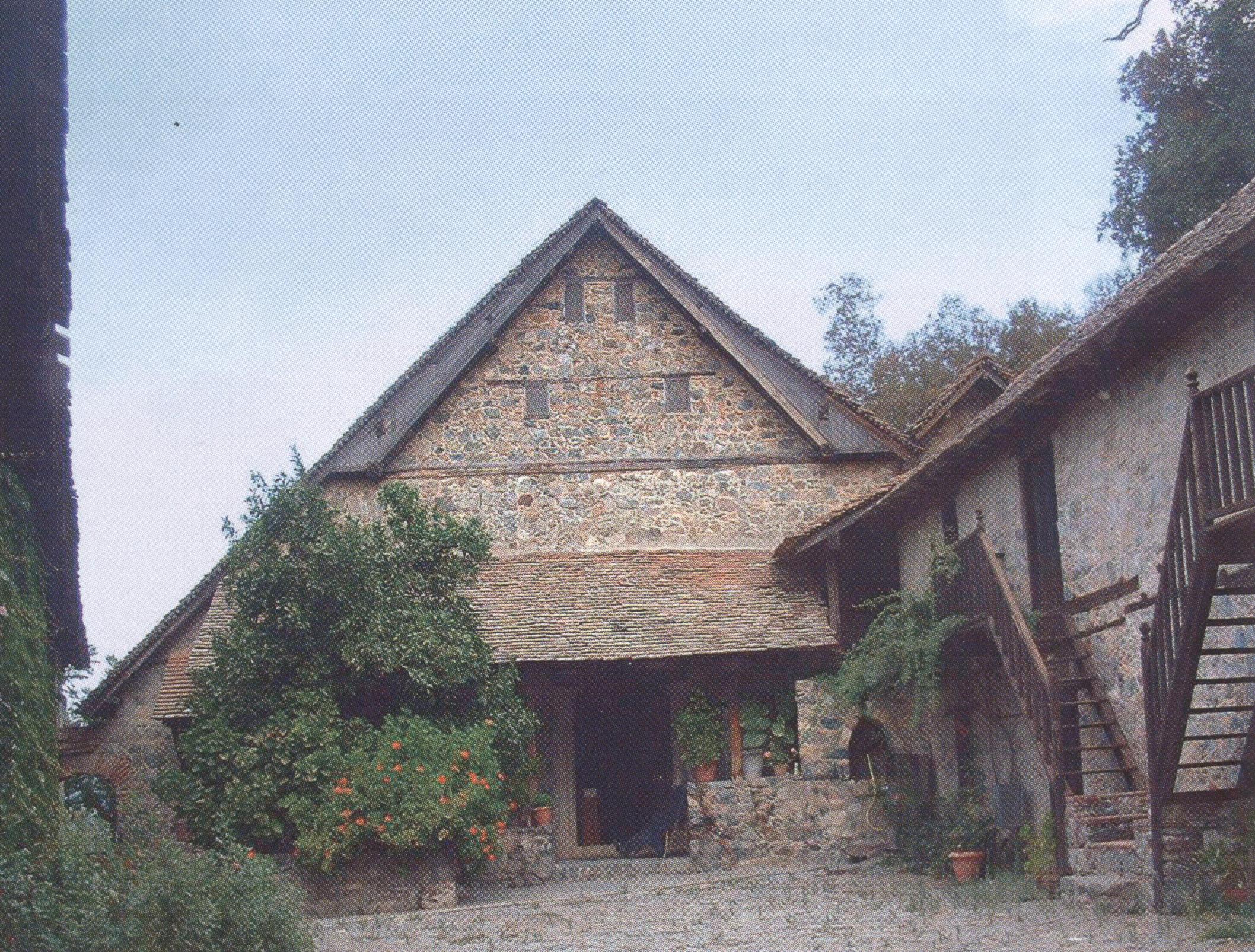
Having three churches under one roof is unique for Cyprus, as is the rectangular courtyard paved with the same local stone used to build the churches and the monastery. Although the monastery has long ceased to function, the monks' cells and auxiliary buildings, including a stone oil-press, survive intact.

 The only modern feature, though hardly distinguishable from the ancient complex, is the iconofylakio, an icon museum, built just outside the south eastern side of the monastery with a generous donation from the late benefactor Constantinos Leventis. It houses a treasure of Byzantine icons and other religious objects which were thought too precious to leave in surrounding unattended chapels.

Icon of St. John Lampadistis the Wonderworker of Cyprus - Commemorated on October 4th (taken from: http://christopherklitou.com/icon_4_oct_john_lampadistis_of_cyprus.htm)

 St. John Lampadistis
St. John's story is a very personal and sad one. What we know of him comes from a now lost 1640 manuscript written by a priest named Savvas from the village of Agios Theodoros Agrou. The work was copied by monk Kirililos of Stavrovouni Monastery in 1903. The manuscript comprised the life of Lampadistis and the prayer said in church on his feast day on 4 October. It was published for the first time in 2003 by the Morphou Bishopric in the jurisdiction of which the Lampadistis monastery is situated and is used here as the main historical source, along with the testimony of the Kalopanayiotis priest Father Andreas.

John took his sanctified name from his birthplace Lampadis, a now extinct village somewhere between the mountain resorts of Galata and Kakopetria. He was the last offspring of Papa-Kyriakos, the priest of the village, and his wife Anna who lived in the time of Archbishop Nicephorus. When John was a child, his father sent him to learn how to read and write through study of the Holy Scriptures, and the amazing aptitude he had shown was an early indication of what his true vocation would be.

When he became a young man, his parents decided it was time to find him a nice girl from a nearby village to settle down with. Not much is known about John's fiancée***, but his future in-laws turned out to be an evil lot! For reasons not recorded in the manuscript, they served the promising lad poisoned fish, causing him to lose his eyesight. They then sent for his father to come and take his son away because he was no longer suitable marriage potential. One can well understand the pain and suffering of the poor village folk upon seeing their brilliant son in such a sorry state. But John didn't seem to share their grief. His physical blindness had opened wide his spiritual vision and he spent his days in prayer. He even gave most of the food provided by his parents to the poor, keeping barely enough to sustain himself.

[***In another source in Greek, St. John and his fiancee are described in greater detail. St. John (who was 18 years old at the time), upon being pressured to marry, but also drawn to serve Christ was unsure about what to do, knelt and prayed for divine illumination. At this point, he heard a voice within him saying: "He that loveth father or mother more than me is not worthy of me: and he that loveth son or daughter more than me is not worthy of me. And he that taketh not his cross, and followeth after me, is not worthy of me."  (Matthew 10:37-38) He hastened to share his desire to live in virginity with the girl with whom he was engaged. She however, did not wish to share in this life, so their engagement was dissolved. This enraged the girl's parents, and they turned to satanism, poisoning St. John, who then lost his sight. (http://www.pigizois.net/kiprioi_agioi/ioannis_o_lampadistis.htm)]

He lived like this for twelve years, until the day he saw his end approaching and summoned his household servant, also named John. He told John that he would be surrendering his soul to the Lord the next day at noon, and asked for a bunch of grapes from his father's new crop. The servant found himself in a difficult position. It was unthinkable for anyone to cut even a single grape from the vineyard before Papa-Kyriakos had been there to bless it. But John insisted, telling his namesake not to fear. The latter gave in and brought a succulent bunch of fresh grapes to John, who said a prayer and started to eat.

When his father saw him, he was furious at what he regarded as irreverence and slapped his blind son across the face. John quietly handed the bunch back to the servant and told him to return it where he had taken it from. The servant again obeyed and, to his amazement, the bunch of grapes rejoined the vine at exactly the spot from where it was cut. (Since that day, bunches of grape have a sensitive knotty spot at which they snap easily away from the plant). By the time the servant returned to tell him about it, John Lampadistis had died.***

[***The Greek source places this story in St. John's youth. St. John picked the grapes to show his father the divine blessing of the harvest, but his father thought that he meant to eat them before they had been blessed on August 6th (the Transfiguration of Christ) and punished and slapped him unjustly. St. John then went and put the grapes back, which were miraculously rejoined to the vine. (http://www.pigizois.net/kiprioi_agioi/ioannis_o_lampadistis.htm)]

 After John was buried, people saw light beaming from his grave. They informed his father, who disregarded it as light from candles. But word spread and individuals who were known to be possessed came to the village, saying they were seeking John's body in order to pray to it and be cured. When Papa-Kyriakos saw that nothing could dissuade them, he agreed to open his son's grave. They found his relics, but his heart was preserved "like a dry fig". The possessed were indeed cured and it was then decided to deposit John's remains in the existing church of Agios Herakleidios at Kalopanayiotis.

The Holy Monastery of St. John Lampadistis, Cyprus (taken from: http://vatopaidi.files.wordpress.com/2009/09/iera_moni_agiou_ioanni_lampadisti_2.jpg)

 The churches
Agios Herakleidios was the island's very first prelate, also from Lampadis, who followed the Apostles Paul, Mark and Barnabas (the latter was the founder of the Cyprus church) when they were journeying through the Troodos Mountains during their visit here in 45 A.D. The church was built in the early 10th century to commemorate Agios Herakleidios’ baptism here, in addition to another one at Politiko, his place of martyrdom near ancient Tamassos.

Icon of St. Herakleidios (and Sts. Paul and Barnabas) from the Monastery of the same name, painted by the fathers of Vatopaidi Monastery (taken from: http://vatopaidi.files.wordpress.com/2009/09/agios-hrakleidios-nea-efestios-eikona-monis.jpg)

The many miracles soon earned John a reputation as a saint. One day, as Papa-Kynakos was standing close to his son's remains in St. Herakleidios' church, he heard a voice telling him to build a church dedicated to John. The priest wasted no time and, in the late 10th century the Church of St. John Lampadistis went up adjacent to that of St. Herakleidios. The miracles attributed to St. John Lampadistis were so frequent and so impressive, that the inhabitants of the area soon came to regard him as their guardian saint.

The third church on the site was added much later, in the 14th century. Unlike the other two which each feature a unique altar screen, this one had none. This was due to the fact that it was not built as an Orthodox church, but as a Latin chapel by the Frankish rulers of the island in their drive to westernize the religious dogma of the Cypriots. The chapel was later dedicated to the Virgin Mary, with a 14th century copy of her famous icon that can be found in the Kykko Monastery.


Father Andreas and Basil Barsky
Father Andreas has been a permanent figure of Agios Lampadastis monastery for the past 45 years. According to him the last monk, Hariton, died in 1926, to be followed by a resident priest who died in 1945. After this, the place remained empty, although the two parishes of Kalopanayiotis alternated holding church services there.

Further information about the history of the monastery has come down to us from the Russian monk and scholarly pilgrim Basil Barsky, who toured the island in 1735. Barsky stayed in the monastery for three days, out of religious curiosity as he said, but also because "of the beauty of the landscape". He counted about 12 monks, noting that they did not strictly observe the monastic rules due to "repeated violent acts by the Ottoman.”
 
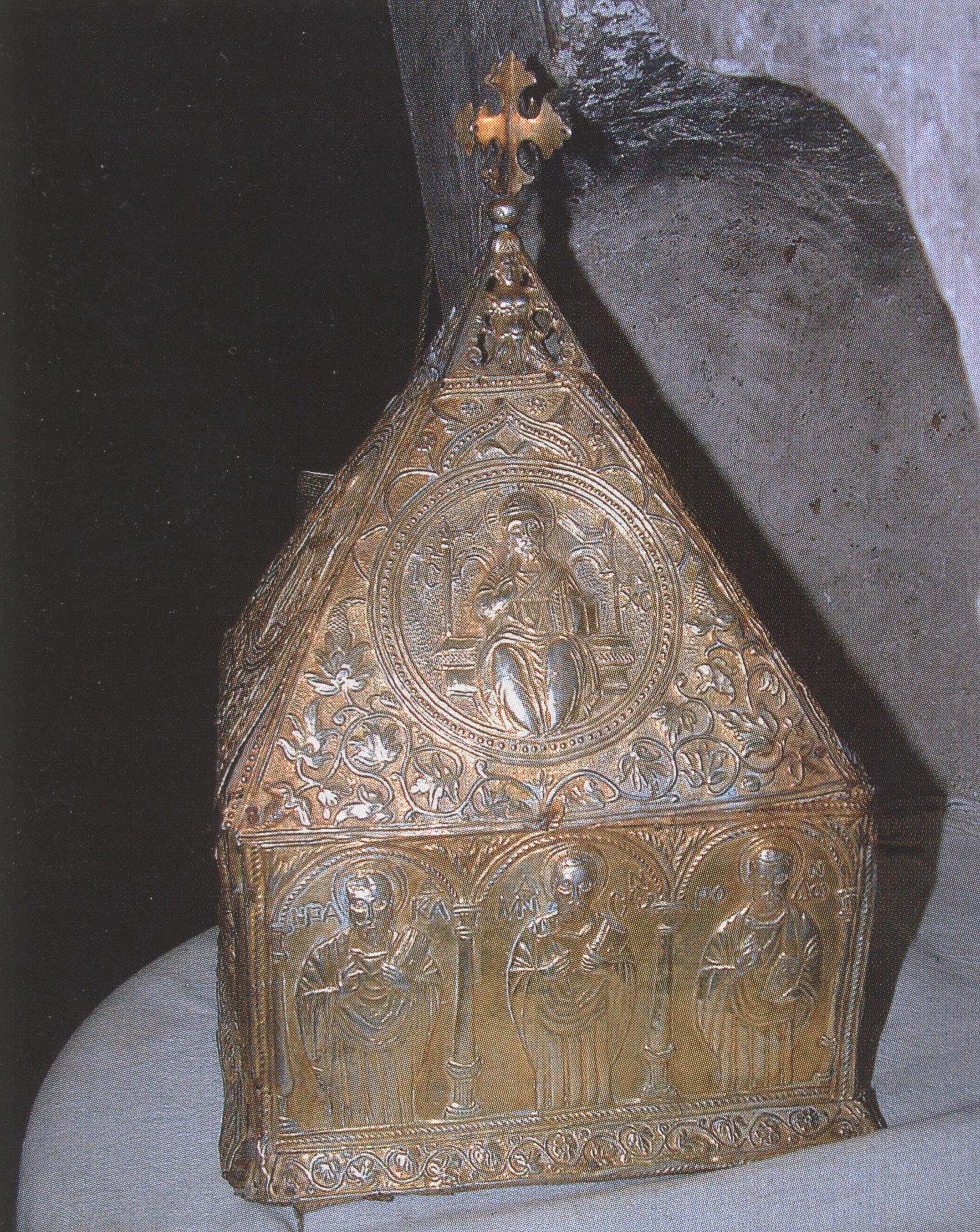
Indeed, Barsky's is the most famous signature on the stone niche containing Saint John Lampadastis' sacred skull. This is kept in a pyramid-shaped case, gilded in gold and silver, which dates back to 1641. The collection of autographs engraved or hand-written around the saint's reliquary is a signed testimony to the repute of the monastery as a pilgrimage through the ages. Most of the signatures belong to Orthodox Greeks who in older times inhabited the southern coast of Asia Minor and took religious excursions to Cyprus by boat. Father Andreas noted that the signatures have been preserved as part of the religious monument, although present-day pilgrims are not allowed to imitate the example of their predecessors.
 

16th Century iconostasis inside the church of St. John Lampadistis (taken from: http://www.chain.to/?t3=9338)

One roof and many icons
The three churches were brought under a tiled roof in the middle of the 18th century, according to Father Andreas, and there are no walls or other partitions separating one from the other. Visitors enter through St. Herakleidios' church, which is cross-shaped with a painted dome, and simply walk through to the other two.
 
The silver reliquary holding the holy and wonderworking Skull of St. John Lampadistis (taken from: http://vatopaidi.files.wordpress.com/2009/09/kara_agiou_ioanni_lampadisti.jpg)
 
Once inside, the most impressive element is probably the image of a youthful, clean-shaven Lampadistis. He is set apart facing the entrance from a gilded icon dated 1776. He is portrayed full size, holding a scroll in his right hand and a cross in his left surrounded by Orthodox prelates and other saints. A small opening is left on the exquisite relief cover for pilgrims to kiss the icon in the Orthodox fashion. A much smaller and older icon, from which the gilded one was probably copied, can be seen close by. Right next to it, resting against a supporting column, is the niche holding the gilded case with the saint's skull. Behind the column there is an upright rectangular ossuary with a pyramidal top, strongly reminiscent of the skull reliquary. According to Father Andreas, this is known as the tomb of St. loannis Lampadistis, which has remained sealed ever since its discovery." (taken from: http://www.chain.to/?t3=9338)
 
13th Century icon of St. John Lampadistis of Cyprus, with scenes from his life (taken from: http://vatopaidi.files.wordpress.com/2009/09/agios-ioannis-lampadistis.jpg)
 
Απολυτίκιο Ήχος α'. Της ερήμου πολίτης...
Της Λαμπάδος το κλέος και Κυπρίων αγλάϊσμα και θαυματουργός όντως ώφθης, Ιωάννη Πατήρ ημών Όσιε. Νηστεία κατατήξας της σαρκός, άλόγους ενθυμήσεις πανσθενώς, όθεν χάριν ίαμάτων εξ ουρανού εδέξω, θεόπνευστε. Δόξα τω δεδωκότι σοι ίσχύν, δόξα τω σε στεφανώσαντι δόξα τω ένεργούντι δια σου πάσιν ιάματα.
 
Apolytikion in the First Tone (amateur translation of the above hymn)
The boast of Lampados and the pride of Cyprus who was shown forth as a wonderworker, John our Righteous Father, By fasting you conquered the irrational thoughts of the flesh utterly, therefore you grant the grace of healing from heaven, O Godly-inspired one. Glory to Him Who gave you strength, glory to Him Whom crowned you, glory to Him who works healing for all through you.

Apolytikion in the Plagal of the Fourth Tone
The image of God, was faithfully preserved in you, O Father. For you took up the Cross and followed Christ. By Your actions you taught us to look beyond the flesh for it passes, rather to be concerned about the soul which is immortal. Wherefore, O Holy John, your soul rejoices with the angels.

Through the prayers of our Holy Fathers, Lord Jesus Christ our God, have mercy on us and save us! Amen!