On Theophany, or the Nativity of Christ by St. Gregory the Theologian
The Title of this Oration has given rise to a doubt whether it was preached on Dec. 25, 380, or on Jan. 6, 381. The word Theophania is well known as a name for the Epiphany; which, however, according to Schaff, was originally a celebration both of the Nativity and the Baptism of our Lord. The two words seem both to have been used in the simplest sense of the Manifestation of God, and certainly were applied to Christmas Day. Thus Suidas, “The Epiphany is the Incarnation of the Saviour;” and Epiphanius (Hær., 53), “The Day of the Epiphany is the day on which Christ was born according to the flesh.” But S. Jerome applies the word to the Baptism of Christ; The day of the Epiphany is still venerable; not, as some think, on account of His Birth in the flesh; for then He was hidden, not manifested; but it agrees with the time at which it was said, This is My beloved Son (In Ezech. I.). There is also a Sermon, attributed to S. Chrysostom, “On the Baptism of Christ,” in which it is expressly denied that the name Theophany applies to Christmas. The Oration itself, however, contains evidence to show that the Festival of our Lord's Birth was kept at the earlier date; for in c. 16 the Preacher says, “A little later you shall see Jesus submitting to be purified in the river Jordan for my purification.” And another piece of evidence occurs in the oration In Sancta Lumina, c. 14, “At His Birth we duly kept festival, both I the leader of the feast, and you. Now we have come to another action of Christ and another Mystery.”
[Note: In a general sense, "Epiphany" or "Theophany" means "Revelation" or "Revelation of God" respectively. Thus the Fathers can use both terms in discussing Christ's Birth, and thus His revelation on earth, or His Baptism in the Jordan, and the revelation of the Holy Trinity. These two Great Feasts are very closely linked theologically, festally, hymnologically, etc., so they are often referred to as continuations of the same feast or feasts with similar themes and implications. For a perfect hymnological example of this relationship, see the Oikos for the feast of Theophany on January 6th.]
I. "Christ is born, glorify Him. Christ from heaven, go out to meet Him. Christ on earth; be ye exalted. Sing unto the Lord all the whole earth; and that I may join both in one word, Let the heavens rejoice, and let the earth be glad, for Him Who is of heaven and then of earth. Christ in the flesh, rejoice with trembling and with joy; with trembling because of your sins, with joy because of your hope. Christ of a Virgin; O you Matrons live as Virgins, that you may be Mothers of Christ. Who does not worship Him That is from the beginning? Who does not glorify Him That is the Last?
II. Again the darkness is past; again Light is made; again Egypt is punished with darkness; again Israel is enlightened by a pillar. Exodus 14:20 The people that sat in the darkness of ignorance, let it see the Great Light of full knowledge. Isaiah 9:6 Old things are passed away, behold all things have become new. 1 Corinthians 5:17 The letter gives way, the Spirit comes to the front. The shadows flee away, the Truth comes in upon them. Melchisedec is concluded. He that was without Mother becomes without Father (without Mother of His former state, without Father of His second). The laws of nature are upset; the world above must be filled. Christ commands it, let us not set ourselves against Him. O clap your hands together all you people, because unto us a Child is born, and a Son given unto us, Whose Government is upon His shoulder (for with the Cross it is raised up), and His Name is called The Angel of the Great Counsel of the Father. Isaiah 9:6 Let John cry, Prepare ye the way of the Lord: Matthew 3:3 I too will cry the power of this Day. He Who is not carnal is Incarnate; the Son of God becomes the Son of Man, Jesus Christ the Same yesterday, and today, and for ever. Hebrews 13:8 Let the Jews be offended, let the Greeks deride; 1 Corinthians 1:23 let heretics talk till their tongues ache. Then shall they believe, when they see Him ascending up into heaven; and if not then, yet when they see Him coming out of heaven and sitting as Judge.
III. Of these on a future occasion; for the present the Festival is the Theophany or Birth-day, for it is called both, two titles being given to the one thing. For God was manifested to man by birth. On the one hand Being, and eternally Being, of the Eternal Being, above cause and word, for there was no word before The Word; and on the other hand for our sakes also Becoming, that He Who gives us our being might also give us our Well-being, or rather might restore us by His Incarnation, when we had by wickedness fallen from wellbeing. The name Theophany is given to it in reference to the Manifestation, and that of Birthday in respect of His Birth.
IV. This is our present Festival; it is this which we are celebrating today, the Coming of God to Man, that we might go forth, or rather (for this is the more proper expression) that we might go back to God— that putting off the old man, we might put on the New; and that as we died in Adam, so we might live in Christ, 1 Corinthians 15:22 being born with Christ and crucified with Him and buried with Him and rising with Him. Colossians 2:11 For I must undergo the beautiful conversion, and as the painful succeeded the more blissful, so must the more blissful come out of the painful. For where sin abounded Grace did much more abound; Romans 5:20 and if a taste condemned us, how much more does the Passion of Christ justify us? Therefore let us keep the Feast, not after the manner of a heathen festival, but after a godly sort; not after the way of the world, but in a fashion above the world; not as our own but as belonging to Him Who is ours, or rather as our Master's; not as of weakness, but as of healing; not as of creation, but of re-creation.
V. And how shall this be? Let us not adorn our porches, nor arrange dances, nor decorate the streets; let us not feast the eye, nor enchant the ear with music, nor enervate the nostrils with perfume, nor prostitute the taste, nor indulge the touch, those roads that are so prone to evil and entrances for sin; let us not be effeminate in clothing soft and flowing, whose beauty consists in its uselessness, nor with the glittering of gems or the sheen of gold Romans 13:13 or the tricks of colour, belying the beauty of nature, and invented to do despite unto the image of God; Not in rioting and drunkenness, with which are mingled, I know well, chambering and wantonness, since the lessons which evil teachers give are evil; or rather the harvests of worthless seeds are worthless. Let us not set up high beds of leaves, making tabernacles for the belly of what belongs to debauchery. Let us not appraise the bouquet of wines, the kickshaws of cooks, the great expense of ointments. Let not sea and land bring us as a gift their precious dung, for it is thus that I have learned to estimate luxury; and let us not strive to outdo each other in intemperance (for to my mind every superfluity is intemperance, and all which is beyond absolute need)—and this while others are hungry and in want, who are made of the same clay and in the same manner.
VI. Let us leave all these to the Greeks and to the pomps and festivals of the Greeks, who call by the name of gods beings who rejoice in the reek of sacrifices, and who consistently worship with their belly; evil inventors and worshippers of evil demons. But we, the Object of whose adoration is the Word, if we must in some way have luxury, let us seek it in word, and in the Divine Law, and in histories; especially such as are the origin of this Feast; that our luxury may be akin to and not far removed from Him Who has called us together. Or do you desire (for today I am your entertainer) that I should set before you, my good Guests, the story of these things as abundantly and as nobly as I can, that you may know how a foreigner can feed the natives of the land, and a rustic the people of the town, and one who cares not for luxury those who delight in it, and one who is poor and homeless those who are eminent for wealth?
We will begin from this point; and let me ask of you who delight in such matters to cleanse your mind and your ears and your thoughts, since our discourse is to be of God and Divine; that when you depart, you may have had the enjoyment of delights that really fade not away. And this same discourse shall be at once both very full and very concise, that you may neither be displeased at its deficiencies, nor find it unpleasant through satiety.
VII. God always was, and always is, and always will be. Or rather, God always Is. For Was and Will be are fragments of our time, and of changeable nature, but He is Eternal Being. And this is the Name that He gives to Himself when giving the Oracle to Moses in the Mount. For in Himself He sums up and contains all Being, having neither beginning in the past nor end in the future; like some great Sea of Being, limitless and unbounded, transcending all conception of time and nature, only adumbrated by the mind, and that very dimly and scantily...not by His Essentials, but by His Environment; one image being got from one source and another from another, and combined into some sort of presentation of the truth, which escapes us before we have caught it, and takes to flight before we have conceived it, blazing forth upon our Master-part, even when that is cleansed, as the lightning flash which will not stay its course, does upon our sight...in order as I conceive by that part of it which we can comprehend to draw us to itself (for that which is altogether incomprehensible is outside the bounds of hope, and not within the compass of endeavour), and by that part of It which we cannot comprehend to move our wonder, and as an object of wonder to become more an object of desire, and being desired to purify, and by purifying to make us like God; John 10:15 so that when we have thus become like Himself, God may, to use a bold expression, hold converse with us as Gods, being united to us, and that perhaps to the same extent as He already knows those who are known to Him. The Divine Nature then is boundless and hard to understand; and all that we can comprehend of Him is His boundlessness; even though one may conceive that because He is of a simple nature He is therefore either wholly incomprehensible, or perfectly comprehensible. For let us further enquire what is implied by “is of a simple nature.” For it is quite certain that this simplicity is not itself its nature, just as composition is not by itself the essence of compound beings.
VIII. And when Infinity is considered from two points of view, beginning and end (for that which is beyond these and not limited by them is Infinity), when the mind looks to the depth above, not having where to stand, and leans upon phenomena to form an idea of God, it calls the Infinite and Unapproachable which it finds there by the name of Unoriginate. And when it looks into the depths below, and at the future, it calls Him Undying and Imperishable. And when it draws a conclusion from the whole it calls Him Eternal (αἴωνιος). For Eternity (αἵων) is neither time nor part of time; for it cannot be measured. But what time, measured by the course of the sun, is to us, that Eternity is to the Everlasting, namely, a sort of time-like movement and interval co-extensive with their existence. This, however, is all I must now say about God; for the present is not a suitable time, as my present subject is not the doctrine of God, but that of the Incarnation. But when I say God, I mean Father, Son, and Holy [Spirit]. For Godhead is neither diffused beyond these, so as to bring in a mob of gods; nor yet is it bounded by a smaller compass than these, so as to condemn us for a poverty-stricken conception of Deity; either Judaizing to save the Monarchia, or falling into heathenism by the multitude of our gods. For the evil on either side is the same, though found in contrary directions. This then is the Holy of Holies, which is hidden even from the Seraphim, and is glorified with a thrice repeated Holy, meeting in one ascription of the Title Lord and God, as one of our predecessors has most beautifully and loftily pointed out.
IX. But since this movement of self-contemplation alone could not satisfy Goodness, but Good must be poured out and go forth beyond Itself to multiply the objects of Its beneficence, for this was essential to the highest Goodness, He first conceived the Heavenly and Angelic Powers. And this conception was a work fulfilled by His Word, and perfected by His Spirit. And so the secondary Splendours came into being, as the Ministers of the Primary Splendour; whether we are to conceive of them as intelligent Spirits, or as Fire of an immaterial and incorruptible kind, or as some other nature approaching this as near as may be. I should like to say that they were incapable of movement in the direction of evil, and susceptible only of the movement of good, as being about God, and illumined with the first rays from God— for earthly beings have but the second illumination; but I am obliged to stop short of saying that, and to conceive and speak of them only as difficult to move because of him, who for his splendour was called Lucifer, but became and is called Darkness through his pride; and the apostate hosts who are subject to him, creators of evil by their revolt against good and our inciters.
X. Thus, then, and for these reasons, He gave being to the world of thought, as far as I can reason upon these matters, and estimate great things in my own poor language. Then when His first creation was in good order, He conceives a second world, material and visible; and this a system and compound of earth and sky, and all that is in the midst of them— an admirable creation indeed, when we look at the fair form of every part, but yet more worthy of admiration when we consider the harmony and the unison of the whole, and how each part fits in with every other, in fair order, and all with the whole, tending to the perfect completion of the world as a Unit. This was to show that He could call into being, not only a Nature akin to Himself, but also one altogether alien to Himself. For akin to Deity are those natures which are intellectual, and only to be comprehended by mind; but all of which sense can take cognisance are utterly alien to It; and of these the furthest removed are all those which are entirely destitute of soul and of power of motion. But perhaps some one of those who are too festive and impetuous may say, What has all this to do with us? Spur your horse to the goal. Talk to us about the Festival, and the reasons for our being here today. Yes, this is what I am about to do, although I have begun at a somewhat previous point, being compelled to do so by love, and by the needs of my argument.

Icon of Jesus Christ, "Emmanuel", which means, "God with us", painted by the Holy Monastery of Ormylia (source)
XI. Mind, then, and sense, thus distinguished from each other, had remained within their own boundaries, and bore in themselves the magnificence of the Creator-Word, silent praisers and thrilling heralds of His mighty work. Not yet was there any mingling of both, nor any mixtures of these opposites, tokens of a greater Wisdom and Generosity in the creation of natures; nor as yet were the whole riches of Goodness made known. Now the Creator-Word, determining to exhibit this, and to produce a single living being out of both— the visible and the invisible creations, I mean— fashions Man; and taking a body from already existing matter, and placing in it a Breath taken from Himself Genesis 2:7 which the Word knew to be an intelligent soul and the Image of God, as a sort of second world. He placed him, great in littleness on the earth; a new Angel, a mingled worshipper, fully initiated into the visible creation, but only partially into the intellectual; King of all upon earth, but subject to the King above; earthly and heavenly; temporal and yet immortal; visible and yet intellectual; half-way between greatness and lowliness; in one person combining spirit and flesh; spirit, because of the favour bestowed on him; flesh, because of the height to which he had been raised; the one that he might continue to live and praise his Benefactor, the other that he might suffer, and by suffering be put in remembrance, and corrected if he became proud of his greatness. A living creature trained here, and then moved elsewhere; and, to complete the mystery, deified by its inclination to God. For to this, I think, tends that Light of Truth which we here possess but in measure, that we should both see and experience the Splendour of God, which is worthy of Him Who made us, and will remake us again after a loftier fashion.
XII. This being He placed in Paradise, whatever the Paradise may have been, having honoured him with the gift of Free Will (in order that God might belong to him as the result of his choice, no less than to Him who had implanted the seeds of it), to till the immortal plants, by which is meant perhaps the Divine Conceptions, both the simpler and the more perfect; naked in his simplicity and inartificial life, and without any covering or screen; for it was fitting that he who was from the beginning should be such. Also He gave him a Law, as a material for his Free Will to act upon. This Law was a Commandment as to what plants he might partake of, and which one he might not touch. This latter was the Tree of Knowledge; not, however, because it was evil from the beginning when planted; nor was it forbidden because God grudged it to us...Let not the enemies of God wag their tongues in that direction, or imitate the Serpent...But it would have been good if partaken of at the proper time, for the tree was, according to my theory, Contemplation, upon which it is only safe for those who have reached maturity of habit to enter; but which is not good for those who are still somewhat simple and greedy in their habit; just as solid food is not good for those who are yet tender, and have need of milk. Hebrews 5:12 But when through the Devil's malice and the woman's caprice, to which she succumbed as the more tender, and which she brought to bear upon the man, as she was the more apt to persuade, alas for my weakness! (for that of my first father was mine), he forgot the Commandment which had been given to him; Genesis 3:5 he yielded to the baleful fruit; and for his sin he was banished, at once from the Tree of Life, and from Paradise, and from God; and put on the coats of skins...that is, perhaps, the coarser flesh, both mortal and contradictory. This was the first thing that he learned— his own shame; Romans 1:22-31 and he hid himself from God. Yet here too he makes a gain, namely death, and the cutting off of sin, in order that evil may not be immortal. Thus his punishment is changed into a mercy; for it is in mercy, I am persuaded, that God inflicts punishment.
XIII. And having been first chastened by many means (because his sins were many, whose root of evil sprang up through various causes and at sundry times), by word, by law, by prophets, by benefits, by threats, by plagues, by waters, by fires, by wars, by victories, by defeats, by signs in heaven and signs in the air and in the earth and in the sea, by unexpected changes of men, of cities, of nations (the object of which was the destruction of wickedness), at last he needed a stronger remedy, for his diseases were growing worse; mutual slaughters, adulteries, perjuries, unnatural crimes, and that first and last of all evils, idolatry and the transfer of worship from the Creator to the Creatures. As these required a greater aid, so also they obtained a greater. And that was that the Word of God Himself— Who is before all worlds, the Invisible, the Incomprehensible, the Bodiless, Beginning of Beginning, the Light of Light, the Source of Life and Immortality, the Image of the Archetypal Beauty, the immovable Seal, the unchangeable Image, the Father's Definition and Word, came to His own Image, and took on Him flesh for the sake of our flesh, and mingled Himself with an intelligent soul for my soul's sake, purifying like by like; and in all points except sin was made man. Conceived by the Virgin, Luke 1:35 who first in body and soul was purified by the Holy [Spirit] (for it was needful both that Childbearing should be honoured, and that Virginity should receive a higher honour), He came forth then as God with that which He had assumed, One Person in two Natures, Flesh and Spirit, of which the latter deified the former. O new co-mingling; O strange conjunction; the Self-Existent comes into being, the Uncreated is created, That which cannot be contained is contained, by the intervention of an intellectual soul, mediating between the Deity and the corporeity of the flesh. And He Who gives riches becomes poor, for He assumes the poverty of my flesh, that I may assume the richness of His Godhead. He that is full empties Himself, for He empties Himself of His glory for a short while, that I may have a share in His Fullness. What is the riches of His Goodness? What is this mystery that is around me? I had a share in the image; I did not keep it; He partakes of my flesh that He may both save the image and make the flesh immortal. He communicates a second Communion far more marvellous than the first, inasmuch as then He imparted the better Nature, whereas now Himself partakes of the worse. This is more godlike than the former action, this is loftier in the eyes of all men of understanding.
XIV. To this what have those cavillers to say, those bitter reasoners about Godhead, those detractors of all that is praiseworthy, those darkeners of light, uncultured in respect of wisdom, for whom Christ died in vain, those unthankful creatures, the work of the Evil One? Do you turn this benefit into a reproach to God? Will you deem Him little on this account, that He humbled Himself for you; because the Good Shepherd, John 10:11 He who lays down His life for His sheep, came to seek for that which had strayed upon the mountains and the hills, on which you were then sacrificing, and found the wanderer; and having found it, Luke 15:4, sq took it upon His shoulders— on which He also took the Wood of the Cross; and having taken it, brought it back to the higher life; and having carried it back, numbered it among those who had never strayed. Because He lighted a candle— His own Flesh— and swept the house, cleansing the world from sin; and sought the piece of money, the Royal Image that was covered up by passions. And He calls together His Angel friends on the finding of the coin, and makes them sharers in His joy, whom He had made to share also the secret of the Incarnation? Because on the candle of the Forerunner there follows the light that exceeds in brightness; and to the Voice the Word succeeds; and to the Bridegroom's friend the Bridegroom; to him that prepared for the Lord a peculiar people, cleansing them by water in preparation for the Spirit? Do you reproach God with all this? Do you on this account deem Him lessened, because He girds Himself with a towel and washes His disciples' feet, and shows that humiliation is the best road to exaltation? Because for the soul that was bent to the ground He humbles Himself, that He may raise up with Himself the soul that was tottering to a fall under a weight of sin? Why do you not also charge upon Him as a crime the fact that He eats with Publicans and at Publicans' tables, Luke 5:29 and that He makes disciples of Publicans, that He too may gain somewhat...and what?...the salvation of sinners. If so, we must blame the physician for stooping over sufferings, and enduring evil odours that he may give health to the sick; or one who as the Law commands bent down into a ditch to save a beast that had fallen into it.
XV. He was sent, but as man, for He was of a twofold Nature; for He was wearied, and hungered, and was thirsty, and was in an agony, and shed tears, according to the nature of a corporeal being. And if the expression be also used of Him as God, the meaning is that the Father's good pleasure is to be considered a Mission, for to this He refers all that concerns Himself; both that He may honour the Eternal Principle, and because He will not be taken to be an antagonistic God. And whereas it is written both that He was betrayed, and also that He gave Himself up and that He was raised up by the Father, and taken up into heaven; and on the other hand, that He raised Himself and went up; the former statement of each pair refers to the good pleasure of the Father, the latter to His own Power. Are you then to be allowed to dwell upon all that humiliates Him, while passing over all that exalts Him, and to count on your side the fact that He suffered, but to leave out of the account the fact that it was of His own will? See what even now the Word has to suffer. By one set He is honoured as God, but is confused with the Father, by another He is dishonoured as mere flesh and severed from the Godhead. With which of them will He be most angry, or rather, which shall He forgive, those who injuriously confound Him or those who divide Him? For the former ought to have distinguished, and the latter to have united Him; the one in number, the other in Godhead. Stumblest Thou at His flesh? So did the Jews. Or do you call Him a Samaritan, and...I will not say the rest. Do you disbelieve in His Godhead? This did not even the demons, O thou who art less believing than demons and more stupid than Jews. Those did perceive that the name of Son implies equality of rank; these did know that He who drove them out was God, for they were convinced of it by their own experience. But you will admit neither the equality nor the Godhead. It would have been better for you to have been either a Jew or a demoniac (if I may utter an absurdity), than in uncircumcision and in sound health to be so wicked and ungodly in your attitude of mind.
XVI. A little later on you will see Jesus submitting to be purified in the River Jordan for my Purification, or rather, sanctifying the waters by His Purification (for indeed He had no need of purification Who takes away the sin of the world) and the heavens cleft asunder, and witness borne to him by the Spirit That is of one nature with Him; you shall see Him tempted and conquering and served by Angels, and healing every sickness and every disease, and giving life to the dead (O that He would give life to you who are dead because of your heresy), and driving out demons, sometimes Himself, sometimes by his disciples; and feeding vast multitudes with a few loaves; and walking dryshod upon seas; and being betrayed and crucified, and crucifying with Himself my sin; offered as a Lamb, and offering as a Priest; as a Man buried in the grave, and as God rising again; and then ascending, and to come again in His own glory. Why what a multitude of high festivals there are in each of the mysteries of the Christ; all of which have one completion, namely, my perfection and return to the first condition of Adam.
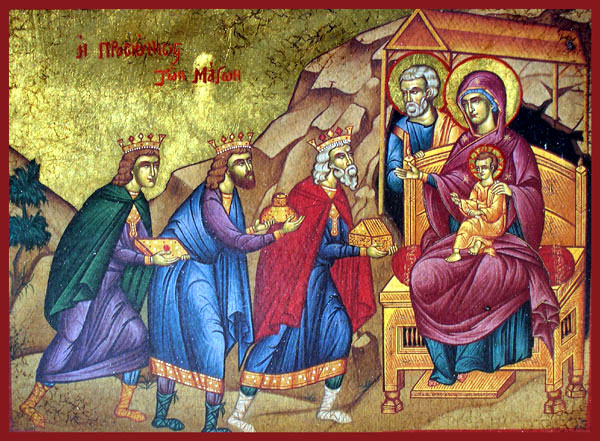
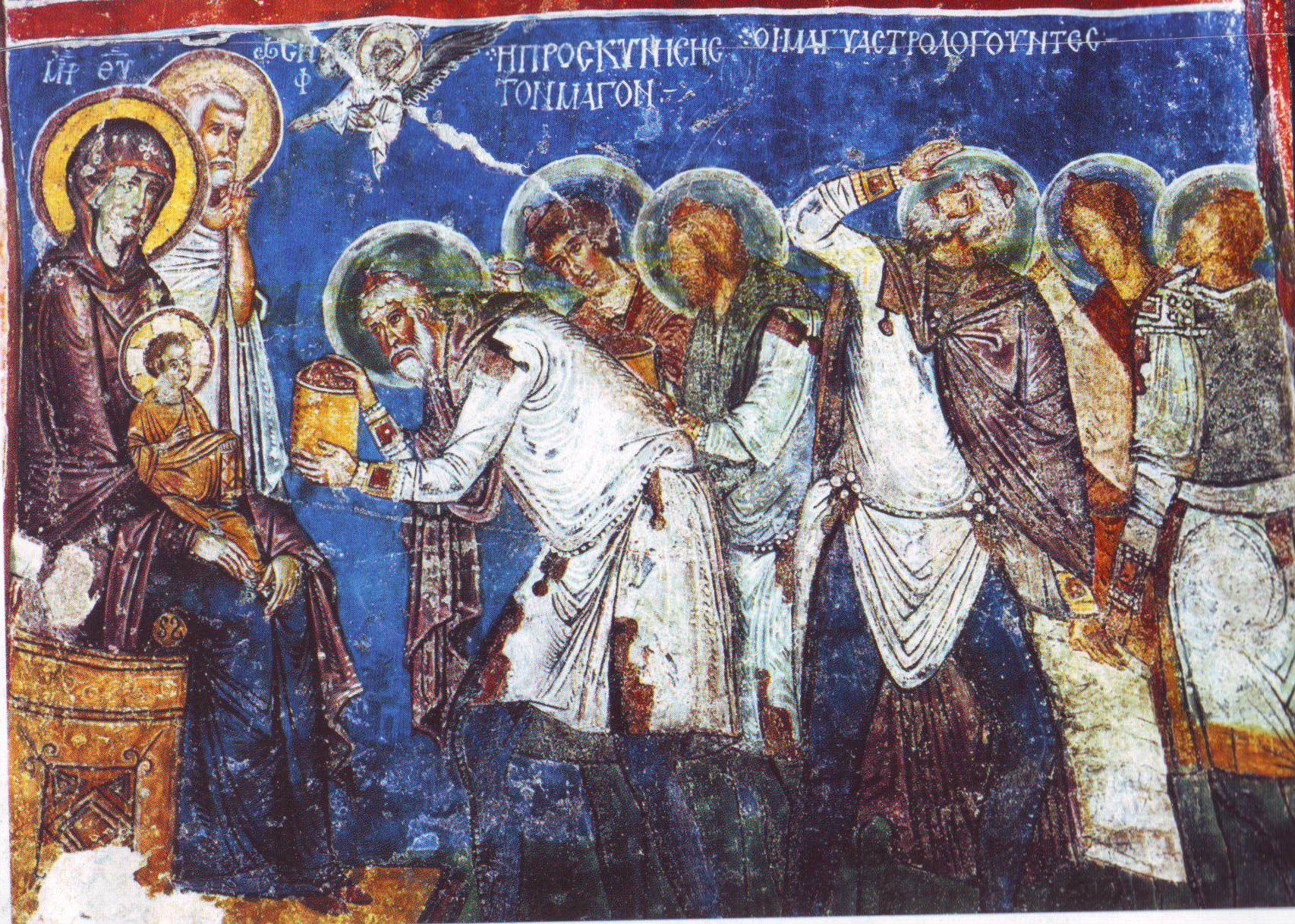
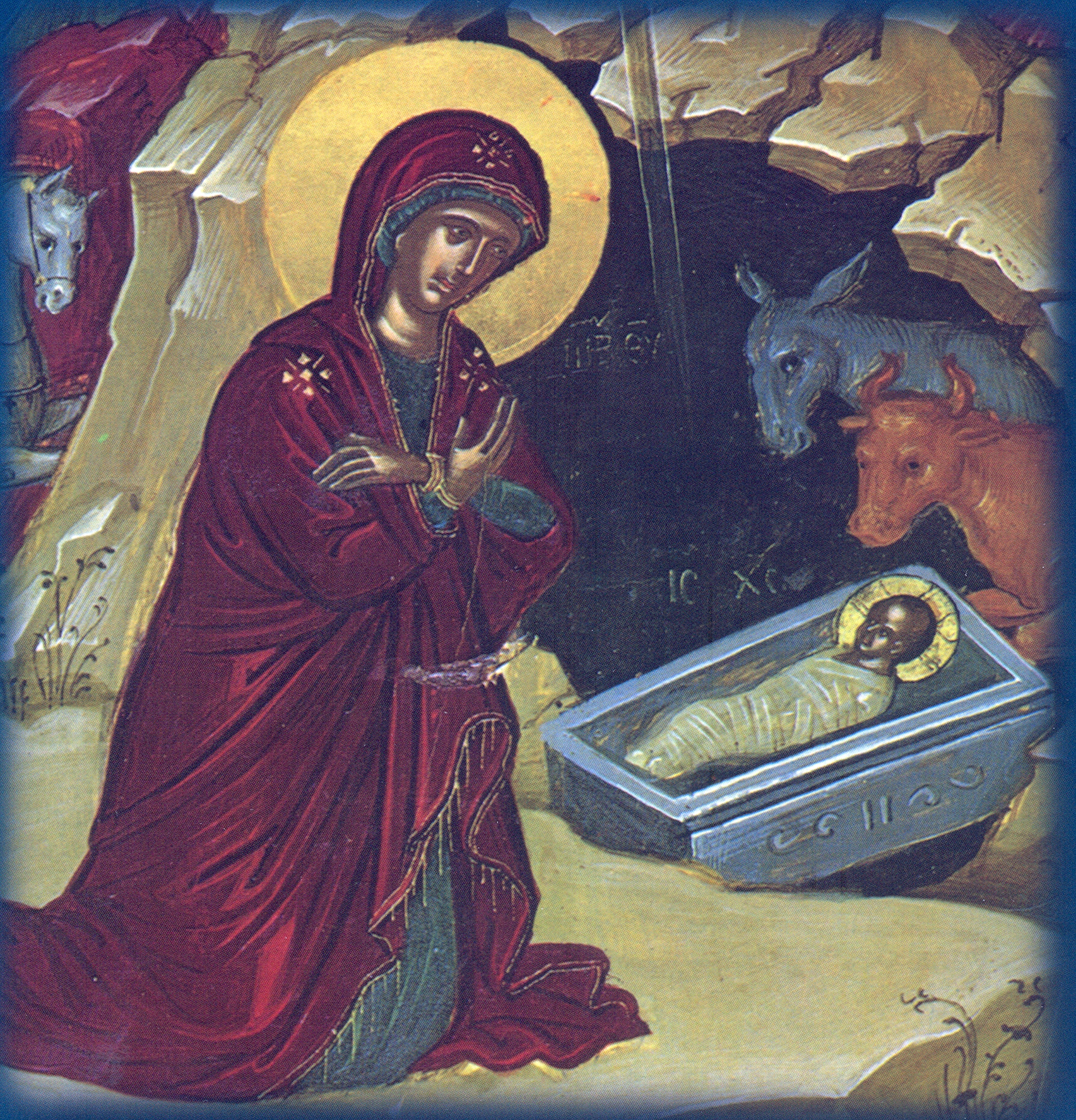
XVII. Now then I pray you accept His Conception, and leap before Him; if not like John from the womb, Luke 1:41 yet like David, because of the resting of the Ark. 2 Samuel 6:14 Revere the enrolment on account of which you were written in heaven, and adore the Birth by which you were loosed from the chains of your birth, Luke 2:1-5 and honour little Bethlehem, which has led you back to Paradise; and worship the manger through which thou, being without sense, wast fed by the Word. Know as Isaiah bids you, your Owner, like the ox, and like the ass your Master's crib; if you be one of those who are pure and lawful food, and who chew the cud of the word and are fit for sacrifice. Or if you are one of those who are as yet unclean and uneatable and unfit for sacrifice, and of the gentile portion, run with the Star, and bear your Gifts with the Magi, gold and frankincense and myrrh, Isaiah 1:3 as to a King, and to God, and to One Who is dead for you. With Shepherds glorify Him; Matthew ii with Angels join in chorus; with Archangels sing hymns. Let this Festival be common to the powers in heaven and to the powers upon earth. Luke 2:14-15 For I am persuaded that the Heavenly Hosts join in our exultation and keep high Festival with us today. ..because they love men, and they love God just like those whom David introduces after the Passion ascending with Christ and coming to meet Him, and bidding one another to lift up the gates.
XVIII. One thing connected with the Birth of Christ I would have you hate...the murder of the infants by Herod. Matthew 2:16 Or rather you must venerate this too, the Sacrifice of the same age as Christ, slain before the Offering of the New Victim. If He flees into Egypt, joyfully become a companion of His exile. It is a grand thing to share the exile of the persecuted Christ. If He tarry long in Egypt, call Him out of Egypt by a reverent worship of Him there. Travel without fault through every stage and faculty of the Life of Christ. Be purified; be circumcised; strip off the veil which has covered you from your birth. After this teach in the Temple, and drive out the sacrilegious traders. John 2:15 Submit to be stoned if need be, for well I know you shall be hidden from those who cast the stones; you shall escape even through the midst of them, like God. If you be brought before Herod, answer not for the most part. Luke 23:9 He will respect your silence more than most people's long speeches. If you be scourged, John 19:1 ask for what they leave out. Taste gall for the taste's sake; Matthew 27:34 drink vinegar; John 19:29 seek for spittings; accept blows, be crowned with thorns, that is, with the hardness of the godly life; put on the purple robe, take the reed in hand, and receive mock worship from those who mock at the truth; lastly, be crucified with Him, and share His Death and Burial gladly, that you may rise with Him, and be glorified with Him and reign with Him. Look at and be looked at by the Great God, Who in Trinity is worshipped and glorified, and Whom we declare to be now set forth as clearly before you as the chains of our flesh allow, in Jesus Christ our Lord, to Whom be the glory for ever. Amen."
(taken from: http://www.newadvent.org/fathers/310238.htm)
Christ is born! Glorify Him!