Friday, February 26, 2010

Miracle of St. Photida for an Aga

Saints celebrated February 26th; St. Photini and her sister St. Photis (or Photida) are in the front row right and center, respectively (http://christopherklitou.com/icon_26_feb_porphyrius_photo_photis_photini_sebastianus.htm)

Miracle of St. Photida for an Aga (amateur translation)
Elder Gregory of the Holy Monastery of the Precious Forerunner Metamorphoseos relates: “One of the many times we went along with the priest of my village, Fr. Aleko, to assist the settlement of Amphipoleos [East Macedonia near Strymona], we met an older man who helped in the church of Amphipoleos. During our conversation he related an event which occurred during the Turkish occupation, when he was 12 years old:

“The Aga [Turkish leader] fell gravely ill, and he ran to doctors in every place, reaching even Thessaloniki, but none could make him well and his health deteriorated. He laid on his bed. One day loosing all hope he thought of St. Photida, for the chapel of the Saint who was the sister of St. Photini [celebrated the same day, February 26th] which was about one kilometer from the village and in it up till today flows a spring of holy water. “The Holy Water of St. Photida”. “St. Photida will make me well”, the Aga said. He ordered the caretaker of the church of Amphipoleos to go bring him holy water from St. Photida.

“The caretaker could not do otherwise. However, leaving the Aga's house he whispered: “Pig, do you think that I will bring you, holy water from our Saint for you to sell?” He left, counted the time that it would have taken to return from the chapel, and so that the Aga wouldn't drink it and to punish him, he took common water and gave it to him instead of the holy water.

“The Aga, when the supposed holy water of St. Photida had arrived, ordered those near him to raise him up from his bed, and with reverence and crying with tears in his eyes he said twice: “St. Photida, help me. St. Photida, help me.” He took the “holy water”, as he thought it was, drank it, and the next day he was well. All remained astonished, especially the caretaker who knew what he did. The faith, the desire and the trust of the Aga in St. Photida, along with the intercessions of the Saint, made him well.”
(http://theologoi-kritis.sch.gr/docs/arthrografia/riginiot8.doc)
 
For more on St. Photini the Great Martyr and those with her, see: http://full-of-grace-and-truth.blogspot.com/2009/02/st-photini-great-martyr-and-those-with.html.
 
Through the prayers of our Holy Fathers, Lord Jesus Christ our God, have mercy on us and save us! Amen!
Wednesday, February 24, 2010

St. Nilus the Ascetic on Prayer


St. Nilus (Neilos) the Ascetic on Prayer
"Prayer is the ascent of the mind towards God. It is a spiritual labour that befits the human mind more than any other preoccupation.

Prayer is born from meekness and the lack of anger that brings to the soul joy and pleasure; it protects man from sorrow and depression.

Just as bread is food for the body and virtue is food for the soul, so the food for the mind (nous) is spiritual prayer.

Just as vision is superior to all the other senses, so is prayer more divine and sacred than all virtues.

He who loves God, always converses with Him like son to father and is averse to every impassioned thought.

Since prayer is an association of the mind with God, then in what state must the mind possibly be, in order to be able, without turning elsewhere, to approach its Lord and converse with Him without the mediation of something else?

If Moses in his attempt to approach the burning bush was hindered until he had removed the sandals from his feet, then shouldn't you who desires to see God and converse with Him, remove and cast out of you every sinful thought?

The entire war between us and the unclean demons does not occur for any other reason but for spiritual prayer, because prayer is extremely hostile and obtrusive to them, whereas for us it is a cause for our salvation, enjoyable and pleasant.

What do demons seek to arouse inside us? Gluttony, prostitution, avarice, anger, resentfulness and all the other passions that fatten the mind so that it will be unable to pray properly; because when irrational passions prevail, they do not allow the mind to move logically.

Do not think that you have acquired virtue if you have not previously struggled for it, even unto blood. Because, according to the apostle Paul (Eph 6:11) we must resist sin to the death, with a fighting spirit and an irreproachable manner.

A bound person cannot run. Nor can the mind, which works like a slave for a certain passion, be able to offer a true prayer, because it is dragged around and wanders here and there on account of impassioned thoughts and cannot remain undisturbed.

You will not be able to pray clearly if you are preoccupied with material things and are agitated by incessant cares, because prayer implies riddance of every care.

If you wish to pray, you are in need of God, Who grants true prayer to whoever persists tirelessly in the struggle of prayer. Invoke Him therefore by saying: "Blessed be Thy Name, Thy Kingdom come" (Matt 6:9); in other words, may the Holy Spirit and Your only begotten Son come, because this is what Christ taught us, when telling us that we must adore and worship God the Father "with the power of the Spirit, Who reveals the Truth" (John 4:24).

First of all, pray to acquire tears, in order to soften with mourning the savageness of your soul. You will then easily confess with honesty before the Lord all the sins that you have committed and you shall receive forgiveness from Him.

Use your tears to succeed in every request of yours. For the Lord is greatly pleased when you pray with tears.

If during your prayer you shed fountains of tears, do not pride yourself that you are above many others. This is not your accomplishment; it is assistance for your prayer from the Lord, so that you will be able to thus confess your sins willingly and appease Him.

When you believe that you do not need tears in your prayer for your sins, consider how far you have drifted away from God, when "you should constantly be near Him" and then you will weep more fervently.

Indeed, if you have an awareness of your condition, you will mourn gladly, deploring yourself and saying like the prophet Isaiah "How is it that while I am unclean and full of passions, I dare to appear before the Almighty Lord? (Isaiah 6:5).

If you wish to pray in praiseworthy way, deny yourself at every moment; and if you suffer many hardships, reflect on the relief you will find when you take refuge in prayer.

If you long to pray as you should, do not sorrow any person. Otherwise your prayer is futile.

Whatever you do against your brother who has wronged you, will all become obstacles during your prayer.

"Leave your offering" says Christ, "in front of the altar and go first and be reconciled with your brother and then come to pray without any agitation" (Matt 5:24), because resentfulness dulls the logic of man who prays and darkens his prayers.

Those who pray but accumulate sorrows and grudges inside them are likened to people who draw water from the well and empty it into a leaking container.

Do not be fond of chattering and human glory. Otherwise, the demons will conspire against you, not behind your back, but in front of your very eyes and they will rejoice with you during prayer time, as they will easily distract you and entice you with uncanny thoughts.

If you wish to pray clearly, do not give in to any carnal demands and you will not have any cloud overshadowing you during prayer.

Do not avoid poverty and sorrow, because they make prayer seem lighter.

Be careful! Are you truly standing before God during the time of prayer, or are you perhaps conquered by human praise and you seek it, by saying many and lengthy prayers?

Do not pray like the Pharisee but rather like the tax collector, so that you too may be vindicated by the Lord.

The praiseworthiness of prayer does not lie in its quantity but its quality. This becomes apparent in the parable of the Tax Collector and the Pharisee and the words of Christ: "When you pray, do not ramble like the idolaters; for they think that with their chatter they will be hearkened" (Matt 6:7).

Do not pray only with external gestures; instead exhort your mind to be aware of the task of prayer with immense fear.

Whether praying alone or together with your brothers, struggle to pray, not out of habit but with awareness.

Awareness of prayer means the gathering of the mind (Nous) with piety, with devout concentration, with secret sighs and the soul's pain that accompanies the confession of our sins.

You should remain standing and endure the exertion, praying with intensity and perseverance and scorn the cares and the thoughts that come to you. For they agitate and upset you, in order to paralyze your strength and intensity.

If you are patient, you will always pray with joy.

Strive to keep your mind deaf and mute during the hour of prayer. Only thus will you be able to pray.

Chanting quells the passions and pacifies the disorderly movements of your body. Therefore chant with awareness and seemliness and you will thus resemble an eaglet soaring high.

If you have not yet received the gift of prayer or chanting, ask for it persistently and you shall receive it.

The devil greatly envies the person who prays, and he uses every possible trick with the intent to hinder his purpose. Thus, when demons see that you are willing to pray sincerely, they will intentionally remind you of certain supposedly necessary things. Soon after, however, they make you forget them, then they force you to look for them. And because you do not remember them, you become worried and sad. When you resume your prayer, they again remind you of the things you were looking for, so that your mind turns back to those things again, and eventually lose that fruitful prayer.

  
During prayer, your memory will bring you either fantasies of past things or recent cares or the face of the one who had grieved you. Therefore, guard your memory well, so that it does not present you with its own cares. And continuously urge yourself to remain aware in Whose presence it is standing, because it is very natural for the mind to be easily carried away by memory during the time of prayer.

The attention paid by the mind that seeks prayer will find prayer, because prayer follows attention more than anything else. Let us therefore ensure that we willingly strive to acquire attention.

At times, by remaining standing during prayer, you can immediately concentrate and pray well; at other times, you may strive very hard, but not achieve your purpose. This occurs, so that you may ask for prayer with greater zeal; and after acquiring it, to have it as your inalienable achievement.

Know that the holy angels prompt us to pray and stand alongside us and rejoice and pray for us. If we therefore become negligent and accept the thoughts that the demons subject us to, we greatly dismay the angels, because, while they strive so much for our sake, we do not want to beseech God - not even for our own sake; instead, by ignoring their services and abandoning their Lord and God, we converse with unclean demons.

A true prayer is said by the one who always offers his first thought as a sacrifice to God.

Do not pray for your desires to be realized, because they certainly do not agree with the will of God; but rather, as you were taught, say in your prayer: "Let Your Will be done" (Matt 6:10), and for every single thing, you should likewise ask God that His Will be done, because He wants whatever is best and beneficial for your soul.

I have often asked God through prayer for something I thought to be good. And I insisted illogically on asking for it, thus violating the divine will. I would not let God provide whatever He knew would be to my benefit. And so, having received what I had asked for, I afterwards felt very sorry that I had not asked that His Will be done, because things did not turn out as I had thought they would.

What is benevolent, if not God? Let us therefore entrust all our needs with Him and everything will go well, as the benevolent One definitely also bestows beneficial gifts.

In your prayer, ask only for the justice and the Kingdom of God - in other words, virtue and divine knowledge - and all the rest will then be added to you.

Entrust the needs of your body to God, and that will reveal to Him that you also entrust the needs of your spirit.

Strive in your prayer to never seek any evil to befall anyone, so that you do not destroy whatever you have built by making your prayer abhorrent.

Let the debtor of the ten thousand talents in the Gospel be an example to you. If you do not forgive the person who has harmed you, neither will you attain the absolution of your sins; because the Gospel says of the debtor of the ten thousand talents who did not forgive his debtor, that "he was delivered to his torturers" (Matt 18:24-35).

It is appropriate that you do not pray only for yourself, but also for every fellow-man, so that in this way, you will be emulating the angelic manner of praying.

Do not be sorrowed if you do not immediately receive from God that which you asked for, because He desires to benefit you even more, through your patient perseverance in prayer. What is there indeed more superior to associating with God and conversing with Him?

In wishing to teach His disciples that they must always pray and not be discouraged, the Lord narrated an appropriate parable (Luke 18:1-8). In this parable a certain unfair judge said the following about a widow who was persistently demanding to be vindicated: "Even if I neither fear God nor feel any shame before people, however, because this woman continuously bothers me and demands to be vindicated, I shall do so". And the Lord then concluded: "So also shall God soon fulfill the wish of those who beseech Him day and night". That is therefore why you should not be discouraged or worried because you did not receive it, because you will receive it later. Be happy and persist, enduring the toil of holy prayer.

Overlook the needs of the body when you pray, so that you do not lose the greater gain of your prayer from the sting of a mosquito or the buzzing of a fly.

If you have diligence in prayer, be prepared for attacks by demons and endure their blows with bravery, because they shall charge at you like wild beasts, to torment you.

He who suffers sorrowful things, will also attain joyful ones. He who perseveres during unpleasant things, will also enjoy pleasant ones.

Do not imagine any form for God when you pray, or allow any shape to imprint itself in your mind; only approach in an incorporeal manner the incorporeal God.

Do not desire to see with your bodily eyes the angels or powers or Christ, in case you might lose your mind completely and thus accept a wolf instead of a shepherd and worship the demon enemies.

Guard yourself from the traps of the demons. For it happens that as you pray in peace and quiet, they may suddenly present you with a strange form, in order to lead you to pride, as you might suppose that it where the divine is. But the divine is incorporeal and without form.

Take care to have plenty of humility and bravery, and no demonic influence will touch your soul. The angels will invisibly drive away the entire influence of the demons.

When the cunning demon uses numerous means and cannot hinder the prayer of the righteous, he withdraws for a while. But then he revenges him later, by pushing him to anger, in order to disperse the exceptional inner state that was created through prayer, or by arousing him with carnal desires in order to pollute his soul.

When you pray the way you should, expect temptations. Stand therefore courageously, to preserve the fruit of your prayer. Because from the very beginning that is what you committed yourself to - working the prayer and guarding its fruits. (Gen 2:15). Having worked therefore, do not leave unguarded what you earned, otherwise you will not have benefited at all from your prayer.

If you pray in a God pleasing way, you will meet such trials, that you will think it is only fair that you become angry. However, no anger against your neighbour is justified. If you study the situation carefully, you will find that it is also possible to resolve the case without anger. Resort therefore to every means, so that you do not become angered.

By co-suffering with our ailment, the Holy Spirit comes to us even though we are unclean because of passions and sins. And if He finds the mind praying sincerely only to Him, He will prevail over him, scatter all the legions of evil thoughts and reflections that surround him and exhorts him towards the love of spiritual prayer.

Do you have a passion for praying? Make yourself dead to this earth. Always have Heaven as your homeland - not with words, but with an angelic life and divine knowledge. Forsake all things, so that you may inherit everything.

If you are a true theologian, you will pray truly. And if you pray truly, you are a true theologian.

Blessed is the mind that during prayer does not form any shape whatsoever inside it. Blessed is the mind that prays without being distracted and continuously acquires an increased desire for God. Blessed is the mind which during the time of prayer becomes incorporeal and free from everything. Blessed is the mind which during the time of prayer remains uninfluenced by anything.

If during prayer you feel greater joy than any other joy, then you have indeed found the true prayer."
(The Voice of the Fathers. "Prayer" by Saint Nilus the ascetic; Holy Monastery of Parakletou; Oropos, Attica 2009; http://www.impantokratoros.gr/713DCA2A.en.aspx)
  
St. Nilus the Ascetic of Sinai - Commemorated on November 12th(http://christopherklitou.com/icon_12_nov_nilas_the_sinaite.htm)
  
Through the prayers of our Holy Fathers, Lord Jesus Christ our God, have mercy on us and save us! Amen!

Monday, February 22, 2010

St. Polycarp the Hieromartyr, Bishop of Smyrna, and his Epistle to the Philippians

"To the angel of the church in Smyrna write: These are the words of him who is the First and the Last, who died and came to life again. I know your afflictions and your poverty—yet you are rich! I know the slander of those who say they are Jews and are not, but are a synagogue of Satan. Do not be afraid of what you are about to suffer. I tell you, the devil will put some of you in prison to test you, and you will suffer persecution for ten days. Be faithful, even to the point of death, and I will give you the crown of life. He who has an ear, let him hear what the Spirit says to the churches. He who overcomes will not be hurt at all by the second death. (Revelation 2:8-11)
  
St. Polycarp the Hieromartyr of Smyrna - Commemorated on February 23 (http://christopherklitou.com/icon_23_feb_polycarp_of_smyrna.htm)

Life of the Saint (Note: Quotes from the first-hand account of the Saint's Martyrdom are interspersed below)
"Saint Polycarp, Bishop of Smyrna, who was "fruitful in every good work" (Col. 1:10), was born in the first century, and lived in Smyrna in Asia Minor. He was orphaned at an early age, but at the direction of an angel, he was raised by the pious widow Kallista. After the death of his adoptive mother, Polycarp gave away his possessions and began to lead a chaste life, caring for the sick and the infirm. He was very fond of and close to St Bucolus, Bishop of Smyrna (February 6). He ordained Polycarp as deacon, entrusting to him to preach the Word of God in church. He also ordained him to the holy priesthood.
  
 The holy Apostle John the Theologian was still alive at this time. St Polycarp was especially close to St John, and sometimes accompanied him on his apostolic journeys.
  
 Shortly before his death, St Bucolus expressed his wish that Polycarp be made Bishop of Smyrna. When St Polycarp was consecrated as a bishop, the Lord Jesus Christ appeared to him. St Polycarp guided his flock with apostolic zeal, and he was also greatly loved by the clergy. St Ignatius the God-Bearer of Antioch (December 20) also had a high regard for him. Setting out for Rome where execution awaited him, he wrote to St Polycarp, "This age is in need of you if it is to reach God, just as pilots need winds, and as a storm-tossed sailor needs a port."
  
 The emperor Marcus Aurelius (161-180) came to the Roman throne and started up a most fierce persecution against Christians. The pagans demanded that the judge search for St Polycarp, "the father of all the Christians" and "the seducer of all Asia."
  
 During this time St Polycarp, at the persistent urging of his flock, stayed in a small village not far from Smyrna. When the soldiers came for him, he went out to them and invited them in to eat. He asked for time to pray, in order to prepare himself for martyrdom. His suffering and death are recorded in the "Epistle of the Christians of the Church of Smyrna to the Other Churches," one of the most ancient memorials of Christian literature.

  
[...and as he prayed he fell into a trance three days before he was taken, and saw his pillow burning with fire, and he turned and said prophetically to those who were with him, I must be burned alive...
  
But to Polycarp, as he entered the arena, there came a voice from heaven, saying, Be strong, and play the man, O Polycarp. And the speaker no man saw; but the voice those of our people who were present heard. And when he was brought in there was a great tumult, when men heard that Polycarp was apprehended.
  
Then, when he had been brought in, the proconsul asked him if he was Polycarp. And when he confessed, he would have persuaded him to deny, saying, Have respect unto thine age, and other things like these, as is their custom to say: Swear by the fortunes of Caesar; Repent; Say, Away with the Atheists. But Polycarp, when he had looked with a grave face at all the multitude of lawless heathen in the arena, having beckoned unto them with his hand, sighed, and looking up unto heaven, said, Away with the Atheists!
  
And when the proconsul pressed him, and said, Swear, and I will release thee, revile Christ; Polycarp said, Eighty and six years have I served him, and in nothing hath he wronged me; and how, then, can I blaspheme my King, who saved me?
  
...While he was saying these and more things, he was filled with courage and joy, and his face was filled with grace; so that he not only was not troubled and confused by the things said unto him, but, on the contrary, the proconsul was astonished, and sent his herald into the midst of the arena to proclaim a third time: Polycarp has confessed himself to be a Christian. (http://www.voskrese.info/spl/polycarp.martyr.html)]
  
  
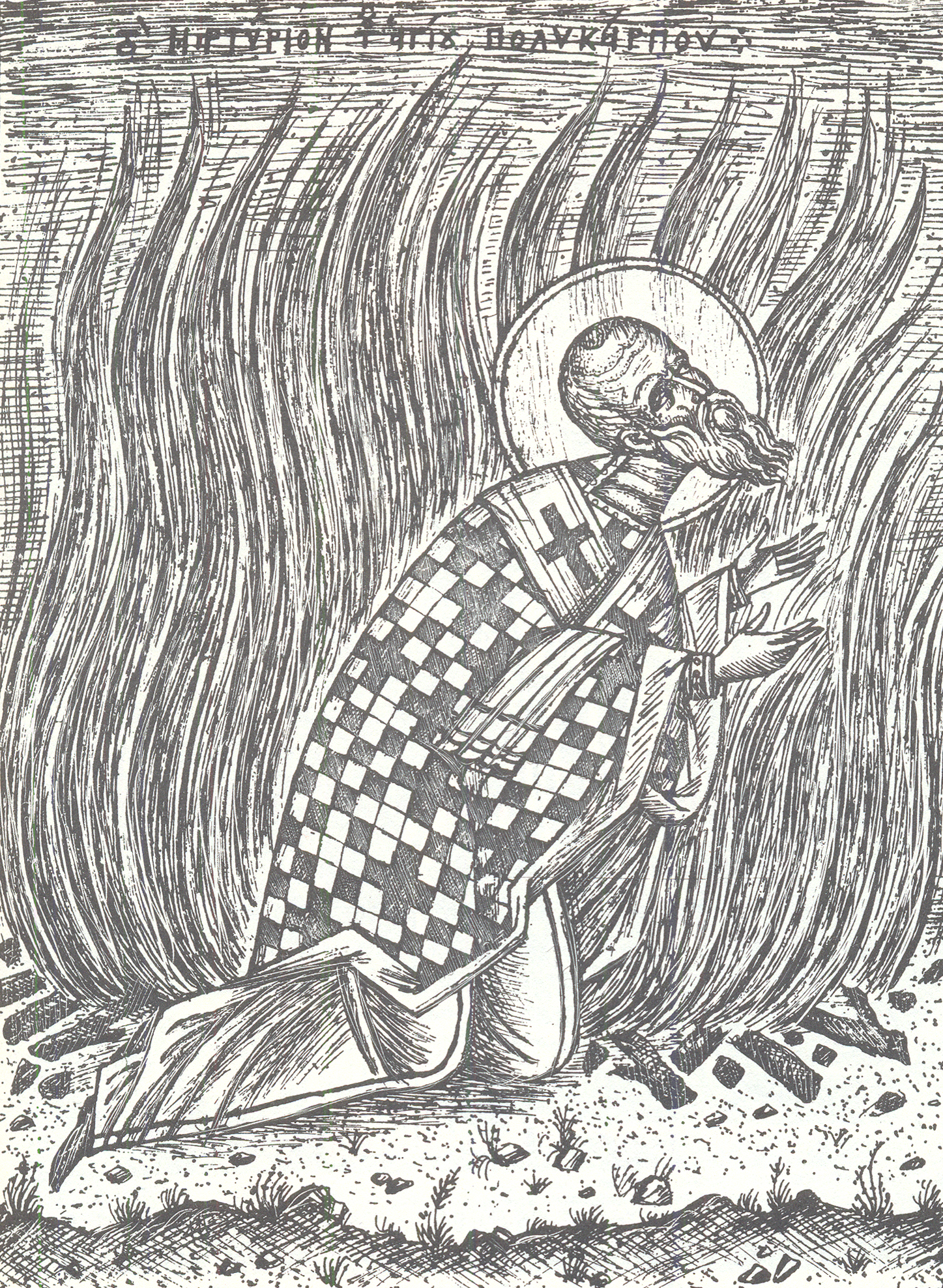
Having been brought to trial, St Polycarp firmly confessed his faith in Christ, and was condemned to be burned alive. The executioners wanted to nail him to a post, but he declared that God would give him the strength to endure the flames, so they could merely tie him with ropes.
  
[But he, having placed his hands behind him, and being bound, like a notable ram appointed for offering out of a great flock, prepared as a whole burnt-offering acceptable unto God, having looked up unto heaven, said, O Lord God Almighty, Father of thy beloved and blessed Son Jesus Christ, through whom we have received our knowledge concerning thee, the God of angels and powers, and of the whole creation, and of all the race of the just who lived before thee, I thank thee that thou hast deemed me worthy of this day and hour, that I should have my portion in the number of the martyrs, in the cup of thy Christ, unto the resurrection of eternal life, both of the soul and body, in the incorruptibility of the Holy Spirit. Among these may I be received before thee this day as a rich and acceptable sacrifice, even as thou hast prepared and made manifest beforehand, and hast fulfilled, thou who art the unerring and true God. On this account, and concerning all things, I praise thee, I bless thee, I glorify thee, together with the eternal and heavenly Jesus Christ thy beloved Son, with whom to thee and the Holy Spirit be glory both now and for ever. Amen. (http://www.voskrese.info/spl/polycarp.martyr.html)]

  
The flames encircled the saint but did not touch him, coming together over his head in the shape of a vault. Seeing that the fire did him no harm, the pagans stabbed him with a dagger. So much blood flowed from this wound that it extinguished the flames. The body of the hieromartyr Polycarp was then cremated. The Christians of Smyrna reverently gathered up what remained of his holy relics, and each year they celebrated the day of his martyrdom.
  
 A story has been preserved about St Polycarp by his disciple, St Irenaeus of Lyons, which Eusebius cites in his ECCLESIASTICAL HISTORY (V, 20):
  
 "I was still very young when I saw you in Asia Minor at Polycarp's," writes St Irenaeus to his friend Florinus, "but I would still be able to point out the place where Blessed Polycarp sat and conversed, and be able to depict his walk, his mannerisms in life, his outward appearance, his speaking to people, his companionable wandering with John, and how he himself related, together with other eyewitnesses of the Lord, those things that he remembered from the words of others. He also told what he heard from them about the Lord, His teachings and miracles....


The martyrdom of St. Polycarp (http://pravicon.com/images/sv/s1737/s1737004.jpg)

 Through the mercy of God to me, I then already listened attentively to Polycarp and wrote down his words, not on tablets, but in the depths of my heart. Therefore, I am able to bear witness before God, that if this blessed and apostolic Elder heard something similar to your fallacy, he would immediately stop up his ears and express his indignation with his usual phrase: 'Good God! That Thou hast permitted me to be alive at such a time!'"
  
 During his life the holy bishop wrote several Epistles to the flock and letters to various individuals. The only one that has survived to the present day is his Epistle to the Philippians which, St Jerome testifies, was read in the churches of Asia Minor at divine services. It was written by the saint in response to the request of the Philippians to send them some letters of the hieromartyr Ignatius (December 20) which St Polycarp had in his possession.
  
 The composer H.I.F. Bibier (1644-1704) has written a Sonata "Scti Polycarpi" for eight trumpets in honor of the holy martyr."
(http://ocafs.oca.org/FeastSaintsViewer.asp?SID=4&ID=1&FSID=100589, http://www.voskrese.info/spl/polycarp.martyr.html; the Greek text is available here: http://www.ccel.org/l/lake/fathers/martyrdom.htm)


St. Polycarp the Hieromartyr, Bishop of Smyrna (Icon courtesy of www.eikonografos.com used with permission)
  
The Epistle of St. Polycarp to the Philippians (Translated by J.B. Lightfoot)
"Polycarp and the presbyters that are with him unto the Church of God which sojourneth at Philippi; mercy unto you and peace from God Almighty and Jesus Christ our Savior be multiplied.
I
   I rejoiced with you greatly in our Lord Jesus Christ, for that ye received the followers of the true Love and escorted them on their way, as befitted you--those men encircled in saintly bonds which are the diadems of them that be truly chosen of God and our Lord;  (2) and that the steadfast root of your faith which was famed from primitive times abideth until now and beareth fruit unto our Lord Jesus Christ, who endured to face even death for our sins, whom God raised, having loosed the pangs of Hades; on whom, (3) though ye saw Him not, ye believe with joy unutterable and full of glory; unto which joy many desire to enter in; forasmuch as ye know that it is by grace ye are saved, not of works, but by the will of God through Jesus Christ.
II
   Wherefore gird up your loins and serve God in fear and truth, forsaking the vain and empty talking and the error of the many, for that ye have believed on Him that raised our Lord Jesus Christ from the dead and gave unto him glory and a throne on His right hand; unto whom all things were made subject that are in heaven and that are on the earth; to whom every creature that hath breath doeth service; who cometh as judge of quick and dead; whose blood God will require of them that are disobedient unto Him. (2) Now He that raised Him from the dead will raise us also; if we do His will and walk in His commandments and love the things which He loved, abstaining from all unrighteousness, covetousness, love of money, evil speaking, false witness; not rendering evil for evil or railing for railing or blow for blow or cursing for cursing; (3) but remembering the words which the Lord spake, as He taught; Judge not that ye be not judged. Forgive, and it shall be forgiven to you. Have mercy that ye may receive mercy. With what measure ye mete, it shall be measured to you again; and again Blessed are the poor and they that are persecuted for righteousness' sake, for theirs is the kingdom of God.
III
   These things, brethren, I write unto you concerning righteousness, not because I laid this charge upon myself, but because ye invited me. (2) For neither am I, nor is any other like unto me, able to follow the wisdom of the blessed and glorious Paul, who when he came among you taught face to face with the men of that day the word which concerneth truth carefully and surely; who also, when he was absent, wrote a letter unto you, into the which if ye look diligently, ye shall be able to be builded up unto the faith given to you, (3) which is the mother of us all, while hope followeth after and love goeth before--love toward God and Christ and toward our neighbor. For if any man be occupied with these, he hath fulfilled the commandment of righteousness; for he that hath love is far from all sin.
IV
   But the love of money is the beginning of all troubles. Knowing therefore that we brought nothing into the world neither can we carry anything out, let us arm ourselves with the armor of righteousness, and let us teach ourselves first to walk in the commandment of the Lord; (2) and then our wives also, to walk in the faith that hath been given unto them and in love and purity, cherishing their own husbands in all truth and loving all men equally in all chastity, and to train their children in the training of the fear of God. (3) Our widows must be sober-minded as touching the faith of the Lord, making intercession without ceasing for all men, abstaining from all calumny, evil speaking, false witness, love of money, and every evil thing, knowing that they are God's altar, and that all sacrifices are carefully inspected, and nothing escapeth Him either of their thoughts or intents or any of the secret things of the heart.
V
   Knowing then that God is not mocked, we ought to walk worthily of His commandment and His glory. (2) In like manner deacons should be blameless in the presence of His righteousness, as deacons of God and Christ and not of men; not calumniators, not double-tongued, not lovers of money, temperate in all things, compassionate, diligent, walking according to the truth of the Lord who became a minister (deacon) of all. For if we be well pleasing unto Him in this present world, we shall receive the future world also, according as He promised us to raise us from the dead, and that if we conduct ourselves worthily of Him we shall also reign with Him, if indeed we have faith. (3) In like manner also the younger men must be blameless in all things, caring for purity before everything and curbing themselves from every evil. For it is a good thing to refrain from lusts in the world, for every lust warreth against the Spirit, and neither whoremongers nor effeminate persons nor defilers of themselves with men shall inherit the kingdom of God, neither they that do untoward things. Wherefore it is right to abstain from all these things, submitting yourselves to the presbyters and deacons as to God and Christ. The virgins must walk in a blameless and pure conscience.
VI
   And the presbyters also must be compassionate, merciful towards all men, turning back the sheep that are gone astray, visiting all the infirm, not neglecting a widow or an orphan or a poor man: but providing always for that which is honorable in the sight of God and of men, abstaining from all anger, respect of persons, unrighteous judgment, being far from all love of money, not quick to believe anything against any man, not hasty in judgment, knowing that we all are debtors of sin. (2) If then we entreat the Lord that He would forgive us, we also ought to forgive: for we are before the eyes of our Lord and God, and we must all stand at the judgment-seat of Christ, and each man must give an account of himself. (3) Let us therefore so serve Him with fear and all reverence, as He himself gave commandment and the Apostles who preached the Gospel to us and the prophets who proclaimed beforehand the coming of our Lord; being zealous as touching that which is good, abstaining from offenses and from the false brethren and from them that bear the name of the Lord in hypocrisy, who lead foolish men astray.
VII
   For every one who shall not confess that Jesus Christ is come in the flesh, is antichrist: and whosoever shall not confess the testimony of the Cross, is of the devil; and whosoever shall pervert the oracles of the Lord to his own lusts and say that there is neither resurrection nor judgment, that man is the firstborn of Satan. (2) Wherefore let us forsake the vain doing of the many and their false teachings, and turn unto the word which was delivered unto us from the beginning, being sober unto prayer and constant in fastings, entreating the all-seeing God with supplications that He bring us not into temptation, according as the Lord said, The Spirit is indeed willing, but the flesh is weak.
VIII
   Let us therefore without ceasing hold fast by our hope and by the earnest of our righteousness, which is Jesus Christ who took up our sins in His own body upon the tree, who did no sin, neither was guile found in His mouth, but for our sakes He endured all things, that we might live in Him. (2) Let us therefore become imitators of His endurance; and if we should suffer for His name's sake, let us glorify Him. For He gave this example to us in His own person, and we believed this.
IX
   I exhort you all therefore to be obedient unto the word of righteousness and to practice all endurance, which also ye saw with your own eyes in the blessed Ignatius and Zosimus and Rufus, yea and in others also who came from among yourselves, as well as in Paul himself and the rest of the Apostles; (2) being persuaded that all these ran not in vain but in faith and righteousness, and that they are in their due place in the presence of the Lord, with whom also they suffered. For they loved not the present world, but Him that died for our sakes and was raised by God for us.
X
   Stand fast therefore in these things and follow the example of the Lord, being firm in the faith and immovable, in love of the brotherhood kindly affectioned one to another, partners with the truth, forestalling one another in the gentleness of the Lord, despising no man. (2) When ye are able to do good, defer it not, for Pitifulness delivereth from death. Be ye all subject one to another, having your conversation unblamable among the gentiles, that your good works both ye may receive praise and the Lord may not be blasphemed in you. (3) But woe to him through whom the name of the Lord be blasphemed. Therefore teach all men soberness, in which ye yourselves also walk.
XI
   I was exceedingly grieved for Valens, who aforetime was a presbyter among you, because he is so ignorant of the office which was given unto him. I warn you therefore that ye refrain from covetousness, and that ye be pure and truthful. Refrain from all evil. (2) But he who cannot govern himself in these things, how doth he enjoin this upon another? If a man refrain not from covetousness, he shall be defiled by idolatry, and shall be judged as one of the Gentiles who know not the judgment of the Lord, Nay, know we not, that the saints shall judge the world, as Paul teacheth? (3) But I have not found any such thing in you, neither have heard thereof, among whom the blessed Paul labored, who were his letters in the beginning. For he boasteth of you in all those churches which alone at that time knew God; for we knew Him not as yet. (4) Therefore I am exceedingly grieved for him and for his wife, unto whom may the Lord grant true repentance. Be ye therefore yourselves also sober herein, and hold not such as enemies but restore them as frail and erring members, that ye may save the whole body of you. For so doing, ye do edify one another.
XII
   For I am persuaded that ye are well trained in the sacred writings, and nothing is hidden from you. But to myself this is not granted. Only, as it is said in these scriptures, Be ye angry and sin not, and Let not the sun set on your wrath. Blessed is he that remembereth this; and I trust that this is in you. (2) Now may the God and Father of our Lord Jesus Christ, and the eternal High-priest Himself the [Son of God Jesus Christ, build you up in faith and truth, and in all gentleness and in all avoidance of wrath and in forbearance and long suffering and in patient endurance and in purity; and may He grant unto you a lot and portion among His saints, and to us with you, and to all that are under heaven, who shall believe on our Lord and God Jesus Christ and on His Father that raised him from the dead. (3) Pray for all the saints. Pray also for kings and powers and princes and for them that persecute and hate you and for the enemies of the cross, that your fruit may be manifest among all men, that ye may be perfect in Him.
XIII
Ye wrote to me, both ye yourselves and Ignatius, asking that if any one should go to Syria he might carry thither the letters from you. And this I will do, if I get a fit opportunity, either I myself, or he whom I shall send to be ambassador on your behalf also. (2) The letters of Ignatius which were sent to us by him, and others as many as we had by us, we send unto you, according as ye gave charge; the which are subjoined to this letter; from which ye will be able to gain great advantage. For they comprise faith and endurance and every kind of edification, which pertaineth unto our Lord. Moreover concerning Ignatius himself and those that were with him, if ye have any sure tidings, certify us.
XIV
I write these things to you by Crescens, whom I commended to you recently and now commend unto you: for he hath walked blamelessly with us; and I believe also with you in like manner. But ye shall have his sister commended, when she shall come to you. Fare ye well in the Lord Jesus Christ in grace, ye and all yours. Amen." (http://www.earlychristianwritings.com/text/polycarp-lightfoot.html)
   
St. Polycarp the Hieromartyr, Bishop of Smyrna (http://clubs.pathfinder.gr/agiospanteleimonas/380907)

Apolytikion in the Fourth Tone
As a sharer of the ways and a successor to the throne of the Apostles, O inspired of God, thou foundest discipline to be a means of ascent to divine vision. Wherefore, having rightly divided the word of truth, thou didst also contest for the Faith even unto blood, O Hieromartyr Polycarp. Intercede with Christ our God that our souls be saved.
  
Kontakion in the First Tone
Through godly virtues, thou broughtest forth for the Lord God much spiritual fruit, O thou most blessed Hierarch, and so didst prove worthy of God thy Lord, O wise Polycarp. Wherefore, on this day we who have all been enlightened through thy holy words extol thy praiseworthy mem'ry and glorify Christ the Lord.
St. Polycarp the Hieromartyr, Bishop of Smyrna (http://pravicon.com/images/sv/s1737/s1737003.jpg)
  
Through the prayers of our Holy Fathers, Lord Jesus Christ our God, have mercy on us and save us! Amen!

Sunday, February 21, 2010

The Triumph of the Church, by St. John Chrysostom

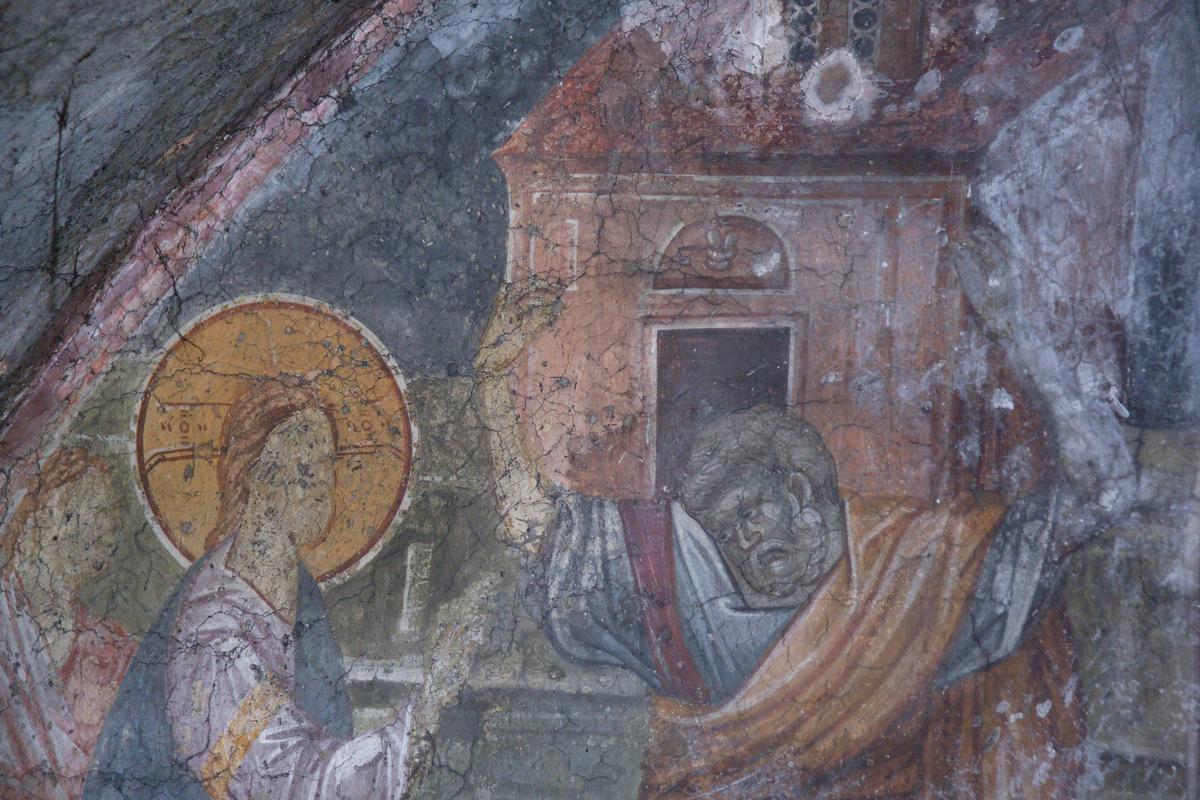
Fresco from Gracanica Monastery depicting Christ's words: “On this stone (i.e. on Peter’s confession of faith) I will build my Church, and the powers of Hades will not prevail against it” (Matthew 16:18). (http://www.srpskoblago.org/Archives/Gracanica/exhibits/digital/n3-w5e5/large/n3-w5e5-2.jpg)

The Triumph of the Church, by St. John Chrysostom
"How does one prove that Christ is God? We should not try to answer this question by using the argument of the creation of heaven and earth, because the unbeliever will not accept it. If we tell him that He raised the dead, healed the blind, expelled demons, he still will not agree. If we tell him that He promised us resurrection from the dead, the kingdom of heaven, and ineffable goods, not only he will not agree, but also he will laugh at us.

How then shall we lead him to the faith, especially when he is not spiritually developed? Surely, we shall do this by resting on truths which are acceptable both to us and to him without any dispute or shadow of doubt.

We shall start from the fact that Christ planted the Church in the world. What is the point then that we absolutely agree upon? It is the fact that Christ planted the Church. It is by this means that we shall reveal the power and prove the divinity of Christ. We shall see that it is impossible to regard the dissemination of Christianity in the whole wide world in such a short period of time as a human work. And indeed, when Christian ethics invites people who have bad habits and are slaves to sin to a higher life. And yet, the Lord managed to liberate from such things not only us, but the entire human species.

Christ’s superbly wondrous achievement is the Church. He achieved this without using arms, without spending money, without mobilizing armies, without causing wars. He achieved it by starting only with twelve disciples, who were insignificant, uneducated, poor, naked, unarmed… It was with such human resource that He succeeded in persuading the nations to think correctly, not only in the present life, but also in the life which is to come. He managed to nullify the ancestral laws, to uproot ancient customs, and to plant new ones. He managed to detach man from an easy way of life and to lead him to a difficult one. He managed all these things, although all fought against Him, and He had to endure a degrading crucifixion and an ignominious death!

This superbly wondrous achievement is not human. Surely, such things do not occur to human beings. What occurs is the exact opposite. In other words, as long as they are alive and prosper their work progresses. When, however, they die, what they created is destroyed along with them. This is endured not only by the rich or the leading ones, but also by the chief governors. This is so, because their laws are abolished, their memory is obliterated, and their names are forgotten, while their intimate associates are pushed aside. These things occur to those who originally governed the nations by a mere nod, and led to war grand armies; to those who condemned to death and recalled the exiled. To the Lord, however, it was the exact opposite that occurred.

It is superbly wondrous because it was achieved by the Crucified Christ. Before the crucifixion the state of his work looked pitiful. Judas betrayed Him. Peter denied Him. The rest of the Disciples fled in order to save their lives, while many believers abandoned Him. He was left alone among enemies. And yet, after the slaughter and the death, so that you may learn that the Crucified Christ was not a mere man, all things became brighter, jollier, and glorious. Peter, the head Apostle, who before the crucifixion did not bear the threat of a maidservant, but after so many heavenly teachings and his participation in the divine mysteries said that he does not know the Lord, the same one after the crucifixion preached Him to the ends of the world. Innumerable martyrs were sacrificed, because they preferred to be put to death than to deny Christ, as the head Apostle had denied Him after being intimidated by a young maiden.

The amazing submission of the world to the Crucified Christ and His Apostles: Now, all the lands, all the cities, the deserted and the inhabited places, confess the Crucified Lord. On Him faith is placed by kings and generals, archons and consuls, slaves and freemen, unlettered and educated, the barbarians and the various nations of humanity. Even that small and insignificant tomb that received the blood stained and tortured body of the Lord is more valued than a thousand royal palaces and more venerable even to kings. What is even a greater paradox is the fact that what happened to the Lord also happened to His disciples. Because, those who were despised and imprisoned, those who were atrociously tortured and underwent innumerable martyrdoms, the very same ones, after their death, were more honored than the kings. Where do we see this? In Rome, the emperors, the consuls and the generals put aside all things and run to venerate the tombs of Peter the fisherman and Paul the tent maker. In Constantinople, those who bear diadems on their heads, wish to be buried next not close to the tombs of the Apostles but at the entrance of their temples. And so the kings become the doormen of the fishermen! Indeed, they are not ashamed for this, but boast about it, not only themselves but also their descendants.

Christ’s prophesy about the Church and its speedy fulfillment. When Christ’s disciples were only twelve and the Church was not in any one’s thought, when the Jewish synagogue was still flourishing and the impious idolatry dominated almost the entire world, the Lord had prophesied: “On this stone (i.e. on Peter’s confession of faith) I will build my Church, and the powers of Hades will not prevail against it” (Matthew 16:18). Do you realize the truth of this prophesy? Do you see its fulfillment? Think how important a fact is the spreading of the Church almost to the entire earth in a very brief span of time. Think how the life of so many nations changed and led to the faith so many peoples, how it abolished ancestral customs, how it liberated from age-long habits, how it scattered like dust the domination of pleasure and the power of sin, how it extinguished like smoke the foul smell of the sacrifices, the idolatrous ceremonies, the abominable feasts, the idols, the pagan altars and temples, how it erected sacred altars everywhere, in our land and in the lands of the Persians, the Scythians, the Africans and the Indians. What I say? Even in the British Isles, which are beyond the Mediterranean, in the ocean, the Church was spread and erected altars.

The superbly wondrous liberation and change that the Church induced in the world: The work of liberation of so many peoples from age-long shameful habits, as well as the change in the manner of life from an easier to a more difficult one, is indeed wondrous, or rather superbly wondrous. It is a proof of divine operation (energy), even if no one had opposed it, even if peace had prevailed and many had assisted. Because this spreading of the Church did not only come into collision with ancient habit, but also with pleasure, the happy manner of life. In other words, it had two powerful opponents, which tyrannized humanity: habit and pleasure. Whatsoever people had received, from centuries ago, from their fathers, their grandfathers and their ancient ancestors, even what they had received from the philosophers and the rhetoricians, all these things they agreed to despise, an attitude extremely difficult. Besides, they had to accept a new manner of life, which was indeed much more difficult; because she removed them from luxury and attached them to fasting. She removed them from avarice and led them to lack of property. She removed them from profanity and led them to chastity. She removed them from aggressiveness and led them to gentleness. She removed them from envy and led them to friendship. She removed them from an easygoing and pleasurable life and led them to a life of difficulties, hardships, and full of sorrows. Indeed she led to this life those who had been accustomed to the life of luxuries. Surely, those who became Christians were not people who lived in some other worlds and did not have sinful habits, but were those who had rotted in them and had become more flexible than clay. It was them that she called to follow the hard and ragged road. And it persuaded them to follow it!

The superbly wondrous work of the Twelve Apostles in the spreading of the Church. How many were persuaded? Not two, not ten, not twenty, not a hundred, but an innumerable crowd. And how many did she use to persuade them? She used two men, uneducated, uncultured, unknown, poor, without property, without bodily strength, without glory, without illustrious ancestry, without rhetorical eloquence. She used twelve men who were fishermen, tent makers, whose mother tongue was foreign; because, they did not speak the same tongue with the idolaters. They spoke Hebrew, which was different from all other languages. It was with them that the Church was built up and spread to the ends of the world. This is not the only wondrous fact, but there is also the fact that these few, these poor, these uneducated and despised men, who set out to change humanity, did not pursue their work without disturbance. They were confronted with innumerable wars from every side. They were opposed by every nation and in every city. But why do I speak of nations and cities? War was raised against them even on every house. Their teaching separated on many occasions the child from the father, the daughter in law from the mother in law, the brother from the brother, the servant from the master, the citizen from the ruler, the man from the woman, and the woman from the man. In every family not all believed simultaneously,, and so the Christians suffered daily harassments, ceaseless enmities, a myriad of deaths. All fought them as common opponents and enemies. They were pursued by kings, governors, citizens, freemen, slaves, crowds, cities. They did not pursue only them, but –how terrible– even the neophyte catechumens, i.e. those who just believed.

The victory of the Apostles and the Church is due to the power of the Crucified but also Risen Lord. It caused horror and wrath to the idolaters the thought of abandoning their pagan altars, of despising their bloody sacrifices, which all their fathers and ancestors practiced, and of believing in the Lord; of believing in Him who took flesh from the Virgin Mary, and stood trial before Pilate, and suffered numberless tribulations and degradations, underwent a dishonorable death, was buried and rose again. It is indeed a paradox, that, while the sufferings of the Lord were indisputable, -inasmuch as many had seen the lashings, the biting, the spitting, the slapping, the cross, the mocking, the entombment– it was not the same with the resurrection. The Lord, after his resurrection, manifested Himself only to the disciples. In spite of this fact, they spoke about the resurrection and persuaded the peoples and built up the Church. How did they do it? They did it with the power of the Lord, who sent them to preach his Gospel to the nations. It was He who opened to them the way. It was He who facilitated their difficult task. Had they not been assisted by the divine power, the spreading of Christianity would not have even begun.

The persecutions against the Church did not inhibit its expansion. The reason was that while the tyrants were forearmed against the Church, while the soldiers interposed their arms, while the mobs raged like a wild fire, while the bad habit was lined up in opposition, while orators, sophists, the rich people, ordinary citizens and leaders were aroused in enmity, the word of God, being stronger than the flame, turned the thistles into ashes, cleansed the fields and sowed the word of the preaching. Some of the believers were thrown into the prisons, others were exiled, others had their property confiscated, others were assassinated, and others were torn to pieces. In spite of the fact that Christians were treated as common criminals, suffering patiently every kind of punishment, humiliation and persecution, more and more people joined the Church. Indeed, the new believers not only were not discouraged by the tortures which they saw the older believers undergoing, but became more eager! They run by themselves, without constraint, showing gratitude to their torturers. They became more fervent in the faith, seeing the torrents of the blood of the believers.

The expansion of the Church in spite of the persecutions proves the incomparable and unconquerable power of Christ. Did you see the incomparable power of Him who achieved all these wonders? How is it possible that people who are undergoing such horrid martyrdoms feel no sorrow? And yet, they rejoiced, and were elated! This is what St. Luke the Evangelist adduces as an example, when he says about the Apostles that “they left from the council rejoicing, because they were proved worthy to be ill-treated for the shake of Christ” (Acts 5:41). While no one can build even a wall with stones and plaster when is persecuted, the Apostles built up the Church throughout the world while sufferings persecutions, imprisonments, exiles and deaths as martyrs. They did not build her up with stones, but with souls –which is much more difficult; since it is not the same to build a wall as to persuade perverted souls to change their manner of life, to abandon their demonic madness and to follow the life of virtue. They achieved this, because they had with them the unconquerable power of the Lord, who had prophesied; “I will build up my Church, and the powers of Hell will not prevail against her” (Matthew 16:18).

Consider how many tyrants fought the Church and how many persecutions they raised against it… Augustus, Tiberius, Gaius, Nero, Vespasian, Titus and their successors right down to Constantine, were all idolaters. All of them –some more moderately, and some more harshly– fought the Church. Even if some of them did not raise persecutions, nevertheless, their attachment to idolatry motivated those who wanted to flatter them to oppose the Church. In spite of all this, the evil schemes and attacks of the idolaters were dissolved as cobwebs, scattered like dust, vanished like smoke. Besides, what were planned against the Church became the occasion of great benefits for the Christians. The reason was that such plans created choruses of martyrs, who constitute the treasure, the pillars, and towers of the Church.

The wondrous fulfillment of what Christ prophesied about the Church reveals most clearly his true Godhead. Do you see the wondrous fulfillment of this prophesy? Indeed, “the powers of Hell cannot prevail against her.” Looking at what came to pass, believe what is to come. No one in the future will be able to prevail against the Church. If they did not manage to crush her when she numbered but a few members, when her teaching seemed novel and strange, when so many terrible wars and so many persecutions were raised against her from everywhere, much more they will not manage to injure her today, when she has spread in the whole world, and increased her dominion among all nations, abolishing their pagan altars and idols, their festivals and celebrations, the smoke and the smell of their abominable sacrifices. How did the Apostles achieve such a great, such an important task, after so many obstacles? Surely, it was by the divine and unconquerable power of Him, who prophesied about the creation and triumph of His Church. No one can deny this, unless he is mindless and completely unable to think."
(Translated and edited by Protopresbyter George Dion. Dragas, PhD, DD, DTh; This article represents selections from St. John Chrysostom’s treatise To Jews and Greeks, a demonstration, that Christ is God… (PG 48, 813-838); http://www.johnsanidopoulos.com/2009/10/triumph-of-church.html)

St. John Chrysostom, Archbishop of Constantinople (Icon courtesy of www.eikonografos.com used with permission)

Through the prayers of our Holy Fathers, Lord Jesus Christ our God, have mercy on us and save us! Amen!

Sermon given on the First Sunday of Lent by St. Luke Archbishop of Simferopol

The Raising of the Holy Icons, and the Sunday of Orthodoxy (Icons courtesy of www.eikonografos.com used with permission)

Sermon given on the First Sunday of Lent (The Sunday of Orthodoxy) by St. Luke Archbishop of Simferopol
"On the first Sunday of Lent, our Holy Church celebrates the Triumph of Orthodoxy, of true faith, which trampled down all heresies and was established. For this reason this Sunday is called the Sunday of Orthodoxy. Heresies showed up even at the very beginning of of Christianity. The Apostles of Christ themselves warned their contemporaries, and with them us too, about the danger of false teachers.

The Holy Apostle Peter writes the following in his Second General Epistle: “But there were also false prophets among the people, even as there will be false teachers among you, who will secretly bring in destructive heresies, even denying the Lord who bought them, and bring on themselves swift destruction. 2 And many will follow their destructive ways, because of whom the way of truth will be blasphemed.”(II Pet. 2: 1-2).

St. Paul, returning to Palestine from Greece, made a stop in Ephesus. To the the Christian inhabitants of the town there he said: “For I know this, that after my departure savage wolves will come in among you, not sparing the flock. Also from among yourselves men will rise up, speaking perverse things, to draw away the disciples after themselves.” (Acts 20: 29 -30).

Many such false teachers and schismatics existed in the first centuries of Christianity. Some heresies troubled the Church for centuries, such as the heresies of Arius, of Macedonius, Eutyches, Dioscorus, of Nestorius and also the heresy of iconoclasm. These heresies caused much disturbance in the Church and afflicted the Church greatly. There were many confessors and martyrs who shed their blood defending the true faith in the fight against false teachers and heretics.

There were also many great prelates, who also suffered under persecution and were often exiled. Saint Flavian, Patriarch of Constantinople, for example, in a council chaired by Dioscorus, called the Robber Synod was “beaten so savagely that he died three days later.”

The last in the line-up of heresies, the heresy of iconoclasm, was the one that tormented our Orthodox Church the most. This heresy first appeared during the reign of Emperor Leo the Isaurian, who came to the throne in 717. He ascended the throne with the help of the army, which had many opponents of those who venerate holy icons, within its ranks. Because he wanted to please the army he started a harsh persecution against iconophiles.

This persecution continued on into the reign of Emperor Constantine Copronymus, who succeeded Leo to the throne. The name Copronymus (“dung-named”) comes from coprus meaning manure, i.e. faeces. He was called Copronymus because he defecated in his baptismal font. These two emperors were in power for many years and brought great affliction upon the Church. Following these, there were other iconoclast emperors, who continued the work of their predecessors and tormented the Church for years.

We can not begin to describe the suffering endured by the Church during the years of iconoclasm, and especially the monks who were in the frontline in the battle for holy icons. The iconoclast emperors closed many monasteries and turned many churches which had icons into shells. The monks, were savagely beaten: they took out their eyes, noses were cut off, icons were broken on their heads. They burnt the fingers of icon-painters hagiographers with burning irons.

The persecution only stopped when Empress Irene came to the throne of the Byzantine Empire, but this was not yet final. In 787 Irene convened the Seventh Ecumenical Council, which set down Orthodox teaching on the veneration of holy icons. But even after this Council iconoclast emperors still existed, for example, Michael and others. The heresy was crushed only under the God-fearing Augusta, Theodora, when a local council was convened in Constantinople in 842, which upheld the Orthodox teaching. The council pronounced an anathema on all those who dare to say that the veneration of holy icons is idolatry and that Orthodox Christians are idolaters.

And here various sects still tell us exactly this thing. They dare to call our icons idols and call us idolaters. And with what nerve? I will tell you of an incident that took place recently in a city in Siberia. During the Liturgy two Baptists walked into the church and started shouting that the Orthodox are pagans idol-worshippers and that the icons are idols. What nonsense!

How dare they open their mouths and say these words dripping with venom, calling us pagans and our icons idols? This shows that they have understood correctly the second commandment of Mosaic Law: “You shall not make for yourself a carved image—any likeness of anything that is in heaven above, or that is in the earth beneath, or that is in the water under the earth;”(Ex. 20.4).

What does this commandment mean? I think the meaning is clear. The commandment prohibits the building of idols for worship, instead of worshipping the One, Unique and True God -as did ancient peoples: the Assyrians, the Babylonians, Egyptians, Greeks, Romans and others- instead of worshipping the One, Unique and True God.That is idolatry. But is our veneration of holy icons anything like idolatry? Certainly not. Idols represented something that does not really exist, something that is a product of imagination. Our own icons depict reality. Really, did the Lord Jesus Christ, who we glorify amd who we venerate in icons, not live among us? Did the Virgin Mary, who was painted by the apostle and evangelist Saint Luke not live among us? This icon was blessed by the very Theotokos herself, saying that grace would always be with this icon. Do you know how many miracles happen from icons of the Virgin Mary?

  
And the other icons don’t they show real saints of God who lived here on Earth? These icons are their portraits and in no way are idols. Only impious and filthy mouth dares to say that our icons are idols and that we are idolaters. Let the ungodly be silent as the Ecumenical Council has pronunced anathema upon them.

You should know this, and remember this and not keep company with heretics.

Do not leave the Church, do not rip the robe of Christ. Remember that Christ in his prayer at Gethsemane, the hierarchical prayer, begged his father, saying: “that they all may be one, as You, Father, are in Me, and I in You; that they also may be one in Us, that the world may believe that You sent Me ” (John 17: 21). The Lord wants unity of the Church. The dissenters, the schismatics, who find errors in the teaching of the Church, are removed from it and believe they will find salvation in their heretical organizations.

But do you know what the great saints said about people who tear the tunic of Christ? Saint Cyprian, bishop of Carthage, said that people who leave the church and do not have communion with it even if they become martyrs, even with their blood, will not be cleansed of their sin because this grievous sin of dividing the Church cannot even be cleaned with shedding of blood. And the holy martyr Ignatius the God-bearer said that he who causes schism in the Church will not inherit the kingdom of God.

All heretics, however, are preachers of schism. While the apostle says: “Now I urge you, brethren, note those who cause divisions and offenses, contrary to the doctrine which you learned, and avoid them.” (Rom. 16: 17). And in another letter says this: “If anyone preaches any other gospel to you than what you have received, let him be accursed” (Gal. 1: 9). And all the heretics do not preach what the Orthodox Church, which gave us spiritual birth, preaches.

Remember also, the word of Lord Jesus Christ, Who told the apostles, and through them us, their successors: “He who hears you hears Me, he who rejects you rejects Me, and he who rejects Me rejects Him who sent Me” (Lk. 10 : 16). These words of the Lord are awesome. Remember them always. Do not forget this day, the day of the Triumph of the Orthodox faith. The faith that was set down by the Seventh Ecumenical Council which established Orthodoxy and trampled down all heresies and schisms.

Over a thousand years have passed since the time of the Seventh Ecumenical Council and such Ecumenical Councils [have not] been convened since.*** Why? The reasons are political. It was impossible to call them. But we should not be sorry that others did not take place and that there are no Ecumenical Councils today. These Seven that we have, sorted out all questions and solved all the problems that the Church had with heresies and established the Orthodox faith.

You will say that there are many new heresies and schisms today. Yes, you are right. But we should know that the new heresies are not saying anything new but repeating what the old heretics have already said. All of these heresies were anathematized by the Seventh Ecumenical Council. So the decisions of seven Ecumenical Councils are enough for us, especially the Seventh Ecumenical Council. This is why we rejoice today and celebrate the Triumph of Orthodoxy, which was expressed and fixed by the Seventh Ecumenical Council.

It was precisely for this reason that it was appointed that a doxology should be chanted on this day, as a thanksgiving to God for securing the Orthodox faith. Let us chant this doxology now."
(http://ypseni.wordpress.com/2010/02/19/on-the-sunday-of-orthodoxy/; Greek text available here: http://vatopaidi.wordpress.com/2010/02/21/%ce%bb%cf%8c%ce%b3%ce%bf%cf%82-%ce%b5%ce%b9%cf%82-%cf%84%ce%b7%ce%bd-%ce%b1-%ce%ba%cf%85%cf%81%ce%b9%ce%b1%ce%ba%ce%ae-%cf%84%cf%89%ce%bd-%ce%bd%ce%b7%cf%83%cf%84%ce%b5%ce%b9%cf%8e%ce%bd-2/)

***It should be noted that two additional councils (under St. Photios the Great and St. Gregory Palamas), while not universally held as "Ecumenical", are reaffirmed as being Orthodox, and I believe are mentioned in the Synodikon of the Triodion (http://www.johnsanidopoulos.com/2010/02/synodicon-of-orthodoxy.html). Also see: http://orthodoxwiki.org/Ecumenical_Councils/. The Greek text above notes that the Saint does not diminish or ignore these, but stresses the importance of the Seventh.

St. Luke Archbishop of Simferopol (http://www.agiosloukas.org/)

Through the prayers of our Holy Fathers, Lord Jesus Christ our God, have mercy on us and save us! Amen!