Friday, January 27, 2012

Akathist to St. Paraskevi the Great Martyr of Rome

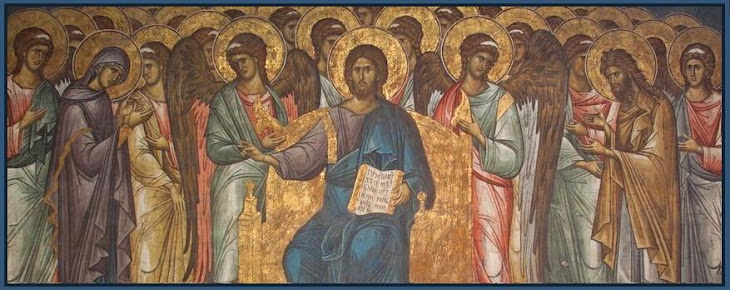
Jesus Christ, depicted with St. Paraskevi the Great Righteous Virgin Martyr of Rome (July 26) (http://www.mlahanas.de/Greece/Arts/AngelosAkotantos/ChristParaskevi.jpg)
   
Akathist to St. Paraskevi the Great Martyr of Rome (amateur translation); for the life of St. Paraskevi, see: http://full-of-grace-and-truth.blogspot.com/2009/07/st-paraskevi-great-martyr-of-rome.html.

Kontakion in the Plagal of the Fourth Tone
As the Lord’s grace-flowing nun, and His fervent apostle and Martyr, we praise you with triumphant hymns, and we praise your memory most tunefully, sprinkling flowers and crying:
Hail, Paraskevi, O comely virgin.
  
Hymns I offer to you the beauty of virgins, O chaste Paraskevi, martyr of Christ (3). For you struggled boldly, and you enlighten and shine with the rays of wonders on those who hymn you, and we offer you hymns with fervor:
Hail, child of pious faithful,
Hail, dear throne of God.
Hail, beautiful-voiced trumpet of love,
Hail, pure servant of the Virgin.
Hail, for from above you cover the Orthodox from blows,
Hail, you who cease the tears and groans of mortals.
Hail, for you are the protection of eyes,
Hail, for you rejoiced in the monastic path.
Hail, for you deposed the boasting of the enemy,
Hail, you who were victorious through Christ’s power.
Hail, divine adornment of Rome,
Hail, speedy healer of wounds.
Hail, Paraskevi, O comely virgin.

Being the root from the divine prayer of your parents, Agathon and Politia watered you with the streams of piety. And you, O comely Virgin, flourished as a tree, as those who gave birth to you rejoiced in your grace, and chanted to the Lord: Alleluia.

Laughter and boldness, the streams of perdition, did not come near your soul, O Godly-minded one, but you spoke with the sacred virgins, and spent your time studying the Scriptures, becoming for us an example, for those who piously cry out:
Hail, most grace-endowed soul,
Hail, our most beloved righteous one.
Hail, nourishment of Orthodox asceticism,
Hail, heroism and worth of the calling.
Hail, divine seal of sacred missions,
Hail, boast and seal of the angelic life.
Hail, youth honored by God,
Hail, the ceasing of idol worship.
Hail, you who takes the honor from the false god,
Hail, joy of those who every cry out:
Hail, Paraskevi, O comely virgin.

You were not at all conquered by the glories of this life, O pure Christ-bearer Paraskevi, but taking hope in the life above, you perceived the things of life as refuse joyfully, and were enriched with divine things, and cried out to God in fervor: Alleluia.

Following the words of your Incorruptible Bridegroom, the divine passing of your parents you perceived as a divine call, and you distributed your wealth to the poor, who praise your philanthropy, and cry out with all reverence:
Hail, you who were filled with the wisdom from above,
Hail, soul of godly monasticism.
Hail, nightingale singing praise of the Most-high,
Hail, you who bestow grace on monastics.
Hail, you who imparted your joy upon your brethren,
Hail, you who possess incorruptible treasuries in the Heavens.
Hail, for you showed manliness in trials,
Hail, for you dissipate the cloud of error.
Hail, greatly-victorious one on the road of the Martyrs,
Hail, lamp which shines with light of purity.
Hail, container that leads towards the Lord,
Hail, rays of the supernatural life.
Hail, Paraskevi, O comely virgin.

Being zealous for the things of Heaven, you locked yourself in a Convent, O most noble champion Paraskevi, for you submitted your wise mind, and joyfully struggled with ascetical pains, worshiping the Lord, and crying out with bitter hymns: Alleluia.

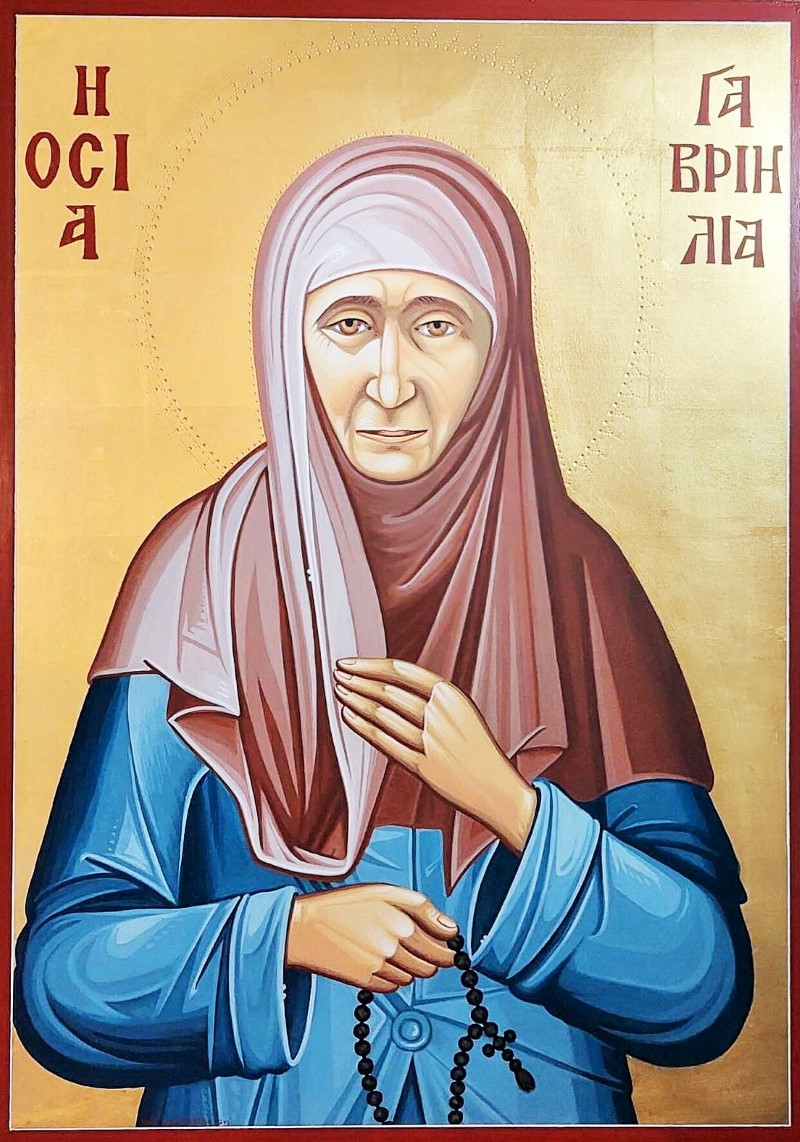
St. Paraskevi the Great Martyr of Rome (http://www.saintparaskevi.com/images/icon.jpg)
  
You were raised by divine grace to the heights of love, desiring the crown of martyrdom, and having sought the blessing of your Superior, you spoke the word of the Lord and dispelled error for many people, who now hymn you:
Hail, dawn of consolation,
Hail, harp of divine knowledge.
Hail, you who shared the name of the Wise Virgins (Matthew 25:1-13),
Hail, you who spoke with the spotless Angels.
Hail, you who embraced the angelic Schema with fervor,
Hail, protection and foundation of those who honor you with faith.
Hail, you who heard unspeakable voices,
Hail, you who were made worthy of the honor of the age to come.
Hail, all-fragrant lyre of the faithful,
Hail, salve for our eyes.
Hail, music of divine love,
Hail, breath of unsleeping worship.
Hail, Paraskevi, O comely virgin.

You walked the God-traced path of the Apostles, as another Protomartyr Thekla, and passed through the land of the Romans, and the cities of the Greeks, as an all-precious doe, preaching Christ fervently, and crying out with longing: Alleluia.

When Antoninos learned of your way Equal-to-the-Apostles, he placed a flaming helmet upon you, but through the will of the Lord, you were preserved utterly unharmed and remained pure, while all the faithful who beheld this, cried out victoriously words such as these:
Hail, divine doe of the flock of Christ,
Hail, for your fragrance was as pure nard (John 12:3).
Hail, teacher of blessing and mindfulness,
Hail, sweetest apostle of the Savior.
Hail, for your words were preached by pure lips,
Hail, for you imparted your experience to ascetics.
Hail, for you are the worker of peace,
Hail, for you are the protector of those endangered.
Hail, catechesis of the holy faithful,
Hail, disappearance of the false gods.
Hail, aloe of Orthodox manliness,
Hail, reproach of the evil heart.
Hail, Paraskevi, O comely virgin.

Demonic waves and unbearable blows, you endured, O much-suffering Lady, for the tyrants sought to burn you, and to break the chain of your faith, but you stood as an unshakable divine statue of Christ, saying: Alleluia.

Shining with your wonders, the choir of those who believed through you were brought to the flock of Christ, enraging the Emperor, who became short of breath through his many tortures, and now these radiant Dwelling-places cry out these in gratitude:
Hail, pure and comely martyr of Christ,
Hail, our map and canon.
Hail, you who ridiculed the false gods,
Hail, you who shattered the faces of idols.
Hail, all-sacred nun, humble and dedicated,
Hail, all-fragrant rose, and seal of the soul.
Hail, for you endured ascetical pains,
Hail, for you also trouble the swarms of the demons.
Hail, dowry to Christ of many talents,
Hail, chosen ode of the God of all.
Hail, root of the presbyter Rome,
Hail, protector of every town and place.
Hail, Paraskevi, O comely virgin.

Dwelling, as Paul, in prison alone, you were made worthy of the vision of an Angel, who showed you the honored symbols of the passion of Christ, in order to give you courage, O all-wise one, that we might cry unto the ages: Alleluia.

St. Paraskevi the Great Martyr of Rome (Source: www.eikonografos.com)
  
You are as a precious coin of the church, O Mother, bearing the seal of your Master, for you were tried by fire, and many tortures, O thrice-glorious one, and were not at all altered, as you hear from all these:
Hail, seal of sacred graces,
Hail, key of uncreated gifts.
Hail, for you endured the stretching of your flesh,
Hail, for you were steadfast manfully as you were being raked.
Hail, for your struggles reached the impassible peak,
Hail, Martyr who also shelters desert ascetics.
Hail, for you were placed in boiling tar,
Hail, for you were divinely kept unharmed.
Hail, savior for many in sickness,
Hail, you who grant light to the blind.
Hail, through whom goodness has come,
Hail, through whom magic has disappeared.
Hail, Paraskevi, O comely virgin.

You were tortured mercilessly, and brutally hung, without your steadfast mind wavering at all, but you cried out to the tyrant: Christ can deliver me from any of your tortures, to Whom I chant fearlessly: Alleluia.

Antoninos' eyes were burned from oil and tar, having asked it of you, but filled with great compassion, you straightaway granted him healing, O Paraskevi, therefore, the ruler who then espoused your faith, cried out:
Hail, spring of gifts,
Hail, well of healings.
Hail, for you won the spoils of the Romans,
Hail, for you preached the Sun of love.
Hail, divinely-breathed organ that makes glad the faithful,
Hail, purest eye that looks against the enemies.
Hail, you who bless those who hymn your many blessings,
Hail, you who conquers the opposing swarms.
Hail, sacred and genuine personage,
Hail, soul arrayed in light.
Hail, faithful honor and worth,
Hail, fragrance to men from Heaven.
Hail, Paraskevi, O comely virgin.

Before your end, they placed a heavy stone upon your chest, O Martyr Paraskevi, while Jesus appeared to you at night, surrounded by light and the radiant ranks of the Angels, and totally healed you. Thus you cried in joy: Alleluia.

With the strength of the Master, you bravely surpassed the weakness of other women. Through the divine Cross and your prayer, you tore apart a fearsome dragon, while all were astonished and cried out triumphantly:
Hail, light-bearing nun,
Hail, crown-bearing Martyr.
Hail, you who were steadfast of soul in terrible dangers,
Hail, you who were victorious in beatings and asceticism.
Hail, repository of grace, and dwelling of love,
Hail, meekness of spirit, and giver of peace.
Hail, for you are the trainer of monastics,
Hail, for you are the intercessor to the Trinity.
Hail, chain of chaste virgins,
Hail, deliverer from sinister spirits.
Hail, you through whom the dragon was torn apart,
Hail, you through whom the governor was astounded.
Hail, Paraskevi, O comely virgin.

You were worthily granted from Heaven an incorruptible crown, O lady, and the grace of wonders, which were founded upon your virtues, and your many struggles and terrible tortures, from which you blossomed forth and were glorified, as your fellow struggles cried out: Alleluia.

  
Your all-sacred Skull, O godly-minded one, rests in the Monastery of the Bodiless Powers Petraki, to which we take refuge, Paraskevi, as we all entreat that we find mercy, and healing of vision, as we cry out with fear:
Hail, healing of the eyes,
Hail, divine stream of wonders.
Hail, foundress of the churches that bear your name,
Hail, plantress of rose-beds of monastics.
Hail, seven-towered castle of those who hope in God,
Hail, dew of Hermon that burns up dangers.
Hail, for your prayer leads towards harmony,
Hail, for your hand heals those in pain.
Hail, help for those fervent in faith,
Hail, providence that you give to the poor.
Hail, vessel of the blessings of God,
Hail, flower of joyous fragrance.
Hail, Paraskevi, O comely virgin.

Water of incorruption is your Holy Water, O Mother, which heals ever sickness. Therefore, we who praise you, hasten to your protection, O Paraskevi, entreating for purification of soul, for those who ceaselessly cry to you: Alleluia.

We are are delivered from the bitter assaults of the demons, O Mother, through the hyssop of your intercessions, and from the visages of false gods, which you threw down to the earth through your unshakable hand, utterly shaming them. In joy we hymn you saying:
Hail, moon of those living in nepsis,
Hail trauma of the demons.
Hail, astonishment of Orthodox asceticism,
Hail, guide of catechesis of the faithful.
Hail, for you were offered as a sacred seal,
Hail, for you were hung from a peg by your hair.
Hail, you who were nailed, for the love of the Lord,
Hail, you who bore the weight from the evil doers.
Hail, apostle among ascetics,
Hail, all-wondrous one among apostles.
Hail, for your members bore indignities,
Hail, firewood that accepted burnings.
Hail, Paraskevi, O comely virgin.

Rejoicing with good cheer, you entered the Bridal Chamber above, O sacred martyr, and fell at the feet of Christ, which you embraced fervently, O all-precious Paraskevi. He placed a crown upon your head, and you cried out: Alleluia.

Nourish me, O Martyr, from your Heavenly Mansions, with the manna of your divine love, that I may cry out with my whole heart the sweet and sacred name of Jesus, and proclaiming your grace, O pure one, I cry out in compunction:
Hail, outer wall of the faithful,
Hail, shield of those who bear your name.
Hail, you who saves the inhabitants of Krokou [Kozani],
Hail, you who drove back the Germans.
Hail, chosen woman of the vale of Tempe,
Hail, Martyr who makes the desires of the Bridal chamber disappear.
Hail, for you work a multitude of wonders in Rodolivo,
Hail, for you deliver from the chaos of the faithless through your intercessions.
Hail, surrounding wall of Meteora,
Hail, terror to the demons.
Hail, you who were enriched with the boldness of Christ,
Hail, you who are the protection of those who hymn you.
Hail, Paraskevi, O comely virgin.

O divine nun, great prize of pious virgins to the Most-high (3) receive this as wild flowers, which we have gathered for you simply, and entreat the divine Trinity for salvation of those who cry with you: Alleluia.

Again, the Kontakion in the Plagal of the Fourth Tone
As the Lord’s grace-flowing nun, and His fervent apostle and Martyr, we praise you with triumphant hymns, and we praise your memory most tunefully, sprinkling flowers and crying:
Hail, Paraskevi, O comely virgin.

St. Paraskevi the Great Martyr of Rome (Source: www.eikonografos.com)
  
Through the prayers of our Holy Fathers, Lord Jesus Christ our God, have mercy on us and save us! Amen!
Thursday, January 26, 2012

St. Ephraim the Syrian

St. Ephraim the Syrian - Commemorated on January 28 (http://pravicon.com/images/sv/s0815/s0815007.jpg)
  
Saint Ephraim the Syrian, a teacher of repentance, was born at the beginning of the fourth century in the city of Nisibis (Mesopotamia) into the family of impoverished toilers of the soil. His parents raised their son in piety, but from his childhood he was known for his quick temper and impetuous character. He often had fights, acted thoughtlessly, and even doubted God's Providence. He finally recovered his senses by the grace of God, and embarked on the path of repentance and salvation.

Once, he was unjustly accused of stealing a sheep and was thrown into prison. He heard a voice in a dream calling him to repent and correct his life. After this, he was acquitted of the charges and set free.

The young man ran off to the mountains to join the hermits. This form of Christian asceticism had been introduced by a disciple of St Anthony the Great, the Egyptian desert dweller Eugenius.

St James of Nisibis (January 13) was a noted ascetic, a preacher of Christianity and denouncer of the Arians. St Ephraim became one of his disciples. Under the direction of the holy hierarch, St Ephraim attained Christian meekness, humility, submission to God's will, and the strength to undergo various temptations without complaint.

St James transformed the wayward youth into a humble and conrite monk. Realizing the great worth of his disciple, he made use of his talents. He trusted him to preach sermons, to instruct children in school, and he took Ephraim with him to the First Ecumenical Council at Nicea (in the year 325). St Ephraim was in obedience to St James for fourteen years, until the bishop's death in 338.

After the capture of Nisibis by the Persians in 363, St Ephraim went to a monastery near the city of Edessa. Here he saw many great ascetics, passing their lives in prayer and psalmody. Their caves were solitary shelters, and they fed themselves with a certain plant.

  
He became especially close to the ascetic Julian (October 18), who was of one mind with him. St Ephraim combined asceticism with a ceaseless study of the Word of God, taking from it both solace and wisdom for his soul. The Lord gave him a gift of teaching, and people began to come to him, wanting to hear his counsel, which produced compunction in the soul, since he began with self-accusation. Both verbally and in writing, St Ephraim instructed everyone in repentance, faith and piety, and he denounced the Arian heresy, which at that time was causing great turmoil. Pagans who heard the preaching of the saint were converted to Christianity.

He also wrote the first Syriac commentary on the Pentateuch (i.e. "Five Books") of Moses. He wrote many prayers and hymns, thereby enriching the Church's liturgical services. Famous prayers of St Ephraim are to the Most Holy Trinity, to the Son of God, and to the Most Holy Theotokos. He composed hymns for the Twelve Great Feasts of the Lord (the Nativity of Christ, the Baptism, the Resurrection), and funeral hymns. St Ephraim's Prayer of Repentance, "O Lord and Master of my life...", is recited during Great Lent, and it summons Christians to spiritual renewal.

From ancient times the Church has valued the works of St Ephraim. His works were read publicly in certain churches after the Holy Scripture, as St Jerome tells us. At present, the Church Typikon prescribes certain of his instructions to be read on the days of Lent. Among the prophets, St David is the preeminent psalmodist; among the Fathers of the Church, St Ephraim the Syrian is the preeminent man of prayer. His spiritual experience made him a guide for monastics and a help to the pastors of Edessa. St Ephraim wrote in Syriac, but his works were very early translated into Greek and Armenian. Translations into Latin and Slavonic were made from the Greek text.

  
In many of St Ephraim's works we catch glimpses of the life of the Syrian ascetics, which was centered on prayer and working in various obediences for the common good of the brethren. The outlook of all the Syrian ascetics was the same. The monks believed that the goal of their efforts was communion with God and the acquisition of divine grace. For them, the present life was a time of tears, fasting and toil.

"If the Son of God is within you, then His Kingdom is also within you. Thus, the Kingdom of God is within you, a sinner. Enter into yourself, search diligently and without toil you shall find it. Outside of you is death, and the door to it is sin. Enter into yourself, dwell within your heart, for God is there."

Constant spiritual sobriety, the developing of good within man's soul gives him the possibility to take upon himself a task like blessedness, and a self-constraint like sanctity. The requital is presupposed in the earthly life of man, it is an undertaking of spiritual perfection by degrees. Whoever grows himself wings upon the earth, says St Ephraim, is one who soars up into the heights; whoever purifies his mind here below, there glimpses the Glory of God. In whatever measure each one loves God, he is, by God's love, satiated to fullness according to that measure. Man, cleansing himself and attaining the grace of the Holy Spirit while still here on earth, has a foretaste of the Kingdom of Heaven. To attain to life eternal, in the teachings of St Ephraim, does not mean to pass over from one realm of being into another, but rather to discover "the heavenly," spiritual condition of being. Eternal life is not bestown on man through God's one-sided efforts, but rather, it constantly grows like a seed within him by his efforts, toils and struggles.

The pledge within us of "theosis" (or "deification") is the Baptism of Christ, and the main force that drives the Christian life is repentance. St Ephraim was a great teacher of repentance. The forgiveness of sins in the Mystery of Repentance, according to his teaching, is not an external exoneration, not a forgetting of the sins, but rather their complete undoing, their annihilation. The tears of repentance wash away and burn away the sin. Moreover, they (i.e. the tears) enliven, they transfigure sinful nature, they give the strength "to walk in the way of the the Lord's commandments," encouraging hope in God. In the fiery font of repentance, the saint wrote, "you sail yourself across, O sinner, you resurrect yourself from the dead."

St Ephraim, accounting himself as the least and worst of all, went to Egypt at the end of his life to see the efforts of the great ascetics. He was accepted there as a welcome guest and received great solace from conversing with them. On his return journey he visited at Caesarea in Cappadocia with St Basil the Great (January 1), who wanted to ordain him a priest, but he considered himself unworthy of the priesthood. At the insistence of St Basil, he consented only to be ordained as a deacon, in which rank he remained until his death. Later on, St Basil invited St Ephraim to accept a bishop's throne, but the saint feigned madness in order to avoid this honor, humbly regarding himself as unworthy of it.

After his return to his own Edessa wilderness, St Ephraim hoped to spend the rest of his life in solitude, but divine Providence again summoned him to serve his neighbor. The inhabitants of Edessa were suffering from a devastating famine. By the influence of his word, the saint persuaded the wealthy to render aid to those in need. From the offerings of believers he built a poor-house for the poor and sick. St Ephraim then withdrew to a cave near Edessa, where he remained to the end of his days.
(http://ocafs.oca.org/FeastSaintsViewer.asp?SID=4&ID=1&FSID=100328)
  
The Dormition of St. Ephraim the Syrian (http://pravicon.com/images/sv/s0815/s0815009.jpg)
  
Troparion - Tone 8
By a flood of tears you made the desert fertile, and your longing for God brought forth fruits in abundance. By the radiance of miracles you illumined the whole universe! Our Father Ephraim, pray to Christ God to save our souls!

Kontakion - Tone 2
Ever anticipating the hour of Judgment, you lamented bitterly, venerable Ephraim. Through your deeds you were a teacher by example; therefore, universal Father, you rouse the slothful to repentance.
(
http://oca.org/FStropars.asp?SID=13&ID=100328)
  
Apolytikion in the Third Tone (amateur translation)
Bearing the life-giving stream in your soul, you were enriched with fear [of God], and were shown a treasury of compunction, therefore you lead us towards perfect virtues through the great number of your teachings. O Righteous Father Ephraim, entreat Christ God that we be granted the great mercy.
  
Through the prayers of our Holy Fathers, Lord Jesus Christ our God, have mercy on us and save us! Amen!
Wednesday, January 25, 2012

St. Xenophon the Righteous, and his family

St. Xenophon the Righteous, and his family - Commemorated on January 26 (http://vatopaidi.files.wordpress.com/2010/01/cf83ceaccf81cf89cf83ceb70187.jpg)
  
Saint Xenophon, his wife Maria, and their sons Arcadius and John, were noted citizens of Constantinople and lived in the fifth century. Despite their riches and position, they distinguished themselves by their simplicity of soul and goodness of heart. Wishing to give their sons John and Arcadius a more complete education, they sent them off to the Phoenician city of Beirut.

By divine Providence the ship on which both brothers sailed was wrecked. The waves tossed the brothers ashore at different places. Grieved at being separated, the brothers dedicated themselves to God and became monks. For a long time the parents had no news of their children and presumed them to be dead.

Xenophon, however, already quite old, maintained a firm hope in the Lord and consoled his wife Maria, telling her not to be sad, but to believe that the Lord watched over their children. After several years the couple made a pilgrimage to the holy places, and at Jerusalem they met their sons, living in asceticsm at different monasteries. The joyful parents gave thanks to the Lord for reuniting the family.

Sts Xenophon and Maria went to separate monasteries and dedicated themselves to God. The monks Arcadius and John, having taken leave of their parents, went out into the wilderness, where after long ascetic toil they were glorified by gifts of wonderworking and discernment. Sts Xenophon and Maria, laboring in silence and strict fasting, also received from God the gift of wonderworking.
  
St. Xenophon with his wife and two sons, all depicted as monastics (http://vatopaidi.files.wordpress.com/2010/01/st-xenophon.jpg)
  
Troparion - Tone 4
O God of our Fathers, always act with kindness towards us;  take not Your mercy from us, but guide our lives in peace through the prayers of Venerable Xenophon and his family.

Kontakion - Tone 4
You kept vigil in the courts of the Lord with your wife and two children, blessed Xenophon, and you gladly lavished your wealth on the poor. Therefore, you have inherited divine joy.
   
Apolytikion in the Fourth Tone (amateur translation)
As a generation blessed by the Lord, made worthy of heavenly glory, you glorified Christ upon the earth ascetically, the Righteous Xenophon, and his wife, along with their holy children, whom we praise, saying with joy: hail, O four-numbered band of the Righteous.
  
St. Xenophon the Righteous, with his two sons (http://pravicon.com/images/sv/s1237/s1237001.jpg)
  
Through the prayers of our Holy Fathers, Lord Jesus Christ our God, have mercy on us and save us! Amen!

Tuesday, January 24, 2012

A miracle of St. Xenia of St. Petersburg

St. Xenia of St. Petersburg, the Fool-for-Christ and Wonderworker (http://days.pravoslavie.ru/Images/im3321.jpg)
  
The Conversion of a French Man to Orthodoxy
By Maria Biniary
WE follow with an account by a resident of France, who was benefited by the Saint in our days.

A French dentist with a private clinic in Paris was injured in a car accident and had to stay in hospital for a few days.

Roman Catholic by creed, but indifferent to the faith, he watched as the patient next to him, a Russian émigré, would pray in the evenings in the ward, and would laugh behind his back.

Since the Russian’s lengthy prayers were repeated for as many days as he remained there, the dentist saw fit to make fun of the praying man, and he joked around with those from the other rooms.

After that first evening of making fun with the others, it was impossible for him to fall sleep.

Suddenly, the door to the ward opened and a woman appeared, wearing men’s clothing and holding a cane in her hand.

She was heading towards his bed. He was startled. Unknown facial features. A sweet, strange face.

“What do you want, lady? I don’t have any change. Who let you in here?”

“I came to tell you,” she said to him, as she lifted her cane, “to stop ridiculing Yuri, who is praying, because you will remain here a long time yet, and will seek his prayers....”

And indeed. Over the following days, he was diagnosed with serious cardiac insufficiency and remained three months in the hospital.

Yuri visited him at one point, and when the Frenchman revealed his vision to him, he began to tell him about St. Xenia and Orthodoxy.

Today, the Frenchman is an active member of the French Orthodox community and Baptized his newborn baby girl with the name Xenia last December, in honor of the Saint and in memory of his miraculous conversion.
(Source: Xριστιανική, No. 515 (829) (9 January 1997), p. 8.(http://www.johnsanidopoulos.com/2011/01/miracle-of-saint-xenia-fool-in-france.html))


Through the prayers of our Holy Fathers, Lord Jesus Christ our God, have mercy on us and save us! Amen!

Friday, January 20, 2012

St. Euthymios the Great

St. Euthymios the Great - Commemorated on January 20 (http://pravicon.com/images/sv/s0731/s0731006.jpg)
  
Saint Euthymius the Great came from the city of Melitene in Armenia, near the River Euphrates. His parents, Paul and Dionysia, were pious Christians of noble birth. After many years of marriage they remained childless, and in their sorrow they entreated God to give them offspring. Finally, they had a vision and heard a voice saying, "Be of good cheer! God will grant you a son, who will bring joy to the churches." The child was named Euthymius ("good cheer").

St Euthymius' father died soon after this, and his mother, fulfilling her vow to dedicate her son to God, gave him to her brother, the priest Eudoxius, to be educated. He presented the chid to Bishop Eutroius of Melitene, who accepted him with love. Seeing his good conduct, the bishop soon made him a Reader.

St Euthymius later became a monk and was ordained to the holy priesthood. At the same time, he was entrusted with the supervision of all the city monasteries. St Euthymius often visited the monastery of St Polyeuctus, and during Great Lent he withdrew into the wilderness. His responsibility for the monasteries weighed heavily upon the ascetic, and conflicted with his desire for stillness, so he secretly left the city and headed to Jerusalem. After venerating the holy shrines, he visited the Fathers in the desert.

Since there was a solitary cell in the Tharan lavra, he settled into it, earning his living by weaving baskets. Nearby, his neighbor St Theoctistus (September 3) also lived in asceticism. They shared the same zeal for God and for spiritual struggles, and each strove to attain what the other desired. They had such love for one another that they seemed to share one soul and one will.

Every year, after the Feast of Theophany, they withdrew into the desert of Coutila (not far from Jericho). One day, they entered a steep and terrifying gorge with a stream running through it. They saw a cave upon a cliff, and settled there. The Lord, however, soon revealed their solitary place for the benefit of many people. Shepherds driving their flocks came upon the cave and saw the monks. They went back to the village and told people about the ascetics living there.

People seeking spiritual benefit began to visit the hermits and brought them food. Gradually, a monastic community grew up around them. Several monks came from the Tharan monastery, among them Marinus and Luke. St Euthymius entrusted the supervision of the growing monastery to his friend Theoctistus.

St Euthymius exhorted the brethren to guard their thoughts. "Whoever desires to lead the monastic life should not follow his own will. He should be obedient and humble, and be mindful of the hour of death. He should fear the judgment and eternal fire, and seek the heavenly Kingdom."

The saint taught young monks to fix their thoughts on God while engaging in physical labor. "If laymen work in order to feed themselves and their families, and to give alms and offer sacrifice to God, then are not we as monks obliged to work to sustain ourselves and to avoid idleness? We should not depend on strangers."

The saint demanded that the monks keep silence in church during services and at meals. When he saw young monks fasting more than others, he told them to cut off their own will, and to follow the appointed rule and times for fasting. He urged them not to attract attention to their fasting, but to eat in moderation.

In these years St Euthymius converted and baptized many Arabs. Among them were the Saracen leaders Aspebet and his son Terebon, both of whom St Euthymius healed of sickness. Aspebet received the name Peter in Baptism and afterwards he was a bishop among the Arabs.

Word of the miracles performed by St Euthymius spread quickly. People came from everywhere to be healed of their ailments, and he cured them. Unable to bear human fame and glory, the monk secretly left the monastery, taking only his closest disciple Dometian with him. He withdrew into the Rouba desert and settled on Mt. Marda, near the Dead Sea.
  
In his quest for solitude, the saint explored the wilderness of Ziph and settled in the cave where David once hid from King Saul. St Euthymius founded a monastery beside David's cave, and built a church. During this time St Euthymius converted many monks from the Manichean heresy, he also healed the sick and cast out devils.

Visitors disturbed the tranquillity of the wilderness. Since he loved silence, the saint decided to return to the monastery of St Theoctistus. Along the way they found a quiet level place on a hill, and he remained there. This would become the site of St Euthymius' lavra, and a little cave served as his cell, and then as his grave.

St Theoctistus went with his brethren to St Euthymius and requested him to return to the monastery, but the monk did not agree to this. However, he did promise to attend Sunday services at the monastery.

St Euthymius did not wish to have anyone nearby, nor to organize a cenobium or a lavra. The Lord commanded him in a vision not to drive away those who came to him for the salvation of their souls. After some time brethren again gathered around him, and he organized a lavra, on the pattern of the Tharan Lavra. In the year 429, when St Euthymius was fifty-two years old, Patriarch Juvenal of Jerusalem consecrated the lavra church and supplied it with presbyters and deacons.

The lavra was poor at first, but the saint believed that God would provide for His servants. Once, about 400 Armenians on their way to the Jordan came to the lavra. Seeing this, St Euthymius called the steward and ordered him to feed the pilgrims. The steward said that there was not enough food in the monastery. St Euthymius, however, insisted. Going to the storeroom where the bread was kept, the steward found a large quantity of bread, and the wine casks and oil jars were also filled. The pilgrims ate their fill, and for three months afterwards the door of the storeroom could not be shut because of the abundace of bread. The food remained undiminished, just like the widow of Zarephath's barrel of meal and cruse of oil (1/3 Kings 17:8-16).

Once, the monk Auxentius refused to carry out his assigned obedience. Despite the fact that St Euthymius summoned him and urged him to comply, he remained obstinate. The saint then shouted loudly, "You will be rewarded for your insubordination." A demon seized Auxentius and threw him to the ground. The brethren asked Abba Euthymius to help him, and then the saint healed the unfortunate one, who came to himself, asked forgiveness and promised to correct himself. "Obedience," said St Euthymius, "is a great virtue. The Lord loves obedience more than sacrifice, but disobedience leads to death."

Two of the brethren became overwhelmed by the austere life in the monastery of St Euthymius, and they resolved to flee. St Euthymius saw in a vision that they would be ensnared by the devil. He summoned them and admonished them to abandon their destructive intention. He said, "We must never admit evil thoughts that fill us with sorrow and hatred for the place in which we live, and suggest that we go somewhere else. If someone tries to do something good in the place where he lives but fails to complete it, he should not think that he will accomplish it elsewhere. It is not the place that produces success, but faith and a firm will. A tree which is often transplanted does not bear fruit."

  
In the year 431, the Third Ecumenical Council was convened in Ephesus to combat the Nestorian heresy. St Euthymius rejoiced over the affirmation of Orthodoxy, but was grieved about Archbishop John of Antioch who defended Nestorius.

In the year 451 the Fourth Ecumenical Council met in Chalcedon to condemn the heresy of Dioscorus who, in contrast to Nestorius, asserted that in the Lord Jesus Christ there is only one nature, the divine (thus the heresy was called Monophysite). He taught that in the Incarnation, Christ's human nature is swallowed up by the divine nature.

St Euthymius accepted the decisions of the Council of Chalcedon and he acknowledged it as Orthodox. News of this spread quickly among the monks and hermits. Many of them, who had previously believed wrongly, accepted the decisions of the Council of Chalcedon because of the example of St Euthymius.

Because of his ascetic life and firm confession of the Orthodox Faith, St Euthymius is called "the Great." Wearied by contact with the world, the holy abba went for a time into the inner desert. After his return to the lavra some of the brethren saw that when he celebrated the Divine Liturgy, fire descended from Heaven and encircled the saint. St Euthymius himself revealed to several of the monks that often he saw an angel celebrating the Holy Liturgy with him. The saint had the gift of clairvoyance, and he could discern a person's thoughts and spiritual state from his outward appearance. When the monks received the Holy Mysteries, the saint knew who approached worthily, and who received unworthily.

When St Euthymius was 82 years old, the young Sava (the future St Sava the Sanctified, December 5), came to his lavra. The Elder received him with love and sent him to the monastery of St Theoctistus. He foretold that St Sava would outshine all his other disciples in virtue.

St. Euthymios the Great, St. Anthony the Great, and St. Sabbas the Sanctified (http://pravicon.com/images/sv/s0731/s0731001.jpg)
  
When the saint was ninety years of age, his companion and fellow monk Theoctistus became grievously ill. St Euthymius went to visit his friend and remained at the monastery for several days. He took leave of him and was present at his end. After burying his body in a grave, he returned to the lavra.

God revealed to St Euthymius the time of his death. On the eve of the Feast of St Anthony the Great (January 17) St Euthymius gave the blessing to serve the all-night Vigil. When the service ended, he took the priests aside and told them that he would never serve another Vigil with them, because the Lord was calling him from this earthly life.

All were filled with great sadness, but the saint asked the brethren to meet him in church in the morning. He began to instruct them, "If you love me, keep my commandments (John 14:15). Love is the highest virtue, and the bond of perfectness (Col. 3:14). Every virtue is made secure by love and humility. The Lord humbled Himself because of His Love for us and became man. Therefore, we ought to praise Him unceasingly, especially since we monks have escaped worldly distractions and concerns."

"Look to yourselves, and preserve your souls and bodies in purity. Do not fail to attend the church services, and keep the traditions and rules of our community. If one of the brethren struggles with unclean thoughts, correct, console, and instruct him, so that he does not fall into the devil's snares. Never refuse hospitality to visitors. Offer a bed to every stranger. Give whatever you can to help the poor in their misfortune."

Afterwards, having given instructions for the guidance of the brethren, the saint promised always to remain in spirit with them and with those who followed them in his monastery.St Euthymius then dismissed everyone but his disciple Dometian. He remained in the altar for three days, then died on January 20, 473 at the age of ninety-seven.

A multitude of monks from all the monasteries and from the desert came to the lavra for the holy abba's burial, among whom was St Gerasimus. The Patriarch Anastasius also came with his clergy, as well as the Nitrian monks Martyrius and Elias, who later became Patriarchs of Jerusalem, as St Euthymius had foretold.

Dometian remained by the grave of his Elder for six days. On the seventh day, he saw the holy abba in glory, beckoning to his disciple."Come, my child, the Lord Jesus Christ wants you to be with me."

After telling the brethren about the vision, Dometian went to church and joyfully surrendered his soul to God. He was buried beside St Euthymius. The relics of St Euthymius remained at his monastery in Palestine, and the Russian pilgrim igumen Daniel saw them in the twelfth century.
(http://ocafs.oca.org/FeastSaintsViewer.asp?SID=4&ID=1&FSID=100238)


Troparion - Tone 4

Rejoice, O barren wilderness! And be glad, sterile desert, that has never known the travail of birth! The man of desires has multiplied your sons; he has planted them in faith and piety. he has watered them with the Holy Spirit: they grow in self-denial and perfect virtue. Through his intercessions, O Christ God, preserve Your people in peace!
  

Kontakion - Tone 8

The wilderness rejoiced at your birth, holy father Euthymius. In your memory, it brings a harvest of joy through your many miracles. Pour these wonders on our souls as well and cleanse us from our sins,
That we may sing: Alleluia!
(
http://oca.org/FStropars.asp?SID=13&ID=100238)
Through the prayers of our Holy Fathers, Lord Jesus Christ our God, have mercy on us and save us! Amen!

Thursday, January 19, 2012

St. Basil the Martyr of Mangazeya

St. Basil the Martyr of Mangazeya - Commemorated March 23 (his martyrdom) and May 10 (the translation of his relics) (http://www.ihtus.ru/092007/st05_01.jpg)
  
Saint Basil was born in 1587 in the very old town of Yaroslavl. Yaroslavl was an important port on the Volga River. Basil's father Theodore was a poor merchant and his family often had very little food.

Even when he was a very small boy, Saint Basil used to go to the church every time he could. He loved God's house and wanted to be there more than any place else.

In those days, when a boy was twelve years old, he could become an apprentice. An apprentice is someone who works for a company without pay just to learn the business. The boss pays the boy's father a certain ammount and then gives the boy food and a place to live.

Because Basil's family was very poor, he agreed to become an apprentice too. The saint became an apprentice for a merchant in the Siberian town of Mangazeya.

St. Basil of Mangazeya (http://cr-sobor.narod.ru/icon9.htm)
  
Sibera was a very dangerous place, full of wild animals, war-like native tribes and lawless men. The journey to Mangazeya was long, difficult and full of danger. When Saint Basil arrived there safely, he hurried to the church to give thanks to God for protection on the road. Then he went to the merchant's office where he was given the job of clerk. Saint Basil was a very good and careful worker. Soon he was given a more responsible job in the company.

Unfortunately, at that time Siberia was a frontier area, and there were almost no women there. Because of this, some men who had beastial passions used to commit homosexual acts with young men and boys. Saint Basil's boss was one of these perverse men. Soon after Saint Basil had arrived in Mangazeya, the boss tried to entice the youth into homosexual relations. He tried flattery, he offered Basil money and finally, he tried threats and punishments.

Saint Basil only continued to fast and pray and ask God to help him remain pure.

St. Basil of Mangazeya, St. Nicholas the Wonderworker, and St. Helen the Equal-to-the-Apostles (http://www.divinum.ru/images/nikolai-vasily-elena-big.jpg)
  
The boss began to hate Basil. He was angry that he would not submit to his evil lust, and he hated Basil's prayerful, religious life. He especially hated Basil for his meek and humble personality. But no matter how much he persecuted and mistreated the innocent lad, Saint Basil continued to faithfully and honestly perform all his duties and responsibilities.

Finally, the persecutions and slanders reached a terrible point. During the Paschal Matins, theives robbed the merchandise house in which Basil worked. The boss, discovering the theft, went to the governor and reported the theft. But then a terrible deed occured: the merchant hated Basil so much and the evil in him was so strong that he formally accused the innocent of being the robber.

Thus, on the day of Christ's Bright Pascha, when the Holy Church calls all people to peace and love, this inocent, God-fearing boy was betrayed by a false witness, just as Christ had been betrayed by false witnesses. The governor did not even investigate the charges. He sent officers to arrest Saint Basil and drag him right out of the church. The governor and Basils boss began to torture the boy in order to force a confession out of him. In spite of all the fierce tortures, the blessed one would only reply meekly: "I am innocent."

The pain of the torture became so unbearable that the youth fainted, but when he came to, he again quietly repeated, "I am innocent."

The meek, humble, Christ-like endurance and peaceful reply of the young saint enraged the evil merchant even more. Finally, he flew into a demonic rage and struck the innocent virgin on the head with a heavy chain of keys. Saint Basil fell to the floor, sighed heavily and gave up his pure soul into the hands of the Lord, on the day of Christ's Radiant Pascha, 1600.

In order to hide this foul crime, the Governor, Mr. Pushkin, and the passion-crazed merchant, placed the body of the holy martyr into a rough coffin and lowered it into a nearby marsh, weighed down with stones.

Rumors of the brutal murder circulated around the town of Mangazeya almost immediately after the incident, but God chose to conceal the sacred relics of His saint for fifty-two years.

St. Basil of Mangazeya, with the implement of his martyrdom (http://norilsk-sobor.ru/files/attaches/1172137201_vasiliymangazeyskiy.jpg)
  
In 1652, during the tenure of the military governor Ignaty Stepanovich Korsakov, God willed to reveal the glory of His Virgin Martyr. In that year, many wonderous events began to occur in the area around Mangazeya. Many pious people had dreams in which a beardless youth appeared to them and many ill people were healed by this holy boy. A strange light was seen over the marsh and unseen voices were heard chanting nearby.

Then, the coffin of the saint rose slowly to the top of the mud. A pious archer, Steven Shiryaev, noticed the coffin, but did nothing about it. Saint Basil appeared to him in a dream and told him to open the the coffin. The whole story of Saint Basil's martyrdom became known.

The coffin was brought out of the swamp and opened. Inside they found the sacred relics of the saint, whole and incorrupt. A chapel was built over the relics and many people received healing through the prayers of the young martyr.

  
[A chapel was built over his grave, and in 1670 the relics were placed in the church of Holy Trinity Monastery near Turakhanov.

In 1719 the holy Metropolitan Philotheus of Siberia (May 31) sent a carved reliquary to the monastery. Many miracles took place there, and St Basil helped Metropolitan Philotheus on many occasions

A new stone church was built at Holy Trinity Monastery in 1787, and the relics were transferred there.

In iconography, St Basil is portrayed as a young man with light brown hair, bare-footed and wearing only a shirt. He is also depicted on the Abaletsk Icon "Of the Sign" (July 20, November 27). (http://ocafs.oca.org/FeastSaintsViewer.asp?SID=4&ID=1&FSID=100874)]

Holy Virgin Martyr Basil of Mangazeya, pray to God for us!
(http://www.johnsanidopoulos.com/2010/03/saint-basil-of-mangazeya-12-year-old.html)
  
For another account with more miracles of the Saint (in Russian), see: http://www.ihtus.ru/092007/st05.shtml.
  
  
Apolytikion in the First Tone
Thou O Basil didst witness unto death to the glory of virginity, and having been cast into the darkness of a swamp by thy cruel tormentors, thou didst ascend to the heights and shine forth with the glory of the Eternal Light, wherefore we cry to thee rejoicing, glory to Christ Who has glorified thee, glory to Him Who has made thee wondrous, glory to Him Who worketh healings for all through thee.

Kontakion in the Plagal of the Fourth Tone
Chosen Martyr of Christ, patron of missionaries, protector of those who struggle for chastity, we see thee as a radiant lamp in the darkness of a wicked and perverse generation. And since thou hast been thrice-crowned by our Saviour, free us from passions, who cry to thee: Rejoice Holy Martyr Basil, radiant light of virginity.
(
http://www.johnsanidopoulos.com/2010/03/saint-basil-of-mangazeya-12-year-old.html)
  
  
Through the prayers of our Holy Fathers, Lord Jesus Christ our God, have mercy on us and save us! Amen!

Saturday, January 14, 2012

St. Sebastian the Martyr of Rome, and those with him

St. Sebastian the Martyr of Rome, and those with him - Commemorated on December 18 (http://www.saint.gr/3288/saint.aspx)

The Holy Martyr Sebastian was born in the city of Narbonum in Gaul (modern France), and he received his education at Mediolanum (now Milan). Under the co-reigning emperors Diocletian and Maximian (284-305) he occupied the position of head of the imperial guards. St Sebastian was respected for his authority, and was loved by the soldiers and those at court. He was a brave man filled with wisdom, his word was honest, his judgment just, insightful in advice, faithful in his service and in everything entrusted to him. He was a secret Christian, not out of fear, but so that he could provide help to the brethren in a time of persecution.

The noble Christian brothers Marcellinus and Mark had been locked up in prison, and at first they firmly confessed the true Faith. But under the influence of the tearful entreaties of their pagan parents (Tranquillinus and Marcia), and also their own wives and children, they began to waver in their intent to suffer for Christ. St Sebastian went to the imperial treasurer, at whose house Marcellinus and Mark were held in confinement, and addressed the brothers who were on the verge of yielding to the entreaties of their family.

"O valiant warriors of Christ! Do not cast away your everlasting crowns of victory because of the tears of your relatives. Do not remove your feet from the necks of your enemies who lie prostrate before you, lest they regain their strength and attack you more fiercely than before. Raise your banner high over every earthly attachment. If those whom you see weeping knew that there is another life where there is neither sickness nor death, where there is unceasing gladness and everything is beautiful, then assuredly they would wish to enter it with you. Anyone who fears to exchange this brief earthly life for the unending joys of the heavenly Kingdom is foolish indeed. For he who rejects eternity wastes the brief time of his existence, and will be delivered to everlasting torment in Hades."

Then St Sebastian said that if necessary, he would be willing to endure torment and death in order to show them how to give their lives for Christ.

So St Sebastian persuaded the brothers to go through with their act of martyrdom, and his speech stirred everyone present. They saw how his face shone like that of an angel, and they saw how seven angels clothed him in a radiant garment, and heard a fair Youth say, "You shall be with Me always."


Zoe, the wife of the jailer Nicostratus, had lost her ability to speak six years previously, and she fell down at the feet of St Sebastian, by her gestures imploring him to heal her. The saint made the Sign of the Cross over the woman, and she immediately began to speak and she glorified the Lord Jesus Christ. She said that she had seen an angel holding an open book in which everything St Sebastian said was written. Then all who saw the miracle also came to believe in the Savior of the world. Nicostratus removed the chains from Marcellinus and Mark and offered to hide them, but the brothers refused.

Mark said, "Let them tear the flesh from our bodies with cruel torments. They can kill the body, but they cannot conquer the soul which contends for the Faith." Nicostratus and his wife asked for Baptism, and St Sebastian advised Nicostratus to serve Christ rather than the Eparch. He also told him to assemble the prisoners so that those who believed in Christ could be baptized. Nicostratus then requested his clerk Claudius to send all the prisoners to his house. Sebastian spoke to them of Christ, and became convinced that they were all inclined to be baptized. He summoned the priest Polycarp, who prepared them for the Mystery, instructing them to fast in preparation for Baptism that evening.

Then Claudius informed Nicostratus that the Roman eparch Arestius Chromatus wanted to know why the prisoners were gathered at his house. Nicostratus told Claudius about the healing of his wife, and Claudius brought his own sick sons, Symphorian and Felix to St Sebastian. In the evening the priest Polycarp baptized Tranquillinus with his relatives and friends, and Nicostratus and all his family, Claudius and his sons, and also sixteen condemned prisoners. The newly-baptized numbered 64 in all.

Appearing before the eparch Chromatus, Nicostratus told him how St Sebastian had converted them to Christianity and healed many from sickness. The words of Nicostratus persuaded the eparch. He summoned St Sebastian and the presbyter Polycarp, and was enlightened by them, and became a believer in Christ. Nicostratus and Chromatus, his son Tiburtius and all his household accepted holy Baptism. The number of the newly-enlightened increased to 1400. Upon becoming a Christian, Chromatus resigned his office of eparch.

During this time the Bishop of Rome was St Gaius (August 11). He blessed Chromatus to go to his estates in southern Italy with the priest Polycarp. Christians unable to endure martyrdom also went with them. Father Polycarp went to strengthen the newly-converted in the Faith.

Tiburtius, the son of Chromatus, desired to accept martyrdom and he remained in Rome with St Sebastian. Of those remaining, St Gaius ordained Tranquillinus as a presbyter, and his sons Marcellinus and Mark were ordained deacons. Nicostratus, his wife Zoe and brother Castorius, and Claudius, his son Symphorian and brother Victorinus also remained in Rome. They gathered for divine services at the court of the emperor together with a secret Christian named Castulus, but soon the time came for them to suffer for the Faith.

The pagans arrested St Zoe first, praying at the grave of the Apostle Peter. At the trial she bravely confessed her faith in Christ. She died, hung by her hair over the foul smoke from a great fire of dung. Her body then was thrown into the River Tiber. Appearing in a vision to St Sebastian, she told him about her death.

The priest Tranquillinus was the next to suffer: pagans pelted him with stones at the grave of the holy Apostle Peter, and his body was also thrown into the Tiber.

Sts Nicostratus, Castorius, Claudius, Victorinus ,and Symphorian were seized at the riverbank, when they were searching for the bodies of the martyrs. They were led to the eparch, and the saints refused his command to offer sacrifice to idols. They tied stones to the necks of the martyrs and then drowned them in the sea.

The false Christian Torquatus betrayed St Tiburtius. When the saint refused to sacrifice to the idols, the judge ordered Tiburtius to walk barefoot on red-hot coals, but the Lord preserved him. Tiburtius walked through the burning coals without feeling the heat. The torturers then beheaded St Tiburtius, and his body was buried by unknown Christians.

Torquatus also betrayed the holy Deacons Marcellinus and Mark, and St Castulus (March 26). After torture, they threw Castulus into a pit and buried him alive, but Marcellinus and Mark had their feet nailed to the same tree stump. They stood all night in prayer, and in the morning they were stabbed with spears.

The Martyrdom of St. Sebastian (http://pravicon.com/images/sv/s1841/s1841003.jpg)

St Sebastian was the last one to be tortured. The emperor Diocletian personally interrogated him, and seeing the determination of the holy martyr, he ordered him taken out of the city, tied to a tree and shot with arrows. Irene, the wife of St Castulus, went at night in order to bury St Sebastian, but found him alive and took him to her home.

St Sebastian soon recovered from his wounds. Christians urged him to leave Rome, but he refused. Coming near a pagan temple, the saint saw the emperors approaching and he publicly denounced them for their impiety. Diocletian ordered the holy martyr to be taken to the Circus Maximus to be executed. They clubbed St Sebastian to death, and cast his body into the sewer. The holy martyr appeared to a pious woman named Lucina in a vision, and told her to take his body and bury it in the catacombs. This she did with the help of her slaves. Today his basilica stands on the site of his tomb.
(http://ocafs.oca.org/FeastSaintsViewer.asp?SID=4&ID=1&FSID=103565)

St. Sebastian the Martyr of Rome, pierced with arrows (http://www.aegeanews.gr/images%5Cstories%5Cproducts%5C4d0e3374c209d_pc170896.jpg)

Troparion - Tone 1

O Sebastian, spurning the assemblies of the wicked, you gathered the wise martyrs who with you cast down the enemy; and standing worthily before the throne of God, you gladden those who cry to you: Glory to Him Who has strengthened you! Glory to Him Who has granted you a crown! Glory to Him Who through you works healing for all!

Troparion - Tone 4

Your holy martyrs, O Lord, through their suffering have received incorruptible crowns from You, our God. For having Your strength, they laid low their adversaries, and shattered the powerless boldness of demons. Through their intercessions save our souls!

Kontakion - Tone 4

Excelling in godly zeal, you gathered a band of martyrs from which you shone as a star. The arrows that wounded your body, O Sebastian, pierced the hearts of the enemy. Therefore Christ has glorified you!

The Martyrdom of St. Sebastian (http://days.pravoslavie.ru/jpg/ih3891.jpg)

Through the prayers of our Holy Fathers, Lord Jesus Christ our God, have mercy on us and save us! Amen!