Friday, July 13, 2012

What Orthodox Iconography Is, by Photios Kontoglou

The Holy Transfiguration of Christ, through the hand of Photios Kontoglou (+July 13, 1965) (http://www.hellenicnews.com/media/k2/items/cache/47b9371a5ec847a6416d19e09506ac86_XL.jpg)
  
What Orthodox Iconography Is, by Photios Kontoglou
The religion of Christ is the revelation, by Him, of the truth. And this truth is the knowledge of the true God and of the spiritual world. But the spiritual world is not what men used to—and still do—call "spiritual."
Christ calls His religion "new wine" and "bread that cometh down from Heaven." The Apostle Paul says, "Therefore, if any man be in Christ, he is a new creation. The old things have passed away: behold, all things have become new."

In a religion like this, one that makes the believer into a "new man," everything is "new." So, too, the art that gradually took form out of the spirit of this religion, and which it invented to express its Mystery, is a "new" art, one not like any other, just as the religion of Christ is not like any other, in spite of what some may say who have eyes only for certain meaningless externals.

The architecture of this religion, its music, its painting, its sacred poetry, insofar as they make use of material media, nourish the souls of the faithful with spirit. The works produced in these media are like steps that lead them from earth up to heaven, from this earthly and temporary state to that which is heavenly and eternal: This takes place so far as is possible with human nature.

For this reason, the arts of the Church are anagogical, that is, they elevate natural phenomena and submit them to "the beautiful transformation." They are also called "liturgical" arts, because through them man tastes the essence of the liturgy by which God is worshipped and through which man becomes like unto the Heavenly Hosts and perceives immortal life.

Ecclesiastical liturgical painting, the painting of worship, took its form above all from Byzantium, where it remained the mystical Ark of Christ’s religion and was called hagiographia or sacred painting. As with the other arts of the Church, the purpose of hagiographia is not to give pleasure to our carnal sense of sight, but to transform it into a spiritual sense, so that in the visible things of this world we may see what surpasses this world.

Hence this art is not theatrically illusionistic. Illusionistic art came into being in Italy during the so-called Renaissance, because this art was the expression of a Christianity which, deformed by philosophy, had become a materialistic, worldly form of knowledge, and of the Western Church, which had become a worldly system. And just as theology followed along behind the philosophy of the ancients—so, too, the painting which expressed this theology followed along behind the art of the ancient idolators. The period is well named Renaissance, since, to tell the truth, it was no more than a rebirth of the ancient carnal mode of thought that had been the pagan world’s.

But just as those theologians were wading around in the slimy swamp waters of philosophy, and were in no position to taste and understand the clear fresh water of the Gospel, "drawn up to life eternal," so, too, the painters who brought about the Renaissance were in no position to understand the mystical profundity of Eastern liturgical iconography, the sacred art of Byzantium. And just as the theologians thought that they could perfect Christ’s religion with philosophy, since for them it seemed too simple, they being in no position to penetrate into the depths of that divine simplicity: just so, the painters thought that they were perfecting liturgical art, more simply called Byzantine, by making it "more natural."

So they set to work, copying what was natural—faces, clothes, buildings, landscapes, all as they appear naturally—making an iconography with the same rationalism that the theologians wanted to make theology with. But the kind of theology you can get out of rationalism is exactly the kind of religious iconography you can get out of copying nature.

This is why their works have no Mystery, nor any real spiritual character. You understand that you have before you some men masquerading as saints—not real saints. Look at the various pictures of the Mother of God. "Madonnas" who pose hypocritically, and those in tears, weeping, which are even falser yet! Corpses and idols for shallow men! Our people, who for centuries have received a great and profound nurture from Christ’s religion, even though outwardly they seem uneducated, call a woman who pretends to be respectable but who is really not, a Frankopanayhia, a "Frankish Virgin," thus making a clear distinction between the "Frankish Virgin" and the true Virgin, the Mother of Christ our God, the austere Odogitria, Her "more precious than the Cherubim, and beyond compare more glorious than the Seraphim". In other words, in the simplest way possible they make a neat, sharp distinction between the art of the world and the art belonging to worship.

Western religious painters who wanted to depict the supernatural visions of religion took as models certain natural phenomena—clouds, sunsets, the moon, the sun with its beams. With these they tried to portray the heavenly glory and the world of immortality, calling certain things "spiritual" which are merely sentimental, emotional, not spiritual at all.

In vain, however. Because the blessedness of the other life is not a continuation of the emotional happiness of this world, neither does it have any relation to the satisfaction the senses enjoy in this life. The Apostle Paul, talking about the good things of the blessedness to come, says that they are such that "eye hath not seen, and ear hath not heard, neither have entered into the heart of man."
How, then, can that world, which lies beyond everything a man can grasp with his senses—how can that world be portrayed by an art that is "natural" and that appeals to the senses? How can you paint "what surpasses nature and surpasses sense"?

Certainly, man will take elements from the perceptible world, "for the senses’ sake," but to be able to express "what surpasses sense" he must dematerialize these elements, he must lift them to a higher plane, he must transmute them from what is carnal into what is spiritual, just as faith transmutes man’s feelings, making them, from carnal, into spiritual. "I saw," says St. John of the Ladder, "some men given over with passion to carnal love, and when they received the Light and took the way of Christ, this fierce carnal passion was changed inside them, with divine grace. into a great love for the Lord."

Thus, even the material elements which Byzantine iconography took from the world of sense were supernaturally transmuted into spiritualities, and since they had passed through the pure soul of a man who lived according to Christ, like gold through a refiner’s fire, they express, as far as is possible for a man who wears a material body, that which the Apostle Paul spoke of, "which eye hath not seen, neither hath entered into the heart of man."

The beauty of liturgical art is not a carnal beauty, but a spiritual beauty. That is why whoever judges this art by worldly standards says that the figures in Byzantine sacred painting are ugly and repellent, while for one of the faithful they possess the beauty of the spirit, which is called "the beautiful transformation."

The Apostle Paul says. "We (who preach the Gospel and live according to Christ ) are ... a sweet savour of Christ unto them that are saved and unto them that perish. Unto them that have within them the small of death (of flesh), we smell of death; and unto them that have within them the smell of life, we smell of life."

And the blessed and hallowed St. John of the Ladder says, "There was an ascetic who, whenever he happened to see a beautiful person, whether man or woman, would glorify the Creator of that person with all his heart, and from a mere glance his love for God would spring afresh and he would pour out on his account a fountain of tears. And one marveled, seeing this happen, that for this man what would cause the soul of another to stink had become a reason for crowns and an ascent above nature. Whoever perceives beauty in this fashion is already incorruptible, even before the dead shall rise in the common Resurrection,"
"Be ye not conformed to this world, but be ye transformed by the renewing of your mind . . ." (Rom. xii. 2)
From Word Magazine
Publication of the Antiochian Orthodox Christian Archdiocese of North America
September 1964
pp. 5-6
  
Through the prayers of our Holy Fathers, Lord Jesus Christ our God, have mercy on us and save us! Amen!

St. Paisios on the death of children

St. Paisios of the Holy Mountain (+July 12, 1994) (source)
  
St. Paisios on the death of children (amateur translation)
God arranges things correspondingly. When I hear of the death of some youth, I mourn, but I mourn as a man. Because, if we examine things more deeply, we see that, the older someone gets, the greater struggle he has, and the more sins he adds. Especially when he is wordly, as the years pass by, instead of his spiritual state improving, it gets worse with cares of life, with injustices, etc. Because of this, it is more triumphant when God takes a youth.

-Elder, why does God allow so many young people to die?
No one has a say with God when he will die. God takes each person in the best instant of his life, in a special way, for him to give up his soul. If He sees that someone will become better, He allows him to live. If, however, He sees that he will become worse, He takes him, in order to save him. There are some further who have a sinful life, but have the attitude to do good, and He takes them near Him, before they are allowed to do it, because He knows that they would do good, if only He would give them the chance. It is as if He tells them: “Don't tire yourself; your good intentions suffice.” With others, because they are very good, He decides to take them near Him, because Paradise requires flower buds.

Naturally, it is difficult for parents and relatives to understand this. They see that a small child dies, that Christ took a little angel, and the parents cry and wail, while they should be joyful, because, do they know what would happen if he grew older? Would he have been able to have been saved? When we left Asia Minor by boat in 1924 to come to Greece, I was a baby. The boat was full of refugees, and, as my mother had me in swaddling clothes, a sailor trampled on top of me. My mother thought that I had died and began to cry. A fellow villager of ours opened the swaddling clothes, and confirmed that I had not been hurt at all. If I had died then, I surely would have gone to Paradise. Now that I am so old, and [though] I have done so much asceticism, I am not sure that I will go to Paradise.

But parents can also be helped by the death of children. They should know that, from that instant, they have an intercessor in Paradise. When they die, their children will come with the six-winged angels to the gate of Paradise to greet their soul. This is not a small matter! To small children who were further burdened here by sicknesses or by some disability, Christ will say: “Come to Paradise, and receive the greatest portion.” And then they will tell Him: “It is beautiful here, our Christ, but we want our mommy to be near us.” And Christ will hear them and save the mother also in some manner.

Of course, mothers should not reach the other extreme. Some mothers believe that their children who died became Saints, and they fall into error. One mother wanted me to give me something from her child who died as a blessing, because she believed that he became a Saint. “Is it blessed,” she asked me, “for me to give away his things?” “No,” I told her, “it is better to not give them away.” One other had attached a photograph of her child who had been killed by the Germans to the Crucified One on the evening of Holy Friday, and said: “And my child suffered like Christ.” The women who were sitting around passing the night by the Crucified One let her go, so that she would not be wounded. What could they say? She was [already] wounded.
(source)
  
Christ an the Theotokos with children: "Let the children come to me..." (source)
 
Through the prayers of our Holy Fathers, Lord Jesus Christ our God, have mercy on us and save us! Amen!

Sunday, July 1, 2012

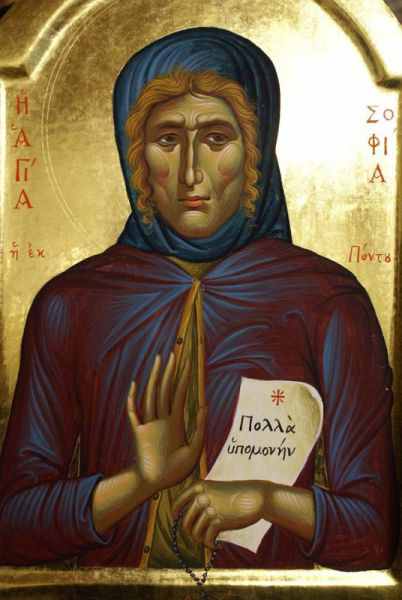
Selected hymns to St. Sophia the New of Kleisoura

St. Sophia the New of Kleisoura - Commemorated May 6 (http://vatopaidi.files.wordpress.com/2011/11/agia-sofia-kleisouras-02.jpg?w=780)
  
In honor of the official Patriarchal numbering among the Saints of St. Sophia the New (7/1/12), I post several hymns to the "Ascetic of the Panagia" below. For pictures from the recent visit of Patriarch Bartholomew to Kastoria and the Monastery of Kleisoura, see: http://www.romfea.gr/epikairotita/13044-patriarxiki-theia-litourgia-agiokatataxi-osias-sofias, http://www.romfea.gr/epikairotita/13048-2012-07-01-16-08-12. For the life of st. Sophia, see: http://full-of-grace-and-truth.blogspot.com/2011/11/st-sophia-righteous-ascetic-of-panagia.html. May she intercede for us all!
  
Selected hymns to St. Sophia the New of Kleisoura (amateur translations below)

Apolytikion in the Third Tone (amateur translations below)
O blessed mother Sophia, you became wise, and the adornment of the Mother of God, and you lived your life in the Monastery ascetically, from which have spread the praise of your struggles, striking the ranks of the demons. And as you stand as an intercessor before Christ, do not neglect those who honor you with fervor.


Kontakion in the Fourth Tone
You became a treasury of Divine wisdom and all-consuming fear [of God], O mother Sophia, through your motherly intercessions, O blessed one, you offer to all the richness of grace.


Megalynarion
Being made spiritually wise, O mother, you passed the whole of your life in utter patience, and now you are made to dwell in the beauty of your Bridegroom, in His bridal chamber.

Doxastikon of the Stichera in the Plagal of the Second Tone
Bearing the fear of God in your heart, which makes men wise, He guided your steps in fulfilling the divine commandments, O Sophia, most-radiant vessel of election, for you loved the Lord above all, and your neighbor along with Him, serving each of those whom you saw with pleasing words and deeds. You therefore gladdened God and men through your asceticism, and your words of consolation, and you were made worthy of the endless joy of the heavens, of which may we who bless you, be made worthy to partake.
  
Doxastikon of the Aposticha in the Plagal of the Fourth Tone
Rejoice in the Lord, O enclosed monastery of Kleisoura, for you possess an intercessor, who recently dwelt in you, the Ascetical Mother Sophia, the heavenly-minded one. As we venerate the container of her all-holy relics, which you protect as an all-precious joy in your arms, we cry out in contrition: O refuge of the faithful in storms, and free healer of sicknessess, hasten to deliver your monastery in dangers, and all your entreaters, as a speedy protector of all, and a fervent intercessor towards the Lord.
  
St. Sophia of Kleisoura (source)
   
Additional Kontakion in the Plagal of the Fourth Tone
She who struggled in asceticism above nature in Kleisoura, and endured the frost as one without flesh, remaining in the courtyard of this Monastery, passing the nights of her life in reading and prayer, let us praise the divine Sophia, and cry out with fervor: Hail, O great Ascetic
  
Oikos
Angels beholding your spotless asceticism, were amazed, O godly-minded Sophia, and the choirs of the faithful of Macedonia together with the people of Pontos wonder at your humility and nepsis, O Mother, and cry out to you in contrition:
Hail, teacher of repentance,
Hail, projector of chastity.
Hail, dweller of the Monastery of Kleisoura,
Hail, most-radiant lamp of divine grace.
Hail, lighthouse of simplicity, and spotless life,
Hail, lamp of humility, and prayer of the heart.
Hail, vessel of the wisdom of God adorned with gold,
Hail, type of His sympathy.
Hail, protection against fleshly desires,
Hail, container of the love of Christ.
Hail, she who had no place to lay her head of earth,
Hail, spring, pouring forth grace.
Hail, O great Ascetic.
  
Synaxarion
On the sixth of this month (May), the Memory of our Righteous and God-bearing Mother Sophia, who lived in asceticism recently in the Monastery of Panagia of Kleisoura, in a God-loving manner.
  
Verses
You were made wise by grace, O divine Sophia,
Sophia recently struggled in asceticism in Kleisoura.
  
Doxastikon of the Praises in the Plagal of the First Tone
She who was bent over as an Ascetic in Kleisoura, but was straight as a cypress in godly wisdom, Sophia who is worthy to be praised, let us bless with boldness, for she put off the evil burden, and her soul then approached the ramparts of heaven, where she ever offers glory to Christ. Therefore, having grown to a height in virtue that cannot be seen, she was made worthy to partake of the food from the tree of life, of which she entreats Christ that we also partake, in the eternal blessedness.

Taken from the full service to the Saint in Greek here: http://voutsinasilias.blogspot.com/2012/05/6.html.
  
  
Through the prayers of our Holy Fathers, Lord Jesus Christ our God, have mercy on us and save us! Amen!

Friday, June 29, 2012

Excerpt from the homily on Sts. Peter and Paul, by St. John Chrysostom


Sts. Peter and Paul, the glorious chiefs of the Apostles - Commemorated June 29 (souce)
  
Excerpt from St. John Chrysostom's homily: "On the chiefs of the apostles Peter and Paul, and on their most-glorious martyrdom" (amateur translation)
I behold heaven and earth in contest today, for this present feast of the memory of the apostles, with the heavenly powers preciously praising their pained voice of teaching, through which was made known to the world the mystery, as Paul cries out: “So that through the church the manifold wisdom of God might now be made known to the rulers and authorities in the heavenly places. (Ephesians 3:10)”, while men on earth rush to rightly praise and show honor to the chiefs, through whom they have entered into salvation. For how was Peter great? How was Paul equal? Through their works and words they conquered all creation in the heavens and upon earth. For though the clay of their bodies was covered with wounds, they were found greater than the angels. What, therefore, shall I say towards those teachers of the creation above and below? I will not find a proper word to honor those who honored our people, who passed through the whole earth and sea, and uprooted the roots of sins, and sowed the seeds of piety in the hearts of disobedient men.
  
Peter, the teacher of the apostles; Paul, who is known to the world, and who partakes with the powers above. Peter, the bridle of the ungrateful Judeans; Paul, the entreaty for the nations. And I see the surpassing wisdom of the Master, for Peter was chosen from among fishermen, while Paul from the maker of tents, and He did this for our benefit. For he drowned the glory of the Judeans. Because of this, to the fisherman, the Lord said: “Go to the shore, and cast out your hook, and the first fish you find, open its mouth, and you will find a coin.” By sea, I take it to mean the lawless judgment of the Judeans. By hook, the crafted word of preaching. By fish, He symbolizes the law. Regarding the opening of its mouth, He speaks of its explanation. To find a coin in it, He means to spiritually examine it. While Paul was used as a tent-maker for the nations, that they who were naked, through the law and grace, might be clothed with the red covering that was dyed in the water and blood of the Master. Therefore, the Master cries to him: “Go forth, therefore, for I send you to the far away nations.” O blessed dyad, in which the souls of the whole world have believed! Peter, the beginning of orthodoxy, the great revealer of the Church, the needed counselor of Christians, the treasure of the powers from above, the apostle honored by the Master. Paul, the great preacher of the truth, the boast of the world, the man in heaven, and angel upon the earth, the glory of the Church, the eagle that soars in the heights, the lyre of the Spirit, the swallow and cicada (τέττιξ), the Master’s organ, the speedy servant of Christ. Paul and Peter, the yoked oxen of the Church, who passed through the world well in things, taking up the cross instead of a yoke, instead of a driver the Savior, instead of a furrow laid down the Scriptures, instead of the plow the grace of the Holy Spirit. Paul and Peter, who daily gladden the Church, the Master’s treasuries, the inns of the world, the receptacles of the Spirit, those who explain the Holy Trinity, those who relate the economy of the divine word. Peter, my spiritual love; Paul, the vessel of election, and my staff. Peter, the temple of God; Paul, the mouth of Christ, the lyre of the Spirit, a man of three cubits and who reaches the heavens; who is outlined in place, and outlines the Master of all for the world; who proceeded from Jerusalem and around as far as Illyricum fulfilling the Gospel of Christ; the long-distance runner, the eagle who reaches heaven; he who fulfills divine grace, he who witnessed for the Lord, bearing His name before the whole world; the three-floored building leading to heaven, and entering paradise, and reaching the Master, and incomprehensible throne that ascends, and he who hears unspeakable mysteries, which cannot be spoken of by man.
(http://khazarzar.skeptik.net/pgm/PG_Migne/John%20Chrysostom_PG%2047-64/In%20Petrum%20et%20Paulum.pdf)
  
Through the prayers of our Holy Fathers, Lord Jesus Christ our God, have mercy on us and save us! Amen!

Tuesday, June 26, 2012

St. Sampson the Innkeeper and Unmercenary

St. Sampson the Innkeeper - Commemorated on June 27 (http://pravicon.com/images/sv/s1830/s1830010.jpg)
  
Saint Sampson the Hospitable was the son of rich and illustrious Roman parents. In his youth he received an excellent education, he studied the medical arts, and doctored the sick without charge. After the death of his parents St Sampson generously distributed alms and set his slaves free, preparing himself to go into the wilderness.

With this intent in mind he soon journeyed from Rome to the East. But the Lord directed him onto a different path, that of service to neighbor, and so St Sampson came to Constantinople. Settling into a small house, the saint began to take in homeless wanderers, the poor and the sick, and he attended to them. The Lord blessed the efforts of St Sampson and endowed him with the power of wonderworking. He healed the sick not only through being a skilled physician, but also as a bearer of the grace of God. [St. Sampson is numbered with the Holy Unmercenary Saints.] News of St Sampson spread abroad. The patriarch heard of his great virtue and ordained him to the holy priesthood.

It was revealed to the grievously ill Emperor Justinian (527-565), that he could receive healing only through St Sampson. In praying, the saint put his hand on the afflicted area, and Justinian was healed. In gratitude the emperor wanted to reward his healer with silver and gold, but the saint refused and instead asked Justinian to build a home for the poor and the sick. The emperor readily fulfilled his request.

St Sampson devoted the rest of his life to serving his neighbor. He survived into old age and after a short illness he departed peacefully to the Lord. The saint was buried at the church of the holy Martyr Mocius, and many healings were effected at his grave. His hospice remained open, and the saint did not cease to care for the suffering. He appeared twice to a negligent worker of the hospice and upbraided him for his laziness. At the request of an admirer of St Sampson the hospice was transformed into a church, and beside it a new edifice was built for the homeless. During the time of a powerful fire at Constantinople the flames did not touch the hospice of St Sampson. Through his intercession a heavy rain quenched the fire.
(http://oca.org/FeastSaintsViewer.asp?SID=4&ID=1&FSID=101828)
  
See also: http://www.johnsanidopoulos.com/2010/06/st-sampson-hospitable-founder-of.html.
  
St. Sampson the Innkeeper and Unmercenary (http://pravicon.com/images/sv/s1830/s1830001.jpg)
  
Troparion - Tone 8
Through your patience, your unceasing prayer, your love for the poor and the help you gave to them, you became worthy of your reward, O holy Sampson. Intercede with Christ God that He may save our souls.

Kontakion - Tone 8
We honor your relics, for you are an excellent physician and powerful intercessor; as we gather to praise you with psalms and hymns, divinely-wise and venerable Sampson, we glorify Christ, who granted you the grace of healing.


Through the prayers of our Holy Fathers, Lord Jesus Christ our God, have mercy on us and save us! Amen!

Monday, June 25, 2012

St. David of Thessaloniki the Dendrite

St. David of Thessaloniki the Dendrite - Commemorated June 26 (http://findingthewaytotheheart.blogspot.com/search/label/St%20David%20of%20Thessaloniki)
  
"With David of old art thou now united, O new David; for thou didst kill the carnal passions like Goliath. On the twenty-sixth, David passed through the gates of life."


The earliest written chronicle of the life of Saint David comes from his contemporary, Saint John Moschos, in his Leimonarion or Spiritual Meadow. Saint John together with his disciple and companion Sophronios the Sophist travelled to Egypt in order to record the great deeds and wise sayings of the Desert Fathers from the monastic authorities of the desert of the late 6th or early 7th century. He records how he met Abba Palladios in Alexandria and tells us the following:
We went to the same Abba Palladios with this request: "Of your charity, tell us, father, where you came from, and how it came about that you embraced the monastic life". He was from Thessalonika, he said, and then he told us this: "In my home country, about three stadia beyond the city wall, there was a recluse, a native of Mesopotamia whose name was David. He was a man of outstanding virtue, merciful and continent. He spent about twenty years in his place of confinement. Now at this time, because of the barbarians, the walls of the city were patrolled at night by soldiers. One night those who were on guard-duty at that stretch of the city-walls nearest to where the elder's place of confinement was located, saw fire pouring from the windows of the recluse's cell. The soldiers thought the barbarians must have set the elder's cell on fire; but when they went out in the morning, to their amazement, they found the elder unharmed and his cell unburned. Again the following night they saw fire, the same way as before, in the elder's cell - and this went on for a long time. The occurrence became known to all the city and throughout the countryside. Many people would come and keep vigil at the wall all night long in order to see the fire, which continued to appear until the elder died. As this phenomenon did not merely appear once or twice but was often seen, I said to myself: 'If God so glorifies his servants in this world, how much more so in the world to come when He shines upon their face like the sun?' This, my children, is why I embraced the monastic life."


Abba Palladios goes on to speak of another monk from Mesopotamia known as Adolas the Recluse. Saint John writes:
The elder also told us this: that after Abba David, there came to Thessalonika another monk, also from Mesopotamia, whose name was Adolas. He confined himself in a hollow plane tree in another part of the city. He made a little window in the tree through which he could talk with people who came to see him. When the barbarians came and laid waste all the countryside, they happened to pass by that place. One of the barbarians noticed the elder looking down at them. He drew his sword and raised his arm to strike the elder, but he remained there rooted to the spot with his hand stuck up in the air. When the rest of the barbarians saw this, they were amazed and, falling down before him, they besought the elder [to restore their comrad]. The elder offered a prayer and healed him and thus he dismissed them in peace.
  
From what we can tell from all the historical sources, including his biography written by an anonymous author of Thessaloniki between 715-720, Saint David was probably born in Mesopotamia around the year 450 AD and died in Thessaloniki sometime between 535 and 541. We don't know why either David or Adolas traveled from Mesopotamia to Thessaloniki, but both the Synaxarion of Constantinople and the Menologion of Emperor Basil II assure us that he did come from somewhere in the "east".

In Thessaloniki David became a monk at the Monastery of Sts. Theodore and Mercurius, otherwise known as Koukouliaton (Κουκουλιατῶν) Monastery, at a young age between the years 465-470. It was known as Koukouliaton because the monks wore cloaks for which it was known and which is depicted in the icons of the Saint. In fact in January of 1944 a marble slab was found in the Jewish cemetery that depicted an icon of Saint David dating back to the 10th century in which he is wearing a cloak with the hood hanging off his shoulders.

We are told that the Monastery of Sts. Theodore and Mercurius was next to the walls of the city at the gate known as Aproiton. We are further informed that there was another monastery next to this one known as Aproiton Monastery, though it is possible it could have been another name for the same monastery. The word "Aproiton" probably indicates the austere rule of the monasteries since it implies that the monks were not allowed to leave their monastery. This gate was probably located along the northern wall of the city to the west of the Acropolis which the Turks called during Ottoman times Eski Delik. It is believed that outside this gate along the wall was the Monastery of Sts. Theodore and Mercurius where Saint David lived a monastic life. Others say the monastery was northeast of the Acropolis in an area known as the Garden of the Sheep, but this seems implausible since the Aproiton is too far west for this to be considered. However we still are not sure where the gate known as Aproiton was actually located for sure. To complicate matters further in locating the actual place of this monastery, one biography tells us that the monastery could be seen from the beach. If this is true, then the monastery would most likely have to be within the city walls to the west of the Acropolis along the northern wall.
St. David of Thessaloniki, depicted with St. Symeon the Stylite (http://pravicon.com/images/sv/s0589/s0589001.jpg)
  
At the Monastery of Sts. Theodore and Mercurius Saint David lived a life of prayer, fasting, vigils, humility, meditation of the sacred Scripture and the cultivation of all the virtues. When the abbot of the monastery passed away, the monks of the monastery found David alone worthy to replace him due to his spiritual gifts. However David refused this honor, and instead decided to live his ascetic ordeals by climbing up an almond tree to the right of the church (the katholikon of the monastery) and living up there for three years. One source tells us that this tree was in between two churches within the monastery. For three years this Saint endured the most extreme trials like the Stylite Saints (some say he endured more because the tree offered him no rest due to its constant swaying in the high winds), enduring the bitter cold of the winter and the burning heat of the summer and fully exposed to all the elements of the weather.

It should be noted that although Saint David was the first ascetic known as a "dendrite" (one who lives in trees) in Thessaloniki followed by Adolas (for whom there is no other historical source other than John Moschos), this type of asceticism was practiced in places like Syria and Mesopotamia from which both David and Adolas came from (see the life of Saint Maro the Dendrite celebrated February 4th). Interesting studies concerning dendrites can be read here and here. The latest dendrite I know of was Saint Joseph the Hesychast who in the 1920's lived in Athens and would pray sitting in a tree in imitation of the Saints. Furthermore, an interesting comparison of trees was depicted in the Church of Chora in Constantinople in the fourteenth century in which Saint David is shown at the entrance to the funeral chapel, and is positioned equidistant between Christ Calling Zaccheus (who had climbed a tree in order to see Christ as he passed through Jericho) and Moses before the Burning Bush. In each, we witness an encounter with the divine – Old Testament, New Testament, Roman Empire.

When those three difficult years passed, after instruction was given to him by an angel of the Lord to live in silence in a cell and he was foretold by this same angel that he would "accomplish one other act of love" before he died, Saint David came down from the almond tree and entered a cell that had been prepared by his disciples. Saint David entered his cell in the presence of Archbishop Dorotheos of Thessaloniki (c.497-c.520) along with many pious clergy and faithful who gathered to see this momentous event when the news had spread. John Moschos informs us that this cell existed outside the walls of the city "about three stadia beyond the city wall", that is, a little more than 555 meters beyond the wall no doubt very near his monastery. From the fact that Archbishop Dorotheos was present at this event, we can ascertain that Saint David entered his cell sometime within the first two decades of the sixth century.

Living as a recluse in his cell and for his unparalleled ascetic feats, this Saint was considered as an angel of God by the people. Many people came to seek his prayers and many healings of demonic possession, diseases and suffering are reported. We can assume it was during this time that the extraordinary events reported by John Moschos took place.
  
One such miracle that is reported bears an amazing resemblance to the account of St. John Moschos. We are told a certain youth had a demon and he came to the cell of the Righteous David crying out: "Release me, O David, thou servant of the eternal God, for fire comes forth from your cell and burns me." Upon hearing this David reached out his hand from his cell through a small window and held the youth, saying: "Our Lord Jesus Christ, the Son of the living God, commands you to go forth from His creature, O unclean spirit!" After doing the sign of the Cross over the youth, the demon was immediately released and all marvelled glorifying God who glorifies those who please Him with God-pleasing works.
Saint David's silence was interrupted sometime after 520 when Archbishop Dorotheos died. His successor, Archbishop Aristeides, together with a multitude of clergy and faithful came to the Saint's cell pleading that he travel to Constantinople so as to entreat Emperor Justinian (527-565) regarding the establishment of Justiniana Prima as the new capital of the Prefecture of Illyricum replacing Thessaloniki. Archbishop Aristeides was against this, since it would demote the status of Thessaloniki and divide Illyricum. Aristeides could not travel to Constantinople because he did not want to leave the city shepherdless with the impending threats of the barbarians.

From 318-379 Sirmium was capital of the Prefecture of Illyricum which encompassed Pannonia, Noricum, Crete, and the whole Balkan peninsula except Thrace. Since 379 Thessaloniki became the capital of the Prefecture of Illyricum. Justiniana Prima was built in 535 in Serbia at the place of Justinian's birth. Justinian's novel 11 announced the imminent transfer of the Illyrian prefecture to Justiniana Prima and the establishment of an archbishopric there making it the metropolis of Illyricum. Thus Eastern Illyricum was to be divided into two ecclesiastical regions under Justinian's law: the southern part belonged to the Archbishop of Thessaloniki and the northern was given autocephalous status under the Archbishop of Justiniana Prima. This was done in order to better protect the northern territories against the barbarians on the other side of the Danube.

David submitted to the pleadings of the Archbishop and the people of Thessaloniki in order to fulfill the prophesy of the angel that appeared to him while on the tree and out of obedience to the bishop and the love of the people of Thessaloniki. After many years of seclusion he emerged from his cell and saw the sun for the first time in many years. His appearance had changed as well. His hair had grown to his lower back and his beard fell all the way down to his feet. Together with his two disciples, Theodore and Demetrios, they left during the night for Constantinople.
  
  
When they arrived in Constantinople his fame preceeded him and he was received with much reverence by the people of Byzantium and was especially well received with much respect and reverence by Empress Theodora who had him escorted into the palace and given hospitality as if he was an angel in the flesh. Justinian was occupied with other matters when he arrived, but was awe-struck at his holy appearance when he finally saw him the next day and listened to his case before the Senate. Before David spoke however the following miracle occurred leaving everyone astonished: David took a piece of live coal with incense in his bare hands and together with his disciples censed the Emperor and the entire Senate and his hand did not burn though he was praying and blessing for about an hour. After this David pleaded the case of Archbishop Aristeides, and Justinian submitted to his wishes so that the status of Thessaloniki remained uninterrupted. Though historians mention the fact that this division of Illyricum never actually took place, they tend to leave out the fact that this was because of the great impression Saint David had on Emperor Justinian.

The Saint returned by ship from Constantinople to Thessaloniki. However, when he arrived at Thermes at a place called Emvolos (about 126 stadia from the Saint's cell), he gave up his spirit to the Lord after making his request known to his disciples that he be buried at his monastery. The ship continued on to the port of Thessaloniki, but a strong wind escorted them as if by divine providence and landed at the spot where Sts. Theodoulos and Agathopodus were martyred on the west side of the city. Upon hearing the news of his falling asleep, the Archbishop with a large crowd gathered to pay their last respects and by procession lead him up to the Monastery of Sts. Theodore and Mercurius where his relics were enshrined in a wooden coffin according to his wishes.

About 150 years after the Saint's death, in 685-690, the abbot of the monastery Demetrios opened his tomb in order to receive a portion of his relics. In doing so however, the plaque on the tomb fell and broke into many pieces. This was seen by the abbot as a sign that it was not the wishes of Saint David for his relics to be portioned. A monk under Demetrios by the name of Sergius eventually became Archbishop of Thessaloniki. He was present when as a monk they had tried opening the tomb of the Saint. Honoring this occurrence, Sergius opened the tomb which emitted a beautiful fragrance from the incorrupt relics and took care to only remove some hair from the beard and head of the Saint in order to distribute to the faithful to increase their faith and help aid in their salvation.

The tomb of the Saint remained undisturbed until the Fourth Crusade in 1204. In 1236 it was taken by Crusaders to Pavia, Italy and from there transferred to Milan in 1967. Finally on September 16, 1978 through the efforts of Metropolitan Panteleimon of Thessaloniki, the sacred relics of Saint David were triumphantly returned to Thessaloniki and housed in the Basilica of Saint Demetrios the Great Martyr. To celebrate this feast a Service was written by the renowned hymnographer Elder Gerasimos Mikragiannanitis. Eventually the relics were transferred to the katholikon of the Monastery of Saint Theodora in the middle of Thessaloniki in a chapel surrounded by icons of the Saint's life.
  
The Holy Relics of St. David, treasured by the Monastery of St. Theodora, Thessaloniki (http://pravoslavie.ks.ua/rubric/svyatyni-gretsii/article/saloniki)
  
It should be pointed out here that the current Monastery of Hosios David in Thessaloniki has no association with the life of the Saint nor is it the site of the Monastery of Sts. Theodore and Mercurious. This is however the oldest monastery in Thessaloniki (only the katholikon currently exists) and in Roman times was known as the Monastery of the Prophet Ezekiel (some say Zachariah) though more popularly known as Latomou Monastery. The mosaics inside are the oldest in the city dating back to approximately the 5th-6th century, especially magnificent being the depiction of a beardless Christ flanked by the prophets Ezekiel and Hakkakuk along with a vision of Ezekiel of Christ surrounded by the symbols of the four Gospels (the angel, eagle, lion, and bull). This monastery was not named after Saint David until 1921 when it was returned to the Orthodox after serving as a mosque since 1430. Interestingly the faithful had the mosaic of the vision of the Prophet Ezekiel covered in mortar (some say the Turks simply white-washed it) all those centuries so that the Turks would not destroy it as was their custom. During the days of Iconoclasm it was covered in ox-skin to be protected. Its existence was lost to history after 1430 until discovered in 1921.

For more on the Latomou Monastery as well as the sources for the life of Saint David, see here and here (Greek only). For a translation of the life in English, see here. For the 8th century life of Saint David, see A. Vasiliev, ‘Life of David of Thessalonica’, Traditio: Studies in Ancient Medieval History, Thought and Religion 4 [1946], pp. 115-147.
  
  
Apolytikion in the Plagal of the Fourth Tone
The image of God, was faithfully preserved in you, O Father. For you took up the Cross and followed Christ. By Your actions you taught us to look beyond the flesh for it passes, rather to be concerned about the soul which is immortal. Wherefore, O Holy David, your soul rejoices with the angels.

Kontakion in the Second Tone
An Angel on earth, and stranger to all earthly things, thou madest a tree thy dwelling like an eagle's nest, whence, O David, thou didst soar up to Heaven, where thou didst find that Tree which in Eden we lost of old. Remember us all, who keep thy memory.
  
Through the prayers of our Holy Fathers, Lord Jesus Christ our God, have mercy on us and save us! Amen!

Tuesday, June 19, 2012

St. Paisios the Great

St. Paisios the Great - Commemorated on June 19 (http://pravicon.com/images/sv/s1647/s1647002.jpg)
  
St Paisius the Great lived in Egypt. His parents, Christians, distributed generous alms to all the needy.

After the death of her husband his mother, on the suggestion of an angel, gave her young son Paisius to the clergy of the church.

The youth Paisius loved monastic life and spent his time in one of the Egyptian sketes. Renouncing his own will, he lived under the spiritual guidance of St Pambo (July 18), finishing all the tasks assigned him. The Elder said that a new monk in particular needs to preserve his sight, in order to guard his senses from temptation. Paisius, heeding the instruction, went for three years with his eyes cast downwards. The saintly ascetic read spiritual books, and he was known for his ascetic fasting and prayer. At first he did not eat any food for a week, then two weeks. Sometimes, after partaking of the Holy Mysteries of Christ, he survived without food for seventy days.

St Paisius went into the Nitrian desert in search of solitude. There he lived in a cave carved out by his own hands. The saint was granted a wondrous vision: the Lord Jesus Christ revealed to him that through his labors the Nitrian wilderness would become inhabited by ascetics. He asked the Lord where the monks would obtain the necessities of life in the desert. The Lord said that if they would fulfill all His commandments, He Himself would provide all their necessities, and would deliver them from demonic temptations and cunning.
St. Paisios the Great (Icon courtesy of www.eikonografos.com used with permission)
  
In time, a number of monks and laymen gathered around St Paisius, and a monastery was established. The most important rule of St Paisius was that no one would do anything by his own will, but in all things would fulfill the will of his elders.

Since his tranquility was being disturbed by so many people, the saint withdrew to another cave farther away. Once, he was transported to a paradisical monastery and partook of the immaterial divine food. After his ascetic labors for salvation, the Lord granted His saint the gift of prescience and healing the souls of men.

One of his disciples, with the saint's blessing, went to sell his handicrafts in Egypt. On the way he encountered a Jew, who told the simple-minded monk that Christ the Savior is not the Messiah, and that another Messiah will come. Confused, the monk said, "Maybe what you say is true," but he did not attribute any particular significance to his words. When he returned, he saw that St Paisius would not acknowledge his arrival, and he asked the reason for his anger. The saint said, "My disciple was a Christian. You are not a Christian, for the grace of Baptism has departed from you." The monk repented with tears, and begged to have his sin forgiven. Only then did the holy Elder pray and ask the Lord to forgive the monk.

A certain monk on his own initiative left the desert and moved near a city. There he had encounters with a woman, who hated and blasphemed Christ the Savior. Under her influence, he not only left the monastery, but also scorned faith in Christ, and finally he reached a state of total disbelief.

Once, through the blessed Providence of God, Nitrian monks came by his home. Seeing them, the sinner remembered his own former life and he asked the monks to ask St Paisius to pray for him to the Lord. On hearing the request, the saint prayed fervently, and his prayer was heard. The Lord, appearing to His saint, promised to forgive the sinner. Soon the seduced monk's woman companion died, and he returned to the desert where, weeping and distressed for his sins, he began to labor at deeds of repentance.

  
St Paisius distinguished himself by his great humility, and performed ascetic deeds of fasting and prayer, but he concealed them from others as far as possible. When the monks asked which virtue is the highest of all, the saint replied, "Those which are done in secret, and about which no one knows."

St Paisius died in the fifth century at a great old age, and he was buried by the monks. After some time his relics were transferred by St Isidore of Pelusium (February 4) to his own monastery and placed beside the relics of his friend St Paul, with whom St Paisius was particularly close during his life.
(http://oca.org/FeastSaintsViewer.asp?SID=4&ID=1&FSID=101755)
  
  
Troparion - Tone 4
The sublime monk and incarnate angel, the bodiless man and citizen of heaven, as he celebrates with us today, grants grace to all who honor him. Let us fervently magnify him!

Kontakion - Tone 8
Let us, the faithful, sing praises to divinely–wise Paisius, the desert's adornment, equal–to–the–angels, Christ's friend and the glory of monks. Let us cry to him: Rejoice, O Father Paisius!
(http://oca.org/FStropars.asp?SID=13&ID=101755)
  
  
Through the prayers of our Holy Fathers, Lord Jesus Christ our God, have mercy on us and save us! Amen!