Wednesday, September 21, 2011

The Holy Prophet Jonah

The Holy Prophet Jonah - Commemorated on September 21 (Greek) / 22 (Russian) (http://pravicon.com/images/sv/s1018/s1018006.jpg)

The Holy Prophet Jonah lived in the eighth century before the birth of Christ and was a successor of the Prophet Elisha.

[It is said that he was that son of the widow of Zarephath in Sidon whom the Prophet Elias had raised from the dead. (http://www.westsrbdio.org/prolog/prolog.htm)]

The Book of the Prophet Jonah contains prophecies about the judgments on the Israelite nation, the sufferings of the Savior, the downfall of Jerusalem, and the end of the world. Besides the prophecies, the Book of Jonah relates how he was sent to the Ninevites to preach repentance (Jon. 3: 3-10).

Icon depicting Jonah fleeing from the Lord on the ship, being thrown overboard, being disgorged by the sea beast, and preaching repentance to the people of Ninevah. Note that the full story is read annually in the Vespers of Holy Saturday (http://anastasis.org.uk/HWSat-V.htm) (http://pravicon.com/images/sv/s1018/s1018009.jpg)

Our Lord Jesus Christ, addressing the Scribes and the Pharisees who demanded a sign from Him, said that no sign would be given except for the sign of the Prophet Jonah, "As Jonah was in the belly of the whale three days and three nights, so also shall the Son of Man be in the heart of the earth three days and three nights (Mt. 12: 40). From these words the Lord shows clearly the symbolic meaning of the Book of the Prophet Jonah in relation to Christ's death on the Cross, descent into Hell, and the Resurrection.

Reproaching the lack of penitence and recalcitrance of the Jews, the Lord said, "The Ninevites shall rise in the judgment with this generation and will condemn it, because they repented at the preaching of Jonah; and one greater than Jonah is here" (Mt. 12: 41).
(http://ocafs.oca.org/FeastSaintsViewer.asp?SID=4&ID=1&FSID=102696)

Prophet Jonah being disgorged by the sea beast, prefiguring Christ's Third-Day Resurrection (http://pravicon.com/images/sv/s1018/s1018007.jpg)

HYMN OF PRAISE
by St. Nikolai Velimirovitch

The Holy Prophet Jonah
Nineveh! Nineveh resounds with sin,
And God sends Jonah to heal Nineveh.
Jonah does not want to, and flees from God!
Oh, where will you go, Jonah, to hide from the Most High?
Jonah sleeps; he sleeps and the tempest rises.
God moves slowly, but He will find you in time.
Hurled into the waves, swallowed by the whale,
``From whom did I flee?'' Jonah asks himself.
``I fled from Him, from Whom one cannot hide!''
God chastises Jonah and yet delivers him,
And, by His providence, glorifies him forever.
Jonah, you do not want to speak to the Ninevites,
But through your punishment you will prophesy the immortal Christ.
You do not want to by words? Then you must, by deeds,
Prophesy Christ and the death and resurrection of the body!
Your deeds, Jonah, will not fade away,
And Christ the Lord will speak of you to men,
That, through you, the mercy of the Living God might be revealed,
By which you will be saved, as well as Nineveh.
Through you, the power of repentance shall be revealed-
The power of repentance and God's forgiveness.
You pitied the gourd, and God pitied men.
Help us to repent, O God, and save us from condemnation.

Prophet Jonah being spit up by the sea beast, and being protected by the shade of the plant.
"And God said to Jonas: Are you then so very grieved over the gourd [which withered in the sun]? And he said: I am very grieved, even to death. And the Lord said: You had pity for the gourd, for which you had suffered no evil, nor did you rear it; it came into being before night, and perished before night. And I, shall I not have pity for Nineve the great city..." (Fourth Reading of the Vespers of Holy Saturday (http://anastasis.org.uk/HWSat-V.htm)) (http://pravicon.com/images/sv/s1018/s1018003.jpg)

Troparion - Tone 2
The memory of your Prophet Jonah, we celebrate today, O Lord. By his prayers we entreat you: O Christ God, save our souls!


Through the prayers of our Holy Fathers, Lord Jesus Christ our God, have mercy on us and save us! Amen!
Thursday, September 15, 2011

St. Niketas the Great Martyr, the Goth

St. Niketas the Great Martyr, the Goth - Commemorated on September 15 (http://pravicon.com/images/sv/s1523/s1523006.jpg)

"The Holy Great Martyr Nicetas was a Goth (a Germanic tribe). He was born and lived on the banks of the Danube River, and suffered for Christ in the year 372. The Christian Faith was then already widely spread throughout the territory of the Goths. St Nicetas believed in Christ and accepted Baptism from the Gothic bishop Theophilus, a participant in the First Ecumenical Council. Pagan Goths began to oppose the spread of Christianity, which resulted in internecine strife.

After the victory of Fritigern, heading a Christian army and inflicting defeat on the pagan Athanaric, the Christian Faith began to spread increasingly among the Goths. The Arian bishop Ulfilas, the successor to Bishop Theophilus, created a Gothic alphabet and translated into the Gothic language many priestly books. St Nicetas worked intensely among his fellow Goths at spreading Christianity. By his personal example and inspired words he brought many pagans to the Christian Faith.

However, after his defeat Athanaric again contrived to gather his own forces, return to his own country and regain his former power. Since he remained a pagan, he continued to hate Christians and persecute them.


[When the Gothic prince Athenarik began to torture Christians, St. Nicetas stood before the prince and denounced him for his paganism and inhumanity. Subsequently harshly tortured, Nicetas confessed his faith in Christ even more strongly, and prayed to God with thanksgiving. His mind was unceasingly raised up to God, and on his breast under his robe he bore an icon of the Most-holy Theotokos with the Pre-eternal Christ Child standing and holding the Cross in His hands. St. Nicetas carried this icon because the Holy Theotokos had appeared to him and comforted him. (http://www.westsrbdio.org/prolog/prolog.htm)]

St Nicetas endured many tortures, and died after being thrown into a fire. His body remained unharmed by the fire and was illumined by a miraculous light. By night, a friend of the martyr, a Christian named Marianus, retrieved the body of St Nicetas,and buried it in Cilicia. Afterwards, it was transferred to Constantinople. Part of the relics of the Great Martyr Nicetas were later transferred to the monastery of Vysokie Dechani in Serbia. St Nicetas received an unfading crown of glory from Christ in the year 372.

We pray to St Nicetas for the preservation of children from birth defects."
(http://ocafs.oca.org/FeastSaintsViewer.asp?SID=4&ID=1&FSID=102615)

The Martyrdom of St. Niketas the Great Martyr (http://pravicon.com/images/sv/s1523/s1523003.jpg)

HYMN OF PRAISE
The Holy Martyr Nicetas
by St. Nikolai Velimirovitch
He is a true patriot who, among his own people,
Erects a true altar to the Living Lord.
Athenarik the Goth ruled by force,
And offered sacrifices to lifeless idols.
But holy Nicetas, the soldier of Christ God,
Was a preacher of eternal salvation.
He cast rays of the Eternal Light throughout the night,
Dispersing the idolatrous darkness that shrouded souls.
Holy Nicetas opposed the prince,
And his brave endurance amazed his people.
By the power of the Honorable Cross, he confounded the darkness
And filled all the people with the fear of God.
His blood was the rosy hue of the new dawn,
And his spirit was raised up to the heavenly courts.
In the terrible fire, Nicetas burned,
But, not even today, has he been consumed.
With the truth of Christ the Goths were baptized,
And they glorified Nicetas, their wonderful one.
O Saint Nicetas, voice of God's trumpet,
Courageous martyr, true patriot;
From the tents of the earth you have departed,
And you stand in the royal courts with the angels.
Pray for us, for the King listens to you,
That He grant our souls mercy.


Troparion - Tone 3
You defeated error and triumphed in martyrdom, Nicetas, namesake of victory; for you conquered the ranks of the enemy and ended your contest by fire. Pray to Christ our God to grant us His great mercy.

Kontakion - Tone 2
You stood firm and defeated delusion and have received your martyr's crown, Nicetas, namesake of victory; you are rejoicing with the angels, together with them you are praying unceasingly to Christ God for us all.


Through the prayers of our Holy Fathers, Lord Jesus Christ our God, have mercy on us and save us! Amen!


Wednesday, September 14, 2011

On the Holy Cross, by St. John Chrysostom

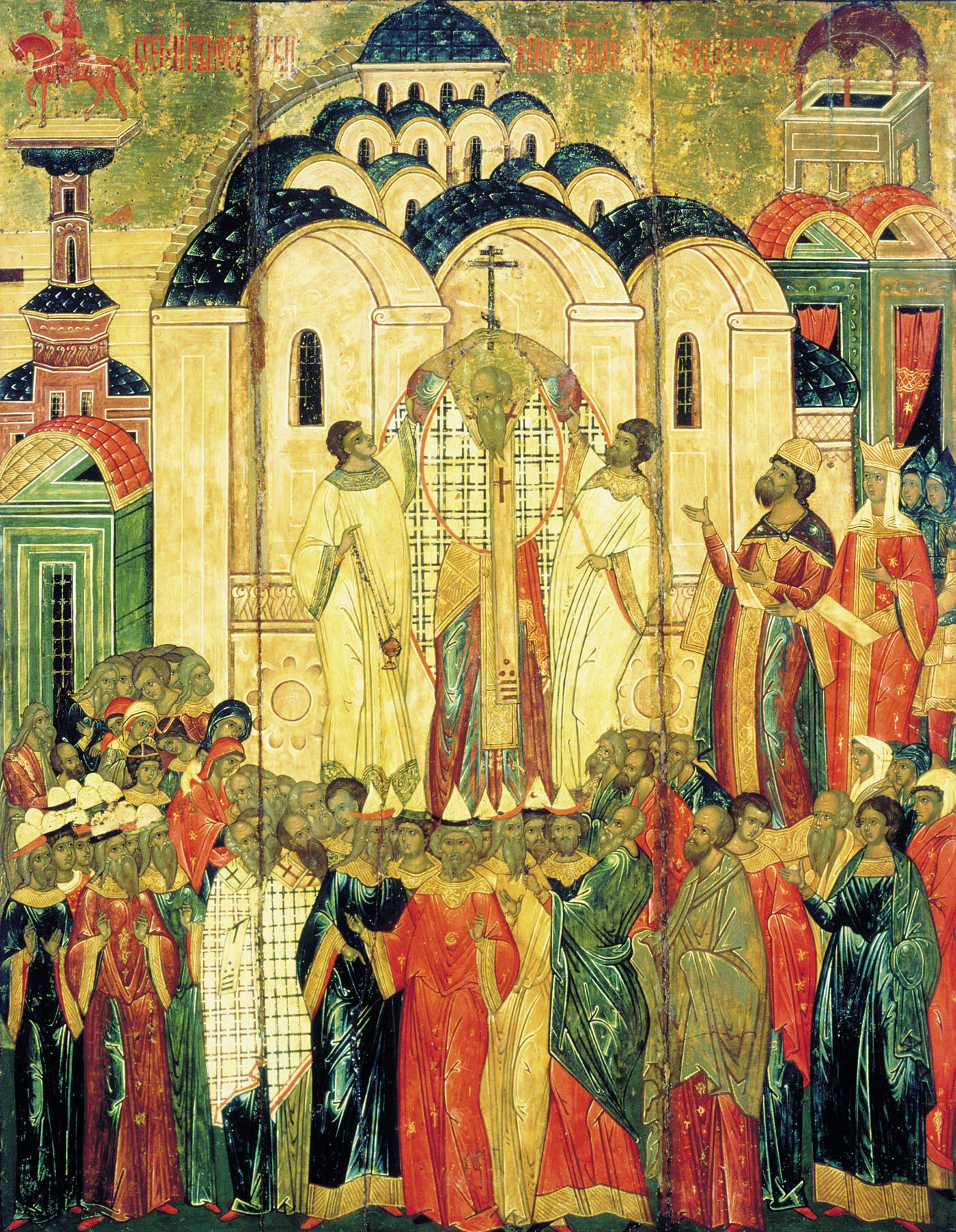
The Elevation of the Precious Cross of Christ (http://www.belygorod.ru/img2/Ikona/Used/232Vozdvijenie_krestaXVIGTG.jpg)

On the Holy Cross, attributed to St. John Chrysostom
Let us consider of what great blessings for us Christ's Cross has become the cause. For though the Lord's Cross sounds sad and bitter, it is in reality full of joy and radiance. For the Cross is the salvation of the Church; the Cross is the boast of those who hope in it; the Cross is reconciliation of enemies to God and conversion of sinners to Christ. For through the Cross we have been delivered from enmity, and through the Cross we have been joined in friendship to God. Through the Cross we have been freed from the tyranny of the devil, and through the Cross we have been delivered from death and destruction. 'When the Cross was not proclaimed, we were held fast by death; now the, Cross is proclaimed, and we have. come to despise death, as though it did not exist, while we have come to long for everlasting life. 'When the Cross was not proclaimed, we were strangers to paradise; but when the Cross appeared, at once a thief was found worthy of paradise. From such darkness the human race has crossed over to infinite light; from death it has been called to everlasting life, from corruption it has been renewed for incorruption. For the eyes of the heart are no longer covered by the darkness that comes through ignorance, but through the Cross they are flooded with the light of knowledge. The ears of the deaf are no longer shut by unbelief, for the deaf have heard the word of the Lord, and the blind have recovered their sight to see the glory of God. These are the gifts we are given through the Cross. What blessing has not been achieved for us through the Cross?
The Cross is proclaimed, and faith in God is confessed and truth prevails in the whole inhabited world. The Cross is proclaimed, and martyrs are revealed and confession of Christ prevails. The Cross is proclaimed, and the resurrection is revealed, life is made manifest, the kingdom of heaven is assured. The Cross has become the cause of all these things, and through the Cross we have been taught to sing. What then is more precious than the Cross? What more profitable for our souls? So let us not be ashamed to name the Cross, but let us confess it with total confidence.
Christ is hung upon the Cross, and the devil has become a corpse. Christ has been stretched on the Cross, and a standard of salvation has been given to the world. Christ has been nailed to the Cross, and every soul has been released from bonds. Christ has been fixed to the Cross, and all creation has been set free from the slavery of corruption. Christ has breathed his last on the Cross, and a new marvel has been shown to the world; for the sun's light is darkened. This what a prophetic saying cries out, "And it shall come to pass in that day, says the Lord, that the sun will set at midday, and the light will become dark in the daytime, and I will change all your feasts into grief and all your songs into laments" [Amos 8:9]. Do you see, beloved, how great a mystery the prophetic saying holds? For here the deeds of both are intimated: I mean of the Jews, who are under the law, and of the nations, who are outside the law, who both practice iniquity. For those who feast according to the law will grieve as they celebrate their feasts, and instead of songs, they make lamentations over Jerusalem. For Jerusalem will no longer hold solemn rites, and no feast will be celebrated in it. While pagan nations will mourn, making confession for their sins, and mourning is cause of blessedness. For scripture says, "Blessed are those who mourn, for they will be comforted" [Matthew 5:4]. They will mourn, then, over their empty feasts and lawless songs that they performed for the unclean demons. Take note then today how a pagan, repenting for the evil things he has done, laments and says with the prophet, "We have erred and strayed in our shame, and our sins have covered us, for we have been filled with our impiety. We have acknowledged the iniquities of our fathers". So then let us too lament and mourn for the evils that have been laid to our charge; let us cling to the Cross, placing all our hopes on the Cross, so that taught through the Cross, fixing our thought on heaven, being brought close to Christ our Saviour, we may be found worthy to be near God in the kingdom of heaven, in Christ our Lord himself, to whom be glory and might to the ages of ages. Amen.
Translation of text by permission of copyright © of the Very Rev. Archimandrite of the Oecumenical Throne Ephrem Lash. www.anastasis.org.uk. This appeared originally in Light of Christ, Newsletter of the Orthodox Church of St. John the Baptist and St. Anthony, London. (http://www.orthodox-christian-comment.co.uk/properofseason-exaltation_of_the_holy_cross.htm)

Through the prayers of our Holy Fathers, Lord Jesus Christ our God, have mercy on us and save us! Amen!

Sunday, September 11, 2011

Greek philosophers foreshadowing Christ

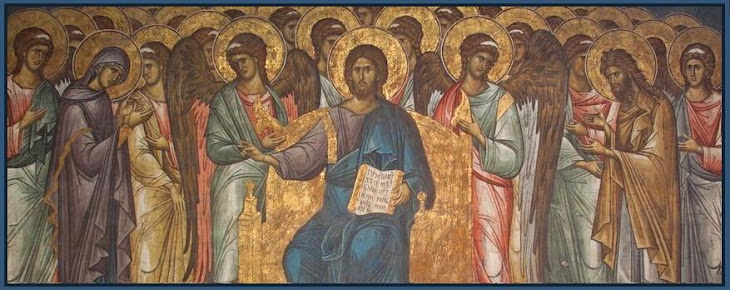
Jesus Christ: "This is the King of Glory", along with St. Paul the Apostle, and St. Justin the Martyr and Philosopher (https://picasaweb.google.com/118177000525429425765/IIcpoB?authkey=Gv1sRgCNLM1Jm-noCQtwE#5647155839515995266)

As outlined by numerous Fathers of the Church, Christ was the expectation of all the nations, and as such, many of the writings from disperate cultures throughout the world tell of and indicate the great Redeemer of the whole world Who was to come: Jesus Christ.

Many of the philosophers of ancient Greece seem to point towards Christ in their writings, and thus many Greeks were primed, in a certain sense, to accept the teachings of Christ's apostles. The picture above is part of a series of icons from the Great Meteora Monastery that depict St. Paul and St. Justin the Philosopher leading Greeks to Christ while citing Greek Philosophy. On either side are depicted many ancient Greek philosophers, and quotes from their writings that seem to point to Christ. (It is worth noting that they put a small fence around these icons, most likely that they might not be venerated like icons of the Saints.)

These are newly-painted icons, but they are by no means out of tradition. The "Hermenia" or Painter's Manual by Monk Dionysios of Fourna mentions the names, descriptions and quotes of such philosophers. The Monasteries of Megiste Lavra and Vatopedi on Mount Athos (as examples) also have depictions of such philosophers.

We can see vividly how God works to lead all nations to the Truth. Though their examples pale in comparison to the love, grace and sacrifice of Christ and His Saints, these philosophers help us understand the human condition, and how our longing can only be satiated by Christ.

The following Greek quotes from the depicted philosophers are from http://enaskitis.blogspot.com/2011/09/blog-post.html, along with my own amateur translations. If you have any suggestions for better translations, or can provide a documented translation or a citation from the philosophers' original writings, please share.

,

“Η Έλληνίς Σίβυλλα η φιλόσοφος” : “Ήξει ουρανόθεν βασιλεύς αιώνων ο μέλλων κρίναι πάσαν σάρκα και κόσμον άπαντα”.
The Greek Sybil, the Philosopher: "The eternal king has come from heaven, who will judge all flesh and the whole world."

For more on the Sybil of Erythrae foreshadowing Christ, see: http://full-of-grace-and-truth.blogspot.com/2010/01/sibyl-of-erythrae-and-prophetic.html.

“Ο Έλλην Σόλων ο σοφός και νομοθέτης” : “Ήν δ’ αυτός τώι αυτοπάτορι απάτωρ τρισόλβιος ός [sic: ως] τι φως τριλαμπές ο δε παθών Θεός εστι και ου θεότης πάθεν όστις φως γαρ, βροτόσωμος αυτός Θεός ήδη και ανήρ πάντως φέρων εν θνητοίς”.
The Greek Solon, the Wise and Law-giver: "Being himself the fatherless father, thrice-praised and thrice-radiant as the light, it is God who suffers and not godhead which suffers, who therefore is light, this mortal-body is God, and man always bringing among mortals.

“Ο Έλλην Πυθαγόρας ο φιλόσοφος και μαθηματικός” : “Ο Θεός εστιν νους και λόγος και πνεύμα και λόγος [bis] σαρκωθείς εκ Πατρός”.
The Greek Pythagoras, the Philosopher and Mathematician: "God is nous and word and spirit and word incarnate from the Father."

“O Έλλην Σωκράτης ο φιλόσοφος” : “Και το όνομα αυτού αυξηθήσεται και τιμηθήσεται υπό πάντων εφ’ όλην την οικουμένην”.
The Greek Socrates the Philosopher: "And his name will be increased and honored by all throughout the world."


“Ο Έλλην Απολλώνιος ο φιλόσοφος” : “Ένα Θεόν ύψιστον εν τρισίν λέγω, ός ουρανόν έρξεν άμα και χθόνα, Θεός ήν μεν αεί και εστίν και έσται ούτε αρξάμενος, ούτε παυσόμενος”.
The Greek Apollon, the Philosopher: "I speak of one God exalted in three, who created heaven and earth, God ever was and is and will be, neither changed, nor ceasing."

“Ο Έλλην Όμηρος ο ποιητής” : “Ήξει προς ημάς οψέ γης άναξ απλούς και σάρκα φανείται δίχα τινός σφάλματος”.
The Greek Homer, the Poet: "He came towards us, later on earth, simple in beginning, and appears in flesh without any error."

“Ο Έλλην Θουκυδίδης ο ιστορικός” : “Ου Θεός έτερος ουκ άγγελος ου δαίμων ου σοφία ουκ ουσία αλλ’ ή μόνος Κύριός εστι δημιουργός τού παντός τών απάντων παντέλειος Λόγος”
The Greek Thucydides, the Historian: "Not another God, nor angel, nor demon, nor wisom, nor any thing else in essence, but the Lord alone is creator of all, the all-perfect Word of all things."

“Ο Έλλην Αριστοτέλης ο φιλόσοφος” : “Οψέποτέ τις επί την πολυσχεδή ταύτην ελάσειεν επί [bis] γην δίχα σφάλματος γενήσεται σαρξ ακάματος φύσει Θεός γέννησις εξ αυτού γαρ ο αυτός ουσιούται Λόγος”.
The Greek Aristotle, the Philosopher: "Never before among the many on earth was seen one without error, he will be born flesh from the ceaseless nature of God, and from him is born the essential Word."
“Ο Έλλην Πλάτων ο φιλόσοφος” : “Εκ μητρονύμφου παναμώμου παρθένου μέλλει σπαρήναι του Θεού μόνος γόνος. Άσαρκον, σαρκικόν και γεννητόν εν γήι τέτοκεν τον ουρανού και γης ποιητήν”.
The Greek Plato, the Philosopher: "From the all-pure virgin mother-bride will be born the sole child of God. The fleshless one becomes flesh and is born on earth, he who is the creator of heaven and earth."

“Ο Έλλην Πλούταρχος, ο πατήρ της ιστορίας”: “Καταγγέλλω εν τρισίν ένα μόνον υψιμέδοντα Θεόν, ού λόγος άφθιτος εν αδαεί κόρηι έγκυμος έσεται [sic]. Ούτος γαρ ως τόξον πυρφόρον ίσος διαδραμείται και κόσμον άπαντα ζωγρήσει και τώι Πατρί προσάξει δώρον”.
The Greek Plutarch, the father of histories: "I proclaim in three one sole exalted-ruler God, the endless word within an innocent pregnant girl. For as a fire-bearing bow he spans, and gives life to all the world, and is offered as a gift to the Father."

St. Justin the Martyr and Philosopher, along with Homer the Historian (http://enaskitis.blogspot.com/2011/09/blog-post.html)

Through the prayers of our Holy Fathers, Lord Jesus Christ our God, have mercy on us and save us! Amen!

Monday, September 5, 2011

Sts. Raphael, Nicholas and Irene heal a recent case of acute leukemia

The Monastery of Sts. Raphael, Nicholas and Irene the Newly-revealed, Goumenissa (https://lh6.googleusercontent.com/-VFL-DDWG7NY/R88jB08fP7I/AAAAAAAAHSY/pyAK8B5QObQ/IMG_1527.jpg)

Sts. Raphael, Nicholas and Irene heal a modern case of acute leukemia (amateur translation)
P. Zoupides (Kallithea, Alexandroupolis) writes: At Pascha in 2003, our only child Joanna (then 4 years old), got sick with a high feaver and otitis. With two doses of strong antibiotics, her body's defenses fell. On May 23rd, she woke us up crying, doubled [in pain] on her bed. After countless tests, they sent us to the Hospital, and from there to Thessaloniki or Athens, because only there could they do a myelogram. On June 2nd we entered the Hematology-Oncology center of AHEPA. Terrible was the sight of so many children there! They drew countless blood and in the end, they did a myelogram. The next day, Director-Professor Fani Athanasiadou told us that our child had dual type acute lymphoblastic leukemia, of T, but primarily B cells, a rare presentation. She would have to be admitted, start chemotherapy, which she probably wouldn't have been able to take...

We were admitted. The very first day, our child told us:
“Daddy, I saw the Papouli [term of endearment for a clergyman].”

“Which Papouli?”

“I saw Papouli Nicholas.”

“Which Nicholas?”

“St. Nicholas. He was wearing black clothes, and he told me, Daddy, that you should go to the Monastery to bring me a small icon of St. Raphael to put above my head, below the icon of Christouli [Christ], there...he is making me well.” At that point she raised her hands and pointed to the icon of Christ that was nailed to the wall above her head.

My God, what things were going through our minds! A unique experience: from sorrow to come joy, from agony, strength, from a tear, faith, and from pain, hope.

It is worth noting that these were words from a four-year-old child, who had never heard of Saints till that point. And furthermore, my mother and I had St. Nicholas [of Myra] as our sole protector.

We ran from excitement to the street and began to ask who was that Saint, and where is that Monastery nearby.

And oh, how great are the signs of God! In the room next door (no. 7) was a sick three-year-old blessed boy (like an angel) Vasilaki, whom the doctors had diagnosed with a tumor on his nose one day before, and who was beginning treatments.

His parents immediately explained that their aunt obviously knew of the monastery of St. Raphael in Griva, Goumenissa, and with great faith they told her:
“Don't let anyone bother the child until I go to the Monastery and bring back holy oil and holy water to cross him with.”

That is what happened. Their aunt went to the Monastery of Griva, entreated the Saints from her soul, and took a bottle of holy oil and holy water. When she reached the hospital, she crossed the child with holy oil and gave him holy water to drink. At the same time, she also read the supplication service to the Saints [Raphael, Nicholas and Irene].

The next morning they resumed their endless tests on the boy, and they all came back negative. The child was totally clear, there was no tumor anywhere. At the hour when the parents and aunt of the child in room 7 were rejoicing, at that instant, my mother was leaving room 6 and almost fell down, seeing them dance from their joy. They told her the miracle of the Saint to their boy, and she called me to hear with my own ears and to tell us to go to this monastery ourselves. The boy's father made a map of the path from Thessaloniki to Griva, and we said our goodbyes.

Without a second discussion, we left with my mother for the monastery. When we got there around 3:30PM, we saw a monk, to whom we explained our little girl's state. He took us to the small church where they have the relics of the Saints and began to read the Paraklesis. Until that moment, none of us could understand what exactly was going on, where and how we got there.

And soon the answer to the mystery was revealed. During the Paraklesis, we heard them commemorate Sts. Raphael, Nicholas and Irene. I turned to stare at my mother. I lifted up my eyes and gazed upon the icon of the three Saints, and began to read their names. Then I understood that: “the Papouli Nicholas” which my daughter mentioned was the Saint from St. Raphael's group, the Saint which none of us knew, though it is clear that he knew us, and sent his intercessions. We burst into tears. We who are so unworthy, were granted to experience such a miracle. We embraced and kissed the all-sacred relics of the Saints, crying, and as our tears fell, we entreated the Saints to help our child in these difficult hours which she was going through, in which we could do nothing but simply watch.

Then the monk gave us holy oil and holy water to cross our daughter with, and urged us to have three Divine Liturgies done in Joanna's name, to go to Holy Confession, and to take Holy Communion, if we could. And of course he mentioned that it would be good, if possible, to go venerate at the place of martyrdom of the Saints on the island of Mytilene.

My child was rescued from certain death by a miracle of the Saints (an extensive description and pictures of the child were recently sent to the monastery).
(http://www.orthodoxia-ellhnismos.gr/2011/09/blog-post_8081.html#more)
 
Through the prayers of our Holy Fathers, Lord Jesus Christ our God, have mercy on us and save us! Amen!

Sunday, September 4, 2011

Homily of St. John Chrysostom on St. Babylas the Hieromartyr

The Martyrdom of the Holy Hieromartyr Babylas - Commemorated September 4th (http://saintlukecolumbia.org/storage/icons/04_vavilas.jpg?__SQUARESPACE_CACHEVERSION=1264281263845)
  
Homily of St. John Chrysostom on St. Babylas the Hieromartyr
1. I was anxious today to pay the debt which I promised you when I was lately here. But what am I to do? In the meanwhile, the blessed Babylas has appeared, and has called me to himself, uttering no voice, but attracting our attention by the brightness of his countenance. Be not, therefore, displeased at the delay in my payment; at all events, the longer the time is, the more the interest will increase. For we will deposit this money with interest. Luke 19:23 Since thus did the master command who entrusted it to us. Being confident, therefore, about what is lent, that both the principal and the profit await you, let us not pass by the gain which falls in our way today, but revel in the noble actions of the blessed Babylas.
How, indeed, he presided over the Church which is among us, and saved that sacred ship, in storm, and in wave, and billow; and what a bold front he showed to the emperor, and how he lay down his life for the sheep and underwent that blessed slaughter; these things and such as these, we will leave to the elder among our teachers, and to our common father, to speak of. For the more remote matters, the aged can relate to you but as many things as happened lately, and within our lifetime, these, I a young man will relate to you, I mean those after death, those after the burial of the martyr, those which happened while he remained in the suburbs of the city. And I know indeed that the Greeks will laugh at my promise, if I promise to speak of the noble deeds after death and burial of one who was buried, and had crumbled to dust. We shall not assuredly on this account keep silence, but on this very account shall especially speak, in order that by showing this marvel truly, we may turn their laughter upon their own head. For of an ordinary man there would be no noble deeds after death. But of a martyr, many and great deeds, not in order that he might become more illustrious (for he has no need of glory from the multitude), but that thou, the unbeliever may learn that the death of the martyrs is not death, but the beginning of a better life, and the prelude of a more spiritual conversation, and a change from the worse to the better. Do not then look at the fact, that the mere body of the martyr lies destitute of energy of soul; but observe this, that a greater power takes its place by the side of it, different from the soul itself—I mean the grace of the Holy Spirit, which pleads to all on behalf of the resurrection, by means of the wonders which it works. For if God has granted greater power to bodies dead and crumbled to dust, than to all living, much more will he grant to them a better life than the former, and a longer, at the time of the bestowal of his crowns; what then are this saint's noble deeds? But be not disturbed, if we take our discourse a little further back. For they who wish to display their portraits to advantage, do not uncover them until they have placed the spectators a little way off from the picture, making the view clearer by the distance. Do you then also have patience with me while I direct my discourse into the past.
  
For when Julian who surpassed all in impiety, ascended the imperial throne, and grasped the despotic sceptre, straightway he lifted up his hands against the God who created him, and ignored his benefactor, and looking from the earth beneath to the heavens, howled after the manner of mad dogs, who alike bay at those who do not feed them and those who do feed them. But he rather was mad with a more savage madness than theirs. For they indeed turn from, and hate their friends and strangers alike. But this man used to fawn upon demons, strangers to his salvation, and used to worship them with every mode of worship. But his benefactor, and Saviour, and him who spared not the only Begotten, for his sake, he turned from and used to hate, and made havoc of the cross, the very thing which uplifted the whole world when it was lying prostrate, and drove away the darkness on all sides, and brought in light more brilliant than the sunbeams; nor yet even then did he desist from his frenzy, but promised that he would tear the nation of the Galilæans, out of the midst of the world; for thus he was wont to call us; and yet if he thought the names of the Christians an abomination, and Christianity itself to be full of much shame, for what reason did he not desire to put us to shame by that means, but with a strange name? Yea because he knew clearly, that to be called by what belongs to Christ, is a great ornament not only to men, but to angels, and to the powers above. On this account he set everything in motion, so as to strip us of this ornament, and put a stop to the preaching of it. But this was impossible, O wretched and miserable man! as it was impossible to destroy the heaven and to quench the sun, and to shake and cast down the foundations of the earth, and those things Christ foretold, thus saying: "Heaven and earth shall pass away, but my words shall not pass away." Matthew 24:35.
  
Well, thou dost not submit to Christ's words; accept therefore the utterance which thus his deeds give. For I indeed having been privileged to know what the declaration of God is, how strong, how invincible a thing, have believed that is more trustworthy than the order of nature, and than experience in all matters. But do thou still creeping on the ground, and agitated with the investigations of human reasoning, receive the witness of the deeds. I gainsay nothing. I strive not.
  
2. What then do the deeds say? Christ said that it was easier for heaven and earth to be destroyed, than for any of his words to fail. Luke 16:17 The emperor contradicted these words, and threatened to destroy his decrees. Where then is the emperor who threatened these things? He is perished and is corrupted, and is now in Hades, awaiting the inevitable punishment. But where is Christ who uttered these decrees? In Heaven, on the right hand of the Father, occupying the highest throne of glory; where are the blasphemous words of the Emperor, and his unchastened tongue? They are become ashes, and dust and the food of worms. Where is the sentence of Christ? It shines forth by the very truth of the deed, receiving its lustre from the issue of the events, as from a golden column. And yet the emperor left nothing undone, when about to raise war against us, but used to call prophets together, and summon sorcerers, and everything was full of demons and evil spirits.
  
What then was the return for this worship? The overturning of cities, the bitterest famine of all famines. For you know doubtless, and remember, how empty indeed the market place was of wares, and the workshops full of confusion, when everyone strove to snatch up what came first and to depart. And why do I speak of famine, when the very fountains of waters were failing, fountains which by the abundance of their stream, used to eclipse the rivers. But since I have mentioned the fountains, come, forthwith, let us go up to Daphne, and conduct our discourse to the noble deeds of the martyr. Although you desire me still to parade the indecencies of the Greeks, although I too desire this, let us abstain; for wherever the commemoration of a martyr is, there certainly also is the shame of the Greeks. This emperor then, going up to Daphne used to weary Apollo, praying, supplicating, entreating, so that the events of the future might be foretold to him. What then did the prophet, the great God of the Greeks? "The dead prevent me from uttering," says he, "but break open the graves, dig up the bones, move the dead." What could be more impious than these commands? The Demon of grave-robbing, introduces strange laws and devises new methods of expelling strangers. Who ever heard of the dead being driven forth? who ever saw lifeless bodies ordered to be moved as he commanded, overturning from their foundations the common laws of nature. For the laws of nature are common to all men, that he who departs this life should be hidden in the earth, and delivered over for burial, and be covered up in the bosom of the earth the mother of all; and these laws, neither Greek, barbarian, Scythian, nor if there be any more savage than they, ever changed, but all reverence them, and keep them, and thus they are sacred and venerated by all. But the Demon raises his mask, and with bare head, resists the common laws of nature. For the dead, he says, are a pollution. The dead are not a pollution, a most wicked demon, but a wicked intention is an abomination. But if one must say something startling, the bodies of the living full of evil, are more polluting than those of the dead. For the one minister to the behests of the mind, but the other lie unmoved. Now that which is unmoved, and destitute of all perception would be free from all accusation. Not that I even would say that the bodies of the living are by nature polluting; but that everywhere a wicked and perverted intention is open to accusations from all.
  
The dead body then is not a pollution O Apollo, but to persecute a maiden who wishes to be modest, and to outrage the dignity of a virgin, and to lament at the failure of the shameless deed, this is worthy of accusation, and punishment. There were at all events, many wonderful and great prophets among ourselves, who spoke also many things concerning the future, and they in no case used to bid those who asked them to dig up the bones of the departed. Yea Ezekiel standing near the bones themselves was not only not hindered by them, but added flesh, and nerves and skin to them, and brought them back to life again. Ezekiel xxxvii But the great Moses did not stand near the bones of the dead, but bearing off the whole dead body of Joseph, thus foretold things to come. Exodus 13:19 And very reasonably, for their words were the grace of the Holy Spirit. But the words of these, a deceit, and a lie which is no wise able to be concealed. For that these things were an excuse, and pretence and that he feared the blessed Babylas, is manifest from what the emperor did. For leaving all the other dead, he only moved that martyr. And yet if he did these things, in disgust at him, and not in fear, it were necessary that he should order the coffin to be broken, thrown into the sea, carried to the desert, be made to disappear by some other method of destruction; for this is the part of one who is disgusted. Thus God did when he spoke to the Hebrews about the abominations of the Gentiles. He bade their statues to be broken, not to bring their abominations from the suburbs to the city.
  
3. The martyr then was moved, but the demon not even then enjoyed freedom from fear, but straightway learned that it is possible to move the bones of a martyr, but not to escape his hands. For as soon as the coffin was drawn into the city, a thunderbolt came from above upon the head of his image, and burnt it all up. And yet, if not before, then at least there was likelihood that the impious emperor would be angry, and that he would send forth his anger against the testimony of the martyr. But not even then did he dare, so great fear possessed him. But although he saw that the burning was intolerable, and knew the cause accurately; he kept quiet. And this is not only wonderful that he did not destroy the testimony, but that he not even dared to put the roof on to the temple again. For he knew, he knew, that the stroke was divinely sent, and he feared lest by forming any further plan, he should call down that fire upon his own head. On this account he endured to see the shrine of Apollo brought to so great desolation; For there was no other cause, on account of which he did not rectify that which had happened, but fear alone. For which reason he unwillingly kept quiet, and knowing this left as much reproach to the demon, as distinction to the martyr. For the walls are now standing, instead of trophies, uttering a voice clearer than a trumpet. To those in Daphne, to those in the city, to those who arrive from far off, to those who are with us, to those men which shall be hereafter, they declare everything by their appearance, the wrestling, the struggle, the victory of the martyr. For it is likely that he who dwells far off from the suburb, when he sees the chapel of the saint deprived of a shrine, and the temple of Apollo deprived of its roof would ask the reason of each of these things; and then after learning the whole history would depart hence. Such are the noble deeds of the martyr after death, wherefore I count your city blessed, that you have shown much zeal about this holy man. For then, when he returned from Daphne, all our city poured forth into the road, and the market places were empty of men, and the houses were empty of women, and the bedchambers were destitute of maidens. Thus also every age and each sex passed forth from the city, as if to receive a father long absent who was returning from sojourn far away. And you indeed gave him back to the band of fellow enthusiasts. But the grace of God did not suffer him to remain there for good, but again removed him beyond the river, so that many parts of the country were filled with the sweet savor of the martyr. Neither even when he came hither was he destined to be alone, but he quickly received, a neighbor, and a fellow-lodger, and one of similar life.*** For he shared with him the same dignity, and for the sake of religion showed forth equal boldness. Wherefore he obtained the same abode as he, this wonderful man being no vain imitator, as it seems, of the martyr. For for so long a time he laboured there, sending letters continually to the emperor, wearying the authorities, and bringing the ministry of the body to bear upon the martyr. For you know, doubtless, and remember that when the midday summer sun possessed the heaven, he together with his acquaintances, used to walk thither everyday, not as spectator only, but also, as intending to be a sharer in what was going on. For he often handled stone, and dragged a rope, and listened, in advance of the workmen themselves, to one who wanted to erect any building. For he knew, he knew what rewards lie in store for him for these things. And on this account he continued doing service to the martyrs, not only by splendid buildings nor even by continual feasts, but by a better method than these. And what is this? He imitates their life, emulates their courage, throughout according to his ability he keeps the image of the martyrs alive, in himself. For see, they gave their bodies to the slaughter, he has mortified the members of his flesh which are upon the earth. They stopped the flame of fire, he quenched the flame of lust. They fought against the teeth of beasts, but this man bore off the most dangerous of our passions, anger. For all these things let us give thanks to God, because he has thus granted us noble martyrs, and pastors worthy of martyrs, for the perfecting of the saints, for the edifying of the body of Christ Ephesians 4:12 with whom be glory, honor, and might to the Father, with the Holy and lifegiving Spirit, now and always, for ever and ever. Amen.
(http://66.37.140.35:3000/bible/fathers/1906.htm; note: a non-Orthodox source site)
  
***Note: One source says that the Sacred Chrysostom is referring to St. Meletios of Antioch (February 12), who helped build the church of St. Babylas, and after his death, was buried next to the Relics of the Hieromartyr. (http://www.ccel.org/ccel/schaff/npnf109.vii.iv.html; note: a non-Orthodox source site)


Through the prayers of our Holy Fathers, Lord Jesus Christ our God, have mercy on us and save us! Amen!

Saturday, September 3, 2011

The Translation of the Relics of St. Nektarios the Wonderworker, Bishop of Pentapolis

The Translation of the Relics of St. Nektarios the Wonderworker, Bishop of Pentapolis - Commemorated on September 3rd (http://agiooros.org/viewtopic.php?f=37&t=626)

Some years [after the blessed repose of St. Nektarios on the evening of November 8th 1920], as is the custom in Greece, his grave was opened to take the relics out. When they opened the grave [on September 2nd 1953], what should they see but that the Saint was whole [i.e. incorrupt] and fragrant. Not even his vestments had changed in any way. It was just as if he had fallen asleep and been buried that very day. They had not told the people of Aegina, because he had already worked many miracles and become very beloved, and a very large crowd would have gathered -- even from Athens and other places where he was known -- for the opening of his grave. So, early in the morning, as soon as they were finished with the Divine Liturgy, as it was dawning they went and began to open the grave. At the same time there was a taxi coming by on the road below the convent. Inside was a woman who had been to some resort place. She was not a woman of good repute, but of ill repute and many sins. As soon as they approached the Holy Trinity Convent, there was such a fragrance in the air that she told the driver, "Stop. What is that fragrance?" So he stopped and looked around. "Oh," he replied, "here is the convent of the Holy Nectarios. What else could such a fragrance be but that they are opening his grave today, and the fragrance is coming from the grave. For many times a fragrance came from his body before they buried him. And even from the grave it comes sometimes." Immediately she opened the door of the taxi and ran to go and see. She went up to the convent at the moment that they had opened the coffin and found the relics whole. She was very moved by this and by the fragrance, especially. She began to weep and publicly confess her sins. Thus she was corrected and became a prudent and Christian woman in her way of life. At that time they telegraphed to Athens to the Archbishop Chrysostom Papadopoulos, and he went to the island to see the relics for himself. After examining the relics, he irreverently counseled the nuns to leave the relics out in the sun and air for two or three days and then rebury him so that he would dissolve...The nuns, fearing the censure of the archbishop and also being simple, did as they were told. For two days they put him outside in the sun and air and then reburied him. But within a month or two they opened the grave a second time and took out the relics which were still whole and put them in a marble sarcophagus.

In 1934, fourteen years after the repose of the Saint, a doctor was coming from one of the villages on horseback and was caught in a very heavy rain in the area of the convent. He got down from his horse and went and stood under a tree. It was raining so hard that he saw it would not let up for a long time. Therefore, he decided that as there was nowhere else nearby, he might as well go to the convent. He had known holy Father Nectarios while he was living, but being a man who did not believe much in such things, he did not reverence the Father much. So he went and knocked at the convent and the nuns opened and put him up for the night. It was evening, and they would not keep any man inside the convent, even the priest of the convent, as it is forbidden by the canons, but they had a little place outside for guests. But as the gates of the convent had not yet closed, he wanted to investigate what he had heard about miracles and incorrupt relics now that he had come to the convent. So he went while it was still light to where the sarcophagus was outside of the church. He began to pull off the heavy marble slab which was on top, as it was not fastened in any manner. He pulled it down to the waist of the Saint. At that very moment a nun happened to come by, and she began to cry out, "What are you doing there? What are you doing, opening our Elder's grave?" And he replied, "I just wanted to take a look." "But you did not have permission," she insisted and began making a commotion. But in the meantime anyway, he investigated the relics. [Later he said, "I was very amazed to see that it was the Father Nectarios that we all knew. And that he could still be recognized from his face and expression. Even his beard was intact; I pulled at some of his beard, but it would not come out. I touched his hand and saw that it was skin. It had remained so well on the bones (there was not much flesh) and had not shriveled up. He could be recognized by anyone who had known him when he was alive."] Then they closed the marble sarcophagus right away.

By the will of God, years later the relics of the Saint dissolved***, and what we have now are his Holy bones. They have since been encased in the Saint’s mitre in Aegina. The top opened so one can kiss the crown of his head. The other parts of his relics, which have much fragrance, are located in a silver box.

[***Note: The following story illustrates why God permitted the dissolution of the Saint's incorrupt Relic:
"There was a rich old lady who had met Nektarios at the monastery and he was her confessor several times. She was now living in Piraeus alone, and cried both day and night over the fact that Nektarios' body had dissolved. She hoped that Nektarios' body would be eternally intact, like the relic of Saint Dionysios on her native island of Zakynthos. She thought that this would be a tribute to Orthodoxy. One night, the old woman saw Nektarios alive at her bedside. He smiled lovingly and sweetly at her. "Why are you so sad?" he asked her. "It was I who prayed to God to allow the decomposition of my body. I did this for all the pious Christians, for whose consolation the relics will now be able to be sent around Greece and around the world." The old woman awoke a bit shaken, but was nevertheless filled with gratitude at seeing her beloved confessor alive and speaking to her."
(from The Saint of our Century by Chondropoulos)]
He endured a life of calumnies, persecutions and false accusations. But God has glorified him, and miracles have abounded since his departure for those who approach his relics with faith or who rely on his powerful intercession. His body remained incorrupt for more that twenty years, distilling a delicate, heavenly scent, and then returned to the earth in the usual way. His relics were strongly redolent with the same perfume at the time of their translation in June 1953. This perfume has continued ever since to rejoice the faithful who come to venerate his precious relics with the assurance that Saint Nectarios has been received by God into the abode of the righteous. His veneration was formally recognized in 1961. The list of his miracles grows longer every day, and his shrine at Aegina has become a most popular place of pilgrimage in Greece.

(http://www.stnectarioschurch.org/StNectarios/stnectarios-bios_finalyears_english.htm)

Icon of St. Nektarios the Wonderworker, with scenes from his life; from the Saint's Monastery in Aegina (http://img.pathfinder.gr/clubs/images/39/39739/46.jpg)

Doxastikon of the Stichera in the Plagal of the Second Tone (Amateur translations below)
Glory to the Father and to the Son and to the Holy Spirit.
Today, as the lily of the field***, according to the divine word, your sacred bones shone from the tomb, O wonder-bearing father Nektarios. And they pour forth the fragrance from your graces, making glad the spiritual senses of the faithful, and driving away the stench of the passions. For by the grace of the Spirit, working through these, perform awesome things. For they are shown a divine hospital, and mercy seat for souls, and refuge of those in turmoil. Therefore at their uncovering, we praise and faithfully cry out to you: O most-fervent Healer of Christ, and righteous Hierarch, ceaselessly intercede, that those who bless you may be saved.

***"Consider the lilies of the field, how they grow; they neither toil nor spin; yet I tell you, even Solomon in all his glory was not arrayed like one of these." Matthew 6:28-29

Apolytikion in the First Tone
As we celebrate the uncovering of your Relics from your holy tomb, O Hierarch Nektarios, we are granted sanctification of bodies and souls and healing of all kinds of passions, for those who approach with reverance, and who cry out to your grace: glory to Him Who glorified you radiantly, glory to Him who sanctified you, glory to Him Who grants to us through you, healings for all.

Kontakion in the Fourth Tone
As we praise the uncovering of your sacred Relics from the tomb, O wonderworker Nektarios, in pious manner we cry to you: hail, you who were in all things equal to the Fathers.

Oikos
Filled with fragrance as the field, O Nektarios, were your holy Relics, as that with which formerly Isaac blessed Jacob***. You were wholly sanctified by your virtuous life of holiness, and were shown a chosen vessel, and equal to the former Saints and a communicant with them. For also the treasury of your holy Relics, as an ark of holiness is presented to all, by the illumination of the All-Holy Spirit, sanctifying those who approach, and healing all forms of illnesses, and granting renewal of repentance to souls fallen in sin. As we celebrate the sacred uncovering, we piously proclaim your wonders, and in pious manner we cry out to you: hail, you who were in all things equal to the Fathers.

***"“See, the smell of my son is as the smell of a field that the Lord has blessed!" Genesis 27:27

Synaxarion
On the third of this month (September), we celebrate the uncovering of the precious Relics of our father among the Saints, Nektarios Bishop of Pentapolis the Wonderworker, which occurred in the year of salvation 1953.

Verses
From the earth your Relics appeared, O Father,
Revealing to all the hidden grace.
On the third, the bones of Nektarios were revealed.

Doxastikon of the Praises in the Plagal of the Fourth Tone
Glory to the Father and to the Son and to the Holy Spirit.
O adornment of Archpriests, radiant with virtues in our days, you were shown forth, O hierarch Nektarios. Therefore the Church of Christ, taking refuge in your glory, as formerly Israel did with the body of Joseph***, the treasury of your Relics is processed with righteous honors, and is piously embraced. And those who receive the fruits of grace from them cry out to you, O Saint: as one who has boldness towards the Lord, ceaselessly intercede that we may keep the good confession spotlessly, and that our souls may be saved.

***"And Moses took the bones of Joseph with him: for he had straitly sworn the children of Israel, saying, God will surely visit you; and ye shall carry up my bones away hence with you." (Exodus 13:19)

Taken from the full service for the Uncovering of the Relics of St. Nektarios in Greek (written by Fr. Gerasimos), available here: http://analogion.gr/glt/texts/Sep/03b.uni.htm.

Through the prayers of our Holy Fathers, Lord Jesus Christ our God, have mercy on us and save us! Amen!