Christ is risen! Truly He is risen!
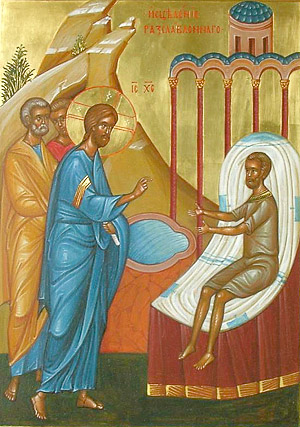
Christ healing the Paralytic by the Pool of Bethesda (source)
Homily XXXVII.
John v. 6, 7
“Jesus saith unto him, Wilt thou be
made whole? The impotent man answered Him, Yea, Sir, but I have no
man, when the water is troubled, to put me into the pool.”
[1.] Great is the profit of the divine
Scriptures, and all-sufficient is the aid which comes from them. And
Paul declared this when he said, “Whatsoever things were written
aforetime, were written aforetime for our admonition upon whom the
ends of the world are come, that we through patience and comfort of
the Scriptures might have hope.” ( Rom. xv. 4, 1 Cor. x. 11.) For
the divine oracles are a treasury of all manner of medicines, so that
whether it be needful to quench pride, to lull desire to sleep, to
tread under foot the love of money, to despise pain, to inspire
confidence, to gain patience, from them one may find abundant
resource. For what man of those who struggle with long poverty or who
are nailed to a grievous disease, will not, when he reads the
passage before us, receive much comfort? Since this man who had been
paralytic for thirty and eight years, and who saw each year others
delivered, and himself bound by his disease, not even so fell back
and despaired, though in truth not merely despondency for the past,
but also hopelessness for the future, was sufficient to
over-strain him. Hear now what he says, and learn the greatness of
his sufferings. For when Christ had said, “Wilt thou be made
whole?” “Yea, Lord,” he saith, “but I have no man, when the
water is troubled, to put me into the pool.” What can be more
pitiable than these words? What more sad than these circumstances?
Seest thou a heart crushed through long sickness? Seest thou all
violence subdued? He uttered no blasphemous word, nor such as we hear
the many use in reverses, he cursed not his day, he was not angry at
the question, nor did he say, “Art Thou come to make a mock and a
jest of us, that Thou asketh whether I desire to be made whole?”
but replied gently, and with great mildness, “Yea, Lord”; yet he
knew not who it was that asked him, nor that He would heal him, but
still he mildly relates all the circumstances and asks nothing
further, as though he were speaking to a physician, and desired
merely to tell the story of his sufferings. Perhaps he hoped that
Christ might be so far useful to him as to put him into the water,
and desired to attract Him by these words. What then saith Jesus?
Ver. 8. “Rise, take up thy bed, and
walk.”
Now some suppose that this is the man
in Matthew who was “lying on a bed” ( Matt. ix. 2 ); but it is
not so, as is clear in many ways. First, from his wanting persons to
stand forward for him. That man had many to care for and to carry
him, this man not a single one; wherefore he said, “I have no man.”
Secondly, from the manner of answering; the other uttered no word,
but this man relates his whole case. Thirdly, from the season and the
time; this man was healed at a feast, and on the Sabbath, that other
on a different day. The places too were different; one was cured in a
house, the other by the pool. The manner also of the cure was
altered; there Christ said, “Thy sins be forgiven thee,” but here He braced the body first,
and then cared for the soul. In that case there was remission of
sins, (for He saith, “Thy sins be forgiven thee,”) but in this,
warning and threats to strengthen the man for the future; “Sin no
more, lest a worse thing come unto thee.” ( Ver. 14.) The charges
also of the Jews are different; here they object to Jesus, His
working on the Sabbath, there they charge Him with blasphemy.
Consider now, I pray you, the exceeding
wisdom of God. He raised not up the man at once, but first maketh him
familiar by questioning, making way for the coming faith; nor doth He
only raise, but biddeth him “take up his bed,” so as to confirm
the miracle that had been wrought, and that none might suppose what
was done to be illusion or a piece of acting. For he would not,
unless his limbs had been firmly and thoroughly compacted, have been
able to carry his bed. And this Christ often doth, effectually
silencing those who would fain be insolent. So in the case of the
loaves, that no one might assert that the men had been merely satisfied, and that what was done was an illusion, He caused that
there should be many relics of the loaves. So to the leper that was
cleansed He said, “Go, show thyself to the priest” ( Matt. viii.
4 ); at once providing most certain proof of the cleansing, and
stopping the shameless mouths of those who asserted that He was
legislating in opposition to God. This also He did in like manner in
the case of the wine; for He did not merely show it to them, but also
caused it to be borne to the governor of the feast, in order that one
who knew nothing of what had been done, by his confession might bear
to Him unsuspected testimony; wherefore the Evangelist saith, that
the ruler of the feast “knew not whence it was,” thus showing the
impartiality of his testimony. And in another place, when He raised
the dead, He said, “Give ye him to eat”; supplying this proof
of a real resurrection, and by these means persuading even the
foolish that He was no deceiver, no dealer in illusions, but that
He had come for the salvation of the common nature of mankind.
[2.] But why did not Jesus require
faith of this man, as He did in the case of others, saying,
“Believest thou that I am able to do this?” It was because the
man did not yet clearly know who He was; and it is not before, but
after the working of miracles that He is seen so doing. For persons
who had beheld His power exerted on others would reasonably have this
said to them, while of those who had not yet learned who He was, but
who were to know afterwards by means of signs, it is after the
miracles that faith is required. And therefore Matthew doth not
introduce Christ as having said this at the beginning of His
miracles, but when He had healed many, to the two blind men only.
Observe however in this way the faith
of the paralytic. When he had heard, “Take up thy bed and walk,”
he did not mock, nor say, “What can this mean? An Angel cometh down
and troubleth the water, and healeth only one, and dost Thou, a man,
by a bare command and word hope to be able to do greater things than
Angels? This is mere vanity, boasting, mockery.” But he neither
said nor imagined anything like this, but at once he heard and arose,
and becoming whole, was not disobedient to Him that gave the
command; for immediately he was made whole, and “took up his
bed, and walked.” What followed was even far more admirable. That
he believed at first, when no one troubled him, was not so marvelous,
but that afterwards, when the Jews were full of madness and pressed
upon him on all sides, accusing and besieging him and saying, “It
is not lawful for thee to take up thy bed,” that then he gave no
heed to their madness, but most boldly in the midst of the
assembly proclaimed his Benefactor and silenced their shameless
tongues, this, I say, was an act of great courage. For when the Jews
arose against him, and said in a reproachful and insolent manner to
him,
Ver. 10. “It is the Sabbath day, it
is not lawful for thee to carry thy bed”; hear what he saith:
Ver. 11. “He that made me whole, the
Same said unto me, Take up thy bed, and walk.”
All but saying, “Ye are silly and mad
who bid me not to take Him for my Teacher who has delivered me from a
long and grievous malady, and not to obey whatever He may
command.” Had he chosen to act in an unfair manner, he might
have spoke differently, as thus, “I do not this of my own will, but
at the bidding of another; if this be a matter of blame, blame him
who gave the order, and I will set down the bed.” And he might have
concealed the cure, for he well knew that they were vexed not so much
at the breaking of the Sabbath, as at the curing of his infirmity.
Yet he neither concealed this, nor said that, nor asked for pardon,
but with loud voice confessed and proclaimed the benefit. Thus did
the paralytic; but consider how unfairly they acted. For they said not, “Who is it that hath made thee
whole?” on this point they were silent, but kept on bringing
forward the seeming transgression.
Ver. 12, 13. “What man is that which
said unto thee, Take up thy bed and walk? And he that was healed wist
not who it was: for Jesus had conveyed Himself away, a multitude
being in that place.”
And why did Jesus conceal Himself?
First, that while He was absent, the testimony of the man might be
unsuspected, for he who now felt himself whole was a credible witness
of the benefit. And in the next place, that He might not cause the
fury of the Jews to be yet more inflamed, for the very sight of one
whom they envy is wont to kindle not a small spark in malicious
persons. On this account He retired, and left the deed by itself to
plead its cause among them, that He might not say anything in person
respecting Himself, but that they might do so who had been healed,
and with them also the accusers. Even these last for a while testify
to the miracle, for they said not, “Wherefore hast thou commanded
these things to be done on the Sabbath day?” but, “Wherefore
doest thou these things on the Sabbath day?” not being displeased
at the transgression, but envious at the restoration of the
paralytic. Yet in respect of human labor, what the paralytic did was
rather a work, for the other was a saying and a word. Here then He
commandeth another to break the Sabbath, but elsewhere He doth the
same Himself, mixing clay and anointing a man’s eyes ( c. 9 ); yet
He doth these things not transgressing, but going beyond the Law. And
on this we shall hereafter speak. For He doth not, when accused by
the Jews respecting the Sabbath, always defend Himself in the same
terms, and this we must carefully observe.
[3.] But let us consider awhile how
great an evil is envy, how it disables the eyes of the soul to the
endangering his salvation who is possessed by it. For as madmen often
thrust their swords against their own bodies, so also malicious
persons looking only to one thing, the injury of him they envy,
care not for their own salvation. Men like these are worse than wild
beasts; they when wanting food, or having first been provoked by us,
arm themselves against us; but these men when they have received
kindness, have often repaid their benefactors as though they had
wronged them. Worse than wild beasts are they, like the devils, or
perhaps worse than even those; for they against us indeed have
unceasing hostility, but do not plot against those of their own
nature, (and so by this Jesus silenced the Jews when they said that
He cast out devils by Beelzebub,) but these men neither respect their
common nature, nor spare their own selves. For before they vex those
whom they envy they vex their own souls, filling them with all manner
of trouble and despondency, fruitlessly and in vain. For wherefore
grievest thou, O man, at the prosperity of thy neighbor? We ought to
grieve at the ills we suffer, not because we see others in good
repute. Wherefore this sin is stripped of all excuse. The fornicator
may allege his lust, the thief his poverty, the man-slayer his
passion, frigid excuses and unreasonable, still they have these to
allege. But what reason, tell me, wilt thou name? None other at all,
but that of intense wickedness. If we are commanded to love our
enemies, what punishment shall we suffer if we hate our very friends?
And if he who loveth those that love him will be in no better a state
than the heathen, what excuse, what palliation shall he have who
injures those that have done him no wrong? Hear Paul, what he saith,
“Though I give my body to be burned, and have not charity, it
profiteth me nothing” ( 1 Cor. xiii. 3 ); now it is clear to every
one that where envy and malice are, there charity is not. This
feeling is worse than fornication and adultery, for these go no
farther than him who doeth them, but the tyranny of envy hath
overturned entire Churches, and hath destroyed the whole world. Envy
is the mother of murder. Through this Cain slew Abel his brother;
through this Esau (would have slain) Jacob, and his brethren Joseph,
through this the devil all mankind. Thou indeed now killest not, but
thou dost many things worse than murder, desiring that thy brother
may act unseemly, laying snares for him on all sides, paralyzing his
labors on the side of virtue, grieving that he pleaseth the Master of
the world. Yet thou warrest not with thy brother, but with Him whom
he serves, Him thou insultest when thou preferest thy glory to His.
And what is in truth worst of all, is that this sin seems to be an
unimportant one, while in fact it is more grievous than any other;
for though thou showest mercy and watchest and fastest, thou art more
accursed than any if thou enviest thy brother. As is clear from this
circumstance also. A man of the Corinthians was once guilty of
adultery, yet he was charged with his sin and soon restored to
righteousness; Cain envied Abel; but he was not healed, and although
God Himself continually charmed the wound, he became more pained
and wave-tossed, and was hurried on to murder. Thus this passion is
worse than that other, and doth not easily permit itself to be cured
except we give heed. Let us then by all means tear it up by the
roots, considering this, that as we offend God when we waste with
envy at other men’s blessings, so when we rejoice with them we are well
pleasing to Him, and render ourselves partakers of the good things
laid up for the righteous. Therefore Paul exhorteth us to “Rejoice
with them that do rejoice, and weep with them that weep” ( Rom.
xii. 15 ), that on either hand we may reap great profit.
Considering then that even when we
labor not, by rejoicing with him that laboreth, we become sharers of
his crown, let us cast aside all envy, and implant charity in our
souls, that by applauding those of our brethren who are well pleasing
unto God, we may obtain both present and future good things, through
the grace and lovingkindness of our Lord Jesus Christ, by whom and
with whom, to the Father and the Holy [Spirit], be glory, now and ever,
world without end. Amen.
Christ healing the Paralytic by the Pool of Bethesda (source)
Christ is risen from the dead, by death trampling down upon death, and to those in the tombs, bestowing life!
Truly the Lord is risen!