Showing posts with label Almsgiving. Show all posts

Thursday, July 23, 2020

Homily II on St. Panteleimon by Metropolitan Avgoustinos Kantiotes

St. Panteleimon the Great Martyr and Unmercenary (source)
  
Homily II on St. Panteleimon by Metropolitan Avgoustinos Kantiotes: "A Lesson of Love"
"This I command you, to love one another." (John 15:17)
"The feast of a martyr is to imitate the martyr." [Quote of St. John Chrysostom]
The stars, my beloved, are not only contained in heaven, but our Church has its own, and the stars of the Church are the Saints (Martyrs, Confessors, Venerable Saints, Teachers and Fathers). The stars illumine heaven, but the noetic firmament of the Church is also illumined by the noetic stars, the Saints. They shine with their life, their virtues, their wonders. And like in heaven "star differs from star according to its radiance" (I Corinthians 15:41), thus among the Saints there are differences. One star of great prominence is today's Saint, the Great Martyr and Healer Panteleimon. Let's take courage to utter a few words, weaving a humble encomium to his memory.

St. Panteleimon was born in the era of terrible persecutions against Christianity, during the reign of Maximian (286-305AD), in a land whose name brings forth tears, in a land which gave birth to so many of the Saints and Martyrs: Asia Minor. Specifically, his homeland was Nicomedia of Bithinia. There was his church, but on a dreadful day in August 1922, the children of Hagar reduced it to rubble. Today in Nicomedia, the bells do not ring. I believe, however, that one day they will ring there again!

His parents were nobles, aristocrats. His father was Eustorgios, an idolater in the close court of the king. His mother, Euboule, was a Christian according to tradition, and implanted in the heart of the child the seed of the faith and of virtue. The Saint, however, had the misfortune of losing his mother. Only those who have lost their mothers can sense the loss which is left in a family by her absence.

However, the seed which his mother had sown within him was not lost. The child grew, became a man and was noted for his goodness. His rich father made provisions to send him to the best teachers, and even to the famous professor of medicine, Euphrosynos. He studied near him, excelled in his lessons and later finished as a great physician. He, however, was still an idolater, and did not believe in Christ.

One encounter, however, changed his life. While he was still young, he met a pious priest of Nicomedia, Ermolaos, who led him into the mystery of Christianity . "If you wish to become a physician," he told him, "you must know the first and greatest physician of souls and bodies, and this is our Lord Jesus Christ!" He related His life and miracles, and from then, the young man began to take care to believe.

The young physician wished to test if things said by Ermolaos were true. And one day, as he was traveling through the countryside, he saw a child who had died, and next to him was a serpent fleeing who had poisoned him. He knelt beside the body, and lifted up his eyes on high and said: "In the name of Jesus Christ, O child, arise, and you, O beast, depart." And immediately, the child came to life, and the serpent died. This event, along with others like it, strengthened within him faith in Christ. He told this to Ermolaos, and was baptized.

The healings which he continued to work were many and are written in his Synaxarion. Only one I will say, that he was serving as a physician in Nicomedia, which had at that time, before the founding of Constantinople, served as the first city of the nation. His fame had spread. He healed with medical drugs, but there where science lifted up its hands out of weakness, in those difficult situations, St. Panteleimon prayed and said: "In the name of Jesus Christ...", and the sick were healed wondrously. His successes however brought about the wrath of his fellow doctors. They condemned him to the king, and thus he was brought before him. Maximian tried to coerce him to become an idolater and to sacrifice to the idols, but he stood immovable. And thus began his martyrdom.
  
St. Panteleimon the Great Martyr and Unmercenary (source)
  
I will not relate his martyrdom in detail. The Saint's faith was great, and he was victorious through fire, and the sword, and iron nails, and ravenous beasts, and the wheel, and the sea, through everything. Many believed in Christ, not just through his wondrous healings, but through his manliness at the hour of his martyrdom. And aristocrats of the court and courtiers and patricians of the highest ranks, in addition to simple people came to believe in the Lord Jesus Christ. Because through all of the Saint's wonders, I discern that the greatest thing was his daily way of life: his love and his philanthropic offering, the sacrifice of himself in order to help his neighbor, his virtuous and chaste way of life, that which is sought of every Christian by the Lord.

In the end, according to the command of the emperor, the military guard led him two kilometers outside of Nicomedia, and there, before the sun had risen, around dawn, the lightning strike of the executioner's sword cut off the head of the Saint. And then, instead of blood, milk poured forth, according to the Synaxarion. And though his precious Relic was laid in the earth, it became a treasury and spring of wonders, while his holy soul flew to the heavenly mansions, to dwell among the Angels and Archangels, and from there, to intercede for everyone, and especially for his homeland of Nicomedia, that again she might see the glory of the faith and that the bells might ring there joyously through a national and religious resurrection.

As I said in the beginning, my beloved, "The feast of a martyr is to imitate the martyr", as described by the sacred Chrysostom. Are we celebrating a martyr? Then we should imitate him. Today, therefore, from the world of the bodiless spirits beyond, the voice of St. Panteleimon reaches us, and mystically speaks to the ears of our souls: "O Christians who are honoring me, become my imitators!"

The Saints are the most clear sign that Christianity is not a utopia, a theory, a philosophy, it is a reality, a harmonious life. They reveal that Christianity crosses the ages and rules in all stations. The Saints are the heroes of the faith and of virtue, the pinnacles of prototypes worthy of imitation.

Today, St. Panteleimon compels us, as the teacher of all, and especially those who are educated, rational, and who are scientists and physicians. There is a false idea that is cultivated by the children of darkness that science is not compatible with our faith. It is false, a satanic lie. Because we see today's Saint was an educated and wise scientist, and through this also believed in the Lord. And not only St. Panteleimon, but many other Saints of the Church. And not only Saints of the ancient eras, but many contemporary and great scientists of national fame (physicians, chemists, mathematicians, physicists, astronomers, and every specialty) believe in God and confess Christ. I know of scientists in Athens who believe, fast and pray, and--it may seem strange to you--arise at midnight to pray the prayer rope! I know of a surgeon in "Evangelismos" Hospital who never takes up the scalpel without kneeling to say: "Lord Jesus Christ, help me, the sinner." Science, not of dimwits, but of great minds, kneels before the Crucified One. In Germany, a surgeon wrote a book with the title: "Behind us stands God", in other words, behind our science is found Christ, the Physician of souls and bodies.

But the Saint is not just the teacher of learned scientists, but of all Christians. He teaches us a lesson which is most simple, but also the most difficult. It is the two words of the Nazarene, which we heard in today's Gospel: "This I command you, to love one another." (John 15:17) It is the lesson of love. And this is taught by St. Panteleimon, because he applied this himself [in his own life]. Whatever he had, he offered, and he became a servant of the people, and suggests to us that we become benefactors, philanthropists and merciful in our social circles. Because of this, I entreat you to be moved even more deeply to deeds of love and philanthropy. Do not wait for everything from the government, from others.

May God, through the intercessions of St. Panteleimon, protect our whole people, that we might with peace and love worship our Lord Jesus Christ unto the ages of ages. Amen.
(+) Bishop Avgoustinos
From a homily recorded in the old Church of St. Panteleimon in Florina on Saturday July 27th, 1968(source)
  
St. Panteleimon the Great Martyr and Unmercenary (source)
  
Through the prayers of our Holy Fathers, Lord Jesus Christ our God, have mercu on us and save us! Amen!

Thursday, February 20, 2020

"When the thrones are set up, and the books are opened..."

Icon of the Second Coming of Christ and the Last Judgment (source)
  
When the thrones are set up, and the books are opened, and God comes to sit in judgment, O, what fear will be then! Angels stand around in fear, and the river of fire is drawn. O, what will we guilty people do then, who are in many sins? When we hear the calling of the blessed from the Father unto the Kingdom, the sinners will be sent unto perdition, and who will endure that terrible sentence? But You, O only Savior Who loves mankind, the King of the ages, before I reach my end, turn me back through repentance, and have mercy on me.


Having come to know the commandments of the Lord, let us do them. Let us feed the hungry, let us give drink to the thirsty, let us clothe the naked, let us enter in to the houses of the sick and visit those in prison, that He might say to us, when He comes to judge the whole earth: Come, the blessed of my Father, inherit the Kingdom that has been prepared for you.
-Idiomela from the Sunday of the Last Judgment
  
(source)
  
Jesus Christ coming on the clouds of glory at His Second Coming, to judge the living and the dead (source)
  
Through the prayers of our Holy Fathers, Lord Jesus Christ our God, have mercy on us and save us! Amen!
Friday, May 31, 2019

A Vision of the Church from the Shepherd of Hermas

Jesus Christ the Son of God the Savior of the World (source)
  
A Vision of the Church from the Shepherd of Hermas (The Third Vision)
  

Chapter 1

The vision which I saw, my brethren, was of the following nature. Having fasted frequently, and having prayed to the Lord that He would show me the revelation which He promised to show me through that old woman, the same night that old woman appeared to me, and said to me, Since you are so anxious and eager to know all things, go into the part of the country where you tarry; and about the fifth hour I shall appear unto you, and show you all that you ought to see. I asked her, saying Lady, into what part of the country am I to go? And she said, Into any part you wish. Then I chose a spot which was suitable, and retired. Before, however, I began to speak and to mention the place, she said to me, I will come where you wish. Accordingly, I went to the country, and counted the hours, and reached the place where I had promised to meet her. And I see an ivory seat ready placed, and on it a linen cushion, and above the linen cushion was spread a covering of fine linen. Seeing these laid out, and yet no one in the place, I began to feel awe, and as it were a trembling seized hold of me, and my hair stood on end, and as it were a horror came upon me when I saw that I was all alone. But on coming back to myself and calling to mind the glory of God, I took courage, bent my knees, and again confessed my sins to God as I had done before. Whereupon the old woman approached, accompanied by six young men whom I had also seen before; and she stood behind me, and listened to me, as I prayed and confessed my sins to the Lord. And touching me she said, Hermas, cease praying continually for your sins; pray for righteousness, that you may have a portion of it immediately in your house. On this, she took me up by the hand, and brought me to the seat, and said to the young men, Go and build. When the young men had gone and we were alone, she said to me, Sit here. I say to her, Lady, permit my elders to be seated first. Do what I bid you, said she; sit down. When I would have sat down on her right, she did not permit me, but with her hand beckoned to me to sit down on the left. While I was thinking about this, and feeling vexed that she did not let me sit on the right, she said, Are you vexed, Hermas? The place to the right is for others who have already pleased God, and have suffered for His name's sake; and you have yet much to accomplish before you can sit with them. But abide as you now do in your simplicity, and you will sit with them, and with all who do their deeds and bear what they have borne.

Chapter 2

What have they borne? said I. Listen, said she: scourges, prisons, great tribulations, crosses, wild beasts, for God's name's sake. On this account is assigned to them the division of sanctification on the right hand, and to every one who shall suffer for God's name: to the rest is assigned the division on the left. But both for those who sit on the right, and those who sit on the left, there are the same gifts and promises; only those sit on the right, and have some glory. You then are eager to sit on the right with them, but your shortcomings are many. But you will be cleansed from your shortcomings; and all who are not given to doubts shall be cleansed from all their iniquities up till this day. Saying this, she wished to go away. But falling down at her feet, I begged her by the Lord that she would show me the vision which she had promised to show me. And then she again took hold of me by the hand, and raised me, and made me sit on the seat to the left; and lifting up a splendid rod, she said to me, Do you see something great? And I say, Lady, I see nothing. She said to me, Lo! Do you not see opposite to you a great tower, built upon the waters, of splendid square stones? For the tower was built square by those six young men who had come with her. But myriads of men were carrying stones to it, some dragging them from the depths, others removing them from the land, and they handed them to these six young men. They were taking them and building; and those of the stones that were dragged out of the depths, they placed in the building just as they were: for they were polished and fitted exactly into the other stones, and became so united one with another that the lines of juncture could not be perceived. And in this way the building of the tower looked as if it were made out of one stone. Those stones, however, which were taken from the earth suffered a different fate; for the young men rejected some of them, some they fitted into the building, and some they cut down, and cast far away from the tower. Many other stones, however, lay around the tower, and the young men did not use them in building; for some of them were rough, others had cracks in them, others had been made too short, and others were white and round, but did not fit into the building of the tower. Moreover, I saw other stones thrown far away from the tower, and falling into the public road; yet they did not remain on the road, but were rolled into a pathless place. And I saw others falling into the fire and burning, others falling close to the water, and yet not capable of being rolled into the water, though they wished to be rolled down, and to enter the water.

Chapter 3

On showing me these visions, she wished to retire. I said to her, What is the use of my having seen all this, while I do not know what it means? She said to me, You are a cunning fellow, wishing to know everything that relates to the tower. Even so, O Lady, said I, that I may tell it to my brethren, that, hearing this, they may know the Lord in much glory. And she said, Many indeed shall hear, and hearing, some shall be glad, and some shall weep. But even these, if they hear and repent, shall also rejoice. Hear, then, the parables of the tower; for I will reveal all to you, and give me no more trouble in regard to revelation: for these revelations have an end, for they have been completed. But you will not cease praying for revelations, for you are shameless. The tower which you see building is myself, the Church, who have appeared to you now and on the former occasion. Ask, then, whatever you like in regard to the tower, and I will reveal it to you, that you may rejoice with the saints. I said to her, Lady, since you have vouchsafed to reveal all to me this once, reveal it. She said to me, Whatsoever ought to be revealed, will be revealed; only let your heart be with God, and doubt not whatsoever you shall see. I asked her, Why was the tower built upon the waters, O Lady? She answered, I told you before, and you still inquire carefully: therefore inquiring you shall find the truth. Hear then why the tower is built upon the waters. It is because your life has been, and will be, saved through water. For the tower was founder on the word of the almighty and glorious Name and it is kept together by the invisible power of the Lord.

Icon depicting the prophecy of Christ from the Proverbs: "Wisdom hath built her house..." (source)

Chapter 4

In reply I said to her, This is magnificent and marvellous. But who are the six young men who are engaged in building? And she said, These are the holy angels of God, who were first created, and to whom the Lord handed over His whole creation, that they might increase and build up and rule over the whole creation. By these will the building of the tower be finished. But who are the other persons who are engaged in carrying the stones? These also are holy angels of the Lord, but the former six are more excellent than these. The building of the tower will be finished, and all will rejoice together around the tower, and they will glorify God, because the tower is finished. I asked her, saying, Lady, I should like to know what became of the stones, and what was meant by the various kinds of stones? In reply she said to me, Not because you are more deserving than all others that this revelation should be made to you — for there are others before you, and better than you, to whom these visions should have been revealed — but that the name of God may be glorified, has the revelation been made to you, and it will be made on account of the doubtful who ponder in their hearts whether these things will be or not. Tell them that all these things are true, and that none of them is beyond the truth. All of them are firm and sure, and established on a strong foundation.

Chapter 5

Hear now with regard to the stones which are in the building. Those square white stones which fitted exactly into each other, are apostles, bishops, teachers, and deacons, who have lived in godly purity, and have acted as bishops and teachers and deacons chastely and reverently to the elect of God. Some of them have fallen asleep, and some still remain alive. And they have always agreed with each other, and been at peace among themselves, and listened to each other. On account of this, they join exactly into the building of the tower. But who are the stones that were dragged from the depths, and which were laid into the building and fitted in with the rest of the stones previously placed in the tower? They are those who suffered for the Lord's sake. But I wish to know, O Lady, who are the other stones which were carried from the land. Those, she said, which go into the building without being polished, are those whom God has approved of, for they walked in the straight ways of the Lord and practiced His commandments. But who are those who are in the act of being brought and placed in the building? They are those who are young in faith and are faithful. But they are admonished by the angels to do good, for no iniquity has been found in them. Who then are those whom they rejected and cast away? These are they who have sinned, and wish to repent. On this account they have not been thrown far from the tower, because they will yet be useful in the building, if they repent. Those then who are to repent, if they do repent, will be strong in faith, if they now repent while the tower is building. For if the building be finished, there will not be more room for any one, but he will be rejected. This privilege, however, will belong only to him who has now been placed near the tower.

Chapter 6

As to those who were cut down and thrown far away from the tower, do you wish to know who they are? They are the sons of iniquity, and they believed in hypocrisy, and wickedness did not depart from them. For this reason they are not saved, since they cannot be used in the building on account of their iniquities. Wherefore they have been cut off and cast far away on account of the anger of the Lord, for they have roused Him to anger. But I shall explain to you the other stones which you saw lying in great numbers, and not going into the building. Those which are rough are those who have known the truth and not remained in it, nor have they been joined to the saints. On this account are they unfit for use. Who are those that have rents? These are they who are at discord in their hearts one with another, and are not at peace among themselves: they indeed keep peace before each other, but when they separate one from the other, their wicked thoughts remain in their hearts. These, then, are the rents which are in the stones. But those which are shortened are those who have indeed believed, and have the larger share of righteousness; yet they have also a considerable share of iniquity, and therefore they are shortened and not whole. But who are these, Lady, that are white and round, and yet do not fit into the building of the tower? She answered and said, How long will you be foolish and stupid, and continue to put every kind of question and understand nothing? These are those who have faith indeed, but they have also the riches of this world. When, therefore, tribulation comes, on account of their riches and business they deny the Lord. I answered and said to her, When, then, will they be useful for the building, Lady? When the riches that now seduce them have been circumscribed, then will they be of use to God. For as a round stone cannot become square unless portions be cut off and cast away, so also those who are rich in this world cannot be useful to the Lord unless their riches be cut down. Learn this first from your own case. When you were rich, you were useless; but now you are useful and fit for life. Be useful to God; for you also will be used as one of these stones.

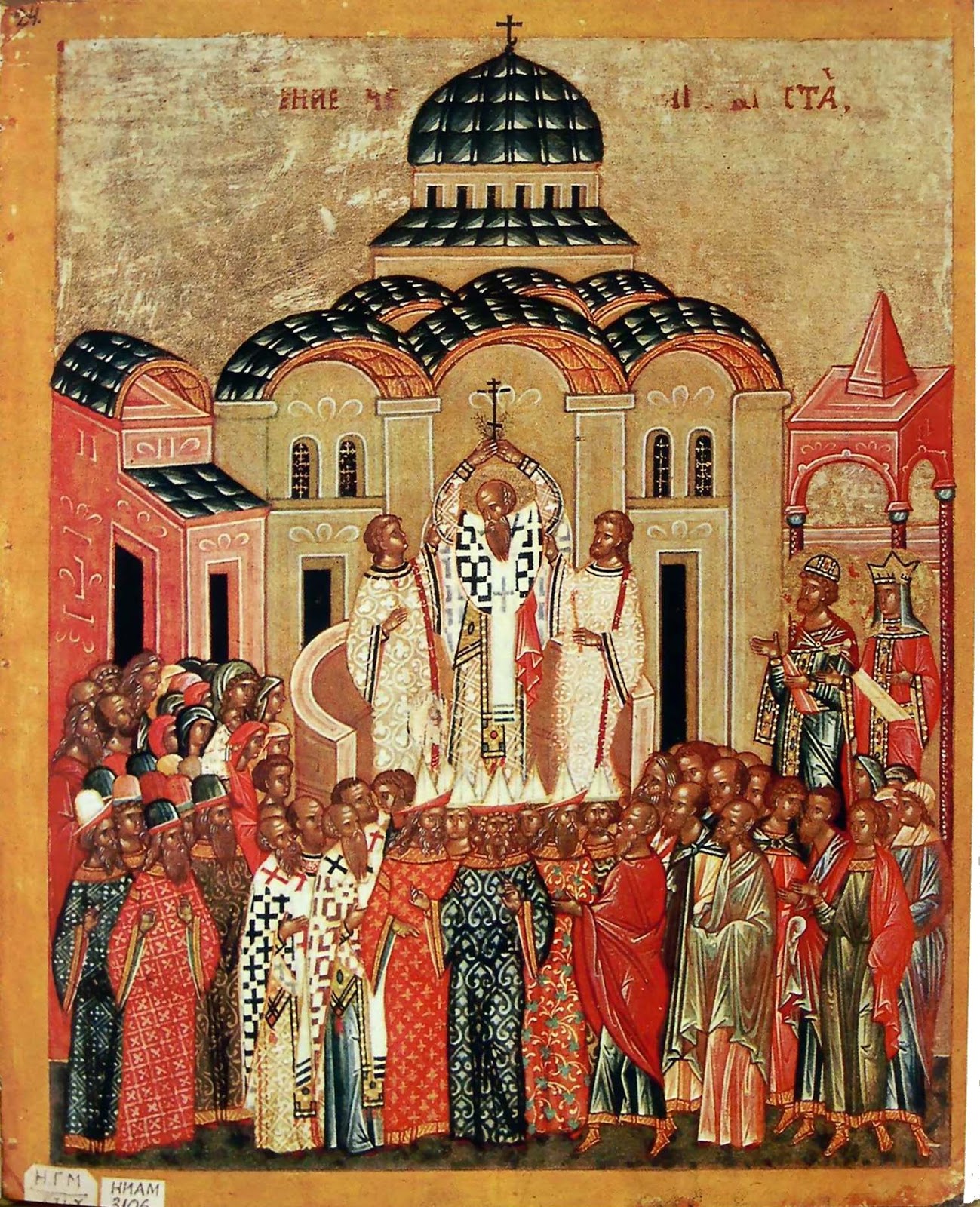
The Exaltation of the Precious Cross in the Church of Christ (source)

Chapter 7

Now the other stones which you saw cast far away from the tower, and falling upon the public road and rolling from it into pathless places, are those who have indeed believed, but through doubt have abandoned the true road. Thinking, then, that they could find a better, they wander and become wretched, and enter upon pathless places. But those which fell into the fire and were burned are those who have departed for ever from the living God; nor does the thought of repentance ever come into their hearts, on account of their devotion to their lusts and to the crimes which they committed. Do you wish to know who are the others which fell near the waters, but could not be rolled into them? These are they who have heard the word, and wish to be baptized in the name of the Lord; but when the chastity demanded by the truth comes into their recollection, they draw back, and again walk after their own wicked desires. She finished her exposition of the tower. But I, shameless as I yet was, asked her, Is repentance possible for all those stones which have been cast away and did not fit into the building of the tower, and will they yet have a place in this tower? Repentance, said she, is yet possible, but in this tower they cannot find a suitable place. But in another and much inferior place they will be laid, and that, too, only when they have been tortured and completed the days of their sins. And on this account will they be transferred, because they have partaken of the righteous Word. And then only will they be removed from their punishments when the thought of repenting of the evil deeds which they have done has come into their hearts. But if it does not come into their hearts, they will not be saved, on account of the hardness of their heart.

Chapter 8

When then I ceased asking in regard to all these matters, she said to me, Do you wish to see anything else? And as I was extremely eager to see something more, my countenance beamed with joy. She looked towards me with a smile, and said, Do you see seven women around the tower? I do, Lady, said I. This tower, said she, is supported by them according to the precept of the Lord. Listen now to their functions. The first of them, who is clasping her hands, is called Faith. Through her the elect of God are saved. Another, who has her garments tucked up and acts with vigour, is called Self-restraint. She is the daughter of Faith. Whoever then follows her will become happy in his life, because he will restrain himself from all evil works, believing that, if he restrain himself from all evil desire, he will inherit eternal life. But the others, said I, O Lady, who are they? And she said to me, They are daughters of each other. One of them is called Simplicity, another Guilelessness, another Chastity, another Intelligence, another Love. When then you do all the works of their mother, you will be able to live. I should like to know, said I, O Lady, what power each one of them possesses. Hear, she said, what power they have. Their powers are regulated by each other, and follow each other in the order of their birth. For from Faith arises Self-restraint; from Self-restraint, Simplicity; from Simplicity, Guilelessness; from Guilelessness, Chastity; from Chastity, Intelligence; and from Intelligence, Love. The deeds, then, of these are pure, and chaste, and divine. Whoever devotes himself to these, and is able to hold fast by their works, shall have his dwelling in the tower with the saints of God. Then I asked her in regard to the ages, if now there is the conclusion. She cried out with a loud voice, Foolish man! Do you not see the tower yet building? When the tower is finished and built, then comes the end; and I assure you it will be soon finished. Ask me no more questions. Let you and all the saints be content with what I have called to your remembrance, and with my renewal of your spirits. But observe that it is not for your own sake only that these revelations have been made to you, but they have been given you that you may show them to all. For after three days — this you will take care to remember — I Command you to speak all the words which I am to say to you into the ears of the saints, that hearing them and doing them, they may be cleansed from their iniquities, and you along with them.

Chapter 9

Give ear unto me, O Sons: I have brought you up in much simplicity, and guilelessness, and chastity, on account of the mercy of the Lord, who has dropped His righteousness down upon you, that you may be justified and sanctified from all your iniquity and depravity; but you do not wish to rest from your iniquity. Now, therefore, listen to me, and be at peace one with another, and visit each other, and bear each other's burdens, and do not partake of God's creatures alone, but give abundantly of them to the needy. For some through the abundance of their food produce weakness in their flesh, and thus corrupt their flesh; while the flesh of others who have no food is corrupted, because they have not sufficient nourishment. And on this account their bodies waste away. This intemperance in eating is thus injurious to you who have abundance and do not distribute among those who are needy. Give heed to the judgment that is to come. You, therefore, who are high in position, seek out the hungry as long as the tower is not yet finished; for after the tower is finished, you will wish to do good, but will find no opportunity. Give heed, therefore, you who glory in your wealth, lest those who are needy should groan, and their groans should ascend to the Lord, and you be shut out with all your goods beyond the gate of the tower. Wherefore I now say to you who preside over the Church and love the first seats, Be not like drug-mixers. For the drug-mixers carry their drugs in boxes, but you carry your drug and poison in your heart. You are hardened, and do not wish to cleanse your hearts, and to add unity of aim to purity of heart, that you may have mercy from the great King. Take heed, therefore, children, that these dissensions of yours do not deprive you of your life. How will you instruct the elect of the Lord, if you yourselves have not instruction? Instruct each other therefore, and be at peace among yourselves, that I also, standing joyful before your Father, may give an account of you all to your Lord.

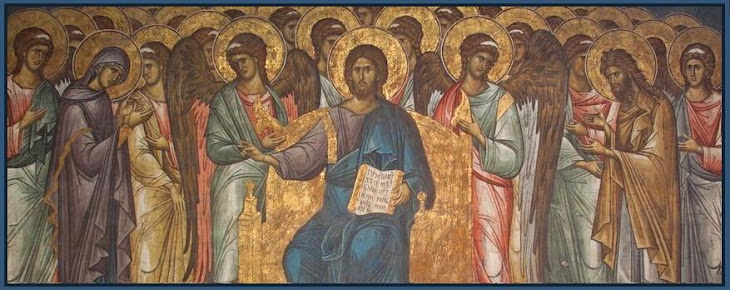
Jesus Christ, the Angel of Great Counsel, the Holy Wisdom of God and filled with blessed silence (source)

Chapter 10

On her ceasing to speak to me, those six young men who were engaged in building came and conveyed her to the tower, and other four lifted up the seat and carried it also to the tower. The faces of these last I did not see, for they were turned away from me. And as she was going, I asked her to reveal to me the meaning of the three forms in which she appeared to me. In reply she said to me: With regard to them, you must ask another to reveal their meaning to you. For she had appeared to me, brethren, in the first vision the previous year under the form of an exceedingly old woman, sitting in a chair. In the second vision her face was youthful, but her skin and hair betokened age, and she stood while she spoke to me. She was also more joyful than on the first occasion. But in the third vision she was entirely youthful and exquisitely beautiful, except only that she had the hair of an old woman; but her face beamed with joy, and she sat on a seat. Now I was exceeding sad in regard to these appearances, for I longed much to know what the visions meant. Then I see the old woman in a vision of the night saying unto me: Every prayer should be accompanied with humility: fast, therefore, and you will obtain from the Lord what you beg. I fasted therefore for one day.
That very night there appeared to me a young man, who said, Why do you frequently ask for revelations in prayer? Take heed lest by asking many things you injure your flesh: be content with these revelations. Will you be able to see greater revelations than those which you have seen? I answered and said to him, Sir, one thing only I ask, that in regard to these three forms the revelation may be rendered complete. He answered me, How long are you senseless? But your doubts make you senseless, because you have not your hearts turned towards the Lord. But I answered and said to him, From you, sir, we shall learn these things more accurately.

Chapter 11

Hear then, said he, with regard to the three forms, concerning which you are inquiring. Why in the first vision did she appear to you as an old woman seated on a chair? Because your spirit is now old and withered up, and has lost its power in consequence of your infirmities and doubts. For, like elderly men who have no hope of renewing their strength, and expect nothing but their last sleep, so you, weakened by worldly occupations, have given yourselves up to sloth, and have not cast your cares upon the Lord. Your spirit therefore is broken, and you have grown old in your sorrows. I should like then to know, sir, why she sat on a chair? He answered, Because every weak person sits on a chair on account of his weakness, that his weakness may be sustained. Lo! You have the form of the first vision.

Chapter 12

Now in the second vision you saw her standing with a youthful countenance, and more joyful than before; still she had the skin and hair of an aged woman. Hear, said he, this parable also. When one becomes somewhat old, he despairs of himself on account of his weakness and poverty, and looks forward to nothing but the last day of his life. Then suddenly an inheritance is left him: and hearing of this, he rises up, and becoming exceeding joyful, he puts on strength. And now he no longer reclines, but stands up; and his spirit, already destroyed by his previous actions, is renewed, and he no longer sits, but acts with vigour. So happened it with you on hearing the revelation which God gave you. For the Lord had compassion on you, and renewed your spirit, and you laid aside your infirmities. Vigour arose within you, and you grew strong in faith; and the Lord, seeing your strength, rejoiced. On this account He showed you the building of the tower; and He will show you other things, if you continue at peace with each other with all your heart.

Chapter 13

Now, in the third vision, you saw her still younger, and she was noble and joyful, and her shape was beautiful. For, just as when some good news comes suddenly to one who is sad, immediately he forgets his former sorrows, and looks for nothing else than the good news which he has heard, and for the future is made strong for good, and his spirit is renewed on account of the joy which he has received; so you also have received the renewal of your spirits by seeing these good things. As to your seeing her sitting on a seat, that means that her position is one of strength, for a seat has four feet and stands firmly. For the world also is kept together by means of four elements. Those, therefore, who repent completely and with the whole heart, will become young and firmly established. You now have the revelation completely given you. Make no further demands for revelations. If anything ought to be revealed, it will be revealed to you.
(source)   
In Thee O Full of Grace All Creation Rejoiceth (source)
  
Christ is risen from the dead, by death trampling down upon death, and upon those in the tombs He has granted life!
Truly the Lord is risen!

Tuesday, April 2, 2019

St. John of the Ladder's advice for those living in the world

St. John writing his Ladder of Divine Ascent (source)
  
Some people living carelessly in the world have asked me: ‘We have wives and are beset with social cares, and how can we lead the solitary life?’ I replied to them: ‘Do all the good you can; do not speak evil of anyone; do not steal from anyone; do not lie to anyone; do not be arrogant towards anyone; do not hate any one; be sure you go to church; be compassionate to the needy; do not offend anyone; do not wreck another man’s domestic happiness; and be content with what your own wives can give you. If you behave in this way you will not be far from the Kingdom of Heaven.’
-St. John Klimakos, The Ladder of Divine Ascent, Step I
(source)
  
Through the prayers of our Holy Fathers, Lord Jesus Christ our God, have mercy on us and save us! Amen!

Sunday, December 16, 2018

St. John of Kronstadt: The most pleasing sacrifice to the Infant Jesus Christ

The Nativity of Christ (source)
 
“What, then, O, brethren, is required of us in order that we might avail ourselves of all the grace brought unto us from on high by the coming to earth of the Son of God? What is necessary, first of all, is faith in the Son of God, in the Gospel as the salvation-bestowing heavenly teaching; a true repentance of sins and the correction of life and of heart; communion in prayer and in the mysteries [sacraments]; the knowledge and fulfillment of Christ’s commandments. Also necessary are the virtues: Christian humility, alms-giving, continence, purity and chastity, simplicity and goodness of heart.
Let us, then, O brothers and sisters, bring these virtues as a gift to the One Who was born for the sake of our salvation – let us bring them in place of the gold, frankincense and myrrh which the Magi brought Him, as to One Who is King, God, and Man, come to die for us. This, from us, shall be the most-pleasing form of sacrifice to God and to the Infant Jesus Christ.”
-St. John of Kronstadt, Sermon on the Nativity of Jesus Christ
Through the prayers of our Holy Fathers, Lord Jesus Christ our God, have mercy on us and save us! Amen!

Thursday, February 15, 2018

Elder Symeon Kragiopoulos on Cheesefare Sunday

Icon depicting the Expulsion of Adam and Eve from Paradise (source)
  
Great Lent is a forty-day period for us to return to God. Due to our sins, we find ourselves outside of paradise. Realizing this fact we seek forgiveness of our sins. If God forgives us, He will put us in paradise. For this reason, the Gospel reading for today’s divine liturgy highlights the first thing needed: “For if you forgive men their trespasses, your heavenly Father will also forgive you. But if you do not forgive men their trespasses, neither will your Father forgive your trespasses,” (Matt. 6, 14-15). Run and do whatever you want. Strive according to your desire. But if you do not look after this very first thing, do not expect your sins to be forgiven. And if your sins are not forgiven, you will not enter into paradise. However much we seek forgiveness from God, that much more must we too forgive others.
  
And, now for the second point. It is impossible to conceive of Great Lent without fasting, as this fasting is a law of God and a law of the Church. During this period, our Lord, and our Church, want us to fast from material foods, but also from our passions, and from our weaknesses.
  
The third point that we, during this period, must pay attention to for our return to be true is: “Do not lay up for yourselves treasures on earth … lay up for yourselves treasures in heaven,” (Matt. 6, 19). When you do almsgiving, when you love, forgive others, think of others, think of heavenly things, of spiritual goods, and of all the things the Lord has promised us –not the earthly things down here–then you gain treasure there. Your heart, then, is there in heaven.
  
If your heart truly desires Christ, it will go towards heaven. From that perspective, we can take stock. Since our hearts do not go towards God  –as if difficulties come to us, and like clockwork there are roadblocks– this means that we love other things more deeply than we love our Christ. This is in accordance with that which the Lords says: “For where your treasure is, there your heart will be also, ” (Matt. 6, 21).
  
Holy Hesychasterion “The Nativity of Theotokos” Publications.
Archimandrite Symeon Kragiopoulos
  
Beautiful icon depicting Christ as the Good Samaritan (source)
  
Through the prayers of our Holy Fathers, Lord Jesus Christ our God, have mercy on us and save us! Amen!

Tuesday, December 19, 2017

Metropolitan Avgoustinos Kantiotes: Are we ready for Christmas?

The Nativity of Christ (source)
  
Metropolitan Avgoustinos Kantiotes: Are we ready for Christmas?
Beloved in Christ, I would like to ask you a question; I ask it of myself and I ask it of you. Are we prepared to celebrate the great feast of Christmas?
  
There are two kinds of preparation; material and spiritual. Our material preparation is more or less finished. Housewives have cleaned their houses, husbands have finished – or have almost finished – their shopping, and children await their presents. Everyone has written their Christmas cards, signing them with the customary, ‘Merry Christmas’ and ‘Happy New Year’. This is worldly preparation; I am not interested in this. What I am interested in is spiritual preparation, the kind of preparation which makes us ready to celebrate the great event of the Incarnation of the Divine Word as is proper. Only a small number have properly prepared themselves. Of a thousand Christians, I doubt if even one celebrates Christmas truly. Does my estimate seem exaggerated? Let us see.
  
How is Christmas celebrated today? A portion of Christians will celebrate it ‘typically’, let us say. Hearing the bells on Christmas Eve, they will go and take part in the service out of habit. This is certainly better than being absent altogether; it is something at least.
  
Others will imitate foreign customs and practices, forgetting the ecclesiastical celebration altogether; in other words, they will pass Christmas Eve without the scent of Christ. For Orthodox Christians, Christmas is meaningless if it is celebrated without church services, without prayer, without confession, without Holy Communion, without forgiveness, without almsgiving. Indeed, the devil has sown a new seed in our homeland, and it is sprouting up everywhere like mushrooms grow in manure. On Christmas Eve people put on these reveillon – a foreign custom and a foreign word – they put on parties in luxurious hotels and other such places, far from the Church, far from hymns, far from the Divine Liturgy, where people gather and amuse themselves with worldly music, with food, with drink and whatever follows from these things. Such a practice is a thorn in the field of our homeland. If it continues to spread, the spirit of secularization will overtake the Christian feast altogether.
  
Some, then, celebrate Christmas ‘typically’, others put on these reveillon and trade in the Church feast for something altogether worldly. And still others, what do they do? They leave. They are not satisfied here. Greece is not enough for them. They have money to spare so they take trips and go on tours. On Christmas Eve when the bells are ringing, these people will be far from their homes in different places, and not only in our country. They aren’t satisfied here, so they hop on an airplane and go celebrate Christmas in Rome, in London, in Paris, in different places.
  
These, beloved, and anyone else who has openly denied the faith, have cast Christmas out of their hearts. For a large number of people, then, Christmas is nothing but another chance to dull their boredom; the actual content of the feast holds no appeal for them. Yes! That day you will have it all! You will have your great salons, your ornate rugs, your curtains, your fancy cutlery, your drinks, your meals, your music, your trips. You will have everything! You will be missing one thing, however. Your will be missing the most valuable thing; the thing which gives the feast meaning! Lacking this thing, what kind of Christmas can you expect to have? Your Christmas will be a Christmas without Christ!
  
But why? How did this happen? How did things get to this point? This is the age which the Prophet Isaiah foresaw. There will come a day, he said, when men will be drunk without wine. This day has arrived. Contemporary man is, “…drunk, but not with wine.” (Isaiah 29:9) For one to be drunk with wine during these days in undoubtedly a sin, for, drunkards shall not inherit the kingdom of God. (1 Cor 6:10) There is, however, a worse kind of drunkenness: woe to those who are drunk without wine, says Isaiah.
  
What, then, is contemporary man drunk on? One is drunk on the love of glory. Another is drunk on the love of money; another is drunk on women and indecent sights; another is drunk on card playing, on games of chance; another on an obsession with sports teams; another on plays and films; another on enjoyments and luxuries. I have particularly noticed that a good many are drunk on politics, something which has become a passion only for us in Greece alone. I say this as one who keeps himself out of party politics. Were you to open my heart you would find nothing but my homeland and my Christ. Here in Greece there is a pathological attachment to politics. Even on Christmas Eve, the feast will be overshadowed by discussions of politics. Nowhere else can one find such a phenomenon.
  
I have also noticed of late that many have become drunk on that strong wine described in the Apocalypse; that wine which the noetic Babylon will give the rulers and the people to drink. This wine, the commentators say, is the pagan spirit, the moral depravity of the world. This wine is so strong that if you were to drink just a few drops, it will cause you to lose your faith, you will forget everything. The strongest wine, then, is not money, or women, or shameful lusts, or other sensual pleasures; it is the cosmopolitan spirit of modern life, it is the emancipation from devotion, knowledge infused with pride, the science of the atheist, the atheistic rebellion, the denial of God and the divinization of man. It is this wine which has made many in our age drunk.
  
Men are drunk, then, on various wines offered to him by the ruler of this age in his golden cup. Do you know what these men are like? I will show you by means of an example.
  
I try, with God’s help, to be a teacher. So I travel to a village where I find someone and try to teach him something about Christ, about the faith, about the mysteries. He listens, but the others tell me, “Don’t waste your time, he’s drunk! Don’t bother sitting with him and taking to him!” This is how the world is today…it is drunk without wine! Is it worth speaking to such men?
  
But I appeal to you, my brothers. I am not speaking to drunks, to those made dizzy by the idols. It is my hope that I speak to the faithful who know but one kind of drunkenness, that holy drunkenness described by the Psalmist who exhorts us to, “…taste and see that the Lord is good.” (Psalm 33:8) I hope that you have you ears open for, “Blessed is he that speaketh in the ears of them that will hear.” (Sirach 25:9)
by Metropolitan Avgoustinos (Kantiotes) of Florina,
Translated by fr. John Palmer (source)
  
Through the prayers of our Holy Fathers, Lord Jesus Christ our God, have mercy on us and save us! Amen! 

Saturday, December 5, 2015

Homily on St. Nicholas by Metropolitan Avgoustinos Kantiotes (+2010)

St. Nicholas the Wonderworker, Archbishop of Myra of Lycia (source)
  
Homily on St. Nicholas by Metropolitan Avgoustinos Kantiotes (+2010) (amateur translation)
And again, my beloved, the great feast of St. Nicholas has dawned. What shall we say? Should we honor his virtues?
  
Should we praise his abstinence? As his Apolytikion says, he was the “teacher of abstinence”. For not only when he was older, but also when he was a child in the arms of his mother, he fasted from milk and did not nurse [on Wednesdays and Fridays].
  
Should we praise his meekness, for his Apolytikion says that he was the “Icon of meekness”? Amidst insults and slanders and schemes of his enemies, he responded with great meekness. He teaches us, that we ourselves, no matter how many times we are insulted and slandered in this world, we must remain meek. There is no greater power than meekness, through which the demons of hell are conquered.
  
Or should we speak of his almsgiving, his great almsgiving? He would go at night to the homes of the poor, and to distribute gold coins, and he saved from filth and corruption.
  
Or should we speak of his faith, the great and unshakable faith which the Saint had? When the Church was endangered by the heresy of Arius, he hastened to the city of Nicea, and there, together with other Holy Fathers, worked towards the triumph of Orthodoxy. Of course, St. Nicholas did not have the gift of speaking like Athanasios the Great, or the debate skills of many of the other Fathers, he was unlettered. But what did this matter? When he heard Arius blaspheme Christ, this meek and humble one arose, and, as his life says, he struck the leader of heresy for his blasphemy. And this is a lesson for us, that when God is being offended, we must rise up. We, instead, whenever we ourselves are offended, whenever we are wronged, slandered, and condemned, then we are filled with wrath, and we become beasts and endanger the world. But, when Christ is being condemned and blasphemed, then we show indifference. The Saint showed the opposite. To the assaults against him, he responded with meekness, but when Christ was being wronged, he responded with strength, and for this reason he struck Arius. We have within us a lot of ego, not the name of Christ, like he did.
  
St. Nicholas, in other words, is the synopsis of all of the virtues, the expression of the Beatitudes of Christ, because in his person was implemented all of the Beatitudes of the Lord (Matthew 5:1-12).
  
But I, my beloved, wish to add to the image of the Saint two words that show that St. Nicholas was not only the merciful, and the meek, and the faithful servant dedicated to the Lord, but was furthermore the protector of the poor and those wronged, the protector of people who were condemned by the mighty ones of their day. I will mention one or two examples, then I will close.
   
The first is that, in his metropolis one morning, women ran with wild hair, wailing and crying out. They fell at the feet of St. Nicholas and said: “Save us!” They entreated the Saint to save them, because their husbands were taken. They were seized, put in bonds and taken to prison. They were condemned to death, and in a few hours they would execute these men. And their wives were in a terrible state. The Saint, as soon as he heard their terrible news, hastened to the prison. But at that hour the prison was empty, because they had taken them bound, and let them out into the fields to execute them. The Saint understood the danger. And that elder ran like a child, and reached the place of the execution. And as soon as he got there, he took the sword from the hands of the executioner, with which he was to slaughter those innocent men. And not this alone, but he greatly censured the tyrant of that city and threatened him, that he would give him up to Constantine the Great. And the tyrant came to his senses, was humbled and repented.
  
St. Nicholas the Wonderworker (source)
  
This was one situation when he saved men. And there is another. In the era of St. Constantine, three soldiers, brave and glorious soldiers, who conquered the barbarians in various wars and battles, and who were the boast of the Byzantine Empire, these three soldiers were slandered and condemned by evil and malicious men. They were seized and thrown in prison, and condemned to death within a few hours. They had no refuge other than the protection of St. Nicholas, And the life of the Saint, which we believe, says that that night, they entreated the Saint to protect them. And then the miracle occurred. What miracle? In his sleep, the Emperor saw a vision. He saw St. Nicholas strike him, and tell him: “What charge do you go to perform? Why do you wish to dip your hands in the blood of the innocent? These three soldiers, who are ready to be executed, these three are innocent men, and you must free them. Do not perform that which you are thinking to do.” In reality, when the Emperor awoke, he immediately called the general, and gave commands to free those three soldiers who had been condemned. They, full of joy and exaltation, hastened to express their thanks to the Saint who freed them.
  
Ba, you will say! Those are old things, and ancient stories. All of those were “In those days...”
  
No, my beloved! Not “in those days”. And today and tomorrow and the day after, and forever until the stars cease to shine, and the rivers to run, and the trees to fill with leaves, until the sun and the moon no longer shine, the miracles of God continue to exist. These are not mythological things.
  
I will relate to you one final one. What occurred? In Kozani in 1944, in those years, the terrible years of slavery for our nation. Then, evil and corrupt men seized 300 men and threw them in prison. And there was wailing and morning. Women, men and children wailing, because their execution was for sure. And that morning in Kozani, the city of St. Nicholas, which has the church of St. Nicholas, dawned a very sad day of St. Nicholas. And the bells of St. Nicholas rung sadly, as if it were Holy Friday. I was then, as God continues to make me worthy to be, a preacher in Kozani. And I ascended the amvon full of tears. And I said: “Today, St. Nicholas does not celebrate. Fall on your knees, fall on your knees both small and great, and entreat the Saint to work his miracle...” And he worked the miracle. That evening, he freed them!
  
St. Nicholas saving those unjustly condemned to death (source)
   
Of course. Our religion is not a lie, it is alive, wholly alive. And yesterday and today and tomorrow, forever there will be miracles. And if you go to the blessed islands of our fatherland, there you will see old sailors with white hair, who passed through oceans and seas, and sailed through the Atlantic ocean, and behold the joy in their eyes. At the hour when they met huge waves and sharks and fearsome beasts, when they were ready to be cast upside down and to be torn to pieces upon the rocks, at that terrible hour of death, when they beheld their death before them—I am not lying, but telling you the truth—they entreated the Saint. And the Saint worked his wonder. And they found themselves on the dry land without understanding how!
  
Therefore, it is a fact that the Saint was meek, and merciful, and faithful, and dedicated to God, it is a fact that he was a man of God. But it is also a fact that St. Nicholas is the protector of those who are wronged and weak.
  
This is the Saint whom we hymn today. And all of us, with one heart and with one soul, united in the faith of Christ, in our Orthodox faith, let us entreat God, through the intercessions of St. Nicholas the Wonderworker, to have mercy and save all of us. Amen.
  
+Bishop Avgoustinos
  
(homily by Metropolitan Avgoustinos Kantiotes, given in the Holy Church of St. Nicholas in the city of Florina on 12/6/78, source)
  
St. Nicholas saving those unjustly condemned (source)
  
Through the prayers of our Holy Fathers, Lord Jesus Christ our God, have mercy on us and save us! Amen!

Sunday, February 22, 2015

St. Gregory Palamas on Love and Forgiveness

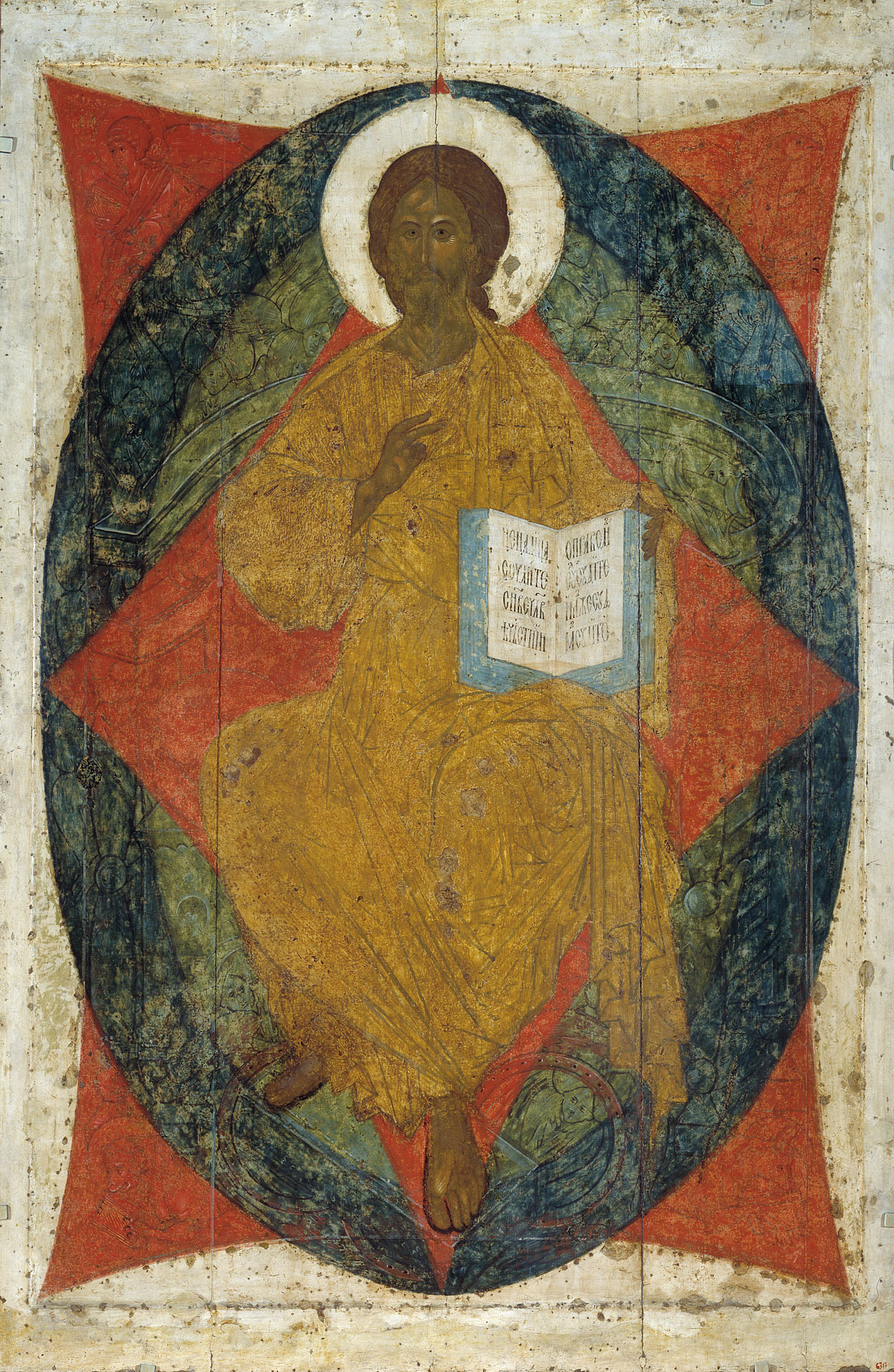
Jesus Christ in majesty (source)
  
"In this time of fasting and prayer, brethren, let us with all our hearts forgive anything real or imaginary we have against anyone. May we all devote ourselves to love, and let us consider one another as an incentive to love and good works, speaking in defense of one another, having good thoughts and dispositions within us before God and men. In this way our fasting will be laudable and blameless, and our requests to God while we fast will be readily received."
-St. Gregory Palamas, excerpt from Homily Seven: "On Fasting"
  
Please forgive me everyone, and may God forgive us all!
 
Through the prayers of our Holy Fathers, Lord Jesus Christ our God, have mercy on us and save us! Amen!

Thursday, November 20, 2014

St. Luke of Simferopol on the Fragrance of Christ

Icon of the Theotokos and Christ, the "Unfading Rose" (source)
  
The rose does not speak, but puts forth a strong fragrance. We too, should put forth fragrance, pour forth spiritual fragrance, the fragrance of Christ. The fragrance of our deeds should be heard from far around: good, pure, and righteous deeds, full of love. Only thus can the Kingdom of God appear within our hearts, appearing not through words, but with power. Amen.
-St. Luke of Simferopol
  
  
St. Luke of Simferopol (source)
  
Through the prayers of our Holy Fathers, Lord Jesus Christ our God, have mercy on us and save us! Amen!

Thursday, November 14, 2013

St. John of Kronstadt on Good Works


Jesus Christ in Majesty (source)
   
St. John of Kronstadt on Good Works
Rejoice at every opportunity of showing kindness to your neighbour as a true Christian who strives to store up as many good works as possible, especially the treasures of love.
   
Our soul, as a spiritual, active being, cannot remain idle; it either does good or evil, one of the two; either wheat grows in it or tares. But as every good comes from God, and as the means of obtaining every good from God is prayer, those who pray fervently, sincerely, from the depths of their hearts, obtain from the Lord grace to do good, and, before all, the grace of faith; whilst, those who do not pray, naturally remain without these spiritual gifts, voluntarily depriving themselves of them by their own negligence and spiritual coldness; and as the wheat of good thoughts, inclinations, intentions, and works grows in the hearts of those who labour and pray fervently to the Lord, so in the hearts of those who do not pray, the tares of every evil grow, smothering the small amount of good that has remained in them from the grace of baptism, chrism, and subsequent penitence and communion.
   
Therefore, we must most carefully look after the field of our heart, lest the tares of evil, slothfulness, luxuriousness, self-indulgence, unbelief, avarice, envy, hatred, and others, should grow within it; we must daily weed the field of our heart — at least, at morning and evening prayers, and refresh it by salutary sighs, as by healthful winds, and water it with abundant tears, as by early and late rain. Besides this, we must by every means implant in the field of our heart the seeds of the virtues, faith, hope in God, and love for God and our neighbour, fertilise it by prayer, patience, good works, and not for a single hour remain in complete idleness and inactivity, for in times of idleness and inactivity the enemy zealously sows his tares. "While men slept, the enemy came and sowed tares among the wheat and went his way."[304] We must also remember that it is impossible to do good works without efforts. Since our voluntary falling into sin the kingdom of God cannot be taken otherwise than by "violence, and the violent take it by force."[305] Why is it that only the narrow way and narrow gate lead to life? Who makes the way of the chosen narrow? The world oppresses the chosen, the devil oppresses them, the flesh oppresses them; it is these that make our way to the kingdom of heaven narrow.
   
There is no need to ask anyone whether we ought to spread or propagate the Glory of God, either by writing, or by word, or by good works. This we are obliged to do according to our power and possibility. We must make use of our talents. If you think much about such a simple matter, then, perhaps, the Devil may suggest to you such foolishness as that you need only be inwardly active.
   
O, if we turned our attention to the consequences of our sins or of our good works! How careful we should then be to shun sin, and how zealous in all that is good! For we should then clearly see that every sin not eradicated in time becomes strengthened by habit, becomes deeply rooted in a man's heart, and sometimes troubles, torments, and wounds him until death, becoming, so to say, awakened and revived in him upon every occasion, reminding him of the sin formerly committed, and thus defiling his thoughts, feelings, and conscience. Streams of tears are necessary to wash away the inveterate filthiness of sin. How tenacious and malignant it is! Whilst, on the contrary, every good action done at any time sincerely, disinterestedly, or having become a habit by repetition, rejoices our hearts and forms the joy and comfort of our life by the consciousness that we have not spent our life entirely in vain, full of sins though it is; that we are like men and not beasts; that we, too, are created after the image of God, and that there is a spark of the Divine light and love in us; that, although they are but few, our good works will form a counterpoise for our evil ones in the balance of God's incorruptible righteousness.
   
How and when are we to care for the imperishable raiment of the soul: meekness, righteousness, chastity, patience, mercy, when all our cares, attention, and means are directed to perishable raiment and the adornment of our body? We cannot serve two masters: for the soul is simple and single. How and when are we to care for the spiritual riches of good works, when we are only greedy after perishable riches and strive to amass it with all our might and means, when our heart clings to money, to the world, and not to God? How and when are we to care for the incorruptible spiritual food and for the blessed drink — for prayer, the reading of God's word, the writings and lives of the Holy Fathers, the Communion of the Body and Blood of the Lord, when we hardly let food and drink out of our mouths, and this stupefying lit-up poisonous smoke which many consider so pleasant? How can our soul rejoice in the Holy Spirit, when we are continually occupied by earthly, vain pastimes and pleasures? O, ruinous service to corruption, drawing us away from the life incorruptible, true and eternal!
   
... Therefore the Holy Spirit is absolutely necessary to us all in all our good works. He is our power, strength, light, peace, and comfort.
   
... continually force yourself to be kind when others exasperate and offend you, to pray for your enemies, for meekness, humility, gentleness, truer benevolence, generosity, disinterestedness, abstinence, chastity, alms-giving, truth and righteousness, industry, obedience, and others. It is difficult to conquer the passions, which become as though our natural members ("Mortify therefore your members which are upon the earth"[553]), but by being continually watchful over yourself, by constant fervent prayer and abstinence, with the help of God you will be able to conquer and eradicate them.
   
We must never forget that we are all one body, and that we should stimulate each other to love and good works; we pastors should especially remember and do this... This is why the Lord said: "Let your light so shine before men that they may see your good works, and glorify your Father Which is in heaven."[1029] "If, therefore, the light that is in thee be darkness, how great is that darkness!"[1030]
   
Concerning modern works of charity. If you enjoy earthly blessings in full measure, and if you give to the needy, but indulge yourself still more, it means that you do good works without the least self-denial. Your works of charity are not great. But what else do we find? What are so-called works of charity? People arrange different entertainments with a charitable object — that is, they intentionally wish before all to serve their sinful flesh, the Devil, and only afterwards their neighbour and God. But this is no charity at all! Such works only bear the name of charity. "Let us do evil, that good may come."[835] "Woe unto you that are full, for ye shall hunger! Woe unto you that laugh now, for ye shall mourn and weep!"[836]
   
Why, after every six days, is a day of rest observed? In order that we may continually remember that after the labours of this present life, the day of eternal rest will come; for in accordance with the apostle, "there remaineth therefore a rest to the people of God."[786] And Sunday betokens the day of the general resurrection, after which a day of rest shall come for all those who have done good work in this present life, in Christ Jesus.
   
You cannot conquer any passion, any sin without gracious help; therefore, always ask the help of Christ, your Saviour. It was for this that He came into the world, for this that He suffered, died, and rose from the dead, in order to help us in everything, to save us from sin, and from the violence of the passions, to cleanse us from our sins, to bestow upon us power in Holy Spirit to do good works, to enlighten us, to strengthen us, to give us peace. You ask how you can save yourself when sin stands at every step, and you sin at every moment? There is a simple answer to this: at every step, at every moment, call upon the Saviour, remember the Saviour, and you will save yourself and others.
   
I am morally nothing without the Lord. I have really not one true thought or good feeling, and can do no good works; without Him I cannot drive away from me any sinful thought, any passionate feeling such as malice, envy, fornication, pride, and so forth. The Lord is the accomplishment of everything good that I think, feel, and do. O, how boundlessly wide is the Lord's grace acting in me! The Lord is everything to me, and so clearly, so constantly. Mine — is only my sinfulness; mine — are only mine infirmities. O, how we ought to love our Lord, Who was pleased to call us into existence from non-existence, to honour us by His image and likeness, to establish us in a paradise of delights, to subdue all the earth unto us, and Who — when we did not keep His commandments, but were allured by the enticement of the Devil, and immeasurably offended our Creator by our ingratitude, and assimilated unto ourselves all the qualities of the tempter (pride, malice, envy, ingratitude) and all his evil arts, which he taught us as his prisoners — did not reject us for ever, but deigned to redeem us from sin, from the curse and death into which we had fallen through sin, and Himself appeared upon earth, having taken our nature upon Him; He Himself became my Teacher, my Healer, my Worker of miracles, my Saviour; He Himself bore the punishment for us, died for us in order that we should not be eternally lost. He rose from the dead, in order to raise us too after death. He ascended into heaven, in order that we, too, should ascend, we who had fallen so low through sin; and He became everything to us — food, drink, light, purification, sanctification, health — and the power that protects, saves, preserves, and has mercy upon us.
   
Do you pay sufficient attention to the state of your soul? whether it is in good health, and, seeing that it lives, is its life vigorous? And, if its present temporal life is happy, then is its eternal life, its eternal happiness, ensured by anything — for instance, by faith — is there in your soul a lively faith in God, in the Saviour, in the Church, — by good works, meekness, humility, gentleness, love of truth and honesty, abstinence, chastity, mercy, patience, obedience, industry, and others? If the reverse is the case, then all your labour is in vain. The soul, perhaps, does many things worthy of wonder, but it will be itself lost. "For what is a man profited, if he shall gain the whole world, and lose his own soul?"[686]
   
It is a remarkable phenomenon in nature that, if you put a plant into a large, wide pot or tub, it grows very much at the roots; they thicken, they give out many ramifications, but the tree itself does not grow much in height, and only yields few and small leaves and flowers. But if it is planted in a small pot, then the roots are small, but the plant itself grows rapidly in height and yields beautiful leaves and flowers (if it is the nature of the plant to produce flowers). Is it not the same with man? When he lives in full liberty, in abundance and prosperity, then he grows in body and does not grow in spirit, does not bring forth fruits — good works; whilst when he lives in straightness, in poverty, sickness, misfortune, and afflictions, in a word, when his animal nature is crushed, then he grows spiritually, bears flowers of virtue, ripens and brings forth rich fruits. This is why the path of those who love God is a narrow one.
   
How corrupt I am become through sin! Anything bad, evil, impure immediately enters into my thoughts and is felt in my heart, whilst anything good, right, pure, holy — is often only thought and spoken of, and not felt. Woe unto me! for as yet evil is nearer to my heart than good. Besides this, we are at once ready to do evil as soon as it is thought of or felt, and we do it quickly and easily if we have no fear of God, whilst "how to perform that which is good I find not"[641] the power within me, and the intended good work is often put off indefinitely.
   
Our self-love and pride would like everything to be as we wish, that we should be surrounded by every honour and comfort of this temporal life; would like all men, and even — how far is pride carried! — all nature itself, to speedily and silently obey a sign from us; whilst, alas! we ourselves are very slow to faith and to every good work — slow to please the one Master of all. Christian! you must absolutely be humble, meek, and long-suffering, remembering that you are clay, dust, nothingness; that you are impure; that everything good that you have is from God; that your life, your breath and everything you possess are God's gifts;
   
Man! the Creator's omnipotence, wisdom, and mercy, which were poured out upon the visible and invisible world, are ready to be bestowed, in all their infinity, upon you also, if you endeavour to be a true child of the Heavenly Father, if you fulfil His commandments to love God and your neighbour. Give yourself up, then, untiringly, and with all your might, to good works and deeds.
   
Do not only do your work when you wish to, but do it especially then, when you do not wish to. Understand that this applies to every ordinary worldly matter, as likewise, and especially, to the work of the salvation of your soul — to prayer, to reading God's word and other salutary books, to attending Divine service, to doing good works, whatever they may be, to preaching God's word. Do not obey the slothful, deceitful, and most sinful flesh; it is eternally ready to rest and lead us into everlasting destruction through temporal tranquillity and enjoyment. "In the sweat of thy face," it is said, " shalt thou eat bread."[334] O miserable soul, "carefully cultivate the talent granted unto thee," sings the Church. [335] "The kingdom of heaven suffereth violence, and the violent take it by force,"[336] says our Lord and Saviour.
   
"Seek ye first the kingdom of God, and His righteousness; and all these things shall be added unto you."[701] How are we to seek first the kingdom of God? In the following manner: let us suppose that you wish to walk, or drive, or else go in a boat somewhere on any worldly, temporal business; before doing so, first pray to the Lord that He may correct the ways of your heart, and then also your present bodily way, or that He may direct the way of your life in accordance with His commandments; desire this with all your heart, and often renew your prayer concerning this. The Lord, seeing your sincere desire and endeavour to walk in accordance with His commandments, will, by degrees, correct all your ways.
   
The way to succeed in any good work. When you are praying at home, at evening, or at morning prayer, or in the church during Divine service, be solicitous in your heart to accomplish this particular good work, and heartily desire to fulfil it to the glory of God. The Lord and His Most-pure Mother will unfailingly teach you, will instil in your heart some bright idea how to accomplish it.
   
In all your works, either at home or at the place of your service, do not forget that all your strength, your light and your success are in Christ and His Cross; therefore, do not fail to call upon the Lord before beginning any work, saying: Jesus, help me! Jesus, enlighten me! Thus your heart will be supported and warmed by lively faith and hope in Christ, for His is the power and glory unto ages of ages.
   
If you have Christian love for your neighbour, then all heaven will love you; if you have union of spirit with your fellow-creatures, then you shall have union with God and all the dwellers of heaven; if you are merciful to your neighbour, then God and all the Angels and Saints will be merciful to you; if you pray for others, then all heaven will intercede for you. The Lord our God is holy, be so yourself also.
   
When the foolish thought of counting up any of your good works enters into your head, immediately correct your fault and rather count up your sins, your continual and innumerable offences against the All-merciful and Righteous Master, and you will find that their number is as the sand of the sea, whilst your virtues in comparison with them are as nothing.
   
Whilst the soul, changeable in its relation to God, suffers changes in itself, thus it unavoidably expands and obtains peace of heart when it draws nearer to God by faith and good works, and unavoidably contracts, becomes restless and wearied, when it withdraws itself from God by unlawful acts, want of faith, and unbelief in God's Truth.
   
In trees there is organic earthly life; in the Christian race the life of Christ, heavenly, spiritual; and we must look upon the spiritual capabilities and powers of true Christians as upon the powers of Jesus Christ Himself. "We have the mind of Christ,"[203] said the Apostle of true Christians; we must also look upon good works as upon the fruits of the grace of Christ.
   
It is a strange phenomenon in our nature, perverted by sin, to hate those to whom we do good, and to make them pay for our benefits by disliking them! Oh, how narrow and poor in love and grace is our heart! How selfish it is! The enemy may well mock at us; he wishes to destroy the fruits of our good works. But the more good you do to others, the more you must love them, knowing that those who receive your benefits serve as a pledge to you of your receiving forgiveness from God.
   
"Worship God in spirit and in truth." In truth, for instance, when you say, "Hallowed be Thy Name." Do you really desire that God's name should be hallowed by the good works of others and by your own?
   
"How can I prepare for death in a Christian manner?" By means of faith, by means of good works, and by bravely bearing the miseries and sorrows that happen to you, so as to be able to meet death fearlessly, peacefully, and without shame, not as a rigorous law of nature, but as a fatherly call of the eternal, heavenly, holy, and blessed Father unto the everlasting Kingdom.
   
Deny yourself sensual delights in the hope that, instead of them, you will obtain higher spiritual, heavenly delights. Do good to all in the hope that, in accordance with God's justice, "with what measure ye mete, it shall be measured to you again";[343] that the good you have done to your neighbour shall be sooner or later returned into your bosom, just as the evil you have done him shall sooner or later be returned into your bosom. Remember that we are one body. "We being many are one bread."[344] Remember that God is just to the highest degree, to an iota.
   
When the Devil is in our heart, then we feel an unusual, overwhelming load and fire in the breast and in the heart. The soul contracts extremely and darkens, everything irritates it, it feels an aversion to every good work; the words and acts of other persons in reference to ourselves we interpret falsely and see in them ill-will and designs against our honour, and therefore we feel a deep, deadly hatred towards them; we are infuriated and long for vengeance. "By their fruits ye shall know them."[51] There are days when the spirit of evil disturbs me.
   
Both the spiritual and bodily powers of a man increase and become perfected and strengthened by their exercise. By exercising your hand in writing, sewing or knitting, you will accustom it to such work; by frequently exercising yourself in composition you will learn to write easily and well; by exercising yourself in doing good works or in conquering your passions and temptations, you will in time learn to do good works easily and with delight; and with the help of God's all-active grace you will easily learn to conquer your passions. But if you cease writing, sewing, knitting, or if you only do so seldom, you will write, sew, and knit badly. If you do not exercise yourself in composition, or do so very seldom, if you live in the material cares of life only, it will probably become difficult for you to connect a few words together, especially upon spiritual subjects: the work set you will seem to you like an Egyptian labour, if you cease praying, or pray seldom; prayer will be oppressive to you. If you do not fight against your passions, or only do so seldom and feebly, you will find it very difficult to fight against them, you will often be conquered by them; they will give you no rest, and your life will be poisoned by them, if you do not learn how to conquer these evil, inward enemies, that settle in your heart. Therefore labour and activity are indispensable for all. Life without activity is not life, but something monstrous — a sort of phantom of life. This is why it is the duty of every man to fight continually and persistently against the slothfulness of the flesh. God preserve every Christian from indulging it! "They that are Christ's have crucified the flesh with the affections and lusts."[264] "Unto everyone that hath shall be given, and he shall have abundance; but from him that hath not, shall be taken away even that which he hath."[265]
   
With the words in your heart "All things are possible to him that believeth,"[1328] strive after everything good and praiseworthy. Whatever good work you have the intention of doing, always have faith. Preserve by every means simplicity of heart, simplicity of faith, hope and love, of meekness, humility and gentleness. Every good comes from God, and God is every good for us. This is the simplicity of faith, hope, and love.
   
Be bold, resolute in every good work, be especially generous in words of kindness, tenderness, sympathy, and still more so in works of compassion and mutual help. Consider despondency, despair in any good work, as an illusion. Say: "I can do all things through Christ Which strengtheneth me,"[1330] though indeed I am the greatest of sinners. " All things are possible to him that believeth."[1331]
   
"Christ came upon earth in order to raise us up to heaven"[1393]; that it is not right to attach ourselves to anything earthly; and that we must value time in order to win eternity; to cleanse our hearts from every impurity, and to do as many good works as possible: "My meat is to do the will of Him That sent Me, and to finish His work."[1394]
   
"He that gathereth not with Me scattereth."[1417] It is necessary to advance in the spiritual life, and ascend higher and higher; to increase more and more the stores of our good works. If we remain stationary at one point of moral perfection, upon one step of the Christian ascent, it is equal to our going back; if we do not gather, it is equal to scattering.

Footnotes
[51] St. Matthew vii. 20.
[203] 1 Corinthians ii. 16.
[264] Galatians v. 24.
[265] St. Matthew xxv. 29.
[304] St. Matthew xiii. 25.
[305] St. Matthew xi. 12.
[334] Genesis iii. 19.
[335] Condakiou at Matins on Holy Tuesday.
[336] St. Matthew xi.12.
[343] St. Matthew vii. 2.
[344] 1 Corinthians x. 17.
[553] Colossians iii. 5.
[641] Romans vii. 18.
[686] St. Matthew xvi. 26.
[701] St. Matthew vi. 33.
[786] Hebrews iv. 9.
[835] Romans iii. 8.
[836] St. Luke vi. 25.
[1029] St. Matthew v. 16.
[1030] St. Matthew vi. 23.
[1328] St. Mark ix. 23.
[1330] Philippians iv. 13.
[1331] St. Mark ix. 23.
[1394] St. John iv. 34.
[1417] St. Luke xi. 23.
Excerpts compiled from: My Life in Christ or Moments of Spiritual Serenity and Contemplation, of Reverent Feeling, of Earnest Self-Amendment, and of Peace in God, St. John of Kronstadt. (source)
      
St. John of Kronstadt the Wonderworker (source)
   
Through the prayers of our Holy Fathers, Lord Jesus Christ our God, have mercy on us and save us! Amen!