Showing posts with label St. Isaac the Syrian. Show all posts

Wednesday, December 20, 2017

Excerpts from Photios Kontoglou on Christmas

The Nativity of Christ (source)
  
Excerpt from Photios Kontoglou on Christmas, from his book "Aivali, my Fatherland"
The spiritual joy and heavenly exaltation which the Christian senses at Christmas cannot be sensed with any other approach, such as he who celebrates it as only a moving occurrence, which is associated with other common joys of the world, with winter, with snow, with a warm cup of tea.

Only the Orthodox Christian celebrates Christmas spiritually, and from his soul he passes the season with sanctified feelings, and we are warmed with a paradoxical warmth which comes from another world, the warmth of the Holy Spirit, according to the Hymn of Ascent which says: "By the Holy Spirit, every soul is given life, and cleansed and exalted and made shining by the Three-fold Monad, in a hidden manner."

Soul and body celebrate together, exalting with divine joy which cannot be sensed by one who is separated far away from Christ. While in the heart of the Christian, these holy days are full of the fragrance of hymnody, full of a most-sweet spiritual radiance, which covers all creation, the mountains, the sea, every rock, every tree, ever stone, every creation. Everything is sanctified, everyone celebrates, everyone chants, everyone rejoices, all creation is "as an olive tree filled with fruit in the house of God". No one can sense such joy in his heart except only he who...loves God and who lives these days of his life together with God, because no one else other than God can give such joy, such peace, according to the word which the Lord said at the Mystical Supper: "My peace I give to you, I do not give you peace like the world gives."

The joy of Christ and peace is transformational by the joy and from the peace of this world. Because of this, the man who rejoices when he goes to church in order to...drink from that immortal spring of joy and peace, says together with the Prophet David: "Send forth, O Lord, Your light and Your truth, they will lead me and take me to Your holy mountain, and to Your dwelling places, and I will go towards the altar of God, to God Who makes glad my youth."

Let us also therefore celebrate, my brethren, the Nativity of Christ "in spirit and truth, in psalms and hymns and spiritual odes", and then everything else will be "added unto us", we will be seen with joy in our home, in our family, in nature, in our social interactions, in pure conversations, because everything will be sweetened by the love of Christ, and will be warmed by the warmth of Him Who is the giver of life.

My brethren, the Nativity of Christ is a great lesson for us on humility. Where was he born? In a manger, more properly in a crib, that we might more deeply sense the unspeakable condescension of God, because the ancient words are made to our eyes to appear rich, and poor things. His mother, the Most-holy Theotokos, far from her house, a stranger in a strange land, went and gave birth in a pen. The ox and the ass warmed Him with their breath. Shepherds were His friends. Together with the newborn lambs was numbered the Lamb of God, Who came to this world to save man from the curse of Adam. What man could be born with a greater humility?

St. Isaac the Syrian writes, in his Word on Humility, the following remarkable words: "I want to open my mouth, my brethren, and speak about the most exalted notion of humility, and I am full of fear, like that man who knows how he will speak of God. Because humility is the cloak of the godhead. Because the Word of God Who became man, became clothed in her, and came in contact with her, taking on a body like ours. And whoever is clothed in her truly becomes like Him, Who descended from the heights, and Who covered with His virtue His grandeur and His glory with humility. And He became like this that creation might not be consumed by beholding Him. Because creation could not gaze upon Him, if He were not to take a part of it and spoke through it. He covered His greatness with flesh, and with this came to dwell with us, with the body which He took from the Virgin and Theotokos Maria. Therefore, as we see how He is of our race and how He speaks like a man, let us not be afraid of His throne. Because of this, whoever puts on the robe that the Creator wore (in other words, humility), He clothes himself in Christ".

The manger is the humble heart, and only within her can Christ come to be born.

Our Church radiantly shines within the darkness of winter, celebrating the Nativity of the Lord. From within her is heard a hymn that surpasses this world, like that which was chanted by the angels the night when the Lord was born, "a sound of pure celebration".
(source)
  
Children singing Christmas carols (source)
  
Note: And the following is is a beautiful short story that paints the picture of a cold cave in the wintertime in Asia Minor, nonetheless warmed and permeated with love for Christ and the humble celebration of the Incarnation by simple shepherds, sailors and monks.
  
A short Christmas story from Aivali, Asia Minor, by Photios Kontoglou, a rendering by Costas and Helen Dedegikas
Christmas Eve, Christmas and snow come together. But this year the weather was extraordinary. Snow did not fall. The atmosphere was angry, blowing a harsh northern wind with freezing rain accompanied by lightning. Within a week the weather became mild and the sea was so calm that you could travel; but by Christmas Eve the weather turned. From the morning the sky was black like lead and wet snow started to fall. In a place named Skrofas by the side of the mountain, which overlooked the sea there was a corral with sheep. This spot was wild and barren with lots of beautiful evergreen bushes and red berries. The corral was enclosed by a primitive dry stonewall.


The shepherds were sitting in a cave set further up the side of the mountain. The cave was large and separated in three or four partitions with a height of three men. The animals were resting under low harnesses so that one had to bend low to enter the cave. Piles of manure were scattered here and there giving off a strong sulphuric odor. However, the earthen floor was swept clean because the shepherds were good-spirited and they had the children sweep the cave often with brooms made of bushes.

The master shepherd was Yianni Barbakos, a half wild man who was born amongst the flocks of goats and sheep. He was dark and hairy with a beard as black as a crow and as curly as a rams fleece. He was wearing breeches to the knee, a leather belt around his waste, a wide sash and heavy boots on his feet. His head was wrapped in a wide bandana like a turban, with lots of fringes - an ancient man! He had two “paragious” (young men who were a combination of apprentices and adopted sons) with him, Alexi and Odysseas, who were no more than 20 years of age. He also had three other boys who cleaned and tended the animals.

These six souls were living in that wild place all alone –hidden from God, seldom seeing another person. The cave was covered in soot and the rock above it was blackened from the smoke that emanated from the mouth of the cave. Their beds were made from animal skins. The walls of the cave were lined with poles that shelved their food, knives and guns. It almost seemed like it was a den of thieves.

Guarding the cave were their dogs, as wild as wolves. The seashore was a cigarette’s distance (the time is takes to smoke a cigarette) from the cave. The sea was calm and day and night you couldn’t hear anything other than the crashing of the waves. Sometimes depending on the weather a ship would pass by, but other than that you wouldn’t see a thing. From the corral you could barely see the mountains of Mytilini between the trees.

On Christmas Eve, as we stated before, the weather had turned for the worse and wet snow was falling. The shepherds started a large fire and gathered around chatting. The boys butchered two lambs and were skinning them for the meal. Alexis had fetched unsalted cheese from storage and some yogurt as well. Odysseas had pulled out an old Church book and because he could read a little as well as the fact that he had limited knowledge of hymns, he read from the Christmas Eve vespers.

At about the time for vespers they heard a rifle shot in the woods. They assumed it was some hunters. All the dogs started barking loudly and leaped out of the corral. Earlier one of the boys, while bringing firewood on his donkey, had heard gunshots in the morning coming from the water towards Hagia Paraskevi.

Within a short time, two men with rifles appeared above the cave shouting at the shepherds to round up their dogs that were surrounding them. Skouris, one of the guard dogs, turned his attention from the hunters to one of their hounds and attacked it. One hunter shot at the dog, hurting it with buckshot forcing it along with the other dogs to retreat. Barbakos, the master shepherd, then appeared with the other shepherds and tied down Skouris and chased away the other dogs.

“Good Afternoon” shouted Panagis Kardamitsas wrapped up in his cartridges and carrying a bag of game (birds he hunted).

The other hunter with him was his son Dimitrios.

“Welcome. Welcome.” Exclaimed Barbakos and his party.

They then led the hunters into the cave.

“My God, what is this place? A Palace! A palace with princes.” Exclaimed Panagis, pointing at the cheeses that had been prepared for dinner.

They asked the hunters to sit down and prepared coffee. The hunters, in turn, offered the shepherds brandy.

“My brother”, exclaimed Panagis, “who would think that we would celebrate Christmas in the cave where Christ was born! Just yesterday we passed Hagia Paraskevi to hunt a little. We figuredwe could sleep at the monastery, but due to the bad weather we couldn’t get there with old man Manolis’ boat. So here we are at your palace. What a dog you have! What a beast! Look what he did to my hound”!

Then he turned to the corner of the cave where his dog was lying, still shivering from fear.

“Come here Flox! Flox! Flox!”

Flox however was still afraid and receded further back.

After a little too much drink, Panagis started to sing in a mellow tone. Later Odysseas started to sing the hymn “Christ is born, rejoice”. At that point they started to hear the dogs begin to howl again. They sent the young boys to see what was happening. Outside it was unbearably cold with frozen rain.

The dogs stopped barking as the boys had reentered the cave with more company. They were three men who looked like sailors accompanied by a couple of monks. They were drenched and shivered with the cold. The shepherds welcomed the men and asked them to sit.

As soon the first guest, the captain, approached the light of the fire, Barbakos recognized him and joyfully greeted him. It was Captain Konstantis Biliktsis who was making his way to Constantinople. He had visited the cave in Scrofa before and they had become good friends. The other two were part of the ship’s crew.

One of the monks, a handsome man with a black beard, was Father Sylvestros Koukoutsos. The monk was very thin with little hair on his beard like Saint John the Kalivitsi. His name was Arsenio Sgouri.

Captain Konstantis had come from Constatinople and brought along Father Sylvestros, who was visiting the city. He was from Mount Athos and he had wished to return home to celebrate Christmas.
Father Arsenios, a Thessalian, was traveling with Father Sylvestros from the Monastery of Pantokratorous to Mount Athos.

They were traveling just fine until they had reached the Cape of Baba when the weather took a turn for the worse. The sky went black and the seas became violent making the journey back to their homeland to celebrate Christmas impossible.

So the captain decided to set anchor where it was safe and he then remembered Barbakos’s cave. Thus he, his crew and passengers made their way to the cave.

As they approached they sawPanagis with Dimitro (his son) and joyful commotion ensued.

“Look” said Panagis, “we were just singing the hymn of Jesus’ birth and right when we were talking about the Three Kings bearing gifts, you three wise men arrived with gifts because I see wine, caviar, breads and sweets (baklavades).

“Myrrh, gold and Frankincense”

‘Ha, Ha, Ha”, Panagis was laughing hard, drunk and slurring his words, he was rubbing his stomach as he liked to eat well.

At that time Father Arsenio Sgouris came alive, smiling and rubbing his hands he said “Thank Jesus Christ who saved us from the violent waves!” as he did the sign of the cross.

Father Silvestos then asked everyone to stand up and pray:
“Christ is born”.

Then they sat to eat. Such a table so blessed and lively had never existed in any palace. They sang and chatted. Their table even had bird’s milk, well done lamb, cheese, foods from Constantinople and other wild game, even wine.

Outside snow was blowing, and the trees and sea were moaning in the wind. In the cave, between the whistling and moaning wind you could hear the bells of the animals ringing in the distance. The cave was emanating a red glow from the flames of the fire and echoing with the singing and happy chattering.

Panagis dozed off from time to time and when awaken by his own snoring he again took part in the
singing.

Truly the scene of the nativity scene was complete. The cave, the shepherds, the wise men with presents and even Jesus himself with his two students, who blessed the food and wine.
  
The Nativity of Christ (source)
   
Through the prayers of our Holy Fathers, Lord Jesus Christ our God, have mercy on us and save us! Amen!

Monday, September 28, 2015

St. Isaac the Syrian: " Blessed is the man who knows his own weakness..."

St. Isaac the Syrian (source)
  
Blessed is the man who knows his own weakness, because this knowledge becomes to him the foundation, root, and beginning of all goodness. For whenever a man learns and truly perceives his own weakness, at that moment he contracts his soul on every side from the laxity that dims knowledge, and he treasures up watchfulness in himself. But no one can perceive his own infirmity if he is not allowed to be tempted a little, either by things that oppress his body, or his soul. For then, comparing his own weakness with God's help, he will straightway understand the greatness of the latter.
-St. Isaac the Syrian, "Ascetical Homilies" (Homily 8)
  
  
Through the prayers of our Holy Fathers, Lord Jesus Christ our God, have mercy on us and save us! Amen!

Saturday, June 28, 2014

St. Isaac the Syrian: The commandments of God are greater than all the treasures of the world

Jesus Christ, the "Pearl of Great Price" (source)
 
The commandments of God are greater than all the treasures of the world, and for whoever keeps them, God is found within them. To men, poverty is abominable, but to God, the prideful soul and the high-minded and conceited nous is more abominable. Wealth is honored by men, but God honors the humbled soul!
-St. Isaac the Syrian
   
(amateur translation of text from source)
 
Through the prayers of our Holy Fathers, Lord Jesus Christ our God, have mercy on us and save us! Amen!

Tuesday, February 18, 2014

St. Isaac the Syrian: "The Lord is found hidden within the commandments..."

Jesus Christ "The Land of the Living", mosaic from the Chora Monastery, Constantinople (source)
 
The Lord is found hidden within the commandments which He Himself gave, and is revealed to those who seek Him. For exactly like a sensible home is to the clean air, so the rational mind corresponds to the divine grace. For the more material you remove from the dwelling place, the more it is filled with clean air. And on the contrary, the more material that is placed in the dwelling place, the more the clean air departs. By the words "materials of the house", we think of containers and goods, and by the words "materials of the nous", we think of vainglory and pleasure. Therefore, the more one removes vainglory and pleasure, the more our heart is filled with the grace of the Holy Spirit with the working of His commandments.
-St. Isaac the Syrian

(amateur translation of text from here)

Through the prayers of our Holy Fathers, Lord Jesus Christ our God, have mercy on us and save us! Amen!

Saturday, January 25, 2014

St. Isaac the Syrian on Self-knowledge

St. Isaac the Syrian (sketch by Photios Kontoglou) (source)
 
He who senses his sins,
is greater than he who raises the dead
with his prayer.

He who groans one hour for his soul, is greater
than he who benefits the whole world.

He who is made worthy to see himself, is greater
than he who is made worthy to see angels.

To him who knows himself,
is given the knowledge of all things.
For the knowledge of ourselves is the fullness
of knowledge of all things.
 
(amateur translation of text from here)
   
Through the prayers of our Holy Fathers, Lord Jesus Christ our God, have mercy on us and save us! Amen!

Friday, March 29, 2013

St. Isaac the Syrian on Fasting

Christ fasting for forty days after His Baptism, and being tempted by the devil, 12th century mosaic from the Basilica of St. Mark, Venice, Italy (source)
 
St. Isaac the Syrian on Fasting

The man who during his whole life loves the conversation of this yoke-mate fasting is a friend of chastity. Just as the satisfaction of the belly is the source of all evils, and as the slackness of sleep kindles the lust of fornication, so fasting, vigil, and wakefulness in God’s service by withstanding the sweetness of sleep through crucifying the body throughout the day and night, are God’s holy pathway and the foundation of every virtue. Fasting is the champion of every virtue, the beginning of the struggle, the crown of the abstinent, the beauty of virginity and sanctity, the resplendence of chastity, the commencement of the path of Christianity, the mother of prayer, the well-spring of sobriety and prudence, the teacher of stillness, and the precursor of all good works. Just as the enjoyment of light is coupled with healthy eyes, so desire for prayer accompanies fasting that is practiced with discernment.
When a man begins to fast, he straightway yearns in his mind to enter into converse with God. For the body that fasts cannot endure to sleep upon its pallet all the night through. Fasting naturally incites wakefulness unto God, not only during the day, but also at night. For the empty body of a faster is not greatly wearied by the battle against sleep. And even if his senses are weakened, his mind is wakeful unto God in prayer. It is better for a man to desist from his liturgy because of weakness due to fasting, than because of sloth due to eating. When the seal of fasting is set upon a man’s lips, his thought reflects with compunction, his heart pours forth prayer, gloom lies upon his countenance, shameful thoughts are far removed from him, cheer cannot be detected in his eyes, and he is an enemy of lusts and vain conversations. No one has ever seen a discerning faster enslaved by evil desires. Fasting with discernment is a spacious mansion for every good thing; but he who neglects fasting makes every good totter. For fasting was the commandment that was given to our nature in the beginning to protect it with respect to the tasting of food, and in this point the progenitor of our substance fell. There, however, where the first defeat was suffered, the ascetic strugglers make their beginning in the fear of God as they start to keep His laws.
And the Saviour also, when He manifested Himself to the world in the Jordan, began at this point. For after His baptism the Spirit led Him into the wilderness and He fasted for forty days and forty nights. Likewise all who set out to follow in His footsteps make the beginning of their struggle upon this foundation. For this is a weapon forged by God, and who shall escape blame if he neglects it? And if the Lawgiver Himself fasts, who among those who keep the law has no need of fasting? This is why the human race knew no victory before fasting, and the devil had never experienced defeat from our nature; but this weapon has made him powerless from the outset. Our Lord was the firstborn Leader of victory, so as to set the first crown of victory upon the head of our nature. When the devil, that foe and tyrant, sees a man bearing this weapon, he is straightway frightened and he recollects and considers that defeat which he suffered in the wilderness at the hands of the Saviour; at once his strength is shattered and the very sight of this weapon, given us by our Commander-in-chief, burns him. What weapon is more powerful and gives more boldness to the heart in the time of battle against the spirits of wickedness, than hunger endured for Christ’s sake? For the more the body toils and endures hardship when the phalanx of the demons encompasses a man, the more his heart is given succour by the power of confidence. He who has armed himself with the weapon of fasting is afire with zeal at all times. Elias the zealot also pursued the work of fasting when he was zealous for God’s law. Furthermore, fasting reminds the faster of the commandments of the Spirit and it is an intermediary between the old Law and the grace given us by Christ. He who is negligent with respect to fasting is slothful, heedless, and feeble in the other ascetical struggles as well and he manifests an inception and an evil token of slackness in his soul, thus giving his antagonist an opportunity for defeating him. It is evident that he who enters naked and unarmed into the struggle will retreat from it without gaining the victory; for his limbs were not shielded with the warmth of fasting’s hunger. Such is the nature of fasting, that whoever perseveres in it will possess an unshakeable mind, one ready to encounter and repel all the troublesome passions.
It is said concerning many of the martyrs, that when they foreknew, either by revelation or by information received from one of their friends, the day on which they were to receive the crown of martyrdom, they did not taste anything the preceding night, but from evening till morning they stood keeping vigil in prayer, glorifying God in psalms, hymns, and spiritual odes, and they looked forward to that hour with joy and exultation, waiting to meet the sword in their fast as ones prepared for the nuptials. Therefore let us also be vigilant, we who are called to an unseen martyrdom so as to receive the crowns of sanctification, so that we may never give our enemies a sign of denial with any member or part of our body. 
St Isaac the Syrian, First Collection, from Homily 37. Source.
   
Through the prayers of our Holy Fathers, Lord Jesus Christ our God, have mercy on us and save us! Amen!

Monday, January 28, 2013

St. Isaac the Syrian, Bishop of Ninevah and Great Hesychast


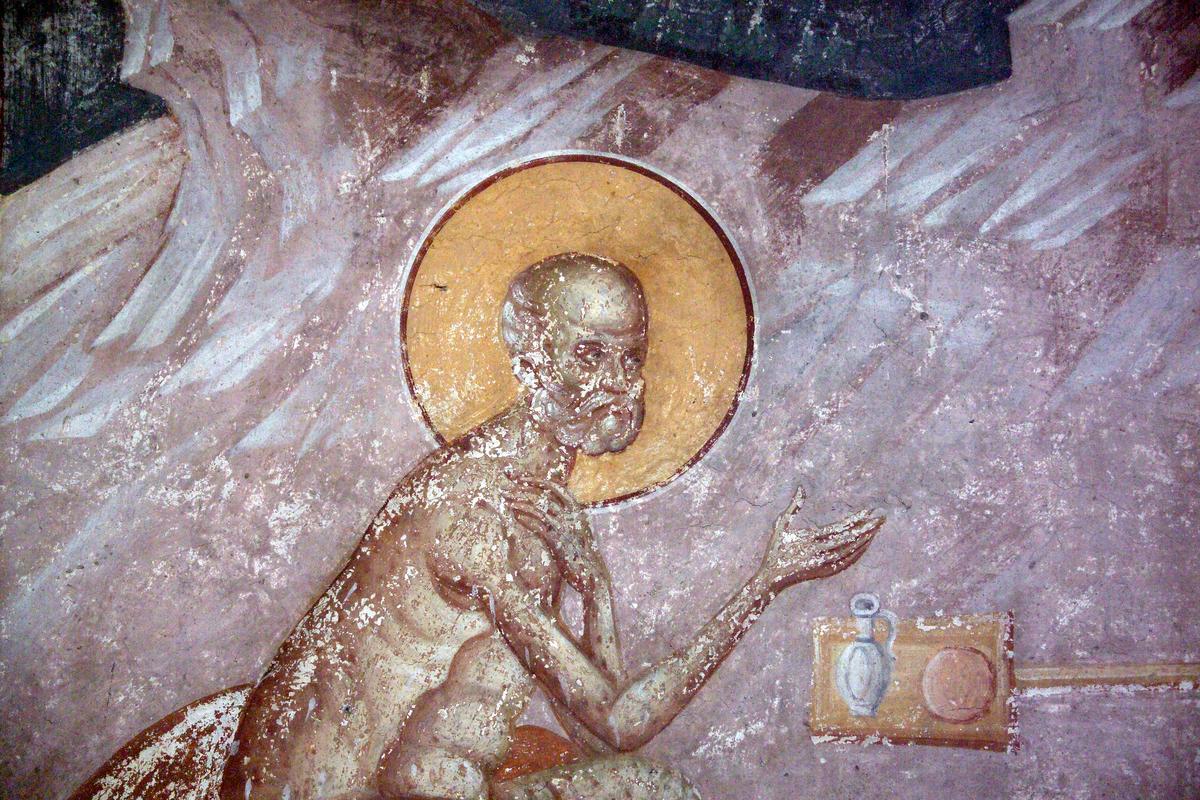
St. Isaac the Syrian, Bishop of Ninevah and Great Hesychast - Commemorated on January 28 and September 28 (source)
   
Saint Isaac the Syrian, Bishop of Ninevah, lived during the sixth century. He and his brother entered the monastery of Mar Matthew near Ninevah and received the monastic tonsure. His learning, virtue, and ascetic manner of life attracted the notice of the brethren, and they proposed that he head the monastery. St Issac did not want this burden, preferring a life of silence, so he left the monastery to live alone in the desert. 

His brother urged him more than once to return to the monastery, but he would not agree. However, when the fame of St Isaac's holy life had spread, he was made Bishop of Ninevah. Seeing the crude manners and disobedience of the inhabitants of the city, the saint felt that it was beyond his ability to guide them, and moreover, he yearned for solitude. 

Once, two Christians came to him, asking him to settle a dispute. One man acknowledged that he owed money to the other, but asked for a short extension. The lender threatened to bring his debtor to court to force him to pay. St Isaac, citing the Gospel, asked him to be merciful and give the debtor more time to pay. The man said, "Leave your Gospel out of this!" St Isaac replied, "If you will not submit to Lord's commandments in the Gospel, then what remains for me to do here?" After only five months as bishop, St Isaac resigned his office and went into the mountains to live with the hermits. Later, he went to the monastery of Rabban Shabur, where he lived until his death, attaining a high degree of spiritual perfection. 

From the early eighth century until the beginning of the eighteenth century, nothing was known about St Isaac of Syria in Europe except for his name and works. Only in 1719 was a biography of the saint published at Rome, compiled by an anonymous Arab author. In 1896, more information on St Isaac came to light. The learned French soteriologist Abbot Chabot published some eighth century works on Syrian history by Iezudena, bishop of Barsa, where the account of St Isaac the Syrian was found.
(source)
    
Sts. Ephraim and Isaac the Syrians (source)
   
St. Paisios and St. Isaac
In the Greek Orthodox calendar there is no official feast day of St. Isaac the Syrian. Traditionally, however, he has been celebrated on January 28th together with the other great Syriac father of the Church, St. Ephraim the Syrian. The Slavic Churches celebrate St. Isaac officially on January 28th.

Not too many years ago Elder Paisios (+1993) sought to change this fact due to his great veneration for St. Isaac. He commissioned a Service to be written in his honor and chose to celebrate his feast on September 28th. The Service was written by the eminent hymnographer Fr. Gerasimos Mikragiannanites (+ 2002). Today the feast of St. Isaac is celebrated on Mount Athos on September 28th.

Furthermore, the first church dedicated to St. Isaac was built on Mount Athos, in the cell of a monk of the brotherhood of Elder Paisios in Kapsala.

Elder Paisios, who would read the Ascetical Homilies of St. Isaac beneath the icon of the Saint, would say of St. Isaac: "If anyone went to a psychiatric hospital and read to the patients Abba Isaac, all those who believed in God would get well, because they would recognize the deeper meaning of life."

He also said:

"First you must read the Gerontikon, Philotheos History, and Evergetinos. All these books are practical not theoretical. Their simple patristic spirit and holiness will help you remove secular logic from your mind. Next, you should read Abba Isaac, and this way you will not see him as a philosopher, but as a man illumined by God."

It should also be noted that before the establishment of September 28th as the feast of St. Isaac by Elder Paisios, when he heard rumors that scholars accused St. Isaac of being a Nestorian, he prayed about this situation. Through divine revelation it was revealed to him that in fact St. Isaac was Orthodox and he wrote in his Menaion for January 28th the following words after the description of the feast of St. Ephraim the Syrian: "...and Isaac the Great Hesychast and much unjustly accused."

Below is the text of the Service in honor of St. Isaac commissioned by Elder Paisios. It is distributed by the Kalyva of the Resurrection of Christ in Kapsala on Mount Athos, where lived Fr. Isaac of Lebanon, a spiritual child of Elder Paisios. His ascetical tradition is maintained by Fr. Euthymios and his brotherhood.

(source)
   
St. Isaac the Syrian (source)
   
Selected quotes of St. Isaac the Syrian

  • What salt is for any food, humility is for every virtue. To acquire it, a man must always think of himself with contrition, self-belittlement and painful salf-judgment. But if we acquire it, it will make us sons of God.
  • Let us love silence till the world is made to die in our hearts. Let us always remember death, and in this thought draw near to God in our heart--and the pleasures of this world will have our scorn.
  •  Walk before God in simplicity, and not in subtleties of the mind. Simplicity brings faith; but subtle and intricate speculations bring conceit; and conceit brings withdrawal from God.
  • As a man whose head is under water cannot inhale pure air, so a man whose thoughts are plunged into the cares of this world cannot absorb the sensations of that new world.
  • It is a spiritual gift from God for a man to perceive his sins.
  • Ease and idleness are the destruction of the soul and they can injure her more than the demons.
  • The purpose of the advent of the Saviour, when He gave us His life-giving commandments as purifying remedies in our passionate state, was to cleanse the soul from the damage done by the first transgression and bring it back to its original state. What medicines are for a sick body, that the commandments are for the passionate soul.
  • A life of spiritual endeavor is the mother of sanctity; from it is born the first experience of perception of the mysteries of Christ--which is called the first stage of spiritual knowledge.
  • To bear a grudge and pray, means to sow seed on the sea and expect a harvest.
  • A small but persistent discipline is a great force; for a soft drop tailing persistently, hollows out hard rock.
  • The key to Divine gifts is given to the heart by love of neighbor, and, in proportion to the heart's freedom from the bonds of the flesh, the door of knowledge begins to open before it.
  • Dispassion does not mean that a man feels no passions, but that he does not accept any of them.
  • This life has been given to you for repentance; do not waste it in vain pursuits.

   
Note: the full Ascetical Homilies of St. Isaac the Syrian has recently been republished in English by the Holy Transfiguration Monastery in Brookline, MA.
   
St. Isaac the Syrian (source)


Apolytikion in the Plagal of the First Tone
He that thundered on Sinai with saving laws for man hath also given thy writings as guides in prayer unto monks, O revealer of unfathomable mysteries; for having gone up in the mount of the vision of the Lord, thou wast shown the many mansions. Wherefore, O God-bearing Isaac, entreat the Saviour for all praising thee.
   
Kontakion in the Plagal of the Fourth Tone
As an ascetic and God-bearer great in righteousness and an instructor of monastics do we honour thee, thou revealer of things sacred, and our protector. But, O Isaac, since thou hast great boldness with the Lord, intercede with Him for all of us who sing thy praise and who cry to thee: Rejoice, O Father most wise in God.
 © Holy Transfiguration Monastery (source)
   
Oikos (amateur translation below)
An Angel in asceticism, in the flesh, you were shown to be, O all-blessed God-bearer Isaac, and through your angelic voice, you imparted to us words of salvation, and we who are led towards the life to come, cry out to you:
Hail, the star from Syria,
Hail, the lamp of hesychia.
Hail, you who overcame daily cares,
Hail, partaker of heavenly illumination.
Hail, God-inscribed pillar of holy Hesychasts,
Hail, sweet-flowing mouth of spiritual teachings.
Hail, for you were filled with God-given wisdom,
Hail, for you deliver from evil passions.
Hail, most-fervent healer of Christ,
Hail, our godly teacher.
Hail, O wise God-bearer Isaac,
Hail, our godly guide.
Hail, O Father most wise in God.

Synaxarion
On the 28th of this month (September), we keep the memory of our Righteous and God-bearing Father Isaac the Syrian, who was the Bishop of the city of Ninevah.
   
Verses
There is need to praise Isaac the Venerable,
For through him, we bring to mind the things to come.
On the 28th, I behold the imperishable boast that is Isaac.
   
Doxastikon of the Aposticha in the Second Tone
The equal to the angels in asceticism, and divine-appearing in virtues, Isaac the godly-minded one, let us praise with hymns and odes, for rising as a phoenix, being watered through streams of tears, he brought forth fruit through the activity of the Spirit for the Church of Christ. And he intercedes ceaselessly to Christ, the Giver-of-Light, that we be granted mercy, and the remission of offenses.
   
Doxastikon of the Praises in the Plagal of the Fourth Tone
The fear of things to come ordered your life, and you abandoned corrupting notions from your soul, O Venerable one, through much hesychia and continence and nepsis, you inscribed upon your nous the ascetical way of life, and from the treasure of your heart, you bestow upon all saving teachings. And therefore, our Father Isaac, as you stand before the Three-sun light [of the Holy Trinity], deliver us from the darkness of passions.
   
Megalynarion
Hail, O divine canon of hesychia, hail, O wise teacher of monastics, hail, you who offer the grace of your word to everyone, O venerable Isaac.
(source)

   
St. Isaac the Syrian, his scroll reading: "Above all, love silence..." (source)
   
Through the prayers of our Holy Fathers, Lord Jesus Christ our God, have mercy on us and save us! Amen!

Friday, October 19, 2012

St. Isaac the Syrian - On the proper way to face sorrows


Christ and the Theotokos "Extreme Humility" (http://www.rel.gr/photo/albums/userpics/10039/normal_akratapeino2.jpg)
   
St. Isaac the Syrian - On the proper way to face sorrows
Just as the eyebrows approach each other, so are the temptations close to men. It was the economy of God to be so, with wisdom that we may receive benefit: namely, through knocking persistently, because of the sorrows, on the door of God's mercy and to enter into your mind, due to the fear of grievous events, the seed of memory of God, so that you may approach Him with supplications and your heart be sanctified through the continuous remembrance of Him. And while you ask Him, He will listen.
   
The person walking the road of God must thank Him for all the sorrows that he faces, and to accuse and dishonor his negligent self, and know that the Lord who loves and looks after him, would not have allowed the grievous things to happen to wake his mind up, if he had somehow not been negligent. God may have allowed some sorrow because man has become proud and consequently he should understand and let him not become disturbed but find the cause within himself, so that the affliction may not double up, namely suffer and not wish to be treated. "In God who is the source of justice there is no injustice".  May we not think otherwise.
   
Do not avoid the sorrows, because being helped by them you learn the truth and love of God well. And do not fear the temptations (negative experiences) for through them you discover treasures. Pray that you may not enter into spiritual temptations, while for the bodily ones, prepare to face them with all your strength, for without them you cannot approach God. Through them comes the divine rest. Whoever avoids the bodily temptations avoids virtue.
   
Without temptations the providence of God for man does not manifest itself, and it is impossible without them to receive the boldness in God and learn the wisdom of the Holy Spirit and moreover, it will not be possible to anchor the divine love in your soul. Before the arrival of temptations, man prays to God as a stranger. From the moment however he enters into temptations for the love of God and does not change opinion, let's say, he has God duty bound towards him and God considers him a genuine friend. For he fought and conquered the enemy, to fulfill the will of God.
   
God does not grant any big grace without a big temptation preceding it, for according to the severity of the temptations the graces were ordained by the wisdom of God, which however men normally do not understand. By the measure of the great sorrows that the providence of God sends you, you understand the great value that His magnanimity grants you. For according to the sorrow you experience is the consolation you will receive.
   
If you ask me what is the reason for all these, I will answer you: your negligence, for you did not bother to find the cure. The cure of all of them is one, and with it man's soul finds immediately the consolation it longs for. But what is the cure? "It is the humility of the heart". Without it, it is impossible to destroy the fence of temptations, in the contrary in fact you will discover that the temptations become stronger and weaken you...
   
According to the level of humility, God gives you the strength to endure calamities. And according to the measure of your patience, the weight of your sorrows becomes light and so you are consoled. And as you are consoled so does your love for God increases. And as much as you love God that much greater joy the Holy Spirit bestows on you. Our compassionate God wishing to bring the temptation of His true children to a good end, does not take but instead gives them the strength to endure. "All these gifts (consolation, love, joy) the strugglers acquire as fruit of their patience" for their souls to arrive at perfection. I wish our Christ and God to make us worthy through His grace to endure the bitterness of temptations for His love and with gratitude of our heart. Amen.
   
The saints show their love to God indeed, by their suffering in His name when for example He sends them sorrows without however distancing from them, for He loves them. Through this suffering love their heart obtains Boldness, so that they may approach Him freely and with conviction that their supplications will be heard and realized. The power of prayer that has boldness is great. That is why He allows His saints to experience every sorrow and acquire experience and be assured of His help and how much He provides and cares for them. This way they acquire wisdom and good sense from temptations, that they may not become negligent, that they may not lack spiritual asceticism on both good and bad, and thus receive through their trials, the knowledge of all things they would need. For otherwise they will be swept away by ignorance and will become the mockery of demons. For if they exercised only in the good things and had no experience of struggles with the evil, they would have gone to war totally unprepared...
   
Man cannot taste and value the good, if previously he did not experience the bitterness of the temptations...
   
Men come to the true knowledge, when God deprives them of His power and makes them to co-experience the human weakness and the difficulty that temptations cause, the cunningness of the enemy, and what adversary they have to fight and how much they have advanced and progressed in virtue and that without the power of God they are weak towards any passion. God does this, that they may receive from all these negative experiences, true humility and to approach close to Him and wait for His certain help and to pray with patience. So where could they learn all these but through the experience of many sorrows which He allows for them to experience? For this way one acquires stable faith through these sorrows while he is assured of the divine help that he many times receives during his struggles.
   
The strugglers therefore, are tempted that they may increase their spiritual wealth, the negligent though to protect themselves from whatever hurts them, the slumberous that they may be awakened, the distant ones that they may approach God and the friends of God that they may enter His Holy Abode with boldness. A son inexperienced in life cannot manage the wealth of his father and help him. For this, in the beginning God sends difficulties and hardships to His children and then He reveals His gifts. Like little children become frightened of scary sights and run, grabbing at their dress of their parents and ask for their help, so does the soul; the more upset and saddened by the fear of temptation the more it runs and clings on God and begs Him with unceasing supplications. And as temptations fall on it, one after the other, that much more it prays. However, when they stop and it recovers its comforts, normally it loses touch with reality and distances from God.
   
The sorrows and dangers kill sensuality, while good times and indifference feed it. For this both God and the holy Angels are joyful in our sorrows, while the devil and his accomplices are joyful when we are lazy and have a good time.
   
Leave your cares to God and in all your difficulties judge yourself, for you, yourself is the cause for all...
    
All the sad occasions and sorrows will torment us doubly if we have no patience. For with patience man turns away the bitterness of afflictions, while pusillanimity gives birth to the despair of hell. Patience is the mother of consolation; it is spiritual power that is born of a broad heart. It is difficult for man to find this power during sorrows, if he does not have the divine grace, which he acquires through persistent prayers and with tears.
   
   
Through the prayers of our Holy Fathers, Lord Jesus Christ our God, have mercy on us and save us! Amen!

Monday, March 15, 2010

Selected Quotes of the Fathers on Vainglory, Pride, and Humility

Christ the Bridegroom (Icon courtesy of www.eikonografos.com used with permission)

Selected Quotes of the Fathers on Vainglory, Pride, and Humility
"Adam became so proud that he wished to become God and died for his pride; the Son of God humbled Himself unto death, and gave life to the fallen. O abyss of humility! Adam and Eve lost themselves through gluttony, the Lord fasted and died for them, in order to give them life. They were disobedlient, Christ fulfilled obedience."
St. John of Kronstadt - My Life in Christ

"Flee vainglory, and you will be glorified; fear pride, and you will be magnified."
St. Isaac the Syrian - "Ascetical Homilies" (Homily Five)

"Pride does not perceive that it walks in darkness and, as being darkened, it does not know the insight of wisdom. For this reason in its own murky thoughts it elevates itself above all, whereas it is more vile and more feeble than any, and it is incapable of learning the ways of the Lord. And the Lord conceals His will from it, because it did not choose to walk in the path of the humble."
St. Isaac the Syrian - "Ascetical Homilies" (Homily Nineteen)
(http://scienceofsalvation.blogspot.com/)

“The sun shines on all alike, and vainglory beams on all activities. For instance, I am vainglorious when I fast; and when I relax the fast in order to be unnoticed, I am again vainglorious over my prudence. When well-dressed I am quite overcome by vainglory, and when I put on poor clothes I am vainglorious again. When I talk I am defeated, and when I am silent I am again defeated by it. However I throw this prickly-pear, a spike stands upright.”
St. John Climacus - The Ladder of Divine Ascent (Step 22, Section 5)

“An angel fell from Heaven without any other passion except pride, and so we may ask whether it is possible to ascend to Heaven by humility alone, without any other of the virtues.”
St. John Climacus - The Ladder of Divine Ascent (Step 23, Section 12)
(http://www.hchc.edu/hellenic/campus_life/vocation/OCTEV_Resources/quotes/johnclimacus.html)

"When pride retreats from a man, humility begins to dwell in him, and the more pride is diminished, so much more does humility grow. The one gives way to the other as to its opposite. Darkness departs and light appears. Pride is darkness, but humility is light."
St. Tikhon of Zadonsk - "Journey to Heaven"

"Pride prevents the soul from setting on the path of faith."
Staretz Silouan - "Wisdom from Mount Athos"

"Humility is a Heavenly siphon which from the abyss of sins can raise the soul to Heaven."
St. John Climacus - The Ladder of Divine Ascent (Step 25)

"When blessed Anthony saw all the snares of the devil spread out everywhere, he sighed, and asked God how anyone could ever avoid them. God answered him, 'Humility. It is humility that enables you to escape them all!' And what is more astonishing, He added, 'They cannot even touch you'."
St. Dorotheos of Gaza - "Discourses and Sayings" (On Humility)

"...The work of fulfilling the Commandments generates a state of humility."
Abba Dorotheos of Gaza - "Discourses amd Sayings"

"Let us humble ourselves and the Spirit of God Himself will instruct the soul."
Staretz Silouan - "Wisdom from Mount Athos"
(http://scienceofsalvation.blogspot.com/)

Through the prayers of our Holy Fathers, Lord Jesus Christ our God, have mercy on us and save us! Amen!

Tuesday, March 9, 2010

Selected Quotes of the Fathers on Hope and Patience

Christ carrying His Cross to Golgotha (Source: www.eikonografos.com)

Selected Quotes of the Fathers on Patience
"Trials are of two kinds. Either affliction will test our souls as gold is tried in a furnace, and make trial of us through patience, or the very prosperity of our lives will oftentimes, for many, be itself an occasion of trial and temptation. For it is equally difficult to keep the soul upright and undefeated in the midst of afflictions, as to keep oneself from insolence and pride in prosperity.”
St. Basil the Great – “I Will Pull Down My Barns” (The Sunday Sermons of the Great Fathers)

"Show patience, and there will be peace.”
St. Anatoly of Optina – “A Collection of Letters to Nuns”

"When patience greatly increases in our soul, it is a sign that we have secretly received the grace of consolation. The power of patience is stronger than the joyful thoughts that descend into the heart.”
St. Isaac the Syrian – “Ascetical Homilies” (Homily Forty-Eight)

"...It is patience that both commends us to God, and saves us for God. It is that same patience which tempers anger, bridles the tongue, governs the mind, guards peace, rules discipline, breaks the onslaught of lust, suppresses the violence of pride, extinguishes the fire of dissension, restrains the power of the wealthy, renews the endurance of the poor in bearing their lot, guards the blessed integrity of virgins, the difficult chastity of widows, and the indivisible love of husbands and wives. It makes men humble in prosperity, brave in adversity, meek in the face of injuries and insults. It teaches us to pardon our offenders quickly; if you yourself should offend, it teaches you to ask pardon often and with perseverance. It vanquishes temptations, sustains persecutions, endures sufferings and martyrdoms to the end. It is this patience which strongly fortifies the foundations of our faith. It is this patience which sublimely promotes the growth of hope. It directs our action, so that we can keep to the way of Christ while we make progress because of his forbearance. It ensures our perseverance as sons of God while we imitate the patience of the Father.”
St. Cyprian of Carthage – “The Good of Patience”

“...In proportion to your humility you are given patience in your woes; and in proportion to your patience the burden of your afflictions is made lighter and you will find consolation; in proportion to your consolation, your love of God increases; and in proportion to your love, your joy in the Holy Spirit is magnified. Once men have truly become His sons, our tenderly compassionate Father does not take away their temptations from them when it is His pleasure to 'make for them a way to escape' (1 Cor. 10:13), but instead He gives His sons patience in their trials. All these good things are given into the hand of their patience for the perfecting of their souls.”
St. Isaac the Syrian - "Ascetical Homilies" (Homily Forty-Two)

“Ask with tears, seek with obedience, knock with patience. For thus he who asks receives, and he who seeks finds, and to him that knocketh it shall be opened.”
St. John Climacus – "The Ladder of Divine Ascent" (Step 28)

“Do not be surprised that you fall every day; do not give up, but stand your ground courageously. And assuredly, the angel who guards you will honour your patience.”
St. John Climacus - "The Ladder of Divine Ascent" (Step 5)

"Do not be cast down over the struggle- the Lord loves a brave warrior. The Lord loves the soul that is valiant"
St. Siloan the Athonite

"...And so let us be glad and bear with patience everything the world throws at us, secure in the knowledge that it is then that we are most in the mind of God."
St. Basil the Great - "Gateway to Paradise"

"Hope also requires a life corresponding to the hope."
St. John of Kronstadt - My Life in Christ

"Tribulations worketh patience, and patience probation, and probation hope, " (Rom. 5:3,4). And even as the violence of the wind, when it rushes upon strong trees, and sways them in all directions, does not root them up, but renders them still firmer and stronger by these attacks; so the soul that is holy, and lives in a religious state, is not supplanted by the inroads of trial and tribulation, but stimulated thereby to more patience; even as the blessed Job, whom they made more illustrious and honourable."
St. John Chrysostom - "Concerning the Statutes"

"Prayer breathes hope..."
St. John of Kronstadt - My Life in Christ

"When you pray, bring to mind the ploughman who sows in hope. He Who causes to return twofold the seed that the ploughman sows with hope, Who has esteemed the seeking of His kingdom and His righteousness to be greater than temporal things, He himself will reward your entreaty according to His promise."
St. Isaac the Syrian - "Ascetical Homilies" (Homily Twenty-Five)

  
Through the prayers of our Holy Fathers, Lord Jesus Christ our God, have mercy on us and save us! Amen!