Showing posts with label Love. Show all posts

Thursday, September 9, 2021

Elder Symeon Kragiopoulos on the Nativity of the Theotokos: "The heavier the burdens we’ve got to lift in this world, the greater God’s blessing will be..."

The Nativity of the Theotokos (source)
   

The heavier the burdens we’ve got to lift in this world, the greater God’s blessing will be, as was the case of saint Anna who, though infertile, brought the Virgin Mary into the world.

Something similar will happen to each one of us, if we don’t despair and if we take this difficult and unbearable burden as special grace from God. Indeed, that’s the way things are. So great will the blessing from God be that man will remain in wonder.

To get to this point, man shouldn’t grumble. On the contrary, let us allow this unbearable cross, this unbearable shame we have to carry be the reason we refuse to grumble. Let it be the reason why we learn to feel gratitude to God. Let it be the reason we cry out to God with all our might, the reason we entrust ourselves to God and indeed expect for His blessing, His grace, His love to come. 

Archimandrite Symeon Kragiopoulos (†)

From the book: Archimandrite Symeon Kragiopoulos, “SPIRITUAL MESSAGES” Panorama Thessaloniki, 2017

(source)

Most-holy Theotokos, save us!

Tuesday, December 1, 2020

St. Porphyrios: God will say to me, "What are you doing here?"


Video with a recording of St. Porphyrios speaking, with English subtitles (source)
   
Through the prayers of our Holy Fathers, Lord Jesus Christ our God, have mercy on us and save us! Amen!

Friday, November 27, 2020

St. Porphyrios: "Unquestionably the higher state is love."

St. Porphyrios of Kavsokalyvia, with scenes from his life (source)

"Which is better? To be meek, humble, peaceful and to be filled with love, or to be irritable, depressed, and to quarrel with everyone? Unquestionably the higher state is love."

-St. Porphyrios of Kavsokalyvia

(source)

Through the prayers of our Holy Fathers, Lord Jesus Christ our God, have mercy on us and save us! Amen!

Friday, November 6, 2020

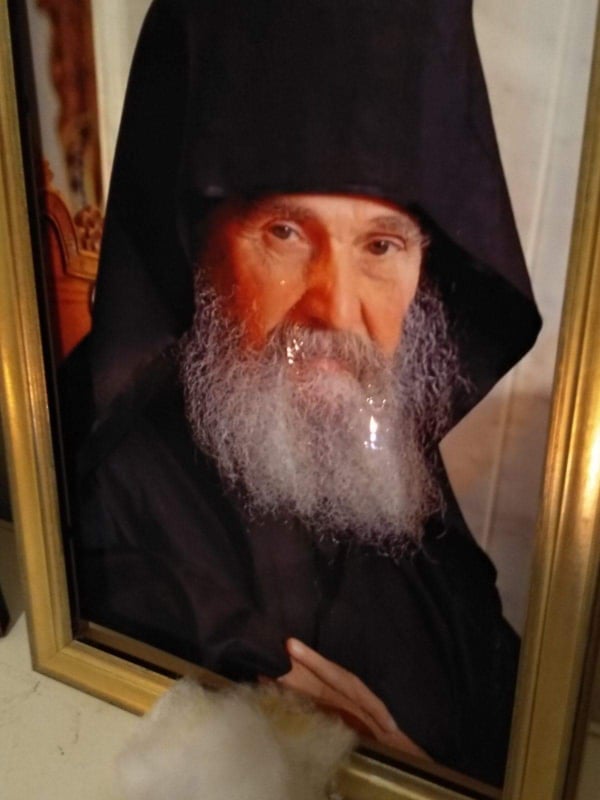
A vision of Elder Ephraim, and a picture of his purported to be weeping

Picture of Elder Ephraim of Arizona purported to be weeping (source)

"I just communicated with Gerontissa Thekla from Montreal, and she told me that our holy Elder appeared to someone living in Crete. He lives ascetically, and would go to visit the Elder at St. Anthony's [in Arizona].

He has this picture of our holy Elder with a constant vigil lamp before it. The Elder told him that God is greatly saddened by the Greeks***, because they are not praying.

On November 3rd, the picture began to weep, not just tears, but it became soaked.

The Elder is praying for all of us."

-Maria

(source)

***Note: By no means are the Greeks the only people that might not be praying as they should, but all people throughout the world, young and old, clergy, laity and monastics, should be repenting and praying as we should, entreating the Lord to save the world.

Elder Ephraim of Arizona (source)

“Elder Ephraim of Philotheou, who lived as an ascetic in Arizona, appeared to a woman in Northern Greece, a long-time spiritual daughter of the elder. At the time of the appearance she was with her daughter-in-law; she was not asleep but actually in a state of alertness. At one point the woman was unresponsive, as if in ecstasy,* and this lasted for about 10 minutes, according to her daughter-in-law who was watching her. She did not realize or comprehend the time duration — i.e., for how long the vision lasted. It was something new for her (the content of the conversation) because she has seen the Elder before, after his repose, both in her sleep as well while she was awake. Due to all this (her shock), she contacted her spiritual father and asked whether this experience was real or a deception by the evil one.

She saw Elder Ephraim and he was very sad and was imploring Christ that the ongoing [direction of] events be averted (all this, of course, is in agreement with what the elder said to many while he was alive).

And he told her:

‘Repentance repentance repentance. Christ is very angry...
We people today should not be in this spiritual state we are in...
Huge tribulations are coming, you can not imagine how bad these will be...
Alas to all of you for what awaits you; you must repent as long as there is time...
You need to kneel and cry, to shed tears of repentance, that Christ soften...
This has to do with what is happening in America as well.
Many people will depart through all that is to come, many people will depart (they will die).
You have no mercy among you. You show no mercy to each other.
You are tough towards each other, you stand ready to eat (consume-destroy) each other ....
Tell all of this to your spiritual father and to others ....’

The woman who saw this was a spiritual daughter of Elder Ephraim and was in communication with him often up until his repose.

- f. I.

*Translator’s noteThe Greek term here is χάθηκε. It was not immediately clear to us if this meant literally or spiritually. We received clarification that it was the latter and have made the change. We have also made other minor changes to improve the English translation and correct typos in the Greek version.

(source)

Elder Ephraim of Arizona (source)

Through the prayers of our Holy Fathers, Lord Jesus Christ our God, have mercy on us and save us! Amen!

Wednesday, September 16, 2020

Homily on Sts. Sophia and her Daughters, by Metropolitan Avgoustinos Kantiotes

St. Sophia and her daughters: Sts. Faith, Hope and Love (source)
  
Homily on Sts. Sophia and her Daughters, by Metropolitan Avgoustinos Kantiotes
After the feast of the Exaltation of the Cross, our Church celebrates, my beloved, the memory of Saints Sophia and her three daughters: Faith, Hope and Love.

St. Sophia was born, according to the Synaxarion, in a great city of Italy. She lived during the era of early persecutions, which, as is known, lasted for at least three centuries.

During that era, for one to be a Christian, it was costly. It cost one positions, honors, money, and even this life. Millions were sacrificed then for the love of Christ. With this heroic spirit, St. Sophia lived as well, and thus raised her daughters.

It is not possible to not rouse the evil of persecutors. They seized her, therefore, together with her daughters, and led them before the governor. He gave them the opportunity of three days in order to make a response, and possibly change their minds. But, after three days, the mother and her daughters remained unshakable in their dedication towards our Lord Jesus Christ.

The mother had fear that her daughters might deny Christ, because they were very young. The first, Faith, was twelve years old. Hope was ten. and Love was nine. Despite this, their weak flesh was strengthened by the grace of God, and they endured martyrdom with unprecedented boldness.

They locked them in prison. They beat them with whips. They pierced them with fiery arrows. They threw them in cauldrons of boiling water. However, like the Three Youths in the Furnace, thus, these three girls hymned God, as those around heard the hymn harmoniously: "Praise ye the Lord, and exalt Him beyond measure unto all the ages."

In the end, the three were beheaded by the sword of the tyrant. Their martyrdom was followed by that of their holy mother.

St. Sophia and her three daughters teach us, my beloved, that, if we wish to be faithful Christians, that Christianity will cost us. And the more faithful we are, the more it will cost us.

Many of us have become successful in this world. We find a myriad of ways to justify our seemingly proper and scandalous station. And later with think that we are Christians. Woe to us, if we do not set as a foundation the heroic mindset which defined the holy martyrs. These three little girls should censure the world. And their mother, St. Sophia, censures those mothers who are upset and tremble, thinking that through their fasting, prayer and reading, that the bodily strength of their little girls will be lessened.

The Martyrs are the greatest censure of our lukewarm, miserable and thrice-wretched Christianity.

However, St. Sophia and her three daughters teach us not only through their martyrdoms, but also through their names.

The name "Sophia", what does this teach us? "Wisdom", we hear in Church when the Priest holds the Gospel and raises it, showing it to the whole multitude of the faithful. The Gospel, in other words, is full of wisdom. There is no wiser book. Wisdom is Christ Himself, the Logos of God. Do you remember the wondrous apostolic reading which we read three days ago, on the feast of the Cross? He said: "But we preach Christ crucified, a stumbling block to Jews and folly to Gentiles, but to those who are called, both Jews and Greeks, Christ the power of God and the wisdom of God." (I Corinthians 1) Christ is wisdom, truth and life.

St. Sophia, therefore, through her name, brings to mind that we must seek from God the illumination of divine wisdom. The names of her three daughters bring to mind the three great theological virtues.

Faith! Awesome power, light, a star, foundation and root. Oh, if there were within our hearts this virtue! We could even bring down the stars from the heavens to the earth, and we could melt the mountains, and even the greatest hindrances would be solved. Do we have faith? If we had faith, 100% faith, the world would be different. But today, people don't even believe 1%. Take almost any Christian and ask him, and you would see that he is full of doubts, totally full of "ifs." If one has an "if", then you don't have faith. Faith is to believe 100% in reality that which our holy Church teaches us.

Hope also brings to mind that, in this world, we have a need for life-giving hope, which would warm us like the sun. The Christian who believes that God is a loving and nurturing Father, an almighty Father and all-wise, he would hope that all those things that God promised, all kinds of great and uplifted and indescribable good things, He will give to him.

And finally, Love, with her name reminds us of the fulfillment and the crown of the virtues. In this world of hatred, egotism, greed, and other evils, love today has grown cold. It is truly a terrible thing, as the sacred Chrysostom says, for us to see the sun be quenched one day. But it is even more terrible for love to be quenched. It is better for the sun to be quenched than for love to be quenched, because it is the sun for our souls. And Christ Himself prophesied, that there will come a cursed day, in which the sun of love will be quenched, and cold and frost will reign upon the earth. (Matthew 24:12)

We are speaking about love, but we don't possess love. Love is a heavenly thing, which is ineffably joined with humility, with obedience, with discipline, the great virtues. It is not something indiscriminate, like ecumenists reach, like worldly people teach. Love differs from love. There is carnal love, love of money, love of small and meaningless things. And there is furthermore love for one's father and mother, which, in the final analysis, also contains something physical. The love which Christ brings to the world, however, has the wings of an eagle, and flies to the third Heaven, and makes man a Cherubim and Seraphim.

Love, therefore, not only for relatives and friends, not just towards Christians, but love for the whole world. Love, even for those who crucify you! For we have Christ as our prototype, Who is love crucified. This love we must have as well.

My beloved, if one were to ask now which of these three virtues are the greatest, the greatest is the third, love. Its beauty is indescribable. The Apostle Paul paints all of this in his beautiful sayings on love, which we have properly heard in vain to this point. "If," he says, "I spoke in the tongues of men and Angels," even if I have done miracles, even if I distribute my earthly goods, even if I go to martyrdom and shed my blood, "and I have not love, then I have become a noisy gong or a clanging cymbal." "I am nothing." (I Corinthians 13:1-2)

These, my beloved, I have to tell you. Believe, in this age of faithlessness. Hope, in this age of hopelessness. Love, in this age of hatred. And first and foremost, keep love, which, as the Apostle Paul says, remains eternally. (ibid 13:7)

For what is Paradise? Is it rivers, crystalline springs? Is it the songs of the Angels, the Cherubim and the Seraphim, is it the Saints, the Martyrs, is it that whole and beautiful world, and indescribable good things? It is these things. But first and foremost, it is love, the love of God towards man. If I took out love from Paradise, immediately Paradise would become Hell.

That Paradise we ourselves should seek, if we sense the dawn of love, if we believe unshakably in the Lord, and if we have steadfast hope in the promises of God unto the ages.

Then, in the heights of Heaven, together with St. Sophia and her three daughters, Faith, Hope and Love, we will hymn the Triune God, saying: "Praise ye the Lord, and exalt Him beyond measure unto all the ages."
(+) Bishop Avgoustinos
Recorded from a homily that occurred in the Chapel of St. Sophia of the Orphanage of the "Agape" Brotherhood of Florina on 9/17/1970, (source)
  
Sts. Sophia, Faith, Hope and Love (source)
  
Through the prayers of our Holy Fathers, Lord Jesus Christ our God, have mercy on us and save us! Amen!

Sunday, September 13, 2020

Homily on the Meaning of the Holy Cross, by Metropolitan Avgoustinos Kantiotes

The Holy Cross of Christ (source)
 
Homily on the Meaning of the Holy Cross, by Metropolitan Avgoustinos Kantiotes
My beloved, what does the Cross teach us? Take a chalk and write, like children do in school, 2+2=4. Thus, the Cross is the "equal sign", but what is it? Do you think that it is simply a piece of wood that we venerate and are saved? You are mistaken, because this is not how it is in reality.

The Cross equals forgiveness.
Because upon the Cross, Christ forgave His murderers. Are there today some here in church who are at odds with each other? Are there women who hate their mothers-in-law? Are there houses where people don't speak with each other? Are there neighbors that don't greet each other? Is there hatred? Well then, the Cross tells us today: "Forgive!" If you don't forgive, then don't approach the Cross, don't venerate it. When, within your heart, you have bitterness, you have this serpent of hatred, you can't approach the Cross. Because the Cross means forgiveness. You must forgive even your greatest enemy.

The Cross equals truth.
Even if they put a knife to your throat, and slaughter you, you should speak the truth. Not in the sense that you go to court and raise your wretched hand upon the Gospel and take a false oath. Not like this. Christ was crucified for the truth. Whoever says lies, whoever goes to court and takes false oaths, he is not worthy to venerate the Cross. The Cross, therefore, equals forgiveness, the Cross equals truth.

The Cross equals humility.
No--even though you might have a very large home, or more money or lands or animals, or if you have children studying in school or if you have a beautiful wife, or whatever else you might do--you should not boast or feel proud. You are not a Christian! Humility! Humble yourself to say: I am nothing, I am a worm, I am nothing in this world. However, when you have pride and you boast and you show off your body and your job and your money, then you are not a Christian.

The Cross equals love.
Is your neighbor hungry? Give him a piece of bread. Is he thirsty? Give him a glass of water. Is he naked? Give him a shirt to wear. Go and console him and wipe away his tears. This is Christianity. Not when you have everything and your neighbor has nothing.

The Cross equals sacrifice.
As Christ sacrificed Himself, thus we must sacrifice ourselves. This is what the Cross means. If you do these things, then you are worthy to be called Christians. But you who dip your hands in blood, you who take false oaths, you who are unjust to the orphan, you cannot approach the Cross. The Cross casts you out.

Read the life of St. Mary of Egypt. On this day, she went to Jerusalem and saw the crowd going into the church and everyone--old, young, women, men--were going to venerate. She herself tried to approach the entrance. But some power pushed her back. She tried and second and a third time, but she was unable. Why? Because she was a sinful woman, and she worked in sin in Alexandria. Only after she repented, then she was able to enter the church and she became a Christian in reality.

The Cross, my beloved, creates presuppositions. We must live corresponding to the teaching of the Cross.

And something else: You should make your Cross properly. Because unfortunately, in our faithless years that we are living through, everything has become fashionable. Fashionable hair, fashionable clothing, fashionable shoes, fashion everywhere. Unfortunately many in Church do it out of fashion. Unfortunately you see scientists, congressmen, ministers, prime ministers, and none are doing their Cross correctly. That which they are doing is not the Cross. It joking and mocking. It is playing with God. Do not play with God. How will they understand that you are a Christian? By your Cross. When you make the sign of the Cross properly, you are doing a whole prayer. Therefore, do your Cross properly.

And when should you do your Cross? When you awake in the morning, do your Cross. Are you going to work? Do your Cross. Are you going to your field? Do your Cross. Are you sowing, returning from your field, entering your home? Do your Cross. Are you sitting at your dinner table? Do your Cross. Are you going to sleep? Do your Cross.

"Though I fall, I make my Cross
And have an Angel by my side."

O woman, are you baking? Make the sign of the Cross in the dough. Wherever you go and whatever you do, make your Cross. The Cross is the "protector of the whole world."
(+) Bishop Avgoustinos
Imera, Kozani, 9/14/1965
(source)
   
Through the prayers of our Holy Fathers, Lord Jesus Christ our God, have mercy on us and save us! Amen!

Wednesday, August 26, 2020

Encomium on the Lord, and on that Cloth that touched His Immaculate Body

Icon depicting the Mandylion of Christ and His Passion (source)
 
Note: Elsewhere, the possibility that the famed Mandylion of Edessa (the original now seemingly lost to history) is one and the same as the Shroud of Turin, has been discussed (for example, see here for a talk by an Orthodox presenter on the subject). There are many places where the history and science that supports this are discussed and disputed at length. In this post, however, I humbly aim to use the style of the Byzantine Encomium to accomplish several things. First, may we ever give thanks to our Lord and Master for all His many blessings to us, and especially for enduring His Passion for our salvation. Also, I intend this to prayerfully contemplate the Cloth (or Cloths) that touched His Immaculate Body, and both the immense theological implications of this, and the many wonders that He worked and continues to work throughout the world for those simple and humble of heart, who are seeking His face. Finally, I aim to marvel at even the possibility that the Lord, in His love for man, could have somehow left us a vivid Icon of His Passion and Resurrection, and allowed this to pass throughout the world and the centuries, healing the sick, warding off enemies and overcoming nations, and, seemingly more impossible, how He could have allowed this Cloth to even reach our days of hardened hearts and little faith, where scientists continue to be astonished at this Relic. Many are struck to the heart with contrition, humility and repentance, and some are even being brought to faith in Him through this. "Thus shall many nations wonder at him; and kings shall keep their mouths shut: for they to whom no report was brought concerning him, shall see; and they who have not heard, shall consider." (Isaiah 52:15)
    
Encomium on the Lord, Who suffered, slept, and arose in the flesh for our salvation,
And on that Cloth that touched His Immaculate Body
“Let the light of Your countenance be signed upon us, O Lord” (Psalm 4:6), for to us who dwell in darkness and the shadow of death (Luke 1:79), the Lord has appeared, to bring light to those in darkness. His uncreated light shines upon all creation as the true radiance of the Father (Kontakion of the Transfiguation), though we sinners, filled with countless sins and passions and weakness, cannot bear to behold His glory.
  
For, if the God-seer was told by the Almighty “You shall not be able to see my face; for no man shall see my face, and live.” (Exodus 33:20), how might we dare to behold the radiance of His face, before which tremble Angels, Archangels, the Cherubim and Seraphim. The Great Moses could scarcely bear to behold His back, bowing to the earth to worship Him, proclaiming: “The Lord God, pitiful and merciful, long-suffering and very compassionate, and true.” (Exodus 33-34).
  
And His Prophet Isaiah, gazing upon the Lord of hosts in His glorious temple, cried out: “Woe is me, for I am pricked to the heart; for being a man, and having unclean lips, I dwell in the midst of a people having unclean lips; and I have seen with mine eyes the King, the Lord of hosts.” (Isaiah 6:5)
  
For when the Prophet Ezekiel beheld the vision of His glory, he exclaimed “This was the appearance of the likeness of the glory of the Lord. And I saw and fell upon my face.” (Ezekiel 2:1)
  
Truly, His glory brings fear and trembling with great awe upon Heaven and earth and the things below the earth, as Prophet Habakkuk sang in prayer: “O Lord, I have heard your report, and was afraid: I considered your works, and was amazed. “(Habakkuk 3:2) It is He “Whose glance dries up the deep, and Whose threatenings melt the mountains” (Prayer from the service of Baptism).
  
But, despite His endless might and glory and radiance, He, in a manner surpassing understanding, deigns to reveal Himself and to come to us in all humility, in gentleness and simplicity, “the voice of a gentle breeze”, as He appeared to the Zealot Elias (I Kings 19:12). Or as Psalmist chants: “He shall come down as rain upon a fleece; and as drops falling upon the earth.” (Psalm 72:6)
  
O, Your wonders, surpassing all wonders, O Lord! “Who is like to thee among the gods, O Lord? who is like to thee? glorified in holiness, marvelous in glories, doing wonders.” (Exodus 15:11) For the Son of the Father, “Light of Light, true God of true God, begotten, not created, of one essence with the Father, through Whom all things were made. For us men and for our salvation, came down from heaven, and was incarnate of the Holy Spirit, and the Virgin Mary, and became man.” (The Symbol of Faith) “This is our God, and there shall none other be accounted of in comparison of him. He hath found out all the way of knowledge, and hath given it unto Jacob his servant, and to Israel his beloved. Afterward did he shew himself upon earth, and conversed with men.” (Baruch 3:35-37).
  
The Lord did deign to come to us, humbling Himself, becoming conceived within the Spotless womb of the Virgin. He was born as a babe into a cave most cold and dark, He Who is the Light of the universe. He nursed milk from His creature, He Who nourishes all creation. He shows obedience, He to Whom every knee bows in heaven and earth and under the earth (Philippians 2:10). He puts off His garments, He Who clothes the Heavens with clouds. He is submerged in the waters of the Jordan, Who drowns error and disperses the hordes of the demons. He preaches, and heals both bodies and souls, that in every way, He might lead us back to the Father.
  
And He does not stop at this, but gives us His own Body and Blood, before His life-giving Passion. Behold! With the eyes of the soul, behold  “the true light that enlightens every man was coming into the world.” (John 1:9) Behold the Man of Sorrows, Who bends His knee in prayer to His Father, giving us a type of fervent prayer. He pours forth sweat as drops of blood, earnestly seeking to deliver the world from death. He endures the kiss of betrayal from one of His Disciples, and suffers buffetings, and scorn, and slander. The Judge of the living and the dead, the Judge most just, stands condemned as a criminal before Pilate. The Creator is bound by His creation, and bitterly flogged. His flesh is torn apart, Who wove garments of skin for the first-formed. He receives a Crown of Thorns, He Who is the King of Angels, Whose glory cannot be fathomed. He receives spitting, Who formed eyes for the blind man with His spittle, and the Purple Robe of mockery, Who adorned the vault of the Heavens, and Who holds the universe in His palm. He carries His Cross, Who carries time and space upon His shoulders, and stretches out His hands, uniting things that were once sundered.
  
One of the very early depictions of the Holy Mandylion of Christ, dated likely to the 12th Century (source)
   
“Let the light of Your countenance be signed upon us, O Lord.” Behold, behold the marks of the nails, the wounds on His precious head, the blood and water pouring from His life-giving side! Behold! The glory that surpasses all things humbles Himself, and endures everything, becoming “obedient unto death, even death on a cross.” (Philippians 2:8) He breathes His last, and gives up His spirit, leaving us His life-giving Body, and the Instruments of His Passion for our consolation, our boast and our healing, for “by his bruises we were healed.” (Isaiah 53:5)
  
Come, O noble Joseph and Nicodemus, gather your boldness to bury the Body of God. Bring your shroud, and your precious myrrh to bury this Stranger in a new Tomb (Homily of St. Epiphanios on Great Saturday), hewn from the rock, Who was hewn from the Virginal Mountain without the hand of man (Daniel 2:45). Cover the face that is the glorious radiance of the Father, soak up the Blood which re-creates all things. Guard with a Stone the Supernatural Stone, from Which our Fathers drank. (I Corinthians 10:4)
  
And after He dwelt bodily in the grave, and His Soul freed the prisoners in Hades, while dwelling in Paradise with the Thief, and never departing the Throne of the Father (Hymn of Proskomede), He Who is uncircumscribable, arose on the third day. He passes unhindered through the stone, Who traversed the portal of the Virgin (from the Praises of Sunday Matins from Plagal of the First Tone) leaving her unharmed. He sends His Archangels to roll away the stone from His life-giving Tomb, at whose appearance, the guard of soldiers became as dead men. He brings joy to His Mother and her fellow Myrrhbearers, making them the Apostles to the Apostles, to tell of the Resurrection.
  
Run, O beloved Disciple, and outrun Cephas, and together behold the Tomb, the sudarium that was upon His head, and the grave-clothes that covered the Immaculate Body of the Master. Behold! He is not here! And with panting, and fear and exhilaration, behold the signs of your risen Lord! The Tomb is empty, the Angel sits upon the stone, and the shroud is left behind, bearing the marks of His Passion. “Hear, O heaven, and hearken, O earth: for the Lord has spoken!” (Isaiah 1:2)
  
Behold the Wisdom of God has built His house, He has been slain (and is alive again), and has poured His Blood, and prepared His table, and calls His servants with a loud proclamation to a feast! “Come, eat of my bread, and drink wine which I have mingled for you.” (Proverbs 9:1-5) He does not leave us orphans (John 14:18), but leaves us another Comforter (John 14:16) to ever abide with us. He leaves us His Divine Mysteries, and leaves us His Image, and the tokens of His Passion, in remembrance of Him. (Luke 22:19)
  
O Lord, “You did not cease doing everything until You led us to heaven and granted us Your kingdom to come.” (Anaphora of St. John Chrysostom) You use every part of creation, visible and invisible, to lead us to Yourself. After Your face was washed and Your Precious Icon was imprinted upon the Cloth, You sent it for healing and protection through Your Apostle, Thaddeus, to the ailing King Apgar. By grasping in faith and love, he received release from his bodily infirmity. Though beforehand he sought that You might visit his kingdom in life, through his repentance and baptism, You were truly brought to Him together with Your Icon, and he was brought to Your Kingdom.
  
The king and the people who beheld Your image cried out to Him, as in the words of the Greatly-suffering Job, to Him Who once appeared "through the whirlwind and clouds" (Job 38:1): "I have heard the report of thee by the ear before; but now mine eye has seen thee. Wherefore I have counted myself vile, and have fainted: and I esteem myself dust and ashes." (Job 42:5-6) Your presence remained hidden for many years, while persecutions raged among Judeans, pagan rulers, and apostates, but was later brought to light again to save the city of Edessa.
  
Suddenly, the divine imprint of Your face, (both, not fashioned by the hand of man) brought joy and consolation and inspiration to Christian peoples. They began to properly depict Your immaculate Icon, as another remembrance of You that strikes fear in the hearts of sinners, and bears hope for those repentant, and brings joy to Your faithful servants. Your face was processed and supplicated by the rich among the people (Psalm 45:12), and soon proceeded to the Queen of Cities, which was greatly enriched by Your presence. “Myrrh, and stacte, and cassia are exhaled from your garments, and out of the ivory palaces” (Psalm 45:8) The king boasted in the King of Kings, and humbly bowed to venerate the Immaculate Icon not made by the hands of man, as He once told His friends: “Blessed are the eyes which see what you see! For I tell you that many prophets and kings desired to see what you see, and did not see it, and to hear what you hear, and did not hear it.” (Luke 10-23-24)
  
Though the City fell into the hands of her enemies, the glory of Your face proceeds forth unto Athens and Paris, unto Glastonbury and Torino and all the lands of the West. The humble and burdened among them take courage in You, as you spoke through Your Prophet: “Fear not; for I am with thee: I will bring thy seed from the east, and will gather thee from the west. I will say to the north, Bring; and to the south, Keep not back; bring my sons from the land afar off, and my daughters from the ends of the earth; even all who are called by my name: for I have prepared him for my glory (Isaiah 43:5-6)
  
The astonishing photographic negative of the Shroud of Turin, depicting a moving icon of Christ's Passion (source)
   
Some deny You and are unable to gaze upon Your face, You before Whom tremble things above and below. But You, O Lord Almighty, the God of Abraham and Isaac and Jacob, Judge of the living and the dead, You do not cease doing all things and using every tool of creation to reach me, the sinner. You broadly cast out the seed of Your Word unto the ends of the universe, and Your wonders are read, and spoken of, and beheld in all places and in every hour. Technologies and science, though offspring of this fallen world, proclaim and cry out Your miracles, Your life, Your painful endurance of suffering unimaginable, and Your wounds that pour out not just Blood and Water, but forgiveness for mankind. And most of all, Your Resurrection is marveled at, and is praised and glorified unto the ages of ages. Your Icon remains, and becomes more astonishing day by day, for those who would wish to see. You speak to our hearts in a land of death and destruction, and You continue to stand, calling us day by day to return to the Father.
  
And now I turn to Your immaculate Icon, O Christ God, and the Cloth that depicts for us Your incarnation and Your Passion and Resurrection:
  
Rejoice, O Cloth, humble working of the hand of man, which was glorified so greatly to touch the Master Himself, He Who bowed the Heavens to embrace the earth in His love for man, and Who, with His hand, wove together all creation, both visible and invisible!
  
Rejoice, O Cloth, which dried the water and perspiration from Him Whose glance dries up the abyss! You encircled to embrace the Body of God that was dejected and cast off from men!
  
Rejoice, O Cloth, that gathered the Precious Blood and Water that flowed from the side of the Master, which He continues to pour forth for His servants daily! This is the Lamb of God "broken and distributed, but not divided; always eaten, yet never consumed, but sanctifying those who partake." (Divine Liturgy)
   
Rejoice, O Cloth, imprinted with the Icon of the Master without the hand of man! You became a teacher and archetype for us that our Lord should be depicted, and showing us how we are to properly paint the Image of God, Who became flesh for our salvation.
     
Rejoice, O Cloth, for you embraced Him Who is carried by the Cherubim and Seraphim, who cover their faces in fear before His awesome countenance!
     
Rejoice, O Cloth, which served as another sign of His Resurrection on the third day, both perplexing and bringing joy to the Apostles Peter and John, and later to all the servants of the Master!
     
Rejoice, O Cloth, which traveled as another Apostle throughout the world, proclaiming the Master's coming in the flesh, His many wonders, and His bodily Passion and Resurrection!
     
Rejoice, O Cloth, which brought healing to Apgar, and was at the same time, both glorious and humble like your Lord! Through you were enemies driven off and awesome and terrible wonders wrought, while you humbly endured to be hidden for many years.
     
Rejoice, O Cloth, which brought unending joy to the Queen of Cities! She, and all her faithful continue to depict your icon and chant in praise of the Lord, entreating for forgiveness of offenses.
     
Rejoice, O Cloth, which was humbly taken as a prisoner like the Redeemer, and brought throughout many lands of the West! You endured marks like the Master, being burnt and cut and put to doubt and scrutiny by men! But these have not diminished the glory of the One you depict. Not at all! But you continue to cry out and proclaim His wonders, bringing more to Him every day.
     
Rejoice, O Cloth, depicted in Churches throughout the world, in icons of wood and stone and cloth, in mosaics and frescoes, depicting the Christ Who put on flesh out of love for man, and Who endured His Passion, while arising on the third day!
     
Rejoice, O Cloth, becoming an Icon of what I must become! For the Lord calls me to become washed and pure likely fine linen, and to embrace Him, and to have Him alone marked upon me indelibly, to ever carry within me His Spotless Blood, and to keep His Icon unfaded unto the ages! For "all who have been baptized into Christ, have put on Christ." (Galatians 3:27)
  
O Lord God Almighty, "Who robes Yourself with light as with a garment; spreading out the heaven as a curtain" (Psalm 104), receive this humble prayer offered to You in thanksgiving and repentance and supplication. You Who are the Light unapproachable, come and clothe us with Yourself, for You are the protection of the naked, and light for those in darkness (Kontakion of Theophany). Grant speedy consolation to Your servants, O Jesus. Come, draw near to us, draw near, You Who are everywhere (Kontakion of Pentecost), that You might fill all things with Yourself (Ephesians 4:10). Grant us mourning for our sins and weaknesses, repentance and confession, and amendment of our lives, that through Your Passion, You might bring to us victory over our Passions. Grant peace to Your Church, to civil authorities, to all Your people. Unite to Your Church those who have fallen from her and bring to her Your sheep not yet of this fold. Protect the poor, the sick, and those suffering in any way, along with those who travel and those tempted. And let the light of Your countenance ever be signed upon us, O Lord, that we might be made worthy to ever behold Your glorious face in Your Kingdom, "for You, O Christ our God, are the illumination of our souls and bodies, and to You we offer up glory, together with Your Father, Who is without beginning, and Your all-holy, good, and life-creating Spirit, now and forever and to the ages of ages. Amen." (Prayer from the Liturgy of St. John Chrysostom)
      
A famous Russian Icon (this version from the 14th Century from the State Museum of Arkhangelsk): "Do not weep for me, O Mother", which often depicts the Holy Mandylion together with Christ, "Extreme Humility" (source)
    
Through the prayers of our Holy Fathers, Lord Jesus Christ our God, have mercy on us and save us! Amen!