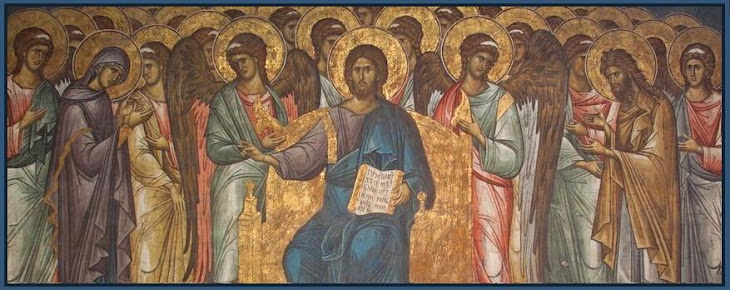
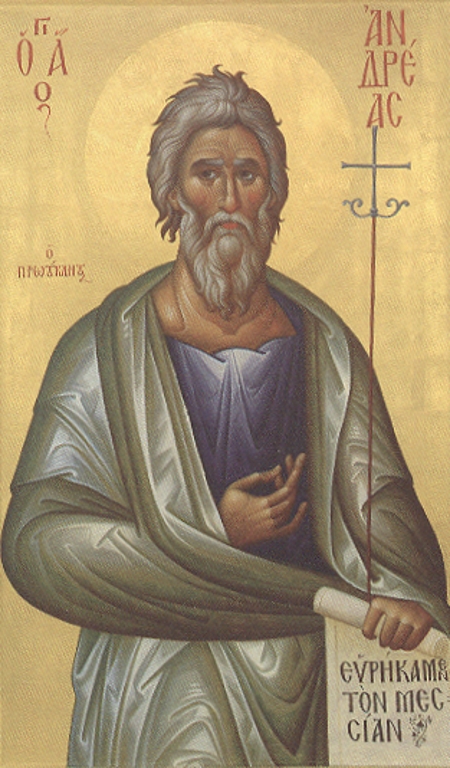
St. Andrew the First-called Apostle - Commemorated on November 30th (Icon courtesy of www.eikonografos.com used with permission)
"The Holy Apostle Andrew the First-called
Andrew, the son of Jonah and brother of Peter, was born in Bethsaida and was a fisherman by trade. At first he was a disciple of St. John the Baptist, but when St. John pointed to the Lord Jesus, saying, Behold the Lamb of God! (John 1:36), Andrew left his first teacher and followed Christ. Then, Andrew brought his brother Peter to the Lord. Following the descent of the Holy Spirit, it fell by lot to the first apostle of Christ, St. Andrew, to preach the Gospel in Byzantium and Thrace, then in the lands along the Danube and in Russia around the Black Sea, and finally in Epirus, Greece and the Peloponnese, where he suffered. In Byzantium, he appointed St. Stachys as its first bishop; in Kiev, he planted a Cross on a high place and prophesied a bright Christian future for the Russian people; throughout Thrace, Epirus, Greece and the Peloponnese, he converted multitudes of people to the Faith and ordained bishops and priests for them. In the city of Patras, he performed many miracles in the name of Christ, and won many over to the Lord. Among the new faithful were the brother and wife of the Proconsul Aegeates. Angered at this, Aegeates subjected St. Andrew to torture and then crucified him. While the apostle of Christ was still alive on the cross, he gave beneficial instructions to the Christians who had gathered around. The people wanted to take him down from the cross but he refused to let them. Then the apostle prayed to God and an extraordinary light encompassed him. This brilliant illumination lasted for half an hour, and when it disappeared, the apostle gave up his holy soul to God. Thus, the First-called Apostle, the first of the Twelve Great Apostles to know the Lord and follow Him, finished his earthly course. St. Andrew suffered for his Lord in the year 62. His relics were taken to Constantinople; his head was later taken to Rome, and one hand was taken to Moscow."
(taken from the Prologue of Ochrid by St. Nikolai: http://www.westsrbdio.org/prolog/prolog.htm)

"In Sinope [Pontos, St. Andrew] prayed for the imprisoned Matthias, his chains fell from him, and the cell door opened. The people beat Andrew, breaking his teeth and cutting his fingers, and left him for dead in a dung heap. Jesus appeared to him and healed him, telling him to be of good cheer. When the people saw him the next day, they were amazed and believed. In Patras, Andrew healed the wife of the proconsul Aegeates of an incurable disease of the eyes. He healed a paralytic, lepers, and all manner of disease. Aegeates heard all of this and arrested Andrew. He tried to compel him through beatings to sacrifice to idols and so restore idolatry in his country. When Andrew refused, he was tied to a cross upside down so that he would live longer and suffer more. Twenty thousand of the faithful stood by and mourned. Even then, Andrew taught them and exhorted them to endure temporary sufferings for the kingdom of heaven. Out of fear of the people, Aegeates came to remove Andrew from the cross. Andrew, however, said that Aegeates could still become a Christian, but that he had already seen Jesus and he would not allow himself to be removed from the cross. Suddenly, a heavenly light illumined Andrew for about half an hour, and then he gave up his spirit."
(Excerpt from the 2005 Daily Lives, Miracles, and Wisdom of the Saints by Tom and Georgia Mitrakos)
The Tradition of St. Andrew in Cyprus (Amateur, work-in-progress translation)
In one of his tours, tradition holds it that the saint came to our island [Cyprus]. The boat, which was traveling to Antioch from Joppa, shortly before passing the well-known cape and islands of the Apostle Andrew, known by the name "Keys" [Kleides], had to stop there in a small harbor, because the wind lull. Over the last few days the water had disappeared. One morning, the master came to the island looking to find water, and he brought with him the Apostle. Unfortunately there was no water anywhere. At some point, when they arrived in the middle of the two churches which exist today, the old and new, that is built a little higher, the Saint kneeled in front of a dry rock and prayed to God to send water. He was seeking the miracle so that all those there would believe in Christ. Later he got up, signed the rock with the sign of the Cross and the miracle happened. From the root of the rock immediately came a spring of water, which runs until today in a pit of the old church and from there goes and comes from a fountain near the sea. It is well-known Holy Water. The blessed water, which refreshed them, but also many others, whole myriads, who partook with faith and were cooled and consoled. First among these was the blind child of the captain.
He was one of the people on the boat who was brought by his father. He was born blind and grew up in a permanent darkness. He had never seen the light. Trees, plants, and animals he struggled to know by touch. That day, when the sailors returned with the bag full of water and explained how it was found on the island, a sweet light of hope lit in the heart of the poor child. Maybe this water, he thought, which emerged from the dry rock after the prayer of that strange fellow, could grant him the light that he sought? Having come about miraculously, perhaps it could provide miracles. With this faith and deep hope the child asked for some water. He drank. He was burning from thirst. The apostle, who was there, rushed and gave the child a container full of the cool water. But the child preferred instead of cooling his lips with the water to wash his face with it. And miracle of miracles! Once the cool water hit the bulbs of the eyes of the child, the chronic darkness began to fall apart. And a light, cheerful light, began to wash the things around...
- "Father, father", the child began to shout when [ψαχουλεύοντας] and ran to find his father. And the captain who was startled by the voices of the child ran to the place where he heard the voice. When he reached the child he stopped, bent down and opened his arms.
- «My child, what are you trying to say?» the father asked with terror.
- «I see! My father, I see! Look at me, I see the sea, people, the sails of our boat inflate. Father, the blessed water which that old man gave me to drink and wash, that granted me what I was seeking. My light, Father ... »
After a short break that ended in tears and sobbing gratitude the captain stood up and said:
- «Child, go and find the pappouli [old man] you were talking about, so we can thank him for what he gave us!».
- "Not me", said the apostle who approached. "Everyone should thank Christ. He gave us the water. He healed the child. He is the True God, who became man and came to the world to save us! »
And the apostle, who everyone gazed on with admiration, began to speak and to teach the new religion. The end of the speech was very fruitful. All those who heard believed and were baptized. First was the captain with his child, who took the name Andreas. And then all the other passengers and some fishermen who were there. They all believed in Christ proclaimed to them by the Apostle and were baptized. Naturally, from the miraculous cure of the blind child, more and more began to follow. In the meantime the wind began to blow and the boat was prepared to continue his journey. The Apostle, who invited to him all those who believed in Christ and were baptized, gave them some final advice and bade them farewell. Thus on this blessed island was organized a group, a church of believers in the one True God.
Many years later, on the place were the Apostle walked, which was blessed with the prayers, miracles, and sweat of the First-called, the great monastery of Apostolos Andreas was built, which over time became a Pan-Cyprian pilgrimage. Each year thousands of pilgrims from all parts of Cyprus, orthodox and heterodox, and even heathen, gather at the monastery to venerate the miraculous icon of the Apostle, to baptize newborn children and offer rich gifts in money or treasure [είδη], to express thanks and gratitude to the divine Apostle. The church is the Font of Siloam to those who are suffering. Multitudes of miracles occur to those visitors with true faith and contrite souls.
In all the temples of our martyred island [Cyprus] we will find the holy icon and the name of the Apostle as one of the most common among the people (Andreas or Adreani - Androula). For reasons only the Lord knows, for many years - since 1974 - the holy monastery together with all Karpasia, the Mesaoria and North Cyprus have been under the sovereignty of...the Turks. Liturgies are not normally performed in the blessed churches that are in these parts. And the bells are no longer rung to invite the faithful [to worship]... But the holy water which sprung from the land after the prayer of the Apostle Andrew remains and continues the gush forth. It continues to gurgle and waits for the holy hour when the faithful of the island, washed and purified in the tears of genuine repentance, will be free again to visit the beautiful monastery and to chant to the Lord thanksgiving for salvation from the evils and bitter trials and to drink and be refreshed from the sweet water. May God, with the help and the intercessions of St. Andrew the Apostle, and all of the other saints of Cyprus, make this day to come quickly.

St. Andrew in Patras
The end of the Apostle resembles the rest of his life. He was martyred in Patras, where he had arrived to convey the message of deliverance and spread the light of Christ. His visit brought forth many fruits. In a few days his teaching with the many miracles of his literally shook-up the foundations of idolatry in Achaia. Among the first who believed was the Proconsul himself. Thus it was said that during the Roman times, the Romans ruler who managed one of the provinces of the state which was called Lesvios, was gravely ill, and was healed by the Apostle. At the example of the Procounsul, other Pagans were quick to follow. But this became known in Rome, and the Emperor Nero, blinded [λύσσαξε] from evil, instructed Lesvios to be replaced immediately by Aegeatis, a very fanatic and hardened pagan.
The First-called met everyday with Lesvios and continued his sermons and miraculous cures. Crowds of people from all over the Achaia watched with interest every day and many joined the ranks of believers. To them were also added the wife of Aegeatis, Maximilla, his brother Stratoklis, a wise mathematician, and many others from their relatives and company.
The proconsul Aegeatis, although he saw his wife Maximilla was saved from certain death by the intervention of the First-called, and though he saw his brother Stratokli, who he admired so, accept the new faith, he remained unmoved. He met with his wife and said that he would deny Christ. But Maximilla did not listen to him.
-I prefer to be separated from you than from my Christ.
And he, blinded by his passion, ordered the arrest of the First-called and for him to be placed in prison. To blackmail the woman who was committed to Christ, he threatened that if she did not return to the idolatry of their fathers, he would horribly torture the Elder Apostle and in the end will crucify him. Troubled, Maximilla ran to the prison to convery the threats of her husband. The good woman trembled, that such harm would befall the worker of her salvation.
- Do not be afraid for my life, my daughter" the First-called said. "Keep your faith firmly. It 's an honor and grace of God for me to be made worthy to leave this world in the same way our Saviour did. Let Aegeatis do what he wants. Let him cut me with swords. Let him burn me with fire. Let him nail me to the cross. «The sufferings of this present time are not worth comparing with the glory that will be revealed to us». [Romans 8:18] Stratoklis, who was there, cried.
- "Don 't cry", the apostle said. "One day we get out of this world. «For here we have no permanent city». [Hebrews 13:14] Watch only the seed of the Gospel, which has been sown in your heart. Let it spread carefully.
The words of the Apostle boosted the courage of Maximilla and Stratoklis and increased [ατσάλωσαν] their willingness to fight to the end. The Aegeatis once again called his wife to him and tried with sweet words and flattering to separate [μεταπείσει] them from the faith of Christ.
- I'm ready to do everything for your love, he said. If you are persuaded to leave Christ, you would be my queen in my house. Otherwise I will nail the old man to the cross, who took away your mind, and I will kill you. The response of Maximillas was truly heroic.
- I prefer a thousand times death rather than life with a pagan like you. The words of the Christian heroine fired-up the anger of her husband, who gave a mandate to torture the Apostle hard and finally to lift him upon a cross, which had the shape of the letter X, which had been set up in the «mouth of the sea of Ammoudias» [«χείλος της θαλάσσιας αμμουδιάς» begins with the greek letter X. Note that other accounts hold that the St. Andrew asked to be nailed on an X-shaped cross, out of his feelings of unworthiness to suffer in the same way as Christ (the same sentiments that led to his brother, St. Peter, being crucified upside-down).] On the Cross, which was made from olive wood, the hands and feet of the Apostle were tied, not nailed. And this was done by the Proconsul to keep the Saint alive for a long time to torture him.
Icon of the Martyrdom of St. Andrew in Patras (Icon courtesy of www.eikonografos.com used with permission)
From a sea, the beautiful sea of Galilee, the Lord called the great Fisherman to follow Him to become a Disciple and a fisher of men. Somewhere else near the sea, the sea of the historic city of Patras, again Christ called his Disciple, the Apostle Andreas, after hard work of sowing his word, to reach our heavenly homeland, to receive the incorruptible crown of righteousness. The Apostle left this world at the age of 80.
Christians of Achaia deeply mourned his death. The pain was still greater, when the Proconsul Aegeatis refused to surrender the holy relic for burial. But God worked thrings according to His Providence. On the same day the saint died, Aegeatis went crazy and committed suicide. "The death of sinners is evil." The Christians with their bishop Stratoklis, the first bishop of Patras, then received the the Sacred Relic and they buried it with great honor. Later, when the throne of Byzantium was ascended by Constantius, who was the son of Constantine the Great, part of the sacred relics were transferred from the city of Patras to Constantiniple and enshrined in the Church of the Holy Apostles «inside the Holy Altar».
The holy of Skull of the First-called seems to have remained in Patras. But when the Turks were to occupy the city in 1460, then Thomas Paleologos, brother of the last emperor Constantine Paleologos and last Master of Moria, took the valuable heirloom and moved to Italy. There it was placed in the church of St. Peter in Rome, where it remained until 1964. On September 26th of that year, a delegation from the pope Paul transferred from Rome the precious treasure and delivered it to its rightful owner, the Church of Patras. The holy Skull of the First-called, after the request of the Archdiocese visited Cyprus in 1967 for a few days and thousands of Cypriots then, young and old, men and women, started from all four corners of our island and went to venerate the Holy Skull of the First-called and show deep and pious reverance and gratitude for what he had provided the island.
In memory of the great apostle let every the soul of every Greek heart kneel in devotion. He is one of the apostles who loved [Greece] and struggled to pass-on the unwaning light of Christ. May his message: «we have found the Messiah» become our motto for life.
«We have found the Messiah» the First-called Apostle cries out also to us. Christ was and is the only Savior and redeemer of mankind. Thus you will also know Him, if you come to know the your Author and Lord and if you place His will and law as the guide of your life. Yes! if you put the holy will and his law as the guide and partner in your life. Because Christ was and is «yesterday and today by Him and in the century». The rescue us embrace this message with all unexceptional faith flogeri Do people in the martyred to see this place better days. That precipitate the sin rectified and again only an honest repentance. With genuine repentance and soul crushing us again resort to all our Savior Christ and ask you to forgive us as they once Ninefites and to restore to us our freedom. And we hear the Lord. We will certainly listen. We attest to the holy words: «Epikalesai with us says, if you thlipseos day in and exeloumai and beliefs with». Son, wherever you care, called the pain with you. And I hear. And will give you what you want, because it is for your own good. And will beliefs. Are you listening? Would give in and with beliefs.
(amateur translation of Greek text from: http://www.synaxaristis.googlepages.com/30νοεμβριου; a work-in-progress)
For a folk tale based on a true miracle of St. Andrew see: http://full-of-grace-and-truth.blogspot.com/2009/11/christallou-and-miracle-of-saint-andrew.html.
Apolytikion in the Fourth Tone
As first of the Apostles to be called, O Andrew, brother of him (Peter) who was foremost, beseech the Master of all to grant the world peace and our souls great mercy.
Kontakion in the Second Tone
Let us praise the namesake of bravery, the divinely eloquent and first to be called of the Disciples of Christ, the kinsman of Peter. As he called out to him in days of old, so now he calls to us, "Come, we have found Him for whom we yearned."
St. Andrew intercede for us!
Through the prayers of our Holy Fathers, Lord Jesus Christ our God, have mercy on us and save us! Amen!