Showing posts with label Pentecost. Show all posts

Tuesday, June 9, 2020

"And He opened His mouth and taught them..."

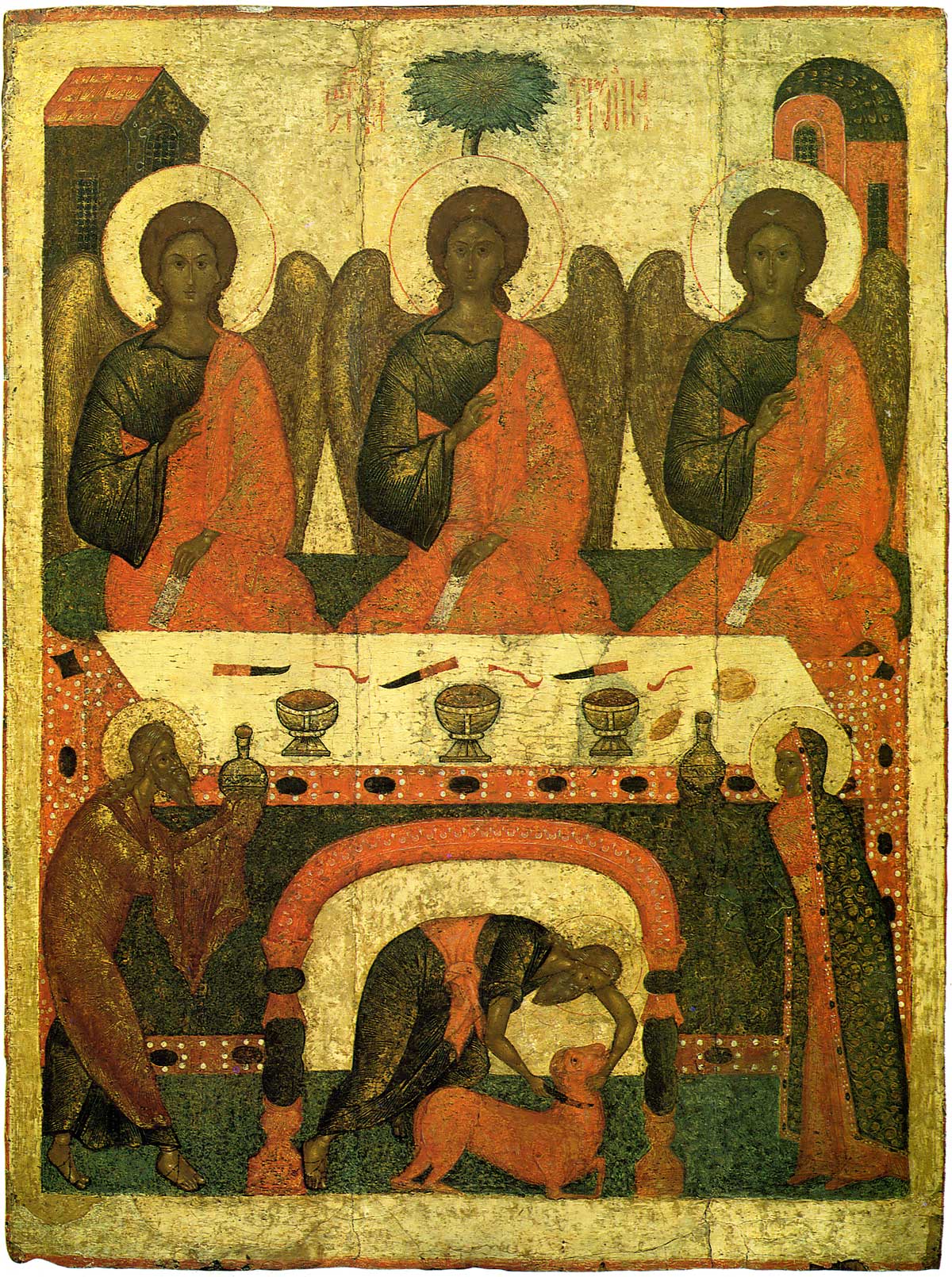
Icon of the Hospitality of Abraham, and type the Holy Trinity (source)
  
Seeing the crowds, he went up on the mountain, and when he sat down his disciples came to him. And he opened his mouth and taught them, saying:
"Blessed are the poor in spirit, for theirs is the kingdom of heaven.
"Blessed are those who mourn, for they shall be comforted.
"Blessed are the meek, for they shall inherit the earth.
"Blessed are those who hunger and thirst for righteousness, for they shall be satisfied.
"Blessed are the merciful, for they shall obtain mercy.
"Blessed are the pure in heart, for they shall see God.
"Blessed are the peacemakers, for they shall be called sons of God.
"Blessed are those who are persecuted for righteousness' sake, for theirs is the kingdom of heaven.
"Blessed are you when men revile you and persecute you and utter all kinds of evil against you falsely on my account. Rejoice and be glad, for your reward is great in heaven, for so men persecuted the prophets who were before you.
-Matthew 5:1-12
 
Through the prayers of our Holy Fathers, Lord Jesus Christ our God, have mercy on us and save us! Amen!
Thursday, May 28, 2020

Fr. George Florovsky: "And Ascended into Heaven..."

The Holy Ascension of Christ (source)
  
“AND ASCENDED INTO HEAVEN....”
V. Rev. George Florovsky, D.D.
“I ascend unto My Father and your Father, and to My God, and Your God” (John 20:17). In these words the Risen Christ described to Mary Magdalene the mystery of His Resurrection. She had to carry this mysterious message to His disciples, “as they mourned and wept” (Mark 16:10). The disciples listened to these glad tidings with fear and amazement, with doubt and mistrust. It was not Thomas alone who doubted among the Eleven. On the contrary, it appears that only one of the Eleven did not doubt—Saint John, the disciple “whom Jesus loved.” He alone grasped the mystery of the empty tomb at once: “and he saw, and believed” (John 20:8). Even Peter left the sepulcher in amazement, “wondering at that which was come to pass” (Luke 24:12).  
  
The disciples did not expect the Resurrection. The women did not, either. They were quite certain that Jesus was dead and rested in the grave, and they went to the place “where He was laid,” with the spices they had prepared, “that they might come and anoint Him.” They had but one thought: “Who shall roll away the stone from the door of the sepulcher for us?” (Mark 16:1-3; Luke 24:1). And therefore, on not finding the body, Mary Magdalene was sorrowful and complained: “They have taken away my Lord, and I know not where they have laid Him” (John 20:13). On hearing the good news from the angel, the women fled from the sepulchre in fear and trembling: “Neither said they anything to any man, for they were afraid” (Mark 16:8). And when they spoke no one believed them, in the same way as no one had believed Mary, who saw the Lord, or the disciples as they walked on their way into the country, (Mark 16:13), and who recognized Him in the breaking of bread. “And afterward He appeared unto the Eleven as they sat at meat, and upbraided them with their unbelief and hardness of heart, because they believed not them who had seen Him after He was risen” (Mark 16:10-14).  
  
From whence comes this “hardness of heart” and hesitation? Why were their eyes so “holden,” why were the disciples so much afraid of the news, and why did the Easter joy so slowly, and with such difficulty, enter the Apostles’ hearts? Did not they, who were with Him from the beginning, “from the baptism of John,” see all the signs of power which He performed before the face of the whole people? The lame walked, the blind saw, the dead were raised, and all infirmities were healed. Did they not behold, only a week earlier, how He raised by His word Lazarus from the dead, who had already been in the grave for four days? Why then was it so strange to them that the Master had arisen Himself? How was it that they came to forget that which the Lord used to tell them on many occasions, that after suffering and death He would arise on the third day?  
  
The mystery of the Apostles’ “unbelief” is partly disclosed in the narrative of the Gospel: “But we trusted that it had been He which should have redeemed Israel,” with disillusionment and complaint said the two disciples to their mysterious Companion on the way to Emmaus (Luke 24:21). They meant: He was betrayed, condemned to death and crucified. The news of the Resurrection brought by the women only “astonished” them. They still wait for an earthly triumph, for an exernal victory. The same temptation possesses their hearts, which first prevented them from accepting “the preaching of the Cross” and made them argue every time the Saviour tried to reveal His mystery to them. “Ought not Christ to have suffered these things and to enter into His glory?” (Luke 24:26). It was still difficult to understand this.  
  
He had the power to arise, why did He allow what that had happened to take place at all? Why did He take upon Himself disgrace, blasphemy and wounds? In the eyes of all Jerusalem, amidst the vast crowds assembled for the Great Feast, He was condemned and suffered a shameful death. And now He enters not into the Holy City, neither to the people which beheld His shame and death, nor to the High Priests and elders, nor to Pilate—so that He might make their crime obvious and smite their pride. Instead, He sends His disciples away to remote Galilee and appears to them there. Even much earlier the disciples wondered, “How is it that Thou wilt manifest Thyself unto us, and not unto the world?” (John 14:22). Their wonder continues, and even on the day of His glorious Ascension the Apostles question the Lord, “Lord, wilt Thou at this time restore again the kingdom to Israel?” (Acts 1:6). They still did not comprehend the meaning of His Resurrection, they did not understand what it meant that He was “ascending” to the Father. Their eyes were opened but later, when “the promise of the Father” had been fulfilled.   In the Ascension resides the meaning and the fullness of Christ’s Resurrection.  
  
The Lord did not rise in order to return again to the fleshly order of life, so as to live again and commune with the disciples and the multitudes by means of preaching and miracles. Now he does not even stay with them, but only “appears” to them during the forty days, from time to time, and always in a miraculous and mysterious manner. “He was not always with them now, as He was before the Resurrection,” comments Saint John Chrysostom. “He came and again disappeared, thus leading them on to higher conceptions. He no longer permitted them to continue in their former relationship toward Him, but took effectual measures to secure these two objects: That the fact of His Resurrection should be believed, and that He Himself should be ever after apprehended to be greater than man.” There was something new and unusual in His person (cf. John 21:1-14). As Saint John Chrysostom says, “It was not an open presence, but a certain testimony of the fact that He was present.” That is why the disciples were confused and frightened. Christ arose not in the same way as those who were restored to life before Him. Theirs was a resurrection for a time, and they returned to life in the same body, which was subject to death and corruption—returned to the previous mode of life. But Christ arose for ever, unto eternity. He arose in a body of glory, immortal and incorruptible. He arose, never to die, for “He clothed the mortal in the splendor of incorruption.” His glorified Body was already exempt from the fleshly order of existence. “It is sown in corruption, it is raised in incorruption. It is sown in dishonor, it is raised in glory. It is sown in weakness, it is raised in power. It is sown a natural body, it is raised a spiritual body” (I Cor. 15:42-44). This mysterious transformation of human bodies, of which Saint Paul was speaking in the case of our Lord, had been accomplished in three days. Christ’s work on earth was accomplished. He had suffered, was dead and buried, and now rose to a higher mode of existence. By His Resurrection He abolished and destroyed death, abolished the law of corruption, “and raised with Himself the whole race of Adam.” Christ has risen, and now “no dead are left in the grave” (cf. The Easter Sermon of Saint John Chrysostom). And now He ascends to the Father, yet He does not “go away,” but abides with the faithful for ever (cf. The Kontakion of Ascension). For He raises the very earth with Him to heaven, and even higher than any heaven. God’s power, in the phrase of Saint John Chrysostom, “manifests itself not only in the Resurrection, but in something much stronger.” For “He was received up into heaven, and sat on the right hand of God” (Mark 16:19).  
  
And with Christ, man’s nature ascends also.   “We who seemed unworthy of the earth, are now raised to heaven,” says Saint John Chrysostom. “We who were unworthy of earthly dominion have been raised to the Kingdom on high, have ascended higher than heaven, have came to occupy the King’s throne, and the same nature from which the angels guarded Paradise, stopped not until it ascended to the throne of the Lord.” By His Ascension the Lord not only opened to man the entrance to heaven, not only appeared before the face of God on our behalf and for our sake, but likewise “transferred man” to the high places. “He honored them He loved by putting them close to the Father.” God quickened and raised us together with Christ, as Saint Paul says, “and made us sit together in heavenly places in Christ Jesus” (Ephes. 2:6). Heaven received the inhabitants of the earth. “The First fruits of them that slept” sits now on high, and in Him all creation is summed up and bound together. “The earth rejoices in mystery, and the heavens are filled with joy.”  
  
“The terrible ascent....” Terror-stricken and trembling stand the angelic hosts, contemplating the Ascension of Christ. And trembling they ask each other, “What is this vision? One who is man in appearance ascends in His body higher than the heavens, as God.”   Thus the Office for the Feast of the Ascension depicts the mystery in a poetical language. As on the day of Christ’s Nativity the earth was astonished on beholding God in the flesh, so now the Heavens do tremble and cry out. “The Lord of Hosts, Who reigns over all, Who is Himself the head of all, Who is preeminent in all things, Who has reinstated creation in its former order—He is the King of Glory.” And the heavenly doors are opened: “Open, Oh heavenly gates, and receive God in the flesh.” It is an open allusion to Psalms 24:7-10, now prophetically interpreted. “Lift up your heads, Oh ye gates, and be lifted up, ye everlasting doors, and the King of Glory shall come in. Who is this King of glory? The Lord strong and mighty....” Saint Chrysostom says, “Now the angels have received that for which they have long waited, the archangels see that for which they have long thirsted. They have seen our nature shining on the King’s throne, glistening with glory and eternal beauty.... Therefore they descend in order to see the unusual and marvelous vision: Man appearing in heaven.”  
  
The Ascension is the token of Pentecost, the sign of its coming, “The Lord has ascended to heaven and will send the Comforter to the world”   For the Holy Spirit was not yet in the world, until Jesus was glorified. And the Lord Himself told the disciples, “If I go not away, the Comforter will not come unto you” (John 16:7). The gifts of the Spirit are “gifts of reconciliation,” a seal of an accomplished salvation and of the ultimate reunion of the world with God. And this was accomplished only in the Ascension. “And one saw miracles follow miracles,” says Saint John Chrysostom, “ten days prior to this our nature ascended to the King’s throne, while today the Holy Ghost has descended on to our nature.” The joy of the Ascension lies in the promise of the Spirit. “Thou didst give joy to Thy disciples by a promise of the Holy Spirit.” The victory of Christ is wrought in us by the power of the Holy Spirit.  
  
“On high is His body, here below with us is His Spirit. And so we have His token on high, that is His body, which He received from us, and here below we have His Spirit with us. Heaven received the Holy Body, and the earth accepted the Holy Spirit. Christ came and sent the Spirit. He ascended, and with Him our body ascended also” (Saint John Chrysostom). The revelation of the Holy Trinity was completed. Now the Spirit Comforter is poured forth on all flesh. “Hence comes foreknowledge of the future, understanding of mysteries, apprehension of what is hidden, distribution of good gifts, the heavenly citizenship, a place in the chorus of angels, joy without end, abiding in God, the being made like to God, and, highest of all, the being made God!” (Saint Basil, On the Holy Spirit, IX). Beginning with the Apostles, and through communion with them—by an unbroken succession—Grace is spread to all believers. Through renewal and glorification in the Ascended Christ, man’s nature became receptive of the spirit. “And unto the world He gives quickening forces through His human body,” says Bishop Theophanes. “He holds it completely in Himself and penetrates it with His strength, out of Himself; and He likewise draws the angels to Himself through the spirit of man, giving them space for action and thus making them blessed.” All this is done through the Church, which is “the Body of Christ;” that is, His “fullness” (Ephesians 1:23). “The Church is the fulfillment of Christ,” continues Bishop Theophanes, “perhaps in the same way as the tree is the fulfillment of the seed. That which is contained in the seed in a contracted form receives its development in the tree.”  
  
The very existence of the Church is the fruit of the Ascension. It is in the Church that man’s nature is truly ascended to the Divine heights. “And gave Him to be Head over all things” (Ephesians 1:22). Saint John Chrysostom comments: “Amazing! Look again, whither He has raised the Church. As though He were lifting it up by some engine, He has raised it up to a vast height, and set it on yonder throne; for where the Head is, there is the body also. There is no interval of separation between the Head and the body; for were there a separation, then would the one no longer be a body, nor would the other any longer be a Head.” The whole race of men is to follow Christ, even in His ultimate exaltation, “to follow in His train.” Within the Church, through an acquisition of the Spirit in the fellowship of Sacraments, the Ascension continues still, and will continue until the measure is full. “Only then shall the Head be filled up, when the body is rendered perfect, when we are knit together and united,” concludes Saint John Chrysostom.   The Ascension is a sign and token of the Second Coming. “This same Jesus, which is taken up from you into heaven, shall so come in like manner as ye have seen Him go into heaven” (Acts 1:11).The mystery of God’s Providence will be accomplished in the Return of the Risen Lord. In the fulfillment of time, Christ’s kingly power will be revealed and spread over the whole of faithful mankind. Christ bequeathes the Kingdom to the whole of the faithful. “And I appoint unto you a Kingdom as My Father has appointed unto me. That ye may eat and drink at My table in My Kingdom, and sit on thrones judging the twelve tribes of Israel” (Luke 22:29-30). Those who followed Him faithfully will sit with Him on their thrones on the day of His coming. “To him that overcomes will I grant to sit with Me in My throne, even as I also overcame, and am set down with My Father in His throne” (Rev. 3:21). Salvation will be consummated in the Glory. “Conceive to yourself the throne, the royal throne, conceive the immensity of the privilege. This, at least if we chose, might more avail to startle us, yea, even than hell itself” (Saint John Chrysostom).  
  
We should tremble more at the thought of that abundant Glory which is appointed unto the redeemed, than at the thought of the eternal darkness. “Think near Whom Thy Head is seated....” Or rather, Who is the Head. In very truth, “wondrous and terrible is Thy divine ascension from the mountain, O Giver of Life.” A terrible and wondrous height is the King’s throne. In face of this height all flesh stands silent, in awe and trembling. “He has Himself descended to the lowest depths of humiliation, and raised up man to the height of exaltation.”What then should we do? “If thou art the body of Christ, bear the Cross, for He bore it” (Saint John Chrysostom).“With the power of Thy Cross, Oh Christ, establish my thoughts, so that I may sing and glorify Thy saving Ascension.” Originally published in Saint Vladimir’s Seminary Quarterly, Vol. 2 # 3, 1954.
(source)
  
The Ascension of Christ (source)
  
Through the prayers of our Holy Fathers, Lord Jesus Christ our God, have mercy on us and save us! Amen!

Friday, June 21, 2019

"I will pour out of my Spirit upon all flesh..."

The Great Feast of Pentecost (source)
  
Rejoice then and be glad, ye children of Sion, in the Lord your God: for he has given you food fully, and he will rain on you the early and the latter rain, as before. And the floors shall be filled with corn, and the presses shall overflow with wine and oil. And I will recompense you for the years which the locust, and the caterpillar, and the palmerworm, and the cankerworm have eaten, even my great army, which I sent against you. And ye shall eat abundantly, and be satisfied, and shall praise the name of the Lord your God for the things which he has wrought wonderfully with you: and my people shall not be ashamed for ever. And ye shall know that I am in the midst of Israel, and that I am the Lord your God, and that there is none else beside me; and my people shall no more be ashamed for ever. And it shall come to pass afterward, that I will pour out of my Spirit upon all flesh; and your sons and your daughters shall prophesy, and your old men shall dream dreams, and your young men shall see visions. And on my servants and on my handmaids in those days will I pour out of my Spirit. And I will shew wonders in heaven, and upon the earth, blood, and fire, and vapor of smoke. The sun shall be turned into darkness, and the moon into blood, before the great and glorious day of the Lord come. And it shall come to pass that whosoever shall call on the name of the Lord shall be saved.
-Joel 2:23-32, Read at the Great Vespers for the Feast of Pentecost
  
The Holy Prophet Joel, holding a scroll with his famous prophecy: "I will pour out my Spirit upon all flesh..." (source)
  
Through the prayers of our Holy Fathers, Lord Jesus Christ our God, have mercy on us and save us! Amen!

Friday, June 14, 2019

"The post-festal and final feast, let us celebrate with joy..."

The Great Feast of Pentecost (source)
  
The post-festal and final feast, let us celebrate with joy, this is Pentecost, the fulfillment and consummation of the promise, on which the fire of the Paraclete straightaway descended upon the earth in the form of tongues, and enlightened the Disciples, and showed them to be mystics of Heaven. The light of the Paraclete has come, and has enlightened the world.
-Kathisma of the Orthros for Pentecost

(source)
  
Through the prayers of our Holy Fathers, Lord Jesus Christ our God, have mercy on us and save us! Amen!

Thursday, June 13, 2019

"And I will put my Spirit in you..."

The Great Feast of Pentecost (source)
  
"And I will take you out from the nations, and will gather you out of all the lands, and will bring you into your own land:  and I will sprinkle clean water upon you, and ye shall be purged from all your uncleannesses, and from all your idols, and I will cleanse you.  And I will give you a new heart, and will put a new spirit in you: and I will take away the heart of stone out of your flesh, and will give you a heart of flesh.  And I will put my Spirit in you, and will cause you to walk in mine ordinances, and to keep my judgments, and do them.  And ye shall dwell upon the land which I gave to your fathers; and ye shall be to me a people, and I will be to you a God."
-Ezekiel 36:24-28, Read at the Great Vespers for the Feast of Pentecost
(source)
  
The Descent of the Holy Spirit at Pentecost (source)
  
Through the prayers of our Holy Fathers, Lord Jesus Christ our God, have mercy on us and save us! Amen!

Wednesday, June 12, 2019

"I will take of the spirit that is upon thee, and will put it upon them..."

The Holy Prophet Moses receiving the Law on Mount Sinai, which became the inspiration for the first feast of Pentecost in the Old Testament (source)
  
And the Lord said to Moses, Gather me seventy men from the elders of Israel, whom thou thyself knowest that they are the elders of the people, and their scribes; and thou shalt bring them to the tabernacle of witness, and they shall stand there with thee.  And I will go down, and speak there with thee; and I will take of the spirit that is upon thee, and will put it upon them; and they shall bear together with thee the burden of the people, and thou shalt not bear them alone...And Moses went out, and spoke the words of the Lord to the people; and he gathered seventy men of the elders of the people, and he set them round about the tabernacle.  And the Lord came down in a cloud, and spoke to him, and took of the spirit that was upon him, and put it upon the seventy men that were elders; and when the spirit rested upon them, they prophesied and ceased. And there were two men left in the camp, the name of the one was Eldad, and the name of the other Modad; and the spirit rested upon them, and these were of the number of them that were enrolled, but they did not come to the tabernacle; and they prophesied in the camp.  And a young man ran and told Moses, and spoke, saying, Eldad and Modad prophesy in the camp.  And Joshua the son of Naue, who attended on Moses, the chosen one, said, My lord Moses, forbid them.  And Moses said to him, Art thou jealous on my account? and would that all the Lord's people were prophets; whenever the Lord shall put his spirit upon them.
-Numbers 11:16-17, 24-49, Read at the Great Vespers for the Feast of Pentecost
  
The Holy Spirit and the Preparation of the Throne of the Lord (source)
  
Through the prayers of our Holy Fathers, Lord Jesus Christ our God, have mercy on us and save us! Amen!

Friday, June 1, 2018

Elder Symeon Kragiopoulos: "God calls all of us and can make each of us a saint..."

Synaxis of All Saints (source)
  
1st Sunday of Matthew 
June 15th, 2014   Bl. Augustine
Matthew 10: 32-33, 37-38; 19: 27-30
‘’The saints make manifest the Holy Spirit’’ 
                A characteristic of the spiritual life is that a person continually makes a new start. He never tires. Fatigue, boredom, despondency, laziness are all human and earthly; they don’t have anything to do with the man of God though. A new day, a new life. A new hour, a new life. Especially today as we close the festal cycle attached to Pascha and start again in some way from the beginning, we should have the attitude that now we are being born, now we are meeting Christ, now we are starting.
                Man tires easily and becomes bored above all when he is not expecting some pleasure from what he does. He becomes active, he comes to life only when he pursues something that pleases him. If he is required to make some sacrifice without expecting to be pleased, then he feels a lack of will, a boredom. His whole self feels heavy. He becomes confused, like he’s not sure what he ought to do. Within him is upheaval.
                 These things are straightforward, though, because we not only have before us the Gospel, but also a two thousand year history, the experience of the Church, and of all the saints. In the Lives of the Saints we find the Gospel put into practice. Studying the Gospel alongside the Lives of the Saints, which saints we imitate, we are not deceived. Why do we become deceived? Because deep within us we want to be deceived. So we are the ones who choose the lie. We think what we think and instead of accepting the truth, we accept a lie. Instead of being influenced by that which is true, we’re influenced by that which is false, illegitimate. The Saints, however, did not do this. What did they do then? Just as Christ, the Son, made manifest his Father, and the Holy Spirit made manifest Christ, so the saints within Orthodox Church make manifest the Holy Spirit, as we observe the fruit of the Spirit in their lives: This is precisely what made them saints, what deified them.
                We are all children of God. God calls all of us and can make each of us a saint, can deify us. Do we want it?
Transcribed talks by Archimandrite Symeon Kragiopoulos
From: Holy Hesychasterion “The Nativity of Theotokos” Publications.
Translated by Fr. Matthew Penney (source)
  
Through the prayers of our Holy Fathers, Lord Jesus Christ our God, have mercy on us and save us! Amen!

Friday, May 25, 2018

"The Father is light, the Logos is light, and the Holy Spirit is light..."

The Hospitality of Abraham and the Mystery of the Holy Trinity (source)
  
The Father is light, the Logos is light, and the Holy Spirit is light, which was sent down upon the Apostles as fiery tongues, and through Whom the whole world is enlightened to worship the Holy Trinity.
-Exaposteilarion of the Feast of Pentecost
  
(source)
  
Through the prayers of our Holy Fathers, Lord Jesus Christ our God, have mercy on us and save us! Amen!

Sunday, June 19, 2016

St. Gregory Palamas on the Holy Spirit

The Hetoimasia (Preparation) of the Throne, with the depiction of the Holy Spirit (source)
  
He is not just everywhere, but also above all, not just in every age and time, but before them all. And, according to the promise, the Holy Spirit will not just be with us until the end of the age, but rather will stay with those who are worthy in the age to come, making them immortal and filling their bodies as well with eternal glory, as the Lord indicated by telling His disciples, "I will pray the Father, and he shall give you another Comforter, that he may abide with you forever" (John 14:16).
-St. Gregory Palamas,
"Homily Twenty-Four: On How the Holy Spirit was Manifested and Shared Out at Pentecost"
(source)
  
Through the prayers of our Holy Fathers, Lord Jesus Christ our God, have mercy on us and save us! Amen!

Monday, May 30, 2016

Prayer for the upcoming Holy and Great Council of the Orthodox Church

Christ is risen! Truly He is risen!
The Great Feast of Pentecost (source)
   
It is widely known that, in a few weeks, the primates and representatives from all canonical Orthodox Churches will gather in Crete for the first synodal gathering of this scope in many years. This will be a truly unique event, and though there are many who are arguing in support or in opposition to this upcoming council, its participants, the process, and the pre-conciliar documents, it is abundantly clear that all of us must pray deeply for illumination and guidance by the Holy Spirit for our bishops, that they might "rightly teach the word of Your truth". As such, I include hymns below for Pentecost, for the Holy Fathers, and a prayer that we hopefully all can offer, entreating the Lord and His Saints for the strength and wisdom to ever follow His commandments.

Apolytikion and Kontakion for the Great Feast of Pentecost, in the Plagal of the Fourth Tone
Blessed art Thou, O Christ our God, Who hast revealed the fishermen as most wise, having sent upon them the Holy Spirit, and through them Thou hast fished the universe, O Lover of mankind, glory to Thee.
 
When the High One descended, confusing tongues, He divided the nations. And when He distributed the fiery tongues He called all to one unity. Wherefore, in unison we glorify the most Holy Spirit. 
  
Apolytikion for the Holy and God-bearing Fathers, in the Plagal of the Fourth Tone
Most glorified art Thou, O Christ our God, Who hast established our Fathers as luminous stars upon the earth, and through them didst guide us all to the true Faith. O Most Merciful One, glory be to Thee.
  
O Lord Jesus Christ our God, send down upon the bishops, clergy, and all those gathered in Thy name the grace of Thy Holy Spirit, for good and profitable counsel unto the benefit of all, and unto the confirmation of the Orthodox Catholic faith and piety, the good order of the Church.
Enlighten their minds with the light of His Divine understanding and truth, and make clear their lips and tongue, that they may counsel, proclaim and order all things unto the greater glory of His holy name.
May their actions be for the edification of the faithful people, the furtherance of good morals, and the uprooting and extermination of every heresy, disorder and wickedness, and do all things perfectly by the power and action and indwelling of the Holy Spirit.
To Thee are due all glory, honor, and worship: to the Father and to the Son, and to the Holy Spirit: now and ever, and unto ages of ages. Amen.
(source)
  
Icon of the Holy and God-bearing Fathers of the First Ecumenical Council (source)
Christ is risen from the dead, by dead, trampling down upon death, and to those in the tombs, He has granted life!
Truly, the Lord is risen!

Sunday, May 31, 2015

Homily on the Feast of Pentecost, by Metropolitan Avgoustinos Kantiotes

The Great and Holy Feast of Pentecost (source)
  
Homily on the Feast of Pentecost, by Metropolitan Avgoustinos Kantiotes
By the mercy of God, my beloved, we have reached the end of the feasts of Pentecostarion. The first feast is the Resurrection of the Lord, which is the greatest in the Orthodox Church. And in this way we differ from the [West], which celebrates Christmas with more grandeur. The Orthodox of the East, as the Queen of Feasts have Pascha. For forty days we hear “Christ is risen”. After the Resurrection, is the Ascension of the Lord, which we celebrated ten days ago. What meaning do these feasts have? In the Resurrection: Christ lives and reigns. In the Ascension: “Let us lift up our hearts.”
  
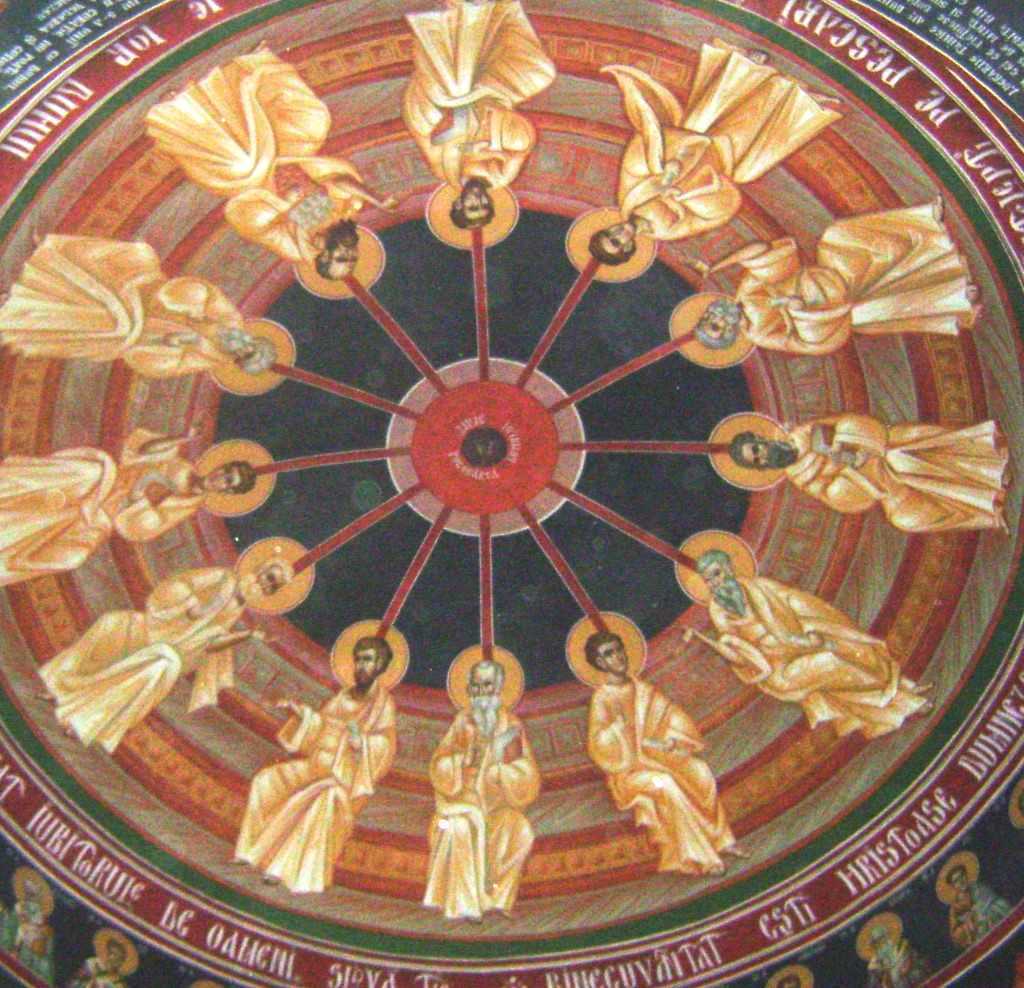
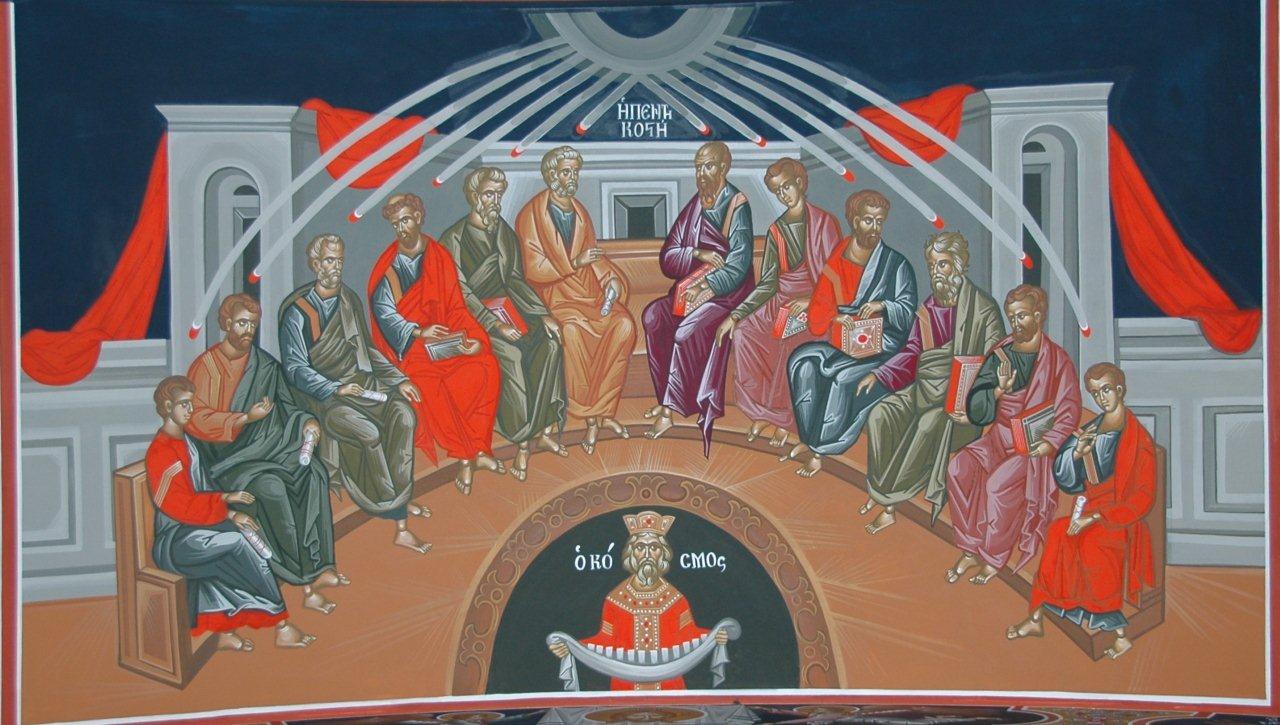
And today, my beloved, we have Pentecost, the great feast which is the fulfillment of the work of the divine economy, and signified the descent of the Holy Spirit. If you go to Mount Athos, in the Byzantine churches, you will see how Pentecost is depicted.
  
Byzantine iconographers, not like those today who are merchants of Christ, were artists who painted with faith and mixed their paints with their tears, and fasted in order to depict the icon of Christ and the Panagia, creating wonderworking icons. Out of ten-thousand icons today, I doubt if we would find one which is wonderworking. Every icon of course has its worth, due to whom it depicts, but another grace comes from the eye and hand of a sanctified iconographer.
  
Therefore, in the Byzantine icon of Pentecost, you will see that in the center is depicted a prophet, the Prophet Joel. He is depicted holding a scroll, on which is written the phrase: “I will pour out my Spirit upon all flesh...” (Joel 3:1-2)
  
I wish to speak, but I hesitate. For what benefit is there from the feasts? For many now, a feast is a party, a gathering, a dance... We do not lessen our sins, but increase them. And for the Church a feast is joy and spiritual exaltation, while we celebrate according to a Judean or idolatrous manner. That terrible prophecy of God is fitting for us, when He says: “Your feasts, my soul hates.” (Isaiah 1:14)
  
I hesitate furthermore, for Pentecost is a feast which is the most difficult for a preacher among all the other topics. For what are we? Nature, worms, unclean animals, lowly-people, sinners, “having unclean lips among a people of unclean lips.” (Isaiah 6:5) How can we speak today regarding the Holy Spirit, in an age which is known for its atheistic speeches, heresies, and generalized corruption?
  
In my place should be one of the Holy Fathers, whose spirits were intangible, and had not a molecule of carnality, and who, when they were praying, did not walk on the earth. And you, my listeners, should be purified, so that our spirits would be in harmony, and so that we be exalted above the heavens, like the Holy Apostles, so that the Holy Spirit would come upon us as well.
  
Behold why I hesitate to speak. But one phrase from today's prayers from the Kneeling Vespers helps to remove my hesitation. Believe me, I would not have even broached the topic, unless those words had strengthened me: “For in fear I stand before You, casting my soul's despair into the sea of Your mercy.” (From the Third Prayer of the Kneeling Vespers) I stand, it says, with fear before you, O Lord, and I the sinner, throw my soul's despair into the abyss of Your mercy.
  
I therefore throw myself into the incomparable mercy of God, and calling upon the grace of the Holy Spirit, I dare to utter a few words. For more properly, I don't speak myself; I become a microphone so that the opinions of the Fathers of our Church can be heard.
  
Pentecost! “I will pour out my Spirit upon all flesh...” The pouring out of the grace of the Holy Spirit, my beloved, in the Holy Scriptures and according to the Fathers of the Church, is characterized by many names. From all of this, I will take one alone, the name “gift”. Why is it called this? Because it is the culmination of everything that God has granted and continues to grant to us.
  
The grace of the Holy Spirit is not the only good thing which mankind has received from God. “In Him we live and move and have our being”, says the Apostle Paul (Acts 17:28), borrowing a phrase from the ancient poet (Aratos). We swim within the abyss of the energies and the gifts of God. What is there that we don't have as a gift from God!
  
I leave the gifts of the earth and the sea. I bring to mind the greatest gifts which come from on high, from heaven.
  
The first [great gift] is light, those countless rays of the sun, which travel at breakneck speeds, covering unimaginable distances. As one Saint said, every ray of the sun which shines upon a flower, a child, an old man, a beggar, a condemned man, upon the face of every person, what is it? It is an embrace by the heavenly Father. The hour when you sense the ray of the sun enlighten and warm you, it is as if God is saying: “O man, I love you.” How much would we pay for how many millions of kilowatts of energy from the sun? And instead of saying thank you, instead of “Glory to You Who has shown forth the light” (The Doxology), God receives blasphemies! And regardless, He sends His light “upon the thankless and sinners” (Luke 6:35).
  
Another [gift] is water, the rain which comes from the clouds, and falls upon the soil and makes it to grow all those things which nourish us. Every corner is a field. What could we pay for, and what does God receive for all of this water? The hen, when she drinks a sip of water, lifts up her head to heaven, as if to say: “Thank you, O Lord.”
  
Another is the air. Like the fish which swim in the water, and couldn't live outside of it, thus does man life within the ocean of the air. And only Earth has this atmospheric air. If we removed the atmosphere, we would die of asphyxia. Because of this, the astronauts carry with them Oxygen tanks. And think of how much it would cost if the Oxygen were sold by pharmacists. Only a few rich people could afford it. And for this, again there is thanklessness and ingratitude that our good God receives.
  
Besides these ordinary gifts of God, however, there are also extraordinary gifts, such as in the Old Testament, the manna, that sweet water, which was received by the mouths of the Jews who desired them. And those thankless ones watered the Son of the Virgin “with gall instead of mana” (hymn from Holy Friday). This is what man is.
  
Listen, my beloved, that up till now all of these gifts benefit me here. I told you understandable and simple things that we all know and can experience, and which penetrate our lives.
  
But man is not designed for here alone, for only this natural sphere, for the life of the body. He is not just a body. He is also a spirit, and primarily a spirit. He therefore, has another life, a life in the sphere of the spirit. And there, in the sphere of the spirit, he has need of other provisions. How can I make you understand? I seek the grace and the power of God.
  
Above all physical gifts which we sense, because we live with them and depend on them, is another great and uplifted gift. All of those gifts, ordinary and extraordinary, are small. Today's great gift is the Holy Spirit. “Taste of the gift of the Holy Spirit” (Acts 2:38) Great and necessary for our life is the light, the water, the air, but all of these are simply icons and symbols of that great gift, which is called the Holy Spirit.
  
The Holy Spirit has come! God has fulfilled His promises. It was prophesied of in the Old Testament by the Prophet Joel. It was the promise of Christ to His disciples, before He ascended into the Heavens. It was the completion of the work of the divine economy, the grand work of God for the salvation and glory of fallen man. Without the gift of the Holy Spirit, the work of the divine economy would be imperfect and incomplete. Today, this work is completed. Glory to the Father and to the Son and to the Holy Spirit!
  
+Bishop Avgoustinos
On the Monday of the Holy Spirit, 1961.
  
(amateur translation of text from source)
  
The Holy Spirit descending upon the Disciple at Pentecost (source)
  
Through the prayers of our Holy Fathers, Lord Jesus Christ our God, have mercy on us and save us! Amen!

Saturday, May 30, 2015

"The third hour was made rich with grace..."

Holy Pentecost (source)
  
The third hour was made rich with grace,
That it might indicate the worship of
Three Persons in singleness of authority;
But now on the one Sovereign of days,
Son, Father, Spirit, blessed are you.

-Second (Iambic) Canon of Pentecost
  
(source)
  
Through the prayers of our Holy Fathers, Lord Jesus Christ our God, have mercy on us and save us! Amen!

Friday, June 13, 2014

St. Porphyrios of Kavsokalyvia on the Holy Spirit

The Patriarch Abraham showing hospitality to the Three Angels, and the depiction of the Holy Trinity (source)
 
And now, the Holy Spirit desires to enter our souls, like then [Pentecost], but He honors our freedom, He does not want to violate it.

He waits for us to open the door on our own, and then He enters our soul, and He will transfigure it.

When He comes to dwell within us, the whole region of our soul is Christ, and then all problems, all delusions, all worries flee.

Then sin also flees.
 
(amateur translation from source)
 
Through the prayers of our Holy Fathers, Lord Jesus Christ our God, have mercy on us and save us! Amen!

Sunday, June 8, 2014

Heavenly King, Comforter

The Holy Spirit depicted in the form of a dove, as part of the "Preparation of the Throne" of Christ (source)
   
Heavenly King, Paraclete, [Comforter] Spirit of Truth, present everywhere, filling all things, Treasury of blessings and Giver of life; come and dwell in us, and cleanse us of every stain, and save our souls, O Good One.
 
Through the prayers of our Holy Fathers, Lord Jesus Christ our God, have mercy on us and save us! Amen!

Saturday, June 22, 2013

Kontakion on Pentecost by St. Romanos the Melodist

The Descent of the Holy Spirit at Pentecost, depicted in one of the domes of St. Mark's in Venice (source)
 
Kontakion on Pentecost by St. Romanos the Melodist
When the Most High came down and confused the tongues,
he parted the nations.
When he divided out the tongues of fire, he called all to unity;
and with one voice we glorify
the All-Holy Spirit.

Give swift and stable comfort to your servants, Jesus,
when our spirits are despondent.
Do not part from our souls in afflictions,
do not be far from our minds in perils, be ever before us.
Be near us, be near, you who are everywhere.
As you are also always with your apostles,
so too unite yourself with those who long for you,
O Compassionate One,
that united to you, we may praise and glorify
the All-Holy Spirit.

You were not parted from your disciples, Saviour, when you took
The road to heaven,
For having reached the things on high, you still hold those below,
for not one place is separate from you, O Uncontainable;
and were there such a place, it perishes and vanishes and becomes like Sodom.
For you establish the universe, filling all things.
The apostles there had you in their souls.
And so, when you had been taken up from the Mount of Olives,
they came down dancing and singing and glorifying
the All-Holy Spirit.

The eleven disciples returned with joy from the Mount of Olives.
For Luke, the revealer of sacred mysteries, writes this.
they returned to Jerusalem,
ascended to the upper room, where they were staying. They entered
and sat down -
Peter and the rest of the disciples.
Kephas, as their leader, said to them,
“Sharers of the Kingdom, let our hearts be on high
with the One who made the promise and said, `I will send you
the All-Holy Spirit.’”

When he had spoken like this to the apostles, Peter roused them to prayer,
and standing in their midst, cried out,
“Let us pray, let us bend the knee, let us ask,
let us make this room a church. For so it is and so it has become.
Let us sing and cry aloud to God,
`Send us your good Spirit
that he may guide us all into your upright land
which you have prepared for those who honor and who glorify
the All-Holy Spirit.’”

On hearing this, those who had been called with him gathered
themselves at once
like lambs to a shepherd, charmed by his word,
and silently they articulated what they longed for
and made intense supplications to the Almighty,
which contained these words,
“To you the Governor and King of the angels,
to the Suzerain and Creator of mortals,
to you, the One who by his mere nod holds sway
over things on earth and sea,
your friends and servants cry aloud, `Swiftly send us
the All-Holy Spirit.’”

As soon as they had completed their supplications, they signed them,
having sealed them with faith and sent them on high.
Their Teacher read them and said,
“Of your own free will, O Paraclete, under no order, but as you wish,
descend.
For the disciples, whom I gathered
for you and the Father, await you,
the ones whom I instructed when I said, `Make disciples of the nations
proclaiming the Father, honoring the Son and praising
the All-Holy Spirit.’”

Then God the Paraclete heeded those who implored him
and took hold of them as they prayed.
Yet the ineffable in no way changed his place,
for condescension did not become alteration,
nor did he suffer diminution,
for he was on high and he was below and everywhere.
For divine nature is ineffable and intangible.
He is not seen with the eyes, but he is known by faith.
He is not grasped by hands, but he is handled
by the hearts of believers,
the All-Holy Spirit.

When the divine Pentecost had been completed, [i.e., 50 days]
the eleven initiates
stood together, persevering in prayers,
and, as the reading from Acts says,
there came a sudden sound, as of a mighty wind,
resounding from heaven,
while it filled the whole room with fire,
but even more, it also struck the loved ones with amazement.
And so, seeing the house tossed about like a skiff,
they cried out, “Master, still the storm and send
the All-Holy Spirit.”

The wise apostles, thinking the whole upper room
was collapsing under the wind,
all shut their eyes in fear.
And then, something more fearful came to pass
and wonder succeeding wonder
added to the first alarm a second terror.
For fiery tongues were touching them again,
and lighting on the head of the beloved,
tongues that were not burning their hair,
but enlightening their minds;
for to purify and cleanse he had sent them on before him,
the All-Holy Spirit.

When Peter saw all that had taken place, he cried out, “Brothers,
let us honor what we see, do not let us pry into it.
Let no one say, `What is this that is being done?’
For what has been accomplished surpasses understanding and vanquishes reasoning.
Spirit and fire are yoked together – certain wonder.
Breeze and flame are linked together – awesome spectacle.
Torches with winds, and sparks with drops of dew.
Who has seen? Who has heard? Who can say what he grants,
the All-Holy Spirit.

“You then, beloved, stand your ground and quietly contemplate the fire
that He who Is in the highest has sent from on high.
Do not be afraid, for the coals do not burn.
Do not be amazed, for this fire does not consume,
but as prudent men remember
how of old the three youths received fire,
how their bodies were not burned, nor a single hair,
how that which received the three showed them to be four,
for it gave up with interest those it had received, because it feared
the All-Holy Spirit.

“So, brothers, let each of you now cast away the fear from his soul
and let him show his longing for the One who was taken up.
For this is how he loved those whom he called:
everything that he foretold he has fulfilled, as he said,
so he has done.
Why then should we be afraid of a flame that does not burn?
Let us think that the fire is a rose, as indeed it is,
for it has been placed on our heads like flowers
with which he has crowned us, adorned us, made us resplendent,
the All-Holy Spirit.”

When Kephas had said this to all the apostles, he became still
along with them
and with them received the Holy Spirit,
for the latter had come after this, as it is written.
He had used as forerunners the two wonders of fire and wind,
because it was necessary that a wonder run before the Spirit,
necessary that a flame precede the Enlightener
and inform the world beforehand like a sounding trumpet
that, as he knows how and as he wills, he comes upon the earth,
the All-Holy Spirit.

Great and fearful were all the things that happened
and they held the minds of all,
for suddenly, being filled with the Spirit, they all
spoke with those who heard them just as they heard them,
to the Romans not as foreigners, to the Parthians like themselves
and to the Medes as their own.
To the Elamites they appeared to be speaking well and clearly,
to the Arabs they were immediately their kin.
To Asians and Phrygians they spoke clearly and distinctly
and to all the nations they were speaking as he gave them power,
the All-Holy Spirit.

But when those who were there from every land saw them all
speaking in tongues,
they were amazed and cried out, What does this mean?
The apostles are Galileans;
how then, as we now see, have they become fellow countrymen
of all the nations?
When did Peter Kephas ever see Egypt?
When did Andrew ever dwell in Mesopotamia?
How did the sons of Zebedee see Pamphylia?
How can we understand these things? What are we to say?
It was entirely as he willed it,
the All-Holy Spirit.

Now those who before were fishermen have become skilled speakers.
Now those who once
stood by the shores of lakes are orators, and clear ones.
Those who previously used to mend their nets
now unravel the webs of orators
and make them worthless with simpler utterances.
For they speak one Word, instead of many,
they proclaim one God, not one of many.
The One as one they worship, a Father beyond understanding,
a Son consubstantial and inseparable, and like to them
the All-Holy Spirit.

Was it not then given them to overcome all
through the tongues they speak?
And why do the fools outside strive for victory?
Why do the Greeks puff and buzz?
Why are they deceived by Aratos the thrice accursed?
Why err like wandering planets to Plato?
Why do they love debilitated Demosthenes?
Why do they not consider Homer a chimera?
Why do they go on about Pythagoras,
who were better muzzled?
Why do they not run believing to those to whom has appeared
the All-Holy Spirit.

Brothers, let us sing the praise of the tongues of the disciples
because, not with elegant words,
but with divine power they caught all mortals in their nets,
because they took up His Cross like a rod,
because they used words again as lines and fished the world,
because they had the Word as a sharp hook,
because the flesh of the Master of all things became for them
a bait, not hunting to bring death,
but drawing out to life those who honor and glorify
the All-Holy Spirit.
(source)
 
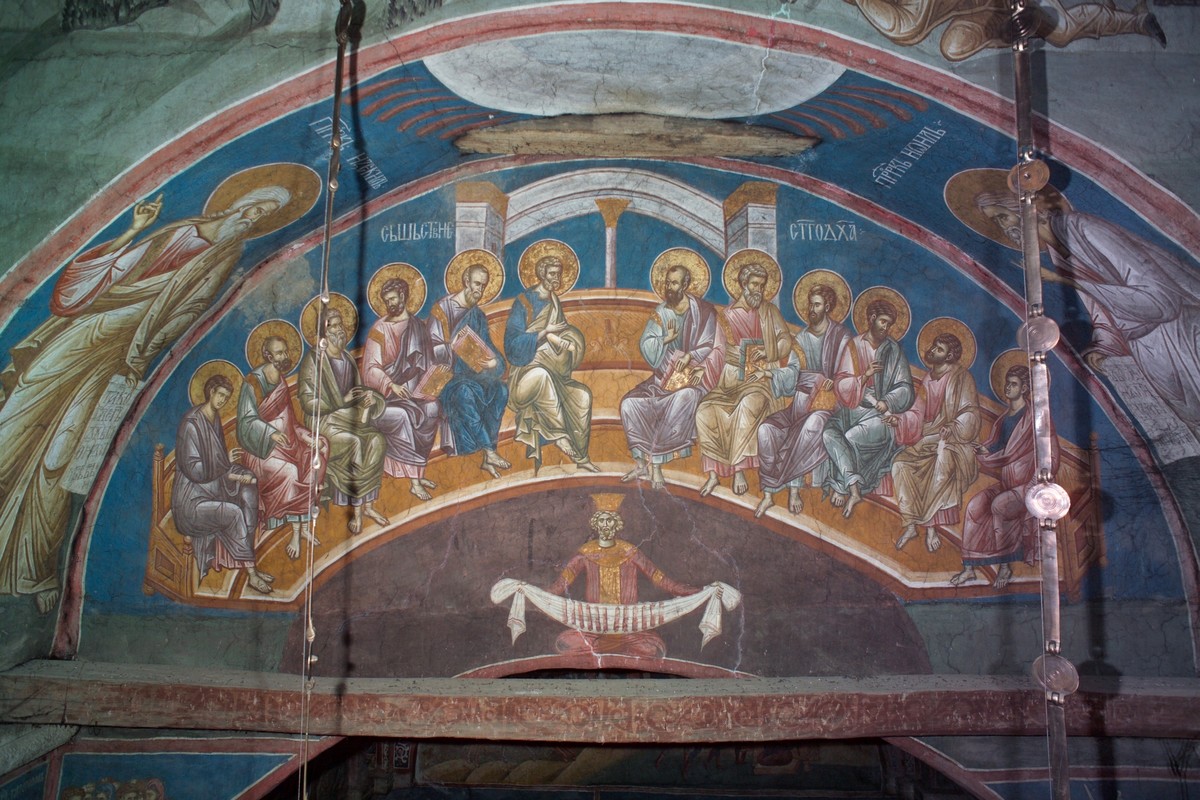
The descent of the Holy Spirit at Pentecost, fresco from the Monastery of Decani (source)
 
Through the prayers of our Holy Fathers, Lord Jesus Christ our God, have mercy on us and save us! Amen!

Homily on Pentecost by St. John Chrysostom

The Great and Holy Feast of Pentecost (source)
 
Homily on Pentecost by St. John Chrysostom
Let us spiritually extol the grace of the Holy Spirit in spiritual hymns, since spiritual grace has on this day shown upon us from heaven. Though our words are too weak to express adequately the greatness of this grace, we shall praise its power and activity to the extent of our abilities; for the Holy Spirit probes all things, even the depths of divinity.

We are celebrating the day of Pentecost, the day of the Descent of the Holy Spirit to the Apostles, the day of the hope of perfection, the end of expectation, the longing for salvation, the fulfillment of prayer and the image of patience. Today the Spirit Who acted to scatter the nations in the time of Heber has formed tongues of fire among the Apostles. His action of old led to the confusion of the nations, in order to restrain the will of man from its brazenness and consequent chastisement; on this occasion, however, amidst fiery tongues, the deeds wrought by the activity of the Holy Spirit served to preserve us as recipients of preaching, in fulfillment of the will of God.

In the beginning the Spirit of God moved over the water, and later, in the time of Christ, the same Holy Spirit of God rested upon him . Then He moved, and now He rested, as being one in essence, equal in honor, ever-existent and unoriginate together with the Father and the Son.

He Who by the flight of a dove over the waters of the Flood heralded fair weather to Noah, the same Holy Spirit, by the sight of a dove at the waters of the Jordan, showed the world the Sonship of Him Who was baptized. Moreover, the Lord had a terrifying answer for those who dared to utter blasphemy against the Holy Spirit:

“Whoever speaks blasphemy against the Holy Spirit, it shall not be forgiven him, neither in this world, neither in the world to come.”

David, declaring his desire for this Holy Spirit, prayed to God, saying: “Cast me not away from Thy presence, O Lord; and take not Thy Holy Spirit from me.”

As is well known, where He is absent, every sort of corruption sets in. Thus, the Spirit of the Lord departed from Saul, and an evil spirit entered into him, wherefore David said,

“Take not Thy Holy Spirit from me.”

This same Holy Spirit sanctified the prophets, instructed the apostles and empowered the mar­tyrs. This same Holy Spirit consecrated Isaiah, taught Ezekiel and revealed the resurrection of the dead. As he says,

“The hand of the Lord was upon me, and carried me out in the spirit of the Lord.”

This same Holy Spirit chose Jeremiah from his mother’s womb, and raised up Daniel to deliver Susanna. As it is written,

“God raised up by the Holy Spirit a young youth, whose name was Daniel.”

David so loved the presence of this same Holy Spirit that he prayed to God, saving,

“Thy Holy Spirit shall lead me in the land of uprightness.”

This same Holy Spirit of God came to dwell in the holy Virgin Mary, embracing her with the communion of the Divine Word at the good pleasure of the Father, and making her the Theotokos. Elizabeth, being filled with this same Holy Spirit, understood that the Lord had come to her by means of the Virgin; wherefore she said,

“And whence is this to me, that the Mother of my Lord should come to me?”

Zachariah, the father of John, was filled with the same Holy Spirit, whereby he declared that the son born to him would be the prophet and forerunner of the King Who was to come. John himself was also filled with the same Holy Spirit; the eyes of his intellect were given light, and he beheld the heavens opened, and the Holy Spirit hovering over Him Who was being bap­tized, Him Who baptized with the Spirit and fire.

By the action of the same Holy Spirit, the Lord Himself, when He was giving His Apostles His teaching in detail and strength­ening their minds for the time of His Passion, said to them:

“If I go not away, the Com­forter will not come unto you.”

Moreover, revealing to them the Spirit’s consubstantial power, He said:

“When the Holy Spirit is come, Which proceedeth from the Father, He will guide you into all truth.”

The holy Apostles waited expectantly for the coming of the power of this same Holy Spirit; they waited together to be clothed with power from on high, according to the commandment of the Lord, Who had said:

“Tarry ye in the city of Jerusalem, until ye be endued with power from on high; for, behold, I shall send the promise of My Father upon you.”

And, as it is written,

“when the day of Pentecost was fully come, all the holy Apostles were assembled with one accord in one place, and the Paraclete was sent to them under the appearance of tongues of fire.”

Having received the abundant promise of the Father and the Holy Spirit, they were strengthened, and they manifested Him Who was sent to them, His grace and His power. The martyr and protodeacon Stephen, filled with the same Holy Spirit, Whom he received by the laying-on of hands of the Apostles, did great wonders and miracles among the people. Being full of the Holy Spirit, he saw the doors of heaven opened and the Only-begotten Son and Word of God standing in the flesh at the right hand of the power of God. Filled with this same Holy Spirit, Paul became the preacher of divine mysteries. As Ananias said to him:

“The Lord, even the Savior, hath sent me to thee, that thou mightest receive thy sight, and be filled with the Holy Spirit.”

And Paul afterwards said with assurance:

“And I think also that I have the Spirit of God.”

The same Holy Spirit came to Cornelius and those that were to be baptized with him, and each of them spoke in his own tongue and magnified God. This same Holy Spirit came upon the Ethiopian eunuch after he went down into the water [of baptism], and he was filled with joy, and he went on his way rejoicing.

This is the same Holy Spirit Who preached by the prophets, Who gave understanding to the apostles, Who spoke to men. He was given to them by the Lord, and all their adversaries were not able to gainsay or resist Him. For, as the Lord said,

“It is not ye that speak, but the Spirit of your Father Which speaketh in you.”

This Holy Spirit also or­dains priests, consecrates churches, purifies altars, perfects sacrifices and cleanses people of their sins. This Holy Spirit abides with the godly, refines the righteous and guides kings. This same Holy Spirit preserved the soul of Simeon, lengthening the time of his life and re­versing the rules of death, until the day when he beheld Him Who is the Redeemer of life and death; for it had been promised unto him by the Holy Spirit, that he should not see death before he had seen the Lord’s Christ.

It was the same Holy Spirit Who gave strength to Elijah, and Whose power Elisha desired when he asked of Elijah:

“Let there be, I pray thee, a double portion of thy spirit upon me.”

This Holy Spirit enlightens souls and sanctifies bodies. It was the same Holy Spirit Who descended upon the Apostles and filled them with divine wisdom. Having received His gifts, they were all filled with the knowledge of God; not only were they given divine knowledge, but also spiritual gifts.

Simon Magus, being a stranger to the Holy Spirit, fell to his perdition. As Peter said to Simon:

“Thy money perish with thee, because thou hast desired to purchase the priceless grace of the Holy Spirit with money.”

Therefore, beloved, let us strive to keep our bodies uncorrupted; for one who has acquired a new body, which is a temple of the Holy Spirit, has become a true victor over the devil. What the Spirit of God has said, may it be done unto me.

Moreover, Joseph, strength­ened by this same Holy Spirit, desired not that his body be defiled by the vile deeds of this life; for he knew that the Spirit does not abide in a body that has commerce with sin; there­fore, he attained a royal rank. This Spirit enlightened Bezaleel, so that he fashioned the tabernacle with all beauty and skill. Joshua the son of Nun, possessing the same Spirit, be­came a faithful heir to Moses and obtained the inheritance of the Promised Land for his people. As God said to Moses:

“Take to thyself Joshua the son of Nun, a man who has the Spirit of God in him.”

This is the Spirit of Whom the Lord, when He breathed upon His disciples after His Resurrection from the dead on the third day, said:

“Receive ye the Holy Spirit.”

And again, it is the same Spirit Who has vouchsafed to give eternal life to the faithful after the general resurrection from the dead. As it is written:

“Thou wilt send forth Thy Spirit, and they shall be created; and Thou shalt renew the face of the earth.”

Many are the gifts of the Holy Spirit; many and all-powerful are His gifts.

As it says in a certain place: By the Word of the Lord were the heavens established, and all the might of them by the Spirit of His mouth. And Isaiah says:

“The Spirit of God shall rest upon him, the spirit of wisdom and understanding, the spirit of counsel and strength, the spirit of knowledge and godliness.”

And Paul adds,

“The Spirit of adoption and of grace.”

He Who is equally ever-existent, and equally unoriginate, and Who shares the throne and the honor of God, His Son and Word, called this Spirit the Spirit Who is our Comforter. David calls Him the Holy Spirit, since the Holy Spirit is sent by holiness; the governing Spirit, since He has dominion over all, be­cause all things came from Him and are kept in existence by Him; and the good Spirit, since salvation and all kinds of goodness are from Him.

And what does Isaiah call Him? The Spirit of God, because He proceeds from God the Father; thus does God Himself speak of the Spirit of God as proceeding, in the words, Which proceedeth from the Father. Isaiah further calls Him the Spirit of wisdom and understanding, because all wisdom and good understanding have been given through Him; and the Spirit of counsel and strength, because He is able to bring to pass that which is desired; and also the Spirit of knowledge and godliness. Ezekiel, a man of the spirit, says:

“And I will give you a new heart and a new Spirit.”

He is one in essence, one in principle and one in counsel with the Father and the Son. Wouldst thou believe? Listen to what the Scriptures say of Him:

“When He prepared the heaven, I was present with Him.”

The prophet further says:

“The Lord, and His Spirit hath sent me.”

Lest anyone think, from what was said, that this new Spirit would come from any creatures living or yet to come, or from any other person, He says:

“And I will put My Spirit in you;”

inasmuch as He said,

“A new Spirit.”

In the Acts of the holy Apostles, this was ex­pressed in commandments:

“The Holy Spirit said, ‘Separate me Barnabas and Saul for the work whereunto I have called them.’”

And again,

“It seemed good to the Holy Spirit, and to us;”

even as it had been said,

“I will put My Spirit in you.”

Would you demonstrate that this was indeed His coming, as was foretold in parables, and that it was His grace acting upon the holy Apostles? Will you believe what was said? Listen to St. John the Evangelist, who says:

“The Holy Spirit was not yet given, because that Jesus was not yet glorified.”

Paul called this Spirit the Spirit of adoption and the Spirit of grace, inasmuch as in the waters of the baptismal font men are born again of water and the Spirit, and we receive the adoption of sons. In the same way, the Lord said to Nicodemus:

“Except a man be born of water and of the Spirit, he cannot enter into the kingdom of God.”

Thus, the Holy Spirit is the Spirit of sonship and the Spirit of grace; for grace and truth came by Jesus Christ, through the Holy Spirit, for those who have been born by the power of God.

Moreover, the Spirit is called the Comforter, because He is also our advocate with the Father. And not only is He with the Father, but He is always with us also as a gift.

“And I will pray the Father, and He shall give you another Comforter, that He may abide with you forever,”

comforting your hearts and making them steadfast in divine patience and trust in Christ. Whereas the holy Apostles re­ceived this testament after Christ’s holy Rising from the dead, and were sent forth to teach and to baptize in the name of the Father and of the Son and of the Holy Spirit, and whereas we have already been vouchsafed this true washing by the Holy Spirit, let us strive to keep our souls and our bodies undefiled as we glorify the Most holy and consubstantial Trinity, the Father and the Son and the Holy Spirit, now and ever and unto the ages of ages. Amen
(source)
  
Through the prayers of our Holy Fathers, Lord Jesus Christ our God, have mercy on us and save us! Amen!

Sunday, June 3, 2012

Excerpt from Homily I on Pentecost by St. John Chrysostom

The Descent of the Holy Spirit at Pentecost (http://images.icon-art.info/main/01300-01399/01318_hires.jpg)
  
Excerpt from Homily I on Pentecost by St. John Chrysostom (amateur translation)
Earth has become heaven for us today, not that the stars have descended to earth, but the apostles have ascended above the heavens, as the grace of the Spirit is poured forth. He made the world heaven, not by changing nature, but through correcting the choice. He found a publican, and prepared him to be an evangelist. He found a blasphemer, and made him an apostle. He found a thief, and brought him to Paradise. He found a harlot, and made her more chaste than a virgin. He found magi, and made them into evangelists. He cast out evil, and brought in virtue, which was provided for by the grace of God. Earth has become heaven. How is it, therefore, that I behold the apostles like stars? Stars in heaven, apostles above heaven. Think on things above, therefore, where Christ is seated on the right hand of God. Stars from sensible fire, apostles from spiritual fire. Stars appear at night, but hide during the day; the apostles, however, night and day shine with their rays. Stars do not appear when the sun is shining; the apostles, however, at the shining of the Sun of righteousness, shine with their own lamps as a result. The stars will fall like leaves at the resurrection [at the Second Coming of Christ]; the apostles will be seized by the clouds in the resurrection. Among the stars there are some dimmer, others brighter; with the apostles, however, none is dimmer, but all are bright.
  
By seeing that these apostles are brighter than the stars, and lights of the world, as we said, we see that this is not just when they lived, but ever after they have died. For the grace of the saints is not cut short by death, nor is it lessened by one's end, nor is it dissolved in the earth, but bears witness to the reality. They were fishermen, and died fishermen. They worked with their nets, and the multitude that were saved by them bear witness. They were workers in the vineyard, and they left it, and the vine brought forth its leaves, and made fruit. For they were vine-workers, and fishermen, and pillars, and physicians, and soldiers, and teachers. They are pillars, for they held up the floor of the faith. They are harbors, for they drove back the waves of impiety. They are guides, for they lead the world from earth to heaven. They are shepherds, for they drove back the wolves, and saved the cattle. They were vine-workers, for they uprooted the thorns, and sowed the seeds of piety. They are physicians, for they cured our wounds. And that you might learn that these words are not folly, I offer all that Paul has done. Do you wish to see him as a planter? “I planted, Apollos watered”. (1 Corinthians 3:6) Do you wish to see a builder? “As a wise architect, I laid a foundation.” (1 Corinthians 3:10) Do you wish to see him as a wrestler? “Therefore I fight, not as one beating the air.” (1 Corinthians 9:26) Do you wish to see him as an athlete? “For we are not fighting against blood and flesh.” (Ephesians 6:12) Do you wish to see him as a traveler? “Proceeding from Jerusalem all the way around to Illyricum did I preach the Gospel of God. (Romans 15:19) We were girded with the breastplate of the faith. Do you wish to see him as a struggler? “I fought the good fight.” (2 Timothy 4:7) Do you wish to see him as one who gains a crown? “Therefore is laid for me the crown of righteousness.” (2 Timothy 4:8) In all things, he truly made himself an imitator of his Master. And his Master, in essence, planned all things thus.
  
Why is this so? For our salvation. “Become a vine, and there was made a root. I am the vine, you are the branches. (John 15:5) You wished to walk, and I became for you the road. (John 14:6) You may enter and exit through me, and find pasture. Become a sheep, for I became the shepherd for you. I am the good shepherd, the good shepherd gives his life for the sheep. (John 10:9-11) Become a sinner, and I become for you the Lamb of God who takes away the sin of the world. (John 1:29) Do you wish to eat? I become a table for you. Do you wish to drink? I become a cup for you. He who eats my flesh and drinks my blood, dwells in me, and I in him. (John 6:56) Do you wish to be clothed? I become a garment for you. All those who have been baptized into Christ, have put on Christ. (Galatians 3:27) Do you desire a bride born to you? I become your Bridegroom. He who has the bride, is the bridegroom. You desired, and I became man for you." For the pure virgin was betrothed to a man, while Christ stood by. The harlot was, and became a virgin. O new and strange things! From outside marriage virginity is dissolved, but spiritually the harlot received, and was made more chaste than a virgin. Study, O heretic, how the harlot is a virgin. I am unable to explain it, but I hold to the faith. All this has been worked by the grace of the Spirit. The grace was poured out, and appeared to them divided as tongues as of fire...
  
Greatly sought after therefore is the Church of Christ, not made safe with walls, but with walls of the faith. Through the Church the heaven is made to stand, and the sea is poured forth, and the air is extended, and the earth is founded, paradise is planted, the law is given, the prophets were sent forth, miracles are worked, the abyss is rent and afflicted, the rocks are separated, and again come together, manna is granted, and they plan to prepare a table. Through the Church the prophets, through the Church the apostles. And what more can I say? Through the Church the only-begotten Son of God became man, as Paul said: “He Who did not spare His own Son.” (Romans 8:32) The Son is not spared, that the Church might be spared. The blood of the Son is poured forth through the Church. It is watered through this blood. Therefore, it is impossible for the plants to wither, but to give forth leaves. It does not depend upon the needs of the seasons, nor is it a servant of the times, in summer bringing forth leaves, and in winter being naked. It does not have need of seasons, but it is planted by the Spirit...
  
Why, therefore, do temptations that approach the Church not hinder her? Is it not that her power might be shown? If none warred against her, some could say: “If she were warred against, she would be defeated.” Because of this she is left to be warred against, that she might not be deserted of battles and be ascribed victory. And the gates of hades, as He said, will not prevail of her, will not overtake her. (Matthew 16:18) They will fight her, but will not conquer her. The Church is battered by storms, but does not drown. She faces storms, but does not sink. She receives arrows, but does not receive wounds. She receives machinations, but does not catch fire. What therefore can I call the Church? One word transformed the fisherman, and made him as unquenchable fire. How many tyrants wished to conquer and make this word disappear, but were unable? For she is founded upon a rock. Think of how many tyrants, kings, rulers, drawn swords, teeth of beasts, dangerous deaths, cauldrons, furnaces [the Church endured]. And though the devil emptied his quiver, the Church was not hurt. Why? Because the Gates of hades will not overtake her. How many rulers fought the Church? Where are those who fought her? They have become silent and forgotten. The Church blossoms. Where is Claudius? Where is Augustus? Where is Nero? Where is Tiberius? Their names are small. And none of these is commemorated. Because they fought the Church, their memory is lost. The Church, however, shines brighter than the sun. Wherever she proceeds, to the Indians, to the Africans, to the Britains, to the world, you find “In the beginning was the Word” (John 1:1), and a virtuous life. Before this, however, cities were filled with impiety, and now the desert is filled with piety. Before this princesses danced, as the daughter of Herodias danced for Herod. Today, handmaidens do not shame themselves through doing this. Before this, mothers would dissolve their marriage at the throw of a dice. Today, virginity is worked ascetically. Before this, the fathers of the Goths shed blood; today they desire to shed their blood for the faith. Before this were the impious idiots. Today, pious kings and people. The king to be receives a crown, and receives a cross, in a timeless age, arrayed with the signs of wisdom, while inside the church one's kingdom is not recognized. Outside are spears, and inside are mysteries. Outside are shields, and inside mystagogies, Theodosios is the son, and the father is Theodosios. Above these, however, we thank God, to Whom belong the glory and the kingdom unto the ages of ages. Amen.
  
For another homily of St. John Chrysostom on Pentecost, see: http://preachersinstitute.com/2010/05/20/sermon-on-the-feast-of-pentecost/.

  
Through the prayers of our Holy Fathers, Lord Jesus Christ our God, have mercy on us and save us! Amen!