Showing posts with label The Divine Liturgy. Show all posts

Tuesday, April 7, 2020

Bishop Alexis of Bethesda on the Current Crisis

An ascetic in private prayer for the world (source)
  
3/25/2020 - "Some Thoughts on the Crisis and the Call of the Corona Virus"
by Bishop Alexis of Bethesda (OCA)
The Bishops of the Holy Orthodox Church love their flocks and ever strive to lead them to well-watered and rich pastures. They care for them, body and soul. In so doing, they are following their Master Christ who not only “cast out unclean spirits,” but also healed “all manner of sickness and all manner of disease among the people.” (Matthew 10:1). In the Gospels, we see that Christ sometimes treated the soul first and the body second; at other times, the body first and the soul second. In the presence of the highly contagious and potentially lethal corona virus, the Bishops’ concern is for the bodily welfare of their people lest even a single lamb be needlessly lost. This is not from a lack of faith or dearth of compassion, but from unwavering faith and an abundance of compassion.
  
Compassion is expressed in giving each sinner the time necessary to repent, for in “hell there is no repentance” (Saint John of Damascus). Faith is expressed in the certainty that our Lord can always be in our midst, that He can always be by our side, for the Psalmist proclaims, “If I ascend up into heaven, Thou art there: if I make my bed in hell, behold, Thou art there” (Psalm 139:8). And if I am shut up in my home away from Church, “Thou art there,” even as the Lord was there for and with the Apostle Peter when he was locked up in prison, so He is there for and with us.
  
During times of uncertainty, anxiety, and fear, we naturally turn to God for refuge, peace, and courage. This is our birthright as baptized Orthodox Christians. Indeed, “God is our refuge and strength, a very present help in trouble. Therefore, we will not fear though the earth should change” (Psalm 46:1-2). With the corona virus, the earth has changed, but we do not fear. The faithful are isolated in their homes, physically separated from loved ones, and even unable to gather together as the Church for the celebration of the mysteries, but we do not fear, for God remains our refuge, our peace, and source of courage. Many are understandably discouraged and downcast about the decision to ban eucharistic gatherings in Church for the sake of the health of our neighbor whom we love. Yet, God remains our refuge, our peace, and our source of courage. Within this trial, this threat to so much that we hold so very dear, there is a call that is given and a promise that beckons. But to hear that call and see the fulfilment of that promise, we need to approach our Savior as His faithful children have always approached Him, not with self-righteous indignation or self-pitying despondency, but with humble, patient hope.
  
The call is to prayer of the heart. The promise is the purifying and illumining grace of the Holy Spirit. In the emphasis on more frequent communion over the past forty years, we might be tempted to neglect the necessary ongoing moment-to-moment inner communion with Christ by prayer, that talking with Him and walking with Him that characterized most of the lives of the Apostles before and after the institution of the Mystical Supper. Many of our greatest saints were deprived of Holy Communion for periods of time that for us would be unbearable to contemplate, but that for them were periods of continued growth from glory to glory, because they were never without Holy Communion with Christ through prayer. Prayer is not easy; it requires concentration, dedication, and love, but through the gates of prayer, we can touch Christ, Christ can touch us, and we can be healed. It is imperative for us all to learn to serve Liturgy at the Altar of the heart and the time is now at hand.
  
During this crisis of the corona virus, we are given the opportunity to become men and women of deep prayer. We are given the occasion to “enter into our closet, and when we have shut the door, pray to our Father which is in secret” (Matthew 6:6), offering Him our repentance, our gratitude, and our love. We can come to understand that “prayer is a safe fortress, a sheltered harbor, a protector of the virtues, a destroyer of passions. It brings vigor to the soul, purifies the mind, gives rest to those who suffer, consoles those who mourn. Prayer is converse with God, contemplation of the invisible, the angelic mode of life, a stimulus towards the divine, the assurance of things longed for, ‘making real the things for which we hope’” (Theodore, the Great Ascetic, Century 1:61).  As Saint Sophrony of Essex puts it, “prayer is infinite creation, far superior to any form of art or science. Through prayer we enter into communion with Him that was before all worlds…Prayer is delight for the Spirit.” (On Prayer, 9).
  
The Elder Aimlianos whose love for the Divine Liturgy was incomparable once said, “It is pointless to go to Church, unnecessary to attend Liturgy, and useless to commune, when I am not constantly praying” (The Church at Prayer, 14).  A spiritual life of private prayer is not a monastic prerogative, but the common inheritance of all the faithful. The saintly elder further notes, “The harm that befalls us if we do not know how to pray is incalculable. Incalculable? It is the only harm from which we suffer. There is no catastrophe that can compare to it. If all the stars and all the planets were to collide with one another, and the universe to shatter into smithereens, the damage would be far less than that which befalls us if we don’t know how to pray”  (The Church at Prayer, 10). The threat of the virus perhaps can open our eyes to the threat of not knowing how to pray to God in our heart. The threat of the virus may turn into a blessing that can enliven our spiritual life.
  
The temptation before us is to deafen our ears to this call to active, arduous prayer to approach God and instead to prefer more passive, easier ways for God to approach us. Now is not the time to try to devise any means to avoid this prayer in private, but it is the time to heed the call to prayer in our heart to the God of our heart. There is a rich, inner world beckoning to us, a world where God is all in God. Let’s take the gift of this time to enter into that world.  And if we do so, when we come together for the Divine Liturgy with a yearning magnified by distance apart, that Liturgy will be more radiant and more angelic than anything we have known before. Through a deep life of inner prayer, we will indeed learn how to set aside all earthly cares, that we may receive the King of all.
(source)
  
The Holy Prophet Jonah (source)
  
4/3/2020 - "The Sign of the Prophet Jonah in our days"
by Bishop Alexis of Bethesda (OCA)
“For those with eyes to see and ears to hear,” these days of being in the belly of the whale, physically separated not only from one another, but also from our beloved Churches and places of prayer, we have a rare opportunity for spiritual growth. In this crisis that has overcome the entire inhabited world, we are given the sign of Jonah that calls forth a response from us all. Saint Ephraim the Syrian writes, “the sign of Jonah served the Ninevites in two ways. If they would have rejected it, they would have gone down to Sheol alive like Jonah, but they were raised from the dead like him because they repented.” The sign of Jonah that is given to us in our forced isolation out of love for our neighbor is a call to repentance, a call to change the way we look at the world around us, the world within us, and the world beyond us. As I suggested in an earlier reflection, it is an opportunity to become men and women of deep prayer who have learned to serve the Divine Liturgy on the altar of their hearts.
  
There are many books about how to pray from which believers can learn the art of prayer. There are many prayer books that have morning prayers, evening prayers, services of supplication, and akathists that the faithful can read on a daily basis. There are the Psalms of David that we can chant throughout the day enabling us to pour out our entire heart before God. And of course, there is the Jesus Prayer, “Lord Jesus Christ have mercy on me,” that every God-loving soul can say, again and again and again, so that it falls like a droplet of pure water upon our stony hearts refashioning them into hearts of flesh that can welcome the King of glory. But all these beautiful, holy words will enable us to touch the hem of Christ’s garment and to become more Christlike in the process only if we say them with the proper disposition of the heart, a heart that is humble, a heart that yields, a heart that can effortlessly utter the words of the Most Pure Virgin, “Behold the handmaid of the Lord; be it unto me according to thy word” (Luke 1:38).
  
This Holy Week and Pascha, the Covid-19 pandemic has given the faithful a hard saying. They will be deprived of celebrating these high and holy days in their parishes. They will be deprived of receiving holy communion. Nevertheless, they need not, now or ever, be deprived of Christ, for nothing, neither death nor life, neither things present nor things to come, can ever “separate us from the love of God, which is in Christ Jesus our Lord” (Romans 8:39). It may be tempting to become angry or despondent, but neither of these states will enable us to pray to God or permit God to approach us. Neither of these responses will help us to receive the sign of Jonah given to our generation. What will enable us to pray is a humble acceptance of our condition in which we make peace with this world as it is, a willingness to yield before that which we cannot control, and then even further to give thanks for the fact that our own will, no matter how good and holy it may seem to us, is being cut off by the severe sanctions now in place. This may sound strange to those unfamiliar with our monastic tradition, but truly when the will is cut off, “the holy soul steadily ascends to heaven as upon golden wings” (Saint John of the Ladder) by virtue of holy obedience. In other words, gently, graciously, and gratefully yielding to this situation with humble acceptance will enable us to pray as we have never prayed before.
  
Obedience is not easy. It is “the tomb of the will,” but it is also “the resurrection of humility,” (Saint John of the Ladder), humility, which is “the very raiment of the Godhead” (Saint Isaac the Syrian). In humble obedience, we are following not only the path of the holy fathers of old, we are walking not only in the footsteps of the Apostles who strove to be obedient to every commandment of their beloved Lord, but we are also imitating our Lord Himself, who “as a man, he humbled himself, and became obedient unto death, even the death of the cross” (Phillipians 2:8). But death is never the last word with respect to obedience, the final word is always life, abundant life, life everlasting. “Wherefore God also hath highly exalted him, and given him a name which is above every name:  That at the name of Jesus every knee should bow, of things in heaven, and things in earth, and things under the earth; And that every tongue should confess that Jesus Christ is Lord, to the glory of God the Father” (Phillipians 2:9-11).
  
Let us receive humbly the sign of the Prophet Jonah in a way that leads to the light and life that are ours in Christ Jesus. This Pascha, let’s sanctify our homes and lives in wonderful ways. Let’s humbly do whatever is necessary to make one room in our home into a Church. If we don’t have an oil lamp burning before the icon of the Most Pure Virgin Theotokos, let’s try to acquire one. If we don’t have a hand censer, charcoal, and incense, let’s decide to order them. And then with a humble, but grateful heart, let’s worship the holy Lord Jesus Christ, the only sinless One. Let’s venerate the icons in our homes, let’s light our vigil light, let’s cense our icons, let’s make our prostrations, and let’s make the words of whatever prayers we offer our own. Let’s mean what we say. Let’s trust in the Lord. Saint Isaac the Syrian once wrote, “The prayer of a humble man is like a word spoken from the mouth into an ear.” Let’s speak to God now as his humbled children, for in this time of trial, He will surely “hearken unto the voice of our cry” (Psalm 5:2) and in turn make our peace as a river and our righteousness as the waves of the sea (Isaiah 48:18).
(source)
  
Christ in prayer in the Garden of Gethsemane before His Passion (source)
  
Through the prayers of our Holy Fathers, Lord Jesus Christ our God, have mercy on us and save us! Amen!

Friday, March 20, 2020

Elder Zacharias of Essex on the Coronavirus

The Desert Father in prayer (source)
  
Elder Zacharias of Essex on the Coronavirus
Many people are in confusion and others panic because of the threat of the Coronavirus epidemic that spread in the whole world. I think, however, that this should not happen, for whatever God does with us, He does it out of love. The God of Christians is a good God, a God of mercy and loving kindness, ‘Who loveth mankind’. God created us out of His goodness in order to share His life and even His glory with us. When we fell into sin, He allowed death to enter our life again out of goodness, so that we may not become immortal in our wickedness, but to seek for a way of salvation. Although we have fallen, God has never stopped to provide for us, not only material goods in order to sustain our race, but He also sent prophets and righteous, preparing His way so that He might come and solve our tragedy, and bring eternal salvation through the Cross and Resurrection of His inconceivable love. He came and took upon Himself the curse of sin, and He showed His love to the end: ‘Having loved His own which were in the world, He loved them unto the end’ (John 13:1). All the things that God did when He created us, when He provided goods in order to sustain the world, when He prepared His way for Him to come on earth, when He came Himself in person and wrought our salvation in such an awesome way, all these things He did out of goodness. His goodness is boundless. He saves us and is so longsuffering towards us, waiting until we ‘come to the knowledge of the truth’ (1 Tim. 2:4) and bring true repentance, so that we may be with Him for all eternity. Thus, at every stage of His relationship with man, our God shows only His goodness and mercy, ‘which is better than life’ (Ps. 63:3); goodness is His Nature and He does all things for the benefit and salvation of man.
 
Consequently, when He shall come again to judge the world, will a different God judge it? Will it not be the same good God, the God of mercy and loving kindness, Who loves mankind? Let us be certain that we shall not appear before any other God than Him Who created us and saved us. And so, it is again with the same mercy and love that He will judge us. For this reason, we should neither panic nor waver, for it will be the same God that will receive us in the other life and will judge us with the same kindness and compassion. Some fear that the hour of their end has come. This plague of Coronavirus has also a positive aspect, because we have a few weeks from the moment it will assail us until our end. Therefore, we can dedicate this time to prepare ourselves for our meeting with God, so that our departure may not occur unexpectedly and without preparation, but after we have run through our whole life each time we stand in prayer before God, at times with thanksgiving unto the end for all the things God has done for us and at other times with repentance, seeking the forgiveness of our transgressions. Nothing can harm us with such a God, Who allows all things out of His goodness. We must simply keep thanksgiving unto the end and the humble prayer of repentance for the forgiveness of our sins.
 
As for myself, this plague is helping me. I longed to find again the prayer I had before, with which I can run through my whole life from my birth until now, thanking God for all His benefits ‘whereof I know and whereof I know not’; and also, with which I can run through my whole life repenting for all my sins and transgressions. It is wonderful to be able to run through your life praying, bringing all things before God with persistence in prayer. Then you feel that your life is redeemed. This is why this situation is truly helping me. I am not panicking but ‘I will be sorry for my sin’ (Ps. 38:18).
 
We must see the goodness of God in all the things that are happening now. The Holy Fathers did see His loving kindness. A similar epidemic occurred in the 4th century in the Egyptian desert, which harvested more than a third of the monks, and the Fathers were saying with great inspiration that, ‘God is harvesting souls of saints for His Kingdom,’ and they did not waver. The Lord Himself speaks in the Gospel about the last days, about the trials and afflictions which the world will go through before His Second Coming. However, we discern neither morbid sadness nor despair in His words. The Lord Who prayed in the garden of Gethsemane with a sweat of blood for the salvation of the whole world, says that when we see the terrible things that precede His Second Coming, we should lift up our heads with inspiration, for our redemption draws nigh (cf. Luke 21:28). Some tell me, ‘May God extend His helping hand.’ But this is precisely the hand of God. He desires and works our salvation ‘at sundry times and in divers manners’ (Heb. 1:1): ‘My Father worketh hitherto, and I work’ (John 5:17). This virus may be a means that God uses in order to bring many to themselves and to repentance, and to harvest many ready souls for His eternal Kingdom. Therefore, for those who surrender and entrust themselves to the Providence of God all will contribute for their good: ‘All things work together for good to them that love God’ (Rom. 8:28).
 
Thus, there is no room for morbid dismay. Neither should we resist the measures that the government is taking in order to diminish the spreading of the afflictions we see in the lives of so many people. It is wrong to go against the authorities. We should do whatever the Government says, because they are not asking for us to deny our faith, they are only asking us to take a few measures for the common wellfare of all people, so that this trial may pass, and this is not at all unreasonable. Some people take it too confessionally, they raise flags and play the martyrs and the confessors. For us there is no doubt: we shall show pure submission to the orders of the Government. It is unfair to disobey the Government since, when we fall ill, it is to their hospitals that we run and they are the ones who undertake all the expenses and our care.
 
This is the ethos of Christ that God showed in His life on earth and this is the apostolic commandment that we have received: ‘...be subject to principalities and powers, obey magistrates, be ready to every good work, speak evil of no man, be no brawlers, but gentle, shewing all meekness unto all men’ (cf. Tit. 3: 1-2); and ‘Submit yourselves to every ordinance of man for the Lord’s sake: whether it be to the king, as supreme...’ (see 1 Pet. 2:13-17). If we do not obey our governors who are not asking much, how will we obey God, Who gives us a divine law, which is far more sublime than any human law? If we keep the law of God we are above human laws, as the apologists of the 2nd century said during the Roman Empire which was persecuting the Christians. It is surprising to see in the country where we live, in the United Kingdom, that the footballers show such understanding and discernment so as to be the first to withdraw from their activities with docility towards the indications of the Government to take prophylactic measures. It would be sad for us, people of faith, to fail reaching the measure of the footballers and showing the same docility towards the authorities for which our Church prays.
 
If they ask us to stop our Church services, let us simply surrender and bless the Providence of God. Besides, this reminds us of an old tradition that the Fathers had in Palestine: in Great Lent, on the Sunday of Cheese fare, after the mutual forgiveness, they would go out in the desert for forty days without Liturgy; they would only continue in fasting and prayer so as to prepare and return on Palm Sunday to celebrate in a godly way the Passion and the Resurrection of the Lord. And so, our present circumstances force us to live again that which existed of old in the bosom of the Church. That is to say, they force us to live a more hesychastic life, with more prayer, which will however make up for the lack of the Divine Liturgy and will prepare us to celebrate with greater desire and inspiration the Passion and Resurrection of the Lord Jesus. Thus, we will turn this plague into a triumph of hesychasm. In any case, whatever God allows in our life is out of His goodness for the well-being of man, for He never wants His creature to be harmed in any way.
Certainly, if we will be deprived of the Divine Liturgy for a longer period of time, we can endure it. What do we receive in the Liturgy? We partake of the Body and Blood of Christ, which are filled with His grace. This is a great honour and benefit for us, but we also receive the grace of God in many other ways. When we practice hesychastic prayer, we abide in the Presence of God with the mind in the heart calling upon the holy Name of Christ. The Divine Name brings us the grace of Christ because it is inseparable from His Person and leads us into His Presence. This Presence of Christ which is purifying, cleanses us from our transgressions and sins, it renews and illumines our heart so that the image of God our Saviour, Christ, may be formed therein.
 
If we shall not have Easter in the Church, let us remember that every contact with Christ is Easter. We receive grace in the Divine Liturgy because the Lord Jesus is present in it, He performs the sacrament and He is the One imparted to the faithful. However, when we invoke His Name, we enter the same Presence of Christ and receive the same grace. Therefore, if we are deprived of the Liturgy, we always have His Name, we are not deprived of the Lord. Moreover, we also have His word, especially His Gospel. If His word dwells continually in our heart, if we study it and pray it, if it becomes our language with which we speak to God as He spoke to us, then we shall have again the grace of the Lord. For His words are words of eternal life (John 6:68), and the same mystery is performed, we receive His grace and are sanctified.
 
Furthermore, each time we show kindness to our brethren the Lord is well-pleased, He considers that we did it in His Name and He rewards us. We show kindness to our brethren and the Lord rewards us with His grace. This is another way in which we can live in the Presence of the Lord. We can have the grace of the Lord through fasting, alms giving and every good deed. So, if we are forced to avoid gathering in Church, we can also be united in spirit in these holy virtues which are known within the Body of Christ, the holy Church, and which preserve the unity of the faithful with Christ and with the other members of His Body. All the things we do for God is a Liturgy, for they minister unto our salvation. The Liturgy is the great event of the life of the Church, wherein the faithful have the possibility to exchange their little life with the boundless life of God. However, the power of this event depends on the preparation we perform before, through all the things we have mentioned, through prayer, good deeds, fasting, love for neighbour, repentance.
 
Therefore, my dear brethren, it is not necessary to make heroic confessions against the Government for the prophylactic measures that it takes for the good of all people. Neither should we despair, but only wisely machinate ways so as not to lose our living communication with the Person of Christ. Nothing can harm us, we must simply be patient for a certain period of time and God will see our patience, take away every obstacle, every temptation and we shall again see the dawn of joyful days, and we shall celebrate our common hope and love that we have in Christ Jesus.
  
Through the prayers of our Holy Fathers, Lord Jesus Christ our God, have mercy on us and save us! Amen!

Thursday, January 9, 2020

Metropolitan Pavlos of Siatista: "What does Christmas mean to us?"

This is a beautiful recording of a Greek talk with English subtitles from Metropolitan Pavlos of Siatista of blessed memory (who reposed almost a year ago exactly, on January 13th, 2019) on the meaning of Christmas and on finding Christ in the feast as the source of our true joy. May he have a blessed Paradise, may we have his blessing, and may our newly-born and baptized Lord save His children! Amen! (source)
  
Through the prayers of our Holy Fathers, Lord Jesus Christ our God, have mercy on us and save us! Amen!

Thursday, October 24, 2019

St. Porphyrios on the Divine Liturgy and on Frequent Communion

Christ serving the Divine Liturgy (source)
  
A conversation with St. Porphyrios of Kavsokalyvia on the Divine Liturgy and on frequent Holy Communion.
He was very upset, because the faithful have rights, as is proper, that the priest be praying in the Holy Altar. But they many times are not in the state to help him.
"I," St. Porphyrios said, "cense them and they do not bow in reverence. I say 'Let us stand aright', but they sit down. I bless them, and they are having a conversation. And the most tragic, I say: 'Drink of this, all of you', and only few people approach for Holy Communion. This is a great pain for the priest."

I asked him: "Elder, does that mean that everyone should be receiving?"

"Hey, I am not saying this myself. The Lord is saying this 'all of you'!

"Perhaps this word has some other meaning that I don't know? And later on, the prayer says: 'through us and to all your people.' Naturally, this applies to those who do not have impediments [i.e. mortal sins for which they are under penance to not receive for a period of time, determined by one's spiritual father.] The rest should have beforehand received the permission of their spiritual father. Otherwise, without Holy Communion, without Christ, how will they go out into their everyday lives? You come to church and you lost the most important thing, the Gift, Which is everything, you remain only with antidoron. Hey George, do you know what "The Holy Altar" is? It is the most precious thing upon the earth. Royal thrones, presidential halls, academic institutions have little worth. The Holy Altar is the Burning Bush. Here Christ descends, the Holy Spirit is present, and the Angels encircle. It is an awesome thing. I, many times, am afraid to touch the Holy Altar with my hands. And before this wonder, you hear the faithful whispering and discussing various topics, not experiencing this unique event. How can one liturgize like this?

"Is the priest alone, or are we all together, clergy and laity? Why do we call it 'liturgy'? Is it or is it not 'the work of the people'? Eh!

"As the priest stands, so should the people stand. Concentrated. Totally dedicated to God. At that hour, we are not upon the earth. 'We who mystically represent the Cherubim', we are in heaven, before the Holy Trinity. Without the 'cares of life'. We are all liturgists...My, my, my! What God has made us worthy to experience! If we believe that before us is completed the Great Sacrifice, we would all be standing 'with fear of God'.

"We should be weeping out of joy that God Himself condescends to be sacrificed out of love for us. If we don't believe this, why are we coming to Church? Who are we mocking? Those who don't come to church therefore are more consistent [i.e. compared to those who come in a disrespectful or faithless manner]. In church we are silent, we are concentrated, and we speak to God.

"Do you understand what I'm saying? If so, you have a responsibility to share this among the rest of our brethren who are ignorant of the terrible mysteries that are being accomplished. If it is as I say.

"May God give us strength to accept this "wonder". Canonically, both the priest and the faithful should repose having lived so closely to the Mystery [of Holy Communion], as close as to the Sun.

"But the greatly compassionate God allows, (hear an awesome thing!) for us to experience rest already [in this life], in our worthlessness."

And the Saint, a true liturgist, began to cry, and finished:
"If you leave in this way, from the Divine Liturgy, full of peace, which shines throughout the world around you...You transmit Christ. You have become a Christ-bearer.

"One prayer says it all: 'Grant us to worship You in holiness."
(source)
  
St. Porphyrios of Kavsokalyvia (source)
  
Through the prayers of our Holy Fathers, Lord Jesus Christ our God, have mercy on us and save us! Amen!

Friday, November 3, 2017

Elder Zacharias of Essex: "Thoughts and Comments on the Crisis in Christianity Today"

Elder Zacharias of Essex: "Thoughts and Comments on the Crisis in Christianity Today" (source)
   
Through the prayers of our Holy Fathers, Lord Jesus Christ our God, have mercy on us and save us! Amen!

Tuesday, April 19, 2016

Elder Aimilianos: "The Divine Liturgy is a betrothal to Christ, it is a wedding"

Christ serving the Divine Liturgy with the Holy Angels (source)
  
The Divine Liturgy is a bethrothal to Christ, it is a wedding. It places us in His Kingdom.

Later, we will go out again, we will go back to our house with our passions, with our sins, and with our miseries.

It doesn't matter. Again we will go to Liturgy, and again we will seize Christ, He will deify us again. And thus, with continuous struggle, with a continuous path, with the Priest before us and we behind, we will reach the Kingdom of Heaven.

Do we go to the Liturgy with this desire? We obtain the Kingdom of the Heavens.
-Elder Aimilianos of Simonopetra

(source)
  
The Holy Angels depicted serving the Divine Liturgy (source)
 
Through the prayers of our Holy Fathers, Lord Jesus Christ our God, have mercy on us and save us! Amen!

Thursday, September 3, 2015

St. John of Kronstadt on Mount Sinai and the Divine Liturgy

The vision of God to the Prophet Moses in the Burning Bush (source)
  
"When the Lord descended upon Mount Sinai the Hebrew people were ordered to prepare and cleanse themselves beforehand. In the Divine Liturgy we have an even greater event than God's descent upon Mount Sinai, here before us is the very face of God the Lawgiver. When the Lord appeared to him in the bush on Mount Horeb, Moses was ordered to put off his shoes from his feet: but here God is manifested in a manner far greater than upon Horeb; there was only the type, here is the antitype Himself."
-St. John of Kronstadt, 'My Life in Christ'
  
  
Icon of St. John of Kronstadt from Sretensky Monastery (source)

Through the prayers of our Holy Fathers, Lord Jesus Christ our God, have mercy on us and save us! Amen!

Sunday, August 23, 2015

St. Kosmas Aitolos on Man as God's Creation

St. Kosmas Aitolos, the New Hieromartyr and Equal-to-the-Apostles (source)
  
"The Most Gracious God made us, my brethren, human beings, and not animals. He made us more honorable than the whole world. The most gracious God gave us, my brethren, eyes to look at the sky, the sun, the moon, and the stars so we can say: "O my God, if the sun which is your creation is so bright, how much brighter are you, O Holy Name, you who are the creator of heaven and earth, the author and fashioner? O my God, find me worthy to enjoy you."
  
God, my brethren, put the mind in our heads. Our mind is like a dish in which we should put all the teachings of the Gospel and not myths and idle talk, which are the art of the devil. He gave us ears to hear the Divine Liturgy which is celebrated by the priest in the church. He gave us a mouth to glorify our Lord, for us to say: "Lord Jesus Christ, Son and Word of the living God, through the Theotokos and all the angels, have mercy on us and forgive us who are sinners and your unworthy servants." We should confess with pure faith and receive the holy Sacraments with pure faith and fear and awe. That is how God wants us, brethren, and not to swear, not for one to betray another, not to take oaths and lie, not to steal from one another, not to take something belonging to another, not to take the name of God in vain for the smallest reason. Do you want to say, my brother: "By God"? Why don't you say: 'By the truth" ? Instead of swearing so your brother will believe you, tell him the straight truth, and if he doesn't believe you, go on your way. We should refrain, my brother, from swearing in the name of God or from taking oaths, and citing our saints. Some insignificant people even swear by the name of the Holy Trinity. Woe to them; a flaming tire will burn them and enflame them.
  
Do you know, brother, how God wants you to be? Just as you don't want your wife to have anything to do with another man, so God doesn't want you to have anything to do with the devil. Do you enjoy having your wife fornicate with another? Of course not. For someone else to kiss her? Neither do you want this. That is what God wants of you too, not to have anything to do with the devil."
-St. Kosmas Aitolos, the New Hieromartyr and Equal-to-the-Apostles

(source)
  
Through the prayers of our Holy Fathers, Lord Jesus Christ our God, have mercy on us and save us! Amen!

Friday, April 10, 2015

"Let all mortal flesh keep silent..."


Christ descending to Hades to free the dead from all time (source)
  
Let all mortal flesh keep silent and in fear and trembling stand, pondering nothing earthly-minded. For the King of Kings and the Lord of Lords comes to be slain, to give himself as food to the faithful. Before him go the ranks of angels: all the principalities and powers, the many-eyed cherubim and the six-winged seraphim, covering their faces, singing the hymn: Alleluia! Alleluia! Alleluia!
-Divine Liturgy of St. Basil, Great and Holy Saturday***
(source)
  
***Note: This ancient hymn is also chanted during the Divine Liturgy of St. James, and during the Divine Liturgy at the Consecration of a Church. However, it is perfectly suited to be chanted on Great and Holy Saturday (see here for more info).
  
The Body of Christ offered on the Holy Altar (source)
  
Through the prayers of our Holy Fathers, Lord Jesus Christ our God, have mercy on us and save us! Amen!

Thursday, August 14, 2014

St. Nephon's Visions of the Divine Liturgy

Christ and the Holy Angels in the Divine Liturgy (source)
 
St. Nephon, Bishop of Constantia (4th Century), was made worthy to see many divine visions, with the illumination of the Holy Spirit, through the eyes of his soul.

Once, in a Divine Liturgy, as soon as the liturgist said: “Blessed is the Kingdom..”, the Saint saw fire descending from heaven and cover the Holy Altar, without the priest understanding anything.

Later, when the Trisagion Hymn was begun by the people, four angels descended and chanted together with them.

During the Epistle, the blessed Apostle Paul appeared to direct the reader.

During the “Alleluia” after the Epistle, the voices of the people ascended united towards heaven, like a fiery and tightly-braided rope.

And at the Gospel, every word came out like flames from the mouth of the priest, and ascended to the heavens.

A short time before the entrance of the precious Gifts, the Venerable One straightaway saw heaven open, and an unspeakable aroma surpassing the world pour forth. Angels descended from on high, chanting hymns and doxologies to the Lamb, to Christ and the Son of God!

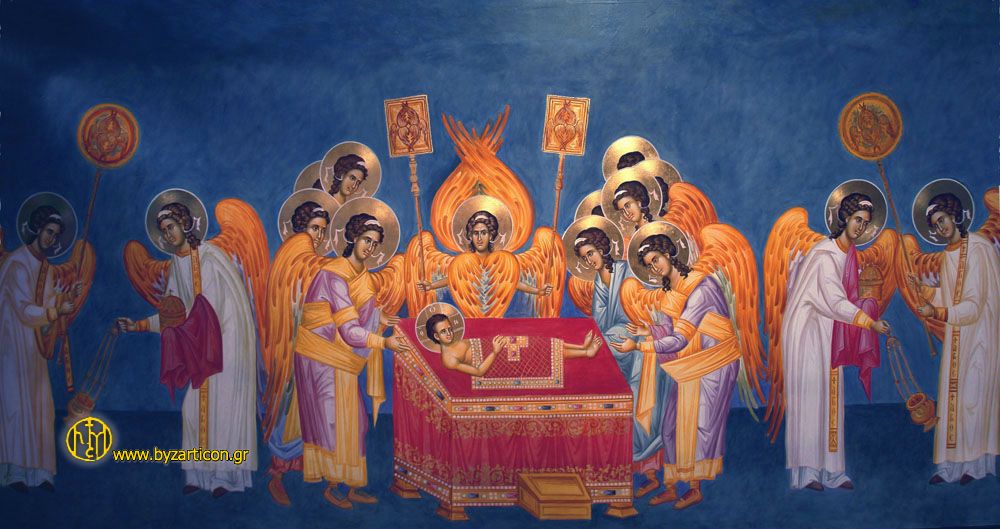
Then there appeared a totally pure and thrice-blessed Infant!

He was held by the arms of the Angels, who brought Him and placed Him on the Holy Paten, where the Precious Gifts were found. Around Him was gathered a multitude of totally radiant youths dressed in white, who approached His divine beauty with wonder and fervor.

The Lamb of God, Who takes away the sins of the world (source)
  
It was the time of the Great Entrance.

The liturgist approached to take in his hands the Holy Paten and the Holy Chalice, and raised them up above his head, lifting together with them, the Infant.

When the Holy Gifts exited, while the people chanted compunctionately, he saw the venerable angels flying over the liturgist in circles.

Two Cherubim and two Seraphim went before him, and a multitude of other Angels followed behind, chanting unspeakable hymns with rejoicing.

When the priest reached the Holy Altar and placed the Precious Gifts, the Angels covered them with their wings. The two Cherubim stood on the right of the liturgist, and the two Seraphim on his left, without [the priest] seeing them.

The divine mystagogy continued.

They said the Creed, and reached the consecration of the Precious Gifts.

The liturgist blessed them and said: “...changing them by Your Holy Spirit. Amen. Amen. Amen.” Then again, the Righteous One saw an Angel take a sword and pierce the Infant, pouring His Blood into the Holy Chalice, while His Body was cut up and placed on the Holy Paten.

Later, [the Angel] returned to his place again, and stood chastely with reverence.

When the liturgist lifted up the Holy [Lamb], crying out: “The Holy Things are for the Holy people of God”, while the people chanted: “One is holy, one is Lord...” one of the faithful approached the Saint and asked him: “Why, O Father, does the priest say: 'The Holy Things are for the Holy people of God'?”

The Saint replied: “He says this for all of us, my child, and it means: to the Holy Members of Christ, may those who are holy approach!”

“And what is holiness, O Father?” the man asked him again, who was very simple.

“If one is dissolute, let him not dare to partake of this great Mystery. If you have made an enemy of anyone, do not approach. If you have made a laughing stock of, or angered, or judged your fellow man, stay far away from Holy Communion. First test yourself, to see if you are virtuous enough to approach, and if you are not, [stay back].”

In the interim, the liturgist cried out: “With fear of God, and faith and love, draw near.”

The Saint then followed all those who communed. Some of their faces turned black as soon as they partook of the Divine Mysteries, while others shone like the sun.

The Angels stood there nearby and followed the Communion with reverence. After every faithful person communed, they placed a crown upon his head.

However, when a sinner approached, they turned their faces in aversion. Then, the spotless Mysteries appeared to disappear from the holy [spoon], so that the sinner might not take within him the Body and Blood of Christ. And the sinner left utterly black...with the disapproval of the Lord spread over his face.

When the liturgy was finished, and the priest consumed the Gifts, then, the Infant appeared whole again above in the arms of the Holy Angels!

Straightaway the roof of the church appeared to split in two. From there the Angels lifted up the Child to the heavens with hymns and doxologies, just like they had brought Him down, and an unspeakable fragrance again filled the whole area.”
 
(amateur translation of text from source)
   
Jesus Christ depicted as an Infant on the Paten, the Lamb of God Who takes away the sins of the world (source)
   
Through the prayers of our Holy Fathers, Lord Jesus Christ our God, have mercy on us and save us! Amen!

Saturday, January 11, 2014

St. Gabriel the Confessor on the Divine Liturgy

The Divine Liturgy on the Holy Mountain (source)
 
St. Gabriel the Confessor and Fool-for-Christ said:
"If you only knew how great a blessing comes from the Divine Liturgy, then you would collect even the dust from the floor of the church to wash your faces with it..."
(source)
 
Through the prayers of our Holy Fathers, Lord Jesus Christ our God, have mercy on us and save us! Amen!

Wednesday, May 1, 2013

Excerpt from the Homily on the Betrayal of Judas, by St. John Chrysostom

The Mystical Supper (source)
   
Excerpt from the Homily on the Betrayal of Judas, by St. John Chrysostom
Translated by Monk Moses of the St. Herman of Alaska Brotherhood from the original Greek, in Patrologia Graeca 49.373–80. See this link for the whole text of this beautiful and moving sermon.
  
Today, beloved, our Lord Jesus Christ was betrayed. It was on this approaching evening that the Jews seized him and took Him away. But do not be dejected, hearing that Jesus was betrayed; rather, be dejected and weep bitterly—not over Jesus Who was betrayed, but over the traitor, Judas. For, indeed, the One Who was betrayed saved the whole world, while the one who betrayed Him lost his own soul. And the One Who was betrayed is seated at the right hand of the Father, while the one who betrayed Him is now in hades, awaiting the inevitable punishment. Thus, weep and moan for his sake; mourn for his sake, since even our Master shed tears on his account. Seeing him, Jesus was troubled and said: One of you shall betray Me ( John 13:21). Oh, how great is our Master’s compassion! The One Who was betrayed grieved for the one who betrayed Him. Seeing him, Jesus was troubled and said: One of you shall betray Me. Why was He disheartened? In order to show His tender love and, at the same time, to teach us that it is altogether fitting to mourn, not for the one enduring evil, but for the one committing it. Committing evil is worse than enduring it; or rather, enduring evil is not evil, but committing it is evil. While enduring evil procures us the Kingdom of Heaven, committing evil results in Gehenna and punishment for us. For Blessed, says the Lord, are they which are persecuted for righteousness’ sake: for theirs is the Kingdom of Heaven (Matt 5:10). Do you see how enduring evil has as its recompense and reward the Kingdom of Heaven?

...What will ye give me and I will deliver Him unto you? Tell me, did Christ teach you that? Did He not restrain in advance your covetous intention, saying: Provide neither gold, nor silver, nor brass in your purses (Matt. 10:9)? Did He not continually advise this, and also say: If someone shall smite thee on thy right cheek, turn to him the other also (Matt. 5:39)? What will ye give me and I will deliver Him unto you? Oh, what madness! Tell me, for what? With what small or great accusation do you betray the Teacher? That He granted you power over demons? That He granted you the power to put an end to sicknesses? To cleanse lepers? To raise the dead? That He brought an end to the tyranny of death? For these benefactions you give this recompense? What will ye give me and I will deliver Him unto you? Oh, what madness! Or rather, what covetousness! For it is covetousness that produced all this evil: lusting after money, he betrayed the Teacher. Such is the root of this evil; worse than the devil, it excites to frenzy the souls it has conquered and renders them oblivious to everyone, both to themselves
and to their neighbors, as well as to the laws of nature, driving them out of their minds and making them insane. See how much it cast out from the soul of Judas: the fellowship, the intimacy, the common
table, the miracles, the instruction, the counsel, the admonitions—all of that was then cast into oblivion by covetousness. Thus Paul rightly said: The love of money is the root of all evil (I Tim. 6:10)...

...I have said all this so that no one will accuse Christ, saying: “Why did He not change Judas? Why did He not make him sensible and good?” How ought Judas to have been made good? By force or voluntarily? If by force, he would not have become better, for no one becomes good by force. But if, by his own deliberate choice, Judas had wanted to, then Christ would have used all means to amend his will and intent. But if he did not want to take the medicine, it is not the Physician Who is at fault but the one who evaded the treatment. Look at how much Christ did in order to win him over and save him: He taught him all wisdom by deeds and by words; He placed him above the demons; He prepared him to perform numerous miracles; He inspired fear in him with the threat of hell; He impelled him forward with the promise of the Kingdom; He continually censured his unspeakable plans, without making them public; He washed his feet along with the others and shared His table with him. He did not leave anything undone, either small or great, but Judas of his own free will remained uncorrected...

But it is time then to approach that fearful table. Therefore, let us all approach with fitting discretion and sobriety. And let no one be Judas any longer; let no one be wicked; let no one possess venom, bearing one thing in his mouth and another in his mind. Christ is present, and He Who set in order that meal of old also sets this one in order now. For it is not a man who causes the elements that are set forth to become the Body and Blood of Christ, but Christ Himself, Who was crucified for our sake. Fulfilling the figure, the priest stands and utters the words. But the power and the grace belong to God. This is My Body, the priest says. These words transform the elements set forth; and just as the words Increase and multiply and fill the earth (Gen. 1:28) were said once, but throughout all time they give our nature the power to beget children, so also from that time until now and until His Coming, these words that were said once accomplish the perfect Sacrifice on each altar table in the churches.
Therefore, let no one hide festering sores within; let no one be filled with wickedness; let no one have venom in his thoughts, lest he partake unto condemnation. For truly it was after Judas had received the Holy Gifts that the devil fell upon him, out of contempt not for the Body of the Lord but for Judas, on account of his shamelessness—so that you understand that the devil especially falls upon and repeatedly attacks those who partake of the Holy Mysteries unworthily, as with Judas at that time. For honors benefit those who are worthy, but honors cast into greater torment those who enjoy them unworthily. I do not say these things to frighten you, but in order to warn you. Therefore, let no one be Judas; let no one that enters have the venom of wickedness. The sacrifice is spiritual food; and just as bodily food that enters a stomach having foul juices makes the illness even worse—not because of its own nature but because of the sickness of the stomach—so also does it usually happen with the spiritual Mysteries. For they also, when they enter a soul that is full of wickedness, ruin and destroy it even more—not on account of their own nature but on account of the sickness of the soul that receives them.
Therefore, let no one have evil thoughts within, but let us purify our mind, for we are truly drawing near to the spotless sacrifice. Let us make our soul holy; it is possible for this to happen even in a single day. How, and in what way? If you have anything against your enemy, expel your anger, treat your wound, put an end to your enmity, so that you may receive healing from the holy table—for you are approaching the fearful and holy sacrifice. Stand in awe before the meaning of this sacrifice. The slain Christ is laid out before us. On what account was He slain and why? In order to make peace between heaven and the earth, in order to make you a friend of the angels, in order to reconcile you entirely to God, to make you, an enemy and opponent, into a friend. He gave His life for those who hate Him, but you continue to hate your fellow servant? And how can you come to the table of peace? He did not decline to die for you, but you cannot bear, for your own sake, to get rid of your anger toward your fellow servant? And what sort of forgiveness are you worthy of?

He abused me, you say, and hurt me a great deal. But what is this? The damage is only to property; by no means did he wound you like Judas did Christ, but nevertheless Christ gave His own Blood for the salvation of those who caused it to pour forth. What can you say is equal to that? If you do not forgive your enemy, you do not hurt him but yourself. You wound him many times in this present life, but you make yourself unpardonable at the judgment in the day to come. For God hates nothing so much as a man who remembers past wrongs, nothing so much as a puffed-up heart and a soul inflamed. Listen to what He says: When you bring your gift to the altar, and there remember, standing high-up at the altar, that your brother has something against you, leave … your gift at the altar and go … be reconciled to your brother, and then … offer your gift (Matt. 5:23–24).
What are you saying?—that I should leave my gift? Yes, for it was for the sake of peace with your brother that this sacrifice took place. Thus, if it is for the sake of peace with your brother that this sacrifice took place, but you have not accomplished that peace, then you take part in the sacrifice to no purpose, the good work is of no benefit to you. Therefore, let us first do that on account of which the sacrifice has been offered, and then we will benefit well from it. The Son of God came down in order to reconcile our nature to the Master. And not only for that did He come down, but also in order to make us who do these things sharers in His name. For He says: Blessed are the peacemakers, for they shall be called sons of God (Matt. 5:9). Do also, according to human strength, that which the only-begotten Son of God did, becoming an agent of peace both for yourself and for others. On account of this, O peacemaker, He even calls you a son of God. And therefore He did not mention any other commandment regarding the time of the sacrifice except to be reconciled with one’s brother, showing that this is the most important of all.
I had wanted to extend my discourse, but what has been said is enough for those who are attentive, if they call it to mind. Beloved ones, let us continually call to mind these words, the holy greetings, and the awe-inspiring kiss of peace with each other. For this joins our minds together and makes everyone become one Body, since we all also partake of one Body. Let us be joined together in one Body, not
mingling with the bodies of one another, but uniting our souls with each other in the bond of love. In this way we will be able to partake with boldness of the meal which is set forth. Even if we possess countless righteous deeds, if we bear remembrance of wrongs, they are all to no avail and in vain, and we will not be able to reap from them any benefit toward our salvation.
Therefore, being conscious of these things, let us bring an end to all anger, and purifying our conscience, let us approach with all meekness and gentleness the table of Christ, to Whom is all glory, honor, and power, together with the Father and the Holy Spirit, now and ever and unto the ages of ages. Amen.
   
The Betrayal of Judas (source)
  
Through the prayers of our Holy Fathers, Lord Jesus Christ our God, have mercy on us and save us! Amen!

Sunday, March 3, 2013

The Splendor of the Divine Liturgy

Christ and the Holy Angels serving the Divine Liturgy (source)


The Splendor of the Divine Liturgy, by Elder Ephraim of Arizona

The Divine Liturgy, what a splendor indeed! Man has been honored by God in such a way that He Himself comes down to earth with His Angelic Orders every time there is a Liturgy, in order to nurture man with His Most Holy Body and His Most Precious Blood! For He has given us everything. Is there anything physical or spiritual, perishable or everlasting, that has not been offered to us? None! Is there anything superior to His Most Holy Body and Blood, which is given to us on a daily basis? There is certainly not. God has enabled man, who is full of soil and dirt, to serve the Divine Liturgy. So priceless is the Divine Love that just a tiny drop exceeds any earthly, physical and secular love.

Adam and Eve's sin was the starting point of all the distressing events that have occurred to this day and of those that will occur until the end of time. Disobedience, like a sperm inside Eve's womb, gave birth to and transmitted physical and spiritual death to all of humanity. Poor Eve, could there have been a way for her to see that "the split second" taste of the fruit would cause such turmoil, thus compelling the Holy Trinity to have a "co-entreaty" so that the one Person of the Life-Giving Trinity would be sent to the world and endure, by the works of His hands, the blows, insults, whipping, spitting as well as all kinds of obscenity and ultimately be hung on the Cross as a curse! "Cursed is everyone that hangeth on a tree" (Gal. 3:13).

The sweet redemption of our Jesus, the light of our troubled souls, His Passion and Life-Giving Resurrection, are re-enacted in every Divine Liturgy through which every sinful soul is delivered. Great indeed is Jesus' love for us! For He took on our human nature and was hung on the Cross, giving us freedom and thus wiping clean all our debts towards our Heavenly Father. And as our beloved Brother He makes us worthy of His co-inheritance which consists of the infinite riches of His Heavenly Father. And if during the time when the Law, which existed before Christ, had overshadowed things, and the blood of oxen and goats as well as a calf's embers purified those who had partaken of them, how much more will Christ's Most Holy Blood, which is partaken from the Holy Altar of the Holy Churches of God, cleanse us from sin and warm up our souls in order to receive the divine love of our most sweet Jesus. The Lamb which was slaughtered for our personal salvation will rinse us with His Most Precious Blood from the filth of our sins and give us eternal rest.

In any case, we owe it to ourselves to become partakers of this heavenly banquet which offers us this most wonderful Mystery of the Holy Altar. Once inside the church, we should stand in fear and devoutness, since our Lord Jesus Christ and His holy angels are present. Those who are attentive and devout are filled with grace and blessings; however, those who are inattentive are condemned, being unworthy.

On the one hand, the Angels serve the Divine Liturgy, and on the other, the faithful come to church in order to partake of the Body and Blood of Christ - "Receive the Body of Christ and taste the Fountain of Immortality" - so that they will live in Christ and not perish in sin. Thus, "let a man examine himself, and so let him eat of that Bread and drink of that Cup, for he that eateth and drinketh unworthily eateth and drinketh damnation to himself" (1 Cor. 11:28-29). For instance, when someone wants to appear before a king, it takes him days to get ready, in terms of general preparation, cleanliness, speech, manner, ethos, etc., so that he would succeed in drawing the king's compassion and, in this way, have his desirable request granted. Even though there is no comparison as far as the two different kings are concerned, each believer should prior to Holy Communion prepare oneself in order to obtain divine mercy and forgiveness. Those who appear before a secular king are, most of the time, adorned by iniquity, flattery, pretence as well as deceit, in order to obtain that which is desired; nevertheless, the Christian believer who appears before the King of kings who in turn keeps an eye on the inner person must be adorned by holiness, humility and the sheer ethos of the soul that is more precious than lost gold.

The Lord created His Church on earth as a Bride, so that She would intercede for His children. He left us the Great Mystery of the Holy Eucharist, in order to be cleansed, become holy and thus become one with God. He has invited us all; some in their childhood, others in their middle as well as old age. As He is Good, He took hold of us like a hen gathers her chicks under her wings, in order to make us partakers of His divine Kingdom. Nothing repelled Him - no ulcer, no wound, no illness, not even the deformity of spiritual phenomena which may characterize our soul. As a father He accepted us, as a mother He breast-fed us, and as an unmercenery doctor He took care of us and clothed us in the garment of adoption, with grace ignoring the heavy debt of our trespasses. We thus owe Him infinite love and worship. Love should remain in the heart like a life-giving source, gushing forth springs of communion wine and streams of divine eros.

We should be partakers of the Sacrifice of the Slaughtered Lamb as often as we can, and as long as we are free to do so, since Holy Communion is a great aid for the believer which in turn helps him to fight sin. Also, we should approach this divine Mystery in a spirit of compunction, crushed hearts, and a good sense of our sins. Great is the mercy of God Who condescends to enter into us; not abhorring the multitude of our sins. Nonetheless, due to His infinite love and affection, we are sanctified, and in this way we are made worthy to become His children and co-heirs of His Kingdom. Hence, let us prepare with a pure conscience aiming at the fortification of our senses, and in chastity let us enter along with the Holy Apostles to the Mystical Supper and partake of our sweet Jesus so that He should dwell with us unto the infinite ages of ages.

Unworthy as I am, I serve my Lord. A ministry rendered that is holy and mighty. Everyday I offer God a well-pleasing sacrifice, the Lamb of God, Immaculate to His Immaculate Father and God, in order that He might be merciful for the things with which we sadden the most good God. He whom we cause grief and Who sacrificed His only begotten Son. My God, Your most beloved Son for our sake! And who are we to deserve this ultimate sacrifice! "For being enemies, we were reconciled to God by the death of His Son" (Rom. 5:10).

It is a fact that numerous interpretations of the Divine Liturgy which were mainly based on the illumination and grace of the Holy Spirit were handed down to us by the Church Fathers. What makes this current analysis of the Divine Liturgy of my spiritual child Father Stephanos Anagnastopoulos noteworthy and beneficial, is the fact that it is offered through the experiences and revelations of worthy Liturgists of the Most High, older and more recent ones.

I, as well as its author, wish that this book will lead us all to the genuine liturgical conscience and life in order to urge us in a spirited way, as grateful servants, to try to rest the heart of His feelings so that He will be comforted, according to the Psalter: "...and because of His servants shall He be comforted" (Psalm 134:14). May we sense that which God offered us and thus rejoice in the beauty of His eros. Amen.

The most unworthy of all
+ Father Ephraim
   
Through the prayers of our Holy Fathers, Lord Jesus Christ our God, have mercy on us and save us! Amen!

Thursday, December 13, 2012

Elder Ephraim of Katounakia on the Priesthood

The Divine Liturgy (source)
 

Elder Ephraim of Katounakia on the Priesthood
When you liturgize, have in mind that you are a mediator. You receive from the world pain, tears, sickness, and supplications and you offer them above to the throne of the Godhead. Then you transfer to the world comfort, therapy, and whatever need someone may have. God has made you worthy of a great office, my child. Cultivate it. The ear of God is at the mouth of the priest.

The stole has great power. The stole is an arbiter of fallen man with the Father, with his Creator. This is why, as much as you can, commemorate more names.

During the time of the Turkish occupation there were many priests circulating around, but one priest circulated and gathered names to be commemorated during the Liturgy. The Turkish officer said to him: "Hey, he is raising a revolution of the people." He took the priest and brought him in. In his sleep all of those the priest had commemorated appeared to him and said: "Listen, either you release the priest, because he commemorated us and consoled us, or we will take your first child." The Turk became fearful. This was during the Turkish occupation. "Come priest, go and be well", he said, "go, for will I lose my child?"

The stole has great power, my child, great power. As much as you can, commemorate more names.

Yes, years ago I was given by Fr. Arsenios, spiritual brother of Elder Joseph, some names from the time he was an immigrant from Russia and came to Greece. I commemorated them. Later he told me: "You know, Elder, what I saw? I saw in my sleep that those names I gave you, well I went to one of their homes. I asked how they were doing here. 'Well,' they said, 'somewhat good, but Papa-Ephraim comes and consoles us.'" It was because I was commemorating his name. Yes. Later he asked another: "How are you doing?" They said: "So so, but it's raining a bit and we're cold, but Papa-Ephraim comes and consoles us." I said to him: "It is, my brother, the names I commemorate."

Why did Papa-Planas become a saint? He commemorated whole papers. Once I remembered some names and I posted them at the Proskomide. There at the clipboard. So in my sleep I saw that certain elderly came, with old clothes, as I heard from the mother of my father, and they said: "You, my child, wrote us down, but the Elder, my child, does not commemorate us."

"Come on," I said to the Elder, "why don't you commemorate them?"

"I could not see them clearly," he said.

"Elder, I saw this and that, and they said that the Elder does not commemorate us," I said.

From that time I received the desire to commemorate as many more names. The more the names, the more the wages you receive. But this is the greatest charity: to unite man with God. This is the greatest charity. And you can do this. As many more names, my child, that you commemorate, so much more the wages do you receive. Yes.
   
Icon depicting Christ the Great High Priest in the center, surrounded by His Holy Priests that are serving the Holy Sacraments (e.g. Baptisms, Weddings, Holy Confession, etc.) and other pastoral activities (e.g. Catechism, visiting the sick, etc.) as His representatives (source)
  
Through the prayers of our Holy Fathers, Lord Jesus Christ our God, have mercy on us and save us! Amen!

Wednesday, November 14, 2012

The Holy Forty Divine Liturgies

Christ communing His Holy Apostles (source)
 
The Holy Forty Divine Liturgies ("Sarantoleitourgo")
During the forty day period prior to the celebration of the Nativity of our Lord*** it is a tradition for priests to celebrate daily the Divine Liturgy. The Forty Liturgies celebrated during this time are a great blessing not only for those who participate, but also for those commemorated among both the living and reposed. As St. Ignatius of Antioch writes: "Take heed, then, often to come together to give thanks to God, and show forth His praise. For when you assemble frequently in the same place, the powers of Satan are destroyed, and the destruction at which he aims is prevented by the unity of your faith" (Eph. 13). The power of the Divine Liturgy isn't magical, but it is a manifestation of love and unity in Christ. It teaches us to forgive, to have love for one another, and to be united in Christ as one body. In such an assembly, where the living and reposed are commemorated, great blessings follow for all.

The Divine Forty Day Liturgies of the Nativity season on behalf of the living and reposed are a manifestation of the love we should have for one another as members of the Church. Nothing makes more real and present the love of Christ for mankind, who took on flesh for the salvation of sinners, then the daily offering of the Divine Eucharist for the forgiveness of sins and life everlasting of the living and reposed.


As St. John of Kronstadt writes: "In the Divine Liturgy is celebrated the Mystery of Love...[O perfect love! O love which embraces all! O strongest love! What can we offer in thanksgiving to God for His love for us? This love is found in the sacrifice of Christ, which is offered for the liberation of all from every evil...]"

And Elder Paisios advised regarding the need to pray for the departed: "Leave in your prayers room for the reposed. The dead can do nothing for themselves. The living can. Bring to the church prosphoro, and give the names of the reposed to be commemorated by the priest in the proskomede. Do also memorials and trisagia. But the trisagion without the Divine Liturgy is nothing. The greatest thing we can do for someone is Forty Liturgies. It would be good to tie it in together with almsgiving."

St. Symeon of Thessaloniki writes of the commemoration of the reposed during the Divine Liturgy: "During the Liturgy their portion which is placed on the diskos invisibly partakes of God, they are cleansed through the Sacred Blood and commune,...and they are consoled...and they rejoice in Christ." 

And St. John Chrysostom writes: "You should not have any doubt whatsoever that the dead will benefit spiritually. The priest does not plead in vain in the Holy Prothesis or at the Holy Table for the reposed in Christ, with faith in the God-man Lord."
(http://www.johnsanidopoulos.com/2011/11/divine-forty-liturgies-and-nativity.html)
   
***Note: There are many places which also celebrate the Forty Divine Liturgies at other periods of the year (e.g. during the forty days after Pascha), while there are other places which, through the grace of God, celebrate the Divine Liturgy every day, for the healing, forgiveness and sanctification of the faithful.
   
On the benefit of the Forty Liturgies for the Departed
Elder Daniel of Katounakia (+1929) was originally from Smyrna, and at one point while he was a monk on Mount Athos he lived at Vatopaidi Monastery. One of his obediences was to travel on business for Vatopaidi to Smyrna where he stayed for nine months.

When Elder Daniel was a young boy in Smyrna, there was a simple Christian named Demetrios, who was known for his great virtue and piety, that would counsel and admonish him with heavenly wisdom. Upon his return to Smyrna the elder had heard that Demetrios was dead and he wished to meet with Demetrios' son George to ask him about it. He writes: "As soon as I arrived, I considered it my inviolable duty to first of all visit George, the son of the ever-memorable Demetrios. I questioned him minutely about the death of his father, of whose repose I had heard from many people."

George described the details of his virtuous father's death to Elder Daniel with tears in his eyes, yet one event was so remarkable that Elder Daniel decided to record it for our spiritual benefit.

Archimandrite Cherubim, in his book Contemporary Ascetics of Mount Athos (vol. 1, pp. 241-245), describes the event as follows:

Reaching the sunset of his earthly life, the divinely-enlightened Demetrios knew beforehand, by the grace of God, the day of his death. On that day he asked a certain devout, guileless, and saintly priest, Fr. Demetrios, to come to him.

"I will die today, my father," he said to him. "I beg you, tell me what I must do at this critical time."

The priest knew of his virtuous life; he knew that he had confessed, received Holy Unction, and had Holy Communion several times. Seeing his desire, however, it came to him to suggest the following:

"If you wish, give a command that after your death forty Liturgies should be served for you in a country chapel."

The dying man accepted the priest's suggestion with joy. A little while later he called his son.

"My son, I ask one favor. I ask that after my death you arrange to have forty Liturgies served for me in some church far away from the city."

"Give me your blessing, Father, and I will promise you to fulfill your wish," was the reply.

After two hours the man of God gave up his spirit. Without delay, his good son addressed Fr. Demetrios, not knowing it was he who had suggested the forty Liturgies.

"Fr. Demetrios, my father left me a command to have forty Liturgies served for him somewhere outside the city. As you sometimes stay at the Chapel of the Holy Apostles, i beg you to take on the labor of serving them. I will take care of your work and the expenses of the church."

With tears the priest replied: "My dear George, I myself gave this advice to your father, and I will always commemorate him as long as I live. I cannot serve a regular forty Liturgies, however, because right now my presvytera is a little sick. You will have to entrust them to another priest."

George, however, knowing Fr. Demetrios' great piety and his father's devotion to him, persisted until he persuaded him. The priest returned to his home and said to his presvytera and his daughters:

"I must serve forty Liturgies for the soul of the good Christian Demetrios. Therefore don't expect me home for forty days. I will be at the Holy Apostles the whole time."

He began willingly to serve the Liturgies. Thirty-nine went by without hindrance, and the last was to fall on a Sunday. On Saturday evening, however, he was seized by a terrible toothache which forced him to return home. He was moaning from the pain. His presvytera suggested that they call someone to extract the painful tooth.

"No," he answered, "I have to serve the last Liturgy tomorrow."

In the middle of the night, however, the pain grew so great that they were forced to summon a specialist to pull the decayed tooth. As he was bleeding, he decided to serve the last Liturgy on Monday.

On Saturday afternoon, George got some money ready to repay the labor of the priest, which he would give him the next day. In the middle of the night, as Sunday was approaching, he arose to pray. The absolute silence of the night was conducive to compunction. Later, growing tired, he sat on his bed and began to recall to his mind the virtues, gifts and wise words of his blessed father. The thought also passed through his mind: "Do the forty Liturgies really benefit the soul of the reposed, or does the Church mainly recommend them for the consolation of the living?" Just at that moment he fell into a light sleep.

He saw himself in a beautiful plain, of an indescribable loveliness one does not see the earth. He felt himself unworthy to be in such a holy paradisiacal place, however, and was overcome by fear, afraid that because of his unworthiness he would be cast out from there and thrust into the depth of hades. But the thought strengthened him: "Since the All-Good God deigned to bring me here, He will have mercy on me and lead me to repentance, for since I am still in my body I must still be living."

After this consoling thought he saw from afar a most pure and clear light, shining much brighter than the sun. He ran towards it and saw with unspeakable surprise a sight of indescribable beauty. Before him stretched a vast forest-garden, all wooded, fragrant with a wonderful and unutterable aroma. He said within himself: "This must be Paradise! Oh, what blessedness awaits those who live virtuously on the earth!"

Examining this other-worldly beauty with astonishment and delight, he saw a most beautiful palace of exceeding brightness and excelling architectural grace, whose walls shone more than gold and diamonds. It was impossible to describe it beauty in human terms, and he was speechless and amazed. Drawing closer - oh joy! He saw his father, light-bearing and shining, before the door of the palace.

"How did you come here, my child?" his father asked him with gentleness and love.

"I don't know either, Father. I realize that I am not worthy of this place. But tell me, how are you here? How did you come here? Whose palace is this?"

"The goodness of our Savior Christ, by the intercession of the Mother of God, whom I especially revere, vouchsafed me this place. I was to have entered into the palace today, but since the builder who is constructing it is suffering from bad health - he had his tooth extracted today - the forty days of its building have not been completed. Therefore I will enter it tomorrow."

After those words George awoke, full of tears and wonder, but also with some perplexities. For the remainder of the night he did not sleep, but sent up continuous praise and glorification to the All-Good God. In the morning he went to attend Liturgy at the Cathedral of St. Photini. Afterwards he took with him prosphora, blessed wine, and an unburnt candle and set out for the region of Mirtakia, where the Chapel of the Holy Apostles was located. He found Fr. Demetrios sitting in a chair inside his cell.

The priest welcomed him with joy, saying: "I also have just come from Divine Liturgy. Now the forty Liturgies are finished."

This he said so as not to grieve George.

George then began to describe in detail the vision he had in the night. When he came to the account of his father's entering was delayed because of the builder's toothache, the priest was overcome with fear, but also by wonder and joy. Standing upright, he said:

"My dear George, I am the builder who worked at constructing the palace. Today I did not serve Liturgy because I had my tooth extracted. See, the handkerchief in my hand is stained with blood. I told you a falsehood because I didn't want to sadden you."

Elder Daniel was deeply moved by this blessed narrative. At the end, George urged him to visit Fr. Demetrios, who at that time was working as a priest in the district of St. John the Theologian. The priest told him exactly the same story, and begged him to record such a profitable tale. This is what happened, as we found it among his manuscripts. At the end of it, Elder Daniel noted with his pen: "The above account I heard in the year 1875, in the month of October. This ever-memorable Demetrios reposed in 1869."

(http://www.johnsanidopoulos.com/2010/09/on-benefits-of-forty-liturgies-for.html)
   
St. George Karslides on the Forty Liturgies
1. When he would Liturgize he would become another man. Those attending church would hear various sounds from the Holy Altar from his heavenly visitors. They would kneel and chant "Lord have mercy".

2. One day the Saint said to his chanter: "I had so many saints today that I didn't have enough room to fit them. We put Saint Panteleimon in one corner, because there was no room."

3. At one time demons bothered the Saint and would not allow him to do the proskomede. After the Liturgy he said: "I began these Forty Liturgies with stress. The demons would yell out the names so that I would not be able to commemorate them, and thus not allow them to be forgiven."

4. After a period of Forty Liturgies he was asked:

"Elder, were you tired to finish them?"

"No my child. It was a pleasure for me, as if I did one Vespers, because they were very good people. Your father had a rich table like Abraham."

Then the man thought: "We were so poor, to the point we were hungry, so where did our father find such a rich table?"

"Don't see things like that," the Saint corrected. "Maybe he did not have to give, but his soul wanted to give much, and God accounted it to him as if he did give it. Your mother is a servant of your father, because she was very tiresome and would sadden him, always complaining to him. But your father always wore a smile with much goodness. Among your relatives you had a blind girl, whom you forgot to write. She was pure and very good."

"But how did you know this?" asked the man in wonder.

"When I commemorate, she also comes to the kollyva, but she comes as a guest, and does not unite with the others. Now everyone went to their place and opened the road for you."
Source: Athonite Flowers (vol. 14). Translated by John Sanidopoulos. (http://www.johnsanidopoulos.com/2011/11/saint-george-karslidis-on-forty.html)

   
Through the prayers of our Holy Fathers, Lord Jesus Christ our God, have mercy on us and save us! Amen!