Showing posts with label Holy Mysteries of the Church. Show all posts

Friday, May 8, 2020

Elder Nikon the Athonite on Loneliness

Christ is risen! Truly He is risen!
This is a beautiful recent talk from Elder Nikon the Athonite on the topic of loneliness, and this is particularly pertinent for our days. Not only are many, even in cities and among other people, plagued with these experiences and emotions, but this likely to be increased, as many are now in isolation due to the coronavirus pandemic. As this coming Sunday is the remembrance of Christ's healing of the Paralytic, who did not have anyone to help him until our Lord raised him from his bed, may we cleave to our Lord, our Panagia and His Saints, may we befriend them that they might always be with us, and may we be friends and neighbors to those around us, showing true love and sacrifice to our God and to His living icons around us! (source)
  
Christ is risen from the dead, by death, trampling down upon death, and to those in the tombs, He has granted life!
Truly, the Lord is risen!

Friday, January 3, 2020

St. Porphyrios on Finding Joy

St. Porphyrios of Kavsokalyvia (source)
  
Once, a woman asked St. Porphyrios why he was happy, even though his health had been seriously endangered. To this, he responded:
"Read the Holy Scriptures, go to Church, have a father confessor, partake of the Holy Mysteries--in one word, become a good Christian--and then, you will find the joy that you are seeking. You see that I am sick now, but I am joyful. Thus you, when you come a bit closer to Christ, will find joy in your life."
(source)

Through the prayers of our Holy Fathers, Lord Jesus Christ our God, have mercy on us and save us! Amen!

Thursday, November 14, 2019

"The serenity of the Athonite world of monks..."

An Athonite service (source)
  
The serenity of the Athonite world of monks, on the slopes of Athos that neighbors Heaven, that is constantly spoken of by the world, continues to reply with silent messages to turn to one's self and reconstitute the spiritual powers of man towards repentance and the sacramental life.
-Elder Prodromos, Abbot of Great Lavra Monastery, Mount Athos

(source)
   
Icon of the Synaxis of the Holy Athonite Fathers (source)
   
Through the prayers of our Holy Fathers, Lord Jesus Christ our God, have mercy on us and save us! Amen!
 

Tuesday, January 22, 2019

Elder Nikon of New Skete: "Show me your faith from your works..."

Excerpt from an interview with Elder Nikon of New Skete where he discusses faith, works and evangelism as regards the Christian faith (source)
   
Through the prayers of our Holy Fathers, Lord Jesus Christ our God, have mercy on us and save us! Amen!

Sunday, December 16, 2018

St. John of Kronstadt: The most pleasing sacrifice to the Infant Jesus Christ

The Nativity of Christ (source)
 
“What, then, O, brethren, is required of us in order that we might avail ourselves of all the grace brought unto us from on high by the coming to earth of the Son of God? What is necessary, first of all, is faith in the Son of God, in the Gospel as the salvation-bestowing heavenly teaching; a true repentance of sins and the correction of life and of heart; communion in prayer and in the mysteries [sacraments]; the knowledge and fulfillment of Christ’s commandments. Also necessary are the virtues: Christian humility, alms-giving, continence, purity and chastity, simplicity and goodness of heart.
Let us, then, O brothers and sisters, bring these virtues as a gift to the One Who was born for the sake of our salvation – let us bring them in place of the gold, frankincense and myrrh which the Magi brought Him, as to One Who is King, God, and Man, come to die for us. This, from us, shall be the most-pleasing form of sacrifice to God and to the Infant Jesus Christ.”
-St. John of Kronstadt, Sermon on the Nativity of Jesus Christ
Through the prayers of our Holy Fathers, Lord Jesus Christ our God, have mercy on us and save us! Amen!

Wednesday, December 12, 2018

"With every "Lord Jesus Christ, have mercy on me," it is like casting an atomic bomb in the heart of the devil..."

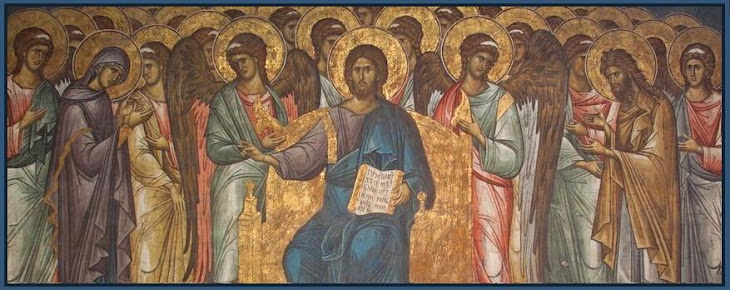
Jesus Christ enthroned in glory (source)
  
When a man says: "Lord Jesus Christ, have mercy on me," do you know what happens? It brings energy, it brings the Grace of the Holy Spirit puts it in action. He orders this "fire" of Divine Grace, to be worked throughout the earth. And how is this done? It brings joy to the angels, and brings sadness and enflames the demons. It is a further hell for the demons.
  
With every "Lord Jesus Christ, have mercy on me," it is like casting an atomic bomb in the heart of the devil (and because of this, [the devil] fervently puts up roadblocks) and it will be heard unto the ages of ages, not because we ourselves have this Grace, but because the name of Jesus Christ itself carries this energy and Grace and has so much power, as much power and Grace that His Godhead has!
  
For this Grace to be energized in essence in ourselves, we must have the following presuppositions:
A) frequent sacramental life
B) to have been forgiven by all men,
C) to proceed through life with purity in body and soul,
D) to have a spiritual guide, and,
E) to have an order and daily program of spiritual duties in the realm of silence and compunction.
-Elder Ephraim of St Andrew Skete, Mount Athos
  
(source)
  
Through the prayers of our Holy Fathers, Lord Jesus Christ our God, have mercy on us and save us! Amen!

Thursday, August 14, 2014

St. Nephon's Visions of the Divine Liturgy

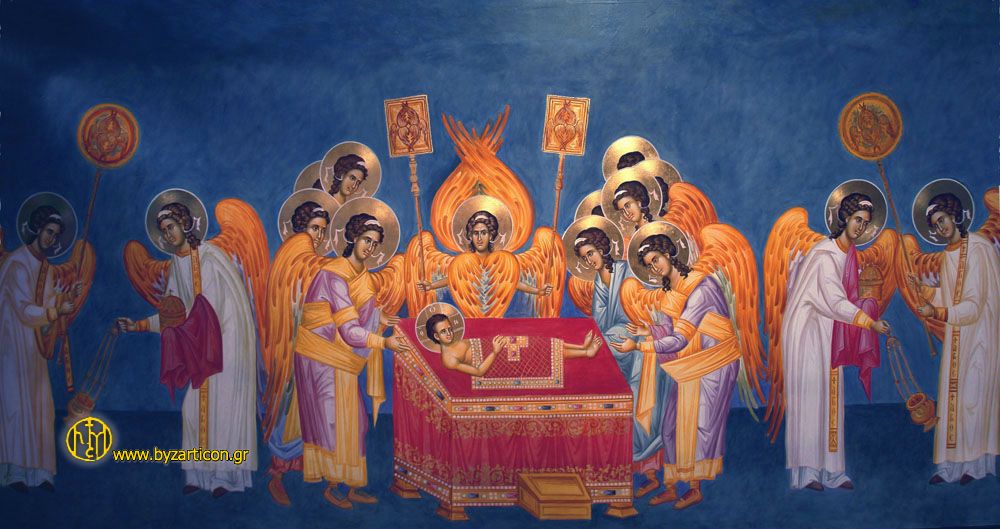
Christ and the Holy Angels in the Divine Liturgy (source)
 
St. Nephon, Bishop of Constantia (4th Century), was made worthy to see many divine visions, with the illumination of the Holy Spirit, through the eyes of his soul.

Once, in a Divine Liturgy, as soon as the liturgist said: “Blessed is the Kingdom..”, the Saint saw fire descending from heaven and cover the Holy Altar, without the priest understanding anything.

Later, when the Trisagion Hymn was begun by the people, four angels descended and chanted together with them.

During the Epistle, the blessed Apostle Paul appeared to direct the reader.

During the “Alleluia” after the Epistle, the voices of the people ascended united towards heaven, like a fiery and tightly-braided rope.

And at the Gospel, every word came out like flames from the mouth of the priest, and ascended to the heavens.

A short time before the entrance of the precious Gifts, the Venerable One straightaway saw heaven open, and an unspeakable aroma surpassing the world pour forth. Angels descended from on high, chanting hymns and doxologies to the Lamb, to Christ and the Son of God!

Then there appeared a totally pure and thrice-blessed Infant!

He was held by the arms of the Angels, who brought Him and placed Him on the Holy Paten, where the Precious Gifts were found. Around Him was gathered a multitude of totally radiant youths dressed in white, who approached His divine beauty with wonder and fervor.

The Lamb of God, Who takes away the sins of the world (source)
  
It was the time of the Great Entrance.

The liturgist approached to take in his hands the Holy Paten and the Holy Chalice, and raised them up above his head, lifting together with them, the Infant.

When the Holy Gifts exited, while the people chanted compunctionately, he saw the venerable angels flying over the liturgist in circles.

Two Cherubim and two Seraphim went before him, and a multitude of other Angels followed behind, chanting unspeakable hymns with rejoicing.

When the priest reached the Holy Altar and placed the Precious Gifts, the Angels covered them with their wings. The two Cherubim stood on the right of the liturgist, and the two Seraphim on his left, without [the priest] seeing them.

The divine mystagogy continued.

They said the Creed, and reached the consecration of the Precious Gifts.

The liturgist blessed them and said: “...changing them by Your Holy Spirit. Amen. Amen. Amen.” Then again, the Righteous One saw an Angel take a sword and pierce the Infant, pouring His Blood into the Holy Chalice, while His Body was cut up and placed on the Holy Paten.

Later, [the Angel] returned to his place again, and stood chastely with reverence.

When the liturgist lifted up the Holy [Lamb], crying out: “The Holy Things are for the Holy people of God”, while the people chanted: “One is holy, one is Lord...” one of the faithful approached the Saint and asked him: “Why, O Father, does the priest say: 'The Holy Things are for the Holy people of God'?”

The Saint replied: “He says this for all of us, my child, and it means: to the Holy Members of Christ, may those who are holy approach!”

“And what is holiness, O Father?” the man asked him again, who was very simple.

“If one is dissolute, let him not dare to partake of this great Mystery. If you have made an enemy of anyone, do not approach. If you have made a laughing stock of, or angered, or judged your fellow man, stay far away from Holy Communion. First test yourself, to see if you are virtuous enough to approach, and if you are not, [stay back].”

In the interim, the liturgist cried out: “With fear of God, and faith and love, draw near.”

The Saint then followed all those who communed. Some of their faces turned black as soon as they partook of the Divine Mysteries, while others shone like the sun.

The Angels stood there nearby and followed the Communion with reverence. After every faithful person communed, they placed a crown upon his head.

However, when a sinner approached, they turned their faces in aversion. Then, the spotless Mysteries appeared to disappear from the holy [spoon], so that the sinner might not take within him the Body and Blood of Christ. And the sinner left utterly black...with the disapproval of the Lord spread over his face.

When the liturgy was finished, and the priest consumed the Gifts, then, the Infant appeared whole again above in the arms of the Holy Angels!

Straightaway the roof of the church appeared to split in two. From there the Angels lifted up the Child to the heavens with hymns and doxologies, just like they had brought Him down, and an unspeakable fragrance again filled the whole area.”
 
(amateur translation of text from source)
   
Jesus Christ depicted as an Infant on the Paten, the Lamb of God Who takes away the sins of the world (source)
   
Through the prayers of our Holy Fathers, Lord Jesus Christ our God, have mercy on us and save us! Amen!

Saturday, July 13, 2013

St. John Chrysostom: "The Church is a hospital, and not a courtroom, for souls"

Jesus Christ, the Son of God, the Savior (source)
 
The Church is a hospital, and not a courtroom, for souls. She does not condemn on behalf of sins, but grants remission of sins.

Nothing is so joyous in our life as the thanksgiving that we experience in the Church. In the Church, the joyful sustain their joy. In the Church, those worried acquire merriment, and those saddened, joy. In the Church, the troubled find relief, and the heavy-laiden, rest.

"Come," says the Lord, "near my, all of you who labor and are heavy-laiden (with trials and sins), and I will give you rest." (Matthew 11:28)

What could be more desirable than to meet this voice? What is sweeter than this invitation? The Lord is calling you to the Church for a rich banquet. He transfers you from struggles to rest, and from tortures to relief. He relieves you from the burden of your sins. He heals worries with thanksgiving, and sadness with joy.

No one is truly free or joyful besides he who lives for Christ. Such a person overcomes all evil and does not fear anything!
-St. John Chrysostom
Amateur translation from: (source)
 
Through the prayers of our Holy Fathers, Lord Jesus Christ our God, have mercy on us and save us! Amen!

Wednesday, November 14, 2012

The Holy Forty Divine Liturgies

Christ communing His Holy Apostles (source)
 
The Holy Forty Divine Liturgies ("Sarantoleitourgo")
During the forty day period prior to the celebration of the Nativity of our Lord*** it is a tradition for priests to celebrate daily the Divine Liturgy. The Forty Liturgies celebrated during this time are a great blessing not only for those who participate, but also for those commemorated among both the living and reposed. As St. Ignatius of Antioch writes: "Take heed, then, often to come together to give thanks to God, and show forth His praise. For when you assemble frequently in the same place, the powers of Satan are destroyed, and the destruction at which he aims is prevented by the unity of your faith" (Eph. 13). The power of the Divine Liturgy isn't magical, but it is a manifestation of love and unity in Christ. It teaches us to forgive, to have love for one another, and to be united in Christ as one body. In such an assembly, where the living and reposed are commemorated, great blessings follow for all.

The Divine Forty Day Liturgies of the Nativity season on behalf of the living and reposed are a manifestation of the love we should have for one another as members of the Church. Nothing makes more real and present the love of Christ for mankind, who took on flesh for the salvation of sinners, then the daily offering of the Divine Eucharist for the forgiveness of sins and life everlasting of the living and reposed.


As St. John of Kronstadt writes: "In the Divine Liturgy is celebrated the Mystery of Love...[O perfect love! O love which embraces all! O strongest love! What can we offer in thanksgiving to God for His love for us? This love is found in the sacrifice of Christ, which is offered for the liberation of all from every evil...]"

And Elder Paisios advised regarding the need to pray for the departed: "Leave in your prayers room for the reposed. The dead can do nothing for themselves. The living can. Bring to the church prosphoro, and give the names of the reposed to be commemorated by the priest in the proskomede. Do also memorials and trisagia. But the trisagion without the Divine Liturgy is nothing. The greatest thing we can do for someone is Forty Liturgies. It would be good to tie it in together with almsgiving."

St. Symeon of Thessaloniki writes of the commemoration of the reposed during the Divine Liturgy: "During the Liturgy their portion which is placed on the diskos invisibly partakes of God, they are cleansed through the Sacred Blood and commune,...and they are consoled...and they rejoice in Christ." 

And St. John Chrysostom writes: "You should not have any doubt whatsoever that the dead will benefit spiritually. The priest does not plead in vain in the Holy Prothesis or at the Holy Table for the reposed in Christ, with faith in the God-man Lord."
(http://www.johnsanidopoulos.com/2011/11/divine-forty-liturgies-and-nativity.html)
   
***Note: There are many places which also celebrate the Forty Divine Liturgies at other periods of the year (e.g. during the forty days after Pascha), while there are other places which, through the grace of God, celebrate the Divine Liturgy every day, for the healing, forgiveness and sanctification of the faithful.
   
On the benefit of the Forty Liturgies for the Departed
Elder Daniel of Katounakia (+1929) was originally from Smyrna, and at one point while he was a monk on Mount Athos he lived at Vatopaidi Monastery. One of his obediences was to travel on business for Vatopaidi to Smyrna where he stayed for nine months.

When Elder Daniel was a young boy in Smyrna, there was a simple Christian named Demetrios, who was known for his great virtue and piety, that would counsel and admonish him with heavenly wisdom. Upon his return to Smyrna the elder had heard that Demetrios was dead and he wished to meet with Demetrios' son George to ask him about it. He writes: "As soon as I arrived, I considered it my inviolable duty to first of all visit George, the son of the ever-memorable Demetrios. I questioned him minutely about the death of his father, of whose repose I had heard from many people."

George described the details of his virtuous father's death to Elder Daniel with tears in his eyes, yet one event was so remarkable that Elder Daniel decided to record it for our spiritual benefit.

Archimandrite Cherubim, in his book Contemporary Ascetics of Mount Athos (vol. 1, pp. 241-245), describes the event as follows:

Reaching the sunset of his earthly life, the divinely-enlightened Demetrios knew beforehand, by the grace of God, the day of his death. On that day he asked a certain devout, guileless, and saintly priest, Fr. Demetrios, to come to him.

"I will die today, my father," he said to him. "I beg you, tell me what I must do at this critical time."

The priest knew of his virtuous life; he knew that he had confessed, received Holy Unction, and had Holy Communion several times. Seeing his desire, however, it came to him to suggest the following:

"If you wish, give a command that after your death forty Liturgies should be served for you in a country chapel."

The dying man accepted the priest's suggestion with joy. A little while later he called his son.

"My son, I ask one favor. I ask that after my death you arrange to have forty Liturgies served for me in some church far away from the city."

"Give me your blessing, Father, and I will promise you to fulfill your wish," was the reply.

After two hours the man of God gave up his spirit. Without delay, his good son addressed Fr. Demetrios, not knowing it was he who had suggested the forty Liturgies.

"Fr. Demetrios, my father left me a command to have forty Liturgies served for him somewhere outside the city. As you sometimes stay at the Chapel of the Holy Apostles, i beg you to take on the labor of serving them. I will take care of your work and the expenses of the church."

With tears the priest replied: "My dear George, I myself gave this advice to your father, and I will always commemorate him as long as I live. I cannot serve a regular forty Liturgies, however, because right now my presvytera is a little sick. You will have to entrust them to another priest."

George, however, knowing Fr. Demetrios' great piety and his father's devotion to him, persisted until he persuaded him. The priest returned to his home and said to his presvytera and his daughters:

"I must serve forty Liturgies for the soul of the good Christian Demetrios. Therefore don't expect me home for forty days. I will be at the Holy Apostles the whole time."

He began willingly to serve the Liturgies. Thirty-nine went by without hindrance, and the last was to fall on a Sunday. On Saturday evening, however, he was seized by a terrible toothache which forced him to return home. He was moaning from the pain. His presvytera suggested that they call someone to extract the painful tooth.

"No," he answered, "I have to serve the last Liturgy tomorrow."

In the middle of the night, however, the pain grew so great that they were forced to summon a specialist to pull the decayed tooth. As he was bleeding, he decided to serve the last Liturgy on Monday.

On Saturday afternoon, George got some money ready to repay the labor of the priest, which he would give him the next day. In the middle of the night, as Sunday was approaching, he arose to pray. The absolute silence of the night was conducive to compunction. Later, growing tired, he sat on his bed and began to recall to his mind the virtues, gifts and wise words of his blessed father. The thought also passed through his mind: "Do the forty Liturgies really benefit the soul of the reposed, or does the Church mainly recommend them for the consolation of the living?" Just at that moment he fell into a light sleep.

He saw himself in a beautiful plain, of an indescribable loveliness one does not see the earth. He felt himself unworthy to be in such a holy paradisiacal place, however, and was overcome by fear, afraid that because of his unworthiness he would be cast out from there and thrust into the depth of hades. But the thought strengthened him: "Since the All-Good God deigned to bring me here, He will have mercy on me and lead me to repentance, for since I am still in my body I must still be living."

After this consoling thought he saw from afar a most pure and clear light, shining much brighter than the sun. He ran towards it and saw with unspeakable surprise a sight of indescribable beauty. Before him stretched a vast forest-garden, all wooded, fragrant with a wonderful and unutterable aroma. He said within himself: "This must be Paradise! Oh, what blessedness awaits those who live virtuously on the earth!"

Examining this other-worldly beauty with astonishment and delight, he saw a most beautiful palace of exceeding brightness and excelling architectural grace, whose walls shone more than gold and diamonds. It was impossible to describe it beauty in human terms, and he was speechless and amazed. Drawing closer - oh joy! He saw his father, light-bearing and shining, before the door of the palace.

"How did you come here, my child?" his father asked him with gentleness and love.

"I don't know either, Father. I realize that I am not worthy of this place. But tell me, how are you here? How did you come here? Whose palace is this?"

"The goodness of our Savior Christ, by the intercession of the Mother of God, whom I especially revere, vouchsafed me this place. I was to have entered into the palace today, but since the builder who is constructing it is suffering from bad health - he had his tooth extracted today - the forty days of its building have not been completed. Therefore I will enter it tomorrow."

After those words George awoke, full of tears and wonder, but also with some perplexities. For the remainder of the night he did not sleep, but sent up continuous praise and glorification to the All-Good God. In the morning he went to attend Liturgy at the Cathedral of St. Photini. Afterwards he took with him prosphora, blessed wine, and an unburnt candle and set out for the region of Mirtakia, where the Chapel of the Holy Apostles was located. He found Fr. Demetrios sitting in a chair inside his cell.

The priest welcomed him with joy, saying: "I also have just come from Divine Liturgy. Now the forty Liturgies are finished."

This he said so as not to grieve George.

George then began to describe in detail the vision he had in the night. When he came to the account of his father's entering was delayed because of the builder's toothache, the priest was overcome with fear, but also by wonder and joy. Standing upright, he said:

"My dear George, I am the builder who worked at constructing the palace. Today I did not serve Liturgy because I had my tooth extracted. See, the handkerchief in my hand is stained with blood. I told you a falsehood because I didn't want to sadden you."

Elder Daniel was deeply moved by this blessed narrative. At the end, George urged him to visit Fr. Demetrios, who at that time was working as a priest in the district of St. John the Theologian. The priest told him exactly the same story, and begged him to record such a profitable tale. This is what happened, as we found it among his manuscripts. At the end of it, Elder Daniel noted with his pen: "The above account I heard in the year 1875, in the month of October. This ever-memorable Demetrios reposed in 1869."

(http://www.johnsanidopoulos.com/2010/09/on-benefits-of-forty-liturgies-for.html)
   
St. George Karslides on the Forty Liturgies
1. When he would Liturgize he would become another man. Those attending church would hear various sounds from the Holy Altar from his heavenly visitors. They would kneel and chant "Lord have mercy".

2. One day the Saint said to his chanter: "I had so many saints today that I didn't have enough room to fit them. We put Saint Panteleimon in one corner, because there was no room."

3. At one time demons bothered the Saint and would not allow him to do the proskomede. After the Liturgy he said: "I began these Forty Liturgies with stress. The demons would yell out the names so that I would not be able to commemorate them, and thus not allow them to be forgiven."

4. After a period of Forty Liturgies he was asked:

"Elder, were you tired to finish them?"

"No my child. It was a pleasure for me, as if I did one Vespers, because they were very good people. Your father had a rich table like Abraham."

Then the man thought: "We were so poor, to the point we were hungry, so where did our father find such a rich table?"

"Don't see things like that," the Saint corrected. "Maybe he did not have to give, but his soul wanted to give much, and God accounted it to him as if he did give it. Your mother is a servant of your father, because she was very tiresome and would sadden him, always complaining to him. But your father always wore a smile with much goodness. Among your relatives you had a blind girl, whom you forgot to write. She was pure and very good."

"But how did you know this?" asked the man in wonder.

"When I commemorate, she also comes to the kollyva, but she comes as a guest, and does not unite with the others. Now everyone went to their place and opened the road for you."
Source: Athonite Flowers (vol. 14). Translated by John Sanidopoulos. (http://www.johnsanidopoulos.com/2011/11/saint-george-karslidis-on-forty.html)

   
Through the prayers of our Holy Fathers, Lord Jesus Christ our God, have mercy on us and save us! Amen!

Monday, April 2, 2012

On the Sanctification of the Holy Myrrh (Chrism)


On the Sanctification of the Holy Myrrh (Chrism)
It is worth noting that this year, through the Grace of the Holy Spirit, the Patriarch of Constantinople will once again consecrate the Holy Myrrh (Chrism) that will then be distributed through the churches under his care. The Holy Chrism is a visible sign of the gift of the Holy Spirit bestowed upon the Church of Christ, and is thus used in baptism services, along with consecration of churches throughout the world. As this event only occurs every ten years or so, it is worth following this great and rich mystery of our Church. Below is the encyclical of Patriarch Bartholomew, followed by other information about the sanctification of the Holy Chrism, that occurs during Holy Week.

Mar 28, 2012
PATRIARCHAL ENCYCLICAL
Prot. No. 217
+ BARTHOLOMEW
By The Mercy Of God
Archbishop Of Constantinople-New Rome
And Ecumenical Patriarch
To The Holy Clergy And The Pious Plenitude
Of The Archdioceses
And Metropolises Of Our Most Holy Apostolic And Patriarchal Ecumenical Throne

Beloved children in the Lord,
Each person, created in the image and likeness of God, is a temple of the Lord. Much more so, those of us who have been baptized in Christ and chrismated with Holy Myrrh, grafted into the good olive tree of the Orthodox Church, are temples of the Holy Spirit that is within us, despite our various sins, both voluntary and involuntary, which alienate us from the Lord. “If we are faithless, yet He remains faithful. He cannot deny Himself.” (2 Tim. 2.13)

This grace is bestowed on us through the Holy Myrrh because, as St. Dionysios the Areopagite states, the service of myrrh perfects divine knowledge and understanding, whereby in a sacred manner our ascent to and blessed communion with the divinity is accomplished. The Myrrh grants the sanctification of the Spirit and is offered to the faithful as spiritual chrismation, a royal gift that sanctifies the soul and body.

Through the Myrrh we receive the pledge of the Spirit, from whom every good and perfect gift derive. Our God, who granted the Holy Spirit both in the law and to His Apostles, sanctifies all those who are anointed with holy myrrh and ranks them among the choir of those saved by grace, if only they preserve their garment of incorruption spotless from all defilement and struggle not to disappoint the Holy Spirit, which they received through Holy Chrism. For the myrrh renders the pious faithful familiar to and genuine servants of God; and when we are sealed with myrrh, we are known by the holy angels and by all heavenly powers, being conformed to these.

When we have holiness as the purpose of our existence in this life, we keep the commandments of God in order that the Holy Spirit, the good Comforter, may remain with us all and that we may inherit the heavenly Kingdom of God in accordance with the words: “Be holy, for I am holy.” (1 Peter 1.16)
Therefore, inasmuch as the periodical sanctification of the Holy Myrrh is a venerated institution of our Mother Church, our Modesty has, together with the Holy and Sacred Synod, decided that its consecration will be performed this year during the Holy and Great Week of our Lord’s Passion and will take place this coming Holy Thursday. The event will be preceded by the boiling of the Holy Myrrh from Holy Monday to Holy Wednesday, when we shall commemorate the sinful woman who anointed the Lord with precious fragrance and who was ultimately shown to be purer than everyone as a result of her great desire for Christ.

The sanctification of Holy Myrrh announced with this Patriarchal Encyclical constitutes a particular blessing for those of us performing, but also for all those who will attend and participate in this service. The Holy Myrrh will be distributed to other Orthodox Churches throughout the world, thereby becoming an unceasing source of sanctification, “a garment of incorruption and perfecting seal, marking those who receive the sacrament of Baptism with the sacred name of the Father and the only-begotten Son and the Holy Spirit.”

We ask you, then, beloved children and brothers in the Lord, not to overlook this historical event of the Sanctification of the Holy Myrrh at our Sacred Center and to do your utmost to participate in prayer and spirit, contributing in any way but especially by your presence at the most holy Patriarchal Church from Holy Monday to Holy Thursday, when the inspiring services of the Sanctification will conclude, so that we may all receive the blessing and grace of our Lord Jesus Christ as well as taste the benefits and gifts of the Holy Spirit.

May His divine grace and boundless mercy be with you all.
March 16, 2012
† BARTHOLOMEW of Constantinople
Fervent supplicant for all before God
  
Patriarch Bartholomew consecrating the Holy Chism in 2002 at the Patriarchate of Constantinople (http://www.amen.gr/uploads/Ecumenical%20Patriarchate%20life13%20/Myron2002.JPG)

The Sanctification of the Holy Chrism

In the Orthodox Church, the Holy Chrism is sanctified for use in the celebration of the sacrament of Chrismation.† It is a visible sign of the transmission of gifts of the Holy Spirit to those who are baptized.

During the early years of Christianity, the transmission of the gifts of the Holy Spirit to the baptized were given by the Apostles through the "laying of hands." It I stated in the Scriptures that, "Now when the Apostles at Jerusalem heard that Samaria had received the word of God, they sent to them Peter and John, who came down and prayed for them that they might receive the Holy Spirit, for it had not yet fallen on any of them, but they had only been baptized in the name of the Lord Jesus. Then they laid their hands upon them and they received the Holy Spirit." (Acts 8:14 17, R.S.V.)

When the Church spread throughout the world and the number of the baptized was greatly increased, it was not possible to continue the practice of Samaria. Consequently, the Apostles introduced the use of the sanctified Chrism.† The Holy Chrism was sanctified by the Apostles and was continued thereafter by the bishops through the Apostolic Succession. The "laying on of hands" was completely replaced by the Holy Chrism to transmit gifts of the Holy Spirit.

The use of the Holy Chrism was introduced to the Christian Church from the existing Old Testament practice. It is stated that, "The Lord said to Moses, 'Take the finest spices    12 pounds of liquid myrrh, 6 pounds of sweet smelling cinnamon, 6 pounds of sweet cane, and 12 pounds of cassia (all weighted according to official standard). Add one gallon of olive oil, and make a sacred anointing oil, mixed like perfume.''' (Exodus 30:22 25)

Over the years of its existence, the Holy Chrism has been known by many names, such as "oil," "oil of Thanksgiving," "oil of anointing," "Chrism," "Chrism of thanksgiving," "Chrism from heavens," "mystical Chrism," "myrrh," "divine myrrh," "mystical myrrh," "great myrrh," and "holy and great myrrh."† Today, the terms generally used are "Holy Myrrh" or "Holy Chrism."

The Holy Chrism is prepared from oil and another fragrant essences, which symbolize the variety of gifts of the Holy Spirit that the chrismated Christian receives. The most ancient list of materials and the aforementioned information "concerning the materials of the myrrh," which are still used today, date from the eighth century C.E.†† This list includes the materials used for the preparation and making of the Holy Chrism. At the Ecumenical Patriarchate of Constantinople, there is an official list of kinds of fragrances, from which the Holy Chrism is made," which includes 57 kinds of elements (***see below).
Information on how Holy Chrism was sanctified during the first centuries of Christianity is not available. The oldest reference is in The Apostolic Tradition of Hippolytos. Later, directions concerning the sanctification of the Holy Chrism were included in the Great Prayer Book (Mega Euchologion) and Goar's Euchologion. Constantinople presently uses this course in the preparation of the Holy Chrism.† During the nineteenth century and at the beginning of the present [twentieth] century, the Ecumenical Patriarchate made a special effort to revise carefully the prayer book containing the order and service of sanctification of the Holy Chrism.† The new revised edition was published for official use at the Ecumenical Throne.† Such services were published in 1890, 1912, and 1960.

In accordance with the rubrics followed by the Ecumenical Patriarchate, the sanctification of the Holy Chrism takes place in the following order:

After the doxology on Palm Sunday, the Patriarch blesses the Archon of the Myrrh who, along with the other Archons, work with him to make the Holy Chrism. They wear a white tunic reaching to the ground. After blessing the Archon of the Myrrh, the Patriarch then places a towel on him.

The next day, on Holy and Great Monday, after the Divine Liturgy of the Presanctified Gifts, the Patriarch enters the Patriarchal Church of the Great Myrrh, Saint George, where an appropriately decorated sepulched and the boilers for the Holy Chrism are located. The Patriarch then blesses the beginning of the cycle of the sanctification of the Holy Chrism with a special holy service. Following the blessing, he sprinkles holy water on the prepared materials, the utensils to be used, and the copper boilers. Then, holding a lighted candle, he touches each boiler, placing pieces of old charred holy icons in them. Then the Patriarch reads chapters from the Holy Gospel. The readings of the lessons (pericopes) from the New Testament are then continued by those present, including hierarchs, clergy from the Patriarchate, as well as visiting clergy. This order of readings continues all day on Holy Monday, Holy Tuesday, and Holy Wednesday.

On Holy and Great Tuesday, after the Divine Liturgy, a small supplication canon to the Theotokos is sung at the holy sepulcher. Prayers are offered for those who contributed material, money, and effort to prepare the Holy Chrism.

On Holy and Great Wednesday, after the Divine Liturgy of the Pre sanctified gifts, the Patriarch once again comes to the holy sepulcher and, after a brief service, places in the boilers rose oil, musk, and other sweet smelling oil. On this day, all preparations for making the Holy Chrism are completed.

On Holy and Great Thursday, after Matins (Orthros) at the Patriarchal chapel of Saint Andrew and after the complete vesting of the Patriarch and the other hierarchs, the procession from the Patriarchal Palace to the Patriarchal Church begins. The bells ring during the entire procession. During the procession, the Patriarch holds the small myrrh container.† The first in order of the hierarchs holds an alabaster containing pre sanctified Chrism.† The second in order of the hierarchs holds an alabaster containing unsanctified Chrism.† The other hierarchs hold small silver vases containing Chrism from the prepared materials to be sanctified. Twenty four archimandrites hold (one on each side) 12 silver containers filled with the Chrism to be sanctified.† During the Divine Liturgy, at the appointed time after the exclamation: "And may the mercy of our Great Lord," the Grand Archimandrite exclaims, "Let us attend."† The congregation kneels, and the Patriarch sanctifies the Holy Chrism according to the rubrics.

Saints of Constantinople: Panagia Pammakaristos (whose icon is kept in the Patriarchal Church of St. George), Sts. Euphemia, Theophano and Solomone (whose holy, incorrupt Relics adorn the Patriarchal Church, as well as part of the pillar of flagellation of the Lord, Holy Patriarchs of Constantinople, and depictions of Hagia Sophia and St. George (source)
  

[The Prayer of the Sanctification of the Holy Chrism (amateur translation)
O God, the Great and Exalted, Who is worshiped by all creation, the spring of wisdom and the abyss of goodness, the unlimited gulf of compassion, You, O Master Who loves man, God of the ages and wonders, Whom none is able to comprehend in mind: Look down and hearken to us, Your servants. We ask and entreat You and we pray to You, send down Your Holy Spirit and sanctify this Myrrh. And make this a myrrh of gladness of the Holy Spirit, and a myrrh of rebirth, a chrism of sanctification, a royal adornment, a breastplate of power against every attack and diabolic energy, an indelible seal, rejoicing of the heart, eternal gladness. That those who are anointed with it may shine as the stars in heaven with Your gladness, without spot or wrinkle, and be received into Your eternal resting place, and receive the confirmation of the calling from above. Through the grace and compassion and love for man of Your Only-begotten Son, through Whom You are blessed, together with Your All-holy and Good and Life-giving Spirit, now and ever, and unto the ages of ages. Amen. (http://voiotosp.blogspot.com/2009/07/19.html)]

At the end of the Divine Liturgy, the sanctified Holy Chrism is transferred from the church to the Patriarchal myrrh center in reverse order according to the order of the Procession. It is in the Patriarchal myrrh center that the alabasters and the containers that contain the Holy Chrism are deposited. Followingthis transfer, the dismissal of the Divine Liturgy takes place.

During the early centuries of Christianity, a firm tradition existed in the Church in which the Holy Chrism was sanctified only by the bishops of the Church and not by the presbyters (priests). At that time, there were no distinctions among bishops, that is among bishops of dioceses and metropolitanate bishops of greater church districts. As the years passed, however, the common right of all bishops was eventually transferred to the bishops of churches with greater status, that is, to the Patriarchs, and finally to the Ecumenical Patriarch, who today is able to transmit this right to the heads of local Orthodox churches. In other words, even though each bishop has the right to sanctify the Holy Chrism by his status as bishop, he is not permitted by canon law to do so. It appears that there are three reasons that restrict the right of sanctifying the Holy Chrism to the Ecumenical Patriarch. These reasons include: a) the scarcity of the materials and the difficulty for each bishop to prepare the Holy Chrism, b) the constant increase of dependence of the diocese on the head of the greater church and district, and c) the special position that the Ecumenical Patriarchate received through the centuries in relation to the other patriarchates of the East and that expresses the spiritual bond between the Church of Constantinople and the local churches of the people who received the Christian faith from its missionaries.

In reality, this exclusive right to sanctify the Holy Chrism of the Ecumenical Patriarchate does not mean that local churches are dependent and subordinate to Constantinople. This act of receiving the Holy Chrism from the Ecumenical Patriarchate is a tangible and visible sign of the amity and bond of local churches, patriarchates, and autocephalous churches with the Ecumenical Patriarchate.† It is a necessary sign, not a sign of superiority of the Ecumenical Patriarchate in the Orthodox Church, but an existing visible sign of unity among the cluster of local Orthodox churches. Nevertheless, in the Orthodox Church, the Holy Chrism, in addition to being sanctified in the Ecumenical Patriarchate, is sanctified in the contemporary patriarchates of Moscow, Belgrade, and Bucharest.

As was stated earlier, Holy Chrism is used mainly in the celebration of the sacrament of Chrismation, which takes place immediately following the sacrament of Baptism. It is, however, a separate, distinct sacrament from Baptism. According to Orthodox Church readings, through the administration of the sacrament of Chrismation, the baptized receive gifts (charismata) that are transmitted to them by the Holy Spirit.† Such gifts also help the baptized live a life in Christ, which they enter through baptism, and equip them in their struggle against sin and the attacks of evil.† Through the seal of Chrismation, the baptized attain "mature manhood, to the measure of the fullness of Christ." (Ephesians 4:13 R.S.V.)

The Holy Chrism is also used to chrismate the heterodox (non Orthodox) joining the Church, and to chrismate those fallen away from the Orthodox Faith and who are returning to the Orthodox Church.† In addition, it is also used to consecrate holy churches, altar tables, objects, and utensils, and for other sacred ceremonial circumstances. In past centuries, it was also used to anoint the Orthodox kings during their crowning.

The following is a list of dates and Patriarchs during the twentieth century when the Holy Chrism was sanctified in the Ecumenical Patriarchate:

1903, Patriarch Joachim III
1912, Patriarch Joachim III
1928, Patriarch Basileios III
1939, Patriarch Benjamin I
1951,Patriarch Athenagoras I
1960, Patriarch Athenagoras I
1973, Patriarch Demetrios 1
1983, Patriarch Demetrios 1
1992, Patriarch Bartholomew
  
  
***Ingredients used for the Holy Chrism
The following are the 57 ingredients that are by tradition used to prepare the Holy Chrism by the Patriarch of Constantinople. Though I can't translate the whole list right now, a few of the ingredients include: olive oil, wine, rose water, mastic, styrax, cassia, cinnamon, etc.

The great number and value of these components is not spurious; they are a visible symbol of the many-varied and diverse gifts of the one Holy Spirit, and His honor and worth that surpasses all human understanding.

Α) ΥΛΗ ΕΨΟΜΕΝΗ:
1. Έλαιον καθαρόν………όκ. 700
2. Οίνος στίφων μέλας………όκ. 200
3. Ανθόνερον αρ ποιότητος………λίτ. 32
4. Ροδόνερον αρ ποιότητος……….λίτ. 40
5. Μαστίχη καθαρά…………λίτ. 20
6. Μετζουβί ή κόμμι ευώδες (ασιλμπέντ παδεμί)………λίτ. 20
7. Άμωμον (γενί παχάρ)………..λίτ. 6
8. Ξυλαλόη μαβέρτη (μαβέρτι ή οδ-αγατζί)………..λίτ. 6
9. Πέπερι μακρόν (δάρι φιλφίλ)…………λίτ. 4 ½
10. Κάρυα αρωματικά (τσεβίζ πεβά ή χηντιστάν)………..λίτ. 6
11. Φύλλος ινδικός (σαδέτζ χηντί η χήντ γιαπραγί)………λίτ. 1 ½
12. Ξυλοκασία ήτοι αγγέλικα Βοεμίας (σελιχί καπουγιού ή ατζελίκ κιοκιού ή μελέκ κιοκιού) …………λίτ. 4
13. Στύραξ υγρά (μεχαΐ σαϊλέ ή καρά κισενλούκ γιαγί)……..λίτ. 4
14. Σμύρνα καθαρά (μουρού σαφί)………λίτ. 12
15. Πέπερις (καρά μπιμπέρ, ή φουλφούλι ασβέστι)…λίτ. 10
16. Εχινάνθη (ιτχίρι μεκαΐ ή κιαπέ σαμανί)………..λίτ. 4
17. Ξυλοβάλσαμον (ουδ-παλασάν)………….λίτ. 1 ½
18. Άκορος ή κάλαμος ευώδης (αζάκ εγιρί ή βέτζ)……….λίτ. 6
19. Ίρις φλωρεντινή (ίρισα ή μενεξε κιοκιού)……………λίτ. 12
20. Βάκχαρις ή άντ΄ αυτής εμπερατόρια (σαφρέντ παχαρί ή κράτ κιοκιού)…………..λίτ. 6
21. Αριστολοχία βέρα (τζεραβεντί ταβίλ)……………….λίτ. 1 ½
22. Καρποβάλσαμον ή κουβέβι (χαμπούλ παλασάν ή κεπαπέ)……………..λίτ. 4
23. Κύπερις (τοπαλάκ κιοκιού ή σαδ)…………………λίτ. 6
24. Μυρισινόκοκκα (μερσίν τοχουμού)………………λίτ. 2
25. Νάρδος κελτική (σουμπούλι φρεγκί ή σουμπούλι ρούμι)………λίτ. 4
26. Κασσία μέλαινα ή άντ΄ αυτής κασκαρίλια όπερ εστί φλοιός αμπάρεως (καρεμφίλ απουγιού ή άμπερκα πουγιού)………………λίτ. 4
27. Βάλανος μυριψική (χαμπούλ μπάν)…………………λίτ. 1 ½
28. Καρδάμωμον μικρόν (κακουλεγί σαγήρ)……….λίτ. 6
29. Καρυοφύλλα (καρεμφίλ)……………….λίτ. 12
30. Κινάμωμον (ταρζίν)………………….λίτ. 12
31. Άσσαρον βερόν (εσαρούν)…………λίτ. 6
32. Μάκερος Ολλάνδας (μπεσμπάσεγι χηντί)………λίτ. 6
33. Τερέβινθος βενετική (τιρεμεντίνη βενεδίκ)………λίτ. 14
34. Ρετσίνη λευκή καθαρά (τσάμ σακίζ εμπιάζ)……………λίτ. 28
35. Μυροβάλανον καθαρόν (χελιλεγί χηντί)……………………λίτ. 4
36. Σάμψυχος ή ματζουράνα (μερτζαντζού)………………λίτ. 4
37. Λάδανος καθαρά (λαδενί κιριντί)……………λίτ. 20
38. Στάχυς νάρδου ινδικού (σουμπούλι χηντί)…………………λίτ. 4
39. Λίβανος λευκός (κισινλούκ εμπιάζ)……………….λίτ. 20
40. Ζηγγίβερις λευκή (τζεντζεμπίλ εμπιάζ)………………λίτ. 12
41. Ζαρνάβας (ζουρουμπάτ)……………..λίτ. 5
42. Τύλλις (χαλαμπέ τοπόϊ τοχουμού)………………λίτ. 4
43. Ελένιον (ατζί κιοκιού)…………………..λίτ. 4
Β΄) ΥΛΗ ΜΕΤΑ ΤΗΝ ΕΨΗΣΙΝ ΤΩΝ ΑΝΩΤΕΡΩ ΤΩ ΜΥΡΩ ΕΓΧΕΟΜΕΝΗ
44. Έλαιον κινναμώμου σεϊλανικόν (ταρτζίν γιαγί)……….λίτ. 1 ½
45. Έλαιον καρυοφύλλων……………..λίτ. 1 ½
46. Μοσχοκαρυοέλαιον Ολλάνδας πηκτόν (χηντιστάν τζεβισί γιαγί)............λίτ. 3
47. Βάλσαμον Μέκκας ήτοι βαλσαμέλαιον (κιαμπέ πελεσανί ή πελεσέγκ γιαγί)………….λίτ. 14
48. Ροδέλαιον ή έλαιον τριαντάφυλλου (γκιούλ αγατζί γιαγί)…..δραμ. 200
49. Έλαιον μάκερις (πεσπασεί χηντί γιαγί)……….δραμ. 20
50. Έλαιον κύτρου…………δραμ. 70
51. Έλαιον καρποβαλσάμου……..δραμ. 35
52. Έλαιον σαμψύχου……….δραμ. 35
53. Έλαιον δάφνης……………δραμ. 70
54. Έλαιον δενδρολιβάνου……..δραμ. 35
55. Έλαιον νάρδου ή λεβάντας……..δραμ. 35
56. Μόσχος ινδικός (μίσκι χηντί)………δραμ. 40
57. Αμπάρι (αμπέρ εμπιάζ)…………δραμ.65
  
Prosomoia chanted during the consecration of the Holy Chrism, in the Second Tone (amateur translation)
Let us stand with fear and joy, let us stand with fervor, O faithful, in the courts of God; today a sacred mystery is accomplished, for the myrrh of anointing, the seal of gifts, is sanctified by the hands of the archpriests. Let us offer to our God glory, for He anoints us His children with chrism, the oil of gladness.
O ranks of pious priests that lead the faithful people, let us approach the mystery with trembling, in the city of the living God, and cleanse our souls, and with pure hands, let us faithfully receive the alabaster container of the myrrh, for now the choir of the Apostles, bestow the laying on of their hands with us, and through the will of the godhead.
  
Hail, O spotless bride of God, for to you was granted the spirit to cry: “Abba, Father”, for the Myrrh was consecrated in your arms, the seal of transformation that leads to grace. Within you was Christ your King, and we become truly sons of your sons in His kingdom, through the fragrant inbreathing of the Myrrh.
  
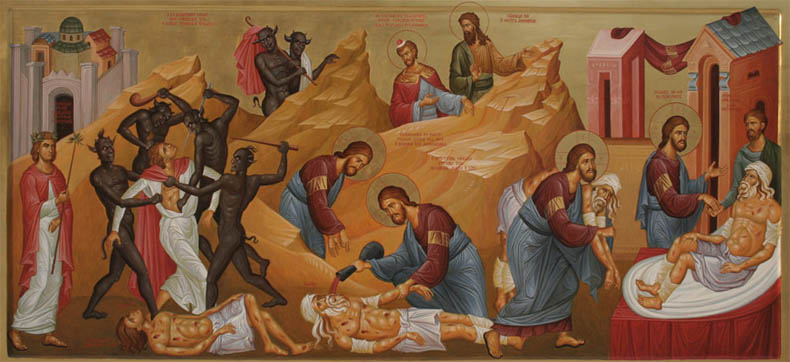
Christ the Good Samaritan (http://www.soldi.ee/images/samar1.jpg)
  
Through the prayers of our Holy Fathers, Lord Jesus Christ our God, have mercy on us and save us! Amen!