Homily of St. John Chrysostom on the Transfiguration of Christ (Matthew 17:28-36)
“
Verily, verily, I say unto you, There are some of them that stand here, which shall not taste of death, until they see the Son of Man coming in His kingdom.”
Thus, inasmuch as He had discoursed much of dangers and death, and of His own passion, and of the slaughter of the disciples, and had laid on them those severe injunctions; and these were in the present life and at hand, but the good things in hope and expectation:—for example, “
They save their life who lose it;” “
He is coming in the glory of His Father;” “
He renders His rewards: “—He willing to assure their very sight, and to show what kind of glory that is wherewith He is to come, so far as it was possible for them to learn it; even in their present life He shows and reveals this; that they should not grieve any more, either over their own death, or over that of their Lord, and especially Peter in His sorrow.
And see what He doth. Having discoursed of hell, and of the kingdom (for as well by saying, “
He that findeth his life shall lose it, and whosoever will lose it for my sake, shall find it; “ as by saying, “
He shall reward every man according to his works,” He had manifested both of these): having, I say, spoken of both, the kingdom indeed He shows in the vision, but hell not yet.
Why so? Because had they been another kind of people, of a grosser sort, this too would have been necessary; but since they are approved and considerate, He leads them on the gentler way. But not therefore only doth He make this disclosure, but because to Himself also it was far more suitable.
Not however that He passes over this subject either, but in some places He almost brings even before our eyes the very realities of hell; as when He introduces the picture of Lazarus, and mentions him that exacted the hundred pence, and him that was clad in the filthy garments, and others not a few.
2. “
And after six days He taketh with Him Peter and James and John.
Now another says, “
after eight,” not contradicting this writer, but most fully agreeing with him. For the one expressed both the very day on which He spake, and that on which He led them up; but the other, the days between them only.
But mark thou, I pray thee, the severe goodness of Matthew, not concealing those who were preferred to himself. This John also often doth, recording the peculiar praises of Peter with great sincerity. For the choir of these holy men was everywhere pure from envy and vainglory.
Having taken therefore the leaders, “
He bringeth them up into a high mountain apart, and was transfigured before them: and His face did shine as the sun, and His raiment was white as the light. And there appeared unto them Moses and Elias talking with Him.
Wherefore doth He take with Him these only? Because these were superior to the rest. And Peter indeed showed his superiority by exceedingly loving Him; but John by being exceedingly loved of Him; and James again by his answer which he answered with his brother, saying, “
We are able to drink the cup; nor yet by his answer only, but also by his works; both by the rest of them, and by fulfilling, what he said. For so earnest was he, and grievous to the Jews, that Herod himself supposed that he had bestowed herein a very great favor on the Jews, I mean in slaying him.
But wherefore doth He not lead them up straightway? To spare the other disciples any feeling of human weakness: for which cause He omits also the names of them that are to go up. And this, because the rest would have desired exceedingly to have followed, being to see a pattern of that glory; and would have been pained, as overlooked. For though it was somewhat in a corporeal way that He made the disclosure, yet nevertheless the thing had much in it to be desired.
Wherefore then doth He at all foretell it? That they might be readier to seize the high meaning, by His foretelling it; and being filled with the more vehement desire in that that round of days, might so be present with their mind quite awake and full of care.
3. But wherefore doth He also bring forward Moses and Elias? One might mention many reasons. And first of all this: because the multitudes said He was, some Elias, some Jeremias, some one of the old prophets, He brings the leaders of His choir, that they might see the difference even hereby between the servants and the Lord; and that Peter was rightly commended for confessing Him Son of God.
But besides that, one may mention another reason also: that because men were continually accusing Him of transgressing the law, and accounting Him to be a blasphemer, as appropriating to Himself a glory which belonged not to Him, even the Father’s, and were saying, “
This Man is not of God, because He keepeth not the Sabbath day;” and again, “
For a good work we stone Thee not, but for blasphemy, and because that Thou, being a man, makest Thyself God:” that both the charges might be shown to spring from envy, and He be proved not liable to either; and that neither is His conduct a transgression of the law, nor His calling Himself equal to the Father an appropriation of glory not His own; He brings forward them who had shone out in each of these respects: Moses, because he gave the law, and the Jews might infer that he would not have overlooked its being trampled on, as they supposed, nor have shown respect to the transgressor of it, and the enemy of its founder: Elias too for his part was jealous for the glory of God, and were any man an adversary of God, and calling himself God, making himself equal to the Father, while he was not what he said, and had no right to do so; he was not the person to stand by, and hearken unto him.
And one may mention another reason also, with those which have been spoken of. Of what kind then is it? To inform them that He hath power both of death and life, is ruler both above and beneath. For this cause He brings forward both him that had died, and him that never yet suffered this.
But the fifth motive, (for it is a fifth, besides those that have been mentioned), even the evangelist himself hath revealed. Now what was this? To show the glory of the cross, and to console Peter and the others in their dread of the passion, and to raise up their minds. Since having come, they by no means held their peace, but “spake,” it is said, “of the glory which He was to accomplish at Jerusalem; “ that is, of the passion, and the cross; for so they call it always.
And not thus only did He cheer them, but also by the excellency itself of the men, being such as He was especially requiring from themselves. I mean, that having said, “
If any man will come after me, let him take up his cross, and follow me;” them that had died ten thousand times for God’s decrees, and the people entrusted to them, these persons He sets before them. Because each of these, having lost his life, found it. For each of them both spake boldly unto tyrants, the one to the Egyptian, the other to Ahab; and in behalf of heartless and disobedient men; and by the very persons who were saved by them, they were brought into extreme danger; and each of them wishing to withdraw men from idolatry; and each being unlearned; for the one was of a “slow tongue,” and dull of speech, and the other for his part also somewhat of the rudest in his bearing: and of voluntary poverty both were very strict observers; for neither had Moses made any gain, nor had Elias aught more than his sheepskin; and this under the old law, and when they had not received so great a gift of miracles. For what if Moses clave a sea? yet Peter walked on the water, and was able to remove mountains, and used to work cures of all manner of bodily diseases, and to drive away savage demons, and by the shadow of his body to work those wonderful and great prodigies; and changed the whole world. And if Elias too raised a dead man, yet these raised ten thousand; and this before the spirit was as yet vouchsafed to them. He brings them forward accordingly for this cause also. For He would have them emulate their winning ways toward the people, and their presence of mind and inflexibility; and that they should be meek like Moses, and jealous for God like Elias, and full of tender care, as they were. For the one endured a famine of three years for the Jewish people; and the other said, “
If thou wilt forgive them their sin, forgive; else blot me too out of the book, which thou hast written.” Now of all this He was reminding them by the vision.
For He brought those in glory too, not that these should stay where they were, but that they might even surpass their limitary lines. For example, when they said, “
Should we command fire to come down from heaven,” and made mention of Elias as having done so, He saith, “
Ye know not what manner of spirit ye are of;” training them to forbearance by the superiority in their gift.
And let none suppose us to condemn Elias as imperfect; we say not this; for indeed he was exceedingly perfect, but in his own times, when the mind of men was in some degree childish, and they needed this kind of schooling. Since Moses too was in this respect perfect; nevertheless these have more required of them than he. For “
except your righteousness shall exceed the righteousness of the Scribes and Pharisees, ye shall in no ease enter into the kingdom of Heaven.” For not into Egypt did they enter, but into the whole world, worse disposed than the Egyptians; neither were they to speak with Pharaoh, but to fight hand to hand with the devil, the very prince of wickedness. Yea, and their appointed struggle was, both to bind him, and to spoil all his goods; and this they did cleaving not the sea, but an abyss of ungodliness, through the rod of Jesse,—an abyss having waves far more grievous. See at any rate how many things there were to put the men in fear; death, poverty, dishonor, their innumerable sufferings; and at these things they trembled more than the Jews of old at that sea. But nevertheless against all these things He persuaded them boldly to venture, and to pass as along dry ground with all security.
To train them therefore for all this, He brought forward those who shone forth under the old law.
4. What then saith the ardent Peter? “
It is good for us to be here.” For because he had heard that Christ was to go to Jerusalem and to suffer, being in fear still and trembling for Him, even after His reproof, he durst not indeed approach and say the same thing again, “
Be it far from thee; but from that fear obscurely intimates the same again in other words. That is, when he saw a mountain, and so great retirement and solitude, his thought was, “
He hath great security here, even from the place; and not only from the place, but also from His going away no more unto Jerusalem.” For he would have Him be there continually: wherefore also he speaks of “tabernacles.” For “
if this may be,” saith he, “
we shall not go up to Jerusalem; and if we go not up, He will not die, for there He said the scribes would set upon Him.”
But thus indeed he durst not speak; but desiring however to order things so, he said undoubtingly, “
It is good for us to be here,” where Moses also is present, and Elias; Elias who brought down fire on the mountain, and Moses who entered into the thick darkness, and talked with God; and no one will even know where we are.”
Seest thou the ardent lover of Christ? For look not now at this, that the manner of his exhortation was not well weighed, but see how ardent he was, how burning his affection to Christ. For in proof that not so much out of fear for himself he said these things, hear what he saith, when Christ was declaring beforehand His future death, and the assault upon Him: “
I will lay down my life for Thy sake. Though I should die with Thee, yet will I not deny Thee.
And see how even in the very midst of the actual dangers he counselled amiss for himself. We know that when so great a multitude encompassed them, so far from flying, he even drew the sword, and cut off the ear of the high priest’s servant. To such a degree did he disregard his own interest, and fear for his Master. Then because he had spoken as affirming a fact, he checks himself, and thinking, what if he should be again reproved, he saith, “
If Thou wilt, let us make here three tabernacles, one for Thee and one for Moses, and one for Elias.”
What sayest thou, O Peter? didst thou not a little while since distinguish Him from the servants? Art thou again numbering Him with the servants? Seest thou how exceedingly imperfect they were before the crucifixion? For although the Father had revealed it to him, yet he did not always retain the revelation, but was troubled by his alarm; not this only, which I have mentioned, but another also, arising from that sight. In fact, the other evangelists, to declare this, and to indicate that the confusion of his mind, with which he spake these things, arose from that alarm, said as follows; mark, “
He wist not what to say, for they were sore afraid;” but Luke after his saying, “
Let us make three tabernacles,” added, “
not knowing what he said.” Then to show that he was holden with great fear, both he and the rest, he saith, “
They were heavy with sleep, and when they were awake they saw His glory;” meaning by deep sleep here, the deep stupor engendered in them by that vision. For as eyes are darkened by an excessive splendor, so at that time also did they feel. For it was not, I suppose, night, but day; and the exceeding greatness of the light weighed down the infirmity of their eyes.
5. What then? He Himself speaks nothing, nor Moses, nor Elias, but He that is greater than all, and more worthy of belief, the Father, uttereth a voice out of the cloud.
Wherefore out of the cloud? Thus doth God ever appear. “
For a cloud and darkness are round about Him;” and, “
He sitteth on a light cloud;” and again, “
Who maketh clouds His chariot;” and, “
A cloud received Him out of their sight;” and, “
As the Son of Man coming in the clouds.”
In order then that they might believe that the voice proceeds from God, it comes from thence.
And the cloud was bright. For “
while he yet spake, behold, a bright cloud overshadowed them; and, behold, a voice out of the cloud, which said, This is My beloved Son, in whom I am well pleased; hear ye Him.”
For as, when He threatens, He shows a dark cloud;—as on Mount Sinai; for “
Moses,” it is said, “
entered into the cloud, and into the thick darkness; and as a vapor, so went up the smoke;” and the prophet said, when speaking of His threatening, “
Dark water in clouds of the air;” —so here, because it was His desire not to alarm, but to teach, it is a bright cloud.
And whereas Peter had said “
Let us make three tabernacles,” He showed a tabernacle not made with hands. Wherefore in that case it was smoke, and vapor of a furnace; but in this, light unspeakable and a voice.
Then, to signify that not merely concerning some one of the three was it spoken, but; concerning Christ only; when the voice was uttered, they were taken away. For by no means, had it been spoken merely concerning any one of them, would this man have remained alone, the two being severed from Him.
Why then did not the cloud likewise receive Christ alone, but all of them together? If it had received Christ alone, He would have been thought to have Himself uttered the voice. Wherefore also the evangelist, making sure this same point, saith, that the voice was from the cloud, that is, from God.
And what saith the voice? “
This is my beloved Son.” Now if He is beloved, fear not thou, O Peter. For thou oughtest indeed to know His power already, and to be fully assured touching His resurrection; but since; thou knowest not, at least from the voice of the Father take courage. For if God be mighty, as surely He is mighty, very evidently the Son is so likewise. Be not afraid then of those fearful things.
But if as yet thou receive it not, consider at least that other fact, that He is both a Son, and is beloved. For “
This,” it is said, “
is My beloved Son.” Now if He is beloved, fear not. For no one gives up one whom he loves. Be not thou therefore confounded; though thou lovest Him beyond measure, thou lovest Him not as much as He that begat Him.
“
In whom I am well pleased.” For not because He begat Him only, doth He love Him, but because He is also equal to Him in all respects, and of one mind with Him. So that the charm of love is twofold, or rather even threefold, because He is the Son, because He is beloved, because in Him He is well pleased.
But what means, “
In whom I am well pleased ?” As though He had said, "
In whom I am refreshed, in whom I take delight;” because He is in all respects perfectly equal with Himself, and there is but one will in Him and in the Father, and though He continue a Son, He is in all respects one with the Father.
“
Hear ye Him.” So that although He choose to be crucified, you are not to oppose Him.
6. “
And when they heard it, they fell on their face, and were sore afraid. And Jesus came and touched them, and said, Arise, and be not afraid. And when they lifted up their eyes, they saw no man, save Jesus only.”
How was it that, when they heard these words, they were dismayed? And yet before this also a like voice was uttered at Jordan, and a multitude was present, and no one felt anything of the kind; and afterwards again, when also they said, “
It thundered, …yet neither at that time did they experience anything like this. How then did they fall down in the mount? Because there was solitude, and height, and great quietness, and a transfiguration full of awe, and a pure light, and a cloud stretched out; all which things put them in great alarm. And the amazement came thick on every side, and they fell down both in fear at once and in adoration.
But that the fear abiding so long might not drive out their recollection, presently He puts an end to their alarm, and is seen Himself alone, and commands them to tell no man this, until He is risen from the dead.
For “
as they came down from the mount, He charged them to tell the vision to no man, until He were risen from the dead.” For the greater the things spoken of Him, the harder to be received by the generality at that time; and the offense also from the cross was the more increased thereby.
Therefore He bids them hold their peace; and not merely so, but He again reminds them of the passion, and all but tells them also the cause, for which indeed He requires them to keep silence. For He did not, you see, command them never to tell any man, but “
until He were risen from the dead.” And saying nothing of the painful part, He expresses the good only.
What then? Would they not afterwards be offended? By no means. For the point required was the time before the crucifixion. Since afterwards they both had the spirit vouchsafed them, and the voice that proceeded from the miracles pleading with them, and whatsoever they said was thenceforth easy to be received, the course of events proclaiming His might more clearly than a trumpet, and no offense of that sort interrupting what they were about.
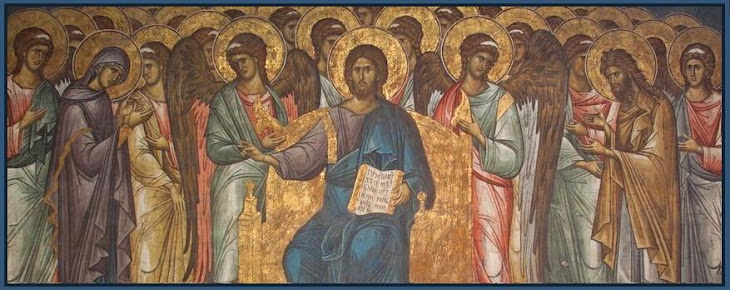
7. Nothing then is more blessed than the apostles, and especially the three, who even in the cloud were counted worthy to be under the same roof with the Lord. But if we will, we also shall behold Christ, not as they then on the mount, but in far greater brightness. For not thus shall He come hereafter. For whereas then, to spare His disciples, He discovered so much only of His brightness as they were able to bear; hereafter He shall come in the very glory of the Father, not with Moses and Elias only, but with the infinite host of the angels, with the archangels, with the cherubim, with those infinite tribes, not having a cloud over His head, but even heaven itself being folded up. For as it is with the judges; when they judge publicly, the attendants drawing back the curtains show them to all; even so then likewise all men shall see Him sitting, and all the human race shall stand by, and He will make answers to them by Himself; and to some He will say, “
Come, ye blessed of my Father; for I was an hungered, and ye gave me meat; “ to others, "
Well done, thou good and faithful servant, thou hast been faithful over a few things, I will set thee over many things. And again passing an opposite sentence, to some He will answer, “
Depart into the everlasting fire, that is prepared for the devil and his angels,” and to others, “
O thou wicked and slothful servants.” And some He will “
cut asunder,” and “
deliver to the tormentors;” but others He will command to “
be bound hand and foot, and cast into outer darkness? And after the axe the furnace will follow; and all out of the net, that is east away, will fall therein. “
Then shall the righteous shine forth as the sun;" or rather more than the sun. But so much is said, not because their light is to be so much and no more, but since we know no other star brighter than this, He chose by the known example to set forth the future brightness of the saints.
Since on the mount too, when He says, “
He did shine as the sun,” for the same cause did He so speak. For that the comparison did not come up to His light, the apostles showed by falling down. For had the brightness not been unalloyed, but comparable to the sun; they would not have fallen, but would easily have borne it.
The righteous therefore will shine as the sun, and more than the sun in that time; but the sinners shall suffer all extremities. Then will there be no need of records, proofs, witnesses. For He who judges is Himself all, both witness, and proof, and judge. For He knows all things exactly; “For all things are naked and opened unto His eyes.”
No man will there appear rich or poor, mighty or weak, wise or unwise, bond or free; but these masks will be dashed in pieces, and the inquiry will be into their works only. For if in our courts, when any one is tried for usurpation, or murder, whatever he may be, whether governor, or consul, or what you will, all these dignities fleet away, and he that is convicted suffers the utmost penalty; much more will it be so there.
8. Therefore that this may not be so, let us lay aside our filthy garments, let us put on the armor of light, and the glory of God will wrap us around. For what is even grievous in the injunctions? or what is there not easy? Hear, for instance, the prophet speaking, and then thou shalt know the easiness thereof. “
Neither though thou bow as a collar thy neck, and strew beneath thee sackcloth and ashes, not even so shalt thou call a fast acceptable; but loose every bond of iniquity, unloose the twisted knots of oppressive bargains.”
See a prophet’s wisdom, how stating first whatever was irksome, and removing it, he exhorts them to obtain salvation by the duties that are easy; signifying, that God needs not toils, but obedience.
Then implying that virtue is easy, but vice grievous and galling, he makes it out by the bare names; “
For,” saith he, “
vice is a bond,” and “
a twisted knot,” but virtue is a disengagement and release from all these.
“
Tear in sunder every unjust compact;” thus calling men’s bills about the interest due to them, and the sums they have lent.
“
Set at liberty them that are bruised;’ them that are afflicted. For such a being is the debtor; when he sees his creditor, his mind is broken, and he fears him more than a wild beast.
“
Bring in the poor that are cast out to thy house; if thou seest one naked, clothe him, and them that belong to thy seed thou shalt not overlook.”
Now in our late discourse which we made unto you when declaring the rewards, we showed the wealth arising from these acts; but now let us see if any of the injunctions be grievous, and transcending our nature. Nay, nothing of the kind shall we discover, but quite the contrary; that while these courses are very easy, those of vice are full of labor. For what is more vexatious than to be lending, and taking thought about usuries and bargains, and demanding sureties, and fearing and trembling about securities, about the principal, about the writings, about the interest, about the bondsmen ?
Nor such is the nature of worldly things; yea, nothing is so unsound and suspicious as that which is accounted security, and contrived for that purpose; but to show mercy is easy, and delivers from all anxiety.
Let us not then traffic in other men’s calamities, nor make a trade of our benevolence. And I know indeed that many hear these words with displeasure; but what is the profit of silence? For though I should hold my peace, and give no trouble by my words, I could not by this silence deliver you from your punishment; rather it has altogether the opposite result; the penalty is enhanced, and not to you only, but to me also, doth such a silence procure punishment. What then signify our gracious words, when in our works they help us not, but rather do harm? What is the good of delighting men in word, while we vex them in deed, bringing pleasure to the ears, and punishment to the soul? Wherefore I must needs make you sorry here, that we may not suffer punishment there.
9. For indeed a dreadful disease, beloved, dreadful and needing much attendance, hath fallen on the church. Those, namely, who are enjoined not even by honest labors to lay up treasures, but to open their houses to the needy, make a profit of other men’s poverty, devising a specious robbery, a plausible covetousness.
For tell me not of the laws that are without; since even the publican fulfills the law that is without, but nevertheless is punished: which will be the case with us also, unless we refrain from oppressing the poor, and from using their need and necessity as an occasion for shameless trafficking.
For to this intent thou hast wealth, to relieve poverty, not to make a gain of poverty; but thou with show of relief makest the calamity greater, and sellest benevolence for money. Sell it, I forbid thee not, but for a heavenly kingdom. Receive not a small price for so good a deed, thy monthly one in the hundred, but that immortal life. Why art thou beggarly, and poor, and mean, selling thy great things for a little, even for goods that perish. when it should be for an everlasting kingdom? Why dost thou leave God, and get human gains? Why dost thou pass by the wealthy one, and trouble him that hath not? and leaving the sure paymaster make thy bargain with the unthankful? The other longs to repay, but this even grudges in the act of repaying. This hardly repays a hundredth part, but the other “an hundredfold and eternal life.” This with insults and revilings, but the other with praises and auspicious words. This stirs up envy against thee, but the other even weaves for thee crowns. This hardly here, but the other both there and here.
Surely then is it not the utmost senselessness, not so much as to know how to gain? How many have lost their very principal for the interest’s sake? How many have fallen into perils for usurious gains. How many have involved both themselves and others in extreme poverty through their unspeakable covetousness !
For tell me not this, that he is pleased to receive, and is thankful for the loan. Why, this is a result of thy cruelty. Since Abraham too, contriving how his plan might take with the barbarians, did himself give up his wife to them; not however willingly, but through fear of Pharaoh. So also the poor man, because thou countest him not even worth so. much money, is actually compelled to be thankful for cruelty.
And it seems to me as though, shouldest thou deliver him from dangers, thou wouldest exact of him a payment for this deliverance. “Away,” saith he; “let it not be.” What sayest thou? Delivering him from the greater evil, thou art unwilling to exact money, and for the lesser dost thou display so much inhumanity?
Seest thou not how great a punishment is appointed for the deed? hearest thou not that even in the old law this is forbidden? But what is the plea of the many? “When I have received the interest, I give to the poor;” one tells me. Speak reverently, O man; God desires not such sacrifices. Deal not subtilly with the law. Better not give to a poor man, than give from that source; for the money that hath been collected by honest labors, thou often makest to become unlawful because of that wicked increase; as if one should compel a fair womb to give birth to scorpions.
And why do I speak of God’s law? Do not even ye call it “filth”? But if ye, the gainers, give your voice so, consider what suffrage God will pass upon you.
And if thou wilt ask the Gentile lawgivers too, thou wilt be told that even by them this thing is deemed a proof of the most utter shamelessness. Those, for example, who are in offices of honor, and belong to the great council, which they call the senate, may not legally disgrace themselves with such gains; there being a law among them which prohibits the same.
How then is it not a horrible thing, if thou ascribe not even so much honor to the polity of Heaven, as the legislators to the council of the Romans; but Heaven is to obtain less than earth, and thou art not ashamed even of the very folly of the thing? For what could be more foolish than this, unless one without! land, rain, or plough, were to insist upon sowing? Tares therefore, to be committed to the fire, do they reap, who have devised this evil husbandry.
Why, are there not many honest trades? in the fields, the flocks, the herds, the breeding of cattle, in handicrafts, in care of property? Why rave and be frantic, cultivating thorns for no good? What if the fruits of the earth are subject to mischance; hail, and blight, and excessive rain? yet not to such an extent as are money dealings. For in whatsoever cases of that sort occur, the damage of course concerns the produce, but the principal remains, I mean, the land. But herein many often have suffered shipwreck in their principal; and before the loss too they are in continual dejection. For never cloth the money-lender enjoy his possessions, nor find pleasure in them; but when the interest is brought, he rejoices not that he hath received gain, but is grieved that the interest hath not yet come up to the principal. And before this evil offspring is brought forth complete, he compels it also to bring forth, making the interest principal, and forcing it to bring forth its untimely and abortive brood of vipers. For of this nature are the gains of usury; more than those wild creatures do they devour and tear the souls of the wretched. This “is the bond of iniquity:” this “the twisted knot of oppressive bargains.”
Yea, “I give,” he seems to say, “not for thee to receive, but that thou mayest repay more.” And whereas God commands not even to receive what is given (for “give,” saith He, “to them from whom ye look not to receive”), thou requirest even more than is given, and what thou gavest not, this as a debt, thou constrainest the receiver to pay.
And thou indeed supposest thy substance to be increased hereby, but instead of substance thou art kindling the unquenchable fire.
That this therefore may not be, let us cut out the evil womb of usurious gains, let us deaden these lawless travailings, let us dry up this place of pernicious teeming, and let us pursue the true and great gains only. “
But what are these?” Hear Paul saying “
Godliness with contentment is great gain.”
Therefore in this wealth alone let us be rich, that we may both here enjoy security, and attain unto the good things to come, by the grace and love towards man of our Lord Jesus Christ, to whom be glory and might with the Father and the Holy Spirit, now and always, and world without end. Amen.
(Note: hosted by non-Orthodox source: http://thedivinelamp.stblogs.com/2010/02/27/st-john-chrysostom-on-the-transfiguration-feb-28-second-sunday-of-lent/)
Through the prayers of our Holy Fathers, Lord Jesus Christ our God, have mercy on us and save us! Amen!