Showing posts with label Asia Minor. Show all posts

Thursday, September 24, 2020

St. Amphilochios of Patmos on the Catastrophe of Asia Minor, the Turks and the Churches of the Apocalypse

The Vision of St John the Theologian of the Revelation on Patmos (source)
   
 Metropolitan Amphilothios (Tsouchos, formerly of New Zealand, and currently Bishop of Ganou and Chora of Eastern Thrace), a spiritual son of St. Amphilochios Makris, related in October 2014 some astonishing prophecies of St. Amphilochios, which we are seeing being fulfilled in our times:

"Do you know why the Greek Christians [were forced to leave] Asia Minor? God allowed them to leave, so that they might not be found there on that day when there will be the great evil."

A beautiful example of a iconographic depiction of Orthodox faithful being driven from their homes in Asia Minor (specifically here from the areas of Klazomenai, Ephesus, Meli and Smyrna, bringing the blessings of their Patron Saints and their treasures to mainland Greece and other lands) (Source)

He was greatly troubled when he faced the mountains of Asia Minor, and knew that the Seven Lampstands of [the Churches] of Revelation were put out: Ephesus, Smyrna, Pergamum, Thyateira, Sardis, Philadelphia and Laodicea, and the only Lampstand left lit was that of the Revelation (on Patmos).

He said: "May God make you worthy to take this LIGHT from the burning Lampstand of the Revelation (on Patmos), and to bring it to light the extiniquished Lampstands of the Evangelist John in Asia Minor."

"We have an outstanding debt first to those Crypto-Christians across, who are waiting until now for something from us, and secondly, to the Turkish people (who, as a whole, are about 50% from Greeks who became moslem). Within their veins runs Greek and Christian blood. The Monasteries of the Dodecanese should become missionaries to them.

The continuation of the above image, here showing the Refugees of Asia Minor coming to Athens, bringing their blessings and being greeted by the Saints in their new land, specifically Athens and St. Philothei, and building new churches (source)

"However, that great evil will occur, as St. Kosmas Aitolos prophesied, that a third of the Turks will fall in war, and a third of the Turks will go to "Kokkine Milia", and a third will become Christians...Therefore, then we must be ready nearby to help them more."

Another unpublished prophecy of the Saint to his spiritual children: "You should learn Turkish! Because you will be needed to catechize the Turks who will come to our faith!"

(source)

St. Amphilochios of Patmos (source)

Through the prayers of our Holy Fathers, Lord Jesus Christ our God, have mercy on us and save us! Amen!
Thursday, July 23, 2020

Homily II on St. Panteleimon by Metropolitan Avgoustinos Kantiotes

St. Panteleimon the Great Martyr and Unmercenary (source)
  
Homily II on St. Panteleimon by Metropolitan Avgoustinos Kantiotes: "A Lesson of Love"
"This I command you, to love one another." (John 15:17)
"The feast of a martyr is to imitate the martyr." [Quote of St. John Chrysostom]
The stars, my beloved, are not only contained in heaven, but our Church has its own, and the stars of the Church are the Saints (Martyrs, Confessors, Venerable Saints, Teachers and Fathers). The stars illumine heaven, but the noetic firmament of the Church is also illumined by the noetic stars, the Saints. They shine with their life, their virtues, their wonders. And like in heaven "star differs from star according to its radiance" (I Corinthians 15:41), thus among the Saints there are differences. One star of great prominence is today's Saint, the Great Martyr and Healer Panteleimon. Let's take courage to utter a few words, weaving a humble encomium to his memory.

St. Panteleimon was born in the era of terrible persecutions against Christianity, during the reign of Maximian (286-305AD), in a land whose name brings forth tears, in a land which gave birth to so many of the Saints and Martyrs: Asia Minor. Specifically, his homeland was Nicomedia of Bithinia. There was his church, but on a dreadful day in August 1922, the children of Hagar reduced it to rubble. Today in Nicomedia, the bells do not ring. I believe, however, that one day they will ring there again!

His parents were nobles, aristocrats. His father was Eustorgios, an idolater in the close court of the king. His mother, Euboule, was a Christian according to tradition, and implanted in the heart of the child the seed of the faith and of virtue. The Saint, however, had the misfortune of losing his mother. Only those who have lost their mothers can sense the loss which is left in a family by her absence.

However, the seed which his mother had sown within him was not lost. The child grew, became a man and was noted for his goodness. His rich father made provisions to send him to the best teachers, and even to the famous professor of medicine, Euphrosynos. He studied near him, excelled in his lessons and later finished as a great physician. He, however, was still an idolater, and did not believe in Christ.

One encounter, however, changed his life. While he was still young, he met a pious priest of Nicomedia, Ermolaos, who led him into the mystery of Christianity . "If you wish to become a physician," he told him, "you must know the first and greatest physician of souls and bodies, and this is our Lord Jesus Christ!" He related His life and miracles, and from then, the young man began to take care to believe.

The young physician wished to test if things said by Ermolaos were true. And one day, as he was traveling through the countryside, he saw a child who had died, and next to him was a serpent fleeing who had poisoned him. He knelt beside the body, and lifted up his eyes on high and said: "In the name of Jesus Christ, O child, arise, and you, O beast, depart." And immediately, the child came to life, and the serpent died. This event, along with others like it, strengthened within him faith in Christ. He told this to Ermolaos, and was baptized.

The healings which he continued to work were many and are written in his Synaxarion. Only one I will say, that he was serving as a physician in Nicomedia, which had at that time, before the founding of Constantinople, served as the first city of the nation. His fame had spread. He healed with medical drugs, but there where science lifted up its hands out of weakness, in those difficult situations, St. Panteleimon prayed and said: "In the name of Jesus Christ...", and the sick were healed wondrously. His successes however brought about the wrath of his fellow doctors. They condemned him to the king, and thus he was brought before him. Maximian tried to coerce him to become an idolater and to sacrifice to the idols, but he stood immovable. And thus began his martyrdom.
  
St. Panteleimon the Great Martyr and Unmercenary (source)
  
I will not relate his martyrdom in detail. The Saint's faith was great, and he was victorious through fire, and the sword, and iron nails, and ravenous beasts, and the wheel, and the sea, through everything. Many believed in Christ, not just through his wondrous healings, but through his manliness at the hour of his martyrdom. And aristocrats of the court and courtiers and patricians of the highest ranks, in addition to simple people came to believe in the Lord Jesus Christ. Because through all of the Saint's wonders, I discern that the greatest thing was his daily way of life: his love and his philanthropic offering, the sacrifice of himself in order to help his neighbor, his virtuous and chaste way of life, that which is sought of every Christian by the Lord.

In the end, according to the command of the emperor, the military guard led him two kilometers outside of Nicomedia, and there, before the sun had risen, around dawn, the lightning strike of the executioner's sword cut off the head of the Saint. And then, instead of blood, milk poured forth, according to the Synaxarion. And though his precious Relic was laid in the earth, it became a treasury and spring of wonders, while his holy soul flew to the heavenly mansions, to dwell among the Angels and Archangels, and from there, to intercede for everyone, and especially for his homeland of Nicomedia, that again she might see the glory of the faith and that the bells might ring there joyously through a national and religious resurrection.

As I said in the beginning, my beloved, "The feast of a martyr is to imitate the martyr", as described by the sacred Chrysostom. Are we celebrating a martyr? Then we should imitate him. Today, therefore, from the world of the bodiless spirits beyond, the voice of St. Panteleimon reaches us, and mystically speaks to the ears of our souls: "O Christians who are honoring me, become my imitators!"

The Saints are the most clear sign that Christianity is not a utopia, a theory, a philosophy, it is a reality, a harmonious life. They reveal that Christianity crosses the ages and rules in all stations. The Saints are the heroes of the faith and of virtue, the pinnacles of prototypes worthy of imitation.

Today, St. Panteleimon compels us, as the teacher of all, and especially those who are educated, rational, and who are scientists and physicians. There is a false idea that is cultivated by the children of darkness that science is not compatible with our faith. It is false, a satanic lie. Because we see today's Saint was an educated and wise scientist, and through this also believed in the Lord. And not only St. Panteleimon, but many other Saints of the Church. And not only Saints of the ancient eras, but many contemporary and great scientists of national fame (physicians, chemists, mathematicians, physicists, astronomers, and every specialty) believe in God and confess Christ. I know of scientists in Athens who believe, fast and pray, and--it may seem strange to you--arise at midnight to pray the prayer rope! I know of a surgeon in "Evangelismos" Hospital who never takes up the scalpel without kneeling to say: "Lord Jesus Christ, help me, the sinner." Science, not of dimwits, but of great minds, kneels before the Crucified One. In Germany, a surgeon wrote a book with the title: "Behind us stands God", in other words, behind our science is found Christ, the Physician of souls and bodies.

But the Saint is not just the teacher of learned scientists, but of all Christians. He teaches us a lesson which is most simple, but also the most difficult. It is the two words of the Nazarene, which we heard in today's Gospel: "This I command you, to love one another." (John 15:17) It is the lesson of love. And this is taught by St. Panteleimon, because he applied this himself [in his own life]. Whatever he had, he offered, and he became a servant of the people, and suggests to us that we become benefactors, philanthropists and merciful in our social circles. Because of this, I entreat you to be moved even more deeply to deeds of love and philanthropy. Do not wait for everything from the government, from others.

May God, through the intercessions of St. Panteleimon, protect our whole people, that we might with peace and love worship our Lord Jesus Christ unto the ages of ages. Amen.
(+) Bishop Avgoustinos
From a homily recorded in the old Church of St. Panteleimon in Florina on Saturday July 27th, 1968(source)
  
St. Panteleimon the Great Martyr and Unmercenary (source)
  
Through the prayers of our Holy Fathers, Lord Jesus Christ our God, have mercu on us and save us! Amen!

Thursday, October 31, 2019

Akathist to St. George Karslides

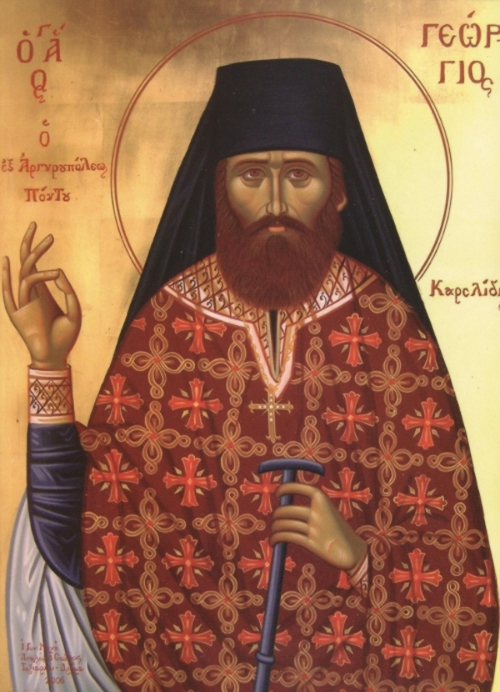
St. George Karslides (source)
  
Akathist to St. George Karslides the Confessor, our New Venerable Father of Drama and Pontos, Founder of the Monastery of the Ascension of Christ, Sipsa
written by Dr. Charalampos Bousias
  
Kontakion in the Plagal of the Fourth Tone
The indomitable sower of virtue, who sowed piety in the furrows of souls, and whom we hymn nobly with love, for in these latter days he founded the Monastery of the Ascension in Drama, as we cry out in fitting hymns: Rejoice, O blessed George.
  
Oikoi
An angel bearing flesh, you were shown to be, while your nous was made to dwell in the heavenly mansions, O George, (3), for you were shown to all to be a surpassing one and the type of blessed ascetics, therefore we bless you, crying out in reverence:
Rejoice, foundation of chastity,
Rejoice, radiance of goodness.
Rejoice, the rejoicing of pious people of Drama,
Rejoice, example of God-bearing ascetics.
Rejoice, the ever-verdant and glorious root of Pontos,
Rejoice, undying and most-radiant torch for the world.
Rejoice, founder of the Monastery of the divine Ascension,
Rejoice, great defender and protector of Drama.
Rejoice, lamp-lighter of the merciful life,
Rejoice, our star of brotherly love.
Rejoice, you who confessed the faith,
Rejoice, you who attracted the grace of God.
Rejoice, O blessed George.
  
You lived a divine life in these latter days, O offspring of Argyroupolis of Pontos, and ever-verdant protector and defender of the people of Drama, as you hastened to heaven, O George, unceasingly chanting: Alleluia.
  
Being the Elder of the honored Monastery of the Ascension in Drama, O George, you built it with your very own hands, and there you lived in chastity with faith, while your divine Relics are ever venerated there, as you hearken to those you cry out to you:
Rejoice, fragrance of new Monastic Saints,
Rejoice, ode of godly gifts.
Rejoice, newly-lit light of Pontos,
Rejoice, newly-founded foundation of grace.
Rejoice, newly-shown life of the age to come, equal to the Angels,
Rejoice, fragrant cinnamon of an honorable life.
Rejoice, for you sanctified your Monastery through your pains,
Rejoice, for you grant holiness richly to Drama.
Rejoice, defender of prayer and nepsis,
Rejoice, vessel of love of the Creator.
Rejoice, you who inspire the struggles of the Venerable,
Rejoice, instrument of many wonders.
Rejoice, O blessed George.
  
Drama was made chaste through your asceticism and your chaste way of life, O blessed George, and you unflinchingly protect it in a godly manner, and it is sanctified by the container of your wholly sacred Relics, O Venerable One, compelling us to ceaselessly chant: Alleluia.
  
Having fervor engraved within your heart, O George, through your divine forbearers, you were watered with the sacred and living streams of the Orthodox faith, and you chanted mindfully to the greatly-compassion Lord, as we cry out:
Rejoice, new boast of the faith,
Rejoice, divine house of grace.
Rejoice, director towards greater wisdom,
Rejoice, most-ready deliverer of the faithful.
Rejoice, telling that is spoken of by God-bearing ascetics,
Rejoice, all-wise reading of pious strugglers.
Rejoice, for you came from Pontos to Drama,
Rejoice, you who play the beautiful-sounding lyre of the Most-High.
Rejoice, dweller in the divine mansions,
Rejoice, foretype of divine wonders.
Rejoice, icon of the life equal to the Angels,
Rejoice, canon of love for the Creator.
Rejoice, O blessed George.
  
Having fiery faith and an icon of the All-Pure [Theotokos], O George, you were granted these joys from your Mother before her repose, and you hastened to Theodosiopoulos, ceaselessly chanting: Alleluia.

St. George Karslides (Source)
  

You came to Tbilisi of Georgia, O thrice-blessed George, at the inspiration of God, and hastened to the sacred Monastery, in which you fought the good fight, as a man equal to the Angels, therefore, we cry out to you these things:
Rejoice, beautiful depth of struggles,
Rejoice, precious stream of accomplishments.
Rejoice, handiwork of Him Who fashioned all things,
Rejoice, beautifully-sounding bird of the Most-High.
Rejoice, for you bore ascetical pains in your flesh,
Rejoice, for you showed to everyone the divine strength of your soul.
Rejoice, for you spat upon the mania of the demons,
Rejoice, for you gladdened the choir of the Angels.
Rejoice, steadfast support of the faith,
Rejoice, radiant knowledge of grace.
Rejoice, sacred defender of piety,
Rejoice, scepter against the madness of the enemy.
Rejoice, O blessed George.
  
Desiring, O divine George, to join the choir of the Angels, they rejoiced together with you at your sacred tonsure, and at that hour, the bells of the Monastery began to ring in a strange and wondrous manner, and the mouths of your sacred fellow monastics were opened to chant: Alleluia.
  
You feet were bound by the shackles of the faithless who had fallen into terror and wretchedness, that you might receive the incorruptible crown of the Confessor, O Father George, and from all of those who honor you, you receive these reverent cries:
Rejoice, the stream of piety,
Rejoice, cradle of the wisdom of God.
Rejoice, for you endured prison like the bodiless,
Rejoice, for you showed wondrous strength as a godly one.
Rejoice, for with humility, you drove away the terrible stench of lawlessness,
Rejoice, for you truly bore pains in your flesh.
Rejoice, for you endured difficulties without complaining,
Rejoice, for you cast out the desires of the flesh.
Rejoice, for you join the choirs of the Angels,
Rejoice, for you are the unsleeping defender of the faithful.
Rejoice, krater of health for the pious,
Rejoice, star of spiritual goodness.
Rejoice, O blessed George.
  
You endured evil things in your flesh from the faithless, while three times you were shot at unjustly, but by the divine will, you remained unharmed, as you chanted hymns to God Who saved you, O George, as you cried out to Him in reverence: Alleluia.
  
You shown forth with the lightning rays of the priesthood, O George, and were made to behold things to come as present, and things far off as close, through your pure heart, O Saint. Therefore, with hymns we praise you, crying out in faith:
Rejoice, vessel of the graces of God,
Rejoice, container of many wonders.
Rejoice, flower of virtue and prudence,
Rejoice, type of expectation for heavenly glory.
Rejoice, for the Creator magnified you greatly,
Rejoice, for the God-man radiantly glorified you.
Rejoice, for you healed the afflictions of the faithful,
Rejoice, for you showed forth the grace of prophecy.
Rejoice, you who were filled with the love of God,
Rejoice, war against the delusion of the enemy.
Rejoice, ray of the wisdom of the Most-high,
Rejoice, all radiant bolt of piety.
Rejoice, O blessed George.
  
Praising your way of life at all times, I hymn your coming to the village of Sipsa, in which you founded a monastery in honor of the glorious Ascension of the Lord, while I cry out with melodious hymns: Alleluia.
  
St. George Karslides (source)
  
The streams of your sacred sweat you mixed with clay to build your monastery of the Divine Ascension, and in it, you struggled ascetically with pains and chastity wondrously, O George, and you open the lips of the pious to cry out to you:
Rejoice, example of asceticism,
Rejoice, myrrh vessel of knowledge.
Rejoice, refuge for the pious people of Drama,
Rejoice, protecting wall for the faithful in dangers.
Rejoice, lily of holiness gladdening the faithful,
Rejoice, pillar of goodness and canon of meekness.
Rejoice, all-bright lamp of struggles day and night,
Rejoice, precious boast of ever-flowing tears.
Rejoice, spigot of prayer and understanding,
Rejoice, unassailable wall of silence and nepsis.
Rejoice, the light and protection of the faithful,
Rejoice, horn of godly providence.
Rejoice, O blessed George.
  
You work strange wonders like a many-headed waterfall, through the container of your Sacred Relics, O Wonderworker George, and we who venerate them reverently offer up a hymn to Christ Who made you wondrous, to Whom we cry out in compunction: Alleluia.
  
You came to Drama living a life of joy, and together were numbered with the choirs of the Venerable Saints and rejoiced together with the radiant Angels, as your newly-lit flame reached the City Above [of Heaven] through your faith, and we cry out in joy:
Rejoice, harp of the wisdom of God,
Rejoice, lyre of dispassion.
Rejoice, the fire-bearing teacher of the people of Drama,
Rejoice, you who followed the Unmercenary Physicians.
Rejoice, you who were seen as a boast for pious Priests,
Rejoice, very-precious adornment of God-bearing Ascetics.
Rejoice, for your eye beholds your refugees in dangers,
Rejoice, for your mouth offers teachings of salvation.
Rejoice, vessel showing the way to Heaven,
Rejoice, frost that crushes the enemy.
Rejoice, you who show us the way to God,
Rejoice, sanctuary against noetic foes.
Rejoice, O blessed George.
  
O Father, you were shown to be a vessel of the Holy Spirit in these latter days, and a myrrh vessel of incomparable streams of wonders, and you became the defender and unsleeping protector of the people of Drama, O George, your refugees, who in unflinching faith, cry out to you: Alleluia.
  
The all-sacred container of your Holy Relics truly pours forth streams of healings for the choirs of the faithful who embrace them with reverence, O Venerable One, and they cry out to you, in this Monastery built by you:
Rejoice, spring of wonders,
Rejoice, deliverer of those in afflictions.
Rejoice, you who received the gift of healings,
Rejoice, you who partake of the drink of incorruption.
Rejoice, very-precious vessel of the graces of God,
Rejoice, you who crushed the innumerable ranks of enemies.
Rejoice, you who alleviate the pains of the faithful,
Rejoice, you who strengthen the pious in sickness.
Rejoice, our ready help,
Rejoice, sacred promontory of the Venerable.
Rejoice, speedy physician of those ill,
Rejoice, protection from the terrible demons.
Rejoice, O blessed George.
  
Through your providence, and speedy help, O George, and the protection that you bring, Drama is made holy through you, and with your help, O Father, and having you as a protector, O Venerable One, she honors you and chants in faith to him who strengthens her: Alleluia.
  
St. George Karslides (source)
  
You traveled the way of pain and difficulties of the Venerable Fathers, O George, and became a radiant icon and pious prototype of asceticism. Therefore, we bless you, crying out to you in compunction:
Rejoice, type of the monastic way,
Rejoice, lamp of wonders.
Rejoice, you who were nourished by noetic prayer,
Rejoice, emblem of sacred compunction.
Rejoice, greatly-voiced trumpet of the way of God,
Rejoice, melodious instrument of an all-spotless life.
Rejoice, divine founder of the Monastery of the Ascension,
Rejoice, deliverer of the choir bearing the name of Christ.
Rejoice, for your light shines to the ends of the earth,
Rejoice, rain that waters the whole world.
Rejoice, spring of heavenly gifts,
Rejoice, tree pouring forth the fragrance of wonders.
Rejoice, O blessed George.
  
We chant melodious hymns and divine praises to you, O thrice-blessed George, as the unflinching protector of the people of Drama, and they in faith embrace the container of your Relics, O Venerable One, crying out to Him Who glorified you: Alleluia.
  
Your precious struggles have shown throughout all creation, O George, with the multitude of your bright and wondrous and sacred ascetical deeds, shining anew with the faith of Christ, and driving away the clouds of darkness for those who cry out to you:
Rejoice, light of confession,
Rejoice, lamp of dispassion.
Rejoice, you who enlightened the city of Drama,
Rejoice, you who gladdened the group of your refugees.
Rejoice, for you shown forth from famed Pontos,
Rejoice, for you drove away the wiles of the enemy.
Rejoice, ever-verdant shoot of dispassion,
Rejoice, wall of piety founded by God.
Rejoice, song of the love of Christ,
Rejoice, ray of nepsis golden with light.
Rejoice, protector of the virgins of your Monastery,
Rejoice, you who cease the evils of the demons.
Rejoice, O blessed George.
  
The sacred Hierarch of Drama removed your Relics from your grave, that richly poured forth grace, granting unassailable joy to the faithful who now venerate them in faith, O George, crying out to Christ: Alleluia.
  
We chant of the wonders that you worked, O George, and we hymn you as a soul-nourishing worker of virtue, and an all-radiant and bright star of the faith of Christ, that illumines the ends of creation, as we cry out:
Rejoice, [bearer of the] Uncreated Light,
Rejoice, horn of goodness.
Rejoice, defender of the Bishop of Drama,
Rejoice, protector of the choir bearing the name of Christ,
Rejoice, unsleeping protector your pious Nuns,
Rejoice, most-sacred rod delivering the faithful.
Rejoice, joyous son of Macedonia,
Rejoice, newly-founded pillar of the Church.
Rejoice, offspring of Argyroupolis,
Rejoice, light of fasting and nepsis.
Rejoice, equal in zeal of the divine Angels,
Rejoice, equal in way of the former Venerable Saints.
Rejoice, O blessed George.
  
O Father beloved by God, Who richly sowed fruit within your soul, O George, (3) and founder of the Monastery of the Ascension, stand beside us as a defender, and intercede that we might obtain virtue, we who praise you, and in unflinching faith cry out to you: Alleluia.

And again the Kontakion of the Saint.
  
(source)

St. George Karslides (source)
  
Through the prayers of our Holy Fathers, Lord Jesus Christ our God, have mercy on us and save us! Amen!

Thursday, August 4, 2011

The Holy Seven Youths of Ephesus

The Holy Seven Youths and Martyrs of Ephesus - Commemorated on August 4 and October 22 (http://www.korners.com.ua/russian/painters/912)


"The Seven Youths of Ephesus: Maximilian, Iamblicus, Martinian, John, Dionysius, Exacustodianus (Constantine) and Antoninus, lived in the third century. St Maximilian was the son of the Ephesus city administrator, and the other six youths were sons of illustrious citizens of Ephesus. The youths were friends from childhood, and all were in military service together.

When the emperor Decius (249-251) arrived in Ephesus, he commanded all the citizens to offer sacrifice to the pagan gods. Torture and death awaited anyone who disobeyed. The seven youths were denounced by informants, and were summoned to reply to the charges. Appearing before the emperor, the young men confessed their faith in Christ.

Their military belts and insignia were quickly taken from them. Decius permitted them to go free, however, hoping that they would change their minds while he was off on a military campaign. The youths fled from the city and hid in a cave on Mount Ochlon, where they passed their time in prayer, preparing for martyrdom.

The youngest of them, St Iamblicus, dressed as a beggar and went into the city to buy bread. On one of his excursions into the city, he heard that the emperor had returned and was looking for them. St Maximilian urged his companions to come out of the cave and present themselves for trial.

Learning where the young men were hidden, the emperor ordered that the entrance of the cave be sealed with stones so that the saints would perish from hunger and thirst. Two of the dignitaries at the blocked entrance to the cave were secret Christians. Desiring to preserve the memory of the saints, they placed in the cave a sealed container containing two metal plaques. On them were inscribed the names of the seven youths and the details of their suffering and death.

The Lord placed the youths into a miraculous sleep lasting almost two centuries. In the meantime, the persecutions against Christians had ceased. During the reign of the holy emperor Theodosius the Younger (408-450) there were heretics who denied that there would be a general resurrection of the dead at the Second Coming of our Lord Jesus Christ. Some of them said, "How can there be a resurrection of the dead when there will be neither soul nor body, since they are disintegrated?" Others affirmed, "The souls alone will have a restoration, since it would be impossible for bodies to arise and live after a thousand years, when even their dust would not remain." Therefore, the Lord revealed the mystery of the Resurrection of the Dead and of the future life through His seven saints.

The owner of the land on which Mount Ochlon was situated, discovered the stone construction, and his workers opened up the entrance to the cave. The Lord had kept the youths alive, and they awoke from their sleep, unaware that almost two hundred years had passed. Their bodies and clothing were completely undecayed.

Preparing to accept torture, the youths once again asked St Iamblicus to buy bread for them in the city. Going toward the city, the youth was astonished to see a cross on the gates. Hearing the name of Jesus Christ freely spoken, he began to doubt that he was approaching his own city.

When he paid for the bread, Iamblicus gave the merchant coins with the image of the emperor Decius on it. He was detained, as someone who might be concealing a horde of old money. They took St Iamblicus to the city administrator, who also happened to be the Bishop of Ephesus. Hearing the bewildering answers of the young man, the bishop perceived that God was revealing some sort of mystery through him, and went with other people to the cave.

At the entrance to the cave the bishop found the sealed container and opened it. He read upon the metal plaques the names of the seven youths and the details of the sealing of the cave on the orders of the emperor Decius. Going into the cave and seeing the saints alive, everyone rejoiced and perceived that the Lord, by waking them from their long sleep, was demonstrating to the Church the mystery of the Resurrection of the Dead.

Soon the emperor himself arrived in Ephesus and spoke with the young men in the cave. Then the holy youths, in sight of everyone, lay their heads upon the ground and fell asleep again, this time until the General Resurrection.

The emperor wanted to place each of the youths into a jeweled coffin, but they appeared to him in a dream and said that their bodies were to be left upon the ground in the cave. In the twelfth century the Russian pilgrim Igumen Daniel saw the holy relics of the seven youths in the cave.

There is a second commemoration of the seven youths on October 22. According to one tradition, which entered into the Russian PROLOGUE (of Saints' Lives), the youths fell asleep for the second time on this day. The Greek MENAION of 1870 says that they first fell asleep on August 4, and woke up on October 22.

There is a prayer of the Seven Sleepers of Ephesus in the GREAT BOOK OF NEEDS (Trebnik) for those who are ill and cannot sleep. The Seven Sleepers are also mentioned in the service for the Church New Year, September 1."
(http://ocafs.oca.org/FeastSaintsViewer.asp?SID=4&ID=1&FSID=102195)


HYMN OF PRAISE: THE SEVEN HOLY YOUTHS OF EPHESUS
by St. Nikolai Velimirovich
When the last rays of the sun turned the west bloody red,
Seven Youths, to God prayed,
That, on the morrow again find themselves alive and healthy,
Before Emperor Decius, brought forth to torture.
And lay down to sleep a long dream, a deep dream,
Time walked by a wide step.
One morning, from the east, the sun dawned
And the Seven from their deep sleep awakened.
And Jamblichus the youngest, to Ephesus hurried
To see, to hear, about everything he inquired,
Does Decius, even them, seek to slaughter,
And bread to buy for the Seven of them.
But behold, what kind of miracle: this is not the gate!
And even the town is totally different!
Everywhere, beautiful churches, domes, crosses,
Jamblichus asks himself: are those not dreams?
Nowhere a familiar face, nowhere kinsmen,
There are no persecutions; there are no martyrs.
"Tell me brethren, the name of this town,
And tell me the name of the emperor, who now reigns?"
Thus Jamblichus inquires. The people, at him, look,
And about him, everyone judges differently.
"This town is Ephesus, now and before,
In Christ, reigns Emperor Theodosius."
This Antipater [The Consul] heard and [Martin] the graying bishop,
The entire town was perplexed,
Everyone, to the cave hurries.
And saw the miracle, glorified God,
And the resurrected servants of Christ the Resurrected One.


Prayer from the Great Euchologion "For One Who Is Ill And Cannot Sleep"

Priest: Let us pray to the Lord.

People: Lord, have mercy.
Priest: O God, Great, Praised, Incomprehensible and Ineffable, Who didst fashion man with Thy hands, taking dust from the earth, and Who didst honor him with Thine Image, O Jesus Christ, Most-desired Name, together with Thy Father Who is without beginning, and Thy Most-Holy, Good, and Lifegiving Spirit: Do Thou manifest unto Thy servant, N., and visit him (her) in soul and body, being entreated by our most-glorious Sovereign Lady, the Theotokos and Ever-Virgin Mary; by the holy Bodiless Powers of Heaven; by the honorable and glorious Prophet, Forerunner and Baptist John; by the holy, glorious and all-praised Apostles; by the holy, glorious and right-victorious Martyrs; by our Fathers among the Saints and ecumenical Teachers: Basil the Great, Gregory the Theologian, and John Chrysostom; by Athanasius and Cyril, Nicholas of Myra in Lycia, Cyril and Methodius, Teachers of the Slavs, Spyridon the Wonderworker, and all the holy Hierarchs; by the holy Apostle, Protomartyr and Archdeacon Stephen; by the holy, glorious Greatmartyrs: George the Trophy-bearer, Demetrius the Myrrgusher, Theodore Stratelates, and all the holy Martyrs; by our Venerable and Godbearing Fathers: Anthony, Euthymius, Savvas the Sanctified, Theodosius (Founder of the Common Life), Onouphrius, Arsenius, Athanasius the Athonite, and all the Venerable Ones; by the holy Unmercenary Physicians: Cosmas and Damian, Cyrus and John, Panteleimon and Hermalaeus, Samson and Diomedes, Thalelaeus and Tryphon, and all the rest; by Saint(s), N. (of the Day); and by all Thy Saints; and grant unto him (her) a peaceful sleep, the sleep of bodily health and salvation, and life and strength of soul and body, as once Thou didst visit Abimelech, Thy favorite, in the house of Agrippa, and gavest him the consolation of sleep, that he not see the Fall of Jerusalem, and having nourished him with sleep, didst raise him up again in the twinkling of an eye, to the glory of Thy goodness; and as Thou didst make manifest Thy holy glorious Seven Youths, confessors and witnesses of Thine Appearance in the days of the Emperor Decius and the Apostate, having sustained them in the cave for 372 years[1], as infants kept warm in their own mother's womb, none having endured corruption, to the praise and glory of Thy love for mankind, and for a testimony and confession of our regeneration and the resurrection of all. Do Thou Thyself, therefore, O Lover of Mankind and King, be present now also with the infusion of Thy Holy Spirit, and visit Thy servant, N., and grant unto him (her) health, strength and power, by Thy grace, for with Thee every action is good, and every gift is perfect. For Thou art the Physician of our souls and bodies, and unto Thee do we send up glory, thanksgiving and worship, together with Thy Father Who is without beginning, and Thy Most-Holy, Good, and Lifegiving Spirit, now and ever, and unto the ages of ages. Amen.
1. It was actually about 184 years.
From The Great Book of Needs (vol. III), St. Tikhon's Seminary Press, 2002, pp. 4-5.
(http://www.johnsanidopoulos.com/2011/08/prayer-of-holy-seven-youths-for-one-who.html)


Holy Seven Youths of Ephesus, Troparion, in Tone IV
In their sufferings, O Lord,/ Thy martyrs received imperishable crowns from Thee, our God;/ for, possessed of Thy might,/ they set at nought the tormentors and crushed the feeble audacity of the demons.// Through their supplications save Thou our souls.

Or this troparion, in the same tone
Great is the wonder of faith!/ The seven holy youths abode in the cave/ as in a royal chamber,/ and died without falling into corruption;/ and after much time they arose as from sleep,/ as an assurance of the resurrection of all men.// Through their supplications, O Christ God, have mercy on us.

Kontakion, in Tone IV, "Having been lifted up..."
Spurning the corrupt things of this world and accepting gifts of incorruption,/ though they died yet did they remain untouched by corruption./ Wherefore, they arose after many years,/ burying all the unbelief of the wicked.// O ye faithful, praising them today in laudation, let us hymn Christ!

Through the prayers of our Holy Fathers, Lord Jesus Christ our God, have mercy on us and save us! Amen!

Wednesday, May 6, 2009

St. John the Theologian, and the Miraculous Manna of his tomb

Christ is risen! Truly He is risen!

Icon of St. John being buried and his tomb in Ephesus found empty, from Decani Monastery (taken from: http://www.srpskoblago.org/Archives/Decani/exhibits/Menologion/September/CX4K3481_l.html)
  
"The feast day of this great apostle and evangelist is celebrated on September 26. This day (May 8) commemorates the miracle which appeared at his grave. When John was over one hundred years old, he took seven of his disciples, went outside the town of Ephesus and ordered them to dig a grave in the form of a cross. After that, the elder went down into this grave and was buried. Later on, when the faithful opened John's grave, they did not find his body. On May 8 of every year, dust [also called "manna"] is raised from his grave from which the sick are healed of various diseases." (taken from the Prologue of St. Nikolai from: http://www.westsrbdio.org/prolog/prolog.cgi)
  
An artistic reconstruction of how St. John's Basilica (built by the Holy Emperor Justinian) over his Tomb in Ephesus might have looked (taken from: http://www.sacred-destinations.com/turkey/images/ephesus/basilica-st-john/model-cc-slimnastics.jpg)
  
The following is from an interesting study of the various pilgrimage sites throughout Asia Minor:
"The most elaborate description of the miracle [of the Manna from St. John the Theologian's Tomb] dates from the very end of the Byzantine period, written by the Catalan Muntaner who arrived in a mercenary force in 1304:
On Saint Stephen’s day, every year, at the hour of vespers, there comes out of the tomb (which is four-cornered and stands at the foot of the altar and has a beautiful marble slab on the top, full twelve palms long and five broad) and in the middle of the slab there are nine very small holes, and out of these holes, as vespers are being sung on St. Stephen’s day (on which day the vespers are of St. John), manna like sand comes out of each hole and rises a full palm high from the slab, as a jet of water rises up. And this manna issues out . . . and it lasts all night and then all Saint John’s day until sunset. There is so much of this manna, by the time the sun has set and it has ceased to issue out, that, altogether, there are of it full three cuarteras of Barcelona [about 120 quarts]. And this manna is marvelously good for many things; for instance he who drinks it when he feels fever coming on will never have fever again. Also, if a lady is in travail and cannot bring forth, if she drinks it with water or with wine, she will be delivered at once. And again, if there is a storm at sea and some of the manna is thrown in the sea three times in the name of the holy Trinity and Our Lady Saint Mary and the Blessed Saint John the Evangelist, at once the storm ceases. And again, he who suffers from gall stones, and drinks it in the said names, recovers at once. And some of this manna is given to all pilgrims who come there; but it only appears once a year."
(taken from "Pilgrimage in Medieval Asia Minor" by Foss, taken from: http://www.doaks.org/publications/doaks_online_publications/DOP56/DP56ch09.pdf)


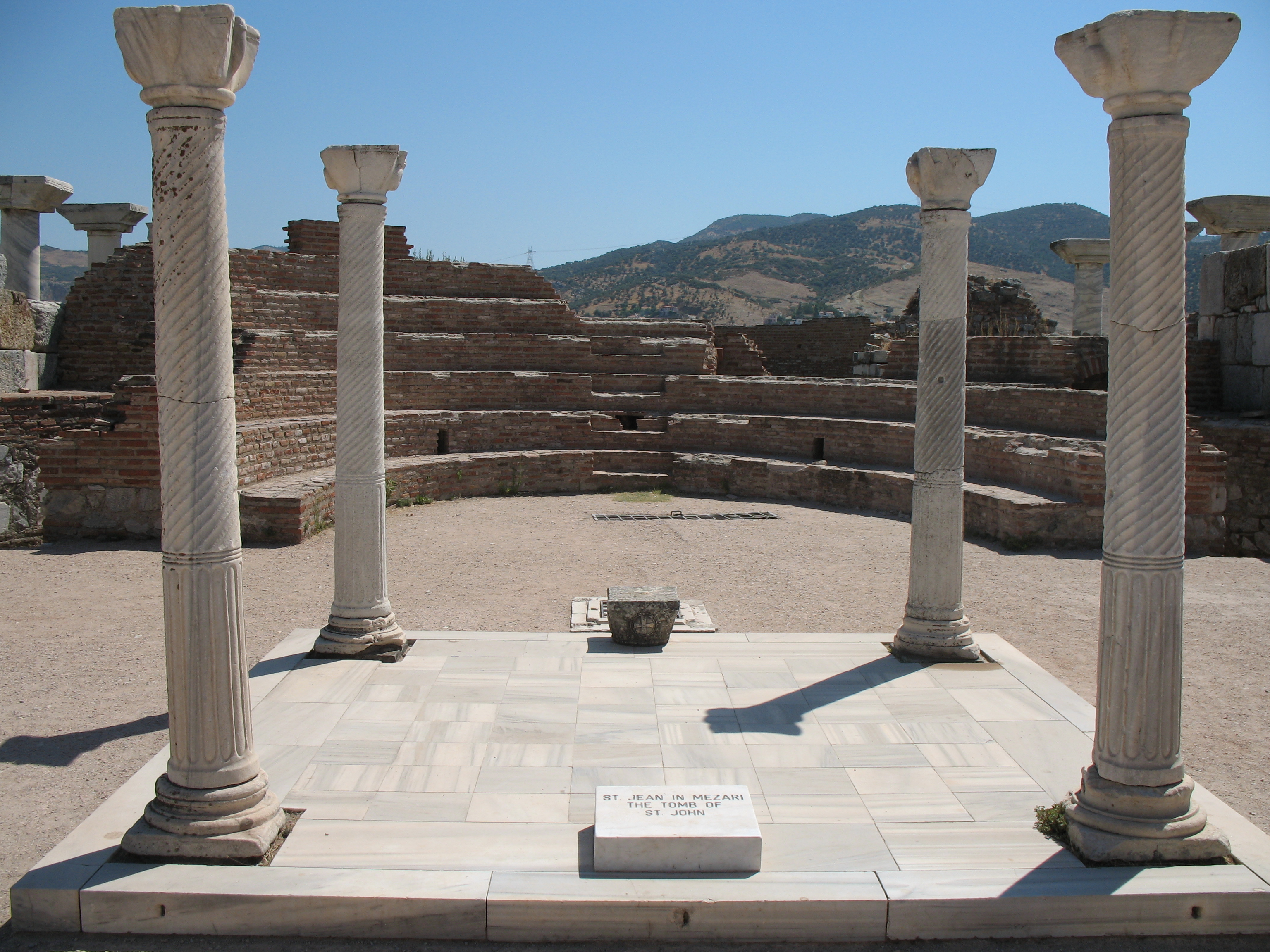
Picture of the Tomb of St. John the Theologian as it appears today, in the ruins of his Basilica in Ephesus (taken from: http://upload.wikimedia.org/wikipedia/commons/7/74/Tomb_of_Saint_John_the_Apostle.jpg)
  
And a Russian Abbot Daniel from the early 12th century, who recorded his pilgrimage to the Holy Land, also visited St. John's Tomb, and mentions the various other holy places near St. John's Basilica:
"It is 60 versts from the isle of Chios to Ephesus; and at this latter place is seen the tomb of St. John the Evangelist. On the anniversary of his death, holy dust rises from this tomb, which believers gather as a remedy against every kind of disease; the garment which John wore is also here. Quite near is the cave in which rest the bodies of the Seven Sleepers who slept for 360 years, having fallen asleep in the reign of the Emperor Decius, and awakened in the time of the Emperor Theodosius. In this same cavern are the (remains of the) three hundred holy fathers and of St. Alexander; the tomb of Mary Magdalene is also here, as well as her head; and the holy Apostle Timothy, the disciple of St. Paul, reposes in his ancient coffin. In the old church the picture of the Holy Virgin is preserved; it was with this that the holy (fathers) refuted the heretic Nestorius. Here, too, one sees the Bath of Dioscorides, where St. John the Evangelist laboured with Prochorus in the house of Romana. We saw, also, the harbour, named the 'Marble Port,' where St. John the Evangelist was cast up by the sea." (taken from: http://chass.colostate-pueblo.edu/history/seminar/daniel/daniel2.htm)
  
Note that the Synaxarion also mentions that the tomb of St. Hermione (September 4th), and the relics of Sts. Audaktos and his daughter St. Kallisthenis (October 4th), and those of other martyrs and bishops, Sts. Aristonos, Tyrannou, Aristoboulos and Paul the Desert-dweller were all found near St. John's Tomb (taken from: http://www.snhell.gr/references/synaxaristis/search.asp). Thus, Ephesus was considered truly a sacred place, but most of all because of the presence St. John the Theologian, the one who reclined on Christ's bosom, and His Beloved Disciple. May he intercede for all of us and help us!


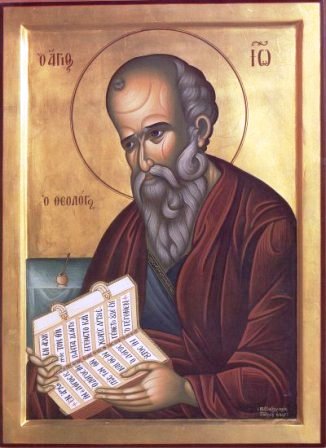
Icon of St. John the Theologian, the Beloved Disciple of Christ (taken from: http://www.photosled.com/data/1985/0508_Ioannis_Theologos.jpg)
  
Apolytikion of St. John the Theologian in the Second Tone
Beloved Apostle of Christ our God, hasten to deliver a people without defense. He who permitted you to recline upon His bosom, accepts you on bended knee before Him. Beseech Him, O Theologian, to dispel the persistent cloud of nations, asking for us peace and great mercy.
  
Kontakion in the Second Tone
Who can recount your greatness, O virgin, for miracles flow and healing springs forth from you. You intercede for our souls, as the Theologian and friend of Christ. (hymns taken from: http://goarch.org/chapel/saints_view?contentid=44)
  
Christ is Risen from the dead, by death, trampling down upon death, and to those in the tombs, bestowing life!
Truly the Lord is risen!

Friday, October 31, 2008

The Life of St. George Karslides the Righteous of Drama (+1959)

Picture of St. George Karslides the Righteous of Drama (1901-1959) - Commemorated on November 4th (icon taken from http://www.rel.gr/photo/displayimage.php?album=7&pos=22; Note: the following five icons from the life of St. George are taken from the ornate, beautiful copy, I believe, of the official Patriarchical acknowledgment of his Sainthood posted on the Metropolis of Drama website: http://www.imdramas.gr/view_image.php?image_id=ierov_001.jpg)

Below are excerpts and summaries from the life of St. George given in an excellent book: Precious Vessels of the Holy Spirit: The Lives and Counsels of Contemporary Elders of Greece, by Herman A. Middleton. Published by Protecting Veil Press 2003.

St. George Karslides was born in Argyroupolis, Pontos in 1901. He was orphaned very young, so it was his pious grandmother, who raised the young Athanasios (St. George's baptismal name) to have a "holy fear of God and a fervent love for the Church's divine services." The region of Pontos in Asia Minor has historically been a great seat of Orthodoxy, and more recently was also the site of such spiritually important monasteries of Panagia Soumela, Peristereota and St. John Vazelonos. At the age of five Athanasios began tending his family's flocks, all while bearing the harsh treatment of his older brother, who made life difficult for him and for his younger sister Anna. They bore this with love, perseverance and holiness. In fact, when Anna died at a young age, light emanated from her grave. Three years later when her remains were exhumed, her bones had the same yellow hue as the Saints of God. "Thus, Athanasios's early days were permeated both with the piety and holiness of lives dedicated to God, as well as with the pain of the corruption and instability of this life. This very realistic understanding of life was to prove to be a firm foundation for Athanasios's future spiritual development." (Middleton)

Because of the extremely difficult situations he was facing, at the age of seven Athanasios decided to run away, and was sheltered for awhile by some crypto-Christians. St. George the Great-martyr was a great protector of Athanasios, and he appeared to him, told him to mount his horse, and helped him to travel to Tiflis, Georgia where a pious priest took care of him. The priest was impressed by his spirituality and maturity, and clothed him in a cassock from age nine. In 1919 Athanasios was tonsured a monk with the name Symeon, and during his tonsure the bells of the monastery began to run by themselves. Fr. Symeon still faced many difficulties, however, as his monastery was soon closed by the communists, and the monks were humiliated, imprisoned, and threatened with execution.

The following is a beautiful story of St. George's time in this prison:

"The imprisoned monks and clergy asked permission at Pascha to go to church. Having been denied this, they fervently prayed for continued strength in the struggle. As they chanted, "Christ is risen," the prison shook and the doors opened of their own accord. The inhabitants of that area hastened to see what was happening and beheld three holy figures who, chanting "Lord have mercy" and holding a cross, were processing in a circle above the prison. The vision lasted until dawn, when the captives were prepared for execution. They were tied together and led to the edge of a cliff. The firing squad took aim and fired. Three bullets hit Symeon, but only grazed him, and did little harm. He was dragged off the cliff, however, by the weight of the others. Miraculously, he fell without being killed and this escaped death." (Middleton)

Once released from prison, he was ordained by Metropolitan John Tsiaparaski of Grouzia Scheta in 1925, and was given the new name George. He was recognized by many as being a God-bearing elder. Despite his difficult situations, he was constant in his ascetical struggles, eating mostly wild greens, sleeping little, and pursuing voluntary poverty (for example, refusing a new cassock to replace his old one which was falling apart). His service of the sacraments was filled with his love, care and attention.

St. George Karslides (source)
   
"During the preparation of the elements [in the Proskomedi, preparation for the Divine Liturgy], God would inform him of the spiritual state of those he commemorated, both the living and the dead. With great pastoral discernment he would pass the information on to his parishoners, either to encourage them to pray more fervently for the souls of the deceased or to bring sinners to repentance. Before bringing the Holy Communion out to the fathful, he would ask that those who wanted to commune come to the left-hand door of the iconostasis where he would read the prayer of absolution over them and anoint them with oil...[St. George] would sometimes be seen levitating during the Divine Liturgy. When he celebrated he would often be visited by the Saints, who would serve him." (Middleton)

In 1929, most likely because of his failing health (not quite thirty years old and semi-paralyzed), St. George moved to Greece, and settled in the town of Sipsa near Drama in northern Greece. He gradually recovered with the help of the local inhabitants, who became aware of his holiness and sought his help. In 1936 the Elder went on a pilgrimage to the Holy Lands, where he met his uncle (who was a monk) who urged him to return to serve in the world, where there was a great need for spiritual guidance. Later, the Elder was given a plot of land by the Greek government, and in the year 1939, a monastery he founded and dedicated to the Ascension of Christ was consecrated.

Many of the accounts of the counsels and miracles of St. George come from this later period of his life as the shepherd of the community of Drama. He forsaw both World War II and the Greek Civil War. During the civil war, three different groups of fighters went to slaughter the inhabitants of Sipsa, and they each felt intense remorse and apprehension and repented beforehand without harming the villagers. The Elder had forseen this danger, and instructed the inhabitants to have a procession around the village with the icon of Panagia. Thus the village was saved from certain destruction.

There are many other stories of St. George's discernment and spiritual gifts: "On another occasion a woman visited him and before she even managed to greet him he told her, "Your hands are on fire. They are burning, but we don't see the fire. What work do you do?" She told him that she was a midwife. "How many children have you killed?" he then asked. She denied having kiled any. "Shall I tell you? Five." He went on to tell her in which villages and of which mothers the children were whom she had aborted. Speechless, the lady wept and through active repentance was reconciled to God." (Middleton)

"One day a lady brought some quinces to the Elder. A pregnant woman stopped her along the way and asked for some, but she refused. When she arrived at the monastery and gave them to the Elder, he told her, "On the way the gate of Paradise opened and you closed it." (Middleton)

In early 1959 St. George forsaw his upcoming death. As the day approached, he gave instructions to his spiritual children on his departure. "On the eve of his repose he asked to be helped to go into the monastery church. There he venerated the icons and partook of the Holy Mysteries one last time. A few hours after midnight on November 4th, 1959, St. George reposed in the Lord.

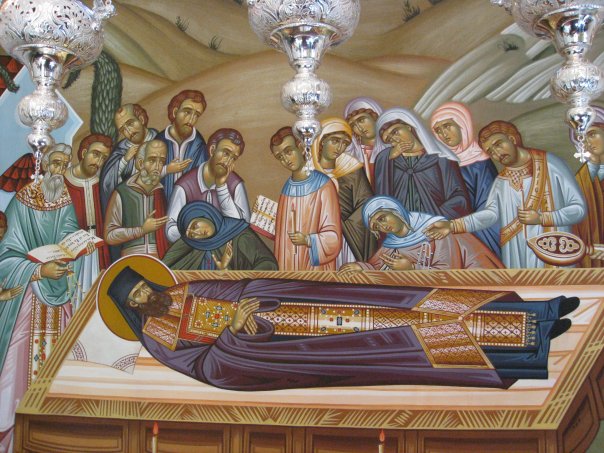
Icon depicting the repose of St. George Karslides the Righteous of Drama (+1959) (taken from: http://commons.orthodoxwiki.org/images/8/8f/GKarslidis02.jpg)

Today a monastic community of nuns continue the spiritual legacy of St. George at the Monastery of the Ascension of Christ in Sipsa, Drama, in northern Greece. St. George has continued to work many miracles after his repose in the Lord. In 2008 St. George was officially acknowledged to be a Saint by the Ecumenical Patriarchate.

Once again, many thanks to the author of the following book for translating the truly inspiring life of the newly-revealed St. George: Precious Vessels of the Holy Spirit: The Lives and Counsels of Contemporary Elders of Greece, by Herman A. Middleton. Published by Protecting Veil Press 2003. For a full biography and many stories and miracles from St. George, see: The Blessed Elder George Karslides (1901-1959), translated from the Greek text of Monk Moses the Athonite, by Orthodox Kypseli Publications. Also see: http://orthodoxwiki.org/George_(Karslidis)_of_Drama.

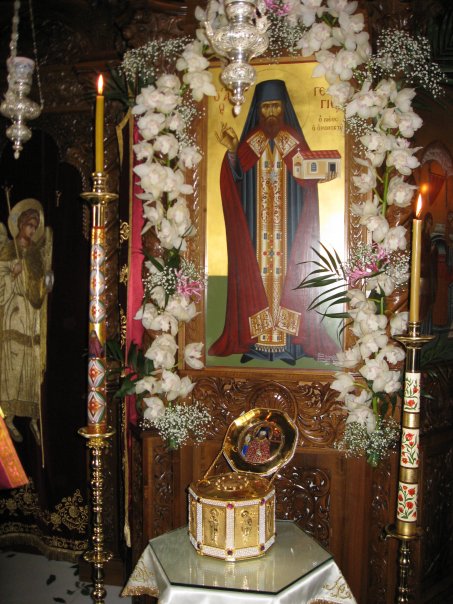
Picture of the Icon of St. George and his holy Skull at the Monastery of the Ascension of Christ, Sipsa (taken from: http://commons.orthodoxwiki.org/images/6/60/GKarslidis05.jpg)


For a beautiful video of the Saint's Monastery of the Ascension of Christ in Sipsa, see: http://apantaortodoxias.blogspot.com/2011/11/blog-post_8910.html.
  
Icon of St. George the Righteous of Drama (taken from: http://vatopaidi.files.wordpress.com/2009/11/agios-georgios-karslides-01.jpg)


Apolytikion of St. George Karslides the Righteous of Drama (amateur translation from the above Greek)
O river of Divine Grace, O God-bearing George, and vessel of miracles of all kinds, we praise him crying out, Ascension, Holy Monastery's Founder, and Drama's protector and shelterer, do not despise those who entreat you, and magnify you, O Righteous Father. Glory to Christ Who glorified you. Glory to Him who sanctified you, Glory to Him who showed forth this new ascetic fruitful.

Apolytikion (for a Monastic) in the Plagal of the Fourth Tone
The image of God, was faithfully preserved in you, O Father. For you took up the Cross and followed Christ. By Your actions you taught us to look beyond the flesh for it passes, rather to be concerned about the soul which is immortal. Wherefore, O Holy George, your soul rejoices with the angels.
(altered from: http://goarch.org/chapel/saints_view?contentid=225&type=saints)
 
St. George Karslides (source)
   
Holy Father George, intercede for us!
Through the prayers of our Holy Fathers, Lord Jesus Christ our God, have mercy on us and save us! Amen!