Showing posts with label Paradise. Show all posts

Sunday, May 2, 2021

Quote from Elder Ephraim of Arizona on Holy Pascha

Christ is risen! Truly He is risen!
The Resurrection of Christ (source)

March 24th, 1980. Holy Pascha.

Today is the Resurrection of Christ.

"Come, receive the light, from the never-setting light..."

O, never-setting, perfect light that never sets, surpassingly bright and surpassingly white, O how you magnetize my nous, my soul, my heart! I desire you endlessly, with love and eros unending. When will I be made worthy of the gift of the compassion of my Most-Holy God the Father, to partake of You unto the ages of ages!

My unworthiness troubles me, that I am not worthy of such a place among the saved, but I am worthy of hell and of eternal punishment.

The Resurrection, the eternal Pascha, attracts me terribly. It draws me above the state of things. Above heaven. Above to the sure desire, which I greatly desire to find. But, when will this occur?

O Pascha, together with the Angels, with the Saints, dressed in white, who so greatly desire me and attract me! New songs and unspeakable words are chanted and praised to God, with an awesome, but also unspeakable peace and serenity.

O Pascha, without end, and transformation of the unspeakable joy and Festival! My Father and my God, preserve me from every evil that I myself might be made worthy, I the refuse, one day to be found at that Pascha which cannot be described in human words, nor expressed and spoken of.

Rejoice and exalt, you to as well, O my Lady Theotokos, at the arising of Your Son and God. In the divine beauty of your Son and God, remember me, the wretched one, that I might be found together with you in the eternal Pascha!

...It is the day of Resurrection, let us brilliantly shine forth, O people, Pascha, the Lord's Pascha.

I greet you this year, my Pascha.

(source)

Elder Ephraim at Pascha at St. Anthony's Monastery, Arizona (source)

Christ is risen from the dead, by death, trampling down upon death, and to those in the tombs, He has granted life!

Truly He is risen!

Tuesday, December 1, 2020

St. Porphyrios: God will say to me, "What are you doing here?"


Video with a recording of St. Porphyrios speaking, with English subtitles (source)
   
Through the prayers of our Holy Fathers, Lord Jesus Christ our God, have mercy on us and save us! Amen!

Tuesday, September 8, 2020

"I am praying to God to place you in Paradise."

An Orthodox Monk at Prayer (source)
  
They asked an Abbess:
"What are you doing here, locked up in the Monastery for so many years?"

She replied: "I am praying to God to place you in Paradise."
(source)
  
Through the prayers of our Holy Fathers, Lord Jesus Christ our God, have mercy on us and save us! Amen!

Tuesday, July 28, 2020

A Study on the Apolytikion of St. Paraskevi


St. Paraskevi the Great Martyr (source)
 
Note: The short but powerful Apolytikion (troparion) of St. Paraskevi, is often times not fully or clearly translated from the original Greek, and is even less often explained regarding its deep meaning and how the Saint illustrates Christ. This is an excerpt from a very lengthy study on the Saint's hymn, including many pertinent scriptural references. May the Saint's love and diligence for the Lord help us to prepare ourselves, and may the Lord make us worthy of His Kingdom, through her prayers.
  
Excerpt from a Study on the Apolytikion of St. Paraskevi
By Archimandrite Theophilos Lemonzi, PhD
Together with the holy icons, it is undeniable that the most beautiful hymns of the Church serve as teaching on the spiritual life, as the faithful person receives the knowledge of the wondrous deeds of the Saints, and is moved to imitate them. While the holy icons spiritually nourish the sight of the faithful, the hymns spiritually nourish the hearing of the faithful.

A special place in the heart and the pious lips of the Orthodox Christians is the Apolytikion of St. Paraskevi, which is as follows:
"Τὴν σπουδήν σου τῇ κλήσει κατάλληλον, ἐργασαμένη φερώνυμε, τὴ ὁ μώνυμόν σου πίστιν εἰς κατοικίαν κεκλήρωσαι, Παρασκευὴ ἀθληφόρε· ὅθεν προχέειςἰ άματα, καὶ πρεσβεύεις ὑπὲρ τῶν ψυχῶ ἡμῶν."
"Working with a diligence proper to your calling, corresponding to your name, you inherited your faith of the same name as a dwelling-place, O Champion Paraskevi, therefore you pour forth healings, and you intercede on behalf of our souls."
 
The author of this perfectly-worked hymn is unknown, however, we can surmise that he was learned and had a deep knowledge of the Holy Scriptures and of Theology. From our pastoral experience we believe that very many have discussed the great teaching that this brings, and the deepest meaning of this Apolytikion, and have tried to translate it into modern Greek...
  
In the first part: "Working with a diligence proper to your calling, corresponding to your name" the main issue is the address «φερώνυμε» ("corresponding to your name", "name-bearer" or "namesake"). This is one who receives his name from someone, and the author is likely using the deepest meaning of the name "Paraskevi" which the Saint bears. The name that we are given at Holy Baptism has a deepest spiritual significance, and we are called to express throughout our life as a Christian that which our name means in reality. The author, with this word, tries to give the reason for which the Saint not only was named "Paraskevi", but also lived this name out in deed, because with her holy life was given meaning corresponding to her name: she correspondingly prepared herself with dedication for Martyrdom, and for the Kingdom of Heaven.
  
The word "Paraskevi" comes from the word "παρασκευάζω", meaning I prepare, but also I make myself something in order to obtain an identity, and it further means preparation, production, and ascesis. The sixth day of the week "Paraskevi" ("Friday") received its name from the Jews, for during that day they prepared for Sabbath rest with whatever they would need for that day, e.g. the food that they would eat. In the same way, St. Paraskevi, through the working of the commandments and asceticism of virtue, she prepared, in other words, she made herself worthy, preparing herself beforehand for her Martyrdom, and for her entrance into eternal life.

The phrase "Working with a diligence proper to your calling, corresponding to your name" furthermore expresses the whole Christian life of the Saint. The phrase "your calling" refers to the call from God towards the Saint for salvation, but also for every person. The meaning of divine call plays a central role in holy history. God called Abraham (Genesis 12:1-2), Moses in the desert of Sinai (Exodus 3:2), and the Holy Prophets. The Holy Apostles (Matthew 4:18-25) and the Apostle Paul (Acts 9:1-19) were called by Jesus to follow and to preach the Gospel. God calls all men "with a holy calling, not in virtue of our works but in virtue of his own purpose and the grace which he gave us in Christ Jesus ages ago," (II Timothy 1:9) through His Grace (Galatians 1:15). What distinguishes this is the freedom of man, and if he will respond to this call, for, as St. John of the Ladder says, even God directs Himself towards all men, because He does not remove their free will, He becomes life and salvation for those alone who desire Him. Because of this, the faithful become partakers in their heavenly calling (Hebrews 3:1), and are called "called and chosen" (Romans 1:6, Revelations 17:14). The significance of this calling is one's participation in eternal life (I Timothy 6:12), however, the faithful must show their love of struggle: ["For to this you have been called, because Christ also suffered for you, leaving you an example, so that you should follow in his steps."] (I Peter 2:21)

With the phrase: "Working with a diligence" is expressed this response to the calling of God towards the Saint for salvation. On Holy Friday, Jesus "worked salvation in the midst of the earth" (Psalm 73:12), through His life-giving death, and St. Paraskevi "worked with diligence", in other words, worked with dedication, zeal and willingness to respond to the divine calling for salvation (see the phrase of St. Paul:  "For see what earnestness this godly grief has produced in you, what eagerness to clear yourselves" (II Corinthians 7:11)) being obedient to the commandment of St. Paul "work out your own salvation with fear and trembling" (Philippians 2:12).

The participation through "working", describes the working of the commandments of the Gospels, and the asceticism of virtue, as a struggle and agony of freedom. The Christian, as a worker of virtue, ought to work with goodness and to turn away from evil: "lead a life worthy of the calling to which you have been called, with all lowliness and meekness, with patience, forbearing one another in love." (Ephesians 4:1-2) As the Saints, who "worked righteousness", and also "received promises" (Hebrews 11:33), thus, the faithful should "work goodness" (Romans 2:10), because God will give to each "according to his works" (Romans 2:6).

The word «σπουδή» comes from the verb "σπουδάζω", which means I hasten, I am going, I am paying attention to details, willingly in order to accomplish something, I am dedicated to something with a unique interest, zeal and care. The faithful should work with care towards their salvation: "be zealous to be found by him without spot or blemish, and at peace" (II Peter 3:14), according to the Apostle Peter, and as the Apostle Paul commands St. Timothy: "Do your best to present yourself to God as one approved, a workman who has no need to be ashamed" (II Timothy 2:15).

St. Paraskevi was detail-oriented regarding the words of the Gospel, and she showed special care, willingness and zeal to be diligent to the Holy Scriptures, such that she was shown a missionary of Christ, and embodied non-possessiveness, giving away all her goods to the poor, studying the ascetical life "and through purity, making her soul beautiful", working ceaselessly for the Gospel and life according to God, confessing her faith in Christ and hastening towards Martyrdom.

The diligence and care of the Saint is further adorned through all of her working of the commandments and through her virtue, her struggles of asceticism and martyrdom, and her uncompromising love, to the point that she healed her persecutor, Antoninus. And all of these occurred with a special desire to be obedient to the word of the Apostle Paul "Never flag in zeal, be aglow with the Spirit, serve the Lord." (Romans 12:11), and because of this, she was continuously witnessing to Christ, even after the first tortures that she suffered. She did not shy away, she was afraid, but continued "receiving the good witness".

The author, therefore, using this word "diligence", wishes to bring to the mind of the faithful the response of the Saint to the call of God towards salvation, her love of struggle, her willingness and care for asceticism in her Christian life, and her bearing witness. The spiritual life, even though it does not come from man, requires the consent of man to bear fruit. This presupposes an unending struggle against the passions, and simultaneously a working towards the keeping of the virtues of the Gospel, as noted by blessed Fr. Michael Karadamakes. The phrase, therefore "Working with a diligence proper to your calling", has the same content as the suggestion of the Apostle Peter to the faithful: "therefore, brethren, be the more zealous to confirm your call and election, for if you do this you will never fall; so there will be richly provided for you an entrance into the eternal kingdom of our Lord and Savior Jesus Christ." (II Peter 1:10-11) and reveals the consent of the Saint to the divine calling towards asceticism and the keeping of the commandments. And all of these she worked with a corresponding and illustrative manner, with humility and love, for the asceticism of virtues, when they do not occur according to the commands of the Gospel, they are not pleasing to God: "An athlete is not crowned unless he competes according to the rules." (II Timothy 2:5) Similar to the Pharisee of the Parable (Luke 18:1-14), who worked to keep the commandments of God, but his inspiration was to please men, and because of this, he was not justified...

In the second part: "you inherited your faith of the same name as a dwelling-place, O Champion Paraskevi", a most important point is point is the word "inherited", which serves as the immediate continuation of the beginning phrase "working with a diligence proper to your calling, corresponding to your name", and reveals that which the Saint received as a gift and inheritance from God due to the diligence and willingness that she showed. The word «κληροῦμαι» means to receive something through lot, and the hymnographer says that the Saint received through her lot, as a lawful inheritor, this faith of the same name as a dwelling-place.

St. Paraskevi with scenes from her life and martyrdom (source)
   
But what does this phrase mean: "your faith of the same name"?

That which she herself possesses is called synonymous, because it shares the same name with something. Synonymous unites two words which have the same meaning. In this specific case, the word «ὁμώνυμον» has the final meaning of the word and means that the two words «πίστις» and «παρασκευή» ("faith" and "preparation") have the same meaning. But why does the hymnographer use this meaning to unite these two words? The reason is most deep and theological. As we mentioned above, the name of the Saint means preparation for martyrdom and for the Kingdom of Heaven, through her working of the commandments of God, her asceticism and love of struggle. As a consequence, the Christian faith is not possible as a theoretical religious ideology, but, as was remarked by Blessed Elder Joseph of Vatopedi, if we keep the commandments, this is a confession. As long as sin is a denial of God, then love of struggle and the taking up of one's Cross is a practical outcome of one's Christian identity. Through Holy Scripture, the meaning of faith plays an essential role.

The faith of holy people goes together with works: the Apostles, having believed in Christ, at the same time: "immediately left their nets and followed Him" (Mark 1:18), and Abraham believed "By faith Abraham obeyed when he was called to go out to a place which he was to receive as an inheritance; and he went out, not knowing where he was to go" (Hebrews 11:8), he left his homeland according to the directive of God and "you see that faith was active along with his works, and faith was completed by works" (James 2:22). Therefore, Blessed Elder Joseph of Vatopedi teaches us that: "our Lord convinces us that it is not enough, and it does not benefit us to know only abstractly that God exists. ['Not every one who says to me, ‘Lord, Lord,’ shall enter the kingdom of heaven, but he who does the will of my Father who is in heaven. (Matthew 7:21)] ["He who has my commandments and keeps them, he it is who loves me.” (John 14:21)]. He who "has", in other words, he who cared to learn the meanings and the goal of my commandments, and who afterwards "keeps" them, in other words, uses them. And He notes the meaning of the commandments "and he who loves me will be loved by my Father, and I will love him and manifest myself to him." (John 14:21) and He confirms again: " He who does not love me does not keep my words."" (John 14:24)

Blessed Fr. John Romanides remarks that, according to Orthodox Theology, man cannot, like Protestant heresies, become a perfect and saved Christian by himself, through some rational decisions regarding the faith and compliance with some general idea about love. He requires ascesis, trial and struggle against the schemes of the devil. This is what St. Paraskevi did. She was not only faithful in words, but expressed this through her asceticism of virtue "faith worked through love" (Galacians 5:6), being obedient to the command of the Apostle Peter "supplement your faith with virtue, and virtue with knowledge" (II Peter 1:5)...

Therefore, the phrase "your faith of the same name" shows that faith means struggle and ascesis for virtue, and serves as a practical confession, for "faith without works is dead" (James 2:26). It means that I prepare myself, through the keeping of the commandments, to receive the Grace of God and to enter the Kingdom of God. The Christian faith does not have a notion of stasis, in other words, that I simply accept an ideology, for "What does it profit, my brethren, if a man says he has faith but has not works? Can his faith save him?" (James 2:14) but it has a dynamic meaning, to confess my faith in Christ with my deeds according to St. Paul's exhortation to Timothy: "Fight the good fight of the faith; take hold of the eternal life to which you were called when you made the good confession in the presence of many witnesses." (I Timothy 6:12) In essence, the phrase "your faith of the same name" summarizes the whole meaning of the "life in Christ".

The hymnographer says that the Saint received from God through lot, "inherited", to have it as a dwelling place sharing the same name with this faith. The word "κλήρος" has to do with the casting of lots (see Acts 1:26), but also the meaning of the lawful part which one receives as an inheritance. The Apostle Paul offers thanksgiving "to the Father, who has qualified us to share in the inheritance of the saints in light." (Colossians 1:12) and the sacred Chrysostom, interpreting this says that the Apostle Paul wishes to teach that sanctification and theosis is not the outcome of human virtue, but serves as a gift of God....

The author, therefore, wishes to show the great gift of the Grace of God to the Saint due to her holy life, and that this gift is given, for she obtained adoption, she became a child of God, and as a result, inherited from Him, according to the word of the Apostle Paul "and if children, then heirs, heirs of God and fellow heirs with Christ, provided we suffer with him in order that we may also be glorified with him." (Romans 8:17) God the Word became man "that we might receive adoption as sons" (Galatians 4:5). The presupposition, however, is for us to "suffer together with Him", as St. Paul says, in other words, ascesis and love of struggle, the diligence for which the Saint showed, and therefore having kept this, "But to all who received him, who believed in his name, he gave power to become children of God" (John 1:12)

The Saint faithfully kept this presupposition, to "suffer together" through asceticism of the virtues and martyrdom, and through this manner she allowed herself to receive the grace of adoption, and because of this, to become a genuine inheritor of His Kingdom.

The content of this lot, of the inheritance which the Saint received was given to her as a dwelling-place sharing the name of the faith. This phrase is difficult to explain, and for us to understand this, we need to understand what we mean by "place" (II Corinthians 5:1-5), as St. Paul compares the biological and mortal status of man with a "tent", in which dwells sin and the passions. We the faithful dwell in this house as well ["Here indeed we groan, and long to put on our heavenly dwelling"] as we experience the consequences of corruption from the passions, and we long to come to dwell in "a building from God, a house not made with hands, eternal in the heavens...For while we are still in this tent, we sigh with anxiety; not that we would be unclothed, but that we would be further clothed, so that what is mortal may be swallowed up by life. He who has prepared us for this very thing is God, who has given us the Spirit as a guarantee..."

St. John Chrysostom, interpreting this, says that this place specifically is not a dwelling made by hands in which we are called to dwell, it is not some stable of the body, but sanctification and incorruption which the faithful receive through Divine Grace...

The person who finds himself under the slavery of the passions comes to dwell in this "earthly tent", in other words, in corruption and sin. He is called to respond to the call from God to repent with a disposition of self-denial, to deny the devil and his words and to walk the path of asceticism, that he might become a recipient of Divine Grace. Blessed Elder Joseph of Vatopedi teaches that, as long as we keep the commandments, we confess our faith in God, and turn our freedom towards God, then Divine Grace is moved, which destroys the old man and builds within us the new, dispassionate one. Divine Grace gives such strength that the Holy Martyrs could endure all the inhumane tortures from their persecutors.

This new reality, the new man, the life in Christ, is the tent not made by human hands, which the faithful hope to be adorned with, and which was received by St. Paraskevi as a gift from God. the hymnographer wishes to show that the Saint, by holding steadfast to her faith, "for we walk by faith, not by sight." (II Corinthians 5:7), endured the struggles of asceticism, and through the keeping of the commandments, of obedience and self-denial, she became a recipient of Divine Grace, receiving "grace sent from above", which works salvation within us...
(source)
 
St. Paraskevi the Great Martyr (source)
 
Through the prayers of our Holy Fathers, Lord Jesus Christ our God, have mercy on us and save us! Amen!

Wednesday, June 17, 2020

Elder Aimilianos on Life as a Spider's Web

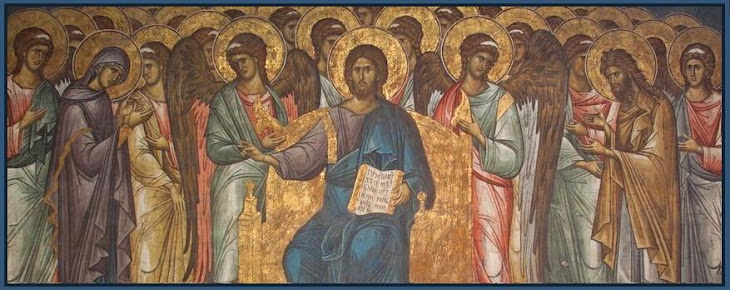
Jesus Christ Deisis with the Theotokos and the Precious Forerunner (source)
  
"When all our days are past, and passed in your wrath, our years will be seen like a spider. Day and night [the spider] works. She rises in the morning, and cleans her corner. She works until the night, and again, the next morning, she is in her same corner. Her web was destroyed. In the morning, she must weave it again. Days and nights of agony, and she sweats and suffers, without, ultimately, her work being completed.

"Whatever I might do, no matter how good it is, is like the work of a spider.

"A work has essential meaning, and is not like a spider's web, but is eternal, only when it is a search for You, when we turn to You, when it occurs for You, when it brings me, not to a desert place, not into a foreign land, not to this temporary earth, but to the true Chanaan, where You are, in Heaven.

"Thus, O Lord, was my life. I should have come to work for You. But I separated myself from You. For me, You no longer did exist, You Who exist from the ages and unto the ages. I thought, would my life be like this? A spider's corner, which would be gone tomorrow. Was I born for this, therefore?

"We have created something which has no worth before You, O Lord, it is nothing. I worked, thought, lived, thinking that I was progressing, that I was going towards the Promised Land. Because, however, I sinned, in reality, my life had no meaning to You. All things which have worth to You are those things that objectively have importance and meaning. Therefore, that which I thought was my success, that which I saw as my joy, that which for me was an object of enthusiasm and shouting for joy, this was something away from which You wished to turn away.

"Eternal life near our sweetest Jesus Christ exists, and You call us towards You, my God!"
-Elder Aimilianos of Simonopetra (+2019)
(source)
  
Elder Aimilianos of Simonopetra (+2019) (source)
  
Through the prayers of our Holy Fathers, Lord Jesus Christ our God, have mercy on us and save us! Amen!

Monday, March 2, 2020

Kontakion of St. Romanos: "On Adam's Lament"

The Expulsion of Adam and Eve from Paradise (source)
 
The Guide of wisdom, Leader of prudence, Chastener of the senseless, and the Defender of the poor: fortify, grant understanding to my heart, O Master. Give me a word, O Word of the Father, for behold, I do not hold back my lips from crying out to You: O Merciful, have mercy on the fallen.

Adam sat and wept across from the delight of Paradise, and beating his eyes with his hands, he said: "O Merciful, have mercy on the fallen."

When Adam beheld the Angel turning him back, and closing the gate of the divine garden, he groaned greatly, and said: "O Merciful, have mercy on the fallen."

O Paradise, bear pain together with your master, who has been impoverished of you, and through the sound of your leaves, entreat the Fashioner to not close you. "O Merciful, have mercy on the fallen."

O Paradise full of virtue, all-holy, all-joyous, which was planted for Adam and was shut from Eve, entreat God for the fallen. "O Merciful, have mercy on the fallen."
-Excerpt from the Kontakion of St. Romanos: "On Adam's Lament", read on Forgiveness Sunday (source)
 
For the remainder of this beautiful Kontakion of St. Romanos, see here.
 
Forgive me, and may God grant us all forgiveness, repentance, and a blessed Lent!
 
Through the prayers of our Holy Fathers, Lord Jesus Christ our God, have mercy on us and save us! Amen!

Thursday, February 20, 2020

"When the thrones are set up, and the books are opened..."

Icon of the Second Coming of Christ and the Last Judgment (source)
  
When the thrones are set up, and the books are opened, and God comes to sit in judgment, O, what fear will be then! Angels stand around in fear, and the river of fire is drawn. O, what will we guilty people do then, who are in many sins? When we hear the calling of the blessed from the Father unto the Kingdom, the sinners will be sent unto perdition, and who will endure that terrible sentence? But You, O only Savior Who loves mankind, the King of the ages, before I reach my end, turn me back through repentance, and have mercy on me.


Having come to know the commandments of the Lord, let us do them. Let us feed the hungry, let us give drink to the thirsty, let us clothe the naked, let us enter in to the houses of the sick and visit those in prison, that He might say to us, when He comes to judge the whole earth: Come, the blessed of my Father, inherit the Kingdom that has been prepared for you.
-Idiomela from the Sunday of the Last Judgment
  
(source)
  
Jesus Christ coming on the clouds of glory at His Second Coming, to judge the living and the dead (source)
  
Through the prayers of our Holy Fathers, Lord Jesus Christ our God, have mercy on us and save us! Amen!

Thursday, January 30, 2020

St. Justin Popovich: "Every Holy Church is a piece of Heaven..."

Interior of an Orthodox Church (source)
  
"Every Holy Church is a piece of Heaven upon the earth. And when you are in Church, you are truly in Heaven. Thus, when the earth crushes you with its hell, run to Church, enter within, and behold, you are within Paradise! If people bother you with their evil, take refuge in Church, and kneel before God, and He will take you under His sweet and all-powerful protection."
-St. Justin Popovich
  
(source)
  
Through the prayers of our Holy Fathers, Lord Jesus Christ our God, have mercy on us and save us! Amen!

Friday, January 17, 2020

St. Sophrony of Essex on the Building of Churches

Cathedral of Christ the Savior in Moscow (source)
  
"It is difficult to built a church today. It will rouse up all the demons," said St. Sophrony of Essex, as he proceeded to tell a parable that he had heard in Russia: "Once, someone went to Hell, but there, he wanted a church so he could pray. Despite his sinfulness, he loved God and wanted to pray. He began to measure the space to lay the foundations. A demon asked him what he was doing, and he replied: 'I want to build a holy church in order to pray.' The demon responded that it was impossible to build a church in Hell, and he tried to hinder him. He then called other demons, and they were unable as well. They mentioned it to their leader, and then they gathered many demons and threw him out of Hell so that he might not build the church." And St. Sophrony continued: "Thus, we as well build churches in order to transform Hell into Paradise, and even if we are unsuccessful with this, we will succeed in the devil not accepting us in Hell."
(source)
  
Through the prayers of our Holy Fathers, Lord Jesus Christ our God, have mercy on us and save us! Amen!

Tuesday, January 14, 2020

St. Porphyrios: "There is no such thing as distances for Christians..."

St. Porphyrios of Kavsokalyvia (source)
  
"There is no such thing as distances for Christians," said St. Porphyrios.
(source)
  
"I want to speak with people, even if they come out of curiosity. I want to listen to them, for as they are speaking, I see into their souls, and as I am praying, the Grace of God affects them."
(source)
  
"Say the Jesus Prayer continuously, and you will not find the Gate of Paradise closed. I greet you all with love in the Lord."
(source)
  
-Excerpts from a recent Greek book on St. Porphyrios: "It is difficult to live with a Saint"

Through the prayers of our Holy Fathers, Lord Jesus Christ our God, have mercy on us and save us! Amen!

St. John of Damascus on Eternity and God's Goodness

Jesus Christ the Son of God, the Savior (source)
  
"In eternity, God gives good things to everyone, because He is the source of good things. Every person, therefore, partakes of the goodness of God according to the manner that he formed himself in this life, receptive to this goodness...God even continuously gives good things to the Devil, but he does not want to receive them."
-St. John of Damascus
  
(Source)
  
Through the prayers of our Holy Fathers, Lord Jesus Christ our God, have mercy on us and save us! Amen!

Wednesday, November 20, 2019

Elder Ephraim of St. Andrew Skete: "God is everywhere present..."

Christ Pantocrator (Source)
  
"God is everywhere present. Wherever God is, there also is His Uncreated Light. The Uncreated Light of our Triune God fills all things. Therefore, no place is a place of darkness. All is all-bright with the Uncreated Light of our Triune God, Who shines with His Light and with his incomparable Divine Love. In other words, God bombards us with incomparable tons of His Divine Love. And woe to him who does not accept this Love, for he will experience it as incomparable hell, as incomparable hate and incomparable darkness in the other life.

"With this teaching, all of the thoughts of modern man are put into order, that say that, if God is incomparable love, how is it possible for us to go to hell for all eternity with so many torments? God neither condemns to hell, nor is hell His creation. God out of love made all things, and whatever He created is wholly light and love. Darkness and punishment were not created by God. We have created them with sin and with death, we have created darkness and hell. Therefore, God, does not condemn us to hell, but we self-condemn ourselves on our own.

"It is like the sun which shines wholly bright, and there are eyes of men who desire to go blind and do not wish to see the light of the sun, even forever. In this eternal self-blinding, one remains in darkness even though he was given the chance to see. Every human being has this pure choice and is free, and God honors this and does not intervene. And man lives his life and works his sins and God does not stand in his way, but unless he turns in repentance and chooses to follow His righteousness, then he can't condemn God for the hell that he will experience in the next life."
-Elder Ephraim of St. Andrew Skete, Mount Athos

(source)

Through the prayers of our Holy Fathers, Lord Jesus Christ our God, have mercy on us and save us! Amen!

Thursday, February 28, 2019

St. Paisios the Athonite on Death, Prayer for the Departed and the Last Judgment

The classic iconographic type depicting the dormition of St. Ephraim the Syrian, with the choirs of his beloved fellow monastics coming from afar to venerate him and pray for him (source)
  
LIFE AFTER DEATH
by Saint Paisios of Mount Athos
  
--Geronda [Elder], when a person dies, does he become immediately aware of his spiritual condition?
--Yes, he does, and says to himself, "What have I done?" But the result in fayda yok, [An expression in the Turkish language, which means: "There is no benefit, there is no progress or success".) that is, this awareness is of no benefit. This can be likened to a drunk man who kills his mother and goes on singing and laughing, but who, upon becoming sober and realizing what he has done, will wail and lament and say, "What have I done?" In much the same way, those who commit wrongdoings in this life are like drunken men. They don't understand what they're doing; they don't have a sense of their guilt. But when they die, this "drunkenness" disappears and they become aware of their real condition. The eyes of their soul are opened and they realize their guilt, because the soul, when separated from the body, moves, sees and perceives with an inconceivable speed.
  
Some people ask when the Second Coming will take place. But for the person who dies, the Second Coming is, in a way, taking place, because he is judged on the basis of the state in which he is found at the time of death.
  
--Geronda [Elder], in what state are the souls of the tormented found at this time?
--They are indicted, imprisoned, and suffer in accordance with the sins they had committed; and they await the final trial, the future Judgment. There are those who have been indicted, facing heavy sentences, and those who have been indicted, facing lighter sentences.
  
--What about the Saints and the thief? (St. Luke 23:32-33 and 39-43)
--The Saints and the thief are in Paradise; but they have not received the final glory, just as those who have been indicted are in hell but have not received the final sentence. Even though God has taught us from centuries ago: "Repent ye, for the Kingdom of Heaven is at hand?" (St. Matthew 3:2 and 4:17) He extends the time more and more, because He waits for us (with the pronoun "us", the Elder means all of humanity) to correct ourselves. But we, by remaining in our (unrepentant) misery, are unjust to the Saints because they cannot receive the final glory, which they are to receive after the future judgment.
  
St. Paisios the Athonite (source)
  
PRAYER AND MEMORIALS FOR THE DEPARTED
  
--Geronda [Elder], can the indicted souls who await trial pray?
--They are aware of their condition and seek help, but they cannot help themselves. Those who are in Hades desire only one thing from Christ: to live for five minutes in order to repent. We, who live, still have time for repentance, but those unfortunate ones who have fallen asleep cannot improve their condition on their own; they await help from us. This is the reason why we have an obligation to help them with our prayer.
  
--It is my belief that only about ten percent of the indicted dead awaiting trial are, as the demons do. They don't seek any help, and they also reject all help. For what can God do for them? It's like a child who has alienated himself from his father, squanders all of his property, and on top of that, curses him. What can his father do for him? But the other indicted ones, who still have a little philotimo, are aware of their guilt. They repent and are tormented because of their sins. They ask to be helped and are helped through the prayers of the faithful. [Saint Nectarios, in his study, A Treatise on the Immortality of the Soul and on the Sacred Memorials, ed. Basil Regopoulos, Thessaloniki 1973, p. 202, writes as a conclusion to what he developed on the basis of the witness of the Holy Fathers: "On the basis of all the above, it becomes clear that the soul after death is unable to do any solitary deed and be relieved from the indissoluble bonds of Hades. Only the Divine Liturgies, the prayers of family members, of the just, which are offered for them, including charity, become instrumental agents of deliverance and freedom from the bonds of Hades."] In other words, God provides an opportunity for them, now that they are awaiting trial, to be helped until the Second Coming takes place. And just as in this life when one who's a friend of the king can intercede and request help for someone awaiting trial, so, too, if one is "a friend" of God, he can intercede with prayer to God, and He can transfer the indicted souls of the dead from one "prison" to another, better one, from one "detention-cell" to another, better one. Or God may transfer them to a "room" or to an "apartment".
Just as we provide some comfort to the imprisoned with the refreshments and other material goods we bring to them, so are the dead refreshed by the prayers and the charity we execute for their souls. The prayers and the sacred memorial offered by the living for the dead are the final chance that God gives to the dead to be helped until the Final Judgment takes place. After the Judgment, there will no longer be any possibility for help.
  
God wants to help those who have fallen asleep because He cares about their ultimate salvation; but He does not help because He has a noble spirit. He does not want to give the devil the right to say: "How can you save him, since he did not labor to achieve it?" But when we pray for those who have fallen asleep, we give God the right to intervene. God is moved more by our prayers for the dead than by those for the living.
  
Kollyva offered for memorial services on the Saturday of the Souls as a symbol of the Resurrection, and out of love and compassion for our departed brethren (source)
  
This is the reason why our Church has the sacred memorials with the kollyva. [Kollyva (κόλλυβα): boiled wheat kernels. The wheat kernels express belief in everlasting life, according to what Jesus said, "Except a grain of wheat fall into the ground and die, it abideth alone; but if it die, it bringeth forth much fruit" (St. John 12:24). It is a tradition among Orthodox Christians to bring a tray of boiled wheat kernels to church for the Memorial Service.] Memorials serve as the best attorney on behalf of the souls of those fallen asleep. They even have the power to bring a soul out of hell. At every Divine Liturgy, we should pray with kollyva for those who have fallen asleep. The wheat has a symbolic meaning: "It is sown in corruption; it is raided in incorruption" (1 Cor. 15:42) according to Sacred Scripture. Some people can't be bothered to boil some wheat and instead bring raisins, cookies or other pastries so that the priest may bless those things. Up on the Holy Mountain, there are some elderly monks who will prepare kollyva for every Divine Liturgy for those who have fallen asleep in the hope of the Resurrection and for the Saint commemorated that day, in order to have his blessing.
  
THE FUTURE JUDGMENT
  
--Geronda [Elder], how is the soul purified?
--When a person observes the Commandments of God, working to be cleansed of one's own passions, then the mind is enlightened; it attains spiritual vision, and the soul becomes as resplendent as it was before the Fall of man. This is the condition he will be in after the resurrection of the dead. But one can see the resurrection of his soul before the General Resurrection only if he is cleansed entirely from the passions. Then, his body will be Angelic, incorporeal, and will not be concerned with material nourishment.
  
--Geronda [Elder], how will the future Judgment take place?
--In the future Judgment, the condition of each person will be revealed in an instant, and each person on his own will proceed to where he belongs. Each person will recognize, as if on a television screen, his own wretchedness, as well as the spiritual condition of others. He will reflect himself upon the other, and he will bow his head, and proceed to the place where he belongs. For example, a daughter-in-law who sat comfortably with her legs crossed in front of her mother-in-law, who with a broken leg took care of the grandchild, will not be able to say, "My Christ, why are you putting my mother-in-law into Paradise without including me?" because that scene will come before her to condemn her..." (Note: Saint of Damascus writes: "For no one should imagine that there will be no recognition of one person by another on that fearful Day of the Judgment. Yes, truly each person will recognize his neighbor, not through the shape of the body, but by means of the vision of the eye of the soul.")
  
The Good Thief in Paradise (source)
  
THE FUTURE LIFE
  
--Geronda [Elder], I have brought some sweets for you to offer to your guests.
--Look how happy they are with that! In the other life we will be saying to ourselves, "In what foolish things we found joy! What things inspired us then!" While now our heart flutters over such things.
  
--Geronda [Elder], how can we understand this at this point in time?
--If you understand this from now, you will not say it in the next life. In any case, those who are to be found up there will be faring well. Have you any idea what handicraft they do there in Heaven? They constantly glorify God. (Note: Saint Symeon the New Theologian writes: "On the fearful Day of Judgment each sinful person will simply see, standing opposite them in the eternal life and in that inexpressible light, their fellow human beings; and they will be judged by them." On Repentance, Logos 5)
  
--Geronda [Elder}, in the other life will those in Hell see those in Paradise?
--Look, just as those who are out at night in the dark can see those who are in a lit room, so will those who will be in Hell see those in Paradise. And this will be an even greater hell for them. So, too, just as those who are in a lit room at night can't see those who are out in the dark, so will those who are in Paradise not see those in Hell. For if the saved were to see those who are condemned in Hell, they would be pained and grieved over their suffering, and would not enjoy Paradise, where "there is no pain..." And not only will they not see them, but they won't even remember if they had a brother or a father or a mother, if they, too are not in Paradise". The Psalmist says, "On that very day his thoughts perish" (Psalm 146:4). For if they are to be remembered, how can it be Paradise? Moreover, those in Paradise will have no awareness of that existence of others, nor will they remember the sins they had committed. For, if they were to remember their sins, they would not be able to bear, out of philotimo, the thought of ever having grieved God. (Source: The Family Life by Saint Paisios of Mount Athos, Spiritual Counsels IV)
(source)
  
Icon of the Second Coming of Christ and the Last Judgment (source)
  
Through the prayers of our Holy Fathers, Lord Jesus Christ our God, have mercy on us and save us! Amen!
Elder Symeon Kragiopoulos: "Make good use of pain..."

Christ being taken down from His Cross (source)
  
How good it would have been if we did not let pain go to waste! One way or another we will suffer. But our whole torture and struggle will go down the drain, unless we make good use of pain, unless we exploit it. We make good use of pain, we exploit pain when we take the correct stance.
  
There comes a time when someone feels the great good which comes out of pain and –no matter how strange it may seem– he says: “Nothing else benefits humanity as much as pain”.
  
When we talk about pain, we generally mean sickness and the overall physical decline of man and death. If it hadn’t been for these, we would have been like brutal beasts. Society would have been a jungle. But thanks to them, we get tamer.
  
A Christian is capable of making such good use of every pain, so that he can constantly be in paradise.
  
Know this: When pain will have completed the work it is supposed to do, God takes away. It is not difficult at all for God to remove whichever pain.
  
When we suffer, when a pain insists, let us think like that: “God wants something good to come out of this in me; and I act as if I do not get it. And all I do is moan and groan.”
  
Let there be no complaint, no rebellion, no kicking about. If possible, whichever pain you have, deal with it by saying these words: “Let it be blessed, my God. Whatever You want.” This way our pain won’t get wasted, but will be exploited to the full. We will take advantage of it, and the great good which saves will come to our hearts.
  
When God visits you with sorrows, say: “Thank you, my God. As I had absolutely no intention to embrace a few ugly things, a few pains, and truly follow your path, you caught up with me and gave me a few. How can I thank you enough?”
  
Holy Hesychasterion “The Nativity of Theotokos” Publications.
Archimandrite Symeon Kragiopoulos
  
Christ healing the Ten Lepers (source)  
Through the prayers of our Holy Fathers, Lord Jesus Christ our God, have mercy on us and save us! Amen!

Friday, February 1, 2019

"The Ancient of Days, Who formerly granted the Law to Moses on Mount Sinai..."

Detail from the icon of the Presentation of Christ to the Temple (source)
  
The Ancient of Days, Who formerly granted the Law to Moses on Mount Sinai, today is seen as an infant, and according to the Law, as the Creator of the Law fulfills the Law, being brought into the Temple and is given to the Priest. The Righteous Symeon receiving Him, and beholding the dissolving of bonds being performed, cries out joyfully: My eyes have seen the Mystery hidden from before the ages, but which has been revealed to us in these latter days, the Light that disperses the darkness of the faithless nations, and the glory of the new Israel. Therefore, let your servant depart from the bonds of this flesh towards the heavenly and wondrous eternal life, You Who grant the world the great mercy.
-Idiomelon from the Litia of Vespers for the Feast of the Presentation of Christ to the Temple
  
(source)
  
Through the prayers of our Holy Fathers, Lord Jesus Christ our God, have mercy on us and save us! Amen!

Thursday, November 1, 2018

St. Gabriel of Georgia on Judging

St. Gabriel the New Confessor and Fool-for-Christ of Georgia (source)
  
I am a great sinner and greatly infirm. If you see a person sinning even at the hour of his death, do not judge him. Judging and mockery are great wounds on the soul. The Lord says, “Man, who art thou that thou shouldst judge for Me?” For with what judgment ye judge, ye shall be judged: and with what measure ye mete, it shall be measured to you again (Matt. 7:2). Judging is a manifestation of human stupidity; it shows that he who judges does not yet know God or himself as he should.
 
Judging is a great sin, when we exalt ourselves above others. All who exalt themselves are abominable before the Lord. Whosoever shall exalt himself shall be abased; and he that shall humble himself shall be exalted (Matt. 23:12). When you judge others you judge God. Whether you’ve seen a thief, a loose woman, or a drunkard sprawled on the street, do not judge, because the Lord allowed their passions. Through these they should find the path to God — they should be humbled, see their own powerlessness, come to know the Lord, and repent. And are you pleasing to God? That means that the Lord in His grace and mercy is restraining your passions. Know that if He lets them go you will fall into worse sins, and perhaps you won’t manage to climb out of those sins and you’ll perish. Therefore be humble and cautious. You saw that a person sinned, but did you see how he later repented? Then don’t judge! Like a thread passing through the eye of a needle, so man experiences the same sin that he judged in another.
 
Be humble and loving before all people, and if you cannot love everyone, at least treat everyone with good will. Kindness will open to you the gates of Paradise, humility will lead you there, and love will reveal God to you. God is seen only in truth and divine love, for “God is Love.” Remember and understand me well: without Christ, all is nothing! Man is created in the image of Christ, and if we who are His likeness do not come to Him, we will perish! If ye believe not that I am He, ye shall die in your sins (John 8:24).
-St. Gabriel the New Confessor of Georgia
~from The Orthodox Word, No. 308
 
St. Gabriel the New of Georgia (source)
  
Troparion, Tone 4
As the Master Christ hid His divinity, clothing it in humanity, and, unseen by us, brought into being His ineffable glory, likewise didst thou hide thy glory by means of foolishness, and by the wonder of thy confession wast shown forth as a shepherd of souls; O venerable Father Gabriel, entreat Christ God to have mercy on our souls.
  
Kontakion, Tone 4
Immeasurable is the mercy of God, by Whose goodness we behold His creation divinized O venerable father, thou didst confirm in thyself the image of thy Creator and exalted thy being to the likeness of God, therefore we glorify thee O Father Gabriel, for thou art worthy of all praise, thou wast on earth a trumpet of righteousness, a preacher of love and dove of purity, and thine all-wondrous humility hast opened to the world a treasury of wisdom, and now in heaven art thou, the advocate of God’s mercy and our salvation.
     
Through the prayers of our Holy Fathers, Lord Jesus Christ our God, have mercy on us and save us! Amen!

Friday, September 14, 2018

"In Paradise formerly, we were stripped naked..."

The Exaltation of the Precious and Life-giving Cross of Christ (source)
  
In Paradise formerly, we were stripped naked through tasting of a tree, and death was brought about by the enemy. And now, by the tree of the Cross, the garment of life is brought to men upon the earth, and the whole world is filled with joy seeing it exalted, as the people all together cry out in faith to God: Your house is filled with glory.
-Kathisma from the feast of the Holy Cross
  
(source)
  
Through the prayers of our Holy Fathers, Lord Jesus Christ our God, have mercy on us and save us! Amen!

Tuesday, April 17, 2018

Elder Ephraim of Arizona on Pascha, Paradise and Springtime

Christ is risen! Truly He is risen!
The Resurrection of Christ (source)
   
"Now in the springtime, when nature is wearing its most beautiful apparel, one feels inexpressible joy when this natural beauty is accompanied by a sublime spiritual state. Truly, our holy God has made all things in wisdom (Ps. 103:26)! The soul cannot get enough of beholding the beauty of nature. Oh, if man would only lift his mind above this earthly realm to the heavenly Jerusalem, to the inconceivable beauty of paradise where the finite, earthly mind ceases to operate! If here in exile, in this accursed land of weeping, our holy God has given us so much beauty to enjoy, I wonder how much there will be in the place where God Himself dwells! Truly, “the sufferings of this present time are not worthy to be compared with the coming glory and bliss (Rom. 8:18).” Theosis* in the heavens, my child! There the Lord our God will remove every tear from our eyes, and do away with all sorrow and pain and sighing, for there the angelic way of life reigns, and the only work is to chant hymns and spiritual odes! An eternal Sabbath is prepared for us where we shall live in joy with our Father, God, Who is waiting for us to be ready so that He may call us to Him forever! There every saved soul will live in an ocean of love, sweetness, joy, amazement, and wonder!" 
*Theosis: Connected with the theoria of uncreated Light, theosis, or divinization, is a participation in the uncreated grace of God. At this stage of perfection, one has reached dispassion. Through the cooperation of God with man, theosis is attained through the action of the transfigurative grace of God.
   
The Resurrection of Christ (source)
   
"Ah, if you could only see a little bit of paradise, if you could only hear for a few seconds the chanting of the sweet angels who shine with heavenly light and emit paradisiacal fragrance! Oh, what beauty! Unfortunately, we are in the dark about all these things.
There everything shines with limitless bliss. And what does the throne of Christ tell you? Christ the Master sits upon a throne, and due to His light no one can discern His sacred and most sweet face. Oh, what sweetness and beauty! What is more beautiful than this? This is truly paradise: to behold the face of our Jesus! Glory to Thy Cross, O Lord, and to Thy Resurrection!
O depth of the wisdom of God! O mysteries of the three sun Deity! Blessed is he who humbles himself like a child, obeying all commands with a guileless soul for the love of God! And woe to him who will hold on to his egotism, like me; how many divine gifts does he deprive himself of!
My children, run with humility to reach the Lord Who humbled Himself for our sake—our sweetest, beloved Christ, the light of our poor souls.
See what beauty awaits us! If you could only see how beautiful it is! You would disregard everything; you would even become like trash to be stepped on, just as long as you would not be deprived of everything that the sweet love of Jesus has prepared! These are the kinds of things my Elder used to tell me, and I am conveying them to you so that you may be sweetened. I am done—forgive me!
   
Christ, the Good Shepherd, Who came to find the lost sheep (source)
   
From Counsels from the Holy Mountain: Selected from the Letters and Homilies of Elder Ephraim of Arizona (sources 1 and 2)
Christ the Creator blessing creation (source)  
Christ is risen from the dead, by death, trampling down upon death, and to those in the tombs, He has granted life!
Truly the Lord is risen!

Thursday, February 15, 2018

Elder Symeon Kragiopoulos on Cheesefare Sunday

Icon depicting the Expulsion of Adam and Eve from Paradise (source)
  
Great Lent is a forty-day period for us to return to God. Due to our sins, we find ourselves outside of paradise. Realizing this fact we seek forgiveness of our sins. If God forgives us, He will put us in paradise. For this reason, the Gospel reading for today’s divine liturgy highlights the first thing needed: “For if you forgive men their trespasses, your heavenly Father will also forgive you. But if you do not forgive men their trespasses, neither will your Father forgive your trespasses,” (Matt. 6, 14-15). Run and do whatever you want. Strive according to your desire. But if you do not look after this very first thing, do not expect your sins to be forgiven. And if your sins are not forgiven, you will not enter into paradise. However much we seek forgiveness from God, that much more must we too forgive others.
  
And, now for the second point. It is impossible to conceive of Great Lent without fasting, as this fasting is a law of God and a law of the Church. During this period, our Lord, and our Church, want us to fast from material foods, but also from our passions, and from our weaknesses.
  
The third point that we, during this period, must pay attention to for our return to be true is: “Do not lay up for yourselves treasures on earth … lay up for yourselves treasures in heaven,” (Matt. 6, 19). When you do almsgiving, when you love, forgive others, think of others, think of heavenly things, of spiritual goods, and of all the things the Lord has promised us –not the earthly things down here–then you gain treasure there. Your heart, then, is there in heaven.
  
If your heart truly desires Christ, it will go towards heaven. From that perspective, we can take stock. Since our hearts do not go towards God  –as if difficulties come to us, and like clockwork there are roadblocks– this means that we love other things more deeply than we love our Christ. This is in accordance with that which the Lords says: “For where your treasure is, there your heart will be also, ” (Matt. 6, 21).
  
Holy Hesychasterion “The Nativity of Theotokos” Publications.
Archimandrite Symeon Kragiopoulos
  
Beautiful icon depicting Christ as the Good Samaritan (source)
  
Through the prayers of our Holy Fathers, Lord Jesus Christ our God, have mercy on us and save us! Amen!