Showing posts with label Medicine. Show all posts

Thursday, July 23, 2020

Homily II on St. Panteleimon by Metropolitan Avgoustinos Kantiotes

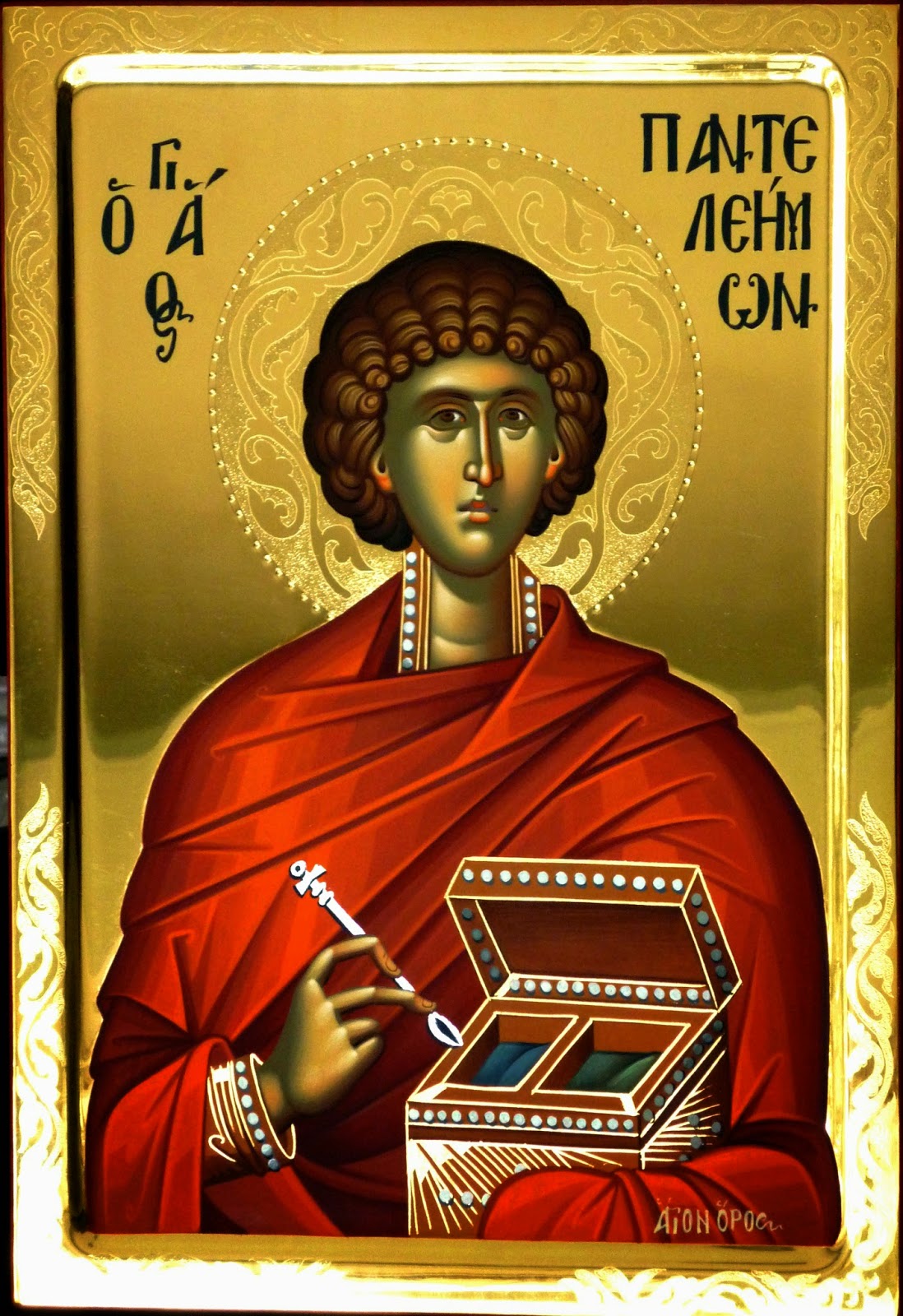
St. Panteleimon the Great Martyr and Unmercenary (source)
  
Homily II on St. Panteleimon by Metropolitan Avgoustinos Kantiotes: "A Lesson of Love"
"This I command you, to love one another." (John 15:17)
"The feast of a martyr is to imitate the martyr." [Quote of St. John Chrysostom]
The stars, my beloved, are not only contained in heaven, but our Church has its own, and the stars of the Church are the Saints (Martyrs, Confessors, Venerable Saints, Teachers and Fathers). The stars illumine heaven, but the noetic firmament of the Church is also illumined by the noetic stars, the Saints. They shine with their life, their virtues, their wonders. And like in heaven "star differs from star according to its radiance" (I Corinthians 15:41), thus among the Saints there are differences. One star of great prominence is today's Saint, the Great Martyr and Healer Panteleimon. Let's take courage to utter a few words, weaving a humble encomium to his memory.

St. Panteleimon was born in the era of terrible persecutions against Christianity, during the reign of Maximian (286-305AD), in a land whose name brings forth tears, in a land which gave birth to so many of the Saints and Martyrs: Asia Minor. Specifically, his homeland was Nicomedia of Bithinia. There was his church, but on a dreadful day in August 1922, the children of Hagar reduced it to rubble. Today in Nicomedia, the bells do not ring. I believe, however, that one day they will ring there again!

His parents were nobles, aristocrats. His father was Eustorgios, an idolater in the close court of the king. His mother, Euboule, was a Christian according to tradition, and implanted in the heart of the child the seed of the faith and of virtue. The Saint, however, had the misfortune of losing his mother. Only those who have lost their mothers can sense the loss which is left in a family by her absence.

However, the seed which his mother had sown within him was not lost. The child grew, became a man and was noted for his goodness. His rich father made provisions to send him to the best teachers, and even to the famous professor of medicine, Euphrosynos. He studied near him, excelled in his lessons and later finished as a great physician. He, however, was still an idolater, and did not believe in Christ.

One encounter, however, changed his life. While he was still young, he met a pious priest of Nicomedia, Ermolaos, who led him into the mystery of Christianity . "If you wish to become a physician," he told him, "you must know the first and greatest physician of souls and bodies, and this is our Lord Jesus Christ!" He related His life and miracles, and from then, the young man began to take care to believe.

The young physician wished to test if things said by Ermolaos were true. And one day, as he was traveling through the countryside, he saw a child who had died, and next to him was a serpent fleeing who had poisoned him. He knelt beside the body, and lifted up his eyes on high and said: "In the name of Jesus Christ, O child, arise, and you, O beast, depart." And immediately, the child came to life, and the serpent died. This event, along with others like it, strengthened within him faith in Christ. He told this to Ermolaos, and was baptized.

The healings which he continued to work were many and are written in his Synaxarion. Only one I will say, that he was serving as a physician in Nicomedia, which had at that time, before the founding of Constantinople, served as the first city of the nation. His fame had spread. He healed with medical drugs, but there where science lifted up its hands out of weakness, in those difficult situations, St. Panteleimon prayed and said: "In the name of Jesus Christ...", and the sick were healed wondrously. His successes however brought about the wrath of his fellow doctors. They condemned him to the king, and thus he was brought before him. Maximian tried to coerce him to become an idolater and to sacrifice to the idols, but he stood immovable. And thus began his martyrdom.
  
St. Panteleimon the Great Martyr and Unmercenary (source)
  
I will not relate his martyrdom in detail. The Saint's faith was great, and he was victorious through fire, and the sword, and iron nails, and ravenous beasts, and the wheel, and the sea, through everything. Many believed in Christ, not just through his wondrous healings, but through his manliness at the hour of his martyrdom. And aristocrats of the court and courtiers and patricians of the highest ranks, in addition to simple people came to believe in the Lord Jesus Christ. Because through all of the Saint's wonders, I discern that the greatest thing was his daily way of life: his love and his philanthropic offering, the sacrifice of himself in order to help his neighbor, his virtuous and chaste way of life, that which is sought of every Christian by the Lord.

In the end, according to the command of the emperor, the military guard led him two kilometers outside of Nicomedia, and there, before the sun had risen, around dawn, the lightning strike of the executioner's sword cut off the head of the Saint. And then, instead of blood, milk poured forth, according to the Synaxarion. And though his precious Relic was laid in the earth, it became a treasury and spring of wonders, while his holy soul flew to the heavenly mansions, to dwell among the Angels and Archangels, and from there, to intercede for everyone, and especially for his homeland of Nicomedia, that again she might see the glory of the faith and that the bells might ring there joyously through a national and religious resurrection.

As I said in the beginning, my beloved, "The feast of a martyr is to imitate the martyr", as described by the sacred Chrysostom. Are we celebrating a martyr? Then we should imitate him. Today, therefore, from the world of the bodiless spirits beyond, the voice of St. Panteleimon reaches us, and mystically speaks to the ears of our souls: "O Christians who are honoring me, become my imitators!"

The Saints are the most clear sign that Christianity is not a utopia, a theory, a philosophy, it is a reality, a harmonious life. They reveal that Christianity crosses the ages and rules in all stations. The Saints are the heroes of the faith and of virtue, the pinnacles of prototypes worthy of imitation.

Today, St. Panteleimon compels us, as the teacher of all, and especially those who are educated, rational, and who are scientists and physicians. There is a false idea that is cultivated by the children of darkness that science is not compatible with our faith. It is false, a satanic lie. Because we see today's Saint was an educated and wise scientist, and through this also believed in the Lord. And not only St. Panteleimon, but many other Saints of the Church. And not only Saints of the ancient eras, but many contemporary and great scientists of national fame (physicians, chemists, mathematicians, physicists, astronomers, and every specialty) believe in God and confess Christ. I know of scientists in Athens who believe, fast and pray, and--it may seem strange to you--arise at midnight to pray the prayer rope! I know of a surgeon in "Evangelismos" Hospital who never takes up the scalpel without kneeling to say: "Lord Jesus Christ, help me, the sinner." Science, not of dimwits, but of great minds, kneels before the Crucified One. In Germany, a surgeon wrote a book with the title: "Behind us stands God", in other words, behind our science is found Christ, the Physician of souls and bodies.

But the Saint is not just the teacher of learned scientists, but of all Christians. He teaches us a lesson which is most simple, but also the most difficult. It is the two words of the Nazarene, which we heard in today's Gospel: "This I command you, to love one another." (John 15:17) It is the lesson of love. And this is taught by St. Panteleimon, because he applied this himself [in his own life]. Whatever he had, he offered, and he became a servant of the people, and suggests to us that we become benefactors, philanthropists and merciful in our social circles. Because of this, I entreat you to be moved even more deeply to deeds of love and philanthropy. Do not wait for everything from the government, from others.

May God, through the intercessions of St. Panteleimon, protect our whole people, that we might with peace and love worship our Lord Jesus Christ unto the ages of ages. Amen.
(+) Bishop Avgoustinos
From a homily recorded in the old Church of St. Panteleimon in Florina on Saturday July 27th, 1968(source)
  
St. Panteleimon the Great Martyr and Unmercenary (source)
  
Through the prayers of our Holy Fathers, Lord Jesus Christ our God, have mercu on us and save us! Amen!

Thursday, February 20, 2020

A Prayer for Cancer Patients

Icon of the Theotokos "Pantanassa" ("Queen of All"), also known as "The Healer of Cancer" (source)
  
An Orthodox Prayer for Cancer Patients,
from the Cell of Elder Gabriel the Athonite,
Approved by the Orthodox Church of Greece
  
Our Lord Jesus Christ, Who rules over the spirits of affliction and health for those who call upon You with fervor of heart, and who with faith in You have emptied themselves, hearken to us sinners, along with those afflicted with the dangerous illness of cancer, and who have been seized from among us, and who persist in longstanding and painful illness, our fathers, brethren and children, full of deep sorrows and pains, and who, unable to flee from their death, entreat everyone [to pray for them]. O Lord, through Your illumining and sanctifying Spirit, guide in medical science those who are seeking to discover and use the good medicine and revealing therapy. Grant strength to those who are suffering, and patience and relief from their pains, bestowing on them every healing of soul and body, through the intercessions of our Most-blessed Lady the Theotokos and Ever-Virgin Mary, the Life-giving Spring, whose waters in the queen of cities [Constantinople] healed the passion of cancer, of our Father among the Saints Parthenios, Bishop of Lampsakos, of the holy, glorious and wonderworking Unmercenaries, of the holy, glorious Great Martyr Panteleimon, [of St. Nektarios of Pentapolis, or other Saints desired to be commemorated, etc.] and of all Your Saints. Amen.
(source)
  
St. Parthenios of Lampsakos, among the Saints whose prayers especially help cancer patients (source)
   
Picture documenting "Great Helpers Against Cancer", or wonderworking Saints whose prayers especially help those suffering from this affliction, including: The Most-Holy Theotokos Pantanassa ("The Healer of Cancer"), Sts. Nektarios of Aegina, Ephraim of Nea Makri, Parthenios of Lampsakos, Patapios of Thebes, John Maximovitch, Anastasia of Rome and John the Russian (source)
   
Icon depicting the Holy Hierarchs and Wonderworkers: Sts. Luke of Simferopol, Nektarios of Pentapolis, and John of San Francisco (source)
   
Through the prayers of our Holy Fathers, Lord Jesus Christ our God, have mercy on us and save us! Amen!

Thursday, October 17, 2019

Service of the Synaxis of the Holy Unmercenaries

The Synaxis of the Holy and Wonderworking Unmercenaries (source)
  
Note: This is an in-progress translation of a liturgical service in praise of the Holy Wonderworking and Unmercenary Physicians. This is a translation of a Greek text, which places their feast on October 17th (that of Sts. Cosmas and Damian from Arabia, along with their brothers and fellow unmercenary martyrs Sts. Leontios, Evtropios and Anthimos). The traditional 20-numbered band of Holy Unmercenaries in the Greek tradition of course is by no means exclusive. There are of course female Holy Unmercenaries (Sts. Philonilla, Zenaida, Hermione, and even St. Anastasia Pharmakolytria in some traditions. There are other Saints not necessarily known as physicians in their lifetimes, but are known for many wondrous cures and therefore are sometimes numbered with the Unmercenaries (such as Sts. Vlasios, Spyriodon, Artemios, etc.) Finally, there have been later additions to the holy band of Unmercenaries through the passage of time, most notably St. Luke the Surgeon of Simferopol, who reposed in the 20th century. As a result, let this not serve as a fixed or exclusive service, but one in prayer to our Lord to heal our many physical, psychological and spiritual afflictions with His mighty arm, through the intercessions of His healing Saints, who left behind every earthly repose, "placing all their hope in heaven" (from the Idiomelon to the Holy Unmercenaries), while giving their lives in love for their fellow men.

Also note, a vespers text exists from the Russian tradition which places this feast on the first Sunday of November (likely in proximity to the feast of Sts. Cosmas and Damian of Asia Minor who celebrate November 1st). As such, I have begun by translating the Matins text and may proceed to the Vespers and the Matins Canon at some point. Finally, note that the translation is not set to the Byzantine meter of the Prosomoia. May the Saints pray for us all and heal our world!

Synaxis of the Holy Unmercenaries (source)
  
Matins
 
After the First Stichologia, the Kathisma in the First Tone. Your tomb, O Savior.
Let us celebrate, O godly-minded ones, the divine and joyous memory of all the sacred Unmercenaries, who are our patrons, and let us praise them out of duty, for they have become the common protectors and saviors of all those in dangers, who speedily deliver all those who hasten to them in faith.

Glory. Both now. Theotokion.
O unwedded and Pure One, Theotokos Maria, the only protection and covering for the faithful in dangers and trials and terrible circumstances, deliver all of those who place their hope in you, having you, O Lady, as a savior for our souls through your divine intercessions.

After the Second Stichologia, the Kathisma in the Third Tone. The beauty.
Unemptying wealth of sympathy and goodness is poured out upon us by the divine Unmercenaries, and no mind of mortals, nor mellifluent tongue can tell of the surpassing ocean and the true streams of their many wonders. Therefore we cry out to them: Rejoice, O eternal springs.

Glory. Both now. Theotokion.
At the beauty of your virginity, and the resplendency of your chastity, Gabriel stood amazed and cried to you, O Theotokos: What are the appropriate words of praise to present to you? What name shall I call you by? At a loss and perplexed am I. And so as I was ordered I cry to you: rejoice, O you Who are full of grace!
  
Panagia Glykophylousa, surrounded by a multitude of the Holy Unmercenaries, Physicians and Healers of Christ (source)
  
After the Polyeleos, the Katisma in the Plagal of the Fourth Tone. The wisdom.
Paradoxically you received from Christ the gifts of heavenly wonders, and you heal all of our passions freely, for within you has shown forth the grace of the Spirit, working the power of divine healings. Therefore, you have inherited incorruptible good things through your unmercenary minds, O God-bearing Unmercenaries. Intercede with Christ God, that forgiveness of offenses be granted to those who celebrate you holy memory with fervor.

Glory. Both now. Theotokion.
Let us all praise the Queen and Mother of the Creator of all, and let us magnify her with our voices and cry out to her in hymns: O Virgin and All-hymned cause of joy, save those who honor you, and protect all those in temptations of all kinds and illnesses and trials through your intercessions, for, as the Mother of God, you have boldness. Entreat that healing of afflictions be granted to those who cry out to you. Intercede to your Son and God that your servants might be granted forgiveness.

Then the Hymns of Ascents in the Fourth Tone, followed by the Prokeimenon:
To His Saints who are in His earth, the Lord has been shown wondrous.
Verse: God is wondrous in His Saints.
 
Matins Gospel of the Feast of the Holy Unmercenaries Sts. Cosmas and Damian (November 1st)
 
Psalm 50.
 
Glory.
Through the intercessions of the Unmercenaries, O Lord of mercy, wash away my many personal offenses.

Both now.
Through the intercessions of the Theotokos, O Lord of mercy, wash away my many personal offenses.

Then the Idiomelon in the Second Tone.
Verse: Have mercy on me, O God...
The choir of the Saints rejoices unto the ages, for their have inherited the Kingdom of the heavens, while the earth that has received their Holy Relics breathes forth fragrance, for they became the servants of Christ, and have come to dwell in eternal life.

Then the Priest says the, "O God, save Your people..." Followed by the Canons to the Theotokos and the Holy Unmercenaries (to be translated at a later time).
  
Synaxis of the Holy Unmercenaries (Source)
  
Kontakion in the Second Tone.
You have received the grace of remedies, spread strength over those in need, glorious, wonderworking Physicians; but by your visitation, cast down the insolence of enemies, healing the world by wonders.
 
The Oikos.
The word of the wise Physicians surpasses all understanding and wisdom; for having received grace from the Most High, they invisibly bestow strength on all; therefore on me too they have bestowed the grace of narration, to sing their praise as God-bearing, well-pleasing to God and healers, who grant multitudes of cures; for they rescue all from pains, healing the world by wonders.
  
Synaxarion
On this day (October 17th) we honor the Synaxis of all the Holy and Wonderworking Unmercenaries (twenty in number).

Verses
I ever honor together the Unmercenaries,
Being gathered here in their church.
The twenty-numbered band of the Unmercenaries,
O choir, save those you entreat you.
Twenty, therefore, Unmercenaries, I ever hymn.
  
Then, the Katavasies of the Theotokos, followed by the 9th Ode.
  
Exaposteilarion in the Third Tone. In the Temple in Spirit.
Receiving the grace of healing from God, blessed Unmercenaries, you cure diseases and heal all those who faithfully have recourse to your divine shrine, and therefore with one voice, we worthily call your holy memory blessed.
 
Another for the Saints in the Fourth Tone. The Disciples gathered.
Together with Saints Kosmas, let us hymn Sampson, Panteleimon, the Damians, Ermolaos, Cyrus and John, Thalelleos, Aniketos, Tryphon, Diomedes, Leontios, Eutropion, Anthimos, with Mokios, Julian, and let us praises the Twenty and celebrate their joyous memory in a godly manner.
 
Theotokion in the same tone.
Let us hymn with a godly mind the Mountain of God, the Palace, and Lamp-stand, and Container, and Ark, and Altar, the Rod and fiery divine Throne and Gate, the Temple and Bridal Chamber, the Pure Virgin, from whom God became incarnate without change and in a manner surpassing nature, and deified our fallen nature, uniting it with the ineffable.
 
Synaxis of the Holy Unmercenaries (source)
  
Then, the Praises, followed by the Prosomoia in the Plagal of the Fourth Tone.
What shall we call you?
What shall we call you, O Unmercenaries? Heaven, for you related the glory of God. Liturgists, for you ceaselessly glorified Him. Bodiless, for you put off the flesh. Stars, for you shine upon the ends of the earth. For many are your names, and even more are your accomplishments. Intercede that our souls be saved.
 
What shall we call you, O glorious ones? Physicians, for you heal the afflictions of mortals. Rivers, for you fill the earth with wonders. Saviors, for you save everyone from dangers. Lights, for you enlighten many. Many are your graces, and even greater are your awesome deeds. Intercede that our souls be saved.
 
What shall we name you, O wise ones? The uprooters of passions or the sower of virtues, noetic paradises, or fruitful plans, sending forth gifts, and nourishment, and granting incorruption to all. Many are your graces, and unemptying are your healings. Intercede that our souls be saved.
 
Your temple has been shown to be a river as from Eden, which surrounds the world, pouring forth and watering healings for the faithful, granting grace freely to those who cry out to you with fervor and in faith: Many are your wonders, O all-blessed Unmercenaries. Intercede that our souls be saved.
 
Doxastikon of the Praises in the Plagal of the Fourth Tone.
(Modeled after the Doxastikon: "The Choir of the Holy Fathers", from the Sundays of the Holy Fathers)
The multitude of the Holy Unmercenaries, who have been gathered from the ends of the earth to rejoice on this joyous day, and whom we hymn harmoniously today together at their sacred shrine, in which they stand invisibly, together with Christ Who crowned their sacred heads, and grants to them the unending grace of wonders. To them let us cry out melodiously: O divine assembly, hoplites inspired by God, in the Lord's army, ever-shining stars of the noetic firmament, the unassailable towers of mystical Sion, the fragrant flowers of Paradise, the fervent physicians of the sick, the boast of the Martyrs, the pride of the Righteous, ceaselessly intercede on behalf of our souls.
 
Both now. Theotokion.
O Lady, do you receive from your servants their entreates, and deliver us from every danger and trial.
 
Then the Great Doxology, followed by the Apolytikion of the Saints in the Plagal of the Fourth Tone.
O Holy Unmercenaries and Wonderworkers, visit our infirmities. Freely you have received, freely give to us.
 
The Epistle and Gospel from the feast of the Holy Unmercenaries Kosmas and Damian (see November 1st).
 
Megalynarion for the Holy Unmercenaries.
You received the gift from God of healing the afflictions of the faithful, and speedily delivering from the gravest passions those who call upon you, O Unmercenaries.
  
The Synaxis of the Holy Unmercenaries (Source)
  
Through the prayers of our Holy Fathers, Lord Jesus Christ our God, have mercy on us and save us! Amen!

Wednesday, July 24, 2019

Metropolitan Avgoustinos Kantiotes on St. Panteleimon the Great Martyr

St. Panteleimon the Great Martyr and Unmercenary (source)
  
Metropolitan Avgoustinos Kantiotes on St. Panteleimon the Great Martyr: He was cast out due to jealousy
"For he knew that for envy they had delivered him" (Matthew 27:18)

My beloved, we are honoring the holy memory of the Great Martyr Panteleimon. Our topic will be the question: What was the reason that St. Panteleimon was persecuted? To this we will give a short response.

St. Panteleimon lived and struggled during the era of persecutions, when the Roman Emperor was Diocletian. He was born in Nicomedia of Asia Minor. His father was an idolater, but his mother was from the women who planted deeply into the heart of their children their faith in Christ. Therefore, she taught St. Panteleimon the truths of the faith.

He was well-sown. He had a call towards learning. He studied medicine near noted scientists. He became an exemplary physician. There were many physicians then, like there are today. However, it is rare today to find a Christian physician. The majority are faithless, materialists. And these have no worth; may God protect you from falling into their hands.

St. Panteleimon differed from them. In what way did he differ? He differed in three ways.

First, regarding money. They were lovers of money. They charged their patients a lot and became rich. St. Panteleimon was unique, a man of ideology. He used science as a mission. He was seen at night visiting huts [of the poor and sick] like an angel. While the others went only to the houses of the great ones, he went to the houses of the poor and served the sick.

And a second way in which he differed from the others. As a famous Greek university professor once said, physicians frequently study medicine like veterinary medicine, and many doctors act like veterinarians. They don't see anything else beyond veins, bones, flesh, ribs, hearts and lungs. Man of course is these, but behind this is something invisible. There is a "little motor", which moves the biological body, and there is the existence of man. And the doctor, when he doesn't see this "little motor", is blind, and is not in the position to perform his work. This "little motor" is the spiritual factor, the soul of man. A multitude of experiments and observations have shown that the soul with the passions, feelings, conscience and impulse greatly impacts the body. There is an interconnectedness between body and soul. This is what our Church chants during the 15-days of August, and which is scientifically correct: "From the great multitude of my sins, ill am I in body, ill am I also in soul..." (from the Small Paraklesis to the Theotokos). And both are sick but the root of evil is sin. Therefore, St. Panteleimon made the correct diagnosis. He saw that, when the soul is freed from guilt, the body is given life, and man breathes deeply. Many illnesses (apoplexies, heart attacks, cancer) have as their cause the spiritual world. Some bitterness from remorse or from slander or from divisiveness or from injustice or anxiety waters the body with poison.
  
St. Panteleimon the Great Martyr and Unmercenary (source)
  
So he differed first for not taking money, secondly because he saw man as a psychosomatic whole, and thirdly, for besides the other medicines which the other physicians had, St. Panteleimon had a rare and unique medicine, and this was the faith. He believed deeply. Because of this, together with medicines from herbs from the earth that he gathered, he knelt next to the pillow of the sick, praying, and--let the faithless disbelieve it, we believe it--the sick man was healed. And to this day, we see the sign of the Cross in clinics, hospitals and healing centers. How truly awesome a thing is the power of faith, a medicine of healing for bodily and spiritual illnesses.

This was St. Panteleimon. And because of this, his healing center was marked every day with a line of sick people, while they did not go to the other physicians of Nicomedia anymore. This being passed over, however, enflamed the hearts of his colleagues with the yellow lamp of jealousy. They were jealous of him, they hated him. They saw that, as long as he was a physician in Nicomedia, they would have to change careers because everyone was hastening to St. Panteleimon. And the sick, who themselves were loosing hope, found their healing near him. Behold therefore the cause of jealousy. Because of this they cast him out. They hated him from the beginning. With what slander did they do so? As an unmercenary? As one taking advantage of people? As an adulterer? As a fornicator? As a dangerous person? As a criminal? None of these things. If they condemned him with these during that decadent regime, it wouldn't work. They condemned him with a condemnation that took hold. Isn't that how it is, that the slanders of the faithful change in every age? Sometimes they use slander A, other times B, other times C. I will not dwell on this, I will just mention that, from the time...with various slanders, with foolish things the jealous attack the worthy men to discredit them--though at the heart of the matter, they don't believe the slanders--and people are no longer judged according to proper and steadfast criteria (ethically), but according to other criteria (politics).

They condemned him therefore with the condemnation of that era that was so devastating: that he was a Christian. And this condemnation led man to dash him to pieces. He was seized, led before rulers, confessed his faith with boldness, suffered all kinds of martyrdom, and thus, his holy soul flew to the heavens like a wholly-white dove to dwell in the heavenly mansions, in order to rejoice together with the Holy Angels and Archangels.

Behold, my beloved, the cause of the persecution and the martyrdom of St. Panteleimon: jealousy.

O jealousy, a great and abyss of a passion! It is a worm and viper that consumes the bowels of he who is jealous, but is also the grave of great men. Terrible are its consequences. If we open the holy stories, we will see that, from the beginning, this was the destruction of the human race. "Out of the jealousy of the devil", says Solomon, "death entered into the world" (Wisdom of Solomon 2:24). Satan was jealous of the magnificence of man, and was filled with wrath against him. Because of this was the first blood spilled upon the earth, due to jealousy. Cain was jealous of his brother Abel and he murdered him "in the field" (Genesis 4:8). From jealousy Esau persecuted Jacob (ibid 27:41), the eleven children of Jacob persecuted Joseph the All-comely (ibid 37), King Saul persecuted David (I Kings 19:10), and a long line of holy men were snuffed out.

And we have examples from our own national history. Great men were snuffed out like the righteous Aristides in antiquity, Socrates who drank the poison, and in later years, Harilaos Trikoubes, etc.

But why do we need other examples? Cast your eye on the Praetorium and to Golgotha. "Which of these two do you wish that I release?" asked Pilate, "Barabbas or Jesus?" Everyone cried out together: "Barabbas". And the Evangelist notes psychologically: "This he did", Pilate, in other words, "for they delivered Him up out of envy." (Matthew 27:18) The envy of the Scribes and Pharisees, which were like fireflies quenched before the great sun that is Christ, led our Lord to Golgotha. Therefore, my brethren, it is a general rule. If there ever appears some person, some worthy personality, who would perform their duty, he will elicit envy and rouse up persecution. Meaningless people do not bother, those who offer help and give their lives to those around them, they are the ones persecuted. St. Paul said this: "All those who desire to live piously in Christ Jesus will be persecuted" (II Timothy 3:12). All those who believe in Christ will be persecuted, along with all those seek to live according to His commandments. It is their fate. All those living, either through his word or through his example, bring about an earthquake. However, this is an earthquake of salvation. Blessed are the communities who have such men, either in science or in the military or in politics or in the holy clergy, for they become the agents of the proper way.

Pray, my brethren, that the sickness of envy might be healed, that it might abandon you. And may our Lord, through the intercessions of St. Panteleimon, transform all our hearts, and may we go forth with virtue and love, to the glory of God. Amen.

+Bishop Avgoustinos

(Homily of Metropolitan of Florina Avgoustinos Kantiotes, delivered in the Holy Church of St. Panteleimon, Florina, 7/27/1976) (source)
  
St. Panteleimon the Great Martyr and Unmercenary (source)
  
Through the prayers of our Holy Fathers, Lord Jesus Christ our God, have mercy on us and save us! Amen!

Thursday, June 27, 2019

"We entreat you to ever visit the glorious hospital which you founded, O Father..."

St. Sampson the Innkeeper and Unmercenary (source)
  
We entreat you to ever visit the glorious hospital which you founded, O Father, in which you ceaselessly stand serving among us, relieving pains with great compassion, and lightening the woes and the pains of our souls.
-from the Matins Canon for St. Sampson the Innkeeper and Unmercenary.

(source)

Through the prayers of our Holy Fathers, Lord Jesus Christ our God, have mercy on us and save us! Amen!

Saturday, May 19, 2018

Elder Nikon of Mount Athos on the Mystery of Pain

   
This is a wonderful talk by Fr. Nikon of Mount Athos on the nature and mystery of pain in our lives, with English subtitles. As there are so many people every day who are aching in body and heart and soul, may we turn to our Lord Who is the ultimate balm for our wounds, in this life and unto eternity, using all the tools He gives us for our healing and consolation.
   
Through the prayers of our Holy Fathers, Lord Jesus Christ our God, have mercy on us and save us! Amen!

Friday, June 10, 2016

St. Luke the Surgeon on Holy Water

St. Luke the Surgeon, Archbishop of Simferopol (source)
  
"Drink Holy Water, the more often, the better. It is the best and most effective medicine. I'm not saying this as a priest, I'm saying it as a doctor, from my medical experience."
-St. Luke the Surgeon, Archbishop of Simferopol
  
(source)
  
Through the prayers of our Holy Fathers, Lord Jesus Christ our God, have mercy on us and save us! Amen!

Saturday, October 18, 2014

Homily of Metropolitan Avgoustinos Kantiotes on St. Luke the Evangelist

St. Luke the Apostle and Evangelist (source)
  
The Beloved Physician
“Embrace Luke, the beloved physician” (Col. 4:14)
Today, my beloved, is a feast and celebration. St. Luke celebrates, one of the stars which enlightens the heaven of our holy Church.
  
Who was St. Luke? It is not sufficient to hear the name and to celebrate the memory of a Saint. We must know his life, and above all, imitate his virtues. As the holy Chrysostom said: “To celebrate a Saint is to imitate the Saint.” Because of this, let us say a few words about this Saint.
 
Luke! And his name alone reveals something, it has meaning. The word “Luke”, as philologists say, comes from the Latin root (lux) which means “light”. From this are derived other words as well. For example, “Lyceum” [corresponding to high school in modern Greece], meaning the school that enlightens, and woe if this school does not enlighten but darkens. Lyceum=the school that enlightens, and Luke=enlightened, radiant. He, of course, was not enlightened from the start, for initially he was an idolater. He was born when everyone worshiped idols and made them gods. He was a Greek by lineage. His homeland was Antioch, that great center of Hellenism in the East. That was his life before Christ, until he believed.
  
His calling was to be a physician (there was at that time a great medical school in Tyre). Furthermore, according to tradition, he had the talent of drawing pictures. Studying medicine, he found himself in Thebes of Viotia, and heard the Apostle Paul, came to know him, believed in Christ, was baptized a Christian, and therefore named Luke—enlightened.
  
From then on he followed the Apostle Paul. The life of Paul, however, was not like the life of today's priests and bishops, as we partake of silence and general comfort. It was a hard life, with poverty, trials, persecutions, shipwrecks, martyrdom, the cross. How many times was he not cast out, seized, flogged, imprisoned, and stoned (by Judeans and idolaters and Roman emperors)? And ultimately he was beheaded in Rome.
 
Throughout all of these situations, Luke did not abandon Paul. He remained near him, near him through these events, near him through his afflictions, near him through all the trials, until the end of his life. Among the fellow workers of Paul, Luke takes the greatest place, of whom he writes: “Luke, the beloved physician” (Col. 4:14). He names him “physician”, because he must have been useful to him many times, when the Apostle Paul was sick and had need of medical care.
  
Luke did not see Christ with his eyes, but he heard of the Lord from those who were “witnesses and servants” of the apostolic preaching (Luke 1:2), and especially from the Apostle Paul. This made a great impression on him, such that he could give a faithful representation of the Lord, and of the apostles and the life of the first Church. He believed deeply, and that which he believed, he preached. And as the Apostle Paul completed his path, Luke fled from Rome. He began to travel and to preach the Gospel of Christ. He circled throughout all of Greece, and finally, he returned to Thebes, where, according to a tradition, he became bishop, and there peacefully gave up his holy soul at the age of 80.
  
He preached with his tongue, he preached with his life and his example, he preached with his miracles. He will forever preach, however, with his God-inspired writings, and especially his Gospel. Whoever reads the Gospel according to Luke, thinks that he is watching the life of Jesus Christ like a movie. The Gospel of Luke is the sweetest Gospel. It is characterized as the Gospel of love, of forgiveness, of mercy, the Gospel of the compassion of God. One of these is the following:

In the Gospel of Luke is found the story of a sinful woman. She had worked orgies. She knew many men and was corrupted. The supposedly holy people in Israel, the Scribes and Pharisees, cut off communion with her, did not approach her, nor even told her a good morning. This woman one day went to Christ. He did not cast her out. He let her be, and she approached Him, knelt, sprinkled His feet with her tears and with her myrrh, and using her hair has a towel, wiped the spotless feet of the Lord. But because Christ accepted her actions, the others were scandalized. “Oh my, what is she doing?!” they said, “If he were a prophet, he would know who is touching him...” And then Christ said a great saying, which is impossible to measure, and which strikes me so deeply. Listen to what He says: “Her sins, which are many, are forgiven, for she loved much.” (Luke 7:47) In other words, the Scribes and Pharisees did not love Him, the “Learned” of that age did not love Him, the Romans did not love Him. This wretched woman loved Him, and she shed bitter tears of repentance. She sensed the redemption which Christ grants.
  
The Gospel of Luke is the Gospel of Joy. It begins from the Annunciation of the Theotokos, with the greeting of Gabriel: “Rejoice, O Full-of-Grace...” (Luke 1:28), and proceeds with the Nativity of Christ, and the joyous angelic message: “Behold, I bring you tidings of great joy...” (Luke 2:10), and ends again with the joy of the Apostles when they saw Christ ascending to the heavens: “And they, having worshiped Him, returned to Jerusalem with great joy” (Luke 24:52). The Gospel is joy. There is no other true joy anywhere. Joy is Christ. Whoever is tried, approaches, and believes like Luke did, he will see that his sorrow becomes joy, and his darkness, light.
  
All of us, beloved, are sick—not as much bodily as spiritually—and all of us have need of healing. Because of this, Christ founded His Church, for it to be a hospital for all men. He Himself is “The Physician of our Souls and Bodies” (Divine Liturgy), and He offers healing, medicine and therapy. His fellow workers in this healing work are the chosen men that He called, the Holy Apostles, the Holy Fathers, and the Clergy of today.
  
Luke was a physician of bodies, who placed his scientific knowledge towards the service of every sick person in pain. However, he himself had need of a physician, the Physician of the Soul. And he found the Physician. He found him in the person of the Apostle Paul, who led him to the hospital of the Church. But the Apostle Paul, before he could offer spiritual healing to Luke, he himself had needed this, which he received walking on the road to Damascus, from our Lord Jesus Christ Himself, Who is the Physician of physicians. In other words, the Apostle Paul and the Evangelist Luke, in the Church of Christ, approached as sick men, and having been healed, with the grace of the Lord, became physicians of the others.
  
On the feast of the holy physician Luke, I now direct this  towards those who share his art.
My beloved physicians, nurses, and all those who serve the sick in any way! No one dishonors the worth of your sacrifice. Everyone knows this and confesses this. But I want to remind you that man is not only a body, he is also a soul. And when you offer healing and therapy to others' bodies, know that you also need healing of your souls. You have a soul that is immortal and beyond all worth; take care of it. You behold the reality daily that this life ends. Work towards your eternal healing. Imitate in this way your protector, St. Luke. Approach with faith the Physician of physicians, and the healer of the whole human existence.
  
I pray that our Lord Jesus Christ, through the intercessions of the Evangelist Luke, may always be with you. Amen.
  
+Bishop Avgoustinos (Metropolitan Augustine Kantiotes of Florina, of blessed memory)
  
Recorded homily which took place in the Church of the Evangelist Luke in the Hospital of Florina (10/18/1985). (amateur translation of text from source)
  
Through the prayers of our Holy Fathers, Lord Jesus Christ our God, have mercy on us and save us! Amen!

Wednesday, July 16, 2014

St. Porphyrios' Advice to a Pediatrician


St. Porphyrios of Kavsokalyvia (source)
  
St. Porphyrios once told a Pediatrician: "Listen to what I have to say to you. Every time you examine a child*** you should offer a fervent prayer with love: Lord Jesus Christ have mercy on your servant."

As he said this he took a deep breath while he opened his hands. "It is in this way that you should pray for every child. God has sent a precious soul into your hands. As you place your hands on them pray fervently within yourself that the grace of God will be transfused into the soul of the child.

"Do all this things spiritually and in secret. The others who are present won't understand anything. You will prescribe to them medicines which science dictates but in the final analysis Christ will heal the child."
(source)
   
***Of course this beautiful advice can apply to anyone in healthcare, for any age.
 
Through the prayers of our Holy Fathers, Lord Jesus Christ our God, have mercy on us and save us! Amen!

Tuesday, January 29, 2013

St. Romanos on Christ as the True Physician

The following is an excerpt from the famed Kontakion of St. Romanos the Melodist "On the Passion and the Mourning of the Theotokos", the first two strophes of which form the Kontakion and Oikos of the Orthros of Holy Friday. The full Greek text is available here, and the full English translation is available from Fr. Ephraim Lash here. Below is my amateur translation.

In the 13th strophe, St. Romanos, in an absolutely beautiful and fascinating metaphor, compares Christ and the instruments of His Passion to a physician with his medical tools. This is a vivid image of  how Christ's passion truly is healing for our broken souls and bodies. May He have mercy on us all and save us!
   
Jesus Christ "Extreme Humility", with the Most-holy Theotokos (Icon courtesy of www.eikonografos.com used with permission)
   
ιγ´
Μικρὸν οὖν, ὦ μῆτερ, ἀνασχοῦ καὶ βλέπεις, 
πῶς καθάπερ ἰατρὸς ἀποδύομαι καὶ φθάνω 
ὅπου κεῖνται, 
καὶ ἐκείνων τὰς πληγὰς περιοδεύω, 
τέμνων ἐν τῇ λόγχῃ τὰ πωρώματα αὐτῶν καὶ τὴν σκληρίαν, 
λαμβάνω καὶ ὄξος, καὶ ἐπιστύφω τὴν πληγήν, 
τῇ σμίλῃ τῶν ἥλων ἀνευρύνας τὴν τομὴν χλαίνη μοτώσω, 
καὶ δὴ τὸν σταυρόν μου ὡς νάρθηκα ἔχων 
τούτῳ χρῶμαι, μῆτερ, ἵνα ψάλλῃς συνετῶς, 
«πάσχων πάθος ἔλυσεν 
ὁ υἱὸς καὶ θεός μου».


XIII.
A short time, O Mother, wait and you will see
How as a physician I strip myself and go
Where [the sick man] is laid,
And examine his wounds,
Lancing with the Spear his wounds and callouses,
And taking vinegar, I disinfect the wound,
Exploring the incision with the probe of the Nails,
Applying the [Purple] Robe as a dressing,
And having my Cross as a splint.
These I make use of, O Mother, that you might chant with understanding,
“By suffering the passion, You dissolved the passions,
My Son and my God.”
   
Christ as the Good Samaritan, 6th Century Codex Rossanensis (source)
   
Through the prayers of our Holy Fathers, Lord Jesus Christ our God, have mercy on us and save us! Amen!

Tuesday, June 26, 2012

St. Sampson the Innkeeper and Unmercenary

St. Sampson the Innkeeper - Commemorated on June 27 (http://pravicon.com/images/sv/s1830/s1830010.jpg)
  
Saint Sampson the Hospitable was the son of rich and illustrious Roman parents. In his youth he received an excellent education, he studied the medical arts, and doctored the sick without charge. After the death of his parents St Sampson generously distributed alms and set his slaves free, preparing himself to go into the wilderness.

With this intent in mind he soon journeyed from Rome to the East. But the Lord directed him onto a different path, that of service to neighbor, and so St Sampson came to Constantinople. Settling into a small house, the saint began to take in homeless wanderers, the poor and the sick, and he attended to them. The Lord blessed the efforts of St Sampson and endowed him with the power of wonderworking. He healed the sick not only through being a skilled physician, but also as a bearer of the grace of God. [St. Sampson is numbered with the Holy Unmercenary Saints.] News of St Sampson spread abroad. The patriarch heard of his great virtue and ordained him to the holy priesthood.

It was revealed to the grievously ill Emperor Justinian (527-565), that he could receive healing only through St Sampson. In praying, the saint put his hand on the afflicted area, and Justinian was healed. In gratitude the emperor wanted to reward his healer with silver and gold, but the saint refused and instead asked Justinian to build a home for the poor and the sick. The emperor readily fulfilled his request.

St Sampson devoted the rest of his life to serving his neighbor. He survived into old age and after a short illness he departed peacefully to the Lord. The saint was buried at the church of the holy Martyr Mocius, and many healings were effected at his grave. His hospice remained open, and the saint did not cease to care for the suffering. He appeared twice to a negligent worker of the hospice and upbraided him for his laziness. At the request of an admirer of St Sampson the hospice was transformed into a church, and beside it a new edifice was built for the homeless. During the time of a powerful fire at Constantinople the flames did not touch the hospice of St Sampson. Through his intercession a heavy rain quenched the fire.
(http://oca.org/FeastSaintsViewer.asp?SID=4&ID=1&FSID=101828)
  
See also: http://www.johnsanidopoulos.com/2010/06/st-sampson-hospitable-founder-of.html.
  
St. Sampson the Innkeeper and Unmercenary (http://pravicon.com/images/sv/s1830/s1830001.jpg)
  
Troparion - Tone 8
Through your patience, your unceasing prayer, your love for the poor and the help you gave to them, you became worthy of your reward, O holy Sampson. Intercede with Christ God that He may save our souls.

Kontakion - Tone 8
We honor your relics, for you are an excellent physician and powerful intercessor; as we gather to praise you with psalms and hymns, divinely-wise and venerable Sampson, we glorify Christ, who granted you the grace of healing.


Through the prayers of our Holy Fathers, Lord Jesus Christ our God, have mercy on us and save us! Amen!

Sunday, June 28, 2009

Sts. Cyrus and John the Holy Unmercenaries

Icon depicting the saints celebrated on January 31st (Sts. Cyrus, John, Athanasia, Theodota, Theoktista, Eudoxia, Claudius and Diodorus) (taken from: http://christopherklitou.com/icon_31_jan_claudius_diodorus_cyrus_john_athanasia_theodota_theoctista_eudoxia.htm)
  
SAINTS CYRUS AND JOHN, THE UNMERCENARY SAINTS AND MIRACLE-WORKERS (whose martyrdom, along with Sts. Athanasia, Theoktisti, Theodoti, and Eudokia, is celebrated on January 31st, and who are additionally celebrated at the transfer of their relics on June 28th)
These charitable and glorious saints were not blood brothers but were brothers in the spirit. At first, Cyrus lived in Alexandria, and as a physician he healed people by the power of Christ and by his knowledge of medicine. Learning that sickness mostly befalls man because of sin, Cyrus always directed the sick to purify their souls from sin through repentance and prayer and, thereby restore health to the body. When Diocletion's persecution against Christians began, Cyrus withdrew to Arabia where he received the monastic tonsure. He became as famous in Arabia as he was in Alexandria, so that people there also resorted to him for assistance.

  
Hearing about Cyrus, John, then a Roman officer in Edessa, came to Arabia to see him. Upon meeting, they loved one another as a brother loves a brother and remained together to live a life of asceticism.

  
At that time, a certain Christian woman named [Athanasia], together with her three daughters, was tortured by the persecutors in the town of Canopus. Hearing of this, Cyrus and John came to Canopus to encourage the mother and her daughters not to abandon the Faith. And truly, thanks to the counsel of these saints, [Athanasia] endured all tortures and, with her daughters, was martyred for Christ. The daughters of [Athanasia] were named: St. Theoctista, age 15; St. Theodota, age 13; and St. Eudocia, age 11. The tormentors then captured Cyrus and John, who, after imprisonment and torture were beheaded in the year 311 A.D. Numerous miracles were wrought by these martyrs, both during their lives and after their deaths. Their relics were translated to Rome during the reign of Emperor Arcadius. These saints are invoked for assistance during the Blessing of Water, in the Sacrament of Holy Unction and especially by those suffering from insomnia.


Fresco showing Sts. Athanasia, Theoktisti, Theodoti, and Eudokia, who were martyred along with Sts. Cyrus and John (taken from: http://christopherklitou.com/icon_31_jan_athanasia_theodota_theoctista_eudoxia.htm)
  
June 28 commemorates the translation of their relics from Canopus to Menuthis and the numerous miracles which occurred over their relics. St. Cyril, Patriarch of Alexandria, prayed fervently to God to destroy the idolatrous impurity in the town of Menuthis where a pagan temple was located and where the power of the demons ruled. An angel of God appeared to the patriarch and told him that Menuthis would be cleansed of its impurity if he translated the relics of Saints Cyrus and John to that town. The patriarch did this immediately. He translated the relics of the martyrs to Menuthis and built a church there in honor of Saints Cyrus and John. Ammonius, the son of Julian the mayor of Alexandria, was healed of scorfula; a Theodore healed of blindness; Isidore of Menuthis was cured of a decaying disease of the liver; the wife of Theodore from poisoning, a Eugenia of dropsy as well as many other people were healed of various diseases and torments by the relics of these saints. This all occurred in the year 412 A.D. (texts above taken from the Prologue of Ochrid by St. Nikolai, http://www.westsrbdio.org/prolog/prolog.htm, from January 31st and June 28th)


Fresco from Decani Monastery depicting St. Sampson (June 27th) and the martyrdom of Sts. Cyrus and John (taken from: http://www.srpskoblago.org/Archives/Decani/exhibits/Menologion/June/CX4K3555_l.html)
  
Their tomb became a renowned shrine in Egypt, and a place of universal pilgrimage. It was found in the area of the modern day resort near Alexandria named Abu Kyr. (taken from: http://goarch.org/chapel/saints_view?contentid=409)


Apolytikion in the Plagal of the Fourth Tone
Since Thou hast given us the miracles of Thy holy Martyrs as an invincible battlement, by their entreaties scatter the counsels of the heathen, O Christ our God, and strenghten the faith of Orthodox Christians, since Thou alone art good and the Friend of man.
  
Kontakion in the Plagal of the Second Tone
With a great voice, O ye faithful, let us hymn the great physicians of the world, the pair beloved of Christ, the luminaries who are radiant with the beams of healing; and as we stand in their temple, we cry out: Cyrus and John, the bestowers of miracles and healers of the ailing, shine forth to the ends of the world.
  
Sts. Cyrus and John the Unmercenaries (http://pravicon.com/images/sv/s0928/s0928006.jpg)
Through the prayers of our Holy Fathers, Lord Jesus Christ our God, have mercy on us and save us! Amen!