Showing posts with label Wealth. Show all posts

Wednesday, February 12, 2020

St. Silouan: "Many rich and powerful men would pay dearly to see the Lord..."

The Most-holy Theotokos holding Christ the Lord (source)
  
"Many rich and powerful men would pay dearly to see the Lord or His Most Pure Mother, but God does not appear in riches, but in the humble heart... Every one of the poorest men can be humbled and come to know God. It need neither money nor reputation to come to know God, but only humility."
-St. Silouan the Athonite, Writings, I.11,21

  
(source)
  
Through the prayers of our Holy Fathers, Lord Jesus Christ our God, have mercy on us and save us! Amen!
Thursday, January 9, 2020

Metropolitan Pavlos of Siatista: "What does Christmas mean to us?"

This is a beautiful recording of a Greek talk with English subtitles from Metropolitan Pavlos of Siatista of blessed memory (who reposed almost a year ago exactly, on January 13th, 2019) on the meaning of Christmas and on finding Christ in the feast as the source of our true joy. May he have a blessed Paradise, may we have his blessing, and may our newly-born and baptized Lord save His children! Amen! (source)
  
Through the prayers of our Holy Fathers, Lord Jesus Christ our God, have mercy on us and save us! Amen!

Wednesday, September 11, 2019

"She is a tree of life to all that lay hold upon her..."

Christ Crucified and His Precious Cross as the Tree of Life, mosaic from San Clemente in Rome (1118) (source)
  
My son, despise not the chastening of the Lord; nor faint when thou art rebuked of him: for whom the Lord loves, he rebukes, and scourges every son whom he receives. Blessed is He who Finds Wisdom Blessed is the man who has found wisdom, and the mortal who knows prudence. For it is better to traffic for her, than for treasures of gold and silver. And she is more valuable than precious stones: no evil thing shall resist her: she is well known to all that approach her, and no precious thing is equal to her in value. For length of existence and years of life are in her right hand; and in her left hand are wealth and glory: out of her mouth proceeds righteousness, and she carries law and mercy upon her tongue. Her ways are good ways, and all her paths are peaceful. She is a tree of life to all that lay hold upon her; and she is a secure help to all that stay themselves on her, as on the Lord.
-Proverbs 3:11-18, read at the Great Vespers for the Feast of the Precious Cross
 
 
Through the prayers of our Holy Fathers, Lord Jesus Christ our God, have mercy on us and save us! Amen!

Thursday, July 18, 2019

Metropolitan Avgoustinos Kantiotes: On the Prophet Elias and the Wonders of Prayer

The Holy Prophet Elias (source)
  
Metropolitan Avgoustinos Kantiotes of Florina: On the Prophet Elias and the Wonders of Prayer
Today, my beloved, we celebrate one of the greatest Saints of our faith, the glorious Prophet Elias. He lived before Christ, but he is also "the second forerunner of the coming of Christ" (from the Apolytikion of the Saint). He is one of the most beloved Saints, and many bear his name, and on many hills there are built chapels in his name, and many villages celebrate his name.

Should we tell of his life? It would take much time and you don't have much stamina. So that I might not tire you, I will tell of a few essential things from the life of the Prophet Elias. I will mention three of the wonders out of the many that he had done.

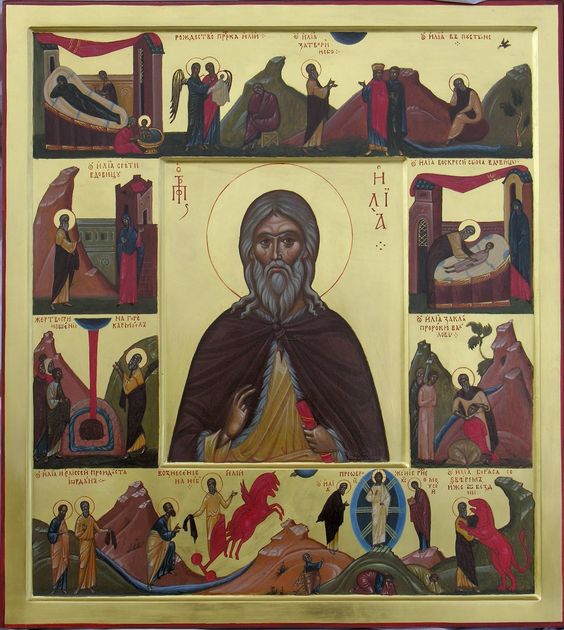
The one was that once, with his prayer, there was a drought that hit along with a famine in Judea. He also was hungry, because the Saints suffer hunger. He went to a village and everyone closed their doors to him. Only one house, a hut, opened their door. And who lived there, a rich man? It was a poor widow with her children. She received him. She had nothing to offer him hospitality, only a handful of flour and a little oil. And these she did not hold back. As soon as she saw him, even though she didn't know who this old man was, she said: "Come in, Elder." She immediately took the flour, made bread and gave him to eat, because he was tired from his journey. This occurred in Zarepta of Sidonia. And then--let the faithless disbelieve; it is their right, but we believe--from that hour on, the widow's house was never lacking in flour and oil. (Third Kings 17:8-16).

What does this mean?  Where there is the blessing of God, everything is riches. One can have incomparable fields, vineyards and olive groves, one can have sacks of gold and silver, one can have it all, but die from hunger. And one can have a handful of flour, a little piece of earth, a bucket of soil, and this will sustain you, as long as one blesses the Lord. These are not just words, they are reality. Because of this our Church chants: "The rick have become poor and hungry, but those who seek the Lord shall not lack any good thing." (Psalm 33:11) Everything, therefore, is a blessing. Some place too high an emphasis of work alone, because above work is the blessing of our Lord Jesus Christ.

Another miracle: While the house of the widow had flour and oil, the rest of the village was suffering hunger, for it had not rained for three and a half years. The impious King Ahab gathered the people of Israel on Mount Carmel, and there, the Prophet Elias censured them for their lack of steadfastness. Until when, he said, will you stand limping with your two feet? If our God is true, then follow Him. If Baal (the idol) is true, then follow him. They heard him without speaking, how would they be justified? Then he told them, I will only preach the true God, while the priests of the idols were about 1000. Today, therefore, we will test who is the true God. Bring two calves, and you will choose whichever you wish, and let us prepare a sacrifice with wood, but we will not light them on fire. And I will prepare the other for sacrifice and will not light it on fire. And you will entreat your god, and I will call upon the Lord my God. And He will hear me and will light and burn the calf of sacrifice, because He is the true God.

They agreed. The priests of shame placed their altar, and their calf upon it, and began to entreat, calling out: "Hear us, Baal". Noon passed, evening came, nothing. Their god was shown to be false. Afterwards, Elias places the clean altar, places wood and the calf upon it in pieces, and tells the others to sprinkle it three times with water (in order that there not be any possibility of fire). And as soon as he prayed, fire descended from heaven and consumed the whole calf, and the wood and the stones and even the water! Nothing remained. Then everyone believed that the only true God is the Lord. Immediately, the Prophet Elias commanded: cease all of the priests of shame, the priests of idolatry. And he took them to the brook of Kisson, and there--terribly--he slaughtered them all (ibid 18:19-40).
  
The Holy Prophet Elias (source)
  
Let us now return again to the house of the widow. What happened there? One day her child fell deathly ill and died. The mother said to the Prophet Elias: "Come to my house to explain to me for which of my sins my son was put to death." "Give me your son." he told her. He took him to the upper room, laid him in his bed, and having prayed to the Lord, breathed three times on the child, and then--let the faithless disbelieve, we believe that there is a God Who works wonders through the Panagia and the Saints--the child was resurrected. "I see that you are a man of God", the widow said. (ibid 17:17-24)

I told you a few things, my beloved, about the Prophet Elias. One more thing I will mention. When it came the time for him to flee from the world, he did not die like we do. As he was walking, a fiery chariot took him and lifted him high. The Prophet Elias still lives. He is hidden somewhere, in one corner of the universe. And we expect him to come again. You don't fear the Prophet Elias, because it seems that you are Saints? I am afraid of him. He is a thunderbolt against sinners, prostitutes, adulterers, blasphemers, atheists, shameful people and all who remain unrepentant. His word is burning. He is the "second forerunner of the coming of Christ", the forerunner of the Second Coming of the Lord. And the Second Coming of the Lord is approaching, it is coming! The signs are many. There are signs which will precede the end of the world, and one of them is the appearing of the Prophet Elias.

One sign of the end of the ages is, as Christ Himself said, that there will be earthquakes, terrible earthquakes (Matthew 24:7). And continuous earthquakes are occurring. Another sign was mentioned by St. Kosmas Aitolos. When they asked him when the end of the world was coming, he replied: "When you see women walking naked in the street." And we see this in reality. Women walking around [naked], corrupting the world*, and even in the church they dare to enter naked. Another sign is the divorces that are increasing, while formerly divorce was unknown and only the shovel of the undertaker separated couples. Another sign that will appear is the 666. The devil will come out and begin to seal people, all, small and great will take this identification. These are the signs of the times. Go and sell your shirt and buy the Book of Revelation and read it, it is all written in there, what will occur.**

Within your houses, have fear of God. How will we be saved? With prayer. With what prayer? Not dead prayer, but living prayer which comes through tears. In the old blessed days the Christians listened in the Church of Christ with contrition. Today, we find the church dead. In the old days, in the crags of our homeland dwelt holy people. And what did they do? Were they partying at night? Before they would go to sleep, the father and mother, along with their seven or eight children would kneel in prayer to God. Show me today a family that prayers together! We have lost the mind of God. Where is prayer, family prayer? Where are the tears, the contrition? Where is Confession and Holy Communion? Where is almsgiving? Where are the wonders of our people?

Because of this, I advise you to take the Gospel and the Revelations and all of you read them, men and women. Pray night and day, at noon and in the evening. And if you can't say many prayers, say only one prayer: "Lord, have mercy", "Lord, have mercy", "Lord, have mercy". And if you say it with your whole heart, you will be heard, and you will work wonders, and the stars will descend to earth.

Let us live like this, therefore, my beloved and blessed ones, with Christ, awaiting the return of the Prophet Elias, and entreating God to save the world. Amen.

(+) Bishop Avgoustinos, recorded from a homily given in the Holy Church of the Prophet Elias, Xanthogeion, Amyntaiou, on July 20th, 1987) (Source)

*Note I: This described lack of modesty, and lust in general is of course not only seen in women, but in men as well, as day by day, filth of body, mind and soul is growing and is being exhibited more externally, in society, TV, the internet, etc.
  
**Note II: Thankfully, there are many good Orthodox guides to reading the Book of Revelation, including the most famous commentary by St. Andrew of Caesarea (translated here), published talks by Fr. Athanasios Mitilinaios, a series by Fr. Thomas Hopko, the series of talks by Fr. Josiah Trenham, etc. Metropolitan Avgoustinos ends this sermon very poignantly, focusing not on fear of the 666 or the Antichrist, but on fear of the Lord, and emphasizing the need for prayer, repentance, contrition, the Holy Scriptures and the Holy Mysteries of our Church.
  
The Holy Prophet Elias, with scenes from his life (Source)
  
Through the prayers of our Holy Fathers, Lord Jesus Christ our God, have mercy on us and save us! Amen!

Wednesday, June 27, 2018

Elder Symeon Kragiopoulos on Sts. Peter and Paul the Apostles

Sts. Peter and Paul the Holy Apostles (source)
  
5th Sunday of June (June 29th, 2014)
Some main points in the life of the leaders of the Apostles.
   “For when I am weak, then I am strong” :  Behold the great, indomitable, and mysterious power of the Apostle Paul. The spirit of our age is entirely opposite. People think that money, rank, titles, wisdom, and worldly science, are power. The example of the Apostle persuades us that human works are finite, fleeting, sinful and vain, whereas those which are accomplished by divine power are true and everlasting. Divine power resides in people who are insignificant by the world’s standards. But it always works miracles so that the Christian who possesses this power, even while he is poor, he makes rich many others, and even though he has nothing, he possesses all things.
    Let us recall the answer of the Apostle Peter, “Yes, Lord; You know that I love You” , when the Lord asked him for the third time: “Peter, do you love me?” Peter was saddened, but his answer is amazing: “Lord, You know all things; You know that I love You.”  And he answers without hesitation, while he should have started to doubt. To say, “For the Lord to ask me again and again, maybe…” Peter, however, doesn’t waver. Peter is true.
    Now let’s you and I stand before God and imitate in some way Peter’s love in our relationship with God. Let’s have this same certainty within ourselves: knowing that the true God, who is entirely loving and compassionate, wants to save each one of us. And let’s approach Him without even the slightest doubt or reservation as to His holiness, goodness, and love for mankind, in which we can have complete trust.
    But maybe the temptation comes that God doesn’t love us. We don’t say it, but deep down our soul lives like this and there we find complaints, reservations, whining. We don’t understand how many things we ruin with God when we adopt such a stance. God wants us to completely believe in His goodness, to completely believe that He doesn’t hold any prejudices; He doesn’t ever show discrimination. This is a fact. And so we too, then, can say: “Lord, You know all things; You know that I love You.”  And we can have the trust that the Apostle Peter had, to whom the Lord finally said: “Feed My lambs, Feed my sheep.” 
Transcribed talks by Archimandrite Symeon Kragiopoulos
 From: Holy Hesychasterion “The Nativity of Theotokos” Publications.
Translated by fr. Matthew Penney
  
Through the prayers of our Holy Fathers, Lord Jesus Christ our God, have mercy on us and save us! Amen!

Wednesday, July 12, 2017

The "Beatitudes" of St. Paisios the Athonite

Jesus Christ, the Son of God, the Savior (source)
  
Note: Truly beautiful and astonishing are these "Beatitudes" of St. Paisios the Athonite, modeled after the Beatitudes of Christ and the lives and writings of the Saints. May we be humbled by his love, sacrifice and self-denial, on behalf of God and his fellow man. May we not despair of our weakness and sinfulness, but make a small effort, through the discretion and guidance of our spiritual fathers to make a change for the better, through the intercessions of such a great saint of our century!
   
The "Beatitudes" of St. Paisios the Athonite
1. Blessed are those who love Christ more than all the worldly things and live far from the world and near God, with heavenly joys upon the earth.
  2. Blessed are those who manage to live in obscu­rity and acquired great virtues but did not acquire even a small name for themselves.
  3. Blessed are those who manage to act the fool and, in this way, protected their spiritual wealth 
4. Blessed are those who do not preach the Gospel with words, but live it and preach it with their silence, with the Grace of God, which betrays them.
  5. Blessed are those who rejoice when unjustly ac­cused, rather than when they are justly praised for their virtuous life. Here are the signs of holiness, not in the dry exertion of bodily asceticism and the great number of struggles, which, when not carried out with humility and the aim to take off the old man, create only illusions.


St. Paisios the Athonite (source)
 
  6. Blessed are those who prefer to be wronged rather than to wrong others and accept serenely and silently injustices. In this way, they reveal in practice that they believe in “one God, the Father Almighty” and expect to be vindicated by Him and not by human beings who repay in this life with vanity.
7. Blessed are those who have been born crippled or became so due to their own carelessness, yet do not grumble but glorify God. They will hold the best place in Paradise along with the Confessors and Martyrs, who gave their hands and feet for the love of Christ and now constantly kiss with devoutness the hands and feet of Christ in Paradise.
  8. Blessed are those who were born ugly and are de­spised here on earth, because they are entitled to the most beautiful place in Paradise, provided they glorify God and do not grumble.
  9. Blessed are those widows who wear black in this life, even unwillingly, but live a white spiritual life and glorify God without complaining, rather than the mis­erable ones who wear assorted clothes and live a spot­ted life.
10. Blessed and thrice blessed are the orphans who have been deprived of their parents’ great affection, for they managed to have God as their Father already from this life. At the same time, they have the affection they were deprived of from their parents in God’s savings bank “with interest”.
   
St. Paisios the Athonite (source)
 
  11. Blessed are those parents who avoid the use of the word “don’t” with their children, instead restraining them from evil through their holy life – a life which chil­dren imitate, joyfully following Christ with spiritual bravery.
  12. Blessed are those children who have been born “from their mother’s womb”(Mt. 19:12) holy, but even more blessed are those who were born with all the inherited passions of the world, struggled with sweat and up­rooted them and inherited the Kingdom of God in the sweat of their face (Cf. Gen. 3:19).
13. Blessed are those children who lived from in­fancy in a spiritual environment and, thus, tirelessly ad­vanced in the spiritual life.
Thrice blessed, however, are the mistreated ones who were not helped at all (on the contrary, they were pushed towards evil), but as soon as they heard of Christ, their eyes glistened, and with a one hundred and eighty degree turn they suddenly made their soul to shine as well. They departed from the attraction of earth and moved into the spiritual sphere.
  14. Fortunate, worldly people say, are the astronauts who are able to spin in the air, orbit the moon or even walk on the moon.
Blessed, however, are the immaterial “Paradise-nauts”, who ascend often to God and travel about Paradise, their place of permanent abode, with the quickest of means and without much fuel, besides one crust of bread.
15. Blessed are those who glorify God for the moon that glimmers that they might walk at night.
More blessed, however, are those who have come to understand that neither the light of the moon is of the moon, nor the spiritual light of their soul of them­selves, but both are of God. Whether they can shine like a mirror, a pane of glass or the lid of a tin can, if the rays of the sun do not fall on them, it is impossible for them to shine.
   
St. Paisios the Athonite (source)
 
16. Fortunate, worldly people tell us, are those who live in crystal palaces and have all kinds of conven­iences.
Blessed, however, are those who have managed to sim­plify their life and become liberated from the web of this world’s development of numerous conveniences (i.e. many inconveniences), and were released from the frightening stress of our present age.
 17. Fortunate, worldly people say, are those who can enjoy the goods of the world.
Blessed, however, are those who give away every­thing for Christ and are deprived even of every hu­man consolation for Christ. Thus it is that they man­age to be found night and day near Christ and His di­vine consolation, which many times is so much that they say to God: “My God, Thy love cannot be en­dured, for it is great and cannot be fit within my small heart”.
  18. Fortunate, worldly people say, are those who have the greatest jobs and the largest mansions, since they possess all means and live comfortably.
Blessed, however, according to the divine Paul, are those who have but a nest to perch in, a little food and some coverings99• For, in this way, they’ve managed to become estranged from the vain world, using the earth as a footstool, as children of God, and their mind is con­stantly found close to God, their Good Father.
  
St. Paisios the Athonite (source)
  
  19. Fortunate are those who become generals and government ministers in their head by way of heavy drinking (even if just for a few hours), with the world­ly rejoicing over it.
Blessed, however, are those who have put off the old man and have become incorporeal, managing to be earthly angels with the Holy Spirit. They have found Paradise’s divine faucet and drink from it and are con­tinually inebriated from the heavenly wine.
  20. Blessed are those who were born crazy and will be judged as crazy, and, in this way, will enter Paradise without a passport.
Blessed and thrice blessed, however, are the very wise who feign foolishness for the love of Christ and mock all the vanity of the world. This foolishness for Christ’s sake is worth more than all the knowledge and wisdom of the wise of this world.
I beg all the Sisters to pray for God to give me, or rather take from me my little mind, and, in this way, se­cure Paradise for me by considering me a fool. Or, make me crazy with His love so I go out my self, outside of the earth and its pull, for, otherwise my life as a monk has no meaning. I became externally white as a monk. As I go I become internally black by being a negligent monk, but I justify myself as one unhealthy, when I hap­pen to be so; other times, I excuse myself again for be­ing ill, even though I am well, and so I deserve to be thoroughly thrashed. Pray for me. 
May Christ and Panagia be with you,
With love of Christ, Your Brother, Monk Paisios
(“Timiou Stavrou”, December 2, 1972). (source)
  
St. Paisios the Athonite (source)
  
Through the prayers of our Holy Fathers, Lord Jesus Christ our God, have mercy on us and save us! Amen!
Saturday, August 22, 2015

St. Paisios the Athonite on trust in God

St. Paisios the Athonite (epigraph also includes that his cell was under Koutloumousiou Monastery) (source)
  
"When we believe in God and have trust in His fatherly providence and concern, then we do not think of ourselves; instead we know that God is aware of our needs and looks after our problems, from the simplest to the most serious one. The only things we must want is to allow God’s love and providence to function for us. When we have this kind of faith and inner disposition, we are able to see God’s miracles––God himself––who is always close to us under all circumstances. In order to experience this we must reject any form of worldly assistance or human hope, and with a pure heart, unhesitatingly and trustfully devote our mind to God. Then the grace of Christ will fill our souls at once...We must totally rely on God’s providence as this is the only way to be relieved of our anxiety and worries... To trust divine providence one must free himself from all worldly concerns and wait for God to look after him.... He must overcome his love for money and trust in it and then rest all his hopes on God and he cannot do both at the same time."
-St. Paisios the Athonite
  
  
Through the prayers of our Holy Fathers, Lord Jesus Christ our God, have mercy on us and save us! Amen!

Saturday, July 25, 2015

Homily on St. Paraskevi by Metropolitan Avgoustinos Kantiotes

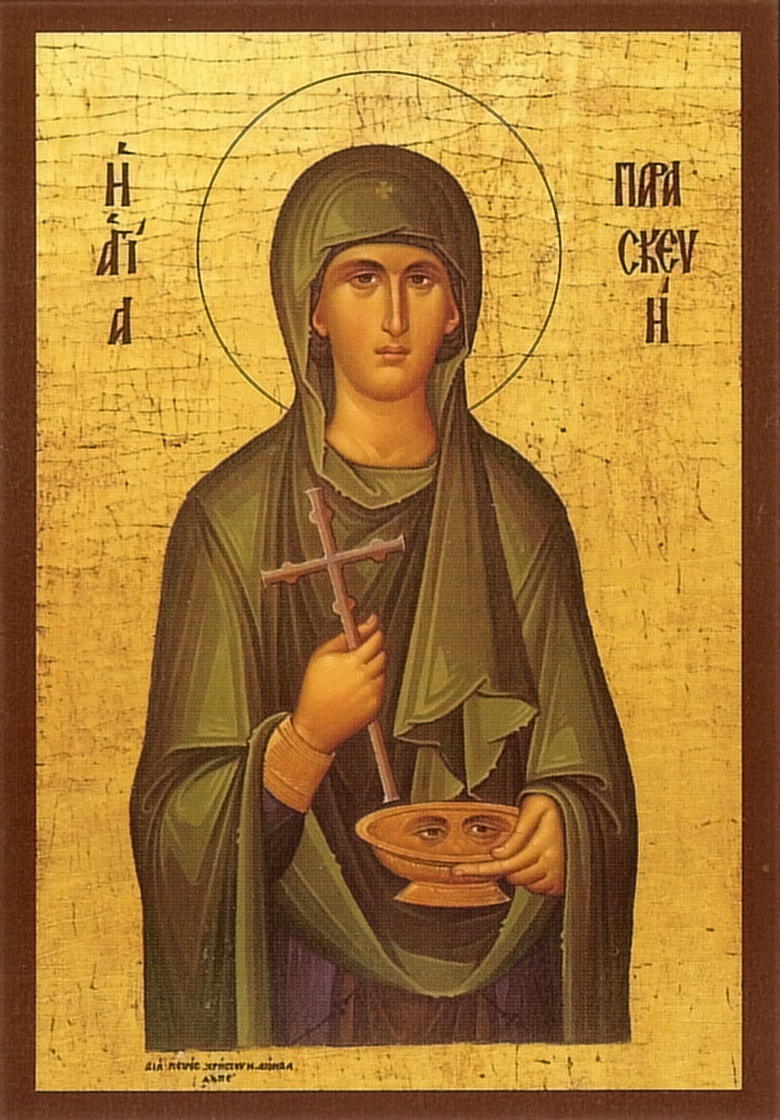
St. Paraskevi the Great Martyr (source)
  
Homily on St. Paraskevi by Metropolitan Avgoustinos Kantiotes (+2010)
"A Bedrock of Virtue"
St. Paraskevi was not an ordinary woman. She was a spiritual meteor, a bedrock of virtue, unshakable amid the ocean of the corrupt community.
  
She implemented that which Christ said, that: “He who hears my words and keeps them resembles a house built upon the rock, and though the rains came and the winds and the rivers fell upon it, the house was not shaken.” (Matthew 7:24-25) And St. Paraskevi was a bedrock of virtue. Foamy waves fell upon her, the greatest waves of life.
  
First, the wave of corruption fell upon her. She was not born in a small village. She was born in the most corrupted city, which in the Holy Scriptures is called the Babylon of the world due to its corruption (Revelation 17:5). She was born in Rome, in a suburb of Rome. But however, she remained uplifted. She was a lily among the dung of her community.
  
Let us all hearken to this, for when we see some woman being led astray, we say: “The community is responsible.” Yes, the community is responsible, I don't deny this. But she herself is also responsible. Give me a woman who loves Christ like St. Paraskevi, and throw her into the most corrupted community, and no wave and no devil could shake her.
  
As soon as one wave left, a stronger wave fell upon her: the wave of orphanhood. This wave is terrible. St. Paraskevi was orphaned of her father and her mother. Because of this she is a protector of orphans. She was orphaned at that age when children could become prey to unscrupulous traffickers who try to exploit them. But she stood tall even while an orphan. She had within her a great fervor for holiness, the life of virginity and grandeur.
  
Woe to the woman who does not have these great desires. No matter how high she climbs, no matter how many qualifications she has, she is deplorable. It is better to be an unlettered villager, which is like a lily, like the flowers that grow in the crags of the rocks of our homeland.
  
Therefore, the waves of corruption and orphanhood fell upon her, but she remained untouched. Because of this I call her a rock. Furthermore, another rock fell upon her, that of money, of wealth. After the death of her pious parents, she remained the sole inheritor of their vast property, which they left to her.
  
Every other girl would think differently. One might buy silken clothes, one might go to dances and gatherings, one might run right and left, would go on trips, would experience the spirit of the sinful life. St. Paraskevi however did the opposite.
  
Money is a great temptation. It is better to be a blessed poor person. Thrice-blessed are little huts, more than great homes. Because in huts dwell diamonds, while in the palaces and the large homes dwell many times prideful souls, who do not love Christ.
  
Money fell into the hands of St. Paraskevi. But she did what St. Anthony did, who had also inherited vast property. He went into church one day. His ear hearkened to the Priest who was reading the Gospel: “Sell your goods and give them to the poor.” (Matthew 19:21) Sell everything and give them to the poor. Anthony heard this. And he did not say that Christ was saying this to others. He distributed his property to the poor. As he hearkened to the words of Christ, so did St. Paraskevi. She kept only a small amount, and with this she founded a small sisterhood of orphan women virgins, who were dedicated to preaching, to enlightenment and to philanthropy.
  
So many foamy waves fell upon St. Paraskevi. Finally, the red wave of blood fell upon her! It was a time when only one would be heard to be a Christian, and one would be put in prison. They seized her at that hour when she had gathered the girls together to teach them. They led her before the judge. They asked her: “Are you a Christian?” She responded: “I boast that I am a Christian.” “We give you,” they said, “three days time to deny Christ.” “No,” the Saint responded, “I don't need time to decide. From this instant I dedicated to sacrifice my life for Christ. Do whatever you wish.”
  
And her martyrdom began. They threw her in a dungeon in the prison. They whipped her with bullwhips. They threw her to the wild beasts. They threw her into a cauldron with burning tar and oil. She endured many forms of martyrdom, but all of these she conquered through the power of Christ.
  
At the end, her hour came. They took her to a temple of the idols with statues of the false gods. She knelt, closed her eyes and made a mystical prayer to God. Immediately, there was an earthquake. The statues fell to the earth and became dust.
  
They couldn't stand it anymore. Thousands of barbarous hands of the idolaters seized her, took her outside and to the place of execution. Her face was shining like the sun. She knelt, prayed and thanked God. Finally, she was beheaded by a Roman soldier. And while her precious head fell down, and her blood watered the earth, her soul, white as a dove, flew to the heavens.
  
St. Paraskevi the Great Martyr (source)
  
Since then, how many years have passed! But as long as the world will exist, the name of St. Paraskevi will remain unto eternity. For: “The memory of the righteous is unto eternity.” (Psalms 111:6)
  
My brethren, St. Paraskevi is an example for all of us. But foremost, she is an example of a virtuous life and faith for women and young people. In this age of great corruption, she is the example and the mirror for virtue for womanhood
  
We live in a time of Babylon, a time of the Apocalypse, when the devil is roaring. He tries to strike the whole world. But most of all, he rabidly fights to strike and to soil girls and women. He wants not a single girl to remain unsoiled.
  
He fights we terrible magazines and newspapers. He soiled our girls with terrible brochures, with movies, with TV shows, which are schools of crime and dishonor. He soils them with mixed baths, with terrible photographs, with corrupting dances, with parties. The day will come when you will not find a pure girl. What will we do?
  
To arms, my brethren, to arms! Not to physical weapons, but to spiritual ones. Fathers, mothers, look towards the honor of your girls.
  
I'm finished, but rather, I'm not yet finished, because I want to be paid. What payment? Money? I am a monk and I leave that to you. I will not finish my homily unless my soul is satisfied.
  
Do you want your homes to be blessed and your girls to be secure? Today, the feast of St. Paraskevi, I entreat you all to do three things. First, go straightaway to your home, and look everywhere to find terrible articles and pictures, and gather them to light them with a holy fire to burn them all. Second, I recommend to all of you to go buy the life of St. Paraskevi and an icon of hers to hang in your home, and speak to your children: “My daughter, my child, become like St. Paraskevi.” And the third thing? Having done the first two, light a candle for the wayward women, those who live in filth and dishonor, and say to St. Paraskevi: “St. Paraskevi, you who are a lily of heaven, help these women of Greece, the women of the whole world to return near the Panagia, near to God, near to Greece, so that we might all have the protection of the Holy Trinity”, Whose blessings I pray might be with you all. Amen.
  
+Bishop Avgoustinos
(homily delivered in Chaidari, Athens, before 1967)
  
(amateur translation of text from source)
  
St. Paraskevi the Great Martyr (source)
  
Through the prayers of our Holy Fathers, Lord Jesus Christ our God, have mercy on us and save us! Amen!

Saturday, November 1, 2014

Homily on the Parable of the Rich Man and Lazarus, by Metropolitan Avgoustinos Kantiotes


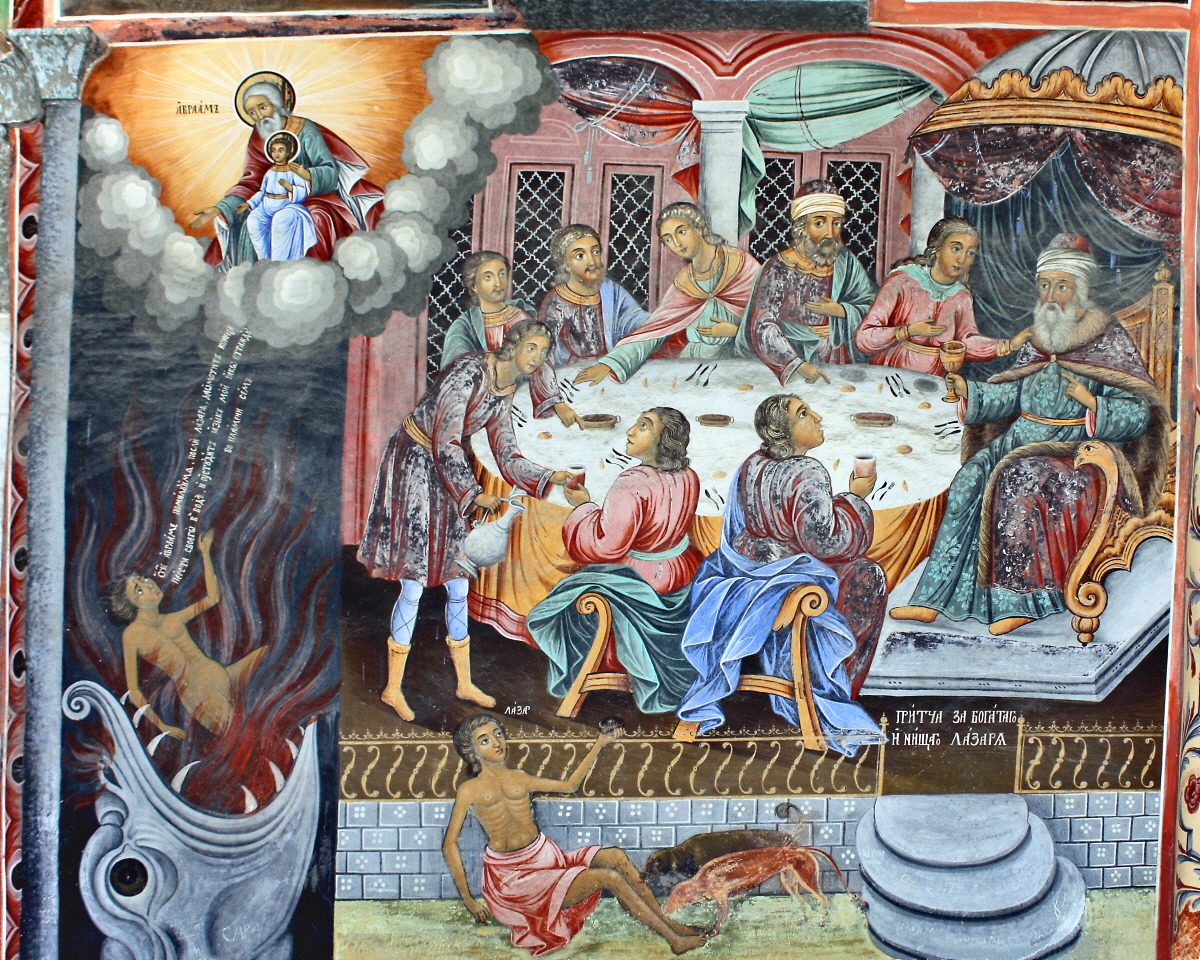
The Parable of the Rich Man and Lazarus (source)

Homily on the Fifth Sunday of Luke (The Parable of the Rich Man and Lazarus - Luke 16: 19-31), by Metropolitan Avgoustinos Kantiotes of Florina (+2010)
"Life beyond the Tomb"
Many things, my beloved, make man afraid. But that which frightens him more than anything is death. Even the word “death” alone brings trembling. Death is a great mystery!

Everyone, more or less, has the question: what happens after death? Is there anything beyond the tomb, or does life end there, and man is extinguished?
The question is an important one. If we believed that life ends in the tomb, then man would be free to do whatever he wishes: to sin, to fornicate, to commit adultery, to break the greatest rules, as long as he evades the eyes of the police and justice. If, however, there is life beyond the tomb, then man must count how he lives in this life, according to the voice of his conscience and the will of God.

To the question as to what is there after death, the answer is given us by today’s Gospel, the beautiful Parable of the Rich Man and Lazarus, which you just heard. What does it tell us?
There was a rich man, who had all of the good things from God. But all of these (houses, fields, everything else), he used for himself alone. He was a selfish self-seeker, and a worshipper of the flesh. He had the best clothes, wore expensive outfits, which only kings would wear, and ate the best food and drank the best wine, and spend his days in his great home. There were people playing music every night there, and sinful women danced unethical dances. Thus he spent his life, “rejoicing radiantly every day” (Luke 16:19). He did not give meaning to anything else.

At his door lay Lazarus, a poor and sick man, alone and abandoned, whom no one gave even the shelter of a roof, or medicine, or any other human help. The rich man never opened his door to show him hospitality, and he tried to survive on the crumbs that fell from the table of the rich man. He was full of wounds, and the dogs licked his wounds. Thus he lived.
But one day, the rich man, who thought that he would live as long as the mountains, heard a knock at the door. Who was it? Death! This is the dark visitor, who comes at an hour that we do not expect him, and seizes old and young, rich and poor, and leads them to the other world. He died, therefore. And his body became the food for worms and odor, and his soul went to Hades, where he sensed the reproaches of his conscience. And he would have preferred, as the Blessed Chrysostom says, to be stung by a scorpion, rather than experience the sting of the conscience. This he learned, when he was in the other world.

Where he was, the rich man sensed a far away other place, a place of light and beauty and joy: Paradise. And he sees in the heart of Paradise, in the bosom of Abraham, whom? Lazarus, the poor man, together with the righteous. Then his soul cried out and said: What did I suffer, why did I believe that there was not another world? And he entreated Abraham for two things. One, to send Lazarus to refresh him with one drop of water, for as he said, he was burning in that abyss. And the other, for Lazarus to go to the world below, to inform his five brothers, that they should remember their ends. But Abraham did not answer his entreaties. He said that there was a chasm between them: “between you and us there is a great chasm that was set” (Luke 16:26). There is no bridge to join the abyss with Paradise, and furthermore, there is no need for anyone to go to the world below, because they have the Scriptures, which bear witness to the other world.
Therefore, my brethren, there is another life. If someone would ask this today, he would find that the majority of so-called Christians do not believe these. What years we are living in! In years past, there were no radios or televisions, and people lived in huts. But within these huts they lived like angels, like holy men, like Lazaruses. Now, God has given them money. Those blessed years, each would wish each other “Good Paradise”. Today, does anyone hear anyone say to another “Good Paradise”? Now, we don’t believe. Children get such an education from schools. In one village, there was a 90 year old woman, who was in danger of dying. Her good spiritual father went to her and told her: “My good Lady, have you ever confessed?” “Never,” she replied. “Have you communed?” “A few times.” “Do you go to church?” “Not much.” “Why, because you are getting ready to go to the other world.” “Bah,” the woman said, “these are myths.” “My Lady, who told you that these are myths?” “My one grandson, who went to university in Thessaloniki, came and told me that there is nothing after death, that man is just physical, flesh and bones…”

Thus faith in the other world is uprooted. To such, the Gospel confirms that that world exists. “And who saw it?” you might say. But have you seen America? Have you seen Australia? Have you seen Canada? Someone else told you that they exist, and you believe. If someone then told you that they did not exist, you would laugh. Thus, as surely as there is an Australia, as there are stars, as this place exists, there is surely the other life, for which man was fashioned. Who confirmed this for us? Christ Himself. And if we do not believe in Christ, who should we believe, the devil?
Therefore, as it is certain—utterly certain that there is another life, what should we do?

First, we should think that the souls will continue to live on there, and that there will come the day when the Lord will stand in judgment inexorably of all, and “those who have done evil” will go to the eternal abyss, but “those who have done good”, to eternal Paradise (John 5:29). You should believe this. You don’t believe this? You are not a Christian, you are a naturalist. You only speak of physical things, and that there is only matter that exists. But man, however, is not just matter.

Second, we should prepare ourselves, we should be ready. We do not know the hour of our death. As the thief does not inform when he will come to break in, it is unknown when death will take us. And when it is time to travel, it is important to have prepared beforehand, and have your ticket in your pocket for when they ask it of you, for without a ticket, you are going nowhere. Our ticket is what? Faith in Christ, our good works, love, philanthropy, showing compassion, whatever is good and beautiful.
I will end with a story. Once, there was a king who had the mindset of the Rich Man in today’s parable. He did not believe in the other world, he partied, wasted time, participated in orgies. In that palace, there was a court jester. What does this mean? They did not have theaters and movies back then, so they had jesters for entertainment. He made the king laugh with the jokes that he said. And he was part of his personal entourage. One day, the king told him: “Take this cane, and I give it to you like a prize. If you ever find someone more senseless, more ridiculous, more wretched than you, give it to him…” He kept the cane. After some years, the king got sick, and was bedridden. He called the doctors, nothing. He took medicine, nothing. He was approaching death. Then, the jester came to him for the last time. “King, what is going on?” he asked. “I am not well. I am leaving for a great journey,” he replied. “And when will you return? he asked.  “I will never return again.” “Have you made any plans, have you prepared?” “No.” “Then, I have found the most wretched one in the world. Take the cane!”
Because of this, my beloved, let us close our ears to the faithless, and let us believe what our Church tells us: “I look for the resurrection of the dead, and the life of the age to come. Amen” (The Creed) Let us be ready, wherever we are, for death, that we might go to the other world, where are the saints and the angels, and where is Christ, the King of the Ages. Amen.
+Bishop Avgoustinos
(preached in the Church of Sts. Peter and Paul, Petron-Amyntaios, 10/30/1983; amateur translation of text from source)
  
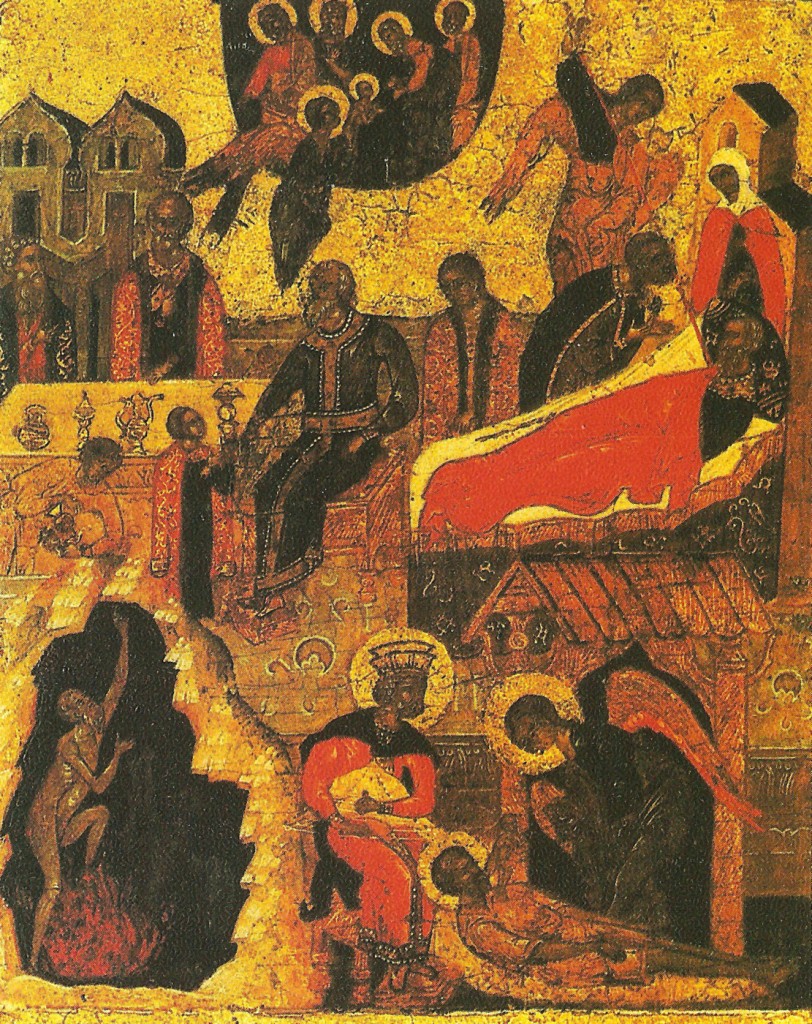
Icon depicting the Parable of the Rich Man and Lazarus (source)
  
Through the prayers of our Holy Fathers, Lord Jesus Christ our God, have mercy on us and save us! Amen!

Saturday, June 28, 2014

St. Isaac the Syrian: The commandments of God are greater than all the treasures of the world

Jesus Christ, the "Pearl of Great Price" (source)
 
The commandments of God are greater than all the treasures of the world, and for whoever keeps them, God is found within them. To men, poverty is abominable, but to God, the prideful soul and the high-minded and conceited nous is more abominable. Wealth is honored by men, but God honors the humbled soul!
-St. Isaac the Syrian
   
(amateur translation of text from source)
 
Through the prayers of our Holy Fathers, Lord Jesus Christ our God, have mercy on us and save us! Amen!

Sunday, October 30, 2011

Selected Quotes of the Fathers on the Parable of the Rich Man and Lazarus

The Rich Man at banquet, and the poor Lazarus, whose sores are being licked by the dogs (http://www.srpskoblago.org/Archives/Decani/exhibits/Collections/PublicMinistry/CX4K2408_l.html)

Selected Quotes of the Fathers on the Parable of the Rich Man and Lazarus (Luke 16:19-31)
"We must observe also, that among the heathen the names of poor men are more likely to be known than of rich. Now our Lord mentions the name of the poor, but not the name of the rich, because God knows and approves the humble, but not the proud."
St Gregory the Great, Pope of Rome

"Lazarus is interpreted, "one who was assisted." For he was poor, and the Lord helped him.
St John Chrysostom

"This discourse concerning the rich man and Lazarus was written after the manner of a comparison in a parable, to declare that they who abound in earthly riches, unless they will relieve the necessities of the poor, shall meet with a heavy condemnation. But the tradition of the Jews relates that there was at that time in Jerusalem a certain Lazarus who was afflicted with extreme poverty and sickness, whom our Lord remembering, introduces him into the example for the sake of adding greater point to His words."
St Cyril of Jerusalem

But the insolence and pride of the wealthy is manifested afterwards by the clearest tokens, for it follows, and no one gave to him. For so unmindful are they of the condition of mankind, that as if placed above nature they derive from the wretchedness of the poor an incitement to their own pleasure, they laugh at the destitute, they mock the needy, and rob those whom they ought to pity."
St Ambrose, Bishop of Milan


"Now if the wearing of fine and precious robes were not a fault, word of God would never have so carefully expressed this. For no one seeks costly garments except for vainglory, that he may seem more honorable than others; for no one wishes to be clothed with such, where he cannot be seen by others."

"And here we must narrowly watch ourselves, seeing that banquets can scarcely be celebrated blamelessly, for almost always luxury accompanies feasting; and when the body is swallowed up in the delight of refreshing itself, the heart relaxes to empty joys."

"But what means it, that when in torments he desires his tongue to be cooled, except that at his feasts having sinned in talking, now by the justice of retribution, his tongue was in fierce flame; for talkativeness is generally rife at the banquet. "
St. Gregory the Great, Pope of Rome


"It may here be observed, that all who are offended by us are exposed to our view. But the rich man sees Lazarus not with any other righteous man, but in Abraham's bosom. For Abraham was full of love, but the man is convicted of cruelty. Abraham sitting before his door followed after those that passed by, and brought them into his house, the other turned away even them that abode within his gate."

"He [the rich man] died then indeed in body, but his soul was dead before. For he did none of the works of the soul. All that warmth which issues from the love of our neighbor had fled, and he was more dead than his body. But no one is spoken of as having ministered to the rich man's burial as to that of Lazarus. Because when he lived pleasantly in the broad road, he had many busy flatterers; when he came to his end, all forsook him. For it simply follows, and was buried in hell. But his soul also when living was buried, enshrined in its body as it were in a tomb."
St John Chrysostom


"And here we must remark what fearful sufferings are heaped upon the rich man in flames. For in addition to his punishment, his knowledge and memory are preserved. He knew Lazarus whom he despised, he remembered his brethren whom he left. For that sinners in punishment may be still more punished, they both see the glory of those whom they had despised, and are harassed about the punishment of those whom they have unprofitably loved."
St Gregory the Great, Pope of Rome

"All this then is said to Him because he chose the happiness of the world, and loved no other life but that in which he proudly boasted; but he says, Lazarus received evil things, because he knew that the perishableness of this life, its labors, sorrows, and sickness, are the penalty of sin, for we all die in Adam who by transgression was made liable to death."
Blessed Augustine

"He says, You received good things in your life, (as if your due;) as though he said, If you have done any good thing for which a reward might be due, you have received all things in that world, living luxuriously, abounding in riches, enjoying the pleasure of prosperous undertakings; but he if he committed any evil has received all, afflicted with poverty, hunger, and the depths of wretchedness. And each of you came hither naked; Lazarus indeed of sin, wherefore he receives his consolation; you of righteous wherefore you endure your inconsolable punishment; and hence it follows, But now he is comforted, and you are tormented. "
St John Chrysostom

"Whatsoever then you have well in this world, when you recollect to have done any thing good, be very fearful about it, lest the prosperity granted you be your recompense for the same good. And when you behold poor men doing any thing blameably, fear not, seeing that perhaps those whom the remains of the slightest iniquity defiles, the fire of honesty cleanses."
 

"Whom does this rich man represent, this man so richly dressed, who enjoyed all those daily banquets? Is it not the Jewish people [or in another sense, hypocritical, false "Christians", for that matter], who made a cult of exterior things, using the delights of the law which they had received, for vain motives, not for true profit? And whom does Lazarus signify, covered in wounds, if not the Gentile peoples? These, when converted to God, were not ashamed to confess their sins, that is to say, they had many wounds and open sores. As when some infection comes from within the body to ulcers of the skin, so showing itself exteriorly, so when we confess our sins, it is in a sense an outbreak of our sores. In confession we manifest in a very profitable way the virus of sin which had concealed its venom within the soul. Exterior wounds bring to the surface the festering sore beneath, and when we confess our sins, we uncover this hidden sore. But the unfortunate Lazarus wished only to eat of the crumbs that fell from the rich man's table, and no one would give him any, because those proud people disdained to admit the Gentiles to the k
nowledge of their law.
St. Gregory the great, Pope of Rome

(http://www.orthodox.net/questions/luke_16_19-31_parable_rich_man_lazarus_22sunape.html)

  
Russian icon depicting the Parable of the Rich Man and Lazarus (source)
  
Through the prayers of our Holy Fathers, Lord Jesus Christ our God, have mercy on us and save us! Amen!