Showing posts with label Metropolitan Avgoustinos Kantiotis. Show all posts

Wednesday, September 16, 2020

Homily on Sts. Sophia and her Daughters, by Metropolitan Avgoustinos Kantiotes

St. Sophia and her daughters: Sts. Faith, Hope and Love (source)
  
Homily on Sts. Sophia and her Daughters, by Metropolitan Avgoustinos Kantiotes
After the feast of the Exaltation of the Cross, our Church celebrates, my beloved, the memory of Saints Sophia and her three daughters: Faith, Hope and Love.

St. Sophia was born, according to the Synaxarion, in a great city of Italy. She lived during the era of early persecutions, which, as is known, lasted for at least three centuries.

During that era, for one to be a Christian, it was costly. It cost one positions, honors, money, and even this life. Millions were sacrificed then for the love of Christ. With this heroic spirit, St. Sophia lived as well, and thus raised her daughters.

It is not possible to not rouse the evil of persecutors. They seized her, therefore, together with her daughters, and led them before the governor. He gave them the opportunity of three days in order to make a response, and possibly change their minds. But, after three days, the mother and her daughters remained unshakable in their dedication towards our Lord Jesus Christ.

The mother had fear that her daughters might deny Christ, because they were very young. The first, Faith, was twelve years old. Hope was ten. and Love was nine. Despite this, their weak flesh was strengthened by the grace of God, and they endured martyrdom with unprecedented boldness.

They locked them in prison. They beat them with whips. They pierced them with fiery arrows. They threw them in cauldrons of boiling water. However, like the Three Youths in the Furnace, thus, these three girls hymned God, as those around heard the hymn harmoniously: "Praise ye the Lord, and exalt Him beyond measure unto all the ages."

In the end, the three were beheaded by the sword of the tyrant. Their martyrdom was followed by that of their holy mother.

St. Sophia and her three daughters teach us, my beloved, that, if we wish to be faithful Christians, that Christianity will cost us. And the more faithful we are, the more it will cost us.

Many of us have become successful in this world. We find a myriad of ways to justify our seemingly proper and scandalous station. And later with think that we are Christians. Woe to us, if we do not set as a foundation the heroic mindset which defined the holy martyrs. These three little girls should censure the world. And their mother, St. Sophia, censures those mothers who are upset and tremble, thinking that through their fasting, prayer and reading, that the bodily strength of their little girls will be lessened.

The Martyrs are the greatest censure of our lukewarm, miserable and thrice-wretched Christianity.

However, St. Sophia and her three daughters teach us not only through their martyrdoms, but also through their names.

The name "Sophia", what does this teach us? "Wisdom", we hear in Church when the Priest holds the Gospel and raises it, showing it to the whole multitude of the faithful. The Gospel, in other words, is full of wisdom. There is no wiser book. Wisdom is Christ Himself, the Logos of God. Do you remember the wondrous apostolic reading which we read three days ago, on the feast of the Cross? He said: "But we preach Christ crucified, a stumbling block to Jews and folly to Gentiles, but to those who are called, both Jews and Greeks, Christ the power of God and the wisdom of God." (I Corinthians 1) Christ is wisdom, truth and life.

St. Sophia, therefore, through her name, brings to mind that we must seek from God the illumination of divine wisdom. The names of her three daughters bring to mind the three great theological virtues.

Faith! Awesome power, light, a star, foundation and root. Oh, if there were within our hearts this virtue! We could even bring down the stars from the heavens to the earth, and we could melt the mountains, and even the greatest hindrances would be solved. Do we have faith? If we had faith, 100% faith, the world would be different. But today, people don't even believe 1%. Take almost any Christian and ask him, and you would see that he is full of doubts, totally full of "ifs." If one has an "if", then you don't have faith. Faith is to believe 100% in reality that which our holy Church teaches us.

Hope also brings to mind that, in this world, we have a need for life-giving hope, which would warm us like the sun. The Christian who believes that God is a loving and nurturing Father, an almighty Father and all-wise, he would hope that all those things that God promised, all kinds of great and uplifted and indescribable good things, He will give to him.

And finally, Love, with her name reminds us of the fulfillment and the crown of the virtues. In this world of hatred, egotism, greed, and other evils, love today has grown cold. It is truly a terrible thing, as the sacred Chrysostom says, for us to see the sun be quenched one day. But it is even more terrible for love to be quenched. It is better for the sun to be quenched than for love to be quenched, because it is the sun for our souls. And Christ Himself prophesied, that there will come a cursed day, in which the sun of love will be quenched, and cold and frost will reign upon the earth. (Matthew 24:12)

We are speaking about love, but we don't possess love. Love is a heavenly thing, which is ineffably joined with humility, with obedience, with discipline, the great virtues. It is not something indiscriminate, like ecumenists reach, like worldly people teach. Love differs from love. There is carnal love, love of money, love of small and meaningless things. And there is furthermore love for one's father and mother, which, in the final analysis, also contains something physical. The love which Christ brings to the world, however, has the wings of an eagle, and flies to the third Heaven, and makes man a Cherubim and Seraphim.

Love, therefore, not only for relatives and friends, not just towards Christians, but love for the whole world. Love, even for those who crucify you! For we have Christ as our prototype, Who is love crucified. This love we must have as well.

My beloved, if one were to ask now which of these three virtues are the greatest, the greatest is the third, love. Its beauty is indescribable. The Apostle Paul paints all of this in his beautiful sayings on love, which we have properly heard in vain to this point. "If," he says, "I spoke in the tongues of men and Angels," even if I have done miracles, even if I distribute my earthly goods, even if I go to martyrdom and shed my blood, "and I have not love, then I have become a noisy gong or a clanging cymbal." "I am nothing." (I Corinthians 13:1-2)

These, my beloved, I have to tell you. Believe, in this age of faithlessness. Hope, in this age of hopelessness. Love, in this age of hatred. And first and foremost, keep love, which, as the Apostle Paul says, remains eternally. (ibid 13:7)

For what is Paradise? Is it rivers, crystalline springs? Is it the songs of the Angels, the Cherubim and the Seraphim, is it the Saints, the Martyrs, is it that whole and beautiful world, and indescribable good things? It is these things. But first and foremost, it is love, the love of God towards man. If I took out love from Paradise, immediately Paradise would become Hell.

That Paradise we ourselves should seek, if we sense the dawn of love, if we believe unshakably in the Lord, and if we have steadfast hope in the promises of God unto the ages.

Then, in the heights of Heaven, together with St. Sophia and her three daughters, Faith, Hope and Love, we will hymn the Triune God, saying: "Praise ye the Lord, and exalt Him beyond measure unto all the ages."
(+) Bishop Avgoustinos
Recorded from a homily that occurred in the Chapel of St. Sophia of the Orphanage of the "Agape" Brotherhood of Florina on 9/17/1970, (source)
  
Sts. Sophia, Faith, Hope and Love (source)
  
Through the prayers of our Holy Fathers, Lord Jesus Christ our God, have mercy on us and save us! Amen!

Sunday, September 13, 2020

Homily on the Meaning of the Holy Cross, by Metropolitan Avgoustinos Kantiotes

The Holy Cross of Christ (source)
 
Homily on the Meaning of the Holy Cross, by Metropolitan Avgoustinos Kantiotes
My beloved, what does the Cross teach us? Take a chalk and write, like children do in school, 2+2=4. Thus, the Cross is the "equal sign", but what is it? Do you think that it is simply a piece of wood that we venerate and are saved? You are mistaken, because this is not how it is in reality.

The Cross equals forgiveness.
Because upon the Cross, Christ forgave His murderers. Are there today some here in church who are at odds with each other? Are there women who hate their mothers-in-law? Are there houses where people don't speak with each other? Are there neighbors that don't greet each other? Is there hatred? Well then, the Cross tells us today: "Forgive!" If you don't forgive, then don't approach the Cross, don't venerate it. When, within your heart, you have bitterness, you have this serpent of hatred, you can't approach the Cross. Because the Cross means forgiveness. You must forgive even your greatest enemy.

The Cross equals truth.
Even if they put a knife to your throat, and slaughter you, you should speak the truth. Not in the sense that you go to court and raise your wretched hand upon the Gospel and take a false oath. Not like this. Christ was crucified for the truth. Whoever says lies, whoever goes to court and takes false oaths, he is not worthy to venerate the Cross. The Cross, therefore, equals forgiveness, the Cross equals truth.

The Cross equals humility.
No--even though you might have a very large home, or more money or lands or animals, or if you have children studying in school or if you have a beautiful wife, or whatever else you might do--you should not boast or feel proud. You are not a Christian! Humility! Humble yourself to say: I am nothing, I am a worm, I am nothing in this world. However, when you have pride and you boast and you show off your body and your job and your money, then you are not a Christian.

The Cross equals love.
Is your neighbor hungry? Give him a piece of bread. Is he thirsty? Give him a glass of water. Is he naked? Give him a shirt to wear. Go and console him and wipe away his tears. This is Christianity. Not when you have everything and your neighbor has nothing.

The Cross equals sacrifice.
As Christ sacrificed Himself, thus we must sacrifice ourselves. This is what the Cross means. If you do these things, then you are worthy to be called Christians. But you who dip your hands in blood, you who take false oaths, you who are unjust to the orphan, you cannot approach the Cross. The Cross casts you out.

Read the life of St. Mary of Egypt. On this day, she went to Jerusalem and saw the crowd going into the church and everyone--old, young, women, men--were going to venerate. She herself tried to approach the entrance. But some power pushed her back. She tried and second and a third time, but she was unable. Why? Because she was a sinful woman, and she worked in sin in Alexandria. Only after she repented, then she was able to enter the church and she became a Christian in reality.

The Cross, my beloved, creates presuppositions. We must live corresponding to the teaching of the Cross.

And something else: You should make your Cross properly. Because unfortunately, in our faithless years that we are living through, everything has become fashionable. Fashionable hair, fashionable clothing, fashionable shoes, fashion everywhere. Unfortunately many in Church do it out of fashion. Unfortunately you see scientists, congressmen, ministers, prime ministers, and none are doing their Cross correctly. That which they are doing is not the Cross. It joking and mocking. It is playing with God. Do not play with God. How will they understand that you are a Christian? By your Cross. When you make the sign of the Cross properly, you are doing a whole prayer. Therefore, do your Cross properly.

And when should you do your Cross? When you awake in the morning, do your Cross. Are you going to work? Do your Cross. Are you going to your field? Do your Cross. Are you sowing, returning from your field, entering your home? Do your Cross. Are you sitting at your dinner table? Do your Cross. Are you going to sleep? Do your Cross.

"Though I fall, I make my Cross
And have an Angel by my side."

O woman, are you baking? Make the sign of the Cross in the dough. Wherever you go and whatever you do, make your Cross. The Cross is the "protector of the whole world."
(+) Bishop Avgoustinos
Imera, Kozani, 9/14/1965
(source)
   
Through the prayers of our Holy Fathers, Lord Jesus Christ our God, have mercy on us and save us! Amen!

Monday, September 7, 2020

Homily on the Nativity of the Theotokos by Metropolitan Avgoustinos Kantiotes

The Nativity of the Theotokos (source)
 
Homily on the Nativity of the Theotokos by Metropolitan Avgoustinos Kantiotes
There was once a pious couple, Joachim and Anna. They believed and worshiped God and fulfilled His holy commandments. However, they did not have any children. Anna was barren, barren like stone or marble. Could a rose ever take root from a piece of marble? In the same way, naturally, from her womb it was unable for a child to come forth. And she was not only barren, but she was advanced in years, an old woman. She had reached the age in which women no longer bear children.

However, that couple prayed and entreated continuously. And God hearkened to their prayer, and Anna became pregnant. On December 9th, we celebrate the conception of St. Anna, and later, after nine months, on September 8th as we celebrate today, she brought into the world a grace-filled little girl, and named her Maria. The name Maria, after the name of Jesus Christ, is the sweetest in the world, and is always upon all of our lips. Maria means the Lady, the Mistress of Heaven and earth.

This, in a few words, is the story of her nativity.

The Nativity of the Most-Holy Theotokos is first of all, a consolation for childless couples. There are also couples today who, despite their wishes, cannot bear children. They run to doctors and midwives, they run to clinics, travel overseas, and spend an incredible amount. They even run to wizards and witches--a great sin. However, they do not bear a child. But God can work His wonder. What wonder? Let the faithless disbelieve, we believe. I know a couple who tried for 20 years to have a child, and suddenly, the woman became pregnant. A wonder, that kept even the physicians and famous midwives speechless, how it could be possible for a barren woman to bring forth a child. Therefore, today as well this miracle continues to occur as it did in the Old and New Testaments, and today we have women who have given birth with faith in God.

But when a woman, for reasons that are known only to divine providence, does not bear a child, she must never loose hope. What does St. Kosmas say? "You don't have a child to raise? Find an orphan near you, feed him, clothe him, take care of him, and your reward will be great."

This is a consolation therefore to those who do not have children, but also it is a teaching for those who have children. This is very important and it cannot be exhausted, I will only add the following.

The child, you wrongly call your own. Of course it is yours, but chiefly, it is of God. What a great mystery! Do not look on this with disdain. For during birth the laws of nature work as God ordained. However, as from a seed God gave the power to bring forth a whole tree, thus, through the small and humble nature of a woman and a man--I do not say this disparagingly--was given the power of new creation. Man, the father and the mother, are co-creators with God. And the child that appears is a wonder.

As the earth in the beginning was "without form and void" (Genesis 1:2), thus is the child within the womb of its mother. What is it in the beginning? An embryo. But how, over the course of nine months, does a heart form, then eyes, hands, feet? And when it is time, it falls from the womb like fruit from the tree. A fruit is a miracle. A child is a miracle. It calls for our wonder. I knew a man who was faithless. I tried to convince him to believe with proofs, but he remained faithless. When he got married and his wife bore their first child, and he heard its cry, then he came to believe in God! Because of this, many times faithless people do not choose to have families or get married.

Therefore, have you given birth to a child? You have a responsibility. And like Joachim and Anna made provisions for the proper raising of the Most-Holy Theotokos--and Panagia owes much to her parents--thus parents must care for their children. As the sacred Chrysostom says: "I will call you a father not when you have born a child, but when you have raised the child as God desires." The first word that the child should learn is the word "Christ". The first movement that they should learn with their little hand should be the sign of the Cross. The first lesson they should learn should be to kneel before Christ to do their little prayer. And when you sit at the table, you should say they we do not eat until we pray. And at night, when the stars come out, they should kneel together for family prayer. And if they show forth some evil deed, some weakness, you should not be complacent. You should correct him. And if he says a bad word, you should advise him. Thus, you will teach him to believe in God.

Therefore, be careful. The child from a young age learns either good or evil. I will give you two examples and close. In one village of Grevena, I met someone who, while at that time the whole village was blaspheming, he did not blaspheme. This made an impression on me. I called him and asked: "How did you learn not to blaspheme?"
He said "When I was a small child, I heard a blasphemy. When I went home I repeated it senselessly. As soon as my grandmother heard it--it was winter then--she took a coal from the fire and burned the tip of my tongue. Look at my tongue," he said, "it is still burnt. From then on, I learned not to blaspheme."***

[***Note: Neither the Metropolitan nor I am encouraging this type of corporal punishment or torture of anyone (God forbid!). But his point is how seriously this child's grandmother took the roots of sin in the family, and how she sought to correct it in the way that she knew. May we, with gentleness and firmness and love (not out of anger), correct bad habits in those we are responsible for, when they first appear, teaching them the consequences of our actions before God.]

And hear another example. When I was traveling through Evia, in one village I heard through a wall a blasphemy. Such a blasphemy I had never heard in my life. I looked, and what did I see? Unbelievable. A father had at his knees a grace-filled child two or three years old, and was teaching him to blaspheme God...How do the stars not fall upon us?!

Therefore, parents have a great responsibility. Have you given birth to a child? You must take care to make him a child of God. Because he will either become a child of God, or a child of the devil. It is better to not bear a child, than to raise him to be a criminal. When the child is raised as God desires, as Joachim and Anna raised the Most-Holy Theotokos, then, one day, people will say: "Blessed parents, God bless the father and mother that bore such a child!" Otherwise, one would hear cursing. Therefore, it is not enough to have children, even to have many children, but, as the Church prays, that they might have many children and "Kalliteknoi" [A beautiful word meaning the bearing of beautiful and grace-filled children.]

This is a very important issue. I will not exhaust it with only a few words. Parents and children, let us entreat God that we might become mothers like St. Anna that we are celebrating today, that we might become fathers like St. Joachim, that we might become women like the Virgin Mary. Then, this earth would be transformed. If not...even though I hope in God, our nation will be saddened.

O mothers, O our holy grandmothers, with nothing but a simple barley loaf or a pita in your hands, make the sign of the Cross and break and distribute it. My child, make our Cross and say..."We ate pita and barley bread, and it tasted like butter, because it had the blessing of God." Today, we eat meat continuously, and illnesses have multiplied. We have become the biggest meat-eaters. And the result? The children from a young age die of heart disease, and run to London for surgeries.

O, our holy faith! Whatever you teach, whatever you preach, are holy. And whoever goes against the Church, against the bonds of the Church, whoever he is, small or great, will be turned to ashes. Because of this, remain close to the Church! Remain steadfast near God, and you will have the blessing of the Most-Holy Theotokos, and all the Saints. Amen.
(+) Bishop Avgoustinos
(From a sermon delivered in Kato Kleinai, Florida, on September 8th, 1986, source)
   
Through the prayers of our Holy Fathers, Lord Jesus Christ our God, have mercy on us and save us! Amen!

Thursday, August 13, 2020

Homily II on the Dormition of the Theotokos by Metropolitan Avgoustinos

The Dormition of the Theotokos (source)
  
Homily II on the Dormition of the Theotokos by Metropolitan Avgoustinos Kantiotes (+2010): "The Glorious Dormition"

"Your glorious Dormition caused the Heavens to rejoice, along with the ranks of the Angels, while the whole earth is glad..." (Sticheron from the Praises of the Feast of the Dormition of the Theotokos

Panagia was a poor girl from Nazareth, from unassuming parents. She did not have anything that would bespeak of glory. Her nativity passed by unnoticed [by the world]. Humble was her entrance into the world, and humble was her life.

But while her entrance was humble, her exit was glorious, and righteous. For she passed throughout her whole life in purity, humility, and utter obedience to the will of God. Which other woman has a calling that could be reckoned with hers? Every [woman] gives birth to mortals, but she was made worthy to become the Mother of the Son of God. As St. Kosmas Aitolos preached: "There were thousands of thousands of women in the world, but none could be found to fill the side of Adam, except our Lady the Theotokos."

When Panagia gave up her spirit to her Son and God, the earth and Heaven were astonished. The burial of her sacred body had a unique grandeur. The Apostles were brought from the ends of the earth to Gethsemane upon the clouds. Myrrh-bearing women and the faithful people followed. An impious Judean tried to defile the sacred body, but was repulsed...

The earth, with her most chosen children gathered to bury the King's Mother. But what were the honors of the earth before the honors of Heaven? As she ascended to the Kingdom on high, she was given an exceptional reception.

The leaders of the Angels knelt to venerate. The Son received the Mother. And she stood and continues to remain at His right hand, interceding on behalf of sinners.

Humble was her entrance, glorious, all-glorious, was her exit. Are these a phantasy, are these a myth? No, a thousand times, no. Our holy Church confirms this, who ordained that today the Dormition of the Most-Holy Theotokos be celebrated. Today, most-beautiful hymns are chanted, with which the greatness of Panagia is praised, and especially, the event of her repose, of her Dormition.
  
Detail from the icon of the Dormition of the Theotokos (source)
  
Many, my beloved, are the lessons of this feast. We will limit ourselves to one thing only, one lesson, which is contained in the word which the Church uses to characterize the event of the repose of the Virgin. Her repose is not called "death", but "dormition". Why? Please pay attention.

In the language of the Holy Scriptures, death does not mean the disappearance of the human existence. No. At death there is a separation. The soul is separated from the body. The soul leaves towards the things above, towards the heavenly world of the spirits. This path is not fantastical, but is a reality, which is confirmed by the word of God. Then, what does the soul meet, how many tollhouses does it pass through, what censures does it undergo, we do not know in detail. The words of holy people, who saw the souls of the reposed pass towards the verdant meadows of Paradise, or towards the dark places of hell, shine some light on this, but this light is dim, and unable to satisfy people's curiosity. To man, through the Scriptures, it has been revealed that the soul that leaves the body does not die (see Luke 12:20, 16:23-26, 23:42-43). This is a fact and the Christian cannot deny this.

But while the soul of man, which has finished this station of his life, ascends as a spirit to the other world, the body, as physical creation is given away to corruption, to temporary corruption. For from this corrupted body, during the universal Resurrection [at the Last Judgment], there will come a renewed and incorrupt body, which will be united with the soul and they will live together unto the ages of ages.

Yes! The body will be raised. In anticipation of the Resurrection, death according to the Scriptures is called "dormition". The Prophet David "slept" (Acts 13:36). The Protomartyr Stephen "slept" (Acts 7:60). The Apostle Paul, when he speaks of those who have left for the other life, does not say that they "died", but he calls them "those who are sleep". "I do not want you to be ignorant, my brethren, concerning those who are asleep, that you might not grieve as the others do who have no hope." (I Thessalonians 4:13). Our Lord Jesus Himself called death "sleep". When He entered the house of Jairus and saw them weeping for the dead girl, He told them: "Do not weep. She has not died, but is only sleeping." (Luke 8:52, Mark 5:39) And regarding Lazarus He said that he had "fallen asleep" (John 11:11-15). And He proceeded to resurrect him, with such ease as if he were waking him from sleep.

Dormition! This word of the Scriptures should be sufficient to teach, console and strengthen Christians, at least those who hasten to churches to celebrate and feast at the "glorious", "all-sacred", and "dormition transcending death", of the Most-Holy Theotokos. Do you hear this, O you who celebrate? Panagia has not died, but has fallen asleep! Her body was buried, placed within the grave, but as the Church chants: "the grave and death could not hold her, for as the Mother of Life, she has proceeded to Life, Who dwelt within the womb of the Ever-Virgin." (Kontakion of the Feast of the Dormition) Panagia, shining forth with all the light of the virtues, "as arrayed in gold" (Psalm 44:10) has proceeded towards the Heavens. "Who", cry out the Angels, "is this that appears like the dawn, fair as the moon, bright as the sun, majestic as the stars in procession?" (Song of Songs 6:10)
  
The Dormition of the Theotokos (source)
  
Panagia, from the height of her glory, is heard to say to all Christians who are tempted here: "Faithful children of the heavenly Father, have strength. What do you fear? Death? But death is the gateway to the new life. Here on high where I am there is a new life, which no one on earth could even begin to imagine. This life is preordained for those who will live with faith and virtue. Here there is no partiality. My Son is the just Judge. When I was below on the earth, I heard voices that blessed me, for I was made worthy to become His Mother, and He said that, in the cycle of blessedness, it would not be me alone who gives Him birth, but for all those who hear Him and keep His word. For Christ is born spiritually in every soul who believes in Him and worships Him as the only Savior. 'Yea of a truth, blessed are those who hear the word of God and keep it.' (Luke 11:28) Therefore, I invite you all to the glory of Heaven."

As the Church chants, truly glorious was the Dormition of the Most-Holy Theotokos. Glorious was also the dormition of all the Righteous, who faithfully completed their missions. Each of them, as they left from this world, could say like the Psalm: "In peace I will lie down and sleep, and I awoke, for You, O Lord, have made me to dwell in hope." (Psalm 4:9) The antithesis occurs with those who did not love God and their neighbor, and did not fulfill their holy duties, and did not complete their mission, but were conquered by evils and passions, and trampled upon divine gifts, walling themselves off and making themselves unworthy of their holy calling, betraying the faith. Their dormition was not radiant, but dark, not glorious, but inglorious. Not radiant Angels, but dark demons were their fellow travelers during the exodus of their souls to the other world. For mourning and cutting are heard during the exodus of the unrepentant sinner. Who would not weep?

O Christians! Panagia had a glorious dormition. But we also must have a glorious dormition. Glorious through faith and virtue. May we receive even one laurel leaf from that glory! May the Lord, through the intercessions of the Most-Holy Theotokos, who proceeds to the Heavens, grant us an end like this. May the prayer of the Church be fulfilled for each of us: "For a Christian ending to our life: painless, blameless, peaceful, and a good defense before the dread Judgment Seat of Christ, let us pray."
(+) Bishop Avgoustinos 
(source)
  
The Dormition of the Theotokos (source)
  
Most-Holy Theotokos, save us!

Friday, July 31, 2020

Homily on the Holy Maccabees by Metropolitan Avgoustinos Kantiotes

Icon of the Holy Maccabees with their Mother St. Solomone, and their teacher Eleazar (source)
  
Homily on the Holy Maccabees by Metropolitan Avgoustinos Kantiotes: "Our Faith is True"
We will speak, my beloved, on the Holy Maccabees. They are a star cluster of nine stars, one being their teacher Eleazar, the second was their mother Solomone, and the other seven are her distinguished children of this large family.

These heroes lived in the 2nd century before Christ, during the reign of the King of Syria and Judea of one of the successors of Alexander the Great, Antiochos the Epiphanes (175-163BC). This man, a fanatical idolater, had endless hatred of the Jews, who were the only ones who believed in the true God. He tried with his whole being to uproot from their hearts their faith which had been given to them by Moses. And he slaughtered, slaughtering like a wild beast, more wild than a tiger or a lion. A beast might eat three or four people, but can't eat more. He, however, slaughtered 80,000 Jews, and blood poured through the streets of Jerusalem like a river. And in order to put an end to their religion, he organized an idol-worshiping feast. In the center of the city, he placed a great and large altar, and there sacrificed sheep and goats and bulls and rams, like the Jews would do typically, but--in order to corrupt them--he also sacrificed pigs, hundreds of pigs, to the gods of the idols. And in order to defile the Jews and to strike their religious consciences, he forced them to consume the meat. We must know that the Jews never ate pork. To this day, if you go to a Jewish home, they never eat pork. I won't go into the reasons that they do it, but in any case they continue to keep this.

The Jews fast. Do we? We also need to fast. And here I will make an aside. Are you a Christian, are you Orthodox? I'm not sure. If you were Orthodox, if you firmly believed in our Orthodoxy, you must keep the fasts. Which fasts? You should fast on Wednesday and Friday: Wednesday because on that day was our Lord Jesus Christ betrayed, and Friday, because on that day He was crucified. If you were Orthodox, you would fast during holy and Great Lent, and the other fasting periods, including January 5th, the day before Theophany, August 29th, the day of the Beheading of the Forerunner, and the Exaltation of the Precious Cross.

Do Christians fast today? Unfortunately, this holy practice seems to be going by the wayside. You can break whatever you wish, and you see people even breaking the fast on Holy Friday. During fasting periods, the meat markets are full and the restaurants at night dish out tons of meat. We [Greeks] have become among the largest meat-eaters in the Balkans. We even buy and ship in meat from Bulgaria and Serbia. All of this eating of meat is very serious for our health as well.

So the Jews therefore fasted, and to mock their fasting, Antiochos forced them to eat pork that had been sacrificed to the idols. First, he called the teacher Eleazar, who was an honorable priest. He told him: "I am 90 years old. Until now I have kept the fast according to the divine law, and I cannot even begin to think about abandoning our holy tradition..." He was seized by the soldiers of Antiochos, bound, and thrown into the fine. Thus, he gave up his soul to God.

After this, one by one he called the seven brothers, the Maccabees. He hold them: "Take pity on your youth." He told the first: "I will give you honor, glories, respect." "Keep your honors, I will remain in the home of my fathers/ I will never taste pork sacrificed to the idols..." Thus, the first said not. The same occurred with the second, the third, the fourth, the fifth, the sixth and the seventh. And after they all denied, each began their terrible martyrdom, which one shudders to even think about. Open the Old Testament to the end and turn to the book of Fourth Maccabees (5-12). Don't just read magazines and newspapers. If you are a Christian, read the holy Scriptures. You will say, I don't have time, or I'm tired...Good try!

Let me make another aside. I tell you to fast, but you don't fast. I tell you to read the Holy Scriptures, but you don't read them. The one you don't do, neither do you do the other. What Christian are you, can you tell me? I tell you to pray, but you don't pray. I tell you to confess, but you don't confess. I tell you to commune, but you don't commune. I tell you to go to church, but you don't go. You only go to church when you're invited to a sacrament [i.e. a baptism or a wedding]. Many go for a memorial service. But this is a sin. Because every church every Sunday is a memorial service. What memorial?  Not of our father or our mother. Every Sunday, we serve a memorial for the Lord. And if you go to the memorial of your father or mother, even more so should you go to the memorial of our Lord Jesus Christ. What does faith cost you? To the martyrs it cost terrible pains and death.

The Maccabees therefore said no, and began their martyrdom. A martyrdom that makes man shudder to read it, as is described in the Holy Scriptures. They put a trident between their eyes. Another they cut off his right hand. Another they cut off the left with a saw. Another they cut off his fingers. Another, they pulled off his nails. Another they raked his flesh with iron nails. Another they skinned him alive, like the butcher skins an animal... But it was as if nothing to them! They remained steadfast.

And in front of all of this, in the presence of the martyrdom of the seven children, who was there, I ask? Their mother, St. Solomone. O, what a mother! She was not at all like some mothers today who would say: "Eat, my child, a little meat, it's nothing..." Today, many mothers are only thinking of their children's bodies, their flesh, in other words. Above the body, they don't see anything else. St. Solomone was a unique mother, a historic mother, a rare example throughout the ages. "No, my children!" she said, "Do not pollute our religion, do not loose the crown of glory!" And their mother prepared them, her seven children, for a terrible martyrdom. It was their faith in God, and this faith showed her to be a heroine, a unique and grand and lady of a woman. How did she find the strength to support all her children to be sacrificed? Don't you think that she felt pain? Of course she felt pain. As her children were being martyred, and she saw them one by one being put to death in the most terrible manner, she suffered. She was pained for each separately, and for them all together. Her pain was greatly multiplied. Mothers, when their children get sick with a fever, they entreat God for the fever to flee from their children and to come to them instead. If, therefore, each child of St. Solomone was martyred once, then she was pained for each, and it was as if she was martyred seven times, multiplied by seven. And, having endured steadfastly and unshaken throughout this trial, in the end, she herself fell into the fire (IV Maccabees 17:1). Thus, they were all burned and became a sacrifice for the love of God, martyrs before Christ.

This, my brethren, in a few words, is the martyrdom of the seven Maccabee children, of their mother Solomone, and their teacher Eleazar. What does it teach us?

One lesson comes forth today. Our faith is not a myth. It is living and wondrous. We have the most true religion, the only truth in the world. Because of this, the Prophets prophesied and gave their lives, including the Maccabees in the Old Testament, and because of this, the Apostles and Martyrs were sacrificed in the New Testament, and because of this, the Fathers and the Teachers of the Church lived in asceticism, and preached theology, and confessed the faith.

Let us as well honor and imitate their struggles out of love, that we might, together with them, become partakers in the glory of the Kingdom of God, to Whom be glory and might unto the ages of ages. Amen.
(+) Bishop Avgoustinos
(Delivered in the Church of the Holy Trinity, Ptolmaidos, on Sunday August 2nd, 1987)
(source)
  
The Holy Maccabee Martyrs (source)  
Through the prayers of our Holy Fathers, Lord Jesus Christ our God, have mercy in us and save us! Amen!

Thursday, July 23, 2020

Homily II on St. Panteleimon by Metropolitan Avgoustinos Kantiotes

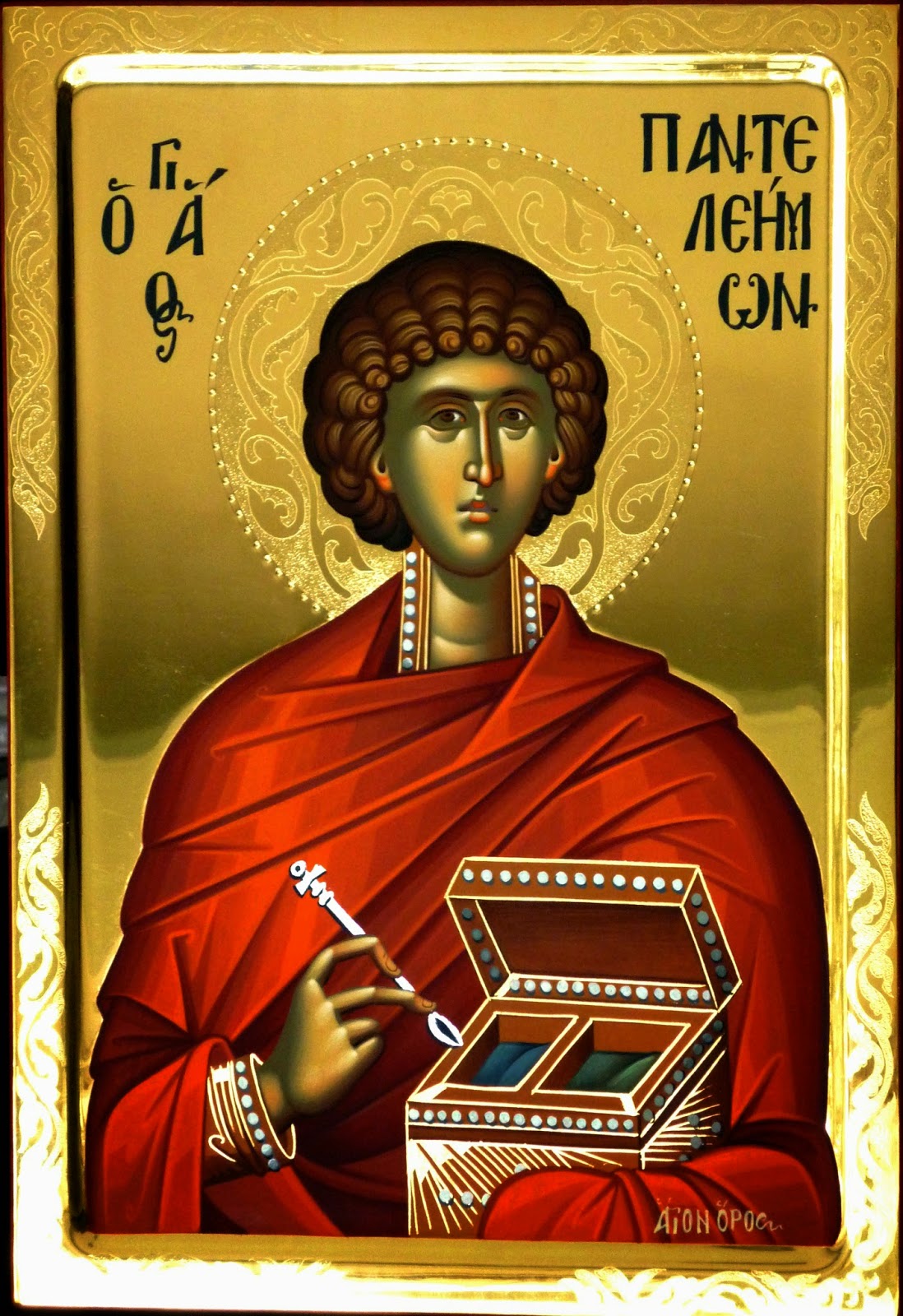
St. Panteleimon the Great Martyr and Unmercenary (source)
  
Homily II on St. Panteleimon by Metropolitan Avgoustinos Kantiotes: "A Lesson of Love"
"This I command you, to love one another." (John 15:17)
"The feast of a martyr is to imitate the martyr." [Quote of St. John Chrysostom]
The stars, my beloved, are not only contained in heaven, but our Church has its own, and the stars of the Church are the Saints (Martyrs, Confessors, Venerable Saints, Teachers and Fathers). The stars illumine heaven, but the noetic firmament of the Church is also illumined by the noetic stars, the Saints. They shine with their life, their virtues, their wonders. And like in heaven "star differs from star according to its radiance" (I Corinthians 15:41), thus among the Saints there are differences. One star of great prominence is today's Saint, the Great Martyr and Healer Panteleimon. Let's take courage to utter a few words, weaving a humble encomium to his memory.

St. Panteleimon was born in the era of terrible persecutions against Christianity, during the reign of Maximian (286-305AD), in a land whose name brings forth tears, in a land which gave birth to so many of the Saints and Martyrs: Asia Minor. Specifically, his homeland was Nicomedia of Bithinia. There was his church, but on a dreadful day in August 1922, the children of Hagar reduced it to rubble. Today in Nicomedia, the bells do not ring. I believe, however, that one day they will ring there again!

His parents were nobles, aristocrats. His father was Eustorgios, an idolater in the close court of the king. His mother, Euboule, was a Christian according to tradition, and implanted in the heart of the child the seed of the faith and of virtue. The Saint, however, had the misfortune of losing his mother. Only those who have lost their mothers can sense the loss which is left in a family by her absence.

However, the seed which his mother had sown within him was not lost. The child grew, became a man and was noted for his goodness. His rich father made provisions to send him to the best teachers, and even to the famous professor of medicine, Euphrosynos. He studied near him, excelled in his lessons and later finished as a great physician. He, however, was still an idolater, and did not believe in Christ.

One encounter, however, changed his life. While he was still young, he met a pious priest of Nicomedia, Ermolaos, who led him into the mystery of Christianity . "If you wish to become a physician," he told him, "you must know the first and greatest physician of souls and bodies, and this is our Lord Jesus Christ!" He related His life and miracles, and from then, the young man began to take care to believe.

The young physician wished to test if things said by Ermolaos were true. And one day, as he was traveling through the countryside, he saw a child who had died, and next to him was a serpent fleeing who had poisoned him. He knelt beside the body, and lifted up his eyes on high and said: "In the name of Jesus Christ, O child, arise, and you, O beast, depart." And immediately, the child came to life, and the serpent died. This event, along with others like it, strengthened within him faith in Christ. He told this to Ermolaos, and was baptized.

The healings which he continued to work were many and are written in his Synaxarion. Only one I will say, that he was serving as a physician in Nicomedia, which had at that time, before the founding of Constantinople, served as the first city of the nation. His fame had spread. He healed with medical drugs, but there where science lifted up its hands out of weakness, in those difficult situations, St. Panteleimon prayed and said: "In the name of Jesus Christ...", and the sick were healed wondrously. His successes however brought about the wrath of his fellow doctors. They condemned him to the king, and thus he was brought before him. Maximian tried to coerce him to become an idolater and to sacrifice to the idols, but he stood immovable. And thus began his martyrdom.
  
St. Panteleimon the Great Martyr and Unmercenary (source)
  
I will not relate his martyrdom in detail. The Saint's faith was great, and he was victorious through fire, and the sword, and iron nails, and ravenous beasts, and the wheel, and the sea, through everything. Many believed in Christ, not just through his wondrous healings, but through his manliness at the hour of his martyrdom. And aristocrats of the court and courtiers and patricians of the highest ranks, in addition to simple people came to believe in the Lord Jesus Christ. Because through all of the Saint's wonders, I discern that the greatest thing was his daily way of life: his love and his philanthropic offering, the sacrifice of himself in order to help his neighbor, his virtuous and chaste way of life, that which is sought of every Christian by the Lord.

In the end, according to the command of the emperor, the military guard led him two kilometers outside of Nicomedia, and there, before the sun had risen, around dawn, the lightning strike of the executioner's sword cut off the head of the Saint. And then, instead of blood, milk poured forth, according to the Synaxarion. And though his precious Relic was laid in the earth, it became a treasury and spring of wonders, while his holy soul flew to the heavenly mansions, to dwell among the Angels and Archangels, and from there, to intercede for everyone, and especially for his homeland of Nicomedia, that again she might see the glory of the faith and that the bells might ring there joyously through a national and religious resurrection.

As I said in the beginning, my beloved, "The feast of a martyr is to imitate the martyr", as described by the sacred Chrysostom. Are we celebrating a martyr? Then we should imitate him. Today, therefore, from the world of the bodiless spirits beyond, the voice of St. Panteleimon reaches us, and mystically speaks to the ears of our souls: "O Christians who are honoring me, become my imitators!"

The Saints are the most clear sign that Christianity is not a utopia, a theory, a philosophy, it is a reality, a harmonious life. They reveal that Christianity crosses the ages and rules in all stations. The Saints are the heroes of the faith and of virtue, the pinnacles of prototypes worthy of imitation.

Today, St. Panteleimon compels us, as the teacher of all, and especially those who are educated, rational, and who are scientists and physicians. There is a false idea that is cultivated by the children of darkness that science is not compatible with our faith. It is false, a satanic lie. Because we see today's Saint was an educated and wise scientist, and through this also believed in the Lord. And not only St. Panteleimon, but many other Saints of the Church. And not only Saints of the ancient eras, but many contemporary and great scientists of national fame (physicians, chemists, mathematicians, physicists, astronomers, and every specialty) believe in God and confess Christ. I know of scientists in Athens who believe, fast and pray, and--it may seem strange to you--arise at midnight to pray the prayer rope! I know of a surgeon in "Evangelismos" Hospital who never takes up the scalpel without kneeling to say: "Lord Jesus Christ, help me, the sinner." Science, not of dimwits, but of great minds, kneels before the Crucified One. In Germany, a surgeon wrote a book with the title: "Behind us stands God", in other words, behind our science is found Christ, the Physician of souls and bodies.

But the Saint is not just the teacher of learned scientists, but of all Christians. He teaches us a lesson which is most simple, but also the most difficult. It is the two words of the Nazarene, which we heard in today's Gospel: "This I command you, to love one another." (John 15:17) It is the lesson of love. And this is taught by St. Panteleimon, because he applied this himself [in his own life]. Whatever he had, he offered, and he became a servant of the people, and suggests to us that we become benefactors, philanthropists and merciful in our social circles. Because of this, I entreat you to be moved even more deeply to deeds of love and philanthropy. Do not wait for everything from the government, from others.

May God, through the intercessions of St. Panteleimon, protect our whole people, that we might with peace and love worship our Lord Jesus Christ unto the ages of ages. Amen.
(+) Bishop Avgoustinos
From a homily recorded in the old Church of St. Panteleimon in Florina on Saturday July 27th, 1968(source)
  
St. Panteleimon the Great Martyr and Unmercenary (source)
  
Through the prayers of our Holy Fathers, Lord Jesus Christ our God, have mercu on us and save us! Amen!

Wednesday, July 22, 2020

Homily II on St. Paraskevi by Metropolitan Avgoustinos Kantiotes

St. Paraskevi the Great Martyr (source)
   
Homily II on St. Paraskevi by Metropolitan Avgoustinos Kantiotes: "A Sacrifice out of Love"
Who, my beloved, was St. Paraskevi whom we are celebrating? What was her life, her words and her miracles? It is not easy to relate these in detail. But let us reverently approach her sacred face.

St. Paraskevi was born in the capital of the ancient world, in Rome, during the reign of Emperor Antoninus (138-161AD). Her upstanding parents, Agathon and Politia, were Christians, but were childless. They promised, therefore, if they would be granted a child, to dedicate it to the Lord. God in reality granted them this girl, and because she was born on Friday, they gave her the name "Paraskevi" [Greek for "Friday", literally the "Day of Preparation", i.e. for the Sabbath]. They raised her as a Christian. But this girl had the misfortune of losing her two parents while she was still young. She had, however, the great blessing to have had the faith in Christ taken root within her at the proper time. As she grew, her love for the Lord lit a fire within her soul. This holy fire, which is not from the earth, but which is lit from Heaven, was so great, that all the waters could not quench it (Song of Songs 8:7). Blessed are all those who experience this.

She loved Christ with her whole heart. Not simply with words, but with deeds. The sign of this was how she responded to the voice of the Gospel: "Sell your goods and give to the poor..." (Matthew 19:21). If this voice were heard in our community, would there be souls that would thus respond? St. Paraskevi, the orphan who inherited a great fortune, distributed her goods to the poor.

She embraced the monastic life and began to preach Christ in Rome, and the surrounding areas. She founded a convent, in which were gathered girls who loved the Lord, and she made a missionary sisterhood, whose goal was to show mercy on the poor and to teach women. With the good example of this sisterhood, and with the fiery preaching of St. Paraskevi, many women who were idolaters came to believe in Christ.

She shown like a star at dawn, like an Angel. Other women and girls of her time were dressed in silk. The patricians of Rome and the ladies of the great families would be seen with their adornments worth more than their whole fortunes. Vain women like these were like swallows who carried their whole nests on them, and thus they would carry the whole fortunes of their husband.

St. Paraskevi did not wear silk. She had another garment, one incorrupt and eternal. She was adorned with modesty, a garment which is not corrupted by time.

Other women then and today attempted to appear beautiful externally. They would pain with makeup and lipstick on their lips, put on their cheeks, their eyebrows, their eyelashes. But if you were to ask me which woman were more beautiful, I would respond that the more beautiful woman is she who weeps when she hears the name of Christ, when she prayers, when she beholds the Epitaphios and the Holy of Holies. This was the beauty that St. Paraskevi had. She was not adorned with accessories but only with tears, which ran from her eyes, when she arose at midnight and prayed beneath the stars of Heaven. These were her very precious diamonds, which were taken by the Angels and brought to Paradise, to adorn the garment of her virginity.

Other women adorn their ears with earings, very precious and very expensive. But if you were to ask me, which woman were more beautiful, I would say: It is not those ears adorned with that kind of earings, which eventually will be destroyed or stolen. The more beautiful woman is she who readily turns to hear the voice of her husband, and this readiness had the ears of St. Paraskevi, who hearkened to the voice of the Gospel, to the voice of Christ Who said: "Blessed are those who hear the word of God and keep it." (Luke 11:28)

Other women of her time, like the queens of Rome, wore luxurious belts on their waist. For St. Paraskevi, her belt was the self-control which she wore. This was the adornment of St. Paraskevi, and thus all women and girls who desire to be called Orthodox Christians should be adorned.
  
St. Paraskevi the Great Martyr (source)
  
Her activities, however, brought about a backlash; this is the law of life. Whoever is struggling, will be fought against. Only the dead do not fight. Those who struggle in the world "fighting the good fight" (I Timothy 6:12) will face all kinds of backlash from the enemy. Evil children don't throw rocks at fruitless, but at fruitful trees. And St. Paraskevi, who was a tree full of fruit, was next to receive the stones thrown by the instruments of Satan. She was fought first by Hebrews who were fighting Christianity. Two of them condemned her to the King Antoninus, that there was a woman who was stirring up his kingdom, and if she were to continue thus, there would remain no one who would not believe in Christ. According to the command of Antoninus, St. Paraskevi was seized, and led before the Emperor. He remained astonished before her physical beauty, and suggested to her: "Deny Christ and I will make you the Queen." She responded: "I would be very senseless to deny the light and to accept the darkness, to deny Christ and to worship the devil, because the idols are the devil."

He tried again with sweet words and promises to shake her, but she stood immovable. "I will give you three days to think properly and to decide, either to become Queen or to suffer martyrdom."

"O King, do not think that three days, or thirty days or thirty years that you might give me could change my mind. Whatever you have to do, do it immediately."
  
Do you see, my beloved, how this woman stood unshaken? Whoever believes in truth and loves Christ, either a woman or a man, does not fear neither seduction nor threats, neither men nor the devil, nor this whole world. The true Christian is a hero, because the Gospel brings forth heroes. A heroine and an unshakable rock of the faith was St. Paraskevi shown to be.

Her martyrdom is one of the most moving. I will only offer a small detail. Antoninus ordered that she be placed in a large cauldron, in which was boiling pitch. And even though the pitch was boiling over, St. Paraskevi was swimming in the cauldron. Many don't believe this, it is their right. We believe in Christ and in the wonders of the Saints. As soon as the Saint entered the cauldron, she made the sign of the Cross, and boiling was transformed into refreshment, as if in soothing water! Antoninus was astonished. He wondered whether this were a trick: "Throw me some of that", he said. She threw some into his face, and the Emperor was blinded, his whole face was burned, and he began to entreat the Saint. And she, with her prayer, healed him, and all the people cried out: "Great and true is the God of the Christians!" Thousands of people believed on the day of her martyrdom.

Ultimately, Antoninus believed, but his successor continued the persecution against the Christians, and because of this, the Saint was later martyred. A soldier led her to the place of her execution, and with the lightning strike of his sword, her precious head was cut off, but her holy soul flew like a dove to the Heavens, to be together with the Most-Holy Theotokos, the Saints and the Angels, and to pray on behalf of us sinners.

See, my beloved, what one woman accomplished! She astonished the whole world. And what are we doing today, clergy and laity? In comparison to her, we have not accomplished anything. On the occasion, however, of her memory, let us honor her with love, and be taught by her example, and let us live as true Christians, and work in our social circles with philotimo.

Let us entreat St. Paraskevi. And let us light a candle not just for our family and for our children, but for our homeland, that we might continue to walk the path of Christ, because only then there will be blessedness. May the Lord be with us. Amen.
  
(+) Bishop Avgoustinos
(Homily delivered at the Holy Monastery of St. Paraskevi, Milochoriou, Eordaias, on Wednesday July 26th, 1967, Source)
  
St. Paraskevi the Great Martyr (source)
  
Through the prayers of our Holy Fathers, Lord Jesus Christ our God, have mercy on us and save us! Amen!

Wednesday, July 24, 2019

Metropolitan Avgoustinos Kantiotes on St. Panteleimon the Great Martyr

St. Panteleimon the Great Martyr and Unmercenary (source)
  
Metropolitan Avgoustinos Kantiotes on St. Panteleimon the Great Martyr: He was cast out due to jealousy
"For he knew that for envy they had delivered him" (Matthew 27:18)

My beloved, we are honoring the holy memory of the Great Martyr Panteleimon. Our topic will be the question: What was the reason that St. Panteleimon was persecuted? To this we will give a short response.

St. Panteleimon lived and struggled during the era of persecutions, when the Roman Emperor was Diocletian. He was born in Nicomedia of Asia Minor. His father was an idolater, but his mother was from the women who planted deeply into the heart of their children their faith in Christ. Therefore, she taught St. Panteleimon the truths of the faith.

He was well-sown. He had a call towards learning. He studied medicine near noted scientists. He became an exemplary physician. There were many physicians then, like there are today. However, it is rare today to find a Christian physician. The majority are faithless, materialists. And these have no worth; may God protect you from falling into their hands.

St. Panteleimon differed from them. In what way did he differ? He differed in three ways.

First, regarding money. They were lovers of money. They charged their patients a lot and became rich. St. Panteleimon was unique, a man of ideology. He used science as a mission. He was seen at night visiting huts [of the poor and sick] like an angel. While the others went only to the houses of the great ones, he went to the houses of the poor and served the sick.

And a second way in which he differed from the others. As a famous Greek university professor once said, physicians frequently study medicine like veterinary medicine, and many doctors act like veterinarians. They don't see anything else beyond veins, bones, flesh, ribs, hearts and lungs. Man of course is these, but behind this is something invisible. There is a "little motor", which moves the biological body, and there is the existence of man. And the doctor, when he doesn't see this "little motor", is blind, and is not in the position to perform his work. This "little motor" is the spiritual factor, the soul of man. A multitude of experiments and observations have shown that the soul with the passions, feelings, conscience and impulse greatly impacts the body. There is an interconnectedness between body and soul. This is what our Church chants during the 15-days of August, and which is scientifically correct: "From the great multitude of my sins, ill am I in body, ill am I also in soul..." (from the Small Paraklesis to the Theotokos). And both are sick but the root of evil is sin. Therefore, St. Panteleimon made the correct diagnosis. He saw that, when the soul is freed from guilt, the body is given life, and man breathes deeply. Many illnesses (apoplexies, heart attacks, cancer) have as their cause the spiritual world. Some bitterness from remorse or from slander or from divisiveness or from injustice or anxiety waters the body with poison.
  
St. Panteleimon the Great Martyr and Unmercenary (source)
  
So he differed first for not taking money, secondly because he saw man as a psychosomatic whole, and thirdly, for besides the other medicines which the other physicians had, St. Panteleimon had a rare and unique medicine, and this was the faith. He believed deeply. Because of this, together with medicines from herbs from the earth that he gathered, he knelt next to the pillow of the sick, praying, and--let the faithless disbelieve it, we believe it--the sick man was healed. And to this day, we see the sign of the Cross in clinics, hospitals and healing centers. How truly awesome a thing is the power of faith, a medicine of healing for bodily and spiritual illnesses.

This was St. Panteleimon. And because of this, his healing center was marked every day with a line of sick people, while they did not go to the other physicians of Nicomedia anymore. This being passed over, however, enflamed the hearts of his colleagues with the yellow lamp of jealousy. They were jealous of him, they hated him. They saw that, as long as he was a physician in Nicomedia, they would have to change careers because everyone was hastening to St. Panteleimon. And the sick, who themselves were loosing hope, found their healing near him. Behold therefore the cause of jealousy. Because of this they cast him out. They hated him from the beginning. With what slander did they do so? As an unmercenary? As one taking advantage of people? As an adulterer? As a fornicator? As a dangerous person? As a criminal? None of these things. If they condemned him with these during that decadent regime, it wouldn't work. They condemned him with a condemnation that took hold. Isn't that how it is, that the slanders of the faithful change in every age? Sometimes they use slander A, other times B, other times C. I will not dwell on this, I will just mention that, from the time...with various slanders, with foolish things the jealous attack the worthy men to discredit them--though at the heart of the matter, they don't believe the slanders--and people are no longer judged according to proper and steadfast criteria (ethically), but according to other criteria (politics).

They condemned him therefore with the condemnation of that era that was so devastating: that he was a Christian. And this condemnation led man to dash him to pieces. He was seized, led before rulers, confessed his faith with boldness, suffered all kinds of martyrdom, and thus, his holy soul flew to the heavens like a wholly-white dove to dwell in the heavenly mansions, in order to rejoice together with the Holy Angels and Archangels.

Behold, my beloved, the cause of the persecution and the martyrdom of St. Panteleimon: jealousy.

O jealousy, a great and abyss of a passion! It is a worm and viper that consumes the bowels of he who is jealous, but is also the grave of great men. Terrible are its consequences. If we open the holy stories, we will see that, from the beginning, this was the destruction of the human race. "Out of the jealousy of the devil", says Solomon, "death entered into the world" (Wisdom of Solomon 2:24). Satan was jealous of the magnificence of man, and was filled with wrath against him. Because of this was the first blood spilled upon the earth, due to jealousy. Cain was jealous of his brother Abel and he murdered him "in the field" (Genesis 4:8). From jealousy Esau persecuted Jacob (ibid 27:41), the eleven children of Jacob persecuted Joseph the All-comely (ibid 37), King Saul persecuted David (I Kings 19:10), and a long line of holy men were snuffed out.

And we have examples from our own national history. Great men were snuffed out like the righteous Aristides in antiquity, Socrates who drank the poison, and in later years, Harilaos Trikoubes, etc.

But why do we need other examples? Cast your eye on the Praetorium and to Golgotha. "Which of these two do you wish that I release?" asked Pilate, "Barabbas or Jesus?" Everyone cried out together: "Barabbas". And the Evangelist notes psychologically: "This he did", Pilate, in other words, "for they delivered Him up out of envy." (Matthew 27:18) The envy of the Scribes and Pharisees, which were like fireflies quenched before the great sun that is Christ, led our Lord to Golgotha. Therefore, my brethren, it is a general rule. If there ever appears some person, some worthy personality, who would perform their duty, he will elicit envy and rouse up persecution. Meaningless people do not bother, those who offer help and give their lives to those around them, they are the ones persecuted. St. Paul said this: "All those who desire to live piously in Christ Jesus will be persecuted" (II Timothy 3:12). All those who believe in Christ will be persecuted, along with all those seek to live according to His commandments. It is their fate. All those living, either through his word or through his example, bring about an earthquake. However, this is an earthquake of salvation. Blessed are the communities who have such men, either in science or in the military or in politics or in the holy clergy, for they become the agents of the proper way.

Pray, my brethren, that the sickness of envy might be healed, that it might abandon you. And may our Lord, through the intercessions of St. Panteleimon, transform all our hearts, and may we go forth with virtue and love, to the glory of God. Amen.

+Bishop Avgoustinos

(Homily of Metropolitan of Florina Avgoustinos Kantiotes, delivered in the Holy Church of St. Panteleimon, Florina, 7/27/1976) (source)
  
St. Panteleimon the Great Martyr and Unmercenary (source)
  
Through the prayers of our Holy Fathers, Lord Jesus Christ our God, have mercy on us and save us! Amen!

Thursday, July 18, 2019

Metropolitan Avgoustinos Kantiotes: On the Prophet Elias and the Wonders of Prayer

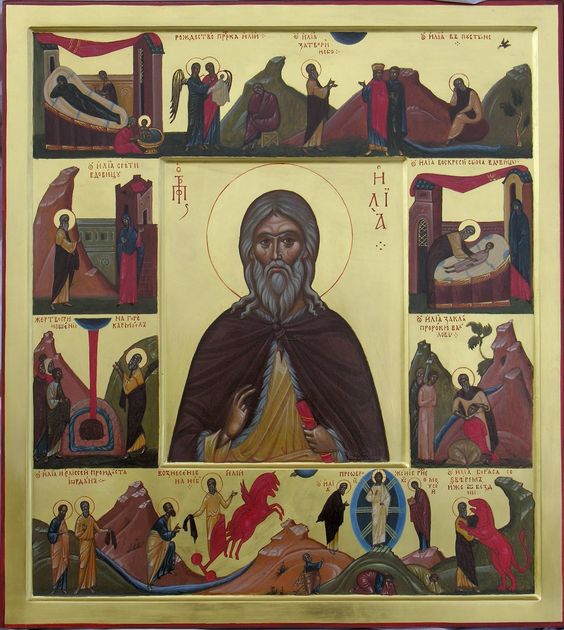
The Holy Prophet Elias (source)
  
Metropolitan Avgoustinos Kantiotes of Florina: On the Prophet Elias and the Wonders of Prayer
Today, my beloved, we celebrate one of the greatest Saints of our faith, the glorious Prophet Elias. He lived before Christ, but he is also "the second forerunner of the coming of Christ" (from the Apolytikion of the Saint). He is one of the most beloved Saints, and many bear his name, and on many hills there are built chapels in his name, and many villages celebrate his name.

Should we tell of his life? It would take much time and you don't have much stamina. So that I might not tire you, I will tell of a few essential things from the life of the Prophet Elias. I will mention three of the wonders out of the many that he had done.

The one was that once, with his prayer, there was a drought that hit along with a famine in Judea. He also was hungry, because the Saints suffer hunger. He went to a village and everyone closed their doors to him. Only one house, a hut, opened their door. And who lived there, a rich man? It was a poor widow with her children. She received him. She had nothing to offer him hospitality, only a handful of flour and a little oil. And these she did not hold back. As soon as she saw him, even though she didn't know who this old man was, she said: "Come in, Elder." She immediately took the flour, made bread and gave him to eat, because he was tired from his journey. This occurred in Zarepta of Sidonia. And then--let the faithless disbelieve; it is their right, but we believe--from that hour on, the widow's house was never lacking in flour and oil. (Third Kings 17:8-16).

What does this mean?  Where there is the blessing of God, everything is riches. One can have incomparable fields, vineyards and olive groves, one can have sacks of gold and silver, one can have it all, but die from hunger. And one can have a handful of flour, a little piece of earth, a bucket of soil, and this will sustain you, as long as one blesses the Lord. These are not just words, they are reality. Because of this our Church chants: "The rick have become poor and hungry, but those who seek the Lord shall not lack any good thing." (Psalm 33:11) Everything, therefore, is a blessing. Some place too high an emphasis of work alone, because above work is the blessing of our Lord Jesus Christ.

Another miracle: While the house of the widow had flour and oil, the rest of the village was suffering hunger, for it had not rained for three and a half years. The impious King Ahab gathered the people of Israel on Mount Carmel, and there, the Prophet Elias censured them for their lack of steadfastness. Until when, he said, will you stand limping with your two feet? If our God is true, then follow Him. If Baal (the idol) is true, then follow him. They heard him without speaking, how would they be justified? Then he told them, I will only preach the true God, while the priests of the idols were about 1000. Today, therefore, we will test who is the true God. Bring two calves, and you will choose whichever you wish, and let us prepare a sacrifice with wood, but we will not light them on fire. And I will prepare the other for sacrifice and will not light it on fire. And you will entreat your god, and I will call upon the Lord my God. And He will hear me and will light and burn the calf of sacrifice, because He is the true God.

They agreed. The priests of shame placed their altar, and their calf upon it, and began to entreat, calling out: "Hear us, Baal". Noon passed, evening came, nothing. Their god was shown to be false. Afterwards, Elias places the clean altar, places wood and the calf upon it in pieces, and tells the others to sprinkle it three times with water (in order that there not be any possibility of fire). And as soon as he prayed, fire descended from heaven and consumed the whole calf, and the wood and the stones and even the water! Nothing remained. Then everyone believed that the only true God is the Lord. Immediately, the Prophet Elias commanded: cease all of the priests of shame, the priests of idolatry. And he took them to the brook of Kisson, and there--terribly--he slaughtered them all (ibid 18:19-40).
  
The Holy Prophet Elias (source)
  
Let us now return again to the house of the widow. What happened there? One day her child fell deathly ill and died. The mother said to the Prophet Elias: "Come to my house to explain to me for which of my sins my son was put to death." "Give me your son." he told her. He took him to the upper room, laid him in his bed, and having prayed to the Lord, breathed three times on the child, and then--let the faithless disbelieve, we believe that there is a God Who works wonders through the Panagia and the Saints--the child was resurrected. "I see that you are a man of God", the widow said. (ibid 17:17-24)

I told you a few things, my beloved, about the Prophet Elias. One more thing I will mention. When it came the time for him to flee from the world, he did not die like we do. As he was walking, a fiery chariot took him and lifted him high. The Prophet Elias still lives. He is hidden somewhere, in one corner of the universe. And we expect him to come again. You don't fear the Prophet Elias, because it seems that you are Saints? I am afraid of him. He is a thunderbolt against sinners, prostitutes, adulterers, blasphemers, atheists, shameful people and all who remain unrepentant. His word is burning. He is the "second forerunner of the coming of Christ", the forerunner of the Second Coming of the Lord. And the Second Coming of the Lord is approaching, it is coming! The signs are many. There are signs which will precede the end of the world, and one of them is the appearing of the Prophet Elias.

One sign of the end of the ages is, as Christ Himself said, that there will be earthquakes, terrible earthquakes (Matthew 24:7). And continuous earthquakes are occurring. Another sign was mentioned by St. Kosmas Aitolos. When they asked him when the end of the world was coming, he replied: "When you see women walking naked in the street." And we see this in reality. Women walking around [naked], corrupting the world*, and even in the church they dare to enter naked. Another sign is the divorces that are increasing, while formerly divorce was unknown and only the shovel of the undertaker separated couples. Another sign that will appear is the 666. The devil will come out and begin to seal people, all, small and great will take this identification. These are the signs of the times. Go and sell your shirt and buy the Book of Revelation and read it, it is all written in there, what will occur.**

Within your houses, have fear of God. How will we be saved? With prayer. With what prayer? Not dead prayer, but living prayer which comes through tears. In the old blessed days the Christians listened in the Church of Christ with contrition. Today, we find the church dead. In the old days, in the crags of our homeland dwelt holy people. And what did they do? Were they partying at night? Before they would go to sleep, the father and mother, along with their seven or eight children would kneel in prayer to God. Show me today a family that prayers together! We have lost the mind of God. Where is prayer, family prayer? Where are the tears, the contrition? Where is Confession and Holy Communion? Where is almsgiving? Where are the wonders of our people?

Because of this, I advise you to take the Gospel and the Revelations and all of you read them, men and women. Pray night and day, at noon and in the evening. And if you can't say many prayers, say only one prayer: "Lord, have mercy", "Lord, have mercy", "Lord, have mercy". And if you say it with your whole heart, you will be heard, and you will work wonders, and the stars will descend to earth.

Let us live like this, therefore, my beloved and blessed ones, with Christ, awaiting the return of the Prophet Elias, and entreating God to save the world. Amen.

(+) Bishop Avgoustinos, recorded from a homily given in the Holy Church of the Prophet Elias, Xanthogeion, Amyntaiou, on July 20th, 1987) (Source)

*Note I: This described lack of modesty, and lust in general is of course not only seen in women, but in men as well, as day by day, filth of body, mind and soul is growing and is being exhibited more externally, in society, TV, the internet, etc.
  
**Note II: Thankfully, there are many good Orthodox guides to reading the Book of Revelation, including the most famous commentary by St. Andrew of Caesarea (translated here), published talks by Fr. Athanasios Mitilinaios, a series by Fr. Thomas Hopko, the series of talks by Fr. Josiah Trenham, etc. Metropolitan Avgoustinos ends this sermon very poignantly, focusing not on fear of the 666 or the Antichrist, but on fear of the Lord, and emphasizing the need for prayer, repentance, contrition, the Holy Scriptures and the Holy Mysteries of our Church.
  
The Holy Prophet Elias, with scenes from his life (Source)
  
Through the prayers of our Holy Fathers, Lord Jesus Christ our God, have mercy on us and save us! Amen!