Showing posts with label Women. Show all posts

Thursday, August 13, 2020

Homily II on the Dormition of the Theotokos by Metropolitan Avgoustinos

The Dormition of the Theotokos (source)
  
Homily II on the Dormition of the Theotokos by Metropolitan Avgoustinos Kantiotes (+2010): "The Glorious Dormition"

"Your glorious Dormition caused the Heavens to rejoice, along with the ranks of the Angels, while the whole earth is glad..." (Sticheron from the Praises of the Feast of the Dormition of the Theotokos

Panagia was a poor girl from Nazareth, from unassuming parents. She did not have anything that would bespeak of glory. Her nativity passed by unnoticed [by the world]. Humble was her entrance into the world, and humble was her life.

But while her entrance was humble, her exit was glorious, and righteous. For she passed throughout her whole life in purity, humility, and utter obedience to the will of God. Which other woman has a calling that could be reckoned with hers? Every [woman] gives birth to mortals, but she was made worthy to become the Mother of the Son of God. As St. Kosmas Aitolos preached: "There were thousands of thousands of women in the world, but none could be found to fill the side of Adam, except our Lady the Theotokos."

When Panagia gave up her spirit to her Son and God, the earth and Heaven were astonished. The burial of her sacred body had a unique grandeur. The Apostles were brought from the ends of the earth to Gethsemane upon the clouds. Myrrh-bearing women and the faithful people followed. An impious Judean tried to defile the sacred body, but was repulsed...

The earth, with her most chosen children gathered to bury the King's Mother. But what were the honors of the earth before the honors of Heaven? As she ascended to the Kingdom on high, she was given an exceptional reception.

The leaders of the Angels knelt to venerate. The Son received the Mother. And she stood and continues to remain at His right hand, interceding on behalf of sinners.

Humble was her entrance, glorious, all-glorious, was her exit. Are these a phantasy, are these a myth? No, a thousand times, no. Our holy Church confirms this, who ordained that today the Dormition of the Most-Holy Theotokos be celebrated. Today, most-beautiful hymns are chanted, with which the greatness of Panagia is praised, and especially, the event of her repose, of her Dormition.
  
Detail from the icon of the Dormition of the Theotokos (source)
  
Many, my beloved, are the lessons of this feast. We will limit ourselves to one thing only, one lesson, which is contained in the word which the Church uses to characterize the event of the repose of the Virgin. Her repose is not called "death", but "dormition". Why? Please pay attention.

In the language of the Holy Scriptures, death does not mean the disappearance of the human existence. No. At death there is a separation. The soul is separated from the body. The soul leaves towards the things above, towards the heavenly world of the spirits. This path is not fantastical, but is a reality, which is confirmed by the word of God. Then, what does the soul meet, how many tollhouses does it pass through, what censures does it undergo, we do not know in detail. The words of holy people, who saw the souls of the reposed pass towards the verdant meadows of Paradise, or towards the dark places of hell, shine some light on this, but this light is dim, and unable to satisfy people's curiosity. To man, through the Scriptures, it has been revealed that the soul that leaves the body does not die (see Luke 12:20, 16:23-26, 23:42-43). This is a fact and the Christian cannot deny this.

But while the soul of man, which has finished this station of his life, ascends as a spirit to the other world, the body, as physical creation is given away to corruption, to temporary corruption. For from this corrupted body, during the universal Resurrection [at the Last Judgment], there will come a renewed and incorrupt body, which will be united with the soul and they will live together unto the ages of ages.

Yes! The body will be raised. In anticipation of the Resurrection, death according to the Scriptures is called "dormition". The Prophet David "slept" (Acts 13:36). The Protomartyr Stephen "slept" (Acts 7:60). The Apostle Paul, when he speaks of those who have left for the other life, does not say that they "died", but he calls them "those who are sleep". "I do not want you to be ignorant, my brethren, concerning those who are asleep, that you might not grieve as the others do who have no hope." (I Thessalonians 4:13). Our Lord Jesus Himself called death "sleep". When He entered the house of Jairus and saw them weeping for the dead girl, He told them: "Do not weep. She has not died, but is only sleeping." (Luke 8:52, Mark 5:39) And regarding Lazarus He said that he had "fallen asleep" (John 11:11-15). And He proceeded to resurrect him, with such ease as if he were waking him from sleep.

Dormition! This word of the Scriptures should be sufficient to teach, console and strengthen Christians, at least those who hasten to churches to celebrate and feast at the "glorious", "all-sacred", and "dormition transcending death", of the Most-Holy Theotokos. Do you hear this, O you who celebrate? Panagia has not died, but has fallen asleep! Her body was buried, placed within the grave, but as the Church chants: "the grave and death could not hold her, for as the Mother of Life, she has proceeded to Life, Who dwelt within the womb of the Ever-Virgin." (Kontakion of the Feast of the Dormition) Panagia, shining forth with all the light of the virtues, "as arrayed in gold" (Psalm 44:10) has proceeded towards the Heavens. "Who", cry out the Angels, "is this that appears like the dawn, fair as the moon, bright as the sun, majestic as the stars in procession?" (Song of Songs 6:10)
  
The Dormition of the Theotokos (source)
  
Panagia, from the height of her glory, is heard to say to all Christians who are tempted here: "Faithful children of the heavenly Father, have strength. What do you fear? Death? But death is the gateway to the new life. Here on high where I am there is a new life, which no one on earth could even begin to imagine. This life is preordained for those who will live with faith and virtue. Here there is no partiality. My Son is the just Judge. When I was below on the earth, I heard voices that blessed me, for I was made worthy to become His Mother, and He said that, in the cycle of blessedness, it would not be me alone who gives Him birth, but for all those who hear Him and keep His word. For Christ is born spiritually in every soul who believes in Him and worships Him as the only Savior. 'Yea of a truth, blessed are those who hear the word of God and keep it.' (Luke 11:28) Therefore, I invite you all to the glory of Heaven."

As the Church chants, truly glorious was the Dormition of the Most-Holy Theotokos. Glorious was also the dormition of all the Righteous, who faithfully completed their missions. Each of them, as they left from this world, could say like the Psalm: "In peace I will lie down and sleep, and I awoke, for You, O Lord, have made me to dwell in hope." (Psalm 4:9) The antithesis occurs with those who did not love God and their neighbor, and did not fulfill their holy duties, and did not complete their mission, but were conquered by evils and passions, and trampled upon divine gifts, walling themselves off and making themselves unworthy of their holy calling, betraying the faith. Their dormition was not radiant, but dark, not glorious, but inglorious. Not radiant Angels, but dark demons were their fellow travelers during the exodus of their souls to the other world. For mourning and cutting are heard during the exodus of the unrepentant sinner. Who would not weep?

O Christians! Panagia had a glorious dormition. But we also must have a glorious dormition. Glorious through faith and virtue. May we receive even one laurel leaf from that glory! May the Lord, through the intercessions of the Most-Holy Theotokos, who proceeds to the Heavens, grant us an end like this. May the prayer of the Church be fulfilled for each of us: "For a Christian ending to our life: painless, blameless, peaceful, and a good defense before the dread Judgment Seat of Christ, let us pray."
(+) Bishop Avgoustinos 
(source)
  
The Dormition of the Theotokos (source)
  
Most-Holy Theotokos, save us!

Wednesday, July 22, 2020

Homily II on St. Paraskevi by Metropolitan Avgoustinos Kantiotes

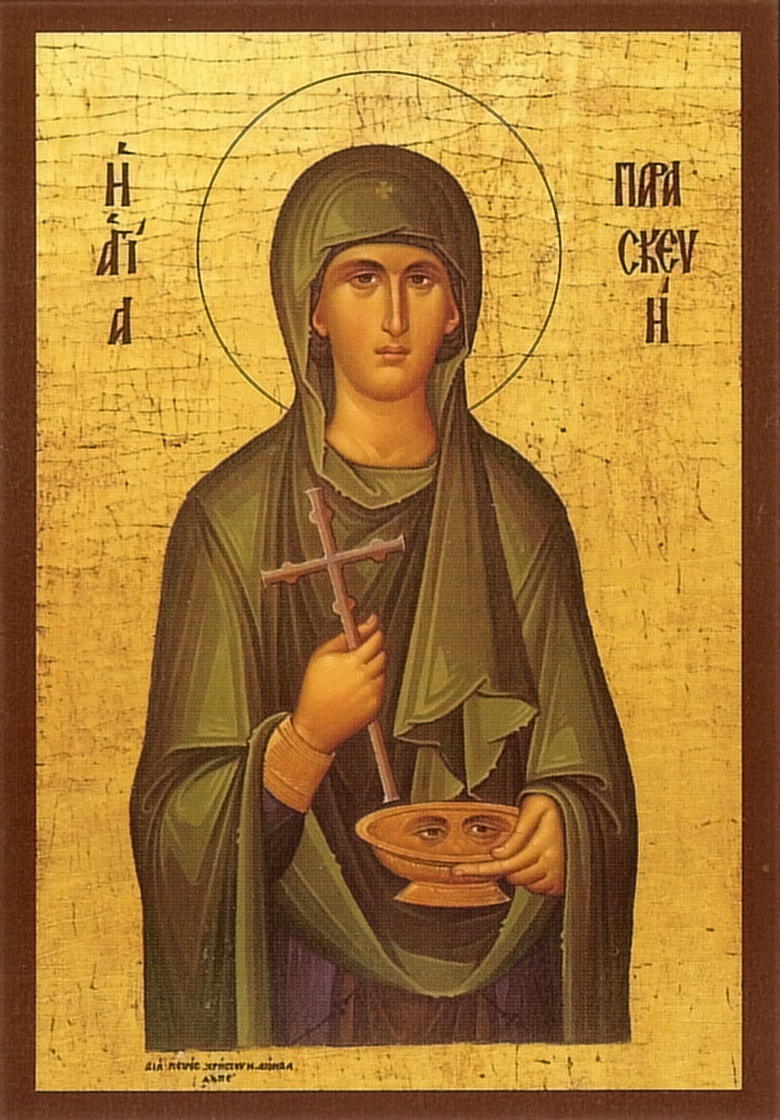
St. Paraskevi the Great Martyr (source)
   
Homily II on St. Paraskevi by Metropolitan Avgoustinos Kantiotes: "A Sacrifice out of Love"
Who, my beloved, was St. Paraskevi whom we are celebrating? What was her life, her words and her miracles? It is not easy to relate these in detail. But let us reverently approach her sacred face.

St. Paraskevi was born in the capital of the ancient world, in Rome, during the reign of Emperor Antoninus (138-161AD). Her upstanding parents, Agathon and Politia, were Christians, but were childless. They promised, therefore, if they would be granted a child, to dedicate it to the Lord. God in reality granted them this girl, and because she was born on Friday, they gave her the name "Paraskevi" [Greek for "Friday", literally the "Day of Preparation", i.e. for the Sabbath]. They raised her as a Christian. But this girl had the misfortune of losing her two parents while she was still young. She had, however, the great blessing to have had the faith in Christ taken root within her at the proper time. As she grew, her love for the Lord lit a fire within her soul. This holy fire, which is not from the earth, but which is lit from Heaven, was so great, that all the waters could not quench it (Song of Songs 8:7). Blessed are all those who experience this.

She loved Christ with her whole heart. Not simply with words, but with deeds. The sign of this was how she responded to the voice of the Gospel: "Sell your goods and give to the poor..." (Matthew 19:21). If this voice were heard in our community, would there be souls that would thus respond? St. Paraskevi, the orphan who inherited a great fortune, distributed her goods to the poor.

She embraced the monastic life and began to preach Christ in Rome, and the surrounding areas. She founded a convent, in which were gathered girls who loved the Lord, and she made a missionary sisterhood, whose goal was to show mercy on the poor and to teach women. With the good example of this sisterhood, and with the fiery preaching of St. Paraskevi, many women who were idolaters came to believe in Christ.

She shown like a star at dawn, like an Angel. Other women and girls of her time were dressed in silk. The patricians of Rome and the ladies of the great families would be seen with their adornments worth more than their whole fortunes. Vain women like these were like swallows who carried their whole nests on them, and thus they would carry the whole fortunes of their husband.

St. Paraskevi did not wear silk. She had another garment, one incorrupt and eternal. She was adorned with modesty, a garment which is not corrupted by time.

Other women then and today attempted to appear beautiful externally. They would pain with makeup and lipstick on their lips, put on their cheeks, their eyebrows, their eyelashes. But if you were to ask me which woman were more beautiful, I would respond that the more beautiful woman is she who weeps when she hears the name of Christ, when she prayers, when she beholds the Epitaphios and the Holy of Holies. This was the beauty that St. Paraskevi had. She was not adorned with accessories but only with tears, which ran from her eyes, when she arose at midnight and prayed beneath the stars of Heaven. These were her very precious diamonds, which were taken by the Angels and brought to Paradise, to adorn the garment of her virginity.

Other women adorn their ears with earings, very precious and very expensive. But if you were to ask me, which woman were more beautiful, I would say: It is not those ears adorned with that kind of earings, which eventually will be destroyed or stolen. The more beautiful woman is she who readily turns to hear the voice of her husband, and this readiness had the ears of St. Paraskevi, who hearkened to the voice of the Gospel, to the voice of Christ Who said: "Blessed are those who hear the word of God and keep it." (Luke 11:28)

Other women of her time, like the queens of Rome, wore luxurious belts on their waist. For St. Paraskevi, her belt was the self-control which she wore. This was the adornment of St. Paraskevi, and thus all women and girls who desire to be called Orthodox Christians should be adorned.
  
St. Paraskevi the Great Martyr (source)
  
Her activities, however, brought about a backlash; this is the law of life. Whoever is struggling, will be fought against. Only the dead do not fight. Those who struggle in the world "fighting the good fight" (I Timothy 6:12) will face all kinds of backlash from the enemy. Evil children don't throw rocks at fruitless, but at fruitful trees. And St. Paraskevi, who was a tree full of fruit, was next to receive the stones thrown by the instruments of Satan. She was fought first by Hebrews who were fighting Christianity. Two of them condemned her to the King Antoninus, that there was a woman who was stirring up his kingdom, and if she were to continue thus, there would remain no one who would not believe in Christ. According to the command of Antoninus, St. Paraskevi was seized, and led before the Emperor. He remained astonished before her physical beauty, and suggested to her: "Deny Christ and I will make you the Queen." She responded: "I would be very senseless to deny the light and to accept the darkness, to deny Christ and to worship the devil, because the idols are the devil."

He tried again with sweet words and promises to shake her, but she stood immovable. "I will give you three days to think properly and to decide, either to become Queen or to suffer martyrdom."

"O King, do not think that three days, or thirty days or thirty years that you might give me could change my mind. Whatever you have to do, do it immediately."
  
Do you see, my beloved, how this woman stood unshaken? Whoever believes in truth and loves Christ, either a woman or a man, does not fear neither seduction nor threats, neither men nor the devil, nor this whole world. The true Christian is a hero, because the Gospel brings forth heroes. A heroine and an unshakable rock of the faith was St. Paraskevi shown to be.

Her martyrdom is one of the most moving. I will only offer a small detail. Antoninus ordered that she be placed in a large cauldron, in which was boiling pitch. And even though the pitch was boiling over, St. Paraskevi was swimming in the cauldron. Many don't believe this, it is their right. We believe in Christ and in the wonders of the Saints. As soon as the Saint entered the cauldron, she made the sign of the Cross, and boiling was transformed into refreshment, as if in soothing water! Antoninus was astonished. He wondered whether this were a trick: "Throw me some of that", he said. She threw some into his face, and the Emperor was blinded, his whole face was burned, and he began to entreat the Saint. And she, with her prayer, healed him, and all the people cried out: "Great and true is the God of the Christians!" Thousands of people believed on the day of her martyrdom.

Ultimately, Antoninus believed, but his successor continued the persecution against the Christians, and because of this, the Saint was later martyred. A soldier led her to the place of her execution, and with the lightning strike of his sword, her precious head was cut off, but her holy soul flew like a dove to the Heavens, to be together with the Most-Holy Theotokos, the Saints and the Angels, and to pray on behalf of us sinners.

See, my beloved, what one woman accomplished! She astonished the whole world. And what are we doing today, clergy and laity? In comparison to her, we have not accomplished anything. On the occasion, however, of her memory, let us honor her with love, and be taught by her example, and let us live as true Christians, and work in our social circles with philotimo.

Let us entreat St. Paraskevi. And let us light a candle not just for our family and for our children, but for our homeland, that we might continue to walk the path of Christ, because only then there will be blessedness. May the Lord be with us. Amen.
  
(+) Bishop Avgoustinos
(Homily delivered at the Holy Monastery of St. Paraskevi, Milochoriou, Eordaias, on Wednesday July 26th, 1967, Source)
  
St. Paraskevi the Great Martyr (source)
  
Through the prayers of our Holy Fathers, Lord Jesus Christ our God, have mercy on us and save us! Amen!

Wednesday, July 18, 2018

Homily on St. Marina by Metropolitan Avgoustinos Kantiotes

St. Marina the Great Martyr (source)
  
Excerpts from a Homily on St. Marina by Metropolitan Avgoustinos Kantiotes, Bishop of Florina: "Christ honored the woman"
Today is a feast, the feast of St. Marina. The churches built in her name celebrate, as do the women who bear her name.

We are honoring a woman. But also the New Testament continuously speaks of women. The Gospel reading today speaks of the woman with the issue of blood (Mark 5:24-34), who was healed by Christ. The Apostle Paul says that between woman and man there is no difference in worth, men and women are equal, for whatever rights the man has, the same does a woman. "There is neither man nor woman", he says, "for you are all one in Christ Jesus" (Galatians e3:28). These words we should say more simply to make it clear.

I don't know how much men love Christ, but women must love Him even more. If men love Him once, women should love Him thousands of times. Why? There is a specific reason.

Do you know what woman was before Christ? Man did with her whatever he wished. He locked her inside and didn't let her go out. The children that she gave birth she had no say over, but the man did. If he wanted, he would just kill them. She herself was so poorly treated that he kept her like an animal. He kept her like an adornment until he threw her out. He took another one, and another, and another... as many as he wanted. Thus woman was truly unhappy. In some places this still occurs. In India, for example, where they don't believe in Christ, the woman has no worth. Did her husband die? They were required to bury her with him. She couldn't be allowed  to live, and they would bury her near her husband in the same grave.

This was the state of the woman. When did it change? Who honored her? Only Christ.

How did Christ honor the woman?

First, with her "side". The Holy Scriptures say that there is no difference in honor. Man was created by God from the dust (Genesis 2:7), but woman was not created from dust, but from the man. He took a piece of his body, to show that she is yoked with the man. But the piece that he took was neither the head, nor the feet. It wasn't from the head so that she would not think that she should rule over the man. Neither was it from the feet, so that she might not think that she is a slave to be trampled upon by the man. He took a piece from his side, which covers his heart, to show that the woman must be beside him, next to him, supporting the man throughout the whole of life, in both joy and sorrow.

Secondly, Christ honored woman with His incarnation. As God He could have chosen not to have been born of a woman. He could have been like the first man, Adam, for not even the Angels are born of a woman. He could have come into the world by some other way. However, He was born of a woman, the Most-Holy Theotokos and Ever-virgin Mary. Why? In order to honor the woman. He was born of a virgin, in order to honor virginity. He was born of one betrothed in order to honor marriage.

Therefore Christ honored the woman. And because of this reason exactly, the women were with Him until the end, such as the Myrrhbearing women, St. Mary Magdalene and the others. And the greatest honor that He gave is that, after the Resurrection, the first "Christ is risen" was not heard by men. No, the woman was the first to receive this joyful news.

Thus did Christ honor the woman. Because of this, women loved Him greatly. One of those was St. Marina, whom we are celebrating today. Who was St. Marina? She was a beautiful and wealthy 15-16 year old girl. She could have found the finest husband. And a potential husband approached her, who had houses, fields and power. But she told him that she preferred Christ above men. And she remained faithful to Him until death.

This, therefore, is what the Apostle is speaking of: there is no difference between woman and man, they are one. And this is what was ordained by Christ, this is what our holy Church teaches.

Let's leave the past for the time being, my beloved, and let's come to today. Do we see woman today as Christ speaks of her, being equal to man? I doubt it.

Where do you want to go? To Athens, to Paris, to New York, to other great cities? There the opposite occurs. There, woman, not one of beauty but of corruption, exercises authority over man. You see a wise university professor or a general who strikes fear in the hearts of the world, and is overcome by a harlot. I'm not speaking of a specific person, I'm speaking generally. If you read history, you will see that many times corrupted women seized strong men by the nose and led them astray like the pied piper. Such women are the tools of the devil...

However, let's leave the big cities and return to the villages, there chaste women, are [unfortunately, sometimes] slaves of men. I had visited many villages as a preacher and I will offer some examples of what I saw.

Once, when I entered a village, I saw a man riding on a horse like a ruler, while behind him was walking his wife, overburdened on her back with wood and with a child in her arms...

Slavery of women, my beloved, and objects of terrible exploitation, either in marriage or outside of marriage. In marriage, regardless of how precious and hard working a woman might be, if she didn't have a good dowry, she couldn't be married off. But the corrupted and inglorious world doesn't even think about marriage. In a thousand satanic ways, such as the terribly "beauty pageants", the woman is prepared and her flesh is sold off like a butcher hangs his meat in the window.*** We have spoken against this, we have struggled against this, and because of this they called us crazy. But one prophecy says: When you see a woman walking naked outside, then the end of the world is coming.

Christ honored the woman, and the Church has shown forth holy women like St. Marina. And today's feast teaches women and men that we should all live with purity and honor.

+Bishop Avgoustinos
From a recorded homily in the Church of St. Marina, Florina, 7/17/1973
(amateur translation of excerpts of text from: source)
  
***Note: One wonders what the Bishop would have said about the terrible and tragic spread of abuse and exploitation of women, from internet pornography to human trafficking to women being abused by men in positions of power, many orders of magnitude worse than he is describing. May our Lord and His Mother deliver all women from such evil, and may His Saints, like St. Marina, both protect and heal those who suffer, and serve as an example of purity and sacrifice of body and soul for Christ!
  
St. Marina the Great Martyr (source)
  
Through the prayers of our Holy Fathers, Lord Jesus Christ our God, have mercy on us and save us! Amen!

Thursday, February 15, 2018

Elder Sophrony of Essex on the Love and Pain of the Theotokos

Christ crucified, in extreme humility, beside His Most-holy Mother, the Theotokos (source)
  
Our Panagia was pained much more than all other women, much more than all other mothers in the world, because no one else was struck, to no one else was done evil like that which was done to Her, the greatest evil of the whole world. They crucified Her Son.

And seeing Him upon the Cross, She was pained so much in her heart...Because of this She can understand every painful existence, and She suffers together with every human who is pained, because She exactly knows what "pain" means. When the soul is seized by the love of God, then, O, how gracious, beloved and joyous is everything! Love, however, goes together with sorrow, and the deeper the love is, even greater is the sorrow.

The Theotokos never sinned, not even in thought, and She never lost grace, and even She had such great sorrows. When she stood beside the Cross, then Her sorrow was impassable like the ocean, and the pains of Her soul were incomparably greater than the pain of Adam after the expulsion from Paradise, because Her love was incomparably greater than the love of Adam in Paradise.

And though She survived it, She survived only with divine power, with the strength of the Lord, because His will was for the Theotokos to later see the Resurrection, and later, after His Ascension, that She might remain the consolation and joy of the Apostles and of the new Christian people. We do not reach the fullness of the love of the Theotokos, and because of this we cannot fully conceive of the depth of Her sorrow.

Her love was perfect. She loved her Son and God incomparably, but She also loved the people with great love. And what did She sense, then, when they whom She herself loved so greatly and whom She so greatly pained for their salvation, when She saw them crucifying her beloved Son?

This we cannot conceive of, because our love for God and man is small. However, the love of Panagia was incomparable and inconceivable, thus incomparable also was her pain, which remains inconceivable to us.

The Theotokos did not relate in the Scriptures Her thoughts, nor her love for Her Son and God, nor the sorrows of Her soul at the hour of the Crucifixion, because even then they couldn't conceive of it. Her love for God was stronger and more fervent than the love of the Cherubim and Seraphim, and all the powers of the Angels and Archangels were amazed with Her.
(source)
  

Icon of Saint Sophrony of Essex (+1993) (source)
  
Through the prayers of our Holy Fathers, Lord Jesus Christ our God, have mercy on us and save us! Amen!

Saturday, July 25, 2015

Homily on St. Paraskevi by Metropolitan Avgoustinos Kantiotes

St. Paraskevi the Great Martyr (source)
  
Homily on St. Paraskevi by Metropolitan Avgoustinos Kantiotes (+2010)
"A Bedrock of Virtue"
St. Paraskevi was not an ordinary woman. She was a spiritual meteor, a bedrock of virtue, unshakable amid the ocean of the corrupt community.
  
She implemented that which Christ said, that: “He who hears my words and keeps them resembles a house built upon the rock, and though the rains came and the winds and the rivers fell upon it, the house was not shaken.” (Matthew 7:24-25) And St. Paraskevi was a bedrock of virtue. Foamy waves fell upon her, the greatest waves of life.
  
First, the wave of corruption fell upon her. She was not born in a small village. She was born in the most corrupted city, which in the Holy Scriptures is called the Babylon of the world due to its corruption (Revelation 17:5). She was born in Rome, in a suburb of Rome. But however, she remained uplifted. She was a lily among the dung of her community.
  
Let us all hearken to this, for when we see some woman being led astray, we say: “The community is responsible.” Yes, the community is responsible, I don't deny this. But she herself is also responsible. Give me a woman who loves Christ like St. Paraskevi, and throw her into the most corrupted community, and no wave and no devil could shake her.
  
As soon as one wave left, a stronger wave fell upon her: the wave of orphanhood. This wave is terrible. St. Paraskevi was orphaned of her father and her mother. Because of this she is a protector of orphans. She was orphaned at that age when children could become prey to unscrupulous traffickers who try to exploit them. But she stood tall even while an orphan. She had within her a great fervor for holiness, the life of virginity and grandeur.
  
Woe to the woman who does not have these great desires. No matter how high she climbs, no matter how many qualifications she has, she is deplorable. It is better to be an unlettered villager, which is like a lily, like the flowers that grow in the crags of the rocks of our homeland.
  
Therefore, the waves of corruption and orphanhood fell upon her, but she remained untouched. Because of this I call her a rock. Furthermore, another rock fell upon her, that of money, of wealth. After the death of her pious parents, she remained the sole inheritor of their vast property, which they left to her.
  
Every other girl would think differently. One might buy silken clothes, one might go to dances and gatherings, one might run right and left, would go on trips, would experience the spirit of the sinful life. St. Paraskevi however did the opposite.
  
Money is a great temptation. It is better to be a blessed poor person. Thrice-blessed are little huts, more than great homes. Because in huts dwell diamonds, while in the palaces and the large homes dwell many times prideful souls, who do not love Christ.
  
Money fell into the hands of St. Paraskevi. But she did what St. Anthony did, who had also inherited vast property. He went into church one day. His ear hearkened to the Priest who was reading the Gospel: “Sell your goods and give them to the poor.” (Matthew 19:21) Sell everything and give them to the poor. Anthony heard this. And he did not say that Christ was saying this to others. He distributed his property to the poor. As he hearkened to the words of Christ, so did St. Paraskevi. She kept only a small amount, and with this she founded a small sisterhood of orphan women virgins, who were dedicated to preaching, to enlightenment and to philanthropy.
  
So many foamy waves fell upon St. Paraskevi. Finally, the red wave of blood fell upon her! It was a time when only one would be heard to be a Christian, and one would be put in prison. They seized her at that hour when she had gathered the girls together to teach them. They led her before the judge. They asked her: “Are you a Christian?” She responded: “I boast that I am a Christian.” “We give you,” they said, “three days time to deny Christ.” “No,” the Saint responded, “I don't need time to decide. From this instant I dedicated to sacrifice my life for Christ. Do whatever you wish.”
  
And her martyrdom began. They threw her in a dungeon in the prison. They whipped her with bullwhips. They threw her to the wild beasts. They threw her into a cauldron with burning tar and oil. She endured many forms of martyrdom, but all of these she conquered through the power of Christ.
  
At the end, her hour came. They took her to a temple of the idols with statues of the false gods. She knelt, closed her eyes and made a mystical prayer to God. Immediately, there was an earthquake. The statues fell to the earth and became dust.
  
They couldn't stand it anymore. Thousands of barbarous hands of the idolaters seized her, took her outside and to the place of execution. Her face was shining like the sun. She knelt, prayed and thanked God. Finally, she was beheaded by a Roman soldier. And while her precious head fell down, and her blood watered the earth, her soul, white as a dove, flew to the heavens.
  
St. Paraskevi the Great Martyr (source)
  
Since then, how many years have passed! But as long as the world will exist, the name of St. Paraskevi will remain unto eternity. For: “The memory of the righteous is unto eternity.” (Psalms 111:6)
  
My brethren, St. Paraskevi is an example for all of us. But foremost, she is an example of a virtuous life and faith for women and young people. In this age of great corruption, she is the example and the mirror for virtue for womanhood
  
We live in a time of Babylon, a time of the Apocalypse, when the devil is roaring. He tries to strike the whole world. But most of all, he rabidly fights to strike and to soil girls and women. He wants not a single girl to remain unsoiled.
  
He fights we terrible magazines and newspapers. He soiled our girls with terrible brochures, with movies, with TV shows, which are schools of crime and dishonor. He soils them with mixed baths, with terrible photographs, with corrupting dances, with parties. The day will come when you will not find a pure girl. What will we do?
  
To arms, my brethren, to arms! Not to physical weapons, but to spiritual ones. Fathers, mothers, look towards the honor of your girls.
  
I'm finished, but rather, I'm not yet finished, because I want to be paid. What payment? Money? I am a monk and I leave that to you. I will not finish my homily unless my soul is satisfied.
  
Do you want your homes to be blessed and your girls to be secure? Today, the feast of St. Paraskevi, I entreat you all to do three things. First, go straightaway to your home, and look everywhere to find terrible articles and pictures, and gather them to light them with a holy fire to burn them all. Second, I recommend to all of you to go buy the life of St. Paraskevi and an icon of hers to hang in your home, and speak to your children: “My daughter, my child, become like St. Paraskevi.” And the third thing? Having done the first two, light a candle for the wayward women, those who live in filth and dishonor, and say to St. Paraskevi: “St. Paraskevi, you who are a lily of heaven, help these women of Greece, the women of the whole world to return near the Panagia, near to God, near to Greece, so that we might all have the protection of the Holy Trinity”, Whose blessings I pray might be with you all. Amen.
  
+Bishop Avgoustinos
(homily delivered in Chaidari, Athens, before 1967)
  
(amateur translation of text from source)
  
St. Paraskevi the Great Martyr (source)
  
Through the prayers of our Holy Fathers, Lord Jesus Christ our God, have mercy on us and save us! Amen!