Showing posts with label Elder Aimilianos of Simonopetra. Show all posts

Wednesday, June 17, 2020

Elder Aimilianos on Life as a Spider's Web

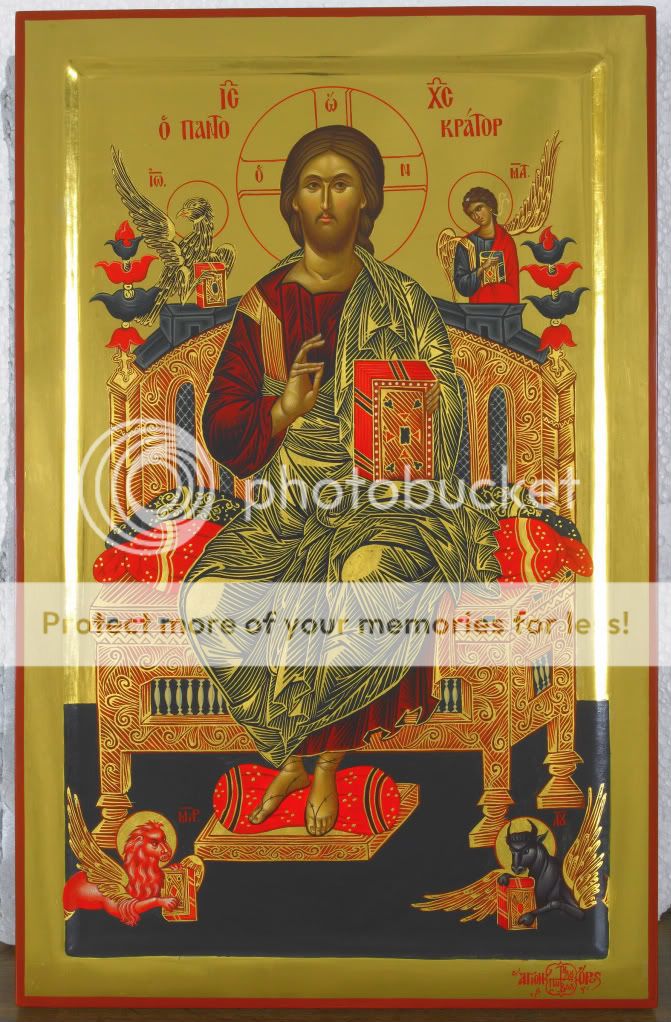
Jesus Christ Deisis with the Theotokos and the Precious Forerunner (source)
  
"When all our days are past, and passed in your wrath, our years will be seen like a spider. Day and night [the spider] works. She rises in the morning, and cleans her corner. She works until the night, and again, the next morning, she is in her same corner. Her web was destroyed. In the morning, she must weave it again. Days and nights of agony, and she sweats and suffers, without, ultimately, her work being completed.

"Whatever I might do, no matter how good it is, is like the work of a spider.

"A work has essential meaning, and is not like a spider's web, but is eternal, only when it is a search for You, when we turn to You, when it occurs for You, when it brings me, not to a desert place, not into a foreign land, not to this temporary earth, but to the true Chanaan, where You are, in Heaven.

"Thus, O Lord, was my life. I should have come to work for You. But I separated myself from You. For me, You no longer did exist, You Who exist from the ages and unto the ages. I thought, would my life be like this? A spider's corner, which would be gone tomorrow. Was I born for this, therefore?

"We have created something which has no worth before You, O Lord, it is nothing. I worked, thought, lived, thinking that I was progressing, that I was going towards the Promised Land. Because, however, I sinned, in reality, my life had no meaning to You. All things which have worth to You are those things that objectively have importance and meaning. Therefore, that which I thought was my success, that which I saw as my joy, that which for me was an object of enthusiasm and shouting for joy, this was something away from which You wished to turn away.

"Eternal life near our sweetest Jesus Christ exists, and You call us towards You, my God!"
-Elder Aimilianos of Simonopetra (+2019)
(source)
  
Elder Aimilianos of Simonopetra (+2019) (source)
  
Through the prayers of our Holy Fathers, Lord Jesus Christ our God, have mercy on us and save us! Amen!
Thursday, February 6, 2020

Elder Aimilianos: "If I am not joyous, then I am nothing!"

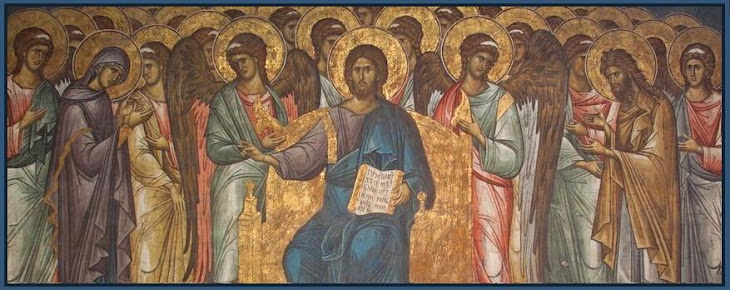
The Parable of the Prodigal Son (source)
  
"The lack of joy is a pathological state of man, a willing closure within one's self. And whatever he wishes to do he will not be successful.

First, one must clean his field, to find out what is going on and why he is not joyous. Then, he must pursue joy within himself, and then the peace of God will take the place of joy. Thus, man should keep his relationship with God and with his Elder [or Spiritual Father], and should seek a true life.

Am I good, faithful, perfect, holy?
Am I a teacher?
If I am not joyous, then I am nothing.

It is important when they tell me: "Physician, heal thyself, and then, offer him to God." God cannot enter into a heart that is not joyful, He cannot find a place of contact, because He is peace, He is the fulfillment of joy.

Only like things can unite, and because of this, God can only unite with a joyous soul. For the monk who is not joyous, the Elder cannot do anything at all, his hands are totally tied.

Whoever thinks that he is approaching to reach "the measure of the stature of the fullness of Christ", but is not joyous, can understand that he is totally deluded. Joy is the criterion, the thermometer.
Joy is something external, but it is also something internal.

Ultimately, it is a necessary presupposition, because the lack of joy makes man study things differently and to become changed. For example, if one puts even one drop of nitric oxide into pure water, immediately he changes its essence. Thus, exactly, one drop of bitterness, depression, sadness transforms the whole atmosphere of a person, and extinguishes God.

But joy must also exist in a brotherhood [or a family], because it is an element both of one's personal life and of the brotherhood.

I cannot be joyous if all those around me do not have the tendency and the atmosphere of joy, neither, however, can I have any benefit if I do not take on this joy from the brotherhood.

Only when I take it on can I say that I have a relationship with the Elder, and then I can take in God, because God is the life that exists within man, and the life which is transmitted through man."
-Elder Aimilianos of Simonopetra, from the book Neptic Life and the Ascetical Canons
(source)
  
Elder Aimilianos of Simonopetra (+2019) (source)
  
Through the prayers of our Holy Fathers, Lord Jesus Christ our God, have mercy on us and save us! Amen!

Tuesday, December 31, 2019

A New Year's Blessing from Elder Aimilianos of Simonopetra

The Adoration of the Magi (source)
  
"My brethren, I wish that the new year will be full of joy and happiness. I wish you many years. Many years, that your joy may increase along with your happiness. Many years that will bring to you and to your families the good things of Abraham, Isaac and Jacob, of the Patriarchs, the Prophets, of the Saints. May all good things come to your village, to your city and to your homes. I know that you are a people beloved by God. Many years, therefore, that we might say, as our Megalynarion says: 'Magnify my soul, Basil, the Great one among the Hierarchs', for he gave us an experience of God that has held fast in our lives. You open the heavens, O Basil, and revealer of heavenly things, and reveal to us that God has descended from there and has come among us."
-Elder Aimilianos of Simonopetra (+2019)

(source)
  
St. Basil the Great (source)
  
Through the prayers of our Holy Fathers, Lord Jesus Christ our God, have mercy on us and save us! Amen!

Friday, July 12, 2019

Elder Aimilianos: How does the Holy Trinity create a person?

The Holy Trinity creating Adam (Source)
  
Elder Aimilianos of Simonopetra: How does the Holy Trinity create a person?
‘At one exceptional and unique moment in history, the heavenly Father wished to create the material world. Once this had been done, He then went on to make the human body, in collaboration with the other two Persons of the Holy Trinity, and breathed the ‘breath of life’ into it. So God’s creation became ‘a living being’ [2]. God then ceased merely to hover above the waters [3] and entered into the created and material elements and living things. He dwelt in a unique, supreme being who became the king and the reason for the creation. Now the reason for the creation is God Himself. From that moment, the conjunction, the path towards identification and union with God became inevitable, and it’s now impossible to conceive of the human person, the image of the invisible God, without the Holy Spirit.
  
 So the Holy Spirit, as one of the Persons of the Holy Trinity, collaborates in the birth of every person. Together with the Father and the Son, He gives to the maternal womb the material which is taken from the father and mother, and the embryo thus conceived is flesh, dust. We people give birth to dust: we’re dust and return to dust [4]. To this dust, the parents give all the capacities and characteristics of their personalities, they give themselves, the image of their flesh.
  
What the heavenly Father did to the first human person, He also does at the birth of every one of us, the difference being that then He first created the dust and afterwards breathed into it the Holy Spirit, whereas now the Holy Spirit enters the person as soon as conception occurs. So from the very first moment, the embryo is alive and is a person, because it’s received the inspiration of the Holy Spirit. It has rational control, is a complete image of the divinity and, until its last moments, bears the features of divine and human nature, unfailingly and unabatedly. There is also internal communication within the person between the human and divine nature, as there is in Christ.
  
It follows, then, that at everyone’s birth there are, on the one hand, divine actions and, on the other, a human contribution, in accordance with the ancient saying and will of the Godhead: ‘increase and multiply’[5]. The husband and wife, one flesh- ‘you shall be one flesh’ [6]- communicate with the Holy Spirit, and the all-powerful Son brings everything together, puts everything into the womb of the woman and in this way we have a complete person, both God and human. The new persons, created by God and created for God, are endowed, at baptism, with divinity, with the charismatic life, at which point the Holy Spirit becomes the inheritance of their existence. From then on, they’re constantly being challenged internally by the Holy Spirit and also project from themselves the sparks, the light of the divinity. In this way, the dust of the earth becomes a radiant life, through vigilance’.
 
The Creation of Adam (source)
  
Through the prayers of our Holy Fathers, Lord Jesus Christ our God, have mercy on us and save us! Amen!

Friday, June 14, 2019

Elder Aimilianos of Simonopetra: "How can we have the Holy Spirit?"

Jesus Christ the Son of God the Savior of the world (source)
  
How can we have the Holy Spirit?

The answer is, for each of us to love his wife: you who are married your wife, and I who am a monk, my monastic life.

I must love my solitude, and not get depressed, not get tired, I must stand vigil, and not think that God sent me here in order to save the whole world, not to think that it is my duty to joke with this or that person, but to look after my job: I must have my eye on Christ.

When you leave your house and get married, you leave behind your father, mother, brothers, relatives, and, instead of your parents, your brothers and relatives, you find a new family. And having left, don't look behind you, as the Psalm of the Theotokos* says, do not think of anything from your former family**. For now you have a whole new world before you, which you must rejoice in, to partake of, to taste, to give life to. Therefore, all of us must give life to our family, to our love, to the divinity that we have wedded, as St. Hesychios says. Then our flesh we will be filled with divinity and we become Christ.
-Elder Aimilianos of Simonopetra
(source)
  
*Hear, O daughter, consider, and incline your ear; forget your people and your father's house;
11 and the king will desire your beauty. (Psalm 45:10-11)
  
*Note: The Elder is not implying that we should not try to help our families as we are able to, but that our spouses after marriage must always take the first place after God.
  
Christ, the Holy Wisdom of God (source)
  
Through the prayers of our Holy Fathers, Lord Jesus Christ our God, have mercy on us and save us! Amen!

Thursday, May 9, 2019

Elder Aimilianos of Simonopetra (+ May 9th, 2019) on the Lord's Resurrection

The Resurrection of Christ (source)
  
Today, May 9th, 2019, Elder Aimilianos of Simonopetra reposed in the Lord. He was a grace-filled preacher and spiritual guide to many throughout the world.
"Fr Aimilianos was born in 1934, and as a priest and theologian he attracted a following of like-minded men and women, some of whom later joined him in renewing one of the monasteries at Meteora. As a young monk and priest he had a profound vision of the light of God, which enfolded him during the Divine Liturgy. ‘Henceforth every Divine Liturgy, prepared for by a long vigil, was a sublime experience of God’s glory.’ His charism was to be able to attract others to share in this commitment to contemplative worship and to deepen their life in Christ. These addresses are just the tip of the iceberg of a remarkable ministry of teaching and spiritual formation, not least among young people. The monastery attracts many pilgrims to this day.
  
"Early in the 1970s tourism was making such inroads at Meteora, where the monasteries perch on high and hitherto inaccessible rocks, that contemplative monastic life was becoming impossible. So Elder Aimilianos and his companions responded to a call to revitalize the ageing brotherhood of Simonopetra, itself perched on a vast rock nearly 1,000 feet above the sea on the Holy Mountain. On 26 November 1973 Elder Aimilianos was elected abbot of the monastery: this proved to be one of the decisive turning points in the renewal of monastic life on Mount Athos. In 1974 his community of nuns migrated to recreate the monastery of Ormylia in Halkidiki, across the water from the Holy Mountain itself and nearer Thessaloniki. In 1995, however, Elder Aimilianos began to fall ill, and in 2000 he retired from active supervision of the two monasteries.
  
Throughout his abbacy he proved a true spiritual elder to his flock: ‘like an overflowing spring, the elder ceaselessly poured himself out to his disciples, offering his words to them with all the magnificent prodigality of divine love.’ He kindled many vocations to the priesthood and the monastic life, and his spiritual influence was, and is, felt far from the Holy Mountain. In the words of the present abbot...
'Elder Aimilianos was our guide, teacher, and father in Christ, and remains so to this day. We lived with him for many years, travelling together in the way of the Spirit. The discourses collected in this volume give expression to his personal experience of God, which was always real, living and dynamic. We believe that they will fill you with joyful hope.'"
May we have his blessing and may he have a blessed Paradise in our risen Lord!  
  
Elder Aimilianos of Simonopetra bringing out the Holy Light on Pascha (source)
  
Elder Aimilianos of Simonopetra (+ May 9, 2019) on the Lord's Resurrection
Before daybreak, at night, in the innards, in the belly of the grave, the Risen Lord sprang up. ‘From the belly, before the morning-star’, the heavenly Father raised Him and since then He has been our eternal High Priest.
 
Christ’s resurrection is a special gift, the last gift on earth of the Lord Who welled like myrrh from that tomb. There has never been a more beautiful treasure-chamber than the Lord’s tomb. There has never been a more beautiful opening than the opening of Christ’s tomb. The Father agreed to His Son being cast into the tomb by the transgressors precisely because He intended light to rise from the grave.

The Father would have remained unknown, inaccessible, but for the coming of the second, consubstantial and co-eternal light, the light of Christ. And Christ would have remained incomprehensible to us, in the end, but for the revelation by the third light, which is one and the same, the light of the most-holy Spirit, Who came to us when we were deprived of our joy, the Lord Jesus. It was in our interests that He should leave us, so that this new light could emerge from the tomb.
  
The prophet called You ‘the fairest of the sons of men’ and they managed to cast You into a pit, as if prophesying your eternal end. They made a mockery of this pleasure to the eyes and joy to the heart, made it into something hateful which people couldn’t bear to look at. But ‘who shall tell his lineage?’ Who can say how many would be born of this corpse. Who can number His spiritual descendants?
  
For the tomb of Christ, the resurrection of Christ is the beginning of a new generation. A generation which doesn’t come through the flesh of the loins but is born from the grave. From the suffering, the death in Christ, this new life arose.
  
It’s the race of people who are not merely not begotten but whose hearts beget them through the death they undergo. Their life begins with the death of baptism, it proceeds to their tonsure, which is again another perfect death and goes on to the third, the final one, in the grave.
  
So, out of the grave, from the mystical formation which occurred in the womb of Christ’s death, there grew the choicest thing our Church has: its virginal people, this new generation of monastics.

Icon depicting Elder Aimilianos of Simonopetra (though not yet canonized) (source)
  
Who can understand how souls are begotten in a virginal manner? How many were able to understand that the Virgin gave birth to Christ?
  
How many are able to understand that our virginity is a marriage and a birth of the Holy Spirit? How many can understand that not from our loins but from our spirits and our hearts we give birth to Christ and give the world the light of the Holy Spirit?
  
All of this is hidden in Christ’s tomb. Our monastic life is the hidden treasure which cannot be sensed by the eyes of either passionate or merely good people, but is revealed only to infants who have chosen Christ and put Him in their hearts. In a wonderful speech to the sons of Israel, Moses the great once foretold their crossing into the promised land. ‘Don’t forget’, he added, ‘that I won’t be with you. I shall stay here. But the Lord will raise another prophet, like me, from among your brethren and he will take my place. He brought me into the world to be the prototype of Him whom you’re waiting for’.
  
Prophet means teacher, inspirer, someone who brings a message fresh from the Father. He opens his ears to listen to what the Father is saying, then puts it into his own mouth and passes it on to people’s souls.
  
So the prophet will come. He Who will move and astound hearts. He will come Who will inspire your hearts and make them heroic and ready to suffer. This is where we find the land of rest, the land of Canaan, the land of delight. But your rest and your delight is the resurrection which emerges from your suffering. You’ll be led by the first martyr, the great martyr, the great teacher, Him Who inflames people’s souls and spirits, raises them on high and takes them up into the heavens.
  
Therefore, my beloved fathers, the risen Lord is our eternal prophet. He it is Who moves us, Who inspires us, Who teaches us. He it is Who rose from the dead to remind us that our monastic life passes through the grave.
  
He is the risen Christ Who goes ahead so that we can follow. The first monk, the first father, the first ‘Elder’.
  
With Christ’s resurrection, God granted us the unique ‘Elder’, the unique father, in this our eternal course, which is now a resurrected life and an ‘introduction into the good things beyond’.
  
This risen Lord is our very life and the whole of our life is now a ‘rite of passage’. Glory and dominion to Him, the resurrected Christ our God, unto the ages of ages.
  
Elder Aimilianos of Simonopetra (+ May 9th, 2019) (source)
  
Christ is risen from the dead, by death, trampling down upon death, and to those in the tombs, He has granted life!
Truly, the Lord is risen!

Tuesday, March 5, 2019

Elder Aimilianos: Fasting and Prayer as a Longing for God

Jesus Christ, detail (source)
  
"Longing for God is expressed with fasting, with an empty stomach... Fasting has a unique meaning by expressing the longing for God... The same occurs for prayer. If prayer to myself had meaning, then my prayer life would be a human endeavor, a tendency and revival, it wouldn't be God. My prayer has meaning because it exactly expresses my longing: 'Come and abide in us...', the: 'Where are you, my God?'

"With fasting, vigil, and prayer, chaos and malaise are shown to be our rags before God, as the poor man shows his rags to his fellow man in order for him to have pity on him to help him, or like the blind man cried out to Christ to give him light. Thus, we show our poverty and he ask that He open our eyes in order to understand that we are sinners, that we might repent and so He can forgive us...

"The approach therefore is an uncreated energy, a true projection of His being. Because of this, my life as well is a true communion with the true God. While God acts, I commune with Him. While God is unapproachable, I partake of Him...

"Only the: 'Where are you, my God?', can make visible the invisible presence of God...We give Him our consent, our being, and He directs everything, He kneads us..."
-Elder Aimilianos of Simonopetra
(source)
  
Through the prayers of our Holy Fathers, Lord Jesus Christ our God, have mercy on us and save us! Amen!

Thursday, March 1, 2018

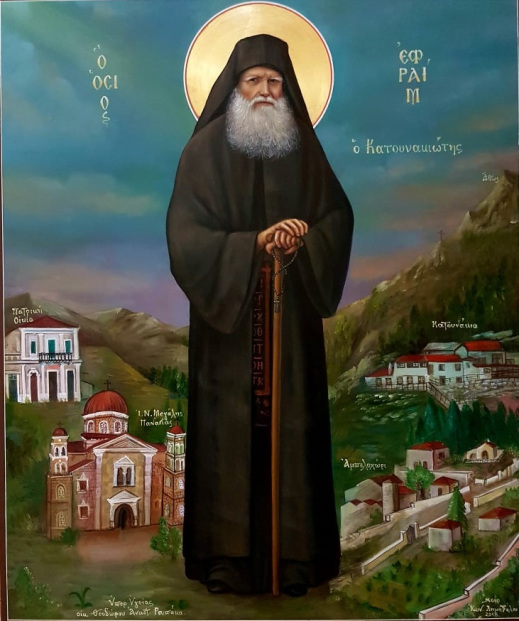
St. Ephraim of Katounakia (+1998)

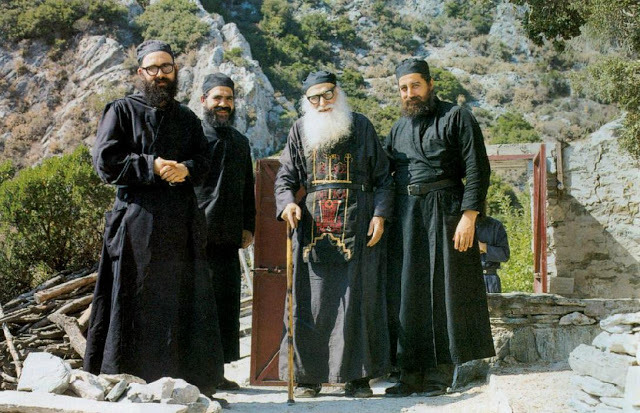
Elder Ephraim of Katounakia (+1998) (source)

Note: This year marks 20 years from the repose of blessed Elder Ephraim of Katounakia, a great figure of Orthodox Athonite Monasticism of the 20th century and spiritual descendant of Elder Joseph the Hesychast. May we have his blessing and follow his life, example and teachings, and may he intercede for us to the Lord!
  
Fr. Ephraim of Katounakia was born in 1912 in Ambelochori, Thiva (Greece). His father was named Ioannis Papanikitas and his mother was Victoria. The Elder's worldly name was Evangelos. He completed high school, but the Grace of God closed off to Evangelos the worldly paths of waywardness.

In Thiva, where his family moved to, Evangelos came to know his later Elders, Ephraim and Nikephoros.

The life of Evangelos was monastic. He struggled spiritually with the Jesus prayer, with prostrations, with fasting, but especially with obedience.
 
Elder Ephraim as a layman (source)
 
His mother was made worthy to receive from St. Ephraim the Syrian the knowledge that it was his desire that his son become a monk and that Evangelos would keep the monastic life.

On September 14th 1933, Evangelos left the world and came to the desert of the Holy Mountain at Katounakia, to the hesychasterion of St. Ephraim the Syrian, and made his prostration to the synodeia of the Elders Ephraim and Nikephoros. After the trial period, he was tonsured a monk of the small schema with the name Longinos. In 1935 he became a great schema monk from his Elder Nikephoros and received the name Ephraim. The next year he was ordained a Priest.
 
Elder Ephraim of Katounakia with his Elders (source)
   
Papa Ephraim was made worthy to know the great rector of the hesychastic life, the discerning and foreseeing  and holy Elder Joseph the Hesychast (1898-1959), and became united with him spiritually together with the blessing of his Elder Nikephoros. Elder Joseph, over time, taught him the un-deluded spiritual life from the famous hesychasts, monk Kallinikos and Hieromonk Daniel. Later, Papa Ephraim taught us the persistent search for the spiritual life and finding an un-deluded and simple spiritual guide, who would be an act of the proper Orthodox faith. The un-deluded spiritual father sees the demonic traps and with corresponding medicine leads the spiritual children to Paradise.

St. Daniel of Katounakia (source)
     
Blessed Papa Ephraim distinguished true from sick obedience when he counseled a monk of a cenobium to show obedience to his Elder not like an animal, but from love and zeal for God.

The holy Elder Joseph the Hesychast gave a program of the hesychastic life to Papa Ephraim, in order to cultivate the prayer: "Lord Jesus Christ, Son of God, have mercy on me", to keep watch over his senses and to lead him towards purification of the heart and divine illumination.

Papa Ephraim, with the blessing of Elder Joseph, was nourished by the "Philokalia of the Holy Neptics", and received the counsels of the Neptic Fathers regarding his struggle. He did not read psychiatric books, nor cultural books on the spiritual life that people keep in the living rooms, nor did he have the fear that he would be included in the circle of "fundamentalism" by worldly people.
 
Elder Ephraim of Katounakia before a picture of Elder Joseph the Hesychast, his great spiritual guide (source)
 
In 1973, Hieromonk Nikephoros, his Elder reposed. After 1980 the Elder had gathered a synodeia around him and kept the commandment of Elder Joseph to keep a synodeia after the death of Papa Nikephoros. Later,  Papa Ephraim reached purification and became that very Elder. Papa Ephraim fought the great enemy of the spiritual life, kenodoxia (vainglory). His sacrifices were for Christ, and not to seek the praise from men.

The Divine Liturgy for Papa Ephraim was astounding and experiential event. He secretly related to a Hieromonk spiritual friend of his that from the first Divine Liturgy that he celebrated, he saw sensibly the Grace of God transform the divine Gifts. Of course, after the sanctification of the Precious Gifts, he saw Christ Himself on the Holy Paten, and it was impossible for him to hold back his tears, when he broke apart the Body of Christ. His tears watered the antimension, and to the right and left he saw Angels serving with him.
  
Elder Ephraim of Katounakia (source)
  
However, Papa Ephraim never sought "liturgical renewal", and in fact, he asked those in cenobiums in the outside world who were at outside diakonemas to not abandon the Psalter.

Papa Ephraim was adorned with the gift of discernment, and saw the spiritual state of every cleric or monk and granted the corresponding medicine for their progress in the spiritual life.

The Grace of God had granted Papa Ephraim the gift of foreknowledge, and because of this, he saw situations that would occur beforehand (such as the earthquake of 1977 in Thessaloniki), and also many times he had called lay people, even from their childhood years, by the name that they would later receive in their monastic tonsure. For example, a student sent a general letter to the blessed Elder without details, and he received a response from Papa Ephraim which related details of his spiritual state and the situation of his village without the student having told him anything beforehand.

Once, some clerics who did not know each other met on the road to Katounakia, and when they reached Papa Ephraim, the blessed holy Elder began to berate one of the clerics, saying that he was not a priest but a mason, who took off his raso, in order to spy on the Holy Mountain. The mason acknowledged his plan.

Papa Ephraim lived experiences which only Orthodox Christians could experience, far away from papist or protestant delusions.

Once, an Abbot, two theologians and a student asked Papa Ephraim to describe the fragrance of holy relics.

The Elder bent his head to the side of his heart and prayed. The place was filled with fragrance and Papa Ephraim told them that because he could not explain it, he entreated God to respond to those he was speaking with.

Papa Ephraim sensed sins as stench. Once, a bishop through a third party asked the blessed holy Elder about ecumenism. The Elder prayed for God to inform him, and then he sensed a stench with a sour, salty and bitter taste, which filled him with dismay.

The Depository of the blessed Papa Ephraim on the unity of the Orthodox was clear: "Schism occurs easily, but unity with difficulty."

So, how much do the words of a modern-day God-bearing Father resonate today?
  
Elder Ephraim of Katounakia (center), depicted with Elder Joseph of Vatopedi (right) and Elder Ephraim of Arizona (left)-- all spiritual children of Elder Joseph the Hesychast (source)
  
Papa Ephraim was highlighted by the Grace of God as a practical guide in the pastoral care of marriage and family, because he helped many young people to embrace marriage without forcing them, and because of this, his letters which have survived comprise a spiritual depository of "parental education", without psychological or philosophical theories for struggling spiritual families.

In 1996 Papa Ephraim suffered a stroke and remained paralyzed. He did not complain at all but glorified God.
 
Elder Ephraim with his synodeia later in life (source)
 
He leaves us his holy paradigm on how to face afflictions.

On February 14 / 27th 1998 Papa Ephraim of Katounakia and Mount Athos delivered his holy soul to the hands of his Creator, Whom he served from his youth.

It was said of a very old man who lived in the 19th century, that he was asked what was the most astonishing moment of his life. He responded that when he was small, he saw and heard St. Kosmas Aitolos.

And our generation was made worthy to know the fragrant flowers of Athonite Monasticism, St. Paisios and Papa Ephraim of Katounakia, who call us to follow their life's example.
(source)
 
Elder Ephraim of Katounakia was officially canonized by the Ecumenical Patriarchate on March 9th, 2020, together with Elders Joseph the Hesychast and Daniel of Katounakia.
  
Elders Ephraim of Katounakia and Aimilianos of Simonopetra (source)
 
The Relationship between Elders Ephraim of Katounakia and Aimilianos of Simonopetra
Elder Aimilianos of Simonopetra was two years younger than Papa Ephraim, but the Most-holy Theotokos had judged that that hieromonk was in a state to understand the experiences of that venerable Athonite monk, as Papa Ephraim later related:

"Our hearts became one, and met like two flames rising up to heaven!"

At his first impression, Papa Ephraim misunderstood the later Elder Aimilianos of Simonopetra. He saw him dressed well, appeared with clothes well-ironed, amorphous, like a little prince, and he said within him:
"Yeah sure, a priest like the others came to talk about prayer! With ironed raso and shirt! Come on, I'll give him a loukoumi so he'll leave!"

Elder Aimilianos, as he was good natured, pleasant and radiant, out of reverence took off his skoufo (hat), and sat respectfully in front of Elder Ephraim. "I am an Abbot in Meteora", he said. He appeared to come with longing to speak with Papa Ephraim on noetic prayer, the monastic life, and its fruits, in general.

"At Meteora you have a lot of people" replied the Elder, perhaps still having some doubt regarding that unexpected visitor. "You should come to the Holy Mountain",  he preferred to say.

Something, however, warned Papa Ephraim within him that he somehow misjudged the young Abbot from Meteora, who, after all, had worked hard, together with two others, to come meet with him.

"Maybe I am being unjust to the man?" He said within himself. He went to bring him a loukoumi for a treat, while within he was pressured and had very serious doubt. "Why don't I get information" in order to be sure. His "Information" [from God], was for the Elder a way and path of life.
 
Elders Ephraim of Katounakia and Aimilianos of Simonopetra (source)
 
Papa Ephraim went into his chapel, to the icon of Panagia in order to get "information" on Fr. Aimilianos, the "selfish muse fire outside, the amorphous one from Meteora".

Papa Ephraim made two, then three prostrations, and said straightaway with honor to the Theotokos: "My Panagia, should I speak with him, or will I waste my words?"

Then, the Blessed Elder Ephraim of Katounakia heard the Most-holy Theotokos herself reply from within Her Icon:

"You have found a second Elder Joseph [the Hesychast]. Speak with him!!" She said.

Papa Ephraim arose, sweating and astonished! "O! I'm crying within myself!!" He said with astonishment. He ran outside, took Fr. Aimilianos and led him into the chapel. They talked for hours between them, and from then on, they were never separated.

Papa Ephraim continuously said of that man planted by God at Meteora: "I found my departed Elder, another Elder Joseph, the golden-tonged and honorable Elder Aimilianos!"

Elsewhere, he said of Elder Aimilianos: "He, my child, is fragrance."
(source)
 
The Blessed Skull of Elder Ephraim of Katounakia, bearing the shape of the Cross and the golden color of the Holy Relics of the Saints (source)
 
Selected quotes from Elder Ephraim of Katounakia
Everyone has a cross to carry. Why? Since the leader of our faith endured the cross, we will also endure it. On one hand, the cross is sweet and light, but, on the other, it can also be bitter and heavy. It depends on our will. If you bear Christ’s cross with love then it will be very light; like a sponge or a cork. But if you have a negative attitude, it becomes heavy; too heavy to lift.
Taken from the book: Elder Ephraim of Katounakia
 
Prayer is a struggle. It strengthens the fight of the faithful against the devil but it is itself also a painful and bloody struggle. All our effort is to concentrate our nous on the words of the "Jesus Prayer."
   
We should make our nous deaf and mute to any other thought, either good or bad, that evil brings us. We should not listen to the thoughts that come from outside or answer them. We need to despise them completely and not converse with them. Thus we should seek in every way the complete muteness of our nous because only with this action can we keep our soul in calmness so that the Jesus Prayer can act effectively.
   
Elder Ephraim of Katounakia (source)
  
It is known that the thoughts are led from the mind into the heart and disturb it. The troubled mind also troubles the heart. Just as the wind raises the waves of the sea, so the wind of thoughts raises waves in the soul. Attentiveness is necessary for prayer. That is why the Fathers talk about prayer in combination with watchfulness. Watchfulness keeps the nous in constant alertness and readiness and prayer brings the divine grace...
   
The Holy Fathers teach that even if man is not always under the dominion of the demons he is, however, under their influence and persistent hostility. They continually turn around the soul and try, by all means, to make the faithful sin, either through the senses (when the object is near) or through the imagination (when the person or object is far away) or through the movements of the flesh. For the whole of man, who consists of soul and body, receives the influence of Satan and gets captured by him.
   
The hostile tactics of the evil, however, are more apparent during prayer. Those who fight in this inner struggle see evil making war against them furiously at every step. They see the devil clearly using all means to distract their nous from God. They see all the cunning devices of the evil demon, who hates the good and kills man.
   
   
According to St. Mark the Ascetic: "When the devil sees that the nous is praying in the heart, then he incurs great and malicious temptations". He hates men exceedingly, and his hatred increases when he sees that they tend to become angels through prayer, and occupy the place the demons had before their fall. St. Gregory of Nyssa describes this malicious envy of the devil, caused by the theosis of man: "The demons are consumed by envy and jealousy when men are ready to acquire kinship with God, whereas they (the demons) have fallen from their relationship with the good"...
   
Imagination is the most cunning weapon of Satan; imagining the past and imagining the future; imagining good works, imagining bad ones. Various thoughts come and preoccupy the nous, so that it ceases to meditate on the name of Jesus. He tries to make man not to show interest in God and express his love. Primarily he coaxes him to call to mind the various faults he has committed in his former and recent life.
   
The Holy Fathers say that the war is usually as fierce as the passions were before. For every pleasure he must pay the proportionate pain. There is a close connection between pleasure and pain in the ascetic life of the Fathers. Pleasure brought about both the Fall and pain; and it is precisely this pain which restores man to his original state and cures him. Thus, man suffers a lot. He pays for each thought and evil pleasure the proportionate amount of suffering, so that an equilibrium may be restored.
   
Events that happened many years ago which he felt pleasure for, being forgotten in the meantime, appear now in all their intensity and range. He may even reach the point of disgust and despair.
Blasphemous thoughts come upon the athlete of prayer...incredulity about the great matters of faith, like the divinity of Christ and the purity of the Most Holy Mother of God and the Saints, etc. Many times these thoughts are expressed and verbalized during prayer, without the wrestler of this struggle knowing it or wanting it...
   
An icon of Elder Ephraim of Katounakia (source)
  
Blasphemous thoughts must be opposed with contempt. Only in this way do they disappear. Blasphemous thoughts are inspired by the devil they are not ours. Here we can affirm that the Lord's word has validity: "You cannot serve God and mammon", (Matt. 6:24) that is, the nous cannot do two things simultaneously. It cannot be enchanted by the sweetest nectar of the Jesus prayer on the one hand and on the other hand, while it is praying, doubt the power of prayer or dogmatic truths. The latter is the attack of the devil. Contempt then is needed and if the blasphemous thought continually attacks us, it needs confession to the spiritual father. Then it disappears immediately. Moreover, the same happens with persistent thoughts. A thought that persists, especially during prayer, needs to be confessed. Thus the devil who hides under it immediately disappears, like the snake when we lift up the stone...
   
The athlete of prayer must not let himself be shaken. He must oppose imagination with the continuous invocation of the name of Jesus, and he must be concentrated within the words of the Jesus prayer. He must stand bravely in the conciseness of the Jesus prayer. He must not think of anything during prayer, either of wrong or even good works...
   
Elder Ephraim of Katounakia (source)
  
Many times the devil, he continued, appears and talks to the athlete of prayer. He challenges him and tries to open a dialogue with him. Sometimes he blames the athlete, sometimes he praises him, sometimes he scoffs at him, sometimes he interprets certain acts wrongly. The inexperienced in this spiritual contest start talking with the devil and answer his questions and his assaults. However, this is an error, especially for the beginners, because the inexperienced in these situations are defeated even if it seems that the devil was put to flight by their replies. Confusion and fear remain. And later, when they recall this scene and all that was said, they will be shaken and troubled. The Fathers recommend that those who do not have the experience and the necessary strength should not answer. They must be indifferent to the devil and despise him. They must do the same in the war against their thoughts. Thus contempt against the devil and perseverance in the Jesus prayer are needed... 
(source)
   
The best prayer is the one you say with your own words. Reading a prayer is not enough. For example, before receiving Holy Communion we read the Service of Preparation for Holy Communion, ‘From lips tainted and defiled, from heart unclean and loathsome…’, sometimes without even understanding the words. You yourself should pray with your own words. Then you will understand what you are saying to God. This prayer has great power; great power indeed!
   
Elder Ephraim placed great importance on the Mystery of Confession
and on obedience to the confessor, even for laymen.
Particularly we remember that he told us, '' For whoever kneels even just once
under the stole of the priest, divine Providence will arrange things in such
a way that Christ will finally gain him. ''
Obedience is Life - Elder Ephraim  of Katounakia

Icon of the Blessed Elder Ephraim of Katounakia (source)
  
Through the prayers of our Holy Fathers, Lord Jesus Christ our God, have mercy on us and save us! Amen!

Tuesday, April 19, 2016

Elder Aimilianos: "The Divine Liturgy is a betrothal to Christ, it is a wedding"

Christ serving the Divine Liturgy with the Holy Angels (source)
  
The Divine Liturgy is a bethrothal to Christ, it is a wedding. It places us in His Kingdom.

Later, we will go out again, we will go back to our house with our passions, with our sins, and with our miseries.

It doesn't matter. Again we will go to Liturgy, and again we will seize Christ, He will deify us again. And thus, with continuous struggle, with a continuous path, with the Priest before us and we behind, we will reach the Kingdom of Heaven.

Do we go to the Liturgy with this desire? We obtain the Kingdom of the Heavens.
-Elder Aimilianos of Simonopetra

(source)
  
The Holy Angels depicted serving the Divine Liturgy (source)
 
Through the prayers of our Holy Fathers, Lord Jesus Christ our God, have mercy on us and save us! Amen!

Thursday, June 14, 2012

A brief analysis of the Jesus Prayer

  
A brief analysis of the Jesus Prayer, by Elder Aimilianos of Simonopetra
The prayer of Mount Athos, who does not recognize it? It is comprised of one small phrase, of measured words.

"Lord Jesus Christ, have mercy on me, a sinner."

With the loud cry "Lord", we glorify God, His glorious majesty, the King of Israel, the Creator of visible and invisible creation, Whom Seraphim and Cherubim tremble before.

With the sweet invocation and summons "Jesus", we witness that Christ is present, our Savior, and we gratefully thank Him, because He has prepared for us life eternal.

With the third word "Christ", we theologically confess that Christ is the Son of God and God. No man saved us, nor angel, but Jesus Christ, the true God.

There follows the intimate petition "have mercy", and we venerate and entreat that God would be propitious, fulfilling our salvation's demands, the desires and needs of our hearts.

That "on me", what range it has! It is not only myself, it is everyone admitted to citizenship in the state of Christ, in the holy Church; it is all those who are members of the body of the Bridegroom.

And finally, so that our prayer be full of life, we close with the word "a sinner", confessing - since we are all sinners - as all the Saints confess and became through this sound sons of light and of the day.

Through this we understand, that this prayer involves:
Glorification
Thanksgiving
Theology
Supplication
and Confession.
Source: Translated by John Sanidopoulos)
  
Elder Aimilianos of Simonopetra (source)
  
Through the prayers of our Holy Fathers, Lord Jesus Christ our God, have mercy on us and save us! Amen!