Showing posts with label St. Arsenios of Paros. Show all posts

Tuesday, January 23, 2018

St. Arsenios of Paros resurrects a baby girl!

St. Arsenios of Paros (source)
  
St. Arsenios of Paros resurrects a baby girl!
A few minutes ago, Gerontissa Arsenia Tsantouli (the Abbess of the Monastery where St. Arsenios of Paros lived in asceticism), and the Nuns offered the following astonishing miracle:

In Belgium lived for many years the sister of Gerontissa Arsenia, where she had a family, and her granddaughter was made worthy 5 months ago to become a mother.

The baby girl was baptized this year, 2018, on the feast of Theophany and received the name Arsenia in honor of the Venerable Arsenios.

However, the baby got sick suddenly and they took her to the hospital with dyspnea.

After two days, January 8th 2018, the baby unfortunately left this life, leaving her parents inconsolable.

That very day, a Greek doctor, who was in that very hospital, was making his rounds, and received as a visitor an old man with a cane, whom he told that the baby was dead. The old man told him to go and perform chest compressions and breaths, and even though 24 hours had passed since her death was confirmed by science, that the child would live.

The doctor noted in a letter that he did what the old man said, and the baby Arsenia, glory to God, returned to life!

As the mother returned to the hospital in order to prepare for the funeral, she found her baby girl alive in her bed.

The Elder who spoke to the doctor was St. Arsenios himself, as his appears in his icon.

"God is wondrous among His Saints!"

Fr. Dionysios Tampakis
January 22nd 2018
The Holy Monastery of Christ Dasous - St. Arsenios, Paros
(source)
  
Through the prayers of our Holy Fathers, Lord Jesus Christ our God, have mercy on us and save us! Amen!

Monday, May 21, 2012

St. Melangell, the Righteous Abbess of Wales

Christ is risen! Truly He is risen!
St. Melangell the Abbess of Wales (+641) - Commemorated May 27 / January 31 (source)
   
"The Church in The British Isles will only begin to grow when she begins to venerate her own Saints"
-Saint Arsenios of Paros (†1877)
   
SAINT MELANGELL -  Celtic landscapes have a way of stirring the human heart with their majesty and grandeur. They bring to mind the courageous and extremely self-sufficient saints who abandoned everything for a life of solitude and prayer in isolated, even treacherous, environs. These saints, by their holy and unconventional lives, conferred peace upon the land and the creatures because they had been liberated, at least in part, from their fallen human nature. As the Apostle Paul succinctly states: "For the creation waits with eager longing for the revealing of the children of God... because the creation itself will be set free from its bondage to decay and obtain the glorious liberty of the children of God." (Romans 8:19,21).

St. Melangell (pronounced Mel-en-geth) is one of these saints who achieved such liberty. Through her consecrated life, she helped free the people and creation in the vicinity of her struggle to attain their supreme status of beauty and completion in God.

Although the major life of St. Melangell was not written until the fifteenth century, it is likely that her cult flourished long before a life was written about her, so great was the esteem with which she was held by the local populace.

The actual era and lineage of St. Melangell are disputed. However, even in the misty shadows of her Irish and/or Welsh genealogy, it is certain that she was of royal or noble lineage and, thus, was expected to marry. In response to God's call to a life of prayer and solitude, St. Melangell renounced her royal status for the religious life. Overlooking her boldness, her father insisted that she marry. Desiring above all things to be devoted to God alone, she fled Ireland around 590 and settled in Pennant, one of the most lonely and lovely areas of Montgomeryshire (present-day Powys), at the head of the Tanant Valley in Northern Wales. In this spot, which came to be called "Pennant Melangell", sleeping on bare rock with a cave as her cell, she lived a hidden life of prayer for almost fifteen years.

Around 604, St. Melangell was "discovered" by the Welsh Prince of Pengwern Powys, Brochfael Ysgithrog, while he was hunting in the area around Pennant. As his hounds pursued their prey, the frightened hare ran into a bramble thicket for safety. Searching for the hare in the thicket, the Prince unexpectedly found St. Melangell. She was deep in prayer and had not heard the dogs or the horn or the sound of human footsteps. The breathless hare had hidden itself in the folds of her garment and peered out at the fierce hounds, trusting in its holy protectress. Prince Brochfael signaled the dogs to snatch the hare, but they dared not approach the saint nor would they kill the hare. Aware now of the situation, St. Melangell bravely drove the hounds back. The Prince had never experienced anything like this before. He was utterly amazed and cautiously approached the anchoress for an explanation. After hearing her story, Prince Brochfael, deeply moved by St. Melangell's beauty, purity and love for God, had no choice but to acknowledge her sanctity. Nonetheless, he suggested that she leave her solitude and be wedded to him, but she adamantly refused. Impressed by her sanctity and determination, he donated a parcel of land, which included a churchyard and valley, to be used by her to found a monastery. The Prince expressed his fervent wish that the area be dedicated to the service of God. He also requested that the land be a place of refuge for people and animals, in particular the hares she had befriended long before the encounter with Prince Brochfael. 

   
St. Melangell is reputed to have lived some thirty-seven years after the hunting incident. The area did indeed become a sanctuary under the anchoress' guardianship. During her life, no animal was ever killed on her land. A known haven of safety not just for hares, but for all creatures, even wild animals living in the area became tame.

Humans, too, sought asylum from persecution, confident that neither prince nor chieftain would set foot upon Pennant Melangell in an attempt to violently seize them or demand unjust tribute. In time, St. Melangell became abbess of a community of virgins who had been drawn to her holy example, seeking their freedom as daughters of God.

The Church of Pennant Melangell is located near Llangynog in Powys. From its first foundation in the seventh century, it was a regular place of worship for the local farming community. For centuries no one would kill a hare in the church or vicinity of Pennant Melangell. Also, if anyone shouted at a hunted hare "God and Melangell be with thee", it was sure to escape. To this day, in honour of the saint, the hares are respected by the local hunters and are never harmed. After her death, St. Melangell became the tutelary saint of hares. Today, she is recognized as the Celtic patroness of [hares, other small] animals and of the natural environment.

Through her resolve to maintain her spiritual focus at any cost, St. Melangell reached a life of "glorious liberty" in which she truly participated as a daughter of God. Local tradition holds that St. Melangell was specially called by the Lord Himself to restore the Pennant Valley to Paradise. Hence, her very presence imbued the land, creatures and people with joy, peace and security. Her community imitated and memorialized her life, bequeathing the essence of sanctity to the area forever.
   
St. Melangell the Righteous of Wales (http://www.allmercifulsavior.com/images/aa-StMelangell2.jpg)
   
Mil engyl a Melangell  (Melangell with a thousand angels)
Trechant lu fyddin y fall.   (Triumphs over all the powers of evil.) 

A Troparion for St Melangell in Tone 8
Preferring the rigours of monasticism to worldly status and marriage, O pious Melangell, thou wast fifteen years on a rock, emulating the example of the Syrian Stylites. Wherefore, O Saint, pray to God that He will give us strength to serve Him as He wills, that we may be found worthy of His great mercy.
(taken from here)
   
Ἀπολυτίκιον Ὁσίας Μελλαγέλας τῆς ἐρημίτιδος (570-641). Ἦχος α´. Τῆς ἐρήμου πολίτης.
(Ποίημα Ἰσιδώρας Καθηγουμένης Ἁγιεροθεϊτίσσης.)
Τοῖς ὁσίοις σου τρόποις, τῷ Θεῷ εὐηρέστησας, καὶ ἀγγελικὴν πολιτείαν, Μελαγγέλα ἐπέδειξας· εὐγένειαν παρεῖδες πατρικήν, καὶ πλοῦτον καὶ τιμὴν βασιλικήν, καὶ εἰς ἔρημον ἐλθοῦσα μοναστριῶν, παρθένων μήτηρ γέγονας. Χαίροις της Ἰρλανδίας ὁ βλαστός, χαίροις Κελτῶν τὸ καύχημα· χαίροις τῆς Βρεττανίας ἡ λαμπάς, τὸ κλέος Οὑαλίας τε.

Μεγαλυνάριον.
Χαίροις βασιλόπαις θαυματουργέ, ἄνθος τῆς ἐρήμου, τῶν παρθένων ἡ καλλονή, χαίροις ἐλεῆμον Ὁσία Μελαγγέλα· ἡ δόξα Οὑαλίας ἡ πολυσήμαντος.
(source)
     
Apolytikion in the First Tone (amateur translations below)
(written by Abbess Isidora Agierotheitissa)
Through your righteous ways and angelic life, you pleased God and were proved, O Melangella, for you abandoned your noble birth, and royal riches and honor, and came to the desert, becoming a mother to virgin nuns. Hail, O root of Ireland, hail, O boast of the Celts, hail, O lamp of Brittany and the pride of Wales.

Megalynarion
Hail, O wondrous daughter of kings, the flower of the desert, and the adornment of virgins, hail, O merciful Melangella the Righteous, the most-notable glory of Wales.

Doxastikon of the Stichera in the Plagal of the Second Tone
Today, in the exhalation of spring, the memory of the Venerable Melangell gives fragrance to the faithful as the lily of the field. For the fragrance of Christ, according to Paul, drives away the odor of death, and to her we cry out: Hail, you who shattered the infirmity of female nature, and with manliness of mind, you struggled as a bodiless one. Hail, the mark of royal glory, who walked the narrow way of asceticism. Hail, the root of Ireland divine in form, the protector and defender of Wales, and the protector of those who bear your name, who are in dangers. Intercede, we pray, to the Trinitarian God, that He have mercy on our souls.

Doxastikon of the Aposticha in the Plagal of the Fourth Tone
When Daniel, unharmed in the lion's den, was beheld by the king, he cried out: "Great are You, the God of Daniel, and there is none other beyond You." When the King Brochfael, who was hunting with his dogs, beheld you, O Venerable Melangell, he wondered at your manliness, and sought to wed you, promising riches and glory. You, however, cried to him: "I am not seeking a groom, for I do not wish for a mortal bridegroom. I left my people and my father's house, and came to Wales, and dwelt in this cave. Therefore, it is not I who life, but Christ lives within me." Entreat Him, O Mother pouring forth wonders, on behalf of those who honor you with fervor.
   
Kontakion in the Fourth Tone.
You stood as abbess in asceticism in the desert like the pine tree, shining upon glorious nuns with wonderworking, and ever entreat on behalf of those who honor you.

Oikos
As when the rabbit fled to your cave when it was being chased by the hunting dogs to be delivered from lack of mercy, thus, O Venerable Mother, we who are warred against by the devil, who prowls like a lion seeking to devour us, hasten to the protection of your intercessions, crying out: help us, O most-sympathetic Melangell, trample upon the enemy, through the God-given sword of your intercessions, and preserve us from his snares, guiding us towards the working out of our salvation with fear and trembling, and ceaselessly entreat your Bridegroom Christ, on behalf of those who honor you.

Synaxarion
On the 27th of this month (May), the Memory of the Venerable Melangell, who hailed from Ireland, and lived in asceticism in Wales.

Melangell, of the coming eternal life,
Together with the angelic choirs, was made worthy.


St. Melangell the Righteous of Wales (http://www.allmercifulsavior.com/images/aa-StMelangell3.jpg)
   
Christ is risen from the dead, by death trampling down upon death, and to those in the tombs, bestowing life!
Truly the Lord is risen!

Tuesday, June 22, 2010

St. Alban the Protomartyr of Britain


"The Church in The British Isles will only begin to grow when she begins to venerate her own Saints"
Saint Arsenios of Paros †1877
(http://oodegr.com/english/biographies/arxaioi/Protomartyr_Alban.htm)
  
St. Alban the Protomartyr of Britain - Commemorated on June 22 (http://ocafs.oca.org/FeastSaintsViewer.asp?SID=4&ID=1&FSID=101785)
  
"Saint Alban (or Albanus), the protomartyr of Britain, was a Roman citizen who lived at Verulamium (modern St Albans), a few miles northwest of London, during a time of persecution. Nothing is known about his family or his occupation.

The chief magistrate of the city had orders to arrest all Christian clergy. One of them, a priest named Amphibalus, fled to Alban's home in order to hide from the soldiers who wished to kill him. Alban was impressed by the priest's constant prayer and vigil, and so he questioned Amphibalus about his beliefs. As a result, Alban came to believe in Christ and asked to be baptized.

Eventually, Amphibalus was forced to move on, and Alban changed clothes with him so that he could get away. The soldiers heard there was a priest hiding in Alban's house, so they came to search it. Seeing Alban dressed in the priest's clothes, they arrested him and brought him before the judge.
  
St. Alban the Protomartyr of Britain (source)
  
The magistrate was offering sacrifice to idols when St Alban appeared before him. After questioning him, he discovered how Alban and the priest had switched clothes. Furious because Alban had allowed a fugitive to escape, the magistrate threatened him with death unless he returned to paganism and revealed where Amphibalus had gone. St Alban replied, "I am also a Christian, and I worship the true God."

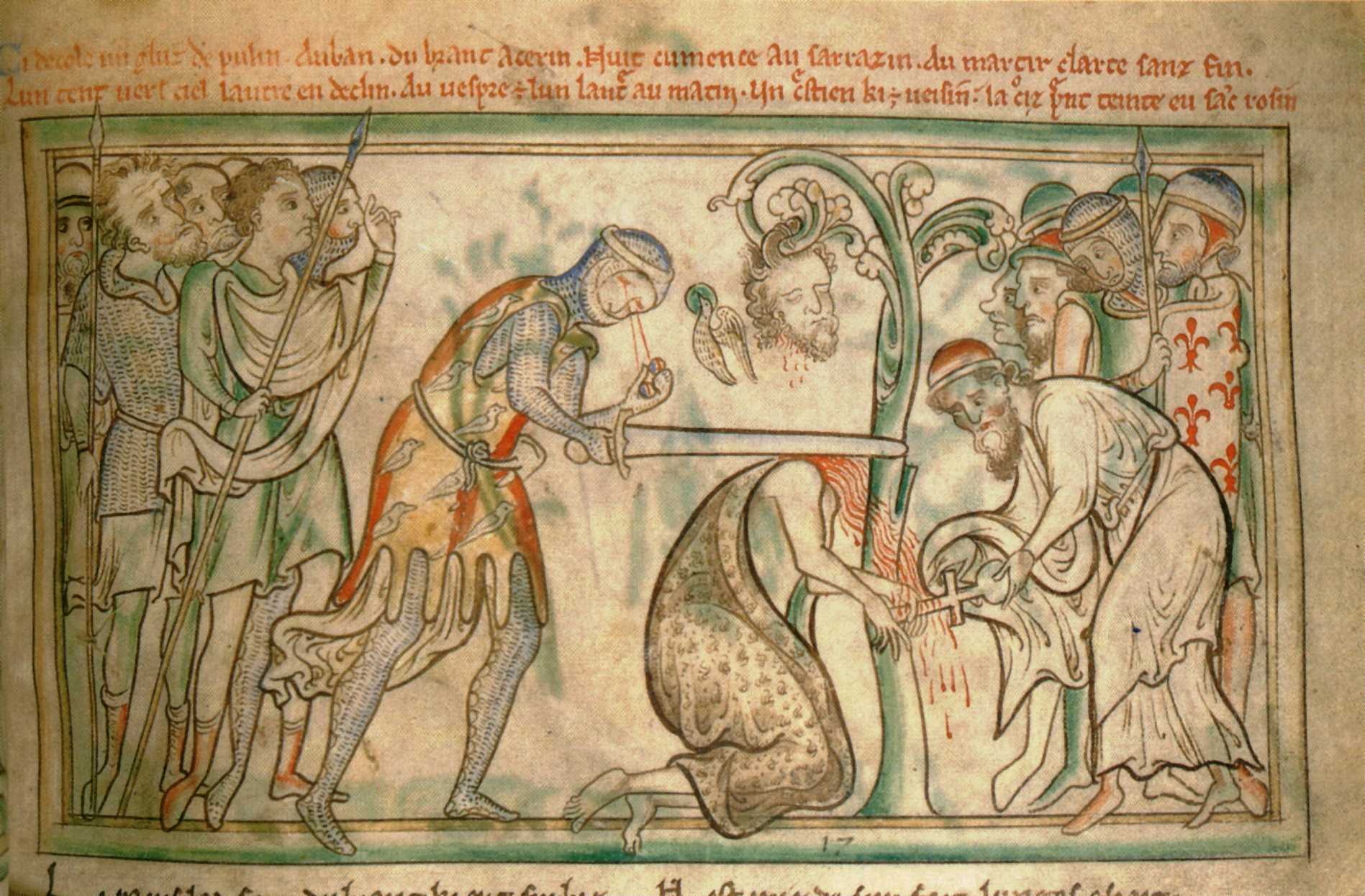
After having the saint beaten and tortured, the magistrate threatened him with execution. St Alban rejoiced and glorified God. The magistrate ordered the soldiers to take St Alban to the Holmhurst Hill to be beheaded. When they came to the river Ver, they saw that the bridge was crowded with people who had come to witness Alban's martyrdom. Since they could not proceed because of the multitude of people, St Alban p rayed and made the Sign of the Cross over the river. At once, the waters parted so that they were able to cross over to the other side.

The executioner was so astonished by the miracle that he threw down his sword and refused to behead the saint. He was arrested, and another man was found to behead them both. There is a tradition that St Alban became thirsty while climbing the hill and asked for water. A small spring gushed forth near the top of the hill, and he was able to drink from it. Pilgrims used to come and drink from St Alban's well, but it is now dry.

The date of St Alban's martyrdom is uncertain, but it is believed that it took place during the reign of Decius (ca. 251) or Valerian (ca. 257). The eighteenth century Turin manuscript (which may be based on a fifth century source) suggests that St Alban may have been executed as early as 209, when the emperor Septimus Severus and his two sons were in Britain. The name of the executioner who was converted has not been preserved. The priest Amphibalus was ultimately caught and put to death at a place called Redbourn, four miles from Verulamium.
  
St. Alban the Protomartyr of Britain (source)
  
When people began to cry out against the magistrate, he put an end to the persecution. In later years a cathedral was built on the site of the martyrdom, and the relics of St Alban, the priest Amphibalus, and perhaps even the executioner were enshrined within. St Bede (May 27) tells us that miracles frequently took place at St Alban's tomb. When the Danes invaded England in 860, the relics were removed for safekeeping, then later returned.

A new chapel and shrine were built for the relics in the early fourteenth century. Two hundred years later, during the dissolution of the monasteries under Henry VIII, the marble shrine was destroyed. Much later, the fragments of the s hrine were reassembled on its former site. What happened to the relics is uncertain, but it is probable that they were either destroyed or buried in an unmarked spot.

Although St Alban is sometimes depicted in military garb, there is no evidence that he was a soldier. After all, he was living in a private home when he was arrested, and not in a barracks. There is a medieval painting in the south aisle beside the Choir in the Abbey which depicts St Alban with red hair. A medieval seal, now in the Durham Cathedral Chapter Library, shows him with a thick beard. He is stocky, with a high, round and balding forehead, and a cloak covers his left side and right shoulder."
(http://ocafs.oca.org/FeastSaintsViewer.asp?SID=4&ID=1&FSID=101785)


Relics of the Saint (Wikipedia)
"In June 2002 a scapula (shoulder blade), believed to be a relic of St Alban, was presented to St Albans Cathedral and placed inside the saint’s restored 13th century shrine. The bone was given by the Church of St. Pantaleon in Cologne, Germany. St Pantaleon's, like St Albans Cathedral a former Benedictine abbey church that had a shrine dedicated to St Alban, has possessed remains believed to be those of St Alban since the 10th century. It is entirely possible that further relics were acquired by the church in the 16th century at the time of the Dissolution of the Monasteries in England, when many such relics were smuggled abroad to prevent their destruction. St Albans Abbey was dissolved in 1539.
  
The Orthodox icon of the Martyr Alban at his Martyrium (source)
  
The largest relic of St Alban in England is the thigh of the protomartyr preserved at St Michael's Benedictine Abbey, Farnborough, Hampshire, which was removed from the St Pantaleon's reliquary in the 1950s."
(http://en.wikipedia.org/wiki/Saint_Alban)
  
Shrine of St. Alban in his cathedral (St. Albans, England) (http://upload.wikimedia.org/wikipedia/commons/a/a9/Shrine-of-st-alban.jpg)
  
On "Lord, I have cried ...", 6 stichera: in Tone I: Spec. Mel.: "O most lauded martyrs ..."

Arise, ye Christian peoples of Albion, leap for joy and join chorus, lifting your voices in sacred hymnody, and let us praise Alban the most laudable, who in accordance with his name was washed whiter than snow by the blood of his martyrdom; for, confessing Christ before the ungodly tyrant, he received a heavenly crown from his Master on high.

O Verulamium, once armed with pagan might, beyond thy ruins rose a new and Christian city, in the place where the holy Alban suffered, and where the shrine of his precious relics was established, to which the faithful have recourse, even in our times; for the grace divine which emboldened him to lay down his life for his Lord doth constantly shine forth upon us who venerate his glorious martyrdom.

O heathen worshipers of false deities, who in your madness venerate the elemental forces of nature as divine, ye are confounded and put to shame by the courageous witness of Alban most wise, who, brought before the pitiless tyrant, steadfastly refused to offer sacrifice to inanimate things, bravely proclaiming with the Psalmist that the gods of the pagans are demons. Wherefore, having witnessed to Christ on earth, he hath inherited His kingdom in the heavens.

St. Alban the Protomartyr of Britain (http://www.allmercifulsavior.com/icons/Icons-Alban.htm)
  
Troparion, in Tone III
With faith, piety and devotion let us hasten to the sacred shrine of the wondrous martyr Alban, the first in Britain to shed his blood for Christ the Lord, for Whom he willingly laid down his life; and let us pray that through his supplications our souls may find mercy and salvation.
 
Kontakion, in Tone II: Spec. Mel.: "Seeking the highest ..."

Imbued with courage and bravery from on high, the glorious martyr Alban stood undaunted before the tyrant and boldly confessed Christ as the only God of all; and he utterly refused to offer sacrifice to false deities. Wherefore, having laid down his life for the Lord, he maketh earnest entreaty in behalf of our souls.
  
Ikos
Heeding well the words of the Saviour to His disciples, thou didst not fear him who could slay thy body, for he was unable to kill thy soul. For this cause, what was taught thee in the darkness by the Christian priest, whose life thou didst save, thou didst proclaim in the light; and what thine ear took in of his pure teaching, thou didst declare openly before the tribunal. Wherefore, having laid down thy life for the Lord, thou makest earnest entreaty in behalf of our souls.

For the full service of St. Alban in English, see: http://orthodoxengland.org.uk/servalb.htm.

St. Alban the Protomartyr of Britain (source)
     
Through the prayers of our Holy Fathers, Lord Jesus Christ our God, have mercy on us and save us! Amen!

Saturday, January 30, 2010

St. Arsenios of Paros the Righteous (+1877)


"Saint Arsenius was born on January 31, 1800 in Ioannina, Epirus of pious Orthodox parents. In holy Baptism he was given the name Athanasius. His parents died when he was quite young. He was only nine years old when he made his way to Kydoniai, Asia Minor, where he was received by Hieromonk Gregory Saraphis and enrolled in his school. His humility and piety endeared him to Fr Gregory and also to the other teachers. The boy remained at the school for five years, surpassing the other students in learning and in virtue.

One day the renowned Spiritual Father Daniel of Zagora, Thessaly came to the school to hear confessions. Athanasius became Daniel's disciple, remaining with him until the latter's death.

Not long after this, Fr Daniel decided to go to the Holy Mountain for quiet and spiritual struggles. Athanasius begged his Elder not to leave him, but to take him with him. He expressed the desire to travel to Mt. Athos, the Garden of the All-Holy Virgin, and to become a monk.

Fr Daniel instructed Athanasius in the monastic life, which is called "the art of arts, and the science of sciences." The holy Elder was a perfect teacher who was accomplished in the spiritual life, and Athanasius was an attentive student. After a time Fr Daniel tonsured his pupil, and told him he had to learn three important lessions. First, he must cut off his own will. Secondly, he must acquire humility. Finally, he must learn obedience. "If you cut off your will, if you become humble, and if you practice perfect obedience, you will also make progress in the other virtues, and God will glorify you." [For a longer account of Elder Daniel's advice to St. Arsenios, see below***]

After a further period of testing, Fr Daniel tonsured Athanasius into the Great Schema and gave him the name Arsenius. The saint remained on Mt. Athos with his Elder for six years. Then they had to leave the Holy Mountain because of the agitation against the so-called "Kollyvades," who called for a strict adherence to Holy Tradition. The name comes from the kollyva (boiled wheat) used in the memorial service. Part of the controversy involved the debate on whether it was proper to serve memorial services for the dead on Sunday. The Kollyvades believed that these services were inappropriate for the Day of Resurrection, but should be served on Saturday. The Kollyvades advocated frequent Communion, rather than the practice of receiving the Holy Mysteries only a few times during the year. When Fr Daniel and St Arsenius left Athos, it was probably due to the animosity of those who opposed the Kollyvades.

[For more on the Kollyvades Fathers, see: http://full-of-grace-and-truth.blogspot.com/2009/04/synaxis-of-holy-kollyvades-fathers.html.]

Early in 1821, before the Greek War of Independence, they went to the Monastery of Pendeli near Athens. Their stay was a brief one, for Fr Daniel forsaw the destruction of the monastery by the Turks.

The two made their way to the Cyclades Islands in the southern Aegean Sea. First they stopped at Paros, perhaps because some of the Kollyvades had settled there. Eventually, they decided to live on the island of Pholegandros. Since there were no teachers for the children, the inhabitants entreated Fr Daniel to allow St Arsenius to instruct their children. The Elder agreed, and had Arsenius ordained as a deacon. Then he was appointed to the teaching post by the government.

The saint remained there as a teacher from 1829-1840. He taught the required subjects in school, but he also helped his students to form a good character, and to live as pious Christians.

In 1840 St Arsenius entered the Monastery of St George on the island of Paros. Elder Daniel had passed away in 1837. Before his repose, he asked his disciple to take his remains to Mt. Athos after two years. St Arsenius left Plolegandros in obedience to Fr Daniel's request, planning to stop on Paros then continue to the Holy Mountain. On Paros the abbot of St George's Monastery, Fr Elias Georgiadis, told St Arsenius that it was God's will for him to remain on Paros. This was providential, because Mt. Athos was undergoing great difficulty after the Greek War of Independence. 3,000 Turkish soldiers occupied Athos, resulting in the departure of 5,000 of the 6,000 monks.

St Arsenius joined the community at St George's Monastery on the northern end of Paros. There he found spiritual strivers of true wisdom and excellent conduct, who were worthy models for him to follow.

When he was ordained to the holy priesthood at the age of forty-seven, St Arsenius intensified his spiritual efforts. Every day he studied the Holy Scriptures and the writings of the Fathers, and became adept at the unceasing prayer of the heart. He also began to show forth the gift of tears. In this, he resembled his patron St Arsenius the Great (May 8), who continuously wept tears of contrition.

Gradually, the inhabitants of Paros came to recognize him as an outstanding Father Confessor and spiritual guide. Whenever he stood before the holy altar, he felt that he was standing before God. He served with great compunction, and his face often became radiant like the face of an angel.

As his virtues became known to people, they flocked to him from near and far. He received all with paternal affection, treating each one with the proper spiritual medicine which would restore their souls to health.

A certain girl from Syros came to the Convent of the Transfiguration to visit her sister, who was a nun. The nun had previously been informed that her sister had fallen into a serious sin. When she learned that the girl was outside the doors of the convent, the nun screamed at her, "Go far away from here. Since you are defiled, you will defile the convent and the nuns." Instead of feeling pity for her sister, and trying to lead her to repentance, the nun and some of the other nuns struck the poor girl and told her to go away.

The wretched girl cried, "I have made a mistake. Forgive me!"

The nun shrieked, "Go away, or I will kill you to wash away the shame you have brought to our family."

"Have you no pity, my sister, don't you share my pain?"

"No," the nun shouted, "you are not my sister, you are a foul harlot."

"Where shall I go?" she sobbed.

"Go and drown yourself," was the heartless reply.

The poor girl fled from the convent, bleeding and wounded, intending to kill herself. At that very moment, St Arsenius was on his way to visit the convent. Seeing the girl in such a state, he asked her what was wrong. She explained that she had been led astray by corrupt men and women. Realizing her sin, she went to the convent to ask her sister for help.

"See what they have done to me, Elder. What do you advise me to do? Shall I drown myself, or leap off a cliff?"

"I do not advise you to do either, my child. If you wish, I shall take you with me and heal the wounds of your soul and body," he said gently.

"Where will you take me?" the miserable girl asked.

"To the convent, my child."

"I beg you not to take me there, Elder. My sister and the other nuns said they would kill me if I came back."

The saint replied, "Do not be afraid. They will not kill you, because I shall entrust you to Christ, and no one will be able to harm you."

"Very well," she said, "If you entrust me to Christ I will not be afraid of them, for Christ is more powerful than they."

St Arsenius led her to the convent, consoling her and encouraging her to repentance and confession. After hearing her confession, he made her a nun. Then he called all the nuns into the church and severely rebuked those who wounded the girl. He reminded them of the parable of the Prodigal Son, and of how Christ had come to save sinners. He often associated with sinners, showing them great love and mercy.

"You, however, have done the opposite. Though you knew that her soul had been wounded by the devil, you did not feel sorry for her. You did not embrace her and try to save her from further sin, but you attacked her and beat her. Then you urged her to kill herself. Now I, your Spiritual Father, tell you that you are not nuns, you are not Christians, you are not even human beings. You are devoid of compassion, affection, and sympathy. You are murderesses! Therefore, I forbid you to receive Holy Communion for three years, unless you recognize your sin. Repent and confess, weep and ask forgiveness from God and from me, your Spiritual Father, and from the other nuns who did not participate in your sinful behavior."

The nuns began to weep bitterly and they repented. Thus, he lessened their penance and forgave them. He gave the girl's sister the penance of not receiving Holy Communion for a whole year. Because the other nuns had shared in this sin, he would not permit them to receive Communion for six months.

St Arsenius foresaw his death a month before it occurred. At the Liturgy for the Feast of St Basil, he announced that he would soon depart from them. With great effort, he was able to serve for the Feast of the Theophany. After the service, he told some nuns that this had been his last Liturgy.

News of the saint's illness and approaching death spread quickly to all the villages of Paros. People wept because they were about to lose their Spiritual Father, and they hastened to bid him farewell and to receive his blessing.

On the eve of his repose, he called the nuns of the convent to come to him. He told them that the next day he would leave this temporary life and enter into eternal life.

On January 31, 1877 St Arsenius received Holy Communion for the last time and fell asleep in the Lord. For three days, people came to kiss his body, then they followed the funeral procession to the burial site which he himself had selected.

St Arsenius of Paros was glorified by the Patriarchate of Constantinople in 1967. He is also commemorated on August 18 (the uncovering of his relics)."
(http://ocafs.oca.org/FeastSaintsViewer.asp?SID=4&ID=1&FSID=100395)


***Elder Daniel's advice to his young disciple, St. Arsenios
“Listen my child, and pay attention to my words,” said Elder Daniel. “If you want to become a true and perfect monk, to master the monastic way of life, which is the true philosophy, the art of arts and the science of sciences, and leads man safely to the Kingdom of Heaven, it is necessary from the very outset to learn three lessons. If you pay the proper attention to these and apply yourself and learn them, you will subsequently learn with ease all the other lessons that are necessary for the mastery of the science which you have decided to follow. Or rather, in these three lessons are contained (on them depend) the whole Law, and the virtues, and all the other lessons. These three lessons are the following: The first is called cuttting out of one’s will; the second, humility; the third, obedience. It is easy for one to learn these intellectually; but to learn them in this way is of no benefit. What benefits one is putting them into practice. It is easy for one to read about them in the writings of the Apostles, and of the Fathers and Teachers of our Holy Church, and thus learn about them. But while it is easy to read and learn about them, it is difficult to put them into practice. Many men, especially educated persons, scholars, teachers, bishops, priests have read about them, are reading about them and have learned about them, and many of them have also taught them and are teaching them to others. However, as they did not practice them, they did not derive any benefit at all. Rather, they brought harm upon themselves and upon other, for ‘he who knew his master’s will and did not act according to it shall receive a severe beating, while he who did not know shall receive a light beating.’ Hence our Lord Jesus Christ enjoined on His holy Apostles, and through them on us and on all men of all generations, first to do and then to teach. ‘Let your light so shine before men, that they may see your good works, and glorify your Father Who is in heaven.’ You note that the Lord did not say: ‘that they may see or hear your good words,’ but ‘your good works.’ Similarly, he says: ‘Whosoever shall do and teach, the same shall be called great in the kingdom of heaven.’ He does not say: ‘Whosoever shall teach’ only, but who wil also and in the first place ‘do.’"
(taken from: Modern Orthodox Saints Vol. 6: St. Arsenios of Paros, by Constantine Cavarnos; http://www.bombaxo.com/blog/?p=1272)

Quotes of St. Arsenios
"Practice self-observation. And if you want to benefit yourself and your fellow men, look at your own faults and not those of others. The Lord tells us: "Judge not, that ye be not judged," condemn not that ye be not condemned. And the Apostle Paul says: "Who art thou that judgest another man's servant?"

"If you want Christ to bless you and what you have, when you meet some poor individual, who is hungry and asks you for food, give him. Also, when you know that some poor man, or a widow, or an orphan are hungry, do not wait for them to ask you for food, but give them. Give with pleasure, and be not afraid that your will become indigent. Have faith that Christ invisibly blesses your few possessions, and you shall never starve, nor will you be in want till the end of your life."

May St. Arsenios intercede for us and help us!

St. Arsenios the Righteous of Paros (http://www.synaxarion.gr/gr/sid/1968/sxsaintinfo.aspx)

Απολυτίκιον Ἦχος α'

Τῆς Ἠπείρου τήν δόξαν καί τῆς Πάρου τό καύχημα, τῆς Μονῆς τοῦ Δάσους προστάτην σέ τιμῶμεν, Αρσένιε. Ώς ἄγγελος γάρ ὤφθης ἐπὶ γῆς ἀσκήσει οὐρανίων ἀρετῶν, διά τοῦτο ἐδοξάσθης παρά Θεοῦ θαυμάτων πάτερ χάρισει. Δόξα τῷ σέ δοξάσαντι Χριστῷ, Δόξα τῷ σέ θαυμαστώσαντι, Δόξα τῷ δωρησαμένω σε ἡμῖν, πρέσβυν ἀκοίμητον.

Apolytikion of St. Arsenios of Paros in the First Tone (amateur translation)
The glory of Epiros and the boast of Paros, the protector of Dasous Monastery, we honor you O Arsenios. You were seen as an angel on earth and [through] ascesis [received] heavenly virtues, because of this you were glorified by God granting us miracles, O Father. Glory to Christ Who glorified you, Glory to Him Who showed you wondrous, Glory to Him Who granted to us an unsleeping intercessor.

Through the prayers of our Holy Fathers, Lord Jesus Christ our God, have mercy on us and save us! Amen!