Showing posts with label Fasting. Show all posts

Friday, July 31, 2020

Homily on the Holy Maccabees by Metropolitan Avgoustinos Kantiotes

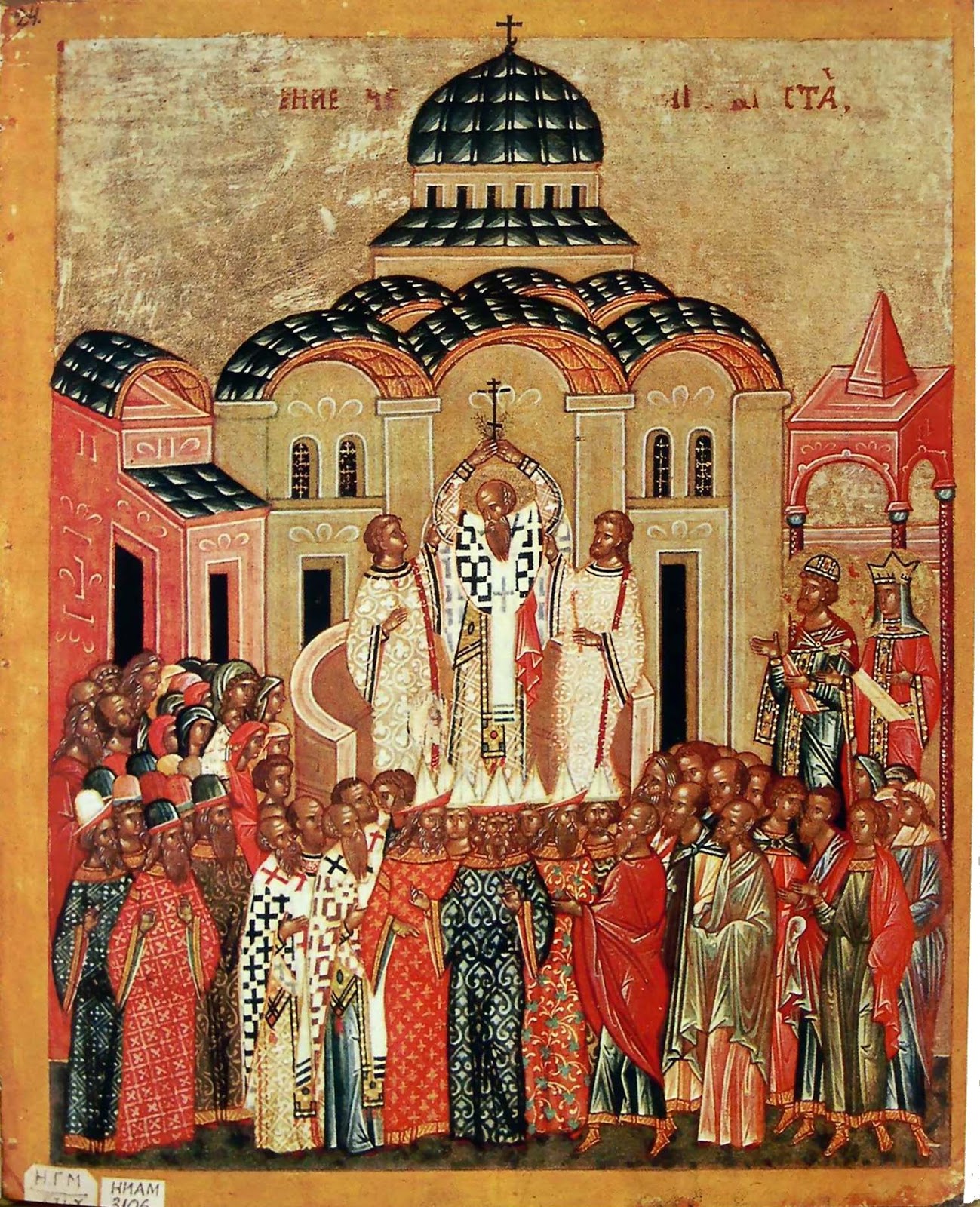
Icon of the Holy Maccabees with their Mother St. Solomone, and their teacher Eleazar (source)
  
Homily on the Holy Maccabees by Metropolitan Avgoustinos Kantiotes: "Our Faith is True"
We will speak, my beloved, on the Holy Maccabees. They are a star cluster of nine stars, one being their teacher Eleazar, the second was their mother Solomone, and the other seven are her distinguished children of this large family.

These heroes lived in the 2nd century before Christ, during the reign of the King of Syria and Judea of one of the successors of Alexander the Great, Antiochos the Epiphanes (175-163BC). This man, a fanatical idolater, had endless hatred of the Jews, who were the only ones who believed in the true God. He tried with his whole being to uproot from their hearts their faith which had been given to them by Moses. And he slaughtered, slaughtering like a wild beast, more wild than a tiger or a lion. A beast might eat three or four people, but can't eat more. He, however, slaughtered 80,000 Jews, and blood poured through the streets of Jerusalem like a river. And in order to put an end to their religion, he organized an idol-worshiping feast. In the center of the city, he placed a great and large altar, and there sacrificed sheep and goats and bulls and rams, like the Jews would do typically, but--in order to corrupt them--he also sacrificed pigs, hundreds of pigs, to the gods of the idols. And in order to defile the Jews and to strike their religious consciences, he forced them to consume the meat. We must know that the Jews never ate pork. To this day, if you go to a Jewish home, they never eat pork. I won't go into the reasons that they do it, but in any case they continue to keep this.

The Jews fast. Do we? We also need to fast. And here I will make an aside. Are you a Christian, are you Orthodox? I'm not sure. If you were Orthodox, if you firmly believed in our Orthodoxy, you must keep the fasts. Which fasts? You should fast on Wednesday and Friday: Wednesday because on that day was our Lord Jesus Christ betrayed, and Friday, because on that day He was crucified. If you were Orthodox, you would fast during holy and Great Lent, and the other fasting periods, including January 5th, the day before Theophany, August 29th, the day of the Beheading of the Forerunner, and the Exaltation of the Precious Cross.

Do Christians fast today? Unfortunately, this holy practice seems to be going by the wayside. You can break whatever you wish, and you see people even breaking the fast on Holy Friday. During fasting periods, the meat markets are full and the restaurants at night dish out tons of meat. We [Greeks] have become among the largest meat-eaters in the Balkans. We even buy and ship in meat from Bulgaria and Serbia. All of this eating of meat is very serious for our health as well.

So the Jews therefore fasted, and to mock their fasting, Antiochos forced them to eat pork that had been sacrificed to the idols. First, he called the teacher Eleazar, who was an honorable priest. He told him: "I am 90 years old. Until now I have kept the fast according to the divine law, and I cannot even begin to think about abandoning our holy tradition..." He was seized by the soldiers of Antiochos, bound, and thrown into the fine. Thus, he gave up his soul to God.

After this, one by one he called the seven brothers, the Maccabees. He hold them: "Take pity on your youth." He told the first: "I will give you honor, glories, respect." "Keep your honors, I will remain in the home of my fathers/ I will never taste pork sacrificed to the idols..." Thus, the first said not. The same occurred with the second, the third, the fourth, the fifth, the sixth and the seventh. And after they all denied, each began their terrible martyrdom, which one shudders to even think about. Open the Old Testament to the end and turn to the book of Fourth Maccabees (5-12). Don't just read magazines and newspapers. If you are a Christian, read the holy Scriptures. You will say, I don't have time, or I'm tired...Good try!

Let me make another aside. I tell you to fast, but you don't fast. I tell you to read the Holy Scriptures, but you don't read them. The one you don't do, neither do you do the other. What Christian are you, can you tell me? I tell you to pray, but you don't pray. I tell you to confess, but you don't confess. I tell you to commune, but you don't commune. I tell you to go to church, but you don't go. You only go to church when you're invited to a sacrament [i.e. a baptism or a wedding]. Many go for a memorial service. But this is a sin. Because every church every Sunday is a memorial service. What memorial?  Not of our father or our mother. Every Sunday, we serve a memorial for the Lord. And if you go to the memorial of your father or mother, even more so should you go to the memorial of our Lord Jesus Christ. What does faith cost you? To the martyrs it cost terrible pains and death.

The Maccabees therefore said no, and began their martyrdom. A martyrdom that makes man shudder to read it, as is described in the Holy Scriptures. They put a trident between their eyes. Another they cut off his right hand. Another they cut off the left with a saw. Another they cut off his fingers. Another, they pulled off his nails. Another they raked his flesh with iron nails. Another they skinned him alive, like the butcher skins an animal... But it was as if nothing to them! They remained steadfast.

And in front of all of this, in the presence of the martyrdom of the seven children, who was there, I ask? Their mother, St. Solomone. O, what a mother! She was not at all like some mothers today who would say: "Eat, my child, a little meat, it's nothing..." Today, many mothers are only thinking of their children's bodies, their flesh, in other words. Above the body, they don't see anything else. St. Solomone was a unique mother, a historic mother, a rare example throughout the ages. "No, my children!" she said, "Do not pollute our religion, do not loose the crown of glory!" And their mother prepared them, her seven children, for a terrible martyrdom. It was their faith in God, and this faith showed her to be a heroine, a unique and grand and lady of a woman. How did she find the strength to support all her children to be sacrificed? Don't you think that she felt pain? Of course she felt pain. As her children were being martyred, and she saw them one by one being put to death in the most terrible manner, she suffered. She was pained for each separately, and for them all together. Her pain was greatly multiplied. Mothers, when their children get sick with a fever, they entreat God for the fever to flee from their children and to come to them instead. If, therefore, each child of St. Solomone was martyred once, then she was pained for each, and it was as if she was martyred seven times, multiplied by seven. And, having endured steadfastly and unshaken throughout this trial, in the end, she herself fell into the fire (IV Maccabees 17:1). Thus, they were all burned and became a sacrifice for the love of God, martyrs before Christ.

This, my brethren, in a few words, is the martyrdom of the seven Maccabee children, of their mother Solomone, and their teacher Eleazar. What does it teach us?

One lesson comes forth today. Our faith is not a myth. It is living and wondrous. We have the most true religion, the only truth in the world. Because of this, the Prophets prophesied and gave their lives, including the Maccabees in the Old Testament, and because of this, the Apostles and Martyrs were sacrificed in the New Testament, and because of this, the Fathers and the Teachers of the Church lived in asceticism, and preached theology, and confessed the faith.

Let us as well honor and imitate their struggles out of love, that we might, together with them, become partakers in the glory of the Kingdom of God, to Whom be glory and might unto the ages of ages. Amen.
(+) Bishop Avgoustinos
(Delivered in the Church of the Holy Trinity, Ptolmaidos, on Sunday August 2nd, 1987)
(source)
  
The Holy Maccabee Martyrs (source)  
Through the prayers of our Holy Fathers, Lord Jesus Christ our God, have mercy in us and save us! Amen!

Tuesday, August 20, 2019

St. Anatolios of Optina on the Best Fasting

Prayer before Christ (source)
  
"The best fasting is to endure whatever is sent to you by God."
-St. Anatolios of Optina

(source)
 
Through the prayers of our Holy Fathers, Lord Jesus Christ our God, have mercy on us and save us! Amen!

Friday, May 31, 2019

A Vision of the Church from the Shepherd of Hermas

Jesus Christ the Son of God the Savior of the World (source)
  
A Vision of the Church from the Shepherd of Hermas (The Third Vision)
  

Chapter 1

The vision which I saw, my brethren, was of the following nature. Having fasted frequently, and having prayed to the Lord that He would show me the revelation which He promised to show me through that old woman, the same night that old woman appeared to me, and said to me, Since you are so anxious and eager to know all things, go into the part of the country where you tarry; and about the fifth hour I shall appear unto you, and show you all that you ought to see. I asked her, saying Lady, into what part of the country am I to go? And she said, Into any part you wish. Then I chose a spot which was suitable, and retired. Before, however, I began to speak and to mention the place, she said to me, I will come where you wish. Accordingly, I went to the country, and counted the hours, and reached the place where I had promised to meet her. And I see an ivory seat ready placed, and on it a linen cushion, and above the linen cushion was spread a covering of fine linen. Seeing these laid out, and yet no one in the place, I began to feel awe, and as it were a trembling seized hold of me, and my hair stood on end, and as it were a horror came upon me when I saw that I was all alone. But on coming back to myself and calling to mind the glory of God, I took courage, bent my knees, and again confessed my sins to God as I had done before. Whereupon the old woman approached, accompanied by six young men whom I had also seen before; and she stood behind me, and listened to me, as I prayed and confessed my sins to the Lord. And touching me she said, Hermas, cease praying continually for your sins; pray for righteousness, that you may have a portion of it immediately in your house. On this, she took me up by the hand, and brought me to the seat, and said to the young men, Go and build. When the young men had gone and we were alone, she said to me, Sit here. I say to her, Lady, permit my elders to be seated first. Do what I bid you, said she; sit down. When I would have sat down on her right, she did not permit me, but with her hand beckoned to me to sit down on the left. While I was thinking about this, and feeling vexed that she did not let me sit on the right, she said, Are you vexed, Hermas? The place to the right is for others who have already pleased God, and have suffered for His name's sake; and you have yet much to accomplish before you can sit with them. But abide as you now do in your simplicity, and you will sit with them, and with all who do their deeds and bear what they have borne.

Chapter 2

What have they borne? said I. Listen, said she: scourges, prisons, great tribulations, crosses, wild beasts, for God's name's sake. On this account is assigned to them the division of sanctification on the right hand, and to every one who shall suffer for God's name: to the rest is assigned the division on the left. But both for those who sit on the right, and those who sit on the left, there are the same gifts and promises; only those sit on the right, and have some glory. You then are eager to sit on the right with them, but your shortcomings are many. But you will be cleansed from your shortcomings; and all who are not given to doubts shall be cleansed from all their iniquities up till this day. Saying this, she wished to go away. But falling down at her feet, I begged her by the Lord that she would show me the vision which she had promised to show me. And then she again took hold of me by the hand, and raised me, and made me sit on the seat to the left; and lifting up a splendid rod, she said to me, Do you see something great? And I say, Lady, I see nothing. She said to me, Lo! Do you not see opposite to you a great tower, built upon the waters, of splendid square stones? For the tower was built square by those six young men who had come with her. But myriads of men were carrying stones to it, some dragging them from the depths, others removing them from the land, and they handed them to these six young men. They were taking them and building; and those of the stones that were dragged out of the depths, they placed in the building just as they were: for they were polished and fitted exactly into the other stones, and became so united one with another that the lines of juncture could not be perceived. And in this way the building of the tower looked as if it were made out of one stone. Those stones, however, which were taken from the earth suffered a different fate; for the young men rejected some of them, some they fitted into the building, and some they cut down, and cast far away from the tower. Many other stones, however, lay around the tower, and the young men did not use them in building; for some of them were rough, others had cracks in them, others had been made too short, and others were white and round, but did not fit into the building of the tower. Moreover, I saw other stones thrown far away from the tower, and falling into the public road; yet they did not remain on the road, but were rolled into a pathless place. And I saw others falling into the fire and burning, others falling close to the water, and yet not capable of being rolled into the water, though they wished to be rolled down, and to enter the water.

Chapter 3

On showing me these visions, she wished to retire. I said to her, What is the use of my having seen all this, while I do not know what it means? She said to me, You are a cunning fellow, wishing to know everything that relates to the tower. Even so, O Lady, said I, that I may tell it to my brethren, that, hearing this, they may know the Lord in much glory. And she said, Many indeed shall hear, and hearing, some shall be glad, and some shall weep. But even these, if they hear and repent, shall also rejoice. Hear, then, the parables of the tower; for I will reveal all to you, and give me no more trouble in regard to revelation: for these revelations have an end, for they have been completed. But you will not cease praying for revelations, for you are shameless. The tower which you see building is myself, the Church, who have appeared to you now and on the former occasion. Ask, then, whatever you like in regard to the tower, and I will reveal it to you, that you may rejoice with the saints. I said to her, Lady, since you have vouchsafed to reveal all to me this once, reveal it. She said to me, Whatsoever ought to be revealed, will be revealed; only let your heart be with God, and doubt not whatsoever you shall see. I asked her, Why was the tower built upon the waters, O Lady? She answered, I told you before, and you still inquire carefully: therefore inquiring you shall find the truth. Hear then why the tower is built upon the waters. It is because your life has been, and will be, saved through water. For the tower was founder on the word of the almighty and glorious Name and it is kept together by the invisible power of the Lord.

Icon depicting the prophecy of Christ from the Proverbs: "Wisdom hath built her house..." (source)

Chapter 4

In reply I said to her, This is magnificent and marvellous. But who are the six young men who are engaged in building? And she said, These are the holy angels of God, who were first created, and to whom the Lord handed over His whole creation, that they might increase and build up and rule over the whole creation. By these will the building of the tower be finished. But who are the other persons who are engaged in carrying the stones? These also are holy angels of the Lord, but the former six are more excellent than these. The building of the tower will be finished, and all will rejoice together around the tower, and they will glorify God, because the tower is finished. I asked her, saying, Lady, I should like to know what became of the stones, and what was meant by the various kinds of stones? In reply she said to me, Not because you are more deserving than all others that this revelation should be made to you — for there are others before you, and better than you, to whom these visions should have been revealed — but that the name of God may be glorified, has the revelation been made to you, and it will be made on account of the doubtful who ponder in their hearts whether these things will be or not. Tell them that all these things are true, and that none of them is beyond the truth. All of them are firm and sure, and established on a strong foundation.

Chapter 5

Hear now with regard to the stones which are in the building. Those square white stones which fitted exactly into each other, are apostles, bishops, teachers, and deacons, who have lived in godly purity, and have acted as bishops and teachers and deacons chastely and reverently to the elect of God. Some of them have fallen asleep, and some still remain alive. And they have always agreed with each other, and been at peace among themselves, and listened to each other. On account of this, they join exactly into the building of the tower. But who are the stones that were dragged from the depths, and which were laid into the building and fitted in with the rest of the stones previously placed in the tower? They are those who suffered for the Lord's sake. But I wish to know, O Lady, who are the other stones which were carried from the land. Those, she said, which go into the building without being polished, are those whom God has approved of, for they walked in the straight ways of the Lord and practiced His commandments. But who are those who are in the act of being brought and placed in the building? They are those who are young in faith and are faithful. But they are admonished by the angels to do good, for no iniquity has been found in them. Who then are those whom they rejected and cast away? These are they who have sinned, and wish to repent. On this account they have not been thrown far from the tower, because they will yet be useful in the building, if they repent. Those then who are to repent, if they do repent, will be strong in faith, if they now repent while the tower is building. For if the building be finished, there will not be more room for any one, but he will be rejected. This privilege, however, will belong only to him who has now been placed near the tower.

Chapter 6

As to those who were cut down and thrown far away from the tower, do you wish to know who they are? They are the sons of iniquity, and they believed in hypocrisy, and wickedness did not depart from them. For this reason they are not saved, since they cannot be used in the building on account of their iniquities. Wherefore they have been cut off and cast far away on account of the anger of the Lord, for they have roused Him to anger. But I shall explain to you the other stones which you saw lying in great numbers, and not going into the building. Those which are rough are those who have known the truth and not remained in it, nor have they been joined to the saints. On this account are they unfit for use. Who are those that have rents? These are they who are at discord in their hearts one with another, and are not at peace among themselves: they indeed keep peace before each other, but when they separate one from the other, their wicked thoughts remain in their hearts. These, then, are the rents which are in the stones. But those which are shortened are those who have indeed believed, and have the larger share of righteousness; yet they have also a considerable share of iniquity, and therefore they are shortened and not whole. But who are these, Lady, that are white and round, and yet do not fit into the building of the tower? She answered and said, How long will you be foolish and stupid, and continue to put every kind of question and understand nothing? These are those who have faith indeed, but they have also the riches of this world. When, therefore, tribulation comes, on account of their riches and business they deny the Lord. I answered and said to her, When, then, will they be useful for the building, Lady? When the riches that now seduce them have been circumscribed, then will they be of use to God. For as a round stone cannot become square unless portions be cut off and cast away, so also those who are rich in this world cannot be useful to the Lord unless their riches be cut down. Learn this first from your own case. When you were rich, you were useless; but now you are useful and fit for life. Be useful to God; for you also will be used as one of these stones.

The Exaltation of the Precious Cross in the Church of Christ (source)

Chapter 7

Now the other stones which you saw cast far away from the tower, and falling upon the public road and rolling from it into pathless places, are those who have indeed believed, but through doubt have abandoned the true road. Thinking, then, that they could find a better, they wander and become wretched, and enter upon pathless places. But those which fell into the fire and were burned are those who have departed for ever from the living God; nor does the thought of repentance ever come into their hearts, on account of their devotion to their lusts and to the crimes which they committed. Do you wish to know who are the others which fell near the waters, but could not be rolled into them? These are they who have heard the word, and wish to be baptized in the name of the Lord; but when the chastity demanded by the truth comes into their recollection, they draw back, and again walk after their own wicked desires. She finished her exposition of the tower. But I, shameless as I yet was, asked her, Is repentance possible for all those stones which have been cast away and did not fit into the building of the tower, and will they yet have a place in this tower? Repentance, said she, is yet possible, but in this tower they cannot find a suitable place. But in another and much inferior place they will be laid, and that, too, only when they have been tortured and completed the days of their sins. And on this account will they be transferred, because they have partaken of the righteous Word. And then only will they be removed from their punishments when the thought of repenting of the evil deeds which they have done has come into their hearts. But if it does not come into their hearts, they will not be saved, on account of the hardness of their heart.

Chapter 8

When then I ceased asking in regard to all these matters, she said to me, Do you wish to see anything else? And as I was extremely eager to see something more, my countenance beamed with joy. She looked towards me with a smile, and said, Do you see seven women around the tower? I do, Lady, said I. This tower, said she, is supported by them according to the precept of the Lord. Listen now to their functions. The first of them, who is clasping her hands, is called Faith. Through her the elect of God are saved. Another, who has her garments tucked up and acts with vigour, is called Self-restraint. She is the daughter of Faith. Whoever then follows her will become happy in his life, because he will restrain himself from all evil works, believing that, if he restrain himself from all evil desire, he will inherit eternal life. But the others, said I, O Lady, who are they? And she said to me, They are daughters of each other. One of them is called Simplicity, another Guilelessness, another Chastity, another Intelligence, another Love. When then you do all the works of their mother, you will be able to live. I should like to know, said I, O Lady, what power each one of them possesses. Hear, she said, what power they have. Their powers are regulated by each other, and follow each other in the order of their birth. For from Faith arises Self-restraint; from Self-restraint, Simplicity; from Simplicity, Guilelessness; from Guilelessness, Chastity; from Chastity, Intelligence; and from Intelligence, Love. The deeds, then, of these are pure, and chaste, and divine. Whoever devotes himself to these, and is able to hold fast by their works, shall have his dwelling in the tower with the saints of God. Then I asked her in regard to the ages, if now there is the conclusion. She cried out with a loud voice, Foolish man! Do you not see the tower yet building? When the tower is finished and built, then comes the end; and I assure you it will be soon finished. Ask me no more questions. Let you and all the saints be content with what I have called to your remembrance, and with my renewal of your spirits. But observe that it is not for your own sake only that these revelations have been made to you, but they have been given you that you may show them to all. For after three days — this you will take care to remember — I Command you to speak all the words which I am to say to you into the ears of the saints, that hearing them and doing them, they may be cleansed from their iniquities, and you along with them.

Chapter 9

Give ear unto me, O Sons: I have brought you up in much simplicity, and guilelessness, and chastity, on account of the mercy of the Lord, who has dropped His righteousness down upon you, that you may be justified and sanctified from all your iniquity and depravity; but you do not wish to rest from your iniquity. Now, therefore, listen to me, and be at peace one with another, and visit each other, and bear each other's burdens, and do not partake of God's creatures alone, but give abundantly of them to the needy. For some through the abundance of their food produce weakness in their flesh, and thus corrupt their flesh; while the flesh of others who have no food is corrupted, because they have not sufficient nourishment. And on this account their bodies waste away. This intemperance in eating is thus injurious to you who have abundance and do not distribute among those who are needy. Give heed to the judgment that is to come. You, therefore, who are high in position, seek out the hungry as long as the tower is not yet finished; for after the tower is finished, you will wish to do good, but will find no opportunity. Give heed, therefore, you who glory in your wealth, lest those who are needy should groan, and their groans should ascend to the Lord, and you be shut out with all your goods beyond the gate of the tower. Wherefore I now say to you who preside over the Church and love the first seats, Be not like drug-mixers. For the drug-mixers carry their drugs in boxes, but you carry your drug and poison in your heart. You are hardened, and do not wish to cleanse your hearts, and to add unity of aim to purity of heart, that you may have mercy from the great King. Take heed, therefore, children, that these dissensions of yours do not deprive you of your life. How will you instruct the elect of the Lord, if you yourselves have not instruction? Instruct each other therefore, and be at peace among yourselves, that I also, standing joyful before your Father, may give an account of you all to your Lord.

Jesus Christ, the Angel of Great Counsel, the Holy Wisdom of God and filled with blessed silence (source)

Chapter 10

On her ceasing to speak to me, those six young men who were engaged in building came and conveyed her to the tower, and other four lifted up the seat and carried it also to the tower. The faces of these last I did not see, for they were turned away from me. And as she was going, I asked her to reveal to me the meaning of the three forms in which she appeared to me. In reply she said to me: With regard to them, you must ask another to reveal their meaning to you. For she had appeared to me, brethren, in the first vision the previous year under the form of an exceedingly old woman, sitting in a chair. In the second vision her face was youthful, but her skin and hair betokened age, and she stood while she spoke to me. She was also more joyful than on the first occasion. But in the third vision she was entirely youthful and exquisitely beautiful, except only that she had the hair of an old woman; but her face beamed with joy, and she sat on a seat. Now I was exceeding sad in regard to these appearances, for I longed much to know what the visions meant. Then I see the old woman in a vision of the night saying unto me: Every prayer should be accompanied with humility: fast, therefore, and you will obtain from the Lord what you beg. I fasted therefore for one day.
That very night there appeared to me a young man, who said, Why do you frequently ask for revelations in prayer? Take heed lest by asking many things you injure your flesh: be content with these revelations. Will you be able to see greater revelations than those which you have seen? I answered and said to him, Sir, one thing only I ask, that in regard to these three forms the revelation may be rendered complete. He answered me, How long are you senseless? But your doubts make you senseless, because you have not your hearts turned towards the Lord. But I answered and said to him, From you, sir, we shall learn these things more accurately.

Chapter 11

Hear then, said he, with regard to the three forms, concerning which you are inquiring. Why in the first vision did she appear to you as an old woman seated on a chair? Because your spirit is now old and withered up, and has lost its power in consequence of your infirmities and doubts. For, like elderly men who have no hope of renewing their strength, and expect nothing but their last sleep, so you, weakened by worldly occupations, have given yourselves up to sloth, and have not cast your cares upon the Lord. Your spirit therefore is broken, and you have grown old in your sorrows. I should like then to know, sir, why she sat on a chair? He answered, Because every weak person sits on a chair on account of his weakness, that his weakness may be sustained. Lo! You have the form of the first vision.

Chapter 12

Now in the second vision you saw her standing with a youthful countenance, and more joyful than before; still she had the skin and hair of an aged woman. Hear, said he, this parable also. When one becomes somewhat old, he despairs of himself on account of his weakness and poverty, and looks forward to nothing but the last day of his life. Then suddenly an inheritance is left him: and hearing of this, he rises up, and becoming exceeding joyful, he puts on strength. And now he no longer reclines, but stands up; and his spirit, already destroyed by his previous actions, is renewed, and he no longer sits, but acts with vigour. So happened it with you on hearing the revelation which God gave you. For the Lord had compassion on you, and renewed your spirit, and you laid aside your infirmities. Vigour arose within you, and you grew strong in faith; and the Lord, seeing your strength, rejoiced. On this account He showed you the building of the tower; and He will show you other things, if you continue at peace with each other with all your heart.

Chapter 13

Now, in the third vision, you saw her still younger, and she was noble and joyful, and her shape was beautiful. For, just as when some good news comes suddenly to one who is sad, immediately he forgets his former sorrows, and looks for nothing else than the good news which he has heard, and for the future is made strong for good, and his spirit is renewed on account of the joy which he has received; so you also have received the renewal of your spirits by seeing these good things. As to your seeing her sitting on a seat, that means that her position is one of strength, for a seat has four feet and stands firmly. For the world also is kept together by means of four elements. Those, therefore, who repent completely and with the whole heart, will become young and firmly established. You now have the revelation completely given you. Make no further demands for revelations. If anything ought to be revealed, it will be revealed to you.
(source)   
In Thee O Full of Grace All Creation Rejoiceth (source)
  
Christ is risen from the dead, by death trampling down upon death, and upon those in the tombs He has granted life!
Truly the Lord is risen!
Tuesday, March 5, 2019

Elder Aimilianos: Fasting and Prayer as a Longing for God

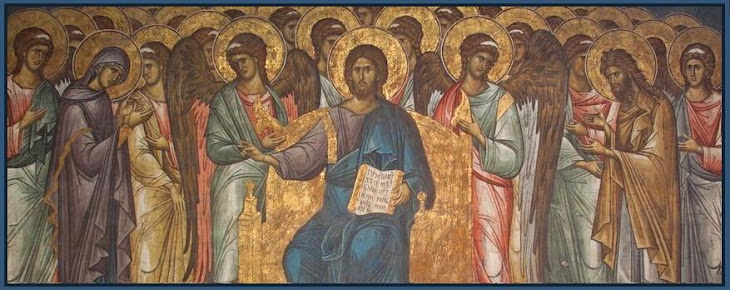
Jesus Christ, detail (source)
  
"Longing for God is expressed with fasting, with an empty stomach... Fasting has a unique meaning by expressing the longing for God... The same occurs for prayer. If prayer to myself had meaning, then my prayer life would be a human endeavor, a tendency and revival, it wouldn't be God. My prayer has meaning because it exactly expresses my longing: 'Come and abide in us...', the: 'Where are you, my God?'

"With fasting, vigil, and prayer, chaos and malaise are shown to be our rags before God, as the poor man shows his rags to his fellow man in order for him to have pity on him to help him, or like the blind man cried out to Christ to give him light. Thus, we show our poverty and he ask that He open our eyes in order to understand that we are sinners, that we might repent and so He can forgive us...

"The approach therefore is an uncreated energy, a true projection of His being. Because of this, my life as well is a true communion with the true God. While God acts, I commune with Him. While God is unapproachable, I partake of Him...

"Only the: 'Where are you, my God?', can make visible the invisible presence of God...We give Him our consent, our being, and He directs everything, He kneads us..."
-Elder Aimilianos of Simonopetra
(source)
  
Through the prayers of our Holy Fathers, Lord Jesus Christ our God, have mercy on us and save us! Amen!

Monday, March 5, 2018

Elder Nikon of New Skete: "If Christ benefited from fasting, then I will fast too!"

Christ being tempted and overcoming the devil in the desert (source)
   

“When man practices asceticism, the devil often gets in over his head. 
Because he knows what a weapon the fasting is! What power the fasting has! 
That is why, during the fasting seasons, during the Great Lent, Dormition Fast and now in the Nativity Fast, which is an easy fast, the devil is getting crazy seeking to destroy our fast by determining us to argue with each other, determining us to judge, to look at what the others are doing to lose the reward we will receive from God for fasting. 
During the fasting seasons we should be more cautious, more vigilant, in a deeper state of awakening and more prayer. 
Let the fast be not only of our stomach! 
Let it be of our eyes also, for the  ears to fast from what they hear, and the  tongue to fast from what it says, to fast from everything! 
Let us fast, but know that because we will make the devil to suffer, he will attack us! 
Do not worry at all about this! He can not do anything! If he could, then he would! 
And if you hear a smart one telling you that Scripture says that it is not a sin what goes into the mouth, but what comes out of it, what he or she says, that it is important, as Christ says, and not what you put into your mouth. 
And they want to say, using the Christ’s words, that fasting is not necessary, because Christ Himself said that what comes out of your mouth, that will condemn you, not what you put into your mouth. 
If somebody tells you such a thing, tell him or her too: If Christ benefited from fasting, then  I will fast too! If I will perform more miracles than Christ, then I will immediately interrupt my fasting. Meanwhile, if He benefited from fasting, then I will benefit even more! 
Continue to fast! And let the smart ones in their cleverness!”
   
Through the prayers of our Holy Fathers, Lord Jesus Christ our God, have mercy on us and save us! Amen!

Wednesday, February 21, 2018

Elder Ephraim of Arizona on Great Lent

Jesus Christ, "Extreme Humility" (source)
  
At this time we’re entering the great spiritual arena of the blessed Great Lent. Holy and Great Lent is a time of compunction, for repentance, for tears, for a change in ourselves, for a new stage in the spiritual life. Like an affectionate mother caring for her children, us Christians, the Church has designated this time of Lent as dedicated to the struggle, in order to help its children fight harder, to purify themselves, draw closer to God and to be counted worthy of celebrating the great day of the radiant Resurrection.
  

Christians, especially monks, have always paid particular attention to this spiritual arena and have thought it especially sacred, because it’s a period which envisages both spiritual and bodily struggles. There’s the struggle of fasting, the struggle of vigils, the struggle of purification and the struggle to fulfill one’s spiritual duties which are many more than at other times of the year. There’s a spiritual “defragmentation” and people pay greater attention to the voice of their conscience in order to correct what they’ve maybe neglected and to improve spiritually.
   
The Church assists us but with penitential hymns and services, as well as with teachings, to oil us up for the fight for the purification of our souls.
  
We have the penitential evening Divine Liturgies of the Presanctified Gifts. The Presanctified is extremely beneficial. It’s Cherubic Hymn is full of spirituality, contemplation, angelic presence. That’s why we should come to these liturgies during Great Lent with even greater compunction. We who consume the Body and Blood of Christ must be so pure and clean, so straight in body and soul for divine grace to have its effect. For this reason we must lead very careful lives. Both in our cells and in church we must wet our face with tears so as to wash our souls and be worthy to take communion. Of course, the devil often makes us wanting in compunction, me more than anyone. Which means we can’t have tears and we often have bad thoughts. Bad thoughts and the sinful images that accompany them must be rejected as soon as they make their appearance. And when we have wicked thoughts or our soul is cold towards one of the brethren, let’s not approach the God of love, Who is so pure and holy.
  
Throughout this period, at every service in Great Lent, we say the prayer of Saint Efraim the Syrian, which is as follows: “Lord and Master of my life, do not give me the spirit of sloth, inquisitiveness, lust for power or idle talk, but give rather the spirit of sobriety, humility, patience and love to me, your servant. Indeed, Lord King, grant me to see my own errors and not to judge my brother, for you are blessed to the ages of ages. Amen”.
  
With these words, the saint wishes to make us understand very clearly, that, apart from other virtues we need to take special care with the last case, that of self-censure and of criticism of our bothers and that without love for our fellow human beings there’s no chance of making even the slightest progress towards our spiritual purification. If we don’t pay attention to our thoughts, our words and our heart, there’s no benefit in fasting. Fasting is of benefit when it’s combines with love for our neighbour and when we don’t criticize others. When we don’t criticize our fellows and instead criticize ourselves, then we’re marked by love for others and love for our soul, concern for purification and the fulfillment of the great commandment, that of love of God and one’s neighbour. Love for God and for our fellows  are the two great virtues which support the whole of the spiritual structure, because if they are absent, they others cannot take form. “God is love and those who live in God in love have God living in them, too” (I. Jn. 4, 16).
  
Another issue which demands that we push ourselves as hard as possible is prayer We should pray in the name of Christ, without neglecting any opportunity and without any waste of time. In the personal vigil in our cell, we should push ourselves, shouldn’t let sleep overcome us, nor neglect nor idleness; we should engage willingly I spiritual matters. As soon as we wake up, prayer should take first place then our rule, our prayer-rope, study and the contemplation of God. We should go to church with great readiness and so get the best results from our presence in the arena.
  
Apart from this, fasting together with bodily exertion helps as regards the forgiveness of sins. “Behold my humility and my efforts and forgive all my sins”. When we labour with the fast, with kneeling, with prayers, with an effort from our heart and mind, this Godly exertion is holy and is richly rewarded by God, because it make people worthy of the crown of glory and honour. The demons fear the fast greatly, because it lays them low. “This kind [of demon] will not depart other than with prayer and fasting”, said the Lord (Math. 17, 21). This is why the holy fathers always began any Godly task with a fast. They considered a fast to be very powerful and that the Holy Spirit does nor overshadow people when they’re replete with food and their stomachs are full. And any Christian who desires purification has to start from this foundation which is fasting, prayer and vigilance. When these three are combined, then people have acquired great stature.
  
In olden times, the fathers had a holy custom. On the eve of Lent, they would leave the monasteries and go deeper into the desert, where they lived in great asceticism until Lazarus Saturday, when they returned in order to celebrate Palm Sunday all together. Some would take a few of the basic essentials as far as food was concerned, others would eat only green plants, in order to struggle more fiercely in the desert. Thereafter they would spend all the days on Great Week together in church, existing on a piece of dried rusk and a few nuts a day. We were given the blessing and the grace of knowing ascetic people who spent not only Great Lent in fasting and spiritual struggle.
  
Our departed elder, Elder Iosif the Cave-Dweller (he used to live in caves, which is where I met him), kept a very strict fast during Great Lent. And, of course, he imposed it on us, too. From Monday to Friday, five days of the week there was no food, except a handful of flour, from which we made a batter with just water. That was it. A little plate every twenty-four hours. And, at the same time, hard work lifting loads on our back during the day and the whole night hundreds of prostrations and hours of prayer. And all of this in order to purify the inner person, to make it cleaner, more honourable in the eyes of God, in order to acquire boldness before God and be able to pray for the whole world. Because the world, people everywhere, needs the prayers of the saints, particularly those of ascetics. Saint Anthony the Great supported the whole world with his prayers.
  
 Of course, we must keep the fast only as far as we’re able, with discretion, because we’re not all the same. “Unless the good be done well, it is not good”. In other words, unless good is done in a good way, method, time and amount, but instead is done without discretion, then it’ll do more harm than good. Fasting is certainly extremely necessary, it’s good, but it’s a means rather than an end The means has an end and that is humility. This is why we need to arrange everything in accordance with the discretion of a spiritual father, someone illumined by the Holy Spirit. Your spiritual father will tell you  how much to fast, how often to receive communion, where to strike at the enemy, what you should do here and what there. And then, through the discretion of your spiritual father, you can put your house in order. We shouldn’t do more than is appropriate, we need moderation in all things, because immoderation cancels out any benefit. So fasting is holy, but it’s a means. We should adjust it according to what our spiritual father says and what out psychosomatic powers allow. As long as there’s good will. Basil the Great says there’s as much difference in resilience between people as there is between iron and grass.
  
Saint Synklitiki fell ill towards the end of her life with a throat disease. Her blessed throat, which had always spoken the word of God, festered on the inside. Her mouth had saved countless people. The devil had asked permission to test her and God had granted it. The stench from her rotting flesh became so bad that the nuns had the greatest difficulty in seeing to her needs. They used the most pungent perfumes to try and bring her a little respite in her sickness. When her mouth had been healthy, it had spoken and brought benefit to many, but when she fell ill, she was able to preach even more strongly. How could a silent and rotting mouth preach? She noiselessly declared her great patience and endurance in God’s trial. She made a titanic effort to deal with the devil of impatience, of complaint, of the labour and toil of sickness. What did she need with fasting? This is why illness is regarded as involuntary asceticism. One person has cancer, another diabetes, somebody else has lots of troublesome health problems. How will these people purify themselves? How will they see God’s light?
  
Through patience and giving thanks to Him. These make up for the fast which, because of their illness, they’re unable to keep, and, in fact, often struggle ten times harder than if they were fasting.
  
During this period, we really have to struggle to purify ourselves. From the ascetic tradition we have hermits who spent the whole of their lives in the desert, with labours, toil, fasts, tears, sleeping on the ground and deprivation of every other kind of pleasure. And all this effort, together with the struggle of the soul against all kinds of thoughts concerning the rebellions of the flesh, engendered sanctity.
  
So every Christian who’s a monk and wants to experience purification has the right to labour and not be deprived of his reward. Purity brings great boldness towards God, because He Himself is pure, the Mother of God is most pure and Saint John the Theologian lived his life as a virgin, as did so many other saints. The whole beauty of the Church is founded on purity and spotlessness. When our heart is pure and beautiful it will exude fragrance and loveliness. But if people have filth in their hearts, that’s what they’ll expel. Let’s struggle to cleanse the inside of our glass, our heart, so that we’ll be pure and pleasing in God’s eyes.

  
We have instances from Church history of many people “in the world” (not monastics, that is), who pleased God and became great. Abba Paphnuti [from Ancient Egyptian = “man of God”], an ascetic of great gifts, once prayed to God and said: “God, who have You placed me with. With whom do I share the same measure of virtue?”. And he heard a voice, saying to him: “Down in Alexandria there’s a poor man, a cobbler, down in a basement. You have the same amount of virtue as he does”. “But I’ve been a hermit in the desert from childhood and I’m equal in virtue with a lay person, a married man?”. “Yes, you’re equal to him”. The next day, the saint picked up his staff and his bag, put in some dry rusks and set off for Alexandria. He went down into the city, found the layman and said to him: “What do you do here, friend?”. “What should I do, father? I’m a sinner, the worst person in the world”. “Can we talk?”. “Certainly”. “What’s the virtue that you’re working on acquiring?”. “Virtue, me? I live ‘in the world’ and am completely mixed up. Now you, you’ve got virtues”. “No, you’re doing something”. “I’m not doing anything”. “God showed me, so you can’t tell me lies. I prayed and He told me that we share the same measure of virtue. There must be something about you”. “Sorry, Father. If what I do can be considered something, I’ll tell you. I married, and from the moment I put on the crown, I said to my wife: ‘If you love me, we’ll live apart, like brother and sister and work for the sanctification of our souls. Do you agree’. ‘I agree’. And since then we’ve lived in purity and virginity”.*
  
[*Note: This marital chastity described is similar to that experienced by other saints, for example, St. John of Kronstadt. St. Paphnoutios is not at all implying that sex and childbearing in marriage are evil or impure. But all married Christians are called to some degree of self-control and purity, (as is prayed for in every wedding service) according to their strength, according to their mutual consent and the guidance of their spiritual fathers, not all to a life of virginity.]
  
In the desert, Blessed Paphnuti tried to cleanse himself through the ascetic life, and restraint, in which he was greatly assisted by the condition of his way of life. The other man lived “in the world”, with a wife, with all the challenges of secular life and, with God’s help had reached the stature of a saint. And his struggle was greater than that of the hermit. Proof that he was great in the eyes of God.
  
After that, something else happened which has to do with this cobbler. One day a Christian went to the Blessed Paphnuti and said:
  
“Father, I quarrelled with a priest and I don’t know how he reacted, whether he cursed me or swore at me, but he’s now departed this life and we weren’t reconciled. What do I do now?”.
  
“There’s nothing I can do in this case, but there’s a holy man who I’ll send you to and he’ll help. Go down to Alexandria, to a basement where there’s this cobbler. Tell him I sent you, mention the problem and he’ll help”.
  
The Christian said to himself: “For goodness’ sake. A hermit can’t help and a layman can?”. Nevertheless, out of obedience to the hermit, he did as he was told. The cobbler told him to wait until night fell and then took him to a church in the city. After again telling him to wait, the cobbler went up to the large door made the sign of the cross and it opened. The inside of the church was bathed in light and there was heavenly music. The cobbler told the man:
  
“Go in there and look at the choirs on the left and right. You’ll see the priest there”.
  
The man went in, saw the priest in the left choir and received his forgiveness.
   
You see what ascetic effort can achieve? What the soul’s struggle can do? What did that layman do to purify his soul. When he told the girl he’d married  that they should live like brother and sister, was that an end to it? No, they fasted and kept vigil together, they made prostrations and read the Gospel. They read Patristic books, went to church, confessed, took communion, chased  away evil thoughts and struggled assiduously. And that’s how they became saints “in the world”.
  
So here is proof that even “in the world”, when Christians take on the struggle with good will, the Grace of God does not exclude anyone. But we make excuse for ourselves and say that because we’re “in the world”, we can’t. Desire gets the better of us. What do we need to do? Fight in the body and in the soul. In other words, control our thoughts. Thoughts come, sinful fantasies, images, faces, idols and scenes. We must get rid of them immediately with “Lord Jesus Christ, have mercy upon me”. When the mind is careful not to accept all of that and has the divine weapon, the Name of Christ, then every enemy of our soul is slain, whether it be the devil, sordid fantasies or repulsive thoughts. Then, if we guard our soul, mind and heart in this way, our inner self will remain clean and pure.
  
Let’s struggle really hard now, and the rewards will be very great. Nobody finds grace unless they make the effort. If a farmer doesn’t tend his crops, he won’t see any yield. When our fast is accompanied, reinforced and flanked by prayer, study, vigilance, church attendance, confession, Holy Communion, good works- especially almsgiving- then the beauty of the preparation of the soul for the reception of Great Week is complete. Then we’ll experience the Holy and Sacred Passion of Christ  more intensely, because our heart will soften, it’ll alter and it’ll realize how great God’s love for humankind is. Then, within us, we’ll experience very forcibly the Holy Resurrection, we’ll celebrate it in a way befitting to God and we’ll celebrate Holy Easter together with the angels. Amen.
  
Brethren, may we all have a blessed and spiritually-profitable Lent, and be made worthy of partaking in Christ's Passion and Resurrection! Please forgive me, and may God forgive us all!
  
Through the prayers of our Holy Fathers, Lord Jesus Christ our God, have mercy on us and save us! Amen!

Thursday, February 15, 2018

Elder Symeon Kragiopoulos on Cheesefare Sunday

Icon depicting the Expulsion of Adam and Eve from Paradise (source)
  
Great Lent is a forty-day period for us to return to God. Due to our sins, we find ourselves outside of paradise. Realizing this fact we seek forgiveness of our sins. If God forgives us, He will put us in paradise. For this reason, the Gospel reading for today’s divine liturgy highlights the first thing needed: “For if you forgive men their trespasses, your heavenly Father will also forgive you. But if you do not forgive men their trespasses, neither will your Father forgive your trespasses,” (Matt. 6, 14-15). Run and do whatever you want. Strive according to your desire. But if you do not look after this very first thing, do not expect your sins to be forgiven. And if your sins are not forgiven, you will not enter into paradise. However much we seek forgiveness from God, that much more must we too forgive others.
  
And, now for the second point. It is impossible to conceive of Great Lent without fasting, as this fasting is a law of God and a law of the Church. During this period, our Lord, and our Church, want us to fast from material foods, but also from our passions, and from our weaknesses.
  
The third point that we, during this period, must pay attention to for our return to be true is: “Do not lay up for yourselves treasures on earth … lay up for yourselves treasures in heaven,” (Matt. 6, 19). When you do almsgiving, when you love, forgive others, think of others, think of heavenly things, of spiritual goods, and of all the things the Lord has promised us –not the earthly things down here–then you gain treasure there. Your heart, then, is there in heaven.
  
If your heart truly desires Christ, it will go towards heaven. From that perspective, we can take stock. Since our hearts do not go towards God  –as if difficulties come to us, and like clockwork there are roadblocks– this means that we love other things more deeply than we love our Christ. This is in accordance with that which the Lords says: “For where your treasure is, there your heart will be also, ” (Matt. 6, 21).
  
Holy Hesychasterion “The Nativity of Theotokos” Publications.
Archimandrite Symeon Kragiopoulos
  
Beautiful icon depicting Christ as the Good Samaritan (source)
  
Through the prayers of our Holy Fathers, Lord Jesus Christ our God, have mercy on us and save us! Amen!

Tuesday, December 19, 2017

Metropolitan Avgoustinos Kantiotes: Are we ready for Christmas?

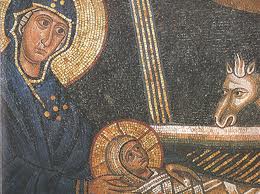
The Nativity of Christ (source)
  
Metropolitan Avgoustinos Kantiotes: Are we ready for Christmas?
Beloved in Christ, I would like to ask you a question; I ask it of myself and I ask it of you. Are we prepared to celebrate the great feast of Christmas?
  
There are two kinds of preparation; material and spiritual. Our material preparation is more or less finished. Housewives have cleaned their houses, husbands have finished – or have almost finished – their shopping, and children await their presents. Everyone has written their Christmas cards, signing them with the customary, ‘Merry Christmas’ and ‘Happy New Year’. This is worldly preparation; I am not interested in this. What I am interested in is spiritual preparation, the kind of preparation which makes us ready to celebrate the great event of the Incarnation of the Divine Word as is proper. Only a small number have properly prepared themselves. Of a thousand Christians, I doubt if even one celebrates Christmas truly. Does my estimate seem exaggerated? Let us see.
  
How is Christmas celebrated today? A portion of Christians will celebrate it ‘typically’, let us say. Hearing the bells on Christmas Eve, they will go and take part in the service out of habit. This is certainly better than being absent altogether; it is something at least.
  
Others will imitate foreign customs and practices, forgetting the ecclesiastical celebration altogether; in other words, they will pass Christmas Eve without the scent of Christ. For Orthodox Christians, Christmas is meaningless if it is celebrated without church services, without prayer, without confession, without Holy Communion, without forgiveness, without almsgiving. Indeed, the devil has sown a new seed in our homeland, and it is sprouting up everywhere like mushrooms grow in manure. On Christmas Eve people put on these reveillon – a foreign custom and a foreign word – they put on parties in luxurious hotels and other such places, far from the Church, far from hymns, far from the Divine Liturgy, where people gather and amuse themselves with worldly music, with food, with drink and whatever follows from these things. Such a practice is a thorn in the field of our homeland. If it continues to spread, the spirit of secularization will overtake the Christian feast altogether.
  
Some, then, celebrate Christmas ‘typically’, others put on these reveillon and trade in the Church feast for something altogether worldly. And still others, what do they do? They leave. They are not satisfied here. Greece is not enough for them. They have money to spare so they take trips and go on tours. On Christmas Eve when the bells are ringing, these people will be far from their homes in different places, and not only in our country. They aren’t satisfied here, so they hop on an airplane and go celebrate Christmas in Rome, in London, in Paris, in different places.
  
These, beloved, and anyone else who has openly denied the faith, have cast Christmas out of their hearts. For a large number of people, then, Christmas is nothing but another chance to dull their boredom; the actual content of the feast holds no appeal for them. Yes! That day you will have it all! You will have your great salons, your ornate rugs, your curtains, your fancy cutlery, your drinks, your meals, your music, your trips. You will have everything! You will be missing one thing, however. Your will be missing the most valuable thing; the thing which gives the feast meaning! Lacking this thing, what kind of Christmas can you expect to have? Your Christmas will be a Christmas without Christ!
  
But why? How did this happen? How did things get to this point? This is the age which the Prophet Isaiah foresaw. There will come a day, he said, when men will be drunk without wine. This day has arrived. Contemporary man is, “…drunk, but not with wine.” (Isaiah 29:9) For one to be drunk with wine during these days in undoubtedly a sin, for, drunkards shall not inherit the kingdom of God. (1 Cor 6:10) There is, however, a worse kind of drunkenness: woe to those who are drunk without wine, says Isaiah.
  
What, then, is contemporary man drunk on? One is drunk on the love of glory. Another is drunk on the love of money; another is drunk on women and indecent sights; another is drunk on card playing, on games of chance; another on an obsession with sports teams; another on plays and films; another on enjoyments and luxuries. I have particularly noticed that a good many are drunk on politics, something which has become a passion only for us in Greece alone. I say this as one who keeps himself out of party politics. Were you to open my heart you would find nothing but my homeland and my Christ. Here in Greece there is a pathological attachment to politics. Even on Christmas Eve, the feast will be overshadowed by discussions of politics. Nowhere else can one find such a phenomenon.
  
I have also noticed of late that many have become drunk on that strong wine described in the Apocalypse; that wine which the noetic Babylon will give the rulers and the people to drink. This wine, the commentators say, is the pagan spirit, the moral depravity of the world. This wine is so strong that if you were to drink just a few drops, it will cause you to lose your faith, you will forget everything. The strongest wine, then, is not money, or women, or shameful lusts, or other sensual pleasures; it is the cosmopolitan spirit of modern life, it is the emancipation from devotion, knowledge infused with pride, the science of the atheist, the atheistic rebellion, the denial of God and the divinization of man. It is this wine which has made many in our age drunk.
  
Men are drunk, then, on various wines offered to him by the ruler of this age in his golden cup. Do you know what these men are like? I will show you by means of an example.
  
I try, with God’s help, to be a teacher. So I travel to a village where I find someone and try to teach him something about Christ, about the faith, about the mysteries. He listens, but the others tell me, “Don’t waste your time, he’s drunk! Don’t bother sitting with him and taking to him!” This is how the world is today…it is drunk without wine! Is it worth speaking to such men?
  
But I appeal to you, my brothers. I am not speaking to drunks, to those made dizzy by the idols. It is my hope that I speak to the faithful who know but one kind of drunkenness, that holy drunkenness described by the Psalmist who exhorts us to, “…taste and see that the Lord is good.” (Psalm 33:8) I hope that you have you ears open for, “Blessed is he that speaketh in the ears of them that will hear.” (Sirach 25:9)
by Metropolitan Avgoustinos (Kantiotes) of Florina,
Translated by fr. John Palmer (source)
  
Through the prayers of our Holy Fathers, Lord Jesus Christ our God, have mercy on us and save us! Amen! 

Saturday, July 8, 2017

Twenty Practical Suggestions for Humility, by Fr. Stephanos Anagnostopoulos

Jesus Christ the Son of God, the Savior (source)
   
Note: These succinct, practical examples of the Beatitudes or the Lives of the Saints, are wonderful reminders of the love, humility and repentance that Christ calls us to. However, please always make sure that you are under the guidance of your spiritual father to prevent any delusion or damage to yourself or your family.
   
Twenty Practical Suggestions for Humility, by Fr. Stephanos Anagnostopoulos (amateur translation)
   
Did they forget you? They don’t even pick up the phone? It doesn’t matter.

Were they unjust to you? Forget about it.

Do they despise you? Rejoice.

Do they condemn you? Don’t fight back.

Do they ridicule you? Don’t respond.

Do they curse you? Be silent and pray.

Do they not let you speak? Do they cut you off? Don’t be sad.

Do they speak evil of you? Don’t fight back.

Do your children, your relatives and your own people take away your rights? Don’t complain.

Do they get angry with you? Remain peaceful.

Do they rob you openly? Be blind to it.

Do they mock you? Forbear it.

Do they not listen to your advice, especially your children? Fall to your knees and pray.

Are you upset with your spouse? You are to blame, not the other.

Were you to blame? Ask forgiveness.

You weren’t to blame? Again ask forgiveness.

Do you have health? Glorify God.

Do you have sickness? Do you have cancer, depression? Are you suffering, tortured, in pain? Glorify God.

Complaining, unemployment, poverty in the house? Fasting. Vigil. Prayer.

For everyone and for everything, prayer. Much prayer. Much prayer. Fasting and prayer, for “these kinds of passions and demons do not come out but with fasting and prayer.”

May we all, my brethren, and first of all myself, follow these humble suggestions, that we may be sure that we will be saved.
    
Jesus Christ, the Son of God, the Savior (source)
   
Through the prayers of our Holy Fathers, Lord Jesus Christ our God, have mercy on us and save us! Amen!