Showing posts with label Slander. Show all posts

Wednesday, December 9, 2020

St. Porphyrios on the Condemnation of Bishops

The Holy Fathers (source)

"We should never attack a Bishop with our mouth. He has the episcopacy upon him. Regardless of the mistakes he has done, we must cover him with our prayers. Thus is created around the Bishop a spiritual defense, a spiritual surrounding wall, without him knowing it, which encircles him, and eventually will allow him, as a rule, for God to revive him."***

-St. Porphyrios of Kavsokalyvia

(source)

***Note: St. Porphyrios is not referring to reaching out, in the proper manner and the proper channels, to discuss moral or canonical transgressions by bishops through a Synod or Archbishops above him. He is also not referring to hierarchs canonically deposed by a Synod or church council. He is properly trying to limit the endless gossip, slander, condemnation and judging that gets hurled against hierarchs throughout the world, but even worse now in the age of the internet. May we humbly pray for our bishops before rushing to condemn them, and thus help both of their and our repentance and our souls. 

Through the prayers of our Holy Fathers, Lord Jesus Christ our God, have mercy on us and save us! Amen!

Thursday, August 20, 2020

A Prayer of Confession, by Blessed Father Nicholas Pekatoros

An Orthodox Priest and Penitent during Holy Confession (source)
  
A Prayer of Confession,
by the Blessed Father Nicholas Pekatoros, for use by his spiritual children:
“I confess to the Lord my God and before you, Holy Father, all my innumerable sins, which I have committed to the present day and hour, in deed, word and thought. Daily and hourly I commit the sin of ingratitude toward the Lord for his great and innumerable blessings and gracious providence toward me, a sinner. These are my sins: empty, foolish words; criticizing and verbally abusing others; defiance; pride; lack of mercy; envy; vengeful anger; slander against others; inattention; neglect where my salvation is concerned; carelessness; a carefree attitude; rudeness; irritability; despondency; returning evil for evil; hardness of heart; disobedience; complaining; self-righteousness; contradictoriness; willfulness; conduct that is blameworthy or disgraceful; speaking evil; lying; excessive laughter; yielding to temptation; love of self; ambition; gluttony; drunkenness; vanity; laziness; thinking impure thoughts; heaping up worldly goods; lusting after others; missing Divine Liturgy and other church services because of laziness and carelessness; wandering of mind during prayer in church and at home; sins of deed; sins of word; sins of thought; and sins of sight, hearing, smell, taste, touch and my other senses, both physical and spiritual. I repent of all my sins and I ask forgiveness. (State here other sins that may be on one’s soul.) I also repent and ask forgiveness for sins I did not confess because of their multitude or because of my forgetfulness. Forgive and release me, Holy Father, and give me your blessing to partake of Christ’s Holy and Life-Giving Mysteries, to the renunciation of sin and the receiving of Life Eternal. Amen.
(source)
  
Through the prayers of our Holy Fathers, Lord Jesus Christ our God, have mercy on us and save us! Amen!

Thursday, June 11, 2020

St. Luke of Crimea: The Meaning of Sorrows

Christ healing the Ten Lepers (source)
 
St. Luke of Crimea: The Meaning of Sorrows
Continuously, people ask why the Lord God sends them sorrows and many times very great trials. It is very important for every Christian to understand that our sorrows are sent according to the will of God, Who is always good and saving. Most of the time, they are not sent to us as punishments for our sins, but in order for us re-orient our paths and our hearts, or they are sent as a response to requests that we offer to God. People many times expect God to accomplish what they ask in prayers to Him in the manner that they think is best. God, however, continuously responds to our prayers in a totally different manner, and not according to how they wished or could imagine.

If they would ask, for example, for God to give them humility, they might imagine that slowly, day by day, humility would grow within their hearts under the beneficial affection of God. The Lord, however, continuously works in a different way: He sends them an unexpectedly harsh blow, which wounds their pride and their ego and which humbles them. Frequently, our God sends afflictions, and we complain and in no way think that, the majority of the times, this is a great beneficence of God, and most likely is the response of God to our prayers, with which we entreated Him to strengthen our faith.

Do you know recognize that, many times, our Lord sends us terrible bodily afflictions and wounds our body in order to strengthen us spiritually? This occurred with the Venerable Pimen the Much-suffering, who lived in asceticism in the Monastery of the [Kiev] Caves, and whose whole life was found on the bed of pain, enduring an incurable sickness, and through this manner, he reached sanctity. Other people, who give great significance to earthly goods, seek from the Lord to increase their wealth. And the Lord responds to them with the destruction of their properties with fires, and in this manner, He helps to turn them away from their attachment to earthly things and from their greed, and to correct their deviations from the correct path, which is taught to us by the Lord's Beatitudes.
  
God treats us like His true sons, whom He chastens for their good. The sorrows that are sent to us by the Lord, we must receive as St. Peter says: "Humble yourselves therefore under the mighty hand of God, that in due time He may exalt you." (I Peter 5:6). If we cannot, despite all our efforts, come to understand the reason that God sends us sorrows, then at least let us humble ourselves below the mighty hand of God, and He will lift us up at the proper time, in order for us to understand His paths, with which He is leading us for this reason. We must, with great humility and without the smallest complaining, accept all the trials and sorrows that are sent to us from God, having the humble conviction that, with these, God is guiding us, and not that He is pouring His wrath upon us. (Isaiah 27:4) We usually think that the Lord is angry with us, and this is why He is sending us sorrows. No. Never think that God is angry. "God is love." (I John 4:8). And perfect love is foreign to any form of injustice.
 
But many times, when our God gives us a harsh blow, through which He humbles us and then later exalts us, we complain against God. Do you understand, however, what a serious sin is complaining against God? When we complain against God, it means that we perceive Him as unjust, we perceive that He has not treated us properly and that He must act towards us in a different manner. However, is it not a serious sin to condemn God for injustice and to slander Him? See, therefore, how great a sin is complaining against God. Because of this: "Conduct yourselves with fear throughout the time of your exile." (I Peter 1:17). We must pray greatly for our mistakes and for our impediments on our path to the Kingdom of the Heavens. But even more than that, we must have fear to break that great commandment of Christ: "Judge not, that you might not be judged." (Matthew 7:1). And complaining against God is not only judging God, but also condemning Him.
  
Let us lay aside judging those unfortunate people who willingly destroy themselves, whom our Lord Jesus Christ does not correct nor chasten, because they are not able to be corrected and are incurable. We only seek His help on our path towards salvation, that we might glorify Him and ever honor Him, together with His beginningless Father and the Lord Spirit. Amen.
(source) 
  
St. Luke the Blessed Surgeon, Archbishop of Simferopol and Crimea (source)


Through the prayers of our Holy Fathers, Lord Jesus Christ our God, have mercy on us and save us! Amen!

Wednesday, July 24, 2019

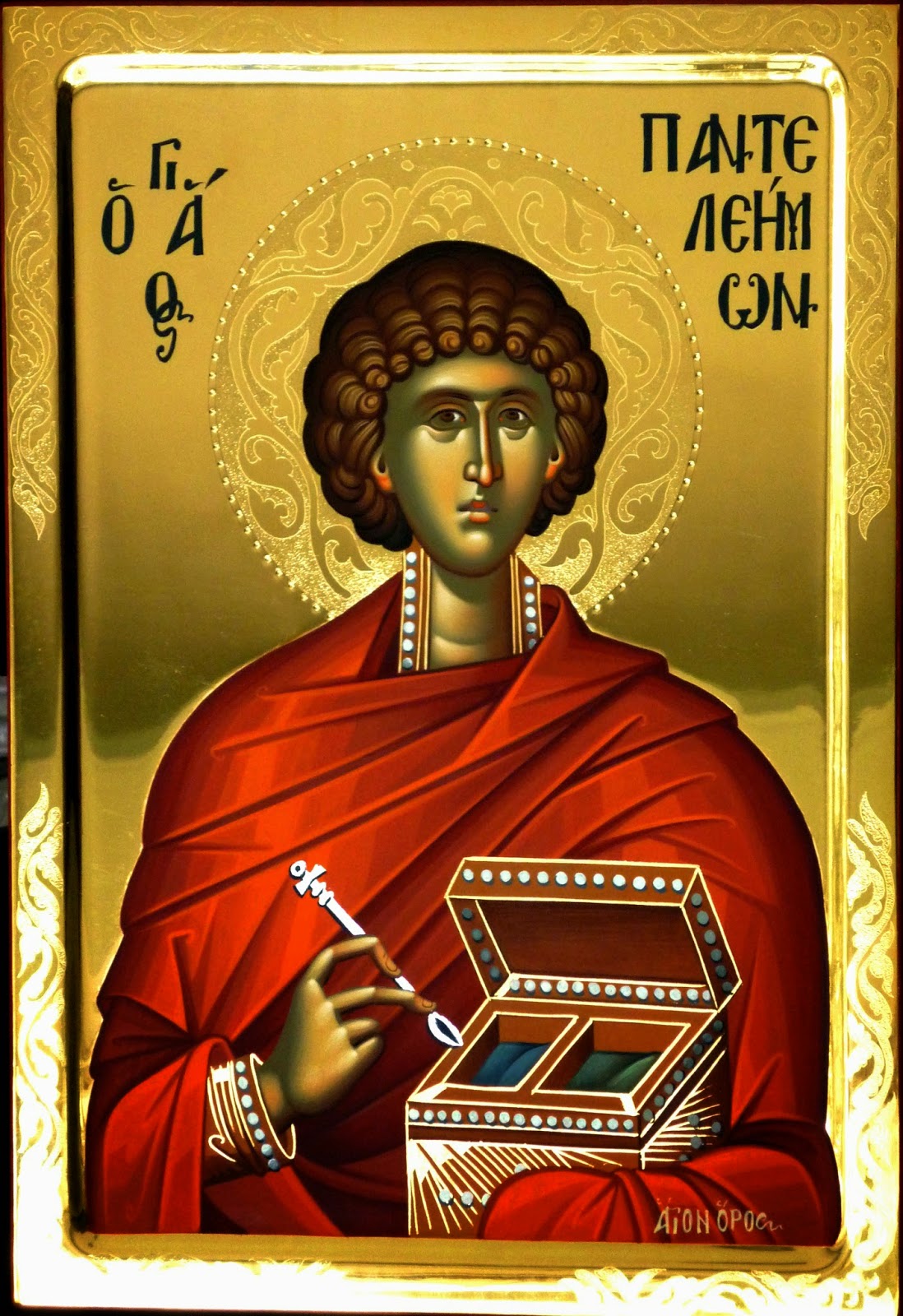
Metropolitan Avgoustinos Kantiotes on St. Panteleimon the Great Martyr

St. Panteleimon the Great Martyr and Unmercenary (source)
  
Metropolitan Avgoustinos Kantiotes on St. Panteleimon the Great Martyr: He was cast out due to jealousy
"For he knew that for envy they had delivered him" (Matthew 27:18)

My beloved, we are honoring the holy memory of the Great Martyr Panteleimon. Our topic will be the question: What was the reason that St. Panteleimon was persecuted? To this we will give a short response.

St. Panteleimon lived and struggled during the era of persecutions, when the Roman Emperor was Diocletian. He was born in Nicomedia of Asia Minor. His father was an idolater, but his mother was from the women who planted deeply into the heart of their children their faith in Christ. Therefore, she taught St. Panteleimon the truths of the faith.

He was well-sown. He had a call towards learning. He studied medicine near noted scientists. He became an exemplary physician. There were many physicians then, like there are today. However, it is rare today to find a Christian physician. The majority are faithless, materialists. And these have no worth; may God protect you from falling into their hands.

St. Panteleimon differed from them. In what way did he differ? He differed in three ways.

First, regarding money. They were lovers of money. They charged their patients a lot and became rich. St. Panteleimon was unique, a man of ideology. He used science as a mission. He was seen at night visiting huts [of the poor and sick] like an angel. While the others went only to the houses of the great ones, he went to the houses of the poor and served the sick.

And a second way in which he differed from the others. As a famous Greek university professor once said, physicians frequently study medicine like veterinary medicine, and many doctors act like veterinarians. They don't see anything else beyond veins, bones, flesh, ribs, hearts and lungs. Man of course is these, but behind this is something invisible. There is a "little motor", which moves the biological body, and there is the existence of man. And the doctor, when he doesn't see this "little motor", is blind, and is not in the position to perform his work. This "little motor" is the spiritual factor, the soul of man. A multitude of experiments and observations have shown that the soul with the passions, feelings, conscience and impulse greatly impacts the body. There is an interconnectedness between body and soul. This is what our Church chants during the 15-days of August, and which is scientifically correct: "From the great multitude of my sins, ill am I in body, ill am I also in soul..." (from the Small Paraklesis to the Theotokos). And both are sick but the root of evil is sin. Therefore, St. Panteleimon made the correct diagnosis. He saw that, when the soul is freed from guilt, the body is given life, and man breathes deeply. Many illnesses (apoplexies, heart attacks, cancer) have as their cause the spiritual world. Some bitterness from remorse or from slander or from divisiveness or from injustice or anxiety waters the body with poison.
  
St. Panteleimon the Great Martyr and Unmercenary (source)
  
So he differed first for not taking money, secondly because he saw man as a psychosomatic whole, and thirdly, for besides the other medicines which the other physicians had, St. Panteleimon had a rare and unique medicine, and this was the faith. He believed deeply. Because of this, together with medicines from herbs from the earth that he gathered, he knelt next to the pillow of the sick, praying, and--let the faithless disbelieve it, we believe it--the sick man was healed. And to this day, we see the sign of the Cross in clinics, hospitals and healing centers. How truly awesome a thing is the power of faith, a medicine of healing for bodily and spiritual illnesses.

This was St. Panteleimon. And because of this, his healing center was marked every day with a line of sick people, while they did not go to the other physicians of Nicomedia anymore. This being passed over, however, enflamed the hearts of his colleagues with the yellow lamp of jealousy. They were jealous of him, they hated him. They saw that, as long as he was a physician in Nicomedia, they would have to change careers because everyone was hastening to St. Panteleimon. And the sick, who themselves were loosing hope, found their healing near him. Behold therefore the cause of jealousy. Because of this they cast him out. They hated him from the beginning. With what slander did they do so? As an unmercenary? As one taking advantage of people? As an adulterer? As a fornicator? As a dangerous person? As a criminal? None of these things. If they condemned him with these during that decadent regime, it wouldn't work. They condemned him with a condemnation that took hold. Isn't that how it is, that the slanders of the faithful change in every age? Sometimes they use slander A, other times B, other times C. I will not dwell on this, I will just mention that, from the time...with various slanders, with foolish things the jealous attack the worthy men to discredit them--though at the heart of the matter, they don't believe the slanders--and people are no longer judged according to proper and steadfast criteria (ethically), but according to other criteria (politics).

They condemned him therefore with the condemnation of that era that was so devastating: that he was a Christian. And this condemnation led man to dash him to pieces. He was seized, led before rulers, confessed his faith with boldness, suffered all kinds of martyrdom, and thus, his holy soul flew to the heavens like a wholly-white dove to dwell in the heavenly mansions, in order to rejoice together with the Holy Angels and Archangels.

Behold, my beloved, the cause of the persecution and the martyrdom of St. Panteleimon: jealousy.

O jealousy, a great and abyss of a passion! It is a worm and viper that consumes the bowels of he who is jealous, but is also the grave of great men. Terrible are its consequences. If we open the holy stories, we will see that, from the beginning, this was the destruction of the human race. "Out of the jealousy of the devil", says Solomon, "death entered into the world" (Wisdom of Solomon 2:24). Satan was jealous of the magnificence of man, and was filled with wrath against him. Because of this was the first blood spilled upon the earth, due to jealousy. Cain was jealous of his brother Abel and he murdered him "in the field" (Genesis 4:8). From jealousy Esau persecuted Jacob (ibid 27:41), the eleven children of Jacob persecuted Joseph the All-comely (ibid 37), King Saul persecuted David (I Kings 19:10), and a long line of holy men were snuffed out.

And we have examples from our own national history. Great men were snuffed out like the righteous Aristides in antiquity, Socrates who drank the poison, and in later years, Harilaos Trikoubes, etc.

But why do we need other examples? Cast your eye on the Praetorium and to Golgotha. "Which of these two do you wish that I release?" asked Pilate, "Barabbas or Jesus?" Everyone cried out together: "Barabbas". And the Evangelist notes psychologically: "This he did", Pilate, in other words, "for they delivered Him up out of envy." (Matthew 27:18) The envy of the Scribes and Pharisees, which were like fireflies quenched before the great sun that is Christ, led our Lord to Golgotha. Therefore, my brethren, it is a general rule. If there ever appears some person, some worthy personality, who would perform their duty, he will elicit envy and rouse up persecution. Meaningless people do not bother, those who offer help and give their lives to those around them, they are the ones persecuted. St. Paul said this: "All those who desire to live piously in Christ Jesus will be persecuted" (II Timothy 3:12). All those who believe in Christ will be persecuted, along with all those seek to live according to His commandments. It is their fate. All those living, either through his word or through his example, bring about an earthquake. However, this is an earthquake of salvation. Blessed are the communities who have such men, either in science or in the military or in politics or in the holy clergy, for they become the agents of the proper way.

Pray, my brethren, that the sickness of envy might be healed, that it might abandon you. And may our Lord, through the intercessions of St. Panteleimon, transform all our hearts, and may we go forth with virtue and love, to the glory of God. Amen.

+Bishop Avgoustinos

(Homily of Metropolitan of Florina Avgoustinos Kantiotes, delivered in the Holy Church of St. Panteleimon, Florina, 7/27/1976) (source)
  
St. Panteleimon the Great Martyr and Unmercenary (source)
  
Through the prayers of our Holy Fathers, Lord Jesus Christ our God, have mercy on us and save us! Amen!

Thursday, November 1, 2018

St. Gabriel of Georgia on Judging

St. Gabriel the New Confessor and Fool-for-Christ of Georgia (source)
  
I am a great sinner and greatly infirm. If you see a person sinning even at the hour of his death, do not judge him. Judging and mockery are great wounds on the soul. The Lord says, “Man, who art thou that thou shouldst judge for Me?” For with what judgment ye judge, ye shall be judged: and with what measure ye mete, it shall be measured to you again (Matt. 7:2). Judging is a manifestation of human stupidity; it shows that he who judges does not yet know God or himself as he should.
 
Judging is a great sin, when we exalt ourselves above others. All who exalt themselves are abominable before the Lord. Whosoever shall exalt himself shall be abased; and he that shall humble himself shall be exalted (Matt. 23:12). When you judge others you judge God. Whether you’ve seen a thief, a loose woman, or a drunkard sprawled on the street, do not judge, because the Lord allowed their passions. Through these they should find the path to God — they should be humbled, see their own powerlessness, come to know the Lord, and repent. And are you pleasing to God? That means that the Lord in His grace and mercy is restraining your passions. Know that if He lets them go you will fall into worse sins, and perhaps you won’t manage to climb out of those sins and you’ll perish. Therefore be humble and cautious. You saw that a person sinned, but did you see how he later repented? Then don’t judge! Like a thread passing through the eye of a needle, so man experiences the same sin that he judged in another.
 
Be humble and loving before all people, and if you cannot love everyone, at least treat everyone with good will. Kindness will open to you the gates of Paradise, humility will lead you there, and love will reveal God to you. God is seen only in truth and divine love, for “God is Love.” Remember and understand me well: without Christ, all is nothing! Man is created in the image of Christ, and if we who are His likeness do not come to Him, we will perish! If ye believe not that I am He, ye shall die in your sins (John 8:24).
-St. Gabriel the New Confessor of Georgia
~from The Orthodox Word, No. 308
 
St. Gabriel the New of Georgia (source)
  
Troparion, Tone 4
As the Master Christ hid His divinity, clothing it in humanity, and, unseen by us, brought into being His ineffable glory, likewise didst thou hide thy glory by means of foolishness, and by the wonder of thy confession wast shown forth as a shepherd of souls; O venerable Father Gabriel, entreat Christ God to have mercy on our souls.
  
Kontakion, Tone 4
Immeasurable is the mercy of God, by Whose goodness we behold His creation divinized O venerable father, thou didst confirm in thyself the image of thy Creator and exalted thy being to the likeness of God, therefore we glorify thee O Father Gabriel, for thou art worthy of all praise, thou wast on earth a trumpet of righteousness, a preacher of love and dove of purity, and thine all-wondrous humility hast opened to the world a treasury of wisdom, and now in heaven art thou, the advocate of God’s mercy and our salvation.
     
Through the prayers of our Holy Fathers, Lord Jesus Christ our God, have mercy on us and save us! Amen!

Sunday, April 29, 2018

St. Luke of Simferopol on Condemnation

Christ is risen! Truly He is risen!
St. Luke the Surgeon, Archbishop of Simferopol of Crimea (source)
   
"Where does condemnation come from? From pride, by the fact that many perceive themselves as higher and better than others. We furthermore condemn out of malice, out of hate, by the fact that, in our heart, there is very little love."
-St. Luke of Simferopol
 
(source)
 
Christ is risen from the dead, by death, trampling down upon death, and to those in the tombs, He has granted life!
Truly the Lord is risen!

Saturday, December 5, 2015

Homily on St. Nicholas by Metropolitan Avgoustinos Kantiotes (+2010)

St. Nicholas the Wonderworker, Archbishop of Myra of Lycia (source)
  
Homily on St. Nicholas by Metropolitan Avgoustinos Kantiotes (+2010) (amateur translation)
And again, my beloved, the great feast of St. Nicholas has dawned. What shall we say? Should we honor his virtues?
  
Should we praise his abstinence? As his Apolytikion says, he was the “teacher of abstinence”. For not only when he was older, but also when he was a child in the arms of his mother, he fasted from milk and did not nurse [on Wednesdays and Fridays].
  
Should we praise his meekness, for his Apolytikion says that he was the “Icon of meekness”? Amidst insults and slanders and schemes of his enemies, he responded with great meekness. He teaches us, that we ourselves, no matter how many times we are insulted and slandered in this world, we must remain meek. There is no greater power than meekness, through which the demons of hell are conquered.
  
Or should we speak of his almsgiving, his great almsgiving? He would go at night to the homes of the poor, and to distribute gold coins, and he saved from filth and corruption.
  
Or should we speak of his faith, the great and unshakable faith which the Saint had? When the Church was endangered by the heresy of Arius, he hastened to the city of Nicea, and there, together with other Holy Fathers, worked towards the triumph of Orthodoxy. Of course, St. Nicholas did not have the gift of speaking like Athanasios the Great, or the debate skills of many of the other Fathers, he was unlettered. But what did this matter? When he heard Arius blaspheme Christ, this meek and humble one arose, and, as his life says, he struck the leader of heresy for his blasphemy. And this is a lesson for us, that when God is being offended, we must rise up. We, instead, whenever we ourselves are offended, whenever we are wronged, slandered, and condemned, then we are filled with wrath, and we become beasts and endanger the world. But, when Christ is being condemned and blasphemed, then we show indifference. The Saint showed the opposite. To the assaults against him, he responded with meekness, but when Christ was being wronged, he responded with strength, and for this reason he struck Arius. We have within us a lot of ego, not the name of Christ, like he did.
  
St. Nicholas, in other words, is the synopsis of all of the virtues, the expression of the Beatitudes of Christ, because in his person was implemented all of the Beatitudes of the Lord (Matthew 5:1-12).
  
But I, my beloved, wish to add to the image of the Saint two words that show that St. Nicholas was not only the merciful, and the meek, and the faithful servant dedicated to the Lord, but was furthermore the protector of the poor and those wronged, the protector of people who were condemned by the mighty ones of their day. I will mention one or two examples, then I will close.
   
The first is that, in his metropolis one morning, women ran with wild hair, wailing and crying out. They fell at the feet of St. Nicholas and said: “Save us!” They entreated the Saint to save them, because their husbands were taken. They were seized, put in bonds and taken to prison. They were condemned to death, and in a few hours they would execute these men. And their wives were in a terrible state. The Saint, as soon as he heard their terrible news, hastened to the prison. But at that hour the prison was empty, because they had taken them bound, and let them out into the fields to execute them. The Saint understood the danger. And that elder ran like a child, and reached the place of the execution. And as soon as he got there, he took the sword from the hands of the executioner, with which he was to slaughter those innocent men. And not this alone, but he greatly censured the tyrant of that city and threatened him, that he would give him up to Constantine the Great. And the tyrant came to his senses, was humbled and repented.
  
St. Nicholas the Wonderworker (source)
  
This was one situation when he saved men. And there is another. In the era of St. Constantine, three soldiers, brave and glorious soldiers, who conquered the barbarians in various wars and battles, and who were the boast of the Byzantine Empire, these three soldiers were slandered and condemned by evil and malicious men. They were seized and thrown in prison, and condemned to death within a few hours. They had no refuge other than the protection of St. Nicholas, And the life of the Saint, which we believe, says that that night, they entreated the Saint to protect them. And then the miracle occurred. What miracle? In his sleep, the Emperor saw a vision. He saw St. Nicholas strike him, and tell him: “What charge do you go to perform? Why do you wish to dip your hands in the blood of the innocent? These three soldiers, who are ready to be executed, these three are innocent men, and you must free them. Do not perform that which you are thinking to do.” In reality, when the Emperor awoke, he immediately called the general, and gave commands to free those three soldiers who had been condemned. They, full of joy and exaltation, hastened to express their thanks to the Saint who freed them.
  
Ba, you will say! Those are old things, and ancient stories. All of those were “In those days...”
  
No, my beloved! Not “in those days”. And today and tomorrow and the day after, and forever until the stars cease to shine, and the rivers to run, and the trees to fill with leaves, until the sun and the moon no longer shine, the miracles of God continue to exist. These are not mythological things.
  
I will relate to you one final one. What occurred? In Kozani in 1944, in those years, the terrible years of slavery for our nation. Then, evil and corrupt men seized 300 men and threw them in prison. And there was wailing and morning. Women, men and children wailing, because their execution was for sure. And that morning in Kozani, the city of St. Nicholas, which has the church of St. Nicholas, dawned a very sad day of St. Nicholas. And the bells of St. Nicholas rung sadly, as if it were Holy Friday. I was then, as God continues to make me worthy to be, a preacher in Kozani. And I ascended the amvon full of tears. And I said: “Today, St. Nicholas does not celebrate. Fall on your knees, fall on your knees both small and great, and entreat the Saint to work his miracle...” And he worked the miracle. That evening, he freed them!
  
St. Nicholas saving those unjustly condemned to death (source)
   
Of course. Our religion is not a lie, it is alive, wholly alive. And yesterday and today and tomorrow, forever there will be miracles. And if you go to the blessed islands of our fatherland, there you will see old sailors with white hair, who passed through oceans and seas, and sailed through the Atlantic ocean, and behold the joy in their eyes. At the hour when they met huge waves and sharks and fearsome beasts, when they were ready to be cast upside down and to be torn to pieces upon the rocks, at that terrible hour of death, when they beheld their death before them—I am not lying, but telling you the truth—they entreated the Saint. And the Saint worked his wonder. And they found themselves on the dry land without understanding how!
  
Therefore, it is a fact that the Saint was meek, and merciful, and faithful, and dedicated to God, it is a fact that he was a man of God. But it is also a fact that St. Nicholas is the protector of those who are wronged and weak.
  
This is the Saint whom we hymn today. And all of us, with one heart and with one soul, united in the faith of Christ, in our Orthodox faith, let us entreat God, through the intercessions of St. Nicholas the Wonderworker, to have mercy and save all of us. Amen.
  
+Bishop Avgoustinos
  
(homily by Metropolitan Avgoustinos Kantiotes, given in the Holy Church of St. Nicholas in the city of Florina on 12/6/78, source)
  
St. Nicholas saving those unjustly condemned (source)
  
Through the prayers of our Holy Fathers, Lord Jesus Christ our God, have mercy on us and save us! Amen!
Sunday, May 17, 2015

Elder Ephraim of Arizona on Slander

Christ is risen! Truly He is risen!
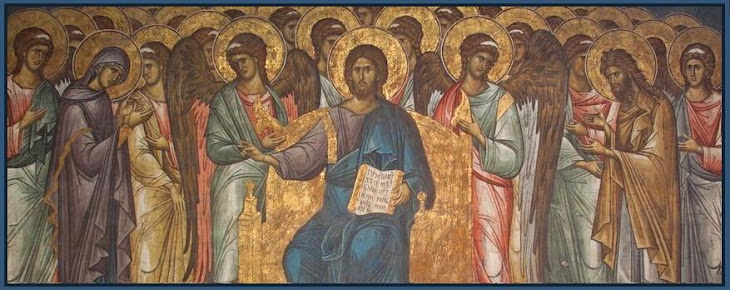
Synaxis of the Holy Athonite Fathers (source)
  
As time passes, it has been disheartening for me to see more and more slander and hatred directed towards Elder Ephraim of Philotheou (now Arizona), and the monasteries which he helped to build in America. I do not know what is in the minds and hearts of those who write condemnations about this great man and his work, which continues to be strengthened through the Grace of the Holy Spirit. In short, all that I can say is that I have seen first-hand what a great blessing that we all have been given.
  
As for myself, I have never, ever seen anything (in many readings of his, in visits to monasteries, in meetings and discussions with monks and nuns from throughout the world) that is out of line from true Orthodox tradition. What I have seen consistently is a love for patience, prayer, ascesis, forgiveness, humility and love: essentially, an angelic life that is Orthodoxy. I have seen time and time again how such love then transforms other people's lives, making their hearts aflame with the love for Christ and for their fellow men. And this is how it is meant to be, as St. John Climacus writes: "Angels are a light for monks, and the monastic life is a light for men." I do not intend this to be a formal defense of Orthodox Monasticism in the country, but just to give my perspective on events as I have seen them.
  
As today is the Sunday of the Blind Man, I pray that we might be like him who allowed the Lord to heal his physical and spiritual blindness. While those around him never did accept the miracle before their eyes, but breathed condemnations and slander against the work of God, the Blind Man proclaimed Christ, and was granted to see and venerate his Creator. May the Lord heal all of our blindness, and may these moving words of Elder Ephraim below help keep us from slandering our brethren (which is a great sin) and lead us all to repentance!
  
Elder Ephraim of Arizona on Slander
Slander is a great evil. Just as the little rudder steers the whole ship wherever it wants, likewise the tongue leads a person either to good or to evil. The holy fathers greatly censure judging other people’s sins, faults, or evil habits. When we judge our brother, we condemn ourselves to a great sin. But when we cover our brother, God will also protect us from great sins. When we expose our brother, we drive the grace of God away from us and He permits us to fall into the same sins so that we learn that we are all weak and that the grace of God supports us. Whoever guards his tongue guards his soul from great sins and grievous falls. The chief cause of criticism and slander is pride and egotism, because one considers oneself better than the others. For this reason it is very beneficial for a person to think of himself as below everyone, so that he considers his brother than him in order that, with the help of God, he may be delivered from this evil.
  
If something pushes you to criticism in any matter regarding a brother or the monastery, try to pray about the matter instead, without passing it under the judgment of your reason. If you turn within yourself through prayer, humility, and mourning, you will find a spiritual treasure—just keep pride and criticism far from you.
  
Be attentive, my child, that you not judge any soul. For God permits the one who judges his neighbor to fall, so that he learns to have sympathy for his weak brother. The mercy of God supports all of us, but if we become proud, God will remove His grace and we shall become worse than the others. It is one thing to condemn someone and another to be fought by thoughts of condemnation. To condemn is a terrible passion, but to be fought by such thoughts and to fight back—this is an occasion for crowns.
  
Each person must bear the weaknesses of others. Who is perfect? Who can boast that he has kept his heart undefiled? Hence, we are all sick, and whoever condemns his brother does not perceive that he himself is sick, because a sick person does not condemn another sick person. Love, endure, overlook, do not get angry, do not flare up, forgive one another, so that you resemble our Christ and are counted worthy to be near Him in His kingdom. My children, avoid condemnation—it is a very great sin. God is greatly saddened when we condemn and loathe people. Let us concern ourselves only with our own faults—for these we should feel pain. Let us condemn ourselves and then we shall find mercy and grace from God.
  
Love one another, and do not be embittered out of egotism. Humility is a sure guide; it does not let the one who possesses it hit the reefs of carelessness and be shipwrecked, but as a luminous guide it leads him faultlessly on sure ground. Egotism is the most evil of evils; it causes all our lapses through unsubmissive thoughts. Fear this and strive to get rid of it, for the more it remains within us, the more it will wound us with the proportionate pain. I beg that you not criticize one another, for this is downright egotism. Excuse your brother’s fault; this is evidence of humility and love. The brother who acts thus will find much grace from God, but he who judges and scandalizes his neighbor should know that not only will he not find grace, but even if he has something he will lose it, so that he may learn the lesson of humility through suffering. Be particularly afraid of inner criticism, that is, thoughts of criticism, because it does not come to light through the spoken word, in which case it is likely to be corrected by someone who hears it. Be careful, I say, about criticism from within, which imperceptibly makes us fatally guilty and deprives us of the life of divine grace and offers as a most bitter drink the death of the soul. I pray that love and freedom from criticism will reign in every expression among you, so that the Holy Spirit may rest in your souls.
  
Experience has shown that it is wrong to accuse and condemn someone without letting him defend himself. As also the sacred Gospel says: “Does our law judge a man before it hears him and knows what he is doing?” (Jn. 7:51 ). If we are not attentive, many sins of condemning others heap up within us, and then repentance is needed. How often a person repents because he spoke! Let us bear in mind the words of Abba Arsenios: “I have often repented for speaking, but I have never repented for keeping silent”. If we are often deceived by the sense of touch, how much more so we are by people’s words. Therefore, much attention is needed, for the devil prowls around roaring to devour us (cf. 1 Pet. 5:8 ). A Christian ought to be like the many-eyed Cherubim, for evil has multiplied greatly, especially the sin of condemnation, which is a common as “bread and cheese”. May God cleanse us and sanctify us for His glory. “Do not let the sun go down on the wrath of your brother” (cf. Eph. 4:26 ). That is, let no one be angry and enraged against his brother past the setting of the sun. have you heard about that brother who was negligent and lazy, who did not go to the all-night vigils and did not do his duties, whom the brethren knew to be a negligent monk? When he fell ill and the hour of his death drew near, the brethren gathered to hear something beneficial, or to comfort him, or in case he wanted to say something to them, but they saw him joyful, cheerful. One brother was scandalized and said, “What is this we see in you, brother? We see that you are joyful even though you are approaching death. But we have the thought that you were not a violent monk, so how do you have such courage and a cheerful face? How do you justify yourself?” “Yes, brethren”, he said, “indeed I was a negligent person and I did not fulfill my duties. But I achieved one good thing, by the grace of God: not to condemn any brother and not to scandalize anyone; and never did I let my heart have something against any brother of the monastery when the sun set. And inasmuch as I did not judge any brother, I believe that God will not judge me either, for He said, “Judge not, that you be not judged” (Mt. 7:1 ) and since I did not judge, I will not be judged”. The brethren marveled and said, “Brother, you found the way of salvation very easily”. And the brother died with much joy. Do you see how the Fathers struggled and how they found the way of salvation?
  
Elder Ephraim of Arizona, blessing (source)
  
Christ is risen from the dead, by death, trampling down upon death, and to those in the tombs, He has granted life!
Truly the Lord is risen!