Showing posts with label St. Patapios of Thebes. Show all posts

Tuesday, December 8, 2020

Paraklesis to St. Patapios of Thebes the Wonderworker

Here is an audio recording of the Paraklesis (Supplication service) to St. Patapios of Thebes, chanted in Greek by the nuns of his monastery outside of Loutraki, where his holy and wonderworking Relic is treasured to this day (source)
   
St. Patapios of Thebes the Wonderworker (source)
   
Through the prayers of our Holy Fathers, Lord Jesus Christ our God have mercy on us and save us! Amen!

Thursday, December 8, 2011

Excerpt from the homily on St. Patapios by St. Andrew of Crete

  
Excerpt from the homily on St. Patapios by St. Andrew of Crete (amateur translation)
Who or what was this Patapios that is spoken of, and who we hasten to praise with these words, and who we have gathered here to celebrate? The citizen of the desert and the visitor in the world; the earthly angel and heavenly man; he who dwelt in heaven and inhabits heaven as the earth mystically in the spirit; he who speaks with men below and above shares pastures with the heavenly choirs; he whose body is buried dead, and through action confirmed the spiritual laws; the ultimate in asceticism and great in virtue; he who watered with his words, and who was all-wise in mind; he who taught the art of Wisdom to all; he who was in great purity; he who was solemn in continence; he who was fervent in faith; he who was awesome in love; he who dwelt in the city, but did not leave the desert.

Through the prayers of our Holy Fathers, Lord Jesus Christ our God, have mercy on us and save us! Amen!
Friday, January 8, 2010

A miraculous healing by St. Patapios

Icon of St. Patapios the Righteous (Icon courtesy of www.eikonografos.com used with permission)

A miraculous healing by St. Patapios
After my education from the Meses Ekklisiastikis Ekpaideuseos, in 1958, the Lord called me to the task of being the head of a family, with my wife Maroulias, in 1959. In November 1960 I entered the Theological School of the University of Athens. On November 19th 1961, by the hands of the ever-to-be-remembered Metropolitan of Corinth Prokopios, I entered the divine service as a Deacon, and in 1963 as a Priest. I was entrusted by the Grace of the Lord, to give three boys a Christian upbringing: Andrew in 1962, Photios in 1965, and Nektarios in 1970.

In the evening of December 21st 1974,  my son Photios, who was at the English Frontisterion and returning home, on the road by the shore of Piraeus, was hit tragically by an oncoming car. The doctors of the Neurosurgical department of the State Hospital of Piraeus said: “Fracture of the left temporal bone, left otorragia, stiff left hemiplegia, diastasis of the lateral sinus, break and flooding of the cranial cavity with blood.”

None of the doctors was able to leave us any hope that he would be resuscitated, much less be healed. He remained in a comatose state for 27 days. Then the healers began to remove the supportive machines, relating that they couldn’t offer any more medical help, and that it would be better to let him die than to keep him on life support as a “vegetable”, or ultimately, in the best case, paralyzed.

Then the boy’s mother, my Presbytera, was heartbroken, and without saying anything, went home to get his funeral shroud, for as the doctors informed us, his death was imminent in a matter of hours.

As she arrived home however, from her expression, our son Andrew became aware that something serious was happening to his brother.

Immediately after his mother left the Hospital, I ran outside, stopped a taxi, and taking the boy’s grandmother—the mother of my wife—I hastened to the Monastery and the Holy Relic of St. Patapios, for I loved the Righteous Saint, and my children love him, and since they were babies I brought them to the Monastery as to our children’s Holy places. As we venerated the Holy Relic with great fervor, I took a piece of cotton with oil from the vigil lamp of the Holy Relic and two candles from the Cave, and I went immediately to the Hospital and Andrew told me: “Cross the child, Dad, and he’ll get better, with the help of St. Patapios”.

Utterly speechless, for he reminded my child to remember my Righteous Saint at that difficult time, trembling and with tears streaming down my face, I crossed the…my roughly dead child! And..O Your immense love O Lord, in twenty minutes, for the first time in 27 days, my child moved and opened his eyes! He looked at me. He recognized me! He grasped my hand with his hand! And he told me:

“Dad, I’m in pain!”

I bent over him, and I kissed his wounded head and whispered: “You’ll get better my child!” The doctors ran. They put back on their machines. They confirmed:

"The fractures fused, the head cleared of blood, and the organs started working again! Full resuscitation!"

After about ten days he came home from the Hospital. With a conservative medical regimen, he returned to school, the 5th Dimotikou. He continued normally. The next school year he was fully healthy!

And the miracle continues. As soon as he finished the Dimotikon Scholeion (1976), he said: “First I thank God, Dad, and I want to enroll in the Rizarios Ecclesiastical School.” Thus occurred. After six years (1982) he graduated from Rizarios and after tests enrolled in the Pastoral Department of the Theological School of the University of Athens (1983), and in December 1st 1987  he received his degree, with VERY GOOD.

During his studies, he was focused on the ascetical fathers, studing mostly the teaching of the Mystical Fathers, especially St. Maximos the Confessor. In September of 1990 he enrolled in post-graduate studies in the University of Durham England. On April 14th 1991 he entered the Holy service, was ordained a deacon, and on July 5th 1991, the feast of St. Athanasios the Athonite, a priest, and received the office of Archimandrite, as an unmarried Cleric, even more devoted to the Church and Holy Science!!
(amateur translation of the Greek text from: http://www.agiooros.net/forum/viewtopic.php?f=45&t=11976&sid=d9dd64995ae2d03d978c92b4064d2c1b; from the book: «ΠΡΟΣΚΛΗΣΙΣ ΓΝΩΡΙΜΙΑΣ ΜΕ ΤΟΝ ΟΣΙΟΝ ΠΑΤΑΠΙΟΝ ΚΑΙ ΤΟ ΜΟΝΑΣΤΗΡΙ ΤΟΥ» 3rd Edition, Athens 1995)

For more information on St. Patapios and his Monastery in Loutraki, see: http://full-of-grace-and-truth.blogspot.com/2008/12/miracle-of-st-patapios-of-thebes.html. May St. Patapios intercede for us and help us!
  
St. Patapios of Thebes (source)
  
Through the prayers of our Holy Fathers, Lord Jesus Christ our God, have mercy on us and save us! Amen!

Monday, April 20, 2009

"Bright Week", or Renewal Week following the Resurrection of Christ

Christ is risen! Truly He is risen!
Close-up icon of Christ Resurrected, telling St. Mary Magdalene "Do not hold me" (Icon courtesy of www.eikonografos.com used with permission)
   
The week after the Great and Holy Feast of Pascha in the Orthodox Church is called Bright Week or Renewal Week. It is a week of concentrated and illustrious celebration of Christ's Resurrection (In fact, tradition holds that the faithful replace morning and evening prayers with the Holy Paschal Hours, which are filled with hymns to the Resurrection. See: http://www.orthodox.net/pascha/paschalhours.html), and many other feasts. This is a fast-free week of constant celebration and spiritual exhilaration.
  
"The hymns chanted every day are identical to those chanted on the Sunday of Pascha, with the exception of a few parts that are taken from the Octoechos (the "Book of the Eight Tones"). Each day has a different tone assigned to it: Easter Sunday is Tone One, Bright Monday is Tone Two, and so on through the eight tones (skipping Tone Seven, the "Grave Tone")" (http://en.wikipedia.org/wiki/Bright_Week)
  
The OCA website compiled an excellent account of the movable feasts of Bright Week, which I summarized and added to below (taken from: http://www.oca.org/FSIndex.asp?SID=4)
  
-Litany of the “Axion Estin” Icon of the Theotokos, Karyes, Mount Athos (For more pictures of the icon and the Litany, see: http://agioritikesmnimes.pblogs.gr/2009/02/143-h-thaymatoyrgh-eikona-axion-estin.html, http://agioritikesmnimes.pblogs.gr/2010/04/995-h-litanefsh-ths-eikonas-axion-esti-th-deftera-toy-pasha.html)
  
Miraculous Icon of Christ and the Theotokos "Axion Estin" - Protaton, Mount Athos (Taken from: http://www.mountathos.gr/active.aspx?mode=en{2aee45f1-c81e-4f0c-9cf9-c2efe471cfd1}View)

-The Litany of the Glykophilousa (Sweet-kissing) icon of the Theotokos, Philotheou Monastery, Mount Athos
Miraculous Icon of Christ and Panagia "Glykophilousa" - Philotheou Monastery, Mount Athos(Taken from: http://www.mountathos.gr/active.aspx?mode=en{7a41e1a3-0425-4b51-80be-1131ca957e56}View)
  
-The Feast of St. George the Trophy-bearer (if his feast falls during Great Lent)
Fresco of St. George the Trophy-bearer (Icon courtesy of http://www.eikonografos.com/ used with permission)
   
Bright Tuesday (3rd Tone) (http://ocafs.oca.org/FeastSaintsViewer.asp?SID=4&ID=1&FSID=29)

-Litany of Panagia Portaitissa (Keeper of the Portal) of Iviron Monastery, Mount Athos (See also: http://full-of-grace-and-truth.blogspot.com/2008/10/miraculous-icon-of-panagia-portaitissa.html)
  
Miraculous Icon of Christ and Panagia "Portaitissa" - Iviron Monastery, Mount Athos (Icon courtesy of http://www.eikonografos.com/ used with permission)
  
-Litany of the "Fovera Prostasia" ("Awesome Protection") icon of the Theotokos
  
-Sts. Raphael, Nicholas and Irene, the Newely-revealed Martyrs of Thermi, Lesvos (Also see: http://full-of-grace-and-truth.blogspot.com/2012/04/sts-raphael-nicholas-and-irene-newly.htmlhttp://fr-d-serfes.org/writtings/straphael.htm, http://orthodoxchristian.info/pages/sts_rni.htm, http://goarch.org/chapel/saints_view?contentid=1045&PCode=1PT&D=T&date=4/21/2009)
  

The Holy Newly-Revealed Martyrs of Thermi, Lesvos (Icon courtesy of http://www.eikonografos.com/ used with permission)
  
-The Finding of the Relics of St. Patapius in Loutraki, Greece (and Sts. Ypomoni and Nikon) (See: http://goarch.org/chapel/saints_view?contentid=327, http://full-of-grace-and-truth.blogspot.com/2008/12/miracle-of-st-patapios-of-thebes.html)

St. Patapios (Patapius) the Righteous of Thebes (Icon courtesy of http://www.eikonografos.com/ used with permission)


The Miraculous Icon of Panagia Vimatarissa - Vatopedi Monastery, Mount Athos (http://www.mountathos.gr/active.aspx?mode=en{0bc0e16a-bb01-422b-9e36-e3fb872c7cf6}View)

For a video of the litany of Panagia Vimatarissa on the Tuesday of Bright Week at Vatopedi Monastery, see: http://www.pemptousia.gr/%ce%b2%ce%b9%ce%bd%cf%84%ce%b5%ce%bf%ce%b8%ce%ae%ce%ba%ce%b7/?v=33442.  
  
-Miracles of the Holy Archangel Michael and the Precious Nail of Christ of Thassos (The text of the Greek service is available here: http://voutsinasilias.blogspot.com/2010/03/blog-post_27.html)
  
One of the Precious Nails that pierced Christ on the Cross, treasured by the Monastery of the Archangel Michael, Thassos (https://picasaweb.google.com/orthodoxinfo/StMichaelTheArchangelConventThassosGreece#5171401153562086034)
   
-The Martyrs of St David of Garesja Monastery in Georgia in 1616 (also April 4).  (Greek account here: http://vatopaidi.wordpress.com/2010/04/06/6000-neoi-osiomartyres-sti-georgia-1616/)

  
-St Sava "Vimataris", Hierodeacon of Vatopedi Monastery (tenth century). (Greek account here: http://vatopaidi.wordpress.com/2010/04/06/agios-savvas-o-vimataris/)
  
-179 Righteous Martyred Fathers of Ntaou Monastery, Penteli (http://www.johnsanidopoulos.com/2010/04/179-holy-martyrs-of-ntaou-penteli-in.html)
  
  
-The holy monastic Fathers who have shone forth on the God-trodden Mt Sinai
  
Synaxis of the Holy Sinaite Fathers (taken from: http://www.pigizois.net/galery/agiografies/sinaxi_sinaiton_pateron.jpg)
  
-The Kasperov Icon of the Most Holy Theotokos (See:http://ocafs.oca.org/FeastSaintsViewer.asp?SID=4&ID=1&FSID=103752)


Bright Thursday (Plagal of the 1st Tone) (http://ocafs.oca.org/FeastSaintsViewer.asp?SID=4&ID=1&FSID=31)
  
  
Bright Friday (Plagal of the 2nd Tone) (http://ocafs.oca.org/FeastSaintsViewer.asp?SID=4&ID=1&FSID=32)
  

Icon of Christ and Panagia "The Life-giving Spring" (Icon courtesy of http://www.eikonografos.com/ used with permission)


Bright Saturday (Plagal of the 4th Tone) (http://ocafs.oca.org/FeastSaintsViewer.asp?SID=4&ID=1&FSID=33)
  
-Synaxis of the Holy Kollyvades Fathers, which includes, according to the author of their service, Sts. Makarios of Corinth, Nikodemos of the Holy Mountain, Niphon the Sanctified, Nikephoros of Chios, Gregory Gravanos, Silvester of Kaisareia, Paisios Velichkovsky, Cyril of Paros, Ierotheos, from the Peloponese, Anthimos from Kephalonia, Parthenios o Skourtos, Auxentios from Andros, Kosmas Aitolos, Arsenios of Paros, Nektarios of Pentapolis, Sabbas of Kalymnos, Nicholas Planas, Parthenios of Chios, Parthenios and Evmenios of Crete, etc. (http://full-of-grace-and-truth.blogspot.com/2009/04/synaxis-of-holy-kollyvades-fathers.html)
  
Icon and Apolytikion (in Greek) of the Holy Kollyvades Fathers (taken from: http://www.pigizois.net/latreia/paraklitikoi_kanones/pdf/esperinos_kolivadon_pateron.pdf)

-Blessing of the Artos

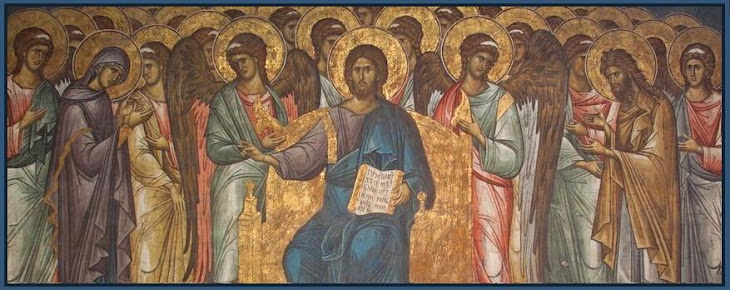
Icon entreating Christ to bless the days of the week through His servants and patrons: Ever Sunday commemorates the Resurrection, Monday the Holy Angels, Tuesday the Precious Forerunner, Wednesday Betrayal of Christ and the Most-holy Theotokos, Thursday the Holy Apostles (and St. Nicholas), Friday the Crucifixion of Christ, and Saturday the Holy Martyrs and all the Departed (source)
  
Christ is Risen from the dead, by death, trampling down upon death, and to those in the tombs, bestowing life!
Truly the Lord is risen!

Sunday, December 7, 2008

A Miracle and the Life of St. Patapios of Thebes

Greetings!

The following story comes from the book: Apostle to Zaire: The Life and Legacy of Blessed Cosmas of Grigoriou, an excellent book about a Grace-filled ascetic and missionary of our times. The book includes the biography of Fr. Cosmas, along with many miracles that have occurred among the faithful there.

"We want the Apolytikion of St. Patapios

One evening a pious Zairian couple arrived at our Mission Center. I knew them very well because they are assiduous followers of our liturgical Services and catechetical teaching. They said to me: 'Father, will you give us the Apolytikion and the Kontakion of St. Patapios?'

'Why is that? And how do you know about St. Patapios?' I [Fr. Cosmas] asked.
The husband replied as follows: 'Recently we have been through a lot of difficulties in our house. We prayed hard at night for God's help. One night I had this vision in a dream. I could see that I was holding tightly onto a rope and walking towards one of our churches without touching the ground, and my wife was walking behind me in exactly the same way. At that moment, a monk came out of the church and said to us: 'Do not be downcast about your problems. Take this Gospel and this prayer-rope, read, pray and call upon my name and I will help you. I am St. Patapios.'

They felt they received these gifts from his hands, and that the Bible was open to the Gospel of St. John. To be sure, with the help of a Zairian, I translated the chants in honour of St. Patapios into Swahili and gave them to the couple, with an icon of the Saint."
   

Icon of St. Patapios the Righteous of Thebes (taken from http://www.analogion.net/IeresMones/IM_OsiouPatapiouLoutrakiou.htm)
 
On the life of St. Patapios (or Patapius) of Thebes:

"Our Holy Father Patapius was born and brought up in the Faith and in the fear of God by pious parents in the Egyptian city of Thebes [in the 7th Century] He perceived and rejected the empty vanity of the world early in life and went into the Egyptian desert, where he devoted himself to cleansing his heart from every worldly thought and desire for the sake of divine love. When his virtues became known among the people, they began to come to him and seek relief from their troubles. Afraid of human glory, which darkens a man's mind and separates it from God, Patapius fled from the desert to Constantinople, for this wonderful saint thought that he could more easily hide himself from men in the heart of a city than in the desert. He built himself a hut close to the Blachernae church and there, enclosed and unknown, took up again his interrupted life of asceticism. But the light cannot be hidden. A child, blind from birth, was led by divine Providence to St Patapius and begged him to offer a prayer that he might be given his sight and look upon God's creation, and praise God all the more. Patapius had pity on the suffering child and prayed to God, and the child saw. Through this miracle, Patapius's godly life became known throughout the entire capital, and people began to turn to him for healing, comfort and teaching. Patapius healed one eminent man of dropsy [edema] after blessing him with a cross and anointing him with oil. Making the sign of the Cross in the air, he freed a youth from an unclean spirit which had cruelly tormented him, and the evil spirit went out of God's creature like smoke, uttering a great cry. He made the sign of the Cross over a woman who had sores on her breasts all filled with worms, and she was healed. St Patapius worked many other miracles, all through prayer in the name or Christ and by the power of the Cross."
(taken from: www.saintjonah.org/bltn/pent27.pdf)
 

Picture from the Monastery of St. Patapios near Loutraki (The church where the Relics of St. Ypomoni (Patience) are kept, and the Cave of St. Patapios is to the left (according to the directions of an informed poster)) (taken from: http://www.analogion.net/IeresMones/IM_OsiouPatapiouLoutrakiou.htm)
 
Some accounts say that he passed away in Constantinople, and his disciples later brought his Holy Remains to a cave near Loutraki, Corinth, Greece, and others say that he moved to this cave in life and there reposed. For centuries his Holy Relics remained in obscurity, but were found miraculous and incorrupt 1400 years later by the Grace of God:

"In early 1904, in grooves in the west of a cave located 18 kilometers above the Loutraki, in Geraneia Mountains, the Grace-flowing Relics of St. Patapios were revealed intact and incorrupt. It was discovered as a result of the efforts of a priest from Loutraki named Father Konstantinos Sousani. He would visit this ascetical cave and Church often, and when he liturgized, he constantly had to stoop down because the cave was low. [At this point, I believe that it was unknown that St. Patapios was buried in this cave] Fr. Kostas Sousanis instructed the marble-worker Vasilios Protopapa to excavate and broaden the cave on all sides. While he was digging, in front of stunned eyes of the bystanders in the crypt, they uncovered the Holy Relic and sof the Saint, sweet-smelling, incorrupt, with the flesh and skin still intact and dry. «The body was found on on a cedar wood base by the head and marble by the legs and covered with a series of tiles» (Proskynitarion of the Monastery of Saint Patapios. Sot. Kapsaski, Mousoyrgoy)

On the leather belt that [the Saint] wore was written the name of Saint Patapios, and he held a small wooden cross...The Holy Relic of Saint Patapios, which constantely «has a sweet-smelling, spiritual fragrance» provides the healing Grace of the Holy Spirit to those who come with faith and devotion." (amateur translation/summary of text from: http://www.servitoros.gr/dirfi/view.php/39/660/)
 
For another account with more miracles of St. Patapios, see: http://www.johnsanidopoulos.com/2009/12/saint-patapios-of-thebes-and-his.html.
 
For another miracle of the Saint, see: http://full-of-grace-and-truth.blogspot.com/2010/01/miraculous-healing-by-st-patapios.html.
 
For an incredible 360 degree panorama view from the balcony of the Monastery, see: http://www.360visits.gr/panorama_id49.


Another picture from the Monastery of St. Patapios, with its beautiful view of the sea and the beach at Loutraki (taken from http://www.analogion.net/IeresMones/IM_OsiouPatapiouLoutrakiou.htm)

Today there is a convent with about forty nuns at the Monastery of St. Patapios (which is 14km from Loutraki, near Corinth, Greece), and many miracles continue to occur for those who call upon the Saint with faith in Christ. Tomorrow (December 8th) is a main feastday of St. Patapios (another feast is the Tuesday after Pascha, when the Finding of his Holy Relics is commemorated), so may we have his blessings.

For audio recordings of Orthros and Divine Liturgy from the Holy Monastery of St. Patapios, Loutraki (from 12/8/09), see: http://apantaortodoxias.blogspot.com/2009/12/8-12-2009.html.

Another icon of St. Patapios (taken from: http://www.rel.gr/photo/displayimage.php?album=26&pos=46)

Apolytikion of St. Patapios in the Plagal of the Fourth Tone
The image of God, was faithfully preserved in you, O Father. For you took up the Cross and followed Christ. By Your actions you taught us to look beyond the flesh for it passes, rather to be concerned about the soul which is immortal. Wherefore, O Holy Patapius, your soul rejoices with the angels.
   
Kontakion of the Saint in the Third Tone
Having found thy Church to be a place of spiritual healing, all the people flock with haste thereto, O Saint, and they ask thee to bestow the ready healing of their diseases and forgiveness of the sins they wrought in their lifetime; O Patapius most righteous, in every need, thou art the protector of all.
 
St. Patapios of Thebes (source)
    
Through the prayers of our Holy Fathers, Lord Jesus Christ our God, have mercy on us and save us! Amen!