Showing posts with label Trials. Show all posts

Friday, November 6, 2020

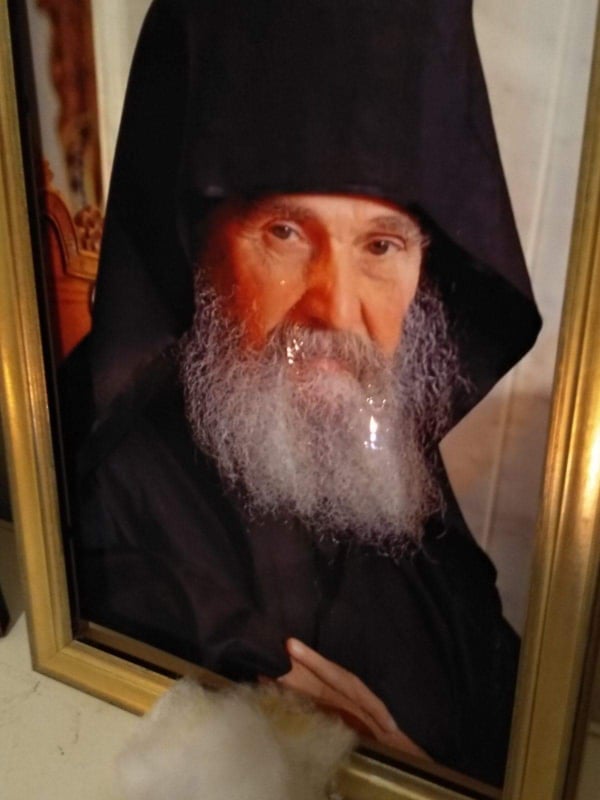
A vision of Elder Ephraim, and a picture of his purported to be weeping

Picture of Elder Ephraim of Arizona purported to be weeping (source)

"I just communicated with Gerontissa Thekla from Montreal, and she told me that our holy Elder appeared to someone living in Crete. He lives ascetically, and would go to visit the Elder at St. Anthony's [in Arizona].

He has this picture of our holy Elder with a constant vigil lamp before it. The Elder told him that God is greatly saddened by the Greeks***, because they are not praying.

On November 3rd, the picture began to weep, not just tears, but it became soaked.

The Elder is praying for all of us."

-Maria

(source)

***Note: By no means are the Greeks the only people that might not be praying as they should, but all people throughout the world, young and old, clergy, laity and monastics, should be repenting and praying as we should, entreating the Lord to save the world.

Elder Ephraim of Arizona (source)

“Elder Ephraim of Philotheou, who lived as an ascetic in Arizona, appeared to a woman in Northern Greece, a long-time spiritual daughter of the elder. At the time of the appearance she was with her daughter-in-law; she was not asleep but actually in a state of alertness. At one point the woman was unresponsive, as if in ecstasy,* and this lasted for about 10 minutes, according to her daughter-in-law who was watching her. She did not realize or comprehend the time duration — i.e., for how long the vision lasted. It was something new for her (the content of the conversation) because she has seen the Elder before, after his repose, both in her sleep as well while she was awake. Due to all this (her shock), she contacted her spiritual father and asked whether this experience was real or a deception by the evil one.

She saw Elder Ephraim and he was very sad and was imploring Christ that the ongoing [direction of] events be averted (all this, of course, is in agreement with what the elder said to many while he was alive).

And he told her:

‘Repentance repentance repentance. Christ is very angry...
We people today should not be in this spiritual state we are in...
Huge tribulations are coming, you can not imagine how bad these will be...
Alas to all of you for what awaits you; you must repent as long as there is time...
You need to kneel and cry, to shed tears of repentance, that Christ soften...
This has to do with what is happening in America as well.
Many people will depart through all that is to come, many people will depart (they will die).
You have no mercy among you. You show no mercy to each other.
You are tough towards each other, you stand ready to eat (consume-destroy) each other ....
Tell all of this to your spiritual father and to others ....’

The woman who saw this was a spiritual daughter of Elder Ephraim and was in communication with him often up until his repose.

- f. I.

*Translator’s note: The Greek term here is χάθηκε. It was not immediately clear to us if this meant literally or spiritually. We received clarification that it was the latter and have made the change. We have also made other minor changes to improve the English translation and correct typos in the Greek version.

(source)

Elder Ephraim of Arizona (source)

Through the prayers of our Holy Fathers, Lord Jesus Christ our God, have mercy on us and save us! Amen!
Friday, July 31, 2020

Homily on the Holy Maccabees by Metropolitan Avgoustinos Kantiotes

Icon of the Holy Maccabees with their Mother St. Solomone, and their teacher Eleazar (source)
  
Homily on the Holy Maccabees by Metropolitan Avgoustinos Kantiotes: "Our Faith is True"
We will speak, my beloved, on the Holy Maccabees. They are a star cluster of nine stars, one being their teacher Eleazar, the second was their mother Solomone, and the other seven are her distinguished children of this large family.

These heroes lived in the 2nd century before Christ, during the reign of the King of Syria and Judea of one of the successors of Alexander the Great, Antiochos the Epiphanes (175-163BC). This man, a fanatical idolater, had endless hatred of the Jews, who were the only ones who believed in the true God. He tried with his whole being to uproot from their hearts their faith which had been given to them by Moses. And he slaughtered, slaughtering like a wild beast, more wild than a tiger or a lion. A beast might eat three or four people, but can't eat more. He, however, slaughtered 80,000 Jews, and blood poured through the streets of Jerusalem like a river. And in order to put an end to their religion, he organized an idol-worshiping feast. In the center of the city, he placed a great and large altar, and there sacrificed sheep and goats and bulls and rams, like the Jews would do typically, but--in order to corrupt them--he also sacrificed pigs, hundreds of pigs, to the gods of the idols. And in order to defile the Jews and to strike their religious consciences, he forced them to consume the meat. We must know that the Jews never ate pork. To this day, if you go to a Jewish home, they never eat pork. I won't go into the reasons that they do it, but in any case they continue to keep this.

The Jews fast. Do we? We also need to fast. And here I will make an aside. Are you a Christian, are you Orthodox? I'm not sure. If you were Orthodox, if you firmly believed in our Orthodoxy, you must keep the fasts. Which fasts? You should fast on Wednesday and Friday: Wednesday because on that day was our Lord Jesus Christ betrayed, and Friday, because on that day He was crucified. If you were Orthodox, you would fast during holy and Great Lent, and the other fasting periods, including January 5th, the day before Theophany, August 29th, the day of the Beheading of the Forerunner, and the Exaltation of the Precious Cross.

Do Christians fast today? Unfortunately, this holy practice seems to be going by the wayside. You can break whatever you wish, and you see people even breaking the fast on Holy Friday. During fasting periods, the meat markets are full and the restaurants at night dish out tons of meat. We [Greeks] have become among the largest meat-eaters in the Balkans. We even buy and ship in meat from Bulgaria and Serbia. All of this eating of meat is very serious for our health as well.

So the Jews therefore fasted, and to mock their fasting, Antiochos forced them to eat pork that had been sacrificed to the idols. First, he called the teacher Eleazar, who was an honorable priest. He told him: "I am 90 years old. Until now I have kept the fast according to the divine law, and I cannot even begin to think about abandoning our holy tradition..." He was seized by the soldiers of Antiochos, bound, and thrown into the fine. Thus, he gave up his soul to God.

After this, one by one he called the seven brothers, the Maccabees. He hold them: "Take pity on your youth." He told the first: "I will give you honor, glories, respect." "Keep your honors, I will remain in the home of my fathers/ I will never taste pork sacrificed to the idols..." Thus, the first said not. The same occurred with the second, the third, the fourth, the fifth, the sixth and the seventh. And after they all denied, each began their terrible martyrdom, which one shudders to even think about. Open the Old Testament to the end and turn to the book of Fourth Maccabees (5-12). Don't just read magazines and newspapers. If you are a Christian, read the holy Scriptures. You will say, I don't have time, or I'm tired...Good try!

Let me make another aside. I tell you to fast, but you don't fast. I tell you to read the Holy Scriptures, but you don't read them. The one you don't do, neither do you do the other. What Christian are you, can you tell me? I tell you to pray, but you don't pray. I tell you to confess, but you don't confess. I tell you to commune, but you don't commune. I tell you to go to church, but you don't go. You only go to church when you're invited to a sacrament [i.e. a baptism or a wedding]. Many go for a memorial service. But this is a sin. Because every church every Sunday is a memorial service. What memorial?  Not of our father or our mother. Every Sunday, we serve a memorial for the Lord. And if you go to the memorial of your father or mother, even more so should you go to the memorial of our Lord Jesus Christ. What does faith cost you? To the martyrs it cost terrible pains and death.

The Maccabees therefore said no, and began their martyrdom. A martyrdom that makes man shudder to read it, as is described in the Holy Scriptures. They put a trident between their eyes. Another they cut off his right hand. Another they cut off the left with a saw. Another they cut off his fingers. Another, they pulled off his nails. Another they raked his flesh with iron nails. Another they skinned him alive, like the butcher skins an animal... But it was as if nothing to them! They remained steadfast.

And in front of all of this, in the presence of the martyrdom of the seven children, who was there, I ask? Their mother, St. Solomone. O, what a mother! She was not at all like some mothers today who would say: "Eat, my child, a little meat, it's nothing..." Today, many mothers are only thinking of their children's bodies, their flesh, in other words. Above the body, they don't see anything else. St. Solomone was a unique mother, a historic mother, a rare example throughout the ages. "No, my children!" she said, "Do not pollute our religion, do not loose the crown of glory!" And their mother prepared them, her seven children, for a terrible martyrdom. It was their faith in God, and this faith showed her to be a heroine, a unique and grand and lady of a woman. How did she find the strength to support all her children to be sacrificed? Don't you think that she felt pain? Of course she felt pain. As her children were being martyred, and she saw them one by one being put to death in the most terrible manner, she suffered. She was pained for each separately, and for them all together. Her pain was greatly multiplied. Mothers, when their children get sick with a fever, they entreat God for the fever to flee from their children and to come to them instead. If, therefore, each child of St. Solomone was martyred once, then she was pained for each, and it was as if she was martyred seven times, multiplied by seven. And, having endured steadfastly and unshaken throughout this trial, in the end, she herself fell into the fire (IV Maccabees 17:1). Thus, they were all burned and became a sacrifice for the love of God, martyrs before Christ.

This, my brethren, in a few words, is the martyrdom of the seven Maccabee children, of their mother Solomone, and their teacher Eleazar. What does it teach us?

One lesson comes forth today. Our faith is not a myth. It is living and wondrous. We have the most true religion, the only truth in the world. Because of this, the Prophets prophesied and gave their lives, including the Maccabees in the Old Testament, and because of this, the Apostles and Martyrs were sacrificed in the New Testament, and because of this, the Fathers and the Teachers of the Church lived in asceticism, and preached theology, and confessed the faith.

Let us as well honor and imitate their struggles out of love, that we might, together with them, become partakers in the glory of the Kingdom of God, to Whom be glory and might unto the ages of ages. Amen.
(+) Bishop Avgoustinos
(Delivered in the Church of the Holy Trinity, Ptolmaidos, on Sunday August 2nd, 1987)
(source)
  
The Holy Maccabee Martyrs (source)  
Through the prayers of our Holy Fathers, Lord Jesus Christ our God, have mercy in us and save us! Amen!

Tuesday, July 28, 2020

A Study on the Apolytikion of St. Paraskevi


St. Paraskevi the Great Martyr (source)
 
Note: The short but powerful Apolytikion (troparion) of St. Paraskevi, is often times not fully or clearly translated from the original Greek, and is even less often explained regarding its deep meaning and how the Saint illustrates Christ. This is an excerpt from a very lengthy study on the Saint's hymn, including many pertinent scriptural references. May the Saint's love and diligence for the Lord help us to prepare ourselves, and may the Lord make us worthy of His Kingdom, through her prayers.
  
Excerpt from a Study on the Apolytikion of St. Paraskevi
By Archimandrite Theophilos Lemonzi, PhD
Together with the holy icons, it is undeniable that the most beautiful hymns of the Church serve as teaching on the spiritual life, as the faithful person receives the knowledge of the wondrous deeds of the Saints, and is moved to imitate them. While the holy icons spiritually nourish the sight of the faithful, the hymns spiritually nourish the hearing of the faithful.

A special place in the heart and the pious lips of the Orthodox Christians is the Apolytikion of St. Paraskevi, which is as follows:
"Τὴν σπουδήν σου τῇ κλήσει κατάλληλον, ἐργασαμένη φερώνυμε, τὴ ὁ μώνυμόν σου πίστιν εἰς κατοικίαν κεκλήρωσαι, Παρασκευὴ ἀθληφόρε· ὅθεν προχέειςἰ άματα, καὶ πρεσβεύεις ὑπὲρ τῶν ψυχῶ ἡμῶν."
"Working with a diligence proper to your calling, corresponding to your name, you inherited your faith of the same name as a dwelling-place, O Champion Paraskevi, therefore you pour forth healings, and you intercede on behalf of our souls."
 
The author of this perfectly-worked hymn is unknown, however, we can surmise that he was learned and had a deep knowledge of the Holy Scriptures and of Theology. From our pastoral experience we believe that very many have discussed the great teaching that this brings, and the deepest meaning of this Apolytikion, and have tried to translate it into modern Greek...
  
In the first part: "Working with a diligence proper to your calling, corresponding to your name" the main issue is the address «φερώνυμε» ("corresponding to your name", "name-bearer" or "namesake"). This is one who receives his name from someone, and the author is likely using the deepest meaning of the name "Paraskevi" which the Saint bears. The name that we are given at Holy Baptism has a deepest spiritual significance, and we are called to express throughout our life as a Christian that which our name means in reality. The author, with this word, tries to give the reason for which the Saint not only was named "Paraskevi", but also lived this name out in deed, because with her holy life was given meaning corresponding to her name: she correspondingly prepared herself with dedication for Martyrdom, and for the Kingdom of Heaven.
  
The word "Paraskevi" comes from the word "παρασκευάζω", meaning I prepare, but also I make myself something in order to obtain an identity, and it further means preparation, production, and ascesis. The sixth day of the week "Paraskevi" ("Friday") received its name from the Jews, for during that day they prepared for Sabbath rest with whatever they would need for that day, e.g. the food that they would eat. In the same way, St. Paraskevi, through the working of the commandments and asceticism of virtue, she prepared, in other words, she made herself worthy, preparing herself beforehand for her Martyrdom, and for her entrance into eternal life.

The phrase "Working with a diligence proper to your calling, corresponding to your name" furthermore expresses the whole Christian life of the Saint. The phrase "your calling" refers to the call from God towards the Saint for salvation, but also for every person. The meaning of divine call plays a central role in holy history. God called Abraham (Genesis 12:1-2), Moses in the desert of Sinai (Exodus 3:2), and the Holy Prophets. The Holy Apostles (Matthew 4:18-25) and the Apostle Paul (Acts 9:1-19) were called by Jesus to follow and to preach the Gospel. God calls all men "with a holy calling, not in virtue of our works but in virtue of his own purpose and the grace which he gave us in Christ Jesus ages ago," (II Timothy 1:9) through His Grace (Galatians 1:15). What distinguishes this is the freedom of man, and if he will respond to this call, for, as St. John of the Ladder says, even God directs Himself towards all men, because He does not remove their free will, He becomes life and salvation for those alone who desire Him. Because of this, the faithful become partakers in their heavenly calling (Hebrews 3:1), and are called "called and chosen" (Romans 1:6, Revelations 17:14). The significance of this calling is one's participation in eternal life (I Timothy 6:12), however, the faithful must show their love of struggle: ["For to this you have been called, because Christ also suffered for you, leaving you an example, so that you should follow in his steps."] (I Peter 2:21)

With the phrase: "Working with a diligence" is expressed this response to the calling of God towards the Saint for salvation. On Holy Friday, Jesus "worked salvation in the midst of the earth" (Psalm 73:12), through His life-giving death, and St. Paraskevi "worked with diligence", in other words, worked with dedication, zeal and willingness to respond to the divine calling for salvation (see the phrase of St. Paul:  "For see what earnestness this godly grief has produced in you, what eagerness to clear yourselves" (II Corinthians 7:11)) being obedient to the commandment of St. Paul "work out your own salvation with fear and trembling" (Philippians 2:12).

The participation through "working", describes the working of the commandments of the Gospels, and the asceticism of virtue, as a struggle and agony of freedom. The Christian, as a worker of virtue, ought to work with goodness and to turn away from evil: "lead a life worthy of the calling to which you have been called, with all lowliness and meekness, with patience, forbearing one another in love." (Ephesians 4:1-2) As the Saints, who "worked righteousness", and also "received promises" (Hebrews 11:33), thus, the faithful should "work goodness" (Romans 2:10), because God will give to each "according to his works" (Romans 2:6).

The word «σπουδή» comes from the verb "σπουδάζω", which means I hasten, I am going, I am paying attention to details, willingly in order to accomplish something, I am dedicated to something with a unique interest, zeal and care. The faithful should work with care towards their salvation: "be zealous to be found by him without spot or blemish, and at peace" (II Peter 3:14), according to the Apostle Peter, and as the Apostle Paul commands St. Timothy: "Do your best to present yourself to God as one approved, a workman who has no need to be ashamed" (II Timothy 2:15).

St. Paraskevi was detail-oriented regarding the words of the Gospel, and she showed special care, willingness and zeal to be diligent to the Holy Scriptures, such that she was shown a missionary of Christ, and embodied non-possessiveness, giving away all her goods to the poor, studying the ascetical life "and through purity, making her soul beautiful", working ceaselessly for the Gospel and life according to God, confessing her faith in Christ and hastening towards Martyrdom.

The diligence and care of the Saint is further adorned through all of her working of the commandments and through her virtue, her struggles of asceticism and martyrdom, and her uncompromising love, to the point that she healed her persecutor, Antoninus. And all of these occurred with a special desire to be obedient to the word of the Apostle Paul "Never flag in zeal, be aglow with the Spirit, serve the Lord." (Romans 12:11), and because of this, she was continuously witnessing to Christ, even after the first tortures that she suffered. She did not shy away, she was afraid, but continued "receiving the good witness".

The author, therefore, using this word "diligence", wishes to bring to the mind of the faithful the response of the Saint to the call of God towards salvation, her love of struggle, her willingness and care for asceticism in her Christian life, and her bearing witness. The spiritual life, even though it does not come from man, requires the consent of man to bear fruit. This presupposes an unending struggle against the passions, and simultaneously a working towards the keeping of the virtues of the Gospel, as noted by blessed Fr. Michael Karadamakes. The phrase, therefore "Working with a diligence proper to your calling", has the same content as the suggestion of the Apostle Peter to the faithful: "therefore, brethren, be the more zealous to confirm your call and election, for if you do this you will never fall; so there will be richly provided for you an entrance into the eternal kingdom of our Lord and Savior Jesus Christ." (II Peter 1:10-11) and reveals the consent of the Saint to the divine calling towards asceticism and the keeping of the commandments. And all of these she worked with a corresponding and illustrative manner, with humility and love, for the asceticism of virtues, when they do not occur according to the commands of the Gospel, they are not pleasing to God: "An athlete is not crowned unless he competes according to the rules." (II Timothy 2:5) Similar to the Pharisee of the Parable (Luke 18:1-14), who worked to keep the commandments of God, but his inspiration was to please men, and because of this, he was not justified...

In the second part: "you inherited your faith of the same name as a dwelling-place, O Champion Paraskevi", a most important point is point is the word "inherited", which serves as the immediate continuation of the beginning phrase "working with a diligence proper to your calling, corresponding to your name", and reveals that which the Saint received as a gift and inheritance from God due to the diligence and willingness that she showed. The word «κληροῦμαι» means to receive something through lot, and the hymnographer says that the Saint received through her lot, as a lawful inheritor, this faith of the same name as a dwelling-place.

St. Paraskevi with scenes from her life and martyrdom (source)
   
But what does this phrase mean: "your faith of the same name"?

That which she herself possesses is called synonymous, because it shares the same name with something. Synonymous unites two words which have the same meaning. In this specific case, the word «ὁμώνυμον» has the final meaning of the word and means that the two words «πίστις» and «παρασκευή» ("faith" and "preparation") have the same meaning. But why does the hymnographer use this meaning to unite these two words? The reason is most deep and theological. As we mentioned above, the name of the Saint means preparation for martyrdom and for the Kingdom of Heaven, through her working of the commandments of God, her asceticism and love of struggle. As a consequence, the Christian faith is not possible as a theoretical religious ideology, but, as was remarked by Blessed Elder Joseph of Vatopedi, if we keep the commandments, this is a confession. As long as sin is a denial of God, then love of struggle and the taking up of one's Cross is a practical outcome of one's Christian identity. Through Holy Scripture, the meaning of faith plays an essential role.

The faith of holy people goes together with works: the Apostles, having believed in Christ, at the same time: "immediately left their nets and followed Him" (Mark 1:18), and Abraham believed "By faith Abraham obeyed when he was called to go out to a place which he was to receive as an inheritance; and he went out, not knowing where he was to go" (Hebrews 11:8), he left his homeland according to the directive of God and "you see that faith was active along with his works, and faith was completed by works" (James 2:22). Therefore, Blessed Elder Joseph of Vatopedi teaches us that: "our Lord convinces us that it is not enough, and it does not benefit us to know only abstractly that God exists. ['Not every one who says to me, ‘Lord, Lord,’ shall enter the kingdom of heaven, but he who does the will of my Father who is in heaven. (Matthew 7:21)] ["He who has my commandments and keeps them, he it is who loves me.” (John 14:21)]. He who "has", in other words, he who cared to learn the meanings and the goal of my commandments, and who afterwards "keeps" them, in other words, uses them. And He notes the meaning of the commandments "and he who loves me will be loved by my Father, and I will love him and manifest myself to him." (John 14:21) and He confirms again: " He who does not love me does not keep my words."" (John 14:24)

Blessed Fr. John Romanides remarks that, according to Orthodox Theology, man cannot, like Protestant heresies, become a perfect and saved Christian by himself, through some rational decisions regarding the faith and compliance with some general idea about love. He requires ascesis, trial and struggle against the schemes of the devil. This is what St. Paraskevi did. She was not only faithful in words, but expressed this through her asceticism of virtue "faith worked through love" (Galacians 5:6), being obedient to the command of the Apostle Peter "supplement your faith with virtue, and virtue with knowledge" (II Peter 1:5)...

Therefore, the phrase "your faith of the same name" shows that faith means struggle and ascesis for virtue, and serves as a practical confession, for "faith without works is dead" (James 2:26). It means that I prepare myself, through the keeping of the commandments, to receive the Grace of God and to enter the Kingdom of God. The Christian faith does not have a notion of stasis, in other words, that I simply accept an ideology, for "What does it profit, my brethren, if a man says he has faith but has not works? Can his faith save him?" (James 2:14) but it has a dynamic meaning, to confess my faith in Christ with my deeds according to St. Paul's exhortation to Timothy: "Fight the good fight of the faith; take hold of the eternal life to which you were called when you made the good confession in the presence of many witnesses." (I Timothy 6:12) In essence, the phrase "your faith of the same name" summarizes the whole meaning of the "life in Christ".

The hymnographer says that the Saint received from God through lot, "inherited", to have it as a dwelling place sharing the same name with this faith. The word "κλήρος" has to do with the casting of lots (see Acts 1:26), but also the meaning of the lawful part which one receives as an inheritance. The Apostle Paul offers thanksgiving "to the Father, who has qualified us to share in the inheritance of the saints in light." (Colossians 1:12) and the sacred Chrysostom, interpreting this says that the Apostle Paul wishes to teach that sanctification and theosis is not the outcome of human virtue, but serves as a gift of God....

The author, therefore, wishes to show the great gift of the Grace of God to the Saint due to her holy life, and that this gift is given, for she obtained adoption, she became a child of God, and as a result, inherited from Him, according to the word of the Apostle Paul "and if children, then heirs, heirs of God and fellow heirs with Christ, provided we suffer with him in order that we may also be glorified with him." (Romans 8:17) God the Word became man "that we might receive adoption as sons" (Galatians 4:5). The presupposition, however, is for us to "suffer together with Him", as St. Paul says, in other words, ascesis and love of struggle, the diligence for which the Saint showed, and therefore having kept this, "But to all who received him, who believed in his name, he gave power to become children of God" (John 1:12)

The Saint faithfully kept this presupposition, to "suffer together" through asceticism of the virtues and martyrdom, and through this manner she allowed herself to receive the grace of adoption, and because of this, to become a genuine inheritor of His Kingdom.

The content of this lot, of the inheritance which the Saint received was given to her as a dwelling-place sharing the name of the faith. This phrase is difficult to explain, and for us to understand this, we need to understand what we mean by "place" (II Corinthians 5:1-5), as St. Paul compares the biological and mortal status of man with a "tent", in which dwells sin and the passions. We the faithful dwell in this house as well ["Here indeed we groan, and long to put on our heavenly dwelling"] as we experience the consequences of corruption from the passions, and we long to come to dwell in "a building from God, a house not made with hands, eternal in the heavens...For while we are still in this tent, we sigh with anxiety; not that we would be unclothed, but that we would be further clothed, so that what is mortal may be swallowed up by life. He who has prepared us for this very thing is God, who has given us the Spirit as a guarantee..."

St. John Chrysostom, interpreting this, says that this place specifically is not a dwelling made by hands in which we are called to dwell, it is not some stable of the body, but sanctification and incorruption which the faithful receive through Divine Grace...

The person who finds himself under the slavery of the passions comes to dwell in this "earthly tent", in other words, in corruption and sin. He is called to respond to the call from God to repent with a disposition of self-denial, to deny the devil and his words and to walk the path of asceticism, that he might become a recipient of Divine Grace. Blessed Elder Joseph of Vatopedi teaches that, as long as we keep the commandments, we confess our faith in God, and turn our freedom towards God, then Divine Grace is moved, which destroys the old man and builds within us the new, dispassionate one. Divine Grace gives such strength that the Holy Martyrs could endure all the inhumane tortures from their persecutors.

This new reality, the new man, the life in Christ, is the tent not made by human hands, which the faithful hope to be adorned with, and which was received by St. Paraskevi as a gift from God. the hymnographer wishes to show that the Saint, by holding steadfast to her faith, "for we walk by faith, not by sight." (II Corinthians 5:7), endured the struggles of asceticism, and through the keeping of the commandments, of obedience and self-denial, she became a recipient of Divine Grace, receiving "grace sent from above", which works salvation within us...
(source)
 
St. Paraskevi the Great Martyr (source)
 
Through the prayers of our Holy Fathers, Lord Jesus Christ our God, have mercy on us and save us! Amen!

Thursday, June 11, 2020

St. Luke of Crimea: The Meaning of Sorrows

Christ healing the Ten Lepers (source)
 
St. Luke of Crimea: The Meaning of Sorrows
Continuously, people ask why the Lord God sends them sorrows and many times very great trials. It is very important for every Christian to understand that our sorrows are sent according to the will of God, Who is always good and saving. Most of the time, they are not sent to us as punishments for our sins, but in order for us re-orient our paths and our hearts, or they are sent as a response to requests that we offer to God. People many times expect God to accomplish what they ask in prayers to Him in the manner that they think is best. God, however, continuously responds to our prayers in a totally different manner, and not according to how they wished or could imagine.

If they would ask, for example, for God to give them humility, they might imagine that slowly, day by day, humility would grow within their hearts under the beneficial affection of God. The Lord, however, continuously works in a different way: He sends them an unexpectedly harsh blow, which wounds their pride and their ego and which humbles them. Frequently, our God sends afflictions, and we complain and in no way think that, the majority of the times, this is a great beneficence of God, and most likely is the response of God to our prayers, with which we entreated Him to strengthen our faith.

Do you know recognize that, many times, our Lord sends us terrible bodily afflictions and wounds our body in order to strengthen us spiritually? This occurred with the Venerable Pimen the Much-suffering, who lived in asceticism in the Monastery of the [Kiev] Caves, and whose whole life was found on the bed of pain, enduring an incurable sickness, and through this manner, he reached sanctity. Other people, who give great significance to earthly goods, seek from the Lord to increase their wealth. And the Lord responds to them with the destruction of their properties with fires, and in this manner, He helps to turn them away from their attachment to earthly things and from their greed, and to correct their deviations from the correct path, which is taught to us by the Lord's Beatitudes.
  
God treats us like His true sons, whom He chastens for their good. The sorrows that are sent to us by the Lord, we must receive as St. Peter says: "Humble yourselves therefore under the mighty hand of God, that in due time He may exalt you." (I Peter 5:6). If we cannot, despite all our efforts, come to understand the reason that God sends us sorrows, then at least let us humble ourselves below the mighty hand of God, and He will lift us up at the proper time, in order for us to understand His paths, with which He is leading us for this reason. We must, with great humility and without the smallest complaining, accept all the trials and sorrows that are sent to us from God, having the humble conviction that, with these, God is guiding us, and not that He is pouring His wrath upon us. (Isaiah 27:4) We usually think that the Lord is angry with us, and this is why He is sending us sorrows. No. Never think that God is angry. "God is love." (I John 4:8). And perfect love is foreign to any form of injustice.
 
But many times, when our God gives us a harsh blow, through which He humbles us and then later exalts us, we complain against God. Do you understand, however, what a serious sin is complaining against God? When we complain against God, it means that we perceive Him as unjust, we perceive that He has not treated us properly and that He must act towards us in a different manner. However, is it not a serious sin to condemn God for injustice and to slander Him? See, therefore, how great a sin is complaining against God. Because of this: "Conduct yourselves with fear throughout the time of your exile." (I Peter 1:17). We must pray greatly for our mistakes and for our impediments on our path to the Kingdom of the Heavens. But even more than that, we must have fear to break that great commandment of Christ: "Judge not, that you might not be judged." (Matthew 7:1). And complaining against God is not only judging God, but also condemning Him.
  
Let us lay aside judging those unfortunate people who willingly destroy themselves, whom our Lord Jesus Christ does not correct nor chasten, because they are not able to be corrected and are incurable. We only seek His help on our path towards salvation, that we might glorify Him and ever honor Him, together with His beginningless Father and the Lord Spirit. Amen.
(source) 
  
St. Luke the Blessed Surgeon, Archbishop of Simferopol and Crimea (source)


Through the prayers of our Holy Fathers, Lord Jesus Christ our God, have mercy on us and save us! Amen!

Wednesday, April 22, 2020

Elder Vasilios of Iveron on Pascha 2020

Christ is risen! Truly He is risen!
The Resurrection of Christ (source)

"This year, the Resurrection tells us many things. If it is true what we believe, and if we are living that which we chant, that "we celebrate the death of death, the deposition of Hades, and the beginning of another, eternal life" (Canon of Pascha), then we would fear for nothing. And every single threat increases the power of the presence of the risen Lord.

"That which occurred this year with the Coronavirus is a temptation, but all temptations are transformed into blessings. We chant "let us say, O brethren, even to those who hate us." (Doxastikon of Pascha) And those who hate us are waiting for our love, and those who do not believe are waiting for the power of our faith. Therefore, if one believes, through this trial he has celebrated the best Pascha this year. In order to have the best Pascha at the time when you cannot celebrate Pascha, one must sense the power of the Risen One, and thus have community with all men.

"And while a temptation such as an illness can create problems, it can reveal the presence of the risen Lord. Amidst the messages and from within the souls of all men comes forth a consolation. The hymn of Kassiane says: "Who can recount the multitude of my sins, and the abysses of Your judgments, my soul-saving Savior?" On the one hand, there is the totality of sins and weaknesses. And on the other hand, there is an abyss of compassions, a bottomless ocean, where storms occur not just to clean out the debris that has accumulated in the lakes, but also to pour forth the element of healing.

"Therefore, the Church rejoices even more at the presence of the Risen One through this trial. And at the same time is also tested the material strength of our faith, and reveals the weakness of him who does not believe, but also, he who believes in himself and in his virtue. Therefore we have this current phenomenon. Some of the faithful--I don't know how to name them--trying to give consolation, condemn. They condemn the Church, and in essence, they reveal their own weakness. Therefore, let us thank the risen Christ, His Mother the Most-Holy Theotokos, and all the Saints who hold within them the Paradise of life.

"Let us entreat Christ to strengthen the truth of our humility, in other words, for us to sense our own weakness until our whole self is Christ. And then we can say together with the Apostle Paul: "For whether we live or die, we are with the Lord." Either we are living, or we are dead in the flesh, but our life is Christ. Therefore, "Christ is risen, and life reigns, Christ is risen, and not one dead remains in the tomb." (Paschal Homily of St. John Chrysostom) To Him belongs the glory and the might unto the ages of ages. Amen."
-Elder Vasilios (Gontikakis), former Abbot of Iveron Monastery, Mount Athos
(source)
  
Christ is risen from the death, by death, trampling down upon death, and to those in the tombs, He has granted life!
Truly the Lord is risen!

Friday, March 20, 2020

St. John Maximovitch: Nothing is Fearful for the Person Whose Hope is in God

Jesus Christ the Son of God the Savior of the world (source)
  
Note: This beautiful talk from St. John the Wonderworker highlights the beauty of a life without fear as long as one has hope in our Lord. May we obey our medical, civic and spiritual leaders, and pray with trust and hope in our Lord, as we weather this storm.
  
"Where can I go from Thy Spirit, and where can I escape from Thy presence? If I go up into heaven, Thou art there; if I go down into hades, Thou art present there. If I take up my wings toward the dawn, and make mine abode in the uttermost parts of the sea, even there shall Thy hand guide me, and Thy right hand shall hold me.” (Psalm 138: 7-10) 

These divinely inspired words of the Psalmist David should be particularly in our thoughts during these days, when the entire world is literally quaking, and from every direction comes news of all kinds of distress, shocks and calamities.

Before you can concentrate on what is occurring in one country, you are distracted by even more threatening events which have unexpectedly erupted someplace else; and before you can get a grasp on them, yet other news distracts your attention to still some other location, forcing you to lose track of the previous ones, even though they have by no means reached their conclusion. 
 
In vain do “the representatives of the nations consult in order to find a remedy for the common affliction. They encourage one another and others, saying, 'peace, peace,' when there is no peace." (Jeremiah 6:14; 8:11)
 
Calamities in the lands where they are unfolding do not come to an end, when suddenly new ones begin in places which had been considered safe and calm. 
 
Those who flee from troubles in one place find themselves amid troubles elsewhere that are even worse. "As if a man fled from a lion, and a bear met him; or went into his house and leaned with his hand against the wall, and a serpent bit him.” (Amos 5:19) Or, as another prophet says, "He who flees at the sound of the terror shall fall into the pit; and he who climbs out of the pit shall be caught in the snare. For the windows of heaven are opened, and the foundations of the earth tremble." (Isaiah 24: 18)
 
This is what we see happening in our days.
 
A person sets out for his peaceful occupation and suddenly falls the victim of military action which erupted in a place where no one had expected it. 
 
The person who escapes danger from military action, finds himself amid the horrors of natural catastrophes, of an earthquake or typhoon. 
 
Many meet their death where some had escaped it, while other people are prepared to risk their lives rather than waste away in places considered to be secure, because they anticipate other catastrophes which could soon come upon those areas.
 
It would seem that there is no place on the globe in recent times that remains a peaceful and calm haven from troubles in the world. 
 
Everything has become complicated: politically, economically, socially. "Danger from rivers, danger from robbers, danger from my own people, danger from Gentiles, danger in the city, danger in the wilderness, danger at sea, danger from false brethren," as the Apostle Paul wrote (2 Corinthians 11: 26). And to these dangers in our days we must add also, "danger in the air and danger from the sky," which are especially frightful. 
 
But when all the dangers listed by the Apostle Paul were endured by this glorious Chief of the Apostles, he had a great consolation. He knew that he was suffering for Christ and that Christ would reward him for these sufferings. "For I know Whom I have believed, and I am sure that He is able to guard until that Day what has been entrusted to me" (2 Timothy 1: 12).  He knew that the Lord would grant him the strength necessary to endure even greater tribulations, and for this reason he boldly says, "I can do all things in Jesus Christ Who strengthens me" (Philippians 4: 13).
 
These current catastrophes are so terrible for us, because they have come upon us because we are not firm in the Faith, and because we are not enduring them for the sake of Christ. For that reason, we have no hope of receiving crowns for them. 
 
And what is even worse, and leaves us powerless in our efforts to counteract our misfortunes, is that we do not strengthen ourselves with the power of Christ.  We put our hope, not in God, but in human powers and means.  We forget the words of the Sacred Scriptures: "Put not your hope in princes, in the sons of men, in whom there is no salvation. Blessed is he whose hope is the God of Jacob, whose hope is in the Lord his God" Psalm 145: 3, 5). And again: "Unless the Lord builds the house, the builders labor in vain; unless the Lord guards the city, the watchman keeps awake in vain" (Psalm 126: 1).
   
We keep trying to find a firm foundation apart from God. And so, we suffer what was foretold by the prophet: "This sin will become for you like the sudden collapse of the wall of a strong city under siege," and which is then immediately vanquished (Isaiah 30: 13). Woe to those who are leaning against those walls! Just as a collapsing wall crushes those who are leaning on it, in the same way, with the destruction of false hopes, all those who placed their trust in them will perish. Their hope will be like a "staff of reed." "When they grasped you with the hand, you broke, and pierced their shoulders; and when they leaned upon you, you broke, and injured their loins" (Ezekiel 29: 7).
 
It is entirely different with those who seek the help of God.  "God is our refuge and strength, our helper in the troubles that grievously befall us. So we will not fear though the earth should rock and mountains be hurled into the heart of the sea" (Psalm 45: 2-3).
 
Nothing is fearful for the person whose hope is in God. He does not fear men who work evil.  "The Lord is my light and my Savior: whom shall I fear? The Lord is the guard of my life; from whom shall I shrink?" (Psalm 26: 1). The horrors of war are not fearful for him. "Though an army encamp against me, my heart shall not fear; though war rise against me, my hope is in Him" (Psalm 26: 3). He is calm when he lives at home. "He who dwells in the help of the Most High, will live in the protection of the God of Heaven" (Psalm 90: 1). He is ready to sail across the sea. "Thy ways are in the sea, and Thy paths in many waters" (Psalm 76: 20).  Boldly, literally on wings, he flies through the sky to distant lands, saying, "Even there Thy hand will guide me and Thy right hand will hold me" (Psalm 138: 10). He knows that if it pleases God to protect his life, "A thousand may fall at your side and ten thousand at your right hand: but it will not come near you" (Psalm 90: 7).  
 
Even death is not fearful for him, because, for the person whose life is Christ, death is gain (Philippians 1: 21). “Who shall separate us from the love of Christ? Shall tribulation, or distress, or persecution, or famine, or nakedness, or peril, or sword? As it is written, 'For Thy sake we are being killed all the day long; we are regarded as sheep to be slaughtered.' No, in all these things we are more than conquerors through Him Who loved us. For I am sure that neither death, nor life, nor angels, nor principalities, nor things present, nor things to come, nor powers, nor height, nor depth, nor anything else in all creation, will be able to separate us from the love of God in Christ Jesus our Lord" (Romans 8: 35-39). "Since we have these promises, beloved, let us cleanse ourselves from every defilement of body and spirit, and make holiness perfect in the fear of God" (2 Corinthians 7: 1).  
 
This is what the Lord says: "Loose the bonds of wickedness; forgive unjust debts; let the oppressed go free; tear up every unjust agreement. Share your bread with the hungry, and bring the homeless poor into your house.  When you see the naked, cover him, and do not mistreat your own people. Then shall your light break forth like the dawn, and your healing shall spring up speedily; your righteousness shall go before you, the glory of the Lord shall be your rearguard. Then you shall call, and the Lord will answer; you shall cry, and He will say, Here I am” (Isaiah 58: 6-9).  
 
Lord, teach me to do Thy will and hear me on the day that I call upon Thee! 
May Thy mercy, O Lord, be upon us, for we have placed our hope in Thee.
Humble John, Bishop of Shanghai
August 30, 1937
St. Alexander Nevsky
@ 2020 "Russkiy Pastyr": English translation of the article "To the Orthodox Flock of Shanghai" 
  
St. John Maximovitch (source)
  
Through the prayers of our Holy Fathers, Lord Jesus Christ our God, have mercy on us and save us! Amen!