Showing posts with label Family Life. Show all posts

Monday, September 7, 2020

Homily on the Nativity of the Theotokos by Metropolitan Avgoustinos Kantiotes

The Nativity of the Theotokos (source)
 
Homily on the Nativity of the Theotokos by Metropolitan Avgoustinos Kantiotes
There was once a pious couple, Joachim and Anna. They believed and worshiped God and fulfilled His holy commandments. However, they did not have any children. Anna was barren, barren like stone or marble. Could a rose ever take root from a piece of marble? In the same way, naturally, from her womb it was unable for a child to come forth. And she was not only barren, but she was advanced in years, an old woman. She had reached the age in which women no longer bear children.

However, that couple prayed and entreated continuously. And God hearkened to their prayer, and Anna became pregnant. On December 9th, we celebrate the conception of St. Anna, and later, after nine months, on September 8th as we celebrate today, she brought into the world a grace-filled little girl, and named her Maria. The name Maria, after the name of Jesus Christ, is the sweetest in the world, and is always upon all of our lips. Maria means the Lady, the Mistress of Heaven and earth.

This, in a few words, is the story of her nativity.

The Nativity of the Most-Holy Theotokos is first of all, a consolation for childless couples. There are also couples today who, despite their wishes, cannot bear children. They run to doctors and midwives, they run to clinics, travel overseas, and spend an incredible amount. They even run to wizards and witches--a great sin. However, they do not bear a child. But God can work His wonder. What wonder? Let the faithless disbelieve, we believe. I know a couple who tried for 20 years to have a child, and suddenly, the woman became pregnant. A wonder, that kept even the physicians and famous midwives speechless, how it could be possible for a barren woman to bring forth a child. Therefore, today as well this miracle continues to occur as it did in the Old and New Testaments, and today we have women who have given birth with faith in God.

But when a woman, for reasons that are known only to divine providence, does not bear a child, she must never loose hope. What does St. Kosmas say? "You don't have a child to raise? Find an orphan near you, feed him, clothe him, take care of him, and your reward will be great."

This is a consolation therefore to those who do not have children, but also it is a teaching for those who have children. This is very important and it cannot be exhausted, I will only add the following.

The child, you wrongly call your own. Of course it is yours, but chiefly, it is of God. What a great mystery! Do not look on this with disdain. For during birth the laws of nature work as God ordained. However, as from a seed God gave the power to bring forth a whole tree, thus, through the small and humble nature of a woman and a man--I do not say this disparagingly--was given the power of new creation. Man, the father and the mother, are co-creators with God. And the child that appears is a wonder.

As the earth in the beginning was "without form and void" (Genesis 1:2), thus is the child within the womb of its mother. What is it in the beginning? An embryo. But how, over the course of nine months, does a heart form, then eyes, hands, feet? And when it is time, it falls from the womb like fruit from the tree. A fruit is a miracle. A child is a miracle. It calls for our wonder. I knew a man who was faithless. I tried to convince him to believe with proofs, but he remained faithless. When he got married and his wife bore their first child, and he heard its cry, then he came to believe in God! Because of this, many times faithless people do not choose to have families or get married.

Therefore, have you given birth to a child? You have a responsibility. And like Joachim and Anna made provisions for the proper raising of the Most-Holy Theotokos--and Panagia owes much to her parents--thus parents must care for their children. As the sacred Chrysostom says: "I will call you a father not when you have born a child, but when you have raised the child as God desires." The first word that the child should learn is the word "Christ". The first movement that they should learn with their little hand should be the sign of the Cross. The first lesson they should learn should be to kneel before Christ to do their little prayer. And when you sit at the table, you should say they we do not eat until we pray. And at night, when the stars come out, they should kneel together for family prayer. And if they show forth some evil deed, some weakness, you should not be complacent. You should correct him. And if he says a bad word, you should advise him. Thus, you will teach him to believe in God.

Therefore, be careful. The child from a young age learns either good or evil. I will give you two examples and close. In one village of Grevena, I met someone who, while at that time the whole village was blaspheming, he did not blaspheme. This made an impression on me. I called him and asked: "How did you learn not to blaspheme?"
He said "When I was a small child, I heard a blasphemy. When I went home I repeated it senselessly. As soon as my grandmother heard it--it was winter then--she took a coal from the fire and burned the tip of my tongue. Look at my tongue," he said, "it is still burnt. From then on, I learned not to blaspheme."***

[***Note: Neither the Metropolitan nor I am encouraging this type of corporal punishment or torture of anyone (God forbid!). But his point is how seriously this child's grandmother took the roots of sin in the family, and how she sought to correct it in the way that she knew. May we, with gentleness and firmness and love (not out of anger), correct bad habits in those we are responsible for, when they first appear, teaching them the consequences of our actions before God.]

And hear another example. When I was traveling through Evia, in one village I heard through a wall a blasphemy. Such a blasphemy I had never heard in my life. I looked, and what did I see? Unbelievable. A father had at his knees a grace-filled child two or three years old, and was teaching him to blaspheme God...How do the stars not fall upon us?!

Therefore, parents have a great responsibility. Have you given birth to a child? You must take care to make him a child of God. Because he will either become a child of God, or a child of the devil. It is better to not bear a child, than to raise him to be a criminal. When the child is raised as God desires, as Joachim and Anna raised the Most-Holy Theotokos, then, one day, people will say: "Blessed parents, God bless the father and mother that bore such a child!" Otherwise, one would hear cursing. Therefore, it is not enough to have children, even to have many children, but, as the Church prays, that they might have many children and "Kalliteknoi" [A beautiful word meaning the bearing of beautiful and grace-filled children.]

This is a very important issue. I will not exhaust it with only a few words. Parents and children, let us entreat God that we might become mothers like St. Anna that we are celebrating today, that we might become fathers like St. Joachim, that we might become women like the Virgin Mary. Then, this earth would be transformed. If not...even though I hope in God, our nation will be saddened.

O mothers, O our holy grandmothers, with nothing but a simple barley loaf or a pita in your hands, make the sign of the Cross and break and distribute it. My child, make our Cross and say..."We ate pita and barley bread, and it tasted like butter, because it had the blessing of God." Today, we eat meat continuously, and illnesses have multiplied. We have become the biggest meat-eaters. And the result? The children from a young age die of heart disease, and run to London for surgeries.

O, our holy faith! Whatever you teach, whatever you preach, are holy. And whoever goes against the Church, against the bonds of the Church, whoever he is, small or great, will be turned to ashes. Because of this, remain close to the Church! Remain steadfast near God, and you will have the blessing of the Most-Holy Theotokos, and all the Saints. Amen.
(+) Bishop Avgoustinos
(From a sermon delivered in Kato Kleinai, Florida, on September 8th, 1986, source)
   
Through the prayers of our Holy Fathers, Lord Jesus Christ our God, have mercy on us and save us! Amen!

Tuesday, April 28, 2020

Paraklesis to St. Argyre the New Martyr, Protector of Marriage

Christ is risen! Truly He is risen!
St. Argyre the New Martyr of Bursa, Protector of Marriage - Commemorated April 5th and April 30th (source)
   
Paraklesis (Supplication Service) to St. Argyre the New Martyr, Protector of Marriage
Written by Fr. Athanasios of Simonopetra

The Priest says the "Blessed is our God...", followed by the Psalm "Lord hear my prayer..." If it is during the Paschal period, "Christ is risen..." is chanted thrice before the Psalm.

Tone Four.
God is the Lord and has revealed Himself to us, blessed is He Who comes in the name of the Lord. (x 4, with verses)

Tone Four. You Who were lifted up upon the Cross.
You were arrayed in the robe of self-control, and trampled upon the serpent of debauchery, and taunted the delusion of Hagar steadfastly, therefore, you were martyred through many forms of torture, and glorified Christ, Whom we pray that you entreat, on behalf of those who honor you, O divine Argyre, that they be granted self-control, and a life of purity.

Glory. Both now.
O Theotokos, we shall never be silent...

Then Psalm 50, followed by the Canon in Plagal of the Fourth Tone.

Ode I. Crossing the waters as on dry land.
Ceaselessly entreat the Trinity on behalf of those who hymn you with fervor, O Argyre, asking for self-control in life, and steadfast purity of hearts.

You greatly loved Jesus, the divine Teacher of purity, O Argyre, entreat Him, as you have great boldness before Him, that He might ever keep us in purity.

You were victorious over the guileful serpent, O Martyr, who desired to separate you from Jesus, dissolve his soul-corrupting schemes against us, through your prayers.

Theotokion.
You are the true Mother of the sweetest Jesus, and the Mother of the faithful by grace, do not cease to intercede that we be granted purity, O All-Pure Lady.

Ode III. Of the vault of the Heavens.
As a surpassingly beautiful bride of Christ, you denied to take upon your shoulders a barbarous life, O namesake of silver, therefore grant me grace to deny the tyrannical life with which the body tempts me, to deny Christ.

With a most-joyous heart, you stood before judges, and confessed the divinity of Christ, O Martyr, make us worthy to worship Him as is proper, that we might reach Heaven where He is praised.

O Argyre, you were shown to be a brave rhetor through your divine words against the Hagarenes, who were sitting in darkness, therefore, make us who honor your ever-memorable memory, worthy to go forth with the light of Christ.

Theotokion.
You were shown to be a spiritual Heaven, O Lady, for you bore Christ the Sun within your womb in purity, through His rays, enlighten us, and show the souls of the faithful to be another heaven through your intercessions.

Deliver, O Argyre, those who honor you with fervor, and drive away every dangerous temptation of the enemy, and grant us our requests through your prayers.

Look down on me, in your good favor...

St. Argyre the New Martyr (source)

Then the Priest says the Entreaty, followed by the Kathisma.

Second Tone. A fervent prayer.
As a bride of Christ and a Martyr steadfast in soul, ever entreat Him, O Argyre, that all of us who honor your divine memory might be protected, and grant purity of souls through the grace of your intercessions.

Ode IV. I have hearkened and heard, O Lord.
You kept your marriage spotless from the corruption of the enemy that wars against us, therefore, O Martyr, ever preserve married couples in reverence and purity.

You submitted everything meaningful in your life to the Lord, and endured tortures, O Argyre, therefore entreat Him that we might be granted patience.

O all-precious one, you endured until victory over the enemy that hates purity, and who greatly assaulted you, therefore, grant to us purity in all things, O Argyre, for those who pray to you.

Theotokion.
You have freed the race of man, O Spotless One, from the bonds of the serpent, and cleanse me from his venom, which has polluted my heart.

Ode V. Lord, enlighten us.
Heal the illnesses of soul and body, O Argyre, for those who hymn you, as you entreat Jesus the Physician, on Whose behalf you suffered.

Censure the darkness and delusion of Hagar, O all-praised one, and grant the light of the Holy Spirit to the souls of those hymning you.

Deliver us from the enemy, O thrice-blessed Argyre, we who are caught within his traps and in danger, and free us from his soul-wounding schemes.

Theotokion.
Grant true knowledge of the Lord, O All-Spotless One, to those who hymn your spotless birth giving, and who magnify your divine glory.

Ode VI. My supplication.
You endured the tortures of godless barbarians for years, O Argyre, and in prison you received the crown of martyrdom for your brave dedication, therefore grant us patience amidst the dangers of this life, O Martyr.

We have known you to higher than rhetors through your victory through silence, O Martyr, and through your passion lasting many years, you proclaim without words to those bearing the name of Christ how to live amidst temptations, O new-martyr Argyre, and Champion of Christ.

The grace of the Holy Spirit, with Which the Savior strengthened you, allowed you to endure in afflicted flesh all things manly like brass, O Argyre, intercede that His Grace will strengthen us as well in life's trials.

Theotokion
Your bore the Teacher of virginity, O Virgin Mary Theotokios, you who were followed by Argyre, desiring your purity, disdaining the fleeting pleasure of life. We entreat that you deliver your servents from this bitterness.

Deliver, O Argyre, those who honor you with fervor, and drive away every dangerous temptation of the enemy, and grant us our requests through your prayers.

Spotless One, who by a word did bring to us the Word eternal...
  
St. Argyre the New Martyr (source)
Zoom in (real dimensions: 528 x 479)
Then the Priest says the Entreaty, followed by the Kontakion.
 
Second Tone. O Protection of Christians.
You have appeared to be a defender of marriage, and a canon of purity through your struggle, O dove of the Lord Argyre, therefore, preserve us well from the schemes of the enemy, that your servants might live their married lives with self-control, and that they might be made worthy of the reward with which you were granted by the Teacher of purity [Christ].
 
Prokeimenon
God is wondrous among His Saints. (2)
Verse: With patience, waited upon the Lord, and He heard me.
God is wondrous among His Saints.
 
The Gospel according to St. Matthew (25:1-13)

Then the kingdom of heaven shall be compared to ten maidens who took their lamps and went to meet the bridegroom. Five of them were foolish, and five were wise.  For when the foolish took their lamps, they took no oil with them;  but the wise took flasks of oil with their lamps.  As the bridegroom was delayed, they all slumbered and slept.  But at midnight there was a cry, ‘Behold, the bridegroom! Come out to meet him.’  Then all those maidens rose and trimmed their lamps.  And the foolish said to the wise, ‘Give us some of your oil, for our lamps are going out.’  But the wise replied, ‘Perhaps there will not be enough for us and for you; go rather to the dealers and buy for yourselves.’  And while they went to buy, the bridegroom came, and those who were ready went in with him to the marriage feast; and the door was shut.  Afterward the other maidens came also, saying, ‘Lord, lord, open to us.’  But he replied, ‘Truly, I say to you, I do not know you.’  Watch therefore, for you know neither the day nor the hour.

Glory.
Through the intercessions of St. Argyre, O Lord of mercy, wash away my many personal offenses.

Both now.
Through the intercessions of the Theotokos...

Verse: Have mercy on me, O God...
Plagal of the Second Tone. Having placed all their hopes in Heaven.
You were shown to be a vessel of purity and self-control, O all-glorious Argyre, and through tortures you received your reward, therefore we entreat you, incline your ear and hearken to your servants, and grant them that grace of purity of soul, and preserve their precious marriages from the attacks of the enemy, for you struggled in Martyrdom for the love of Christ, and through your prayers, may we all be granted Paradise.

Then, the Priest says the "Save O God, Your people..."
   
St. Argyre the New Martyr, depicted in the prison where she remained for 17 years for Christ and to preserve the purity of her marriage (source)
  
Ode VII. Once from out of Judea.
You did not give way at all to the slavery of the body, O Martyr of Christ, but you stoked the fire of your love and increased it, O godly-minded Argyre, which we entreat might be granted to those who celebrate your memory in faith.

You were shown to be steadfast, as you were truly a tower founded upon the rock amidst tortures, O thrice-blessed one, and out of eros for the Master, having this has your foundation, may we also have this in our souls, O Argyre, through your prayers.

Your manly soul, was offered up like a whole-burnt lamb to the Master, and through your love surpassing nature, you endured tortures and trials, O Argyre, therefore, help us, who are storm-tossed with trials.

Theotokion
Remain with us, O Mother, at the time when the arrows of the enemy are launched against us your children, and our lamp of patience is not at all shining, but the darkness of faithless terror surrounds us. Dissolve them all by your light.

Ode VIII. The King of the Heavens.
Behold, our day of need has come, O New Martyr Argyre, hasten, give your helping hand to your servants, out of your sympathy.
 
Grant peace to my scattered nous, and to the thoughts that war against me from the hater of purity, O Martyr, and grant to it the memory of the Lord.
 
O Argyre, through your prayers, speedily dissolve the terrible and shameless bonds of sin that are drowning the souls of your entreaters.
 
Theotokion.
As the One who surpassed all self-control of all generations of women, O Pure Virgin, grant self-control to those who hymn you with fervor.
 
Ode IX. Saved through you, Theotokos.
O Argyre, you overlooked the ways of the world, and you now ever behold that which the eyes of men cannot behold, grant all of those who hymn you to be made worthy of this as well.
 
You trampled upon the serpent through your struggles, O Argyre, and you received the face of your Bridegroom [Christ], pray for us as well, O Martyr, that we might some day behold Him.
 
Show forth to be temples of self-control and purity, all young people and those who honor you with fervor, O Argyre, and deliver us all from the traps of the enemy.
 
Theotokion.
O undefiled Virgin, strengthen those who are living in self-control and purity, entreating the Master together with Argyre.
  
St. Argyre the New Martyr, holding the Marriage Crowns as a great Protector of Marriage (as she had requested her icon be painted, through divine revelation) (source)

Then, the "Truly it is right to call you blessed...", followed by the Megalynaria.

O all-famed Martyr of the Lord, thrice-blessed Argyre, preserve those who venerate your body with faith and fervor, from all dangers and passions and trials.

You dawned like a radiant star from Bithynia, as a greatly-suffering Martyr of Christ, and you enlighten the whole multitude of the faithful, O Argyre, you praise you with fervor.

Rejoice, radiant lamp of self-control, and dwelling-place of purity on behalf of Jesus, and grant every gift to those you praise you, O godly-minded Argyre, the boast of women.

Preserve married couples well, O Martyr of Christ, who lived with self-control and purity and kept your faith, help them to keep their marriages as you did, O sacrifice of purity.

Those who approach your temple on Lesvos full of reverence, make worthy, O Argyre, to live this life with purity in Christ, and make them to be partakers of the divine Kingdom.

All the ranks of Angels, God's messangers...

Then the Trisagion, followed by the Apolytikion of the Saint.

Apolytikion of St. Argyre in the Fourth Tone
You put to shame tyrants through your tortures, O pure one, you were shown forth, O much-suffering one, as strong as a diamond, O glorious martyr of Christ. You shown forth in struggles with love and zeal and unquenchable longing, for Christ the Savior, Who worthily glorified you, O Argyre.
  
St Argyre the New Martyr (source)
   
Then the Priest says the Entreaty, commemorating the desired names, followed by the Apolysis, then the final hymns.

Prosomoion in the Second Tone. When from the Tree.
Rejoice, O New Martyr Argyre, rejoice and hearken to those who entreat you, grant self-control for those in the yoke of marriage, and purity to those unmarried, and health to those afflicted in body and soul through your prayers, for you have been shown to all to be a golden and fragrant vessel of Jesus, crowned by Christ.

As you were beheld in the sacred vision, bearing the Marriage Crowns, and sought for your icon to be thus depicted, O Argyre, send down crowns from on high upon those who are married, and keep their precious marriages well, that, having been victorious over temptations, and every sin of the flesh, they might be crowned by God like Martyrs.

Lady, do you receive...

My numerous hopes are placed...
(source)
   
St. Argyre the New Martyr (source)
   
Christ is risen from the dead, by death, trampling down upon death, and to those in the tombs, He has granted life!
Truly the Lord is risen!

Thursday, April 16, 2020

A Message of Consolation from Gerontissa Thekla of Panagia Parigoritissa Monastery, Quebec, Canada

Blessed Makrina of Portaria, at her Monastery of Panagia Odigitria, in springtime (source)
  
A Message of Consolation from Gerontissa Thekla of Panagia Parigoritissa Monastery, Quebec, Canada
Having entered the fourth week of quarantine, and in view of the coming of the Holy days of Pascha, being pressured by the stress and fear that is being imposed on us; with the pressure developing from trying to govern the monastery under such circumstances and with deep sadness filling my heart from the pain and sadness of the people around us, due to their lack of certain basic necessities but mainly due to the deprivation of the consolation and strength offered by the church attendance and the strongest medicine, Holy Communion, brought me to seclusion and prayer. I implored and I continually implore God to send His ineffable mercy to the world, to heal the sick to strengthen them, to comfort the elderly and those that are struck by loneliness and are living difficult situations.
  
I was somehow feeling guilty because we at the Monastery, at these times are comforted by the sacramental life, where on the contrary our brethren are lacking this, and I was looking for a way to comfort them. Then I heard a voice telling me; “Remember what you used to do?” Then, as if my mind opened, I saw and believe me, I relived (in feeling) those unique moments.
  
When I first entered the Monastery in 1975 (forty five years ago), it was at a time that the Holy Monastery of Philotheou on Mount Athos did not number many monks and there were very few priests. Therefore there were not enough priests to serve the Metochia. Our Monastery was a Metochi (dependence) of the Monastery of Philotheou, so for many years we did not have a priest to serve our needs. Someone would come, (very rarely), throughout the year, but never on Great Feasts: i.e. the Nativity of Christ, Pascha, Annunciation, Pentecost…, we were always left on these holy days with no priest.
  
If such a situation would take place at a Parish, the parishioners would complain, would yell, use indecent words, maybe even curse and the only one happy from all of this would be the “tempter” with his angels.
  
For us it would be the opposite. We would fast as if preparing for Holy Communion, we would gather together in our chapel which was an extension to a hallway, (¼ of the size of our Monastery’s church here). We would read the services and at the end, our Most Holy Gerondissa Makrina would “commune” us by giving us Great Holy Water and Holy Bread. She would always counsel us that, “If we would be as we should be spiritually, then it is possible noetically to receive Holy Communion from Holy Angels, just like we have read many times in the lives of the Saints.”
  
Believe me, back then we lived many heavenly moments which we never encountered again even after when we had a permanent priest and would serve forty day liturgies. Now I realize that due to the deprivation but also to the great zeal and patience we had, the Lord would bless us with grace that accompanies martyrdom.
  
The chapel would be fragrant as if someone had sprinkled it all over with myrrh. Our eyes would stream with endless tears. Our heart would leap from the Grace of God. On the days that we supposedly “communed”, without even realizing it, we would speak softly because we felt as if we had partaken in some sacred ceremony. Saying the prayer, our mouth would taste as if we had taken a very fragrant candy. We would feel the presence of Holy Communion, even though we had not received it, and throughout the day we would be cautious not to spit, nor chew gum and throw it out. So great was the sense of the presence of Holy Communion. No matter what I write, it is not possible to describe the feeling of Christ’s grace that we lived back in those days of deprivation, because there are not words to express this. A few years later, at the Holy Monastery of Philotheou, the number of priests grew and we no longer had a problem needing a priest; everything found its place in our monastery.
  
After 19 years, when obedience brought myself and sister Ephraimia here to Canada, we again encountered the same problem; the lack of priests. For 7 years, our Monastery did not have a priest. But now it was not so bad because the priests here had the order from the Archbishop to come during the week and serve the Divine Liturgy, so that we would commune. However, again Saturdays and Sundays and feast days we would not have a priest. The priests had to serve at their own parishes and communities. So, we would read the services, on our own, decorate the icons, the Cross for the Elevation of the Holy Cross, and for the Sunday of the veneration of the Cross during Great Lent; we would bring out the Lord’s Cross on Holy Thursday; and we would try to raise the morale of the young novices, who had complete inexperience of these things.
  
These, along with so many more are now a wealth of experiences that exists inside of us and whenever it is needed we open the “treasure box” of experiences and we choose whatever is needed depending on the circumstance.
  
Then suddenly, as if my nous opened and I relived all of this spiritual state very intensely, as it being an answer to my prayer; the message being that whoever prepares themselves with humility, without grumbling and protesting, but with much prayer and faith in the Providence of God, and receives Holy water and Holy Bread in replacement of Holy Communion and contemplates that theoretically “God did not permit me to receive Holy Communion, as being “unworthy and unprepared”, then this person will be filled by God’s grace of endurance of martyrdom, of which Saint Luke the doctor would say: “I loved much the grace of martyrdom, which so wonderfully cleanses the soul”.
  
The tempter wanted to close the churches; let us make our homes into churches. He shut 11 churches; let us open 11 thousand. May each home become a church; let prayer be raised like a torch of fire towards heaven; let the incense fragrance all the neighbourhoods; may the candle and the vigil lamp always be lit. Let us attend the services through electronic correspondence, praying together, and not lying down, or eating, or smoking. If we do this, instead of closing down the churches, they will grow and spread and whole cities will become churches. Then God will give His blessing, and seeing our repentance and our faith He will cast away this evil plague and give us the freedom along with our churches to live many years working for Him.
  
I wish you a Blessed Holy week, a spiritual ascent, a double well-being of spirit and soul, patience and unwavering trust in God’s Providence, so that the light of the Resurrection will shine forth in our hearts and replenish us with the gifts of the Most Holy Spirit. Amen.
“Blessed and Bright Resurrection!”
With infinite love in Christ
Τhe least in Christ,
Abbess Thekla & the sisters
(source)
  
The Holy Monastery of Panagia Parigoritissa, Quebec, Canada (source)
  
Through the prayers of our Holy Fathers, Lord Jesus Christ our God, have mercy on us and save us! Amen!

Thursday, April 2, 2020

St. Porphyrios: "Your house can be a monastery, if you wish..."

An Orthodox Family that gathers in prayer and love at home (source)
  
"Your house can be a monastery, if you wish. There is no difference in this. It is sufficient for you to do what I am saying. It is not the place that makes the Monastery. It is the way of life. Go, pray, and have patience in everything...One can be in Omonia Square***, and there have a concentrated nous like he on Mount Athos. And one can be on Athos, and not have a concentrated nous, like he is in Omonia."
-St. Porphyrios of Kavsokalyvia
  
(source)
  
***Note: Omonia Square in Athens is a busy and distracted square in Athens. Compare to Times Square in New York City. Of note, St. Porphyrios worked for many years in the Polyclinic of Athens right here, and proves that one can become a Saint anywhere.
  
Through the prayers of our Holy Fathers, Lord Jesus Christ our God, have mercy on us and save us! Amen!

Thursday, January 9, 2020

Metropolitan Pavlos of Siatista: "What does Christmas mean to us?"

This is a beautiful recording of a Greek talk with English subtitles from Metropolitan Pavlos of Siatista of blessed memory (who reposed almost a year ago exactly, on January 13th, 2019) on the meaning of Christmas and on finding Christ in the feast as the source of our true joy. May he have a blessed Paradise, may we have his blessing, and may our newly-born and baptized Lord save His children! Amen! (source)
  
Through the prayers of our Holy Fathers, Lord Jesus Christ our God, have mercy on us and save us! Amen!

Friday, October 18, 2019

St. Porphyrios on Prayer for Children

An Orthodox Family (source)
  
St. Porphyrios of Kavsokalyvia once gave advice to a mother regarding her child:
"Your child has an internal problem, that's why he is acting this way. The child is good, he doesn't want what he is doing but he is being forced, he is bound by something. He is not corrected with logic, and you can't force him with advice, nor with threats. This will work the opposite.
  
He may get worse, he may remain as he is, or he may be changed for the better. But for him to change, his mother must be sanctified. For him to be freed, he wants a holy person to be near him, who, with much love, will teach him, not to strike fear in him, but to live with holiness, and the child that sees him will be zealous to imitate him.
  
More than anything, the child needs near him a person of much and fervent prayer. Prayer works wonders. The mother is not sufficient with her physical caress of her child, but should struggle to spiritually caress him with prayer.
  
When a mother goes to caress without prayer, the child reacts and pushes away the hand of his mother. When, however, without caressing him, she mystically does so with her prayer, then his soul senses something unexplainable, and this spiritual caress attracts him to his mother.
  
The mother in her prayer for her child must melt like a candle. She should pray silently and with her hands lifted up high to Christ, so that she might mystically embrace her child.
(source)
 
Through the prayers of our Holy Fathers, Lord Jesus Christ our God, have mercy on us and save us! Amen!

Thursday, July 25, 2019

Church of Greece appoints Day for the Protection of the Unborn Child

The Theotokos greeting Elizabeth, and the Precious Forerunner bowing to Christ in their wombs (source)
  
Church of Greece appoints Day for the Protection of the Unborn Child
On July 9th, 2019 the Holy Synod of the Church of Greece decided to formally address the issue of abortions in the country. The movement "Let me live" was received with joy and gratefulness, and they appointed the First Sunday after Christmas (on which the Church reads the Gospel of the Slaughter of the Holy Innocents by Herod), as a day dedicated to the protection of the life of the Unborn Child. They mention specifically that: "Faithful to the Word of the Gospel and the Tradition of our Orthodox Church, [the Church] proclaims the truth, that the unborn child is a person, an icon of God, from the moment of conception, and she struggles for the protection of its life unconditionally and without presuppositions."
(source)
   
Icon of the slaughter of the Holy Innocents (source)
  
Through the prayers of our Holy Fathers, Lord Jesus Christ our God, have mercy on us and save us! Amen!

Thursday, July 18, 2019

Metropolitan Avgoustinos Kantiotes: On the Prophet Elias and the Wonders of Prayer

The Holy Prophet Elias (source)
  
Metropolitan Avgoustinos Kantiotes of Florina: On the Prophet Elias and the Wonders of Prayer
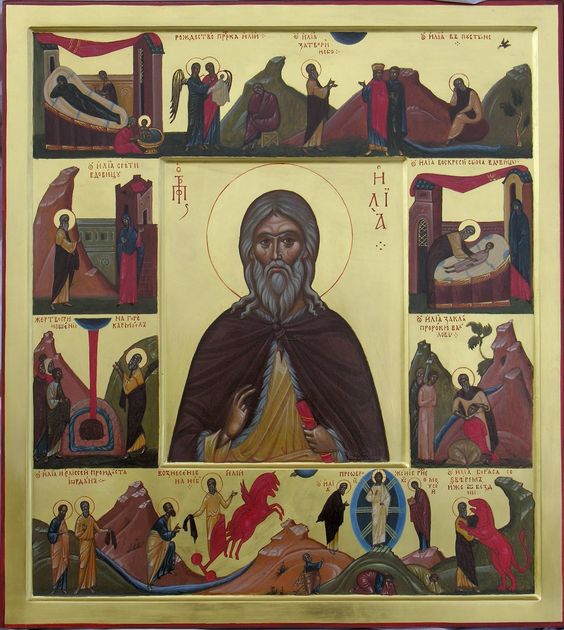
Today, my beloved, we celebrate one of the greatest Saints of our faith, the glorious Prophet Elias. He lived before Christ, but he is also "the second forerunner of the coming of Christ" (from the Apolytikion of the Saint). He is one of the most beloved Saints, and many bear his name, and on many hills there are built chapels in his name, and many villages celebrate his name.

Should we tell of his life? It would take much time and you don't have much stamina. So that I might not tire you, I will tell of a few essential things from the life of the Prophet Elias. I will mention three of the wonders out of the many that he had done.

The one was that once, with his prayer, there was a drought that hit along with a famine in Judea. He also was hungry, because the Saints suffer hunger. He went to a village and everyone closed their doors to him. Only one house, a hut, opened their door. And who lived there, a rich man? It was a poor widow with her children. She received him. She had nothing to offer him hospitality, only a handful of flour and a little oil. And these she did not hold back. As soon as she saw him, even though she didn't know who this old man was, she said: "Come in, Elder." She immediately took the flour, made bread and gave him to eat, because he was tired from his journey. This occurred in Zarepta of Sidonia. And then--let the faithless disbelieve; it is their right, but we believe--from that hour on, the widow's house was never lacking in flour and oil. (Third Kings 17:8-16).

What does this mean?  Where there is the blessing of God, everything is riches. One can have incomparable fields, vineyards and olive groves, one can have sacks of gold and silver, one can have it all, but die from hunger. And one can have a handful of flour, a little piece of earth, a bucket of soil, and this will sustain you, as long as one blesses the Lord. These are not just words, they are reality. Because of this our Church chants: "The rick have become poor and hungry, but those who seek the Lord shall not lack any good thing." (Psalm 33:11) Everything, therefore, is a blessing. Some place too high an emphasis of work alone, because above work is the blessing of our Lord Jesus Christ.

Another miracle: While the house of the widow had flour and oil, the rest of the village was suffering hunger, for it had not rained for three and a half years. The impious King Ahab gathered the people of Israel on Mount Carmel, and there, the Prophet Elias censured them for their lack of steadfastness. Until when, he said, will you stand limping with your two feet? If our God is true, then follow Him. If Baal (the idol) is true, then follow him. They heard him without speaking, how would they be justified? Then he told them, I will only preach the true God, while the priests of the idols were about 1000. Today, therefore, we will test who is the true God. Bring two calves, and you will choose whichever you wish, and let us prepare a sacrifice with wood, but we will not light them on fire. And I will prepare the other for sacrifice and will not light it on fire. And you will entreat your god, and I will call upon the Lord my God. And He will hear me and will light and burn the calf of sacrifice, because He is the true God.

They agreed. The priests of shame placed their altar, and their calf upon it, and began to entreat, calling out: "Hear us, Baal". Noon passed, evening came, nothing. Their god was shown to be false. Afterwards, Elias places the clean altar, places wood and the calf upon it in pieces, and tells the others to sprinkle it three times with water (in order that there not be any possibility of fire). And as soon as he prayed, fire descended from heaven and consumed the whole calf, and the wood and the stones and even the water! Nothing remained. Then everyone believed that the only true God is the Lord. Immediately, the Prophet Elias commanded: cease all of the priests of shame, the priests of idolatry. And he took them to the brook of Kisson, and there--terribly--he slaughtered them all (ibid 18:19-40).
  
The Holy Prophet Elias (source)
  
Let us now return again to the house of the widow. What happened there? One day her child fell deathly ill and died. The mother said to the Prophet Elias: "Come to my house to explain to me for which of my sins my son was put to death." "Give me your son." he told her. He took him to the upper room, laid him in his bed, and having prayed to the Lord, breathed three times on the child, and then--let the faithless disbelieve, we believe that there is a God Who works wonders through the Panagia and the Saints--the child was resurrected. "I see that you are a man of God", the widow said. (ibid 17:17-24)

I told you a few things, my beloved, about the Prophet Elias. One more thing I will mention. When it came the time for him to flee from the world, he did not die like we do. As he was walking, a fiery chariot took him and lifted him high. The Prophet Elias still lives. He is hidden somewhere, in one corner of the universe. And we expect him to come again. You don't fear the Prophet Elias, because it seems that you are Saints? I am afraid of him. He is a thunderbolt against sinners, prostitutes, adulterers, blasphemers, atheists, shameful people and all who remain unrepentant. His word is burning. He is the "second forerunner of the coming of Christ", the forerunner of the Second Coming of the Lord. And the Second Coming of the Lord is approaching, it is coming! The signs are many. There are signs which will precede the end of the world, and one of them is the appearing of the Prophet Elias.

One sign of the end of the ages is, as Christ Himself said, that there will be earthquakes, terrible earthquakes (Matthew 24:7). And continuous earthquakes are occurring. Another sign was mentioned by St. Kosmas Aitolos. When they asked him when the end of the world was coming, he replied: "When you see women walking naked in the street." And we see this in reality. Women walking around [naked], corrupting the world*, and even in the church they dare to enter naked. Another sign is the divorces that are increasing, while formerly divorce was unknown and only the shovel of the undertaker separated couples. Another sign that will appear is the 666. The devil will come out and begin to seal people, all, small and great will take this identification. These are the signs of the times. Go and sell your shirt and buy the Book of Revelation and read it, it is all written in there, what will occur.**

Within your houses, have fear of God. How will we be saved? With prayer. With what prayer? Not dead prayer, but living prayer which comes through tears. In the old blessed days the Christians listened in the Church of Christ with contrition. Today, we find the church dead. In the old days, in the crags of our homeland dwelt holy people. And what did they do? Were they partying at night? Before they would go to sleep, the father and mother, along with their seven or eight children would kneel in prayer to God. Show me today a family that prayers together! We have lost the mind of God. Where is prayer, family prayer? Where are the tears, the contrition? Where is Confession and Holy Communion? Where is almsgiving? Where are the wonders of our people?

Because of this, I advise you to take the Gospel and the Revelations and all of you read them, men and women. Pray night and day, at noon and in the evening. And if you can't say many prayers, say only one prayer: "Lord, have mercy", "Lord, have mercy", "Lord, have mercy". And if you say it with your whole heart, you will be heard, and you will work wonders, and the stars will descend to earth.

Let us live like this, therefore, my beloved and blessed ones, with Christ, awaiting the return of the Prophet Elias, and entreating God to save the world. Amen.

(+) Bishop Avgoustinos, recorded from a homily given in the Holy Church of the Prophet Elias, Xanthogeion, Amyntaiou, on July 20th, 1987) (Source)

*Note I: This described lack of modesty, and lust in general is of course not only seen in women, but in men as well, as day by day, filth of body, mind and soul is growing and is being exhibited more externally, in society, TV, the internet, etc.
  
**Note II: Thankfully, there are many good Orthodox guides to reading the Book of Revelation, including the most famous commentary by St. Andrew of Caesarea (translated here), published talks by Fr. Athanasios Mitilinaios, a series by Fr. Thomas Hopko, the series of talks by Fr. Josiah Trenham, etc. Metropolitan Avgoustinos ends this sermon very poignantly, focusing not on fear of the 666 or the Antichrist, but on fear of the Lord, and emphasizing the need for prayer, repentance, contrition, the Holy Scriptures and the Holy Mysteries of our Church.
  
The Holy Prophet Elias, with scenes from his life (Source)
  
Through the prayers of our Holy Fathers, Lord Jesus Christ our God, have mercy on us and save us! Amen!

Friday, June 14, 2019

Elder Aimilianos of Simonopetra: "How can we have the Holy Spirit?"

Jesus Christ the Son of God the Savior of the world (source)
  
How can we have the Holy Spirit?

The answer is, for each of us to love his wife: you who are married your wife, and I who am a monk, my monastic life.

I must love my solitude, and not get depressed, not get tired, I must stand vigil, and not think that God sent me here in order to save the whole world, not to think that it is my duty to joke with this or that person, but to look after my job: I must have my eye on Christ.

When you leave your house and get married, you leave behind your father, mother, brothers, relatives, and, instead of your parents, your brothers and relatives, you find a new family. And having left, don't look behind you, as the Psalm of the Theotokos* says, do not think of anything from your former family**. For now you have a whole new world before you, which you must rejoice in, to partake of, to taste, to give life to. Therefore, all of us must give life to our family, to our love, to the divinity that we have wedded, as St. Hesychios says. Then our flesh we will be filled with divinity and we become Christ.
-Elder Aimilianos of Simonopetra
(source)
  
*Hear, O daughter, consider, and incline your ear; forget your people and your father's house;
11 and the king will desire your beauty. (Psalm 45:10-11)
  
*Note: The Elder is not implying that we should not try to help our families as we are able to, but that our spouses after marriage must always take the first place after God.
  
Christ, the Holy Wisdom of God (source)
  
Through the prayers of our Holy Fathers, Lord Jesus Christ our God, have mercy on us and save us! Amen!

Tuesday, April 9, 2019

Fr. Andreas Konanos on Anxiety and Stress

This is a good talk from Fr. Andreas Konanos, a popular preacher in Greece in recent years. Fr. Andreas has a very light-hearted, positive style and tends to discuss a lot of topics in a spiritual manner that resonate with people today. This talk is on anxiety and stress, and the role of our bodies, minds, relationships and our spiritual life in affecting our lives (with English subtitles). I hope his wide-ranging and wise thoughts and advice may be helpful and give consolation to many who continue to suffer daily.
  
Through the prayers of our Holy Fathers, Lord Jesus Christ our God, have mercy on us and save us! Amen!

Tuesday, January 22, 2019

St. Iakovos of Evia: "For married people, your prayer ropes and prostrations are your children..."

Christ blessing the children (Source)
  
There was once a pious couple with nine children. The husband was very pious and a little overly-zealous as regards spiritual things.

By letter he said that he wanted to do everything like a monk. His wife complained to St. Iakovos of Evia that she was exhausted and that she wanted help. When they came to the Monastery of St. David, at night, while the children were crying and screaming, the wife also was crying because she was so tired...

The husband went to a chapel at the Monastery of the Holy Unmercenaries and was doing prostrations, praying the prayer rope and serving vigil.

The wife complained to St. Iakovos and she was right.

The next day, the Saint, as soon as he saw them in the courtyard of the Monastery, understood what was going on and that they were starting to fight amongst themselves.

The Saint spoke with sweet words and with discernment in order to comfort the pained and exhausted mother, and with discernment and a smile he said to the father: "I was proud of you last night. You chanted all night and prayed. Good job! But you would have had an even greater blessing and reward if you sat a half hour instead of three, near your wife helping her to feed the children and put them to bed, because for married people, your prayer ropes and prostrations are your children. When they grow up you will have time to do them, but "a brother is helped by a brother". Let everything be done by mutual consent."
(source)
  
St. Iakovos of Evia surrounded by children (source)
  
Through the prayers of our Holy Fathers, Lord Jesus Christ our God, have mercy on us and save us! Amen!

Thursday, February 11, 2016

The Holy Mothers of the Three Hierarchs: Sts. Nonna, Emmelia and Anthousa

The Three Holy Mothers of the Three Hierarchs: Sts. Nonna, Emmelia and Anthousa - Commemorated the Sunday after the Feast of the Presentaton of Christ to the Temple (source)
  
In Greece, the feast of the Presentation of Christ to the Temple, due to the praise to the Theotokos of the feast, has become the day on which they celebrate Mother's Day. Related to this, and also based on the fact that January is the month in which the Three Great Hierarchs and Ecumenical Teachers are celebrated (Sts. Basil the Great, Gregory the Theologian, and John Chrysostom), the Sunday after the Feast of the Presentation of Christ has come to be the common feast of their mothers. Sts. Nonna, Emmelia and Anthousa are perfect examples of Christian motherhood, and one can see the great virtue in their lives, and especially through their children, the fruits of their labors and faith. Below I inclue their lives, and also hymns from the joint feast of these Three Holy Mothers. May they intercede for us all and help us!
  
Life of St. Nonna
Saint Nonna, the mother of St Gregory the Theologian (January 25, 389), was the daughter of Christians named Philotatos and Gorgonia, who raised her in Christian piety. St Nonna was also an aunt of St Amphilochius, Bishop of Iconium (November 23).   St Nonna entered into marriage with Gregory of Arianzus (January 1), the rich landowner of an estate in the Arianzus and Nazianzos districts. The marriage was advantageous by earthly considerations, but grievous for the pious soul of Nonna. Her husband Gregory was a pagan, a follower of the sect of the Supremists (Hypsistarii), who venerated a supreme god and observed certain Jewish rituals, while at the same time they worshipped fire.   St Nonna prayed that her spouse would turn to the holy truth. St Nonna’s son, St Gregory the Theologian, wrote about this: “She could not bear this, being half united to God, because he who was part of her remained apart from God. She wanted a spiritual union in addition to the bodily union. Day and night she turned to God with fasting and many tears, entreating Him to grant salvation to her husband.”   Through the prayers of St Nonna, her husband Gregory had a vision in his sleep. “It seemed to my father,” writes St Gregory, “as though he was singing the following verse of David: ‘I was glad when they said to me, let us go into the house of the Lord’ (Ps. 121/122: 1). He had never done this before, though his wife had often offered her supplications and prayers for it.”   The Psalm was strange to him, but along with its words, the desire also came to him to go to church. When she heard about this, St Nonna told her husband that the vision would bring the greatest pleasure if it were fulfilled.   The elder Gregory went to the First Ecumenical Council at Nicea, where he made known his conversion to Christ. He was baptized, ordained presbyter, and then Bishop of Nazianzos devoting himself totally to the Church. At the same time as his consecration as bishop, his wife St Nonna was made a deaconness. With the same zeal with which she had raised her children, she now occupied herself in performing works of charity.   “She knew,” says St Gregory the Theologian, “one thing to be truly noble: to be pious and to know from where we have come and where we are going; and that there is one innate and trusty wealth: to use one’s substance on God and on the poor, especially the impoverished kin.   One woman may be distinguished for frugality, and another for piety, while she, difficult as it is to combine both qualities, excelled all others in both of them. In each she attained the height of perfection, and both were combined in her. She did not permit one duty to interfere with the other, but rather each supported the other.   What time and place of prayer ever eluded her? She was drawn to this each day before anything else, and she had complete faith that her prayers would be answered. Although greatly moved by the sorrows of strangers, she never yielded to grief to the extent that she allowed any sound of woe to escape her lips before the Eucharist, or a tear to fall from her eye, or for any trace of mourning to remain on a Feast day, though she repeatedly endured many sorrows. She subjected every human thing to God.   Her final years brought St Nonna many sorrows. In the year 368 her younger son Caesarios died, a young man of brilliant expectations; and in the following year, her daughter died. The brave old woman bore these losses submitting to the will of God.   In the year 370 Bishop Gregory, then already an old man, participated in the consecration of St Basil the Great as Bishop of Caesarea. St Nonna, who was somewhat younger than her husband, was also ready to enter into the next life, but through the prayers of her beloved son her time on earth was prolonged.   “My mother,” wrote her son, “ was always strong and vigorous, and free from sickness all her life, but then she became ill. Because of much distress... caused by her inability to eat, her life was in danger for many days, and no cure could be found. How then did God sustain her? He did not send down manna, as for Israel of old; He did not split open a rock, in order to provide water for the thirsty people; nor did He send food by ravens, as with Elias, nor did He feed her..., as He once fed Daniel, who felt hunger in the pit. But how?”   It seemed to her that I, her favorite son (not even in dreams did she prefer anyone else), had appeared to her suddenly by night with a basket of the whitest bread. Then I blessed these loaves with the Sign of the Cross, as is my custom, and I gave her to eat, and with this her strength increased.”St Nonna believed the vision was real. She became stronger, and more like her old self.   St Gregory visited her early the next morning and, as usual, asked what sort of night she had, and if she required anything. She replied, “My son, you have fed me and now you ask about my health. I am well.” At this moment her maids made signs to me that I should not contradict her, but to accept her words so that the actual truth should not distress her.”   Early in the year 374 the hundred-year-old St Gregory the Elder reposed. After this, St Nonna almost never emerged from the church. Soon after his death, she died at prayer in the temple on August 5, 374.    St Nonna was a model wife and mother, a remarkable woman who devoted her life to God and the Church without neglecting her other responsibilities. Because of her spiritual, social, and domestic concerns, St Nonna would be a most fitting patron for Orthodox women’s organizations.
(source)
  
Life of St. Emmelia
St Basil the Great’s mother St Emilia was the daughter of a martyr. On the Greek calendar, she is commemorated on May 30. St Basil’s father was also named Basil. He was a lawyer and renowned rhetorician, and lived at Caesarea.   Ten children were born to the elder Basil and Emilia: five sons and five daughters. Five of them were later numbered among the saints: Basil the Great; Macrina (July 19) was an exemplar of ascetic life, and exerted strong influence on the life and character of St Basil; Gregory, afterwards Bishop of Nyssa (January 10); Peter, Bishop of Sebaste (January 9); and Theosebia, a deaconess (January 10).
(source)
  
St. Anthoua the Mother of St. John Chrysostom (source)
  
See here for a brief life of St. Anthousa, the Mother of St. John Chrysostom.
  
The Three Hierarchs, together with their Mothers (source)
  
Selected hymns from the Feast of the Three Holy Mothers, Sts. Nonna, Emmelia and Anthousa - Commemorated the Sunday after the Feast of the Presentation of Christ to the Temple

Prosomoia of the Stichera in the Plagal of the Fourth Tone.
What shall we call you, O Saints?
What shall we say of you, O Emmelia? The child-loving mother of wondrous children, the tender-loving woman of sacred works, for you bore the Great Basil, and also nursed Peter and Navkration, the bearer of Gregory of Nyssa, and Makrina who was enlightened by God, intercede, that our souls be saved.
  
How shall we call you, O divine Nonna? A mother of fervant prayer, like that of the Prophet Samuel, the sweetest spouse, as proclaimed by Gabriel? You sprouted the all-wise Gregory, and you watered Caesarios and Gorgonia with the springs of piety, and the waters of the faith, intercede, that our souls be saved.
  
How shall we now hymn Anthousa? As the spouse of Sekoundos, the Christian leader, the mother of John Chrysostom the wise. As a pillar of wisdom and chastity, and an example of motherly purity, fragrant flower of love, and unfading crown of glory, intercede, that our souls be saved.
   
Doxastikon of the Stichera in the Plagal of the Second Tone
A day of rejoicing has shined forth upon the Church of Christ, and She has put forth this common feast for the exaltation of the Christian people. Come, therefore, the ranks of the Orthodox, let us honor in hymns and God-inspired melodies, the memory of the Holy Mothers of the Three Glorious Hierarchs. For behold, Mariam who gave birth to God, offered to the Priest in the Temple her holy and most-sacred Fruit [Christ], becoming the prototype to Mothers. But these famed Mothers Emmelia, Nonna and Anthousa, bore fruit in prayer, and offered their tears to God for their faithful children, and nursed them on the milk of piety, and offered them up as pure, spotless and fitting sacrifices. Let us cry out to them: rejoice, O chaste Mothers, the God-sent examples for their children, sons and daughters, the hope of spouses, and the fervent intercessors for the faithful, and the speedy deliverers. Therefore, entreat Christ, we pray, on behalf of those who honor your all-pious and ever-blessed memory, and send down upon us all peace, and great mercy for our souls.
  
Idiomelon of the Litia in the First Tone
Rejoice in the Lord, O Church of Christ, at the divine memory today of the famed Mothers of the Three Hierarchs: Emmelia, Nonna and Anthousa. For these thrice-blessed ones sprouted their God-planted children, and watered them faithfully with the teaching and commandments of the Lord, and lived venerably, bearing this painful and fleeting life, proceeding then to the heavenly Fatherland, where they ceaselessly entreat on behalf of our souls.
  
Doxastikon of the Aposticha in the Second Tone
Today, we have been gathered to a table of spiritual rejoicing, for the common and light-bearing and all-glorious memory, of the Venerable Mothers of the Three Hierarchs: Emmelia, Nonna and Anthousa. Come, O lovers of feasts, and let us hymn their divine virtues, imitating their way [of life] in an exacting manner, their spousal faith, their nurturing of their children, and their God-pleasing manner, that the greatly merciful God might bear for us mercy, on that terrible and awesome day, of His Righteous [Judgment].
 
Apolytikion of the Saints in the First Tone. The Three Great Lights.
The three Holy Mothers of the Teachers let us honor, who bore the Hierarchs, and preached Christ, and watered them with the milk of piety, and nurtured them on the glorious faith, training them as trees. Emmelia the divine, and Nonna the thrice-blessed, and the chaste Anthousa, the astonishment of Lebanon. Come, the imitators of their struggles, let us gather together to offer hymns to them, as they intercede for us to the Trinity.
   
Kontakion in the Fourth Tone. You have appeared today.
The feast of the Mothers shines forth today, come, you who love feasts, let us praise them, crying out: Rejoice Emmelia, together with divine Nonna, and all-praised Anthousa.
  
Oikos
Behold now, the light-bearing day has dawned of the divine memory our Venerable Mothers. Come, you of godly mind, rejoice now, and hasten to honor them as is right with godly hymns, imitating their incomprehensible way of life, and their God-pleasing manner, and their virtues and struggles, their pains and sweats, for their entreated God with prayer, and supplication, and humility, and love, patience and chastity, and with every other virtue, especially chastity and brotherly love. Therefore, with fervor let us cry out: Rejoice Emmelia, together with divine Nonna, and all-praised Anthousa.
  
Synaxarion
On this day, the Sunday after the Presentation of our Lord and Savior and God, the Memory of the Holy Mothers of the Three Hierarchs: Emmelia, Nonna and Anthousa.
  
Verses
Let us honor the memory of the Holy Mothers
Emmelia, Nonna and Anthousa.
They entreat the Infant Forty-days-old, together with God's Mother.
  
Exaposteilarion in the Third Tone.
The heaven in the stars.
In the Temple the Priest met the Infant Christ, and in the House of God, let us all praise in hymns and odes the virtues of Emmelia, Nonna and Anthousa, as is right.
  
In the Praises, Sticheron Prosomoion in the First Tone.
The heavenly ranks.
Come, all the faithful, let us celebrate the memory of the Mothers of the Great Hierarchs, Holy Emmelia with joy, who bore Basil, Nonna who bore Gregory, and the chaste Anthousa who sprouted forth the Chrysostom.
  
Doxastikon of the Praises, in the Plagal of the First Tone
Let us sound the trumpet in the clarion of song, skipping festally, and let us rejoice in the Spirit, hymning in God-inspired hymns, the light-bearing memory of the Holy Mothers of the Three Hierarchs, and let us say to them in praise: Rejoice, you who raised Basil the Priest, and were the tender-loving mother of ten children, Emmelia, all-praised, the prototype of the family. Rejoice, the chaste spouse of the sacred Gregory, who bore the second Theologian, together with Caesarios and Gorgonia, Nonna, all-blessed. Rejoice, the most-chaste wife of Sekoundos, who sprouted John the Chrysostom, and educated him to be the rhetor of Lebanon, Anthousa, the divine adornment. But, O Mothers, you rejoiced in your sons and daughters like fruitful olive trees, and you kept your spousal faith, and struggled tirelessly to love your children and your brethren, and you transmitted to your children all the virtues faithfully. Intercede with the Savior, that those who celebrate your memory might be shown mercy upon their souls.
  
Megalynarion
Come O faithful, let us praise the sacred Mothers of the Great Hierarchs: Emmelia, Nonna, and the chaste Anthousa, crying out "Rejoice" to the godly ones in faith.
  
  
See here for the Akathist to the Three Holy Mothers.
  
Sts. Nonna, Anthousa and Emmelia (source)
      
Through the prayers of our Holy Fathers, Lord Jesus Christ our God, have mercy on us and save us! Amen!