Showing posts with label St. Paraskevi the Great Martyr. Show all posts

Tuesday, July 28, 2020

A Study on the Apolytikion of St. Paraskevi


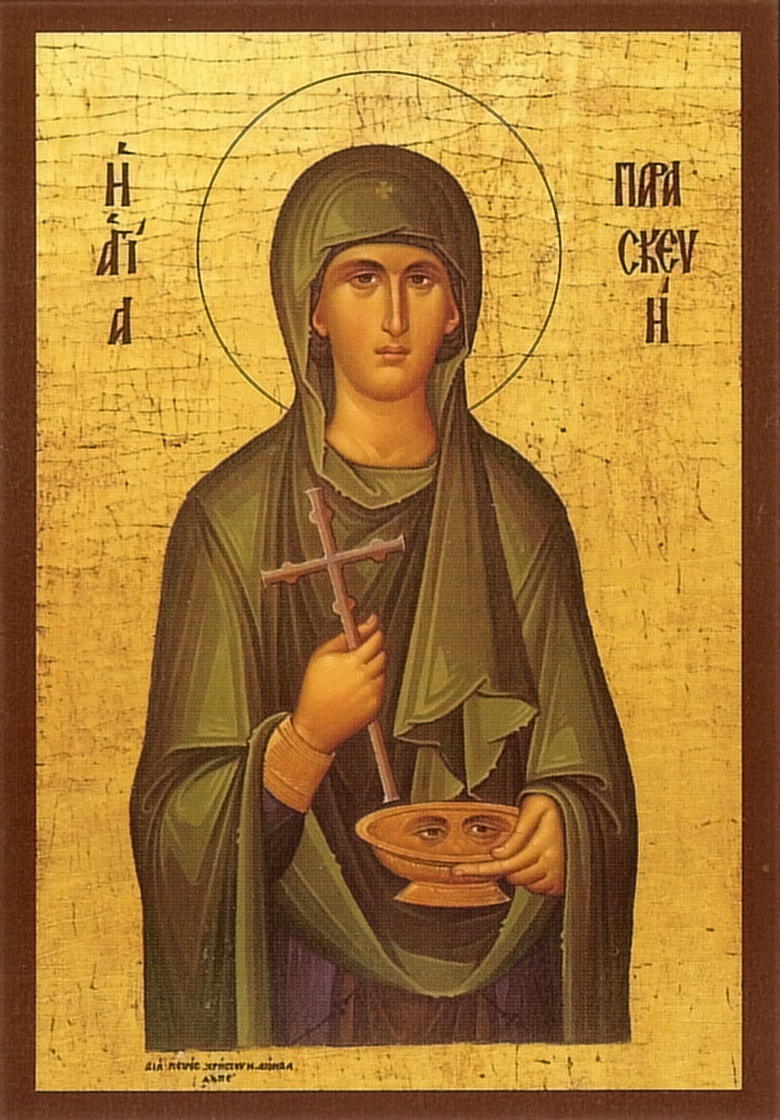
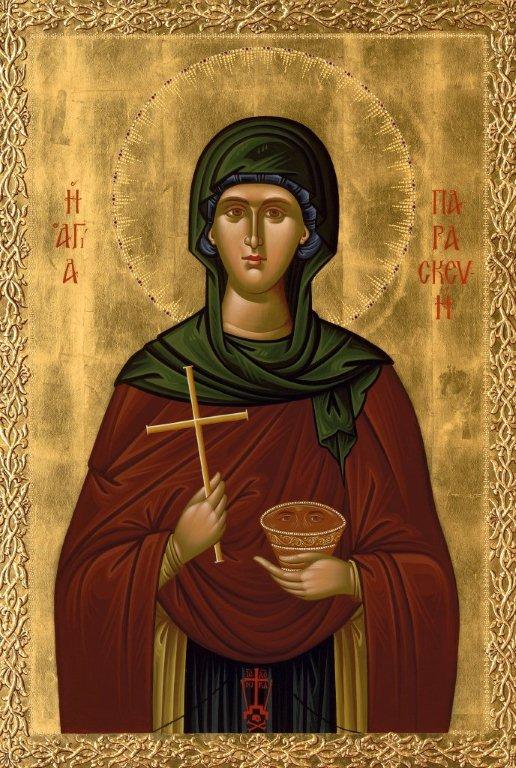
St. Paraskevi the Great Martyr (source)
 
Note: The short but powerful Apolytikion (troparion) of St. Paraskevi, is often times not fully or clearly translated from the original Greek, and is even less often explained regarding its deep meaning and how the Saint illustrates Christ. This is an excerpt from a very lengthy study on the Saint's hymn, including many pertinent scriptural references. May the Saint's love and diligence for the Lord help us to prepare ourselves, and may the Lord make us worthy of His Kingdom, through her prayers.
  
Excerpt from a Study on the Apolytikion of St. Paraskevi
By Archimandrite Theophilos Lemonzi, PhD
Together with the holy icons, it is undeniable that the most beautiful hymns of the Church serve as teaching on the spiritual life, as the faithful person receives the knowledge of the wondrous deeds of the Saints, and is moved to imitate them. While the holy icons spiritually nourish the sight of the faithful, the hymns spiritually nourish the hearing of the faithful.

A special place in the heart and the pious lips of the Orthodox Christians is the Apolytikion of St. Paraskevi, which is as follows:
"Τὴν σπουδήν σου τῇ κλήσει κατάλληλον, ἐργασαμένη φερώνυμε, τὴ ὁ μώνυμόν σου πίστιν εἰς κατοικίαν κεκλήρωσαι, Παρασκευὴ ἀθληφόρε· ὅθεν προχέειςἰ άματα, καὶ πρεσβεύεις ὑπὲρ τῶν ψυχῶ ἡμῶν."
"Working with a diligence proper to your calling, corresponding to your name, you inherited your faith of the same name as a dwelling-place, O Champion Paraskevi, therefore you pour forth healings, and you intercede on behalf of our souls."
 
The author of this perfectly-worked hymn is unknown, however, we can surmise that he was learned and had a deep knowledge of the Holy Scriptures and of Theology. From our pastoral experience we believe that very many have discussed the great teaching that this brings, and the deepest meaning of this Apolytikion, and have tried to translate it into modern Greek...
  
In the first part: "Working with a diligence proper to your calling, corresponding to your name" the main issue is the address «φερώνυμε» ("corresponding to your name", "name-bearer" or "namesake"). This is one who receives his name from someone, and the author is likely using the deepest meaning of the name "Paraskevi" which the Saint bears. The name that we are given at Holy Baptism has a deepest spiritual significance, and we are called to express throughout our life as a Christian that which our name means in reality. The author, with this word, tries to give the reason for which the Saint not only was named "Paraskevi", but also lived this name out in deed, because with her holy life was given meaning corresponding to her name: she correspondingly prepared herself with dedication for Martyrdom, and for the Kingdom of Heaven.
  
The word "Paraskevi" comes from the word "παρασκευάζω", meaning I prepare, but also I make myself something in order to obtain an identity, and it further means preparation, production, and ascesis. The sixth day of the week "Paraskevi" ("Friday") received its name from the Jews, for during that day they prepared for Sabbath rest with whatever they would need for that day, e.g. the food that they would eat. In the same way, St. Paraskevi, through the working of the commandments and asceticism of virtue, she prepared, in other words, she made herself worthy, preparing herself beforehand for her Martyrdom, and for her entrance into eternal life.

The phrase "Working with a diligence proper to your calling, corresponding to your name" furthermore expresses the whole Christian life of the Saint. The phrase "your calling" refers to the call from God towards the Saint for salvation, but also for every person. The meaning of divine call plays a central role in holy history. God called Abraham (Genesis 12:1-2), Moses in the desert of Sinai (Exodus 3:2), and the Holy Prophets. The Holy Apostles (Matthew 4:18-25) and the Apostle Paul (Acts 9:1-19) were called by Jesus to follow and to preach the Gospel. God calls all men "with a holy calling, not in virtue of our works but in virtue of his own purpose and the grace which he gave us in Christ Jesus ages ago," (II Timothy 1:9) through His Grace (Galatians 1:15). What distinguishes this is the freedom of man, and if he will respond to this call, for, as St. John of the Ladder says, even God directs Himself towards all men, because He does not remove their free will, He becomes life and salvation for those alone who desire Him. Because of this, the faithful become partakers in their heavenly calling (Hebrews 3:1), and are called "called and chosen" (Romans 1:6, Revelations 17:14). The significance of this calling is one's participation in eternal life (I Timothy 6:12), however, the faithful must show their love of struggle: ["For to this you have been called, because Christ also suffered for you, leaving you an example, so that you should follow in his steps."] (I Peter 2:21)

With the phrase: "Working with a diligence" is expressed this response to the calling of God towards the Saint for salvation. On Holy Friday, Jesus "worked salvation in the midst of the earth" (Psalm 73:12), through His life-giving death, and St. Paraskevi "worked with diligence", in other words, worked with dedication, zeal and willingness to respond to the divine calling for salvation (see the phrase of St. Paul:  "For see what earnestness this godly grief has produced in you, what eagerness to clear yourselves" (II Corinthians 7:11)) being obedient to the commandment of St. Paul "work out your own salvation with fear and trembling" (Philippians 2:12).

The participation through "working", describes the working of the commandments of the Gospels, and the asceticism of virtue, as a struggle and agony of freedom. The Christian, as a worker of virtue, ought to work with goodness and to turn away from evil: "lead a life worthy of the calling to which you have been called, with all lowliness and meekness, with patience, forbearing one another in love." (Ephesians 4:1-2) As the Saints, who "worked righteousness", and also "received promises" (Hebrews 11:33), thus, the faithful should "work goodness" (Romans 2:10), because God will give to each "according to his works" (Romans 2:6).

The word «σπουδή» comes from the verb "σπουδάζω", which means I hasten, I am going, I am paying attention to details, willingly in order to accomplish something, I am dedicated to something with a unique interest, zeal and care. The faithful should work with care towards their salvation: "be zealous to be found by him without spot or blemish, and at peace" (II Peter 3:14), according to the Apostle Peter, and as the Apostle Paul commands St. Timothy: "Do your best to present yourself to God as one approved, a workman who has no need to be ashamed" (II Timothy 2:15).

St. Paraskevi was detail-oriented regarding the words of the Gospel, and she showed special care, willingness and zeal to be diligent to the Holy Scriptures, such that she was shown a missionary of Christ, and embodied non-possessiveness, giving away all her goods to the poor, studying the ascetical life "and through purity, making her soul beautiful", working ceaselessly for the Gospel and life according to God, confessing her faith in Christ and hastening towards Martyrdom.

The diligence and care of the Saint is further adorned through all of her working of the commandments and through her virtue, her struggles of asceticism and martyrdom, and her uncompromising love, to the point that she healed her persecutor, Antoninus. And all of these occurred with a special desire to be obedient to the word of the Apostle Paul "Never flag in zeal, be aglow with the Spirit, serve the Lord." (Romans 12:11), and because of this, she was continuously witnessing to Christ, even after the first tortures that she suffered. She did not shy away, she was afraid, but continued "receiving the good witness".

The author, therefore, using this word "diligence", wishes to bring to the mind of the faithful the response of the Saint to the call of God towards salvation, her love of struggle, her willingness and care for asceticism in her Christian life, and her bearing witness. The spiritual life, even though it does not come from man, requires the consent of man to bear fruit. This presupposes an unending struggle against the passions, and simultaneously a working towards the keeping of the virtues of the Gospel, as noted by blessed Fr. Michael Karadamakes. The phrase, therefore "Working with a diligence proper to your calling", has the same content as the suggestion of the Apostle Peter to the faithful: "therefore, brethren, be the more zealous to confirm your call and election, for if you do this you will never fall; so there will be richly provided for you an entrance into the eternal kingdom of our Lord and Savior Jesus Christ." (II Peter 1:10-11) and reveals the consent of the Saint to the divine calling towards asceticism and the keeping of the commandments. And all of these she worked with a corresponding and illustrative manner, with humility and love, for the asceticism of virtues, when they do not occur according to the commands of the Gospel, they are not pleasing to God: "An athlete is not crowned unless he competes according to the rules." (II Timothy 2:5) Similar to the Pharisee of the Parable (Luke 18:1-14), who worked to keep the commandments of God, but his inspiration was to please men, and because of this, he was not justified...

In the second part: "you inherited your faith of the same name as a dwelling-place, O Champion Paraskevi", a most important point is point is the word "inherited", which serves as the immediate continuation of the beginning phrase "working with a diligence proper to your calling, corresponding to your name", and reveals that which the Saint received as a gift and inheritance from God due to the diligence and willingness that she showed. The word «κληροῦμαι» means to receive something through lot, and the hymnographer says that the Saint received through her lot, as a lawful inheritor, this faith of the same name as a dwelling-place.

St. Paraskevi with scenes from her life and martyrdom (source)
   
But what does this phrase mean: "your faith of the same name"?

That which she herself possesses is called synonymous, because it shares the same name with something. Synonymous unites two words which have the same meaning. In this specific case, the word «ὁμώνυμον» has the final meaning of the word and means that the two words «πίστις» and «παρασκευή» ("faith" and "preparation") have the same meaning. But why does the hymnographer use this meaning to unite these two words? The reason is most deep and theological. As we mentioned above, the name of the Saint means preparation for martyrdom and for the Kingdom of Heaven, through her working of the commandments of God, her asceticism and love of struggle. As a consequence, the Christian faith is not possible as a theoretical religious ideology, but, as was remarked by Blessed Elder Joseph of Vatopedi, if we keep the commandments, this is a confession. As long as sin is a denial of God, then love of struggle and the taking up of one's Cross is a practical outcome of one's Christian identity. Through Holy Scripture, the meaning of faith plays an essential role.

The faith of holy people goes together with works: the Apostles, having believed in Christ, at the same time: "immediately left their nets and followed Him" (Mark 1:18), and Abraham believed "By faith Abraham obeyed when he was called to go out to a place which he was to receive as an inheritance; and he went out, not knowing where he was to go" (Hebrews 11:8), he left his homeland according to the directive of God and "you see that faith was active along with his works, and faith was completed by works" (James 2:22). Therefore, Blessed Elder Joseph of Vatopedi teaches us that: "our Lord convinces us that it is not enough, and it does not benefit us to know only abstractly that God exists. ['Not every one who says to me, ‘Lord, Lord,’ shall enter the kingdom of heaven, but he who does the will of my Father who is in heaven. (Matthew 7:21)] ["He who has my commandments and keeps them, he it is who loves me.” (John 14:21)]. He who "has", in other words, he who cared to learn the meanings and the goal of my commandments, and who afterwards "keeps" them, in other words, uses them. And He notes the meaning of the commandments "and he who loves me will be loved by my Father, and I will love him and manifest myself to him." (John 14:21) and He confirms again: " He who does not love me does not keep my words."" (John 14:24)

Blessed Fr. John Romanides remarks that, according to Orthodox Theology, man cannot, like Protestant heresies, become a perfect and saved Christian by himself, through some rational decisions regarding the faith and compliance with some general idea about love. He requires ascesis, trial and struggle against the schemes of the devil. This is what St. Paraskevi did. She was not only faithful in words, but expressed this through her asceticism of virtue "faith worked through love" (Galacians 5:6), being obedient to the command of the Apostle Peter "supplement your faith with virtue, and virtue with knowledge" (II Peter 1:5)...

Therefore, the phrase "your faith of the same name" shows that faith means struggle and ascesis for virtue, and serves as a practical confession, for "faith without works is dead" (James 2:26). It means that I prepare myself, through the keeping of the commandments, to receive the Grace of God and to enter the Kingdom of God. The Christian faith does not have a notion of stasis, in other words, that I simply accept an ideology, for "What does it profit, my brethren, if a man says he has faith but has not works? Can his faith save him?" (James 2:14) but it has a dynamic meaning, to confess my faith in Christ with my deeds according to St. Paul's exhortation to Timothy: "Fight the good fight of the faith; take hold of the eternal life to which you were called when you made the good confession in the presence of many witnesses." (I Timothy 6:12) In essence, the phrase "your faith of the same name" summarizes the whole meaning of the "life in Christ".

The hymnographer says that the Saint received from God through lot, "inherited", to have it as a dwelling place sharing the same name with this faith. The word "κλήρος" has to do with the casting of lots (see Acts 1:26), but also the meaning of the lawful part which one receives as an inheritance. The Apostle Paul offers thanksgiving "to the Father, who has qualified us to share in the inheritance of the saints in light." (Colossians 1:12) and the sacred Chrysostom, interpreting this says that the Apostle Paul wishes to teach that sanctification and theosis is not the outcome of human virtue, but serves as a gift of God....

The author, therefore, wishes to show the great gift of the Grace of God to the Saint due to her holy life, and that this gift is given, for she obtained adoption, she became a child of God, and as a result, inherited from Him, according to the word of the Apostle Paul "and if children, then heirs, heirs of God and fellow heirs with Christ, provided we suffer with him in order that we may also be glorified with him." (Romans 8:17) God the Word became man "that we might receive adoption as sons" (Galatians 4:5). The presupposition, however, is for us to "suffer together with Him", as St. Paul says, in other words, ascesis and love of struggle, the diligence for which the Saint showed, and therefore having kept this, "But to all who received him, who believed in his name, he gave power to become children of God" (John 1:12)

The Saint faithfully kept this presupposition, to "suffer together" through asceticism of the virtues and martyrdom, and through this manner she allowed herself to receive the grace of adoption, and because of this, to become a genuine inheritor of His Kingdom.

The content of this lot, of the inheritance which the Saint received was given to her as a dwelling-place sharing the name of the faith. This phrase is difficult to explain, and for us to understand this, we need to understand what we mean by "place" (II Corinthians 5:1-5), as St. Paul compares the biological and mortal status of man with a "tent", in which dwells sin and the passions. We the faithful dwell in this house as well ["Here indeed we groan, and long to put on our heavenly dwelling"] as we experience the consequences of corruption from the passions, and we long to come to dwell in "a building from God, a house not made with hands, eternal in the heavens...For while we are still in this tent, we sigh with anxiety; not that we would be unclothed, but that we would be further clothed, so that what is mortal may be swallowed up by life. He who has prepared us for this very thing is God, who has given us the Spirit as a guarantee..."

St. John Chrysostom, interpreting this, says that this place specifically is not a dwelling made by hands in which we are called to dwell, it is not some stable of the body, but sanctification and incorruption which the faithful receive through Divine Grace...

The person who finds himself under the slavery of the passions comes to dwell in this "earthly tent", in other words, in corruption and sin. He is called to respond to the call from God to repent with a disposition of self-denial, to deny the devil and his words and to walk the path of asceticism, that he might become a recipient of Divine Grace. Blessed Elder Joseph of Vatopedi teaches that, as long as we keep the commandments, we confess our faith in God, and turn our freedom towards God, then Divine Grace is moved, which destroys the old man and builds within us the new, dispassionate one. Divine Grace gives such strength that the Holy Martyrs could endure all the inhumane tortures from their persecutors.

This new reality, the new man, the life in Christ, is the tent not made by human hands, which the faithful hope to be adorned with, and which was received by St. Paraskevi as a gift from God. the hymnographer wishes to show that the Saint, by holding steadfast to her faith, "for we walk by faith, not by sight." (II Corinthians 5:7), endured the struggles of asceticism, and through the keeping of the commandments, of obedience and self-denial, she became a recipient of Divine Grace, receiving "grace sent from above", which works salvation within us...
(source)
 
St. Paraskevi the Great Martyr (source)
 
Through the prayers of our Holy Fathers, Lord Jesus Christ our God, have mercy on us and save us! Amen!

Wednesday, July 22, 2020

Homily II on St. Paraskevi by Metropolitan Avgoustinos Kantiotes

St. Paraskevi the Great Martyr (source)
   
Homily II on St. Paraskevi by Metropolitan Avgoustinos Kantiotes: "A Sacrifice out of Love"
Who, my beloved, was St. Paraskevi whom we are celebrating? What was her life, her words and her miracles? It is not easy to relate these in detail. But let us reverently approach her sacred face.

St. Paraskevi was born in the capital of the ancient world, in Rome, during the reign of Emperor Antoninus (138-161AD). Her upstanding parents, Agathon and Politia, were Christians, but were childless. They promised, therefore, if they would be granted a child, to dedicate it to the Lord. God in reality granted them this girl, and because she was born on Friday, they gave her the name "Paraskevi" [Greek for "Friday", literally the "Day of Preparation", i.e. for the Sabbath]. They raised her as a Christian. But this girl had the misfortune of losing her two parents while she was still young. She had, however, the great blessing to have had the faith in Christ taken root within her at the proper time. As she grew, her love for the Lord lit a fire within her soul. This holy fire, which is not from the earth, but which is lit from Heaven, was so great, that all the waters could not quench it (Song of Songs 8:7). Blessed are all those who experience this.

She loved Christ with her whole heart. Not simply with words, but with deeds. The sign of this was how she responded to the voice of the Gospel: "Sell your goods and give to the poor..." (Matthew 19:21). If this voice were heard in our community, would there be souls that would thus respond? St. Paraskevi, the orphan who inherited a great fortune, distributed her goods to the poor.

She embraced the monastic life and began to preach Christ in Rome, and the surrounding areas. She founded a convent, in which were gathered girls who loved the Lord, and she made a missionary sisterhood, whose goal was to show mercy on the poor and to teach women. With the good example of this sisterhood, and with the fiery preaching of St. Paraskevi, many women who were idolaters came to believe in Christ.

She shown like a star at dawn, like an Angel. Other women and girls of her time were dressed in silk. The patricians of Rome and the ladies of the great families would be seen with their adornments worth more than their whole fortunes. Vain women like these were like swallows who carried their whole nests on them, and thus they would carry the whole fortunes of their husband.

St. Paraskevi did not wear silk. She had another garment, one incorrupt and eternal. She was adorned with modesty, a garment which is not corrupted by time.

Other women then and today attempted to appear beautiful externally. They would pain with makeup and lipstick on their lips, put on their cheeks, their eyebrows, their eyelashes. But if you were to ask me which woman were more beautiful, I would respond that the more beautiful woman is she who weeps when she hears the name of Christ, when she prayers, when she beholds the Epitaphios and the Holy of Holies. This was the beauty that St. Paraskevi had. She was not adorned with accessories but only with tears, which ran from her eyes, when she arose at midnight and prayed beneath the stars of Heaven. These were her very precious diamonds, which were taken by the Angels and brought to Paradise, to adorn the garment of her virginity.

Other women adorn their ears with earings, very precious and very expensive. But if you were to ask me, which woman were more beautiful, I would say: It is not those ears adorned with that kind of earings, which eventually will be destroyed or stolen. The more beautiful woman is she who readily turns to hear the voice of her husband, and this readiness had the ears of St. Paraskevi, who hearkened to the voice of the Gospel, to the voice of Christ Who said: "Blessed are those who hear the word of God and keep it." (Luke 11:28)

Other women of her time, like the queens of Rome, wore luxurious belts on their waist. For St. Paraskevi, her belt was the self-control which she wore. This was the adornment of St. Paraskevi, and thus all women and girls who desire to be called Orthodox Christians should be adorned.
  
St. Paraskevi the Great Martyr (source)
  
Her activities, however, brought about a backlash; this is the law of life. Whoever is struggling, will be fought against. Only the dead do not fight. Those who struggle in the world "fighting the good fight" (I Timothy 6:12) will face all kinds of backlash from the enemy. Evil children don't throw rocks at fruitless, but at fruitful trees. And St. Paraskevi, who was a tree full of fruit, was next to receive the stones thrown by the instruments of Satan. She was fought first by Hebrews who were fighting Christianity. Two of them condemned her to the King Antoninus, that there was a woman who was stirring up his kingdom, and if she were to continue thus, there would remain no one who would not believe in Christ. According to the command of Antoninus, St. Paraskevi was seized, and led before the Emperor. He remained astonished before her physical beauty, and suggested to her: "Deny Christ and I will make you the Queen." She responded: "I would be very senseless to deny the light and to accept the darkness, to deny Christ and to worship the devil, because the idols are the devil."

He tried again with sweet words and promises to shake her, but she stood immovable. "I will give you three days to think properly and to decide, either to become Queen or to suffer martyrdom."

"O King, do not think that three days, or thirty days or thirty years that you might give me could change my mind. Whatever you have to do, do it immediately."
  
Do you see, my beloved, how this woman stood unshaken? Whoever believes in truth and loves Christ, either a woman or a man, does not fear neither seduction nor threats, neither men nor the devil, nor this whole world. The true Christian is a hero, because the Gospel brings forth heroes. A heroine and an unshakable rock of the faith was St. Paraskevi shown to be.

Her martyrdom is one of the most moving. I will only offer a small detail. Antoninus ordered that she be placed in a large cauldron, in which was boiling pitch. And even though the pitch was boiling over, St. Paraskevi was swimming in the cauldron. Many don't believe this, it is their right. We believe in Christ and in the wonders of the Saints. As soon as the Saint entered the cauldron, she made the sign of the Cross, and boiling was transformed into refreshment, as if in soothing water! Antoninus was astonished. He wondered whether this were a trick: "Throw me some of that", he said. She threw some into his face, and the Emperor was blinded, his whole face was burned, and he began to entreat the Saint. And she, with her prayer, healed him, and all the people cried out: "Great and true is the God of the Christians!" Thousands of people believed on the day of her martyrdom.

Ultimately, Antoninus believed, but his successor continued the persecution against the Christians, and because of this, the Saint was later martyred. A soldier led her to the place of her execution, and with the lightning strike of his sword, her precious head was cut off, but her holy soul flew like a dove to the Heavens, to be together with the Most-Holy Theotokos, the Saints and the Angels, and to pray on behalf of us sinners.

See, my beloved, what one woman accomplished! She astonished the whole world. And what are we doing today, clergy and laity? In comparison to her, we have not accomplished anything. On the occasion, however, of her memory, let us honor her with love, and be taught by her example, and let us live as true Christians, and work in our social circles with philotimo.

Let us entreat St. Paraskevi. And let us light a candle not just for our family and for our children, but for our homeland, that we might continue to walk the path of Christ, because only then there will be blessedness. May the Lord be with us. Amen.
  
(+) Bishop Avgoustinos
(Homily delivered at the Holy Monastery of St. Paraskevi, Milochoriou, Eordaias, on Wednesday July 26th, 1967, Source)
  
St. Paraskevi the Great Martyr (source)
  
Through the prayers of our Holy Fathers, Lord Jesus Christ our God, have mercy on us and save us! Amen!

Wednesday, July 24, 2019

"She who loved Christ, the most beautiful..."

St. Paraskevi the Great Martyr (source)
  
She who loved Christ, the most beautiful, and through purity, was herself made beautiful in soul, and through all kinds of pains and trials approached Him as a spotless bride. Therefore, He made you worthy to dwell within His bridal chamber in the heavens, where you ever entreat Him, O All-praised Paraskevi, on behalf of those who honor you.
-Kathisma from Matins for the feast of St. Paraskevi the Great Martyr

(source)

Through the prayers of our Holy Fathers, Lord Jesus Christ our God, have mercy on us and save us! Amen!

Saturday, July 25, 2015

Homily on St. Paraskevi by Metropolitan Avgoustinos Kantiotes

St. Paraskevi the Great Martyr (source)
  
Homily on St. Paraskevi by Metropolitan Avgoustinos Kantiotes (+2010)
"A Bedrock of Virtue"
St. Paraskevi was not an ordinary woman. She was a spiritual meteor, a bedrock of virtue, unshakable amid the ocean of the corrupt community.
  
She implemented that which Christ said, that: “He who hears my words and keeps them resembles a house built upon the rock, and though the rains came and the winds and the rivers fell upon it, the house was not shaken.” (Matthew 7:24-25) And St. Paraskevi was a bedrock of virtue. Foamy waves fell upon her, the greatest waves of life.
  
First, the wave of corruption fell upon her. She was not born in a small village. She was born in the most corrupted city, which in the Holy Scriptures is called the Babylon of the world due to its corruption (Revelation 17:5). She was born in Rome, in a suburb of Rome. But however, she remained uplifted. She was a lily among the dung of her community.
  
Let us all hearken to this, for when we see some woman being led astray, we say: “The community is responsible.” Yes, the community is responsible, I don't deny this. But she herself is also responsible. Give me a woman who loves Christ like St. Paraskevi, and throw her into the most corrupted community, and no wave and no devil could shake her.
  
As soon as one wave left, a stronger wave fell upon her: the wave of orphanhood. This wave is terrible. St. Paraskevi was orphaned of her father and her mother. Because of this she is a protector of orphans. She was orphaned at that age when children could become prey to unscrupulous traffickers who try to exploit them. But she stood tall even while an orphan. She had within her a great fervor for holiness, the life of virginity and grandeur.
  
Woe to the woman who does not have these great desires. No matter how high she climbs, no matter how many qualifications she has, she is deplorable. It is better to be an unlettered villager, which is like a lily, like the flowers that grow in the crags of the rocks of our homeland.
  
Therefore, the waves of corruption and orphanhood fell upon her, but she remained untouched. Because of this I call her a rock. Furthermore, another rock fell upon her, that of money, of wealth. After the death of her pious parents, she remained the sole inheritor of their vast property, which they left to her.
  
Every other girl would think differently. One might buy silken clothes, one might go to dances and gatherings, one might run right and left, would go on trips, would experience the spirit of the sinful life. St. Paraskevi however did the opposite.
  
Money is a great temptation. It is better to be a blessed poor person. Thrice-blessed are little huts, more than great homes. Because in huts dwell diamonds, while in the palaces and the large homes dwell many times prideful souls, who do not love Christ.
  
Money fell into the hands of St. Paraskevi. But she did what St. Anthony did, who had also inherited vast property. He went into church one day. His ear hearkened to the Priest who was reading the Gospel: “Sell your goods and give them to the poor.” (Matthew 19:21) Sell everything and give them to the poor. Anthony heard this. And he did not say that Christ was saying this to others. He distributed his property to the poor. As he hearkened to the words of Christ, so did St. Paraskevi. She kept only a small amount, and with this she founded a small sisterhood of orphan women virgins, who were dedicated to preaching, to enlightenment and to philanthropy.
  
So many foamy waves fell upon St. Paraskevi. Finally, the red wave of blood fell upon her! It was a time when only one would be heard to be a Christian, and one would be put in prison. They seized her at that hour when she had gathered the girls together to teach them. They led her before the judge. They asked her: “Are you a Christian?” She responded: “I boast that I am a Christian.” “We give you,” they said, “three days time to deny Christ.” “No,” the Saint responded, “I don't need time to decide. From this instant I dedicated to sacrifice my life for Christ. Do whatever you wish.”
  
And her martyrdom began. They threw her in a dungeon in the prison. They whipped her with bullwhips. They threw her to the wild beasts. They threw her into a cauldron with burning tar and oil. She endured many forms of martyrdom, but all of these she conquered through the power of Christ.
  
At the end, her hour came. They took her to a temple of the idols with statues of the false gods. She knelt, closed her eyes and made a mystical prayer to God. Immediately, there was an earthquake. The statues fell to the earth and became dust.
  
They couldn't stand it anymore. Thousands of barbarous hands of the idolaters seized her, took her outside and to the place of execution. Her face was shining like the sun. She knelt, prayed and thanked God. Finally, she was beheaded by a Roman soldier. And while her precious head fell down, and her blood watered the earth, her soul, white as a dove, flew to the heavens.
  
St. Paraskevi the Great Martyr (source)
  
Since then, how many years have passed! But as long as the world will exist, the name of St. Paraskevi will remain unto eternity. For: “The memory of the righteous is unto eternity.” (Psalms 111:6)
  
My brethren, St. Paraskevi is an example for all of us. But foremost, she is an example of a virtuous life and faith for women and young people. In this age of great corruption, she is the example and the mirror for virtue for womanhood
  
We live in a time of Babylon, a time of the Apocalypse, when the devil is roaring. He tries to strike the whole world. But most of all, he rabidly fights to strike and to soil girls and women. He wants not a single girl to remain unsoiled.
  
He fights we terrible magazines and newspapers. He soiled our girls with terrible brochures, with movies, with TV shows, which are schools of crime and dishonor. He soils them with mixed baths, with terrible photographs, with corrupting dances, with parties. The day will come when you will not find a pure girl. What will we do?
  
To arms, my brethren, to arms! Not to physical weapons, but to spiritual ones. Fathers, mothers, look towards the honor of your girls.
  
I'm finished, but rather, I'm not yet finished, because I want to be paid. What payment? Money? I am a monk and I leave that to you. I will not finish my homily unless my soul is satisfied.
  
Do you want your homes to be blessed and your girls to be secure? Today, the feast of St. Paraskevi, I entreat you all to do three things. First, go straightaway to your home, and look everywhere to find terrible articles and pictures, and gather them to light them with a holy fire to burn them all. Second, I recommend to all of you to go buy the life of St. Paraskevi and an icon of hers to hang in your home, and speak to your children: “My daughter, my child, become like St. Paraskevi.” And the third thing? Having done the first two, light a candle for the wayward women, those who live in filth and dishonor, and say to St. Paraskevi: “St. Paraskevi, you who are a lily of heaven, help these women of Greece, the women of the whole world to return near the Panagia, near to God, near to Greece, so that we might all have the protection of the Holy Trinity”, Whose blessings I pray might be with you all. Amen.
  
+Bishop Avgoustinos
(homily delivered in Chaidari, Athens, before 1967)
  
(amateur translation of text from source)
  
St. Paraskevi the Great Martyr (source)
  
Through the prayers of our Holy Fathers, Lord Jesus Christ our God, have mercy on us and save us! Amen!

Saturday, July 26, 2014

A recent miracle of St. Paraskevi the Great Martyr

St. Paraskevi the Great Martyr and Wonderworker (source)
 
For the account of an astonishing recent miracle of St. Paraskevi, at her Shrine in Woodlawn, NY, see the following site. May St. Paraskevi pray for us all, that we be healed of our bodily and spiritual blindness!

Doxastikon of the Praises for St. Paraskevi in the Second Tone.
In the city of our God, on His holy mountain, there the Saint has come to dwell, keeping her lamp unquenchably. Let us hear the praise of the virgin: "O virginity, the temple of God! O virginity, the glory of the martyrs! O virginity, the partaker with the Angels!"
   
(amateur translation of text from source)
 
Through the prayers of our Holy Fathers, Lord Jesus Christ our God, have mercy on us and save us! Amen!

Sunday, November 25, 2012

St. Paraskevi appearing to a young Elder Iakovos


St. Paraskevi appearing to a young Elder Iakovos (Tsalikis) (amateur translation)
Outside the village there was, on a small hill, a chapel of St. Paraskevi.
Elder Iakovos would go there regularly when he was young, to pray to the Saint.
The Elder himself relates:
“With my hands I dug the soul and created a make-shift staircase, so pilgrims could go without difficulty to the chapel. I cut a fluffy bush, swept the church, lit the vigil lamps, and sat and gazed at the icons, in the total silence of the night on the deserted hill.
I was neither afraid on my own, nor did I ever have cowardly thoughts.
I then saw the Saint as nun coming out of the Holy Altar, crossing through her church and out into the yard, and to bend and clean her vigil lamps. With my childish mind I said that the Saint was cleaning her plates, just like my mother did every evening, no matter how tired she was (for she thought what if she died during the night, and in the morning the women find dirty dishes, and be scandalized for the absent homemaker).
Having this thought in my mind, I thought that the Saint cleaned her plates at night, too.
One night, as I was going to the chapel as usual, I saw the Saint dressed like a nun a few meters outside the church. She told me:
“Come here, Iakovos, I want to talk to you!”
I was afraid, and my legs buckled. I told her:
“I am afraid to come near you. Tell me from were I am standing what you wanted to say. I am afraid to come near you.”
Then the Saint said to me:
“Why are you afraid of me? You have come here for so long and helped keep my church tidy and lit my vigil lamps! I have much to tell you. Ask me what gift you want from me, what gift should I give you?”
Then I told her:
“Let me go ask my mother.” And immediately I turned around and fled running for my home.
I told my mother that I saw St. Paraskevi and she asked me to tell her what gift I want from her.
“You saw St. Paraskevi, my child? How did you see her? What happened exactly?” my mother asked.
And having related all the details, she told me: “My child, ask the Saint to give you her favor.”
The next night I went to the chapel, and again I see the Saint like a nun waiting for me outside of her church. I waited far away a bit then told her:
“I want you to give me your favor.”
The Saint told me: “My favor? During your life you will see many glories and honors, and you will take gold in your hands (and she made a motion, indicating a great amount), but it will not touch you.”
And in reality, as the Elder said, “Countless money passed through my hands, but all of it went towards its goal, to those suffering, to the poor, to those in need. And St. Paraskevi told me many other things, and again I returned to my home.”
   
Through the prayers of our Holy Fathers, Lord Jesus Christ our God, have mercy on us and save us! Amen!

Friday, January 27, 2012

Akathist to St. Paraskevi the Great Martyr of Rome

Jesus Christ, depicted with St. Paraskevi the Great Righteous Virgin Martyr of Rome (July 26) (http://www.mlahanas.de/Greece/Arts/AngelosAkotantos/ChristParaskevi.jpg)
     
Please note that the meter of this translation is not set to match the original music.
For the life of St. Paraskevi, see: http://full-of-grace-and-truth.blogspot.com/2009/07/st-paraskevi-great-martyr-of-rome.html.
  
Akathist to St. Paraskevi the Great Righteous Virgin Martyr of Rome
  
Kontakion in the Plagal of the Fourth Tone
As the Lord’s grace-flowing nun, and His fervent apostle and Martyr, we praise you with triumphant hymns, and we praise your memory most tunefully, sprinkling flowers and crying:
Rejoice, Paraskevi, O comely virgin.
  
Hymns I offer to you the beauty of virgins, O chaste Paraskevi, martyr of Christ (3). For you struggled boldly, and you enlighten and shine with the rays of wonders on those who hymn you, and we offer you hymns with fervor:
Rejoice, child of pious faithful,
Rejoice, dear throne of God.
Rejoice, beautiful-voiced trumpet of love,
Rejoice, pure servant of the Virgin.
Rejoice, for from above you cover the Orthodox from blows,
Rejoice, you who cease the tears and groans of mortals.
Rejoice, for you are the protection of eyes,
Rejoice, for you rejoiced in the monastic path.
Rejoice, for you deposed the boasting of the enemy,
Rejoice, you who were victorious through Christ’s power.
Rejoice, divine adornment of Rome,
Rejoice, speedy healer of wounds.
Rejoice, Paraskevi, O comely virgin.

Being the root from the divine prayer of your parents, Agathon and Politia watered you with the streams of piety. And you, O comely Virgin, flourished as a tree, as those who gave birth to you rejoiced in your grace, and chanted to the Lord: Alleluia.

St. Paraskevi the Great Martyr (http://www.sakketosaggelos.gr/Article/800/)
  
Laughter and boldness, the streams of perdition, did not come near your soul, O Godly-minded one, but you spoke with the sacred virgins, and spent your time studying the Scriptures, becoming for us an example, for those who piously cry out:
Rejoice, most grace-endowed soul,
Rejoice, our most beloved righteous one.
Rejoice, nourishment of Orthodox asceticism,
Rejoice, heroism and worth of the calling.
Rejoice, divine seal of sacred missions,
Rejoice, boast and seal of the angelic life.
Rejoice, youth honored by God,
Rejoice, the ceasing of idol worship.
Rejoice, you who takes the honor from the false god,
Rejoice, joy of those who every cry out:
Rejoice, Paraskevi, O comely virgin.

You were not at all conquered by the glories of this life, O pure Christ-bearer Paraskevi, but taking hope in the life above, you perceived the things of life as refuse joyfully, and were enriched with divine things, and cried out to God in fervor: Alleluia.

St. Paraskevi the Great Martyr, holding her head that was severed for Christ (http://apantaortodoxias.blogspot.com/2012/02/blog-post_7613.html)


Following the words of your Incorruptible Bridegroom, the divine passing of your parents you perceived as a divine call, and you distributed your wealth to the poor, who praise your philanthropy, and cry out with all reverence:
Rejoice, you who were filled with the wisdom from above,
Rejoice, soul of godly monasticism.
Rejoice, nightingale singing praise of the Most-high,
Rejoice, you who bestow grace on monastics.
Rejoice, you who imparted your joy upon your brethren,
Rejoice, you who possess incorruptible treasuries in the Heavens.
Rejoice, for you showed manliness in trials,
Rejoice, for you dissipate the cloud of error.
Rejoice, greatly-victorious one on the road of the Martyrs,
Rejoice, lamp which shines with light of purity.
Rejoice, container that leads towards the Lord,
Rejoice, rays of the supernatural life.
Rejoice, Paraskevi, O comely virgin.

Being zealous for the things of Heaven, you locked yourself in a Convent, O most noble champion Paraskevi, for you submitted your wise mind, and joyfully struggled with ascetical pains, worshiping the Lord, and crying out with bitter hymns: Alleluia.

St. Paraskevi the Great Martyr of Rome (http://www.saintparaskevi.com/images/icon.jpg)
  
You were raised by divine grace to the heights of love, desiring the crown of martyrdom, and having sought the blessing of your Superior, you spoke the word of the Lord and dispelled error for many people, who now hymn you:
Rejoice, dawn of consolation,
Rejoice, harp of divine knowledge.
Rejoice, you who shared the name of the Wise Virgins (Matthew 25:1-13),
Rejoice, you who spoke with the spotless Angels.
Rejoice, you who embraced the angelic Schema with fervor,
Rejoice, protection and foundation of those who honor you with faith.
Rejoice, you who heard unspeakable voices,
Rejoice, you who were made worthy of the honor of the age to come.
Rejoice, all-fragrant lyre of the faithful,
Rejoice, salve for our eyes.
Rejoice, music of divine love,
Rejoice, breath of unsleeping worship.
Rejoice, Paraskevi, O comely virgin.

You walked the God-traced path of the Apostles, as another Protomartyr Thekla, and passed through the land of the Romans, and the cities of the Greeks, as an all-precious doe, preaching Christ fervently, and crying out with longing: Alleluia.
  
  
When Antoninos learned of your way Equal-to-the-Apostles, he placed a flaming helmet upon you, but through the will of the Lord, you were preserved utterly unharmed and remained pure, while all the faithful who beheld this, cried out victoriously words such as these:
Rejoice, divine doe of the flock of Christ,
Rejoice, for your fragrance was as pure nard (John 12:3).
Rejoice, teacher of blessing and mindfulness,
Rejoice, sweetest apostle of the Savior.
Rejoice, for your words were preached by pure lips,
Rejoice, for you imparted your experience to ascetics.
Rejoice, for you are the worker of peace,
Rejoice, for you are the protector of those endangered.
Rejoice, catechesis of the holy faithful,
Rejoice, disappearance of the false gods.
Rejoice, aloe of Orthodox manliness,
Rejoice, reproach of the evil heart.
Rejoice, Paraskevi, O comely virgin.

Demonic waves and unbearable blows, you endured, O much-suffering Lady, for the tyrants sought to burn you, and to break the chain of your faith, but you stood as an unshakable divine statue of Christ, saying: Alleluia.

  
Shining with your wonders, the choir of those who believed through you were brought to the flock of Christ, enraging the Emperor, who became short of breath through his many tortures, and now these radiant Dwelling-places cry out these in gratitude:
Rejoice, pure and comely martyr of Christ,
Rejoice, our map and canon.
Rejoice, you who ridiculed the false gods,
Rejoice, you who shattered the faces of idols.
Rejoice, all-sacred nun, humble and dedicated,
Rejoice, all-fragrant rose, and seal of the soul.
Rejoice, for you endured ascetical pains,
Rejoice, for you also trouble the swarms of the demons.
Rejoice, dowry to Christ of many talents,
Rejoice, chosen ode of the God of all.
Rejoice, root of the presbyter Rome,
Rejoice, protector of every town and place.
Hail, Paraskevi, O comely virgin.

Dwelling, as Paul, in prison alone, you were made worthy of the vision of an Angel, who showed you the honored symbols of the passion of Christ, in order to give you courage, O all-wise one, that we might cry unto the ages: Alleluia.

St. Paraskevi the Great Martyr of Rome (Source: www.eikonografos.com)
  
You are as a precious coin of the church, O Mother, bearing the seal of your Master, for you were tried by fire, and many tortures, O thrice-glorious one, and were not at all altered, as you hear from all these:
Rejoice, seal of sacred graces,
Rejoice, key of uncreated gifts.
Rejoice, for you endured the stretching of your flesh,
Rejoice, for you were steadfast manfully as you were being raked.
Rejoice, for your struggles reached the impassible peak,
Rejoice, Martyr who also shelters desert ascetics.
Rejoice, for you were placed in boiling tar,
Rejoice,for you were divinely kept unharmed.
Rejoice, savior for many in sickness,
Rejoice, you who grant light to the blind.
Rejoice, through whom goodness has come,
Rejoice, through whom magic has disappeared.
Rejoice, Paraskevi, O comely virgin.

You were tortured mercilessly, and brutally hung, without your steadfast mind wavering at all, but you cried out to the tyrant: Christ can deliver me from any of your tortures, to Whom I chant fearlessly: Alleluia.

  
Antoninos' eyes were burned from oil and tar, having asked it of you, but filled with great compassion, you straightaway granted him healing, O Paraskevi, therefore, the ruler who then espoused your faith, cried out:
Rejoice, spring of gifts,
Rejoice, well of healings.
Rejoice, for you won the spoils of the Romans,
Rejoice, for you preached the Sun of love.
Rejoice, divinely-breathed organ that makes glad the faithful,
Rejoice, purest eye that looks against the enemies.
Rejoice, you who bless those who hymn your many blessings,
Rejoice, you who conquer the opposing swarms.
Rejoice, sacred and genuine personage,
Rejoice, soul arrayed in light.
Rejoice, faithful honor and worth,
Rejoice, fragrance to men from Heaven.
Rejoice, Paraskevi, O comely virgin.

Before your end, they placed a heavy stone upon your chest, O Martyr Paraskevi, while Jesus appeared to you at night, surrounded by light and the radiant ranks of the Angels, and totally healed you. Thus you cried in joy: Alleluia.
  
  
With the strength of the Master, you bravely surpassed the weakness of other women. Through the divine Cross and your prayer, you tore apart a fearsome dragon, while all were astonished and cried out triumphantly:
Rejoice, light-bearing nun,
Rejoice, crown-bearing Martyr.
Rejoice, you who were steadfast of soul in terrible dangers,
Rejoice, you who were victorious in beatings and asceticism.
Rejoice, repository of grace, and dwelling of love,
Rejoice, meekness of spirit, and giver of peace.
Rejoice, for you are the trainer of monastics,
Rejoice, for you are the intercessor to the Trinity.
Rejoice, chain of chaste virgins,
Rejoice, deliverer from sinister spirits.
Rejoice, you through whom the dragon was torn apart,
Rejoice, you through whom the governor was astounded.
Rejoice, Paraskevi, O comely virgin.

You were worthily granted from Heaven an incorruptible crown, O lady, and the grace of wonders, which were founded upon your virtues, and your many struggles and terrible tortures, from which you blossomed forth and were glorified, as your fellow struggles cried out: Alleluia.
  
  
Your all-sacred Skull, O godly-minded one, rests in the Monastery of the Bodiless Powers Petraki, to which we take refuge, Paraskevi, as we all entreat that we find mercy, and healing of vision, as we cry out with fear:
Rejoice, healing of the eyes,
Rejoice, divine stream of wonders.
Rejoice, foundress of the churches that bear your name,
Rejoice, plantress of rose-beds of monastics.
Rejoice, seven-towered castle of those who hope in God,
Rejoice, dew of Hermon that burns up dangers.
Rejoice, for your prayer leads towards harmony,
Rejoice, for your hand heals those in pain.
Rejoice, help for those fervent in faith,
Rejoice, providence that you give to the poor.
Rejoice, vessel of the blessings of God,
Rejoice, flower of joyous fragrance.
Rejoice, Paraskevi, O comely virgin.

Water of incorruption is your Holy Water, O Mother, which heals ever sickness. Therefore, we who praise you, hasten to your protection, O Paraskevi, entreating for purification of soul, for those who ceaselessly cry to you: Alleluia.

  
We are are delivered from the bitter assaults of the demons, O Mother, through the hyssop of your intercessions, and from the visages of false gods, which you threw down to the earth through your unshakable hand, utterly shaming them. In joy we hymn you saying:
Rejoice, moon of those living in nepsis,
Rejoice, trauma of the demons.
Rejoice, astonishment of Orthodox asceticism,
Rejoice, guide of catechesis of the faithful.
Rejoice, for you were offered as a sacred seal,
Rejoice, for you were hung from a peg by your hair.
Rejoice, you who were nailed, for the love of the Lord,
Rejoice, you who bore the weight from the evil doers.
Rejoice, apostle among ascetics,
Rejoice,, all-wondrous one among apostles.
Rejoice, for your members bore indignities,
Rejoice, firewood that accepted burnings.
Rejoice, Paraskevi, O comely virgin.

Rejoicing with good cheer, you entered the Bridal Chamber above, O sacred martyr, and fell at the feet of Christ, which you embraced fervently, O all-precious Paraskevi. He placed a crown upon your head, and you cried out: Alleluia.
  
  
Nourish me, O Martyr, from your Heavenly Mansions, with the manna of your divine love, that I may cry out with my whole heart the sweet and sacred name of Jesus, and proclaiming your grace, O pure one, I cry out in compunction:
Rejoice, outer wall of the faithful,
Rejoice, shield of those who bear your name.
Rejoice, you who saves the inhabitants of Krokou [Kozani],
Rejoice,you who drove back the Germans.
Rejoice, chosen woman of the vale of Tempe,
Rejoice, Martyr who makes the desires of the Bridal chamber disappear.
Rejoice, for you work a multitude of wonders in Rodolivo,
Rejoice, for you deliver from the chaos of the faithless through your intercessions.
Rejoice, surrounding wall of Meteora,
Rejoice, terror to the demons.
Rejoice, you who were enriched with the boldness of Christ,
Rejoice, you who are the protection of those who hymn you.
Rejoice, Paraskevi, O comely virgin.

O divine nun, great prize of pious virgins to the Most-high (3) receive this as wild flowers, which we have gathered for you simply, and entreat the divine Trinity for salvation of those who cry with you: Alleluia.

Again, the Kontakion in the Plagal of the Fourth Tone
As the Lord’s grace-flowing nun, and His fervent apostle and Martyr, we praise you with triumphant hymns, and we praise your memory most tunefully, sprinkling flowers and crying:
Rejoice, Paraskevi, O comely virgin.

St. Paraskevi the Great Martyr of Rome (Source: www.eikonografos.com)
  
Through the prayers of our Holy Fathers, Lord Jesus Christ our God, have mercy on us and save us! Amen!

Thursday, October 13, 2011

The Miracle of St. Paraskevi in 1442 on the Island of Chios

  
St. Athanasios of Paros records [in the New Chiakon Leimonarion] the following miracle of St. Paraskevi which took place in 1442 on the island of Chios which is annually commemorated on October 14th:

A hieromonk named Ambrose was celebrating Vespers in honor of Sts. Nazarius, Gervasius, Protasius and Celsus in the Church of St Paraskevi on October 14th in Palaiokastro in the village of Halandra. No one else was in the church. At the end of the service, rain suddenly began to pour down in torrents with a great roar as if the sea was being emptied onto the island, and this continued all night. Ambrose was unable to leave the church and return to his cell. Thinking that the island would be completely flooded by the storm, he began to pray to God to save his homeland and soothe His righteous anger. [St. Athanasios interprets this storm as a consequence of the aftermath of what happened at the Council of Ferrara-Florence.]

The pious hieromonk Ambrose prayed for hours to the point where he grew tired and sat down at a stasidi. While sitting he fell asleep. He had a dream at dawn and saw the church roofless, and, in the heights, a cloud of light within which stood the form of a beautiful and modest woman in prayer to God with hands raised. After her prayer, she said to the Ambrose who was struck with fear: "Ambrose, don't be afraid; I am the Righteous Martyr Paraskevi; your homeland is saved." Ambrose immediately awoke and noticed the rain stopped at once. With joy he began to pray the Matins service.

People from the lower village came up and informed Fr. Ambrose that the waters from the sea rose up to their part of the village up to the Church of Panagia Eleimonitria. It was at that time that Fr. Ambrose revealed to them his vision of St. Paraskevi and her promise that the island was saved. Taking her icon he proceeded to the flooded area of the island and lead a litany. When this was done the waters receded back to the sea. For this the people glorified God for the miracle worked through the Virgin Martyr Paraskevi.

From that time, the island of Chios has celebrated St. Paraskevi's feast day with great solemnity, primarily on her feast day on July 26th, but also on October 14th to celebrate her great miracle. Till this day her holy icon works miracles for the people of Chios.

   
Selected hymns from the feast commemorating the miracle of St. Paraskevi on Chios (amateur translations below from the full Greek service of the feast here: http://voutsinasilias.blogspot.com/2009/10/14.html)

Doxastikon of the Stichera in the Second Tone
Glory to the Father and the Son and the Holy Spirit.
Rejoice, today, all of Chios, in the memory of the Righteous Martyr, and radiantly celebrate, for the island has found a most fervent protector in dangers. And though once the sea was raging, angered against the City [Constantinople], the Saint raised her martyrical hands in supplication, and paradoxically the island was saved. Therefore we too, the descendents of those saved, reverently commemorate the miracle, and with faith and fervor cry out to her, saying: O Paraskevi most wondrous, do not cease to ever intercede for us.

Aposticha in the Plagal of the Second Tone
Come, all of Chios, and gather spiritually to commemorate the sacred remembrance of the awesome miracle of the Righteous Martyr, which saved all of the city from drowning by the waves. By divine command, the sea, which was to destroy the sinners who angered God, obeyed its bounds, and returned to its original place.

Hail, O all-famed Paraskevi, we cry to you who saved Chios from the all-holy surge. Through your intercessions, you stopped the anger of the Lord of all, and were beheld in an all-radiant cloud with uplifted hands by the Righteous Ambrosios, who heard you, and thus banished all fear and chaos. And ever, out of need, we celebrate this yearly feast, and applaud your grace, O Martyr worthy of praise.
 
We ever thank you, O Champion Paraskevi, and annually chant and proclaim in your Holy Church, for you saved us from the terrible surge from the Lord because of lawlessness, and we pray to you, to ever look upon with compassion this gathering, being in the presence of God with the sacred Matrona. For you are ever Chios' support, and taking refuge in the two of you, let us hearken to the words of the Scriptures.

Doxastikon of the Aposticha in the First Tone
Glory to the Father and the Son and the Holy Spirit.
O most-praised Paraskevi, the boast of Martyrs, and the protector of our city paradoxically from its works, and ceaseless intercessor towards God. We, out of necessity, praise you and we thank you, for you had compassion upon us, who had sinned against the Master, and did not leave us to perish in the end. And we pray to you: do not cease to ever entreat Him, that we find mercy on the Day of Judgment.

Through the prayers of our Holy Fathers, Lord Jesus Christ our God, have mercy on us and save us! Amen!