Showing posts with label St. James Adelphotheos. Show all posts

Sunday, October 23, 2011

The Divine Liturgies of St. James Adelphotheos and St. Basil the Great

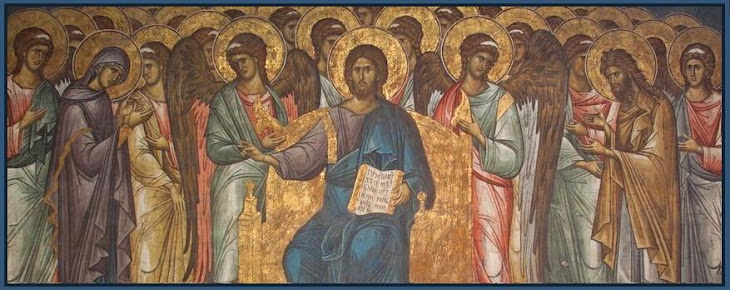
St. James (Iakovos) Adelphotheos, the First Bishop of Jerusalem, depicted enthroned with Christ, the Theotokos, and his father, St. Joseph the Betrothed (alterred from: http://pravicon.com/images/sv/s0848/s0848011.jpg)

Note: In this selection, we see both the historical and spiritual importance of the Divine Liturgy of St. James (Iakovos) Adelphotheos, and the Divine Illumination that underlined the composition of the Divine Liturgy of St. Basil the Great. It is important to keep in mind that this in no way demeans the ancient and compunctionate Liturgy of St. James, which many Orthodox Churches still celebrate to this day (on St. James' Feast on October 23, or on other days). In addition, it is important to know that this does not justify just any change to the holy services of the Orthodox Church. St. Basil, one of the greatest Fathers of the Church, had the wisdom, discernment, and divine guidance to know when alterations were necessary to the Divine Liturgy. To this day, there seem to be no grounds for further alterations to the timeless, heavenly and soul-saving Divine Liturgies of the Orthodox Church.

The Divine Liturgies of St. James Adelphotheos and St. Basil the Great (amateur translation)
According to the tradition of the Orthodox Church, three of the old Divine Liturgies include that of the Apostle James, that of Basil the Great of Asia Minor, and that of John Chrysostom of Constantinople.

After the Resurrection of Christ, St. James, the son of Joseph the Betrothed, the so-called "Adelphotheos" ["Brother of God"], became the Archpriest of the faithful of Jerusalem, and wrote in Hebrew certain prayers and entreaties to God to be said by the Priests when they would celebrate the Divine Mystagogy, which was granted by our Lord Jesus Christ to the Apostles on that night that he was betrayed.

Those prayers and the service of the Divine Liturgy were translated into Greek, as they are found today. St. Clement, the disciple of the Holy Apostle Peter whom he appointed Pope of Rome, advised all Christians to celebrate the Divine Mystagogy in this manner.

In this way, therefore, the Christians celebrated the Divine Liturgy for 350 years. However, those prayers and the Service was very long. The Priests neglected the service and did not liturgize, while the Christians during the Liturgy grew tired and yawned, as they wanted to go to their homes and to their jobs.


Thus St. Basil the Great saw this situation, and hoped in some way to ease the great burdens of the Christians, while also trying to find time to expand his teaching. He asked God to show him a sign that he might know if it was His will to complete his task [i.e. to write an shorter Divine Liturgy].

Thus he prayed for many days with fasting and tears.

One night, he saw a wondrous and paradoxical vision, which he was made worthy of due to his purity and holiness, and which I am afraid to relate, O blessed Christians, being myself unworthy and full of all uncleanliness.

Therefore in this vision, St. Basil saw Christ with the Apostles (O Your condescension, O Lord Who loves mankind!) and according to the archpriestly order He celebrated the Divine Mystagogy with them. However, the Lord did not say the prayers as written in the Liturgy of the Brother of God James, but He shortened them in the manner in which St. Basil later composed his Divine Liturgy.

The Saint, having seen this vision, thanked God Who hearkened to his prayer, and he wrote the Divine Liturgy in a more condensed fasion, as it is found today.
(http://athos.forumup.gr/about2205-athos.html)

St. Basil the Great, celebrating the Divine Liturgy (http://pravicon.com/images/sv/s0384/s0384019.jpg)
  
Through the prayers of our Holy Fathers, Lord Jesus Christ our God, have mercy on us and save us! Amen!

Friday, October 24, 2008

St. Iakovos (James) Adelphotheos (the Brother of God)

Iakovos (or James, sometime "the Lesser" to distinguish him from St. James the Brother of St. John the Theologian) Adelphotheos (literally the "Brother of God") - Commemorated on October 23rd (taken from http://www.srpskoblago.org/Archives/Decani/exhibits/Menologion/October/CX4K3528_l.html)

 "James is called the Lord's brother because he was the son of the righteous Joseph, the betrothed of the Most-holy Theotokos. When the righteous Joseph was near death, he divided his estate among his sons, and wanted to leave a portion to the Lord Jesus, the son of the Most-holy Virgin, but all the other brothers opposed this, not regarding Jesus as their brother. James greatly loved Jesus and declared that he would include Jesus in his share. That is why he is called the Lord's brother. From the beginning, James was devoted to the Lord Jesus. According to tradition, he traveled to Egypt with the Most-holy Virgin and Joseph, when Herod sought to slay the newborn King.

Fresco depicting the Flight into Egypt, Decani Monastery (taken from: http://www.srpskoblago.org/Archives/Decani/exhibits/Frescoes/Nave/SouthChoir-2/CX4K1946_l.html)

Later, as soon as he heard Christ's teaching, James lived by it. It is said of him that he never ate fat or oil, but lived on just bread and water, and was a virgin to the end of his life on earth. He often kept vigil at night and prayed to God. The Lord numbered him among His Seventy Apostles. Following His glorious Resurrection, the Lord appeared to him especially, as the Apostle Paul testifies (I Corinthians 15:7). He was Bishop of Jerusalem for thirty years and zealously governed the Church of God. At the instruction of the Lord, James compiled the first Liturgy, which seemed very long for later Christians, and St. Basil and St. John Chrysostom shortened it. He converted many Jews and Greeks to the Christian Faith, and even the unbelieving Jews were amazed at his righteousness, referring to him as ``James the Just.'' When Ananias became High Priest, he and other Jewish elders determined to kill James for being a preacher of Christ. Once, during the feast of Passover, when many people had gathered in Jerusalem, the elders forced James to climb onto the roof of the Temple, and tried to make him speak against Christ. He climbed up and spoke to the people of Christ as the Son of God and the true Messiah, of His Resurrection and His eternal glory in the heavens. The infuriated priests and elders pushed him off the roof; he fell and was severely injured, but was still alive. Then, one man ran up and struck him on the head with a fuller's club with such force that his brains spilled out. Thus, this most glorious apostle of Christ died a martyr's death, and went to live eternally in the Kingdom of his Lord. James was sixty-six years old when he suffered for Christ." (taken from: http://www.westsrbdio.org/prolog/prolog.htm)

The Martyrdom of St. James, the Brother of God (http://pravicon.com/images/sv/s0848/s0848007.jpg)

A critical and researched translation of the Liturgy of St. James can be found by Fr. Ephraim Lash at http://www.anastasis.org.uk/lit-james.htm. In his introduction he interestingly discusses the use of St. James' Liturgy:

"The Divine Liturgy of St James, which was until recently only celebrated on the island of Zakynthos on his feast on 23 October and in Jerusalem on the Sunday after Christmas, is today celebrated in an increasing number of Orthodox churches. It was the ancient rite of Jerusalem, as the Mystagogic Catecheses of St Cyril of Jerusalem imply. It is still, in its Syrian form, the principal liturgy of the Syrian Oriental Church, both in Syriac and, in the ancient Syrian Orthodox Church of India, in Malayalam and English."

St. Iakovos is also commemorated by having his apolytikion chanted in the service of Holy Unction (see: http://www.anastasis.org.uk/euchelai.htm). One reason could be that a portion of his letter is the first Epistle read in the service, and his teaching contained within could be the origin of the Holy Unction sacrament:

"Are any among you sick? They should call for the elders of the church and have them pray over them, anointing them with oil in the name of the Lord. The prayer of faith will save the sick, and the Lord will raise them up" (James 5:13-15)


Icon of St. Iakovos Adelphotheos (taken from: http://vatopaidi.files.wordpress.com/2009/10/saint_james_the_just.jpg)

Apolytikion in the Fourth Tone
As the Lord's disciple, O righteous One, you received the Gospel, as Martyr, you have unwavering courage, as the Lord's brother, you have forthrightness, as Hierarch, intercession. Intercede with Christ our God, that our souls may be saved.

Kontakion in the Fourth Tone
O wondrous Iakovos, God the Logos, only-begotten of the Father, who dwelt among us in latter days, declared you, the first shepherd and teacher of Jerusalem, and faithful steward of the spiritual mysteries. Wherefore, we all honor you, O Apostle.
(taken from: http://goarch.org/chapel/saints_view?contentid=254)
   
St. James (Iakovos) Adelphotheos, the First Bishop of Jerusalem, depicted enthroned with Christ, the Theotokos, and his father, St. Joseph the Betrothed (alterred from: http://pravicon.com/images/sv/s0848/s0848011.jpg)

St. Iakovos, intercede for us!
Through the prayers of our Holy Fathers, Lord Jesus Christ our God, have mercy on us and save us! Amen!