Showing posts with label Photios Kontoglou. Show all posts

Sunday, April 19, 2020

Photios Kontoglou on the Resurrection of Christ

Christ is risen! Truly He is risen!
Fresco of the Resurrection of Christ by Kontoglou, from the Church of Panagia Kapnikarea, Athens (source)

Photios Kontoglou: "Let us purify our senses..."
Orthodox Christians, today, the God-inspired tongue of the melodist, St. John of Damascus, says: "Let us purify our senses and we will see the unapproachable light of the Resurrection, and we will behold Christ shining forth, and we will hear Him say "Rejoice", as we sing the hymn of victory". (Canon of Pascha) Therefore, he cries to us to purify our senses, so that we might behold Christ Who is risen from the grave. We should purify our senses, because they are unclean, soiled, because we use them for fleshly and material ends.

And how are the senses cleansed? If our heart and mind are cleansed with spiritual nourishment, and with the grace of the Holy Spirit, then our senses will also be cleansed, and will changed from fleshly to spiritual. The melodist says this because he was taught this by our Lord and Savior Himself, when He said during the Beatitudes: "Blessed are the pure in heart, for they shall see God." And if we cleanse our senses, he says that we will see Christ "shining forth", with lightning, not dull, but most pure and shining with the uncreated Light of the Resurrection, "the unapproachable light of the Resurrection." And not only will be see Him "clearly", but we will hear Him also say (for this is why all of our senses must be pure), and His voice will not come from afar, that we might be unsure if we actually heard Him, but we will hear "clearly", with power.

We do not only soil our senses when we use them for fleshly deeds and activities, in other words, to use them for pleasures of the body, but when we use them for some deeds which even the world calls "spiritual", while they are in reality fleshly, and in some ways are even more evil than those that appear fleshly.***

These "spiritual" deeds are the evil thoughts which our nous has, seeking divine things, but are impious ones, and with these our pride is spread and our brazenness before God, because we give food to our vanity, so we appear to know more than others, while the wise Solomon said: "The beginning of wisdom (in other words, wisdom according to God) is the fear of the Lord". With these rummaging and with these philosophies, the Christian truly pollutes his senses, blunts them, and instead of making them spiritual, makes them organs of coarseness, because with them we have been studying coarse, physical things, and not spiritual things. Because, as I had said before, all of these activities appear spiritual, but in reality they are fleshly, according to the Apostle Paul, who says that we have made "the nous to be flesh", as he writes to the Colossians: "Let no one disqualify you, insisting on self-abasement and worship of angels, taking his stand on visions, puffed up without reason by his sensuous mind." (Colossians 2:18) And in the Epistle to the Ephesians he writes: "They are darkened in their understanding, alienated from the life of God because of the ignorance that is in them, due to their hardness of heart." (Ephesians 4:18) Why, therefore, does he say "you must no longer live as the Gentiles do, in the futility of their minds" (Ephesians 4:17)? Is he not speaking of those vain rummages which the philosophers do, even if done by those who appear more spiritual? Because that which they are speaking of is of the flesh (for "from the flesh come the things of the flesh"), in other words, we make spiritual things fleshly. Whoever seeks and studies with this fleshly spirit, first will loose the virginal simplicity of the mind, with which he was first blessed (this is the first blessedness), which our sweetest Christ has bestowed on them, saying: "Blessed are the poor in spirit". Later, he who uses his mind to excavate divine things troubles God, Who is hidden beneath undiscerning minds and covered by a dark cloud, and this is revealed by the mouth of the Prophet Isaiah, as he said: ""I revealed myself to those who did not ask for me; I was found by those who did not seek me." (Isaiah 65:1) St. Cyril of Alexandra says: "Faith is not something that is obtained, for it is a way of hope that beholds where there is no hope, and faith that searches for that which is lacking and cannot be found, faith is not according to the same reason as hope." And St. Basil the Great says: "The simple faith is more mighty than rational words of proof."

And many Christians pollute themselves even today, and even more so follow this form of rummage and searching  "distanced from the life of God", as St. Paul said of the Gentiles, and we stir up the faith, which these unfortunate people do not even recognize, and they "water it down" with various sciences and philosophies, with "commonly-held beliefs", while their vain thought becomes something "vain and false", abolished by arrogance and deafness to the holy Tradition of Orthodoxy, until Christianity becomes a systematic way of life, without revelation of Immortality, in other words, without Christ. And they wish to teach the simple and innocent sheep of Christ, Who blessed them with the Beatitudes, especially with the first and the eighth.

Therefore, how can people like this celebrate Christ Risen from the dead? How strange and paradoxical! Do philosophers and scientists believe? But whoever believed in a philosophy? I ask to learn. With Christ, philosophy is finished and buried for whoever believed in Him. Let us listen to St. Paul cry out: "The ancient things have passed away, for behold all things have been made new." What are the ancient things? "The vanity of the nous", the wise and mellifluous weavers of words, in order to falsely appear humble, while their pride is reavealed by their messages, like the ethical philosophers before Christ, and the current "ethical" Christians today. "Behold, all things have been made new." A voice bearing the hope of the blessed Paul, which again speaks to our heart, saying the "Rejoice" of his and our Risen Lord! "Yes, all things have been made new!" We have become new, because the Resurrection of Christ is something "new and strange", and this "newness" has made all things new, because all former things have been deposed. The old things have been deposed by Him Who "deposed death", because wherever is "The Author of Life" is lacking, there death reigns. He deposed the curse of the flesh and brought the blessing of the Spirit. He deposed knowledge and brought the Faith ("Righteousness is found from the faith").

The old things were Knowledge, searching, and man seeking blindly and not finding anything. The new is the Faith, which opens the spiritual eyes of man and beholds the Sun of Righteousness "Christ shining forth with the unapproachable light of the Resurrection." He is sufficient for all, our mind does not need anymore to seek like the philosophers of the nations, for "The Way" has been found, in other words, as He Himself said cleanly and in few words: "All things have been delivered to me by my Father; and no one knows the Son except the Father, and no one knows the Father except the Son and any one to whom the Son chooses to reveal him." (Matthew 11:27)

"Any one to whom the Son chooses to reveal Him", anyone to whom the Son wishes to reveal, can come to know the Father. Where are you going, therefore, O Christian, to come to know God and Christ, you who are blind, weak, impure, with your own power, while our Lord Himself said that only the Father can illumine the mind to come to know Christ, and Christ to come to know the Father? And you don't dare lower yourself to pray and to entreat Him to enlighten you, but you become filled with impious seeking, like the ancients beforehand who had not yet heard of Christ, speaking words with authority?  Elsewhere He says: "I am the door, I am the way, I am the teacher, I am the light, I am the physician, the intercessor" (I Timothy 2:2), the shepherd, the Rabbi. He is the "First-born of new creation", Who made "all things new", and also made "new men", "granting life to those in the graves."

Yes, with the Resurrection of Christ, all things have been made new. Because of this, the melodist says with joy and exaltation: "Come let us drink a new drink, not one marvelously brought forth from a barren rock (of philosophy), but the spring of incorruption which springs forth from the grave of Christ, in Whom we are fortified," and "Come, let us partake of the new vine of divine rejoicing on the auspicious day of the Resurrection, let us commune with the Kingdom of Christ, hymning Him as God unto the ages." (Canon of Pascha)

O Christians, my brethren, you who occupy yourselves [solely] with the sciences and with philosophies, hearken to our Lord Who speaks through the mouth of the prophet: "They have left me, Who am the spring of life, and have dug dry pits that have no water." And He says with His own mouth in the Gospel "Whoever puts his hand to the plow and looks back (in other wards, does not deny worldly knowledge which consumed men before I came into the world) is not fit for the Kingdom of God" (Luke 9:62) And He said another time: "you do not put new wine into old wine skins".

Let us therefore purify our minds from the filth of all forms of [vain] knowledge, because otherwise, we will not be able to behold Christ "shining forth with the unapproachable light of the Resurrection", and neither will we hear Him clearly say to us "Rejoice". Eyes to see Him and ears to hear Him cannot be given with knowledge that is "empty vanity", but only with the blessed Faith in our Lord and Savior Jesus Christ, Who is glorified unto the endless ages of ages. Amen.
Photis Kontoglou
(Kivotos Menaion, March 1st, 1952)
(source)
   
***Note: Kontoglou is referring to what many others have described as well, how we can even use external spiritual things for our pride and “spiritual gluttony”. For example, see this article by Abbot Tryphon: https://blogs.ancientfaith.com/morningoffering/2019/11/authentic-orthodoxy/.
  
Icon of Jesus Christ "The Savior of Souls", by Photios Kontoglou (source)
   
Photios Kontoglou: Faith and the Resurrection
The faith of the Christian is tested with the Resurrection of Christ, like gold in the furnace. From the whole Gospel, the Resurrection of Christ is the most unbelievable fact, totally unexpected by our logic, and a true witness to its truth. But because it is something totally unbelievable, our faith must be complete in order to believe it. We men continually say that we have faith, but we only hold what is believed from our mind. Therefore, there is no need for faith, because reason is sufficient. Faith requires unbelievable things.

Many men are faithless. The very Disciples of Christ did not put faith in the words off their Teacher, when He said that He would arise, despite all of the honor and dedication that they had towards Him, and their trust in His words. And when the Myrrhbears went at sunrise to the Tomb of Christ, and saw two Angels who spoke to them, saying that He had risen, they hastened to tell this joyous news to the Disciples, but they did not believe their words, having the notion that they were fantasies: "And their words appeared to them an idle tale, and they did not believe them."

Do you see all of the faithlessness that Christ Himself struggled against? Even with His own Disciples. Do you see with how much forbearance He endured it all? And despite this, today most of us are separated from Christ by a frozen wall, the wall of faithlessness. He opens His embrace and calls us, and we deny Him. He shows us His pierced hands and feet, and we say that we don't believe...

Yes, those who have this blessed simplicity of conscience, were blessed by the Lord, saying: "Blessed are the poor in spirit, for theirs is the kingdom of the heavens. Blessed are the pure of heart, for they will see God." And to Thomas, who needed to touch Him to believe, He said: "Because you have seen me, Thomas, do you believe? Blessed are those who have not seen and believe."

Let us entreat the Lord to grant us this rich poverty, and this pure heart, that we might be resurrected, and stand together with Him.

This "ignorance" is greater than knowledge: "This is the ignorance that is higher than knowledge." Blessed and thrice-blessed are those who have this. Christ is risen!
  
The Myrrhbearers at the Tomb of Christ, by Kontoglou (source)
  
Christ is risen from the dead, by death, trampling down upon death, and to those in the tombs, He has granted life!
Truly the Lord is risen!

Friday, April 10, 2020

Photios Kontoglou: "Blessed is He Who comes in the name of the Lord"

Christ raising Lazarus, by Photios Kontoglou (source)
  
Photios Kontoglou: "Blessed is He Who comes in the name of the Lord"
He Whose throne is heaven, and Whose footstool is the earth, the Son of God and His Logos, Who is eternal with Him, today humbles Himself, and comes to Bethany on a little donkey.

And the children of the Hebrews received Him, crying out: "Hosanna in the highest, blessed is He Who comes, the King of Israel."

The warlords of the world, when they would finish a war and threw down their enemies, they would return glorified, and sitting on golden chariots to enter their city. Before them would go the trumpets and flags and brave generals and a multitude of soldiers, covered with iron armor and bearing weapons around a chariot that was filled with many pieces of armor and swords and spears that remained from the conquered nation.

Similar things like these were the great nails that they used in the Crucifixion of our Savior Jesus Christ!

All of these warriors were iron-clad like wild beasts, their heads locked within fearsome helmets, their spears and hairy hands were bloodied from war, their strong legs walked proudly and stretched, like a lion that tore apart a deer with its claws and stretches with roars and frightens the world.

Later would come the golden chariot of the warlord, where he would sit on a throne, adorned with precious stones, proud, haughty, fearsome, who could not be looked upon in the eye without averting one's gaze, carrying his terrible scepter, whose every movement of his command was an order, without opening the mouth of the one holding it.

Horses on that day, were harnessed to that chariot, with gold-embroidered straps with carousels and they also walked pompously and proudly like the humans. A beautiful girl, like a fairy, was decorated, holding a golden crown above the head of the champion, and other girls and boys tossed incense and other spices in great censers shaped like candelabras.

Behind them came the men and women who were taken as slaves, who were sick and wounded, and they were being dragged by the soldiers who struck them.

As much glory as the people had in front, so much disdain and misfortune had those who followed behind. They were bound with ropes and chains, many were pierced, tattered, wounded, jaundiced and half-dead, from their martyrdoms and from their vigils. Many were half-naked and their backs were darkened from the whips. Among them were women, ashamed virgins, stolen mothers with their innocent children in their hands, elderly who were holding on to their grandchildren by the hand, all traumatized like lamps going to the marketplace. Around them, the world grew insane and cried out, glorifying the victor, with many mouths foaming. A cry rose like smoke above the whole city. This scene, they called a "triumph."

One such triumph is performed today by Christ, the Price of Peace and of Love. However, He has changed all the rest and turned it upside down from what men were used to, and thus, His triumph is the triumph of poverty and humility.

The Roman ruler was seated upon a throne and golden chariot, but Christ is seated on a little donkey, possibly among the most humble and disdained among the animals.

And He Himself was humble, meek, silent, poorly-dressed, as the Prophecy which says: "Say to the daughter of Zion: Behold your King is coming, meek and having salvation is He, humble and mounted on a donkey, on a colt, the foal of a donkey." (Zachariah 9:9) His hand had never held a scepter, but blessed the world. He Himself is returning from war, but a war much more difficult to win, a war against evil and falsehood and hypocrisy and love of money.

And He was not going to rest from that war, but was going to begin another, even harder, to be crowned with a crown of thorns, and to be beaten and to mocked, and in the end, to be nailed upon a Cross like an evil-doer.

He was not surrounded by wild servants, but by innocent fishermen, who were disdained like Him. And He neither carried behind Him slaves that He tyrannized, but men whom He freed from the slavery of the Devil, and the dead whom He had raised through His voice.

They did not blare trumpets and drums to glorify Him, but innocent children, which symbolized the simplicity which Christians have, cried out: "Blessed is He Who comes", and instead of holding flags waved the green branches of trees. Verdant branches and clothes strewn on the road for the donkey to walk over.

And this blessed donkey, with a bowed head, humble, ignorant, bore Christ Who was sitting on its back, Whom the fiery six-winged Seraphim stand about with fear. He was not carried by a golden chariot, nor a prized stallion, nor even a seat held by others, but by a little donkey. What eye does not shed a tear and is not astonished by this mystery!

Christ overturned what sinful man saw regarding what is right and true. Who, however, is in the position to sense the freedom which He brings us, and would follow the donkey, and not the fine horses that glow proudly, which enter Rome with many idols, instead of entering together into the kingdom of Peace, the Jerusalem on high?

Many "serious" people, one could say, did not understand this, saying that the children where childish, and the men were manly. The same was said by the high priests, men of authority: But when the chief priests and the scribes saw the wonderful things that he did, and the children crying out in the temple, “Hosanna to the Son of David!” they were indignant;  and they said to him, “Do you hear what these are saying?” And Jesus said to them, “Yes; have you never read, ‘Out of the mouth of babes and sucklings thou hast brought perfect praise’?” And leaving them, he went out of the city to Bethany and lodged there." (Matthew 21:15-17)

The chief priests and the scribes had read the Psalm of David which said how the Christ would be met by the babes and they did not believe Him Whom they hymned. And if we have read today's Gospel and the Psalm and what Christ said to the Hebrews, would we not be judged more strictly than if we had not believed Him? Our vanity and our pride prevent us from going along His poor path, and we are ashamed to follow a leader Who is riding upon a donkey. We don't want the humble, the poor. Can one become a Christian who does not love that which Christ loved?

Yesterday, Saturday, He raised a dead man, Lazaros. Who was this Lazaros? Was he a notable, famous person? Lazaros was a poor villager, but as the Gospel says, he was a friend of Christ, Who would have all men as His friends.

The Gospel notes that Christ had a friend in the world, and that he was poor and unlearned. But who among us loves this rich poverty of Christ? Where Christ is missing, there is the true poverty, because where Christ is missing, there is also missing true life and death rules. This you would understand well if you look around you and ponder. Where are those almighty Roman leaders who made their triumphant entry, as we described above?  What happened to them, and the myriads that worshiped them and knelt before them like the reeds before the north wind? Who brings to mind those who wrote the history of that time?


Bodies, souls, thrones, diamonds, horses, pride, horrors, voices, all fell into a pit and were lost and extinguished as if they had never been drunk. And what is left of all this in people's hearts? Nothing and even less than nothing.
But man is unfaithful even to what he sees and what he grasps with his hands, and he pulls the path that they have taken, and he happily drags Nero's chariot, because "his neck is iron." His ears are pricked by Him Who says: "I am God, the first and the last, I am. I nourish my sheep and I will give them rest." He Who was sitting upon the donkey, it is He Who remains alive within simple souls unto the ages, and is for them a source of nourishment, a source of immortality, joy and delight, according to the words that say: "The heart of those who seek the Lord shall rejoice."

Yes, whoever senses the joy of Christ, is like that dead man [Lazaros] who was raised. There are many kinds of pain in the world. Those who suffer in body and soul, their pain cleanses them and takes them to God, and these are the beloved ones of Christ and walk in His army with His consoling light. The others suffer futily. That is why the Apostle Paul wrote to the Corinthians: "Now I rejoice, not because you were grieved, but because you were grieved into repenting; for you felt a godly grief, so that you suffered no loss through us.  For godly grief produces a repentance that leads to salvation and brings no regret, but worldly grief produces death." (2 Corinthians 7:9-10).

For those who hope in God, Christ transforms their futile sweat into sweat of salvation "a refreshing sweat", but we mourn and are pained in every way like the idolaters, slaughtered by the knives of fate. They did not allow their sweat of agony to become transformed into sweat of prayer and hope.

Whoever does not believe in Christ and in the Gospel is dead, as no true life exists within him. Because life does not mean to breath and to walk and to eat and drink, but to sense the grace of immortality. Then, one can chant together with that exceptional hymn that is the Apolytikion:

"By raising Lazarus from the dead before Your passion, You did confirm the universal Resurrection, O Christ God! Like the children with the palms of victory,  we cry out to You, O Vanquisher of death; Hosanna in the Highest! Blessed is He that comes in the Name of the Lord!
(source)
  
Christ entering Jerusalem on Palm Sunday (source)
  
Through the prayers of our Holy Fathers, Lord Jesus Christ our God, have mercy on us and save us! Amen!

Friday, July 12, 2019

Photios Kontoglou (+ July 13, 1965): The Greatest Icon Painter of 20th Century Greece

Photios Kontoglou of Blessed Memory (November 8th, 1895 - July 13th, 1965), a self-portrait (source)

Photios Kontoglou: The Greatest Icon Painter of 20th Century Greece

by Dr. Constantine Cavarnos (of blessed memory)

19 February 2017
            Photios Kontoglou, the greatest icon painter of modern Greece and one of her most important theologians and literary writers, died in Athens on July 13, 1965. His death, during surgery, passed almost entirely unnoticed in America, even among Greek-Americans, but he was deeply mourned throughout Greece.
            I was in Greece when he died and had the good fortune of seeing and talking with this great and holy man just five days before his “falling asleep.” The editor of an Athenian religious monthly asked me to write an obituary . . .  I have undertaken to write this brief biography.
 
Archangel Gabriel, by Photios Kontoglou (source)
  
            Photios Kontoglou was born on November 8, 1895, at Kydoniai (Aivali), on the west coast of Asia Minor, across from Mytilene. Kydoniai was a city consisting of about 30,000 Greeks and three persons—the district governor, the judge, and the tax collector—who were Turks.
            Kontoglou came from a devout family, which had its own chapel containing precious articles including a carved ancient crucifix and a large panel icon depicting Saint Paraskevi. Many of his ancestors were monks, and an uncle, Stephanos Kontoglou, was abbot of the Monastery of Saint Paraskevi near Kydoniai. Stephanos was an important influence in Photios’s life. In his book Vasanta (1923), Kontoglou dedicates the chapter of translations from the Psalms of David “to the austere soul of the Hieromonk Stephanos Kontoglou, my uncle, whose virtue I perpetually have before me as a model and rule.”
 
Photios Kontoglou (right) and his friend Yiannis Tsarouchis (left), dressed as novice monks at Meteora in 1932 (source)
  
             The young Kontoglou was extremely fond of the sea, sailing, and the solitude of the deserted neighboring islets. He liked to live alone, like Robinson Crusoe. Daniel Defoe’s hero fascinated Kontoglou; he mentions him in many of his writings.
            After graduating from the famous Academy of Gymnasium of Kydoniai, Kontoglou spent several years in Europe, especially in France, studying art and acquiring painting techniques. He lived in Paris during the First World War, where he first gained attention, winning prizes for his paintings and his writings. His first book, a novel entitled Pedro Cazas, was written and published there in 1919.
            After the armistice, Kontoglou returned to Kydoniai. In 1920 he wrote a remarkable prologue for the second edition of Pedro Cazas which was published in Athens in 1922. In this prologue he set forth some of the basic ideas by which he abided ever after.
 
Archangel Michael, by Photios Kontoglou (source)
  
            Persecuted by the Turks, he and his family went to Thermi, Mytilene, in 1922. Later he resided in Athens, but always lived on the outskirts, as he disliked the distractions of cities. When the Kontoglou family left Kydoniai, they took only the sacred articles mentioned above and a few Church books. These were his most cherished possessions. After his death his wife, Maria, fulfilling his wish, gave them to the Monastery of Saint Paraskevi at Nea Makri in Attica.
            In Athens Kontoglou soon became well-known in literary circles as a result of his highly-praised book, Pedro Cazas. His reputation as a writer grew with the appearance of two additional books: Vasanta (a Sanskrit word meaning “springtime”) in 1923, and Taxidia (“Travels”) in 1928, and the literary and art periodical Filikh Etairia (“Friendly Society”) which he founded in 1925. Within a few years, Kontoglou had won an enviable place in the Greek world of letters, admired for his style—which is characterized by clarity, simplicity, vigor and warmth—as well as his remarkable observations and profound thoughts.
 
The Holy Apostle Paul, by Photios Kontoglou (source)
  
            As a painter, Kontoglou was slow in winning recognition. He had to overcome difficult obstacles. After leaving Europe, he became increasingly impressed by the Byzantine traditions of painting and decided to master this style of painting. But he had to become his own teacher and learn the secrets of Byzantine art. He did this by reading old manuscripts and visiting Byzantine monuments, patiently studying the works of the old masters.
            Further, Kontoglou had to overcome strong prejudice on the part of the public against Byzantine art. Having won their liberation from the Turks, the Greeks began to turn the West for prototypes in art, especially the adoption of European (particularly Italian Renaissance) models and techniques. According to the European view at that time, Byzantine civilization was a lower civilization, not worthy of serious study, and Byzantine art especially was lower, almost barbaric art. Kontoglou succeeded magnificently in overcoming both obstacles, but it took time.
 
The Holy Mandylion, by Photios Kontoglou (source)
  
            The first obstacle was by far easier to overcome. He learned his most important lessons about Byzantine art at the Holy Mountain of Athos and at Mystra. It is significant that while at Athos, he wrote several chapters, the preface and profound concluding chapter on the fine arts of his second book, Vasanta. It was also at Athos that one of his three poems in this book was inspired by a Byzantine painting in a very old chapel there. His debt to Athos in his development as an iconographer is evinced by a volume published in 1925 containing photographs of copies, executed by him, of Byzantine frescoes at Athos; and also by the illustrations in two issues of Filikh Etairia that year showing panel icons of the Monastery of Iviron rendered by him.
            Kontoglou visited Mystra not long after. He made copies of some of the wall paintings in the Byzantine churches at Mystra. He later worked there for a long time cleaning wall paintings in the Church of Peribleptos.
 
Photios Kontoglou before his icon of the Precious Forerunner (Source)
  
            Comparing Byzantine and European religious art, Kontoglou says in his book Taxidia, “In the countries of Europe there are churches with paintings that are famous for their artistic merit; yet they do not have the mystery and the power of evoking contrition (katanyxis) possessed by the icons that were done by some unlettered and simple Byzantine painters.”
            Around 1930, Kontoglou was appointed technical supervisor at the Byzantine Museum in Athens. He possessed both great love for the works in the museum, and technical knowledge for cleaning and preserving them.
 
Panagia and Christ "Sweet-kissing", by Photios Kontoglou (source)
  
            In 1932, Kontoglou published a slender volume entitled Icones et Fresques d’Art Byzantine, with twenty plates of Byzantine panel icons and frescoes he copied. He continued to paint panel icons during this period.
            During the later thirties, Kontoglou decorated three large rooms of the City Hall of Athens with historical frescoes. This was his first large scale work as a fresco painter, and his only extensive secular one. His next major achievement as a fresco painter was the iconographic decoration of the large Church Zoodochos Peghi at Liopesi (Paiania), a town near Athens. He began the work in 1939, but could not resume it until after the Second World War. When I met Kontoglou in 1952, he showed me the beautiful Byzantine murals he had painted at Liopesi.
 
Kontoglou's famous frescos in the City Hall of Athens, depicting Saints and historical figures in the history of the Greek Nation (source)
  
            Kontoglou wrote at least eight books between 1942 and 1945, during the war. Most are rather short. The longest and important is Mystikos Kepos (“Mystical Garden”) in 1944. His chapters on Piety (Theosveia) and Saint Isaac the Syrian are masterpieces, full of deep religious feeling. He speaks of other remarkable ascetics of Syria and Mesopotamia, and stresses the virtues of faith, humility and purity.

One of the first icons of Sts. Raphael and Nicholas of Thermi, Lesvos, painted by Photios Kontoglou and treasured by the Monastery of St. Raphael to this day (source)
  
            The most fruitful period for Kontoglou, as both painter and writer, was the last twenty years of his life. Assisted by several of his talented pupils, he painted numerous panel icons in churches in many parts of Greece, as well as in the United States and other countries, and many thousands of square yards of wall paintings. After the church at Liopesi, mentioned above, Kontoglou frescoed the entire interior of the Church of Saint Andrew off Patission Street at Athens. He did wall paintings for the new Metropolitan Church of Evangelismos in Rhodes and the Church of Saint George at Stemnitsa, Arcadia. Finally, he decorated with fresco icons the eastern apse, central dome, pendentives and barrel vaults below the dome, and other surfaces of the following Athenian churches: Kapnikarea, Saint George at Kypseli, Saint Haralambos in the park Pedion tou Areos, Saint Nicholas at Kato Patissia, and others.
 
Self-portrait of Photios Kontoglou with his wife and daughter (source)
  
            Through these works, through the training of many gifted young artists in the techniques of Byzantine iconography, and through his long, luminous and spirited defense of Byzantine art which culminated in 1961 in the monumental two-volume work entitled Ekphrasis (“Expression”) in which he teaches the theory and practice of Byzantine iconography, Kontoglou succeeded in making this art prevail in Greece. His influence spread to America, where many churches have been decorated with panel icons, frescoes and mosaics by his pupils.
            During the same period, he wrote such edifying books as  A Great Sign (1945), with accounts of many extraordinary recent miracles at Thermi, Mytilene; The Life and Conduct of Blaise Pascal (1947); The Life and Ascesis of Our Holy Father Saint Mark the Anchorite  (1947, translated in The Orthodox Word, no. 1, Sept.-Oct., 1966, with illustrations by Kontoglou); Fount of Life (1951), presenting brief descriptions of the lives and selections from the teachings of some of the great Saints of the Orthodox Church; The Holy Gospel According to Matthew, Interpreted (1952); Expression (1961); and What Orthodoxy Is and What Papism Is (1964). Kontoglou also translated into Greek Leonid Ouspensky’s L’Icone: Quelques Mots sur son Sens Dogmatique, and published it with a preface and notes of his own. Together with the young theologian Basil Moustakis, Kontoglou founded and edited Kivotos (1952–1955), a religious periodical concerned especially with Orthodox spirituality.
 
Jesus Christ the Merciful, by Photios Kontoglou (source)
  
            Kontoglou contributed many articles to various other periodicals and encyclopedias. His articles in the Athenian daily Elephtheria are so numerous that they would fill several volumes. Many of them are among the most profound written by a Greek. Most are concerned with religious themes, such as faith and reason, religion and philosophy, religious versus secular art, Byzantine iconography and music, the lives of Martyrs and other Saints, and so on.
            Kontoglou won the Academy of Athens Prize for his book Ekphrasis, in 1961, and the Purfina Prize for his book Aivali; My Native Place, in 1963. The latter is the first volume of his Erga (“Works”) which began to be published by Astir Publishing Company at Athens in 1962.
            In recognition of his great achievements as an author, the Academy of Athens, the highest cultural institution in Greece, awarded him on March 24, 1965, its Aristeion Grammaton, its highest prize in letters.
            Kontoglou also carried on an enormous correspondence. He once told me that he wrote about fifty letters a month, corresponding not only with Greeks, but also Americans, Finns, Frenchmen, Germans, Russians, Ugandans and others. He had countless friends and admirers throughout the world who sought his guidance on iconography, and on Orthodox doctrine and living.
 
St. Charalampos the Hieromartyr, by Photios Kontoglou (source)
  
            In Kontoglou’s writings, we encounter a man who has unshakable religious faith, free from all skepticism and metaphysical anguish. We encounter a man who is steeped in the Holy Scriptures and writings of the Eastern Church Fathers, particularly the great mystics such as Saint Macarios the Egyptian, Saint John Climacos, Saint Isaac the Syrian, Saint Symeon the New Theologian, and Saint Gregory the Sinaite. We find a man who has the profoundest respect for the Sacred Tradition of Eastern Orthodoxy, including all its dogmas, canons and sacred arts (architecture, iconography, music), tolerating no deviations. Orthodoxy was for him the sacred Kivotos, the sacred Ark, and these its precious contents, which must be carefully guarded and not cast away, or exchanged for counterfeits.
            Kontoglou was strongly opposed to the participation of Orthodoxy in “ecumenism,” seeing in such participation the dangers of compromise on matters which admit of no compromise. He was especially critical of the maneuvers of Patriarch Athenagoras, in whom he saw an apostate . . . a betrayer of Greece and Orthodoxy. In his last book, entitled Ti Einai he Orthodoxia kai ti Einai ho Papismos (“What Orthodoxy Is and What Papsim Is”) Kontoglou stressed the abyss that separates Orthodoxy from Roman Catholicism, which renders utterly absurd Athenagoras’s assertions that there are no real differences between the two.
 
The Holy Prophet Elias, by Photios Kontoglou (source)
  
            Kontoglou was a man of adamantine Orthodox faith and impeccable character, adorned with the virtues of great humility, long-suffering, courage, wisdom, purity, hope and love. He was a devout man, a holy man, a man of God. All that he did bears the impress of these qualities.
 
The grave of Photios Kontoglou of Blessed Memory, in the Holy Monastery of the Annunciation - St. Ephraim in Nea Makri. For more on his relationship with St. Ephraim, see here. (source)
  
            As during his life, so at his death, it was evident that Kontoglou was free from worldly attachments, a citizen of the City of God, not of the earthly city, whose glory is temporary and whose power is doomed to pass away. He died poor, ignored by the State. His body was not accompanied to the grave by any State dignitaries, but only by friends and admirers, who loved him deeply.
This article was originally published by the Monastery of St. John, www.monasteryofstjohn.org, in The Divine Ascent Vol. 3/4.  This and other publications can be found on their bookstore website, www.stjohnsbookstore.com.  (source)
  
See the following sites for Photios Kontoglou on Orthodox Iconography and Byzantine Music. May his memory be eternal!
  
Christ Pantocrator, by Photios Kontoglou (source)
  
Through the prayers of our Holy Fathers, Lord Jesus Christ our God, have mercy on us and save us! Amen!

Thursday, March 14, 2019

Photios Kontoglou on Panagia as the Humble Queen

The Most-holy Theotokos and Christ surrounded with Angels depicted in the wonderworking icon of Panagia Pantanassa (Queen of All) treasured by Vatopedi Monastery, Mount Athos (source)
  
"Panagia is the spiritual adornment of Orthodoxy. For us Greeks [and for all peoples], she is the pained mother, the consolation, the protector, who stands beside us in every circumstance.

"In every part of Greece are built countless churches and monasteries, palaces to this humble Queen, and a multitude of chapels in the mountains, the fields, the islands, that are fragrant from her virginal and spiritual fragrance.

"Within each of these is found her ancient and honored icon with her dark hair and golden face, which receives all of the tears of our tortured faithful, because we have no one else to help us except Panagia: 'we who sin have no one else, who intercedes for us before God, praying endlessly, in ills and all dangers, for us who are laiden with our many sins and mistakes' (Paraklesis to the Theotokos).
  
"The beauty of the Panagia is not a bodily beauty, but spiritual, because where there is pain there is also found holiness, there alone is spiritual beauty. Bodily beauty brings bodily excitement, but spiritual beauty bring contrition, respect and pure love. This is the beauty which our Panagia has.
  
"And this beauty is depicted in her [Byzantine] icons which pious men fashion, who fast and chant and are found with contrite heart and spiritual purity.
  
"In the face of Panagia are depicted this mystical beauty which attracts like a magnet pious souls and brings them silence and consolation."
-Photios Kontoglou (+1965)
  
(source)
  
Forgive me, and may the Lord forgive us all and grant us a blessed Lent!
  
Most-holy Theotokos, save us!

Friday, May 4, 2018

What is the flame that St. Ephraim is holding?

Christ is risen! Truly He is risen!
  
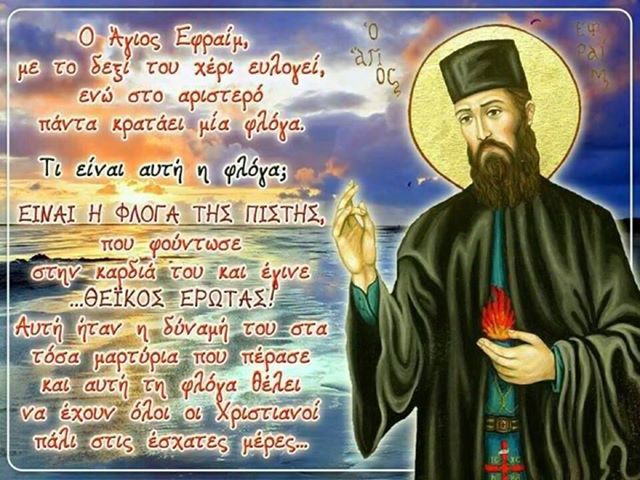
Every icon of St. Ephraim depicts him blessing with his right hand, and with his left, he is holding a flame. This is through divine revelation to the first iconographer of St. Ephraim, Blessed Photi Kontoglou. Of course, St. Ephraim was martyred by having a flaming piece of wood pierced into his abdomen, but this pious reflection by a faithful Christian above gives another interpretation:
 
"What is this flame? It is the flame of the faith, which blazed in his heart and became divine eros! This was his strength through so many martyrdoms which he endured, and this flame he wishes for all Christians to have within them again during the last days..."
     
St. Ephraim of Nea Makri, the Newly-revealed Great Martyr and Wonderworker (source)
  
Another beautiful icon of St. Ephraim, where the iconographer explicitly writes "XC", which stands for "Christ", in the fiery heart of the Saint (source)
  
Christ is risen from the dead, by death, trampling down upon death, and to those in the tombs, He has granted life!
Truly the Lord is risen!
Wednesday, December 20, 2017

Excerpts from Photios Kontoglou on Christmas

The Nativity of Christ (source)
  
Excerpt from Photios Kontoglou on Christmas, from his book "Aivali, my Fatherland"
The spiritual joy and heavenly exaltation which the Christian senses at Christmas cannot be sensed with any other approach, such as he who celebrates it as only a moving occurrence, which is associated with other common joys of the world, with winter, with snow, with a warm cup of tea.

Only the Orthodox Christian celebrates Christmas spiritually, and from his soul he passes the season with sanctified feelings, and we are warmed with a paradoxical warmth which comes from another world, the warmth of the Holy Spirit, according to the Hymn of Ascent which says: "By the Holy Spirit, every soul is given life, and cleansed and exalted and made shining by the Three-fold Monad, in a hidden manner."

Soul and body celebrate together, exalting with divine joy which cannot be sensed by one who is separated far away from Christ. While in the heart of the Christian, these holy days are full of the fragrance of hymnody, full of a most-sweet spiritual radiance, which covers all creation, the mountains, the sea, every rock, every tree, ever stone, every creation. Everything is sanctified, everyone celebrates, everyone chants, everyone rejoices, all creation is "as an olive tree filled with fruit in the house of God". No one can sense such joy in his heart except only he who...loves God and who lives these days of his life together with God, because no one else other than God can give such joy, such peace, according to the word which the Lord said at the Mystical Supper: "My peace I give to you, I do not give you peace like the world gives."

The joy of Christ and peace is transformational by the joy and from the peace of this world. Because of this, the man who rejoices when he goes to church in order to...drink from that immortal spring of joy and peace, says together with the Prophet David: "Send forth, O Lord, Your light and Your truth, they will lead me and take me to Your holy mountain, and to Your dwelling places, and I will go towards the altar of God, to God Who makes glad my youth."

Let us also therefore celebrate, my brethren, the Nativity of Christ "in spirit and truth, in psalms and hymns and spiritual odes", and then everything else will be "added unto us", we will be seen with joy in our home, in our family, in nature, in our social interactions, in pure conversations, because everything will be sweetened by the love of Christ, and will be warmed by the warmth of Him Who is the giver of life.

My brethren, the Nativity of Christ is a great lesson for us on humility. Where was he born? In a manger, more properly in a crib, that we might more deeply sense the unspeakable condescension of God, because the ancient words are made to our eyes to appear rich, and poor things. His mother, the Most-holy Theotokos, far from her house, a stranger in a strange land, went and gave birth in a pen. The ox and the ass warmed Him with their breath. Shepherds were His friends. Together with the newborn lambs was numbered the Lamb of God, Who came to this world to save man from the curse of Adam. What man could be born with a greater humility?

St. Isaac the Syrian writes, in his Word on Humility, the following remarkable words: "I want to open my mouth, my brethren, and speak about the most exalted notion of humility, and I am full of fear, like that man who knows how he will speak of God. Because humility is the cloak of the godhead. Because the Word of God Who became man, became clothed in her, and came in contact with her, taking on a body like ours. And whoever is clothed in her truly becomes like Him, Who descended from the heights, and Who covered with His virtue His grandeur and His glory with humility. And He became like this that creation might not be consumed by beholding Him. Because creation could not gaze upon Him, if He were not to take a part of it and spoke through it. He covered His greatness with flesh, and with this came to dwell with us, with the body which He took from the Virgin and Theotokos Maria. Therefore, as we see how He is of our race and how He speaks like a man, let us not be afraid of His throne. Because of this, whoever puts on the robe that the Creator wore (in other words, humility), He clothes himself in Christ".

The manger is the humble heart, and only within her can Christ come to be born.

Our Church radiantly shines within the darkness of winter, celebrating the Nativity of the Lord. From within her is heard a hymn that surpasses this world, like that which was chanted by the angels the night when the Lord was born, "a sound of pure celebration".
(source)
  
Children singing Christmas carols (source)
  
Note: And the following is is a beautiful short story that paints the picture of a cold cave in the wintertime in Asia Minor, nonetheless warmed and permeated with love for Christ and the humble celebration of the Incarnation by simple shepherds, sailors and monks.
  
A short Christmas story from Aivali, Asia Minor, by Photios Kontoglou, a rendering by Costas and Helen Dedegikas
Christmas Eve, Christmas and snow come together. But this year the weather was extraordinary. Snow did not fall. The atmosphere was angry, blowing a harsh northern wind with freezing rain accompanied by lightning. Within a week the weather became mild and the sea was so calm that you could travel; but by Christmas Eve the weather turned. From the morning the sky was black like lead and wet snow started to fall. In a place named Skrofas by the side of the mountain, which overlooked the sea there was a corral with sheep. This spot was wild and barren with lots of beautiful evergreen bushes and red berries. The corral was enclosed by a primitive dry stonewall.


The shepherds were sitting in a cave set further up the side of the mountain. The cave was large and separated in three or four partitions with a height of three men. The animals were resting under low harnesses so that one had to bend low to enter the cave. Piles of manure were scattered here and there giving off a strong sulphuric odor. However, the earthen floor was swept clean because the shepherds were good-spirited and they had the children sweep the cave often with brooms made of bushes.

The master shepherd was Yianni Barbakos, a half wild man who was born amongst the flocks of goats and sheep. He was dark and hairy with a beard as black as a crow and as curly as a rams fleece. He was wearing breeches to the knee, a leather belt around his waste, a wide sash and heavy boots on his feet. His head was wrapped in a wide bandana like a turban, with lots of fringes - an ancient man! He had two “paragious” (young men who were a combination of apprentices and adopted sons) with him, Alexi and Odysseas, who were no more than 20 years of age. He also had three other boys who cleaned and tended the animals.

These six souls were living in that wild place all alone –hidden from God, seldom seeing another person. The cave was covered in soot and the rock above it was blackened from the smoke that emanated from the mouth of the cave. Their beds were made from animal skins. The walls of the cave were lined with poles that shelved their food, knives and guns. It almost seemed like it was a den of thieves.

Guarding the cave were their dogs, as wild as wolves. The seashore was a cigarette’s distance (the time is takes to smoke a cigarette) from the cave. The sea was calm and day and night you couldn’t hear anything other than the crashing of the waves. Sometimes depending on the weather a ship would pass by, but other than that you wouldn’t see a thing. From the corral you could barely see the mountains of Mytilini between the trees.

On Christmas Eve, as we stated before, the weather had turned for the worse and wet snow was falling. The shepherds started a large fire and gathered around chatting. The boys butchered two lambs and were skinning them for the meal. Alexis had fetched unsalted cheese from storage and some yogurt as well. Odysseas had pulled out an old Church book and because he could read a little as well as the fact that he had limited knowledge of hymns, he read from the Christmas Eve vespers.

At about the time for vespers they heard a rifle shot in the woods. They assumed it was some hunters. All the dogs started barking loudly and leaped out of the corral. Earlier one of the boys, while bringing firewood on his donkey, had heard gunshots in the morning coming from the water towards Hagia Paraskevi.

Within a short time, two men with rifles appeared above the cave shouting at the shepherds to round up their dogs that were surrounding them. Skouris, one of the guard dogs, turned his attention from the hunters to one of their hounds and attacked it. One hunter shot at the dog, hurting it with buckshot forcing it along with the other dogs to retreat. Barbakos, the master shepherd, then appeared with the other shepherds and tied down Skouris and chased away the other dogs.

“Good Afternoon” shouted Panagis Kardamitsas wrapped up in his cartridges and carrying a bag of game (birds he hunted).

The other hunter with him was his son Dimitrios.

“Welcome. Welcome.” Exclaimed Barbakos and his party.

They then led the hunters into the cave.

“My God, what is this place? A Palace! A palace with princes.” Exclaimed Panagis, pointing at the cheeses that had been prepared for dinner.

They asked the hunters to sit down and prepared coffee. The hunters, in turn, offered the shepherds brandy.

“My brother”, exclaimed Panagis, “who would think that we would celebrate Christmas in the cave where Christ was born! Just yesterday we passed Hagia Paraskevi to hunt a little. We figuredwe could sleep at the monastery, but due to the bad weather we couldn’t get there with old man Manolis’ boat. So here we are at your palace. What a dog you have! What a beast! Look what he did to my hound”!

Then he turned to the corner of the cave where his dog was lying, still shivering from fear.

“Come here Flox! Flox! Flox!”

Flox however was still afraid and receded further back.

After a little too much drink, Panagis started to sing in a mellow tone. Later Odysseas started to sing the hymn “Christ is born, rejoice”. At that point they started to hear the dogs begin to howl again. They sent the young boys to see what was happening. Outside it was unbearably cold with frozen rain.

The dogs stopped barking as the boys had reentered the cave with more company. They were three men who looked like sailors accompanied by a couple of monks. They were drenched and shivered with the cold. The shepherds welcomed the men and asked them to sit.

As soon the first guest, the captain, approached the light of the fire, Barbakos recognized him and joyfully greeted him. It was Captain Konstantis Biliktsis who was making his way to Constantinople. He had visited the cave in Scrofa before and they had become good friends. The other two were part of the ship’s crew.

One of the monks, a handsome man with a black beard, was Father Sylvestros Koukoutsos. The monk was very thin with little hair on his beard like Saint John the Kalivitsi. His name was Arsenio Sgouri.

Captain Konstantis had come from Constatinople and brought along Father Sylvestros, who was visiting the city. He was from Mount Athos and he had wished to return home to celebrate Christmas.
Father Arsenios, a Thessalian, was traveling with Father Sylvestros from the Monastery of Pantokratorous to Mount Athos.

They were traveling just fine until they had reached the Cape of Baba when the weather took a turn for the worse. The sky went black and the seas became violent making the journey back to their homeland to celebrate Christmas impossible.

So the captain decided to set anchor where it was safe and he then remembered Barbakos’s cave. Thus he, his crew and passengers made their way to the cave.

As they approached they sawPanagis with Dimitro (his son) and joyful commotion ensued.

“Look” said Panagis, “we were just singing the hymn of Jesus’ birth and right when we were talking about the Three Kings bearing gifts, you three wise men arrived with gifts because I see wine, caviar, breads and sweets (baklavades).

“Myrrh, gold and Frankincense”

‘Ha, Ha, Ha”, Panagis was laughing hard, drunk and slurring his words, he was rubbing his stomach as he liked to eat well.

At that time Father Arsenio Sgouris came alive, smiling and rubbing his hands he said “Thank Jesus Christ who saved us from the violent waves!” as he did the sign of the cross.

Father Silvestos then asked everyone to stand up and pray:
“Christ is born”.

Then they sat to eat. Such a table so blessed and lively had never existed in any palace. They sang and chatted. Their table even had bird’s milk, well done lamb, cheese, foods from Constantinople and other wild game, even wine.

Outside snow was blowing, and the trees and sea were moaning in the wind. In the cave, between the whistling and moaning wind you could hear the bells of the animals ringing in the distance. The cave was emanating a red glow from the flames of the fire and echoing with the singing and happy chattering.

Panagis dozed off from time to time and when awaken by his own snoring he again took part in the
singing.

Truly the scene of the nativity scene was complete. The cave, the shepherds, the wise men with presents and even Jesus himself with his two students, who blessed the food and wine.
  
The Nativity of Christ (source)
   
Through the prayers of our Holy Fathers, Lord Jesus Christ our God, have mercy on us and save us! Amen!