Showing posts with label St. Paisios the Great. Show all posts

Tuesday, June 19, 2012

St. Paisios the Great

St. Paisios the Great - Commemorated on June 19 (http://pravicon.com/images/sv/s1647/s1647002.jpg)
  
St Paisius the Great lived in Egypt. His parents, Christians, distributed generous alms to all the needy.

After the death of her husband his mother, on the suggestion of an angel, gave her young son Paisius to the clergy of the church.

The youth Paisius loved monastic life and spent his time in one of the Egyptian sketes. Renouncing his own will, he lived under the spiritual guidance of St Pambo (July 18), finishing all the tasks assigned him. The Elder said that a new monk in particular needs to preserve his sight, in order to guard his senses from temptation. Paisius, heeding the instruction, went for three years with his eyes cast downwards. The saintly ascetic read spiritual books, and he was known for his ascetic fasting and prayer. At first he did not eat any food for a week, then two weeks. Sometimes, after partaking of the Holy Mysteries of Christ, he survived without food for seventy days.

St Paisius went into the Nitrian desert in search of solitude. There he lived in a cave carved out by his own hands. The saint was granted a wondrous vision: the Lord Jesus Christ revealed to him that through his labors the Nitrian wilderness would become inhabited by ascetics. He asked the Lord where the monks would obtain the necessities of life in the desert. The Lord said that if they would fulfill all His commandments, He Himself would provide all their necessities, and would deliver them from demonic temptations and cunning.
St. Paisios the Great (Icon courtesy of www.eikonografos.com used with permission)
  
In time, a number of monks and laymen gathered around St Paisius, and a monastery was established. The most important rule of St Paisius was that no one would do anything by his own will, but in all things would fulfill the will of his elders.

Since his tranquility was being disturbed by so many people, the saint withdrew to another cave farther away. Once, he was transported to a paradisical monastery and partook of the immaterial divine food. After his ascetic labors for salvation, the Lord granted His saint the gift of prescience and healing the souls of men.

One of his disciples, with the saint's blessing, went to sell his handicrafts in Egypt. On the way he encountered a Jew, who told the simple-minded monk that Christ the Savior is not the Messiah, and that another Messiah will come. Confused, the monk said, "Maybe what you say is true," but he did not attribute any particular significance to his words. When he returned, he saw that St Paisius would not acknowledge his arrival, and he asked the reason for his anger. The saint said, "My disciple was a Christian. You are not a Christian, for the grace of Baptism has departed from you." The monk repented with tears, and begged to have his sin forgiven. Only then did the holy Elder pray and ask the Lord to forgive the monk.

A certain monk on his own initiative left the desert and moved near a city. There he had encounters with a woman, who hated and blasphemed Christ the Savior. Under her influence, he not only left the monastery, but also scorned faith in Christ, and finally he reached a state of total disbelief.

Once, through the blessed Providence of God, Nitrian monks came by his home. Seeing them, the sinner remembered his own former life and he asked the monks to ask St Paisius to pray for him to the Lord. On hearing the request, the saint prayed fervently, and his prayer was heard. The Lord, appearing to His saint, promised to forgive the sinner. Soon the seduced monk's woman companion died, and he returned to the desert where, weeping and distressed for his sins, he began to labor at deeds of repentance.

  
St Paisius distinguished himself by his great humility, and performed ascetic deeds of fasting and prayer, but he concealed them from others as far as possible. When the monks asked which virtue is the highest of all, the saint replied, "Those which are done in secret, and about which no one knows."

St Paisius died in the fifth century at a great old age, and he was buried by the monks. After some time his relics were transferred by St Isidore of Pelusium (February 4) to his own monastery and placed beside the relics of his friend St Paul, with whom St Paisius was particularly close during his life.
(http://oca.org/FeastSaintsViewer.asp?SID=4&ID=1&FSID=101755)
  
  
Troparion - Tone 4
The sublime monk and incarnate angel, the bodiless man and citizen of heaven, as he celebrates with us today, grants grace to all who honor him. Let us fervently magnify him!

Kontakion - Tone 8
Let us, the faithful, sing praises to divinely–wise Paisius, the desert's adornment, equal–to–the–angels, Christ's friend and the glory of monks. Let us cry to him: Rejoice, O Father Paisius!
(http://oca.org/FStropars.asp?SID=13&ID=101755)
  
  
Through the prayers of our Holy Fathers, Lord Jesus Christ our God, have mercy on us and save us! Amen!

Saturday, June 19, 2010

The deceived disciple of St. Paisios the Great

St. Paisios the Great - Commemorated on June 19th (http://www.orthodoxphotos.com/Icons_and_Frescoes/Icons/Various_Saints/9.shtml)
  
The deceived disciple of St. Paisios the Great
"In the Life of the great Father of the Egyptian desert, St. Paisius the Great (June 19), we may see a shocking example of how easy it is to lose the grace of God. Once a disciple of his was walking to a city in Egypt to sell his handiwork. On the way he met a Jew who, seeing his simplicity, began to deceive him, saying: "O beloved, why do you believe in a simple, crucified Man, when He was not at all the awaited Messiah? Another is to come, but not He." The disciple, being weak in mind and simple in heart, began to listen to these words and allowed himself to say: "Perhaps what you say is correct." When he returned to the desert, St. Paisius turned away from him and would not speak a single word to him. Finally, after the disciple¹s long entreaty, the Saint said to him: "Who are you? I do not know you. This disciple of mine was a Christian and had upon him the grace of Baptism, but you are not such a one; if you are actually my disciple, then the grace of Baptism has left you and the image of a Christian has been removed." The disciple with tears related his conversation with the Jew, to which the Saint replied: "O wretched one! What could be worse and more foul than such words, by which you renounced Christ and His divine Baptism? Now go and weep over yourself as you wish, for you have no place with me; your name is written with those who have renounced Christ, and together with them you will receive judgment and torments." On hearing this judgment the disciple was filled with repentance, and at his entreaty the Saint shut himself up and prayed to the Lord to forgive his disciple this sin. The Lord heard the Saint¹s prayer and granted him to behold a sign of His forgiveness of the disciple. The Saint then warned the disciple: "O child, give glory and thanksgiving to Christ God together with me, for the unclean, blasphemous spirit has departed from you, and in his place the Holy Spirit has descended upon you, restoring to you the grace of Baptism. And so, guard yourself now, lest out of sloth and carelessness the nets of the enemy should fall upon you again and, having sinned, you should inherit the fire of gehenna."
(http://www.fatheralexander.org/booklets/english/charismatic_revival_s_rose_e.htm)
  
Through the prayers of our Holy Fathers, Lord Jesus Christ our God, have mercy on us and save us! Amen!

Monday, October 20, 2008

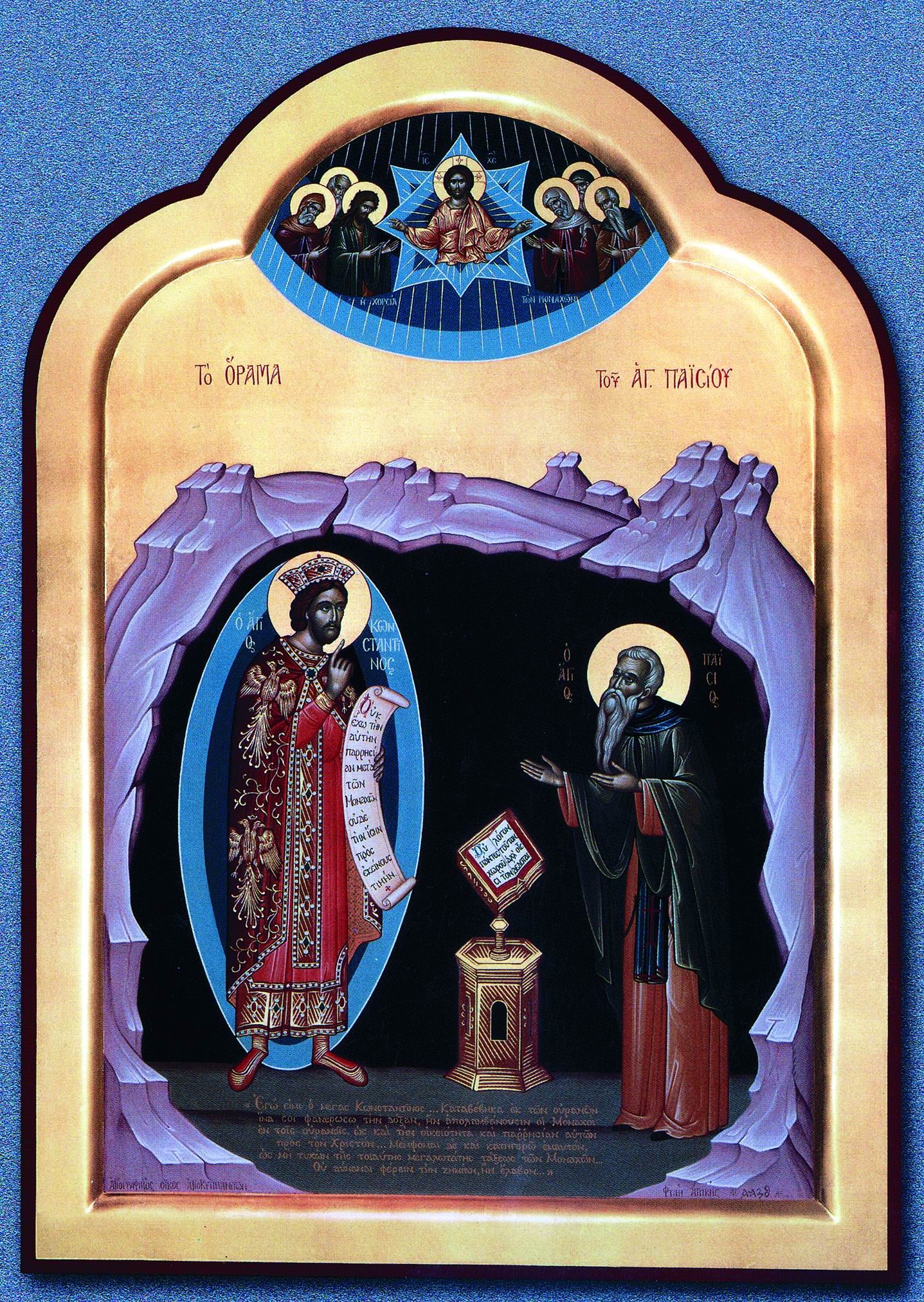
The Vision of St. Paisios of St. Constantine the Great

Greetings!

I stumbed across this interesting icon depicting a vision that St. Paisios the Great saw of St. Constantine the Great (http://www.pigizois.net/galery/agiografies/agiografies.htm).


The Vision of St. Paisios (amateur translation)
"I am Constantine the Great...
I descended from heaven to reveal
the glory which monks receive
in heaven, and the closeness [oikeiothta] and boldness
they have towards Christ...
I blame myself and I condemn myself,
for not having been granted this great rank of the Monastics...
I am unable to bear the loss, which I experienced...
I do not have the same boldness as the Monastics,
nor equal honor towards them..."
  
This event is taken from the full life of St. Paisios published in the "Neon Eklogion" ( "Νέον Εκλόγιον"), which is a compendium of numerous full lives of Saints. The full text in Greek of this event I am posting, in addition to my translation below:


Full account of the vision of St. Constantine the Great by St. Paisios (amateur translation)
Therefore (says the righteous John), desiring to see myself as I was able, his special theoria, and to taste of divine grace, I went to him [St. Paisios], and before I knocked on the door of his cell, I heard him speaking with another man. I was reluctant to knock, so I waited outside. The little sound I made, however, was heard by the precious father, and he came outside. He saw me, and was filled with joy and embraced me, and I him. He took me into his cell, where I didn't see anyone else. I was puzzled, and I wondered: who was in here previously and was talking with the Righteous Elder a short time before? And I looked around and saw no one.

The Elder asked me: "Why are you looking here and there in bewilderment, as if you were looking at something strange?"

I replied: "Indeed I see something strange, and I don't know what to think, for a short time ago, I heard the voice of another man who was speaking with you, and now I don't see anyone else. What should I think? I beseech your Holiness to reveal to me this strange mystery.

The divine father told me: "O John, God wishes to reveal to you a strange mystery today, and I must reveal to you the love which the Giver-of-Good-things has for us.

"He whom you heard speaking with me, my perfect friend, was Constantine the Great, the first King of the Christians, who descended from heaven, being sent by God, and told me: 'Blessed are you who have been made worthy of the monastic life, for truly unique is the godly blessing of the Savior towards you.'

"I asked him: And who are you, my Lord, who are saying these things, and magnifying us Monks? He replied: 'I am Constantine the Great, and I descended from the heavens, that I might reveal to you the glory which Monks receive in the heavens, and the closeness and boldness which they have towards Christ. And I magnify you, O Paisios, for you guide them in this holy path of asceticism. I therefore blame and condemn myself, for not being granted this greatest rank of the Monastics, and I cannot bear the loss which I experienced.'

"And again I said: 'Why, O wondrous one, do you judge yourself? Have you not received that eternal glory, and divine illumination?' He replied to me: 'Yes, I have received them, but I do not have that boldness of the Monks, neither glory equal to theirs, for I saw the souls of some Monks who had been separated from the body, and flew as eagles, and with great daring rise to the heavens. And the rank of demons did not dare approach them at all. Then I saw that the gates of heaven were opened for them, and they entered in, and appeared before the heavenly King, standing with great boldness before the throne of God. For this reason, therefore, I am amazed by you Monks, and I bless you, and I condemn myself for not being made worthy of boldness life this. For I wish that I could have left my passing kingdom, and the royal robe and crown, and to become poor, and to wear sackcloth, and to accept all those things that the monastic life seeks.'

"Again I said to him: 'You say this well, O most-holy King, and you console us with these words. However, this must be the judgment of our God, and and we are unable to say anything different regarding divine righteousness. For the Righteous Judge grants to each according to his worth in righteousness, and rewards for the works of everyone, for your unique life did not have the same struggles as the life of Monks, for you had a wife to help you, and your children, and your servants, and different rewards and comforts. For the Monks, disdaining all of the joys of this present life, receive God, instead of the good things of the World. And bearing Him with joy, and special richess, and to be made pleasing to Him, they consider Him their food, and their great reward. And they are, according to the Apostle, 'destitute, afflicted, ill-treated'. Therefore it is impossible, my King, for you to be equal to them.

"And at that point, therefore, you came, O my brother John, and [St. Constantine] straightaway ascended to the heavens. Therefore, now having learned this mystery that has occurred, how good must the pains of asceticism seem. Strengthen the brothers."
______________________________________

St. Constantine, such a great Saint of our Church, is admitting that the glory and boldness before Christ that monastics receive is great. The rich treasure that is Orthodox Monasticism cannot be overstated, and as Fr. Ephraim of Philotheou mentioned in his book Counsels from the Holy Mountain, "An entire army of monastics has filled heaven." May their boldness intercede for us sinners, who are unwilling to apply the teachings of Christ to our lives.
  
Apolytikion of St. Constantine the Great - Plagal of the 4th Tone
Your Apostle among the Rulers, St. Constantine, who once beheld in the sky the image of Your Cross, and who like Paul received his calling not from man, once entrusted the Ruling City into Your hand. We entreat You to restore it in peace forever, at the intercession of the Theotokos, O Lord who loves humanity.

Apolytikion of St. Paisios the Great in the Fourth Tone
The incarnate Angel, and the boast and summit of monks, the bodiless man, the citizen of Heaven, the great God-bearing Paisius celebrateth with us in divine jubilation, granting grace to all them that extol him with rev'rence. With fervour let us honour this day, off'ring him songs of praise.
  
Prayer Attributed to St. Paisios
O Lord, Jesus Christ my God, forsake me not.
O Lord, do not stand afar off from me.
O Lord, stretch out to me a helping hand.
O Lord, support me with the fear of You.
O Lord, plant this fear and the love for You in my heart.
O Lord, teach me to do Your will.
Amen.
Through the prayers of our Holy Fathers, Lord Jesus Christ our God, have mercy on us and save us! Amen!