Showing posts with label Great Lent. Show all posts
Friday, April 3, 2020
"My mind is wounded, my body is feeble, my spirit is sick..."
Christ healing the sick (source)
My mind is wounded, my body is feeble, my spirit is sick, my speech has lost its power, my life is ebbing, and the end is at the door. What shalt thou do, O miserable soul, when the Judge comes to examine thy deeds?
I have reviewed for thee, O my soul, Moses’ account of the creation of the world, and then all of the canonical Scripture that tells the story of both the righteous and the wicked. But thou, my soul, hast followed the ways of the wicked and hast sinned against God.
The Law is grown weak, the Gospel unpracticed, and the whole of Scripture is ignored by thee; the Prophets fail and the words of the righteous are useless. Thy wounds, O soul, have multiplied, and there is no physician to heal thee.
I will now show thee, O my soul, examples from the New Testament, to lead thee to repentance. Follow the example of the righteous and avoid following the ways of the sinners and strive to regain the grace of Christ through prayer and fasting, purity and reverence.
Christ became man, calling thieves and harlots to repentance. Repent then, O my soul! For the doors of the Kingdom are already opened and the Publicans and penitent Pharisees and adulterers pass through before thee.
Christ became man by assuming my flesh and He willingly experienced all that belongs to our nature apart from our sin. Thus, He set before thee, O my soul, an example and image of His own condescension.
Healing sickness, Christ the Word preached the Gospel to the poor, cured the crippled, ate with publicans, and conversed with the sinners; and with the touch of His hand, He brought back the departed soul of Jairus’ daughter.
Do not require of me worthy fruits of repentance, for my strength has failed within me. Rather, grant me an ever-contrite heart and a poor and simple spirit, that I may offer them to Thee as a pleasing sacrifice, O only Savior.
O my Judge Who knowest me, look upon me with Thy merciful eye when Thou comest again with the Angels to judge the whole world, and spare me; take pity on me, O Jesus, for I have sinned more than any other.
-Excerpts from the Great Canon of St. Andrew of Crete
(source)
Through the prayers of our Holy Fathers, Lord Jesus Christ our God, have mercy on us and save us! Amen!
Labels:
Great Lent,
Hymns,
Illness,
Repentance,
St. Andrew of Crete,
the Last Judgment
Thursday, March 19, 2020
"O Lord, Who fought alongside the greatly-meek David..."
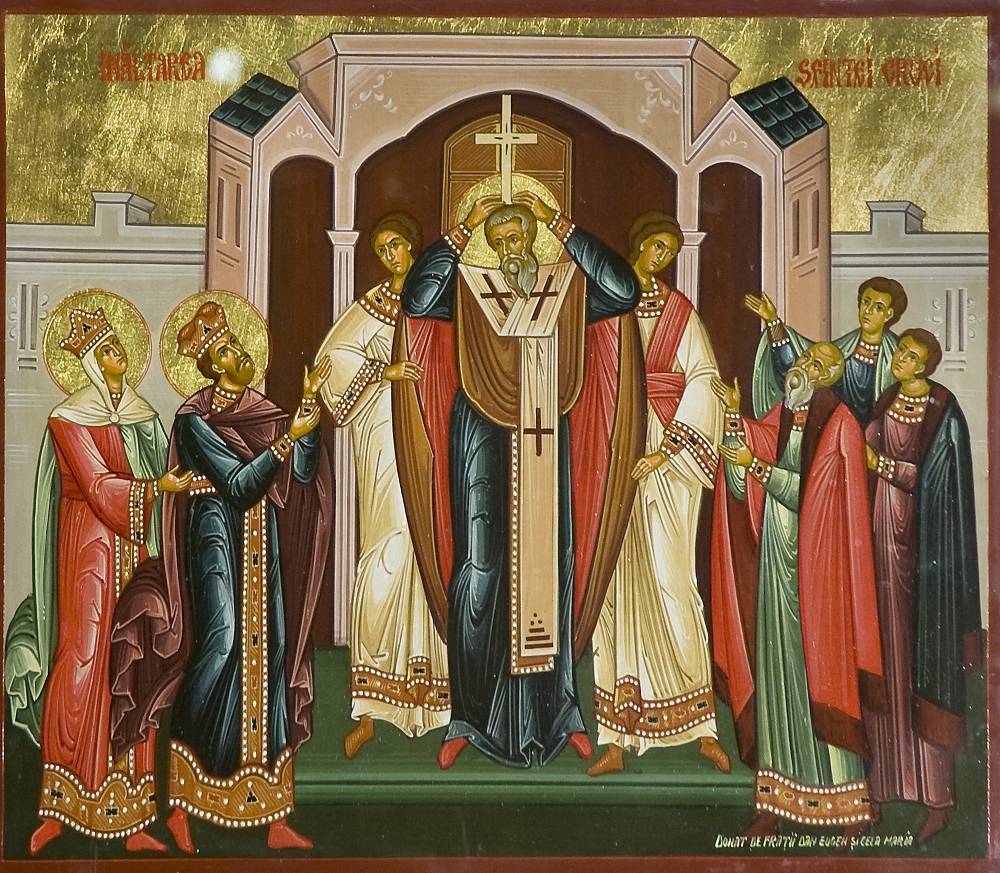
The Holy Cross of Christ (source)
O Lord, Who fought alongside the greatly-meek David, warring together with Your faithful people against the foreign king, through the weapon of Your Cross, depose our enemies, and show forth Your ancient mercies upon us, O Compassionate One, that they may truly know that You are God, and through hope in You we will be victorious, and through the intercessions of Your Spotless Mother, grant us the great mercy.
-Doxastikon from the Aposticha of Great Vespers for the Veneration of the Cross
(source)
Through the prayers of our Holy Fathers, Lord Jesus Christ our God, have mercy on us and save us! Amen!
Tuesday, March 17, 2020
When St. Iakovos sacrificed church on Pascha for his brother
The Resurrection of Christ (source)
Note: As many are being asked to, and agreeing to temporarily forego participation in Divine Services (whether voluntarily, or due to their not being offered) out of concerns for the spread of the Corona virus, may this beautiful and short story from St. Iakovos' youth be instructive to us all with great discernment and in obedience to our spiritual leaders. Once, out of love and sacrifice for his fellow man, the Saint agreed to forego participation in church for the Passion and Resurrection of Christ. The Lord did not abandon him.
When Elder Iakovos of Evia (1920-1991) was serving in the army before he became a monk, he was granted permission to take all of Holy Week and Pascha off.
But during the week, he noticed one of his fellow soldiers was very depressed. And he asked him, “Why are you so sad, Mr George?”
“Papa-Iakove, you with your religiosity, managed to convince the commander to give you the entire week off. You will be fine with your chanting, your monk practices, but how about me? I also want to go to my village to spend Pascha with my fiancĂ©e. ”
“Okay, George, now you want the day of Pascha off – do you also want a couple of other days off?”
“Well, it would be good to have Great Friday off, and even Thursday, so I can get to church and hear a couple of gospels…”
“Don’t worry George, I will take care of it.”
This man of God, who lived for these services – this was his life, these hymns were his breath – he sacrificed it all for his fellow man, and he stayed inside the barracks – Holy Thursday, Holy Friday, Saturday and Pascha Sunday.
Out of curiosity I asked him, “Very well, Elder, how did you pass these days?”
“I was serving guard duty, and I was on a hill watching the citizens of Athens going to their churches, and I was trying to repeat the prayer of Jesus. And on the night of Pascha, when I heard the joyous bells, I sighed and I said, ‘O my Christ, now our Christians are receiving Your Holy Light.’ And as I said this, the Holy Light came to me as well!”
“How did this happen, Elder?”
“Well, my child, a light came from on high and rested on me, and I became all light!”
The man of God had sacrificed the created light of the Pascha candle, and he received the uncreated Light of Divinity. This was Elder Iakovos. This was inside his nature – the willingness to sacrifice even his prayer and his personal effort and struggle, for the love of his neighbour.
Source: From a talk given by Bishop Neophytos of Morphou, Cyprus.
(source)
St. Iakovos carrying Christ on His Cross (source)
Through the prayers of our Holy Fathers, Lord Jesus Christ our God, have mercy on us and save us! Amen!
Monday, March 2, 2020
Kontakion of St. Romanos: "On Adam's Lament"
The Expulsion of Adam and Eve from Paradise (source)
The Guide of wisdom, Leader of prudence, Chastener of the senseless, and the Defender of the poor: fortify, grant understanding to my heart, O Master. Give me a word, O Word of the Father, for behold, I do not hold back my lips from crying out to You: O Merciful, have mercy on the fallen.
Adam sat and wept across from the delight of Paradise, and beating his eyes with his hands, he said: "O Merciful, have mercy on the fallen."
When Adam beheld the Angel turning him back, and closing the gate of the divine garden, he groaned greatly, and said: "O Merciful, have mercy on the fallen."
O Paradise, bear pain together with your master, who has been impoverished of you, and through the sound of your leaves, entreat the Fashioner to not close you. "O Merciful, have mercy on the fallen."
O Paradise full of virtue, all-holy, all-joyous, which was planted for Adam and was shut from Eve, entreat God for the fallen. "O Merciful, have mercy on the fallen."
-Excerpt from the Kontakion of St. Romanos: "On Adam's Lament", read on Forgiveness Sunday (source)
For the remainder of this beautiful Kontakion of St. Romanos, see here.
Forgive me, and may God grant us all forgiveness, repentance, and a blessed Lent!
Through the prayers of our Holy Fathers, Lord Jesus Christ our God, have mercy on us and save us! Amen!
Thursday, April 25, 2019
"The Lord spoke to Job through the whirlwind and clouds..."
(source)
" The Lord spoke to Job through the whirlwind and clouds..." (Job 38:1)
(source)
"When the stars were made, all my angels praised me with a loud voice." (Job 38:7)
(source)
"And who prepared a course for the violent rain, and a way for the thunders; to rain upon the land where no man, the wilderness, where there is not a man in it; so as to feed the untrodden and uninhabited , and cause it to send forth a crop of green herbs? Who is the rain's father? and who has generated the drops of dew? And out of whose womb comes the ice? and who has produced the frost in the sky, which descends like flowing water? who has terrified the face of the ungodly?" (Job 38:25-30)
(source)
"And who is he that numbers the clouds in wisdom, and has bowed the heaven to the earth?" (Job 38:37)
(source)
"And do the gates of death open to thee for fear; and did the porters of hell quake when they saw thee?"
(Job 38: 17)
(source)
"I have heard the report of thee by the ear before; but now mine eye has seen thee. Wherefore I have counted myself vile, and have fainted: and I esteem myself dust and ashes." (Job 42:5)
(source)
"They that saw me abhorred me: the very persons whom I had loved, rose up against me." (Job 19:19)
(source)
"And they stood aloof and abhorred me, and spared not to spit in my face...They have risen up against on the right hand of offspring; they have stretched out their foot, and directed against me the ways of their destruction. My paths are ruined; for they have stripped off my raiment..." (Job 30:10-13)
(source)
"Who will tell him his way to his face, whereas he has done ? who shall recompense him? And he has been led away to the tombs..." (Job 21:28-32)
(source)
"Where then is yet my hope? or shall I see my good? Will they go down with me to Hades, or shall we go down together to the tomb?" (Job 17:15-16)
"For I know that he is eternal who is about to deliver me, to raise up upon the earth my skin that which I am conscious of in myself, which mine eye has seen, and not another, but all have been fulfilled to me in bosom." (Job 19:25-27)
(source)
"And the Lord blessed the latter end of Job, than the beginning...And Job died, an old man and full of days: and it is written that he will rise again with those whom the Lord raises up." (Job 42: 12, 17)
Through the prayers of our Holy Fathers, Lord Jesus Christ our God, have mercy on us and save us! Amen!
Thursday, April 18, 2019
"O Lord, Your voice destroyed the kingdom of Hades..."
Christ raising Lazarus from the dead (source)
O Lord, Your voice destroyed the kingdom of Hades, and the word of Your authority raised up a man four-days-dead from the tomb. And Lazarus became a foretaste of regeneration and salvation, for all things are possible for You, O Master and King of All. Grant your servants forgiveness of sins and great mercy.
-from the Vespers Stichera for the Raising of Lazarus, written by Leo the King
(source)
Through the prayers of our Holy Fathers, Lord Jesus Christ our God, have mercy on us and save us! Amen!
Thursday, April 11, 2019
"Flee from the flames, O my soul..."
Abraham and Lot fleeing the destruction of Sodom, while Lot's wife remained and turned to a pillar of salt (source)
The Lord once rained fire from heaven and consumed the land of Sodom.
Seek salvation on the mountain as did Lot, O my soul, and find thy refuge in Zoar.
Flee from the flames, O my soul, flee from the burning heat of Sodom, flee the destruction of the divine fire.
Thou knowest, O my soul, how the cities to which Christ offered the Gospel were cursed. Fear their example and their punishment, for the Master likened them to Sodom and condemned them all to hell.
-Excerpt from the Great Canon of St. Andrew of Crete
(source)
The Destruction of Sodom (source)
Through the prayers of our Holy Fathers, Lord Jesus Christ our God, have mercy on us and save us! Amen!
Labels:
Great Lent,
Hell,
Hymns,
Punishment,
Repentance,
St. Andrew of Crete,
the Last Judgment
Friday, March 29, 2019
"What shall we offer to You, O Christ? For You gave us Your Precious Cross..."
The Exaltation of the Precious Cross of Christ (source)
What shall we offer to You, O Christ? For You gave us Your Precious Cross to venerate, on which Your All-holy Blood was spilled, and on which Your Flesh was affixed with nails, which we now embrace, giving thanks to You.
With hymns, let all of the trees of the forest skip for joy for their fellow tree, beholding the Cross being embraced today, on which Christ lifted up His head, as was foretold by the divine David.
You were put to death on the tree that I might find life. O Christ-bearing Cross, my protector unassailable, and mighty strength against the demons, O Cross which we venerate today, we cry out: Sanctify me with your glory.
-from the Matins Canon for the Feast of the Veneration of the Holy Cross
(source)
Through the prayers of our Holy Fathers, Lord Jesus Christ our God, have mercy on us and save us! Amen!
Labels:
Christ's Passion,
Great Lent,
Hymns,
The Holy Cross,
Trees
Thursday, March 14, 2019
Photios Kontoglou on Panagia as the Humble Queen
The Most-holy Theotokos and Christ surrounded with Angels depicted in the wonderworking icon of Panagia Pantanassa (Queen of All) treasured by Vatopedi Monastery, Mount Athos (source)
"Panagia is the spiritual adornment of Orthodoxy. For us Greeks [and for all peoples], she is the pained mother, the consolation, the protector, who stands beside us in every circumstance.
"In every part of Greece are built countless churches and monasteries, palaces to this humble Queen, and a multitude of chapels in the mountains, the fields, the islands, that are fragrant from her virginal and spiritual fragrance.
"Within each of these is found her ancient and honored icon with her dark hair and golden face, which receives all of the tears of our tortured faithful, because we have no one else to help us except Panagia: 'we who sin have no one else, who intercedes for us before God, praying endlessly, in ills and all dangers, for us who are laiden with our many sins and mistakes' (Paraklesis to the Theotokos).
"The beauty of the Panagia is not a bodily beauty, but spiritual, because where there is pain there is also found holiness, there alone is spiritual beauty. Bodily beauty brings bodily excitement, but spiritual beauty bring contrition, respect and pure love. This is the beauty which our Panagia has.
"And this beauty is depicted in her [Byzantine] icons which pious men fashion, who fast and chant and are found with contrite heart and spiritual purity.
"In the face of Panagia are depicted this mystical beauty which attracts like a magnet pious souls and brings them silence and consolation."
-Photios Kontoglou (+1965)
(source)
Forgive me, and may the Lord forgive us all and grant us a blessed Lent!
Most-holy Theotokos, save us!
Thursday, March 7, 2019
"O Champions of Christ, you make the all-sacred fast even more joyous..."
The Holy Forty Martyrs of Sebaste (source)
O Choir of flames four-times-ten, army wholly chosen by God, you make Lent shine furthermore because of your sacred struggles, sanctifying and enlightening our souls.
The forty-numbered Choir of Martyrs, who would not hymn? For they entered into the waters of the lake bravely, being clenched by the cold, and offered up an ode to the Lord: "Do not let waters drown us in your anger, O Lord, do not let your waters drown us in your anger, O Lover of mankind, but lighten the burden and the bitter wind, for You dyed our feet in Your very own blood, and you have led us, O God, into your eternal mansions, that we might have rest in the bosom of the Patriarch Abraham."
You watered the faithful with the chalice of truth, filled with your own blood, and with the fire of tortures, and the drowning of water. O Four Decades of the Lord, you chanted to the Savior, though separate in bodies, but united in spirit, and you offered yourselves to Christ, while the Mother and bride of God offered her Christ-loving child, who was carried on her shoulders, saying: Come, O Champion, and struggle together with the rest.
O Champions of Christ, you make the all-sacred fast even more joyous through your glorious struggles, for you were Forty in number, and you sanctify the Forty-day Lent, imitating the saving passion through your struggle on behalf of Christ. Therefore, as ones having boldness, intercede that in peace we might meet the Third-day Resurrection of our God and the Savior of our souls.
-Idiomela and Doxastikon from the Matins for the Feast of the Holy Forty Martyrs of Sebaste
(source)
The Holy Forty Martyrs of Sebaste (source)
Through the prayers of our Holy Fathers, Lord Jesus Christ our God, have mercy on us and save us! Amen!
Tuesday, March 5, 2019
Elder Aimilianos: Fasting and Prayer as a Longing for God
Jesus Christ, detail (source)
"Longing for God is expressed with fasting, with an empty stomach... Fasting has a unique meaning by expressing the longing for God... The same occurs for prayer. If prayer to myself had meaning, then my prayer life would be a human endeavor, a tendency and revival, it wouldn't be God. My prayer has meaning because it exactly expresses my longing: 'Come and abide in us...', the: 'Where are you, my God?'
"With fasting, vigil, and prayer, chaos and malaise are shown to be our rags before God, as the poor man shows his rags to his fellow man in order for him to have pity on him to help him, or like the blind man cried out to Christ to give him light. Thus, we show our poverty and he ask that He open our eyes in order to understand that we are sinners, that we might repent and so He can forgive us...
"The approach therefore is an uncreated energy, a true projection of His being. Because of this, my life as well is a true communion with the true God. While God acts, I commune with Him. While God is unapproachable, I partake of Him...
"Only the: 'Where are you, my God?', can make visible the invisible presence of God...We give Him our consent, our being, and He directs everything, He kneads us..."
-Elder Aimilianos of Simonopetra
(source)
Through the prayers of our Holy Fathers, Lord Jesus Christ our God, have mercy on us and save us! Amen!
Sunday, March 11, 2018
Elder Ephraim of Arizona: "Carry your cross with patience and joy"
Jesus Christ taken from the Cross, mourned by the Theotokos, His Mother (source)
About the grief that torments you, I have told you many times that it is your cross which our Jesus has given to you so that you may become an imitator of Him and not be a stranger to His love. For whoever loves Him sincerely follows Him not only to Mount Tabor, where the glory of His divinity appeared (in other words, not only at the time of His visitation through His sweet grace and joy ), but follows Him also on the uphill climb to Golgotha and His Crucifixion (in other words, also in the absence of His grace and in sorrowful occurrences, which produce distress, pain, despair, perplexity, labor, and sweat).
Precisely then is the inner man tested and it is revealed what he is: counterfeit or true, skilled or unskilled, captain or sailor. Precisely then are our intentions tested, and he who is courageous and patient is rewarded internally by the visitation of God through the increase of grace. In this manner, the Christian is trained in the spiritual struggle until he reaches the end and finds rest.
Struggle philosophically; carry your cross with patience and joy until you bring it to the Place of the Skull, to the tomb, so that our Jesus may give you the resurrection! He who bears his cross for the love of Christ will be raised by the Lord on the last day. How long will our life be? The time of our death is unknown, whereas patience will be rewarded eternally. This cross of grief you are bearing has already given you very much, and how much more it will give you! And yet you do not see this, for God wisely hides it from you for your benefit.
Entreat God continuously to give you patience, and thank Him with knowledge; then you will be able to endure ioyfully, awaiting your salvation through these afflictions.
(source)
Through the prayers of our Holy Fathers, Lord Jesus Christ our God, have mercy on us and save us! Amen!
Thursday, March 8, 2018
Elder Symeon Kragiopoulos: "The Cross is glory for Christ."
Jesus Christ crucified (source)
Only God knows what every one of us should go through. And not only should we get prepared for it but also look forward to it with joy. Because this is our glory.
The cross is glory for Christ. Similarly, for the men of God any given suffering, any given injustice, any given pain for the love of God, is glory, too.
At the time when you are treated unfairly, you suffer. You may not be beaten up, but at the time when you are harmed, your soul is in pain. If you are beaten up physically, the pain you suffer may be a lot less than the heartache, the spiritual pain. Still, look forward to this injustice against you with joy and thank God because this is the way man’s soul is glorified...
Brethren, I want you to believe me. Some of us may have a “but” inside them; this is no good. You may have the worst of the things, be it hereditary or of a different cause. In the long run, it will be to your benefit, if you take things the right way.
If your complaint and tantrum get out of the way, if, these go, and I mean the very fact that you put the blame elsewhere, humility and salvation come.
Why do you put the blame of your condition on something else? Because you want to salvage your ego and you don’t even realize it.
Some people have been so utterly devastated in this life, that they believe they have no pride. Yet, precisely their stubbornness, their state of non-repentance, their complaint, their conviction that it’s somebody else’s fault, reveals a fierce ego, an ego without humility.
As soon as we become humble, as soon as we get rid of whatever grudges we may be bearing, as soon as we repent, salvation instantly comes. Man is saved. These words are true.
Holy Hesychasterion “The Nativity of Theotokos” Publications.
Archimandrite Symeon Kragiopoulos
(source)
Through the prayers of our Holy Fathers, Lord Jesus Christ our God, have mercy on us and save us! Amen!
Labels:
Elder Symeon Kragiopoulos,
Endurance,
Great Lent,
Humility,
Pain,
Patience,
Pride,
Repentance,
The Holy Cross
Monday, March 5, 2018
Elder Nikon of New Skete: "If Christ benefited from fasting, then I will fast too!"
Christ being tempted and overcoming the devil in the desert (source)
“When man practices asceticism, the devil often gets in over his head.
Because he knows what a weapon the fasting is! What power the fasting has!
That is why, during the fasting seasons, during the Great Lent, Dormition Fast and now in the Nativity Fast, which is an easy fast, the devil is getting crazy seeking to destroy our fast by determining us to argue with each other, determining us to judge, to look at what the others are doing to lose the reward we will receive from God for fasting.
During the fasting seasons we should be more cautious, more vigilant, in a deeper state of awakening and more prayer.
Let the fast be not only of our stomach!
Let it be of our eyes also, for the ears to fast from what they hear, and the tongue to fast from what it says, to fast from everything!
Let us fast, but know that because we will make the devil to suffer, he will attack us!
Do not worry at all about this! He can not do anything! If he could, then he would!
And if you hear a smart one telling you that Scripture says that it is not a sin what goes into the mouth, but what comes out of it, what he or she says, that it is important, as Christ says, and not what you put into your mouth.
And they want to say, using the Christ’s words, that fasting is not necessary, because Christ Himself said that what comes out of your mouth, that will condemn you, not what you put into your mouth.
If somebody tells you such a thing, tell him or her too: If Christ benefited from fasting, then I will fast too! If I will perform more miracles than Christ, then I will immediately interrupt my fasting. Meanwhile, if He benefited from fasting, then I will benefit even more!
Continue to fast! And let the smart ones in their cleverness!”
(source)
Through the prayers of our Holy Fathers, Lord Jesus Christ our God, have mercy on us and save us! Amen!
Wednesday, February 21, 2018
Elder Ephraim of Arizona on Great Lent
Jesus Christ, "Extreme Humility" (source)
At this time we’re entering the great spiritual arena of the blessed Great Lent. Holy and Great Lent is a time of compunction, for repentance, for tears, for a change in ourselves, for a new stage in the spiritual life. Like an affectionate mother caring for her children, us Christians, the Church has designated this time of Lent as dedicated to the struggle, in order to help its children fight harder, to purify themselves, draw closer to God and to be counted worthy of celebrating the great day of the radiant Resurrection.
Christians, especially monks, have always paid particular attention to this spiritual arena and have thought it especially sacred, because it’s a period which envisages both spiritual and bodily struggles. There’s the struggle of fasting, the struggle of vigils, the struggle of purification and the struggle to fulfill one’s spiritual duties which are many more than at other times of the year. There’s a spiritual “defragmentation” and people pay greater attention to the voice of their conscience in order to correct what they’ve maybe neglected and to improve spiritually.
The Church assists us but with penitential hymns and services, as well as with teachings, to oil us up for the fight for the purification of our souls.
We have the penitential evening Divine Liturgies of the Presanctified Gifts. The Presanctified is extremely beneficial. It’s Cherubic Hymn is full of spirituality, contemplation, angelic presence. That’s why we should come to these liturgies during Great Lent with even greater compunction. We who consume the Body and Blood of Christ must be so pure and clean, so straight in body and soul for divine grace to have its effect. For this reason we must lead very careful lives. Both in our cells and in church we must wet our face with tears so as to wash our souls and be worthy to take communion. Of course, the devil often makes us wanting in compunction, me more than anyone. Which means we can’t have tears and we often have bad thoughts. Bad thoughts and the sinful images that accompany them must be rejected as soon as they make their appearance. And when we have wicked thoughts or our soul is cold towards one of the brethren, let’s not approach the God of love, Who is so pure and holy.
Throughout this period, at every service in Great Lent, we say the prayer of Saint Efraim the Syrian, which is as follows: “Lord and Master of my life, do not give me the spirit of sloth, inquisitiveness, lust for power or idle talk, but give rather the spirit of sobriety, humility, patience and love to me, your servant. Indeed, Lord King, grant me to see my own errors and not to judge my brother, for you are blessed to the ages of ages. Amen”.
With these words, the saint wishes to make us understand very clearly, that, apart from other virtues we need to take special care with the last case, that of self-censure and of criticism of our bothers and that without love for our fellow human beings there’s no chance of making even the slightest progress towards our spiritual purification. If we don’t pay attention to our thoughts, our words and our heart, there’s no benefit in fasting. Fasting is of benefit when it’s combines with love for our neighbour and when we don’t criticize others. When we don’t criticize our fellows and instead criticize ourselves, then we’re marked by love for others and love for our soul, concern for purification and the fulfillment of the great commandment, that of love of God and one’s neighbour. Love for God and for our fellows are the two great virtues which support the whole of the spiritual structure, because if they are absent, they others cannot take form. “God is love and those who live in God in love have God living in them, too” (I. Jn. 4, 16).
Another issue which demands that we push ourselves as hard as possible is prayer We should pray in the name of Christ, without neglecting any opportunity and without any waste of time. In the personal vigil in our cell, we should push ourselves, shouldn’t let sleep overcome us, nor neglect nor idleness; we should engage willingly I spiritual matters. As soon as we wake up, prayer should take first place then our rule, our prayer-rope, study and the contemplation of God. We should go to church with great readiness and so get the best results from our presence in the arena.
Apart from this, fasting together with bodily exertion helps as regards the forgiveness of sins. “Behold my humility and my efforts and forgive all my sins”. When we labour with the fast, with kneeling, with prayers, with an effort from our heart and mind, this Godly exertion is holy and is richly rewarded by God, because it make people worthy of the crown of glory and honour. The demons fear the fast greatly, because it lays them low. “This kind [of demon] will not depart other than with prayer and fasting”, said the Lord (Math. 17, 21). This is why the holy fathers always began any Godly task with a fast. They considered a fast to be very powerful and that the Holy Spirit does nor overshadow people when they’re replete with food and their stomachs are full. And any Christian who desires purification has to start from this foundation which is fasting, prayer and vigilance. When these three are combined, then people have acquired great stature.
In olden times, the fathers had a holy custom. On the eve of Lent, they would leave the monasteries and go deeper into the desert, where they lived in great asceticism until Lazarus Saturday, when they returned in order to celebrate Palm Sunday all together. Some would take a few of the basic essentials as far as food was concerned, others would eat only green plants, in order to struggle more fiercely in the desert. Thereafter they would spend all the days on Great Week together in church, existing on a piece of dried rusk and a few nuts a day. We were given the blessing and the grace of knowing ascetic people who spent not only Great Lent in fasting and spiritual struggle.
Our departed elder, Elder Iosif the Cave-Dweller (he used to live in caves, which is where I met him), kept a very strict fast during Great Lent. And, of course, he imposed it on us, too. From Monday to Friday, five days of the week there was no food, except a handful of flour, from which we made a batter with just water. That was it. A little plate every twenty-four hours. And, at the same time, hard work lifting loads on our back during the day and the whole night hundreds of prostrations and hours of prayer. And all of this in order to purify the inner person, to make it cleaner, more honourable in the eyes of God, in order to acquire boldness before God and be able to pray for the whole world. Because the world, people everywhere, needs the prayers of the saints, particularly those of ascetics. Saint Anthony the Great supported the whole world with his prayers.
Of course, we must keep the fast only as far as we’re able, with discretion, because we’re not all the same. “Unless the good be done well, it is not good”. In other words, unless good is done in a good way, method, time and amount, but instead is done without discretion, then it’ll do more harm than good. Fasting is certainly extremely necessary, it’s good, but it’s a means rather than an end The means has an end and that is humility. This is why we need to arrange everything in accordance with the discretion of a spiritual father, someone illumined by the Holy Spirit. Your spiritual father will tell you how much to fast, how often to receive communion, where to strike at the enemy, what you should do here and what there. And then, through the discretion of your spiritual father, you can put your house in order. We shouldn’t do more than is appropriate, we need moderation in all things, because immoderation cancels out any benefit. So fasting is holy, but it’s a means. We should adjust it according to what our spiritual father says and what out psychosomatic powers allow. As long as there’s good will. Basil the Great says there’s as much difference in resilience between people as there is between iron and grass.
Saint Synklitiki fell ill towards the end of her life with a throat disease. Her blessed throat, which had always spoken the word of God, festered on the inside. Her mouth had saved countless people. The devil had asked permission to test her and God had granted it. The stench from her rotting flesh became so bad that the nuns had the greatest difficulty in seeing to her needs. They used the most pungent perfumes to try and bring her a little respite in her sickness. When her mouth had been healthy, it had spoken and brought benefit to many, but when she fell ill, she was able to preach even more strongly. How could a silent and rotting mouth preach? She noiselessly declared her great patience and endurance in God’s trial. She made a titanic effort to deal with the devil of impatience, of complaint, of the labour and toil of sickness. What did she need with fasting? This is why illness is regarded as involuntary asceticism. One person has cancer, another diabetes, somebody else has lots of troublesome health problems. How will these people purify themselves? How will they see God’s light?
Through patience and giving thanks to Him. These make up for the fast which, because of their illness, they’re unable to keep, and, in fact, often struggle ten times harder than if they were fasting.
During this period, we really have to struggle to purify ourselves. From the ascetic tradition we have hermits who spent the whole of their lives in the desert, with labours, toil, fasts, tears, sleeping on the ground and deprivation of every other kind of pleasure. And all this effort, together with the struggle of the soul against all kinds of thoughts concerning the rebellions of the flesh, engendered sanctity.
So every Christian who’s a monk and wants to experience purification has the right to labour and not be deprived of his reward. Purity brings great boldness towards God, because He Himself is pure, the Mother of God is most pure and Saint John the Theologian lived his life as a virgin, as did so many other saints. The whole beauty of the Church is founded on purity and spotlessness. When our heart is pure and beautiful it will exude fragrance and loveliness. But if people have filth in their hearts, that’s what they’ll expel. Let’s struggle to cleanse the inside of our glass, our heart, so that we’ll be pure and pleasing in God’s eyes.
We have instances from Church history of many people “in the world” (not monastics, that is), who pleased God and became great. Abba Paphnuti [from Ancient Egyptian = “man of God”], an ascetic of great gifts, once prayed to God and said: “God, who have You placed me with. With whom do I share the same measure of virtue?”. And he heard a voice, saying to him: “Down in Alexandria there’s a poor man, a cobbler, down in a basement. You have the same amount of virtue as he does”. “But I’ve been a hermit in the desert from childhood and I’m equal in virtue with a lay person, a married man?”. “Yes, you’re equal to him”. The next day, the saint picked up his staff and his bag, put in some dry rusks and set off for Alexandria. He went down into the city, found the layman and said to him: “What do you do here, friend?”. “What should I do, father? I’m a sinner, the worst person in the world”. “Can we talk?”. “Certainly”. “What’s the virtue that you’re working on acquiring?”. “Virtue, me? I live ‘in the world’ and am completely mixed up. Now you, you’ve got virtues”. “No, you’re doing something”. “I’m not doing anything”. “God showed me, so you can’t tell me lies. I prayed and He told me that we share the same measure of virtue. There must be something about you”. “Sorry, Father. If what I do can be considered something, I’ll tell you. I married, and from the moment I put on the crown, I said to my wife: ‘If you love me, we’ll live apart, like brother and sister and work for the sanctification of our souls. Do you agree’. ‘I agree’. And since then we’ve lived in purity and virginity”.*
[*Note: This marital chastity described is similar to that experienced by other saints, for example, St. John of Kronstadt. St. Paphnoutios is not at all implying that sex and childbearing in marriage are evil or impure. But all married Christians are called to some degree of self-control and purity, (as is prayed for in every wedding service) according to their strength, according to their mutual consent and the guidance of their spiritual fathers, not all to a life of virginity.]
In the desert, Blessed Paphnuti tried to cleanse himself through the ascetic life, and restraint, in which he was greatly assisted by the condition of his way of life. The other man lived “in the world”, with a wife, with all the challenges of secular life and, with God’s help had reached the stature of a saint. And his struggle was greater than that of the hermit. Proof that he was great in the eyes of God.
After that, something else happened which has to do with this cobbler. One day a Christian went to the Blessed Paphnuti and said:
“Father, I quarrelled with a priest and I don’t know how he reacted, whether he cursed me or swore at me, but he’s now departed this life and we weren’t reconciled. What do I do now?”.
“There’s nothing I can do in this case, but there’s a holy man who I’ll send you to and he’ll help. Go down to Alexandria, to a basement where there’s this cobbler. Tell him I sent you, mention the problem and he’ll help”.
The Christian said to himself: “For goodness’ sake. A hermit can’t help and a layman can?”. Nevertheless, out of obedience to the hermit, he did as he was told. The cobbler told him to wait until night fell and then took him to a church in the city. After again telling him to wait, the cobbler went up to the large door made the sign of the cross and it opened. The inside of the church was bathed in light and there was heavenly music. The cobbler told the man:
“Go in there and look at the choirs on the left and right. You’ll see the priest there”.
The man went in, saw the priest in the left choir and received his forgiveness.
You see what ascetic effort can achieve? What the soul’s struggle can do? What did that layman do to purify his soul. When he told the girl he’d married that they should live like brother and sister, was that an end to it? No, they fasted and kept vigil together, they made prostrations and read the Gospel. They read Patristic books, went to church, confessed, took communion, chased away evil thoughts and struggled assiduously. And that’s how they became saints “in the world”.
So here is proof that even “in the world”, when Christians take on the struggle with good will, the Grace of God does not exclude anyone. But we make excuse for ourselves and say that because we’re “in the world”, we can’t. Desire gets the better of us. What do we need to do? Fight in the body and in the soul. In other words, control our thoughts. Thoughts come, sinful fantasies, images, faces, idols and scenes. We must get rid of them immediately with “Lord Jesus Christ, have mercy upon me”. When the mind is careful not to accept all of that and has the divine weapon, the Name of Christ, then every enemy of our soul is slain, whether it be the devil, sordid fantasies or repulsive thoughts. Then, if we guard our soul, mind and heart in this way, our inner self will remain clean and pure.
Let’s struggle really hard now, and the rewards will be very great. Nobody finds grace unless they make the effort. If a farmer doesn’t tend his crops, he won’t see any yield. When our fast is accompanied, reinforced and flanked by prayer, study, vigilance, church attendance, confession, Holy Communion, good works- especially almsgiving- then the beauty of the preparation of the soul for the reception of Great Week is complete. Then we’ll experience the Holy and Sacred Passion of Christ more intensely, because our heart will soften, it’ll alter and it’ll realize how great God’s love for humankind is. Then, within us, we’ll experience very forcibly the Holy Resurrection, we’ll celebrate it in a way befitting to God and we’ll celebrate Holy Easter together with the angels. Amen.
Source: www.zoiforos.gr
Brethren, may we all have a blessed and spiritually-profitable Lent, and be made worthy of partaking in Christ's Passion and Resurrection! Please forgive me, and may God forgive us all!
Through the prayers of our Holy Fathers, Lord Jesus Christ our God, have mercy on us and save us! Amen!
Thursday, February 15, 2018
Elder Symeon Kragiopoulos on Cheesefare Sunday
Icon depicting the Expulsion of Adam and Eve from Paradise (source)
Great Lent is a forty-day period for us to return to God. Due to our sins, we find ourselves outside of paradise. Realizing this fact we seek forgiveness of our sins. If God forgives us, He will put us in paradise. For this reason, the Gospel reading for today’s divine liturgy highlights the first thing needed: “For if you forgive men their trespasses, your heavenly Father will also forgive you. But if you do not forgive men their trespasses, neither will your Father forgive your trespasses,” (Matt. 6, 14-15). Run and do whatever you want. Strive according to your desire. But if you do not look after this very first thing, do not expect your sins to be forgiven. And if your sins are not forgiven, you will not enter into paradise. However much we seek forgiveness from God, that much more must we too forgive others.
And, now for the second point. It is impossible to conceive of Great Lent without fasting, as this fasting is a law of God and a law of the Church. During this period, our Lord, and our Church, want us to fast from material foods, but also from our passions, and from our weaknesses.
The third point that we, during this period, must pay attention to for our return to be true is: “Do not lay up for yourselves treasures on earth … lay up for yourselves treasures in heaven,” (Matt. 6, 19). When you do almsgiving, when you love, forgive others, think of others, think of heavenly things, of spiritual goods, and of all the things the Lord has promised us –not the earthly things down here–then you gain treasure there. Your heart, then, is there in heaven.
If your heart truly desires Christ, it will go towards heaven. From that perspective, we can take stock. Since our hearts do not go towards God –as if difficulties come to us, and like clockwork there are roadblocks– this means that we love other things more deeply than we love our Christ. This is in accordance with that which the Lords says: “For where your treasure is, there your heart will be also, ” (Matt. 6, 21).
Holy Hesychasterion “The Nativity of Theotokos” Publications.
Archimandrite Symeon Kragiopoulos
(source)
Beautiful icon depicting Christ as the Good Samaritan (source)
Through the prayers of our Holy Fathers, Lord Jesus Christ our God, have mercy on us and save us! Amen!
Sunday, March 30, 2014
St. Nikolai Velimirovich on the Five Wounds of Christ
Christ crucified in extreme humility, together with the Theotokos, and St. John the Theologian (source)
St. Nikolai Velimirovich on the Five Wounds of Christ (amateur translation)
You write that you heard from some old
women about some myth regarding the five wounds of Jesus, and you
asked where this myth can be found?
Read the New Testament! Are you not
ashamed before heaven and earth at the ignorance of your faith! Leave
aside all the other studies and readings until you first learn that
which is the most meaningful and saving. First comes the science of
the faith, and then the rest of the studies...
The five wounds of Jesus are not words,
but awesome reality. Because of this, it is better to know them than
words. Two wounds in the hands, two wounds in the feet, and one in
the side. All from black iron, and much more so, from the utterly
black sin of men. They pierced the hands which blessed. They pierced
the feet that walked and led to the only true road. They pierced the
chest, which poured forth fiery and heavenly love to the frozen chest
of man.
The Son of God allowed them to pierce
His hands on behalf of the many sinful hands—a forest of
hands—which murdered, stole, burned, seized, set traps, physically
assaulted. And [He allowed them] to pierce His feet for the sins of
many feet—a forest of feet—which walked in evil, plundered the
innocent, trampled upon justice, soiled the holy and trampled upon
goodness. And [He allowed them] to pierce the chest on behalf of many
stony hearts—quarries of hearts—in which were born every malice
and every impiety, and the sacrilegious thoughts and the bestial
desires, and which, throughout all the ages, were forged by the fires
of plotting brother against brother, neighbor against neighbor, and
man against God.
The hands of Jesus were pierced in
order to heal every hand from sinful works. The feet of Jesus were
pierced in order to return every foot from the sinful roads. The
chest of Jesus was pierced in order to purge every heart of sinful
desires and thoughts. When the abominable Cromwell, professor of
England, began to seize the properties of monasteries and closed
them, there was throughout the whole land of England a boisterous
litany from a few thousand human souls to show the displeasure of the
people. Before them were people bearing signs with the epigraph: “The
five wounds of Jesus”, and chanted ecclesiastical hymns and were
celebrating liturgies to God in the fields. The abominable professor
was greatly afraid by these signs, and therefore lessened his
violence.
May you learn of the five wounds of
Jesus, and keep your five senses on the living God. The five wounds
of Jesus are five wounds of five-times clean blood, with which the
human race was cleansed and the earth was sanctified. From these five
wounds the whole blood of the Righteous One was shed, until the last
drop. The Wonderworking Lord, Who knew to multiply bread, and to give
five loaves to feed five thousand hungry men, multiplied His five-times
pure blood, and with this He feeds and unites thousands of churches and
millions of the faithful. This is the Divine Communion.
On Holy Friday, spiritually approach,
together with the Panagia and Mother of God, below the Cross, in
order to be washed by that life-giving blood from the five wounds of
Jesus. That you might, with a cleansed and regenerated soul, cry out
on Sunday together with the Myrrhbearers: Christ is risen!
(source)
Through the prayers of our Holy Fathers, Lord Jesus Christ our God, have mercy on us and save us! Amen!
Subscribe to:
Posts (Atom)