Showing posts with label Rome. Show all posts

Wednesday, February 6, 2019

St. Dorothea (Dorothy) the Virgin Martyr of Caesarea

St. Dorothea (Dorothy) the Virgin Martyr of Caesarea - Commemorated February 6th (source)
  
The Holy Martyr Dorothy, the Martyrs Christina, Callista and the Martyr Theophilus lived in Caesarea of Cappadocia and suffered under the emperor Diocletian in either the year 288 or 300. Saint Dorothy was a pious Christian maiden, distinguished by her great beauty, humility, prudence, and God-given wisdom, which astonished many. Arrested upon orders of the governor Sapricius, she steadfastly confessed her faith in Christ and was subjected to tortures.    Failing to break the will of the saint, the governor sent to her two women, the sisters Christina and Callista, who once were Christians, but fearing torture, they renounced Christ and began to lead impious lives. He ordered them to get Saint Dorothy to offer sacrifice to the pagan gods, but just the reverse happened. Saint Dorothy convinced them that the mercy of God is granted to all who repent, so they corrected themselves and returned to Christ. The tormentors tied them back to back and burned them in a vat of tar. Through martyrdom, Christina and Callista atoned for their sin of apostasy, receiving from God not only forgiveness, but crowns of victory.
  
The church of St. Dorothea in Rome, where is treasured her Holy Relics (source)
  
   Saint Dorothy was again subjected to tortures, but she gladly endured them and accepted the death sentence. She cried out with joy, thanking Christ for calling her to Paradise and to the heavenly bridal chamber. As they led the saint to execution Theophilus, one of the governor’s counselors, laughed and said to her, “Bride of Christ, send me an apple and some roses from the Paradise of your Bridegroom.” The martyr nodded and said, “I shall do that.”    At the place of execution, the saint requested a little time to pray. When she finished the prayer, an angel appeared before her in the form of a handsome child presenting her three apples and three roses on a pure linen cloth. The saint requested that these be given to Theophilus, after which she was beheaded by the sword.    Having received the gracious gift, the recent mocker of Christians was shaken, and he confessed Christ as the true God. His friends were astonished, and wondered whether he were joking, or perhaps mad. He assured them he was not joking. Then they asked the reason for this sudden change. He asked what month it was. “February,” they replied. “In the winter, Cappadocia is covered with ice and frost, and the trees are bare of leaves. What do you think? From where do these apples and flowers come?” After being subjected to cruel tortures, Saint Theophilus was beheaded with a sword. The relics of Saint Dorothy are in Rome in the church dedicated to her, and her head is also at Rome, in a church of the Mother of God at Trastevero.
(source)
  
St. Dorothea the Virgin Martyr (source)
  
Apolytikion for the Saint in the Fourth Tone
O Lord Jesus, unto Thee Thy lamb doth cry with a great voice: O my Bridegroom, Thee I love; and seeking Thee, I now contest, and with Thy baptism am crucified and buried. I suffer for Thy sake, that I may reign with Thee; for Thy sake I die, that I may live in Thee: accept me offered out of longing to Thee as a spotless sacrifice. Lord, save our souls through her intercessions, since Thou art great in mercy.
  
Through the prayers of our Holy Fathers, Lord Jesus Christ our God, have mercy on us and save us! Amen!
Saturday, January 14, 2012

St. Sebastian the Martyr of Rome, and those with him

St. Sebastian the Martyr of Rome, and those with him - Commemorated on December 18 (http://www.saint.gr/3288/saint.aspx)

The Holy Martyr Sebastian was born in the city of Narbonum in Gaul (modern France), and he received his education at Mediolanum (now Milan). Under the co-reigning emperors Diocletian and Maximian (284-305) he occupied the position of head of the imperial guards. St Sebastian was respected for his authority, and was loved by the soldiers and those at court. He was a brave man filled with wisdom, his word was honest, his judgment just, insightful in advice, faithful in his service and in everything entrusted to him. He was a secret Christian, not out of fear, but so that he could provide help to the brethren in a time of persecution.

The noble Christian brothers Marcellinus and Mark had been locked up in prison, and at first they firmly confessed the true Faith. But under the influence of the tearful entreaties of their pagan parents (Tranquillinus and Marcia), and also their own wives and children, they began to waver in their intent to suffer for Christ. St Sebastian went to the imperial treasurer, at whose house Marcellinus and Mark were held in confinement, and addressed the brothers who were on the verge of yielding to the entreaties of their family.

"O valiant warriors of Christ! Do not cast away your everlasting crowns of victory because of the tears of your relatives. Do not remove your feet from the necks of your enemies who lie prostrate before you, lest they regain their strength and attack you more fiercely than before. Raise your banner high over every earthly attachment. If those whom you see weeping knew that there is another life where there is neither sickness nor death, where there is unceasing gladness and everything is beautiful, then assuredly they would wish to enter it with you. Anyone who fears to exchange this brief earthly life for the unending joys of the heavenly Kingdom is foolish indeed. For he who rejects eternity wastes the brief time of his existence, and will be delivered to everlasting torment in Hades."

Then St Sebastian said that if necessary, he would be willing to endure torment and death in order to show them how to give their lives for Christ.

So St Sebastian persuaded the brothers to go through with their act of martyrdom, and his speech stirred everyone present. They saw how his face shone like that of an angel, and they saw how seven angels clothed him in a radiant garment, and heard a fair Youth say, "You shall be with Me always."


Zoe, the wife of the jailer Nicostratus, had lost her ability to speak six years previously, and she fell down at the feet of St Sebastian, by her gestures imploring him to heal her. The saint made the Sign of the Cross over the woman, and she immediately began to speak and she glorified the Lord Jesus Christ. She said that she had seen an angel holding an open book in which everything St Sebastian said was written. Then all who saw the miracle also came to believe in the Savior of the world. Nicostratus removed the chains from Marcellinus and Mark and offered to hide them, but the brothers refused.

Mark said, "Let them tear the flesh from our bodies with cruel torments. They can kill the body, but they cannot conquer the soul which contends for the Faith." Nicostratus and his wife asked for Baptism, and St Sebastian advised Nicostratus to serve Christ rather than the Eparch. He also told him to assemble the prisoners so that those who believed in Christ could be baptized. Nicostratus then requested his clerk Claudius to send all the prisoners to his house. Sebastian spoke to them of Christ, and became convinced that they were all inclined to be baptized. He summoned the priest Polycarp, who prepared them for the Mystery, instructing them to fast in preparation for Baptism that evening.

Then Claudius informed Nicostratus that the Roman eparch Arestius Chromatus wanted to know why the prisoners were gathered at his house. Nicostratus told Claudius about the healing of his wife, and Claudius brought his own sick sons, Symphorian and Felix to St Sebastian. In the evening the priest Polycarp baptized Tranquillinus with his relatives and friends, and Nicostratus and all his family, Claudius and his sons, and also sixteen condemned prisoners. The newly-baptized numbered 64 in all.

Appearing before the eparch Chromatus, Nicostratus told him how St Sebastian had converted them to Christianity and healed many from sickness. The words of Nicostratus persuaded the eparch. He summoned St Sebastian and the presbyter Polycarp, and was enlightened by them, and became a believer in Christ. Nicostratus and Chromatus, his son Tiburtius and all his household accepted holy Baptism. The number of the newly-enlightened increased to 1400. Upon becoming a Christian, Chromatus resigned his office of eparch.

During this time the Bishop of Rome was St Gaius (August 11). He blessed Chromatus to go to his estates in southern Italy with the priest Polycarp. Christians unable to endure martyrdom also went with them. Father Polycarp went to strengthen the newly-converted in the Faith.

Tiburtius, the son of Chromatus, desired to accept martyrdom and he remained in Rome with St Sebastian. Of those remaining, St Gaius ordained Tranquillinus as a presbyter, and his sons Marcellinus and Mark were ordained deacons. Nicostratus, his wife Zoe and brother Castorius, and Claudius, his son Symphorian and brother Victorinus also remained in Rome. They gathered for divine services at the court of the emperor together with a secret Christian named Castulus, but soon the time came for them to suffer for the Faith.

The pagans arrested St Zoe first, praying at the grave of the Apostle Peter. At the trial she bravely confessed her faith in Christ. She died, hung by her hair over the foul smoke from a great fire of dung. Her body then was thrown into the River Tiber. Appearing in a vision to St Sebastian, she told him about her death.

The priest Tranquillinus was the next to suffer: pagans pelted him with stones at the grave of the holy Apostle Peter, and his body was also thrown into the Tiber.

Sts Nicostratus, Castorius, Claudius, Victorinus ,and Symphorian were seized at the riverbank, when they were searching for the bodies of the martyrs. They were led to the eparch, and the saints refused his command to offer sacrifice to idols. They tied stones to the necks of the martyrs and then drowned them in the sea.

The false Christian Torquatus betrayed St Tiburtius. When the saint refused to sacrifice to the idols, the judge ordered Tiburtius to walk barefoot on red-hot coals, but the Lord preserved him. Tiburtius walked through the burning coals without feeling the heat. The torturers then beheaded St Tiburtius, and his body was buried by unknown Christians.

Torquatus also betrayed the holy Deacons Marcellinus and Mark, and St Castulus (March 26). After torture, they threw Castulus into a pit and buried him alive, but Marcellinus and Mark had their feet nailed to the same tree stump. They stood all night in prayer, and in the morning they were stabbed with spears.

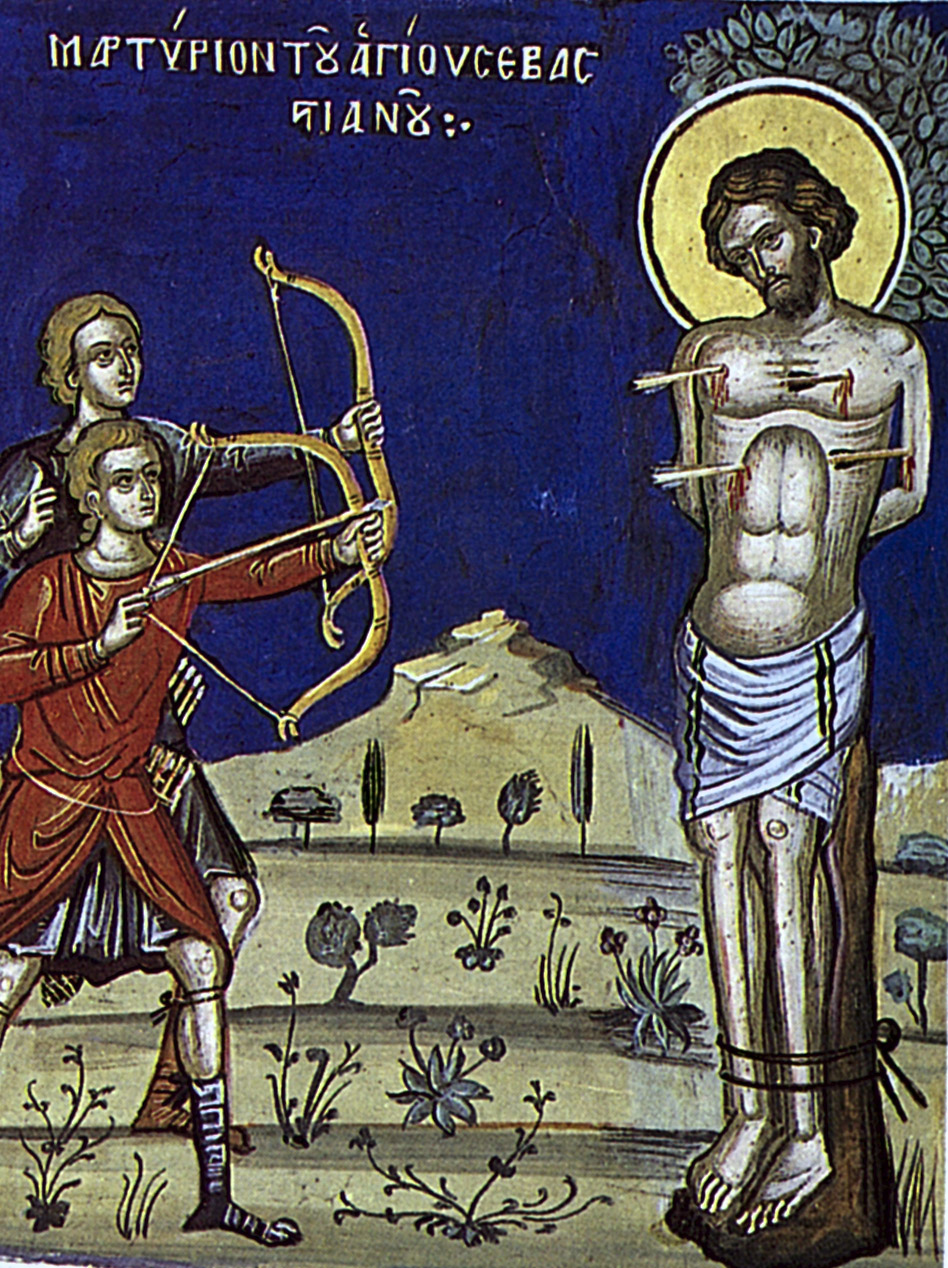
The Martyrdom of St. Sebastian (http://pravicon.com/images/sv/s1841/s1841003.jpg)

St Sebastian was the last one to be tortured. The emperor Diocletian personally interrogated him, and seeing the determination of the holy martyr, he ordered him taken out of the city, tied to a tree and shot with arrows. Irene, the wife of St Castulus, went at night in order to bury St Sebastian, but found him alive and took him to her home.

St Sebastian soon recovered from his wounds. Christians urged him to leave Rome, but he refused. Coming near a pagan temple, the saint saw the emperors approaching and he publicly denounced them for their impiety. Diocletian ordered the holy martyr to be taken to the Circus Maximus to be executed. They clubbed St Sebastian to death, and cast his body into the sewer. The holy martyr appeared to a pious woman named Lucina in a vision, and told her to take his body and bury it in the catacombs. This she did with the help of her slaves. Today his basilica stands on the site of his tomb.
(http://ocafs.oca.org/FeastSaintsViewer.asp?SID=4&ID=1&FSID=103565)

St. Sebastian the Martyr of Rome, pierced with arrows (http://www.aegeanews.gr/images%5Cstories%5Cproducts%5C4d0e3374c209d_pc170896.jpg)

Troparion - Tone 1

O Sebastian, spurning the assemblies of the wicked, you gathered the wise martyrs who with you cast down the enemy; and standing worthily before the throne of God, you gladden those who cry to you: Glory to Him Who has strengthened you! Glory to Him Who has granted you a crown! Glory to Him Who through you works healing for all!

Troparion - Tone 4

Your holy martyrs, O Lord, through their suffering have received incorruptible crowns from You, our God. For having Your strength, they laid low their adversaries, and shattered the powerless boldness of demons. Through their intercessions save our souls!

Kontakion - Tone 4

Excelling in godly zeal, you gathered a band of martyrs from which you shone as a star. The arrows that wounded your body, O Sebastian, pierced the hearts of the enemy. Therefore Christ has glorified you!

The Martyrdom of St. Sebastian (http://days.pravoslavie.ru/jpg/ih3891.jpg)

Through the prayers of our Holy Fathers, Lord Jesus Christ our God, have mercy on us and save us! Amen!

Saturday, January 17, 2009

The Veneration of the Precious Chains of St. Peter the Apostle

Greetings!

Yesterday (January 16th), our Church celebrates the Veneration and the many miracles which came about through the Precious Chains of the Apostle Peter.

Mosaic Icon of St. Peter the Apostle (Icon courtesy of http://www.eikonografos.com/ used with permission)

First, here is the account from the Greek Orthodox Archdiocese website (http://www.goarch.org/chapel/saints/388):
"Herod Agrippa, the grandson of Herod the Great and king of the Jews, grew wroth against the Church of Christ, and slew James, the brother of John the Evangelist. Seeing that this pleased the Jews, he took Peter also into custody and locked him up in prison, intending to keep him there until after the feast of the Passover, so that he could win the favour of the people by presenting him to them as a victim. But the Apostle was saved when he was miraculously set free by an Angel (Acts 12:1-19). The chains wherewith the Apostle was bound received from his most sacred body the grace of sanctification and healing, which is bestowed upon the faithful who draw nigh with faith.
That such sacred treasures work wonders and many healings is witnessed by the divine Scripture, where it speaks concerning Paul, saying that the Christians in Ephesus had such reverence for him, that his handkerchiefs and aprons, taken up with much reverence, healed the sick of their maladies: "So that from his body were brought unto the sick handkerchiefs or aprons, and the diseases departed from them, and the evil spirits went out of them" (Acts 19:12). But not only the Apostles' clothing (which certainly touched the bodies of the sick), but even their shadow alone performed healings. On beholding this, people put their sick on stretchers and beds and brought them out into the streets that, when Peter passed by, his shadow "might overshadow some of them"(Acts 5:15). From this the Orthodox Catholic [Catholic meaning "universal", not referring to Roman Catholicism] Church has learned to show reverence and piety not only to the relics of their bodies, but also in the clothing of God's Saints."
  

Picture of the Chains of St. Peter the Apostle kept in Rome (in San Pietro in Vincoli (St Peter in Chains) Roman Catholic Church) (taken from: http://www.sacred-destinations.com/italy/rome-st-peter-in-chains.htm)
  
Here is the account from the Orthodox Church of America website (http://ocafs.oca.org/FeastSaintsViewer.asp?FSID=100202):
"The Veneration of the Honorable Chains of the Holy and All-Praised Apostle Peter: In about the year 42, on the orders of Herod Agrippa, the Apostle Peter was thrown into prison for preaching about Christ the Savior. In prison he was held secure by two iron chains. During the night before his trial, an angel of the Lord removed these chains from the Apostle Peter and led him out from the prison (Acts 12:1-11).

Christians who learned of the miracle took the chains and kept them as precious keepsakes. For three centuries the chains were kept in Jerusalem, and those afflicted with illness and approached them with faith received healing. Patriarch Juvenal (July 2) presented the chains to Eudokia, wife of the emperor Theodosius the Younger, and she in turn transferred them from Jerusalem to Constantinople in either the year 437 or 439.

Eudokia sent one chain to Rome to her daughter Eudoxia (the wife of Valentinian), who built a church on the Esquiline hill dedicated to the Apostle Peter and placed the chain in it. There were other chains in Rome, with which the Apostle Peter was shackled before his martyrdom under the emperor Nero. These were also placed in the church.

On January 16, the chains of St Peter are brought out for public veneration."
  
Finally, St. Nikodemos of the Holy Mountain, in his Neon Eklogion, devotes a lengthy section to discussing the miracles associated with the Precious Chains of St. Peter. I'm not sure if a translation exists (perhaps in the Great Synaxaristes), but if not, perhaps at some point this in-depth discussion of the lives and miracles of the Saints can be translated. (For the Greek version, see the Νέον Εκλόγιον: http://anemi.lib.uoc.gr/search/?dtab=m&search_type=simple&search_help=&display_mode=&wf_step=init&show_hidden=0&number=10&keep_number=&cclterm1=%CE%9D%CE%AD%CE%BF%CE%BD&cclterm2=&cclterm3=&cclterm4=&cclterm5=&cclterm6=&cclterm7=&cclterm8=&cclfield1=term&cclfield2=&cclfield3=&cclfield4=&cclfield5=&cclfield6=&cclfield7=&cclfield8=&cclop1=&cclop2=&cclop3=&cclop4=&cclop5=&cclop6=&cclop7=&isp=&search_coll%5Bmetadata%5D=1&&stored_cclquery=&skin=&rss=0&display_mode=detail&ioffset=1&offset=15&number=1&keep_number=10&old_offset=11&search_help=detail)

But roughly, St. Nikodemos discusses that the Chains of St. Peter not only worked healings of physical ailments, but those for the soul, too. Once, a wise and pious Christian came to the Pope of Rome [who was Orthodox before the Great Schism] to confess a grave and fatal sin. The Pope showed joy at the man's repentance and confession, and he gave the man a canon of penance to fully deliver him from his sin by the authority of the Foremost (Κορυφαίον) of the Apostles [St. Peter]. So he told the man to put the Holy Chains of the Apostle on his hands, feet and body, and to proceed around the church where the Holy Apostle's Remains were kept seven times. Then, he would enter the center of the church, and hit his head against the door covering the Remains, and if they would open on their own accord, he would be assured of the forgiveness of his sin. The man did all this, and he touched the container of the Apostle's Remains, beseeching his help. And--O the speedy sympathy of the Foremost of the Apostles of Christ, Peter!--the seals were breached and the locks and doors opened on their own, and the man was assured of Christ's forgiveness! He returned to his home full of joy. For to him who received the keys to the Kingdom of Heaven and opens to whoever he wishes, it is paradoxical to see that the gates of that place [the container of the Apostle's Holy Relics] which were locked by the righteous from the unworthy, opened accordingly to him who was purified by repentance. And that Pope continued in the ways of compassion, and sharing this story with other Christians, he would fill them with joy. He became a model in the giving of canons, and gave confessing Christians a way of entreaty, and in this way they received the forgiveness of their sins.***
[***Note: So that this story is not misinterpreted, here is a short quote about the so-called "kanona" or canon of penance: "It is accompanied by our acceptance of whatever penance or kanona that may be possibly assigned by our spiritual father (e.g., fasting, almsgiving, or whatever else he considers suitable). We also must fully comprehend and accept that such penance does not constitute a “sentence” or a “punishment,” but it is a therapeutic and pedagogical element of our spiritual healing and means by which our spirituality is increased." (taken from: http://members.cox.net/orthodoxheritage/MOM%2005%202006.htm) Thus, Christ Himself runs to embrace us again as soon as we turn back to Him in repentance, and the canon is meant only to further help heal the penitent.]
  

Icon of the Veneration of the Precious Chains of the Apostle Peter (taken from: http://ocafs.oca.org/FeastSaintsViewer.asp?FSID=100202)
  
Apolytikion of the Veneration of St. Peter's Chains in the Fourth Tone
Without leaving Rome, thou didst come to us by the precious chains which thou didst wear. O foremost of the Apostles. And worshipping them with faith, we pray: By thine intercessions with God, grant us great mercy.
Kontakion in the Second Tone
Now Christ God, the Rock, doth glorify the rock of faith, illustriously, in calling all to celebrate the dread wonders of the most precious chains of Peter, the first and chief of the disciples of Christ our God, Who granteth forgiveness of sins unto all.
(taken from:
http://www.goarch.org/chapel/saints/388)
   

The Veneration of the Precious Chains of St. Peter the Apostle (http://www.ruicon.ru/exhibition/1x1.php?page_30=574&)
  
St. Peter the Apostle, intercede for us!
Through the prayers of our Holy Fathers, Lord Jesus Christ our God, have mercy on us and save us! Amen!