Encomium on the Beheading of the Precious Forerunner, by St. Theodore the Studite
Showing posts with label St. Theodore the Studite. Show all posts
Friday, August 29, 2014
Encomium on the Beheading of the Precious Forerunner, by St. Theodore the Studite
St. John, the Precious Forerunner and Baptist of Christ (source)
Encomium on the Beheading of the Precious Forerunner, by St. Theodore the Studite
Dear God-fearing Christians, the feast which we have gathered here to celebrate together today is radiant and filled with divine joy. It is rightly called radiant because it shines from the very name of him whom we are honouring today, since he is called the lamp of the light. He is not, of course, a lamp who illumines us with material light, because then his radiance would not be enduring and constant and would be lost every time some obstacle moved in front of it. But it is light that shows the brilliant radiance of divine grace in the depths of the hearts of those who have gathered to celebrate his memory and who elevate their minds to think upon the sufferings of the righteous man, so that gazing with the eyes of our souls upon his blessed martyrdom, we shall be filled with spiritual joy.
But our eyes rejoice at the sight of the blood of every saint, our ears delight to hear their messages of salvation and our lips reverence them. Because their loss grants perfect participation in the immortal and true life. I do not, of course, mean merely a drop of blood, but anything at all from their holy members- a single hair or anything they wore or touched with their hands- is desirable and valuable for those who have decided to believe and to worship God in the proper manner. This is why people who have something like this in their homes or church- that is a complete relic or a part thereof, even a very small piece- consider it a special honour and are proud of it, as if it were a treasure which advances their sanctification and ensures their salvation. And so they approach the reliquary containing the sacred dust with great reverence and touch with awe the sacred relics which are untouchable because of their sanctity.
What more do I need to say than to refer generally to the blood of all the apostles, the martyrs and prophets, which various gory murderers shed in many different ways and which now circles the earth like a rich river and extinguishes impiety?
Such was the blood of the Forerunner and Baptist of Christ, of whom we are speaking today, which he shed from his sacred neck like precious myrrh, which perfumes the whole world. This blood was not engendered by hedonistic gluttony, nor by wine, nor by any of the other foods which fatten the greedy and give them pleasure.
It was created by the grace of abstinence, which the saint practised from his infancy until his martyr’s death. And as the Lord said, John neither ate nor drank (Matth. 11, 18-19).
This blood was shed before the blood of the Lord, the immortal chalice. Because it was needful that the Forerunner of the Light, who with his radiant birth from a barren mother illumined everyone on earth, should become an effulgent herald also to those who were below the earth, that is in Hell.
This blood has boldness before the Almighty Lord, more than the blood of the righteous Abel. Because every action has within it a mystical voice, which is not produced by the vocal chords but which becomes evident from the power invested in it by the person who performs the action.
This blood is more deserving than that of the Patriarchs (Abraham, Isaac and so on), more valuable than the blood of the prophets and more sanctified than the blood of all the righteous. Because it is more wonderful even than the blood of the apostles and of the martyrs. Now these words are not mine; they’re from the Great Word, Jesus Christ, Who gave this testimony concerning the Honourable Forerunner.
It is blood which adorns the Church more beautifully than any decoration with variegated and rare flowers. It was shed for justice at the end of the era when the old law was in force, and became a flower which stands at the entrance of the presence of Christ.
But let us continue now to tell, on the basis of the Holy Gospels, how this blood was shed, by whom and for what cause. According to the Gospel, Herod arrested John, bound him and cast him into prison, because of Herodias, the wife of his brother, Philip. Because John had told him: “You’re not allowed to live with her”. So he wanted to put John to death but was afraid to do so, because all the people considered him a prophet (Matth, 14, 2-5).
Let’s see first who this Herod was, because there are two people with the same name, which is confusing, and we have to be clear who we’re talking about. This one is Herod the Tetrarch. His father, also Herod and the murderer of the Innocents, had died long before [In 4 B. C. Herod I actually had four sons named Herod].
But why did John upbraid him? Because he had abandoned his lawful wife, the daughter of King Aretas, and was living, illicitly, with the wife of his brother Philip. He could, of course, have married her legally, if she hadn’t already had children by his brother, because Mosaic law allowed this in order to provide heirs. But since she wasn’t childless, he couldn’t. She had a daughter who was also called Herodias, the offspring of a viper, the devil’s tool in her perdition. This is why John, quite rightly, rebuked him. This castigation, however, was not hubristic and was not spoken in order to wound Herod’s soul and dignity, but it was more of a reminder, the aim of which was to bring him to his senses.
So what did he say to Herod? “You’re not allowed to live with her”. He reminded him of the divine law, as if saying to him: “Look and see what the Law orders you to do. If there are two brothers and one of them dies without issue, the widow is not allowed to marry a stranger. The brother of the deceased shall marry her and the child who is born will take the name of the deceased, and thus his name will not be lost in Israel (Deut. 15, 5). That’s what the law says. But you’ve taken the wife of your brother and she already has a child. Don’t transgress against the ordinance put in place by the legislator. And don’t soil your royal purple with inadmissible incest. Don’t be seen to be doing something illegal when you should be giving your subjects an example of willing and glad observance of the law. And if you do fall into this error, you’ll be punished, because those in high office are punished more severely”.
But since he’d only recently come to power, Herod forgot about God. He was furious, boiling with rage, and would not accept the rebuke. He did not imitate David, who, when he was chastised by the prophet Nathan for the sin of adultery, said: “I have sinned before you, Lord” (II Kings 12-13). And the Lord forgave him, because of his humility. Herod, on the other hand, had John arrested, bound and cast into prison (Matth. 14, 3). So the one who was a prisoner of the passion of lewdness arrested him who lived in the most sublime freedom, because of his holy life. He who was bound by the magical cords of debauchery, put bonds on him who was liberated from all things, living as he did outside any binding relationship. He who was, in practice, sinking deep into the mire, put in prison him who was the guard and herald of the Church.
For the sake of Herodias, the wife of his brother, Philip (Matth. 14, 9). For the sake of Herodias, who shared the morals of Delilah, a true tool of the devil. Because it was she who encouraged him who shared her bed- or illicit love we should really say- and made him furious with John. She told him: “I’m a queen and I can’t be made a laughing-stock by the son of Zachariah. Imprison the tongue that’s breaking my bones. Stab, at once, him whose words are wounding my soul like arrows”. And although he wanted to put him to death, he didn’t do so because he was afraid of the people, who considered John a prophet and respected him as such (Matth. 14, 5). Because if people in power want to do something illegal, they can’t execute it as soon as they’ve thought of it, for two reasons: first because they’re ashamed and fear their subjects; and second because they wait until the opportunity arises to put into effect the hatred in their souls without risk to themselves.
So while they were celebrating Herod’s birthday, Herodias’ daughter came out in front of them and danced. She pleased Herod very much and he swore to grant her anything she wanted (Matth. 14, 6).
On the day when he ought to have been thanking God for bringing him into the light of this life, he chose the works of darkness.. This was a day meant for spiritual joy, not for dancing, and certainly not for women dancing in front of men. What did this dance produce? The oath. And from that? Murder. Root out evil and lawlessness will not flourish. But if evil does take root, it’ll bear fruit, that is, it’ll be put into effect. Herodias’ daughter danced in the midst of the guests and pleased Herod. What else would the harlot-trained girl have learned from her mother, other than to dance provocatively and with such skill as to please Herod greatly. This is why he swore an oath to grant her whatever she wished. This is how rashly the tongues of people run away with them when they lose themselves in the passions of degradation: they blurt out in front of everyone, without thinking, whatever comes into their mind. The girl, schooled by her mother, brought about the hideous decapitation of Saint John, which the venomous Herodias had been wanting to achieve for a long time. I imagine she would have said: “This is the chance we’ve been looking for, my child. You’ve managed, with your dancing feet, to get him to offer me what I wanted. You’ve ended my pain with your skilful song. Let’s bury the man who’s rebuking us. Go quickly and tell Herod: ‘Give me John the Baptist’s head on a platter’ (Matth. 14, 8). What a ferocious and murderous demand! Even though she didn’t have the right to think and enjoy the spectacle of the murder, she outdid everyone in cruelty. What a crazed murderess! Not content with decapitation, you arranged for the head to be brought to you on a platter. What a depraved and debauched woman! Your brutality outstrips even that of blood-stained Jezebel.
The Gospel tells us that the king was saddened. But because he had sworn an oath and had promised in front of his guests, he ordered that she be given the head. He sent to the prison and had John beheaded. Then they set the head on a platter and brought it to the girl and her mother (Matth. 14, 11).
What an evil end to a diabolical coil! Who aimed the stroke of the deathly sword at the saintly head? A lawless servant, who like another Doeg, did not imitate those Jews who with circumspection and bravery stood up to King Saul when he ordered them to murder God’s prophets. “And they brought the head of John on a platter”. What should we call this revel? A banquet or the scene of a murder? What should we call the addle-pated guests? Fellow diners or blood-stained participants?
What an unprecedented sight! What a sinful sight! On the one hand, they were offering chicken and, on the other, a platter with the head of a prophet. From one side, rich clear wine was flowing and from the other the blood of a righteous man was gushing.
How terrible it is for me to say it and dreadful to express!
“And they gave it to the girl and she took it to her mother”. What a sinful sight! Alas! How utterly macabre! The invaluable head was exchanged for a worthless action; the pure and inviolate head, worthy of respect even from the angels, was given for an accursed and impious act. And she handed it to her mother as if she were giving her well-cooked food. To her who in her manic fury had directed the death, as if the child were saying: “Here you are, mother, meat of the flesh of him who lived on earth as if fleshless. Drink the blood of the faster. Once and for all we’ve now shut the mouth of him who rebuked us”.
According to the Gospel, his disciples then came, took away his body and buried it (Matth. 14, 13). Those of you who love history, look at how the burial of this righteous man is depicted and gives the lie to those enemies of the holy icons, who are also enemies of the truth. Fix the story in your minds and draw useful conclusions. How they took the saint, bound in heavy chains, from the prison How the executioner, like a wild animal, raised the sword against the holy head. How, after the beheading, the myrrh-exuding head was offered to the raving Herodias. And also how the sacred body was buried by the hands of his disciples, who all stood there, in tears, with a pain that tore at their souls. How one embraced the feet of the saint, another tried to fit the head back on to the motionless body and another sang funeral hymns while censing the body.
Now I’m there in my mind’s eye and can see the funeral of the righteous man taking place in an atmosphere of peace, as is mentioned in the Prophet Isaiah [57, 1-2: “See how the just man has perished and no one takes it to heart, and righteous men are taken away and no-one considers it. For the righteous man has been removed by injustice. His burial shall be in peace”]. I envision that angelic face, whose eyes have set like two shining suns and on which all the beauty of his soul has been imprinted. Without any fleeting and earthly breath, but full of the overpowering fragrance of divine grace. I kiss those holy hands, which never touched sin and the finger that pointed people to Christ, Who took upon Himself the sin of the whole world. I fall down before those beautiful feet, which told the good news to people and through which the way of the presence of the Lord was prepared. Bring me, so that I may reverence it, the honourable chain with which the most precious and angel-like of men was bound. Bring me the venerable platter on which the revered head- more precious than gold and jewels- was placed. Had I been there, I wouldn’t have omitted to pay my respects to the murderous sword which sliced through the holy neck, nor would I have hesitated to cover with kisses the ground where the treasure was laid, in the certainty that this, too, would bring me divine grace. Blessed grave and joyous tomb-stone, that cover the thrice-blessed corpse and wrap the body more precious than a mass of emeralds and pearls.
So at this scene there were the visible company of his disciples and an invisible host of angels, praising, glorifying and hymning John, bearing to eternal joy him who lived as a bodiless angel and foretold the coming of the Messiah. He who was a genuine friend of the Lord, who guided the Church to the celestial Bridegroom, the undimmed lamp of the ineffable light, the living voice of God the Word, who was superior to the prophets, greater than any man ever born of woman. The burial of this righteous man, then, was peaceful, as we’ve described it, a harbinger of joy and salvation to the whole world.
So did the insane Herod manage to escape punishment for his profanity for the rest of his life on earth? Of course not. On the contrary, because of this misdeed, all his subjects rose up against him and he was deposed. In this way, God wanted to frighten and admonish later kings, to prevent them committing similar crimes. But to return to our theme, let us acclaim this day as is proper.
Today, John the Forerunner is praised because he sacrifices his head for the truth, and Herod the transgressor is ridiculed and mocked. Today, John the Forerunner is lauded by all for his stern rebuke, and the insane Herod is dishonoured through his adultery. Today, the head of John the Forerunner is offered as a sacred sacrifice on a platter, and the adulteress Herodias, against her will, receives eternal condemnation. Today, the blood of John the Forerunner is shed because he observed the divine law and he who opposed the Baptist by breaking the law is rightly driven out. Today, because of forthrightness towards Herod, John the Forerunner is beheaded for upholding righteousness.
This is the way the kings of the earth learn not to put away their lawful wives and they condemn him who did so. Today, John the Baptist plants a landmark in the ground and urges all men to be satisfied with their lawful wife and to go no further than that. Today, John the Forerunner descends into Hell and the dead receive the glad tidings of the presence of Christ. Today, the heavens rejoice over the decapitation of John the Forerunner, who was sacrificed for God’s justice; while people on earth celebrate with hymns of thanksgiving. And in my view, the Honourable Forerunner is watching us from the heavens and rewarding with divine gifts those who praise him with hymns. Among the choir of the prophets, like the morning star, he rises and illumines the firmament of the Church. Among the apostles, before them and more than them he shines as a sun among suns. Among the martyrs, he is distinguished for his miracles, like a star-decked sky. Among the righteous he stands out for the many trials he suffered, for the sake of justice, and he who spread joy throughout the world is elevated higher than the cedars of Lebanon.
Because if, according to Saint Luke (2, 10) many people rejoiced at his birth, the joy on this the day of his martyr’s death should be equivalent. We have been found worthy to celebrate it, all of us, priests, hermits, coenobites and lay people, because everyone has a share in the joy his message provides. And may his intercessions be even more with us, who live in this holy monastery, in the name of Jesus Christ, our Lord.
To Whom is due glory and power, together with the Father and the All-Holy and Life-Giving Spirit, now and ever and unto the unending ages of ages. Amen.
Through the prayers of our Holy Fathers, Lord Jesus Christ our God, have mercy on us and save us! Amen!
Friday, April 19, 2013
Catechesis on the Annunciation by St. Theodore the Studite
The Most-holy Theotokos and Christ (source)
CATECHESIS 64
On the incarnate dispensation of our Lord Jesus Christ, and that we should celebrate spiritually. It was spoken on the day of the Annunciation.
Brethren and fathers, the Annunciation is here and it is the first of the Feasts of the Lord, and we should not simply celebrate as most do, but with understanding and with reverence for the mystery. What is the mystery? That the Son of God becomes son of man, using the holy Virgin as the means, dwelling in her and from her fashioning for himself a temple and becoming perfect man. Why so? That he might ransom those under the law, as it is written, and that we might receive sonship[Gal. 4,5.]; that we may no longer be slaves, but free; no longer subject to the passions, but free of passions; no longer friends of the world, but friends of God; no longer walking according to the flesh, but according to the spirit. Those who walk according to the flesh, think the things of the flesh; those who walk according to the spirit, the things of the spirit; for the thought of the flesh is death; but the thought of the spirit, life and peace. And so the thought of the flesh is hostile to God, for it is not subject to the law of God. Indeed it cannot be. Those who are in the flesh cannot please God [Rom. 8,5-8.]. In brief this is the power of the mystery, and this is why we should celebrate spiritually and behave spiritually, with holiness and justice, with love, with gentleness, with peace, with forbearance, with goodness, with the Holy Spirit [2 Cor. 6,6.], so that as far as we ourselves are concerned we do not render the dispensation of our Lord Jesus Christ empty and ineffectual. Not only that, but we should both pray and grieve for the world. Why so? Because the Son of God came to save the world, and the world rejects him. Tribes and languages reject him; the barbarian nations reject him, those who have had his holy name invoked upon them reject him, some through abandoning the faith, others through their evil lives. What should he have done and did not do? Being God he became man, he humbled himself, becoming obedient unto death, the death of the cross [Phil. 2,8.]; he gave us his body to eat and his blood to drink; he allowed us to call him Father, Brother, Head, Teacher, Bridegroom, Fellow-heir and all the other titles which there is no time to mention now. And still he is rejected, and still he bears it. For, he says, I have not come to judge the world, but to save the world [John 12,47.]. What then is there to say, brethren? That the genuine disciples are grieved by the rejections of their fellow-disciples, thus showing love both for the teacher and for the disciples. So too, genuine servants suffer in the same way from the desertions of their fellow-servants. This is why the great Apostle orders that we should offer supplications, prayers, entreaties, thanksgivings on behalf of all mankind, for kings and for all in high positions [1 Tim. 2,1-2.]; and elsewhere he says this on the subject, I speak the truth in Christ, I do not lie, my conscience bears witness with me in the Holy Spirit, that I have a great grief and unceasing anguish in my heart; for I have prayed that I might be anathema to Christ for the sake of my brethren, my kinsmen according to the flesh [Rom. 9,1-3.]. You see the power of love? You see the height of friendship? Moses shows it too when he says to God, If you will forgive them their sin, forgive; if not, wipe me out of the book which you have written [Exodus 32,32]. So we too, as genuine and not counterfeit disciples, should not only look to what concerns ourselves, but we should grieve and pray for our brothers and for the whole world; for by so doing what is pleasing to the Lord we shall become inheritors of eternal life, in Christ Jesus our Lord, to whom be the glory and the might with the Father and the Holy Spirit, now and for ever, and to the ages of ages. Amen.Texts and translation copyright to Archimandrite Ephrem © (source)
Through the prayers of our Holy Fathers, Lord Jesus Christ our God, have mercy on us and save us! Amen!
Friday, September 7, 2012
Excerpt from the Homily on the Nativity of the Theotokos by St. Theodore the Studite
The Nativity of the Theotokos - Commemorated September 8th (http://iconreader.files.wordpress.com/2011/09/0ikonarozhdestbogomatmrub.jpg)
Excerpt from the Homily on the Nativity of the Theotokos by St. Theodore the Studite (amateur translation)
Creation celebrates radiantly today,
receiving the Virgin as a new heaven. A girl is born upon the earth,
who holds the King of the heavens in her palm. A youth comes into the
light of the rays of the sun and shines brighter than lightning. A
child shines from a barren womb, who is the most-sacred treasury of
virginity. Who would not come out for this festival? Who would not
come out for the feast, and speak lovingly of the Virgin? A beautiful
gift of virgins is incorruption, bodily chastity, the giving of
riches to the poor in thanksgiving, the meekness of rulers, the
righteousness of kings, the holiness of priests, and the lawfulness
of all in all things. And with gifts like these follow the bearing of
lamps; come let us skip joyously. Let us sing characteristically with
David: “Come let us rejoice in the Lord, let us cry to God our
Savior.” The temple that receives the Creator of all is given
refuge, that the Creator and Word might be prepared a strange
dwelling, that the Sun of righteousness might be covered with a cloud
of light, that He Who clothes the heaven with clouds might be clothed
in the God-woven robe and raised to stand, that He Who orders times
and seasons and years might be shown a bridal chamber.
Dance, O youths, for it is the nativity
of the Virgin. Skip, O mothers, for the motherly fruit is the Virgin.
Barren ones, have hope, for she who was formerly barren later gave
birth to a godly child beyond her hopes. Let no lady be absent from
this choir, which crowns the crown of the Queen to celebrate her
nativity.
(http://khazarzar.skeptik.net/pgm/PG_Migne/Theodorus%20Studita_PG%2099/Homilia%20in%20nativitatem%20Mariae.pdf)
Most-holy Theotokos, save us!
Through the prayers of our Holy Fathers, Lord Jesus Christ our God, have mercy on us and save us! Amen!
Sunday, May 8, 2011
Excerpt from the Encomium on St. John the Theologian by St. Theodore the Studite
Christ is risen! Truly, He is risen!
The following is an excerpt from an encomium by St. Theodore the Studite on St. John the Theologian. It is a truly beautiful homily, and I have yet to find it translated, so I have started by translating a small piece. May the Theologian (along with St. Theodore) intercede for us all!
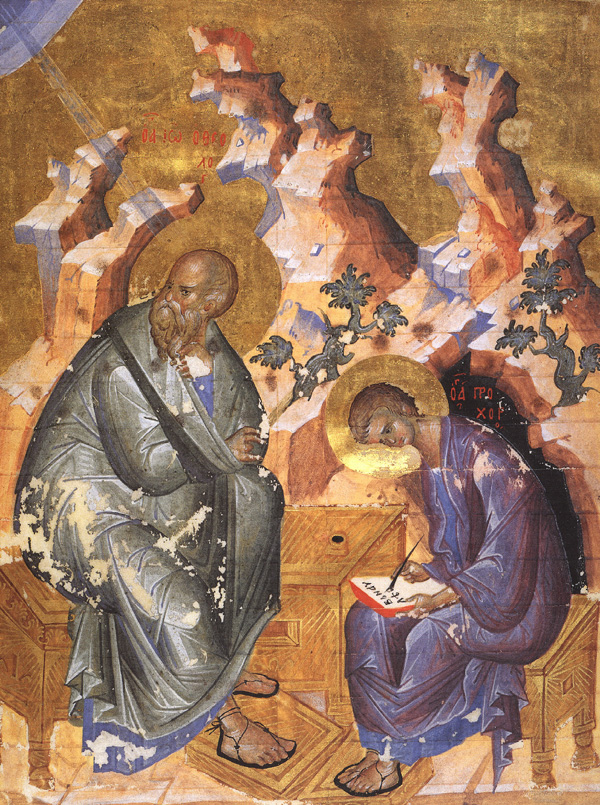
St. John the Theologian, and his disciple, St. Prochoros (http://ia600102.us.archive.org/13/items/Icoane/IoanEvanghelistul06.jpg)
Θεοδώρου Στουδίτου, “Εγκώµιον εις τον µέγαν Ιωάννην τον απόστολον και ευαγγελιστήν του Χριστού.” Migne J.P. Patrologia Graeca, 99, 771-788
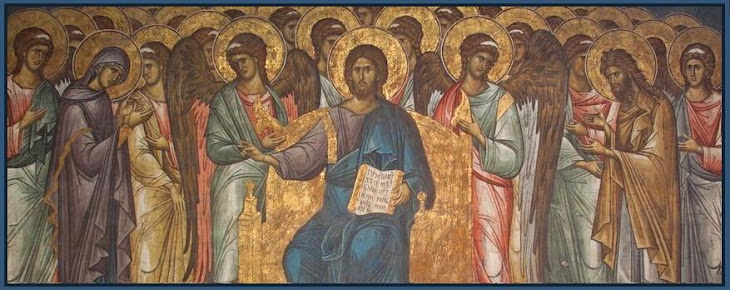
The Theotokos "Kataphygi" ("Refuge"), and St. John the Theologian (http://upload.wikimedia.org/wikipedia/commons/9/9b/Avers_Poganovo_Icon.JPG)
Excerpt from an Encomium on St. John the Theologian, by St. Theodore the Studite (Amateur translation)
And do you wish to learn who was this great man? John, O men, the very early apostle, the pronounced of the evangelists, the great and golden-winged eagle of God, the one who studied the unapproachable depths of heaven, the man who was beyond the cherubim and unequalled in theoria, the presence of the beginningless Word, and angel among angels, the most greatly-worded preacher of truth, the most highly-seen nous, the fiery tongue, the godly-phrased mouth, the endless gulf of wisdom, the unapproachable in depth of dogmas, the great container of knowledge, the lightning of the Spirit that appears to the world, the thunder of grace of the universe, the firm pillar of the Church, the confirming foundation of God, the net capturing the wildness of the human nature, the fisher of souls with the heavenly-lengthed rod, the one who ever moves to saw apart heresies, the one who cuts the weeds of impiety with a sharp knife, the one who locks out the armies of atheism with a heavenly key, the one who removes the teeth of the noetic beasts that corrupt the mind, the one who sails the waves of the river of the wisdom of God, the most-pure temple of virginity, the very early beloved one and recliner-on-the-boosm of the [One Who] is desired, the great and beautiful-roaded sun on the Gospel, and what else could you say? For this dusky catalogue of a thousand [praises] cannot do justice even if the abyss were filled with encomiums. Bring them, bring all that can be said, for though this is poor, and I have no tongue to speak, a power from above will work the greatness of a miracle, for the height of heaven cannot be counted. And if we be granted to praise him, let us as a foundation take from the honey-like flowers of his evangelical words, and beholding this, from this honey let us rationally make wax, and as those called to the apostolic feast as to a king, as an assistant where the word is received, approach himself and take courage.
Christ is risen from the dead, by death, trampling down upon death, and to those in the tombs, bestowing life!
Truly the Lord is risen!
Monday, March 7, 2011
Selected Quotes of the Fathers on Great Lent
Icon depicting the Ladder of Divine Ascent (http://translate.googleusercontent.com/translate_c?hl=en&ie=UTF-8&sl=ru&tl=en&u=http://www.icon-art.info/hires.php%3Flng%3Dru%26type%3D1%26id%3D2003&prev=_t&rurl=translate.google.com&twu=1&usg=ALkJrhhDAO54XnD9TEkjm8n8KUbzjWnOHQ)
Selected Quotes of the Fathers on Great Lent
"As we are therefore beginning this sacred season, dedicated to the purification of the soul, let us be careful to fulfill the Apostolic command that we cleanse ourselves from all defilement of the flesh and of the spirit (IICor. 7:11), so that restraining the conflict that exists between the one and the other substance, the soul, which in the Providence of God is meant to be the ruler of the body, may regain the dignity of its rightful authority, so that, giving offense to no man, we may not incur the contumely of evil mongers. With just contempt shall we be tormented by those who have no faith, and from our wickedness evil tongues will draw weapons to wound religion, if the way of life of those who fast be not in accord with what is needed in true self-denial. For the sum total of our fasting does not consist in merely abstaining from food. In vain do we deny our body food if we do not withhold our heart from iniquity, and restrain our lips that they speak no evil." - St. Leo the Great - 'Lent the Season of Purification
"Blessed is the mind that passes the time of its pilgrimage in chaste sobriety, and loiters not in the things through which it has to walk, so that, as a stranger rather than the possessor of its earthly abode, it may not be wanting in human affections, and yet rest on the Divine promises." - St. Leo the Great - 'Homily 49: On Great Lent
"...We must then so moderate our rightful use of food that our other desires may be subject to the same rule. For this is also a time of peace and serenity, in which having put away all stains of evil doing we strive after steadfastness in what is good. Now is the time when generous Christian souls forgive offences, pay no heed to insults, and wipe out the memory of past injuries. Now let the Christian soul exercise itself in the armour of justice, on the right hand and on the left, so that amid honour and dishonour, evil report and good, the praise of men will not make proud the virtue that is well rooted, the conscience that has peace, nor dishonour cast it down. The moderation of those who worship God is not melancholy, but blameless." - St. Leo the Great - "Lent the Season of Purification (The Sunday Sermons of the Great Fathers)
"When He had fasted for forty days and forty nights, and afterwards was hungry, He gave an opportunity to the devil to draw near, so that He might teach us through this encounter how we are to overcome and defeat him. This a wrestler also does. For in order to teach his pupils how to win he himself engages in contests with others, demonstrating on the actual bodies of others that they may learn how to gain the mastery. This is what took place here. For, desiring to draw the devil into contest, He made His hunger known to him. He met him as he approached, and meeting him, with the skill which He alone possessed, He once, twice, and a third time, threw His enemy to the ground." - St. John Chrysostom - The Sunday Sermons of the Great Fathers
"Special services, special foods, continence, not going to dances and events, all this awakes one to piety and reflection on our present purpose, on the past and on eternity. Seeing in ourselves a falling away from the commandments of God, we try to reconcile ourselves to God through repentance and communion of the most pure and life-giving Mysteries of Christ, which burn the thorns of our sins. You, when you have not fulfilled this duty during the year, of course will fulfill it during the Fast. The most merciful Lord loved us so much, that He gave us, through food and drink, His most pure Body and life-giving Blood, as a token of life eternal and the incorrupt future feast. Let us offer Him thanksgiving with pure hearts, lips and acts!" - St. Macarius of Optina (Letters...)
"And though every day a man lives may rightly be a day of repentance, yet is it in these days more becoming, more appropriate, to confess our sins, to fast, and to give alms to the poor; since in these days you may wash clean the sins of the whole year." - St. John Chrysostom - "The Sunday Sermons of the Great Fathers"
(http://scienceofsalvation.blogspot.com/)
"Brethren and Fathers, our good God who gives us life and brings us from year to year, has brought us also with love for mankind to this present time of fasting, in which each of the eager, as their choice directs, enters the contest; one devoting himself to self-mastery, eating only every two or three days, another to vigil, keeping vigil for so long or so long, another spending even longer in prostrations, and others in other ascetic actions. Quite simply during these holy days it is possible to see great zeal and attention. But the true subject behaves with obedience not at any particular time, but keeps up the struggle always. What is the struggle? Not to walk according to one’s own will, but to let oneself be ruled by the disposition of the superior. This is better than the other works of zeal and is a crown of martyrdom; except that for you there is also change of diet, multiplication of prostrations and increase of psalmody are in accord with the established tradition from of old. And so I ask, let us welcome gladly the gift of the fast, not making ourselves miserable, as we are taught, but let us advance with cheerfulness of heart, innocent, not slandering, not angry, not evil, not envying; rather peaceable towards each other, and loving, fair, compliant, full of mercy and good fruits; breathing in seasonable stillness, since hubbub is damaging in a community; speaking suitable words, since too unreasonable stillness is profitless; yet above all unsleepingly keeping watch over our thoughts, not opening the door to the passions, not giving place to the devil. If the spirit of the powerful one, it says, rise up against you, do not let it find your place. So that the enemy has power to suggest, but in no way to enter. We are lords of ourselves; let us not open our door to the devil; rather let us keep guard over our soul as a bride of Christ, not set about with tumult, unwounded by the arrows of the thoughts; for thus we are able to become a dwelling of God in Spirit. Thus we may be made worthy to hear, "Blessed are the pure in heart, for they shall see God." Quite simply, Whatever is true, whatever noble, whatever just, whatever pure, whatever lovely, whatever of good report, if there is anything virtuous, if there is anything praiseworthy, to speak like the Apostle, do it; and the God of peace will be with you all, in Christ Jesus, our Lord, to whom be the glory and the might, with the Father and the Holy Spirit, now and for ever, and to the ages of ages. Amen." - St. Theodore the Studite - Catechesis 53 "On fasting; and that the true fast of the obedient and the subject is the cutting off of one’s will. Given on Cheesefare Sunday."
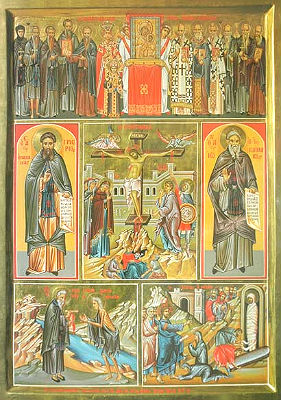
The Feasts of Great Lent: the Sunday of Orthodoxy, Sts. Gregory Palamas and John Klimakos, the Crucifixion of Christ, St. Mary of Egypt, and the raising of St. Lazarus (http://happy-school.ru/Ikona/put_posta.jpg)
Forgive me, and may God forgive us all!
Through the prayers of our Holy Fathers, Lord Jesus Christ our God, have mercy on us and save us! Amen!
Saturday, August 14, 2010
Excerpt from St. Theodore the Studite's Encomium on the Dormition of the Theotokos
“Now the Mother of God shuts her material eyes, and opens her spiritual eyes towards us like great shining stars that will never set, to watch over us and to intercede before the face of God for the World’s protection. Now those lips, moved by God’s grace to articulate sounds, grow silent, but she opens her [spiritual] mouth to intercede eternally for all of her race. Now she lowers those bodily hands that once bore God, only to raise them, in incorruptible form, in prayer to the Lord on behalf of all creation. At this moment her natural form, radiant as the sun, is hidden; yet her light shines through her painted image, and she offers it to the people for the life-giving kiss of relative veneration, even if the heretics are unwilling. The holy dove has flown to her home above, yet she does not cease to protect those below; departing from her body, she is with us in spirit; gathered up to heaven, she banishes demons by her intercession to the Lord.”
(http://www.holytrinity.info/pdf/2005_august_ekfonesis.pdf)
Most-Holy Theotokos, save us!
Sunday, March 21, 2010
Sermon of St. Theodore the Studite for the Fifth Sunday of Great Lent
Christ Talking to Women from Jerusalem : "Daughters of Jerusalem, weep not for me, but weep for yourselves" (http://stage.srpskoblago.org/Archives/Decani/exhibits/Collections/PassionChrist/CX4K1903_l.html)
CATECHESIS 68: That We Must Be Renewed For What Is Ahead Through Endurance of the Trials That Fall Upon Us, Both Visible and Invisible.
by St. Theodore the Studite
Given On the 5th Sunday of Great Lent.
"Brethren and fathers, because winter has passed and spring has arrived, we see creation flourishing again; the plants are flowering, the earth is growing green, the birds are singing and everything else is being renewed; and we take pleasure in all this and we glorify God the master craftsman who transforms and changes creation year by year, and it is reasonable to do so. "Ever since the creation of the world His eternal power and divine nature, invisible though they are, have been understood and seen through the things He has made" [Rom. 1:20].
It is our duty not just to stay where we are, but to advance further and to examine carefully for ourselves the logic of creation. How? Because this renewal has winter as its cause. It would not have reached its prime had it not first undergone snows and rains and winds. And so it is with the soul; unless it is first snowed on by afflictions, troubles and difficulties, it will not flower, it will not fruit; but by enduring, it bears fruit and partakes in a blessing from God, as it is written: "Ground that drinks up the rain falling on it repeatedly, and that produces a crop useful to those for whom it is cultivated, partakes in a blessing from God" [Heb. 6:7].
Therefore, brethren, let us also endure every affliction, every trouble, every trial which assails us both visibly and invisibly. The fast we are drawing out as we hunger and thirst and are otherwise made wretched, so that we may bear fruit and partake of God's blessing; and not only that, but that we may nourish and welcome Jesus as our guest. For just as we enjoy the sight of creation, so He too enjoys the ripe beauty[1] of our souls. What are the fruits? "Love, joy, peace, patience, goodness, generosity, faithfulness, gentleness, self-mastery" [Gal. 5:22]. By these He is nourished, by these He is entertained. And blest the one who nourishes Him, because he will be nourished by Him with eternal good things; and blest the one who receives Him as his guest, because he will be received by Him as his guest in the kingdom of heaven! Indeed! So if someone is to receive a king as his house guest, he rejoices and is extremely glad; how much more then someone who receives the King of kings and Lord of lords as his house guest. That he is received is clear from what He himself has said: "I and my Father will come and make our abode with him" [John 14:23]. And again: "One who has My commandments and keeps them, is the one who loves Me; the one who loves Me will be loved by My Father, and I shall love him and manifest Myself to him" [John 14:21].
Therefore, since such are the promises, let us not only bear, but let us endure with joy all things, both those that are present, those that are whispered about, and those that are expected, as we listen to the Apostle when he says: "Now I rejoice in my sufferings for your sake, and in my flesh I complete what is lacking in Christ's afflictions for the sake of His body, that is the Church" [Col. 1:24]. And again Saint James who says: "My brethren, whenever you face trials of any kind, consider it nothing but joy, because you know that the testing of your faith produces endurance; and let endurance have its full effect, so that you may be perfect and complete, lacking in nothing" [James 1:2-4]. Do you see then that in trials there is joy, and in tribulations gladness? For these are the things that are exchanged where God is concerned; and this is how the saints led their lives; this too how we, by doing violence to ourselves and yet greater violence, and by living our life in their footsteps, shall inherit the kingdom of heaven, in Christ Jesus our Lord, to whom be glory and might, with the Father and the Holy Spirit, now and always and to the ages of ages. Amen.
1. The Greek has literally ‘the hour of our souls’, but the word can also connote ‘beauty‘, ‘ripeness’, ‘the bloom of youth’, ‘spring-time’. Hence, for example, the derivatives ‘beautiful’ and ‘ripe’."
(http://www.anastasis.org.uk/ths68-70.htm)
St. Theodore the Studite - Commemorated on November 11th (http://ocafs.oca.org/FeastSaintsViewer.asp?FSID=103281)
Through the prayers of our Holy Fathers, Lord Jesus Christ our God, have mercy on us and save us! Amen!
Wednesday, March 10, 2010
Sermon of St. Theodore the Studite for the Fourth Wednesday of Great Lent
Christ the Great High Priest (Icon courtesy of www.eikonografos.com used with permission)
Catechesis 66 of St. Theodore the Studite: That This Pascha Is a Type of the Future and Eternal Pascha; and About Endurance and Courage
Given on the Fourth Wednesday of the Great Fast
"Brethren and fathers, Lent is already galloping past and the soul rejoices at the imminence of Pascha, because by it it finds rest and is relieved of many toils. Why did this thought sound for me in advance? Because it is as if our whole life directs its reason contemplating the eternal Pascha. For this present Pascha, even though it is great and revered, is nevertheless, as our fathers explain, only a type of that Pascha to come. For this Pascha is for one day and it passes, while that Pascha has no successor. From it "pain, grief and sighing have fled away"[1]; there everlasting joy, gladness and rejoicing; there the sound of those who feast[2], a choir of those who keep festival and contemplation of eternal light; where there is the blessed breakfast[3] of Christ and the new[4] drink of which Christ spoke, "I shall not drink of the fruit of this vine, until I drink it with you new in the kingdom of my Father".[5] Of this He spoke to his disciples when He was about to ascend to heaven, "I am going to prepare a place for you and, if I go, I will prepare a place for you. I am coming again and I will take you to myself, so that where I am you maybe also. And where I am going you know, and the way you know."[6] And a little further on, "On that day you will know that I am in the Father, and you are in Me, and I am in you."[7] And elsewhere, "Father, I wish that where I am they may be with Me also, so that they may see My glory, which You gave Me, because You loved from before the foundation of the world."[8] But because this concerns not only the Apostles, but also ourselves, He also said, "I do not ask this only for them, but also for those who through their word believe in Me, so that all may be one, as You, Father, are in Me and I am in You, that they may also be one in Us."[9] What could be more comforting than these words? What could be more appealing? What soul can they not soften? What heart not prick with compunction, even should someone say that the human heart is a nature of stone? With thoughts like these the saints bore all that they bore, considering afflictions as joys, constraints as freedoms[10], struggles as delights, harsh training as relaxation, deaths as lives.
I beseech you, my brother, should not we also, since we have the same aim and seek the same Pascha, bravely and courageously bear our present condition, not falling, not succumbing to despondency, but rather roused with greater fervour watching for the wicked serpent who works to deceive us by the passions, transforming himself into an angel of light,[11]and altering things from what they are; show dark as light, bitter as sweet. This was how he ensnared our forefather, bewitching his sight and depicting as beautiful what was not, and as a result through food casting him out of Paradise. But let us, who have learned by experience what a deceiver he is, not leave the paradise of God’s commandments, nor, when he indicates to us that the fruit is beautiful, let the eye of soul or body be directed there, otherwise we are being caught in the snare. But let us flee by every means from looking. What is the fruit which seems beautiful? The love of the flesh, the evil lust of every one of the destructive passions. If we avoid experiencing them, my brothers, we shall be saved and easter[12] to age on age, with all the Saints in Christ Jesus our Lord, to whom be glory and might with the Father and the Holy Spirit, now and for ever, and to the ages of ages. Amen.
Notes:
[1] Isaiah 35:10. The phrase is familiar from the prayer for the departed.
[2] Cf. Psa. 42:4, where the Greek has a singular. The same phrase is found, but with the plural, in the prayers after Communion.
[3] Cf. John 21:12.
[4] The Greek has koinon, ‘common’, but the word should be kainon, ‘new’, as the following citation makes clear. There is also an echo of the Paschal canon, ‘Come, let us drink a new drink’ (poma kainon).
[5] Matthew 26:29.
[6] John 14:2-4.
[7] John 14:20.
[8] John 17:24.
[9] John 17:20-21.
[10] It is difficult to reproduce the play in Greek on stenochoria and evrychoria.
[11] 2 Corinthians 11:14.
[12] St Theodore uses a very rare verb paschazein, and temptation to follow G. M. Hopkins and use ‘easter’ as a verb is irresistible. The only reference in Lampe is to St Theodore’s contemporary Theophanes, who uses it of the Quartodecimans, who ‘easter’ with the Jews.
(http://www.johnsanidopoulos.com/2010/03/sermon-for-fourth-wednesday-of-great.html)
For many excellent sermons of St. Theodore the Studite used throughout the Great Fast, see: http://www.anastasis.org.uk/lent.htm.
St. Theodore the Studite - Commemorated on November 11th (http://christopherklitou.com/icon_11_nov_theodore_the_studite.htm)
Through the prayers of our Holy Fathers, Lord Jesus Christ our God, have mercy on us and save us! Amen!
Thursday, December 25, 2008
On the Nativity of Christ: the Catechesis of St. Theodore
Christ is born! Glorify Him!
The following is the Catechesis 32 from St. Theodore the Studite, titled: "On the Nativity of the Saviour and the vigorous pursuit of our ascetic life", as translated by Fr. Ephraim and taken from: http://www.anastasis.org.uk/ths32.htm . It is traditionally read after the First of the Royal Hours for Christmas.
Detail of the Infant Christ and the Theotokos from a fresco of the Holy Nativity of Christ from Decani Monastery (taken from: http://www.srpskoblago.org/Archives/Decani/exhibits/Collections/GreatFeasts/CX4K1562.html)
St. Theodore the Studite - CATECHESIS 32: "On the Nativity of the Saviour and the vigorous pursuit of our ascetic life.
Brethren and Fathers, already the Manifestation of God is near and the day of joy is at the doors; for it is a great joy, such as has not been since time began, that the Son of God has come to us, not through riddles and symbols, as he appeared of old to the fathers, but by coming to live with us and manifesting himself in his own person through his birth from a Virgin. There has been nothing more blest than this in generations of generations, nothing more wonderful among all the wonders that God has done since time began. For this reason Angels are proclaiming the good tidings of the mystery and a star revealing that the heavenly has been brought to birth on earth; for this reason Shepherds are running to see the salvation that has been proclaimed, and Magi are bringing gifts fit for a king; for this reason a new song is being sung for new events, because God, who is glorified in the highest, has appeared as peace on earth. And the Apostle bears witness when he says, For he is our peace, who has made both one, breaking down the middle wall of partition, the hostility between us, in his flesh. He has abolished the law with its commandments and ordinances, that he might create in himself one new humanity in place of two, thus making peace, and might reconcile both to God in one body through the Cross, thus putting to death that hostility through it. This is what the prophets and the just since time began desired to see, but did not see except through faith; while we have both seen and our hands have touched, as it is written, concerning the Word of life, and this life has been revealed, and we have received sonship. But what shall we give in return for all that the Lord has given to us? Already holy David anticipated and cried out the answer. I shall take the cup of salvation and call on the name of the Lord. So then let us rejoice, brethren, because we have been granted to give the Lord a return for all that he has given us. And what is this return? The cross-bearing way of life that we have taken on, and the confession in which we stand and we boast in our hope of the glory of God. And this is confessedly a witness. Meanwhile it is not for us to feast for just one day, but throughout our life; just as those who are governed by the flesh and in thrall to the passions are unable to feast, even if they seem to feast, nor are they at liberty, for they are slaves of the passions sold under sin. Indeed it is written, Everyone who sins is a slave of sin; but the slave does not abide in the house for ever. The son abides for ever. Since then we too have been granted to have been called sons according to grace, we remain in the house for ever, if we hold firm the beginning of our undertaking to the end. And so, empowered by the Holy Spirit, let us still hold to our monastic state, and let us consider how to provoke one another to love and good deeds, to obedience, to humility, to meekness, and let us be eager for everything which is of the best, not weakening in our resolve, but straining ever more and more, and the more so as we see the day drawing near. For the great and manifest day of the Lord is drawing near, on which the judge of all will be revealed and will appear in the glory in which he appeared to the Apostles at his divine Transfiguration, as he brings and judges every creature and rewards each according to its work. But may it be given to us too, with all the saints, to see him looking upon us with a kindly face and taking us into the kingdom of heaven, by the grace and pity and love for mankind of our Lord Jesus Christ, to whom are due glory, honour and worship with the Father and the Holy Spirit, now and always and to the ages of ages. Amen."Through the prayers of our Holy Fathers, Lord Jesus Christ our God, have mercy on us and save us! Amen!
Subscribe to:
Posts (Atom)