Showing posts with label Sts. Cyrus and John the Unmercenaries. Show all posts

Thursday, June 27, 2019

"You trampled upon the basest pleasures..."

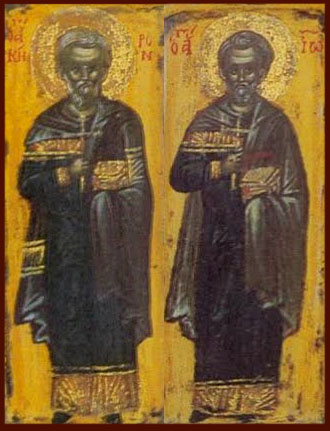
Sts. Cyrus and John the Unmercenaries (source)
  
You trampled upon the basest pleasures, and clearly proceeded towards the divine height of martyrdom through grace, O Cyrus and John, lights for the whole world. Therefore, we entreat you that we be delivered from the darkness of sin and from afflictions, as you pray to the God of all.
-Kathisma from the Matins for the feast of Sts. Cyrus and John the Unmercenaries

(source)
  
St. Cyrus the Unmercenary (source)
  
Through the prayers of our Holy Fathers, Lord Jesus Christ our God, have mercy on us and save us! Amen!
Tuesday, January 31, 2012

Excerpt from the Encomium to Sts. Cyrus and John by St. Sophronios Patriarch of Jerusalem

Sts. Cyrus and John the Holy Unmercenaries and Martyrs (http://pravicon.com/sv-1149, http://pravicon.com/sv-928)
  
Excerpt from the Encomium to Sts. Cyrus and John by St. Sophronios Patriarch of Jerusalem (amateur translation)
Others have praised other saints, triumphing in their gifts for many days, and in many ways preaching their works. They have raised exalted churches, they have adorned them with different forms of marble, while others have formed golden mosaics, and others have painted joyous icons, and others have gilded with gold and silver...and all have done so to honor and praise the martyrs in a thousand ways, as each is able and desires. They wish to offer to them their victories through them, and to show the care that they feel towards them, and they partook of unfading things instead of corruptible, instead of the things of this life, the things that have no end; the people praise these glorious ones whom they love, and offer them gifts out of habit. We, however, find that the word is more precious than natural materials, for it comes from the natural tongue, but proceeds from the spirit, which therefore flows as a stream unspoken; let us praise the saints in this way. He who therefore rejoices in the martyrs, takes refuge in the Word of God, Who made them martyrs. So it is worthy to celebrate their feast, we who have been greatly benefited from their grace, entreating them to open our mouth, that they might receive from us our gift offered to them...
  
Let us therefore praise the perfect among martyrs, and offer words of joy to those who listen. The faithful skip, seeing the ways of Cyrus being praised, and the mass of the pious ones praise John, learning of his encomium. From the Gospels and from the words of the Lord, which were first offered to the apostles, comes the praise of the martyrs Cyrus and John, and we say to them: You are the light of the world, and the salt of the earth, O thrice-blessed ones, and the light to those in darkness and the salt that does not loose its potency, and the light that is not extinguished and the salt that is not thrown out, the sleepless light and the salt that is not trampled upon, the light that is ever seen and the salt that is ever effective, the light of everything sweet and the salt beloved by all things...the light of godly-knowledge and salt fashioned from love of God, light that dissolves the darkness and salt that gives flavoring to food, light that illumines the dark things and salt that makes pleasant unpleasant things, light that reveals things that were lost and salt which seasons things. O holy band, through whom the Divine works wonders! For truly “God is wondrous among His saints”. O band of martyrs, through whom the world rejoices! O band of righteous ones, through whom life is renewed! O band of holy ones, through whom the faith is preserved! O band of praised ones, through whom the faithful are magnified! O band of zealous ones, through whom error is destroyed! O band of powerful ones, through whom we are delivered from the devil! O band of soldiers, through whom the demons are banished to perdition! O band of pious ones, through whom the idols are drowned! Hail, O band truly holy, and presence of God, who confirm the age to come to men. Hail, O precious band, you who were heavenly without leaving the earth. Hail O holy band, you who rejoice with the angels and give help to men. You are truly worthy to hear from the Savior, Who praises and cries out with a great voice: “You are the light of the world and the salt of the earth,” light illuminating from the true light, and salt from that true spring of salt, and light that illumines those who take refuge in you, and spring that continuously flows for those who praise you.
(http://books.google.com/books?id=CMHUAAAAMAAJ&printsec=frontcover&source=gbs_ge_summary_r&cad=0#v=onepage&q&f=false)
  
  
Through the prayers of our Holy Fathers, Lord Jesus Christ our God, have mercy on us and save us! Amen!

Sunday, June 28, 2009

Sts. Cyrus and John the Holy Unmercenaries

Icon depicting the saints celebrated on January 31st (Sts. Cyrus, John, Athanasia, Theodota, Theoktista, Eudoxia, Claudius and Diodorus) (taken from: http://christopherklitou.com/icon_31_jan_claudius_diodorus_cyrus_john_athanasia_theodota_theoctista_eudoxia.htm)
  
SAINTS CYRUS AND JOHN, THE UNMERCENARY SAINTS AND MIRACLE-WORKERS (whose martyrdom, along with Sts. Athanasia, Theoktisti, Theodoti, and Eudokia, is celebrated on January 31st, and who are additionally celebrated at the transfer of their relics on June 28th)
These charitable and glorious saints were not blood brothers but were brothers in the spirit. At first, Cyrus lived in Alexandria, and as a physician he healed people by the power of Christ and by his knowledge of medicine. Learning that sickness mostly befalls man because of sin, Cyrus always directed the sick to purify their souls from sin through repentance and prayer and, thereby restore health to the body. When Diocletion's persecution against Christians began, Cyrus withdrew to Arabia where he received the monastic tonsure. He became as famous in Arabia as he was in Alexandria, so that people there also resorted to him for assistance.

  
Hearing about Cyrus, John, then a Roman officer in Edessa, came to Arabia to see him. Upon meeting, they loved one another as a brother loves a brother and remained together to live a life of asceticism.

  
At that time, a certain Christian woman named [Athanasia], together with her three daughters, was tortured by the persecutors in the town of Canopus. Hearing of this, Cyrus and John came to Canopus to encourage the mother and her daughters not to abandon the Faith. And truly, thanks to the counsel of these saints, [Athanasia] endured all tortures and, with her daughters, was martyred for Christ. The daughters of [Athanasia] were named: St. Theoctista, age 15; St. Theodota, age 13; and St. Eudocia, age 11. The tormentors then captured Cyrus and John, who, after imprisonment and torture were beheaded in the year 311 A.D. Numerous miracles were wrought by these martyrs, both during their lives and after their deaths. Their relics were translated to Rome during the reign of Emperor Arcadius. These saints are invoked for assistance during the Blessing of Water, in the Sacrament of Holy Unction and especially by those suffering from insomnia.


Fresco showing Sts. Athanasia, Theoktisti, Theodoti, and Eudokia, who were martyred along with Sts. Cyrus and John (taken from: http://christopherklitou.com/icon_31_jan_athanasia_theodota_theoctista_eudoxia.htm)
  
June 28 commemorates the translation of their relics from Canopus to Menuthis and the numerous miracles which occurred over their relics. St. Cyril, Patriarch of Alexandria, prayed fervently to God to destroy the idolatrous impurity in the town of Menuthis where a pagan temple was located and where the power of the demons ruled. An angel of God appeared to the patriarch and told him that Menuthis would be cleansed of its impurity if he translated the relics of Saints Cyrus and John to that town. The patriarch did this immediately. He translated the relics of the martyrs to Menuthis and built a church there in honor of Saints Cyrus and John. Ammonius, the son of Julian the mayor of Alexandria, was healed of scorfula; a Theodore healed of blindness; Isidore of Menuthis was cured of a decaying disease of the liver; the wife of Theodore from poisoning, a Eugenia of dropsy as well as many other people were healed of various diseases and torments by the relics of these saints. This all occurred in the year 412 A.D. (texts above taken from the Prologue of Ochrid by St. Nikolai, http://www.westsrbdio.org/prolog/prolog.htm, from January 31st and June 28th)


Fresco from Decani Monastery depicting St. Sampson (June 27th) and the martyrdom of Sts. Cyrus and John (taken from: http://www.srpskoblago.org/Archives/Decani/exhibits/Menologion/June/CX4K3555_l.html)
  
Their tomb became a renowned shrine in Egypt, and a place of universal pilgrimage. It was found in the area of the modern day resort near Alexandria named Abu Kyr. (taken from: http://goarch.org/chapel/saints_view?contentid=409)


Apolytikion in the Plagal of the Fourth Tone
Since Thou hast given us the miracles of Thy holy Martyrs as an invincible battlement, by their entreaties scatter the counsels of the heathen, O Christ our God, and strenghten the faith of Orthodox Christians, since Thou alone art good and the Friend of man.
  
Kontakion in the Plagal of the Second Tone
With a great voice, O ye faithful, let us hymn the great physicians of the world, the pair beloved of Christ, the luminaries who are radiant with the beams of healing; and as we stand in their temple, we cry out: Cyrus and John, the bestowers of miracles and healers of the ailing, shine forth to the ends of the world.
  
Sts. Cyrus and John the Unmercenaries (http://pravicon.com/images/sv/s0928/s0928006.jpg)
Through the prayers of our Holy Fathers, Lord Jesus Christ our God, have mercy on us and save us! Amen!