Showing posts with label Optina Fathers. Show all posts

Thursday, October 10, 2019

St. Ambrose of Optina: "A continuously happy life produces extremely unhappy consequences..."

St. Ambrose of Optina (source)
  
“A continuously happy life produces extremely unhappy consequences. In nature we see that there are not always pleasant springs and fruitful summers, and sometimes autumn is rainy and winter cold and snowy, and there is flooding and wind and storms, and moreover the crops fail and there are famine, troubles, sicknesses and many other misfortunes. All of this is beneficial so that man might learn through prudence, patience and humility. For the most part, in times of plenty he forgets himself, but in times of various sorrows he becomes more attentive to his salvation.”
-St. Ambrose of Optina
 
(source)
  
Through the prayers of our Holy Fathers, Lord Jesus Christ our God, have mercy on us and save us! Amen!

Tuesday, August 20, 2019

St. Anatolios of Optina on the Best Fasting

Prayer before Christ (source)
  
"The best fasting is to endure whatever is sent to you by God."
-St. Anatolios of Optina

(source)
 
Through the prayers of our Holy Fathers, Lord Jesus Christ our God, have mercy on us and save us! Amen!

Friday, December 6, 2013

Martyr-Abbess Margaret of Menzelinsk (+1918)

St. Nicholas the Wonderworker (source)
  
Mother Margaret was the abbess of the Prophet Elijah monastery in Menzelinsk, Kazan diocese. Under her strict and demanding, but at the same time loving guidance, the monastery prospered. It had fruit trees, kitchen-gardens, apiaries, and workshops for the production of icons and gold-weaving. There was even a photographic laboratory - an extreme rarity at that time.
In the late summer of 1918 the White armies left Kazan and the neighbouring towns, and Mother Margaret decided not to remain in the power of the Bolsheviks.

She was at the wharf preparing to leave when St. Nicholas appeared to her and said: "Why are you running from your crown?"

Stunned by the vision, Abbess Margaret returned to the monastery and told the monastery priest about what had happened. And sensing that she would soon have to suffer for the faith, she asked for her coffin to be prepared in advance, and that she should be buried on the very day of her death, after the burial service.

The next day Abbess Margaret was arrested as a "counter-revolutionary". They dragged her out onto the porch of the church during a service, and after refusing her request to commune of the Holy Mysteries, shot her. Immediately after the burial service, the sisters of the monastery buried her behind the altar of the church where she had been shot.

It was only the next day that the abbess's request to be buried on the very day of her death, which had at first seemed strange to the priest, became comprehensible. For the same chekists who had shot Abbess Margaret brought out a Muslim mullah to be shot, wishing to bury him in one grave with the Orthodox superior of the monastery. However, since she was already buried, they could not do this and took the mullah somewhere else.


A great Russian elder - St. Ambrose of Optina, it seems - prophesied about this monastery that under one superior they would build a church, another would be a martyr, and under a third - the bells would fall. The prophecy was fulfilled. Abbess Margaret became a martyr, and under the last superior they removed the bells from the church and closed the monastery.

In the 1970s, near the main church of the Menzelinsk monastery, which was closed at that time, they decided to dig a hole behind the very altar. Suddenly they came on a coffin. In it were the incorrupt relics of Abbess Margaret with a cross on her breast. They did not disturb the coffin, but filled in the grave and found another place for the hole...

(Source: A. Zhuravsky, Zhizneopisaniya Novykh Muchenikov Kazanskikh god 1918, Moscow, 1996, pp. 171-174; source)
   
Icon of the Venerable-Martyr Margaret (+1918) (source)
  
Through the prayers of our Holy Fathers, Lord Jesus Christ our God, have mercy on us and save us! Amen!

Monday, March 7, 2011

Selected Quotes of the Fathers on Great Lent


Selected Quotes of the Fathers on Great Lent

"As we are therefore beginning this sacred season, dedicated to the purification of the soul, let us be careful to fulfill the Apostolic command that we cleanse ourselves from all defilement of the flesh and of the spirit (IICor. 7:11), so that restraining the conflict that exists between the one and the other substance, the soul, which in the Providence of God is meant to be the ruler of the body, may regain the dignity of its rightful authority, so that, giving offense to no man, we may not incur the contumely of evil mongers. With just contempt shall we be tormented by those who have no faith, and from our wickedness evil tongues will draw weapons to wound religion, if the way of life of those who fast be not in accord with what is needed in true self-denial. For the sum total of our fasting does not consist in merely abstaining from food. In vain do we deny our body food if we do not withhold our heart from iniquity, and restrain our lips that they speak no evil." - St. Leo the Great - 'Lent the Season of Purification
"Blessed is the mind that passes the time of its pilgrimage in chaste sobriety, and loiters not in the things through which it has to walk, so that, as a stranger rather than the possessor of its earthly abode, it may not be wanting in human affections, and yet rest on the Divine promises." - St. Leo the Great - 'Homily 49: On Great Lent
"...We must then so moderate our rightful use of food that our other desires may be subject to the same rule. For this is also a time of peace and serenity, in which having put away all stains of evil doing we strive after steadfastness in what is good. Now is the time when generous Christian souls forgive offences, pay no heed to insults, and wipe out the memory of past injuries. Now let the Christian soul exercise itself in the armour of justice, on the right hand and on the left, so that amid honour and dishonour, evil report and good, the praise of men will not make proud the virtue that is well rooted, the conscience that has peace, nor dishonour cast it down. The moderation of those who worship God is not melancholy, but blameless." - St. Leo the Great - "Lent the Season of Purification (The Sunday Sermons of the Great Fathers)
"When He had fasted for forty days and forty nights, and afterwards was hungry, He gave an opportunity to the devil to draw near, so that He might teach us through this encounter how we are to overcome and defeat him. This a wrestler also does. For in order to teach his pupils how to win he himself engages in contests with others, demonstrating on the actual bodies of others that they may learn how to gain the mastery. This is what took place here. For, desiring to draw the devil into contest, He made His hunger known to him. He met him as he approached, and meeting him, with the skill which He alone possessed, He once, twice, and a third time, threw His enemy to the ground." - St. John Chrysostom - The Sunday Sermons of the Great Fathers
"Special services, special foods, continence, not going to dances and events, all this awakes one to piety and reflection on our present purpose, on the past and on eternity. Seeing in ourselves a falling away from the commandments of God, we try to reconcile ourselves to God through repentance and communion of the most pure and life-giving Mysteries of Christ, which burn the thorns of our sins. You, when you have not fulfilled this duty during the year, of course will fulfill it during the Fast. The most merciful Lord loved us so much, that He gave us, through food and drink, His most pure Body and life-giving Blood, as a token of life eternal and the incorrupt future feast. Let us offer Him thanksgiving with pure hearts, lips and acts!" - St. Macarius of Optina (Letters...)
"And though every day a man lives may rightly be a day of repentance, yet is it in these days more becoming, more appropriate, to confess our sins, to fast, and to give alms to the poor; since in these days you may wash clean the sins of the whole year." - St. John Chrysostom - "The Sunday Sermons of the Great Fathers"
(http://scienceofsalvation.blogspot.com/)
"Brethren and Fathers, our good God who gives us life and brings us from year to year, has brought us also with love for mankind to this present time of fasting, in which each of the eager, as their choice directs, enters the contest; one devoting himself to self-mastery, eating only every two or three days, another to vigil, keeping vigil for so long or so long, another spending even longer in prostrations, and others in other ascetic actions. Quite simply during these holy days it is possible to see great zeal and attention. But the true subject behaves with obedience not at any particular time, but keeps up the struggle always. What is the struggle? Not to walk according to one’s own will, but to let oneself be ruled by the disposition of the superior. This is better than the other works of zeal and is a crown of martyrdom; except that for you there is also change of diet, multiplication of prostrations and increase of psalmody are in accord with the established tradition from of old. And so I ask, let us welcome gladly the gift of the fast, not making ourselves miserable, as we are taught, but let us advance with cheerfulness of heart, innocent, not slandering, not angry, not evil, not envying; rather peaceable towards each other, and loving, fair, compliant, full of mercy and good fruits; breathing in seasonable stillness, since hubbub is damaging in a community; speaking suitable words, since too unreasonable stillness is profitless; yet above all unsleepingly keeping watch over our thoughts, not opening the door to the passions, not giving place to the devil. If the spirit of the powerful one, it says, rise up against you, do not let it find your place. So that the enemy has power to suggest, but in no way to enter. We are lords of ourselves; let us not open our door to the devil; rather let us keep guard over our soul as a bride of Christ, not set about with tumult, unwounded by the arrows of the thoughts; for thus we are able to become a dwelling of God in Spirit. Thus we may be made worthy to hear, "Blessed are the pure in heart, for they shall see God." Quite simply, Whatever is true, whatever noble, whatever just, whatever pure, whatever lovely, whatever of good report, if there is anything virtuous, if there is anything praiseworthy, to speak like the Apostle, do it; and the God of peace will be with you all, in Christ Jesus, our Lord, to whom be the glory and the might, with the Father and the Holy Spirit, now and for ever, and to the ages of ages. Amen." - St. Theodore the Studite - Catechesis 53 "On fasting; and that the true fast of the obedient and the subject is the cutting off of one’s will. Given on Cheesefare Sunday."
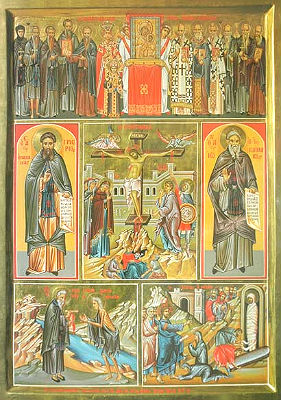
The Feasts of Great Lent: the Sunday of Orthodoxy, Sts. Gregory Palamas and John Klimakos, the Crucifixion of Christ, St. Mary of Egypt, and the raising of St. Lazarus (http://happy-school.ru/Ikona/put_posta.jpg)

Forgive me, and may God forgive us all!
Through the prayers of our Holy Fathers, Lord Jesus Christ our God, have mercy on us and save us! Amen!

Tuesday, March 9, 2010

Selected Quotes of the Fathers on Hope and Patience

Christ carrying His Cross to Golgotha (Source: www.eikonografos.com)

Selected Quotes of the Fathers on Patience
"Trials are of two kinds. Either affliction will test our souls as gold is tried in a furnace, and make trial of us through patience, or the very prosperity of our lives will oftentimes, for many, be itself an occasion of trial and temptation. For it is equally difficult to keep the soul upright and undefeated in the midst of afflictions, as to keep oneself from insolence and pride in prosperity.”
St. Basil the Great – “I Will Pull Down My Barns” (The Sunday Sermons of the Great Fathers)

"Show patience, and there will be peace.”
St. Anatoly of Optina – “A Collection of Letters to Nuns”

"When patience greatly increases in our soul, it is a sign that we have secretly received the grace of consolation. The power of patience is stronger than the joyful thoughts that descend into the heart.”
St. Isaac the Syrian – “Ascetical Homilies” (Homily Forty-Eight)

"...It is patience that both commends us to God, and saves us for God. It is that same patience which tempers anger, bridles the tongue, governs the mind, guards peace, rules discipline, breaks the onslaught of lust, suppresses the violence of pride, extinguishes the fire of dissension, restrains the power of the wealthy, renews the endurance of the poor in bearing their lot, guards the blessed integrity of virgins, the difficult chastity of widows, and the indivisible love of husbands and wives. It makes men humble in prosperity, brave in adversity, meek in the face of injuries and insults. It teaches us to pardon our offenders quickly; if you yourself should offend, it teaches you to ask pardon often and with perseverance. It vanquishes temptations, sustains persecutions, endures sufferings and martyrdoms to the end. It is this patience which strongly fortifies the foundations of our faith. It is this patience which sublimely promotes the growth of hope. It directs our action, so that we can keep to the way of Christ while we make progress because of his forbearance. It ensures our perseverance as sons of God while we imitate the patience of the Father.”
St. Cyprian of Carthage – “The Good of Patience”

“...In proportion to your humility you are given patience in your woes; and in proportion to your patience the burden of your afflictions is made lighter and you will find consolation; in proportion to your consolation, your love of God increases; and in proportion to your love, your joy in the Holy Spirit is magnified. Once men have truly become His sons, our tenderly compassionate Father does not take away their temptations from them when it is His pleasure to 'make for them a way to escape' (1 Cor. 10:13), but instead He gives His sons patience in their trials. All these good things are given into the hand of their patience for the perfecting of their souls.”
St. Isaac the Syrian - "Ascetical Homilies" (Homily Forty-Two)

“Ask with tears, seek with obedience, knock with patience. For thus he who asks receives, and he who seeks finds, and to him that knocketh it shall be opened.”
St. John Climacus – "The Ladder of Divine Ascent" (Step 28)

“Do not be surprised that you fall every day; do not give up, but stand your ground courageously. And assuredly, the angel who guards you will honour your patience.”
St. John Climacus - "The Ladder of Divine Ascent" (Step 5)

"Do not be cast down over the struggle- the Lord loves a brave warrior. The Lord loves the soul that is valiant"
St. Siloan the Athonite

"...And so let us be glad and bear with patience everything the world throws at us, secure in the knowledge that it is then that we are most in the mind of God."
St. Basil the Great - "Gateway to Paradise"

"Hope also requires a life corresponding to the hope."
St. John of Kronstadt - My Life in Christ

"Tribulations worketh patience, and patience probation, and probation hope, " (Rom. 5:3,4). And even as the violence of the wind, when it rushes upon strong trees, and sways them in all directions, does not root them up, but renders them still firmer and stronger by these attacks; so the soul that is holy, and lives in a religious state, is not supplanted by the inroads of trial and tribulation, but stimulated thereby to more patience; even as the blessed Job, whom they made more illustrious and honourable."
St. John Chrysostom - "Concerning the Statutes"

"Prayer breathes hope..."
St. John of Kronstadt - My Life in Christ

"When you pray, bring to mind the ploughman who sows in hope. He Who causes to return twofold the seed that the ploughman sows with hope, Who has esteemed the seeking of His kingdom and His righteousness to be greater than temporal things, He himself will reward your entreaty according to His promise."
St. Isaac the Syrian - "Ascetical Homilies" (Homily Twenty-Five)

  
Through the prayers of our Holy Fathers, Lord Jesus Christ our God, have mercy on us and save us! Amen!

Sunday, November 15, 2009

St. Paisius Velichkovsky the Righteous

St. Paisius Velichkovsky the Righteous - Commemorated on November 15 (icon taken from: http://ocafs.oca.org/FeastSaintsViewer.asp?SID=4&ID=1&FSID=103311)

"Saint Paisius Velichkovsky was born in Poltava in Little Russia on December 21, 1722, and was the eleventh of twelve children. His father John was a priest, who named him Peter at his Baptism, in honor of St Peter the Metropolitan of Moscow, on whose Feast he was born.

After the children's father died, their mother Irene raised them in piety. Peter was sent to study at the Moghila Academy in Kiev in 1735. After four years, Peter decided to leave the world and become a monk. At the age of seventeen, he went in search of a monastery and a good spiritual Father. For seven years Peter visited various monasteries, including the Kiev Caves Lavra, but he did not feel drawn to any of the monasteries of Ukraine.

After being made a rassophore monk (one blessed to wear the rasson, but not yet tonsured "into the mantle") at the St Nicholas Medvedevsky Monastery with the name Platon, he found that there was no experienced Elder there who could teach him obedience or give him spiritual direction. Not wishing to begin his monastic life without such guidance, he left the monastery a week after his tonsure with the blessing of his Elder.

At first, he went to Kiev, where he happened to meet his sister-in-law, the widow of his older brother Archpriest John. She informed him of his mother's sorrow when he left Kiev, and her mind seemed to be affected by her grief. Then one day an angel appeared to her and told her that instead of loving the Creator with her whole heart and soul, she loved His creation (her son) more. Because of this excessive love, the angel went on, she was thinking of starving herself to death, which would result in her eternal condemnation. The angel said that by God's grace, her son would become a monk, and that she should also renounce the world and become a nun. After this, she became calm and accepted God's will. She entered a convent and was tonsured with the name Juliana. After about ten years, she departed to the Lord.

While at Kiev, Platon met two monks from Romania who were about to return to their country. After crossing the border into Moldavia, they came to Vlachia and the Skete of St Nicholas, which is called Treisteny, around 1745. The Elder of the Skete, Hieroschemamonk Michael, was away on business in Ukraine, so Platon and his companions were welcomed by the Superior, Fr Demetrius. Platon was placed under a general obedience and given a cell near the Skete, from which the church was visible.

As he was sleeping one night, the semantron was sounded calling the monks to Sunday Matins, but Platon did not hear it. He woke up and ran to the church, only to find that the Gospel had already been read, and the Canon was being sung. In his grief and shame, he did not enter the church, but returned to his cell and wept bitter tears. After the Liturgy, when it was time for the meal, the Superior and the Elder were surprised that Platon had not been seen at the services. The Elder ordered that the meal be delayed while he sent a Fr Athanasius to find out what had happened to Platon. Fr Athanasius found him and asked why he was weeping. With difficulty, Platon was able to tell him the cause of his sorrow. Fr Athanasius tried to console him and urged him to come to the Skete, where the others were waiting for him. Finally, he was persuaded to go.

Seeing the brethren at table but not eating, Platon fell down before them weeping and asking forgiveness. The Elder and the Superior lifted him up and heard from Fr Athanasius the reason for his sorrow. The Elder told Platon not to grieve so over something that had happened involuntarily, and did his best to console him. From that time, however, the saint would not sleep lying down in bed, but sitting up on a bench.

One day the Elder Onuphrius of Kyrkoul visited the Skete and spoke about his Skete at Kyrkoul. Platon long to see Kyrkoul, and so he returned there with Fr Onuphrius. He remained there for a time, conversing with Fr Onuphrius about overcoming the passions, the struggle with demons, unceasing prayer, and other soul-profiting topics. This seed fell on good ground, later bearing spiritual fruit a hundredfold.

The time came when Platon was filled with a longing to visit Mount Athos. He asked the brethren of the Skete, and those of other Sketes, for their forgiveness and blessing for the journey. He also thanked them for their kindness and their paternal instruction. They blessed him and let him go in peace. At that time he was just twenty-four years old.

Platon went to Mount Athos in 1746, arriving at the Great Lavra on July 4, the eve of the Feast of St Athanasius of Athos. His traveling companion, Hieromonk Tryphon fell ill and died after four days. Platon would have died from the same illness, if not for the care of the Russian monks. He recovered and lived in solitude in a cell called Kaparis near the Pantokrator Monastery. He went around visiting the ascetics and solitaries, looking for a spiritual Father, but was unable to find anyone suitable.

18th-Century portrait of St. Paisios Velichkovsky (taken from: http://days.pravoslavie.ru/Images/ii1708&774.htm)

In 1750 St Basil of Poiana Marului (April 15) visited the Holy Mountain and spent some time with Platon, who asked him for monastic tonsure. Elder Basil granted his request, giving him the name Paisius. Then Fr Basil returned to his Skete at Vlachia. About three months later, a young monk named Bessarion came to the Holy Mountain from Vlachia. He went around to the monasteries searching for an instructor, but did not find one. He also came to Fr Paisius and asked him to tell him something about saving his soul. Fr Paisius sighed and told him that he himself had been looking for an instructor without success. Yet, feeling compassion for Fr Bessarion, he talked to him a little about the qualifications necessary for a true instructor, and about the Jesus Prayer. After hearing him, Fr Bessarion said, "What more do I seek?" He fell down at the feet of Fr Paisius, entreating him to be his Elder. Fr Paisius did not want to be anyone's Elder, wishing instead to be under authority himself. Fr Bessarion remained for three days weeping until Fr Paisius agreed to accept him as a friend, and not as a disciple. For about four years they lived together fulfilling God's commandments, cutting off their own will and obeying one another as equals.

Other disciples began to join them, and their number continued to increase. Since they needed a priest and a confessor, they begged Fr Paisius to accept ordination. He did not want to hear of this, and repeatedly refused to consent. They did not give up, however. They asked him how he could expect to teach the brethren obedience and cutting off their own will, when he disobeyed the tearful entreaties of those who wanted him to accept. Finally, he said, "May the will of God be done."

In 1754 Fr Paisius was ordained to the holy priesthood and was given the Skete of the Prophet Elias, where he began to accept even more disciples. St Paisius remained on Mt Athos for a total of seventeen years, copying Greek patristic books and translating them into Slavonic.

Picture of the Skete of Prophet Elias, Mount Athos (taken from: http://paisius-niamets.orthodoxy.ru/f_mon9b.jpg)

In 1763 Fr Paisius went to Moldavia with sixty-four disciples, and was given the Dragomirna Monastery near the city of Sochava and on the border between Bukovina and Moldavia. Here he remained for twelve years, and the number of monks increased to three hundred and fifty. His friend Hieromonk Alexius came to visit him from Vlachia, and Fr Paisius asked him to tonsure him into the Schema. Fr Alexius did so, but without changing his name. While at Dragomirna, Fr Paisius corrected the Slavonic translations of patristic books by comparing them to the Greek manuscripts he had copied on Mt Athos.

The Russo-Turkish war broke out in 1768, and Moldavia and Vlachia saw many battles. Dragomirna and the forests around it became filled with refugees from the villages near the battlegrounds. Another catastrophe appeared in 1771 with the outbreak of plague. When Dragomirna and Bukovina came under the control of Austrian Catholics, St Paisius and his flock fled to Moldavia. In October of 1775, he went to Secu ("Beheading") Monastery, which was dedicated to St John the Baptist, with many of his monks.

Secul was too small for the number of brethren, who were crowded with three to five monks in a cell. In the spring, more brethren were due to arrive from Dragomirna, so new cells had to be built. After three years of labor one hundred cells were completed, and everyone had a place. Still, the numbers increased and they had to look for a larger monastery.

St. Paisios Velichkovsky, engraving from the Greek edition of the Blessed Paissy Velichkovsky (taken from: http://paisius-niamets.orthodoxy.ru/f_ico6b.jpg)

Prince Constantine Muruz wrote to the Elder saying that there was no larger monastery than Neamts, about two hours from Secul. On August 14, 1779, St Paisius moved to Neamts Monastery where he spent the last fifteen years of his life translating the writings of the Holy Fathers. He organized the community according to the Typikon (Rule) of Mt Athos. He gathered about a thousand monks in the monastery, instructing them in the unceasing prayer of the heart.

Archbishop Ambrose visited St Paisius at Neamts in 1790, staying for two days to converse with the Elder. During the Sunday Liturgy, he raised St Paisius to the rank of Archimandrite. He remained two more days, then departed after blessing everyone.

St Paisius fell asleep in the Lord on November 15, 1794 at the age of seventy-two. It is possible that God revealed the date of his death to him beforehand, for he stopped translating books. He only reviewed and corrected what had already been translated.

He was ill for four days, but felt well enough to attend the Liturgy on Sunday. After the service, he asked everyone to come and receive his blessing. He said farewell to them all, then returned to his cell and would not receive anyone. A few days later, on November 15, he received the Holy Mysteries again and surrendered his soul to God. His funeral was conducted by Bishop Benjamin of Tuma, and was attended by multitudes of priests, monks, laymen, nobles and ordinary people.

The holy relics of St Paisius were uncovered in 1846, 1853, 1861 and 1872, and were found to be incorrupt.

St Paisius has had an enormous influence, not only in Romania, but throughout the Orthodox world. His disciples traveled to Russia, sparking the spiritual revival of the nineteenth century with Slavonic translations of the PHILOKALIA and the tradition of eldership which they had learned from St Paisius. This influence has been felt even in America through St Herman of Alaska (December 13). St Herman was taught by Elders whose spiritual formation was guided by St Paisius. He first met Fr Nazarius, who became his Elder at Valaam, at Sarov, then followed him to Sanaxar when St Theodore (February 19) was their igumen.

One of the books that St Herman brought with him to America was the Slavonic PHILOKALIA, printed in 1794. He absorbed the spiritual wisdom that it contained, and imparted it to others."
(taken from: http://ocafs.oca.org/FeastSaintsViewer.asp?SID=4&ID=1&FSID=103311)

"The glorification of St Paisius was performed [by the] Russian Orthodox Church Outside of Russia on the feast day of Holy Prophet Elias on July 20, 1982 at the Russian Skete of St Elias on Mt Athos, which was founded by St Paisius." (taken from: http://www.russianorthodoxchurch.ws/01newstucture/pagesen/articles/lavronpaisius.html, another account of St. Paisios)

Icon of St. Paisios Velichkovsky (taken from: http://paisius-niamets.orthodoxy.ru/f_ico11b.jpg)

"[For] Orthodox Christians of the 20th century there is no more important Holy Father of recent times than Blessed Paisius Velichkovsky. This is so not merely because of his holy life; not merely because, like another Saint Gregory Palamas, he defended the hesychast practice of the mental Prayer of Jesus; not only because he, through his many disciples, inspired the great monastic revival of the 19th century which flowered most notably in the holy Elders of Optina Monastery; but most of all because he redirected the attention of Orthodox Christians to the sources of Holy Orthodoxy, which are the only foundation of true Orthodox life and thought whether of the past or of the present, whether of monks or of laymen."
Excerpt from the "Introduction to Blessed Paisius Velichkovsky: The Man Behind the Philokalia", by Fr. Seraphim Rose of Platina (http://www.orthodoxinfo.com/phronema/intro_bpv.aspx)

The following is a (Russian) site with more information, icons, pictures, writings, and services of St. Paisios: http://paisius-niamets.orthodoxy.ru/.

St. Paisios intercede for us and help us!

Icon of St. Paisios Velichkovsky (taken from: http://days.pravoslavie.ru/Images/ii1708&533.htm)

Troparion - Tone 2
Having become a stranger on earth, you reached the heavenly homeland, venerable Father Paisius. You taught the faithful to lift up their minds to God, crying out to Him with all their hearts: "Lord Jesus Christ, Son of God, have mercy on me a sinner!"


Kontakion - Tone 8
Like a much-laboring bee, you were an elect zealot of the monastic life, supplying our souls with the writings of the Fathers through which you guide us on the path of salvation. Therefore we cry out to you: "Rejoice, truly-wise Paisius, for through you the tradition of spiritual elders has been restored to us!"

Through the prayers of our Holy Fathers, Lord Jesus Christ our God, have mercy on us and save us! Amen!