Showing posts with label St. Nikephoros the Leper. Show all posts

Wednesday, April 13, 2022

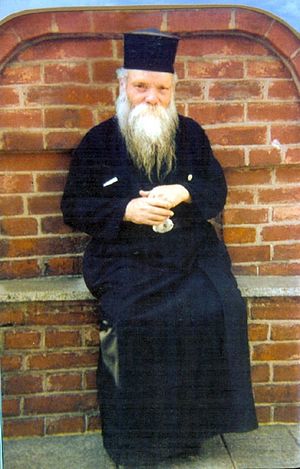
Elder Eumenios Saridakis canonized


Icon of Sts. Anthimos of Chios, Nikephoros the Leper, and the Newly-canonized Eumenios (Saridakis) (https://www.pinterest.com/pin/846958273649953332/)

On April 14th, 2022, the Synod of the Ecumenical Patriarchate canonized Elder Eumenios (Saridakis) (https://www.romfea.gr/epikairotita-xronika/49430-apokleistiko-agiokatataksi-gerontos-evmeniou-saridaki)

Holy Elder Eumenios Saridakis:
the holy friend of lepers

Reposed on May 23, Sunday before Pentecost, 1999

St. Porphyrios of Kavsokalyvia used to say about Elder Evmenios: “You should go and receive the blessing of Elder Eumenios, for he is the hidden Saint of our time. A saint like Elder Eumenios comes along only once every two hundred years ”.

Fr. Eumenios was born in 1931 in Ethia of Monophatsion in the province of Heraklion of Crete, the eighth child of a poor family of faithful Christians. He became a monk at the age of 17; he struggled to cultivate his soul with love and prayer and was tested very harshly by leprosy; but later also, while a priest, by a demonic influence which tormented him in body and soul, but was freed of it after many prayers, vigils and exorcisms in monasteries of Crete, such as the monasteries of Koudoumás and Panagía Kalyvianí. 
Leprosy brought him to the Hospital for Infectious Diseases in the St.Barbara suburb of Athens. He was healed there, but, having seen human suffering, he decided to remain at the Hospital as a priest, in order to help comfort his fellow-men as much as he could! That was where “he was to begin his pastoral work, in the presence of which, those with theological degrees and ecclesiastic offices ought to kneel”.

His love and his ascetic labours brought God’s grace upon him; this humble priest (who officiated in the chapel of the Holy Unmercenaries and Physicians, Saints Cosmas and Damianos, situated inside the Hospital for Infectious Diseases) reached a high degree of sanctity – which he kept secret as much as he could – and became endowed with the gift of foresight, lofty spiritual experiences and visions and helped countless people of every social class and level of education – not only with his advice and his prayers, but also with his sanctified presence.

The Elder loved everyone, every individual personally, and he was particularly a laughing saint – his booming laugh was one of his distinctive features – likewise, he would often exit the Inner Sanctum during the course of a Liturgy, with his beard soaked by his tears, since he used to pray for all of our suffering and unfortunate fellow-men, obviously because he also had the gift of tears.

At the Hospital for Infectious Diseases, he was blessed to meet the leprosied holy monk Nicephorus [St. Nikephoros the Leper] who, even though blinded by the illness, had nevertheless become a great spiritual father of many Christians and a teacher to Elder Evmenios.

He spent the last two years of his life at the “Annunciation” Hospital and on May 23, 1999 he gave up his spirit in the Lord and was buried at his birth place (in Ethia), in accordance with his wishes. (cf. Monk Simon, Fr. Evmenios – The hidden saint of our time, Athens 2010, ed. 2, pp. 137-146). (http://o-nekros.blogspot.gr/2011/02/elder-evmenios-saridakis-holy-friend-of.html)

Apolytikion of St Eumenios Saridakis in the Plagal of the First Tone

A divine comforter for those storm-tossed, the defender of those in dangers and the sure guide of the faithful towards piety, let us praise Eumenios with our hymns, for he suffered with zeal equaling Job, and drives away the evil spirits, and he is our good-minded intercession with the compassionate Lord.

(https://www.romfea.gr/images/article-images/2022/04/Osios-Eumenios-Akolouthia.pdf)


Through the prayers of our Holy Fathers, Lord Jesus Christ our God, have mercy on us and save us! Amen!

Thursday, April 2, 2020

Megalynarion to St. Nikephoros the Leper

St. Nikephoros the Leper (source)
  
Σῷζε ἐξωλείας δαιμονικῆς, * καὶ ἐπιδημίας,θλιβερᾶς κορωναϊοῦ, * πᾶσαν τὴν Ἑλλάδα, λαοὺς τῆς οἰκουμένης, * θεόφρον Νικηφόρε,προστάτα μέγιστε.
  
 Save from all demonic destruction now, * and Coronavirus, that most fearsome terrible plague, * save all of the Greek land, and the peoples of the whole world, * O Nikephoros, great protector, and one of godly mind.
  
St. Nikephoros the Leper with scenes from his life (source)
   
Through the prayers of our Holy Fathers, Lord Jesus Christ our God, have mercy on us and save us! Amen!

Friday, February 15, 2013

St. Anthimos of Chios (+1960)


St. Anthimos of Chios (+1960) - Commemorated on February 15th (source)
   
Brief life of St. Anthimos
St. Anthimos, who in the world was known as Argyrios K. Vagianos, was born on July 1, 1869 to devout peasants, Konstantinos and Argyra, in Chios in the region of St. Luke Leivadion. He left elementary school early to become a shoe mender. At the age of nineteen he visited the Skete of the Holy Fathers founded by the monk Pachomios, who had been the spiritual counselor of St Nektarios. With the blessing of the elder, Anthimos returned home and built himself a small hut and dwelt in it. His only help in his spiritual contests was an icon of the Mother of God given to him by his mother later known as Panagia Voithia (the Helper), which soon began to work miracles, drawing many to his hermitage.
St. Anthimos of Chios (source)
 
He had returned home to relieve the suffering of his parents and help the poor of his village as well. After a time he retired to the Skete, and it was here that he became a monk and took the name Anthimos given by Elder Pachomios. He fell ill there and his abbot sent him home to his parents for the sake of his health. At home, despite the fact that he was caring for his aged parents and practicing his shoe mender's trade, he continued to live as a monk, spending nights on end in prayer and sometimes living only on bread and water for extended periods. He took his inspirtion reading about the lives of the great ascetics, and in this way he was able to conquer every assault of the devil.
 

Photograph of St. Anthimos of Chios (source)
   
Increasing numbers of visitors came to his hermitage and wonder-working icon of the Theotokos, and in 1909, at the age of forty, he received the Great Schema by the successor of Pachomios, Hieromonk Andronikos. The people of Chios wanted him to be ordained to the priesthood, but his bishop refused due to the Saint's lack of education. At the prompting of Anthimos' godfather, the Bishop of Smyrna ordained him instead in 1910. After a pilgrimage to Mt Athos in 1911, he returned to Chios, where he became chaplain to a leper hospital. Soon the hospital, which had fallen into corruption, became a spiritual center, as much like a monastery as a hospital. Saint Anthimos tended many of the sickest with his own hands, working many miracles of healing; some of his recovered patients became monks or nuns (such as Righteous Nikephoros the Blind).
 
Photograph of St. Anthimos of Chios (source)
   
With the notorious 'Exchange of Populations' of 1922-1924, refugees poured into Chios, many of them destitute nuns and girls. In response to a vision of the Mother of God, St Anthimos built a monastery in 1930, which opened with thirty nuns and grew rapidly, despite the opposition of many who said that setting up such a community was out of date. The Monastery of Panagia Voithia, as it came to be known, soon housed eighty nuns and was known througout Greece as a model of monastic life. Father Anthimos served as priest to the nuns, and continued to receive the many faithful — often sixty or seventy per day — who came to him for prayer or counsel. He carried on this ministry for more than thirty years, working many miracles of healing. When he was too old to work with his hands, he retired to his cell and prayed that he be enabled to serve his neighbor until his last breath.
   
The wondrous icon of Panagia Voithia "Help" (source)
   
On January 27, 1960 St. Anthimos celebrated his final Divine Liturgy. He reposed in peace at the age of ninety-one on February 15th, mourned and revered by the whole island of Chios. The remains of St. Anthimos are in the church inside of the monastery he founded and still work miracles along with the holy icon of Panagia Voithia. He was canonized by the Ecumenical Patriarchate on August 13, 1992.
   
The church of the Monastery of Panagia Voithia, with the Holy Relics of her founder, St. Anthimos of Chios (source)
   
The following account is taken from an interview with Protopresbyter Andrea Dafnou who knew St. Anthimos:
"I have been found worthy to receive the blessing of two sacred personalities, while still alive, that were canonized. One of these is St. Anthimos of Chios. When I was a child, I injured my eye. I was afraid that, if my father found out, that he would beat me. I remember it had become bruised as well. What would I do? I thought that I should go to the holy man up at Panagia Voithia Monastery. I told him my problem. He read a prayer over me, crossed me, and healed me! Receiving his blessing, I left.


St. Anthimos of Chios (source)
  
"The other holy personality that I had the blessing to meet was another Saint of Chios, Saint Symeon, the abbot of Psaron. From the age of 8 I would go to the Monastery and learn letters studying the Psalms of David! I remember he was a strogly built man and upkept the monastery buildings with much love. At night they would hear him go to a gorge next to the Monastery and break stones, in order to, as he would say, tame himself through work and for the devil to not battle against him. In the morning he would be prompt for Services. I was blessed, from the age of five, to be near him" (ΑΠΟΣΤΟΛΗ, num. 55, Winter 2003-04).

A Miracle of St. Anthimos is related here.
   
Panagia Voithia and St. Anthimos of Chios (source)
   
Sayings
- “Humble-mindedness will bring all the virtues.”
- “What do people do when their hands and faces are dirty? They turn on a tap and allow the water to clean away the stains. We should imitate them. Only, we should open two taps – our eyes, so that an abundance of tears of repentance pour out, which will wash out all the poisons of this futile world which have infected and dirtied our wretched souls”.
The Spiritual Lineage of Sts. Pachomios of Chios, Nektarios of Pentapolis, and Anthimos of Chios (source)
   
- "The Panagia is the only mother of all Christians. And who does not call upon her. Because the sufferings of mankind are many in this vain world, nowhere else can we all find relief, except in the Panagia. When you are sitting there quietly, a thought suddenly comes to you and brings darkness. Where will you go to be loosed from this darkness? To the Panagia. All the Saints are our helpers, but above all is the Panagia.
"She has the riches of great compassion. She has great love for mankind, especially for sinners. For this reason she never ceases to mediate to her Son, and the Son takes great joy when His mother intercededs on behalf of mankind. For this reason she brought us His mother and granted her to us that we may have her as a source of salvation."
   
St. Anthimos of Chios (source)
   
Apolytikion of St. Anthimos of Chios in the Third Tone (amateur translation)
O new boast of Orthodoxy, and newly-adorned flower of purity, you shared the name of Anthimos of Nikomedia, and shared his virtues and way of life, O new seal and adornment of the venerable, O Father Anthimos, the boast of all Chios, entreat Christ God to grant us the great mercy.
St. Anthimos of Chios and his disciple, St. Nikephoros the Leper, holding the wondrous icon of Panagia Voithia (source)
  
Through the prayers of our Holy Fathers, Lord Jesus Christ our God, have mercy on us and save us! Amen!

Thursday, January 3, 2013

Selected miracles of St. Nikephoros the Leper


St. Nikephoros the Leper - Commemorated January 4 (source)
   
Selected miracles of St. Nikephoros the Leper (amateur translation)
Fr. Eumenios said that, one night, having helped Fr. Nikephoros get ready to sleep, he then went to his cell to rest. He did not fall asleep immediately, however. He had an unsettled feeling, like he had perhaps not closed the stove properly. Many thoughts ran through his mind. He got up, therefore, and went to the cell of the Elder. In order to not bother him, in case he had fallen asleep, he thought not to knock on the door, nor the customary monastic practice to say “Through the prayers of our Holy Fathers, Lord Jesus Christ our God, have mercy on us”, and wait for the reply: “Amen”. Slowly, he opened the door, and what did he see? He saw Fr. Nikephoros floating a meter above the ground, with his hands lifted up in prayer. His face shone like the sun. As soon as Fr. Eumenios saw this awesome sight, without speaking he slowly closed the door and ran back to his cell. His face fell to the floor, and he began to cry with groans, thinking that he might have saddened the Elder by his not having knocked, and by his seeing this wondrous sight. But he also cried with joy, for he saw with his own eyes how great and virtuous was his spiritual father, Fr. Nikephoros. In the morning, when he went as usual to help him, he made a prostration, and asked forgiveness for his offense. He, with a light smile, forgave him immediately, and told him not to tell anyone what he saw while he was alive.
   
Fr. Eumenios further related that, one night, many years the dormition of Fr. Nikephoros, because there were many mosquitos and other insects in his cell, he thought it good to close up the doors and windows, and to empty a whole bottle of strong pesticide inside. After this, he fell asleep. He would not have awakened, however, if Fr. Nikephoros had not appeared to him to wake him, to take his hand and bring him out of the cell. And, before Fr. Eugenios came to his senses regarding what happened, he told him: “My child, don't go back into your cell until you first open the doors and windows, to air it out well.” And immediately, he disappeared. After a while, Fr. Eugenios realized that a miracle had occurred, and he thanked Fr. Nikephoros, his beloved Elder, with all his heart, for he saved him from a certain death.
   
Fr. Amphilochios, a hieromonk from the Holy Monastery of St. Paraskevi, Megara, confirmed that, one day, he was sitting in his cell, when he sensed a fragrance. He looked right and left, but did not find where this fragrance was coming from, which grew stronger wherever he went. Then in an instant, his eye fell upon a large mailing envelope. He opened it, and within found a portion of a Holy Relic which was unspeakably fragrant, and on one portion he read: “Fr. Nikephoros Tzanakakes, January 4th 1964”. This Holy Relic was in the possession of another hieromonk, who sent it to the Monastery for temporary care, as he would be out of town. When Fr. Amphilochios removed it from the envelope and placed it with reverence in a place where he had other Holy Relics, then the fragrance lessened slightly.
   
Monk Kallinikos from the Holy Mountain said: “When I was given a small portion from the Holy Relics of Fr. Nikephoros, it was fragrant. After a time, however, it stopped. One day, when I opened it to venerate, I said to the Elder: “My Saint, I am unworthy, but I entreat you, do me a favor and do not disdain me, the sinner.” And—O the wonder!--it once again was fragrant. After several days, I went again to venerate, and as soon as I opened the small container in which was the Holy Relic, an unspeakable fragrance again poured forth throughout my cell. Immediately I wrote the following megalynarion to the Saint: “You are a spiritual icon of virtue, and you resembled, O Father, the patience of Job, and you endured trials, pleasing God, therefore after death you were made fragrant.”
   
Hieromonk Matthias related that, after the dormition of Fr. Eumenios, Fr. Epiphanios, the hieromonk who became the Priest at the Church of the Leper Station, found in a container some of the Holy Relics of Fr. Nikephoros. Therefore, Fr. Matthias told him: “I want you to give me a portion from the Holy Relics.” Fr. Epiphanios said: “I will bring it to you myself, as soon as I travel to Thessaloniki.” And in reality, a short time later, he went. He opened and placed the portion in a small container on the table. He lit a candle. After a short time, another priest came to visit Fr. Matthias. When he saw the Holy Relic, he venerated it, and said: “To whom does this Holy Relic belong, that is fragrant?” Fr. Matthias said: “I didn't believe it, but we got up and went to venerate. In reality, it was fragrant, and however much time passed, it was all the more fragrant. This lasted for several days. I have venerated many Holy Relics of many Saints, but this is the first time that this has happened to me..."
   
Through the prayers of our Holy Fathers, Lord Jesus Christ our God, have mercy on us and save us! Amen!

Sunday, December 2, 2012

Selected hymns to St. Nikephoros the Leper

St. Nikephoros the Leper - Commemorated January 4 (source)
 
On December 3rd, 2012, the Holy Synod of the Ecumenical Patriarchate of Constantinople announced their decision to officially number among the Saints, St. Nikephoros the Leper. He was a faithful disciple of St. Anthimos of Chios, a perfect example of Christ-like humility, patience and endurance in afflictions, and a great consoler of many. The following are amateur translations of selected hymns from the service of the Saint in Greek here. May St. Nikephoros intercede for us all!
 

Doxastikon of the Stichera in the Plagal of the Second Tone
The lover of piety, the fighter of the good fight, the cornerstone of patience, come let us honor the venerable Nikephoros together. For he passed through the fire and water of the scourge of leprosy, and passed on to joyous abundance. And in the furnace of trials you were shone to be bronze, shining more than gold, bestowing upon all souls the saving joy.
   
Doxastikon of the Aposticha in the Plagal of the First Tone
The heavenly ladder raised up through divine virtues, Nikephoros the heavenly-minded, who was reared well through the godly-wise instruction of the great teacher Anthimos. In struggles of righteousness, you were sanctified on the island of Chios in these latter years, and were shown forth unspeakably shining with sacred wonders for the whole church. With him [St. Anthimos], entreat Christ to make us also worthy of divine illumination in His Kingdom, as an incomparably compassionate Father.
   
Apolytikion in the First Tone
Nikephoros the Venerable, through his struggles with leprosy, and his manliness in asceticism, astonished the Angels, for suffering as another Job, he endured, glorifying God, and now he is crowned with glory by Him, with wonders of discernment. Hail, O guide of monastics, hail, O covering of light, hail to you, from whose Relics pour forth joyous fragrance.
   
Kontakion in the Plagal of the Fourth Tone
As the bravest athlete of steadfastness, and the greatest diamond of patience, who was tried by the turmoil of affliction, and thus were glorified by God, let us honor Nikephoros the Leper, and crying out to him: hail, O namesake of victory.
   
Oikos
You were shown steadfast in asceticism, O Nikephoros, and endured the pain of leprosy. And therefore in every manner you offered thanksgiving to Him, bringing forth praises from a clean heart, O God-bearer. Therefore we, inspired by your piety, in fervor cry out to you these words:
Hail, O strength of continence,
Hail, O Atlas of endurance.
Hail, you who endured the pain of the flesh with manliness,
Hail, you who came to know the beauty of the spirit in wisdom.
Hail, the type of the righteous, and diagram of monastics,
Hail, the guide of the faithful in divine virtues.
Hail, the pillar of light enlightening creation,
Hail, the lamp of the Church that gladdens souls.
Hail, the boast and beloved son of Crete,
Hail, the glory of Chios, and disciple of Anthimos.
Hail, you who through leprosy were purified more than gold,
Hail, you who kept faith towards Christ, your Bridegroom.
Hail, O namesake of victory.
   
Synaxarion
On the fourth of this month (January), we commemorate our Righteous and God-bearing Father Nikephoros the Leper, who struggled with endurance on Chios in these latter years, and was made honorable in asceticism.
   
Verses
You wore the schema of Monks, O Nikephoros,
Becoming a type of ceaseless prayer.
On the fourth of January, the leprous flesh of Nikephoros was buried,
While his all-radiant soul passed to the heavens.
   
Doxastikon of the Praises in the Plagal of the First Tone
The most-sacred treasury of the All-Holy Spirit, more pure in virtues than snow, with Christ's meekness and humility of heart, the beloved friend, let us magnify Nikephoros. For in his soul he magnified the Lord, and chanted His sweet words by heart ceaselessly, becoming a mouth of consolation to all. Therefore, he was rightly honored by Christ, with the unspeakable fragrance of his Relics, ever gladdening those who venerate them, and who glorify his all-festal memory.
   
Megalynarion
Come, O divine, Christ-loving multitude, let us adorn the friend of Christ, Nikephoros the Leper, with hymns of praise, as the perfect struggler of divine steadfastness.
   
St. Nikephoros the Leper (source)
   
Through the prayers of our Holy Fathers, Lord Jesus Christ our God, have mercy on us and save us! Amen!

Sunday, January 3, 2010

St. Nikephoros the Leper (+1964)

St. Nikephoros the Leper (+ January 4th, 1964) (picture taken from: http://www.egolpio.com/AGIOLOGIO/nikiforos_lepros.htm)
 
Fr. Nikephoros (in the world, Nicholas) was born in a village of Chania (Crete), in Serikari. His parents were simple and pious villagers, who while he was still a small child, died and left him an orphan. Thus, at the age of thirteen he left his home, traveled to Chania and began to work in a barbershop. There he started to show the first signs of Hansen's disease (i.e. leprosy). At that time, lepers were exiled to the island of Spinaloga, because leprosy was a transmissible disease and was treated with fear and horror. Nicholas, when he was sixteen years old and when the signs of his disease began to be more visible, to flee from enclosure on Spinaloga fled with a boat for Egypt. There he remained working in Alexandria, again in a barbershop, however the signs of his disease became even more evident, especially on his hands and face. Due to the suggestions of a cleric he fled to Chios where there was a home for lepers, in which was a priest, Fr. Anthimos Vagianos, later St. Anthimos of Chios.
 
Icon of St. Anthimos of Chios (+1960) - Commemorated on February 15th (icon taken from: http://christopherklitou.com/icon_15_feb_anthimus_of_chios.htm)
   
Nicholas reached Chios in 1914 at the age of 24. At the leper home in Chios, where there was a grouping of many beautiful little homes, was a chapel of St. Lazaros, where was preserved the wonder-working icon of Panagia of Ypakoe (Obedience). In that place was opened the stadium of virtues for Nicholas. Within two years St. Anthimos discerned that he was ready for the angelic schema and tonsured him a monk with the name Nikephoros. The disease progressed and evolved in the absence of suitable medicines, and brought many great changes (the medicine was found later, in 1947).

Fr. Nikephoros lived with indiscriminate, genuine obedience, with austere fasting, working in gardens. He also compiled in a catalogue the miracles of St. Anthimos, which he had seen with his own eyes (many took the place of healing of the demon-possessed).
 
Picture of St. Anthimos (right) and Fr. Nikephoros (left) in Chios (taken from: http://www.egolpio.com/AGIOLOGIO/nikiforos_lepros.htm)
 
There was a unique spiritual relationship between St. Anthimos and monk Nikephoros, who “did not separate himself from him by even a step”, as mentioned by Fr. Theoklitos of Dionysiou in his book “St. Anthimos of Chios”. Fr. Nikephoros prayed for endless hours at night, performing countless prostrations, not offering a word to anyone nor spoiling his heart on anyone, and was the head chanter of the church. Because of his illness, however, slowly he lost his eyesight and most of the hymns were chanted by others.
 
In 1957 the Lovokomeio of Chios was closed and the remaining patients, along with Fr. Nikephoros, were sent to the Anti-Leper Station of St. Barbara in Athens, in Aigaleo. At that time Fr. Nikephoros was about 67 years old. His body parts and his eyes had been totally affected and transformed from the illness.
   
Picture of Fr. Nikephoros at a young age, in Chios (taken from: http://ierapostoli.wordpress.com/2009/02/27/tyflos_nikoforos/)

 There, in the Anti-Leper station lived Fr. Eumenios, who also had Hansen's disease, but because of medical advances was totally cured. He decided however to remain for the rest of his life in the Anti-leper station near his fellow patients, who he treated with much love. Thus he became a spiritual child of Fr. Nikephoros, to whom as a reward for his patience, the Lord had granted many gifts. Many people flocked to the humble cell of the leper monk Nikephoros, at St. Barbara of Aigaleo, to receive his blessing. Those who met him mention that:

Though he was confined to bed, with wounds and pains, he did not murmur but showed great patience.

He had the grace of comforting the troubled.

His eyes were constantly irritated, his vision was minimal, and he had hooked hands and paralyzed lower extremities.

Besides all of these he was most sweet, mild, greatly smiling, relating grace-filled stories, he was enjoyable, lovable.


[He said: “My children, do you pray? And how do you pray? ...with the prayer of Jesus you should pray, with the “LORD JESUS CHRIST, HAVE MERCY ON ME”. Thus you should pray. This way is good.”]

His face, which was eaten by the signs of his sickness and wounds, shone and imparted joy to all who saw this totally poor and phenomenally sick man who said: “Let His holy Name be glorified.”

At the age of 74, on January 4th 1964, Fr. Nikephoros reposed in the Lord. His holy relics were fragrant when they were later uncovered. Fr. Eumenios, and other pious people offered many occasions when miracles occurred at the intercessions of Fr. Nikephoros.
(from the book: Nikephoros the Leper: The Radiant Athlete of Patience, by Monk Simon, Athens 2007; amateur translation of the Greek text from: http://ierapostoli.wordpress.com/2009/02/27/tyflos_nikoforos/)

Book Cover of: Nikephoros the Leper: The Radiant Athlete of Patience (taken from: http://www.stamoulis.gr/ViewShopProduct.aspx?ProductId=377173)

On December 3rd, 2012, the Holy Synod of the Ecumenical Patriarchate of Constantinople announced their decision to officially number among the Saints, St. Nikephoros the Leper. He was a faithful disciple of St. Anthimos of Chios, a perfect example of Christ-like humility, patience and endurance in afflictions, and a great consoler of many. The following are amateur translations of selected hymns from the service of the Saint in Greek here. May St. Nikephoros intercede for us all!
   
St. Anthimos of Chios with his disciple, St. Nikephoros the Leper (source)
  
Through the prayers of our Holy Fathers, Lord Jesus Christ our God, have mercy on us and save us! Amen!